Soul Shoppe's work is made possible by donors and partners who care deeply about the young people in their communities! We can't do this work without you. Support our work in classrooms and on playgrounds across the nation by donating here.
A lot of adults are looking at the same scene right now. A teen has homework open, a phone buzzing, three school deadlines in the same week, and a level of stress that shows up as irritability, shutdown, or “I’ll do it later.” From the outside, it can look like laziness or poor follow-through. From the inside, it often feels like overload.
That’s why time management for teenager issues need to be treated as more than an organization problem. For parents, teachers, and counselors, this is often a self-regulation problem first. When a young person learns how to notice pressure, make choices, and use a plan without getting trapped in perfectionism, they gain something bigger than productivity. They gain a sense of agency.
Why Time Management Is an Essential Skill for Teenagers
A teenager can be busy all day and still feel like nothing important got done. That’s common when attention is constantly being pulled in different directions. School asks for sustained focus. Friends expect quick replies. Devices make every moment interruptible.
The pressure is real. U.S. teenagers are experiencing a dramatic surge in screen time, with the average teen spending 4.8 hours per day on social media platforms, and 35% describe their social media use as “almost constant” according to the CDC data brief on teen screen time and social media use. That time competes with homework, sleep, and face-to-face connection.
Time management is really self-management
For teens, calendars and checklists matter. But the deeper skill is learning how to manage energy, emotions, distractions, and competing priorities. That’s why this belongs in the same conversation as self-awareness and regulation. Adults who want a fuller framework can connect this work to self-management skills for children and students.
When teens feel behind, they often tell themselves one of two stories:
“I’m bad at this.” They see missed work as proof they’re irresponsible.
“I work better under pressure.” They normalize last-minute stress because it feels familiar.
Neither story helps. A better message is that time management is a learnable life skill.
What adults often miss
Time management isn’t about turning teens into tiny adults who optimize every hour. It’s about helping them feel less scattered and more steady.
Practical rule: If a strategy improves completion but increases panic, it isn’t sustainable.
In schools and homes, the strongest time habits usually grow when adults teach three things together:
What teens need
What it looks like in practice
Awareness
noticing where time and attention are going
Planning
deciding what matters most before the day gets hectic
Emotional regulation
staying engaged when a task feels boring, hard, or scary
A teen who can pause before reaching for the phone, start homework without spiraling, and recover after a rough day is building a foundation that supports both wellness and learning. That’s why this skill matters so much.
Connect Before You Correct Understanding Teen Motivation
When adults see procrastination, the instinct is often correction. “Use your planner.” “Start earlier.” “Put your phone away.” Sometimes that helps. Often it doesn’t, because the visible behavior isn’t the whole problem.
A more useful starting point is this: teens often struggle with time management because of “low motivation, lack of time, perfectionist tendencies, or lack of rest,” and effective support reframes time management as a beneficial skill to manage pressure as described in this mental health resource on teen time management.
What procrastination may actually mean
A student says they forgot to start a project. That can mean several different things.
Fear of failure: “If I try and it’s not good, everyone will know.”
Perfectionism: “If I can’t do it really well, I don’t want to begin.”
Mental fatigue: “I’m too drained to organize my thoughts.”
Low confidence: “I don’t know how to start, so I avoid it.”
Schedule overload: “There wasn’t a realistic place to put this.”
If adults skip that layer and jump straight to control, teens often hear criticism instead of support.
Conversation starters that lower defensiveness
The goal isn’t to interrogate. It’s to help a teen name what’s happening. That naming alone reduces shame.
Try language like this:
“What feels hardest about starting this?” This gets past “I don’t know” faster than “Why didn’t you do it?”
“Does this feel confusing, boring, stressful, or like too much?” Some teens need choices before they can identify emotions.
“Do you want help making a plan, or do you want me to just sit with you while you begin?” This preserves dignity and gives them agency.
“Are you avoiding the task, or are you avoiding the feeling the task brings up?” Older teens often respond well to this because it respects their inner experience.
You don’t want to introduce time management as one more mountain a teen has to climb. It works better when they experience it as relief.
What connection looks like at home and at school
Parents can use a short evening check-in instead of repeated reminders. A teacher can pull a student aside and ask what part of an assignment feels sticky. A counselor can help a teen notice patterns, such as freezing whenever a task involves public evaluation or long writing.
A simple response pattern works well:
Validate the feeling “That sounds overwhelming.”
Reduce the size of the task “Let’s figure out the first tiny move.”
Return control “Which step do you want to do first?”
Trust holds significant importance. Teens are more likely to use planners, timers, and routines when they don’t feel those tools are being used against them. They need support that says, “You’re capable, and we can build this together.”
Building Sustainable Routines Not Rigid Schedules
Rigid schedules often fail because teen life isn’t tidy. Buses run late. Practice gets extended. Energy changes across the week. A plan that only works on a perfect day usually collapses by Tuesday.
A better approach is a routine with anchors. The anchors are the essential elements that protect health and learning. According to this adolescent time-use and wellness summary, the CDC recommends 8 to 10 hours of sleep for teens, while homework and screen-heavy leisure compete for that time. When sleep is protected, teens tend to function with better focus, memory, and motivation.
Start with the big rocks
Ask a teen to build the week in this order:
Sleep first Bedtime and wake time don’t need to be identical every day, but they should be stable enough that the body can predict rest.
School obligations next Class time, commute, practices, tutoring, and fixed family responsibilities go in before anything optional.
Homework blocks after that Not “do homework all evening.” Use a clear start time and a realistic stopping point.
Downtime on purpose Teens need unstructured space. If rest only happens by accident, it gets crowded out.
Many teens say they “have too much to do,” but what they really have is too much to hold in working memory. A brain dump helps.
Have the teen write everything down on paper or in a notes app:
math worksheet
text coach back
finish slides
shower
study vocab
birthday gift for friend
email teacher
laundry
chemistry quiz Friday
Don’t sort it at first. Just empty the mind. Then group items into school, personal, family, and follow-up.
A routine should feel supportive, not suffocating. If a plan leaves no room for being human, it won’t last.
A weekly rhythm teens can actually use
Here’s a simple pattern that works better than minute-by-minute control:
Time of week
Focus
Sunday evening
look at the week, list deadlines, choose priority tasks
After school
short reset, snack, short break before homework
Early evening
focused schoolwork block
Later evening
lighter tasks, prep for tomorrow, wind-down
Friday or Saturday
catch-up block if needed, then true downtime
Teachers can reinforce this by posting major due dates clearly and encouraging backward planning. Parents can reinforce it by asking, “What does your week look like?” instead of “Do you have homework?” The first question invites strategy. The second often gets a defensive answer.
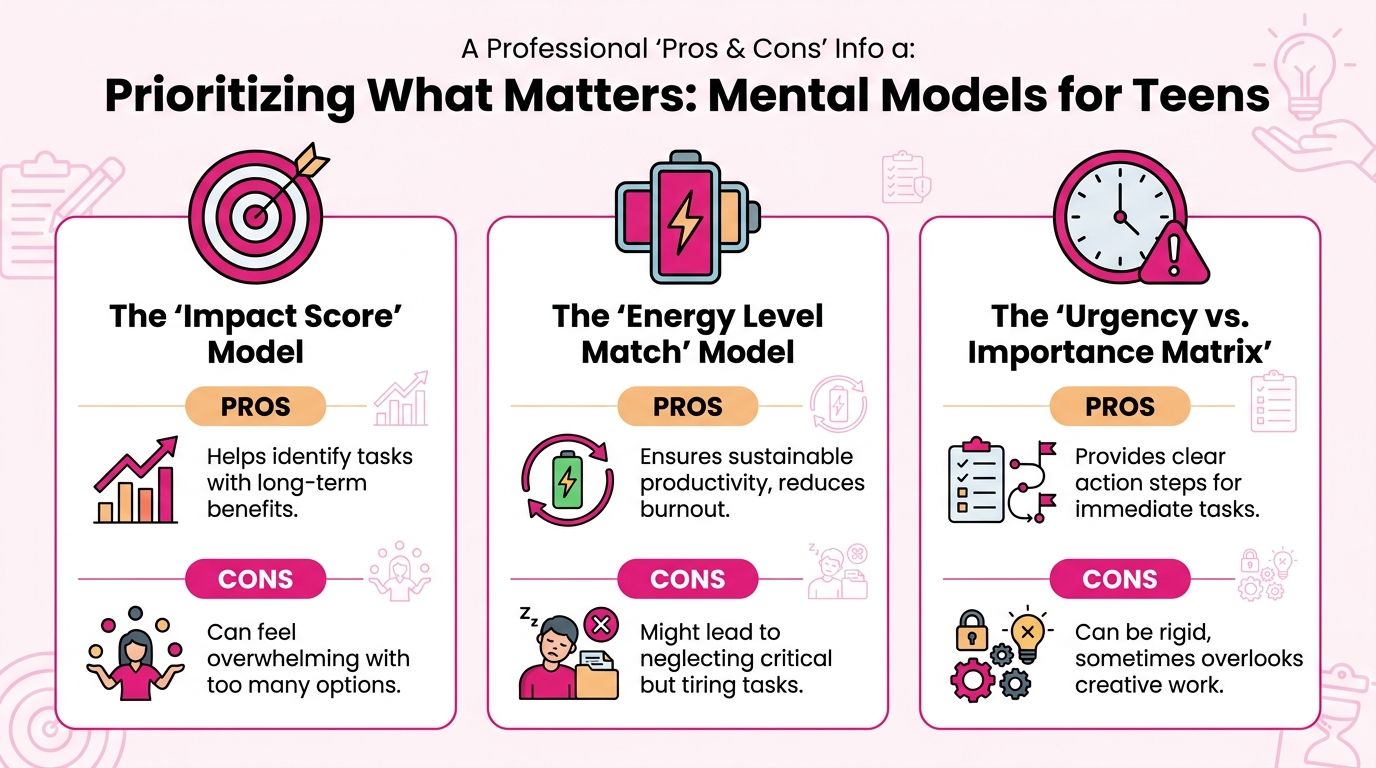
Helping Teens Prioritize What Truly Matters
A teen sits down to work with a history test coming up, a group chat buzzing, laundry half-finished, and a friend sending messages about social drama. Everything feels urgent. That’s the moment when prioritizing matters most.
A teen version of the Eisenhower Matrix
The easiest way to teach prioritizing is to sort tasks by urgent and important.
Category
Teen example
Best response
Urgent and important
assignment due tomorrow, forgot instrument for concert
do it now
Important but not urgent
studying for next week’s exam, drafting scholarship essay
schedule it
Urgent but not important
pressure to reply instantly to nonessential messages
limit it
Neither urgent nor important
scrolling without purpose
cut it back
This model works because it turns a vague sense of pressure into a concrete choice.
What this looks like in real life
Take Maya, a student with a science quiz on Friday. On Wednesday night she plans to “study later,” but her phone keeps lighting up. A friend wants immediate advice about an argument. Another group chat is active. She starts toggling between messages, a study guide, and a video. An hour passes. She feels busy and gets very little done.
That’s where adults can coach without taking over. Ask, “Which of these affects tomorrow or next week in a meaningful way?” The science quiz belongs in important but not urgent until the night before. That means it deserves protected time now, before it becomes a crisis.
A useful script for teens is:
Write down every current demand.
Circle the items that affect grades, commitments, health, or relationships in a lasting way.
Pick one task to do first.
Silence or move the rest out of reach for the block of time.
The 80/20 rule helps teens stop treating everything as equal
The ASU Prep Digital article on time management for teens describes the Pareto Principle, or 80/20 rule, as the idea that 80% of results can come from 20% of high-impact activities. It also notes research cited there showing multitasking increases errors by 50% and can double the time it takes to complete tasks because of task-switching costs.
That matters for teens because they often spread effort thinly across too many small actions. They check five apps, rearrange notes, answer messages, and tell themselves they’re working. In practice, their best results usually come from a few high-impact actions.
For a student, those high-impact actions might be:
Reviewing the study guide for tomorrow’s quiz
Starting the first paragraph of the essay
Emailing the teacher about a missing assignment
Sleeping on time before a demanding day
Everything else may still matter, just not first.
When a teen says, “I have too much to do,” the next question is, “Which task will make the biggest difference if it gets done today?”
If you’re teaching this at school or at home, pair it with a simple reflection question from goal-setting practices for kids and students: What is the one action that moves this forward most? That keeps teens from confusing motion with progress.
From Planning Tools to Practical Application
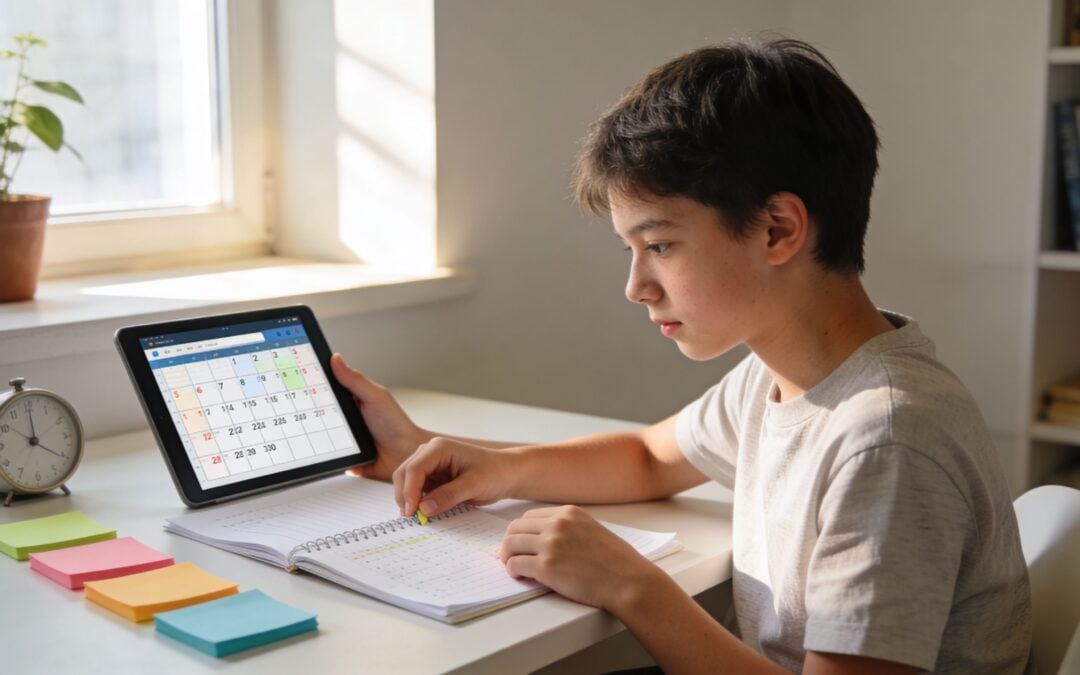
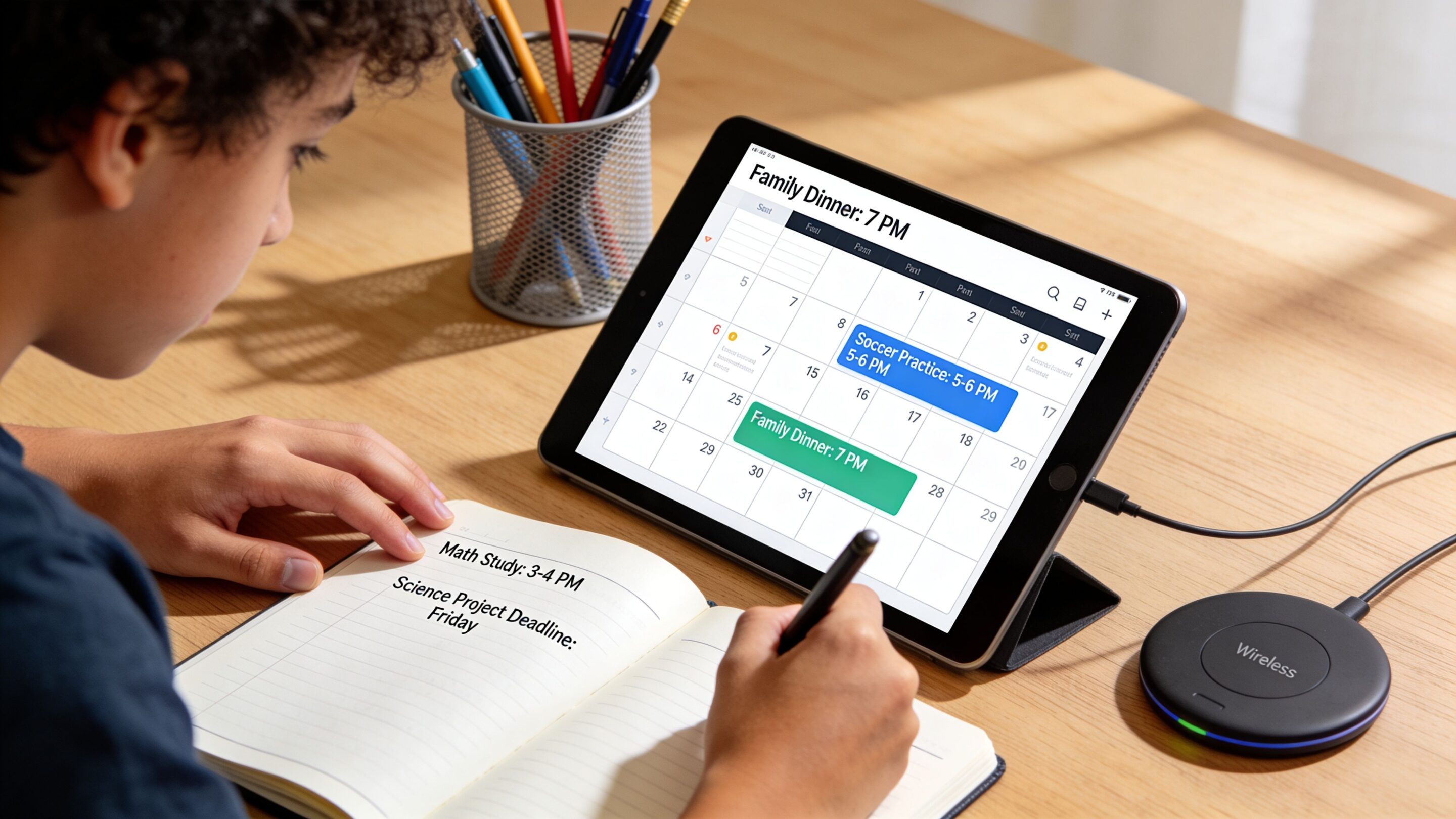
A planning tool won’t rescue a teen by itself. A beautifully color-coded planner can still sit unopened in a backpack. A calendar app can become one more ignored notification. The tool matters less than whether the teen will follow through with its use.
That said, structured planning does make a difference. A study of university students learning time management through workshops found that teaching goal setting, prioritization, and time blocking reduced academic failure rates by 71% in the experimental group compared with the control group. The age group is older than middle or high school students, but the takeaway is still useful: clear planning habits are teachable, and they help.
Analog versus digital tools
Some teens think best with paper. Others need reminders that travel with them.
Tool type
Works well for teens who
Common drawback
Paper planner
like writing by hand, want fewer distractions
may forget to check it
Whiteboard
benefit from seeing the week at a glance
not portable
Google Calendar
need reminders and repeating events
can become cluttered
Todoist or similar app
like checking off tasks and sorting lists
may overbuild the system
Notebook plus phone reminders
want simple and flexible
information gets split across places
For long deadlines, visual countdowns can help a lot. If a teen struggles to grasp how close a due date really is, a tool like this Google Calendar countdown guide can make upcoming projects more concrete.
A practical example with a school project
Say a student has a social studies presentation due in two weeks. Many teens write “work on project” in their planner, which is too vague to act on.
A usable plan is more specific:
Day one Read the rubric. Choose topic. Write down what “done” means.
Day two Gather sources and save them in one folder.
Day three Create a rough outline with intro, main points, and conclusion.
Next work block Make slides or draft note cards.
Later in the week Practice aloud once, revise weak spots, check required materials.
Time blocking offers a solution. Instead of waiting for motivation, the teen assigns each step to a specific block of time. “Wednesday, 7:00 to 7:30, find sources.” “Thursday, after dinner, outline.” Small assignments to time reduce the mental friction of starting.
How adults can support without hovering
The best support sounds like coaching, not surveillance.
Ask to see the breakdown, not just the final due date.
Help estimate how long one step might take.
Prompt a weekly review on the same day each week.
Let the teen choose the tool when possible.
If a student consistently forgets digital alerts, paper may be better. If they lose papers, an app may be the smarter fit. The goal isn’t the perfect system. The goal is a repeatable one.
Overcoming Procrastination with Self-Compassion
Procrastination usually looks like avoidance. Underneath, it’s often protection. A teen protects themselves from boredom, confusion, fear of doing poorly, or the discomfort of not knowing where to begin.
That’s why shame rarely fixes it. Harsh self-talk can create a short burst of panic, but panic isn’t the same as steady follow-through. Teens need strategies that lower the barrier to starting.
Use small-entry strategies
Two tools work especially well because they reduce pressure.
The 5-minute rule Tell yourself you only have to work for five minutes. Starting is the win. Once momentum begins, continuing gets easier.
Pomodoro-style work blocks Use a short focused interval, then take a brief break. For teens, shorter rounds are often more realistic than demanding long stretches of concentration.
If attention is especially hard to hold, these practical steps to improve focus can give parents and educators extra ideas for reducing distractions and making task initiation easier.
Replace the inner critic
Listen for the difference between these two voices.
Self-criticism
Self-compassion
“I’m so lazy.”
“I’m having trouble starting, and I can begin small.”
“I always do this.”
“This is a pattern, not my identity.”
“I ruined the whole night.”
“I can still make one good choice now.”
The most helpful response to procrastination is often, “What is the kindest next step that still moves this forward?”
That may mean opening the document, finding the worksheet, or setting a timer and sitting near a supportive adult. Not every rescue move has to be dramatic.
Reset the nervous system first
Some teens can’t plan their way out of overload until their bodies calm down. A short breathing exercise, a stretch break, or a minute of quiet can create enough space to re-engage. Teachers and caregivers who want simple regulation tools can draw from these mindfulness activities for students.
One practical routine works well in the moment:
Name the feeling.
Shrink the task.
Set a short timer.
Begin without aiming for perfect.
That sequence teaches a powerful lesson. Action doesn’t require feeling fully ready first. Sometimes readiness grows after starting.
Conclusion Fostering Agency and Systemic Well-Being
When adults approach time management as an SEL skill, teens gain more than better homework habits. They learn how to notice overwhelm, make thoughtful choices, recover from avoidance, and build confidence through follow-through. That is real emotional growth.
Adults also need to be honest about the systems around them. As noted in this ASCD article on teen downtime and support, many teens are carrying schedules so overloaded with academics, activities, and family responsibilities that it becomes mathematically impossible to protect enough sleep and daily free time. In those cases, the answer isn’t “manage your time better.” The answer is to reduce the load.
Healthy time management for teenager success happens when teens have both skills and breathing room. Families, schools, and youth programs all play a role in creating that balance.
Soul Shoppe helps schools, families, and communities build the kind of emotional foundation that makes skills like time management stick. Explore Soul Shoppe for practical SEL programs, workshops, and resources that support self-regulation, connection, and confidence in everyday school and home life.
A teen slouches in their chair and stares at the desk when it’s time to share. Another shrugs off a compliment, then whispers to a classmate, “It’s probably dumb anyway.” In schools and at home, those moments add up. They tell you something important is happening beneath the surface.
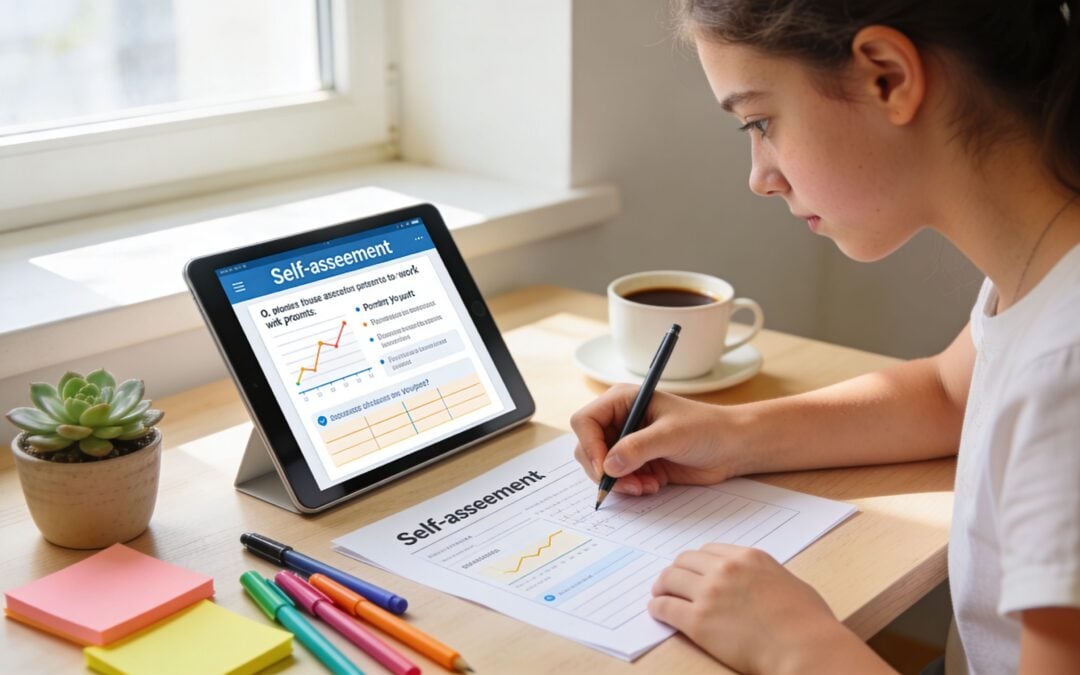
Teens are managing academic pressure, social changes, identity questions, and constant comparison. According to the National Health Statistics Survey summary discussed by Total Life Counseling, 58.5% of teens feel somewhat undervalued and need social support. That’s exactly why self esteem worksheets for teens still matter. They give adults a concrete starting point when a teen doesn’t yet have the words.
The catch is that a worksheet by itself rarely changes much. A good worksheet helps a teen notice a pattern, name a strength, question a harsh belief, or practice a response. A significant shift happens when a teacher, counselor, or parent uses that page to create safety, reflection, and follow-through.
Some tools work best for one-on-one counseling. Others fit an advisory period, a lunch group, or a home routine. The strongest options also make it easier to connect self-esteem work to broader SEL goals like empathy, communication, peer support, and emotional regulation.
Below are 10 strong options, with the trade-offs that matter when you’re choosing something teens will use.
1. Tools Of The Heart Online Course
Tools Of The Heart Online Course isn’t a worksheet library in the narrow sense. It’s the option I’d put first when the problem isn’t only one teen’s negative self-talk, but the climate around them. If students are shutting down, excluding one another, or struggling to repair conflict, isolated worksheets won’t carry the whole load.
Soul Shoppe built this as a flexible digital SEL course for educators, staff, and families. The practical advantage is the shared language it creates around self-regulation, mindfulness, communication, conflict resolution, and peer support. That matters because self-esteem improves faster when teens don’t feel alone in the work.
Where it stands out
A lot of self esteem worksheets for teens focus on internal reflection only. That’s useful, but incomplete. The strongest self-esteem growth often happens when adults pair reflection with belonging, safe discussion, and repeated practice in real relationships.
This course supports that wider approach. It helps adults model what calm repair sounds like, how to name feelings without shame, and how to give students structured ways to support one another.
Practical rule: Use a worksheet to surface a thought. Use an SEL routine to change what happens next.
A middle school example looks like this. A student completes a self-talk page and writes, “Nobody wants me in their group.” Instead of stopping there, the adult can connect that reflection to class norms, partner structures, and repair language. The teen doesn’t just identify a belief. They experience a different social pattern.
Best fit and real trade-offs
This is the best fit for schools, youth programs, and families that want more than print-and-go pages. It works especially well when you want self-esteem tools to connect with bullying prevention, peer inclusion, and emotional safety. Soul Shoppe also offers a helpful read on self-esteem for kids that supports this broader mindset.
What works well:
Shared language across adults: Teachers, counselors, and caregivers can reinforce the same SEL skills.
Better group transfer: Teens practice confidence through communication and connection, not just solo reflection.
Flexible delivery: It can support classroom use, staff development, after-school settings, and home follow-up.
What doesn’t work as well:
Self-study has limits: If adults move through it without discussion or planning time, implementation can get thin.
Schoolwide use takes coordination: The impact is stronger when multiple adults buy in, which isn’t always easy in a busy district.
If you need a few quick pages for tomorrow, this isn’t the fastest pick. If you want a system that helps worksheets stick, it’s one of the strongest options on the list.
2. Therapist Aid
Therapist Aid fits the moment when a teen will give you ten workable minutes, but not forty. In a counseling office, that often matters more than having the most detailed worksheet on the internet.
The materials are clean, familiar, and easy to put in front of adolescents without a long setup. For school counselors, social workers, and parents who want a structured starting point, that practicality is the main advantage. A teen can complete a strengths inventory, reflection page, or journal prompt without feeling like they were handed a textbook.
Why it works in real settings
Therapist Aid is strongest when the goal is to start a useful conversation fast. The instructions are usually clear, the design feels age-neutral, and the pages work across several formats, including individual sessions, small groups, and take-home follow-up.
I usually look for three things before handing a teen any self-esteem worksheet:
Quick entry: The student can begin with little explanation.
Credible tone: The page does not feel childish, preachy, or too clinical for the setting.
Discussion value: The worksheet gives the adult something concrete to ask about next.
Therapist Aid usually delivers on those points.
A simple traits page often gets more honest responses than a broad identity exercise, especially with a teen who is guarded, sarcastic, or emotionally tired.
How to choose the right worksheet here
This resource is a better match for targeted support than for a full sequence of lessons. If the need is classroom-wide SEL instruction, these pages usually need extra framing and partner discussion to keep them from becoming isolated seatwork. If the need is counseling, check-in support, or a short skills group, they are much easier to use well.
A few practical pairings help:
For individual counseling: Use a positive traits or self-talk worksheet, then ask, “Which answer felt true today, and which one felt hardest to write?”
For a small group: Start with a strengths page, then invite each teen to name one strength they use at school and one they hide.
For home use: Send one short reflection page with a caregiver prompt such as, “Tell me about one answer you want me to understand, not fix.”
Those prompts matter. The worksheet should open the door, not carry the whole intervention.
Best use cases and limitations
This is a strong option for school counseling offices, brief intervention groups, and students who need structure without too much emotional intensity at the start. It also works well for adults who want printable materials they can use tomorrow.
The trade-off is straightforward. Therapist Aid gives you solid standalone tools, not a built-out SEL progression. Many helpful resources are member-only, and even the free pages work best when an adult adds context, discussion, and repetition over time.
If you need a full semester plan, this will not do that by itself. If you need clear, usable worksheets that help a teen name strengths, challenge self-criticism, and start talking, it is one of the more dependable picks on the list.
3. Psychology Tools
Psychology Tools is the most clinical option on this list, and that’s both its strength and its limitation. If you’re working with a teen who gets stuck in harsh self-criticism, distorted thinking, or repetitive shame narratives, the structure here can be extremely useful.
The worksheets are typically one concept per page, with formats like fillable PDFs and editable files. That makes them easier to tailor for school groups, counseling sessions, or telehealth support.
When the extra depth helps
Some teens need more than “write three good things about yourself.” They need help tracking when self-critical thoughts show up, what triggers them, and how to answer them with something more balanced. That’s where this library stands out.
The design also works for adults who want a more explicit cognitive-behavioral frame. You can move from event, to thought, to feeling, to response in a way that’s easy to teach.
A useful school example: a student writes, “I got one question wrong, so I’m stupid.” On a Psychology Tools-style page, you can help them identify the thought, test the evidence, and build a replacement thought such as, “I missed one part, and I can still learn this.”
The trade-off in classrooms
This isn’t usually my first recommendation for a quick homeroom activity. The materials can feel too clinical for a broad classroom audience, especially if students are already resistant to SEL. In those settings, the pages work better when the adult simplifies the language and uses only one slice of the exercise.
Best for: Counselors, psychologists, targeted small groups, and older teens who can tolerate reflection.
Less ideal for: Fast classroom warm-ups or reluctant students who shut down when something feels like therapy.
Helpful feature: Editable formats make it easier to adapt wording to your students.
If your setting allows depth, this is a strong library. If you need instant engagement, you’ll probably want a more visual or youth-forward tool.
4. PositivePsychology.com
PositivePsychology.com is a strong middle-ground option. It offers free self-esteem worksheets, practical prompts, and enough background explanation for adults who want to understand why an activity works before they use it.
That’s useful for teachers and parents who don’t want a heavily clinical tone but also don’t want fluff. The materials often center strengths, growth, reflection, and positive self-talk.
Where it fits best
This is the kind of resource I’d use when I need something for advisory, a short SEL block, or homework after a counseling session. The pages are usually straightforward enough to use quickly, and the broader articles help adults frame the conversation.
A practical classroom example: use a strengths worksheet at the end of the week, then ask students to write one example of when that strength showed up in class, at home, or with a friend. That extra step matters because teens often dismiss abstract strengths until they connect them to real behavior.
According to the same Mental Health Center Kids analysis, PositivePsychology.com benchmarks structured worksheets such as strengths and inner-critic activities against evidence-based protocols and notes self-esteem gains in short teen interventions. I’d still treat that as support for structured practice, not as a promise that any single printable will create a big change on its own.
Don’t ask teens to “be positive.” Ask them to get specific.
What to watch for
The free materials are a plus. The downside is that not every resource is clearly labeled for teens, so you’ll need to review tone and language before handing it out. Some pages work beautifully for adolescents, while others feel more adult-oriented.
This one is best for adults who are comfortable curating and adapting. If you want one platform that spoon-feeds a full teen sequence, another option may be easier.
5. Mylemarks
Mylemarks feels built by someone who understands the day-to-day rhythm of school counseling. The resources are practical, visually approachable, and easy to use in small groups, one-on-one sessions, or telehealth.
Its self-esteem materials, including journaling formats for teens, are useful when you want reflection that feels guided rather than rigid. That makes a difference for students who won’t engage with a dense workbook page.
Why it works with real students
Some self esteem worksheets for teens fail because they look too formal. Others fail because they’re so simplified that older students feel talked down to. Mylemarks usually lands in a better middle space.
A good example is how you might use a self-esteem journal prompt in a lunch group. Ask students to respond to one page privately, then invite them to share only one line they’re comfortable reading aloud. That lowers pressure while still creating connection.
Short activities also make follow-through easier. You can assign one page after a rough peer interaction, after a conflict with a teacher, or before a student-led conference where confidence matters.
Main strengths and weak spots
Student-friendly visuals: Helpful for teens who shut down around text-heavy pages.
Flexible delivery: Works in print, telehealth, and brief school-based sessions.
Broad SEL catalog: Easier to build continuity if you also need tools for anxiety, coping, or friendships.
The trade-off is that many resources are sold individually, so you may end up piecing together your own sequence. Stock rotation can also be frustrating if you planned around a specific item and it’s temporarily unavailable.
For counselors who don’t mind curating, it’s a practical and usable library.
6. Centervention
Centervention is a smart choice if you want a mix of free printables and a broader SEL platform. It’s especially useful in schools that need to support both universal classroom instruction and targeted interventions.
The printables cover common self-esteem themes such as strengths, self-awareness, and perfectionism versus self-improvement. The platform side adds more structure for schools that want progress monitoring and a wider SEL framework.
Best school use
I’d consider this most useful for middle grades and early teens, especially when your staff wants something easy to launch. The pages are accessible, and they pair well with practical mini-lessons.
A classroom example: use a perfectionism worksheet after a student says, “If I can’t do it right, I’m not doing it.” Then run a quick board activity where students sort statements into “high standards” versus “all-or-nothing thinking.” That turns the worksheet into a shared learning moment.
What to know before choosing it
The free materials are helpful, but some may skew younger than a high school audience wants. If you work mostly with older teens, you’ll want to preview design and tone carefully.
This platform is strongest when you need scalability.
Good fit: Tier 1 and Tier 2 school supports, middle school groups, advisory lessons.
Less ideal: Older teens who want more mature design and language.
Added value: Schools can move from a printable to a fuller SEL system without changing vendors.
If your school is trying to bridge classroom SEL and intervention support, Centervention deserves a look.
7. Between Sessions Resources
Between Sessions Resources does one thing well. It gives counselors directive, assignable worksheets that are easy to use between meetings. If you’re the kind of practitioner who wants a teen to leave with one concrete task, this style works.
The self-esteem content sits inside a broader therapy resource library, which helps when low self-esteem is tangled up with anxiety, anger, social stress, or family conflict.
Practical value for counseling rhythm
A lot of teen growth happens between sessions, not during them. This library leans into that. The worksheets are often direct enough that a counselor can say, “Do page two this week, circle the hardest prompt, and bring it back next time.”
That’s useful for school-based work where your actual face time may be short. A student might complete a self-belief worksheet at home, then use your next meeting to unpack one sentence they wrote rather than starting from scratch.
If a teen never finishes homework, assign fewer prompts and ask for one honest answer, not a full page.
The downside
The site can take patience to find one's way around because it mixes public and premium materials. The visual style also leans more clinical than trendy, which means some teens will connect with the substance but not the presentation.
Still, for counselors who care more about function than polish, it’s a solid option. It’s especially strong when self-esteem work needs to continue across multiple sessions in small, manageable steps.
8. Whole Person Associates The Teen Self-Esteem Workbook
The resource described by Whole Person Associates uses a step-by-step progression and includes five separate sections that guide participants toward learning more about themselves and understanding how self-esteem affects them. The sections include the Teen Self-Esteem Scale, Teen Self-Worth Scale, and Teen Self-Understanding Scale.
Why the structure matters
This is a good fit for small groups, pull-out support, or counseling programs that want a beginning, middle, and end. Teens often do better when they can see a progression instead of feeling like each week is a totally unrelated activity.
A practical school example: run a six-week group where week one focuses on self-assessment, week two on self-worth, week three on assertiveness, and later sessions on self-responsibility and daily application. That gives students a sense of movement.
The workbook approach also helps adults stay organized. You’re not scrambling each week for another printable that sort of matches the theme.
Real trade-offs
The downside is tone. Traditional workbook design can feel formal, and some teens prefer shorter, more visual pages. It also isn’t a free resource, so access may depend on your counseling budget.
This is one of the better choices when you need reproducibility and order. It’s less ideal if your students only tolerate short, highly visual activities.
9. Mental Health Center Kids
Mental Health Center Kids self-esteem bundle is a practical print-and-go choice for adults who want variety fast. The pages cover strengths, positive self-talk, coping trackers, accomplishments, and self-forgiveness in a format that feels approachable.
This is not the place I’d go for deep implementation guidance. It is a place I’d go when I need visually engaging materials I can sort through and use right away.
Strong for variety, weaker for sequencing
The big benefit is range. If you’re planning a short advisory series or building a counseling folder for a teen, it’s useful to have different page types available. Some students respond to trackers. Others respond to reflection prompts. Others need something creative and low-pressure.
A home example: a parent can choose one accomplishments page for Sunday evening and one positive self-talk page before a stressful school day. That kind of light routine often gets more cooperation than a thick packet.
The market overview connected to this brand also notes substantial demand for self-esteem themed educator resources and digital formats, but I’d still judge this specific bundle mainly on usability rather than on market claims. In practice, its value is that adults can quickly find pages that feel less dry than traditional worksheets.
Best fit
Best for: Advisory, counseling homework, family check-ins, short-term SEL support.
Watch for: Some bundles span wide age ranges, so older teen users may need a careful page selection.
Bottom line: Great as a grab-and-go bank. Less strong as a full developmental sequence.
10. GoZen!
GoZen! printable packs are among the most visually engaging options for confidence, self-talk, perfectionism, and body confidence. If your students reject anything that looks like a standard worksheet, the comic-style design and youth-forward tone can help.
That design matters more than adults sometimes think. A teen who refuses a plain black-and-white handout may willingly complete a page that feels more like an activity pack.
Engagement first
GoZen! works well for targeted themes. If a small group is focused on body image, perfectionism, or negative inner talk, the deeper thematic packs can support a multi-session sequence without becoming repetitive.
A practical group example: use a self-talk page, then ask students to rewrite one inner-critic statement as if they were talking to a close friend. Follow that with a pair-share where each student offers one supportive phrase another student could use this week.
That move from page to spoken practice is important. Self-esteem work sticks better when teens hear and use language out loud.
Sometimes the “best” worksheet is simply the one a teen will actually touch, read, and finish.
Where it can be too much
The packs are large, which is helpful if you want depth but inefficient if you need only three pages. You’ll need to curate carefully so students don’t get overwhelmed and staff don’t lose the thread.
This is a strong choice when engagement is your first hurdle. It’s less efficient when you want a minimal, tightly focused handout.
10-Resource Comparison: Teen Self-Esteem Worksheets
Product
Target audience
Key features
Unique selling points / value
Price & access
Tools Of The Heart Online Course (Soul Shoppe)
Educators, school staff, families, whole campuses
Research-based SEL modules; experiential, application-focused; self‑regulation, mindfulness, communication
20+ years of school‑wide implementation; shared language; pairs with workshops, coaching & app for sustained change
Paid course / school licensing, contact Soul Shoppe for pricing
Therapist Aid (Self‑Esteem Worksheets)
School counselors, clinicians, small groups
Adolescent-specific worksheets; clear instructions; some fillable/customizable files
Clinician-created, easy to search by topic; trusted by professionals
Mostly free samples; many downloads require paid membership
Putting Tools into Practice From Worksheet to Well-Being
A teacher passes out a self-esteem worksheet during advisory. One student finishes in two minutes and stares at the desk. Another jokes through every prompt. A third writes a page and then refuses to discuss it. The worksheet did not fail. The match, timing, or follow-up probably did.
Self esteem worksheets for teens work best when adults choose them for a specific purpose and plan what happens after the page is complete. In practice, that means deciding three things first. Where will this happen: classroom, counseling office, or home? What is the immediate goal: awareness, language, reframing, or connection? How much emotional risk can this teen handle today?
That last question matters. Adults often assign a highly personal reflection sheet before a teen trusts the setting. A guarded student usually does better with low-exposure tasks first: rating statements, identifying one believable strength, matching self-talk examples, or choosing a coping response from a list. Deeper writing fits better after the teen has some safety and success.
A simple selection framework helps.
For classrooms, choose short, concrete worksheets that lead to discussion without pressuring disclosure. Strength spotting, self-talk sorting, and quick confidence check-ins tend to work well because students can participate at different levels. For counseling, use worksheets that examine triggers, core beliefs, and replacement thoughts, since privacy and follow-up are built in. For home use, pick low-pressure formats that can fit into routines, such as one-page journals, trackers, or prompts a caregiver can revisit later in the week.
The follow-up questions matter as much as the worksheet itself. Use prompts that help teens get specific:
After a strengths worksheet: “Which strength feels true on a good day? Which one is hardest to claim?”
After a negative self-talk page: “What was the exact sentence in your head?”
After a social conflict reflection: “What meaning did you attach to what happened?”
After a journaling prompt: “What part would feel okay to say out loud?”
After a praise or affirmation activity: “What makes that compliment hard to accept?”
Specific language helps teens separate events from identity. “I froze during the presentation” can be examined and improved. “I am awkward” sticks unless someone helps challenge it.
Implementation also needs a realistic view of trade-offs. A classroom worksheet should protect time, privacy, and group momentum, but that usually means less depth. A counseling worksheet can go further, but it reaches fewer students at once. Home activities can strengthen transfer and consistency, yet they depend on caregiver capacity and the teen’s willingness to engage outside school. The right choice is the one the adult can support well, not the one with the most impressive prompt.
Here is what that can look like in practice.
In advisory, a teacher might use a self-talk worksheet with two sentence stems on the board: “The thought I hear when I mess up is…” and “A more accurate thought is…” Students can write privately, share in pairs, or submit anonymous examples. That preserves choice while still building shared language.
In a counseling group, an individual reflection page can be paired with structured peer feedback. A prompt such as “One thing I assume other people notice about me is…” often opens the door to corrective experiences, especially when peers are coached to respond with concrete, respectful observations instead of vague reassurance.
At home, a caregiver can turn a strengths worksheet into a weekly habit. Ask the teen to name one strength they used that day and add a short example. Keep the bar low. “You kept going when homework got frustrating” is enough. Self-esteem grows faster when teens see evidence linked to real behavior.
Worksheets also work better when they sit inside a broader SEL routine. If a school uses common language for self-talk, emotional regulation, repair, and belonging, students hear the same message in more than one place. A teacher can reinforce it before a presentation. A counselor can revisit it during check-in. A caregiver can use similar wording after a rough evening. Soul Shoppe is one example of a broader SEL framework schools may use to build those consistent routines and conversations over time.
For adults deciding where to start, keep the plan narrow. Pick one concern, such as perfectionism, social withdrawal, harsh self-talk, or trouble accepting praise. Choose one worksheet that fits the setting. Then decide the follow-up before handing it out: What will the teen discuss, practice, or notice next?
That sequence turns a printable into actual skill-building. Over time, the worksheet becomes less important than the pattern around it: reflection, conversation, practice, and repetition.
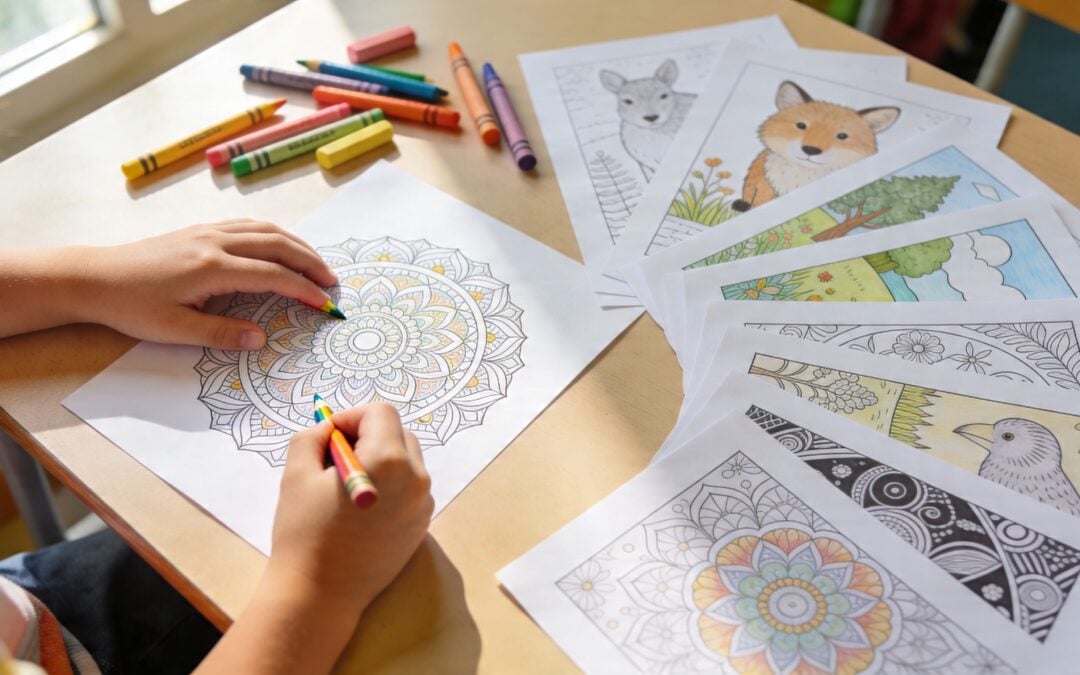
A student walks in already keyed up. Maybe it's a quiz day. Maybe recess went badly. Maybe nothing obvious happened, but you can see it in the tight shoulders, the quick breathing, the way the pencil taps the desk. In those moments, anxiety coloring pages can help because they give kids something simple, concrete, and regulating to do with their hands while the nervous system settles.
That doesn't mean every coloring page works the same way. Some are really coping-skills lessons in disguise. Some are best for a calm-down corner. Some work because an adult sits beside the child and co-regulates. Others are better for small groups, counseling offices, or independent use during transitions. The printable matters, but the pairing matters more. A page plus a script, a check-in, or a reflection prompt turns coloring from filler into SEL practice.
There’s also a real reason educators keep returning to coloring. A 2018 study in the IAFOR Journal of Arts & Humanities found that coloring activities, especially mandala coloring, reduced state anxiety in adolescents more than free-form coloring or puzzle controls. That matters in schools because we often need tools that work in the moment, not just ideas students are supposed to remember later.
I’ve used coloring pages before class meetings, after lunch, in counseling groups, and during those tense weeks when test worry rises. The strongest resources don't just say "relax." They help kids name feelings, notice body signals, and practice what to do next.
Below are the anxiety coloring pages and printable tools I’d trust with students, staff, and families. Each one includes a practical way to use it, because the best printable in the world won't do much if adults don't know how to frame it.
1. National Institute of Mental Health Stand Up to Stress! Coloring & Activity Book
The NIMH Stand Up to Stress! Coloring & Activity Book is the one I’d hand to a school team that wants a trustworthy starting point. It isn’t only a stack of pretty pages. It teaches kids what stress feels like, what coping looks like, and how to reach for help in language upper-elementary students can understand.
I like it for grades 3 through 6 because it meets students where they are. The design is approachable, and the activities don't assume a big counseling vocabulary. It also comes from a mental health agency, which gives principals and counselors confidence when they’re sending materials home.
Best way to use it at school
This works well in a short-term counseling group, a health block, or a re-entry plan for a student who’s been overwhelmed. Because it mixes coloring with coping content, you can move from regulation to conversation without switching materials.
Try a simple three-step routine:
Color first: Give students two quiet minutes to start one page before any discussion.
Name the signal: Ask, "What does worry feel like in your body right before it gets big?"
Choose one strategy: Have each student circle or say one coping action they could try later that day.
A practical classroom example: before a spelling test, invite students to color for a few minutes while practicing a slow inhale and exhale. That pairing fits with school-based interest in quick regulation tools, and child anxiety support works best when adults teach coping explicitly, not only react after stress spikes. If you want language to extend the lesson, Soul Shoppe’s guide to anxiety coping skills for kids offers helpful phrases teachers and caregivers can borrow.
Practical rule: Don’t hand out the whole booklet at once. Pick one page that matches the moment, such as body clues, calming strategies, or asking for support.
One more reason this resource stands out. The booklet is easy to distribute in school communities because it’s free and available in English and Spanish on the NIMH site.
2. Sesame Workshop Coloring to Calm Down and Color Me Calm
When a child needs connection more than instruction, I reach for Sesame Workshop’s Coloring to Calm Down resources. These pages are short, warm, and easy to use with an adult sitting nearby. That matters because many anxious moments in early childhood and elementary settings are really co-regulation moments.
These aren't the pages I’d use for a deep lesson on anxiety. They’re better for reset points. Think arrival time, after a conflict, before bedtime at home, or while waiting for a counseling appointment.
Why they work with younger children
Sesame Workshop understands how to keep the activity light while still prompting awareness. Kids can color without feeling like they’re in a "lesson," but the adult can still guide attention toward breathing, noticing, and settling.
Here’s a script teachers and caregivers can use while coloring together:
"Let’s color one part slowly. While you do that, see if your shoulders feel tight or soft. I’m going to make my breathing slower too."
That adult modeling piece is the whole point. If the grownup’s voice gets slower and their posture relaxes, the page becomes a shared calming routine instead of a demand to "calm down."
Use this resource when you want:
A fast transition reset: Keep a few copies by the door for students who need help shifting into class.
A family handoff tool: Send one page home with a note suggesting an adult color alongside the child.
A calm corner routine: Pair the page with crayons, a timer, and one feeling prompt.
If you're helping adults build that side-by-side support, Soul Shoppe’s post on teaching children how to self-soothe gives language that fits this style well.
The main limitation is scope. You won’t get a huge library or school-specific anxiety themes. But for young students who need a gentle entry point, these anxiety coloring pages are easy to trust and easy to repeat.
3. GoZen! Printable Library and Calm Down Corner Kit
If you’re outfitting a whole counseling office, grade-level team, or district calm-down space, GoZen! Plus is one of the more complete options. I wouldn’t describe it as a coloring-page site alone. It’s an SEL printable system that includes mindful coloring inside a broader library of journals, posters, activities, and regulation tools.
That broader setup is useful because anxiety coloring pages work best when they aren’t isolated. A child may color first, then use a feelings chart, then write a coping plan, then practice self-talk. GoZen! makes that sequence easier.
Where it fits best
This is strongest for adults who want consistency across settings. A counselor can use one page in a small group, a teacher can place a related version in the calm corner, and a caregiver can reinforce similar language at home.
A practical implementation example looks like this:
Morning check-in: Student identifies energy level or feeling.
Coloring choice: Student selects a mindful coloring page tied to calm, focus, or strengths.
Reflection: Adult asks, "What changed in your body while you colored?"
Transfer: Student picks one strategy to use when worry returns.
That’s the kind of structure many schools need. Without it, coloring can drift into "something to keep kids busy." With it, students start linking internal states, actions, and outcomes.
A 2019 Pepperdine University study involving 160 undergraduates found that four structured coloring conditions, including adult coloring books, all significantly reduced state anxiety after anxiety induction, with no significant differences among conditions. I wouldn’t transfer college findings directly onto every child setting, but the takeaway is useful for educators. The regulating effect may come less from finding the "perfect" page and more from giving students a structured, contained coloring experience they can put to use.
The downside is cost. Much of the library sits behind a subscription or paid product. Still, for schools that want a reusable SEL bank rather than a one-off printable, it’s a strong option.
4. Teachers Pay Teachers Feeling Nervous at School Coloring Pages
The Feeling Nervous at School Coloring Pages on Teachers Pay Teachers stands out because it focuses on familiar school triggers. That specificity matters. A lot of anxiety coloring pages are generic. Kids color hearts, swirls, or flowers, but no one helps them talk about the cafeteria, hallway noise, substitute teachers, or tests.
This kind of resource is useful when a student’s worry is tied to predictable school moments. If the anxiety shows up during transitions or academic pressure, context-specific pages often open the door faster than broad mindfulness designs.
Good fit for counseling groups and check-ins
I’d use these pages with a small counseling group for students who all struggle with school-day nerves. Each student colors a page tied to a common trigger, then shares what that moment feels like and what helps.
You can make the conversation concrete with prompts like:
Before the moment: "What does your body do when you know this part of the day is coming?"
During the moment: "What helps a little, even if it doesn’t make the feeling disappear?"
After the moment: "Who can notice you’re having a hard time and support you?"
Some children can color and talk at the same time. Others need the coloring first and the talking later. Let the page lower the pressure before you ask for words.
This resource also pairs well with classroom support planning. A teacher might notice that one student always melts down before independent work. The child colors a page about school worry with the counselor, identifies body clues, then practices a one-sentence help script such as, "Can you get me started?" That kind of bridge from page to action is what makes the printable worthwhile.
The caution with Teachers Pay Teachers is consistency. Listings vary by seller, visual quality, and licensing terms. Review carefully before sharing across a whole team.
5. St. Jude Children’s Research Hospital Free Coloring Pages
St. Jude’s free coloring pages are a good reminder that anxiety support doesn't always need to look overtly clinical. These pages aren’t framed as a full anxiety curriculum. Instead, they offer art-centered activity sheets that work well in waiting spaces, family events, classrooms, and counseling offices where you want calming engagement without making a child feel singled out.
That matters for students who resist anything that feels like "therapy work." Sometimes a playful page is the safer doorway.
Best use for mixed-age settings
I especially like resources like this when you have a broad age range or a public-facing setting. A family night, a school wellness fair, or a counseling waiting room needs materials that feel welcoming to many kinds of kids.
Try setting up a coloring station with one short invitation:
"You can color anything you like. While you color, notice one thing your hands are doing and one thing your breathing is doing."
That prompt keeps the tone low-pressure. It doesn’t force disclosure, but it still builds awareness.
This type of use fits with the broader picture of coloring as an accessible support. In a randomized trial with patients receiving treatment for generalized anxiety disorder, adding coloring therapy for three weeks led to statistically superior outcomes compared with the control group on measures including HAMA, SAS, and positive mood, according to the PMC article on coloring therapy and anxiety outcomes. In school terms, I’d translate that carefully. Coloring won’t replace clinical care, but it can serve as a practical adjunct that supports regulation and coping.
For implementation, keep the expectations simple:
Offer choice: Lay out several pages instead of assigning one.
Keep tools easy: Crayons, markers, and colored pencils should all be available.
Skip forced sharing: Let students decide whether they want to talk after coloring.
The tradeoff is focus. Because these pages aren’t specifically built around school anxiety or coping scripts, the adult has to provide the SEL framing.
6. Awkward Critters Free SEL Activities with Anxiety Themes
There’s something powerful about giving anxiety a character. The Awkward Critters activities page does that in a way younger students can understand. Instead of asking children to explain a vague internal storm, it lets them relate to a creature, compare experiences, and talk about worry with a bit more distance.
That distance can lower shame. A child who won’t say, "I get anxious at school" might say, "Raven worries a lot when things feel uncertain."
A strong option for K to 5 bibliotherapy
These pages work best when paired with the Awkward Critters books, but they still have value on their own. I’d use them in a classroom read-aloud, a lunch bunch, or a home setting where a parent wants to open a feelings conversation without overwhelming the child.
A scriptable activity:
Read or summarize the character.
Invite the child to color while thinking about times they feel similar.
Ask, "What does Raven do when worry gets loud?"
Then ask, "What helps you when your worry gets loud?"
That sequence matters because children often need to talk about the character first before they can talk about themselves.
Why character pages can be easier than abstract pages
Many mandala-style anxiety coloring pages regulate through rhythm and repetition. Character pages do something different. They normalize emotion. They tell children, "This feeling exists. It has patterns. You are not the only one."
I’ve seen this work particularly well with students who are verbal but guarded. If direct SEL worksheets lead to shrugging or joking, a character-based page can bypass that resistance.
The limitation is depth and volume. This isn’t a giant printable library, and it works best when adults lean into the relational side. If you hand out the page without discussion, you’ll miss most of its value.
7. Empowering Education Mindful Coloring K to 2 lesson and printable
A first-grade class comes in from recess loud, wiggly, and slightly off balance. Handing out crayons alone will not settle that energy. The Empowering Education mindful coloring lesson for K to 2 helps teachers turn coloring into a taught regulation routine with clear language, pacing, and reflection.
That distinction matters in early grades. Young students often treat coloring as a race, a performance task, or a chance to compare work. This lesson redirects attention to sensory noticing. In practice, that means the adult is teaching the process the same way they would teach lining up, partner talk, or how to use a calm corner.
I like this resource because it answers the question many teachers wonder: what do I say while students color? A good SEL printable is only half the tool. The other half is the script that helps children slow their bodies and name what changed.
Best use: teach it before students need it
Use this lesson during a neutral part of the day, not only after a meltdown or difficult transition. Regulation routines work like fire drills. Children benefit when they practice the steps while calm, so the routine feels familiar when stress is higher.
A simple classroom sequence might sound like this:
"Today we are practicing mindful coloring. Our job is to notice our hands, our breath, and the way the crayon moves."
"Put both feet on the floor. Let your shoulders soften."
"Color one small section slowly. There is no prize for finishing first."
"Pause and check in. Is your body feeling busy, steady, tight, or calm?"
That last step is where the SEL learning happens. Without reflection, coloring stays an art activity. With reflection, it becomes practice in self-awareness.
If your class already uses short regulation routines, this lesson fits well alongside other mindfulness activities for students that build attention and body awareness.
As noted earlier in the article, structured coloring appears more helpful for calming than completely open-ended coloring in some settings. For a K to 2 teacher, the practical takeaway is straightforward. A page with simple structure, plus adult guidance, often works better than saying, "Here, color this," and hoping students settle.
Use with care: If a child starts worrying about neatness, staying in the lines, or picking the "right" color, shift the goal right away. Say, "We are practicing slow breathing and steady hands, not making a perfect picture."
This is not a giant printable library, and that is part of its value. It gives adults a lesson they can teach, repeat, and adapt. In a classroom or counseling group, that repeatable routine is often what helps a simple coloring page become a regulation tool.
8. Monday Mandala Large free catalog of mandala coloring pages
If you need sheer variety, Monday Mandala is practical. The site has a large catalog, and that’s a real advantage in school settings because anxiety coloring pages aren't one-size-fits-all. One child settles with simple shapes. Another wants intricate repetition. Another needs something in between.
This is the kind of site I’d use to stock a calm corner binder or counselor file cabinet. Print several levels, sort them by complexity, and let students choose.
Differentiation is the real value here
An anxious student who’s already overloaded may do better with wide spaces and fewer decisions. A student who ruminates might benefit from a more detailed design that holds attention longer.
I’d label folders something like this:
Easy start: Large spaces, simple lines, less visual demand.
Steady focus: Moderate detail for students who want a bit more engagement.
Deep focus: Intricate pages for older students who enjoy repetitive coloring.
That organization helps adults match the page to the child’s state instead of grabbing whatever is on top.
There’s also a broader cultural reason these pages are so widely available. The adult coloring book market has grown significantly as mental health awareness and mindfulness practices have become more mainstream, according to Techsci Research’s adult coloring book market overview. In schools, that wider adoption means educators can now access more printable formats, themes, and digital options than they could a decade ago.
The drawback is obvious. Monday Mandala doesn’t provide the SEL framing for you. You have to add the language, the check-in, and the closure. Still, for volume and flexibility, it’s hard to beat.
9. Mindful Art Center Free mandala coloring pages
Sometimes you don’t want an enormous catalog. You want a small, clean set you can print today and use tomorrow. That’s where the Mindful Art Center mandala printables are helpful.
The pages feel teacher-ready. They’re especially useful for upper elementary and middle school students who may resist cartoonish designs but still respond to a quiet, structured visual task.
Good for brain breaks and counselor drop-ins
I’d keep these for moments when a student needs a reset but not a long processing conversation. The page itself does some of the work because the repeating pattern naturally encourages slow attention.
A simple counseling office routine:
Student chooses a mandala.
Adult says, "You don’t need to finish. Just start with one section."
After a few minutes, adult asks, "Are things feeling faster, slower, or the same inside?"
That final question matters because it teaches self-observation without pressure.
Start with a corner or one ring of the mandala. Many anxious students calm faster when the task feels finite.
These pages also work well for test-prep weeks. I’ve seen teachers place one on each desk as students enter, with soft music and a brief breathing cue. It changes the emotional temperature of the room without taking much time.
The tradeoff is scope. This is a small library, and the pages aren’t designed for specific triggers like peer conflict or classroom performance anxiety. But for quality, ease, and a more mature visual style, it’s a solid choice.
10. KidMinds Free mandala coloring pages for kids
The KidMinds mandala coloring pages for kids are useful when you want one larger set that can stretch across several grades. The mix of simpler and more detailed pages makes it easier to support siblings at home, mixed-age groups, or classrooms where students have different attention spans.
This is the kind of printable bank I’d recommend to families who say, "Can you just give me one thing I can keep on hand for rough evenings or stressful mornings?"
How to turn a free set into an SEL routine
Because the pages themselves aren’t anxiety-specific, the adult has to provide the structure. The good news is that structure can be simple.
Try this at home or at school:
Before coloring: Ask the child to rate their body as "busy," "in-between," or "calm."
During coloring: Invite them to color one small section at a time.
After coloring: Ask, "What does your body need next, water, movement, quiet, or help?"
That last question keeps the activity from becoming an endpoint. Coloring helps a child settle enough to notice the next need.
There’s still a gap in the field. Adult-focused content dominates many searches and printable collections, while evidence-informed, school-ready anxiety coloring pages for children remain less developed, as discussed in Clarity Clinic’s article on printable coloring pages for stress and anxiety. In practice, many educators are still adapting general coloring resources into child-centered SEL tools on their own.
KidMinds works well for that kind of adaptation. It gives you enough variety to build a system:
Transition pages for arrival or after recess
Test-day pages for quiet entry routines
Home copies for backpacks or caregiver support
It’s not a specialized intervention, but it is flexible, approachable, and easy to reuse.
Anxiety Coloring Pages, 10-Resource Comparison
Resource
Core features
Target audience
Unique strength
Limitations
Price / Access
National Institute of Mental Health, “Stand Up to Stress!” Coloring & Activity Book
30+ pages blending psychoeducation and colorable activities; ages 8–12; English & Spanish; public-domain PDF
Upper-elementary students, school counselors, district distribution
Government-produced, evidence-aligned content with explicit reuse rights
Skews to 8–12; may need scaffolding for K–1; not pure coloring-only pack
Free, public-domain download
Sesame Workshop, “Coloring to Calm Down” / “Color Me Calm”
Single-page calm coloring with mindfulness prompts; variants for families and military
Early childhood, caregivers, kindergarten teachers for co-regulation
Trusted brand; designed for adult–child co-coloring and modeling calm
Limited number of pages; not targeted to specific school anxiety scenarios
Free printable
GoZen!, Printable Library & Calm Down Corner Kit
1,000+ SEL printables including mindful coloring, journals, posters; licensing guidance
Schools, counselors, districts seeking comprehensive SEL kits
Extensive, lesson-aligned library with educator scaffolds and org licensing
Most content behind paywall; account setup and cost may exceed small budgets
20-page curated mandala packet for kids; varied complexity and print guidance
Primary through early middle-school teachers and families
Larger single free set that bridges early grades to middle school
Not explicitly labeled for anxiety; blog ads may appear
Free download
Beyond the Page: Fostering Resilient, Emotionally Aware Kids
Anxiety coloring pages are one of my favorite low-barrier supports because they’re easy to introduce and easy to repeat. A teacher can keep a folder in a desk. A counselor can slide a page across the table without turning the moment into a big event. A caregiver can print one at home and sit beside a child who’s having a hard night. That accessibility matters.
But the page is only the beginning. Coloring works best when adults treat it as a regulation tool, not a distraction tactic. If the message is "Do this so you stop bothering people," kids feel that. If the message is "This can help your body settle so you can notice what you need," the same page becomes respectful and useful.
That’s why pairing matters so much. A simple breathing prompt, a body-awareness question, or a closing reflection can turn coloring into real SEL practice. Even a short script helps. "What do you notice in your hands?" "Did your breathing change?" "What might help next?" Those questions build interoception, language, and agency.
It also helps to match the resource to the purpose. If you need explicit coping instruction, NIMH is a better fit than a generic mandala page. If a child needs co-regulation, Sesame Workshop is often stronger than an independent printable. If you’re stocking a calm corner for many ages, a broad catalog like Monday Mandala or KidMinds gives you needed range. If you want school-specific discussion, a focused Teachers Pay Teachers resource may open better conversations.
In classrooms, I recommend teaching coloring routines before students are dysregulated. Practice them during morning meeting, SEL block, or a quiet Friday reset. That way, when anxiety rises, the routine already feels familiar. Kids don’t have to learn a new strategy in the middle of a hard moment.
For counselors and administrators, the bigger implementation question is consistency. If every adult uses different language, students have to start over in each room. A shared script helps. You might decide that every adult in the building uses the same three prompts: "What are you noticing in your body?" "What helps you feel a little steadier?" and "What do you need next?" Once those become routine, any anxiety coloring page can fit into a wider support system.
Families need that consistency too. When a school sends home a printable, add one or two lines for caregivers. Keep it plain. "Color with your child for a few minutes. You don’t need to fix the feeling. Just notice together and ask what might help next." That kind of guidance makes home use much more effective.
Most important, remember what success looks like. The goal isn't to eliminate anxiety. Kids need to know that worry, stress, and uncertainty are part of life. The goal is to help them recognize those feelings earlier, respond with tools instead of panic, and trust that support is available. Coloring can help create that bridge because it slows the moment down enough for awareness and choice to return.
When schools build around that idea, anxiety coloring pages stop being throwaway printables. They become part of a culture of emotional safety, shared language, and everyday resilience. For schools and districts that want a more thorough approach, Soul Shoppe offers experiential programs and curriculum designed to help students and staff build connection, self-regulation, empathy, and strong school communities.
If you want more than a folder of printables, Soul Shoppe can help your school build the kind of SEL culture where tools like anxiety coloring pages take hold. Their workshops, assemblies, coaching, and curriculum give students and adults shared language for mindfulness, self-regulation, communication, and conflict resolution so support feels consistent across classrooms, counseling spaces, and home connections.
A lot of schools are dealing with the same pattern right now. A disagreement starts at recess, follows students into the hallway, reappears during math, and ends with an office referral that doesn't really solve anything. The students feel wronged, the teacher loses instructional time, and the adults are left managing the same conflict in different forms all week.
That’s why conflict resolution for schools can’t live as a single lesson, a poster in the counseling office, or a once-a-year assembly. It has to be a system. When schools build shared language, predictable routines, tiered supports, and student leadership into daily practice, conflict becomes teachable instead of punishable.
Why a School-Wide Approach to Conflict Resolution Matters
A school rarely has a “behavior problem” in isolation. More often, it has a systems problem. Students move from classroom to playground to cafeteria to aftercare, and if each space handles conflict differently, children learn that resolution depends on which adult is closest, not on a skill they can use anywhere.
That inconsistency is expensive. It costs teaching time, emotional energy, and trust. It also sends a quiet message to students that conflict is something adults take over, rather than something children can learn to manage with support.
Discipline alone doesn’t teach replacement skills
A removal, a warning, or a consequence may stop a moment. It usually doesn’t teach what the student should do next time. If a child doesn’t know how to calm down, explain an upset, listen, repair harm, or re-enter a relationship, the same pattern returns with new players.
Schools that teach conflict resolution as part of daily practice tend to see broader gains. Research summarized by the Conflict Resolution Education report found that students in CRE programs ranked 12 percentile points higher in achievement than matched peers, while the same body of research found decreases in aggressiveness, discipline referrals, and suspension rates, along with improvements in school and classroom climate.
That matters because academic focus and emotional safety are connected. A classroom where students expect ridicule, retaliation, or constant adult rescue is not a classroom where deep learning holds.
Practical rule: If your conflict process only starts after a major incident, you’re already late.
A calm campus is built, not wished for
Leaders sometimes ask whether conflict resolution is “one more initiative.” In practice, it works better as an organizing principle for how adults respond, how students speak, and how relationships are repaired.
A school-wide model gives staff a common approach to questions like these:
What happens first: Does the adult separate students, coach them, or send them out?
What language is expected: Are students taught sentence stems, listening moves, and repair routines?
When does conflict become a support issue: Which students need more than universal instruction?
How do families hear about the work: Are they getting the same language children hear at school?
Schools already investing in social-emotional learning programs for schools usually find that conflict resolution becomes one of the clearest ways SEL shows up in visible, daily behavior.
What leaders should notice first
Before launching anything new, walk the campus and listen.
Look for repeated hotspots, repeated students, and repeated adult phrases. If one teacher says “use your words,” another says “stop arguing,” and a third says “go to the office,” the school is teaching three different conflict models at once.
A school-wide approach creates coherence. And coherence is what turns conflict from a drain on learning into part of how a school teaches children to live and learn together.
Laying the Foundation for a Peaceful School
Many programs fail because schools start with materials instead of agreements. They buy a curriculum, run a training, and hope the culture changes on its own. It usually doesn’t.
A peaceful school starts with adult clarity. Staff need to know what the school believes about conflict, when adults step in, what students are expected to practice, and how repair happens after harm.
Start with a clear operating belief
The most useful starting point is simple: conflict is normal, aggression is not, and resolution is teachable.
That belief changes the tone of the whole program. Instead of asking, “How do we stop kids from having conflict?” the school asks, “How do we teach students to handle conflict safely and skillfully?”
That difference shows up in policy language, referral practices, and classroom routines.
A short guiding statement can help. For example:
At our school, conflict is addressed through safety, regulation, communication, problem-solving, and repair. We teach students to resolve everyday disagreements with support, and we respond to harm in ways that protect the community and rebuild trust.
Build a representative team before you draft anything
Don’t assign this work to one counselor and hope it spreads. Build a small implementation team with enough range to catch blind spots.
Include:
A classroom teacher: Someone who knows what can realistically happen during a busy school day.
An administrator: Someone who can align discipline practice with the new approach.
A counselor or mental health staff member: Someone who can guide regulation, crisis response, and referral pathways.
A specials, recess, or lunch representative: Many conflicts happen outside core instruction.
A family voice: Parents often catch language gaps between school and home.
If your school serves students with high stress exposure, make sure your planning reflects trauma-informed care. Adults need to distinguish between willful harm, lagging skills, and nervous-system overload. Without that lens, schools can mistake dysregulation for defiance and over-punish children who need structure, co-regulation, and predictability.
Write a policy adults can actually use
The best conflict resolution policies are short enough to remember and specific enough to apply. A dense document nobody reads won’t change practice.
Your policy should answer five things:
What counts as classroom-manageable conflict
What requires immediate adult or administrative response
What process students are taught for everyday disagreement
How restorative repair happens after harm
How incidents are documented and reviewed
A workable policy often sounds like this in plain language:
Minor peer conflict: Staff coach students through the school’s shared process.
Repeated conflict: Teacher documents patterns and requests targeted support.
Safety concern or severe aggression: Adult secures safety first, then a restorative and support process follows when students are regulated.
Repair: Students rejoin community through accountability, not just time away.
Decide what adults will do consistently
Consistency doesn’t mean every teacher has the same personality. It means students get the same sequence.
For example, adults might agree to this response pattern:
Situation
Adult move
Heated but safe disagreement
Pause interaction, regulate, coach students through script
Ongoing repeated conflict
Track pattern, notify support team, involve family
Harmful incident with safety concern
Secure safety, separate, regulate, investigate, repair later
Classroom community impact
Use circle, class meeting, or restorative conversation
Plan for the first ninety days, not just launch day
Early implementation falls apart when schools ask adults to improvise. Give staff a narrow, manageable opening routine.
A practical rollout often includes:
Shared language posters in classrooms and common spaces
Short staff scripts for coaching student conflict
A referral pathway for students who need more support
A family communication plan that explains the approach in plain terms
A meeting cadence so the implementation team can adjust quickly
Schools sustain this work when adults stop treating conflict resolution as an add-on and start treating it as part of instruction, supervision, and relationship repair.
That’s the foundation. Without it, the rest becomes a set of disconnected tactics.
Designing Tiered Interventions for Student Support
Not every student needs the same level of help. Some children need daily modeling and simple scripts. Some need extra practice in small groups. A smaller number need individualized planning because conflict is tied to trauma, skill gaps, neurodivergence, persistent peer patterns, or significant emotional dysregulation.
That’s where a tiered model helps. It keeps schools from over-referring everyday conflict while still responding seriously when students need more.
Tier 1 is for every student, every day
Tier 1 is the core of conflict resolution for schools. This is what all students are taught, in all classrooms, whether they currently struggle with conflict or not.
For younger students, one of the clearest universal models is the NAEYC three-step approach. In that model, the teacher first states the behavior and identifies emotions, then explains the implications, and finally helps children address the problem and brainstorm solutions. The approach showed 85% efficacy in reducing incidents, and after 6 weeks of consistent use, 75% of children independently verbalized solutions, compared with 20% at baseline.
That kind of Tier 1 work looks simple, but it changes a lot. Instead of “Stop it,” students hear language like:
“You both want the same blocks.”
“You seem frustrated.”
“What could you say to tell him what you need?”
“What’s another way to solve this?”
What Tier 1 should include
A strong universal layer usually includes:
Common scripts: I-statements, listening stems, repair language
Visual supports: Posters in classrooms, playgrounds, and high-conflict spaces
Adult modeling: Staff using the same language with students and with each other
Re-teaching: Short refreshers after breaks, schedule changes, and difficult incidents
If you need examples of how conflict work connects to relationship skills more broadly, this guide on relationship conflict resolution is a useful companion for thinking about shared language across settings.
Tier 2 is for students who need more repetition and coaching
Some students understand the language during a lesson but can’t access it when emotions rise. Others get stuck in the same peer conflict patterns, even with classroom support. Tier 2 is where schools provide targeted, short-term help.
These supports might include check-in groups, lunch bunches, counselor-led social problem-solving groups, or planned rehearsal before high-risk times like recess or partner work.
A Tier 2 group might practice:
entering play
handling “no”
solving turn-taking problems
responding to teasing without escalation
repairing friendship conflict after exclusion
This layer works best when it’s practical, not abstract. Students need to rehearse the exact moments that keep tripping them up.
A student who can explain the steps in counseling but can’t use them on the blacktop doesn’t need more theory. They need rehearsal in context.
Tier 3 is individualized and coordinated
Tier 3 is for students with persistent, complex, or high-impact conflict needs. At this level, the question isn’t just “How do we stop the behavior?” It’s “What function is this conflict serving, what skills are missing, and what support plan will hold under stress?”
Tier 3 often includes individualized behavior plans, counseling support, family partnership, restorative re-entry after serious incidents, and close coordination across adults.
Individual plan, family meeting, restorative re-entry, coordinated supports
Student support team
The trade-off leaders need to accept
A tiered system requires discipline from adults. Schools often overuse Tier 3 responses for Tier 1 problems, or they under-respond to Tier 3 needs by repeating classroom reminders that clearly aren’t enough.
The right question is not “What consequence fits?” It’s “What level of instruction and support fits?”
When schools answer that well, staff stop feeling like every conflict is a crisis, and students stop getting mixed signals about what help is available.
Bringing Conflict Resolution into the Classroom
Teachers don’t need another abstract framework. They need language they can use at 10:12 a.m. when two students are both claiming the same marker, one child is near tears, and the rest of the class is watching.
That’s where classroom routines matter. The strongest conflict resolution programs give teachers a repeatable script, a physical place to regulate, and enough practice time that students don’t rely on adults for every disagreement.
Use one classroom protocol until students know it cold
The Responsive Classroom conflict resolution protocol is useful because it’s concrete. It teaches four steps: Calming down, Explaining the upset, Discussion, and Acknowledgment. In implemented classrooms, teachers reported a 70 to 80% reduction in teacher interventions for peer disputes after 3 months.
Those four steps are simple enough for young children and still useful with older elementary students when the language is adjusted.
A classroom version might sound like this:
Calming down “Pause. Take a breath. Step to the calm spot if you need it.”
Explaining the upset “Say, ‘I feel upset when ___ because ___.’”
Discussion “The listener says, ‘What I hear you saying is ___.’”
Acknowledgment “End with an agreement, a thank you, or another clear sign that the conflict is closed for now.”
A script teachers can use in the moment
Say two students are arguing over scissors during a project.
Teacher: “Both of you stop for a second. Nobody is in trouble. We’re going to solve it.”
Student A: “He grabbed them.”
Teacher: “First, calm your body. Two breaths.”
Student B: “But I had them first.”
Teacher: “You’ll both get a turn. A, use the sentence frame.”
Student A: “I feel mad when you take the scissors because I was still using them.”
Teacher: “B, say back what you heard.”
Student B: “You feel mad because I took the scissors when you were still using them.”
Teacher: “A, is that right?”
Student A: “Yes.”
Teacher: “Now B, your turn.”
Student B: “I felt frustrated because I thought you were done and I needed them.”
Teacher: “A, what did you hear?”
This kind of structure slows the moment down enough for learning to happen.
Set up a calm-down spot that actually works
A peace corner only helps if it’s a tool, not a punishment chair.
Include things students can use independently:
Breathing cards
A feelings chart
Sentence stems for conflict
Paper and pencil for drawing or writing
A visual of the class conflict steps
Place it where students can regulate without becoming a spectacle. Then teach how to use it during neutral times. Don’t wait until a conflict is already active.
If the first time students hear about the calm-down spot is during an argument, they’ll experience it as removal. If they practice with it ahead of time, they’ll use it as a tool.
Mini-lessons by grade band
K to 2 lesson idea
Read a story where two characters want the same object. Pause and ask:
“How is each character feeling?”
“What could one character say with an I-statement?”
“What would good listening look like?”
Then have students role-play with puppets or picture cards.
Grades 3 to 5 lesson idea
Give students a common school scenario: one student feels left out of a game, another says the teams were already set.
Ask pairs to practice:
speaker statement
listener paraphrase
solution brainstorm
closing acknowledgment
Middle grades adaptation
Use realistic conflicts: group work, social exclusion, rumor repair, seat disputes, digital misunderstandings that spill into school.
Students usually need less simplification and more credibility. Keep the process direct. Avoid babyish language.
Build it into classroom culture, not just crisis response
Teachers get better results when conflict resolution shows up before there’s conflict.
The classroom is where the system becomes real. If students only encounter conflict resolution language in assemblies or counseling sessions, they won’t use it when it counts.
Empowering Students with Peer Mediation and Restorative Practices
When adults handle every disagreement, students may comply, but they don’t become peacemakers. A school shifts culture when students learn that they can help hold the community together.
Peer mediation is one of the clearest ways to make that shift visible.
A well-run peer mediation program doesn’t ask children to manage unsafe situations or serious harm on their own. It gives trained students a role in resolving everyday disputes that are appropriate for peer support. That usually includes friendship tension, misunderstandings, line-cutting complaints, recess disagreements, and low-level social conflict.
The results are strong. A meta-analytic review summarized in the Civil Mediation Council report on resolving conflict in schools found a 93% agreement rate across 4,327 mediations. In schools with peer mediation programs, 77.5% reported less staff time spent sorting out conflict and 63.5% reported calmer playgrounds. One documented service managed 135 student conflict cases, and 59 of those could have led to permanent exclusion or prosecution without that support.
What student mediators need to learn
Peer mediators don’t need to sound like miniature lawyers. They need a few well-practiced habits.
Train students to do these things well:
Stay neutral: No taking sides, even when one student seems more persuasive.
Use a structure: Open, hear each side, identify the problem, brainstorm, agree on next steps.
Protect privacy: Explain what stays in mediation and what must be reported for safety.
Know limits: Unsafe behavior, threats, coercion, and severe bullying go to adults.
Close clearly: End with a specific agreement, not vague goodwill.
A simple student mediator opening script can be:
“I’m here to help both of you talk and listen. I’m not choosing who’s right. Each person gets a turn, and we’re looking for a solution you can both agree to.”
How to launch without overcomplicating it
Start smaller than you think. A pilot with a trained group of upper elementary or middle grade students is usually more sustainable than a schoolwide splashy launch with weak adult support.
Choose:
one coordinator
a quiet meeting space
a referral process
a short training sequence
a supervision routine
Restorative practices fit naturally here too. For a broader frame on how circles, repair conversations, and accountability can work alongside mediation, this overview of restorative practices in education is a helpful companion.
Here’s a short look at peer-led conflict support in action:
Use circles to strengthen the ground before harm happens
Peer mediation handles person-to-person disputes. Restorative circles help with group tension, shared impact, and community repair.
Use circles for:
class reset after a rough week
community building at the start of term
re-entry after conflict affects the whole room
reflection after exclusion or rumor spread
The mistake schools make is using circles only after things go wrong. Students need experience with turn-taking, listening, and respectful disagreement in lower-stakes moments first.
The trade-off that matters
Student leadership is powerful, but it’s not self-sustaining. Peer mediation programs need adult coordination, regular practice, and visible trust from staff. When schools announce the program and then stop tending to it, students quickly notice that the adults don’t really believe in it.
When schools do tend to it, students stop being passive recipients of discipline and start becoming active participants in school culture.
Building Community Buy-In with Staff Training and Family Engagement
A conflict resolution model only works when adults use the same language often enough that students can predict it. If the classroom teacher coaches repair, the recess aide threatens punishment, and the family only hears about incidents after the fact, the program won’t hold.
That’s why buy-in is not a side task. It is the implementation work.
The sustainability challenge is real. The Rutgers Policy Lab discussion of conflict resolution on the playground notes that many initiatives fade after initial grants because ongoing teacher training and school buy-in are missing, and it reports that dropout rates can be as high as 70% in underfunded districts when programs lack continuous support and integration.
Train the adults who actually see the conflict
Schools sometimes train teachers and forget everyone else. But students often practice their worst conflict habits in transition spaces.
Aides and noon supervisors: quick coaching language for common disputes
Office staff: calm intake when students arrive upset
Administrators: alignment between discipline and repair
Specialists and after-school staff: consistent language across settings
Keep the training concrete. Adults should leave with sentence stems, referral rules, and examples from real school situations.
A useful staff reminder card might include:
“Pause. Regulate first.”
“Name what you see without blame.”
“Have each student state impact.”
“Guide paraphrasing.”
“Decide whether this is classroom, targeted, or administrative support.”
Give families language they can recognize and reuse
Family engagement works best when schools avoid jargon. Most caregivers don’t need a long explanation of frameworks. They need to know what their child is learning and how to reinforce it at home.
A short newsletter blurb can say:
This month, students are practicing how to calm down, explain what upset them, listen to another person’s perspective, and solve everyday peer conflict respectfully. You can support this at home by asking, “What happened, how did you feel, and what would repair look like?”
Offer family workshops if you can, but don’t make the program dependent on attendance. Send home scripts, short videos, and common phrases.
Schools can also strengthen family partnership by creating more welcoming entry points into school life. Practical ideas for engaging parent volunteers in school events can help leaders create the kind of relational trust that makes hard conversations easier later.
Watch for the buy-in trap
There’s a difference between verbal agreement and operational agreement.
Staff might say they support conflict resolution, then continue to:
send every disagreement to the office
skip student reflection because it takes too long
use shame-based language when stressed
treat repair as optional
That’s why leaders need walkthroughs, coaching, and follow-up. One training day won’t change habits that formed over years.
Adults don’t need perfection. They need repetition, feedback, and permission to practice the same way students do.
Measuring Success and Ensuring Long-Term Impact
If a school only measures suspensions, it misses most of the story. Conflict resolution changes often show up first in classroom flow, student language, recess tone, and how quickly adults can return students to learning.
Track outcomes that help you see both culture and implementation.
Measure both behavior and climate
A useful school dashboard usually includes a mix of these:
Compare baseline to current data, revise policy, plan next year’s onboarding
Protect the work from staff turnover
The strongest long-term move is to build conflict resolution into existing systems instead of treating it like a standalone program.
Embed it in:
new staff onboarding
classroom expectation documents
student support team meetings
family handbooks
supervision training
leadership walkthrough tools
That’s how schools keep the work from disappearing when a champion leaves.
Conflict resolution for schools lasts when it becomes part of how the school functions, not just part of what the school says it values.
If your school is building a more connected, restorative approach to student conflict, Soul Shoppe offers practical SEL workshops, assemblies, and tools that help students and adults build shared language for self-regulation, communication, and conflict resolution across the whole campus.
You’re probably reading this in the middle of real life. A student is tapping a pencil. Another is asking for help while half the class is still settling down. At home, dinner is on the table, but everyone’s attention is somewhere else. One child is replaying what happened at recess. A grownup is thinking about tomorrow’s schedule.
That’s usually where “living in the now” gets misunderstood. It can sound vague, lofty, or unrealistic. In schools and homes, it’s not any of those things. It’s the practical skill of noticing what is happening inside and around you, then returning your attention to this moment with enough steadiness to make a wise next choice.
As educators and caregivers, we don’t need children to become perfectly calm or meditative. We need them to notice, “My body is tight.” “My mind is racing.” “I’m not listening.” “I need a reset.” That kind of presence changes how kids learn, how adults respond, and how relationships recover after stress.
From Scattered Moments to Mindful Connection
The quiz papers are face down. A teacher says, “Begin,” and the room looks ready. Still, one student is frozen after a hard recess moment. Another is on a third trip to the sharpener. A third has already decided, “I’m bad at math,” before reading question one.
At home, the pattern can look quieter but feel just as familiar. A caregiver asks about the day while packing lunches in their head for tomorrow. A child shrugs, says “fine,” and carries worry from the bus ride, the group project, or the lunch table into the evening.
These are ordinary moments of attention slipping away.
Researchers Matthew Killingsworth and Daniel Gilbert found that people spend about 47% of their waking hours thinking about something other than what they are doing, a pattern they linked with lower happiness in their published study in Science. In classrooms and homes, that drift shows up in ways adults know well. Directions need repeating. Conflict escalates fast. A child’s body is in the room, but their attention is stuck in a different moment.
What living in the now actually means
Living in the now means bringing attention back to what is happening here, in this body, in this room, at this moment, so a child or adult can choose the next action with more care.
That sounds abstract until you watch it in practice. Presence works like putting both feet back on the ground before taking the next step. You are not erasing the past. You are not ignoring what comes next. You are helping the nervous system register, “I am here now, and I can notice what is true before I act.”
In Soul Shoppe programs, that often starts with something simple and concrete, because children learn this skill best by doing it, not by hearing a lecture about mindfulness.
In a classroom, that might sound like:
Before a lesson: “Check in with your body. Are your shoulders up or down? Let them drop.”
During conflict: “Pause. Tell me what happened in one sentence. Then tell me what you feel right now.”
Before speaking: “Put a hand on your chest or desk. Feel the surface. Now say your words.”
At home, it might look like:
At pickup: “Do you want to start with your mind, your body, or your feelings?”
At dinner: “Let’s each name one thing we notice right now. A sound, a smell, or how our body feels in the chair.”
At bedtime: “What is one thing your body is still holding from today? What would help it settle?”
For restless children, “notice your breath” can feel too vague or too hard. A better entry point is often sensory and external. “Find three blue things.” “Press your feet into the floor.” “Push your hands together for five seconds.” These are present-moment practices too.
For children who resist, the goal is not perfect participation. It is a small return of attention. A muttered answer counts. One second of eye contact counts. A child tapping their knees while listening counts.
For children who have experienced trauma, presence needs to feel safe, predictable, and chosen. Some children do better looking at a spot on the wall than closing their eyes. Some need movement before reflection. Some need the adult to say, “You do not have to share. Just notice whether your body feels fast, slow, tight, or loose.”
That is what mindful connection looks like in real life. It is brief, teachable, and repeatable. And over time, these small routines help children build the inner pause that makes learning, repair, and relationship more possible.
The SEL Science of Being Present
A student walks in from recess still carrying the argument that happened on the blacktop. Their body is in the classroom, but their attention is still outside. Then math starts. A classmate bumps their chair. The pencil drops. The student snaps.
That sequence is common in K to 8 spaces. It is also teachable.
Present-moment awareness gives children a way to notice what is happening inside them before the feeling takes over their words or actions. In SEL terms, it supports the skills underneath the skills. A child needs to notice frustration before they can manage it. They need to catch the tightening shoulders, hot face, or racing thoughts before they can make a different choice.
Research has linked school-based SEL to stronger emotional skills, behavior, and academic functioning, and mindfulness-informed approaches are often studied as part of that picture. If you work in a school or support a busy home, the takeaway is practical. Presence helps children get to regulation, connection, and learning faster because it gives them a small pause between experience and reaction.
How presence supports each SEL skill
Educators often ask, “What does being present change?” A simple way to explain it is to picture a traffic light. Presence helps a child notice the yellow light. Without that moment of noticing, they go straight from feeling to action.
Here is how that shows up across SEL:
Self-awareness starts with noticing. “My stomach feels tight.” “My hands want to grab.” “I am getting embarrassed.”
Self-management follows awareness. “I can press my feet down.” “I can ask for a break.” “I can try again instead of tearing the page.”
Social awareness gets stronger when a child has enough steadiness to notice another person’s face, tone, or need.
Relationship skills improve when students can stay in the moment long enough to listen, repair, and respond.
Responsible decision-making depends on a brief pause. Even two seconds can change what happens next.
A principal may talk about school climate. A counselor may talk about co-regulation. A teacher may say, “I need the class back with me.” These are different names for the same human capacity.
A classroom example
A student gets a problem wrong and embarrassment rises fast. If no one has taught present-moment skills, that feeling often turns into behavior right away. The paper gets crumpled. A peer gets blamed. The student checks out.
With practice, the sequence can look different:
The student notices heat in the face and tightness in the chest.
They hear a familiar cue such as, “Pause and plant your feet.”
They press both feet down or place a hand on the desk.
They take one slower breath or ask for help.
That is observable SEL. It is not a theory. It is a routine the nervous system can learn through repetition.
This matters even more for children who are restless, resistant, or carrying stress from hard experiences. For those students, “pay attention” is often too vague. A concrete cue works better. “Feel your shoes on the floor.” “Look for two corners in the room.” “Push your palms together.” Soul Shoppe’s approach works well here because it gives children simple tools they can try in real time, instead of asking them to understand a big idea first.
Adults need the same practice. A teacher who notices, “My voice is getting sharp,” can reset before correction turns into power struggle. A parent who realizes, “I am asking questions too fast,” can slow the conversation and help a child feel safer.
People sometimes hear “be present” and picture a calm child sitting still with folded hands. That picture leaves out real life.
A child can be present while angry. A teacher can be present while frustrated. Presence means noticing what is here with enough clarity to respond on purpose.
That distinction matters in classrooms and homes. The goal is not a performance of calm. The goal is a return to awareness.
For children with trauma histories, that return must feel safe and chosen. Some students regulate better with eyes open. Some need movement before reflection. Some will only tolerate a five-second check-in, and that still counts. The science matters because it points us toward practice. Children build presence through repeated, supported experiences of noticing, naming, and returning.
Core Practices for Building Present-Moment Awareness
The strongest classroom and home routines are concrete. Children do better when the practice is short, repeatable, and tied to something they can feel in their body.
Start there.
Sensory grounding that works in real time
Sensory grounding helps restless students because it gives attention a job. Instead of saying, “Calm down,” you say, “Notice.”
Try a Sound Scavenger Hunt when the room is buzzy.
Script:
“Let your body get still enough to hear.”
“Find one sound close to you.”
“Now one sound far away.”
“Now one sound you didn’t notice at first.”
“Open your eyes and tell me just one.”
This works well before independent work, after recess, or during a noisy transition at home.
Another favorite is Color Find.
Script:
“Look around and find three things that are blue.”
“Now two things that are soft.”
“Now one thing that helps this room feel safe.”
That last prompt matters. It helps children connect presence with safety, not just compliance.
Breathwork kids can actually do
Some children love breathing exercises. Some feel awkward or resistant. Keep the language simple and avoid making it feel performative.
Five-Finger Breathing is often a good entry point.
Script:
“Hold up one hand like a star.”
“Use one finger from your other hand to trace up a finger as you breathe in.”
“Trace down as you breathe out.”
“Keep going until you reach the thumb again.”
For younger children, I say, “Smell the flower, blow the pinwheel.” For older students, I say, “Match your breath to your hand and let your shoulders drop if they want to.”
If you want more ready-to-use activities, Soul Shoppe’s article on mindfulness exercises for kids offers classroom-friendly ways to build this habit.
Movement for children who don’t want to sit still
Some students connect to the present through movement faster than through stillness. That’s not a problem. It’s useful information.
Try Robot to Ragdoll.
Script:
“Stand tall like a robot. Tight arms, tight legs, tight face.”
“Freeze.”
“Now melt into a ragdoll. Loose shoulders, loose knees, loose jaw.”
“Do that two more times and notice which feels better for learning.”
You can also use Push the Wall.
Script:
“Place your hands on the wall.”
“Push slowly and feel your muscles turn on.”
“Take one breath.”
“Step back and notice if your body feels more ready.”
For many children, especially after conflict or overstimulation, pressure and movement are more regulating than verbal reminders.
When a child can’t access quiet attention, offer a body-based path into the moment.
A reflection tool for older students and adults
For upper elementary, middle school, and grownups, structured reflection can help uncover what keeps pulling attention away from the present. One useful approach is the Wheel of Life. According to this explanation of the Wheel of Life coaching tool, K-8 adaptations such as a Student Wheel show 70% self-regulation gains in SEL programs.
A simple Student Wheel might include:
Friendships
Schoolwork
Family
Rest
Play
Body and health
Hobbies
Feelings
Ask students to rate how each area feels right now, then choose one small improvement. Not a total life overhaul. Just one next step.
Examples:
“Friendships feels low. I will sit with one safe person at lunch.”
“Schoolwork feels stressful. I will ask the teacher my first question instead of waiting.”
“Rest feels low. I will put my backpack away before snack so my body can settle.”
This works because presence grows when children can name what is pulling on them.
Later in the day, you can pair that reflection with a communication routine. If you’re helping students or family members respond with more care, this guide to active listening is a helpful companion. Presence and listening reinforce each other.
A short guided practice for busy days
Use this when you have two minutes and not a second more.
“Put both feet on the floor.”
“Notice where your body touches the chair.”
“Take one breath in.”
“Take one slower breath out.”
“Name one feeling in your mind.”
“Look at one thing in the room that stays still.”
“Begin.”
A simple video can help adults and children practice outside the moment of stress too.
What to remember
Not every practice fits every child every day. One student settles with breath. Another needs movement. Another needs to draw before talking.
That isn’t inconsistency. That’s responsive teaching.
Weaving 'Now' Moments into Your Classroom and Home
The most effective presence practices don’t live in a special binder. They live inside the day you already have.
A teacher doesn’t need a new 30-minute block. A caregiver doesn’t need a perfect evening routine. What helps most is attaching a small “now” moment to places that already repeat.
That’s also how habits become part of a group culture. Children learn by watching one another, borrowing language, and repeating shared routines. If you want a useful overview of how that process works, this explanation of social learning concepts gives a clear frame for why modeling matters so much.
In the classroom
Try matching practices to predictable moments:
Morning arrival Greet students, then offer one settling choice: hand on heart, wall push, or three quiet breaths.
Before transitions Ring a chime or give a verbal cue such as, “Notice your feet before you move.”
Before assessments Invite students to unclench hands, drop shoulders, and look at one corner of the paper before starting.
After recess or lunch Use sound noticing, stretching, or one sentence stem: “Right now my body feels…”
After conflict Don’t rush to a full discussion. Start with regulation. “Can you feel your feet? Are you ready to talk now or in two minutes?”
For teachers wanting additional age-appropriate ideas, this Soul Shoppe piece on teaching mindfulness to children offers practical ways to fold these routines into school life.
At home
Families can build the same habit without calling it mindfulness if that word doesn’t fit.
Try these anchors:
In the car “Before we talk, let’s each notice one thing we can see outside.”
At meals “What does your first bite taste like?” “What does your body feel like today?”
During homework frustration “Stop. Shake out your hands. Tell me what your brain is saying right now.”
At bedtime “What happened today that your body is still holding?” “What is over now?”
The routine matters more than the label. A one-minute reset done daily teaches more than a long lesson done rarely.
Activity adaptations for living in the now
Practice
Grades K-2 (Ages 5-7)
Grades 3-5 (Ages 8-10)
Grades 6-8 (Ages 11-14)
Sound noticing
Listen for one near sound and one far sound
Identify three layers of sound in the room
Notice sound without judging it as annoying or good
Breathing practice
Smell the flower, blow the pinwheel
Five-finger breathing with slower exhale
Silent counted breathing before tests or transitions
Body check-in
“My body feels wiggly, sleepy, or tight”
Name body sensations and choose a reset tool
Track body cues linked to stress, conflict, or avoidance
Mindful movement
Stretch high, fold low, shake out arms
Robot to Ragdoll or wall push before work time
Short movement reset, then self-direct back into focus
Reflection
Draw the feeling with color
Sentence stem: “Right now I need…”
Brief journal entry on what is pulling attention away
Conflict repair
“I didn’t like that” with adult support
Pause, breathe, say what happened
Pause, regulate, then use respectful problem-solving language
A few ready-made routines
Some readers get stuck because they like the idea but can’t picture when to use it. Here are examples.
Morning Meeting Starter “Show me with your fingers how ready your body feels for learning. One means not ready yet. Five means ready. If you’re below a three, choose a reset.”
Transition Tamer “When you hear the signal, freeze your feet, soften your face, and take one breath before moving.”
Pre-Test Focuser “Your job is not to feel perfect. Your job is to arrive. Eyes on the page. One inhale. Longer exhale. Start with the easiest problem.”
Bedtime Wind-Down “Let’s tell the truth about the day. What felt good? What felt hard? What can your body let go of now?”
These small scripts help children trust the routine. Over time, they begin to use the language without being prompted.
Troubleshooting Resistance and Deepening the Practice
Many children don’t respond to “let’s be mindful” with calm appreciation. They giggle. They groan. They stare at you. Some become more activated when asked to be still.
That response makes sense.
The brain doesn’t naturally rest in the present for long stretches. A key challenge is that the present moment is neurologically hard to inhabit, and our brains may spend 50-75% of waking hours mind-wandering, as described in this discussion of why the present is hard to access. That difficulty can be even more pronounced for children, who are still developing the skills that support impulse control and attention.
When children say it’s silly
Don’t argue. Translate the practice into plain purpose.
Instead of:
“We’re doing mindfulness now.”
Try:
“We’re helping our brains get back.”
“We’re giving your body a reset.”
“We’re making it easier to learn.”
“We’re noticing what’s happening before it gets bigger.”
For some students, naming the benefit lowers resistance. For others, choice lowers resistance more than explanation does.
Offer options:
Sit or stand
Eyes open or lowered
Breathe, stretch, draw, or listen
Join now or watch first
Choice protects dignity.
When a child is restless or dysregulated
Stillness is not the first intervention for every nervous system. If a child is bouncing, agitated, or close to a meltdown, start with action.
Try this sequence:
Orient by looking around the room.
Press hands together or push against a wall.
Move with marching, stretching, or carrying books.
Name one body sensation.
Then invite one breath if it feels accessible.
That order matters. Regulation often moves from body to breath, not the other way around.
Some children need to arrive through motion before they can arrive through attention.
A trauma-informed approach
For children who have experienced chronic stress, the phrase “just be in the moment” can feel impossible. If the body is scanning for danger, calm attention won’t come from pressure.
Use these trauma-informed principles:
Lead with safety Keep your voice steady. State what will happen next.
Offer predictability Repeat the same short routine often.
Avoid forced participation Invite. Don’t demand.
Use external anchors Sounds, objects, textures, and movement can feel safer than closing eyes or focusing inward.
Respect the no A child who declines may still be learning by watching.
If a student says, “I hate this,” you can respond with, “Thanks for telling me. You can keep your eyes open and just listen for one sound.” That keeps the door open.
For neurodiverse learners
Many neurodiverse students benefit from present-moment practices, but they may need adaptation.
Consider:
shorter directions
visual prompts
tactile supports
movement before reflection
concrete language instead of metaphor
reduced emphasis on silence
For one child, a fidget may support focus. For another, doodling while listening may be the pathway to staying present. Don’t confuse a nontraditional regulation strategy with disengagement.
Reflection without judgment
Adults often turn mindfulness into another performance metric. Children can feel that instantly.
Instead of asking, “Did you do it right?” ask:
“What did you notice?”
“Was your body more settled, less settled, or the same?”
“Which tool helped a little?”
“What should we try next time?”
For adults, useful reflection sounds like:
“When did I feel most available today?”
“What pulled me out of the moment?”
“What helped me return without force?”
“Did I ask children for presence that I wasn’t practicing myself?”
These questions build awareness without shame.
The grownup obstacle
Many adults say, “I don’t have time.”
Often what they mean is, “I don’t have capacity for one more thing.” That’s real. So don’t add another thing. Put presence inside what you already do.
Try:
one breath before answering a hard email
both feet on the floor before speaking to a child in distress
one moment of silence before starting the car
noticing your jaw during a tense meeting
Living in the now becomes sustainable when it stops being a performance and starts becoming a return.
Your Soul Shoppe Toolkit for Lasting Change
Children learn presence through repetition, relationship, and shared language. Adults do too. That’s why one-off reminders rarely create lasting change. A school or family needs routines, cues, and tools people can use when emotions are calm and when emotions are big.
A structured practice helps. According to this presentation on cultivating presence through daily protocols, 70% of participants sustain more than 30 minutes of daily presence after 30 days, with a 25% drop in cortisol. The same source reports that bringing 10-minute daily Now Circles into K-8 settings has led to 60% gains in peer empathy. For educators, that points to something practical. Presence grows when it is taught as a repeatable routine, not treated as a one-time inspiration.
What lasting implementation looks like
In schools, lasting change usually includes:
Shared language Students and staff use the same words for noticing feelings, needs, and regulation tools.
Predictable practice Presence shows up during arrival, transitions, conflict repair, and academic stress.
Adult modeling Students see grownups pause, reset, and repair in real time.
Family connection The same simple tools travel home in accessible ways.
Reflection Teachers and caregivers track what helps different children return to the moment.
A defined toolkit matters more than enthusiasm alone.
One practical option for schools and families
Soul Shoppe is one resource schools use to teach self-regulation, mindfulness, communication, and conflict resolution through experiential SEL programs, workshops, assemblies, coaching, and family-facing supports. If you’re looking for materials that help turn these ideas into repeatable school and home routines, their overview of social-emotional learning tools is a useful starting point.
For principals and SEL leaders, the practical question is often not “Does presence matter?” It’s “How do we help busy adults teach it consistently?” The answer usually includes scripts, modeling, and a small set of rituals that can be used across grade levels.
A simple action plan
If you want this to stick, keep it narrow at first.
Pick one moment of the day Arrival, before tests, after recess, dinner, or bedtime.
Choose one routine Sound noticing, wall push, five-finger breathing, or a one-sentence body check-in.
Use the same words for two weeks Consistency helps children feel safe enough to participate.
Offer choice Let children engage through breath, movement, drawing, or listening.
Reflect briefly Ask, “What helped?” instead of “Did it work?”
Small daily practice beats occasional intensity. Children trust what adults repeat.
What success really looks like
Success is not a perfectly serene classroom or a child who always pauses before reacting.
Success looks more like this:
a student notices they’re overwhelmed sooner
a teacher catches tension before snapping
a parent chooses curiosity instead of immediate correction
a class returns to focus faster after disruption
a child uses one learned phrase during conflict instead of shutting down
Those are meaningful signs of growth. They are also the building blocks of belonging.
Living in the now is not about escaping real life. It’s about meeting real life with more awareness, steadiness, and care. In schools and homes, that changes the climate one small moment at a time.
If you want support turning these ideas into daily practice, explore Soul Shoppe for school-based SEL programs, family resources, and experiential tools that help kids and grownups build presence, empathy, and connection together.
Beyond ABCs, the strongest preschool lesson plan ideas build a classroom where children learn how to be with themselves and with other people. You can see the difference quickly. One child is disappointed that the blue marker is gone, but instead of melting down, she says, “I’m frustrated.” Two children both want the same truck, and with support, they try turns instead of grabbing. A quiet child starts to join circle because the routines feel safe and predictable.
That kind of room doesn’t happen because a teacher added a poster about feelings. It happens because social-emotional learning is built into the day, not saved for a special lesson once a week. Preschoolers need repeated practice with naming emotions, calming their bodies, listening, solving problems, and feeling that they belong. Those skills are just as teachable as counting, sorting, or letter recognition.
That’s also why the best preschool lesson plan ideas aren’t only about themes like apples, weather, or community helpers. They connect academic learning with concrete social practice. Early math standards already point in this direction. Kindergarten students in the Common Core are expected to organize, represent, and interpret data in categories, including comparing how many are in each group, according to CCSS-aligned guidance summarized here. In preschool, that can look like graphing favorite feelings, tallying classroom choices, or sorting how classmates like to greet each other.
Busy teachers and parents don’t need more cute activities without a plan. They need lessons that work in real classrooms, with wiggles, conflicts, uneven language development, and a wide range of needs. The ideas below are built for that reality. Each one includes a clear activity, practical examples, differentiation moves, simple assessment, and a home extension so the lesson doesn’t stop at pickup.
1. Emotion Recognition and Naming Circle
Start with the simplest skill, giving feelings names children can use. Sit in a circle with a mirror, a few emotion cards, and one short picture book. Pick just three or four feelings at first, such as happy, sad, frustrated, and excited. More choices sound richer, but too many labels at once usually create guessing instead of understanding.
Ask children to look at a card, copy the face, then check themselves in the mirror. That mirror matters. Preschoolers often understand feelings better when they can connect the word to a face and body, not just hear an adult define it.
How to run it
Read a familiar story and pause on one page. Ask, “How does the character feel?” Then follow with, “What do you see that makes you think that?” That second question keeps the conversation grounded in observable clues like eyebrows, tears, posture, or voice.
At transition times, repeat a quick ritual. Children can point to a feeling card as they come to circle, lunch, or rest. If you want to deepen the work, Soul Shoppe’s guidance on naming feelings and helping kids find the words they need fits naturally with this kind of daily practice.
Practical rule: Don’t correct a child too quickly if they misread a feeling. Ask what they noticed first. The explanation often tells you more than the answer.
For differentiation, offer visual choices instead of open-ended questions for children with limited expressive language. For sensory-sensitive children, skip exaggerated group mimicking if it feels like too much and let them point or match instead.
Assessment: Note whether a child can match a facial expression to a feeling word, identify a character’s emotion, or name their own feeling with support.
Home extension: Send home two or three feeling words with simple prompts like “When did you feel excited today?”
What works: Repetition, mirrors, and familiar books.
What doesn’t: Abstract discussions about emotions without visual support.
2. Mindfulness and Breathing Activity Stations
Some children need movement to calm. Some need touch. Some need a script. A single whole-group breathing lesson rarely reaches everyone, which is why stations work well.
Set up three calm choices around the room. One can be bubble breathing. One can be a stuffed animal “belly buddy” station where children watch the toy rise and fall on their stomach. One can be a sensory station with a glitter bottle or soft fabric squares for slow touch and observation.
Keep the language concrete. “Smell the flower, blow out the candle” works better than “regulate your nervous system.” Practice when children are calm, not only after a conflict. If you wait until a child is already overwhelmed, the strategy feels like a demand instead of a tool.
Best station choices for preschool
A short rotation is enough. Preschool attention is brief, and calm practice should feel accessible, not heavy.
Bubble breathing: Children inhale, then blow slowly enough to make one large bubble instead of many fast ones.
Belly buddy breathing: Children lie down and watch a plush toy move as they breathe.
Slow-move path: Tape simple footprints on the floor and invite heel-to-toe walking.
Soul Shoppe’s explanation of the belly breathing technique gives families and staff a shared routine, which helps children use the same language across settings.
Teachers often ask whether mindfulness belongs in preschool. It does, if it stays physical, brief, and optional in delivery. Children don’t need long silent meditations. They need usable calming habits.
Some children will giggle through the first few rounds. That’s normal. Stay steady and keep going.
For differentiation, let children choose between seated, standing, or lying-down options. For children who resist stillness, begin with movement and end with one breath.
Assessment: Watch whether children can copy the breath pattern, choose a calming station, or return to group with less support over time.
Home extension: Send one breathing phrase home and encourage families to use it before bedtime or transitions.
What works: Consistent routines and visual prompts.
What doesn’t: Treating calming tools as consequences.
3. Kindness and Empathy Circle Stories
Books are one of the easiest ways to teach empathy because they let children practice noticing another person’s inner world. Choose stories with clear social moments. A character is left out. Someone makes a mistake. A friend helps. Keep the plot simple enough that children can track both action and feeling.
Read slowly and stop often. Ask, “What might help right now?” That question moves children from emotion recognition into response. You’re not only naming sadness. You’re teaching what caring can look like.
Turning story time into social practice
After reading, act out one moment with puppets or stuffed animals. If the story shows a child dropping blocks and feeling upset, one puppet can offer help, one can laugh, and children can compare the outcomes. This keeps empathy concrete.
Soul Shoppe’s approach to teaching empathy pairs well with this kind of discussion because preschoolers learn best when caring language is practiced, not merely praised.
Use a class kindness chart, but keep it descriptive. Write or draw what happened: “Mila got a tissue for Ben” or “Jordan moved over so Ava had space.” Avoid turning kindness into a competition for stickers.
Assessment: Listen for whether children can identify how a character feels and suggest one helpful response.
Differentiation: Offer picture choices for children who struggle with open discussion. For children with social communication differences, rehearse one response line such as “Do you want help?”
Home extension: Send home one book title and one dinner-table question, such as “When did someone help you today?”
One strong example is a classroom “kindness replay.” After lunch, the teacher briefly retells one helpful moment from the morning and asks children to show the feeling on their faces. That simple replay ties story language to real classroom life.
4. Conflict Resolution and Problem-Solving Role-Play
This lesson belongs in every preschool room because conflicts will happen anyway. The question isn’t whether children will argue over materials, space, or turns. The question is whether they’ll have any script beyond grabbing, crying, or shutting down.
Use a very simple scenario first. Two children want the same shovel. One child says, “I had it.” The other says, “I want it now.” Freeze the action and ask the group what the children could say or do next.
Lead in with a visual support, then show the role-play clip below during teacher planning or for family workshops.
A simple problem-solving path
Children need a short sequence they can remember under stress. Long scripts fall apart in real moments.
Say the problem: “We both want the truck.”
Listen: Use a talking object so each child gets a turn.
Pick a solution: Trade, take turns, use a timer, or find another similar item.
Check back: “Did that work?”
Soul Shoppe shares helpful examples in these conflict resolution activities for kids, and the key is the same in preschool as in older grades. Children need repeated rehearsal before a real disagreement.
What doesn’t work is forcing apologies on demand. A child can say “sorry” and still have no idea what to do next time. What works is helping children name the problem, hear another person, and try a concrete next step.
“Use your words” is too vague for most preschoolers. Give them the actual words.
For inclusive practice, use picture cards showing options like wait, trade, ask, or help. For children who struggle with transitions, keep the same conflict routine every day and post it at child height.
Assessment: Notice whether a child can state the problem, wait for a turn to speak, or choose from two possible solutions.
Home extension: Share the same classroom script with families so children hear the same language at home.
5. Belonging and Classroom Community Building
If children don’t feel they belong, every other lesson gets harder. They’re less willing to speak, take risks, ask for help, or recover from mistakes. Community building isn’t extra. It’s part of classroom management, family engagement, and learning readiness all at once.
A strong belonging lesson can be as simple as a daily greeting choice board. Children choose a wave, fist bump, dance move, or verbal hello. Then they see their photo moved from “home” to “school” on an attendance board. That small ritual tells a child, “You’re seen. You matter here.”
Routines that help children feel included
The strongest routines are predictable and visible. They don’t depend on which adult is leading that day.
Name practice: Use every child’s name often and learn the correct pronunciation from family members.
Shared jobs: Give every child a real classroom role, not just the most confident children.
Cooperative play: Choose activities where children build or create together instead of competing.
Family presence: Display family photos at eye level and refer to them naturally during the day.
For a simple movement option, cooperative games for team building can be adapted for preschool with shorter turns and clear visual expectations.
One useful classroom project is a “We Belong Here” mural. Each child adds a handprint, photo, or drawing of something important to them. During circle, children introduce one piece of their section. That works better than generic “all about me” pages that end up on a wall without shared discussion.
Assessment: Watch who enters easily, who hangs back, who knows classmates’ names, and who joins group tasks with support.
Differentiation: Offer nonverbal greeting choices, visual job cards, and a quiet participation option for children who warm up slowly.
Home extension: Ask families to send a photo, favorite song, or short note about what helps their child feel safe.
6. Social Stories and Friendship Skills Curriculum
Some social skills have to be taught directly. “Be nice” doesn’t tell a child how to join a game, ask for a turn, or respond when someone says no. Social stories help because they break a social moment into clear, repeatable steps.
Pick one friendship skill and stay with it for several days. Joining play is a good starting point. Read a short homemade social story with photos of your classroom: “I see children playing. I can watch first. I can say, ‘Can I play?’ I can join gently.” Using real photos from your room makes the story easier to transfer into daily play.
One skill at a time works best
Children learn social routines through repetition and consistency. When adults switch language constantly, children don’t know what to hold onto.
Try a mini-cycle like this over one week:
Day one: Read the social story and model the skill.
Day two: Practice with puppets.
Day three: Rehearse in centers with adult support.
Day four: Notice and narrate real examples.
Day five: Review with photos of children using the skill.
This is especially helpful for neurodiverse learners and children who need more predictability around social expectations. Existing preschool planning resources often leave that adaptation gap wide open, even though inclusive classrooms need concrete modifications for sensory needs, transitions, and social communication support, as discussed in this overview of inclusive preschool education gaps.
What works is using the same short language across adults. “Watch, ask, join gently” is easier than a long lecture in the block area.
Assessment: Track whether a child can use one step independently, such as watching first or asking to join.
Differentiation: Use picture cue cards, peer models, and shorter practice bursts in low-stress settings.
Home extension: Send the social story home so families can rehearse the same script before playdates or sibling play.
7. Self-Awareness and Personal Strengths Discovery
Preschoolers benefit from hearing what they’re good at, but broad praise isn’t enough. “Good job” fades quickly. Specific reflection helps children build a more stable sense of self.
Create a weekly “strength spotlight” for one child. Use photos, a quote, and one or two teacher observations. “You kept trying to fit the puzzle piece even when it was tricky.” “You noticed Maya was sad and brought her a tissue.” That kind of feedback teaches children to connect actions with identity.
Make strengths visible and specific
This lesson works best when strengths include both academic and social qualities. Otherwise, children start to think only fast finishers or strong talkers have value.
Use a small display or binder page with prompts like:
I enjoy
I’m learning
My friends know me for
One thing I’m proud of
Children can dictate responses while you write. Revisit those statements later so they don’t become a one-time poster and disappear into wall décor.
A nice extension is a “teacher noticing board” near sign-in. Families can read one sentence about what their child did well that day. Keep it concrete and effort-based.
Children believe the stories adults repeat about them. Make those stories accurate, generous, and specific.
For differentiation, let children respond through pointing, drawing, choosing photos, or moving objects instead of speaking. For children who struggle with self-expression, start with preference language: “I like,” “I don’t like,” “I want,” and “I need.”
Assessment: Listen for whether children can name a preference, a strength, or a task they’re still learning.
Home extension: Invite families to share one strength they see at home so school and home language align.
What works: Documentation, photos, and child dictation.
What doesn’t: Empty praise that gives no usable information.
8. Listening and Respectful Communication Lessons
Listening has to be taught as a physical and social skill. Preschoolers don’t automatically know how to wait, track a speaker, or respond respectfully, especially in a busy room with noise, movement, and competing interests.
Begin with a game, not a lecture. Sound scavenger hunts work well. Ask children to close their eyes for a few seconds and identify what they hear: a bell, footsteps, a zipper, water running. Then connect that same body posture to listening to a friend.
Teach what listening looks like
A visual checklist helps because “listen” is invisible unless you make it concrete. Draw simple icons for eyes watching, body still, mouth quiet, and ears listening.
The progression can look like this:
Model: Teacher and assistant show good and poor listening in a playful way.
Practice: Children use a talking object during partner share.
Reflect: Ask, “What did listening help us do?”
For early childhood classrooms, this kind of communication practice belongs alongside academics. Preschoolers naturally gather and organize information through hand-raising counts, tallying, and classroom voting, and teachers can help them see those moments as real data work, according to Stanford’s DREME guidance on data in the preschool classroom. A simple example is voting on which song to sing, then listening while classmates explain their choice.
What doesn’t work is expecting long carpet discussions without scaffolds. What works is short turns, visible supports, and specific praise such as, “You waited until Ana finished.”
Assessment: Watch whether a child can wait for a turn, repeat back one idea, or face the speaker during a short exchange.
Differentiation: Use visual timers, partner talk before whole group, and movement breaks between speaking turns.
Home extension: Encourage families to use one listening game during car rides or meals.
9. Celebrating Diversity and Inclusive Community Practices
Children notice differences early. They notice skin tones, languages, family structures, mobility devices, hairstyles, food, and names. If the classroom stays silent, children still form ideas. Inclusive teaching means guiding those observations with respect instead of pretending everyone is the same.
Start by looking at the room itself. Do the books, dolls, puzzles, dramatic play items, and posters reflect the children you teach and the wider world? If not, the lesson begins with changing the environment.
Small classroom choices send big messages
Use books and materials that include many kinds of families, cultures, and abilities in everyday situations, not only in holiday units. Normalize difference through routine conversation. “Ayaan says hello to grandma in Arabic.” “Lena has two homes.” “Mateo uses headphones when the room feels loud.”
This area is often underdeveloped in common preschool planning resources. Much of the available content still centers academic themes while offering limited guidance for directly embedding social-emotional learning into daily instruction, including empathy, emotional regulation, and peer connection, as noted in this discussion of a social-emotional integration gap in preschool planning.
One practical activity is a family story share. Invite each family to contribute a photo, object, song, greeting, or favorite food tradition. Keep it simple so participation is realistic. A family doesn’t need to come in person to be included.
When bias shows up, respond calmly and clearly. Children need correction without shame and guidance without silence.
For differentiation, preview new cultural materials for children who need routine, and provide sensory alternatives during music, food, or celebration activities. Inclusion isn’t only representation. It’s also access.
Assessment: Notice whether children show curiosity respectfully, use classmates’ names correctly, and include peers whose backgrounds differ from their own.
Home extension: Ask families to share one word, ritual, or tradition they’d like honored in the classroom.
10. Teaching Resilience and Growth Mindset Through Challenge Activities
A good challenge activity is hard enough to require effort and manageable enough that children can still succeed with support. That balance matters. If the task is too easy, children don’t practice persistence. If it’s too hard, you get shutdown, avoidance, or frantic behavior.
Try a building challenge with recycled materials, blocks, tape, and clothespins. Ask children to make a bridge for a toy animal or a house that won’t fall when the table is gently tapped. Then pause halfway through and ask, “What are you trying now?” That question shifts attention from outcome to strategy.
How to teach persistence without pressure
Use growth-minded language all through the lesson. “You’re still figuring it out.” “That didn’t work yet.” “What else could you try?” Keep your tone matter-of-fact. If adults become overly excited or evaluative, children start performing for approval instead of staying with the task.
Children also benefit from early exposure to data and investigation through play. Researchers and teacher supports connected to early childhood data science describe a need for practical tools that help teachers bridge abstract ideas through concrete experiences like sorting, observing, and representing information in play-based ways, as explained in Adding Data Science to Preschool Math. In a resilience lesson, children can compare which building designs stood longer or sort strategies that helped.
A reflection circle after the challenge is where much of the learning lands. Ask, “What was tricky?” “What did you do when it got frustrating?” “Who changed their plan?”
Assessment: Notice whether a child stays with a task, asks for help, tries a second strategy, or recovers after a mistake.
Differentiation: Offer graduated materials, visual step cards, and a break option for children who become overwhelmed.
Home extension: Send home one challenge prompt using common household materials and encourage families to praise effort and strategy, not speed or perfection.
These preschool lesson plan ideas work because they treat social-emotional learning as daily instruction, not an add-on. Children don’t build empathy from one kindness poster. They build it by hearing feelings named, watching adults model repair, practicing scripts in real moments, and revisiting the same skills across the year. That repetition is what turns a lesson into a habit.
If you’re trying to improve your planning, start smaller than you think you should. Pick one routine and make it consistent. An emotion check-in at arrival. A breathing station after recess. A friendship script in the block area. A class kindness replay before dismissal. Most classrooms improve through steady practice, not through a giant reset.
That matters in modern early childhood settings because the academic side of preschool has gotten more complex. Preschool enrollment reached 58% of 3 to 5-year-olds in the United States by 2023, according to the measurement lesson plans overview citing NCES data. At the same time, teachers are being asked to support early math, language, behavior, inclusion, and family partnership. The most workable response isn’t to carve the day into disconnected programs. It’s to teach whole-child skills through what you’re already doing.
For example, graphing can become a feelings lesson when children sort how they feel at morning meeting. That connects naturally to early standards for organizing and interpreting category data. A collaborative art project can become a belonging lesson when each child contributes something personal and the class practices noticing one another’s ideas. Story time can become empathy practice when children pause to read facial expressions and suggest caring responses. The strongest preschool lesson plan ideas do double duty.
Teachers also need permission to notice trade-offs. Whole-group discussions build shared language, but some children will participate better with puppets, picture cards, or partner talk first. Open-ended activities encourage voice and creativity, but many children need clear visuals and repeated scripts before they can succeed in them. Calm corners help when they’re taught proactively. They don’t help much when they’re introduced only after a child is already dysregulated and feels sent away.
Inclusion has to stay at the center of this work. If a lesson depends on long verbal responses, children with language delays or social communication differences may get left out. If it depends on noisy sensory materials, some children will spend the lesson coping rather than learning. If it assumes all families can attend daytime events or send supplies, belonging becomes uneven. Good planning anticipates those barriers and offers more than one path into participation.
Keep assessment simple and useful. In preschool, the best assessment often looks like a clipboard note, a photo, or one sentence recorded after an interaction. Can the child name a feeling with support? Ask to join play? Recover after frustration? Wait for a turn? Use a calming strategy? Those observations tell you more than a polished final product.
There’s also real value in shared language across school and home. Children do better when teachers, counselors, administrators, and caregivers use the same short phrases for breathing, listening, problem-solving, and repair. That’s one reason many schools look for SEL partners that support adults as well as children. Soul Shoppe’s work is built around connection, safety, empathy, and practical tools that school communities can use, including research-based experiential programs delivered over more than 20 years.
The goal isn’t a perfect classroom with no conflict, no tears, and no noise. Preschool shouldn’t look like that. The goal is a room where children learn what to do with big feelings, mistakes, and differences. When SEL sits at the heart of your planning, the classroom becomes calmer, clearer, and more humane. Children don’t just learn letters, numbers, and routines. They learn how to live and learn alongside other people.
If you want support turning these ideas into shared schoolwide practice, Soul Shoppe offers practical SEL programs, workshops, and tools that help children and adults build empathy, communication, conflict resolution, and belonging in everyday classroom life.