Soul Shoppe's work is made possible by donors and partners who care deeply about the young people in their communities! We can't do this work without you. Support our work in classrooms and on playgrounds across the nation by donating here.
In a recent blog, we talked about using trauma-informed teaching strategies to foster a safe learning environment for all students. The unfortunate fact is that some children have past or current trauma that they’re dealing with. (USDVA) Since it’s not always possible to know which students have a traumatic experience in their backgrounds, especially when they are new to a class, educators just have to assume that they will have some students dealing with trauma in their classes. (CDC)
It might not always be possible to prepare for individual cases of trauma, but it is possible to incorporate trauma-informed activities for students into a lesson plan. Trauma-informed lesson plans help students recognize their classrooms as safe places to learn and ask questions. Educators are a large part of a child’s developmental process. With a deft understanding of the realities of recovering from trauma, a teacher can be part of a child’s healing process. (GSE)
Take a look at this overview of a few trauma-informed activities for students.
Trauma-Informed Activities for Students
Trauma-Informed Icebreakers
For a lot of kids, trauma has the most pronounced effect on their ability to integrate socially. (SDLab)
Trauma-informed icebreakers have a twofold positive impact on the lives of students.
Firstly, effective trauma-informed icebreakers provide a more comfortable way for students to be welcomed into a classroom.
Secondly, in the long run, using trauma-informed icebreakers will provide children with tools to carry into their later lives. Children with trauma in their backgrounds will be prepared with effective icebreakers to use in future social interactions. Additionally, children without trauma in their backgrounds will be better prepared for interactions with people coping with traumatic experiences in the future.
There’s been a lot of ink spilled on the subject of icebreakers and there are many resources available to help design them. (IQA) However, ensuring icebreakers are trauma-informed requires one more layer of review.
Approach creating icebreakers with these five things in mind:
Encourage positive relationships.
Create a safe and welcoming physical space.
Use positive priming, i.e., set the tone.
Identify and encourage character strengths.
Encourage resilience with affirmative language tactics–I can do this, I am capable of this, etc.
Creating trauma-informed icebreakers with these things in mind will help prepare children for new social experiences.
A great example of this is Beach Ball Bonding. (SCS) This is where you toss the beach ball around the room and the person who catches it shares something about themselves. For younger children, prompts can be as simple as “What’s your favorite candy?” For older students, you might ask social-emotional questions like, “What do you do to calm yourself when you’re upset?” Or, “Tell us about something you’d like to see improved in the school.”
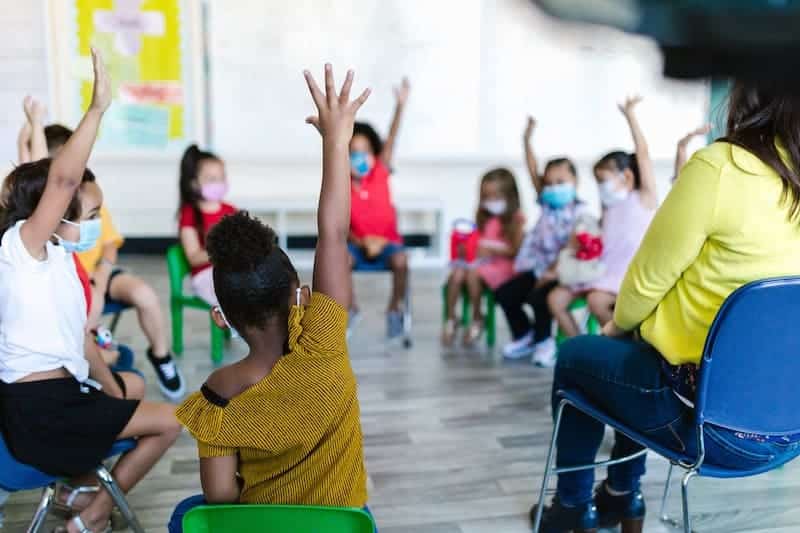
Circles: Compliment, Affirmation Language, and Community
Mediated conversations where all students get to participate in a subject with positive intent help to create a safe sense of belonging among all students. Particularly students with trauma in their backgrounds who may find it difficult to feel at ease in a group setting.
In the pursuit of creating a safe and nurturing environment for all students, but particularly for those students with traumatic experiences in their backgrounds, it might prove valuable to incorporate classroom conversations. (KickBoard) Some examples include:
Compliment circles. Everyone in class gets a chance to pay a compliment to everyone else in the class.
Affirmation language circles. Everyone gets a chance to say something affirming or encouraging about everyone in the class, for example, that they are capable of overcoming something challenging.
Community circles. Everyone in class gets a chance to exchange something that builds community, for example finding things they have in common that they might not have known they shared.
Conversations like this can go a long way toward making all students feel like the classroom is a safe and inclusive place.
Journaling
Sometimes writing down thoughts feels less intimidating than talking about them out loud. When children have intense emotions, such as those related to trauma, sometimes ensuring they have quiet time to journal helps with self-soothing.
Reading
In many cases, books can create opportunities for children to think about difficult subjects in a safer way than other activities. Books can lay out the realities of a tough emotional state in a way that makes it possible to consider that state and its repercussions constructively.
There are a lot of trauma-informed reading materials out there, including teaching resources and books appropriate for students to read. (Lee&Low) Incorporating titles from a trauma-informed reading list into school curricula creates a tool for dialogue. Children might not always know what questions to ask, or they might not know how to describe the context of their questions. However, books can inspire questions, sometimes unexpected ones. They also create a context for a focused and productive conversation.
Other Trauma-Informed Tools
Students can inform educators about how they are feeling and what they need each day with a feelings and needs poster. They simply refer to the poster by writing down one of their feelings and needs at the beginning of the day. Younger students can tap the poster to show the teacher, instead of writing it down. Order the feelings posterhere.
Additionally, it’s helpful to have a corner where students can go when they are feeling overwhelmed or just need time away. A peace corner is a place where students can empty their emotional balloons. Click here to find out how to build a peace corner.
Safe, Positive, and Encouraging Lesson Plans
Creating trauma-informed activities for students should include encouraging positive relationships and developing a safe environment. Teachers can set the tone in their classrooms by identifying strengths and by encouraging resilience through positive language–you can do it!
Planning for the school year is an opportunity to add new educational layers to curricula. Adding elements of social and emotional learning through classroom activities is always a good idea. Social-emotional learning fosters better development that can improve the classroom environment and prepare children for challenges and opportunities in their futures.
Fun Indoor Classroom Games
Developing fun indoor classroom games for kids with social-emotional learning requires choosing and framing fun interactive activities. (MakingCaringCommon) Several common indoor classroom games already provide social-emotional learning opportunities. They just need to be framed so that students get used to approaching activities with the right mindset to practice social and emotional skills.
Here are a few suggestions to start with:
Social-Emotional Games for Students
Most games are already predicated on skills like paying attention, practicing memory, understanding how to use rules to make goals and follow through on decisions. As a result, turning a fun indoor game into a social-emotional learning game might be as simple as pointing out the skills the game asks the students to practice. (GSE)
For example…
I Spy
This reliable game is predicated on several important social-emotional skills. For example, it relates to focus, such as:
Practicing filtering between senses and impressions
Focusing in spite of distractions
Reacting to detailed instructions in a timely fashion
Framing this game to turn it into a social-emotional learning game might look something like this:
Tell students that this game is about exercising their “focus power.” Additionally:
Tell students they get to use “focus binoculars” to help them pay better attention to details. For younger kids, this might include miming holding a pair of binoculars to their eyes.
Make it clear that “focus power” involves more than just their sense of sight. They need to look, but they also need to listen for clues, and they need to make a point of thinking about using their minds to hush distractions.
When the game is over, moderate a conversation with the students. Get them talking about frustrations or distractions that made the game difficult, and discuss strategies for improving attention.
An important aspect of turning a game into a social-emotional learning activity is the roundup at the end. Educators can ask students to think about other times they need to use their “focus power,” and what that looks like to them.
The Name Game
With this game, students will be able to practice paying attention to what other people say. Find out about more listening skills activitieshere. This game helps students:
Practice active listening
It helps with memory, in particular, as it relates to social interactions.
It also helps with social skills.
Arrange students into a circle. Students take turns saying their name and accompany it with some kind of movement. Examples include raising their hand or sticking out a foot. Then all of the other students say that student’s name and imitate the motion. Go around the circle, repeating every new student’s name and motion and add it to a sequence. Frame this game by talking to students about engaging their “memory power.”
Before starting the game, ask students why remembering is important in and out of school.
Talk about all of the activities in life that involve “memory power.” Things like remembering where grandma lives, or which snacks you and your friends like in common, or the rules to games.
When the game is over, review with students the challenging parts of the game–talk about the easy parts too.
Talk with students about how to use memory power in their lives as it relates to making friends or other social skills.
Simon Says
The game of Simon Says creates opportunities for students to practice the following skills:
Community participation
Active listening
Paying close attention to what they’re doing
Frame Simon Says as a social-emotional learning activity by telling students how they can use their “stop and think power” to do well.
Set it up by talking about how powerful our minds are over our bodies when we are in the habit of stopping to think about our actions.
Talk through all the times, in and out of the classroom, that we need to stop and think about what we do.
When the game is over, students can talk through how they paid attention and what they did to help themselves control their bodies.
Have a class discussion about ways to practice stop and think power throughout the rest of the day.
Classroom Games for Kids
Games make excellent teaching tools. They create classroom bonding activities, and they provide learning opportunities that might not otherwise arise. In most cases, fun indoor classroom games can be turned into social-emotional learning experiences, if they’re framed correctly.
Soul Shoppe provides social emotional learning programs for schools and homeschooling families. Our in-person and online programs provide training to educators to help them learn how to create social-emotional learning classroom activities. Additionally, Soul Shoppe provides direct-to-student curriculum such as the online course Tools of the Heart. Contact us for more information here to learn more about our online courses.
Setting boundaries is important in leading a successful and emotionally rewarding life. (HarvardBusinessPublishing) Sometimes, when we feel uncomfortable we instinctively know when our boundaries are crossed. However, both children and adults often have trouble understanding what’s happening on an intellectual level at times when they have that instinctive sense that their boundaries are being crossed. Additionally, children might not always have a clear idea about how to process and respond to uncomfortable situations that result from violations of their sense of autonomy, however large or small those experiences are. (GSE)
A well-rounded education built with social-emotional learning can include learning opportunities that help children with boundaries. In order to develop into confident and well-rounded members of society, children need to learn how to define their boundaries, and subsequently, how to maintain those boundaries.
In order to create activities that incorporate teaching boundaries, it’s important to first define boundaries. Once you define these boundaries it also gives children an idea of different kinds of boundaries that need to be respected.
Here’s a brief overview of the seven (7) types of boundaries:
Seven Types of Boundaries
1. Physical Boundaries
People generally require physical boundaries in order to maintain a basic sense of safety. Everyone has different thresholds and triggers that give them a sense that their physical boundaries are not respected. Some examples include:
Unwelcome touching of any kind
How close a person is to their personal space (for example someone might be standing too close)
Sanctity of their things–is their lunch, school supplies, jacket, etc., respected?
It is important to recognize that different kids have different levels of comfort with physical boundaries. Some might need you to stand further away. Some don’t mind if their classmates touch their backpacks. Some kids love hugs and others don’t like to be touched at all. With this You Belong poster, kids come into the classroom in a line and touch the symbol of what they prefer – a hug, a high five, a handshake, or a fist bump.
Children need to be aware of what their preferences are when it comes to their physical boundaries. Then they can be encouraged to vocalize those boundaries.
2. Emotional and Mental Boundaries
Children might not always recognize that their emotional and mental boundaries aren’t being respected because they haven’t yet developed the tools to recognize and articulate their feelings about what makes them emotionally and mentally uncomfortable. Therefore, with younger kids, especially, look for clues like:
If the child has trouble talking about a particular subject
If the child is showing signs of embarrassment
These kinds of signs can mean the child is sensing that someone has crossed their mental or emotional boundaries.
3. Spiritual or Religious Boundaries
This is sometimes a challenging subject to approach in a classroom setting, but it might come up. Classrooms are full of kids with many different backgrounds. Educators will have to prepare themselves to moderate situations arising from a need for spiritual and religious boundaries.
4. Time Boundaries
School is an ideal learning environment to help children figure out how to create and defend their schedules. Adults, more than children, tend to have trouble setting boundaries with their time. Therefore, it’s valuable for children to learn how to recognize when people are taking advantage of their time so they can set boundaries in adulthood. For example, when a student is trying to complete an assignment and someone is distracting them, they can learn to say, “I’ll talk to you later. I need to do my work right now.”
5. Financial and Material Boundaries
Children won’t need to worry about placing boundaries around finances in elementary school. Financial boundaries have more to do with adulthood. However, class stores and using play money can be introduced in elementary school to help them become aware of financial priorities.
6. Sexual Boundaries
It is never too early for children to develop an understanding of having and respecting bodily boundaries. While the youngest grades might not be the ideal environment for conversations about sexual boundaries, it is an ideal environment to start talking about respecting the physical comfort and safety of themselves and other people.
7. Non-negotiable Boundaries
Boundaries are about safety and comfort. Therefore, violation of those boundaries can seriously compromise a person’s sense of well-being. Because every child comes from a different background, every child will have unique ideas and situations that will inform personal non-negotiable boundaries. Both parents and educators can help children figure out those boundaries.
Boundaries for Kids
Kids will test boundaries. They will test their own boundaries, trying things to see how uncomfortable those things leave them. Their peers will have boundaries, and kids will test those, figuring out how the community will react to them. Teachers and parents will set boundaries, and kids will push against those boundaries to figure out how far they can be pushed. It’s not only natural to do it, but kids will learn a lot about how boundaries work by checking out how pliable the boundaries around them are. (UsableKnowledge)
As a result, one effective way to teach boundaries in a safe way is through demonstration. (ChildMindInstitute) Boundaries correlate with responding to actions, feelings, and social interactions. Therefore, children will look to their peers and the important adults in their lives to learn how to create appropriate boundaries.
Teaching Boundaries Activities
Here are a few suggestions for creating activities that will create more intentional learning experiences for children:
Board games and yard games. These are great ways to simulate life’s boundaries. Talk about why the rules are important. What happens when a rule is broken? etc.
Class discussions. Moderated conversations about the different types of boundaries help relate abstract ideas to experiences.
Role-playing. Children learn a lot from acting out complex scenarios. (HowtoAdult)
Value assessment. When children have to articulate what they find important they will also start thinking about protecting those values.
Reading with subsequent guided conversation.
Soul Shoppe encourages building healthy boundaries in children. Whether helping in the classroom or assisting parents at home, Soul Shoppe provides tools to help teachers and parents teach social emotional skills to children. Click for more information on SEL Programs for Elementary Schools or our parent support programs.
If children leave school with a belief in their ability to successfully set then accomplish their goals, then their education has helped boost them towards success. Creating lessons that teach self-efficacy in the classroom can be some of the most valuable lessons that educators can provide. (GSE) We have created a guide for self-efficacy in teaching for elementary students.
Self-Efficacy in Teaching
Teaching self-efficacy in the classroom means showing students how to plan their actions while feeling confident in their ability to carry out their plans. (SERC) Using engaging tactics will reinforce a sense of self-determination and personal effectiveness.
Here are some things to consider when setting out to incorporate self-efficacy into a teaching curriculum. (TheEducationHub)
1. Create Opportunities that Capitalize on Successes
Few moments reinforce confidence like experiencing successes. Often children, because of fewer experiences in their lives, haven’t yet experienced as many independent successes. Therefore, beginning a habit of believing that they can succeed is a valuable lesson.
Practicing extra gestures of positive reinforcement for both minor and major achievements is a great opportunity to improve self-efficacy. (TeachStart) For example:
Send children a letter or postcard praising them for their achievement.
Create an award where students can nominate each other for achievements they recognize.
Designate an achievement wall, where students can display their achievements for the class.
Creating a positive reinforcement feedback system goes a long way toward teaching children to believe in themselves.
2. Peer Modeling
Peer modeling is the practice of recognizing students who will step forward to provide clarity in classroom dialogue. Students who are asked to rise to the challenge may be viewed by their peers as someone to trust to have the right answers on a given subject. This can bolster a child’s confidence. Encouraging peer modeling in the classroom is a great tactic in building self-efficacy. This process must be approached carefully, but if done well it can be an effective aid to self-efficacy in education.
3. Goals and Feedback
Setting goals is a key skill. Implementing exercises where students have to set goals, follow through with them, and deal with windfalls and setbacks will give them a valuable skill to carry forward into the rest of their lives.
Educators should help students set and keep goals, and at the same time they should create feedback opportunities so that students can learn how to assess their plans. Additionally, this will help them learn how to make adjustments to goals where necessary.
Goal-setting journals, worksheets, visual boards, and goal-tracking sheets are all helpful tools. Read more about goal-setting for studentshere.
4. Self-Assessment
The practice of self-assessment isn’t always used in curricula driven by test scores and grades. If children are encouraged through classroom activities to develop a practice of self-assessment, asking themselves to make critical appraisals of the quality of their own work, it will serve them well for the rest of their lives. Using self-assessment sheets that are reviewed, or even simply put into an anonymous dropbox, can help students learn how to assess themselves on a given task. Self-assessment is a powerful tool in self-efficacy teaching.
5. Create Problem Solving Opportunities
Perhaps the single most effective skill any educator can impart to their students is the ability to problem solve. When students are empowered to approach every experience in life with a problem-solving mindset, they will be prepared to cope with many of the puzzles life throws their way.
An example of a problem-solving activity is the pyramid activity. (Wrike) Arrange students into groups and have them form a pyramid. Tell them they can only move two people but must reverse the pyramid.
6. Support Affirmation
A student’s self-confidence is affected by more than academic achievement. Since children spend a lot of time in school or engaging in school-related activities, it’s important for educators to help their students learn self-affirmations, as they pertain to parts of their personality other than academic achievement. Their social skills, hobbies like juggling or origami, their creative skills, or even their skills in being a good helper, are all examples. Self-affirmation is a large part of self-efficacy.
Teachers Teaching Self-Efficacy to Themselves
Kids learn a lot by example. Children are watching us all the time, and one of the most effective ways to teach them social and emotional learning skills is by living the lessons we wish to teach.
Educators who demonstrate self-efficacy will teach self-efficacy.
Bullying can be one of the most devastating experiences of a child’s life. Studies have shown that there are several negative effects of bullying that impact everyone involved, including the child on the receiving end as well as the child who does the bullying behavior. (MentalHealth) Bullying can have long-lasting, detrimental effects on a person’s self-esteem and general emotional well-being.
The reality is that most classroom settings can make bullying difficult to monitor and counteract. Students in a classroom outnumber their teachers, often thirty-to-one. Simple math makes it clear how hard it is for a teacher to even know about every instance of bullying behavior, let alone have the capacity to intervene. Therefore, being proactive can help mitigate the issue before trouble starts.
It’s important for teachers to recruit their students into a classroom-wide anti-bullying effort.
Anti-Bullying Activities for the Classroom
The fundamentals of teaching anti-bullying include (GSE):
Encourage students to be part of the solution. Children often rise to the occasion when they’re invited to do so.
Have honest conversations about the effects of bullying. For children, awareness of the consequences of their actions will help them make more empathic decisions.
Find opportunities to strengthen community and friendship. Stronger community ties help children both avoid bullying behaviors themselves and feel like they have choices when it comes to doing something about bullying when it occurs.
Use role playing. Learning through role play helps children use their imaginations and provides the opportunity to experience life in someone else’s shoes for empathy and understanding. It also involves problem-solving in many scenarios which helps prepare them for challenging social encounters.
Reinforce positive behavior. Children often look for reinforcement. Providing clear reinforcement of positive behavior through acknowledgment, rewards, etc. helps children to evolve.
These principles can be incorporated into anti-bullying activities.
Anti-bullying activities give students the chance to develop and practice the skills of empathy, fairness, and kindness. These activities will create a foundation for conversations about bullying and help children learn how to take care of each other.
Here are a few ideas for anti-bullying activities for elementary students to get started.
Anti-bullying Activities
Tube of Stuff Activity
The purpose of this activity is to demonstrate that actions have consequences that can’t be taken back. It’s appropriate for small children in kindergarten or first grade.
In this activity, children are given a tube of paint or toothpaste and a long roll of butcher paper. Children take turns squeezing the contents of the tube in a long line. When the tube is empty, they will be asked to put the paint or toothpaste back into the tube.
The teacher can then explain that what we say is like that paint or toothpaste. You can’t take things back. (MeraKilane)
Pledge Activity
Providing children with chances to take ownership of their actions creates opportunities for growth. Children, if given the chance, will often rise to the occasion if they’re asked to act with integrity.
Teachers can create an anti-bullying pledge that their students all sign. This helps show students that what they do matters. It also creates buy-in when implementing an anti-bullying classroom culture.
Gamify Kindness
Giving positive reinforcement for acts of kindness helps students feel excited about being kind to their fellow classmates. It also creates a precedent for children to carry kindness outside of the classroom, and into adulthood.
If educators create positive feedback loops for their students to receive small rewards for acts of kindness, it can help encourage a culture of kindness.
Create an “Acts of Kindness Chart”:
Acts of kindness receive gold stars.
Multiple acts of kindness within a specified period might lead to a classroom celebration.
Kids might play “I spy” to report acts of kindness that they see each other carry out.”
Compliment Circle
This activity turns the practice of kindness into an interactive game. Have students sit in a circle. Students take turns saying something complimentary to every member of the classroom. Depending on the age group, encourage students to go beyond superficial compliments such as “I like your shoes,” to more meaningful compliments such as “You are always nice on the playground.” Go around the circle until everyone has had a chance to compliment the entire class.
Reading Books
Find reading lists that include books about understanding bullying and what to do about it. (WeAreTeachers) Books are some of the best ways for children to think through complicated social and emotional situations like bullying. Then, through questions and guided conversation, children can talk through solutions.
Anti-bullying through Social and Emotional Learning
At Soul Shoppe, we use social and emotional teaching techniques to help educators and parents. It’s important for all students to see the classroom as a safe place. Our Peacemaker Training teaches educators how to build anti-bullying environments in schools. Contact us with questions about creating anti-bullying activities for the classroom.