You've just explained the directions, and a few students are already asking what to do. At home, you've asked your child to put on shoes, grab a water bottle, and meet you at the door, but only one of those things happened. Those moments are easy to read as defiance, laziness, or distraction.
Usually, they're a listening problem. Not hearing, but listening. Filtering noise, holding information, noticing tone, reading emotion, and staying present long enough to respond well. In a busy classroom or a full family schedule, that's a big skill set.
That's why games for listening matter so much. They give children low-pressure practice with attention, self-regulation, empathy, and communication repair. They also help adults shift from “Why aren't they listening?” to “What support helps them listen better?” That question changes everything.
Many adults need that reminder too. Some of the same principles that help kids tune in also show up in strong leadership tips from Corporate Challenge Events. Clear expectations, emotional safety, and repetition work across ages.
Listening games have deep roots. Maria Montessori's sensory methods date back to 1912, and active listening games have remained part of early childhood education for decades. One example, documented by Mathful Play's Listen, Count, and Guess activity, describes a classic bucket-and-object game and cites sensory play research showing 85% improvement in auditory discrimination skills among children ages 3 to 5 after four weeks of regular play.
1. Circle Listening
Some games for listening are lively. This one is quiet on purpose.
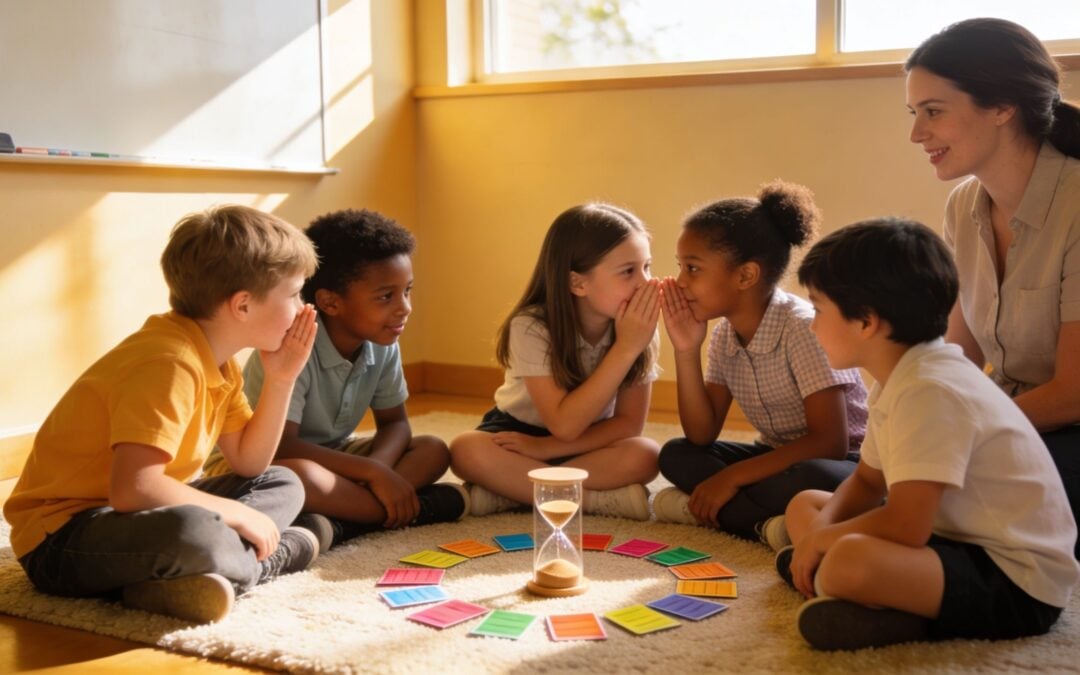
In a talking circle, students sit in a circle, and only the person holding the talking piece speaks. Everyone else listens without interrupting. That single structure slows the room down and gives children a clear experience of what respectful attention feels like.
Circles work best when adults stop treating them like a performance. Children don't need a perfect answer. They need time, predictable norms, and a real chance to be heard.
How to run it well
Start small. A group of 8 to 12 is usually easier to manage than a whole class if students are new to the format. Use a simple object as the talking piece, such as a smooth stone, a small stuffed animal, or a wooden stick.
Use low-stakes prompts first:
Easy entry prompt: “What's one sound you heard on the way here?”
Belonging prompt: “What helps you feel calm at school?”
Repair prompt: “What should someone do when they interrupt by accident?”
If you want a school-based model for this work, Soul Shoppe shares practical examples in its piece on restorative circles in schools.
Practical rule: Don't force every child to speak on the first round. Passing is often what makes the circle feel safe enough for honest participation later.
This practice aligns naturally with SEL because it teaches turn-taking, perspective-taking, and emotional restraint. The strongest circles aren't the ones with the most polished sharing. They're the ones where children begin responding to one another with less sarcasm, fewer interruptions, and more patience.
A practical classroom example: after recess conflict, don't begin with “What happened?” Start with “What do you need from others so you can listen right now?” That question lowers pressure and often gets better participation.
Later, you can deepen the prompts:
Conflict awareness: “What makes listening hard when you're upset?”
Community building: “What does respect sound like?”
Reflection: “When did someone listen to you this week?”
Here's a short visual introduction you can use if students need to see the structure before trying it.
Make the goal visible
For preschoolers, invisible ideas fade fast. A drawing, a photo, or a simple picture card keeps the goal in view.
Research from Boston Children's Health Physicians notes that visually representing goals can support follow-through. For preschoolers, drawing the goal can increase task completion for independence skills by up to 50% compared with verbal instructions alone.
That doesn't mean every family needs a perfect chart. It means the child benefits from seeing what they're aiming for.
Try these easy versions:
Draw it: Sketch a toothbrush, backpack, or toy bin.
Use a photo: Take a picture of the child completing the step.
Make a first-then card: “First shoes on, then outside.”
Use one symbol: A cup icon near the sink means “put cup here.”
“Our goal is something we can see and do.”
Sample scripts for common preschool moments
Adults often ask for exact words. Here are a few.
Situation
Try saying
Morning dressing
“Your goal is one sleeve by yourself. I'll help with the other one if you need it.”
Classroom cleanup
“We're all working on one cleanup goal. Put three items where they belong.”
Turn-taking
“Your goal is to ask for a turn with words.”
Bedtime routine
“Let's draw your bedtime goal. Pajamas first, then book.”
The simpler the script, the more likely children are to remember it and act on it.
A Toolbox of Goal-Setting Activities and Examples
Sometimes adults understand the concept but still wonder, “What goal should I use tomorrow?”
The easiest answer is to start where the child already bumps into difficulty. If mornings are hard, build a morning goal. If transitions are rough, create a transition goal. If a child wants to help, turn that desire into a helper goal.
For families who like paper tools, journals, or planners for older kids and adults, it can be interesting to look at strategic partners for personal growth. For preschoolers, though, the “planner” is usually much simpler: a photo, a picture card, a basket label, or a tiny checklist with images.
Sample Preschool Goal-Setting Ideas
If you're planning classroom routines, preschool lesson plan ideas can help you connect goals to the flow of the day.
Domain
Example Goal
What to Say
Activity Idea
Self-Care & Independence
Put both shoes by the door
“Your goal is shoes by the mat.”
Make a shoe spot with tape or a picture label
Self-Care & Independence
Wash hands before snack
“What comes first before we eat?”
Put picture cues by the sink
Self-Care & Independence
Zip coat after help starting
“You pull it up after I click it.”
Practice on a dressing board or jacket station
Helping & Community
Carry one napkin to the table
“Today you're our napkin helper.”
Set up a helper basket near meals
Helping & Community
Put one book back after reading
“When you finish, the book goes home to the shelf.”
Match books to shelf labels with pictures
Helping & Community
Greet one classmate or family member
“Can you say good morning to one friend?”
Use arrival name cards
Quiet Time & Focus
Sit and look at one book for a few minutes
“Your goal is book time with your body calm.”
Create a cozy reading spot
Quiet Time & Focus
Finish one simple puzzle step
“Let's find the edge piece first.”
Offer a small puzzle with a tray
Quiet Time & Focus
Stay with one center before switching
“Pick one job, then we'll check back.”
Use a center choice card
Movement & Motor Skills
Hop to the line
“Can your feet do two hops to the line?”
Make a hop path with floor spots
Movement & Motor Skills
Carry a tray with two hands
“Your goal is two hands all the way.”
Practice with beanbags or cups
Movement & Motor Skills
Stack blocks carefully
“Build up, then stop and look.”
Challenge the child to make a short tower
Social-Emotional Skills
Ask for help with words
“What can you say if it's too hard?”
Practice with puppets
Social-Emotional Skills
Wait for one turn
“Your goal is to wait, then go.”
Use a turn-taking game
Social-Emotional Skills
Use a calm-down spot
“When your body feels big, you can go to your cozy spot.”
Add a visual choice card for calming tools
Choose the goal by watching, not guessing
The best examples come from observation. Notice where a child nearly succeeds. That's usually the sweet spot.
For example:
A child who throws all the toys during cleanup may not need “better behavior.” They may need a smaller cleanup target.
A child who avoids drawing may need a goal around sitting for one short art step, not finishing a whole project.
A child who always asks for help immediately may need a goal like “try one step, then ask.”
Classroom lens: Strong goals often begin with, “I noticed you can almost do this.”
That tone protects dignity. It invites partnership instead of correction.
Tracking Progress with Purpose and Joy
Tracking can help children stay engaged, but only if it feels encouraging. When adults turn tracking into pressure, preschoolers either perform for the reward or avoid the task altogether.
The better approach is to make progress visible while keeping the emotional message clear. We're noticing effort. We're not grading worth.
That matters because self-recording changes the child's role. They're no longer just receiving adult feedback. They're participating in their own growth.
Simple self-recording tools work best:
Pom-pom jar: Add one pom-pom after the child completes the agreed step.
Picture checklist: The child marks off images, not words.
Sticker path: One sticker for each day they practice.
Goal ladder: Each rung shows one tiny part of the task.
The tool should match the child's developmental level. If the tracker is confusing, it becomes one more demand.
Keep celebration grounded in effort
There's nothing wrong with being happy when a child meets a goal. The key is what you highlight.
Try responses like:
“You kept working when it felt tricky.”
“You remembered the first step on your own.”
“You came back after getting frustrated.”
“You used your picture card to help yourself.”
Those comments teach children what to value in themselves.
A supportive classroom routine can strengthen this. During meeting time, children might share one goal they're practicing or one step they tried that day. In many classrooms, simple daily check-ins and reflection tools create the emotional safety needed for that kind of sharing.
When tracking stops helping
Sometimes a chart loses its power. Sometimes a child starts demanding the sticker more than caring about the skill. That's your cue to adjust.
You might:
Simplify the tracker: Move from a weekly chart to one card.
Change the visual: Use photos instead of icons.
Shorten the time frame: Track one routine, not the whole day.
Pause the tool: Keep the goal, remove the chart for a while.
Tracking should support ownership. If it starts feeling like surveillance, it's time to reset.
Adapting Goal Setting for Every Child
Many goal-setting resources often fall short. They offer one chart, one script, and one version of success. Preschoolers don't come in one version.
Some children are highly verbal and eager to announce a goal. Others communicate through movement, gestures, AAC, or very few words. Some love visual charts. Others respond better to real photos, objects, or a short adult-child routine repeated the same way every day.
If a child has communication differences, don't assume they can't participate in goal setting. Change the entry point.
For example:
For children with limited verbal language: Offer two photo choices. “Coat” or “hands washed.”
For children with motor challenges: Make the goal about one meaningful part of the routine they can own.
For children who are easily overwhelmed: Use one goal in one setting, with the same adult and same visual each time.
For highly active children: Build movement into the goal. “Carry two cushions to the circle” may work better than “sit still nicely.”
For cautious or shy children: Start privately. A public goal-share can come later, or not at all.
Use tools that match the child, not adult convenience
Sticker charts are popular because adults can set them up quickly. But quick for adults isn't always accessible for children.
Better options might include:
Real photos instead of cartoon icons
Object cues like an actual spoon, shoe, or book
Single-step boards rather than multi-step charts
Simple tech supports if a child responds well to them
Choice-based language so the child has some ownership
The most effective goal is the one the child can understand, enter, and experience as success.
In inclusive practice, child-led doesn't mean child-alone. It means we watch carefully, adapt thoughtfully, and refuse to confuse compliance with growth.
If you want support building inclusive, practical SEL routines around goal setting, communication, and self-regulation, Soul Shoppe offers programs and resources designed to help school communities and families create more connection, confidence, and belonging for every child.
A student walks in from recess with a scraped knee. A classmate shrugs and says it was an accident. The adult nearby heard laughter before the fall, but missed the moment of contact. At home that afternoon, the same child says, "I'm fine," yet starts asking to skip the bus, gym, or lunch line.
Physical bullying often hides inside those unclear moments. Adults usually picture a visible fight, but many physical bullying examples begin as quick acts that are easy to dismiss. A shove in a crowded line. A trip framed as clumsiness. Hair grabbed during a tense exchange. A backpack slapped from a student's hands while others watch. Like a smoke alarm that chirps before a full alarm sounds, these smaller incidents can signal a larger pattern.
What separates bullying from rough play or a single conflict is not just the contact. It is the repeated behavior, the intent to intimidate, and a power imbalance between the students involved.
Federal school crime and safety reporting summarized by the National Center for Education Statistics describes physical bullying among the forms students report at school, including being pushed, shoved, tripped, or spit on, as shown in NCES Indicators of School Crime and Safety reporting on bullying victimization. For many students, the injury is only part of the harm. The bigger change is often internal. They start scanning the hallway, avoiding transitions, or choosing isolation because school no longer feels predictable.
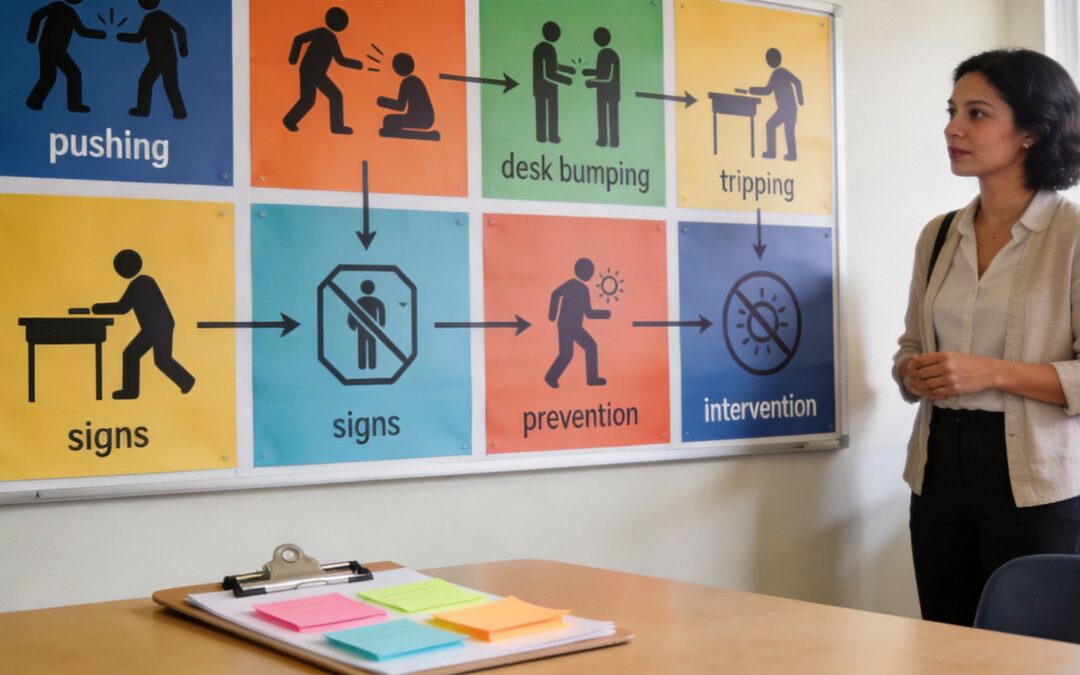
The examples below are designed for real decisions adults make every day. Each one pairs a physical bullying behavior with a three-part toolkit: signs you can observe early, prevention steps that reduce the chance of escalation, and SEL-based response scripts you can use in the moment. That structure helps teachers, caregivers, and school staff do more than label behavior. It helps them notice patterns sooner, respond calmly, and teach safer ways to handle conflict.
1. Hitting, Punching, and Striking
This is the form adults recognize fastest. One student hits another in the arm during math centers. A child gets punched in the back after days of taunting. A student uses an object, not just a hand, to strike someone and then claims they were “messing around.”
A documented school case from Boston Children's Hospital shows how serious this can become. In that account, a fifth-grade student named Samantha experienced ongoing bullying that escalated into a male classmate punching her in the back after repeated harassment. After the assault and an inadequate school response, she missed 30 days of school that year, described in Boston Children's Hospital's account of Samantha's story.
What adults usually notice first
Students who are being hit often change their body language before they tell the full story. They may flinch when a certain peer gets close, protect one side of their body, ask to stay inside during recess, or suddenly want an adult nearby during transitions.
Teachers may also notice social warning signs. A peer group goes quiet when an adult approaches. Witnesses look at one another before answering. The targeted student minimizes what happened, but their face shows fear.
Check injury patterns: Bruises on upper arms, shoulders, ribs, or the back can signal targeted contact rather than ordinary play.
Watch for protective behavior: A child who turns sideways, ducks, or keeps distance from one student may be telling you something without words.
Protect witnesses: Students are more likely to report when they know adults won't name them publicly.
Practical rule: Don't ask only, “Did he hit you?” Ask, “Has this happened before, and who was nearby each time?”
Prevention and response script
Prevention starts with clear adult language. Students need to hear that striking someone is not a joke, not horseplay, and not something they have to solve alone. Staff also need a shared response: stop the behavior, separate students calmly, check for injury, gather statements privately, and document specifics.
Try language like this:
“I saw contact that wasn't safe. I'm separating you now. We'll talk privately, and I'm going to make sure everyone is okay.”
For the targeted student:
Name safety first: “You didn't deserve to be hit.”
Invite detail gently: “Tell me what happened right before, during, and after.”
Offer choice: “Would you like to talk here, with the counselor, or with another trusted adult?”
For the student who hit:
Set a firm boundary: “You may be upset, but you may not use your body to hurt someone.”
Build accountability: “You're going to tell me what choice you made, what impact it had, and what repair is needed.”
2. Pushing, Shoving, and Tripping
A student reaches the stairwell with the rest of the class, then hesitates. Another student brushes past and clips their shoulder just hard enough to throw them off balance. By the time an adult turns, it looks like clumsiness.
That is part of why pushing, shoving, and tripping are missed so often. The act is quick, the setup is easy to hide, and the target is often left looking like the one who “fell.” Yet the message lands with force. You are not safe when I am near you.
Unlike an isolated accident, bullying with body contact follows a pattern. It often shows up in motion. Hallways, lunch lines, dismissal areas, locker rows, and classroom doorways give a student cover because everyone is already squeezed together. For a child on the receiving end, each transition can start to feel like crossing a narrow bridge while someone keeps shaking the rails.
A common example is subtle but repeated. One student gets nudged off the walking path every morning. Another is tripped near the same table during lunch pickup. Nobody sees a punch, but one child keeps losing space, balance, and dignity.
Here's a short visual resource that can support staff discussion during training meetings:
Keep the script simple
You don't need a long peace process for five-year-olds. Three steps are enough in most classrooms: say the problem, listen, pick a solution. If children are too escalated, step in and co-regulate first.
What doesn't work is forcing instant apologies. A child can say “sorry” and still have learned nothing. It's more effective to help them repair with action, like returning the marker, checking on a friend, or inviting someone back into play.
“Use the words before you need the words.” Practice at calm times so children can access them during stress.
Differentiate it this way:
For language learners: Add picture cards for key phrases.
For impulsive children: Let them physically hold a step card to pace the conversation.
For home use: Parents can role-play sibling conflicts using stuffed animals instead of direct correction.
Simple assessment: Listen for independent use of taught phrases and notice whether children need less adult mediation in recurring conflicts.
5. Self-Awareness and Personal Strength Activities
Kindergarteners often know what they like before they know what they're good at. That's a useful starting point. Preferences, interests, helpers, and proud moments all lead toward self-awareness.
An “All About Me” activity becomes SEL when it goes beyond favorite color. Children need chances to identify what helps them, what feels hard, and where they shine.
Lesson plan in a box
Learning focus: Recognizing strengths, preferences, support systems, and personal identity.
Materials: Mirrors, paper for self-portraits, family questionnaire, crayons, and sentence stems such as “I'm good at…” and “I feel proud when…”.
Directions:
Start with observation: Children look in a mirror and draw themselves.
Add personal details: Invite them to finish prompts about favorite play, people who help them, and something they're learning.
Use peer noticing: Pair children to share one strength they saw in a classmate, such as “you build carefully” or “you help people zip coats.”
Display the work: Put self-portraits and strength statements at child eye level.
What to watch for
Some children light up when asked about strengths. Others freeze because they aren't used to talking about themselves in positive ways. That's normal. Offer examples tied to observable behavior, not personality labels alone.
A useful trade-off here is between polish and authenticity. Adult-made projects may look beautiful, but they hide the child's real voice. Messier work often tells you more.
Differentiate it this way:
For children who struggle to generate ideas: Offer photo choices or oral interviews.
For children with limited fine motor stamina: Let them dictate while an adult scribes.
For families: Ask caregivers to contribute one “I notice…” statement about their child at home.
Simple assessment: Look for richer self-descriptions over time. “I like dinosaurs” can grow into “I keep trying when puzzles are hard” or “I ask friends to play.”
6. Cooperative Games and Team Building Activities
Not every game in kindergarten needs a winner. In fact, some of the best social emotional learning activities for kindergarten remove winning on purpose so children can focus on communication and shared goals.
Cooperative games help children practice waiting, noticing others, and solving problems together without the emotional spike of competition. That makes them especially useful early in the year or after social tension in the class.
Lesson plan in a box
Learning focus: Cooperation, turn-taking, shared attention, and group problem-solving.
Materials: Parachute or sheet, soft ball, blocks, painter's tape, or any simple movement props.
Directions:
Choose one shared mission: Keep the ball on the parachute, build one class tower, or cross a taped “river” together using mats.
Name the success condition clearly: “We succeed if everyone stays in the game and we solve it together.”
Pause for reflection: After one round, ask what helped the group.
Repeat with one change: Add a challenge such as quieter voices, slower bodies, or a new partner.
Good competition versus bad friction
There's nothing wrong with occasional competitive play, but young children often need more coaching than adults expect when they lose. Cooperative formats reduce that friction and make room for children who usually withdraw.
The mistake is assuming children automatically know how to collaborate. They don't. You still need to model phrases like “your turn,” “let's try your idea,” and “we need everyone.”
A related implementation gap in SEL is measurement. One summary notes that many programs still don't include reliable assessment tools, which leaves schools looking for practical ways to track growth in skills like emotion regulation and empathy. The discussion of this gap in kindergarten SEL implementation points toward simple observation rubrics and checklists as an area educators still need.
Differentiate it this way:
For children who dominate: Give them a listening role or ask them to repeat another child's idea first.
For children who hesitate: Pair them with a steady peer and assign a clear job.
For home use: Families can do cooperative puzzles, blanket forts, or “build one tower together” challenges.
Simple assessment: Use a quick teacher checklist. Note who waits, who invites others in, who recovers after mistakes, and who can share materials without adult prompting.
7. Gratitude and Appreciation Practices
Gratitude routines can become shallow fast if they turn into forced positivity. In kindergarten, appreciation works when it stays specific, honest, and connected to relationships. Children don't need to be thankful all the time. They need practice noticing what is good while still having room for hard feelings.
This is a strong closing or transition routine because it helps children end the day connected rather than scattered.
Lesson plan in a box
Learning focus: Noticing support, expressing appreciation, and strengthening classroom belonging.
Materials: Paper leaves or sticky notes, a bulletin board or wall space, sentence stems, and markers.
Directions:
Set a narrow prompt: “Name one person, place, or moment from today you appreciate.”
Model specificity: “I appreciate Mateo because he held the door when my hands were full.”
Record it visibly: Add children's words to a thankfulness tree or appreciation board.
Invite response: Let the child receiving appreciation say “thank you” or smile and wave if they prefer.
Keep it grounded
Some children will say “my toys” or “ice cream” every time. That's fine at first. Then gently widen the lens with follow-up questions about people, effort, comfort, or help.
What doesn't work is using gratitude to bypass real problems. If a child had a hard day, let both things be true. “You were sad at cleanup, and you also appreciated playing with Ana” is a healthy message.
The market for SEL tools and programs continues to grow, with the global social and emotional learning market projected to rise from USD 2.71 billion in 2026 to USD 15.67 billion by 2034, according to Fortune Business Insights' SEL market projection. For schools, that growth is one more reason to choose routines that staff can sustain, not just purchase.
Appreciation lands best when children can connect it to a real action they saw or received.
Differentiate it this way:
For children who struggle to generate ideas: Offer stems like “I appreciated when…” or “Thank you for…”
For nonwriters: Let them dictate or draw the appreciated moment.
For families: Try a bedtime routine where each person thanks one other person for something specific from the day.
Simple assessment: Notice whether children begin offering appreciation without prompting and whether peer relationships soften around children who are often overlooked.
Morning meetings, end-of-day reflections, family routines
Low-cost way to reinforce positivity and appreciation
Weaving SEL into the Fabric of Your Classroom
These routines work because they fit real kindergarten life. They don't require a special week, a perfect class, or an hour carved out of an already full schedule. They work when they show up in morning meeting, transitions, play, conflict, cleanup, and dismissal.
Consistency matters more than variety. One teacher may get strong results from a daily feelings circle and one breathing routine. Another may lean on puppets for conflict role-play and a weekly appreciation board. Both approaches can work if children get repeated practice and adults use shared language across the day.
There's also a practical reason to treat this work as foundational. Some newer conversations in SEL point to a gap between standalone activities and classroom instruction. The discussion of SEL integrated with academics reflects what many educators already know firsthand. Children participate more fully in literacy, math, and play when they feel safe, connected, and capable of managing frustration.
If you're leading a classroom, start with one routine you can sustain for a month. If you're an administrator, look for schoolwide language and simple observation tools so teachers aren't each inventing their own system. If you're a parent, borrow one practice and repeat it at home in a low-pressure way. Repetition builds transfer.
These choices also support engagement. Children learn more when they feel that they belong, can take risks, and know what to do after mistakes. That's one reason classroom culture and how to increase student engagement are so closely connected.
For schools that want a more coordinated approach, Soul Shoppe is one relevant option. The organization offers SEL programs focused on connection, safety, empathy, self-regulation, mindfulness, communication, and conflict resolution for school communities. What matters most, though, isn't picking the fanciest program. It's choosing practices that adults will use, children can understand, and families can reinforce.
Kindergarteners are learning far more than letters and numbers. They're learning how to be with themselves and with other people. That deserves time on the schedule.
If you want support building a shared SEL language across classrooms, families, and school staff, explore Soul Shoppe for programs, tools, and practical strategies centered on connection, safety, and empathy.