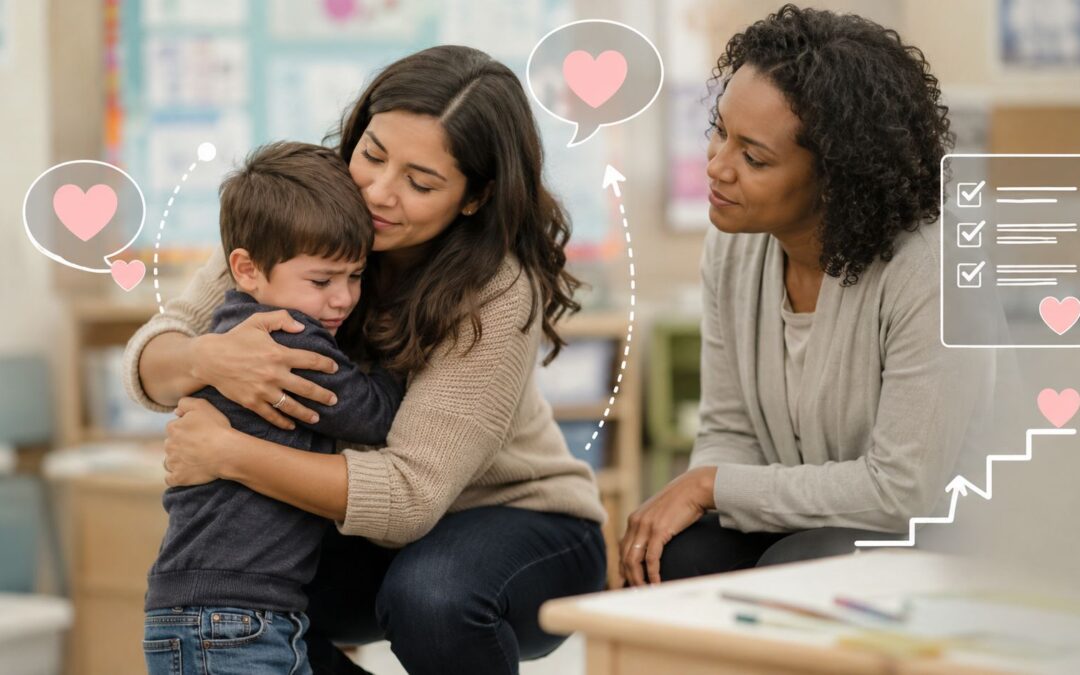
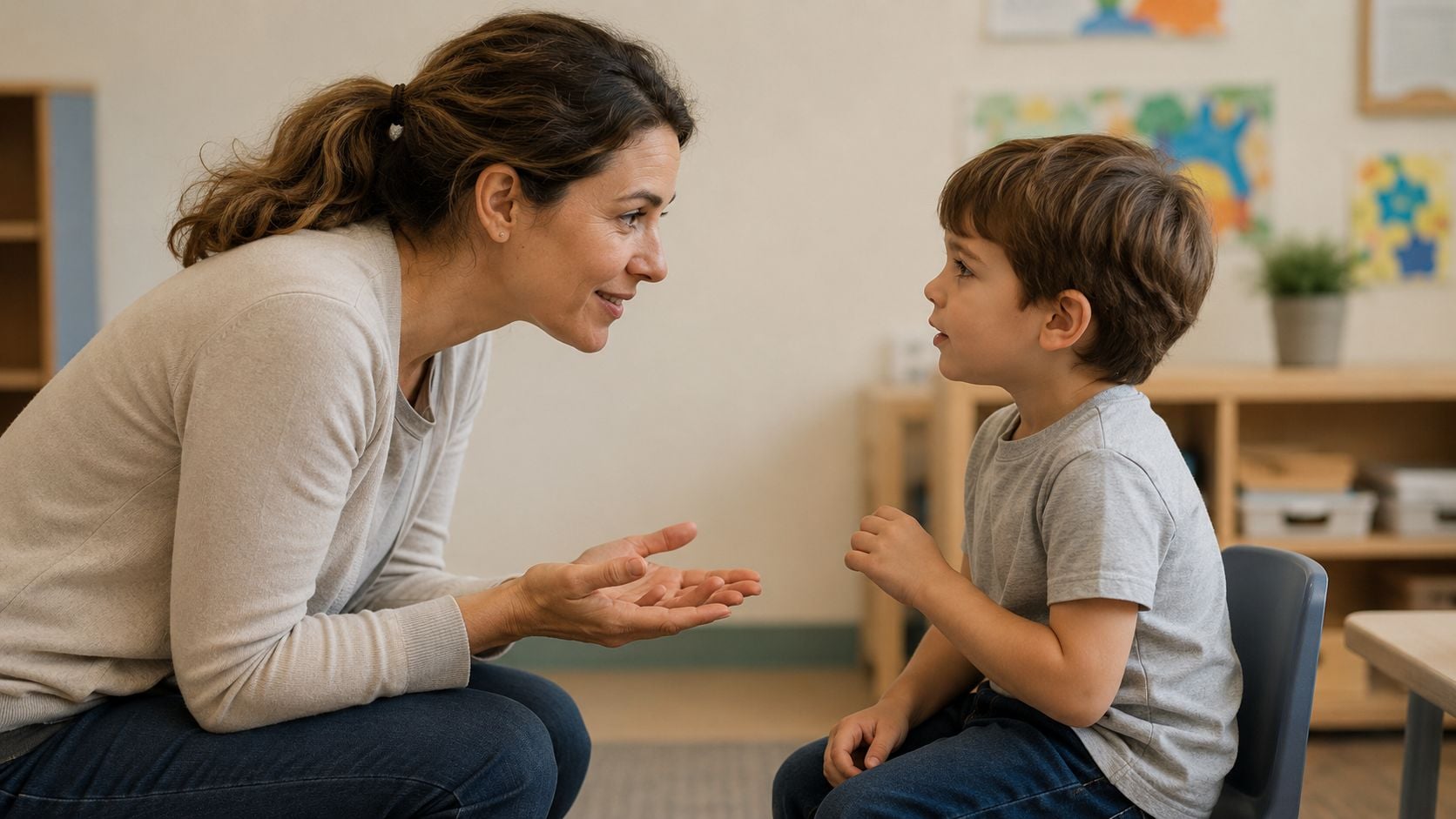
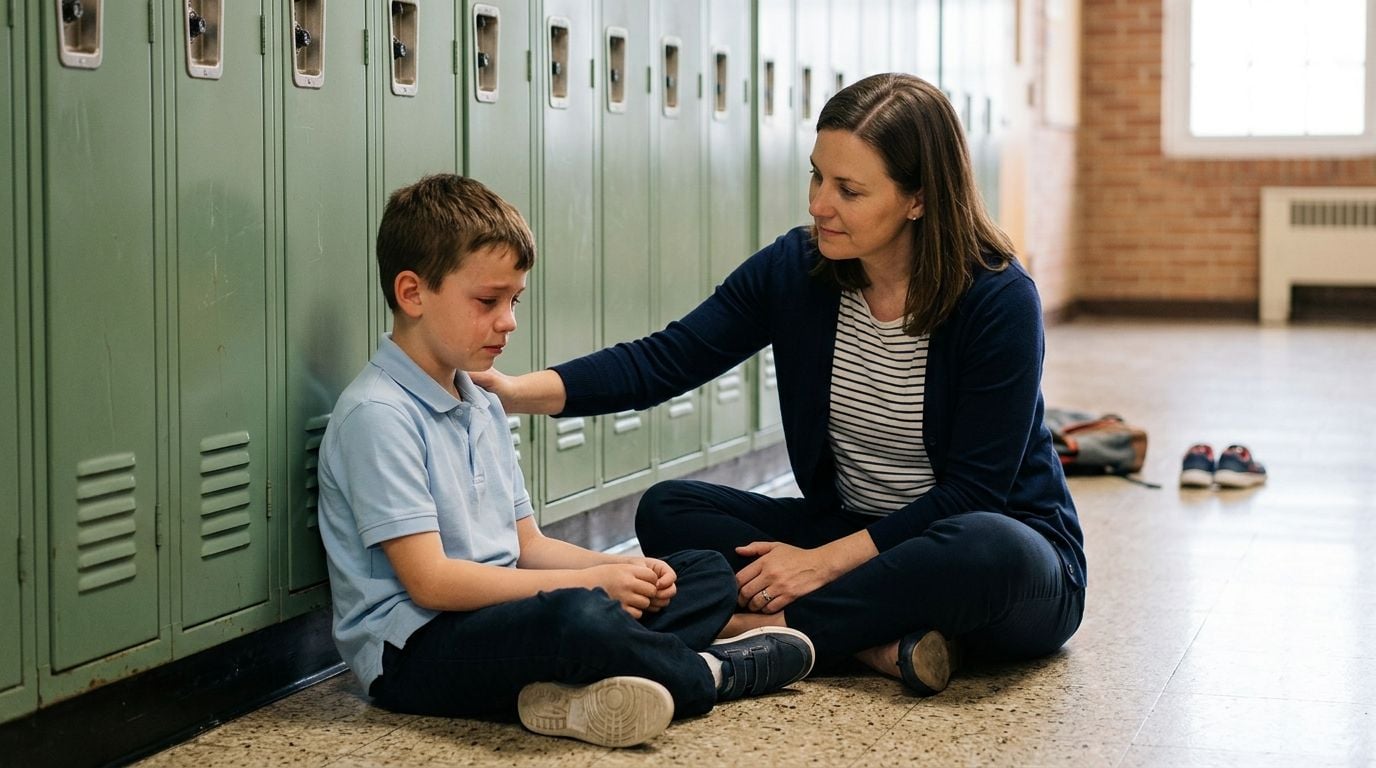
A student arrives at school unusually quiet, a child bursts into tears after losing a game, or a classmate sits alone while everyone else joins a group. In each moment, the adult has a choice. You can rush toward advice, correction, or reassurance, or you can pause long enough to understand what the child is experiencing.
Showing empathy means noticing another person's experience, communicating that it matters, and responding in a way that supports safety and connection. It doesn't mean agreeing with every action or solving every problem immediately. It means helping a child feel seen before guiding them toward a safer, kinder, or more useful next step.
Empathy also gives social-emotional learning a practical shape. Shared language, such as naming feelings, asking perspective-taking questions, and repairing harm, helps children and adults respond more consistently at school and home. The examples below offer short scripts, realistic K–8 situations, age-appropriate adjustments, and repeatable practices that turn empathy into something children can hear, see, and use.
1. Active Listening with Reflective Responses
Active listening begins with a simple shift: stop planning your response before the child finishes speaking. Give the words your full attention, whether that means setting down a grading pen, turning away from your phone, or pausing a household task. Children are more likely to explain what happened when they sense that an adult is listening to understand rather than preparing to correct.
Reflect the child's message and feeling before offering advice. A teacher might say, “I see you're disappointed about that math test. You studied hard and expected a better result. Tell me more about what happened.” This leaves room for the student to describe embarrassment, confusion, or worry before the teacher discusses mistakes or study plans.
At home, a parent could say, “It sounds like you felt left out when your friend didn't invite you to the birthday party. That must have hurt.” Then wait. Silence may feel uncomfortable, yet it can give a child time to find the words they could not say immediately.
Practical rule: Reflect first, solve second.
A school counselor supporting presentation anxiety might respond, “You're worried about tomorrow because you're afraid you'll forget your lines. That's a real concern. What would help you feel more prepared?” The counselor recognizes the fear without promising a perfect outcome. Adults can practise this sequence with an active listening activity.
Adjust the response to the child
Younger children may need a brief reflection paired with a visual cue, such as pointing to a feelings chart. Older students may prefer less eye contact, a quieter setting, or extra time before answering. Match the child's pace and emotional tone. Watch for a tight jaw, lowered shoulders, or restless movement, which may signal that the conversation needs more space.
Useful prompts include:
Reflect the message: “So what I'm hearing is that the group changed the plan without telling you.”
Reflect the feeling: “It sounds like you felt embarrassed when everyone laughed.”
Leave room: “I'm listening. Take your time.”
Move toward support: “Your feelings make sense, and we can think about what might help.”
Listening becomes more useful when it is practised during ordinary moments, not reserved for major distress. A brief, undistracted conversation after recess or at bedtime can help adults deepen your bond by closing the gap. Reflecting a feeling does not approve unsafe behavior. It helps the child feel understood before the adult sets a limit or works on a solution.
2. Naming and Validating Emotions
Children often act before they can explain what they feel. Naming the emotion gives the experience language, much like adding labels to a map, while still leaving room to guide unsafe behavior.
A teacher might notice a student withdrawing during group work and say, “You seem disappointed because the plan changed without you. That feeling makes sense. We still need to speak respectfully and decide how you can participate.” The statement validates exclusion or disappointment without approving refusal, insults, or disruption.
At home, a parent could respond to a tantrum with, “You're angry because your brother took your toy. Anger tells us something important was lost. Hitting and grabbing are not safe, so let's find another way to ask for it back.” The adult accepts the emotion as real while setting a clear limit on the action.
Give feelings a clear structure
A sentence pattern helps adults respond calmly under pressure:
“You seem [emotion] because [situation]. That makes sense.”
For example, “You seem anxious because tomorrow is your first day at a new school. Those feelings make sense, and they do not mean something is wrong with you.” A counselor can adapt the wording for an older student by saying, “It sounds like the change is making you uneasy. Do you want to name what part feels hardest?”
Younger children may choose from a feelings chart, point to a face, or use colors before they can explain the cause. Older students may prefer a private conversation or time to write. At home and in class, add words such as disappointed, jealous, relieved, lonely, proud, worried, and frustrated to a visible chart. Use stories and ordinary moments to ask, “What might this character be feeling?” Adults seeking more ideas can read ways to help kids find the words they need.
Adults should model the same practice: “I'm frustrated, so I'm going to pause before I answer.” For trauma-informed support strategies, consult the Homeless Engagement Lift Partnership care guide. Keep validation specific. “You're upset because your project was damaged” offers more support than “Don't be sad,” while avoiding “It's not a big deal” or “You're overreacting.”
3. Perspective-Taking Questions
Perspective-taking helps children consider what another person may have noticed, felt, or needed. The adult's job isn't to announce the correct answer. Ask questions that help the child investigate another viewpoint, then accept that their first answer may be incomplete.
After a playground conflict, a teacher might ask, “When your classmate said she didn't want to play with you, what do you think might have been going on for her? Have you ever felt that way?” This question leaves room for possibilities. Perhaps the classmate was tired, wanted a different game, or felt hurt by something that happened earlier.
A parent whose child hit a sibling could ask, “Your brother was playing with your toy. How do you think he felt when you hit him?” followed by, “What do you think he needed?” The questions focus on impact and need rather than turning the conversation into a lecture about sharing.
Keep curiosity ahead of judgment
Use “What do you think?” instead of “I think you should know.” If the child says, “She was just being mean,” ask, “What makes you think that?” or “What else might have been happening?” You're not required to accept an unkind interpretation, but correcting too quickly can shut down reflection.
In a group-project conflict, a counselor might say, “Put yourself in their shoes for a moment. How would you feel if your peers didn't want to work with you on something important?” For younger children, use dolls, drawings, or two chairs to represent different viewpoints. Older students can write a short message from each person's perspective.
Perspective-taking works best during calm moments, not only after harm. Discuss a character in a story, a disagreement in a film, or a passing moment in the hallway. Adults seeking additional activities can use these perspective-taking activities to make the practice concrete.
Keep the exchange open-ended. A child doesn't have to produce a perfect empathetic answer immediately. Repeated questions, patient follow-up, and connections to the child's own experiences gradually make other viewpoints easier to recognize.
4. Nonverbal Empathy Cues and Physical Presence
Before an adult says anything, children often read the adult's face, posture, distance, and voice. A teacher who kneels beside a crying student communicates something different from a teacher who speaks across the room while continuing to sort papers. Physical presence can say, “I'm here with you,” even before a conversation begins.
A teacher might sit beside a child at eye level, soften their expression, and wait. A parent welcoming a child home after a difficult school day could crouch down, make gentle eye contact, and stay nearby without asking a rapid series of questions. The child may talk once their body feels less pressured.
A school counselor supporting an anxious student might sit at a slight angle rather than directly face-to-face, relax their shoulders, and speak in a calm, measured voice. That position can feel less confrontational, especially when the student is already guarded.
Let the child guide closeness
Touch must be appropriate, welcomed, and sensitive to the child's needs. Ask, “Would a hug help?” or “Would you like me to sit here?” A child who steps away, avoids eye contact, or stiffens may be asking for more space. Respecting those signals is itself an act of empathy.
Adults should also check their own tension. Children notice hurried movements, clenched hands, sharp volume, and forced smiles. Slow your speech, lower your volume, and take a breath before approaching. You can reflect a child's emotion with a concerned expression without copying their distress or becoming overwhelmed by it.
“Sometimes being present is more helpful than finding the perfect words.”
Use silence intentionally. A child may need time to cry, draw, breathe, or sit before explaining. After a short pause, offer a low-pressure statement such as, “I'm staying with you,” or “You don't have to talk yet.” The video below can support a staff or family discussion about communicating care through presence.
After the immediate response, check back with the targeted student privately. Ask, “Where do you feel safest during this part of the day?” and “What would make tomorrow easier?” The follow-up communicates that reporting doesn’t end when the conversation ends.
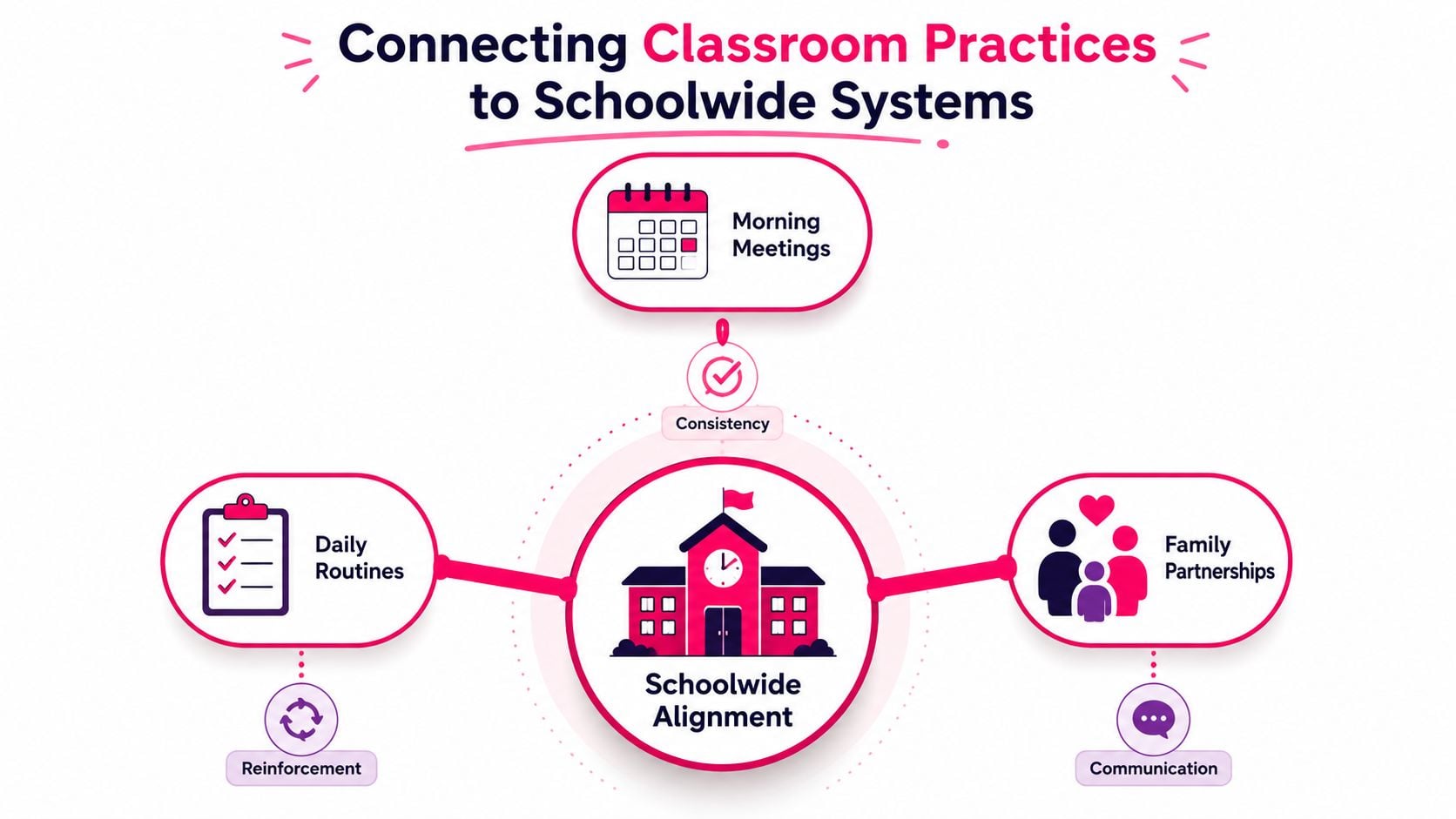
Connecting Classroom Practices to Schoolwide Systems
A classroom agreement loses power when students hear different expectations in the hallway, cafeteria, bus line, or online learning space. Teachers strengthen prevention when they use the same core vocabulary as counselors, administrators, lunch supervisors, and families.
Start by comparing your classroom language with the school’s PBIS or MTSS materials. If the school uses “be respectful,” identify what that means during group work, recess, and digital communication. If the school emphasizes reporting, clarify who receives the report, what gets documented, and how students are protected from retaliation.
Make consistency visible
A shared vocabulary might include:
Belonging: Every student has a safe way to participate.
Bystander: A student who sees or hears a harmful interaction.
Upstander action: A safe choice to speak up, interrupt, invite, or report.
Repair: A structured effort to address impact and rebuild trust.
Report: Information given to a trusted adult so the school can respond.
A Louisiana procedure illustrates why staff need clear escalation rules. In that state process, a teacher, counselor, bus operator, or other school employee who witnesses bullying or receives a report must make a verbal report the same day and a written report within two days. The Louisiana Department of Education reporting procedure is state-specific, so use your own policy as the authority, but the practical lesson is broad: don’t rely on memory or informal hallway conversations.
Invite families into prevention
Family engagement works best when it gives caregivers a clear, manageable role. Send a short multilingual tip sheet that defines bullying, conflict, exclusion, and reporting. A brief video update can demonstrate the language students are practicing, such as “Stop. That’s not okay here,” or “I’m going to get an adult.”
Use conference prompts that gather information rather than assign blame:
“Where does your child feel connected at school?”
“Have you noticed changes in friendships, routines, or digital communication?”
“Which adult does your child trust when something feels unsafe?”
“What language works well at home for asking for help?”
A simple communication calendar might include an opening-year explanation of shared expectations, a midterm reminder about reporting and bystander choices, and a later invitation for families to share patterns they’re noticing. Teachers can bring recurring observations to leadership, such as repeated exclusion in a particular transition, unclear supervision in a common area, or inconsistent responses to digital incidents.
For a broader view of how school-based programs combine policies, training, student skills, and family involvement, consult bullying prevention programs for schools. Your classroom notes can become useful system feedback when they describe conditions and patterns, not just individual children.
Overcoming Real Barriers to Implementation
Teachers don’t abandon prevention because they don’t care. They abandon routines that require separate planning, depend on every colleague responding identically, or become impossible during a crowded week of assessments, IEP meetings, and family conferences.
A 2025 NIJ synthesis of support needs for the Olweus Bullying Prevention Program identified recurring gaps involving training intensity, staff discussion, competing priorities, time constraints, communication, and staff support. A 2025 thematic review likewise emphasized program fidelity, teacher efficacy, and school climate. The practical conclusion is simple: implementation needs organizational support, not just a folder of lesson plans.
Use a five-minute integration model
Attach prevention to existing moments:
Arrival: Greet students and scan for changes in mood, friendship patterns, or avoidance.
Literacy: Ask how a character could respond as a target, bystander, or trusted adult.
Group work: Assign rotating roles and observe who gets interrupted or excluded.
Transition: Reinforce one observable behavior, such as making room or reporting safely.
Dismissal: Use a private reflection prompt or quick check-in with a student who seemed isolated.
For staff alignment, invite a colleague to observe one routine for a short, non-evaluative visit. The observer records only whether the teacher stated the norm, structured participation, and followed up on a concern. Compare notes briefly and choose one adjustment.
Digital bullying needs its own protocol because educators may be only moderately prepared to identify and respond to online incidents, particularly subtle exclusion and chat-based harassment, according to a 2025 peer-reviewed review of online-school anti-bullying measures. The review in PMC highlights gaps in training, awareness, and monitoring systems.
When a digital concern reaches you, preserve relevant information according to school policy, record who reported what and when, and avoid asking students to conduct their own investigation. Escalate threats, harassment, or repeated targeting through the school’s established pathway, then involve families and support staff as policy requires.
Common Implementation Barriers and Practical Workarounds
Workaround
Time Required
Limited planning time
Embed a discussion prompt into an existing lesson or transition
A few minutes
Inconsistent staff responses
Agree on one shared sentence and one reporting path
A brief team check-in
Punitive default reactions
Replace labels with behavior-specific language and a repair step
The same conference time
Digital incidents
Use a written decision path for preserving information and escalating concerns
A short documentation step
Staff fatigue
Rotate responsibility for sharing examples and reviewing patterns
A scheduled team routine
Tracking Progress Without Adding Paperwork
Measurement should help you decide what to do next, not create another binder. Keep the system small, consistent, and focused on student experience as well as adult response.
Use three sources of information:
A two-question student pulse check: Ask, “Do you feel safe joining groups in this class?” and “Is there an adult you can tell when something feels wrong?” Offer a private response method and avoid asking students to name peers in a group setting.
A lean incident log: Record the date, setting, behavior, apparent power difference, whether the behavior may repeat, adult action, student support, and bystander response. This captures context instead of reducing the event to “aggressor” and “victim.”
A peer-nomination sociogram: At quarterly intervals, use age-appropriate prompts such as “Who helps others feel included?” or “Who would you choose for a partner when you need support?” Follow school privacy procedures and use results to plan connections, not to rank children.
Stagger the collection
A nine-month rhythm might look like this:
Month 1: Establish a baseline pulse check and review classroom routines.
Month 2: Review incident settings and supervision points.
Month 3: Conduct the first sociogram and plan intentional peer connections.
Month 4: Repeat the pulse check and adjust one routine.
Month 5: Review bystander behavior in incident logs.
Month 6: Conduct a second sociogram and compare connection patterns.
Month 7: Repeat the pulse check before a high-transition period.
Month 8: Review family reports, digital concerns, and recurring locations.
Month 9: Complete a final pulse check and summarize next steps.
A one-page dashboard can contain four boxes: student safety responses, trusted-adult access, incident contexts, and follow-up completion. Share trends with administrators using neutral language: “Reports cluster during unstructured group formation,” or “Students are reporting more quickly, but follow-up documentation is inconsistent.”
Be careful when incidents appear to decrease. Fewer reports can mean fewer incidents, improved adult supervision, or students learning to hide behavior. Compare pulse responses, private check-ins, bystander actions, and location patterns before concluding that the problem has disappeared.
Soul Shoppe offers school communities workshops, assemblies, coaching, and tools that build shared language for connection, self-regulation, communication, conflict resolution, and safe peer support. Visit Soul Shoppe to explore resources that can help your staff turn bullying prevention into daily classroom practice.
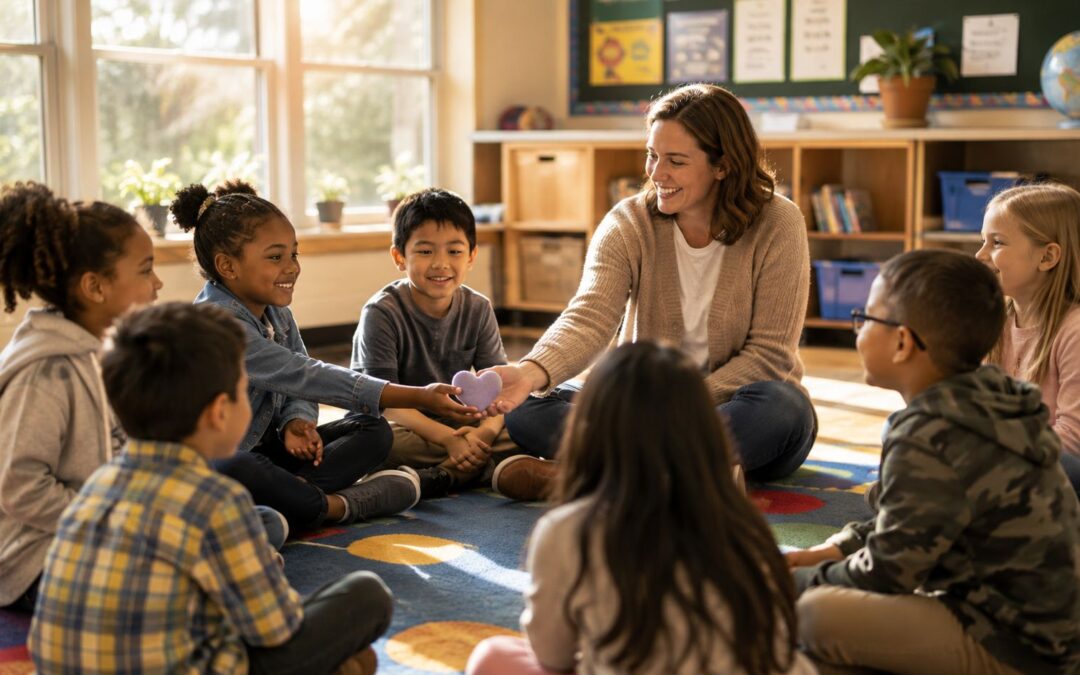
A Monday morning can reveal more about a school’s community than a polished mission statement. A third grader arrives anxious, keeps their backpack on, and avoids eye contact. A classmate says hello by name. The teacher gathers everyone for a five-minute circle, where students name how they’re arriving and listen without interruption. Later, two children disagree over a game, then use the class’s shared language to explain what happened and repair the problem.
Those moments may look small, but they shape attendance, behavior, emotional safety, and learning. The value of community in K–8 schools isn’t an abstract ideal or a pleasant extra. It’s a practical intervention built through repeated routines, adult responses, student leadership, and family partnership. The useful question isn’t whether community matters. It’s which daily actions make it visible, and how a school can tell whether those actions are working.
What a Strong K-8 Community Actually Looks Like
A strong community doesn’t depend on having unusually outgoing teachers or naturally cooperative children. It comes from structures that make connection predictable, especially on difficult days.
In the classroom above, the greeting tells the anxious student, “You were noticed.” The circle gives every child a regular chance to be heard. The conflict language prevents a small disagreement from becoming a social wound. None of this requires a dramatic event. It requires adults to repeat the same expectations until students can use them without waiting for rescue.
The daily signals students can feel
Across a school day, belonging appears in ordinary details:
Predictable greetings: Adults and peers use students’ names and acknowledge their arrival.
Inclusive norms: The class defines what listening, disagreement, participation, and repair look like.
Shared problem-solving language: Students can say, “I felt left out,” “I need a reset,” or “How can we make this right?”
Peer-helper roles: Children have meaningful ways to welcome, guide, explain, and support one another.
Responsive adults: Staff notice withdrawal, conflict, or distress and respond before the student has to escalate.
A younger student might choose a feelings card during morning meeting. An older student might use a structured conversation after a group-project disagreement. The language changes with age, but the underlying message stays steady: everyone belongs, everyone has responsibilities, and conflict can be addressed without humiliation.
A school without these structures often feels inconsistent. One teacher may welcome students warmly while another treats connection as a distraction. A lunch conflict may be ignored until it becomes a referral. A child may sit alone for weeks because no routine helps peers notice or include them. When community is assumed rather than built, the most socially confident students usually benefit first, while quiet, new, anxious, or isolated students remain on the edge.
Practical rule: If a community practice only works when a particular adult is present, the school has a helpful person, not yet a dependable system.
School leaders can use guidance on improving school culture to examine whether expectations, routines, and adult language reinforce one another. The central test is simple: Can a student predict how people will greet them, handle harm, invite participation, and respond when they ask for help?
Community is the infrastructure underneath instruction. When it’s reliable, teachers spend less energy managing avoidable social confusion, and students have more capacity to participate. When it’s missing, academic strategies often have to work against isolation, mistrust, and unresolved conflict.
Defining the Value of Community in Schools
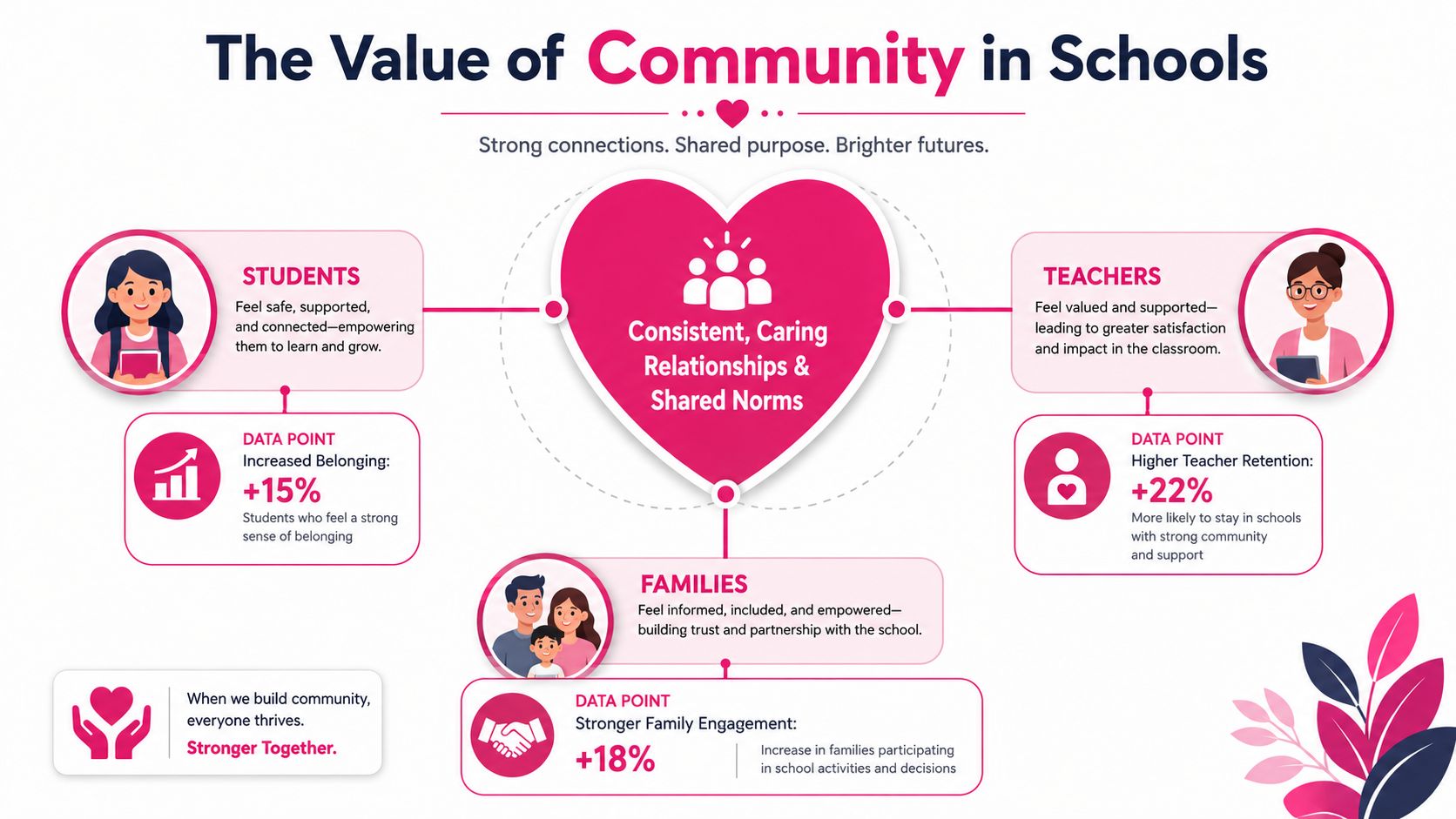
The value of community is the measurable benefit students, staff, and families gain from consistent caring relationships and shared norms within a school. That definition matters because it moves community away from vague language. A school can ask whether students feel known, whether adults respond consistently, whether families can participate, and whether those conditions connect with attendance and behavior.
Four layers overlap.
Social-emotional development
Students practice self-regulation, empathy, communication, and conflict skills inside relationships. A second grader who learns to pause before grabbing a toy is developing a skill. A sixth grader who can name harm, listen to another perspective, and agree to repair is applying that skill in a more complex setting.
These abilities grow through repeated practice, not a single assembly. Teachers need shared phrases and predictable responses so students hear the same expectations in the classroom, hallway, cafeteria, and playground.
Academic engagement
Belonging supports the conditions students need to attend, participate, persist through difficulty, and ask for help. A child who expects ridicule may hide confusion. A child who trusts the teacher and peers is more likely to attempt a challenging task, recover from an error, and return after a difficult day.
A 2020 meta-analysis of secondary education found a small positive relationship between school belonging and academic achievement, r = .18, and a small negative relationship with absence or dropout, r = -.16. Links with motivational, social-emotional, and behavioral outcomes were stronger, approximately r = .30 to .39 in the review (2020 meta-analytic review).
Physical and emotional safety
Safety isn’t only the absence of physical danger. Students also need predictable responses to bullying, exclusion, teasing, and conflict. A community teaches children that adults will listen, investigate, protect privacy where possible, and help repair harm.
Belonging
Belonging means feeling known, valued, included, and accepted as a participating member of the group. “School connectedness” is a research term for a student’s sense that people at school care about them and their learning. “Collective efficacy” describes adults’ shared belief that they can work together to support students. In plain language, students experience connectedness, while staff build the adult cooperation that makes connectedness dependable.
These layers don’t operate separately. A student who feels safe can focus. A student who feels known is more likely to request support. A family that trusts the school is more likely to share information before a concern becomes a crisis. Schools actively build these conditions through language, schedules, relationships, and follow-through.
What the Research Says About Belonging and Outcomes
A student who stops attending, avoids group work, or reacts sharply to correction may be showing a connection problem, not just a motivation problem. Research cannot prove that every community-building program causes better outcomes, but it does show that belonging is related to health, learning, attendance, and social-emotional measures. The effect also varies by age, setting, and program design.
A Canadian population health analysis found that 64% of Canadians reported a strong sense of community belonging in 2005, including 17% who described it as very strong and 47% as somewhat strong. Close to two-thirds of people with very strong or somewhat strong belonging reported excellent or very good general health, compared with about half of those with very weak belonging. The association remained after accounting for age, socioeconomic status, and other confounders (Statistics Canada population health study).
A newer Canadian cohort study found that young adults with a somewhat weak sense of belonging had a 76% higher relative risk of premature mortality than those reporting somewhat strong belonging, with RR 1.76 and a 95% confidence interval of 1.27 to 2.43 (Canadian cohort study). Among middle-aged adults in the weaker-belonging group, the pattern differed, with RR 0.82 and a 95% confidence interval of 0.69 to 0.98. For educators, the lesson is modest but useful: belonging matters, yet its effects should be interpreted in context rather than treated as a universal guarantee.
What the school evidence tells us
Outcome area
Research finding
What educators can track
Academic achievement
Secondary-school belonging has a small positive relationship with achievement, r = .18 (meta-analysis)
Assignment completion, grades, and student-reported belonging
Absence and dropout
Belonging has a small negative relationship with absence or dropout, r = -.16
Attendance patterns, late arrivals, and withdrawal from school activities
Motivation and social-emotional outcomes
Associations are stronger than the academic relationship, approximately r = .30 to .39
Help-seeking, participation, peer connection, and classroom behavior
Primary-school achievement
A 2025 quasi-experimental study found stronger evidence that belonging preceded later achievement than the reverse direction (Oxford statement)
Changes over time, not a single survey result
A survey response can reflect a supportive teacher, close friendships, or a generally successful school experience. An advisory period, peer mediation system, or family-engagement routine creates opportunities for connection, but the routine alone cannot guarantee that a lonely student feels included. Use the sense of belonging guide to clarify what students may be describing when they say they feel connected or left out.
Evidence also limits broad claims. A 2025 APA review found improvements in several social-connection outcomes, but pooled analyses among young adults did not show a statistically significant overall reduction in loneliness (APA review). Connection and loneliness are different measures. A busy school may offer many activities while a student still lacks one trustworthy relationship.
Schools can therefore treat community as a measurable K–8 intervention. Track routines, language, family practices, attendance, behavior, and belonging together, then adjust the supports when the pattern shows that a student is present but not participating.
Everyday Practices That Build Community at School
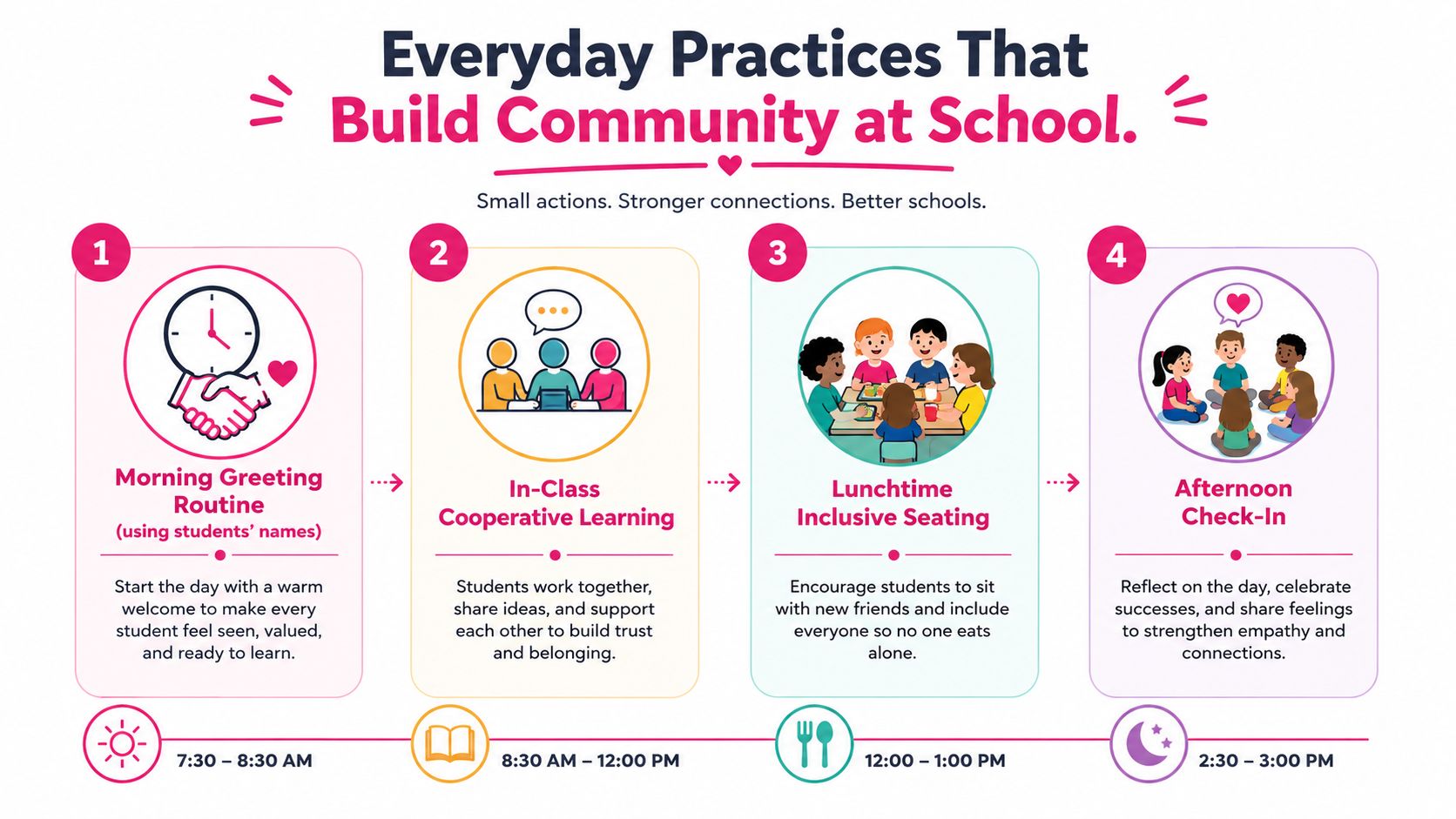
At 8:15, Ms. Rivera stands at the classroom door. She greets each student by name and offers three choices: wave, fist bump, or verbal hello. Once everyone is seated, students point to a check-in card showing how they’re feeling. One child chooses “tired,” and Ms. Rivera says, “You can participate in a low-key way today, and I’ll check back with you after reading.”
The routine takes little time, but it gives the teacher useful information and gives students a safe way to be seen.
During the first lesson, students work in pairs with rotating roles. One explains the task, one records the thinking, and both must ask a question before requesting adult help.
A transition ritual keeps the room settled between subjects. Students pause, name the next expectation, and thank a partner who helped them. At lunch, staff protect inclusive seating rather than allowing the same social hierarchy to determine every table. A recess buddy system gives new or isolated students a clear invitation without labeling them as a problem.
Language shift: Replace “I need you to calm down” with “We’re going to reset together so everyone can learn.”
The afternoon closes with a brief check-in. Students complete the sentence, “Today I contributed by…” or “Tomorrow I may need…” A teacher can use the responses to identify a child who needs a private conversation, not a public correction.
Families can mirror the same rhythm without recreating school at home. At dinner, try a high-low-share: one good moment, one difficult moment, and one thing the child hopes for tomorrow. During pickup or bedtime, ask, “Who helped you feel included today?” or “Was there a moment when someone needed help?”
These questions work better than “How was school?” because they invite a story. Parents can also use the school’s shared repair language: “What happened, who was affected, and what would help make it better?” Consistency between home and school helps children experience community as a way of treating people, not merely as a classroom activity.
Here’s a short video that can help teams visualize cooperative routines in practice:
Program Examples That Bring Community to Life
A principal may begin with a whole-school workshop on conflict language. Students practice identifying the difference between an accident, an unkind choice, and harm that needs adult support. Staff learn the same terms, then use them in the cafeteria and during math-group disagreements. Families receive a short version of the language so a child hears familiar prompts at home.
That’s the useful role of a structured program. It turns an appealing idea into scheduled practice with a common vocabulary.
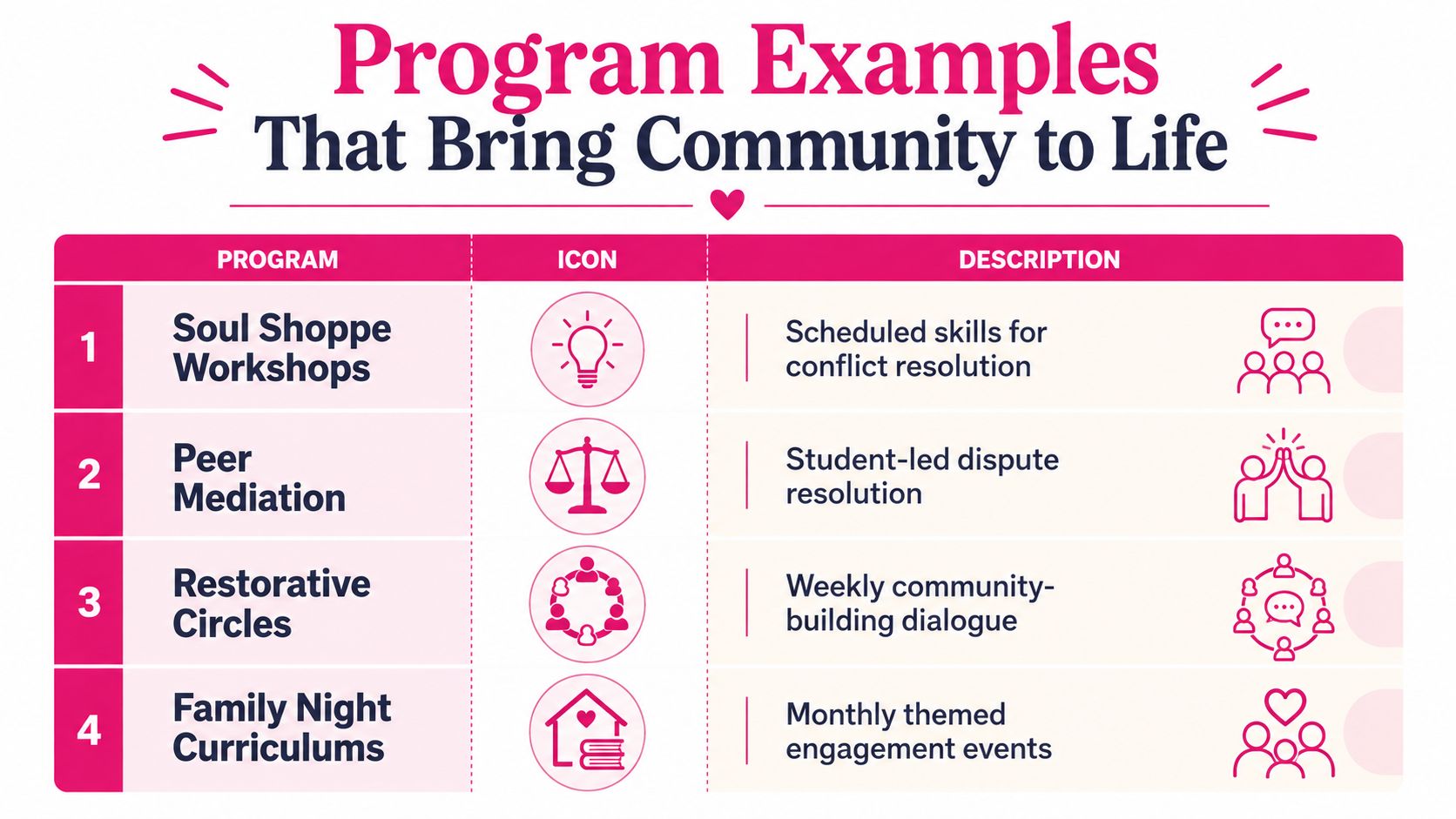
A school might use Soul Shoppe workshops and assemblies to teach communication, conflict resolution, and community-building skills across students, staff, and families. Its Peacemaker approach trains adults to support student peer leadership and conflict-resolution practices. Schools should still define their own success measures, because a well-run workshop is a starting condition, not proof that belonging has improved.
Matching the approach to the school
Workshops and coaching: External facilitators can introduce shared skills, model lessons, and coach adults. This option helps when staff need a common launch, but leaders must schedule follow-up practice.
Peer mediation: Trained students help peers use a defined process for manageable disputes. Adults still handle safety concerns, bullying, and situations involving a power imbalance.
Restorative circles: A weekly circle can build relationships before conflict occurs. It may include appreciation, problem-solving, or repair after harm.
Family nights: A themed evening can demonstrate listening, calming, and conflict tools that families can use immediately at home.
Community schools research offers stronger evidence for integrated approaches than for isolated feel-good events. A 2017 review of 143 studies found that well-implemented community schools improved student and school outcomes, with attendance and chronic absence changes often appearing first. Grades and test scores also improved, and math gains were strongest when implementation had been in place for several years (community schools review).
Lighter options can work when staffing is limited. A buddy-class partnership, teacher-led morning meeting, or student welcome team costs little, but each needs an owner, a schedule, and a review point. If a school also wants to deploy a campus safety app, leaders should position it as one part of a broader safety and communication system, not as a substitute for trusted adults and responsive relationships.
The strongest model combines adult coaching, student roles, family-facing tools, and leadership review. Leaders can also draw on school-community partnership guidance when deciding how outside partners, families, and school staff will share responsibility.
Measuring Whether Your School Community Is Working
A community initiative needs a measurement plan that staff can sustain. Start with four sources of information, then review them together instead of treating a single survey as the truth.
Four measures that belong together
Attendance shows whether students are arriving and remaining connected to school. Review regular attendance and chronic absence patterns by grade and student group. Attendance may move before academic results, as the community-schools review found (community schools evidence).
Connectedness surveys capture whether students feel welcome, known, respected, and supported. Keep them brief, use age-appropriate wording, and tell students what adults will do with the results. A survey that disappears into a report can reduce trust.
Behavior trends show where conflict or exclusion may be concentrated. Review incidents by grade, location, time, and type, but don’t interpret fewer referrals as automatic improvement. A teacher may refer less because behavior improved, or because students stopped reporting and adults stopped documenting.
Student voice adds context. Ask a few children, “Where do you feel most included?” “When do students get left out?” and “Which adult helps when something goes wrong?” Short interviews, exit tickets, and suggestion routines can reveal patterns that numbers miss.
Measure
What it shows
Who owns it
Cadence
Attendance
Access, participation, and possible disengagement
Administrator and attendance team
Regular team review
Connectedness survey
Students’ experience of belonging and support
Counselor or SEL lead
Repeated pulse checks
Behavior incidents
Conflict, safety, and response patterns
Administrator and grade teams
Monthly review
Student voice
Explanations behind patterns
Teachers, counselors, and student leaders
Ongoing short prompts
A healthy baseline isn’t a perfect score. It’s a clear picture of who feels included, who doesn’t, where incidents happen, and which grades need attention. Leaders should disaggregate results so a school-wide average doesn’t hide students who remain isolated.
Measurement warning: Don’t collect belonging data once a year and call the work evaluated. Ask, respond, and show students what changed.
At 60 days, the team can ask which routine students recognize and which groups still report weak connection. At 90 days, compare patterns, examine implementation, and adjust one or two practices. Resources on outcome measurement can help schools connect activities with observable results rather than counting events.
A Practical Checklist for Administrators, Teachers, and Parents
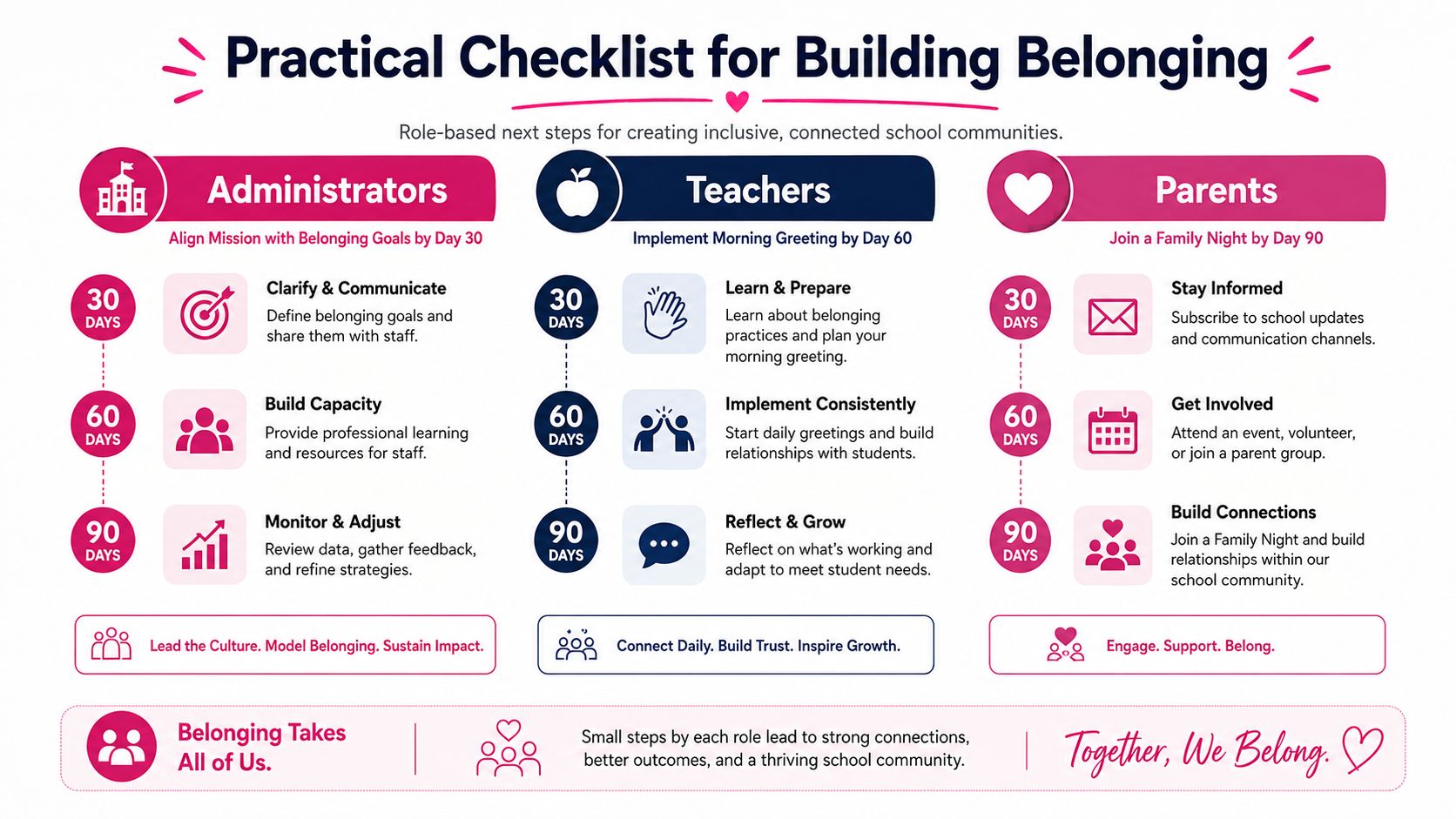
Community becomes durable when each adult knows their part. The timeline below keeps the work manageable and gives schools opportunities to correct course before a promising idea fades.
Administrators
By day 30, align the mission, staff language, and improvement plan around belonging. Protect time for morning meetings or advisory, identify the staff member who will coordinate the work, and establish a baseline using attendance, behavior, connectedness, and student voice.
By day 60, schedule common planning time so teachers can compare routines and problem-solve together. Review discipline and attendance data by grade, then pilot one evidence-informed program or internal practice with clear measures.
By day 90, ask: Which students report stronger connection? Which students still remain on the margins? Which adult practices are consistent across settings, and what needs coaching?
Teachers
Start tomorrow with a greeting at the door and a short closing circle. Post shared agreements in student-friendly language, use restorative questions during manageable conflicts, and send families a weekly note that includes one community practice students are learning.
At day 60, use a quick pulse question such as, “I have an adult at school I can go to when I need help.” Review responses privately and follow up with students who need a stronger connection. At day 90, ask whether the routine changed participation, peer interaction, or help-seeking, and revise the practice with students.
Parents and caregivers
Create predictable pickup, homework, and bedtime routines. Spend five minutes each day asking an open question, such as, “When did you feel included today?” Attend two school events during the year, volunteer once per quarter if possible, and reinforce the same agreements used at school.
At day 60, ask your child which school routine helps them feel comfortable and which moment feels hardest. At day 90, share that pattern with the teacher and agree on one support to continue at home and school.
A useful question for every role: What will a student experience differently because we chose to build community on purpose?
Community-building isn’t finished when the posters go up or the assembly ends. It’s working when students can name where they belong, adults respond with shared language, families know how to reinforce the work, and the school uses evidence to support the children who are still waiting at the edge.
Soul Shoppe offers workshops, assemblies, coaching, and family tools that help K–8 communities practice communication, empathy, self-regulation, and conflict resolution. Visit Soul Shoppe to explore practical ways to turn belonging into daily school and home routines.
A seventh grader shoves past another student in the hallway. The second student turns, raises his voice, and within moments a careless shoulder bump has become a public argument. A teacher points to an “I-statement” poster and asks both students to explain their feelings. They stare at the wall, mutter a memorized apology, and leave angrier than before.
This scene is familiar because conflict resolution for middle school often fails at the moment students need it most. The activity may look thoughtful on paper, yet the adults haven’t accounted for audience pressure, embarrassment, friendship politics, digital rumors, or the speed at which an adolescent nervous system reacts. Effective instruction has to move beyond attractive scripts and help students use skills under pressure.
Why Middle School Conflicts Need a Different Approach
Middle school students aren’t older elementary students, and they aren’t miniature high school students. Early adolescence brings rapid emotional and social change. Students are developing judgment while also navigating heightened emotional reactivity, stronger sensitivity to peer approval, and a growing concern with social status. A private correction can feel manageable. A public invitation to “talk it out” can feel like humiliation.
That distinction changes the adult response. A peace table designed for younger children may feel childish to a seventh grader who worries that classmates are watching. A high school peer mediation model may assume more independence, verbal confidence, and willingness to reflect than some younger adolescents can yet access. The student who refuses to speak may not be uninterested in repair. They may be protecting themselves from losing face.
The audience is part of the conflict
Consider two students involved in a group-chat dispute. One posted a screenshot, another shared it, and classmates added comments. By the time the students reach school, the original disagreement has become a status contest. Asking them to apologize in front of peers may reward performance instead of honesty.
Begin with three questions:
Who is watching? A student may choose escalation because backing down publicly carries a social cost.
What happened before the visible incident? Hallway conflicts often begin with online messages, exclusion, teasing, or a rumor that adults haven’t seen.
What does each student risk by participating? Fear of retaliation, embarrassment, or being labeled weak can make a structured conversation feel unsafe.
A useful first step is to teach students that conflict resolution isn’t the same as immediate reconciliation. A student can set a boundary, request space, report harassment, or participate in a repair conversation. The correct response depends on the situation.
Practical rule: Never confuse a quiet student with a regulated student. Silence can mean reflection, fear, shutdown, or strategic self-protection.
Compliance isn’t the same as learning
Students can repeat “I feel frustrated when you interrupt me” without understanding when or why to use the sentence. Genuine skill acquisition shows up when a student pauses before posting, asks for clarification, names the actual problem, or chooses adult support instead of retaliation.
That requires repeated practice in realistic settings. The field of school conflict resolution has deep roots, with school-based programs, including peer mediation, emerging in American schools in the early 1970s. A review of the field later estimated that U.S. schools had more than 6,000 conflict resolution programs (historical review of implementation and outcomes). The lesson for today’s middle schools isn’t that every program works automatically. It’s that the model became valuable because students need structured, repeatable ways to manage disagreement.
For a broader foundation in communication, boundaries, and cooperation, teachers and caregivers can also use these social skills for middle school ideas. The strongest approach calibrates language, privacy, practice, and accountability to the way early adolescents think and behave in real time.
Evidence-Backed Frameworks That Actually Work
No single framework solves every middle school conflict. The practical choice depends on the problem, staff capacity, available data, and whether administrators will protect time for consistent implementation. These approaches are most useful when adults teach the skill before a crisis, model it during ordinary classroom friction, and revisit it after an incident.
Restorative practices
Restorative practices help students examine harm, responsibility, and repair. A teacher might say, “I’m concerned that a private screenshot was shared and several students were targeted.” Then the teacher asks restorative questions such as:
What happened from your perspective?
Who was affected?
What were you thinking or feeling at the time?
What needs to happen now to repair the harm?
In practice, the teacher doesn’t force a dramatic confession. The teacher meets with students separately when needed, checks safety, and brings students together only when each person can participate without intimidation.
Sixty-second snapshot: A student says, “I only reposted it because everyone else was laughing.” The teacher responds, “You didn’t create the original message, but your choice affected what happened next. What could repair that part?” The student identifies the repost, removes it where possible, and agrees to correct the false claim privately.
Restorative work is especially helpful when a relationship needs repair, but it can fall flat when staff use circles as a substitute for investigation, boundaries, or consequences.
RULER tools
The RULER Approach, developed by Yale’s Center for Emotional Intelligence, gives students shared language for recognizing and managing emotion. A Mood Meter can help a student distinguish irritation from shame or anxiety before the feeling becomes an accusation. A Meta-Moment creates a pause between the emotional trigger and the chosen response.
Sixty-second snapshot: A student circles “angry” on a classroom emotion display, then realizes the stronger feeling is embarrassment. The teacher asks, “What response would help the person you want to be in this moment?” The student chooses to request a private conversation rather than confront a peer at lunch.
Collaborative Problem Solving
Collaborative Problem Solving replaces a power struggle with a conversation about an unsolved problem and a lagging skill. In a Plan B conversation, the adult first listens, identifies the student’s concern, names the adult concern, and invites a realistic solution.
Sixty-second snapshot: A student keeps interrupting group work. Instead of saying, “You need to follow directions,” the teacher asks, “I’ve noticed you’re taking over when the group disagrees. What makes it hard to wait for your turn?” The student says classmates ignore his ideas. Together they plan a visible turn-taking routine.
Adapted peer mediation
Peer mediation can give students ownership, but middle school mediators need careful selection, substantial practice, supervision, and clear referral limits. They shouldn’t handle threats, coercion, serious harassment, or situations involving a major power imbalance.
A CDC school safety fact sheet reported that 38% of middle and high schools offered peer mediation, while 58% taught conflict resolution or violence prevention in a required course (CDC school safety fact sheet). Those figures show that mediation and direct instruction have both been used as parts of formal prevention systems.
Framework
Best For
Staff Training Time
Time to Impact
Key Limitation
Restorative practices
Harm, relationship repair, community concerns
Moderate
Gradual
Unsafe or forced conversations can deepen harm
RULER tools
Emotion recognition and regulation
Moderate
Visible in daily routines
Naming emotion doesn’t resolve the underlying problem
Collaborative Problem Solving
Repeated behavior and unmet needs
Moderate to substantial
Gradual
Requires patience and consistent adult follow-through
Peer mediation
Appropriate student-to-student disputes
Substantial
Depends on referrals and supervision
Not suitable for every conflict
Schools comparing broader SEL options can review SEL programs for schools while keeping the central question in view: how will students practice, use, and demonstrate the skill?
Classroom-Ready Implementation Strategies
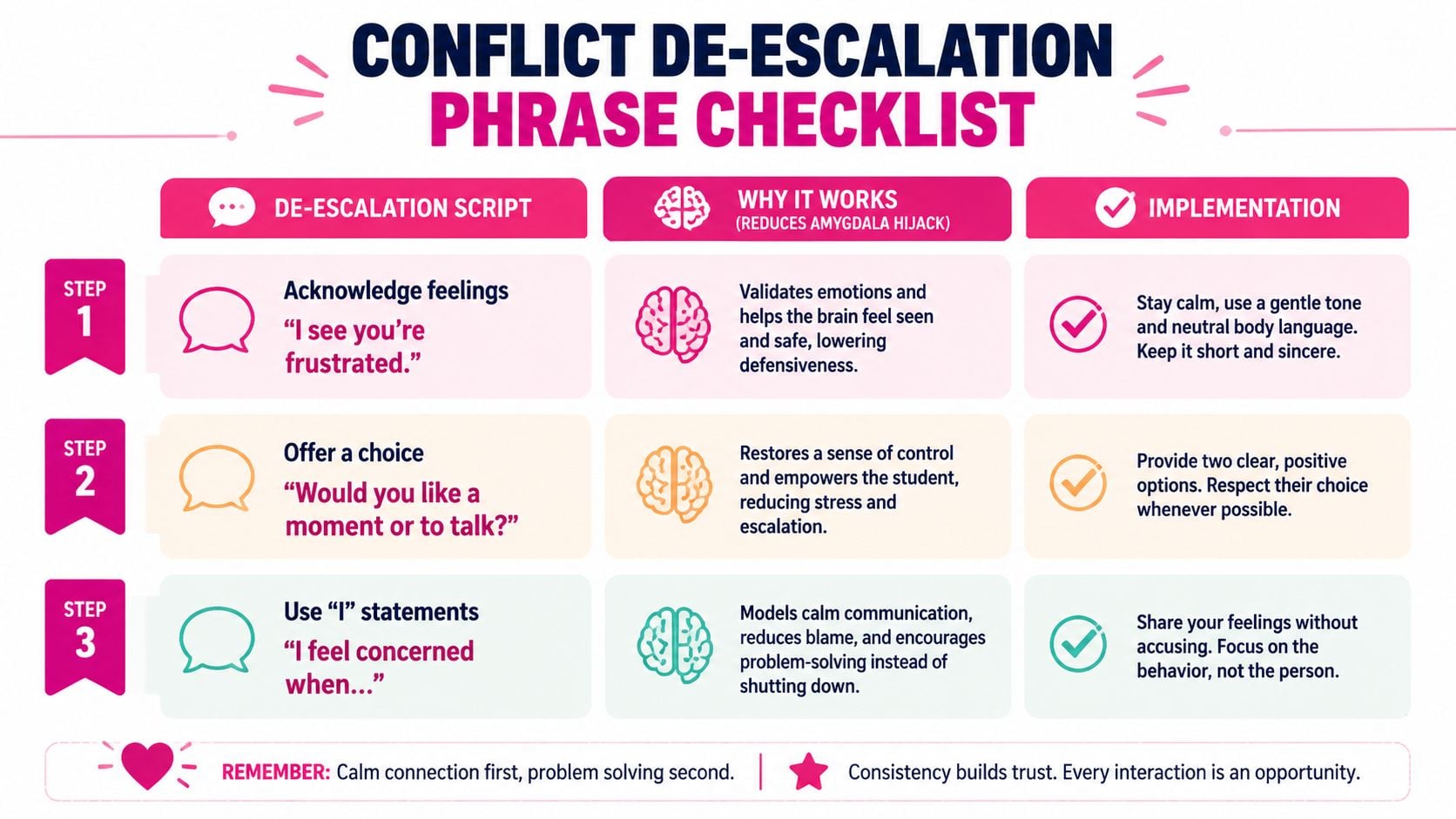
The first move during a conflict is regulation, not analysis. A student whose body is braced for threat won’t absorb a lecture about empathy. Use a low voice, reduce the audience, create physical space, and offer a small choice.
Try these phrases:
Acknowledge: “I can see this matters to you.”
Offer choice: “Would you like a moment, or would you rather talk with me privately?”
Set a boundary: “I’ll listen, but I won’t let anyone threaten or insult another student.”
Invite a next step: “Tell me what happened from your point of view.”
Avoid escalation: Replace “Calm down” with “Take a breath. We can solve one part of this at a time.”
A role-play that feels real
Use a scenario card rather than asking students to invent a conflict.
Scenario card: A student sends a Snapchat message claiming that a classmate cheated. Another student forwards it to friends. By morning, several classmates are whispering. The accused student confronts the sender near the lockers.
Student instructions:
Identify the observable facts without adding motives.
Choose one de-escalation phrase.
Use an “I” statement to describe impact.
Request a specific next step.
Decide when an adult must become involved.
Observer checklist:
Did the speaker avoid insults and threats?
Did the speaker describe behavior rather than label a person?
Did the listener allow the other person to finish?
Did either student ask for space or adult support?
Did the proposed solution address the rumor, not just the argument?
Debrief with questions such as, “Which phrase lowered the temperature?” and “What would change if the students were surrounded by peers?” Don’t praise a polished performance alone. Ask students to identify the moment when the conflict could have gone in a different direction.
A fifteen-minute restorative circle
Keep the protocol short and predictable.
Opening, two minutes: “We’re here to understand what happened and decide what needs to happen next.”
Ground rules, two minutes: One person speaks at a time. Students may pass once. No insults, threats, interruptions, or retaliation.
First round, four minutes: “What happened from your perspective?”
Impact round, three minutes: “Who was affected, and how?”
Repair round, three minutes: “What would make the next interaction safer or more respectful?”
Close, one minute: Summarize the agreement and name who will follow up.
Use a talking object only if it helps students wait their turn. A visibly structured process works better than a symbolic object that feels childish or confusing.
A short video can help staff rehearse language before using it with students:
When the plan breaks down
A student refuses. Don’t force disclosure in front of peers. Offer a private check-in, a written response, or a delayed conversation, while still addressing safety and behavior.
The conflict began online. Save relevant information according to school policy, separate the digital facts from assumptions, and teach that off-campus activity can still affect school safety. Don’t ask students to recreate a public online argument in a public classroom.
Power is unequal. Don’t mediate when one student is frightened, coerced, targeted, or unable to disagree freely. Investigate, protect the targeted student, involve the appropriate safeguarding process, and use restorative dialogue only if safety and genuine choice are present.
For SPED classrooms, shorten directions, preview the sequence visually, allow processing time, and provide alternate communication methods. For multilingual learners, use translated emotion words, visuals, sentence frames, and a chance to rehearse privately before speaking publicly. Teachers can find additional SEL activities for middle school to build practice into existing routines. Even visual reminders, including custom apparel for bullying awareness, can reinforce shared language when they support instruction rather than replace it.
The first two weeks
During the first week, teach one de-escalation phrase, model it, and practice it with low-stakes disagreements. During the second week, add the role-play, collect student reflections, and coach the language during real group work. Keep a simple record of referrals, repeated locations, conflict types, and whether students used the taught strategy. The point isn’t to create paperwork. It’s to see whether the skill appears outside the lesson.
What the Research Really Shows About Effectiveness
A polished conflict-resolution activity can produce a quiet classroom for one period and still leave recurring conflicts unchanged. Research therefore needs to examine more than student satisfaction. A large middle-school evaluation combined teacher and student surveys, disciplinary records across school years, mediation records, and matched comparisons between students who mediated and those who did not (middle-school peer mediation evaluation). This kind of design helps schools ask whether behavior changed beyond the mediation room.
A whole-school restorative-practices trial across 14 middle schools found no significant intention-to-treat effects across the full outcome set, with p-values above 0.14. Students who reported more experience with restorative practices, however, also reported better school climate, stronger peer attachment, improved social skills, and lower physical and cyberbullying victimization (whole-school restorative-practices trial). Consistent delivery matters more than program selection alone, according to this body of research.
The same source describes a Learning Policy Institute analysis across 485 middle schools and about 2 million students. Greater exposure to restorative practices during the move from fifth to sixth grade was associated with improved English and math performance, lower suspension probability, and fewer suspension days, with stronger effects for Black and Latino/a students (Learning Policy Institute findings within the review). Schools should measure how often students encounter the practices and how consistently adults use them, rather than treating adoption as proof of implementation.
What to measure
Track the chain from instruction to daily behavior:
Reach: Which students received instruction, coaching, mediation, or circle participation?
Fidelity: Did adults follow the agreed sequence, language, and safety checks?
Immediate response: Did students feel heard, identify the issue, and understand the next step?
Behavioral change: Did repeated referrals, fights, harassment reports, or classroom disruptions change over time?
Equity: Who is referred, excluded, interrupted, or asked to repair harm?
A Pennsylvania middle-school evaluation reported significantly greater improvement in conflict responses for treatment-group students, with a treatment effect of F[1,31]=52.86, p<.0005 (ERIC evaluation of a middle-school conflict-resolution program). It also reported decreased violence and stronger use of conflict-resolution tools in hypothetical situations. Direct teaching and rehearsal can build usable skills, while transfer to everyday conflicts still requires observation and follow-up.
Framework
Effectiveness Rating
Key Outcomes
Common Pitfalls
Restorative practices
Mixed, stronger with consistent exposure
Climate, attachment, social skills, disciplinary outcomes
Adoption without sufficient uptake
Peer mediation
Promising for appropriate disputes
Satisfaction, agreements, structured dialogue
Weak supervision or unsafe referrals
Direct conflict instruction
Evidence of skill improvement
Better responses and application in scenarios
One lesson without follow-up
Cooperative learning
Positive evidence for peer relations and empathy
Better relationships and lower bullying risk
Unstructured group work
A broader review found 23 studies covering 4,327 mediations, with 4,028 agreements, a 93% success rate, and 88% participant satisfaction with agreements (peer mediation outcomes review). These figures describe mediation outcomes, not proof that an entire school experienced fewer fights. Record agreements separately from recurrence, safety concerns, and disciplinary patterns.
Curriculum research adds another warning. A 2019 review of six middle-school peace and conflict curricula reported that none had been evaluated with outcome-assessment studies (review of peace education and conflict-resolution curricula). An activity may produce thoughtful discussion in the moment, yet schools still need to check whether students use the language during lunch, group work, online conflict, and other settings without immediate adult guidance.
Scaling from Classroom to Campus-Wide Programs
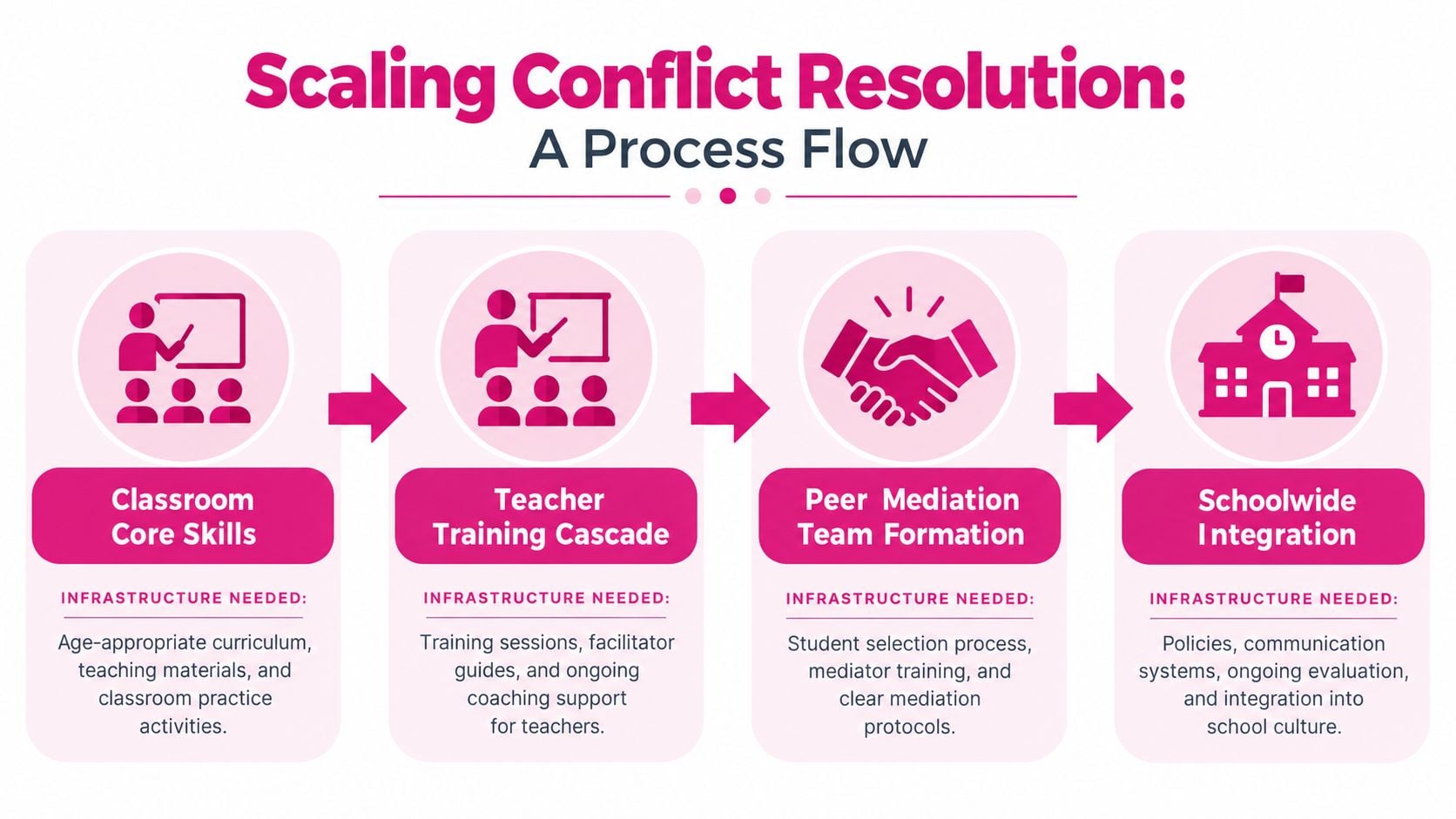
A schoolwide conflict-resolution program becomes real in the places where conflicts unfold, such as a crowded lunchroom, a hallway after dismissal, or a group chat that spills into first period. Shared posters help, but students need consistent language, protected practice time, clear referral rules, supervision, and measures showing whether support reaches them.
Begin with a classroom core, then test it against campus conditions. Teachers can use the same phrases for pausing, describing impact, requesting space, and seeking help. Counselors can map recurring conflict types and locations. Administrators must distinguish incidents requiring investigation from those that may qualify for mediation, and identify situations that peer processes cannot safely handle.
Build the adult system first
A training cascade has value only when the first group rehearses the actual language, decisions, and coaching process. Staff should role-play a hallway escalation, a group-chat rumor, a refusal to participate, and a conflict involving unequal power. A presentation may create agreement in the room; rehearsal shows whether adults can respond under pressure.
Consider two versions of the same lunch conflict. In the first, one supervisor sends students to different adults, another insists on an immediate apology, and a third offers mediation without checking safety. Students receive mixed signals, and the school cannot tell what intervention occurred. In the second, supervisors use a shared pause script, document the incident, complete the same safety check, and refer it through one process. The difference is not a more appealing activity. It is a system that can be observed and improved.
Administrators should examine discipline patterns before selecting a campus goal. If referrals cluster around lunch, train lunch supervisors and practise there. If rumors and friendship disputes dominate, build scenarios around those experiences rather than generic workplace examples.
Peer mediation should follow adult consistency and clear safety limits. Research on peer mediation programs in elementary and secondary schools describes commonly referred conflicts involving gossip and rumors, dating and friendship issues, and harassment. The study reported that 53% of mediated conflicts involved eighth graders. Schools can prepare upper-grade mediators for rumor spreading and friendship breakups, while checking whether local referrals show the same pattern.
Measure reach, fidelity, and impact
As noted in the earlier research summary, consistent delivery matters more than initial adoption. Use a small dashboard:
Reach: Record which grades and student groups receive lessons or referrals.
Fidelity: Sample whether staff followed the agreed protocol and completed safety checks.
Impact: Review recurring incidents, student climate feedback, and classroom observations.
Equity: Compare access to support across student groups without treating demographic patterns as explanations by themselves.
Family engagement helps students practise beyond school. Send home a short conversation guide with prompts such as, “What happened?” “What did you need?” and “What could make tomorrow easier?” Provide translated versions and invite caregivers to practise during ordinary disagreements.
A developed peer structure may benefit from guidance on peer mediation in schools, adapted to local safety policies, staffing, and student needs. Funding can cover training, substitute time, materials, and coaching. Leaders still need to assign ownership and protect practice time.
Your Implementation Roadmap and Next Steps
Start by listening to the school you have. Review referral records, ask students where conflicts begin, interview teachers about repeated patterns, and identify which adults students trust. Don’t select a framework because its activities look engaging. Select it because the problem, staff capacity, and safety conditions match its demands.
Use this rollout sequence:
First, establish a baseline. Record conflict locations, broad incident types, adult responses, repeat referrals, and student perceptions of safety and belonging.
Next, choose a narrow starting point. A grade-level routine, advisory lesson, lunch supervision plan, or carefully screened mediation process is easier to improve than a vague campus initiative.
Train adults through rehearsal. Practice the words, pauses, documentation, and referral decisions staff will use in real moments.
Pilot and review. Watch whether students receive the intervention, whether adults deliver it consistently, and whether outcomes differ across groups.
Expand only after adjustment. Add classrooms, staff, and peer mediators when the core process is clear enough to survive staff absence or schedule pressure.
During the first ninety days, expect uneven participation, awkward language, and some students testing whether adults mean what they say. Respond with coaching, not constant reinvention. If students refuse, preserve choice while maintaining boundaries. If staff skip the process, simplify the protocol and observe the setting where it breaks down. If referrals rise at first, examine whether students are finally reporting incidents rather than assuming the program caused the increase.
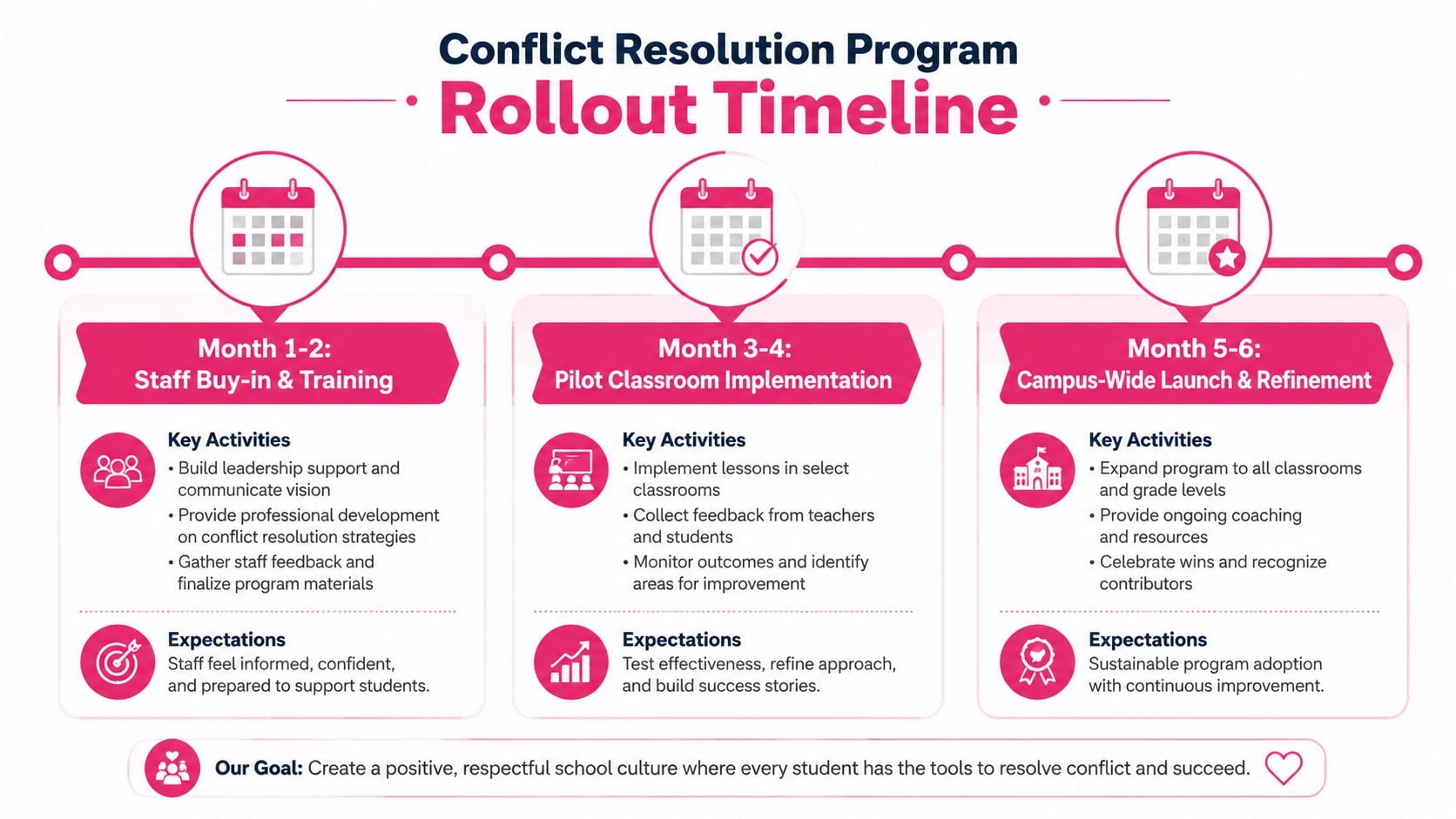
The supplied rollout timeline offers a practical structure: Month 1-2 for staff buy-in and training, Month 3-4 for pilot classroom implementation, and Month 5-6 for campus-wide launch and refinement. Treat those phases as a planning scaffold, not a guarantee. Staff turnover, budget constraints, and shifting priorities make documentation essential. Keep a short protocol, train new adults through the same scenarios, and review outcome data alongside student voice.
The central test is simple: can students use the skill when the audience is watching, the rumor is online, and the adult isn’t standing beside them? Build toward that test gradually, measure more than apologies, and protect safety whenever repair isn’t appropriate.
Soul Shoppe offers interactive workshops and coaching that give school communities shared language for communication, self-regulation, empathy, and conflict resolution. Visit Soul Shoppe to explore practical ways to bring those tools into middle school classrooms, family conversations, and campus-wide SEL systems.
An SEL initiative can have thoughtful lessons, polished materials, and enthusiastic launch events, yet still struggle in practice. A teacher may use one set of words for calming down, families may use another at home, students may not understand how to ask for help, and community partners may not know how their work connects to the school's priorities. Without shared language and ownership, SEL becomes another program instead of part of daily life.
Strong stakeholder engagement strategies connect classrooms, homes, leadership teams, and community settings. They help schools listen before deciding, communicate during implementation, adapt when conditions change, and give students and families meaningful influence over the work. The OECD describes stakeholder engagement as involving people or groups with an interest in a topic in decision-making and implementation processes, a definition that fits K–8 SEL particularly well (OECD guidance on stakeholder engagement).
The strategies below pair each purpose with an implementation sequence, a usable communication template, measurement ideas, and a school-based example parents and teachers can adapt with students. Soul Shoppe is one relevant example of a social-emotional learning organization whose workshops, coaching, family resources, and shared tools can help schools build alignment across the wider community.
1. Collaborative Needs Assessment and Joint Planning
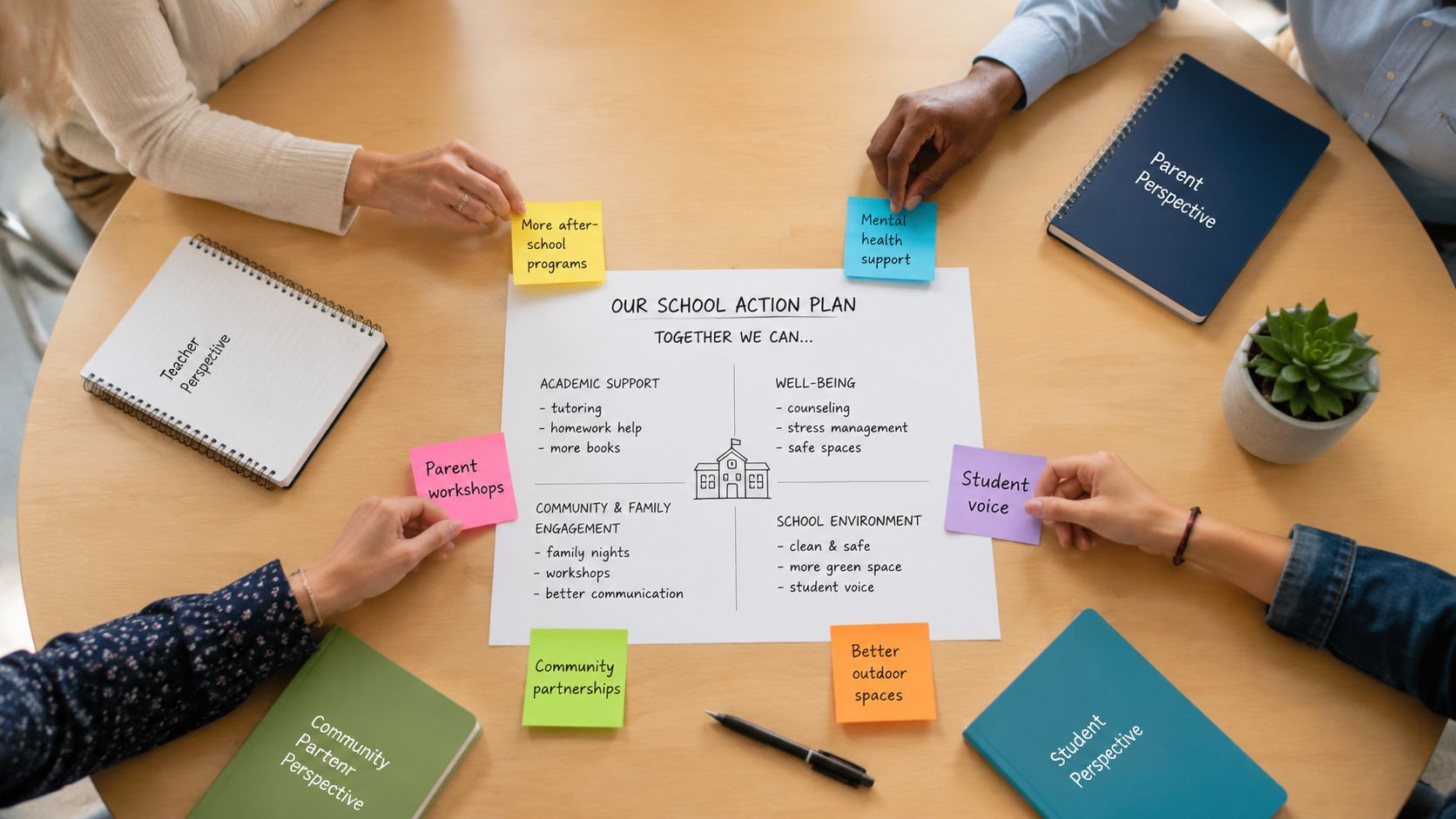
SEL planning works better when the people affected by the work help define the problem. Students notice peer dynamics adults may miss. Families understand home routines and stressors. Teachers see classroom patterns, while administrators and community partners understand operational constraints and available support.
Start by gathering input through more than one format. Combine a short survey with student listening circles, family conversations, teacher focus groups, and one-on-one interviews. Invite quieter participants directly, and use small groups so confident voices don't dominate. A planning committee with representatives from each stakeholder group can review themes, identify shared priorities, and turn them into an action plan.
Practical rule: Never ask for input without explaining how it will shape the next decision.
A district SEL coordinator might convene teachers, parents, student leaders, and community partners to identify bullying hotspots before introducing Soul Shoppe's Junior Giants Strike Out Bullying program. A principal could use family surveys and listening sessions to understand barriers to emotional regulation at home, then select Soul Shoppe modules that address those needs. In a classroom, a teacher might ask parents about student triggers and communication styles before choosing conflict-resolution tools that fit home practices.
Share the findings in plain language. Say, “Families asked for strategies that work during morning transitions, so we're adding a short routine for getting ready and leaving home.” Measure participation by stakeholder group, the priorities identified, and whether the final plan clearly responds to the feedback.
2. Regular Transparent Communication and Progress Sharing
Families and staff can't support an SEL initiative they rarely hear about. Communication should make the work visible without turning every update into a promotional message. Share what students are learning, where implementation is difficult, what has changed, and how adults can reinforce the same skills.
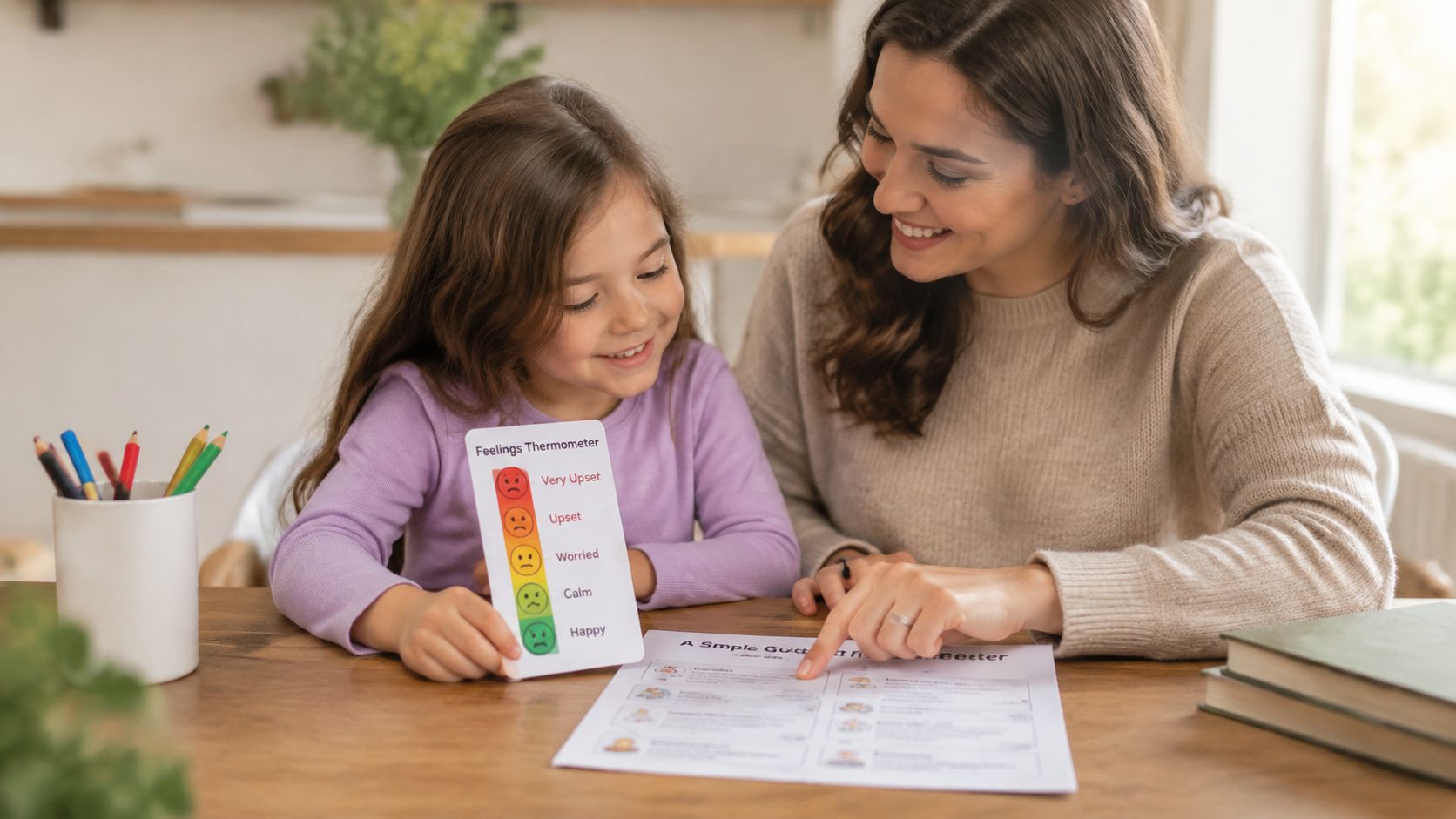
Create a communication calendar around natural milestones, such as staff training, classroom launches, family events, and review meetings. Use newsletters, parent meetings, classroom messages, digital platforms, short videos, and translated materials. Keep the content concrete. A simple explanation of a feelings thermometer is more useful than a general statement about emotional wellbeing.
A principal might send a monthly “SEL Snapshot” with one mindfulness practice from the Soul Shoppe curriculum and a brief update on classroom behavior patterns. A counselor could publish a quarterly “Conflict Resolution Corner” featuring a student success story, with permission, and a practice families can try at home. A district might share student videos about self-regulation tools, provided families and students have given appropriate consent.
Use a message structure that acknowledges reality:
What we're seeing: Students are using the conflict-resolution steps, but teachers need more support during unstructured times. What we're changing: We're adding monthly coaching sessions and a short playground practice. How families can help: Ask your child to describe the first step they use when a conflict begins.
Track whether updates reach different stakeholder groups, whether families understand the language being used, and whether communication includes both progress and challenges. A relationship survey can offer a useful benchmark. In a 2025 regulator survey, 51% of stakeholders reported satisfaction with their relationship, while the average relationship rating was 6.1 out of 10 The lesson for schools is practical: communication should be assessed by relationship quality, not message volume alone.
3. Structured Feedback Loops and Responsive Adaptation
A suggestion box isn't a feedback system if nobody knows what happened afterward. SEL contexts change as students move classrooms, family circumstances shift, and teachers discover which activities work in real conditions. Schools need a cycle that collects input, interprets it, makes a decision, and reports back.
Keep the first request short. Students can use a thumbs-up or thumbs-down signal, complete a one-sentence reflection, or choose one word that describes a session. Teachers can complete a brief “What's working, what's not” form each month. Families might respond to one focused question after a workshop rather than a long evaluation.
Then assign responsibility. A feedback steering committee can review comments from students, families, teachers, and partners, separate urgent concerns from longer-term patterns, and recommend adjustments. The committee should publish a short response, even when the answer is that a request cannot be adopted immediately.
For example, after a Soul Shoppe mindfulness workshop, students might report that a breathing technique felt difficult to use before a test. The teacher could adjust the pacing and offer a quieter alternative. A grade-level team could review teacher feedback about classroom conflict tools and request additional coaching. A parent advisory group examining bullying concerns might recommend a different emphasis in the Junior Giants program.
Use a visible response template:
You told us: Several students wanted more role-play practice.
We changed: The next lesson includes two student-led scenarios.
We'll check: Students will reflect on whether the practice felt useful.
Measure response rates qualitatively, the number and type of adjustments made, and whether the people who offered feedback can identify a change connected to their input. A feedback loop builds trust only when participants can see the connection between speaking and action.
4. Family Engagement Partnerships and Home Connection Programs
Students practice SEL across settings, not only during a scheduled lesson. Families need access to the same core language and tools, but schools shouldn't assume every caregiver can attend a meeting, use the same communication channel, or apply a strategy without adaptation.
Offer several entry points. Schedule family sessions at different times, provide interpretation and translated materials, and ask whether families prefer video, written guidance, group learning, or one-on-one support. Childcare and a light dinner can remove practical barriers for an in-person event. A parent leader model can also turn families from attendees into facilitators.
A school might host monthly Soul Shoppe Family Nights where caregivers practice the same self-regulation and mindfulness tools their children use. A teacher could send home a one-page guide titled “How to Use a Feelings Thermometer When Your Child Is Upset,” with three simple steps and a sample phrase. A district might offer a parent course through Soul Shoppe's app or learning platform so families can learn on their own schedules.
The home connection can begin at the dinner table. Schools can share dinner-time conversation starters that help caregivers ask about feelings, friendships, and problem-solving without turning the conversation into an interrogation.
Ask families to contribute their existing strengths rather than presenting school tools as replacements for cultural or household practices. A useful invitation might read, “What helps your child manage big feelings at home? We'd like to learn from your family and connect those practices with the tools students are learning at school.”
The Brookings review identifies six practical areas for family-school engagement, including decision-making, communication, teaching practice, home learning, design, and system change (family-school engagement review). Schools can measure family participation, access across formats, caregiver confidence using the tools, and student reports of consistent language between school and home.