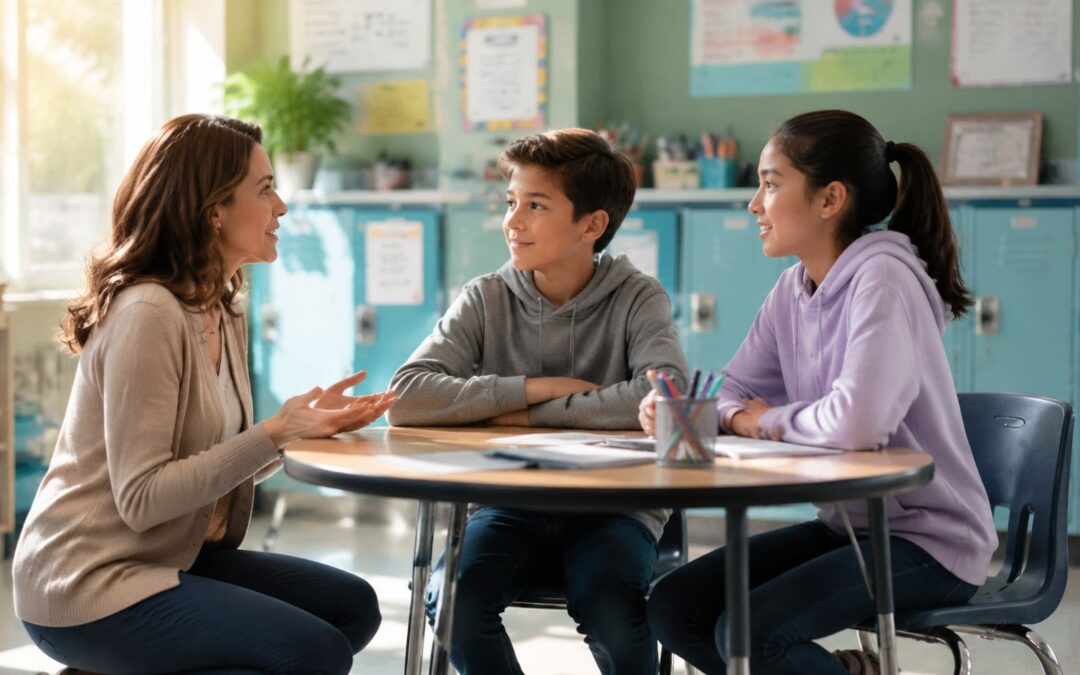
A seventh grader shoves past another student in the hallway. The second student turns, raises his voice, and within moments a careless shoulder bump has become a public argument. A teacher points to an “I-statement” poster and asks both students to explain their feelings. They stare at the wall, mutter a memorized apology, and leave angrier than before.
This scene is familiar because conflict resolution for middle school often fails at the moment students need it most. The activity may look thoughtful on paper, yet the adults haven’t accounted for audience pressure, embarrassment, friendship politics, digital rumors, or the speed at which an adolescent nervous system reacts. Effective instruction has to move beyond attractive scripts and help students use skills under pressure.
Why Middle School Conflicts Need a Different Approach
Middle school students aren’t older elementary students, and they aren’t miniature high school students. Early adolescence brings rapid emotional and social change. Students are developing judgment while also navigating heightened emotional reactivity, stronger sensitivity to peer approval, and a growing concern with social status. A private correction can feel manageable. A public invitation to “talk it out” can feel like humiliation.
That distinction changes the adult response. A peace table designed for younger children may feel childish to a seventh grader who worries that classmates are watching. A high school peer mediation model may assume more independence, verbal confidence, and willingness to reflect than some younger adolescents can yet access. The student who refuses to speak may not be uninterested in repair. They may be protecting themselves from losing face.
The audience is part of the conflict
Consider two students involved in a group-chat dispute. One posted a screenshot, another shared it, and classmates added comments. By the time the students reach school, the original disagreement has become a status contest. Asking them to apologize in front of peers may reward performance instead of honesty.
Begin with three questions:
Who is watching? A student may choose escalation because backing down publicly carries a social cost.
What happened before the visible incident? Hallway conflicts often begin with online messages, exclusion, teasing, or a rumor that adults haven’t seen.
What does each student risk by participating? Fear of retaliation, embarrassment, or being labeled weak can make a structured conversation feel unsafe.
A useful first step is to teach students that conflict resolution isn’t the same as immediate reconciliation. A student can set a boundary, request space, report harassment, or participate in a repair conversation. The correct response depends on the situation.
Practical rule: Never confuse a quiet student with a regulated student. Silence can mean reflection, fear, shutdown, or strategic self-protection.
Compliance isn’t the same as learning
Students can repeat “I feel frustrated when you interrupt me” without understanding when or why to use the sentence. Genuine skill acquisition shows up when a student pauses before posting, asks for clarification, names the actual problem, or chooses adult support instead of retaliation.
That requires repeated practice in realistic settings. The field of school conflict resolution has deep roots, with school-based programs, including peer mediation, emerging in American schools in the early 1970s. A review of the field later estimated that U.S. schools had more than 6,000 conflict resolution programs (historical review of implementation and outcomes). The lesson for today’s middle schools isn’t that every program works automatically. It’s that the model became valuable because students need structured, repeatable ways to manage disagreement.
For a broader foundation in communication, boundaries, and cooperation, teachers and caregivers can also use these social skills for middle school ideas. The strongest approach calibrates language, privacy, practice, and accountability to the way early adolescents think and behave in real time.
Evidence-Backed Frameworks That Actually Work
No single framework solves every middle school conflict. The practical choice depends on the problem, staff capacity, available data, and whether administrators will protect time for consistent implementation. These approaches are most useful when adults teach the skill before a crisis, model it during ordinary classroom friction, and revisit it after an incident.
Restorative practices
Restorative practices help students examine harm, responsibility, and repair. A teacher might say, “I’m concerned that a private screenshot was shared and several students were targeted.” Then the teacher asks restorative questions such as:
What happened from your perspective?
Who was affected?
What were you thinking or feeling at the time?
What needs to happen now to repair the harm?
In practice, the teacher doesn’t force a dramatic confession. The teacher meets with students separately when needed, checks safety, and brings students together only when each person can participate without intimidation.
Sixty-second snapshot: A student says, “I only reposted it because everyone else was laughing.” The teacher responds, “You didn’t create the original message, but your choice affected what happened next. What could repair that part?” The student identifies the repost, removes it where possible, and agrees to correct the false claim privately.
Restorative work is especially helpful when a relationship needs repair, but it can fall flat when staff use circles as a substitute for investigation, boundaries, or consequences.
RULER tools
The RULER Approach, developed by Yale’s Center for Emotional Intelligence, gives students shared language for recognizing and managing emotion. A Mood Meter can help a student distinguish irritation from shame or anxiety before the feeling becomes an accusation. A Meta-Moment creates a pause between the emotional trigger and the chosen response.
Sixty-second snapshot: A student circles “angry” on a classroom emotion display, then realizes the stronger feeling is embarrassment. The teacher asks, “What response would help the person you want to be in this moment?” The student chooses to request a private conversation rather than confront a peer at lunch.
Collaborative Problem Solving
Collaborative Problem Solving replaces a power struggle with a conversation about an unsolved problem and a lagging skill. In a Plan B conversation, the adult first listens, identifies the student’s concern, names the adult concern, and invites a realistic solution.
Sixty-second snapshot: A student keeps interrupting group work. Instead of saying, “You need to follow directions,” the teacher asks, “I’ve noticed you’re taking over when the group disagrees. What makes it hard to wait for your turn?” The student says classmates ignore his ideas. Together they plan a visible turn-taking routine.
Adapted peer mediation
Peer mediation can give students ownership, but middle school mediators need careful selection, substantial practice, supervision, and clear referral limits. They shouldn’t handle threats, coercion, serious harassment, or situations involving a major power imbalance.
A CDC school safety fact sheet reported that 38% of middle and high schools offered peer mediation, while 58% taught conflict resolution or violence prevention in a required course (CDC school safety fact sheet). Those figures show that mediation and direct instruction have both been used as parts of formal prevention systems.
Framework
Best For
Staff Training Time
Time to Impact
Key Limitation
Restorative practices
Harm, relationship repair, community concerns
Moderate
Gradual
Unsafe or forced conversations can deepen harm
RULER tools
Emotion recognition and regulation
Moderate
Visible in daily routines
Naming emotion doesn’t resolve the underlying problem
Collaborative Problem Solving
Repeated behavior and unmet needs
Moderate to substantial
Gradual
Requires patience and consistent adult follow-through
Peer mediation
Appropriate student-to-student disputes
Substantial
Depends on referrals and supervision
Not suitable for every conflict
Schools comparing broader SEL options can review SEL programs for schools while keeping the central question in view: how will students practice, use, and demonstrate the skill?
Classroom-Ready Implementation Strategies
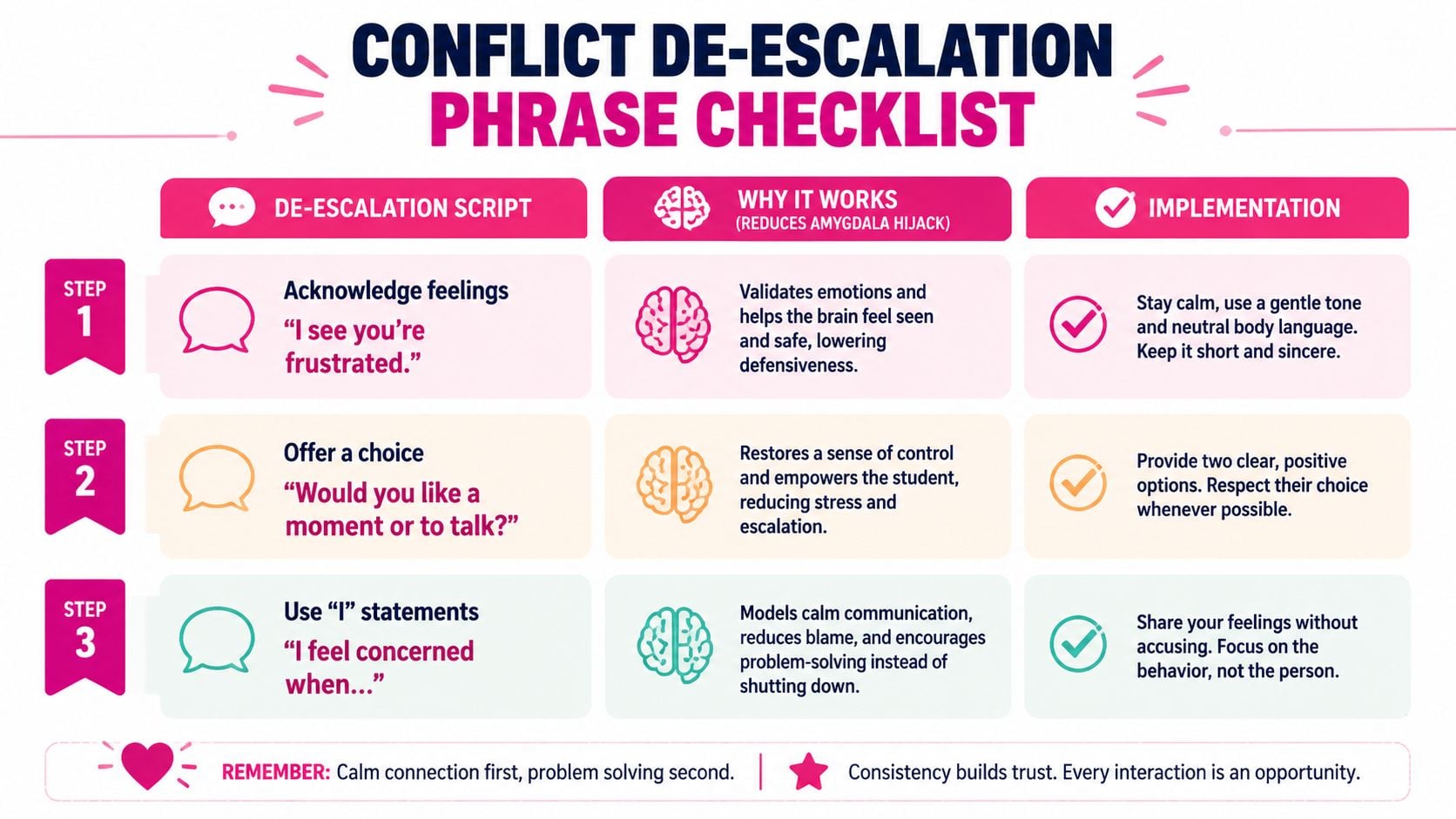
The first move during a conflict is regulation, not analysis. A student whose body is braced for threat won’t absorb a lecture about empathy. Use a low voice, reduce the audience, create physical space, and offer a small choice.
Try these phrases:
Acknowledge: “I can see this matters to you.”
Offer choice: “Would you like a moment, or would you rather talk with me privately?”
Set a boundary: “I’ll listen, but I won’t let anyone threaten or insult another student.”
Invite a next step: “Tell me what happened from your point of view.”
Avoid escalation: Replace “Calm down” with “Take a breath. We can solve one part of this at a time.”
A role-play that feels real
Use a scenario card rather than asking students to invent a conflict.
Scenario card: A student sends a Snapchat message claiming that a classmate cheated. Another student forwards it to friends. By morning, several classmates are whispering. The accused student confronts the sender near the lockers.
Student instructions:
Identify the observable facts without adding motives.
Choose one de-escalation phrase.
Use an “I” statement to describe impact.
Request a specific next step.
Decide when an adult must become involved.
Observer checklist:
Did the speaker avoid insults and threats?
Did the speaker describe behavior rather than label a person?
Did the listener allow the other person to finish?
Did either student ask for space or adult support?
Did the proposed solution address the rumor, not just the argument?
Debrief with questions such as, “Which phrase lowered the temperature?” and “What would change if the students were surrounded by peers?” Don’t praise a polished performance alone. Ask students to identify the moment when the conflict could have gone in a different direction.
A fifteen-minute restorative circle
Keep the protocol short and predictable.
Opening, two minutes: “We’re here to understand what happened and decide what needs to happen next.”
Ground rules, two minutes: One person speaks at a time. Students may pass once. No insults, threats, interruptions, or retaliation.
First round, four minutes: “What happened from your perspective?”
Impact round, three minutes: “Who was affected, and how?”
Repair round, three minutes: “What would make the next interaction safer or more respectful?”
Close, one minute: Summarize the agreement and name who will follow up.
Use a talking object only if it helps students wait their turn. A visibly structured process works better than a symbolic object that feels childish or confusing.
A short video can help staff rehearse language before using it with students:
When the plan breaks down
A student refuses. Don’t force disclosure in front of peers. Offer a private check-in, a written response, or a delayed conversation, while still addressing safety and behavior.
The conflict began online. Save relevant information according to school policy, separate the digital facts from assumptions, and teach that off-campus activity can still affect school safety. Don’t ask students to recreate a public online argument in a public classroom.
Power is unequal. Don’t mediate when one student is frightened, coerced, targeted, or unable to disagree freely. Investigate, protect the targeted student, involve the appropriate safeguarding process, and use restorative dialogue only if safety and genuine choice are present.
For SPED classrooms, shorten directions, preview the sequence visually, allow processing time, and provide alternate communication methods. For multilingual learners, use translated emotion words, visuals, sentence frames, and a chance to rehearse privately before speaking publicly. Teachers can find additional SEL activities for middle school to build practice into existing routines. Even visual reminders, including custom apparel for bullying awareness, can reinforce shared language when they support instruction rather than replace it.
The first two weeks
During the first week, teach one de-escalation phrase, model it, and practice it with low-stakes disagreements. During the second week, add the role-play, collect student reflections, and coach the language during real group work. Keep a simple record of referrals, repeated locations, conflict types, and whether students used the taught strategy. The point isn’t to create paperwork. It’s to see whether the skill appears outside the lesson.
What the Research Really Shows About Effectiveness
A polished conflict-resolution activity can produce a quiet classroom for one period and still leave recurring conflicts unchanged. Research therefore needs to examine more than student satisfaction. A large middle-school evaluation combined teacher and student surveys, disciplinary records across school years, mediation records, and matched comparisons between students who mediated and those who did not (middle-school peer mediation evaluation). This kind of design helps schools ask whether behavior changed beyond the mediation room.
A whole-school restorative-practices trial across 14 middle schools found no significant intention-to-treat effects across the full outcome set, with p-values above 0.14. Students who reported more experience with restorative practices, however, also reported better school climate, stronger peer attachment, improved social skills, and lower physical and cyberbullying victimization (whole-school restorative-practices trial). Consistent delivery matters more than program selection alone, according to this body of research.
The same source describes a Learning Policy Institute analysis across 485 middle schools and about 2 million students. Greater exposure to restorative practices during the move from fifth to sixth grade was associated with improved English and math performance, lower suspension probability, and fewer suspension days, with stronger effects for Black and Latino/a students (Learning Policy Institute findings within the review). Schools should measure how often students encounter the practices and how consistently adults use them, rather than treating adoption as proof of implementation.
What to measure
Track the chain from instruction to daily behavior:
Reach: Which students received instruction, coaching, mediation, or circle participation?
Fidelity: Did adults follow the agreed sequence, language, and safety checks?
Immediate response: Did students feel heard, identify the issue, and understand the next step?
Behavioral change: Did repeated referrals, fights, harassment reports, or classroom disruptions change over time?
Equity: Who is referred, excluded, interrupted, or asked to repair harm?
A Pennsylvania middle-school evaluation reported significantly greater improvement in conflict responses for treatment-group students, with a treatment effect of F[1,31]=52.86, p<.0005 (ERIC evaluation of a middle-school conflict-resolution program). It also reported decreased violence and stronger use of conflict-resolution tools in hypothetical situations. Direct teaching and rehearsal can build usable skills, while transfer to everyday conflicts still requires observation and follow-up.
Framework
Effectiveness Rating
Key Outcomes
Common Pitfalls
Restorative practices
Mixed, stronger with consistent exposure
Climate, attachment, social skills, disciplinary outcomes
Adoption without sufficient uptake
Peer mediation
Promising for appropriate disputes
Satisfaction, agreements, structured dialogue
Weak supervision or unsafe referrals
Direct conflict instruction
Evidence of skill improvement
Better responses and application in scenarios
One lesson without follow-up
Cooperative learning
Positive evidence for peer relations and empathy
Better relationships and lower bullying risk
Unstructured group work
A broader review found 23 studies covering 4,327 mediations, with 4,028 agreements, a 93% success rate, and 88% participant satisfaction with agreements (peer mediation outcomes review). These figures describe mediation outcomes, not proof that an entire school experienced fewer fights. Record agreements separately from recurrence, safety concerns, and disciplinary patterns.
Curriculum research adds another warning. A 2019 review of six middle-school peace and conflict curricula reported that none had been evaluated with outcome-assessment studies (review of peace education and conflict-resolution curricula). An activity may produce thoughtful discussion in the moment, yet schools still need to check whether students use the language during lunch, group work, online conflict, and other settings without immediate adult guidance.
Scaling from Classroom to Campus-Wide Programs
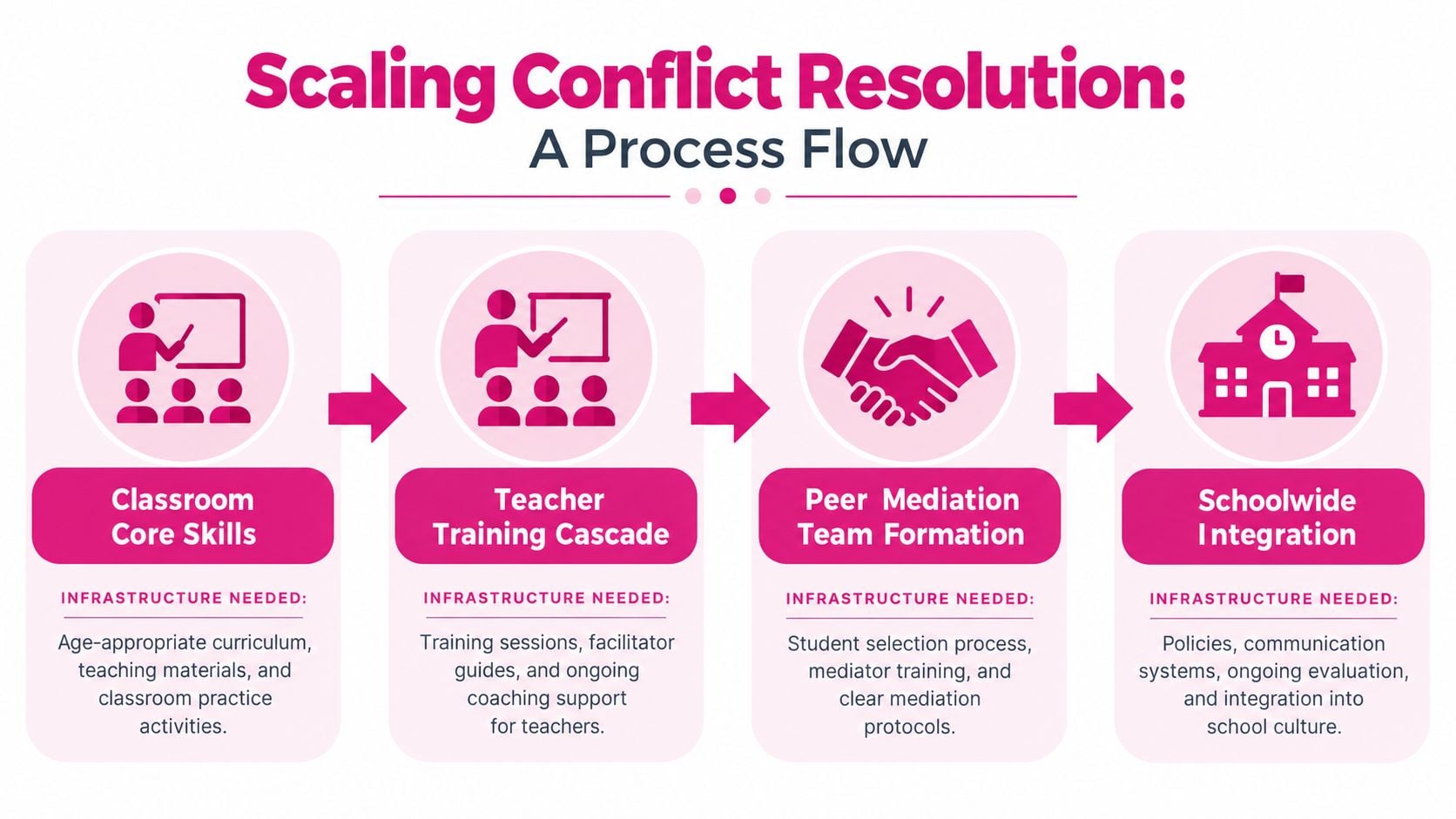
A schoolwide conflict-resolution program becomes real in the places where conflicts unfold, such as a crowded lunchroom, a hallway after dismissal, or a group chat that spills into first period. Shared posters help, but students need consistent language, protected practice time, clear referral rules, supervision, and measures showing whether support reaches them.
Begin with a classroom core, then test it against campus conditions. Teachers can use the same phrases for pausing, describing impact, requesting space, and seeking help. Counselors can map recurring conflict types and locations. Administrators must distinguish incidents requiring investigation from those that may qualify for mediation, and identify situations that peer processes cannot safely handle.
Build the adult system first
A training cascade has value only when the first group rehearses the actual language, decisions, and coaching process. Staff should role-play a hallway escalation, a group-chat rumor, a refusal to participate, and a conflict involving unequal power. A presentation may create agreement in the room; rehearsal shows whether adults can respond under pressure.
Consider two versions of the same lunch conflict. In the first, one supervisor sends students to different adults, another insists on an immediate apology, and a third offers mediation without checking safety. Students receive mixed signals, and the school cannot tell what intervention occurred. In the second, supervisors use a shared pause script, document the incident, complete the same safety check, and refer it through one process. The difference is not a more appealing activity. It is a system that can be observed and improved.
Administrators should examine discipline patterns before selecting a campus goal. If referrals cluster around lunch, train lunch supervisors and practise there. If rumors and friendship disputes dominate, build scenarios around those experiences rather than generic workplace examples.
Peer mediation should follow adult consistency and clear safety limits. Research on peer mediation programs in elementary and secondary schools describes commonly referred conflicts involving gossip and rumors, dating and friendship issues, and harassment. The study reported that 53% of mediated conflicts involved eighth graders. Schools can prepare upper-grade mediators for rumor spreading and friendship breakups, while checking whether local referrals show the same pattern.
Measure reach, fidelity, and impact
As noted in the earlier research summary, consistent delivery matters more than initial adoption. Use a small dashboard:
Reach: Record which grades and student groups receive lessons or referrals.
Fidelity: Sample whether staff followed the agreed protocol and completed safety checks.
Impact: Review recurring incidents, student climate feedback, and classroom observations.
Equity: Compare access to support across student groups without treating demographic patterns as explanations by themselves.
Family engagement helps students practise beyond school. Send home a short conversation guide with prompts such as, “What happened?” “What did you need?” and “What could make tomorrow easier?” Provide translated versions and invite caregivers to practise during ordinary disagreements.
A developed peer structure may benefit from guidance on peer mediation in schools, adapted to local safety policies, staffing, and student needs. Funding can cover training, substitute time, materials, and coaching. Leaders still need to assign ownership and protect practice time.
Your Implementation Roadmap and Next Steps
Start by listening to the school you have. Review referral records, ask students where conflicts begin, interview teachers about repeated patterns, and identify which adults students trust. Don’t select a framework because its activities look engaging. Select it because the problem, staff capacity, and safety conditions match its demands.
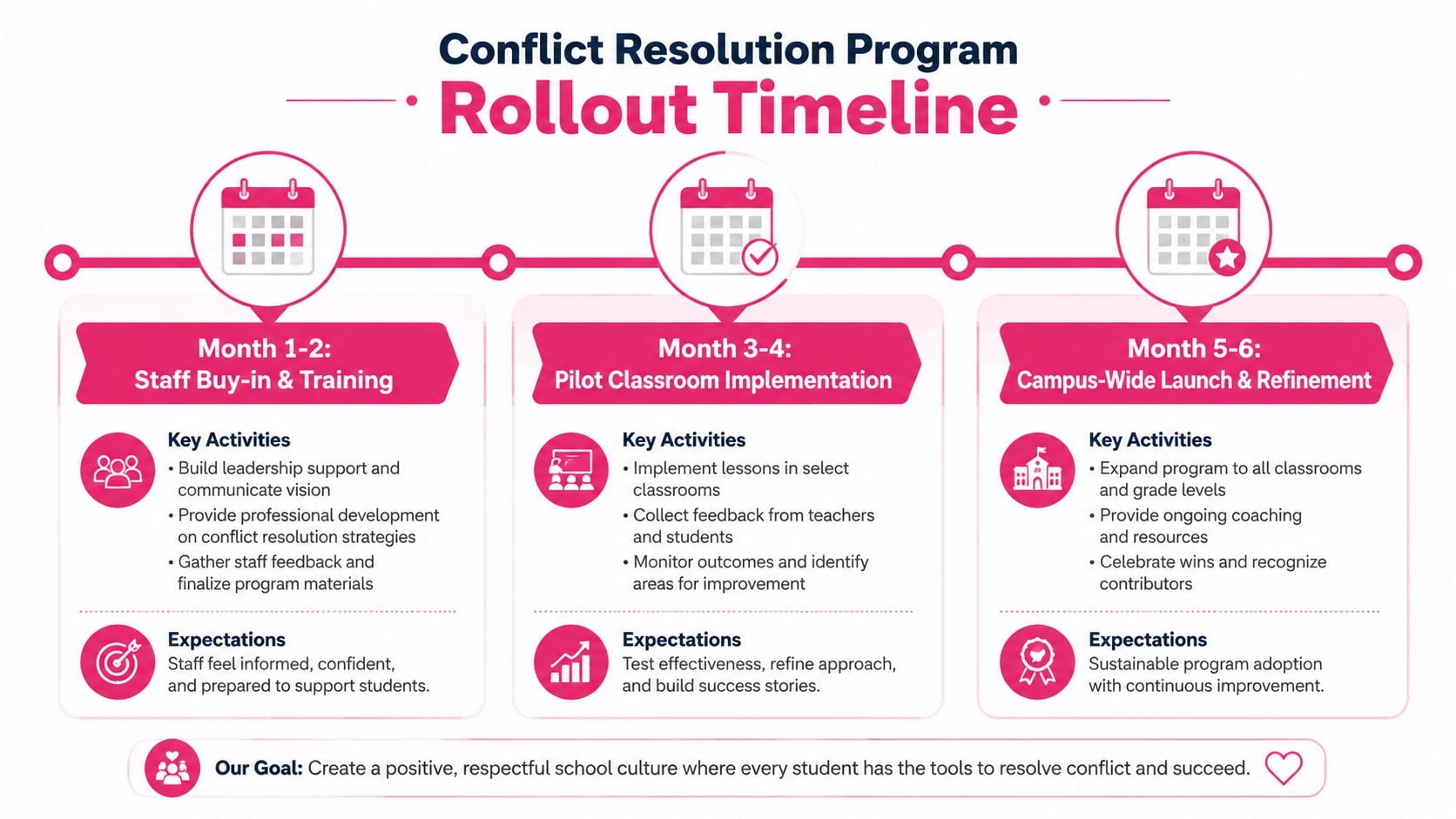
Use this rollout sequence:
First, establish a baseline. Record conflict locations, broad incident types, adult responses, repeat referrals, and student perceptions of safety and belonging.
Next, choose a narrow starting point. A grade-level routine, advisory lesson, lunch supervision plan, or carefully screened mediation process is easier to improve than a vague campus initiative.
Train adults through rehearsal. Practice the words, pauses, documentation, and referral decisions staff will use in real moments.
Pilot and review. Watch whether students receive the intervention, whether adults deliver it consistently, and whether outcomes differ across groups.
Expand only after adjustment. Add classrooms, staff, and peer mediators when the core process is clear enough to survive staff absence or schedule pressure.
During the first ninety days, expect uneven participation, awkward language, and some students testing whether adults mean what they say. Respond with coaching, not constant reinvention. If students refuse, preserve choice while maintaining boundaries. If staff skip the process, simplify the protocol and observe the setting where it breaks down. If referrals rise at first, examine whether students are finally reporting incidents rather than assuming the program caused the increase.
The supplied rollout timeline offers a practical structure: Month 1-2 for staff buy-in and training, Month 3-4 for pilot classroom implementation, and Month 5-6 for campus-wide launch and refinement. Treat those phases as a planning scaffold, not a guarantee. Staff turnover, budget constraints, and shifting priorities make documentation essential. Keep a short protocol, train new adults through the same scenarios, and review outcome data alongside student voice.
The central test is simple: can students use the skill when the audience is watching, the rumor is online, and the adult isn’t standing beside them? Build toward that test gradually, measure more than apologies, and protect safety whenever repair isn’t appropriate.
Soul Shoppe offers interactive workshops and coaching that give school communities shared language for communication, self-regulation, empathy, and conflict resolution. Visit Soul Shoppe to explore practical ways to bring those tools into middle school classrooms, family conversations, and campus-wide SEL systems.
You're not dealing with a child who is “acting out” when they can't sit still, blurt answers, or melt down after a loud hallway transition. More often, you're seeing a body that hasn't yet learned how to notice itself, calm itself, or organize itself for learning. Body awareness activities help children connect what they feel inside with what they do outside, which is why they're so useful in classrooms, counseling spaces, and at home.
That connection matters because body awareness is tied to interoception, the internal sense that helps kids notice hunger, tension, breathing, and fatigue. A major meta-analysis found a small but statistically significant association between mindfulness and objective body awareness, based on 17 independent effect sizes with an effect size of g = 0.21 and a 95% CI of 0.08 to 0.34 from the Scientific Reports analysis of mindfulness and body awareness. The takeaway for educators is simple, small practices can still matter, especially when they're repeated consistently.
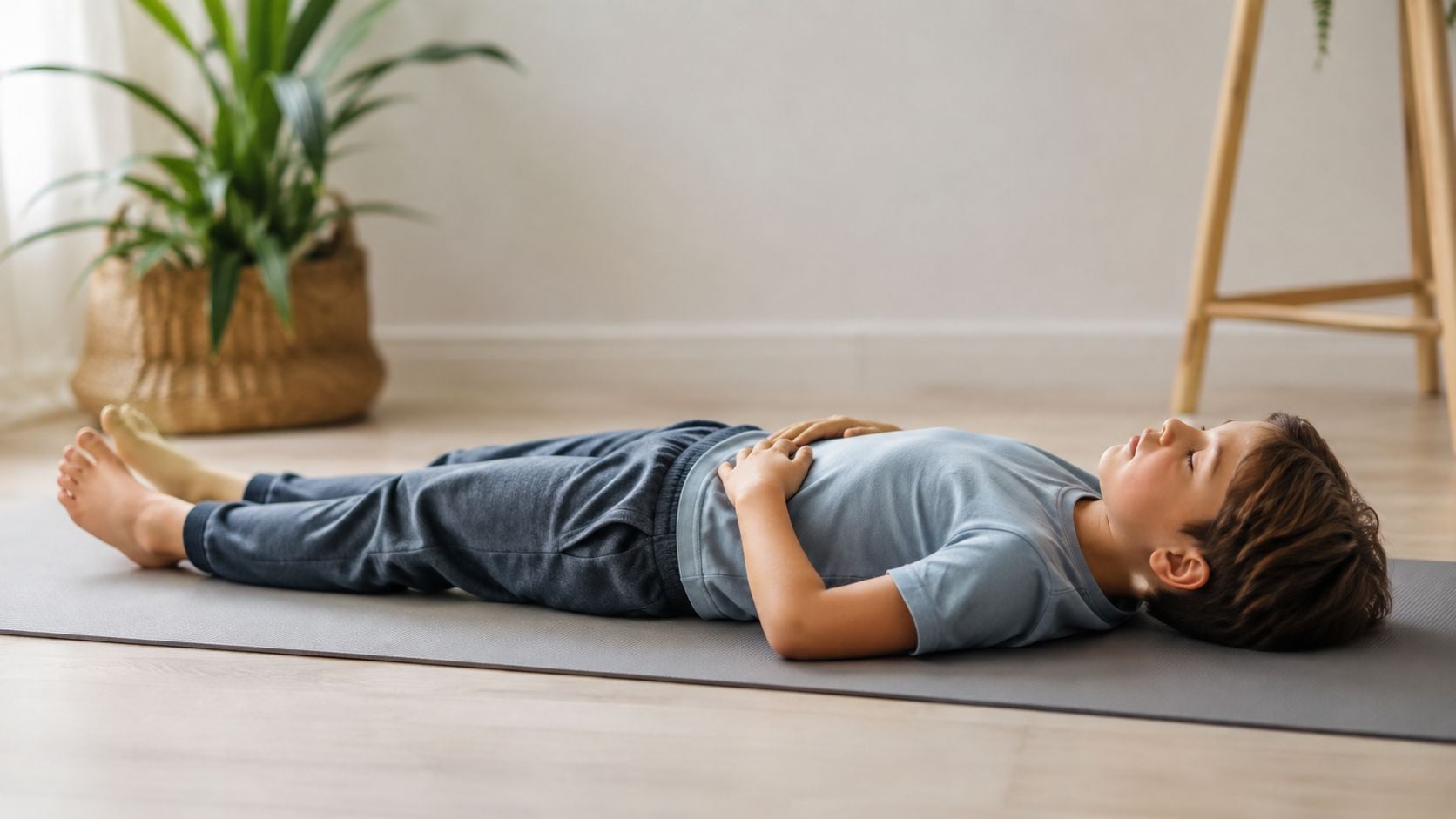
1. Body Scan Meditation
A body scan gives students a structured way to notice what's happening inside without having to fix anything right away. That matters because many children don't know how to name tension, calm, restlessness, or discomfort until those feelings spill into behavior. A short scan helps them pause, locate sensations, and build the language for self-regulation.
In practice, an elementary teacher might start the day with a 5-minute scan so students can transition from home mode to school mode. A parent might use the same routine at bedtime, pausing at each body part and asking, “What do you notice here?” A school counselor can also use this before testing, especially with anxious students who carry stress in their shoulders, stomach, or jaw.
How to guide it well
Start with a clear path, head to toe or toe to head, and keep your pacing slow. For younger students, 3 to 5 minutes is enough, while older students can usually handle a longer practice. If a child fidgets, that doesn't mean the activity failed, it usually means the child is still learning how to notice.
Practical rule: Aim for awareness, not stillness. A child can be shifting in place and still be fully engaged in a body scan.
For trauma-sensitive use, offer seated practice, open eyes, or a choice to skip any part that feels uncomfortable. After the scan, ask a simple reflection question such as, “Where did you feel tension?” or “Where did your body feel calm?” If you want a ready-made companion resource for students, the internal guide at Soul Shoppe's mindfulness exercises for students pairs well with this routine.
2. Movement Breaks with Intentional Awareness
Movement breaks work best when they're more than just a quick burst of energy. When children notice how their arms, legs, breath, and balance feel during movement, they begin to connect motion with regulation. That's important because many students need movement to reset their nervous systems, and the awareness piece turns an ordinary break into a real SEL tool.
A teacher might lead a 5-minute energy reset with arm circles, leg swings, and spinal twists, then ask what each movement felt like. A parent and child can do a feeling dance at home, then compare notes about body sensations, like “My legs felt strong” or “My heart was beating fast.” In a classroom, a brain break card deck can become more meaningful when each movement ends with a quick reflection, not just a timer.
Make movement observable
Use prompts that direct attention into the body while students move. “What do you feel in your legs right now?” is better than “Are you ready?” because it brings attention to sensation instead of compliance. Cues like “Stand tall and feel your feet on the ground” help anchor the body, especially during transitions.
A school can also build movement stations into the morning or mid-morning routine. One group might jump, one might stretch, and one might twist, then everyone checks in on energy, breath, and focus afterward. Soul Shoppe's fun brain breaks fit naturally here because they turn movement into a repeatable classroom rhythm.
Give students choices. “Big stretches or small stretches?” invites agency, and agency supports regulation.
To keep the routine effective, use the same cue language often. Students learn faster when the structure stays familiar, because they can stop thinking about what comes next and start noticing what their bodies are telling them.
3. Five Senses Grounding Exercise
The 5-4-3-2-1 practice helps students come back to the present when stress starts pulling their attention in too many directions. It works because the senses give the brain concrete information, which can interrupt spiraling thoughts and help a child settle enough to learn. For anxious students, this is often one of the most practical body awareness activities because it's simple, discreet, and easy to repeat.
A teacher can use it in the middle of a stressful announcement and ask the whole class to name something they see, touch, hear, smell, and taste. A parent can guide a child through it in a waiting room before a doctor's appointment. A school counselor can teach it to a student who feels uneasy in the hallway, then post a small reminder card near the classroom door so the student can use it independently.
Keep it teachable before it's needed
Introduce the sequence during a calm moment, not in the middle of a meltdown. That way, students can practice when their brains are open to learning and use the same pattern later when they're dysregulated. For K-1 students, simplify it to 3-2-1, such as three things they see, two they can touch, and one they hear.
Some students are sensory-sensitive, so don't force every sense in every situation. You can skip taste, use gentle movement sensations instead, or ask the child to stay with preferred senses first. Soul Shoppe's 5 senses activity supports this kind of grounding practice well because it reinforces the same sequence in a kid-friendly way.
The best grounding tools don't demand perfect answers. They help a child notice what's there without judgment.
Follow the exercise with a quick body check-in. Ask, “What changed in your body after that?” That question helps students connect an outside-sense exercise with an inside-body shift, which is the learning.
4. Proprioceptive Awareness Activities with Wall Pushes and Weighted Tasks
Some children need stronger physical input before they can settle into learning. Proprioceptive activities, like wall pushes, chair pushes, carrying books, or moving furniture, give the brain clear information about where the body is in space and how much force it's using. That's why these tasks can feel grounding for dysregulated students, especially when their bodies are seeking heavy input or resistance.
A classroom teacher might have students do 10 to 15 wall pushes before independent work, then ask how their bodies feel afterward. At home, a parent can turn routine chores into a body-awareness moment by asking a child to carry the laundry basket, push chairs into place, or squeeze therapy putty while talking about muscle effort. A child who's overwhelmed can also take a heavy-work break by moving books or pushing a rolling cart under adult supervision.
Use force on purpose
Form matters here. Hands should be flat on the wall, the body slightly angled, and the push should come from the shoulders and core, not just the arms. That keeps the activity intentional and safer, and it also makes the body feedback clearer.
You can pair the work with simple counting or breathing, such as “push for 4 counts, rest for 4 counts.” That combination helps students feel the input in their muscles while staying connected to a calm rhythm. The Soul Shoppe embodiment practices resource aligns well with this approach because it treats body input as a regulation skill, not just a movement break.
Use these activities before hard moments, not only after problems happen. Transitions, tests, and busy hallway times are often the best moments for preventive heavy work.
If you're building a wider motor toolkit, a relevant companion resource is motor skills activities for preschoolers, especially for younger children who need more hands-on movement variety.
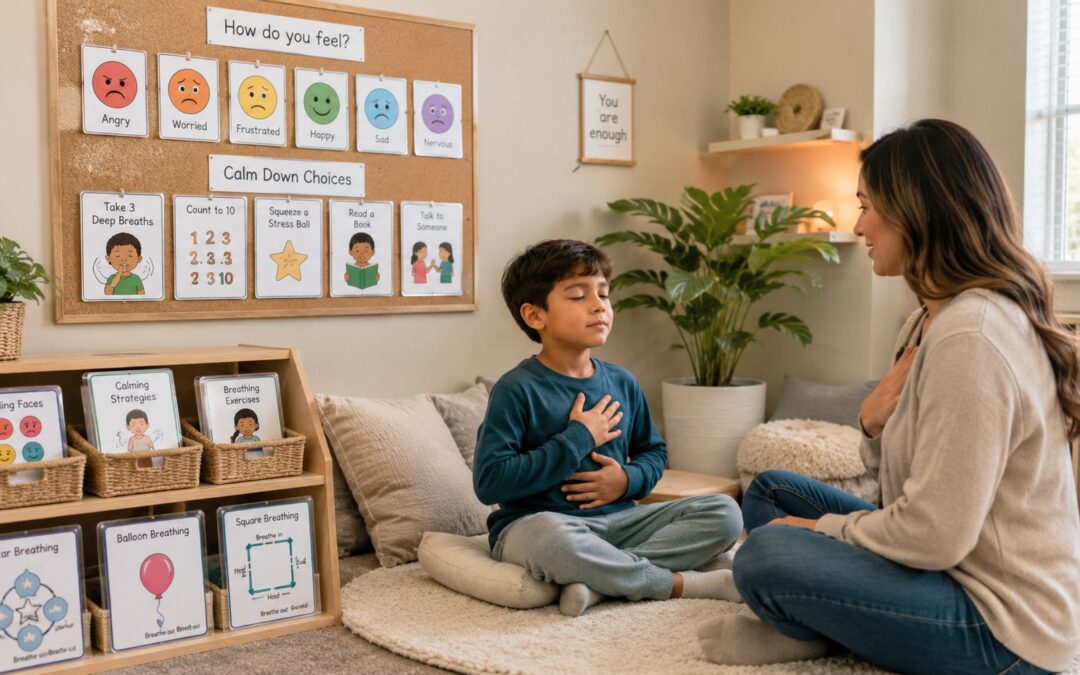
5. Breathing Awareness Exercises with Hand Placement
Breathing becomes a body-awareness skill when children can feel it, not just hear about it. Hand placement helps with that because a hand on the belly or chest gives direct tactile feedback about expansion, rhythm, and pace. When students notice the breath moving the body, they start to connect calm breathing with a calmer internal state.
A kindergarten teacher might lead “bubble breath,” asking children to breathe in like they're smelling a flower and out like they're blowing bubbles. A parent can help a child at bedtime place a hand on the heart and notice what changes after three slow breaths. A counselor might teach box breathing for test anxiety, helping a student feel the belly rise and fall through each phase.
Make the breath visible and concrete
Model the breathing yourself so children can see what slow, steady breaths look and sound like. Young children usually do better with imagery than technical language, so “smell the flower, blow the candle” often lands better than “regulate your respiratory pattern.” For older children, counting can help, especially if they're already familiar with patterns like inhale, hold, exhale, hold.
Offer options for hand placement, too. Some children like a hand on the belly, some prefer the chest, and some don't want touch on the body at all. That choice matters, because the goal is awareness and safety, not forcing a pose.
A breathing bell or timer can make this a shared classroom habit. When it chimes, everyone stops for three conscious breaths, then checks in with the body before returning to work. This kind of routine gives students a predictable moment to notice what's happening inside them, which helps build trust in the practice.
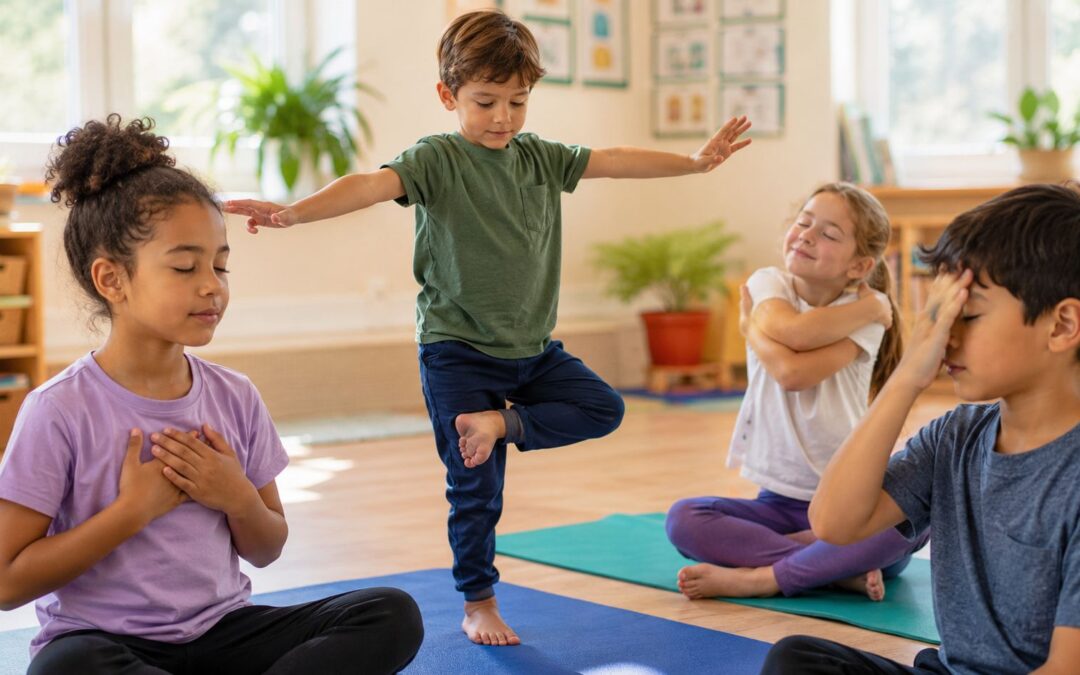
6. Yoga and Mindful Stretching
Yoga works well for body awareness because it combines pose, breath, and attention all at once. A child isn't just reaching for a shape, they're learning how the shape feels, where balance lives, and how emotions shift inside the body. That makes yoga especially useful for students who need a safe, playful way to inhabit their bodies with more confidence.
An elementary class might move through an animal flow sequence, starting with mountain pose, then moving into downward dog, then resting in child's pose. A parent and child might do bedtime yoga in pajamas, using gentle stretches to release the day before sleep. A teacher can also keep yoga cards in the classroom so children can pick a pose when they need a regulation tool.
Keep the practice child-friendly
Start with familiar poses such as mountain, child's pose, and downward dog. The simpler the pose, the easier it is for students to focus on sensation instead of performance. Use storytelling when you can, because a forest, a strong tree, or a steady mountain gives children something concrete to inhabit.
Remind students that it's “your yoga,” not a test of perfect form. Some children will need wall support, some will prefer kneeling, and others may want a chair-based version. Keep child's pose available as a resting option throughout the sequence so children learn that pause is part of practice, not a sign of failure.
Pair each pose with a quick body question. “In warrior pose, I feel…” or “What do you notice in your shoulders now?” helps children connect posture with emotion and physical sensation. Over time, they start recognizing which shapes help them feel strong, which help them feel calm, and which ones they can use on their own.
The most useful yoga routines in schools are the ones children can remember without adult prompting.
7. Body Mapping and Emotional Awareness
Body mapping helps children see feelings instead of only talking about them. That's powerful because emotions often show up physically before a child has words for them, tight fists, a heavy chest, a hot face, or a stomach that feels strange. When students draw or color where feelings live in the body, they build a bridge between emotional literacy and body awareness.
A teacher can hand out a simple body outline and ask students to color where they feel anger, sadness, happiness, or worry. A parent can sit with a child and make a feeling map together, talking about where calm or concern shows up during the day. A counselor can use body maps to help a student describe worry as chest tightness, then return to that map later when it's time to choose a regulation strategy.
Make the map safe and usable
Keep the language neutral. Ask, “Where do you notice calm?” instead of “What's wrong with your body?” because the point is understanding, not judgment. Offer options for children who don't want to draw, such as stickers, symbols, or words written directly on the outline.
If the activity happens in a group, display it carefully and remove identifying details when needed. That helps normalize the idea that many children feel emotions in similar places. Revisit the maps after teaching coping tools so students can see whether something shifted.
This is also a strong place to connect action to sensation. If a child says anger lives in the hands, hand squeezes or wall pushes may help. If worry lives in the chest, breathing practices may be the right next step. The value of body mapping is that it makes regulation feel specific instead of abstract.
Real-life interoception training; engages all senses and gratitude
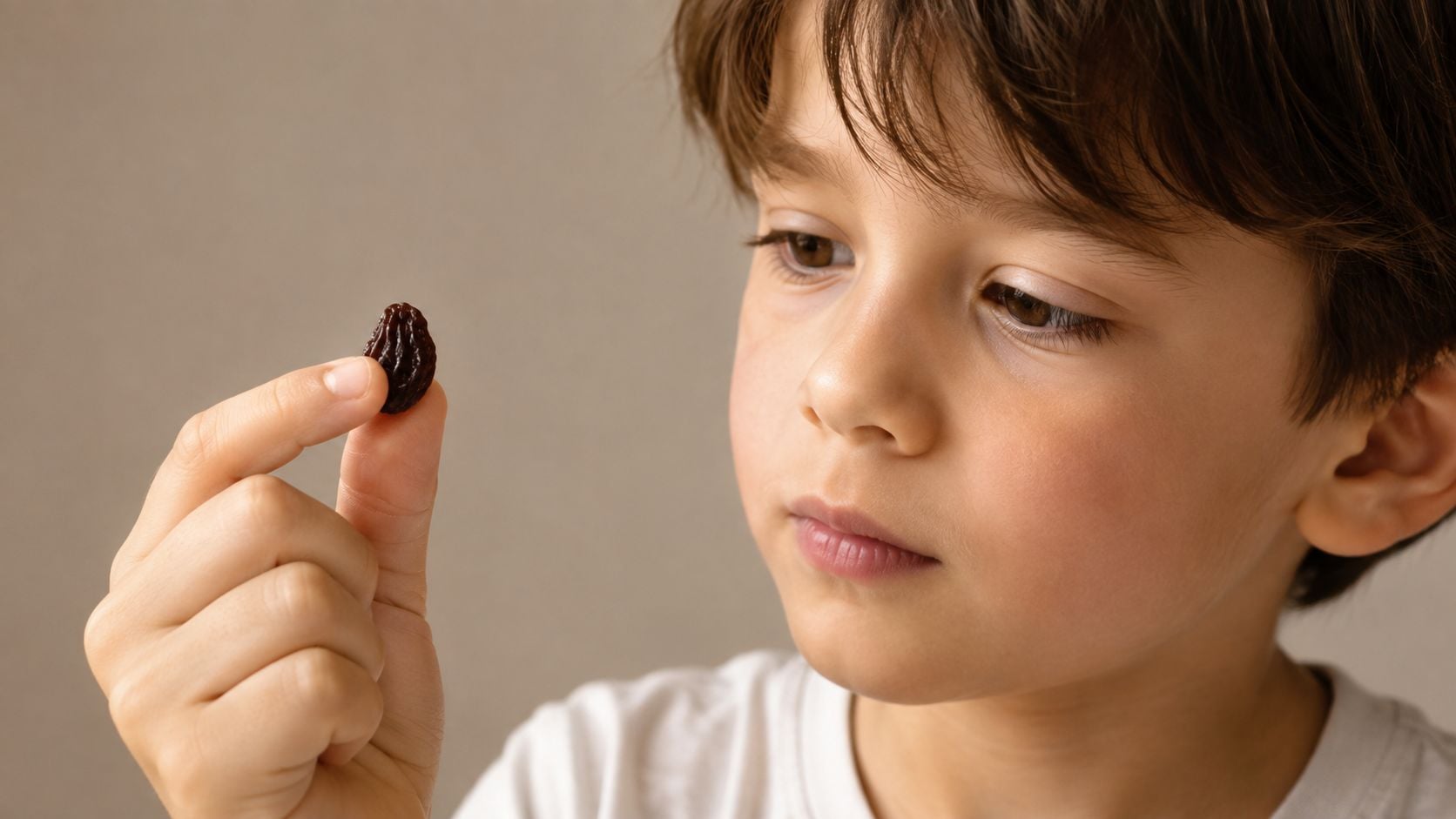
8. Mindful Eating and Sensory Food Exploration
Mindful eating slows children down enough to notice hunger, fullness, texture, and taste before those cues get buried by speed or distraction. It's one of the clearest ways to connect body awareness with everyday life, because meals and snacks already happen in homes and schools. When a child pauses to notice food with all the senses, the body becomes part of the learning process.
An elementary classroom might do a mindful raisin tasting with one small raisin, asking students to notice color, wrinkles, smell, texture, and flavor changes. A parent and child can share a slow snack at home and compare what they each notice in the first bite and the last bite. A school lunch routine can begin with a simple pause to smell the food and check in with hunger before eating.
Keep the experience small and pressure-free
Use tiny amounts of food so the task stays focused and doesn't turn into a full snack time challenge. One raisin, one strawberry slice, or one piece of chocolate is enough for the first practice. Start with neutral or preferred foods, and don't frame foods as good or bad.
For children with sensory sensitivities, ask what they notice rather than assuming they'll enjoy the texture or taste. Some kids will be curious, some will be cautious, and some will need repeated tries before the practice feels safe. That's normal.
A simple script works well here. “Notice the color. Notice the smell. Notice the texture on your tongue. Notice how the taste changes as you chew.” Afterward, ask how the body feels, and whether fullness or satisfaction showed up differently. That reflection helps children connect eating with body signals instead of autopilot.
Weaving Awareness into Everyday Life
Body awareness becomes most useful when it shows up in ordinary moments, not only in special lessons. A morning body scan can help a class settle in. A wall-push reset can help a student move from transition chaos into focused work. A five-senses pause can turn a stressful hallway, announcement, or doctor's office wait into a chance to regulate instead of react.
The strongest routines are the ones adults repeat with calm consistency. When a teacher uses the same cue language, the same breathing pattern, or the same reflection question, students begin to trust the process. That trust matters because body awareness is personal, and some children need many low-pressure repetitions before they can use a tool on their own.
These activities also support social-emotional learning in a very practical way. Children who can notice body signals are better positioned to name emotions, ask for help, and choose a strategy before escalation takes over. That's especially important in K-8 settings, where students are growing fast, managing more complex social situations, and learning how school expectations feel in their bodies.
Parents and teachers don't need a perfect program to start. A short scan before the bell, a movement break after recess, a hand-on-belly breath before bedtime, or a sensory check-in during snack time can make a real difference when it's repeated over time. Small moments of awareness help children understand that their bodies are not obstacles to learning, they're part of how learning works.
At Soul Shoppe, we believe safe, connected communities are built through practice, language, and care. When adults model body awareness, they give children a reliable way to reset, reflect, and return to learning with more confidence and compassion.
Soul Shoppe helps schools and families build the shared language kids need for self-regulation, mindfulness, and connection. If you want practical support that turns body awareness activities into everyday SEL habits, visit Soul Shoppe and explore programs that help children thrive at school and at home.
You're setting up a calm corner because the day already has enough friction, and the students in front of you need a place that helps them reset without feeling singled out. The strongest calm down corner printables do more than decorate a wall. They give children a clear, repeatable path from big feeling to calm body, which is why the best resources pair visual cues with simple routines, family language, and easy-to-use strategy cards. A good setup can be quiet, low-prep, and teachable, and that matters whether you're a classroom teacher, counselor, or parent trying to make regulation feel practical instead of mysterious.
1. Calm Down Corner Kit, Social Emotional Workshop on TPT
This is the kind of bundle many teachers reach for first because it feels complete without being random. The four-part setup gives you a sign, feelings visuals, strategies, and step-by-step process posters, so the corner doesn't become a pile of pretty paper that children ignore. The product page also shows how much support it offers for actual use, not just display, which is where a lot of calm spaces fall apart.
Why it works in a real classroom
The bundle includes 27 emotion visuals and 29 strategy cards covering breathing, mindful minutes, and affirmations, plus a teacher guide and student reflection forms. That mix matters because students usually need both the language for the feeling and a next step for what to do with it. The interactive option with Velcro also helps the corner function like a routine, not a poster wall.
Practical rule: If a student can point, choose, and return, the corner is teachable. If the setup requires adult narration every time, the child is not really using the tool independently.
Best use case
Use this kit when you want one purchase to anchor the whole calm space. It fits teachers who want structure, reflection, and enough variety for different student needs. The trade-off is prep. If you want many pieces in rotation, expect lamination and assembly time, especially if you're using the more interactive formats.
2. Calming Strategies Visual Cards and Poster, Teaching Exceptional Kinders on TPT
This set is lean, direct, and easy to launch. It works best when the goal is to get children using a calm space quickly without building a huge display first. The visuals are simple enough for students who need fast cues, which makes the set especially strong for primary classrooms and special education settings.
The cards show actions like deep breaths, wall pushes, and think happy thoughts, and they come in both color and black-and-white with an included poster. That flexibility is useful when you want to print on different paper stocks or let students color their own versions. The ring format also supports independent selection, which keeps the student in charge of choosing a strategy instead of waiting for an adult to assign one.
The main trade-off is scope. This is not a full calm corner library. It gives you a clean, efficient starter set, but you'll probably want to add feelings visuals or a social story if the corner is new to the class.
Best use case
Use this set when you need a fast, affordable way to teach strategy use. It's strong for K–2, and it can also support students with autism or other support needs who benefit from uncluttered visuals. For older elementary students, the design may feel young, so pair it with more neutral signage if you're working beyond the primary grades.
3. Calm Down Techniques, Pocket of Preschool
A preschool calm corner works best when the adults around the child use the same language. This Pocket of Preschool resource is built with that reality in mind, so it fits early childhood classrooms that need family alignment as much as room setup. It stays grounded in Pre-K and kindergarten use, which matters because younger children rely on repetition, visual cues, and clear routines before they can use a calm space on their own. The pack also includes a teacher mini-unit, so the corner is tied to instruction instead of sitting in the room as decoration.
Early years need a simpler path
The pack includes 36 calm-down cards, deep-breath charts, yoga pose cards, multiple safe-place sign options, a read-aloud social story, teacher tips, and a take-home family letter. That mix gives children more than one entry point, which is helpful because some students calm their bodies first, while others need to name the feeling before they can use a strategy. The social story helps adults present the corner as support, not punishment, and the sign choices make it easier to match the room's setup. If you want help choosing display dimensions, the pack includes multiple safe-place sign options in standard poster sizes explained.
The family letter may be the piece teachers use least, but it can make the biggest difference. When caregivers use the same words at home, children are more likely to understand what the corner is for in class and use it without extra prompting. It also helps prevent a common problem in early childhood rooms, where a calm space becomes a novelty spot children visit only when an adult sends them there. With the letter, the routine can start to feel familiar in both settings.
Best use case
Choose this one for Pre-K and K classrooms where the calm corner needs to fit naturally into the daily schedule. It works well for teachers who already use read-alouds, morning meeting, and circle time as places to teach behavior skills. The tone and visuals are less suited to upper grades, so I would pass on it if your students need a more mature look or more independent self-regulation tools.
4. Calm Down Corner Tool Kit, Proud to Be Primary
This toolkit works well when you want a calm-down corner that also supports direct SEL teaching. The layout is broad enough for classroom routines, but not so huge that it becomes unwieldy. It gives you enough material to teach strategies in whole group and then let students use them on their own later.
Built for classroom rhythm
The kit includes Ways to Calm Down cards, multiple breathing visuals, feelings check-ins, journal pages, and a short social story. That's a strong mix because students don't all need the same entry point. Some notice their body first, some need a feeling label, and some are ready to reflect in writing once they've settled.
The journal pages add an important layer. They turn the calm corner into a place where students can think about what happened, which strategy helped, and what they might try next time. That reflective step matters in K–4 settings because many students can calm down, but still need help connecting the experience to their own behavior pattern.
The best calm corners don't just help children feel better. They help them learn what helped.
Best use case
Use this toolkit if you want one set that supports lessons, independent use, and follow-up reflection. It's a strong fit for K–4. The only real downside is overlap. Many schools already own breathing visuals, journal pages, or check-in tools, so some pieces may duplicate what's in your room.
5. Calm Down Corner Printables with Calming Coloring Pages and Visuals, Cupcakes & Curriculum
This bundle is especially strong for family engagement and student reflection. It's not just a set of posters, it's a system of visuals that moves from feeling identification to coping and then to follow-up. That makes it a good choice when you want your calm corner to connect school and home instead of sitting isolated on a wall.
The set includes 30 emotion visuals, 15 self-regulation visuals, and 11 focus strategies, plus five breathing posters and trace-the-breath visuals. It also includes an affirmation station with 40 affirmations and parent check-in and student tracking materials. Those elements make the resource especially useful for students who need repeated practice naming feelings before they can move into coping.
The different poster sizes are useful in real rooms. A tiny calming spot in a counseling office doesn't need the same layout as a larger classroom corner, and this set lets you scale the visuals to the space you have. The family tracking tools also help when a child uses the corner across settings, because adults can compare language without guessing what happened.
Best use case
This is a solid choice for primary and elementary classrooms that value home communication. It's also a good fit for counselors who want students to reflect after using the space. The trade-off is prep, since the full set can take time to organize if you want to use every part.
6. Calm Down Area Printables, Self-Regulation Calm Down Kit, Counselor Keri
A student walks into the counseling office already worked up, and the usual verbal reminders are not enough. This kit fits that moment because it gives adults a clear sequence to follow, from body cues to thoughts, feelings, and strategies. The sports theme will not suit every room, but the process-focused design is practical for counseling offices and Tier 2 supports. This step-by-step approach aligns with the self-regulation strategies for students covered in our guide.
A counseling-friendly structure
The set uses color and black-and-white formats organized by body cues, thoughts, emotions, and strategies. It also includes an emotion word wall, photo examples of setup, a no-cut binder-friendly version, a Locker Room Report reflection sheet, and quarterly prompts to support growth over time. That layout gives adults a repeatable way to coach self-regulation, instead of relying on a one-time calming activity.
The binder-friendly option is a practical win in tight spaces. Not every counselor office or hallway corner has room for posters, bins, and themed décor, so a compact version keeps the core function intact without taking over the room. The reflection sheet also helps a student leave with a concrete summary of what worked, which makes it easier to carry the same language back to class.
Best use case
Use this kit when calm-down supports need to live inside a counseling intervention or small-group routine. It works especially well when adults are tracking student progress and want a visual way to coach self-regulation. The sports theme is the main trade-off, since some teachers will prefer a more neutral look, but the underlying structure is strong for students who need guided practice rather than a decorative corner.
7. Calm Down Kit for Preschool Kids, Pre-K Pages
This one is a strong match for early learners who need choice, repetition, and take-home continuity. It's a large set, but the structure still feels approachable because the visuals are made for preschool and transitional kindergarten. That age fit matters more than people think, because young children need simple entry points before they can use self-regulation tools independently.
The kit is a 92-page package with multiple poster versions in color and black-and-white, full-page and mini calm-down books, picture cards, and choice boards. The mini books are especially helpful because children can color them, take them home, and hear the same coping language from families. That makes the calm-down corner less of a school-only routine and more of a shared skill.
Choice boards and ring-bound cards are a smart design choice for preschoolers. They reduce the amount of verbal processing required when a child is already upset. Instead of explaining the options over and over, the adult can point, and the student can choose.
Implementation note: For younger children, consistency beats variety. A few repeated visuals used well will usually outperform a crowded corner full of unused printables.
Best use case
Pick this set if you're teaching Pre-K or transitional kindergarten and want strong home-school connection. It's also useful for caregivers who want a printable calm corner at home that mirrors classroom language. The main limitation is age range. It's not built with upper elementary use in mind, and that shows in the visual style.
8. FREE Calm Down Corner Starter Kit, Confident Classroom Resources on TPT
Free resources can be weak, but this one is useful as a launch point. It gives you the basics without forcing you to build the system from scratch. That makes it ideal when you're testing a calm corner in a classroom, counseling space, or home setting and want to keep prep minimal.
Simple, usable, immediate
The kit includes a deep-breathing poster, an emotion wheel, and a My Calm Down Choices checklist. Those three visuals are enough to introduce the basic routine. A child can name a feeling, look at options, and choose a strategy without needing a larger bundle on day one.
The simplicity is the strength. It's easy to laminate, easy to display, and easy to explain to families. The cost is depth. If you want emotions, strategies, reflection, and family follow-up all in one place, you'll outgrow this quickly.
Best use case
Use this as a starter kit when the bigger question is, “Will my students use this?” It's also useful as an add-on to an existing corner that needs one or two more visuals. For PreK–3 and special education settings, the language and illustration style are friendly and practical.
9. Themed Calm Down Corner Printables, LittleYellowStar on TPT
This is the best choice when you care about matching the calm corner to the rest of the room. Some classrooms need a neutral, theme-coordinated look because the rest of the environment already carries a strong visual identity. These kits solve that problem by offering themed options without changing the function of the corner.
Looks that still work
The available themes include Boho Rainbow, Ocean, Space, and Sports, and the sets include posters plus card-size strategy, feelings, and breathing tools. That format flexibility is helpful because you can choose a larger wall display for the main area and smaller cards for a ring or pocket chart. The files are quick to print and use, which helps teachers who don't want a long setup process.
The main value here is consistency. Students notice when every part of the room looks intentional, and a calm corner that matches the rest of the classroom can feel more integrated. The downside is that the style may read as too cute for older students, especially in upper elementary or middle school spaces.
Best use case
Choose this when décor coordination matters and you still want functional SEL tools. It's especially appealing for teachers who like the corner to blend into a broader classroom theme. If you need a heavy-duty intervention tool with family communication and reflection layers, look elsewhere.
10. Calm Down Corner Printables Kit Plus Social Story, One Giggle Classroom
This set bridges classroom and home in a way many bundles don't. The inclusion of family letters and both school and home social stories tells you the designer understands that regulation skills need consistency across settings. That makes it especially helpful when a student's behavior looks different at home and at school.
Strong bridge between settings
The kit includes over 100 pages, 14 strategy cards, 21 emotion posters, multiple sizes of feelings check-ins, and a worry jar activity set. The strategy cards cover movement, breathing, and grounding, which gives children a range of ways to respond depending on what their body needs. The social story pieces are useful for introducing the corner before a child needs it, which usually makes the whole system easier to accept.
The worry jar adds a nice emotional release option. Some students need a place to put their worry before they can settle enough to use another tool. That kind of practical detail makes the kit feel ready for both classroom use and parent partnership.
Best use case
Use this if you want a complete set that still feels organized. It fits primary classrooms well, and it's especially strong when families are part of the support plan. The only downside is that it may overlap with materials you already own, so it works best when you're building from scratch or replacing a very thin setup.
Top 10 Calm-Down Corner Printables Comparison
Product
Target audience
Core features
Unique selling point
Ease of implementation
Price / value
Calm Down Corner Kit (Social Emotional Workshop, TPT)
Calm Down Corner Printables Kit + Social Story (One Giggle Classroom)
Elementary + families
100+ pages; family letters; school/home social stories; 14 strategy cards; 21 emotion posters; worry jar
Strong home/classroom bridge; comprehensive w/ family tools
Moderate (multi-page pack)
Mid-range
Bringing Your Calm Corner to Life
Getting the printables is step one. Success comes from how you integrate them. Start by introducing the corner as a safe, positive space, not a time-out zone. Model the language yourself, and say something simple like, “My brain feels fuzzy, I'm going to use a breathing card.” That matters because children learn the routine by watching adults treat it as normal, not punitive.
The most effective calm-down spaces stay visually sparse and predictable. A low-traffic corner with a cushion or beanbag, a feelings chart at child height, and a few laminated cards often works better than a crowded display. The setup guide from Lantern Path Books emphasizes keeping materials sparse, printing cards on card stock, laminating for repeat use, and teaching the routine together so children hear language like, “Anyone can come here when a feeling feels big” calm-corner setup guide. That approach lines up with school-based SEL that focuses on proactive regulation, not just response after escalation.
Adults also need to teach the return-to-task piece. A calm corner works best when children know how long to stay, how to check in, and how to rejoin class afterward. One classroom study documented a small shift in observed behavior, with total behaviors moving from 15 before implementation to 14 after implementation, and another body of classroom reporting noted a 21% decrease in disruptive behaviors after calm down corners were introduced classroom study summary. The point isn't to chase a perfect number. The point is that a structured routine can help students use the space for self-regulation instead of decoration.
Do not overbuild the corner on day one. Start with a feelings visual, two or three coping cards, and one clear rule card. Then extend the tools beyond the corner itself. Use a breathing card during transitions, pull a feeling visual into morning meeting, or let a child choose a strategy card before a hard task. If your school wants a larger SEL framework with shared language, Soul Shoppe's Peace Corner concept and self-soothe guidance around a quiet corner fit naturally with this kind of implementation, especially when the goal is a whole-school regulation routine rather than isolated décor.
If you want calm down corner printables that change behavior, use tools that teach language, routine, and repair together. Visit Soul Shoppe to explore SEL resources that help children and adults build a shared calm-down practice for school and home.
It's the middle of the afternoon. Pencils are tapping, chairs are scraping, and the room feels one comment away from unraveling. You don't need a complicated reset, you need a short, calm pause that helps students regulate, refocus, and return ready to learn. That's exactly where mindfulness brain breaks earn their place in K-8 classrooms and at home.
The strongest research on active breaks and mindfulness points in the same direction. Brief, scheduled pauses can improve attention and concentration, and mindfulness-based interventions have been associated with gains in global cognition and attention-related skills in learning settings, including executive attention, working memory, and sustained attention (systematic review and meta-analysis). In other words, these are not filler activities. They're short, structured tools for helping students reset before fatigue turns into behavior problems. For a quick timing model that fits busy classrooms, see this practical Pomodoro and ADHD-friendly tips resource.
1. Box Breathing for Emotional Regulation
Box breathing gives students a clear rhythm when feelings are running hot. The pattern is simple, inhale for four counts, hold for four, exhale for four, hold for four. That structure matters because predictable pacing helps a nervous system settle, and it gives children a concrete action to repeat when they feel overwhelmed.
A 3rd-grade teacher might use it every morning during the transition from arrival to morning work. Students can hold up four fingers as they count, which adds visual support and keeps the whole class synced. At home, parents often use the same routine before bed or after conflict so children hear the same cue in both settings. For younger students, the language can be even simpler, “smell the flowers, hold, blow bubbles.”
Practical rule: Teach box breathing when the room is calm, not during a meltdown. Once students have practiced it successfully, they're far more likely to use it when they're anxious before a quiz, upset after recess, or stuck in the middle of a hard conversation.
A visual aid helps a lot. Draw a square on the board, trace it with a finger, or use an animated breathing tool so students can follow the shape with their eyes and breath. A discreet hand signal also helps, especially for older students who don't want to interrupt instruction to ask for help.
A breathing break works best when students can request it without embarrassment.
Teachers who want a step-by-step family-friendly version can pair this with Soul Shoppe's belly breathing technique. Used consistently, box breathing becomes less of a “calm down” trick and more of a self-regulation habit students can carry into tests, friendships, and home routines.
2. Body Scan Meditation for Awareness and Tension Release
A body scan works well when students seem distracted but can't explain why. Instead of asking them to “relax,” you guide them to notice sensations from head to toe, including tension, warmth, pressure, or stillness. That awareness helps students recognize stress earlier, which is a key SEL skill, because children can't use coping tools they haven't learned to notice.
A 4th-grade teacher might guide a body scan after lunch, when the class has energy to burn but still needs to settle for reading or writing. A 2nd-grade class can use a shorter “sleepy scan” before dismissal, with simple prompts like, “Notice your feet. Notice your legs. Notice your belly.” At bedtime, parents often use the same pattern to help children wind down in a familiar voice.
Keep the language gentle and observational
Familiar voices matter. If you record the script in your own voice, students usually settle more quickly because the rhythm feels safe and recognizable. Start short, around five to seven minutes for younger children, and give permission for small wiggles or posture shifts. The goal is noticing, not perfect stillness.
For trauma-informed practice, avoid telling students exactly what to relax. Say, “Notice where your body meets the chair,” or “See if anything feels tight or loose,” rather than directing a specific body part to change. Some students do better with breath paired to each region, one breath at the shoulders, one at the chest, one at the hands. If a child feels uncomfortable closing their eyes, let them keep a soft gaze or look down at their desk.
Teachers looking for a child-centered companion resource can use Soul Shoppe's mindfulness teaching guide for children. A body scan is most useful when it feels like noticing, not forcing, and when students leave the practice with more self-awareness than they had before.
3. 5-4-3-2-1 Sensory Grounding for Anxiety and Overwhelm
When a student's anxiety climbs, attention often shrinks with it. The 5-4-3-2-1 grounding routine gives students a quick way to return to the present by naming five things they see, four they can touch, three they hear, two they smell, and one they taste. It works well before presentations, during sensory overload, or any time a student looks disconnected and overwhelmed.
A 3rd grader who is about to present can use the sequence right at her desk and often settle enough to speak. In counseling, a middle schooler might name classroom objects, touch a soft chair, listen for a fountain, and notice lotion or hand soap in the room. For younger children, laminated picture cards can keep the routine concrete during fire drills or other stressful transitions, and teachers who want more hands-on sensory support can pair it with preschool sensory table ideas.
Make the senses visible and flexible
For younger students, point to the object or let them touch it as they name it. That keeps the exercise active instead of abstract, which is often easier for children who get flooded by too much verbal direction. If smell or taste is not practical, swap in other grounding prompts that still bring attention back to the room, such as “one thing you like,” “one thing you're grateful for,” or “one thing that feels safe.”
Use grounding before the anxiety rises, not only after a child is already in distress.
A visual anchor card can make this routine easier to remember. Some teachers draw simple icons for each sense and post them near the carpet or send them home for family use. Parents can turn it into a game at a restaurant or family gathering, asking, “Can you find five things we can see together?” That kind of playful repetition helps children use grounding without feeling singled out.
For more classroom-ready wording and child-friendly variations, teachers can look at Soul Shoppe's grounding techniques for kids. Sensory grounding interrupts spirals and gives students a concrete place to put attention when their minds feel noisy.
4. Loving-Kindness Meditation for Connection and Empathy
Loving-kindness meditation changes the emotional tone of a room in a quiet but noticeable way. Students repeat phrases of goodwill toward themselves and others, such as, “May I be happy. May I be safe. May you be happy. May you be healthy.” The practice can soften self-criticism, reduce social friction, and give empathy a concrete routine instead of a vague expectation.
A 5th-grade teacher might use it once a week, starting with self-kindness and then expanding outward to classmates. That sequence gives students repeated practice wishing well for the people they share space with every day, which can support a more respectful classroom climate over time. A counselor can also use it with students involved in conflict to lower shame before a repair conversation, and teachers looking to build lifelong emotional skills can use the same structure to reinforce emotional language and perspective-taking.
A 2nd-grade class may need simpler words and a drawing component. Children can draw a heart, a sun, or a safe place while repeating, “May I be kind. May you be kind. May we be safe.” Parents sometimes use the same idea at bedtime, especially after sibling conflict, because the calm repetition can help move a child out of blame and toward repair.
Start where children can succeed
Begin with self-compassion and loved ones before moving toward neutral or difficult people. That sequence matters because some students are not ready to extend goodwill to someone who hurt them. Do not push a child to send kindness toward someone they fear. Move carefully, and pair the practice with restorative conversations when a real repair is needed.
To deepen engagement, try drawing, gentle movement, or a recorded script in your own voice. Teachers who want a broader empathy lens can also explore Soul Shoppe's empathy teaching resource. Loving-kindness works best when it feels concrete, repeated, and emotionally safe, not abstract or performative.
5. Mindful Movement and Stretching for Energizing and Calming
Some students can't access stillness first. They need movement before mindfulness makes sense. Mindful movement gives them that bridge by pairing stretching, walking, or yoga poses with deliberate attention to breath, muscles, and balance.
A 3rd-grade teacher might use a short stretching sequence after reading block to help students re-enter writing with better focus. A kindergarten class can make the practice playful with animal stretches, which lowers self-consciousness and keeps the routine age-appropriate. In a 6th-grade PE class, a mindful walk before activity can settle entry energy without turning the whole period into a silent meditation.
Pace determines the effect
Slow movement tends to calm. Faster, more energetic movement can wake students up when they're sluggish. That's why a teacher should choose the pace intentionally instead of treating movement as one-size-fits-all. A classroom that's buzzy after lunch usually needs slower breathing and slower stretches, while a sleepy group before math may benefit from standing reaches or wall pushes.
Model the movements slowly and exaggerate the shape. Students follow what they can see, not what they're told.
Offer standing, seated, and wall-supported versions so every child can participate without drawing attention to differences. A 5th grader who fidgets during transitions may do better with chair yoga than with a full-group pose sequence. Use descriptive language like, “Feel your feet on the floor,” or, “Notice your shoulders releasing,” so movement stays linked to awareness.
The most useful classroom versions keep competition out of the room. This isn't about who stretches best. It's about helping students notice how their bodies feel before they return to work. For self-conscious learners, calmer music or dimmer lighting can make participation feel safer, and outdoor practice often adds a helpful layer of sensory richness.
6. Mindful Listening and Silence for Presence and Connection
Silence is hard for many children at first, especially in noisy classrooms. That's exactly why mindful listening can be so effective. It teaches students to notice sound without reacting to it, and it helps them practice presence in a way that feels more accessible than sitting still with closed eyes.
A 4th-grade class might do a short sound meditation with dimmed lights, then share what they noticed, such as the air conditioner, a hallway footstep, or the bell. In counseling, two students in conflict can practice mindful listening by taking turns speaking and listening without planning a response. A 2nd-grade class can start with just two minutes of daily silence and build gradually as students become more comfortable.
Use sound as a shared anchor
Foreground and background sounds make a useful distinction for students who get distracted easily. Ask them to identify what sounds are closest, what sounds are far away, and what sounds they can tune out. If the environment is noisy, a nature soundtrack can give the class one shared anchor without requiring perfect quiet from the whole building.
A partner-listening routine also works well in upper elementary and middle school. One student speaks, the other listens with full attention, then they switch. Sentence starters like, “I heard you say…” or, “What stood out to me was…” keep the reflection respectful and focused.
Normalize silence before you ask children to sit in it.
The benefit isn't just calm. It's respect, attention, and the ability to listen without immediately preparing a reply. That matters in classrooms, on playgrounds, and in family conversations where children need practice hearing one another all the way through.
7. Mindful Eating and Sensory Awareness for Presence and Gratitude
Mindful eating turns a snack into a short lesson in attention. Instead of rushing through a raisin, strawberry, or chocolate chip, students slow down and notice texture, aroma, flavor, and the experience of eating itself. That small pause can help children recognize hunger and fullness cues, which makes the practice useful both for mindfulness and for everyday self-awareness.
A 3rd-grade class might use mindful chocolate chip eating as a brain break before writing. A kindergarten class can do it with strawberries, using exaggerated smelling and tiny bites to keep the steps concrete. In 6th grade, a raisin can become an introduction to mindfulness before an SEL unit, especially if students are ready for a more reflective activity.
Keep the food, pacing, and language inclusive
Choose safe, sensory-rich foods and check allergies with families in advance. Have alternatives ready so every child can participate without stress. In schools where food insecurity may be part of students' reality, frame the activity as a special practice, not a reward or a test of self-control.
Use descriptive language that stays away from judgment. Say, “Notice the shape,” “Notice the scent,” or, “Take one tiny bite and see what changes.” Younger children often respond well to playful directions like, “Eat like a slow snail,” because the image keeps the pace slow without sounding punitive.
For a student who tends to overeat quickly, mindful eating can also become a discreet counseling tool. It gives them language for noticing satisfaction before they're uncomfortably full. A teacher can end by asking what students noticed, which builds metacognition and gratitude without making the moment heavy.
7 Mindfulness Brain Breaks Comparison
Technique
Implementation complexity
Resource requirements
Expected outcomes
Ideal use cases
Key advantages
Box Breathing for Emotional Regulation
Low, teachable in minutes, short practice (3–5 min)
Intro to mindfulness, sensory lessons, gratitude practices
Tangible, engaging, concrete for learners resistant to sitting meditation
Making Mindfulness a Classroom Habit, Not an Interruption
These mindfulness brain breaks work best when they become part of the day's rhythm, not an emergency measure. The research supports that timing matters, brief breaks can help students reset attention, and mindfulness-based practices can support cognition and attention-related skills in learning contexts (active breaks review, mindfulness meta-analysis). The practical lesson is simple. Keep the break short, keep the cue predictable, and keep the language warm.
Teachers and caregivers don't need to do all seven at once. One practice, used consistently, often does more for a classroom than a long list of ideas that never leave the planning stage. If a group needs regulation, start with box breathing or a body scan. If they need grounding, use 5-4-3-2-1. If they need connection, choose loving-kindness or mindful listening. The right fit depends on the moment, the age group, and what the children can tolerate calmly.
There's also a real trade-off to respect. Some students love stillness, and some don't. Some classrooms can hold silence easily, and others need movement first. That's not a failure of the practice, it's a sign that the teacher is reading the room correctly and choosing the right reset for the learners in front of them. The most effective routines are timed, predictable, and matched to student needs, especially when the goal is regulation rather than performance.
Soul Shoppe offers research-based, experiential SEL programs, workshops, coaching, and tools that help school communities build shared language for self-regulation, mindfulness, communication, and conflict resolution. For schools and families looking to make these routines more consistent, their programs can support the same kinds of connection and safety these brain breaks are designed to strengthen.
If you're ready to bring calmer transitions and more focused learning into your classroom or home, visit Soul Shoppe to explore programs, courses, and tools that support mindfulness, SEL, and conflict resolution. Their work can help you turn short reset moments into a shared language kids use.
You can feel it within the first few minutes of the day.
In one classroom, students walk in slowly, avoid eye contact, and wait to be told what to do. Questions are met with silence. A mistake on the board makes a few kids smirk, and the rest of the room gets even quieter. In another classroom down the hall, students are still very much children. They wiggle, talk, and need reminders. But they also greet each other, take academic risks, and recover from missteps faster. The difference isn't just management style. It's climate.
For K to 8 educators, that difference matters every single period. When the room feels safe, predictable, and human, students are more available for learning. When it feels tense, cold, or chaotic, even strong lesson plans can fall flat. If you're working on behavior, engagement, belonging, or academic recovery, you're already working on classroom climate whether you call it that or not.
That's also why climate can't be separated from the larger work of connection across a campus. If you're thinking about how the classroom fits into the wider student experience, this piece on how to improve school culture helps show how those daily classroom moments build into something bigger.
The Invisible Force Shaping Your Classroom
A lot of teachers hear the phrase classroom climate and picture posters, flexible seating, or a calm corner. Those things can help, but they aren't the whole story. Climate is the lived feeling of the room. It's the emotional weather students and adults move through together all day.
You've seen it in small moments. A student raises a hand even though they aren't sure of the answer. A classmate drops a pencil and another student picks it up. A child who had a hard recess still walks back in and joins math without shutting down. Those moments don't happen by accident. They happen when the room feels safe enough for students to participate, recover, and belong.
What teachers often notice first
Most educators don't start by naming climate. They notice symptoms:
Participation drops when students are worried about being wrong.
Behavior escalates when kids don't feel connected or understood.
Energy gets flat when expectations are unclear or trust is thin.
Peer conflict lingers when students don't have shared tools for repair.
That's why climate can feel invisible and obvious at the same time. You can't hang it on a bulletin board, but you can absolutely feel it during transitions, group work, partner talk, and conflict.
Practical rule: If students are constantly scanning for embarrassment, exclusion, or unpredictability, they have less energy left for learning.
For teachers, this can be confusing because classroom climate isn't one single thing. It includes how students feel with you, how they treat one another, how safe it feels to try, and how clear and fair the learning environment is. It also includes parts of the room adults often overlook, like lighting, noise, space, and temperature.
The good news is that climate is not fixed. It shifts through repeated daily choices. The way you welcome students, respond to mistakes, organize support, handle conflict, and design routines all shape the atmosphere students experience.
Defining Classroom Climate Beyond Decoration and Rules
When people ask, what is classroom climate, the simplest answer is this. It's the overall emotional and academic atmosphere students experience in your room. Not your intentions. Not your posted expectations. The actual felt experience of being there.
A useful way to explain it to colleagues or families is to call it the room's emotional atmosphere. Students and teachers breathe it in every day. If that atmosphere feels respectful, clear, and supportive, kids are more likely to engage. If it feels sharp, confusing, or unsafe, participation shrinks.
According to Flip Education's classroom climate overview, classroom climate is a dual-dimension construct made up of an academic dimension and a social-emotional dimension. The academic side includes expectations, intellectual rigor, and support for learning. The social-emotional side includes belonging, safety, respect, and teacher warmth. That same source describes climate as the felt quality of daily life, created through thousands of interactions that shape whether students feel safe and included. In practice, that's why a positive climate supports risk-taking, curiosity, and collaboration.
What climate is and what it isn't
Many readers find this distinction challenging. Classroom climate is related to classroom culture and school climate, but it isn't the same thing.
Term
What it focuses on
Example
Classroom climate
The day-to-day felt experience in one room
“I feel safe asking for help in this class.”
Classroom culture
The deeper shared values and habits that build over time
“In this class, we repair harm and keep trying.”
School climate
The broader atmosphere across the school community
“This school feels welcoming and orderly.”
That distinction matters because teachers can directly shape classroom climate every day. You may not control every building-wide variable, but you do control many of the interactions students experience in your room.
Why decor and rules don't tell the full story
A beautiful room can still have a brittle climate. A tightly managed room can still feel emotionally unsafe. Students can follow directions and still feel unseen.
Climate sits underneath visible routines. A posted rule like “respect others” doesn't create respect by itself. Students decide whether respect is real by watching how adults respond to mistakes, who gets heard, whose feelings matter, and whether repair is possible after conflict.
Students learn the climate of a room by living in it, not by reading the walls.
That's also why two classrooms with the same curriculum and behavior chart can feel completely different. One teacher may hold high expectations while offering strong scaffolds and warmth. Another may hold the same expectations but respond in ways that increase anxiety. The standard looks similar on paper. The climate feels very different to children.
The Four Pillars of a Positive Classroom Climate
It is 9:10 a.m. A student gets an answer wrong and freezes. One classmate snickers. Another looks away. The teacher has a choice in that moment. Brush past it, correct it sharply, or turn it into a safe chance to learn. Those small moments reveal classroom climate faster than any poster on the wall.
A positive climate rests on four pillars that students experience all day long. If one pillar is shaky, the room can feel tense or unpredictable. If all four are steady, students are more likely to participate, recover from mistakes, and stay connected to learning. This is also where the benefits of social-emotional learning in daily school life become visible. SEL is not separate from climate. It gives teachers concrete ways to strengthen it.
Psychological and physical safety
Safety is the floor students stand on. If that floor feels shaky, everything else gets harder.
Psychological safety means students can ask for help, make a mistake, disagree respectfully, and try again without humiliation. Physical safety includes the emotional message sent by the room itself. Crowded pathways, constant noise, poor visibility, harsh lighting, and uncomfortable seating can all raise stress before a lesson even begins. Teachers sometimes overlook these factors because they seem logistical, not relational. Students feel them immediately.
A useful check is to scan your room the way a sensitive third grader would. Where are bottlenecks? Which seats make it hard to see, hear, or focus? Which areas tend to spark conflict during transitions? Tomorrow, you can widen one traffic path, create a calm reset spot, lower visual clutter near your meeting area, or move high-demand materials away from crowded corners.
Belonging and community
Belonging answers a different question. Do I have a place here?
Children do not need constant harmony to feel belonging. They need repeated signs that they matter to the group. They hear their name pronounced correctly. They see their work and identity reflected in the room. They notice that groups are formed in ways that include everyone, not just the most socially confident students. They experience repair after conflict instead of quiet exclusion.
This pillar grows through routines more than speeches. A second grade teacher opens with partner greetings so each child is acknowledged early. A sixth grade teacher rotates discussion partners and teaches sentence stems for inviting quieter peers in. A class meeting gives students language for naming harm, listening, and making things right. Belonging works like a braided rope. Many small strands create strength.
Positive norms and expectations
Students also need to know what this classroom asks of them and what support they can count on when the work is hard.
Healthy norms are more than rules on a chart. They are shared ways of speaking, listening, moving, and solving problems. In strong climates, expectations are clear enough to reduce anxiety and flexible enough to teach, not just punish. Students learn that respect includes waiting, disagreeing without insults, sharing materials fairly, and rejoining the group after a mistake. They also learn that academic struggle is part of learning, not proof that they do not belong.
This pillar becomes visible when teachers model the behavior they want to see.
Clear interaction norms show students how to enter a conversation, challenge an idea, and repair harm.
Academic norms make room for revision, questions, and productive struggle.
Predictable responses from adults help students trust that discipline will be fair and instruction will stay steady.
A fifth grade teacher might say, “In this class, we explain our thinking, listen fully, and try again,” and then practice those moves during math discussion. That is what makes expectations real.
Teacher-student relationships
Relationships hold the other three pillars in place. A room can have good procedures and still feel cold. Students can follow directions and still avoid risk if they do not trust the adult.
Catlin Tucker's piece on psychological safety draws on Dr. Amy Edmondson's definition of psychological safety as a climate of interpersonal trust and mutual respect. In K-8 classrooms, that trust grows through ordinary, repeatable actions. Teachers admit mistakes, invite student voice, notice effort, and stay calm enough to be predictable during stress.
These moves are simple, but they are not small. You say, “I gave unclear directions. Let me fix that.” You ask students for quick feedback at the end of the week. You kneel beside a frustrated writer and coach instead of correcting from across the room. When students trust the adult, feedback feels usable, and challenge feels manageable.
Why Climate Matters The Research on Student Outcomes
Some school decisions get labeled “extra” when they aren't directly tied to instruction. Classroom climate doesn't belong in that category. It affects how instruction lands.
A national study of 16,258 students found that for every one-point increase in a student's positive perception of their learning environment, math scores increased by 2.061 points, and a one-point increase in perceived safety correlated with a 1.806-point rise in math scores, as reported in the Educational Longitudinal Survey analysis. That's a strong reminder that safety and learning environment are not side issues. They are tied to academic outcomes.
What those findings mean in daily practice
Teachers don't experience climate as a research term. They experience it as whether students enter discussion, persist through challenge, and regulate themselves well enough to stay in the lesson.
A broader review in this overview of classroom climate research found small to moderate positive effects on social competence, motivation, engagement, and academic performance, along with small negative effects on socioemotional distress and externalizing behaviors. That means a positive climate isn't just about nicer feelings. It supports the social and emotional conditions students need in order to learn and relate well.
If you need language for advocating this work to colleagues or families, connect it to outcomes they already care about:
Academic engagement improves when students feel safe enough to participate.
Peer interactions get stronger when empathy and repair are part of the room.
Behavior support becomes more effective when students feel connected instead of managed.
Well-being improves when socioemotional support is built into the school day.
Families often understand this immediately. They know the difference between a child who says, “I got something wrong today,” and a child who says, “I don't want to go back.” For a deeper look at the wider student impact, Soul Shoppe's article on the benefits of social-emotional learning offers language many school teams can use in conversations with staff and caregivers.
A strong classroom climate helps students use what they know. A weak one often hides what they're capable of.
How to Measure the Vibe in Your Classroom
It is 10:15 a.m. Your lesson is organized, the directions were clear, and still the room feels off. One table jumps in right away. Another goes quiet. One student keeps looking around before answering, as if checking whether it is safe to be wrong.
That is classroom climate showing up in real time.
Teachers can measure that kind of pattern. You do not need a long formal tool to start. You need a simple routine for noticing what students experience across the day, then checking whether your systems for safety, belonging, support, and physical comfort are landing the way you intended.
A helpful starting point is this: climate is a group pattern, not a single moment. One student's rough day matters, but it does not define the whole room. You are looking for repeated signals across the class. Short, repeated check-ins often give you more useful information than a one-time survey because they show what students feel again and again.
Low-effort ways to gather student feedback
Use methods your students can handle quickly and accurately.
Anonymous mini-surveys work well when you repeat the same few prompts over time. Try statements like “I feel safe sharing ideas here,” “Students treat each other with respect,” “I know what to do when I get stuck,” and “Our room helps me focus.”
Emoji check-ins help younger students report feelings without needing a lot of language. You can ask about inclusion, clarity, or stress with simple visual choices.
Exit tickets can pair one learning question with one climate question. For example: “What helped you learn today?” or “Did partner work feel comfortable, confusing, or hard today?”
Fist-to-five check-ins give you a quick class snapshot. Ask about asking for help, understanding directions, feeling ready to join discussion, or how comfortable the room felt for learning.
Quick space scans are easy to miss, but they matter. Notice noise, crowding, seating flow, glare, temperature, and whether students can access materials without bottlenecks. A room can be emotionally warm and still feel physically hard to learn in.
Look for trends, then match the trend to the pillar of climate underneath it.
Signal
What it may mean
Next step
Many students avoid speaking during discussion
Emotional safety may be weak
Use turn-and-talk before whole-group sharing, and name mistakes as part of learning
Students often say they are unsure what to do
Support and structure may be inconsistent
Tighten routines, model directions, and post one clear process at a time
Some students report belonging while others do not
Connection may depend too much on social status or seating patterns
Rework partnerships, greeting routines, and who gets invited into leadership
Students lose focus at the same time each day
The physical environment may be working against attention
Check noise, movement breaks, seating layout, lighting, and material access
Students say adults do not listen
Voice and respect may be uneven
Add regular reflection prompts and make space for students to influence parts of the day
Teacher reflection belongs here too. After class, ask questions that are specific enough to answer candidly. Who got warm attention from me today. Who mostly heard correction. Which students took up space easily, and which students stayed at the edge. Did my setup help students regulate, move, and concentrate, or did it add friction?
A classroom thermometer works best when you check it regularly. One survey in October will not tell you what February feels like.
If the same pattern shows up across student feedback, your observation notes, and the physical flow of the room, treat it as useful information and adjust the environment, not just the lesson.
Practical SEL Strategies to Improve Your Classroom Climate
Good climate grows from repeated moves, not one big reset. The most useful strategies are small enough to use tomorrow and strong enough to repeat all year.
Build belonging first
Students settle faster when they feel recognized.
Try a Positive Starter routine at the door. Greet each student by name and offer a choice like a wave, thumbs up, or brief verbal check-in. Choice matters because some students want warmth without physical contact, and some need a softer entry after a difficult morning.
Other simple belonging moves work well across K to 8:
Morning or opening circles give every student a voice, even if the prompt is brief.
Partner rotations prevent social isolation and widen peer connection.
Two-minute connection conferences let you learn one non-academic detail about students over time.
A parent can use the same approach at home by replacing “How was school?” with one specific question such as “When did you feel included today?” That helps children notice climate, not just tasks.
Strengthen safety through predictable repair
Safety doesn't mean the absence of conflict. It means students know what happens when conflict or mistakes occur.
Use these routines:
Co-create class agreements in student-friendly language like “We let people finish” or “We fix harm.”
Teach I-statements so students can say, “I felt frustrated when my idea was interrupted.”
Model your own repair when you speak too sharply or rush a child.
Research summarized in the verified guidance on emotional intelligence shows that fostering these skills directly improves climate. Teachers can use a Feeling Words Chart to help students name emotions and run empathy drills where students role-play conflict by stating how the other person might feel, based on the findings in this well-being and classroom climate paper.
Here's what that can look like in a third grade class. Two students argue over markers. Before solving the problem, the teacher asks each child to choose a word from the chart. One says “left out.” The other says “annoyed.” Then both try one sentence about the other person's perspective. That slows the conflict and builds empathy instead of rushing straight to blame.
Make expectations clear without making the room rigid
Students do better when the room feels organized and transparent. If you use a digital platform, organize materials in consistent modules, include due dates, and place help resources where students can find them easily. That reduces uncertainty and supports the emotional side of climate because students know where to go when they're stuck.
For in-person routines, keep it visible and repeatable:
Show what participation sounds like with sentence stems.
Teach help-seeking by naming exactly what students can do before frustration spikes.
Celebrate revision and effort so rigor doesn't become fear of being wrong.
This short video offers a useful classroom-facing lens on creating a safer, more connected learning space.