Step into any kindergarten classroom and you'll see the same pattern by 9:15 a.m. Someone is beaming because they got the red marker. Someone else is in tears because a friend sat in “their” spot. Another child is trying hard to join a game but doesn't yet have the words. The day is full of reading, counting, lining up, cleaning up, waiting, sharing, losing, trying again, and all of the feelings that come with it.

That's why social emotional learning activities for kindergarten matter so much. They aren't extras for the end of the day if there's time left. They're part of how young children learn to be in school with other people. When children can name feelings, notice body signals, solve small conflicts, and reconnect after hard moments, the rest of the classroom runs better too.

The long view matters. A longitudinal study of over 9,000 elementary students in Baltimore City Public Schools found that kindergarteners rated “Not Ready” in social-emotional readiness were up to 80% more likely to be retained by fourth grade, up to 80% more likely to require special education services, and up to seven times more likely to face suspension or expulsion at least once, according to New America's summary of the research.

You don't need a complicated system to start. You need routines children can use. The seven activities below are built like a lesson plan in a box, with materials, directions, differentiation, and simple ways to tell whether they're working.

1. Emotion Recognition and Connection Circles

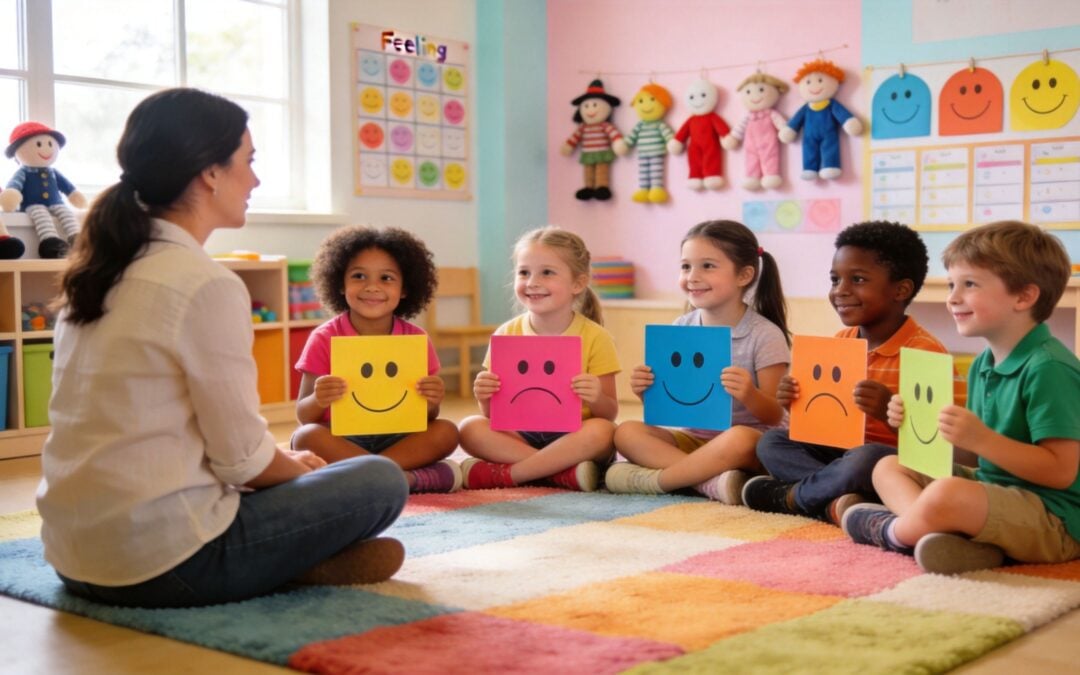
A teacher teaches emotional intelligence to a diverse group of kindergarten students in a bright classroom setting.

A good circle routine does two jobs at once. It builds emotional vocabulary, and it gives children a reliable place to belong. In kindergarten, that predictability matters as much as the feelings lesson itself.

This one works best when you keep it short and repeat it daily. Fifteen to twenty minutes is usually enough. Long circles lose children fast, especially if too much talking comes from adults.

Lesson plan in a box

Learning focus: Naming feelings, listening to peers, and making simple connections between emotions and experiences.

Materials: Feelings cards with clear faces, a talking piece, chart paper, and a class feelings chart for kids.

Directions:

  • Open with a ritual: Sit in a circle and pass the talking piece. Each child says their name and points to a feeling card or color.
  • Model a real check-in: The teacher goes first. “I feel disappointed because it's raining and we can't go outside yet. I know that feeling will pass.”
  • Add one connection question: Ask, “What helps when you feel frustrated?” or “What does your face look like when you feel proud?”
  • Build a class anchor chart: Record children's words and draw simple icons beside them for pre-readers.

What works and what doesn't

What works is structure. Children do better when the order stays the same, the visuals are concrete, and everyone knows the listening rules. A talking piece helps because it makes turn-taking visible.

What doesn't work is pushing children to disclose more than they want to share. Some children will point to a card, whisper, or say “pass.” That still counts as participation.

Practical rule: Don't correct a child's feeling. If a child says, “I'm mad and sad,” accept both and help them add words.

Differentiate it this way:

  • For emerging speakers: Let them point, hold up a card, or copy a sentence stem.
  • For children with big energy: Give them a fidget or assign a circle job like card helper.
  • For home use: Parents can do the same routine at dinner with three feeling choices instead of a full chart.

Simple assessment: Notice whether children move from generic words like “good” and “bad” toward more precise words like “nervous,” “lonely,” or “excited.” Also watch whether they begin responding to peers with comments such as “me too” or “that happened to me.”

2. Mindfulness and Breathing Practice Activities

A young child in a white shirt blowing bubbles while sitting on a blanket outdoors.

Breathing practice gets dismissed when adults make it too abstract. Kindergarteners don't need a lecture on the nervous system. They need something they can see, feel, and copy.

Bubble breath, balloon belly, and smell-the-flower breathing all work because they are physical and playful. The best time to teach them is when children are calm, not in the middle of a meltdown.

Lesson plan in a box

Learning focus: Self-regulation, body awareness, and calming during transitions or rising frustration.

Materials: Bubbles, a stuffed animal for belly breathing, visual cue cards, and a child-friendly guide to belly breathing technique.

Directions:

  • Teach one breath first: Place a stuffed animal on a child's belly while they lie down or sit back. Breathe in slowly to “lift” the animal, then breathe out to lower it.
  • Practice with movement: Have children make their arms wide like a balloon while inhaling, then slowly hug themselves while exhaling.
  • Use it in real moments: Before lining up, after recess, or after a conflict, invite the class to choose one breath together.
  • Keep it brief: Two or three minutes is enough for the first few weeks.

A universal kindergarten study of the Fun FRIENDS program in Japan found significant reductions in problem behaviors, and the program used developmentally appropriate SEL practices such as emotional regulation, social skills, parent reinforcement, and play-based activities, according to the PMC article on Fun FRIENDS.

Common mistakes

The biggest mistake is treating breathing as compliance. If a child hears “go calm down” every time they're upset, the strategy starts to feel like punishment. Offer it as support, not a command.

The second mistake is offering only one way to regulate. Some children breathe better while standing, swaying, or pressing their hands together. Choice helps.

Breathing practice should feel like rehearsal, not correction.

Differentiate it this way:

  • For sensory-seeking children: Pair breathing with wall pushes or stretching.
  • For children who resist closing eyes: Keep eyes open and focus on a bubble wand, pinwheel, or teacher's hand signal.
  • For home use: Try one breathing cue before bed, before homework, or before leaving the house.

Simple assessment: Track whether children begin using breathing language on their own. You'll hear it in phrases like “I need balloon breaths” or see it when they pause before reacting during transitions.

3. Kindness and Empathy Building Activities

A young boy and girl sitting at a table smiling while stacking colorful plastic toy blocks together.

Kindness activities work best when they move beyond “be nice.” Kindergarteners need to see, hear, and practice what kindness looks like in real situations. Help, waiting, inviting, checking in, and noticing someone's feelings are all more teachable than the word nice.

A simple empathy routine can grow out of storytime, play, or a classroom problem. If one child is left out at blocks, that's your lesson right there.

Lesson plan in a box

Learning focus: Perspective-taking, caring actions, and inclusive language.

Materials: Read-aloud book about friendship, chart paper, sentence stems, and a short family resource on how to teach empathy.

Directions:

  • Read and stop often: Ask, “How does this character feel?” and “What might help?”
  • Role-play two versions: Act out an unkind response, then replay the same moment with a kinder choice.
  • Make it concrete: Build a “kindness looks like” chart with examples such as sharing tape, scooting over, asking “want to play?” and helping clean up.
  • Close with one action: Each child chooses one kind act to try during center time.

Make praise specific

General praise fades quickly. Descriptive feedback teaches. “You noticed Maya looked sad and offered her a seat” is more useful than “good job being nice.”

One practical trade-off is visibility. Public kindness chains and class shout-outs can motivate some children, but others start performing for praise. Keep some recognition quiet and direct.

Differentiate it this way:

  • For shy children: Let them draw a kind act rather than perform it.
  • For children who act before thinking: Use puppets first so they can rehearse at a safe distance.
  • For families: Send home one weekly prompt such as “Ask someone in your home what kind act helped them today.”

Simple assessment: Watch for transfer during play. Are children beginning to invite peers in, offer help, or use feeling language when someone is upset? That's the true test.

4. Conflict Resolution and Problem-Solving Role-Plays

Most kindergarten conflict is predictable. Someone grabs. Someone cuts in line. Someone says, “You can't come.” Because the conflicts repeat, the language should repeat too. Children need short phrases they can remember when upset.

Start with puppets. Puppets lower the pressure, slow down the scene, and make it easier for children to notice what happened without feeling blamed.

Lesson plan in a box

Learning focus: Using words in conflict, listening to another person, and choosing a simple next step.

Materials: Two puppets, picture cards showing common school conflicts, visual prompts with phrases, and a classroom guide to conflict resolution activities for kids.

Directions:

  • Act out a familiar problem: A puppet grabs a block tower piece without asking.
  • Pause the scene: Ask children what each puppet might be feeling.
  • Teach two sentence frames: “I don't like when…” and “Can we solve this?”
  • Practice a few endings: Take turns, find another block, rebuild together, or ask for help.

This short video can support your modeling:

Keep the script simple

You don't need a long peace process for five-year-olds. Three steps are enough in most classrooms: say the problem, listen, pick a solution. If children are too escalated, step in and co-regulate first.

What doesn't work is forcing instant apologies. A child can say “sorry” and still have learned nothing. It's more effective to help them repair with action, like returning the marker, checking on a friend, or inviting someone back into play.

“Use the words before you need the words.” Practice at calm times so children can access them during stress.

Differentiate it this way:

  • For language learners: Add picture cards for key phrases.
  • For impulsive children: Let them physically hold a step card to pace the conversation.
  • For home use: Parents can role-play sibling conflicts using stuffed animals instead of direct correction.

Simple assessment: Listen for independent use of taught phrases and notice whether children need less adult mediation in recurring conflicts.

5. Self-Awareness and Personal Strength Activities

Kindergarteners often know what they like before they know what they're good at. That's a useful starting point. Preferences, interests, helpers, and proud moments all lead toward self-awareness.

An “All About Me” activity becomes SEL when it goes beyond favorite color. Children need chances to identify what helps them, what feels hard, and where they shine.

Lesson plan in a box

Learning focus: Recognizing strengths, preferences, support systems, and personal identity.

Materials: Mirrors, paper for self-portraits, family questionnaire, crayons, and sentence stems such as “I'm good at…” and “I feel proud when…”.

Directions:

  • Start with observation: Children look in a mirror and draw themselves.
  • Add personal details: Invite them to finish prompts about favorite play, people who help them, and something they're learning.
  • Use peer noticing: Pair children to share one strength they saw in a classmate, such as “you build carefully” or “you help people zip coats.”
  • Display the work: Put self-portraits and strength statements at child eye level.

A young girl smiling while holding a colorful drawing of a person at home or school.

What to watch for

Some children light up when asked about strengths. Others freeze because they aren't used to talking about themselves in positive ways. That's normal. Offer examples tied to observable behavior, not personality labels alone.

A useful trade-off here is between polish and authenticity. Adult-made projects may look beautiful, but they hide the child's real voice. Messier work often tells you more.

Differentiate it this way:

  • For children who struggle to generate ideas: Offer photo choices or oral interviews.
  • For children with limited fine motor stamina: Let them dictate while an adult scribes.
  • For families: Ask caregivers to contribute one “I notice…” statement about their child at home.

Simple assessment: Look for richer self-descriptions over time. “I like dinosaurs” can grow into “I keep trying when puzzles are hard” or “I ask friends to play.”

6. Cooperative Games and Team Building Activities

Not every game in kindergarten needs a winner. In fact, some of the best social emotional learning activities for kindergarten remove winning on purpose so children can focus on communication and shared goals.

Cooperative games help children practice waiting, noticing others, and solving problems together without the emotional spike of competition. That makes them especially useful early in the year or after social tension in the class.

Lesson plan in a box

Learning focus: Cooperation, turn-taking, shared attention, and group problem-solving.

Materials: Parachute or sheet, soft ball, blocks, painter's tape, or any simple movement props.

Directions:

  • Choose one shared mission: Keep the ball on the parachute, build one class tower, or cross a taped “river” together using mats.
  • Name the success condition clearly: “We succeed if everyone stays in the game and we solve it together.”
  • Pause for reflection: After one round, ask what helped the group.
  • Repeat with one change: Add a challenge such as quieter voices, slower bodies, or a new partner.

Good competition versus bad friction

There's nothing wrong with occasional competitive play, but young children often need more coaching than adults expect when they lose. Cooperative formats reduce that friction and make room for children who usually withdraw.

The mistake is assuming children automatically know how to collaborate. They don't. You still need to model phrases like “your turn,” “let's try your idea,” and “we need everyone.”

A related implementation gap in SEL is measurement. One summary notes that many programs still don't include reliable assessment tools, which leaves schools looking for practical ways to track growth in skills like emotion regulation and empathy. The discussion of this gap in kindergarten SEL implementation points toward simple observation rubrics and checklists as an area educators still need.

Differentiate it this way:

  • For children who dominate: Give them a listening role or ask them to repeat another child's idea first.
  • For children who hesitate: Pair them with a steady peer and assign a clear job.
  • For home use: Families can do cooperative puzzles, blanket forts, or “build one tower together” challenges.

Simple assessment: Use a quick teacher checklist. Note who waits, who invites others in, who recovers after mistakes, and who can share materials without adult prompting.

7. Gratitude and Appreciation Practices

Gratitude routines can become shallow fast if they turn into forced positivity. In kindergarten, appreciation works when it stays specific, honest, and connected to relationships. Children don't need to be thankful all the time. They need practice noticing what is good while still having room for hard feelings.

This is a strong closing or transition routine because it helps children end the day connected rather than scattered.

Lesson plan in a box

Learning focus: Noticing support, expressing appreciation, and strengthening classroom belonging.

Materials: Paper leaves or sticky notes, a bulletin board or wall space, sentence stems, and markers.

Directions:

  • Set a narrow prompt: “Name one person, place, or moment from today you appreciate.”
  • Model specificity: “I appreciate Mateo because he held the door when my hands were full.”
  • Record it visibly: Add children's words to a thankfulness tree or appreciation board.
  • Invite response: Let the child receiving appreciation say “thank you” or smile and wave if they prefer.

Keep it grounded

Some children will say “my toys” or “ice cream” every time. That's fine at first. Then gently widen the lens with follow-up questions about people, effort, comfort, or help.

What doesn't work is using gratitude to bypass real problems. If a child had a hard day, let both things be true. “You were sad at cleanup, and you also appreciated playing with Ana” is a healthy message.

The market for SEL tools and programs continues to grow, with the global social and emotional learning market projected to rise from USD 2.71 billion in 2026 to USD 15.67 billion by 2034, according to Fortune Business Insights' SEL market projection. For schools, that growth is one more reason to choose routines that staff can sustain, not just purchase.

Appreciation lands best when children can connect it to a real action they saw or received.

Differentiate it this way:

  • For children who struggle to generate ideas: Offer stems like “I appreciated when…” or “Thank you for…”
  • For nonwriters: Let them dictate or draw the appreciated moment.
  • For families: Try a bedtime routine where each person thanks one other person for something specific from the day.

Simple assessment: Notice whether children begin offering appreciation without prompting and whether peer relationships soften around children who are often overlooked.

Kindergarten SEL: 7-Activity Comparison

Approach Implementation complexity Resource requirements Expected outcomes Ideal use cases Key advantages
Emotion Recognition and Connection Circles Moderate, requires consistent, skilled facilitation Low, visual cards, talking piece, circle space Improved emotion vocabulary, regulation, classroom belonging Daily morning meetings, community-building, social-emotional routines Builds psychological safety and predictable emotional routines
Mindfulness and Breathing Practice Activities Low to moderate, simple but needs repeated modeling Minimal, props (bubbles, scarves), brief time slots Immediate calming, better focus and self-regulation Transitions, calming moments, moments of dysregulation Portable regulation tools supported by neuroscience
Kindness and Empathy Building Activities Moderate, needs authentic modeling and reinforcement Low, books, simple project materials, tracking visuals Increased prosocial behavior, reduced bullying risk Culture-building, empathy lessons, service projects Fosters inclusion and peer support; builds empathy skills
Conflict Resolution and Problem-Solving Role-Plays Moderate to high, skilled facilitation and scaffolding required Moderate, puppets/scripts, scenarios, rehearsal time Better conflict-handling, communication confidence, fewer disputes Teaching conflict skills, rehearsing real classroom scenarios Makes problem-solving concrete through safe practice
Self-Awareness and Personal Strength Activities Low to moderate, needs thoughtful facilitation and follow-through Low, art supplies, display space, family input Stronger self-concept, engagement, growth-mindset development Start of year introductions, strength-based grouping, portfolios Highlights individual strengths and informs instruction
Cooperative Games and Team Building Activities Moderate, clear instructions and reflection needed Moderate, space, simple equipment (parachute, props) Improved teamwork, belonging, reduced competition stress PE, movement breaks, group cohesion sessions Highly engaging and inclusive; builds collaboration skills
Gratitude and Appreciation Practices Low, simple routines but require authenticity Minimal, jars/boards, prompts, brief time Increased wellbeing, stronger relationships, positive focus Morning meetings, end-of-day reflections, family routines Low-cost way to reinforce positivity and appreciation

Weaving SEL into the Fabric of Your Classroom

These routines work because they fit real kindergarten life. They don't require a special week, a perfect class, or an hour carved out of an already full schedule. They work when they show up in morning meeting, transitions, play, conflict, cleanup, and dismissal.

Consistency matters more than variety. One teacher may get strong results from a daily feelings circle and one breathing routine. Another may lean on puppets for conflict role-play and a weekly appreciation board. Both approaches can work if children get repeated practice and adults use shared language across the day.

There's also a practical reason to treat this work as foundational. Some newer conversations in SEL point to a gap between standalone activities and classroom instruction. The discussion of SEL integrated with academics reflects what many educators already know firsthand. Children participate more fully in literacy, math, and play when they feel safe, connected, and capable of managing frustration.

If you're leading a classroom, start with one routine you can sustain for a month. If you're an administrator, look for schoolwide language and simple observation tools so teachers aren't each inventing their own system. If you're a parent, borrow one practice and repeat it at home in a low-pressure way. Repetition builds transfer.

These choices also support engagement. Children learn more when they feel that they belong, can take risks, and know what to do after mistakes. That's one reason classroom culture and how to increase student engagement are so closely connected.

For schools that want a more coordinated approach, Soul Shoppe is one relevant option. The organization offers SEL programs focused on connection, safety, empathy, self-regulation, mindfulness, communication, and conflict resolution for school communities. What matters most, though, isn't picking the fanciest program. It's choosing practices that adults will use, children can understand, and families can reinforce.

Kindergarteners are learning far more than letters and numbers. They're learning how to be with themselves and with other people. That deserves time on the schedule.


If you want support building a shared SEL language across classrooms, families, and school staff, explore Soul Shoppe for programs, tools, and practical strategies centered on connection, safety, and empathy.