

Glitter Sensory Bottle: A Guide to Calm and Focus
A child is under the table. Another is crying because the math page feels impossible. At home, your own child is yelling that their socks feel wrong, their brother touched their stuff, and now everything is too much.
Those moments don't need a lecture first. They need a bridge back to calm.
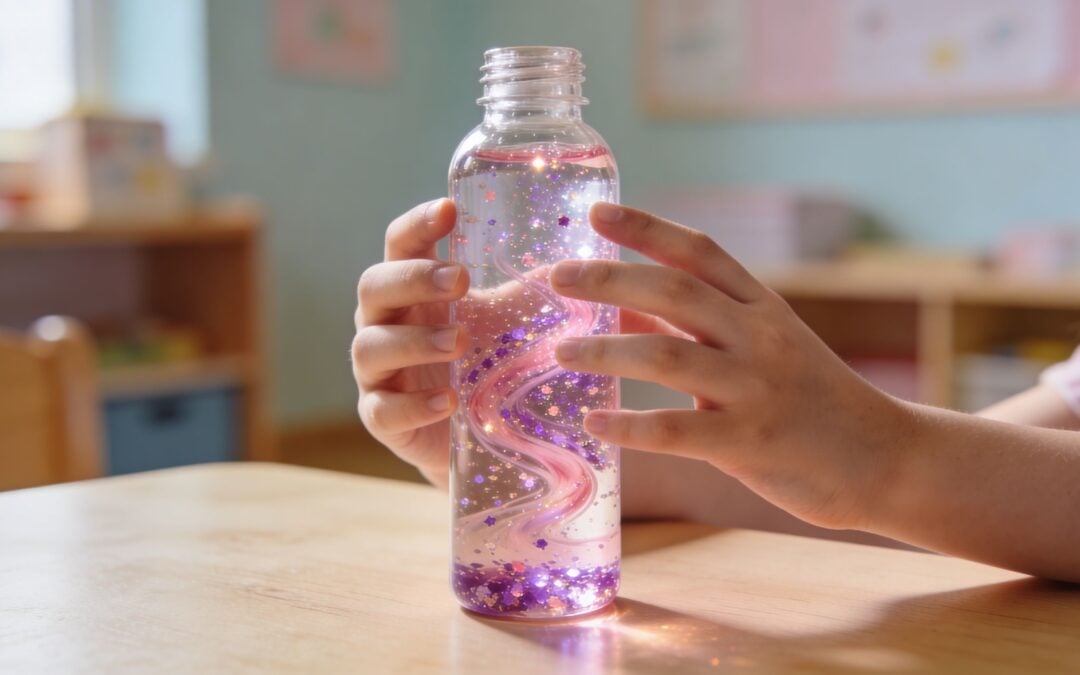
One of my favorite tools for that bridge is a glitter sensory bottle. It looks simple, and that’s part of its power. A sealed bottle with water, glue, and glitter gives a child something concrete to hold when their feelings are anything but. Their eyes track the swirling sparkle. Their hands stay busy. Their breathing often begins to slow without anyone demanding, “Calm down.”
That’s why this tool has stayed in classrooms, counseling spaces, and family homes for years. It isn’t just a cute craft. It’s a practical support for self-regulation, transitions, mindfulness, and emotional language.
More Than a Craft The Power of a Simple Glitter Bottle
I remember offering a glitter bottle to a student during a rough transition after recess. He wasn't ready to talk. He wasn't ready to problem-solve. He was only ready to say, “Everyone is too loud.”
So we didn’t start with words. I handed him the bottle, sat nearby, and said, “Watch until the glitter settles. I’ll stay with you.”
That was enough to interrupt the spiral.
A glitter sensory bottle works because it gives children an outside object that matches their inside experience. When feelings are scattered, the glitter is scattered too. When the motion slows, children can see what settling looks like.
Why this simple tool matters
Glitter sensory bottles became popular in early childhood education and therapy in the early 2010s, with tutorials appearing on educational websites by 2015. That growth lined up with wider school interest in social-emotional learning. According to Children's Learning Centers of Fairfield County, citing CASEL, SEL programs reached 27% of U.S. students by 2017, up from 3% in 2011.
That rise matters in everyday practice. Schools needed tools that were easy to introduce, easy to repeat, and simple enough for children to understand.
A bottle like this can support:
- Big feelings: anger, frustration, disappointment, or sensory overload
- Transitions: entering class, leaving recess, moving to homework, bedtime, or car rides
- Quiet reset routines: calm corners, counselor offices, reading nooks, and family reset spaces
- Mindfulness lessons: making breathing visible and concrete for children who don't connect with abstract instructions
A child doesn't need to explain everything before they can start regulating.
Where families and teachers often get stuck
Many adults dismiss this tool because it seems too small. They think, “It’s just glitter in a bottle.” I understand that reaction.
But children often need regulation strategies that are visible, repeatable, and low-pressure. A glitter bottle checks all three boxes. It gives the nervous system something predictable to follow.
If you're building a calm corner or looking for other engaging craft activities for kids, this kind of hands-on project fits beautifully because it isn't only about making something. It's about creating a tool children can use later, when emotions rise and words disappear.
The Science of Calm Developmental and SEL Objectives
When a child watches glitter drift downward, a few helpful things happen at once. Their eyes focus on one moving target. Their body gets a cue to pause. Their brain shifts from reacting outward to noticing inward.
That’s why this tool can work even when a child isn’t ready to talk.

A visual anchor for a busy nervous system
Children in distress are often dealing with too much input at once. A glitter sensory bottle narrows attention. Instead of tracking every sound, face, and demand in the room, they track one slow visual event.
That matters in both classrooms and homes. Predictable movement can reduce the pressure to respond right away. It offers a nonverbal path toward regulation.
In therapeutic contexts, the effect has been measured. A 2022 study referenced by the National Autism Center included sensory tools like these in 40% of effective behavior plans, with a 45% decrease in agitation episodes when used as a 2 to 3 minute visual timer. The same source explains that the settling time can mirror calming deep breathing cycles. That finding is summarized by Cultivate BHE’s overview of glitter sensory bottles for autism support.
How this connects to SEL skills
A glitter bottle isn't the lesson by itself. It's a support for the lesson.
When adults pair the bottle with simple reflection, children begin to build core SEL capacities:
- Self-awareness: “My body feels tight.” “My thoughts are racing.”
- Self-management: “I can pause before I yell.”
- Attention control: “I can stay with one thing until I feel steadier.”
- Emotional language: “My feelings were stormy. Now they’re quieter.”
For educators who want shared language around development, social-emotional development in children gives a helpful frame for understanding how these skills grow over time.
Why neurodivergent children often respond well
For many children with ADHD, autism, sensory processing differences, or high anxiety, verbal directions can add pressure during a hard moment. “Use your words” may be too much too soon.
A glitter sensory bottle can help because it asks very little at first. Watch. Hold. Breathe. Wait.
That simplicity makes it useful as a co-regulation tool. The adult doesn’t have to fix everything immediately. They can sit nearby and offer a calm rhythm.
Practical rule: Use the bottle before the child is fully escalated whenever possible. Early support works better than emergency support.
The metaphor children understand quickly
One reason this works so well in SEL lessons is that the metaphor is easy to grasp.
You can say:
- “When we shake the bottle, it looks like our thoughts when we’re upset.”
- “The glitter isn’t bad. It’s just moving fast.”
- “Your feelings can be big and still settle.”
That kind of language is respectful. It doesn't shame the child for being dysregulated. It normalizes the experience and gives them a picture for what regulation feels like.
For older elementary and middle school students, I often add one sentence: “Calm doesn’t mean no feelings. It means your body is ready to think again.”
How to Make a Perfectly Mesmerizing Glitter Bottle
A good glitter bottle should do one thing well. It should move slowly enough to hold attention, but not so slowly that it turns into murky sludge.
Most first attempts go wrong for a simple reason. People guess the ratios.
The best results come from understanding what each ingredient does.

The master recipe
Experiments with sensory bottle recipes show that the glue-to-water ratio shapes the settling speed. According to The Craft-at-Home Family’s clear-glue sensory bottle experiment, a 3:1 water-to-clear-glue ratio yields a benchmark 3-minute settling time, and using clear school glue instead of pre-mixed glitter glue can create up to 4 times longer glitter suspension.
That means clear glue gives you more control over the calming effect.
Here’s the setup I recommend most often.
What to gather
- A clear plastic bottle: Choose a sturdy bottle that feels solid in small hands. Smooth-sided plastic bottles work well in classrooms.
- Warm water: Warm water helps the glue dissolve more smoothly.
- Clear school glue: Clear glue usually gives a cleaner, slower visual effect than glitter glue.
- Fine glitter: Fine glitter stays in motion longer. A little chunky glitter can add visual interest.
- Optional food coloring: One or two drops are enough if you want tint.
- A funnel and spoon: These cut down on frustration and spills.
- Strong adhesive for the lid: Super glue is a common choice for the threads.
If you're working on a sensory unit, 5 senses activities for kids can pair nicely with the bottle-making process because children can talk about what they see, hear, and feel as they create.
How to build it
Fill the bottle with warm water first.
Don’t fill it all the way. Leave room for the glue and the glitter to move.Add clear glue.
Aim for that 3:1 water-to-clear-glue ratio if you want a slower, calming descent.Pour in glitter.
Start modestly. You can always add more. Too much glitter can make the bottle visually crowded.Add color if you want it.
A drop or two of food coloring is plenty.Close the lid temporarily and shake.
Watch the movement before you seal it for good.Adjust if needed.
If the glitter drops too fast, add more clear glue. If it barely moves, add a little more water.
A short demonstration can help if you want to see the process in action.