A child is halfway through math when the pencil snaps. He shouts, pushes the paper away, and folds into tears. A teacher might see refusal. A parent might hear, “He knows better than this.” But in that moment, the more useful question is simpler. What skill is missing right now, and how can an adult help build it?

That question changes everything about how to have self control, especially for kids. It moves us away from labeling children as “good,” “bad,” “easy,” or “difficult,” and toward teaching, practicing, and supporting a developmental skill. Self-control grows in relationships, routines, and environments that make regulation possible.

Adults need that reminder too. Most children don't learn self-control because someone told them to “try harder.” They learn it because caring adults reduce overwhelm, name what's happening, model calm, and give them tools they can use when emotions spike.

Why Self-Control Is More Than Just Good Behavior

A child blurts out again during read-aloud. Another grabs materials instead of waiting. Another falls apart when it's time to clean up. These moments often get treated as behavior problems first.

Often, they're skill problems first.

A concerned young boy sitting at a school desk looking at his teacher during a private lesson.

Self-control is a teachable life skill

Self-control is not the same thing as blind obedience. It includes pausing, noticing an impulse, tolerating frustration, managing a strong feeling, and making a more helpful choice. That's why it belongs in the same conversation as reading, writing, and problem-solving. Children need instruction, practice, feedback, and support.

A major reason this matters is that self-control reaches far beyond classroom compliance. A 40-year study of 1,000 children in New Zealand found that childhood self-control was one of the strongest predictors of adult outcomes. Children in the top fifth for self-control had crime conviction rates of 13% versus 43% for those in the bottom fifth, and those patterns held regardless of initial intelligence or family socioeconomic status, as summarized in this American Scientist review of the Dunedin study.

That finding should shift the tone adults use. When we help a child wait, reset, recover, and choose again, we aren't only managing today's moment. We're strengthening a lifelong capacity.

Practical rule: Treat self-control lapses as information. They tell you where a child needs structure, modeling, or co-regulation.

What this looks like in real life

In practice, children often need adults to separate the feeling from the action.

  • A frustrated student can be upset without throwing supplies. The adult job is to help the child feel the feeling and contain the behavior.
  • A child can want to interrupt and still learn to pause. That pause usually begins with cues, routines, and repeated practice.
  • A child can struggle with transitions and still be capable. Needing support during change doesn't mean the child is manipulative.

This reframe matters for parents too. If your child melts down after school, that doesn't prove they're choosing chaos at home. It may mean they used up a lot of regulation during the day and need connection, food, rest, and fewer demands before they can access better skills.

Adults are not just correcting behavior

Adults are teaching children how to respond to inner experiences. That means helping them notice body signals, understand triggers, and use strategies before a problem grows. When schools and families approach self-control this way, discipline becomes more effective because it becomes more instructional.

A child who hears, “Let's slow your body down so your brain can think,” gets a path forward. A child who hears only, “What is wrong with you?” gets shame, and shame rarely improves regulation.

The Developing Brain and the Science of Self-Control

Many adults know the feeling of saying something they regret before they can stop themselves. Children live closer to that edge because their self-control system is still developing.

One simple way to explain it is the upstairs brain and downstairs brain idea. The upstairs brain handles planning, perspective-taking, decision-making, and inhibition. The downstairs brain reacts quickly to threat, frustration, excitement, and strong emotion. When a child is tired, hungry, embarrassed, overstimulated, or rushed, the reactive system can take over fast.

An educational infographic explaining brain development and self-control stages from early childhood through adolescence.

Self-control uses real mental energy

Self-control isn't a switch that stays on all day. It takes effort. Research summarized by the APA found that the average person spends three to four hours per day actively resisting desires, and when people attempted resistance, the rate of acting on those desires dropped from 70% to 17%, which shows both how powerful and how effortful self-control can be in everyday life, according to the APA overview on self-control research.

That matters in schools and homes because children are asked to regulate constantly. Sit still. Wait your turn. Ignore the noise. Keep trying. Use a calm voice. Share. Transition. Stop touching that. Start this instead.

By noon, many children are not being “lazy” or “defiant.” They're taxed.

Why empathy helps children build skill

When adults understand that self-control is effortful, our responses get smarter. Instead of assuming a child should already be able to handle a hard moment alone, we start offering support that helps the child borrow regulation.

That can sound like this:

  • Naming the state: “Your body looks revved up.”
  • Reducing language: “Pause. Breathe. Feet on floor.”
  • Offering structure: “First two calm breaths, then we solve the problem.”
  • Staying nearby: “I'm with you while you get regulated.”

For a deeper look at the broader set of abilities that support these moments, this piece on self-management skills for children is a useful companion.

Kids don't access self-control well when they feel unsafe, overwhelmed, or flooded. Connection helps reopen access to thinking.

A useful trade-off adults often miss

There's a difference between demanding regulation and building regulation. Demanding regulation may get short-term compliance from some children. Building regulation creates long-term capacity.

If a teacher says, “Calm down now,” that may raise pressure. If the teacher says, “Let's get your body settled first,” the child gets a usable step. If a parent launches into a lecture while a child is crying hard, the child usually can't process it. If the parent waits, co-regulates, and talks later, the lesson has a better chance of landing.

This is why routines, cues, and adult nervous-system steadiness matter so much. Children develop self-control partly through repeated experiences of being guided back into regulation.

Creating Environments That Build Self-Control

The most practical answer to how to have self control is not “use more willpower.” It's make self-control easier to use.

Research on self-control increasingly points to antecedent-focused strategies, which means changing the environment or cues before temptation, frustration, or overload takes over. That approach is about designing fewer battles, not just winning the battle after it has already started, as described in this discussion of antecedent-focused self-control strategies.

A woman organizing colorful building blocks into clear labeled storage bins in a tidy playroom.

Start with friction and flow

When a child struggles repeatedly, look at the setup before you look at the consequence. Ask:

  • What's hard about this environment? Noise, clutter, waiting, confusing directions, too many choices.
  • What cue is missing? A visual schedule, a timer, a first-then card, a cleanup song.
  • What support is too far away? Water, fidgets, a break space, headphones, a calm adult.

Children usually do better when the expected behavior is visible and easy to start.

Here are examples that work in both classrooms and homes:

  • Use visual schedules. A child who argues at every transition often settles when they can see what comes next.
  • Prepare the body before the demand. Before homework, try snack, movement, water, and a quick preview of the task.
  • Limit open-ended clutter. Fewer materials in view can reduce distraction and conflict.
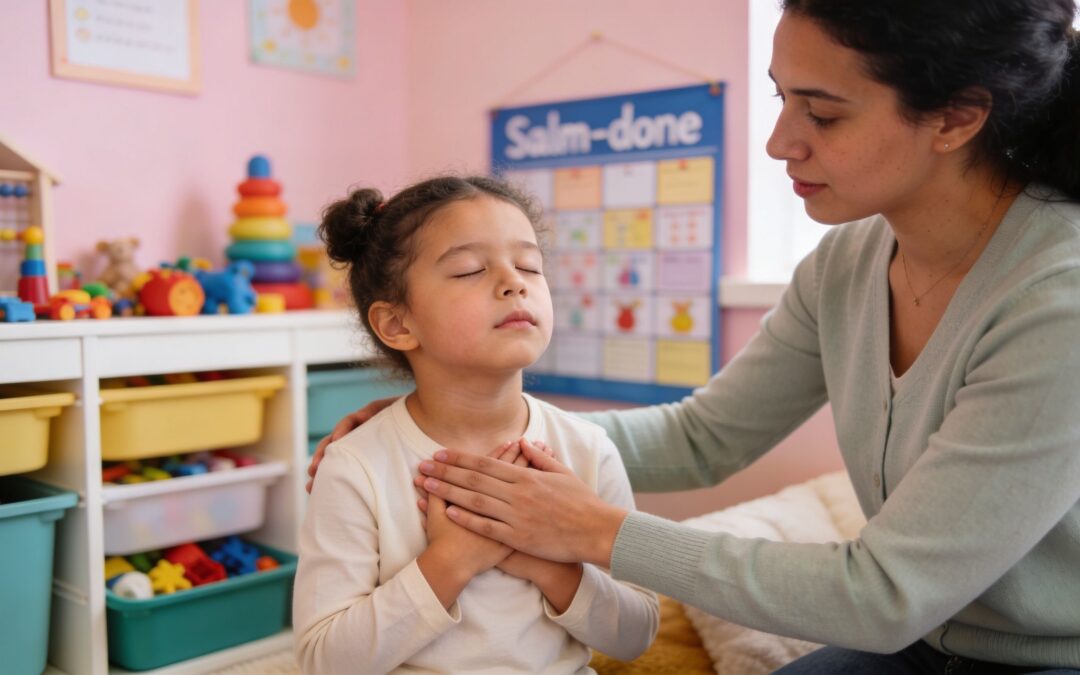
  • Create a calm-down spot before it's needed. A beanbag, feeling chart, paper to scribble on, stuffed animal, and breathing prompt can do a lot.

A strong routine helps because it lowers uncertainty. This guide to routines for kids that help children feel emotionally grounded offers practical ideas for building that structure.

Build spaces that cue regulation

A calm-down corner is not a punishment chair. It's a place where a child can recover enough to think again. The difference is important.

A punitive space says, “Go away until you act right.”
A supportive space says, “Here are tools to help your body settle.”

Good calm-down spaces usually include a few consistent options, not a giant menu. Try:

  • Breathing cue cards
  • A soft object to squeeze
  • A simple feelings chart
  • Paper and crayons
  • A sand timer or visual timer

Use the space during calm moments too. Practice before it's needed. Sit there together and say, “This is the place we go when our bodies need help.”

This quick video can help adults think more concretely about setting up those supports in everyday spaces.

Reduce the number of self-control demands

Some children spend the entire day in correction. That's too many battles. Environmental design can lower the total load.

Try a few swaps:

Common setup More supportive setup
Long verbal directions One step at a time with a visual cue
Waiting with nothing to do Waiting with a job, object, or song
Homework right after a draining day Short reset routine before work begins
Toys or materials everywhere Rotated choices in labeled bins
Adult attention only after disruption Adult connection before a tough transition

The best self-control support often looks boring from the outside. Predictable routines, clear spaces, and repeated cues don't feel dramatic. They work because they lower stress.

If you're teaching groups, this is also where one structured option can help. Soul Shoppe offers school-based SEL workshops that teach shared language for self-regulation, mindfulness, and communication, which can make it easier for adults across a campus to use the same cues and routines.

Actionable Self-Control Activities for Every Age

Willpower alone is unreliable. An evidence-based framework for self-control identifies different kinds of strategies, including situation-change approaches that modify the environment and cognition-change approaches that shift how we think. That matters because relying only on brute-force effort has a high failure rate. The same summary notes that approximately 88% of New Year's resolutions fail, which is a useful reminder that people need tools, not just good intentions, according to this overview of effective self-control strategies.

For kids, that means giving them games, routines, scripts, and planning tools they can use.

Use practice that feels like play

Self-control activities work best when they are short, repeatable, and tied to real situations. A child doesn't need a speech on discipline. The child needs lots of chances to stop, wait, notice, choose, and recover.

If you're building a more intentional sequence of lessons for a class, counseling group, or family workshop, this GroupOS training curriculum development guide is a helpful planning resource for organizing skills into teachable chunks.

The activity ideas below also pair well with these self-regulation activities for kids, especially if you want more options for movement, mindfulness, and reflection.

Age-Appropriate Self-Control Activities

Age Group Activity Name How It Builds Self-Control
K-2 Simon Says Children practice listening, inhibiting an impulse, and waiting for the right cue before acting. It strengthens pause-and-check skills in a playful format.
K-2 Red Light Green Light Kids move, stop, and restart based on an external signal. This helps with body control, attention, and shifting from action to inhibition quickly.
K-2 Freeze Dance Children learn to enjoy excitement while still stopping their bodies on cue. This is useful for kids who lose control when energy rises.
K-2 Stuffed Animal Breathing A child lies down with a stuffed animal on their belly and watches it rise and fall. This makes breathing visible and gives the body a concrete way to slow down.
K-2 First-Then Cards “First shoes, then playground” or “First clean up, then story” helps children tolerate delay. The visual sequence lowers arguing and makes expectations easier to hold.
Grades 3-5 Jenga with a pause rule Before each move, students take one breath and name their plan. This links impulse control to motor control and helps children slow themselves before acting.
Grades 3-5 Goal-setting chart Children pick one specific self-control goal, such as raising a hand before speaking, and track practice over time. The focus stays on noticing progress, not perfection.
Grades 3-5 Marshmallow Test 2.0 Instead of a high-pressure challenge, invite children to practice delay with support. Let them brainstorm what helps waiting, such as singing quietly, looking away, or holding a fidget.
Grades 3-5 Rewind and redo After a conflict or interruption, ask the child to replay the moment and try a better response. This builds reflection without turning the mistake into identity.
Grades 3-5 Frustration ladder Children rank tasks from “a little hard” to “very hard” and plan what strategy fits each level. This helps them prepare before big emotions hit.
Grades 6-8 If-then planning Students write plans like, “If I want to check my phone during homework, then I'll put it in another room until I finish one assignment.” This turns vague intentions into action steps.
Grades 6-8 Digital pause challenge Teens choose a regular time to put devices away before sleep, homework, or meals. The key skill is changing the environment so temptation is not constantly present.
Grades 6-8 Thought reframe cards Students practice replacing “I can't do this” with “This is hard, but I can start with one part.” This builds cognition-change skills rather than pure suppression.
Grades 6-8 Peer conflict script practice In pairs, students rehearse how to pause, name a feeling, and ask for what they need. Self-control improves when language is available during stress.
Grades 6-8 Two-minute reset routine Students build a personal sequence such as breathe, unclench hands, sip water, review the next step. The routine becomes a portable tool for school, home, and activities.

How to choose the right activity

Don't choose based only on age. Choose based on the moment that keeps breaking down.

  • If the problem is impulsive movement, use stop-start games and body cues.
  • If the problem is frustration, use breathing, redo practice, and task chunking.
  • If the problem is distraction, use environmental changes like phone placement, visual checklists, and limited materials.
  • If the problem is social conflict, use role-play and scripts.

A good self-control activity should transfer into real life. If a child can stop during a game but not during line-up, bring the same cue, same language, and same routine into line-up.

One more reminder for adults. Practice works better when it's brief and frequent. Five calm minutes every day usually builds more than one long lecture after a meltdown.

What to Say When Self-Control Falters

The words adults use during a child's hard moment can either increase shame or increase regulation. That doesn't mean being permissive. It means being effective.

Current summaries of self-control work point to awareness and reappraisal, not just suppression. In plain language, children do better when adults help them notice what they're feeling and rethink the moment, instead of demanding that they stuff emotions down, as discussed in this overview of self-discipline and self-awareness practices.

When a child blurts out in class

Less helpful: “Stop interrupting. You know the rule.”

That statement may be true, but it doesn't give the child a regulation tool in the moment.

More helpful: “You've got something to say. Put a hand on your knee so your body remembers to wait.”

This works because it gives the child a concrete action.

You can follow later with: “Next time you feel the idea jumping out, what can your body do first?”

When a child melts down over hard work

Less helpful: “It's not that hard. Just do it.”

That usually makes the child feel more alone and more flooded.

More helpful: “Your frustration got big. Let's get your body steady, then we'll do the first part together.”

Now the child has a sequence. Regulate first. Problem-solve second.

For families and classrooms already teaching communication tools, these I statements for kids can support calmer repair once the child is ready to talk.

When two children are in conflict

Less helpful: “Both of you stop. I don't want to hear it.”

That can end noise without building skill.

More helpful:
“Pause. I'm going to help both of you slow down.”
“You wanted the same thing at the same time.”
“Tell what happened without blaming.”
“Now tell what you need.”

This keeps the adult in a coaching role.

Scripts that regulate instead of shame

Use short phrases. A dysregulated child can't process a speech.

  • For escalation: “I'm here. Breathe with me.”
  • For impulsive action: “Pause your body.”
  • For frustration: “You can be upset and safe at the same time.”
  • For repair: “Try that again in a stronger way.”
  • For transitions: “First we settle, then we solve.”

“You're having a hard time” lands very differently than “You're being hard.”

One trade-off worth naming

Soft tone does not mean soft boundaries. You can be warm and firm at the same time.

A regulated adult might say, “I won't let you hit. I'm moving closer to keep everyone safe.” That is not permissive. It is clear, protective, and calm. Children learn self-control faster when the adult's boundary is steady and the adult's shame level is low.

Later, when the child is calm, then comes reflection. What happened in your body? What was the trigger? What can you do sooner next time? That's where learning sticks.

Noticing Progress and Deepening Your Practice

Most adults miss progress because they're looking for perfect behavior. Self-control rarely grows that way. It usually shows up in small shifts first.

You might notice a child pause for one second before grabbing. You might hear, “I need space,” instead of a shove. You might see a child recover faster after getting upset. Those are real gains.

Signs self-control is growing

  • Earlier noticing: The child recognizes frustration before it spills over.
  • Better language: The child can name a feeling, need, or problem more clearly.
  • Shorter recovery time: The upset still happens, but it doesn't last as long.
  • More use of tools: The child reaches for breathing, a break, a script, or a support cue.
  • Improved repair: After a hard moment, the child can redo, apologize, or rejoin more smoothly.

For adults supporting this work across classrooms or family systems, some teams like using a simple coaching platform to keep reflection notes, goals, and follow-up consistent. The tool matters less than the habit of noticing patterns and adjusting support.

Keep the standard realistic

Self-control is a developmental journey. Children need repetition, calm adults, and environments that don't overload them. The question is not whether a child ever loses control. The question is whether the child is becoming more able to notice, pause, recover, and choose with support.

That's meaningful growth. It deserves to be seen.


If you want more support building self-control through shared language, experiential SEL tools, and practical routines for school and home, explore Soul Shoppe. Their programs, workshops, and resources focus on helping children and adults practice regulation, empathy, communication, and conflict resolution in ways that fit everyday life.