

10 Best Anxiety Coloring Pages for Kids (2026 Guide)
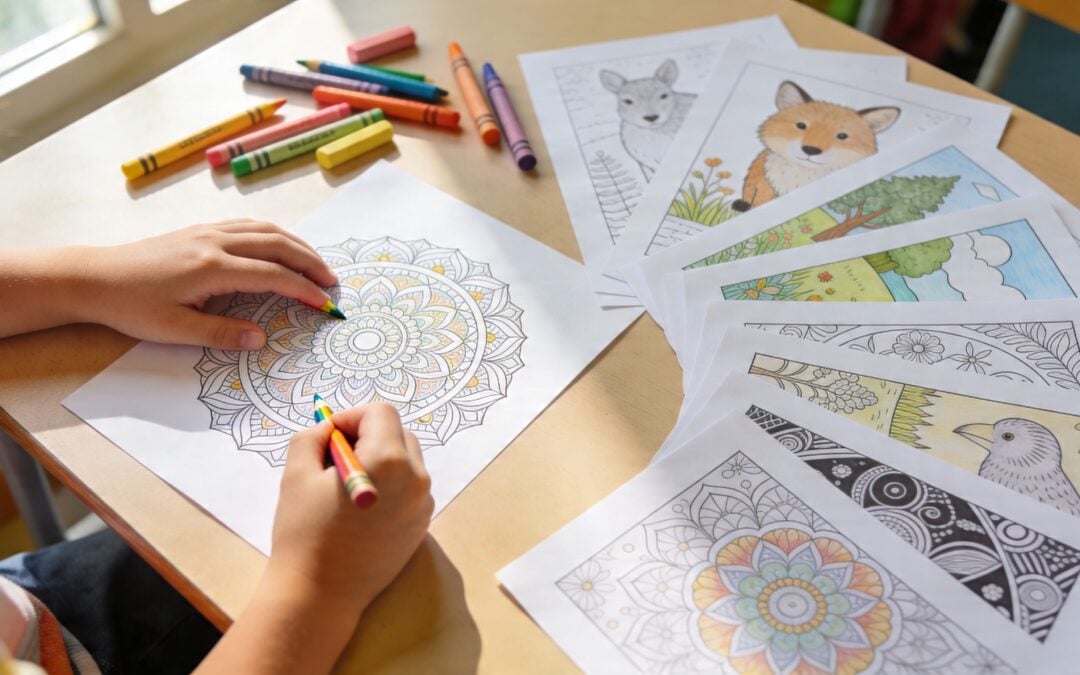
A student walks in already keyed up. Maybe it's a quiz day. Maybe recess went badly. Maybe nothing obvious happened, but you can see it in the tight shoulders, the quick breathing, the way the pencil taps the desk. In those moments, anxiety coloring pages can help because they give kids something simple, concrete, and regulating to do with their hands while the nervous system settles.
That doesn't mean every coloring page works the same way. Some are really coping-skills lessons in disguise. Some are best for a calm-down corner. Some work because an adult sits beside the child and co-regulates. Others are better for small groups, counseling offices, or independent use during transitions. The printable matters, but the pairing matters more. A page plus a script, a check-in, or a reflection prompt turns coloring from filler into SEL practice.
There’s also a real reason educators keep returning to coloring. A 2018 study in the IAFOR Journal of Arts & Humanities found that coloring activities, especially mandala coloring, reduced state anxiety in adolescents more than free-form coloring or puzzle controls. That matters in schools because we often need tools that work in the moment, not just ideas students are supposed to remember later.
I’ve used coloring pages before class meetings, after lunch, in counseling groups, and during those tense weeks when test worry rises. The strongest resources don't just say "relax." They help kids name feelings, notice body signals, and practice what to do next.
Below are the anxiety coloring pages and printable tools I’d trust with students, staff, and families. Each one includes a practical way to use it, because the best printable in the world won't do much if adults don't know how to frame it.
1. National Institute of Mental Health Stand Up to Stress! Coloring & Activity Book

The NIMH Stand Up to Stress! Coloring & Activity Book is the one I’d hand to a school team that wants a trustworthy starting point. It isn’t only a stack of pretty pages. It teaches kids what stress feels like, what coping looks like, and how to reach for help in language upper-elementary students can understand.
I like it for grades 3 through 6 because it meets students where they are. The design is approachable, and the activities don't assume a big counseling vocabulary. It also comes from a mental health agency, which gives principals and counselors confidence when they’re sending materials home.
Best way to use it at school
This works well in a short-term counseling group, a health block, or a re-entry plan for a student who’s been overwhelmed. Because it mixes coloring with coping content, you can move from regulation to conversation without switching materials.
Try a simple three-step routine:
- Color first: Give students two quiet minutes to start one page before any discussion.
- Name the signal: Ask, "What does worry feel like in your body right before it gets big?"
- Choose one strategy: Have each student circle or say one coping action they could try later that day.
A practical classroom example: before a spelling test, invite students to color for a few minutes while practicing a slow inhale and exhale. That pairing fits with school-based interest in quick regulation tools, and child anxiety support works best when adults teach coping explicitly, not only react after stress spikes. If you want language to extend the lesson, Soul Shoppe’s guide to anxiety coping skills for kids offers helpful phrases teachers and caregivers can borrow.
Practical rule: Don’t hand out the whole booklet at once. Pick one page that matches the moment, such as body clues, calming strategies, or asking for support.
One more reason this resource stands out. The booklet is easy to distribute in school communities because it’s free and available in English and Spanish on the NIMH site.
2. Sesame Workshop Coloring to Calm Down and Color Me Calm

When a child needs connection more than instruction, I reach for Sesame Workshop’s Coloring to Calm Down resources. These pages are short, warm, and easy to use with an adult sitting nearby. That matters because many anxious moments in early childhood and elementary settings are really co-regulation moments.
These aren't the pages I’d use for a deep lesson on anxiety. They’re better for reset points. Think arrival time, after a conflict, before bedtime at home, or while waiting for a counseling appointment.
Why they work with younger children
Sesame Workshop understands how to keep the activity light while still prompting awareness. Kids can color without feeling like they’re in a "lesson," but the adult can still guide attention toward breathing, noticing, and settling.
Here’s a script teachers and caregivers can use while coloring together:
"Let’s color one part slowly. While you do that, see if your shoulders feel tight or soft. I’m going to make my breathing slower too."
That adult modeling piece is the whole point. If the grownup’s voice gets slower and their posture relaxes, the page becomes a shared calming routine instead of a demand to "calm down."
Use this resource when you want:
- A fast transition reset: Keep a few copies by the door for students who need help shifting into class.
- A family handoff tool: Send one page home with a note suggesting an adult color alongside the child.
- A calm corner routine: Pair the page with crayons, a timer, and one feeling prompt.
If you're helping adults build that side-by-side support, Soul Shoppe’s post on teaching children how to self-soothe gives language that fits this style well.
The main limitation is scope. You won’t get a huge library or school-specific anxiety themes. But for young students who need a gentle entry point, these anxiety coloring pages are easy to trust and easy to repeat.
3. GoZen! Printable Library and Calm Down Corner Kit

If you’re outfitting a whole counseling office, grade-level team, or district calm-down space, GoZen! Plus is one of the more complete options. I wouldn’t describe it as a coloring-page site alone. It’s an SEL printable system that includes mindful coloring inside a broader library of journals, posters, activities, and regulation tools.
That broader setup is useful because anxiety coloring pages work best when they aren’t isolated. A child may color first, then use a feelings chart, then write a coping plan, then practice self-talk. GoZen! makes that sequence easier.
Where it fits best
This is strongest for adults who want consistency across settings. A counselor can use one page in a small group, a teacher can place a related version in the calm corner, and a caregiver can reinforce similar language at home.
A practical implementation example looks like this:
- Morning check-in: Student identifies energy level or feeling.
- Coloring choice: Student selects a mindful coloring page tied to calm, focus, or strengths.
- Reflection: Adult asks, "What changed in your body while you colored?"
- Transfer: Student picks one strategy to use when worry returns.
That’s the kind of structure many schools need. Without it, coloring can drift into "something to keep kids busy." With it, students start linking internal states, actions, and outcomes.
A 2019 Pepperdine University study involving 160 undergraduates found that four structured coloring conditions, including adult coloring books, all significantly reduced state anxiety after anxiety induction, with no significant differences among conditions. I wouldn’t transfer college findings directly onto every child setting, but the takeaway is useful for educators. The regulating effect may come less from finding the "perfect" page and more from giving students a structured, contained coloring experience they can put to use.
The downside is cost. Much of the library sits behind a subscription or paid product. Still, for schools that want a reusable SEL bank rather than a one-off printable, it’s a strong option.
4. Teachers Pay Teachers Feeling Nervous at School Coloring Pages
The Feeling Nervous at School Coloring Pages on Teachers Pay Teachers stands out because it focuses on familiar school triggers. That specificity matters. A lot of anxiety coloring pages are generic. Kids color hearts, swirls, or flowers, but no one helps them talk about the cafeteria, hallway noise, substitute teachers, or tests.
This kind of resource is useful when a student’s worry is tied to predictable school moments. If the anxiety shows up during transitions or academic pressure, context-specific pages often open the door faster than broad mindfulness designs.
Good fit for counseling groups and check-ins
I’d use these pages with a small counseling group for students who all struggle with school-day nerves. Each student colors a page tied to a common trigger, then shares what that moment feels like and what helps.
You can make the conversation concrete with prompts like:
- Before the moment: "What does your body do when you know this part of the day is coming?"
- During the moment: "What helps a little, even if it doesn’t make the feeling disappear?"
- After the moment: "Who can notice you’re having a hard time and support you?"
Some children can color and talk at the same time. Others need the coloring first and the talking later. Let the page lower the pressure before you ask for words.
This resource also pairs well with classroom support planning. A teacher might notice that one student always melts down before independent work. The child colors a page about school worry with the counselor, identifies body clues, then practices a one-sentence help script such as, "Can you get me started?" That kind of bridge from page to action is what makes the printable worthwhile.
For broader classroom strategies, Soul Shoppe’s article on how to help students with anxiety supporting emotional well-being in the classroom complements this kind of school-specific work.
The caution with Teachers Pay Teachers is consistency. Listings vary by seller, visual quality, and licensing terms. Review carefully before sharing across a whole team.
5. St. Jude Children’s Research Hospital Free Coloring Pages
St. Jude’s free coloring pages are a good reminder that anxiety support doesn't always need to look overtly clinical. These pages aren’t framed as a full anxiety curriculum. Instead, they offer art-centered activity sheets that work well in waiting spaces, family events, classrooms, and counseling offices where you want calming engagement without making a child feel singled out.
That matters for students who resist anything that feels like "therapy work." Sometimes a playful page is the safer doorway.
Best use for mixed-age settings
I especially like resources like this when you have a broad age range or a public-facing setting. A family night, a school wellness fair, or a counseling waiting room needs materials that feel welcoming to many kinds of kids.
Try setting up a coloring station with one short invitation:
"You can color anything you like. While you color, notice one thing your hands are doing and one thing your breathing is doing."
That prompt keeps the tone low-pressure. It doesn’t force disclosure, but it still builds awareness.
This type of use fits with the broader picture of coloring as an accessible support. In a randomized trial with patients receiving treatment for generalized anxiety disorder, adding coloring therapy for three weeks led to statistically superior outcomes compared with the control group on measures including HAMA, SAS, and positive mood, according to the PMC article on coloring therapy and anxiety outcomes. In school terms, I’d translate that carefully. Coloring won’t replace clinical care, but it can serve as a practical adjunct that supports regulation and coping.
For implementation, keep the expectations simple:
- Offer choice: Lay out several pages instead of assigning one.
- Keep tools easy: Crayons, markers, and colored pencils should all be available.
- Skip forced sharing: Let students decide whether they want to talk after coloring.
The tradeoff is focus. Because these pages aren’t specifically built around school anxiety or coping scripts, the adult has to provide the SEL framing.
6. Awkward Critters Free SEL Activities with Anxiety Themes

There’s something powerful about giving anxiety a character. The Awkward Critters activities page does that in a way younger students can understand. Instead of asking children to explain a vague internal storm, it lets them relate to a creature, compare experiences, and talk about worry with a bit more distance.
That distance can lower shame. A child who won’t say, "I get anxious at school" might say, "Raven worries a lot when things feel uncertain."
A strong option for K to 5 bibliotherapy
These pages work best when paired with the Awkward Critters books, but they still have value on their own. I’d use them in a classroom read-aloud, a lunch bunch, or a home setting where a parent wants to open a feelings conversation without overwhelming the child.
A scriptable activity:
- Read or summarize the character.
- Invite the child to color while thinking about times they feel similar.
- Ask, "What does Raven do when worry gets loud?"
- Then ask, "What helps you when your worry gets loud?"
That sequence matters because children often need to talk about the character first before they can talk about themselves.
Why character pages can be easier than abstract pages
Many mandala-style anxiety coloring pages regulate through rhythm and repetition. Character pages do something different. They normalize emotion. They tell children, "This feeling exists. It has patterns. You are not the only one."
This works particularly well with students who are verbal but guarded. If direct SEL worksheets lead to shrugging or joking, a character-based page can bypass that resistance.
The limitation is depth and volume. This isn’t a giant printable library, and it works best when adults lean into the relational side. If you hand out the page without discussion, you’ll miss most of its value.
7. Empowering Education Mindful Coloring K to 2 lesson and printable

A first-grade class comes in from recess loud, wiggly, and slightly off balance. Handing out crayons alone will not settle that energy. The Empowering Education mindful coloring lesson for K to 2 helps teachers turn coloring into a taught regulation routine with clear language, pacing, and reflection.
That distinction matters in early grades. Young students often treat coloring as a race, a performance task, or a chance to compare work. This lesson redirects attention to sensory noticing. In practice, that means the adult is teaching the process the same way they would teach lining up, partner talk, or how to use a calm corner.
I like this resource because it answers the question many teachers wonder: what do I say while students color? A good SEL printable is only half the tool. The other half is the script that helps children slow their bodies and name what changed.
Best use: teach it before students need it
Use this lesson during a neutral part of the day, not only after a meltdown or difficult transition. Regulation routines work like fire drills. Children benefit when they practice the steps while calm, so the routine feels familiar when stress is higher.
A simple classroom sequence might sound like this:
- "Today we are practicing mindful coloring. Our job is to notice our hands, our breath, and the way the crayon moves."
- "Put both feet on the floor. Let your shoulders soften."
- "Color one small section slowly. There is no prize for finishing first."
- "Pause and check in. Is your body feeling busy, steady, tight, or calm?"
That last step is where the SEL learning happens. Without reflection, coloring stays an art activity. With reflection, it becomes practice in self-awareness.
If your class already uses short regulation routines, this lesson fits well alongside other mindfulness activities for students that build attention and body awareness.
As noted earlier in the article, structured coloring appears more helpful for calming than completely open-ended coloring in some settings. For a K to 2 teacher, the practical takeaway is straightforward. A page with simple structure, plus adult guidance, often works better than saying, "Here, color this," and hoping students settle.
Use with care: If a child starts worrying about neatness, staying in the lines, or picking the "right" color, shift the goal right away. Say, "We are practicing slow breathing and steady hands, not making a perfect picture."
This is not a giant printable library, and that is part of its value. It gives adults a lesson they can teach, repeat, and adapt. In a classroom or counseling group, that repeatable routine is often what helps a simple coloring page become a regulation tool.
8. Monday Mandala Large free catalog of mandala coloring pages
If you need sheer variety, Monday Mandala is practical. The site has a large catalog, and that’s a real advantage in school settings because anxiety coloring pages aren't one-size-fits-all. One child settles with simple shapes. Another wants intricate repetition. Another needs something in between.
This is the kind of site I’d use to stock a calm corner binder or counselor file cabinet. Print several levels, sort them by complexity, and let students choose.
Differentiation is the real value here
An anxious student who’s already overloaded may do better with wide spaces and fewer decisions. A student who ruminates might benefit from a more detailed design that holds attention longer.
I’d label folders something like this:
- Easy start: Large spaces, simple lines, less visual demand.
- Steady focus: Moderate detail for students who want a bit more engagement.
- Deep focus: Intricate pages for older students who enjoy repetitive coloring.
That organization helps adults match the page to the child’s state instead of grabbing whatever is on top.
There’s also a broader cultural reason these pages are so widely available. The adult coloring book market has grown significantly as mental health awareness and mindfulness practices have become more mainstream, according to Techsci Research’s adult coloring book market overview. In schools, that wider adoption means educators can now access more printable formats, themes, and digital options than they could a decade ago.
The drawback is obvious. Monday Mandala doesn’t provide the SEL framing for you. You have to add the language, the check-in, and the closure. Still, for volume and flexibility, it’s hard to beat.
9. Mindful Art Center Free mandala coloring pages

Sometimes you don’t want an enormous catalog. You want a small, clean set you can print today and use tomorrow. That’s where the Mindful Art Center mandala printables are helpful.
The pages feel teacher-ready. They’re especially useful for upper elementary and middle school students who may resist cartoonish designs but still respond to a quiet, structured visual task.
Good for brain breaks and counselor drop-ins
I’d keep these for moments when a student needs a reset but not a long processing conversation. The page itself does some of the work because the repeating pattern naturally encourages slow attention.
A simple counseling office routine:
- Student chooses a mandala.
- Adult says, "You don’t need to finish. Just start with one section."
- After a few minutes, adult asks, "Are things feeling faster, slower, or the same inside?"
That final question matters because it teaches self-observation without pressure.
Start with a corner or one ring of the mandala. Many anxious students calm faster when the task feels finite.
These pages also work well for test-prep weeks. Some teachers place one on each desk as students enter, with soft music and a brief breathing cue. It changes the emotional temperature of the room without taking much time.
The tradeoff is scope. This is a small library, and the pages aren’t designed for specific triggers like peer conflict or classroom performance anxiety. But for quality, ease, and a more mature visual style, it’s a solid choice.
10. KidMinds Free mandala coloring pages for kids

The KidMinds mandala coloring pages for kids are useful when you want one larger set that can stretch across several grades. The mix of simpler and more detailed pages makes it easier to support siblings at home, mixed-age groups, or classrooms where students have different attention spans.
This is the kind of printable bank I’d recommend to families who say, "Can you just give me one thing I can keep on hand for rough evenings or stressful mornings?"
How to turn a free set into an SEL routine
Because the pages themselves aren’t anxiety-specific, the adult has to provide the structure. The good news is that structure can be simple.
Try this at home or at school:
- Before coloring: Ask the child to rate their body as "busy," "in-between," or "calm."
- During coloring: Invite them to color one small section at a time.
- After coloring: Ask, "What does your body need next, water, movement, quiet, or help?"
That last question keeps the activity from becoming an endpoint. Coloring helps a child settle enough to notice the next need.
There’s still a gap in the field. Adult-focused content dominates many searches and printable collections, while evidence-informed, school-ready anxiety coloring pages for children remain less developed, as discussed in Clarity Clinic’s article on printable coloring pages for stress and anxiety. In practice, many educators are still adapting general coloring resources into child-centered SEL tools on their own.
KidMinds works well for that kind of adaptation. It gives you enough variety to build a system:
- Transition pages for arrival or after recess
- Test-day pages for quiet entry routines
- Home copies for backpacks or caregiver support
It’s not a specialized intervention, but it is flexible, approachable, and easy to reuse.
Anxiety Coloring Pages, 10-Resource Comparison
| Resource | Core features | Target audience | Unique strength | Limitations | Price / Access |
|---|---|---|---|---|---|
| National Institute of Mental Health, “Stand Up to Stress!” Coloring & Activity Book | 30+ pages blending psychoeducation and colorable activities; ages 8–12; English & Spanish; public-domain PDF | Upper-elementary students, school counselors, district distribution | Government-produced, evidence-aligned content with explicit reuse rights | Skews to 8–12; may need scaffolding for K–1; not pure coloring-only pack | Free, public-domain download |
| Sesame Workshop, “Coloring to Calm Down” / “Color Me Calm” | Single-page calm coloring with mindfulness prompts; variants for families and military | Early childhood, caregivers, kindergarten teachers for co-regulation | Trusted brand; designed for adult–child co-coloring and modeling calm | Limited number of pages; not targeted to specific school anxiety scenarios | Free printable |
| GoZen!, Printable Library & Calm Down Corner Kit | 1,000+ SEL printables including mindful coloring, journals, posters; licensing guidance | Schools, counselors, districts seeking comprehensive SEL kits | Extensive, lesson-aligned library with educator scaffolds and org licensing | Most content behind paywall; account setup and cost may exceed small budgets | Subscription / paid products; organizational licensing |
| Teachers Pay Teachers, “Feeling Nervous at School Coloring Pages” | Focused pages tied to common K–8 school anxiety triggers; download + discussion prompts | Classroom teachers and school counselors addressing situational anxiety | Highly contextualized to real school stressors; instant download | Quality and scope vary by seller; pricing/licensing vary | Paid marketplace download (price varies) |
| St. Jude Children’s Research Hospital, Free Coloring Pages | Patient-art–inspired coloring and activity pages; art-therapy emphasis | Waiting rooms, school nurses, classrooms, family events | Trusted nonprofit resource with family- and clinic-appropriate designs | Not a cohesive anxiety curriculum; designs vary in focus/playfulness | Free printable |
| Awkward Critters, Free SEL Activities (Anxiety-Themed Pages) | Character-based coloring and anxiety-specific activities tied to book series | K–5 educators and families using the Awkward Critters books | Explicit anxiety content in an approachable character format; supports bibliotherapy | Smaller set of pages; most effective when paired with the books | Free downloads |
| Empowering Education, Mindful Coloring (K–2 lesson + printable) | Structured K–2 lesson with teacher script, body-scan prompts, printable journal page, citations | K–2 teachers needing a ready-to-teach mindful-coloring lesson | Clear facilitation script and evidence citations so activity is skills-based | Limited to early grades; single-lesson packet (few pages) | Free PDF |
| Monday Mandala, Large Free Catalog of Mandala Coloring Pages | Thousands of mandalas with varied complexity; no account required | Teachers/counselors needing wide differentiation (primary to secondary) | Huge variety for matching student tolerance and differentiation | Not anxiety-specific; site contains ads, supervision recommended | Free (ad-supported) |
| Mindful Art Center, Free Mandala Coloring Pages | Curated printable mandalas with educator-facing mindfulness framing | Upper elementary and middle school counselors/teachers | High-quality designs plus explicit mindfulness context for educators | Smaller library than large catalogs; not scenario‑specific | Free printable |
| KidMinds, Free Mandala Coloring Pages (20-page set) | 20-page curated mandala packet for kids; varied complexity and print guidance | Primary through early middle-school teachers and families | Larger single free set that bridges early grades to middle school | Not explicitly labeled for anxiety; blog ads may appear | Free download |
Beyond the Page: Fostering Resilient, Emotionally Aware Kids
Anxiety coloring pages are one of my favorite low-barrier supports because they’re easy to introduce and easy to repeat. A teacher can keep a folder in a desk. A counselor can slide a page across the table without turning the moment into a big event. A caregiver can print one at home and sit beside a child who’s having a hard night. That accessibility matters.
But the page is only the beginning. Coloring works best when adults treat it as a regulation tool, not a distraction tactic. If the message is "Do this so you stop bothering people," kids feel that. If the message is "This can help your body settle so you can notice what you need," the same page becomes respectful and useful.
That’s why pairing matters so much. A simple breathing prompt, a body-awareness question, or a closing reflection can turn coloring into real SEL practice. Even a short script helps. "What do you notice in your hands?" "Did your breathing change?" "What might help next?" Those questions build interoception, language, and agency.
It also helps to match the resource to the purpose. If you need explicit coping instruction, NIMH is a better fit than a generic mandala page. If a child needs co-regulation, Sesame Workshop is often stronger than an independent printable. If you’re stocking a calm corner for many ages, a broad catalog like Monday Mandala or KidMinds gives you needed range. If you want school-specific discussion, a focused Teachers Pay Teachers resource may open better conversations.
In classrooms, I recommend teaching coloring routines before students are dysregulated. Practice them during morning meeting, SEL block, or a quiet Friday reset. That way, when anxiety rises, the routine already feels familiar. Kids don’t have to learn a new strategy in the middle of a hard moment.
For counselors and administrators, the bigger implementation question is consistency. If every adult uses different language, students have to start over in each room. A shared script helps. You might decide that every adult in the building uses the same three prompts: "What are you noticing in your body?" "What helps you feel a little steadier?" and "What do you need next?" Once those become routine, any anxiety coloring page can fit into a wider support system.
Families need that consistency too. When a school sends home a printable, add one or two lines for caregivers. Keep it plain. "Color with your child for a few minutes. You don’t need to fix the feeling. Just notice together and ask what might help next." That kind of guidance makes home use much more effective.
Most important, remember what success looks like. The goal isn't to eliminate anxiety. Kids need to know that worry, stress, and uncertainty are part of life. The goal is to help them recognize those feelings earlier, respond with tools instead of panic, and trust that support is available. Coloring can help create that bridge because it slows the moment down enough for awareness and choice to return.
When schools build around that idea, anxiety coloring pages stop being throwaway printables. They become part of a culture of emotional safety, shared language, and everyday resilience. For schools and districts that want a more thorough approach, Soul Shoppe offers experiential programs and curriculum designed to help students and staff build connection, self-regulation, empathy, and strong school communities.
If you want more than a folder of printables, Soul Shoppe can help your school build the kind of SEL culture where tools like anxiety coloring pages take hold. Their workshops, assemblies, coaching, and curriculum give students and adults shared language for mindfulness, self-regulation, communication, and conflict resolution so support feels consistent across classrooms, counseling spaces, and home connections.