Soul Shoppe's work is made possible by donors and partners who care deeply about the young people in their communities! We can't do this work without you. Support our work in classrooms and on playgrounds across the nation by donating here.
When students enter middle school, social-emotional growth doesn't continue in a straight line. A large longitudinal study summarized by the University of Virginia found that three of four measured SEL competencies, self-efficacy, self-management, and social awareness, declined during middle school, with the slump beginning around sixth grade before rebounding in high school. That pattern changes the question educators should ask. Social skills for middle school aren't a soft extra or a reward for finishing academic work. They're a developmental and academic-support priority.
Students in grades 6–8 are learning how to enter conversations, handle status, interpret digital messages, recover from mistakes, and participate with peers whose expectations may differ from their own. Parents and teachers can help by teaching these behaviors explicitly, rehearsing them in low-risk situations, and connecting them to belonging, peer safety, classroom participation, and access to learning.
Why Middle School Is the Critical Window for Social Skills
Middle school creates a particularly important intervention window because several changes arrive together. Students become more sensitive to peer reactions, friendships become more socially complex, and classroom participation can feel publicly risky. At the same time, students are still developing the planning, inhibition, and emotional regulation needed to pause before reacting.
The research summarized by the University of Virginia describes a middle-school SEL slump rather than a simple pattern of adolescent misbehavior. A Harvard CEPR summary of related work describes a panel study spanning grades 4 through 12 that found middle-school declines alongside widening gaps by socioeconomic and racial groups. That makes social development in grades 6–8 an equity issue, not only a behavior concern.
Metric
Elementary, Grade 5
Middle School, Grades 6–8
Impact
Self-efficacy
Often stronger before the transition
Declines during the middle-school period
Students may take fewer academic and social risks
Self-management
More established in familiar settings
Can dip as demands and peer pressures increase
Conflict and impulsive reactions can interrupt learning
Social awareness
Built through stable routines and relationships
Becomes harder as group dynamics grow more complex
Students may misread cues or overlook exclusion
School belonging
Supported by established connections
Can weaken during the transition
Participation, trust, and persistence may suffer
The timing matters. Students aren't fixed in a “socially awkward” identity during these years. Their skills are developing, and well-designed instruction can give them practice precisely when peer acceptance, identity formation, and classroom participation become more consequential. A teacher who teaches conversation entry, repair, and perspective-taking is giving students tools they can use in group work, lunchrooms, extracurricular activities, and online interactions.
Practical rule: Treat a social breakdown as a teachable moment, not proof of a permanent character flaw.
Peer networks create both risk and opportunity. A student who can join a group respectfully, listen for an opening, and respond to disagreement has more ways to access collaborative learning. A student who can't yet do those things may avoid a group, dominate it, or withdraw after one uncomfortable exchange. In that sense, social skills become part of the infrastructure of attendance, belonging, and academic engagement.
Schools should also resist waiting for students to “grow out of it.” The research on SEL importance supports a broader view of social-emotional learning, one that connects emotional development with students' ability to learn and function within a community. Early, consistent practice can protect confidence and peer functioning while schools address the gaps that become more visible during adolescence.
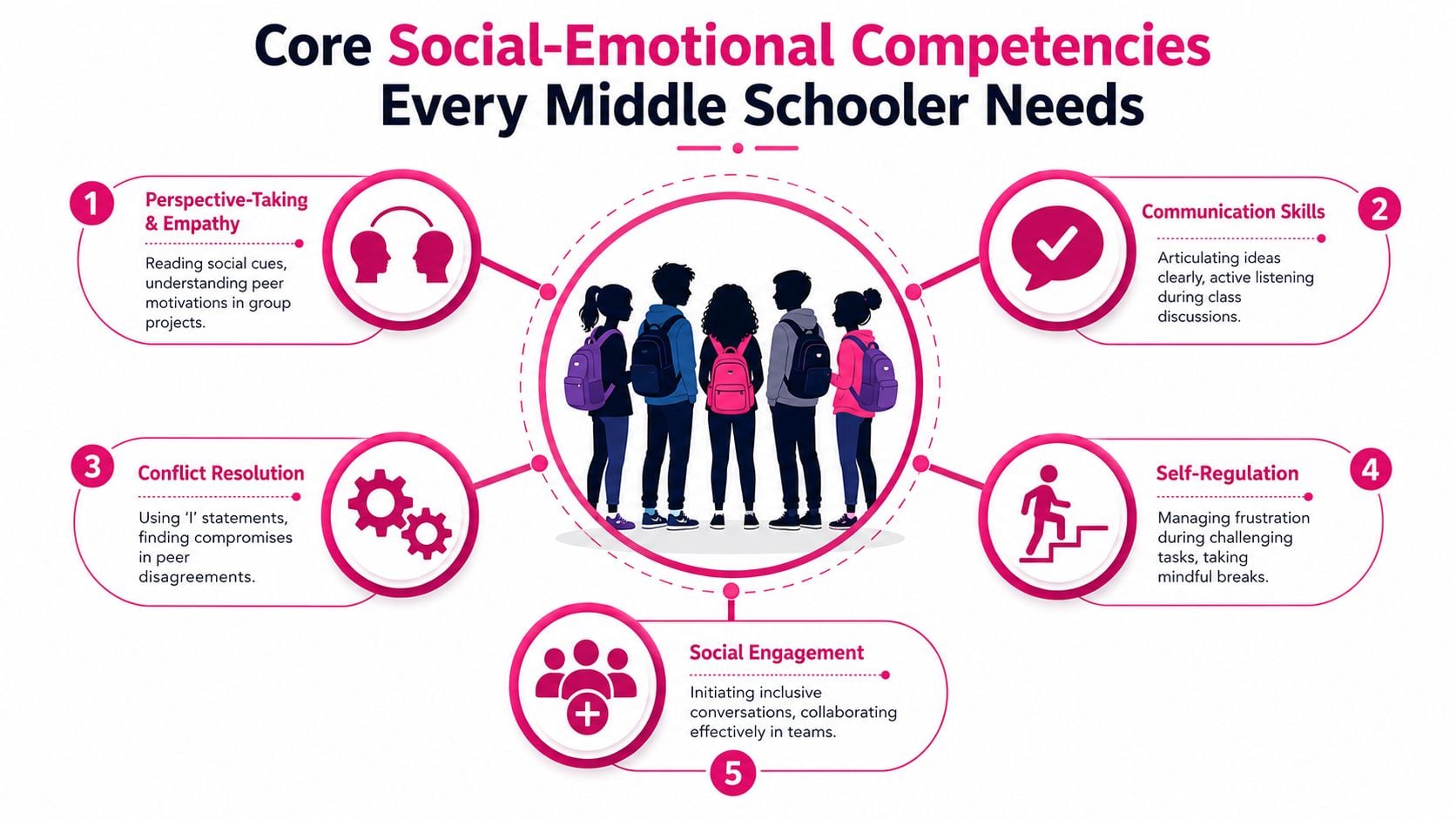
Core Social-Emotional Competencies Every Middle Schooler Needs
Students need more than reminders to “be nice.” They need a shared vocabulary, visible models, and repeated opportunities to practice specific behaviors.
Perspective-taking and empathy
Perspective-taking means asking what another person may know, feel, want, or misunderstand before deciding what their behavior means. Empathy adds the willingness to respond with care.
In a group project, Maya sees Jordan staring at the instructions and not contributing. Without this skill, she might say, “You're being lazy.” With practice, she can pause and ask, “Did the directions make sense? Do you want to choose a role together?” The second response leaves room for confusion, anxiety, language differences, or a different working style.
Teach students to look for observable evidence, generate more than one possible explanation, and check their assumption with a respectful question.
Self-regulation in social situations
Self-regulation isn't the same as staying quiet. It means noticing an emotional signal, creating a pause, and choosing a response that protects the student's goals.
During a frustrating lab, a student may feel blamed when a partner points out an error. An unregulated response might include sarcasm, shouting, or leaving the group. A practiced response sounds like, “I'm getting frustrated. I need a minute, then I'll come back and fix my part.”
Adults can teach a simple sequence: notice, pause, name, choose. A visual cue, breathing routine, movement break, or private check-in can make the sequence accessible without publicly singling out a student.
Assertive communication
Assertiveness lets students express needs and boundaries without attacking or surrendering their voice. A useful structure is: “I feel or notice…, I need…, can we…?”
If a partner keeps interrupting, “You never listen” invites a defensive argument. “I lose my train of thought when I'm interrupted. Please let me finish, then I'll listen to your idea” is clearer and more actionable. Students also need practice receiving feedback, saying no, and asking for clarification.
Collaborative problem-solving
Group work exposes whether students can negotiate roles, share control, and repair a disagreement. A team might disagree about who presents. One student wants the speaking role, another has prepared the visual, and a third has done most of the research.
Instead of letting the loudest student decide, teach the group to list the task requirements, identify each person's preference, and build a plan that distributes responsibility. The skill is not avoiding disagreement. It's using disagreement to reach a workable decision.
Social awareness and inclusion
Social awareness helps students notice who gets invited, who gets interrupted, and who remains on the edge of a group. It also helps them understand that classmates may communicate, celebrate, or participate in different ways.
A student can practice inclusion by moving beyond “everyone is already included” and using a concrete action: invite a classmate into a paired discussion, explain an unwritten game rule, or ask whose perspective hasn't been heard. These competencies are learnable behaviors, not personality types. The five core SEL competencies explained can help adults align their language across classrooms and home conversations.
Common Social Challenges Students Face in Grades 6 Through 8
A seventh-grade student named Luis often takes over group work. He answers before others finish, rewrites classmates' ideas, and insists that his method is the only efficient one. His grades may look strong, but classmates stop volunteering around him. The teacher sees incomplete collaboration, while Luis may see only “people who don't try.”
The intervention isn't a vague instruction to cooperate. Luis can practice a two-turn rule, listen to two contributions before adding another, and ask, “What do you think?” The teacher can privately frame the goal as increasing the group's thinking, not reducing Luis's intelligence.
Friendship conflict creates another familiar pattern. A student receives a short message, assumes it means anger, forwards a screenshot, and confronts the friend the next morning. Tone disappears easily in text, and an audience can turn a private misunderstanding into public conflict. Students need a pause script: “I might be reading this wrong. Can we talk in person before I respond?”
A new student may understand the academic work but struggle to enter established peer networks. A teacher can assign rotating partners with defined roles, teach conversation openings, and avoid making the new student perform gratitude in front of the class. Inclusion works better when the structure doesn't depend on one child's courage.
Bullying situations also reveal a skills gap. A bystander may recognize harm yet fear becoming the next target. Give students multiple options, such as interrupting safely, redirecting the targeted student, documenting and reporting, or seeking an adult. “That joke isn't okay here” is one possible script, but students should never be required to confront danger directly.
Social confidence grows when students have a specific next move, not when adults repeat “just speak up.”
Academic performance can expose social needs too. A high-achieving student who rejects feedback may protect their self-image by refusing collaboration. A student who misses cues may appear defiant. Neurodivergent students may interpret indirect language differently, English language learners may need additional processing time, and students from different cultural backgrounds may encounter unfamiliar norms around eye contact, interruption, or disagreement. Cultural responsiveness means teaching the classroom expectation clearly without treating one communication style as the only respectful one.
These challenges are developmentally common, but “common” doesn't mean students should handle them without instruction. Families can use the guide to negative peer pressure to start conversations about choices, belonging, and the difference between loyalty and unsafe behavior. Teachers can connect the same ideas to group roles, digital citizenship, and restorative conversations.
Practical Activities and Scripts for Building Social Skills
Short, repeated practice usually works better than an occasional lecture. The activities below fit into advisory, morning meetings, counseling sessions, or a brief family conversation.
Perspective-Taking Pause
Objective: Separate facts from assumptions during conflict.
Present a short scenario, such as, “Your partner doesn't reply when you ask for their part.”
Have students name only what they observed.
Ask them to generate possible explanations.
Invite them to choose a respectful question.
Role-play the question and response.
Adult script: “We know the message wasn't answered. We don't know why. What are two explanations that don't involve mind-reading?”
Debrief: “How does checking an assumption change what you do next?”
Group Work Contract
Objective: Make collaboration expectations visible before problems begin.
Ask students to identify behaviors that help a group function.
Record agreements about turn-taking, roles, deadlines, and repair.
Add a process for disagreement.
Have each student choose one behavior to practice.
Revisit the contract after the task.
Student script: “If we disagree, we'll explain our reasons, listen once more, and choose the option that best meets the assignment.”
Differentiation: Offer sentence frames and visual role cards. Let students contribute by speaking, writing, pointing, or selecting from choices.
Feelings Forecast
Objective: Build self-awareness before emotional pressure rises.
At the beginning of class or during dinner, students choose a word, color, or symbol for their current state. They identify one situation that may challenge them and one support they can use.
Adult script: “What emotional weather are you bringing today? What might change it, and what can you do if the forecast gets stormy?”
Students don't need to disclose private details. They can say, “I'm at low energy and may need written directions.”
Repair rehearsal
Objective: Practice returning to a relationship after harm.
Give pairs a scenario involving an interruption, exclusion, or hurtful comment.
Ask the student who caused the harm to name the behavior without excuses.
Add an acknowledgment of impact.
Practice a repair request.
Let the other student decide what response feels appropriate.
Script: “I interrupted you and made it harder for you to finish. I'm sorry. Next time I'll write my thought down and wait. Is there anything you need from me now?”
For additional activity ideas that can be adapted for counseling, advisory, or group work, educators can consult the California Teen Center 2026 activities guide. Keep activities voluntary when disclosure could feel exposing, and offer alternatives for students who need processing time or reduced social demand. A structured social skills group approach can provide consistent practice for students who need more repetition.
SEL Competency
Activity Name
Time Required
Best Setting
Self-awareness
Feelings Forecast
Brief check-in
Advisory or home
Self-management
Pause and Choose
Short rehearsal
Classroom or counseling
Social awareness
Perspective-Taking Pause
Short role-play
Advisory
Relationship skills
Group Work Contract
Planning activity
Any project class
Responsible decision-making
Repair Rehearsal
Scenario practice
Home or school
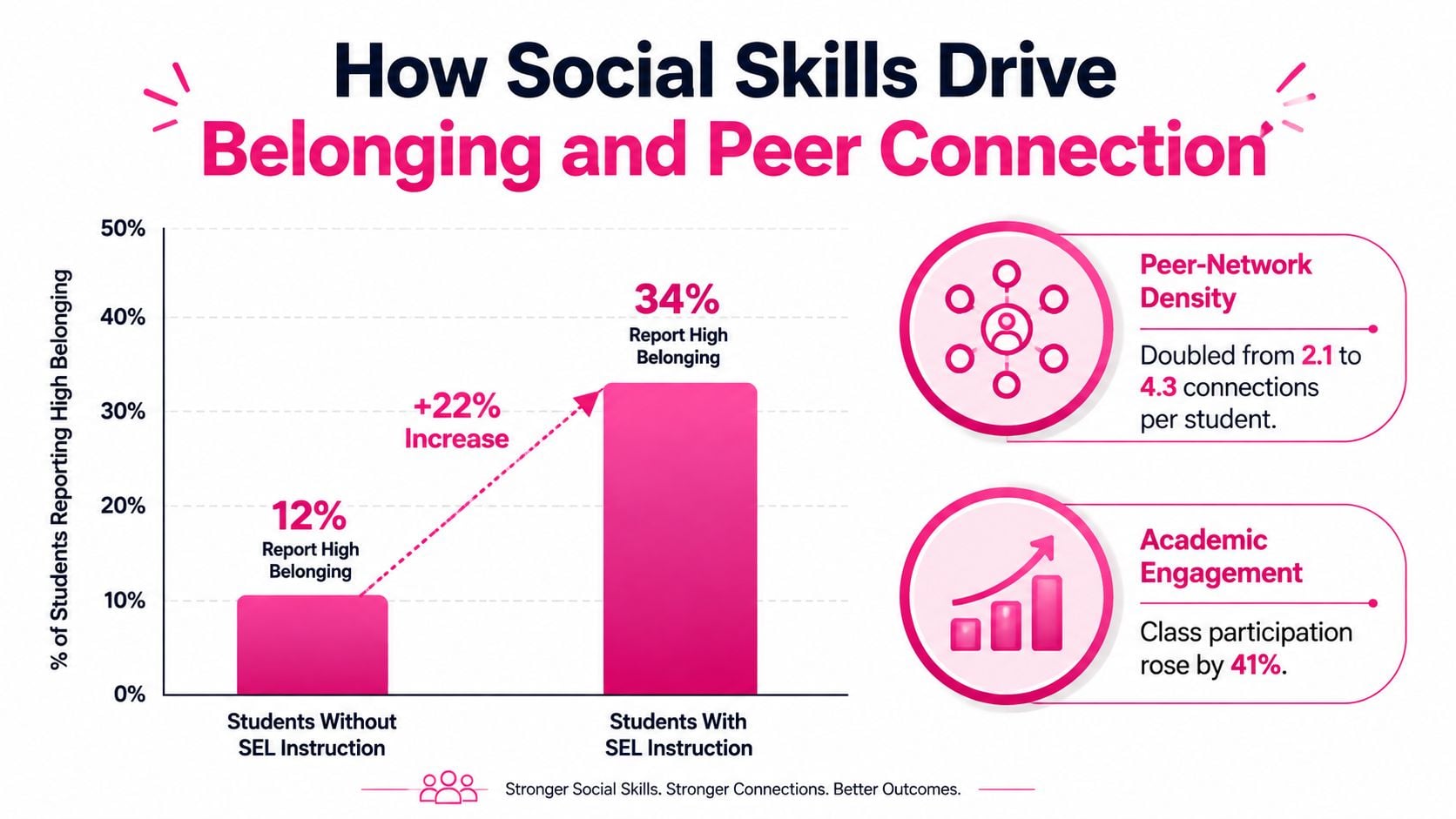
How Social Skills Drive Belonging and Peer Connection
Belonging depends on more than whether a student has a friend. It also depends on whether the student can enter a group, remain safe during disagreement, ask for help, and trust that adults will respond when exclusion occurs.
Survey data from the Australian Longitudinal Study of Australian Children found that 80–90% of 12–13-year-olds and 14–15-year-olds reported having friends (statistical report). Friendship is widespread, but friendship quality and peer acceptance still shape school engagement and academic access. A student can have friends outside school and still feel unable to participate in a particular classroom community.
A school-based social-skills study involving 56 students found statistically significant changes in peer-network measures after a seven-session intervention. Degree centrality increased from 9.34 to 12.16, while closeness centrality shifted from 0.0062 to 0.0058 (peer-network study). These measures don't mean every student suddenly becomes socially confident. They do show why instruction can be evaluated as a change in peer connection, not just a change in self-reported behavior.
A systematic review of 49 middle-school studies found that supportive teacher and peer relationships consistently predicted stronger school connectedness. Discrimination, peer victimization, and mental-health difficulties predicted weaker connectedness, while longitudinal evidence indicated that connectedness tends to decline across middle school (systematic review).
That evidence changes how schools should interpret participation. A quiet student may need a safer entry point, not a public demand to speak. A student who dominates may need structured turn-taking, not only a reprimand. A teacher who makes peer connection teachable can widen access to group discussion, feedback, and academic risk-taking.
The peer climate also matters for bystanders. Recent research discussed in the verified YouthTruth analysis connects belonging with students' willingness to intervene as bystanders. A school that teaches scripts while ignoring bullying and exclusion leaves students with tools but no safe culture in which to use them. Social skills instruction works best when adults pair individual practice with clear reporting routes, consistent responses, and deliberate opportunities to build cross-group connections.
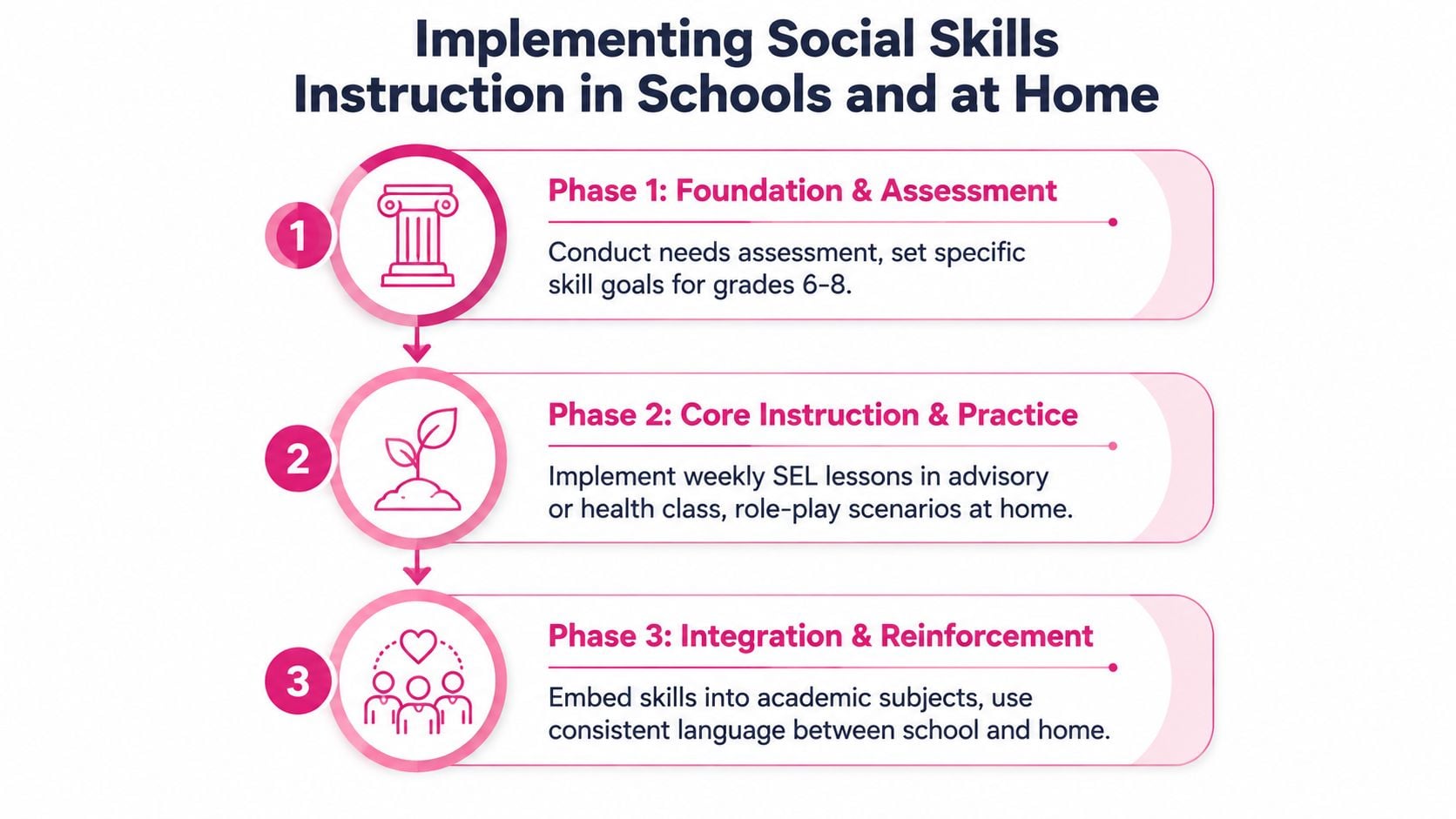
Implementing Social Skills Instruction in Schools and at Home
A sustainable plan begins with observation, not assumptions. Ask students which social situations feel difficult, review patterns in group work and referrals, and invite staff to record what they see during transitions, lunch, and collaborative tasks. Keep the questions focused on skills and conditions rather than labeling students as popular, difficult, or unmotivated.
Build a shared sequence
Start with a small set of skills, such as entering a group, regulating during conflict, and repairing harm. Teach the same words in advisory, classrooms, counseling, and family conversations. Students benefit when “pause,” “check the story,” and “repair” mean the same thing wherever they hear them.
A school can pilot regular practice, then adjust based on student feedback and observations. Short sessions fit more naturally into advisory or homeroom than a one-time assembly. Schedule explicit instruction before predictable pressure points, including the start of the school year, major transitions, and intensive collaborative assignments.
Reinforce instead of reteach from scratch
Teachers should name the skill when they see it: “You waited, asked a question, and made room for another idea.” At home, caregivers can model the same process during ordinary disagreement.
Try these conversation starters:
Notice the choice: “What did you do when the group ignored your idea?”
Explore the impact: “How might your words have landed?”
Plan the next move: “What could you say tomorrow that protects your boundary?”
Connect to learning: “How did feeling safe or unsafe affect your concentration?”
Avoid common implementation mistakes. Don't reduce SEL to a poster, a reward system, or a single presentation. Don't ask one counselor to carry the entire program while other adults use conflicting responses. Don't collect only discipline counts. Brief pre- and post-reflections, teacher observations, and carefully designed peer-nomination tools can help schools notice changes in confidence, participation, and connection while protecting student privacy.
Families can reinforce the work without turning dinner into therapy. Choose one weekly scenario, model your own pause, and invite the student to generate a response. The adult's job is to scaffold reflection, not interrogate the child for a perfect answer.
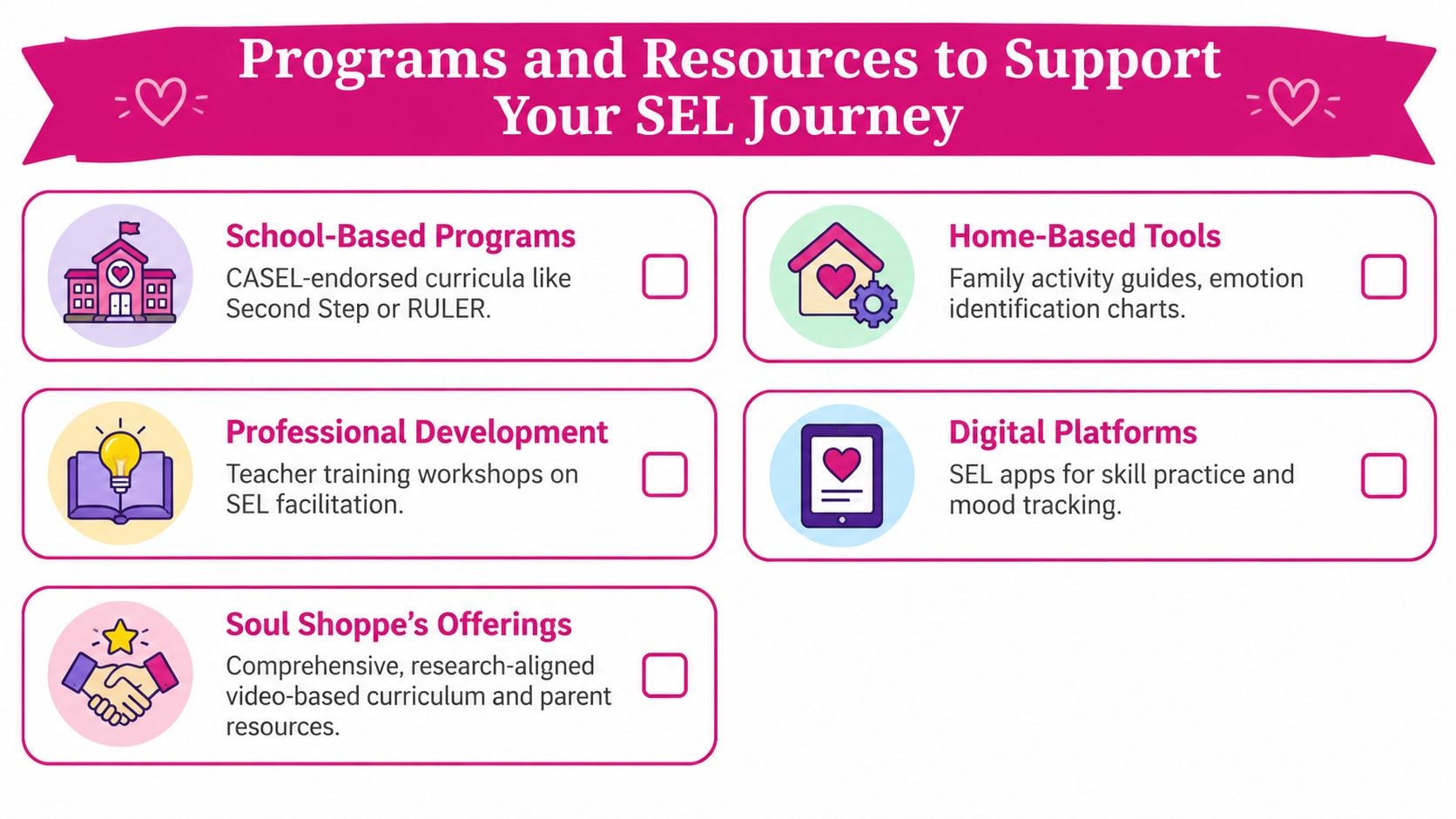
Programs and Resources to Support Your SEL Journey
Schools choosing resources for social skills for middle school should look beyond attractive lessons. The strongest fit will be developmentally appropriate for grades 6–8, culturally responsive, practical within advisory or homeroom, accessible to neurodivergent learners and English language learners, and designed to help adults observe progress.
CASEL's program guidance and framework can help leaders compare curricula and clarify the competencies a school wants to prioritize. Second Step and the Yale Center for Emotional Intelligence offer complementary materials for classroom instruction, emotion language, and adult learning. Families may also benefit from simple activity guides, conversation prompts, and visual emotion tools that make practice possible outside school.
Soul Shoppe provides school SEL programming and resources focused on practical skills such as self-regulation, empathy, communication, and conflict resolution, with formats that can include student experiences, adult support, and family engagement. Schools should evaluate any provider by asking how lessons are adapted for middle-school development, how staff learn the shared language, and how the school will monitor belonging and peer safety over time.
The case for investment is straightforward. Middle school is a period when social-emotional competencies can dip, peer relationships become more influential, and belonging can determine whether students participate fully in academic life. Schools that teach students how to regulate, connect, include, and repair are addressing both immediate peer experiences and the foundation students carry into high school.
Soul Shoppe offers research-based SEL programs, interactive student experiences, adult support, and family resources that teach practical tools for self-regulation, empathy, communication, and conflict resolution. To build a shared approach to social skills for middle school, visit Soul Shoppe and explore options for your school community.
A child stands beside the classroom door after another student hugs them without asking. At home, a caregiver notices a child agreeing to every request, then becoming quiet and irritable. In both situations, something feels wrong, but the child may not yet have the words to explain it.
A healthy boundary is a clear limit that protects safety, autonomy, time, emotions, or relationships without rejecting connection. It can sound like, “Please stop,” “I need some space,” or “I'm not available for that right now.” Boundaries also belong to adults. A teacher can protect a professional role, and a parent can decline an unreasonable demand without withdrawing love.
Clear boundaries help children practice self-regulation, empathy, and assertive communication. They also make classrooms and homes more predictable, which supports psychological safety. The need for this teaching is practical. In a 2023 survey highlighted by Our Watch's research record, many surveyed young people misidentified controlling or coercive behavior as healthy, and only 22% felt completely confident taking action when they felt unsafe, uncomfortable, or disrespected.
The following examples of healthy boundaries are organized around everyday relationships and developmental settings. Each one gives adults a script, a teaching tactic, and observable cues that signal a limit needs attention.
1. Establishing Clear Communication About Screen Time and Device Use
At dinner, a child reaches for a tablet while a caregiver checks messages under the table. In class, several phones interrupt a group discussion. These moments show why device boundaries work best when everyone understands when, where, and why screens are permitted. The purpose is shared attention, not treating technology as bad.
A teacher might say:
“Phones go in the parking area during our discussion. You can collect yours when the activity ends so everyone has a fair chance to listen and contribute.”
At home, an adult can say, “We keep dinner tech-free so we can talk and notice one another. That rule applies to grownups too.” A school may also set screen-free classroom days for hands-on collaboration, reading, movement, and conversation.
Teach the reason and model the limit
Invite children to choose one device-free time or zone. Explain that the agreement can support sleep, learning, face-to-face connection, and mental health. Adults must follow it as well. Clear, kind communication about limits is a skill adults can strengthen through assertiveness training for expats, then model in everyday family and school conversations.
Use practical supports:
Start small: Choose dinner, homework, or morning arrival instead of changing every device habit at once.
Use reminders: A timer, visual schedule, or classroom signal makes transitions less dependent on willpower.
Name the next step: Say, “You have five minutes left, then the tablet returns to the charging station.”
Notice repeated arguments during transitions, hidden devices, anxiety when access ends, or difficulty joining meals and lessons without checking a screen. These cues show that the agreement may need clearer wording, more practice, or stronger adult modeling.
2. Setting Limits on Emotional Labor and Parentification
Children need emotional support, but they shouldn't become a parent's confidant, conflict mediator, or emotional regulator. A child can know that a caregiver is worried without being asked to solve adult problems. The same principle applies at school. Teachers can be warm and authentic without processing divorce, financial distress, or other private struggles with students.
A parent who has had a difficult workday might say:
“That's an adult problem I'm working on with a grown-up helper. You didn't cause it, and you don't need to fix it. I'm glad you told me about your day.”
If money is tight, a teenager may hear, “We're being careful with spending this month,” rather than receiving frightening details about adult finances. A teacher can say, “I'm having a hard day, so I'm going to take a quiet breath before we begin,” without making the class responsible for the teacher's emotional recovery.
Support without transferring responsibility
Adults need their own support network, whether that means a friend, therapist, family member, support group, or another trusted adult. Trauma-informed parenting guidance can help caregivers think about safety, regulation, and the difference between sharing appropriately and oversharing.
Teach children that caring and carrying are different. They can listen, offer kindness, or get a trusted adult, but they don't need to manage a sibling's behavior or settle a parent's argument.
Look for signs such as a child monitoring an adult's mood, apologizing for ordinary needs, trying to mediate conflict, keeping secrets to protect a caregiver, or seeming unusually responsible for everyone's feelings. Teachers may notice a student repeatedly asking whether an adult is okay instead of focusing on age-appropriate work.
Respond with reassurance and a clear return of responsibility: “You noticed I was upset, and that was caring. The adults will handle this. Your job is to get ready for school.”
3. Respecting Privacy and Appropriate Physical Boundaries
Children's bodies, personal space, and private moments deserve respect. Asking before touching teaches autonomy in ordinary situations, including hugs, hair adjustments, clothing corrections, physical demonstrations, and comfort. Respect doesn't remove adult responsibility for safety. It gives children language to identify comfort and discomfort while adults remain attentive.
A teacher supporting a distressed student might offer choices:
“Would you like a high-five, a thumbs-up, or some space?”
“Is it okay if I sit beside you?”
“You can tell me to stop if you don't want a touch.”
A parent can knock on a teenager's closed bedroom door and wait before entering. A coach can ask, “Is it okay if I help adjust your posture?” before physical guidance. When visiting relatives, a caregiver might say, “You can wave, shake hands, or just say hello. You don't have to hug.”
Practice short, usable language
Younger children can rehearse “Please stop,” “I need some space,” and “I'm not comfortable with that.” Adults can use role-play based on ordinary situations, such as a sibling grabbing a toy or a classmate attempting an unwanted hug. The Child Mind Institute's boundary activity gives adults a practical prompt for asking children how they could respond when someone hugs without permission.
Children also need to learn that other people's limits matter. Model asking, accepting “no,” and choosing another greeting. Don't say, “But they love you,” to override a child's physical boundary. Love doesn't create automatic permission.
A physical-boundary lesson should include anatomically correct names for body parts, the concept that private parts aren't for other people to touch, and a clear instruction to tell a trusted adult if something feels unsafe. Pay attention when a child freezes, pulls away, avoids a person or setting, becomes distressed during greetings, or repeatedly says “no” while adults continue. Those are cues to pause and listen.
Before showing a visual reminder, let children know that asking first is part of respectful care.
4. Separating Your Own Emotions from Your Child's or Student's Behavior
A child's behavior can trigger an adult's frustration, embarrassment, fear, or sense of failure. A healthy emotional boundary helps the adult separate those feelings from the child's identity. A grocery-store meltdown may signal sensory overload, hunger, fatigue, or an unmet need. It isn't automatically disrespect, and it doesn't define the parent.
A caregiver might pause, lower their voice, and say, “Your body is having a hard time. I won't let you hit. We can leave the store and calm down.” The adult holds the safety limit while avoiding shame.
Teachers face the same challenge. Instead of saying, “You're so disruptive,” a teacher can say, “I need you to raise your hand before speaking. I'll listen when it's your turn.” The statement addresses a specific behavior and gives the student a clear replacement.
Use a pause before correction
A pause can be a breath, a count, a sip of water, or a brief step into the hallway when another adult can supervise. Ask, “What need might this child be trying to meet?” rather than, “Why are they trying to upset me?” This question doesn't excuse unsafe behavior. It helps the adult choose a useful response.
Try these language shifts:
Own your feeling: “I feel frustrated, so I'm going to take a breath.”
Describe the action: “The blocks were thrown.”
State the limit: “Blocks stay on the floor.”
Offer repair: “Let's pick them up and try again.”
A parent may feel rejected when a teenager chooses lunch with friends instead of joining the family. Recognizing development and changing expectations can protect the relationship from unnecessary guilt or pressure.
Boundary trouble may show up as shouting, public correction, threats, sarcasm, or consequences chosen mainly to discharge adult anger. Journaling, talking with a trusted adult, and noticing recurring triggers can help parents and teachers respond to the child in front of them rather than to their own old wounds.
5. Maintaining Professional Boundaries Between Teachers and Students
Students need caring adults, but a teacher-student relationship isn't a friendship. Professional boundaries protect students from favoritism, secrecy, blurred roles, and inappropriate access while allowing genuine warmth and mentorship.
A teacher can respond to a personal social-media request by saying:
“I don't connect with current students through my personal account. You can reach me through the school platform, where I'll respond during school hours.”
A middle-school teacher may mentor a student closely while meeting in a classroom with windows, a library, or another visible school space. The teacher can share general information, such as having a family or enjoying a hobby, without discussing marital conflict, financial problems, or other private matters.
Make the relationship predictable
Use school-approved communication channels. Keep personal and professional social-media accounts separate, and apply the same standard across students. A useful question is, “Would I do this with every student, or only with this one?” If the answer is only one student, pause and consult administration.
Teachers should document significant conversations according to school policy. They should also ask for guidance when a student discloses sensitive information, requests secrecy, or seeks contact outside normal channels. A warm boundary sounds calm, not punitive.
Communication: “Please email through the school account.”
Location: “We'll talk here with the door open.”
Confidentiality: “I care about what you shared, and I may need to involve the right adult to help keep you safe.”
Consistency: “The same classroom expectations apply to everyone.”
A teacher may notice boundary pressure when one student receives unusual access, private messages continue after hours, gifts or secrets become part of the relationship, or the student reacts strongly to ordinary professional limits. Strategies for building trust with students are strongest when trust grows from reliability, respect, and clear roles rather than special treatment.
6. Saying No to Unreasonable Requests and Overcommitment
Adults teach children about limits through their own calendars. A parent who accepts every activity, volunteer request, and family demand may unintentionally model exhaustion as proof of love. A teacher who keeps adding committees and extra projects may show students that caring requires ignoring capacity.
A teacher can say, “I appreciate you thinking of me, but I'm at my capacity this year.” A parent might tell a child, “Our family can manage two activities per season so we have time together.” Neither response rejects the person. Each one answers a request.
Keep the script short
You don't need a long defense. Over-explaining can make a clear boundary sound negotiable. Try:
“Thank you for asking. I'm not able to take that on right now.”
“That doesn't work for our schedule.”
“I can help for this part, but I can't manage the whole project.”
“We chose two activities, and we're keeping that limit.”
Say no early when possible. A teacher who can't chaperone a field trip can decline before plans depend on them, then suggest another colleague who may enjoy the opportunity. A parent can review the family calendar before agreeing to another sport, lesson, or weekend commitment.
Children may react with disappointment. Adults can validate that feeling without changing the limit: “I know you wanted to add another activity. It makes sense to feel disappointed. We're still keeping two so we have time to rest and be together.”
Signs of overcommitment include constant rushing, resentment, missed family routines, difficulty sleeping, and saying yes before checking capacity. In school, watch for an adult who becomes unavailable to students because every spare period is filled. Saying no to one task can protect rest, existing responsibilities, and the quality of care already promised.
7. Creating Consistent Consequences and Not Using Shame as a Tool
Children need limits that make sense before a difficult moment arrives. A consistent consequence connects a specific behavior with a predictable next step. Shame attacks identity, while a healthy boundary addresses the action and leaves room for learning, repair, and reconnection.
A parent might say, “Hitting isn't safe. The game stops now. When your body is calm, we'll check on your sibling and practice asking for a turn.” The adult doesn't call the child “mean” or “a hitter.” The focus stays on safety and responsibility.
In a classroom, a teacher could use a previously explained response to missing work, such as a private meeting, a work period, or another school-approved consequence. The response should apply fairly and remain separate from statements about intelligence or worth. A restorative approach may ask a student to create an action plan after disrupting class and then follow through.
Protect dignity while holding the line
Write down common behaviors and the agreed responses so adults aren't inventing consequences while angry. Correct privately when possible. Then give the child a chance to reconnect and demonstrate the better choice.
Useful wording includes:
“That choice wasn't safe.”
“This is a behavior we're working on.”
“You can be angry, and you can't throw the chair.”
“What needs to happen to repair the harm?”
Children may need a brief break, loss of a privilege, a repair conversation, or supervised practice. The response should fit the behavior and the child's developmental needs. A consequence that humiliates, isolates, or labels a child may stop visible behavior temporarily while making mistakes harder to disclose.
Cues that shame has entered the system include public call-outs, threats about being “bad,” laughter from peers, forced apologies without reflection, or a child hiding accidents and problems. Replace those patterns with calm privacy, clear expectations, and a pathway back into the group. The boundary is firm, but the relationship remains available.
8. Honoring Children's Right to Their Own Thoughts, Feelings, and Beliefs
Children are developing identities, opinions, values, and beliefs. Respecting their inner world doesn't mean accepting every behavior. It means adults can listen to a thought or feeling without treating disagreement as defiance.
A child who says, “I hate math,” may be communicating confusion, shame, boredom, a learning barrier, or a difficult classroom experience. A teacher can ask, “What about math feels frustrating?” rather than insisting that the child must enjoy it. A parent whose child becomes interested in a different religion or belief system can listen and ask what the belief means to them, even when the family holds different views.
Validate feelings without surrendering limits
A student who disagrees with a lesson might hear, “I'm curious what would have made more sense to you?” The teacher can consider the feedback while still explaining the learning goal. At home, a caregiver can say, “You're allowed to feel angry. You're not allowed to insult your sister.”
Try these responses:
“Tell me more.”
“That sounds frustrating.”
“I don't share that conclusion, but I want to understand it.”
“You can choose whether to start now or in ten minutes.”
“Your feeling is okay. We still need a safe action.”
The distinction matters. Thoughts and feelings can be welcomed for discussion, while behaviors may require limits. Offering age-appropriate choices gives children practice with autonomy without transferring adult responsibility to them.
Watch for children who stop sharing, automatically agree, apologize for feelings, or say what they think adults want to hear. Adults may also notice themselves correcting too quickly, mocking a preference, or treating questions as disrespect. Curiosity repairs that pattern. Ask one more question before giving a lecture, and show children that honest communication won't cost them belonging.
8-Point Healthy Boundaries Comparison
Boundary
Implementation Complexity
Resource Requirements
Expected Outcomes
Ideal Use Cases
Key Advantages
Establishing Clear Communication About Screen Time and Device Use
Medium, requires coordinated rules and consistent modeling
Low–Medium, time, timers, adult coordination
Reduced distraction, better sleep, more face-to-face connection
Families and classrooms wanting focused learning/mealtimes
Clear expectations and modeled technology habits
Setting Limits on Emotional Labor and Parentification
High, involves changing adult patterns and roles
Medium, therapy or adult support network; difficult conversations
Healthy boundaries become useful when adults practice them before conflict makes language difficult. Choose one boundary for home, one boundary for the classroom, and one relationship-specific script. For example, a family might choose device-free dinner, a class might choose a consistent hand-raising routine, and a child might rehearse, “Please stop. I don't like that.”
Use the same sequence each time:
Name the limit: “Phones stay in the charging basket during dinner.”
Explain why it matters: “We're protecting time to connect.”
Listen to the child's perspective: “What feels hardest about this rule?”
Follow through consistently: Apply the agreement calmly and predictably.
Repair after conflict: Reconnect, review what happened, and practice the next response.
This process works across student-student, teacher-student, parent-child, and caregiver-peer relationships. A student can say, “I need space right now.” A teacher can say, “We'll talk through the school platform.” A parent can say, “That's an adult problem, and I'm handling it with another adult.” A caregiver can say, “I'm not able to add another activity this season.”
Boundaries protect relationships. They aren't punishments, walls, or proof that someone is difficult. They make expectations visible, reduce guesswork, and give children a safer way to understand consent, privacy, capacity, and responsibility. The history of boundary practice has moved from broad ideas about the self and interpersonal limits toward structured attention to consent, reflection, education, and safe relationships, as described in a 2025 paper on relational boundaries in health settings.
Schools should also evaluate whether children can use the skills, not only whether they enjoyed a lesson. A randomized middle-school evaluation of the Shifting Boundaries intervention found significant reductions in sexual victimization and violence victimization or perpetration compared with controls, while it didn't find significant gains across several knowledge, attitude, intention, and harassment measures, according to the evaluation published by the Academy of Management. That finding supports measuring observable behavior alongside knowledge and discussion.
Practice matters. In a parent-focused boundary-setting and social-competence program, mean content-knowledge gains across the five sessions ranged from 11% to 41%, according to the ERIC full-text study. Families and schools can use that principle without turning boundary teaching into a test. Repeat the language, role-play realistic situations, notice cues, and revisit the agreement as children develop.
For additional classroom practice, educators can browse 4th grade SEL resources. Soul Shoppe also connects self-regulation, empathy, communication, conflict resolution, and psychological safety through experiential SEL resources for school communities. Its programs and adult resources can help families, teachers, and students build shared language that supports belonging while making limits easier to understand.
Soul Shoppe offers practical SEL programs, workshops, coaching, and resources that help children and adults practice self-regulation, empathy, communication, and assertive boundary-setting. Visit Soul Shoppe to explore tools for bringing consistent, relationship-centered boundary language into your school and home.
61% of U.S. adults have experienced at least one adverse childhood experience, or ACE, and 16% have experienced four or more types, according to the Centers for Disease Control and Prevention's ACE prevention data. Among high school students, three in four reported at least one ACE, while one in five reported four or more. These experiences can include abuse, neglect, and household dysfunction during childhood, the same developmental years when adult responses can either intensify stress or help children feel safe enough to recover and learn.
Trauma informed parenting offers a practical way to make that protective response more consistent. It doesn't ask parents or teachers to diagnose a child, excuse unsafe behavior, or find perfect words during every hard moment. It asks adults to understand behavior in context, reduce avoidable threats, create predictable routines, and teach regulation through relationship.
Why Trauma Informed Parenting Matters Now
Adversity can shape health, learning, relationships, and later opportunities. The CDC's overview of ACEs and prevention explains why early experiences matter, but a child's distress rarely arrives with a label. It may look like defiance, withdrawal, impulsivity, perfectionism, or a sudden loss of skills.
Trauma informed parenting is a framework for responding to children with safety, curiosity, and steady boundaries. Instead of asking, “What's wrong with you?” an adult can ask, “What might this behavior be communicating?” A child who refuses to enter a classroom may feel overwhelmed by separation or uncertainty. A child who argues about every instruction may be trying to regain control. A child who seems indifferent may be protecting themselves from disappointment.
Those possibilities guide observation, not diagnosis. Hunger, fatigue, learning differences, sensory needs, family stress, developmental changes, and ordinary frustration can also influence behavior. Trauma informed practice keeps the explanation open while addressing the immediate need: helping the child regain enough regulation to participate.
Caregiver regulation makes that work possible. A dysregulated adult can turn a difficult moment into a threat, even with caring intentions. Before correcting, lower your voice, slow your breathing, and use a brief script: “I'm getting frustrated. I'm going to pause so I can help.” This is not easy or quick, especially when work, siblings, and household stress are already demanding attention. It is a repeatable skill, not a test of perfect patience.
Safety is more than the absence of danger
Children need physical safety and emotional safety. A safe environment includes clear expectations, calm adult voices, reliable transitions, and consequences that teach rather than humiliate. It also allows a child to say, “I need help,” without expecting punishment for asking.
Teachers can post a visual schedule and explain changes before they happen. Parents can give a transition warning before leaving a playground or beginning homework. A school and family can agree on one shared phrase, such as, “You are safe, and we will work out the next step,” so the child hears a consistent message across settings.
Practical rule: Connection doesn't remove boundaries. It helps children experience boundaries without feeling abandoned or threatened.
A 2024 systematic review and meta-analysis found benefits from trauma-informed parenting programs for parenting outcomes and parental mental health. The review reported a pooled parenting outcome of d = 0.75, with a 95% confidence interval of 0.09 to 1.15, and a parental mental health effect of d = 0.21, with a 95% confidence interval of 0.09 to 0.32, in the peer-reviewed review indexed by PubMed. The practical message is grounded and hopeful: adult responses can change, and caregiver well-being belongs in the plan.
Families can also review this discussion of the pandemic's effects on children to consider how prolonged stress may continue to affect children's behavior and connection.
The Five Core Principles of Trauma Informed Parenting
The five principles commonly used in trauma-informed care are safety, choice, collaboration, trustworthiness, and helping children build agency and voice. Together, they guide adults to reduce re-traumatization by including emotional and physical safety in ordinary decisions, not only during crises. A practical guide to trauma-informed care principles describes approaches such as warning a child before a transition and offering two acceptable choices.
Safety and choice
A child experiences safety when expectations are understandable and adults protect people without adding shame. At home, a parent might say, “I won't let anyone get hurt. I'm moving the blocks while we calm down.” In class, safety may include a quiet place where a student can reset privately rather than being singled out by peers.
Choice gives children a manageable sense of agency while adults retain responsibility for limits. Offer two options that meet the same need: “Do you want to put on your shoes before or after your coat?” or “Would you like to start with the odd problems or the even problems?” The choices need to be real, clear, and possible for the child to carry out.
Collaboration and trustworthiness
During homework, collaboration might sound like, “The assignment feels too big right now. Should we read the directions together, or would you like to explain the first question to me?” The adult keeps the expectation in place, while the child helps decide how to begin. That shared problem-solving can turn resistance into participation.
Trustworthiness develops through accurate promises and dependable follow-through. Avoid saying, “Nothing will change,” when a change is unavoidable. Say, “The schedule is changing today. I'll tell you what I know, and I'll check in with you after lunch.” A teacher who returns when promised, or a parent who explains a changed plan, shows that adults can remain predictable even when circumstances shift.
Building agency in ordinary moments
A child who notices body tension and walks away instead of hitting is practicing agency. Adults strengthen that learning by naming the process: “You noticed your body getting tense and moved away before you hit. That was a safer choice. Let's practice what you can say next time.” The focus stays on awareness, skill use, and repair, rather than praise that ignores difficulty.
Caregivers carrying their own histories may need structured support instead of trying to change family patterns alone. therapy for young parents NY is one possible resource for connecting personal healing with day-to-day parenting.
A short video can help families and educators hear how these principles translate into practice:
The Overlooked Role of Caregiver Regulation
A calm script cannot work reliably when the adult delivering it is already overwhelmed. Trauma informed parenting often focuses on what to say to a child, yet caregiver stress and regulation are the engines that make those words usable. The caregiver's nervous system sets the emotional temperature of the interaction.
Parent trauma and child trauma are strongly linked, but trauma exposure is only one influence on parenting. Parenting stress can shape how trauma exposure relates to harsh or sensitive parenting. A 2025 systematic review of longitudinal studies found that common pathways from parent trauma to child outcomes run through caregiver mental health and parenting behavior, according to the review record from the American Psychological Association. Support therefore needs to address parental stress, depression, and regulation skills alongside empathy and validation.
Regulation before response
A child throws a shoe during the morning rush. The adult's first impulse may be to threaten, lecture, or grab. Regulation starts with a brief interruption:
Put both feet on the floor.
Exhale slowly before speaking.
Name the state privately: “I'm overloaded and getting sharp.”
Reduce the demand to the next safe action.
Use a low, brief sentence: “The shoe is on the floor. I'll help you pick it up.”
This is practical safety, not indulgence. It keeps the adult's nervous system from adding another layer of threat to an already difficult moment.
Short practices can fit into existing routines. Drink water before school pickup, sit in the car for a minute, trade a bedtime task with another adult, or write down the trigger after everyone is safe. A repeatable practice can help more than an elaborate plan that never happens.
Your regulation is part of the support you're giving your child, not a reward you earn after the child behaves.
Repair matters after a rupture: “I yelled. That was frightening, and it wasn't your responsibility to calm me. I'm going to try again.” Caregivers who want a simple framework for noticing and interrupting their reactions can explore this guide to self-regulation. Professional support is appropriate when stress, depression, anger, or trauma symptoms affect safety or daily functioning. Caregivers carrying their own histories may benefit from structured support rather than trying to change family patterns alone. therapy for young parents NY offers a directory of clinicians who specialize in parent-focused trauma work.
Recognizing Trauma Signs Across Different Ages
Trauma doesn't have one appearance. Some children become loud and restless, while others become exceptionally quiet. Some hide distress behind achievement, humor, caretaking, or apparent independence. The useful question isn't whether a behavior proves trauma. It's whether a meaningful change, repeated pattern, or intense reaction is telling adults that the child needs more support.
Early childhood
A kindergartner may collapse when the class changes activities, cling to a caregiver at drop-off, regress in toileting, or become distressed by ordinary noise. Adults may label the child defiant or “too sensitive,” especially when the reaction seems larger than the event.
Start with predictability and co-regulation: “First we'll clean up, then we'll line up. You can hold the transition card or stand beside me.” At home, a parent might say, “Your body is having a hard time stopping. I'll stay close while we move to the next thing.”
The Child Welfare Information Gateway's guidance for parenting children who have experienced trauma recommends concrete regulation supports such as a calm space, waiting until parent and child are calm before discussing behavior, and reflecting feelings back.
School age
A third-grader might stop joining friends at recess, complain of stomachaches, lose materials, or react intensely to correction. Adults may mistake withdrawal for laziness and irritability for disrespect. A teacher can check the pattern rather than escalating immediately: “I've noticed independent work has felt harder this week. Do you want to start with me, use the quiet table, or tell me what got in the way?”
Parents can look for changes across settings. Ask whether sleep, appetite, play, concentration, or willingness to separate has shifted. One difficult afternoon doesn't explain a child's needs, but repeated changes deserve curiosity and communication.
Middle school
A seventh-grader may experience a sudden drop in grades, avoid trusted adults, take risks, become unusually controlling, or seem emotionally flat. Adolescents often protect privacy, so direct interrogation can close the door. Try, “You don't have to tell me everything right now. I've noticed school feels heavier, and I'm available to help you find support.”
Teachers can offer private check-ins, predictable deadlines, and a discreet way to request a break. For more examples of observable changes, consult this resource on signs of stress in children and how to support students. Adults should avoid diagnosing from behavior alone and should involve qualified professionals when concerns persist or safety is at risk.
Practical Strategies and Scripts for Daily Life
The most useful trauma informed parenting tools fit into ordinary moments. They reduce uncertainty, support regulation, and preserve limits without turning every struggle into a power contest.
Morning transitions
Transitions can activate fear or resistance, especially when a child doesn't know what will happen next. Use a visual sequence, give advance notice, and offer one limited choice.
Give a warning: “In ten minutes, we'll wash hands and sit for dinner.”
Name the next step: “Shoes, backpack, then the car.”
Offer agency: “Do you want the blue socks or the gray socks?”
A child who tears up a worksheet may be overwhelmed, not unwilling. Lower the intensity before teaching the skill.
Try: “I can see this feels too hard right now. Let's take three breaths, choose one problem, and ask for help if we need it.” A calm corner with breathing cards, a sensory object, or a glass of water can create enough space for problem-solving.
Teachers can offer the same sequence at school: regulate, connect, clarify, then complete. Avoid demanding an explanation while the child is crying or shouting. A regulated brain is better positioned to listen and plan.
Aggressive outbursts
Safety comes first. Move other children away, remove dangerous objects, and stay nearby if doing so is safe. Speak and keep your words short: “I won't let you hit. I'm here. Your hands can push the wall or squeeze this cushion.”
The American Bar Association's trauma-informed recommendations emphasize teaching and modeling alternatives to violence while maintaining a respectful, trusting relationship. After the child settles, reflect the feeling and teach the replacement: “You were furious when the game ended. Next time, say ‘I need a break' or come to me.”
Withdrawal and bedtime anxiety
Withdrawal needs an invitation, not a demand for disclosure. Sit nearby and say, “You don't need to talk yet. I'll keep you company.” At bedtime, use the same short routine, explain what will happen, and leave a predictable way to reconnect: “I'll check on you after I put the dishes away.”
These strategies aren't magic phrases. They work through repetition, adult steadiness, and follow-through.
Partnering with Schools and Knowing When to Seek Help
Schools can reach families who aren't already connected to therapy or child welfare services. A 2025 implementation study found that a universal trauma-informed parenting program offered in public schools could engage parents exposed to high levels of ACEs, according to the study from Johns Hopkins University. A 2026 scoping review found that published child-welfare interventions have mostly focused on foster or resource parents and the child's trauma symptoms, leaving less attention for biological parents, caregivers outside the system, and prevention before crisis involvement.
That makes school partnership practical, not merely aspirational. A parent can tell a teacher, “My child has been under significant stress. You don't need the private details, but predictable transitions and a quiet check-in may help.” A teacher can respond, “What helps at home? What signs tell you your child is becoming overwhelmed? How should we communicate when we notice a change?”
Questions that create alignment
Parents can ask:
Predictability: “How does my child learn about schedule changes?”
Regulation: “Where can my child take a brief, supervised break?”
Connection: “Which adult checks in privately?”
Communication: “What information should we share, and how will it be protected?”
SEL support: “How does the school teach emotional awareness, conflict resolution, and help-seeking?”
Teachers should avoid promising secrecy or sharing a child's history broadly. Share only information needed to support safety, learning, and communication, following school policy and applicable safeguarding requirements.
Professional support becomes important when distress persists, intensifies, disrupts learning or relationships, causes major changes in sleep or daily functioning, or creates risk of harm. Immediate safety concerns, abuse concerns, suicidal statements, or serious violence require urgent help through local emergency, crisis, safeguarding, or medical services. Parents and teachers can document observable behavior and consult a pediatrician, licensed mental health professional, or school-based counselor rather than trying to determine a diagnosis alone.
Building Resilience One Connection at a Time
Progress rarely looks like a child who never melts down again. It looks more like a parent who notices the early signs, lowers their voice, and repairs after a difficult morning. It looks like a teacher who gives a student a private reset instead of public criticism, then welcomes the student back into learning.
Resilience grows through repeated experiences of safety, belonging, skill-building, and repair. A caregiver might say, “We both had a hard time. We're still connected, and we can practice a different ending.” That sentence doesn't erase the rupture, but it shows the child that conflict doesn't have to end the relationship.
The most durable habits are small:
Pause before reacting.
Meet physical needs and reduce uncertainty.
Treat behavior as communication while holding clear limits.
Give choices where choices are possible.
Ask for help before stress becomes a safety crisis.
Repair openly when you get it wrong.
For additional ideas about how relationships support children's capacity to recover and adapt, read building resilience in children. Parents and educators can begin today by choosing one predictable transition, one regulation support, and one repair phrase to practice consistently.
Soul Shoppe offers school and family SEL programs, parenting resources, courses, and an app that support emotional awareness, self-management, communication, and connection. Visit Soul Shoppe to explore practical tools and structured support for building safer, more connected relationships at home and school.
Stress, transition, academic frustration, and peer conflict can all push an elementary student out of thoughtful problem-solving fast. The good news is that self-regulation is teachable, especially when adults model it, practice it during calm moments, and reinforce it in the middle of real school routines. A 2022 review of school-based self-regulation programs found consistent improvement in 66% of the 50 studies, with gains showing up across curriculum-based, family-based, mindfulness, yoga, exercise, and social-skills formats, and pooled task-based outcomes from 19 studies showed a moderate positive effect size of 0.42 with a 95% confidence interval of 0.32 to 0.53 (NIHR evidence alert). That matters because elementary students don't need one perfect trick, they need usable tools for feelings, bodies, thinking, and relationships.
In classrooms and at home, the best supports are the ones children can use during math trouble, hallway conflict, screen-time homework, or a hard goodbye. Soul Shoppe's connection, safety, and empathy-centered SEL approach fits that need because it gives students shared language for regulation, communication, and repair without treating big feelings as bad behavior.
1. The Zones of Regulation
A color chart can make emotional self-awareness easier for young children to grasp. The Zones of Regulation gives students a simple way to name what is happening in their bodies and brains by sorting feelings into four color-coded states, Blue, Green, Yellow, and Red. A child who can say, “I'm in Yellow,” is already doing more regulation work than a child who only acts out.
A classroom example makes the idea clearer. A 2nd grader may notice that the Yellow Zone shows up as fast speech, shaky hands, or restless legs, then choose a tool such as deep breathing or a short movement break. A teacher can also say to a 4th grader, “I see you might be in the Blue Zone. Let's look at your strategy list and pick one that fits.” Students learn this language faster when the same chart appears in classrooms, hallways, and cafeterias, because then the words mean the same thing everywhere.
Make the zone language concrete
Children need practice with the chart while they are calm. Role-play gives them that chance before a real problem starts. Create a strategy menu for each zone, then rehearse it during morning meeting or after recess. For example, Green Zone strategies might include deep breathing, movement, or talking with a friend. A quick class check can show whether students can match a feeling to a zone and a zone to a tool, which tells the teacher whether the lesson has moved from naming to use.
Practical rule: If a student can name the zone but can't choose a tool, the lesson isn't finished yet.
For K–2, keep the language short and visual, with simple pictures and one clear action for each zone. For 3–5, ask students to explain why they chose a zone and which strategy fits best, since older students can start linking body clues to choices more independently.
Home-school transfer: Send the zone chart home and invite families to use the same words during homework, bedtime, or sibling conflict.
Simple progress check: Notice whether students can name their zone without adult prompting and choose one matching strategy.
2. Mindfulness and Breathing Techniques
Mindfulness helps children practice paying attention on purpose, right now, without judging themselves for getting distracted. That idea becomes clearer when a child pauses, takes a breath, and returns to a hard task instead of spiraling into frustration. Calm is learned through repetition, the same way reading fluency grows through practice.
A classroom routine can start. A teacher might say, “Breathe in for 4 counts, hold for 4, out for 6. Notice how your body feels.” A 3rd grader can use box breathing at a desk during a test, and a parent can teach starfish breathing at bedtime by tracing each finger while breathing in and out. A body scan gives students another tool. They can notice feet, legs, stomach, and heartbeat, which helps them catch tension before it turns into a bigger reaction.
When breathing is paired with sound, the routine can feel even more settling. Teachers or families can choose mood music for videos with calming nature tracks or other quiet background music to support relaxation during breathing practice.
For a plain-language breathing guide that families can reuse, Soul Shoppe's belly breathing technique is a useful companion.
Some children do better with a picture cue. Others follow counts more easily. Both paths work, so the goal is not to find one perfect method, but to give students a few simple ways to reset their bodies. Keep the practice short at first, then repeat it often enough that the steps feel familiar before stress shows up.
A quiet corner can support this work if it includes visual cues, like expanding circles or a flower to smell and blow. Use the same breathing language before transitions so students hear the same script in the morning, after recess, and before challenging work. A teacher might say to the whole class, “Hands on belly, slow breath in, slow breath out.” A parent can use the same cue at home before reading or bedtime.
A calm breathing skill works best when adults teach it before the crisis, not during the crisis.
For younger children, the script should stay short and concrete. “Smell the flower, blow out the candle” gives K–2 students one image and one action they can repeat without much language load. For 3–5 students, invite them to choose the breathing style that fits the moment, such as before a quiz, during partner work, or after a disagreement.
A simple progress check is to watch what happens after frustration. If a child can settle faster, rejoin the task sooner, or resist a transition with less protest, the breathing routine is starting to work. Families and teachers can also notice whether students begin using the same language on their own, which shows the strategy is moving from adult-led practice to independent use.
3. Movement Breaks and Sensory Strategies
Some students calm down by moving, pressing, carrying, squeezing, or fidgeting. That is often a regulation need. When adults treat movement and sensory input as useful supports, children can stay in the room and still give their bodies what they need.
A teacher might lead a 5-minute dance break between lessons, with jumping jacks, spins, and toe touches. Another classroom might keep a movement menu on the wall with wall push-ups, bear crawls, jumping jacks, and stretches. A 4th grader who uses a textured fidget during morning meeting is using tactile input to stay focused. At home, a child doing homework with a weighted lap pad or compression blanket may settle better and work longer.
One student's story shows how specific this can be. A second grader who taps every pencil and swings in the chair may not need more warnings first. He may need heavy work before writing, like carrying books to the library, pushing a bin of supplies, or doing wall push-ups. Once his body gets that input, the pencil tapping often drops because the nervous system has something else to organize around. A simple classroom script helps: “First we move, then we work.”
The same idea fits transitions, too. A quick movement burst before math or writing can reset attention. If you want a fun classroom example bank, Soul Shoppe's fun brain breaks page connects movement with positivity and reset routines.
Match the sensory tool to the student
Not every child needs the same input. Some need motion, some need pressure, some need a fidget, and some need all three at different times. Ask students what helps them focus, then teach them when to use it and when to put it away. That keeps the tool tied to regulation, not random use.
You can also build proprioceptive work into the day, like pushing a cart, stacking chairs, or carrying supplies. Those tasks give organizing input to the nervous system and can prevent bigger behavior spikes later. If a child gets restless during independent work, offer a brief job that uses the body on purpose, then return to the task. The pattern is simple: give the body work, then ask the brain for work.
K–2 adaptation: Offer two or three choices, such as stretch, dance, or wall push-ups.
3–5 adaptation: Let students self-select from a movement menu and explain why that choice helps.
Simple progress check: Track whether the child returns to work faster after a break and needs fewer adult reminders.
4. Social-Emotional Check-ins and Reflective Conversations
A student often tells you how they're doing before they have the words for it. That's why short check-ins matter. They create a pause, show care, and give adults useful information before a small issue turns into a big one.
A morning check-in can be as simple as, “How are you feeling today? On a scale of 1 to 10, where are you at? Tell me more about that.” A parent might ask at dinner, “What was the hardest part of your day? What helped you through it? What might you do differently tomorrow?” Those questions build reflection, not just compliance. A counselor can also ask after an incident, “Help me understand what happened. What were you feeling? What do you need from me?”
Soul Shoppe's daily check-ins for students connects with this approach by using mood meters and reflection tools to help students notice and name their state.
A child who feels noticed is more likely to tell the truth about what they need.
Keep the conversation open and specific
Use open-ended questions instead of yes-or-no prompts. Make eye contact, pause long enough for a real answer, and reflect back what you hear. If a student seems quiet, try a private check-in and name what you noticed without accusing.
For younger students, feelings charts and emoji scales make it easier to answer. For older elementary students, a private one-on-one conversation can uncover stress that never shows up in whole-group settings.
K–2 adaptation: Offer gesture-based responses, like thumbs up, sideways, or down.
3–5 adaptation: Ask students to explain the feeling, the trigger, and one support that might help.
Simple progress check: Look for more honest sharing, quicker help-seeking, and fewer surprises.
5. Cognitive Reframing and Positive Self-Talk
Children believe their thoughts, especially when they are tired, embarrassed, or stuck. That's why self-talk matters. When a student says, “I can't do this,” the adult goal isn't fake cheerfulness, it's helping the child find a more accurate thought that makes effort possible.
A 3rd grader staring at a math problem can hear, “You haven't solved this yet. You can try a different strategy. What's one thing you could try?” A 5th grader before a presentation might repeat, “I've practiced this. I know my material. I can do hard things.” At home, a canceled playdate can become, “I'm sad the plan changed, and I can still have a good day doing something else I enjoy.” Those small shifts help children stay flexible instead of spiraling.
Soul Shoppe's life is perspective resource fits this kind of thinking because perspective-taking gives children another way to interpret a hard moment without denying the hard moment itself.
Teach students to question the thought
A simple thought-detective routine works well. Ask whether the thought is a fact or an opinion, then ask what evidence supports it and what evidence does not. That keeps reframing grounded and avoids toxic positivity.
Use anchor charts with phrases like Not yet, I made a mistake, and I need help. Students hear those phrases often enough that they start using them on their own during hard work.
K–2 adaptation: Use picture-based reframes and short, repeatable phrases.
3–5 adaptation: Have students write or say a replacement thought before a tough assignment.
Simple progress check: Notice whether the child recovers from a mistake without shutting down.
6. Problem-Solving and Conflict Resolution Skills
Conflicts don't disappear when kids get older. They just get more complex. That's why students need a reliable way to move from reacting to solving.
A 4th-grade pair can use a simple sequence after arguing over a basketball. First, each child tells their side without blame. Next, each listens. Then they name the problem together, brainstorm solutions, and pick one to try. A student can also use an I statement, like, “I felt left out when you didn't ask me to play. I'd like to be included next time.” That language is stronger than blame because it tells the other person what happened and what would help.
Classrooms can support this with a peace table or peace corner and a visual guide for the steps. Families can do the same thing at home when siblings argue over screens, chores, or turn-taking.
Useful rule: Don't rush to consequences before students have practiced repair.
Teach the steps before the conflict
Model the process during low-stakes moments, not only after a fight. Ask students to repeat what the other person said before they suggest a solution. That builds listening and reduces the urge to defend first.
A school can also use peer mediation when older elementary students are ready for more responsibility. When student leaders help classmates work through conflict, the process becomes part of the school culture instead of an adult rescue plan.
K–2 adaptation: Use picture cards and simple choices, like “take turns, trade, or ask for help.”
3–5 adaptation: Have students practice active listening and solution brainstorming in role-play.
Simple progress check: Look for shorter conflicts, more repair language, and less adult mediation.
7. Emotion Coaching and Validation
Emotion coaching tells students that feelings are real, names them clearly, and sets limits on behavior without shaming the child. That balance matters. A child who hears, “Your feelings make sense, and we still can't hit,” learns both safety and structure.
A 2nd grader melting down during cleanup might hear, “I see you're really upset. You're safe. I'm here. Let's notice that angry feeling together.” A 5th grader who blurts “I'm stupid” during math might hear, “I hear you're frustrated. You're not stupid. You're learning something hard. Let's take a break and come back.” A counselor can also say, “It sounds like your feelings are really hurt. That makes sense. What do you need right now?”
A classroom emotion thermometer helps children show intensity before behavior gets out of hand. If a student marks a 4 out of 5, the teacher can respond to the level instead of guessing.
Validate first, then coach
Stay low, calm, and warm. Name the feeling before solving the problem. If the child is overwhelmed, help with body calming first, then return to the issue after regulation improves.
Consistency between home and school helps a lot here. When adults use the same language for feelings, boundaries, and repair, students don't have to relearn the rules in every setting.
K–2 adaptation: Use simple emotion words and body cues, like hot, tight, or shaky.
3–5 adaptation: Invite students to describe what happened, what they felt, and what they need next.
Simple progress check: Notice whether the child accepts support faster and recovers without escalating as often.
8. Positive Reinforcement and Strengths-Based Recognition
Children repeat what gets noticed. If adults only point out mistakes, students learn to brace for correction. If adults also name effort, courage, kindness, persistence, and repair, students start to see those qualities as part of who they are.
A teacher might say, “I noticed you raised your hand and shared your idea. That took courage.” A class can use peer shout-outs, such as, “I want to recognize Marcus for helping a friend who was struggling.” Families can add a simple dinner ritual where each person shares something they did well and something they're proud of. Recognition can also focus on process, like, “I noticed you tried three different strategies before asking for help.”
A school might even build a recognition program around SEL behaviors, like noticing empathy, problem-solving, persistence, and helping others. The point isn't prizes, it's identity. Children begin to internalize the message that they are capable, helpful, and worth noticing.
Keep praise specific and believable
Say what you saw. Avoid vague praise like “good job” when you can be concrete instead. Specific feedback teaches the student what to repeat.
This works best when it's balanced with real expectations, not used to smooth over every struggle. A child still needs correction sometimes, but they also need to hear that effort and growth count.
K–2 adaptation: Use stickers, brief notes, and immediate verbal recognition.
3–5 adaptation: Invite students to recognize peers and reflect on their own strengths.
Simple progress check: Watch for more initiative, more peer kindness, and more willingness to try again.
Elementary Self-Regulation: 8-Strategy Comparison
Strategy
Implementation complexity
Resource requirements
Expected outcomes
Ideal use cases
Key advantages
The Zones of Regulation
Moderate, requires explicit teaching and consistent use
Schoolwide culture work, motivating overlooked students
Reinforces desired behaviors, builds intrinsic motivation and belonging
Turn Regulation Tools Into Daily Habits
No single strategy works for every student or every emotional state. A child who needs movement after recess may need breathing before a test and a check-in after a conflict. The strongest classrooms usually start with one shared language tool, one body-based option, and one relationship-based routine, then teach those consistently before adding more.
A practical starting point is simple. Choose one visual language, like the Zones. Choose one calming body tool, like breathing or movement. Choose one relational routine, like a daily check-in or reflective conversation. Then model each tool, practice it during calm moments, and use it across school and home so the child hears the same script everywhere.
Track what you can see. Notice whether the student can name a feeling, choose a strategy, recover after frustration, ask for help, and repair conflict. Those signs matter more than a perfect worksheet or a quiet body for a few minutes. A child who can return to learning after a hard moment is building the core skill.
Home-school teamwork makes this stronger. Share the student's preferred tools, the words that help, and the routines that work best in both places. When families and educators use the same language, children don't have to start over every morning.
Soul Shoppe offers workshops, coaching, courses, an app, and SEL resources that support connection, safety, empathy, and shared regulation language for school communities and families. If you're ready to strengthen these habits with a practical, relationship-centered approach, visit Soul Shoppe and explore the tools that fit your students best.
If you want practical SEL support for classrooms, homes, and school communities, Soul Shoppe offers workshops, coaching, courses, an app, and classroom-ready resources built around connection and shared language. Visit Soul Shoppe to explore tools that can help elementary students practice self-regulation, repair conflict, and build confidence in everyday moments.
You're in a familiar spot if you've ever watched a student go quiet during morning meeting. The prompt is friendly enough, the room is calm, and yet one child is clearly doing the math of, “This question doesn't fit my life.” That small disconnect is exactly where culturally responsive SEL starts to matter, because SEL only works when students can see themselves in the way it's taught, practiced, and repaired.
A lot of educators already teach with care. They want kids to feel safe, heard, and included. The hard part is that good intentions can still miss students when the routines, examples, discipline choices, and family communication all assume one dominant experience instead of many.
When the Morning Meeting Prompt Misses the Mark
A teacher asks, “What did you do this summer?” A few hands shoot up, and one student stares at the floor. Maybe their summer looked like caring for siblings, moving apartments, helping at a family business, or staying inside because money was tight. The question wasn't cruel, it was just narrower than the room.
That's the everyday problem culturally responsive SEL is meant to solve. SEL is strongest when the prompt, the activity, and the response options leave room for different cultures, family structures, and lived realities. When they don't, some students participate with ease while others learn that school asks them to translate themselves before they can belong.
Practical rule: If a prompt only works for one kind of childhood, it's not neutral. It's selective.
A safer circle prompt sounds more open. “What's something you learned, made, noticed, or did over the break?” That version still invites reflection, but it doesn't punish kids whose experiences don't match the most common script. It also opens space for family care, work, language brokering, community routines, and rest.
The same pattern shows up in transitions, conflict repair, and praise. A child who hears adults only celebrate one kind of communication style can start to think their home norms are wrong. The safe space guidance from Soul Shoppe fits here because psychological safety isn't just about warm language, it's about whether students can show up without editing their identities first.
In other words, the prompt is never “just a prompt.” It's a signal about who the classroom expects to be centered, who gets to speak comfortably, and who has to work harder just to enter the conversation.
What Culturally Responsive SEL Actually Means
Think of students like different soils, not empty plots. Some are already rich with family language, survival skills, humor, ceremony, caregiving, and community expectations. Culturally responsive SEL works when instruction notices that richness and builds from it instead of flattening it into one school-approved version of “good behavior.”
A working definition is simple. It's SEL designed around students' cultural strengths, identities, and lived realities, while also examining power, bias, and barriers that shape school life. That means you're not only teaching self-management or empathy, you're asking whose norms are being treated as default and whose experiences are treated as exceptions.
The three layers that show up in real classrooms
First, design around cultural strengths. Teachers connect lessons to family routines, community stories, home languages, music, and local examples. Washington's SEL Culturally Responsive Practices Brief says these practices affirm students' cultural place in the world and intentionally address barriers to SEL, which is a useful way to think about the work when you're explaining it to colleagues or families (Washington OSPI brief).
Second, center student identities and lived realities. That means students are not asked to hide where they come from in order to participate. The PMC review of early childhood and elementary practice points to classroom community, family engagement, critical literacy, multicultural literature, and print-rich environments as connected dimensions of culturally responsive teaching (PMC review).
Third, examine power and bias. This is the piece many school teams skip because it feels harder, but it matters. If a lesson never names discrimination, privilege, or microaggressions, it can become a polished version of inclusion that still leaves the hardest realities untouched.
A good test is simple. If your SEL lesson could run the same way in every room without acknowledging who your students are, it's probably not culturally responsive yet.
For a plain-language explanation, you could tell a parent, “We're teaching kids how to manage emotions and solve problems in ways that respect their culture, language, and family life, while also helping them deal with unfairness at school and beyond.” That's the heart of it.
What the Research Actually Shows
The evidence base is encouraging, but it's not magic, and it's not finished. A 2024 systematic review and meta-analysis of culturally responsive SEL programs included 13 studies in the qualitative review and 7 studies in the quantitative meta-analysis, with an overall effect size of Hedges' g = 0.36 (2024 systematic review). That matters because it shows measurable promise, while also showing the field is still building.
A second meta-analysis of culturally adapted SEL programs found 0.27 overall with a 95% confidence interval of 0.13 to 0.41 (meta-analysis PDF). In the subset that met the SAFE criteria for effective SEL implementation, the effect size was 0.26 with a 95% confidence interval of 0.15 to 0.37. Programs that did not meet SAFE criteria were not statistically distinguishable from the null, which is a useful reminder that adaptation alone doesn't replace strong implementation.
What seems to matter most
The strongest programs in the review were delivered at the targeted level, led by researchers, and used multiple culturally responsive strategies rather than just one (2024 systematic review). That lines up with what many educators feel in practice. A single poster, holiday craft, or renamed activity doesn't shift student experience very much. Design choices, repeated over time, do.
The research on English learners also points to gains in self-awareness and relationship skills after cultural and linguistic adaptation (technical review). That makes sense, because those are the skills most tied to classroom participation, peer interaction, and feeling safe enough to speak.
The biggest gap is measurement. The literature still leans toward principles and implementation advice, not a widely accepted framework that cleanly separates culturally responsive SEL from generic SEL (gap review). If you're presenting this to a board or parent group, that honesty helps. The field has real evidence, and it still needs stronger tools for tracking what changes for marginalized students.
Takeaway for leaders: treat the research as a reason to start thoughtfully, not as a reason to overclaim.
Everyday Classroom Strategies That Change Practice
The fastest way to make culturally responsive SEL feel real is to change the ordinary moves. Not the one-off assembly, the ordinary moves. The morning prompt, the response format, the way a disagreement is repaired, the examples on the wall, the way an adult talks about home language, all of that teaches SEL whether you planned it or not.
Five shifts you can use tomorrow
Use asset-based identity talk. Ask, “What's a skill, tradition, or habit your family has that helps people care for each other?” That prompt lets students name pride instead of only problem-solving. The Children's Institute guidance recommends conversations that are asset-based and connected to children's lives, including home languages, music, games, and lived experiences (Children's Institute).
Make prompts inclusive by design. Swap out questions that assume one experience, like “What did you do this summer?” for “What did you learn, notice, or do over the break?” The SMART article's caution about exclusionary prompts is useful because it shows how small wording choices can widen or narrow participation (SMART article).
Offer more than one response mode. Let students draw, speak, write, record audio, or use a short video to show understanding. A counselor running a coping-skills lesson can say, “Choose the format that helps you share your thinking clearly.” That supports voice and cultural relevance at the same time.
Represent more than one kind of child in materials. Use books, photos, and class examples that reflect different family structures, neighborhoods, abilities, and languages. When students see people like them in the learning environment, they don't have to spend energy wondering whether school has room for them.
Respond to conflict with context, not just correction. If a student gets into a peer conflict, ask what happened, what the students were feeling, and what social rule or family expectation might be shaping the moment. That kind of response keeps the focus on learning and repair instead of only compliance.
If the strategy can live inside your existing meeting, lesson, or hallway response, it's probably a real practice, not an extra.
Sample Lesson Snippets You Can Use This Week
An elementary lesson can be short and still carry a lot of meaning. Start with a multicultural read-aloud, then move to a self-portrait activity, and finish with a family interview about how caregivers solve conflicts at home. The point is to connect story, identity, and home wisdom to concrete SEL language.
Elementary lesson on feelings and apology language
Open with, “Today we're looking for how families care for one another in different ways.” Read a book that includes children from an underrepresented community, then ask students to notice one problem the character faces and one way the character shows care or courage. After the read-aloud, have students draw self-portraits and label one strength they learned from family or community.
Send home a simple interview question. “How do the adults in your family solve problems when people are upset?” When students return, ask them to share one idea from home and connect it to naming feelings, using calm words, or making an apology that repairs harm. If a student brings up a difficult home experience, respond with care, thank them for trusting the room, and move the conversation toward support rather than forcing public details.
Upper-grade lesson on perspective-taking
In middle grades, use youth culture, music, or a familiar local example to open a discussion about perspective. You might say, “Different people can hear the same song, watch the same clip, or live the same moment and still walk away with different feelings. Let's practice noticing that without arguing someone out of their experience.” Then use structured dialogue norms so students know how to listen, wait, and respond.
Ask students to compare how two people might interpret the same event based on identity, friendship history, language, or community norms. Give them sentence stems such as, “I could see that differently because…” and “That makes me think about…” If a student names discrimination or an exclusionary moment, the adult's job is to slow the room down, acknowledge the harm, and keep the discussion grounded in respect.
The PMC review's connected dimensions, classroom community, family engagement, critical literacy, multicultural literature, and print-rich environments, match this kind of lesson design well (PMC review). Students aren't just talking about empathy. They're practicing it in a format that honors where they come from.
Family and Community Engagement as a Core Layer
Family partnership can't sit on the edge of this work. A 2025 study in rural TK classrooms found three CR-SEL themes, multicultural and critical perspective development, inclusive environment, and family engagement, which says a lot about what schools often miss when they treat parent involvement as a separate add-on (ACT report). Families are not an audience for SEL. They're part of the implementation.
What stronger partnership looks like
Start by asking caregivers what respect, discipline, and emotional regulation look like at home. That gives you a real baseline and keeps you from assuming the school's default language is the only workable one. It also surfaces differences you can discuss without turning them into deficits.
Offer communication in languages families use and in formats they can access. A short bilingual message, a phone call with interpretation, or a brief video message can do more than a polished flyer no one reads. Consistency matters here more than performance.
Invite families to co-design a small piece of learning. A family interview, a story about how adults in the household solve conflict, or a community partner visit can become the bridge between classroom skills and home practice. The 2025 rural TK findings matter because they show family engagement as a central theme, not a courtesy.
Trust grows when families see that school asks them for expertise, not just attendance.
Community organizations can help too. Youth programs, cultural leaders, after-school staff, and neighborhood groups can extend the same SEL language across settings so students don't have to relearn how relationships work every time they change rooms. That continuity is especially helpful when children are moving between school expectations and home expectations.
If language access, time, or previous negative school experiences make family engagement hard, start small. One honest question, one translated message, and one follow-up loop are better than a big event that doesn't change everyday communication.
Naming Power, Bias, and Identity-Based Stressors
Culturally responsive SEL gets thin fast if it only celebrates difference. Real classrooms also have to deal with power, privilege, implicit bias, institutional racism, microaggressions, discrimination, and the stress students carry when they're constantly managing how they're seen. If the work stops at kindness, it misses the moments when kindness alone isn't enough.
Here's the practical difference. A celebration-of-diversity lesson says, “We all have unique backgrounds.” A deeper CR-SEL lesson asks, “Who gets interrupted, who gets believed, who gets corrected, and who has to translate themselves in this room?” That question isn't too heavy for kids when it's handled with care and age-appropriate language.
When a student names discrimination in circle time, don't rush past it. Say, “Thank you for saying that out loud. That sounds painful, and it matters.” Then pause the group, clarify the harm, and decide whether the next step is repair, adult follow-up, or a private check-in.
If a microaggression happens between peers, the goal isn't public shaming. The goal is to make the harm visible, name the impact, and help the student understand why the comment landed the way it did. A calm script works better than a lecture: “I want us to pause. That phrase can send a message about who belongs, and that's not okay here.”
For staff learning, resources that focus on communication across difference can help. A useful example is this deaf communication etiquette guide, which reminds adults that respectful interaction starts with listening, not assumptions. That same humility applies across culturally responsive practice.
The larger point is simple. SEL should help students regulate emotions and build relationships, but it should also give them language for unfairness. That's where empathy becomes more than a feeling and turns into a skill for school life.
Measuring Impact and Taking the Next Step
Schools usually want to know whether a new approach is helping. That's fair. For culturally responsive SEL, the best indicators are practical, visible, and a mix of numbers and stories, because no single data point tells the whole story.
Sample indicators for tracking culturally responsive SEL
Indicator
What to Look For
Data Source
Student belonging
Students say they feel seen, safe, and included
Student surveys, circles, interviews
Discipline patterns
Fewer repeated exclusions for the same students
Office referrals, restorative logs
Attendance
More consistent participation over time
Attendance records
Family engagement
More two-way contact and family input
Call logs, workshop attendance, feedback forms
Student voice
More students naming their experiences and perspectives
Writing samples, discussions, reflection prompts
The field still lacks a widely accepted framework that cleanly separates culturally responsive SEL from generic SEL, so track what matters in your community and watch patterns over time (measurement gap review). If you want a broader look at thinking about outcomes in schools, the measuring program impact resource can help leaders think clearly about evidence, even when the metrics are not perfectly neat.
A 30-60-90 day starter path
In the first 30 days, audit SEL materials for representation, wording, and assumptions. In the next 30, pilot one culturally responsive move per grade level, such as inclusive prompts, family interviews, or multimodal response options. By 90 days, gather family input, review student voice, and compare what changed in belonging, participation, or conflict patterns.
Principals often ask whether this is the same as critical race theory. It isn't. This work is classroom-based, relational, and practical, with a focus on how students experience belonging, fairness, communication, and support.
Parents often ask whether language access really matters. It does, because families can't partner with a school if the school only communicates in ways some caregivers can't fully use.
If pushback shows up, stay concrete. Describe what changed in the lesson, why you changed it, and how students responded. If a program looks polished but doesn't let families, identity, and bias show up openly, keep looking.
Soul Shoppe helps school communities build shared language for connection, self-regulation, and conflict resolution, which fits this kind of work when schools want structured SEL support. If you're ready to strengthen belonging and make your routines more culturally responsive, visit Soul Shoppe and explore how its programs can support your students, staff, and families.