

Building Confidence in Kids: A Guide for Home & School
A child stands at the edge of the soccer field, the classroom door, the birthday party circle, or the top of the slide and says the same thing in different words: “What if I mess up?” Adults usually feel the urge to answer fast. We say, “You'll be fine,” “Just be confident,” or “Don't worry so much.”
That response is kind, but it usually isn't enough.
Building confidence in kids works better when we stop treating confidence like a mood and start treating it like a set of experiences. Children build it when they feel safe enough to try, connected enough to belong, and capable enough to recover when something doesn't go smoothly. At home and at school, that means confidence grows through routines, language, and relationships far more than through pep talks alone.
Why True Confidence Is More Than Just Praise
A lot of adults are trying hard to encourage children, but many kids still hesitate, avoid, melt down, or quit quickly when something feels uncertain. That gap matters. A child can hear “good job” all day and still believe, deep down, “I can't do hard things.”

The modern view of confidence is much more useful. Guidance from Nationwide Children's Hospital on building healthy self-esteem emphasizes that confidence is built through repeatable behaviors such as praising effort, setting realistic goals, normalizing mistakes, and teaching problem-solving. That shift matters because it moves adults away from vague praise and toward concrete experiences of mastery.
Praise helps, but mastery sticks
Children borrow our words for a while. Then they test those words against real life.
If a student hears “you're amazing” but never gets to struggle, adjust, and succeed on their own, the praise feels thin. If a child hears “you're so smart” and then gets one answer wrong, that label can crack fast. By contrast, when a child thinks, “I didn't know how to do this, then I learned,” confidence starts to root.
A simple way to frame it is this:
- Empty praise says: “Feel good.”
- Real confidence says: “You can handle hard things.”
- Healthy support says: “I'll stay with you while you practice.”
Confidence is not the absence of doubt. It's the memory of having done something hard before.
This is also why a growth mindset approach for kids can be so helpful when adults use it well. The value isn't in repeating “yet” as a slogan. The value is in helping children connect effort, strategy, and progress.
Why this matters right now
Emotional distress isn't rare. In 2023, 40% of U.S. high school students reported persistent sadness or hopelessness, while 20% seriously considered attempting suicide, according to the CDC data cited in They Are the Future's teen self-esteem statistics roundup. Those are older students, but the message for K-8 adults is clear. Children need environments where risk-taking feels emotionally safe.
The same source reports that the average 2-year-old hears 432 negative statements per day versus 32 positive statements, a roughly 13.5-to-1 imbalance, in cited family-level research. That doesn't mean adults are unkind all day. It means correction, hurry, limits, and frustration can easily outnumber language that builds competence.
What works better than general encouragement
Try replacing broad praise with specific reflection:
| Instead of this | Try this |
|---|---|
| “Good job” | “You kept trying even when that was frustrating.” |
| “You're a natural” | “You used a new strategy and it helped.” |
| “Don't be shy” | “You can start with one small step.” |
| “Just believe in yourself” | “What part feels doable first?” |
That's the heart of building confidence in kids. Adults don't create it by convincing children to feel fearless. We help children earn it.
The Unspoken Foundation of Confidence Safety and Belonging
Some children look “unconfident” when the issue is not feeling safe. Others seem defiant or checked out when they feel exposed, excluded, or unsure where they fit. In both cases, pushing performance before connection usually backfires.

Confidence grows faster in environments where children can make mistakes without shame, ask questions without being mocked, and participate without worrying they'll be socially punished for it. That applies in classrooms, on teams, at lunch tables, and at home.
KidsHealth's guidance notes that confidence grows when children feel they matter to others and have healthy friendships, and that confidence is shaped by exclusion, bullying, and classroom climate, not just by praise from adults. You can read that perspective in KidsHealth's guide to boosting self-esteem.
What psychological safety looks like in real life
Psychological safety sounds abstract until you watch for it. You can usually spot it by listening to what children are willing to do.
In a safe classroom, a student says, “I'm confused,” without scanning the room first. In a safe home, a child admits, “I forgot,” without bracing for humiliation. On a healthy team, a player can try, miss, and stay included.
Here are signs an environment supports confidence:
- Mistakes stay small: Adults correct behavior without attacking identity.
- Participation is flexible: Children can start with a partner, a smaller role, or a quieter entry point.
- Adults notice inclusion: Who gets picked, ignored, interrupted, or laughed at is taken seriously.
- Repair happens: Conflict, teasing, and social harm are addressed instead of minimized.
Practical rule: If a child spends more energy protecting themselves than engaging, confidence-building strategies won't land.
A lot of school adults find it helpful to strengthen the environment before asking a child to take bigger social or academic risks. Soul Shoppe has useful ideas in this safe space guide for classrooms and communities, especially for building shared norms around listening, inclusion, and repair.
Belonging is social, not private
Many articles treat confidence like a private trait inside the child. That's too narrow. Children build self-trust partly through other people's responses.
Consider two students with the same skill level. One is greeted by name, paired with kind peers, and invited in when they hesitate. The other is corrected publicly, left out at recess, and teased when they make mistakes. Their “confidence level” will not develop the same way, even if both receive the same academic instruction.
That's why belonging has to be built intentionally.
Home and school routines that raise belonging
- Opening check-ins: Ask, “What's one word for how you're coming in today?” This gives children a low-pressure way to be themselves.
- Private connection: A quick one-on-one moment often changes a child's whole day. “I'm glad you're here” is simple and powerful.
- Structured partner work: Pair children thoughtfully. Don't let social confidence depend only on who is already popular.
- Family rituals: Try rose-thorn-bud at dinner. One good thing, one hard thing, one thing you're looking forward to.
For coaches and activity leaders, peer safety matters just as much. If sports are part of a child's life, adults may also find this director's guide on sports bullying useful for recognizing how team culture affects participation and self-worth.
A quick reflection tool for adults
Ask these questions about your classroom, home, or program:
- Can this child make a mistake here without losing status?
- Does this child have at least one reliable connection with an adult?
- Do peers treat this child like they belong?
- Are we asking for courage before we've built enough safety?
When the answer is no, confidence work should start with the ecosystem, not the child.
Actionable Strategies for Building Everyday Competence
Once safety is in place, confidence grows through practice. Not giant, dramatic breakthroughs. Small wins. Repeated effort. Real ownership. Adults often underestimate how much children need visible, doable success.

One especially useful method is to create micro-goals with a 70% to 95% success rate, then pair them with specific process feedback. That recommendation comes from Dr. Paul McCarthy's guide to building child confidence in sports. The idea is simple. The task should be challenging enough to stretch the child, but not so hard that they keep hitting a wall.
Start with the next smallest step
Adults often assign the whole task when the child only has the capacity for the first slice of it.
A few examples:
- A child who says “I can't clean my room” may only need to start with put books on the shelf.
- A student who avoids writing may begin with say your idea out loud, then write one sentence.
- A child nervous about joining recess can start with stand near the game for two minutes, then choose whether to join.
This is where goal-setting routines for kids become practical. Good goals are concrete, visible, and small enough that the child can tell whether they did the step.
Adults should support the step, not steal the step.
That means resisting the urge to over-help. If you organize the backpack, fix the homework error, speak for the child, or finish the project, the task may get done, but the child doesn't get the mastery experience.
A simple planning tool:
| Situation | Too big | Better micro-goal |
|---|---|---|
| Homework avoidance | “Finish all your homework” | “Do the first two problems, then check in” |
| Friendship stress | “Go make friends” | “Ask one classmate to sit together” |
| Sports hesitation | “Play confidently” | “Call for the ball one time” |
| Morning routine | “Be more responsible” | “Put lunchbox by the door before bed” |
Use process feedback, not identity labels
Children listen closely to what adults highlight. If we mostly praise outcomes or traits, children often become more fragile around mistakes. If we praise process, they learn what to repeat.
Try these swaps:
Instead of: “You're so smart.”
Say: “You stuck with that when it got tricky.”Instead of: “You're such a good artist.”
Say: “You kept revising until it matched your idea.”Instead of: “You're the brave one.”
Say: “You felt nervous and still took the first step.”
Notice what changes. The child is no longer protecting a label. They're learning a method.
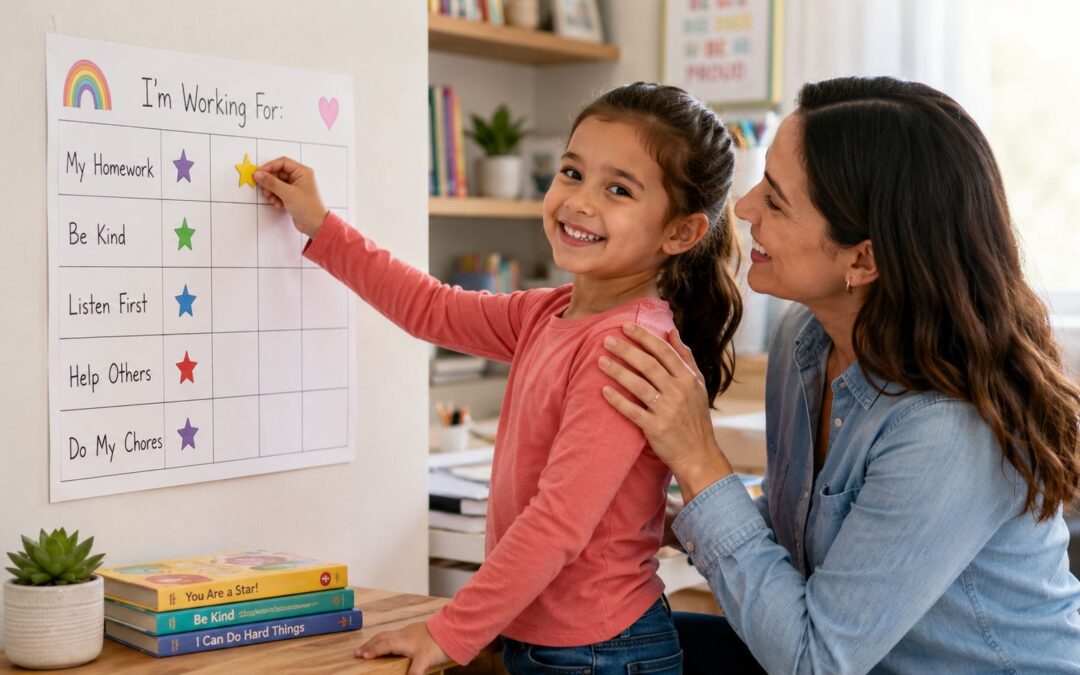
Create visual proof of success
Children forget their competence when they're upset, embarrassed, or comparing themselves to others. That's why visual reminders help.
A few options work well at home and in school:
- Confidence CV: A page titled “Things I've learned to do.” Include school, social, and life skills.
- Success jar: Write small wins on slips of paper. “Asked for help.” “Tried again.” “Read out loud.”
- Highlight reel folder: Save drawings, kind notes, photos of projects, and reflection sheets.
- Achievement collage or journal: This is one area where Soul Shoppe's confidence-building activities can be useful, especially reflective tools like goals journaling or an achievements collage.
A child who says, “I never do anything right,” often needs evidence, not argument.
Here's a helpful video for parents and teachers thinking about competence-building in everyday situations.