

Break Cards for Students: Calm Classrooms & Self-Regulation
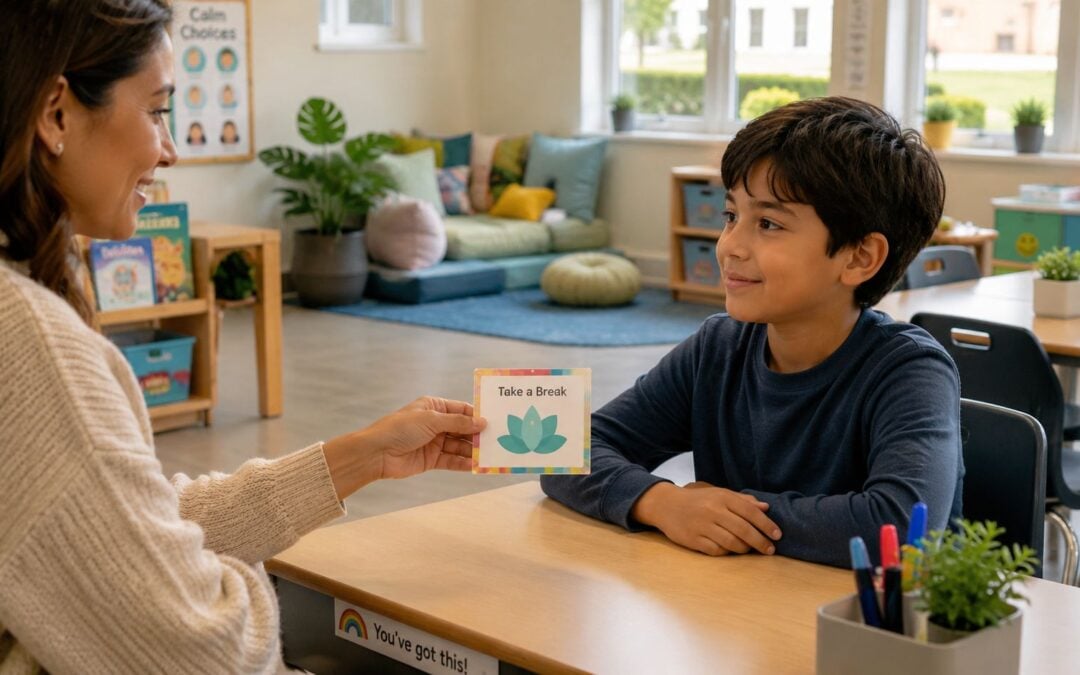
A student is tapping their pencil faster and faster. The room is louder than usual. The assignment has several steps, and you can see the moment when effort starts to turn into overwhelm. Sometimes that student shuts down. Sometimes they argue. Sometimes they crumple the paper or leave their seat.
Most teachers know that moment.
What helps is rarely a lecture about making good choices. Students need a way to communicate before stress spills over. Break cards for students can offer that path. Used well, they give a child a simple, concrete way to say, “I need a pause,” without needing the perfect words at the perfect time.
That shift matters. A break card is not just about stopping behavior. It's about helping a student notice what's happening in their body, ask for support, and return with more control. That is self-regulation in action. It also makes the classroom safer and steadier for everyone else.
An Introduction to Proactive Classroom Support
Many classroom supports begin too late. A teacher responds after the chair tips back, after the refusal, after the tears, after another student gets pulled into the moment. By then, everyone is trying to recover.
A break card works earlier. It gives the student a visible, predictable signal they can use before they hit their limit. Instead of waiting for escalation, you teach a routine for regulation.
That proactive stance changes the tone of the room. The student learns, “My teacher wants me to notice my stress and use a tool.” The class learns, “Taking care of yourself is part of learning here.”
What this looks like in real life
A second grader is doing writing workshop and starts erasing every sentence. A middle schooler freezes during partner work because the room feels socially intense. A student coming back from lunch is already overloaded by noise and transition.
In each case, the break card can serve the same basic purpose. It helps the student communicate a need quickly and safely.
Breaks work best when they are treated as support, not as a reward and not as a punishment.
That distinction is important. If the card feels punitive, students avoid it. If it feels random, adults stop trusting it. If it becomes part of a calm routine, students start to build confidence using it.
Why teachers often hesitate
Most hesitation comes from two honest concerns:
- Will students overuse it and try to escape work?
- Will some students be unable to use it independently because of language, developmental level, or stress?
Those concerns are valid. They don't mean the tool is flawed. They mean the routine has to be designed carefully. A break card system needs boundaries, modeling, and follow-through. It also needs flexibility for students who don't all communicate in the same way.
What Are Break Cards and Why Do They Work
A break card is best understood as a visual request system. The Watson Institute describes a break card as a cue that tells a student to take a break from an activity in order to prevent behavior issues, and explains that it should be taught by honoring requests during training, then gradually reducing cards as behavior improves and using the system across settings like school routines Watson Institute guidance on break cards.
That definition clears up a common misunderstanding. A break card is not just a reminder sitting on a desk. It is a communication tool. For a student who can't easily say, “I'm overwhelmed,” handing over a card may be far easier than speaking.

The real reason they help
When students use a break card successfully, several things happen at once.
- The student notices internal signals. They begin to connect body cues like tight shoulders, fast breathing, or irritability with the need for support.
- The student makes a safer choice. Instead of yelling, bolting, or refusing, they use an agreed-upon signal.
- The adult responds predictably. That predictability lowers anxiety because the student doesn't have to guess whether they'll be heard.
- The class stays more settled. One student gets support without a power struggle swallowing the lesson.
This is why break cards align so well with SEL practice. They build self-awareness, self-management, and responsible decision-making in a form young people can use in the moment.
A simple classroom example
A student in fourth grade starts to get frustrated during multi-step math. Rather than ripping up the worksheet, they place a card on the corner of the teacher's desk. The teacher nods, points to the calm area, and the student takes a short reset with a visual timer. Then they return and complete the first problem with support.
That is a small interaction, but it teaches a lasting lesson. Stress can be noticed. Help can be requested. Regulation can happen without shame.
If you're supporting students who also struggle with sustained attention, it can help to pair break routines with broader attention supports like this guide on how to improve focus with ADHD. Attention and regulation often overlap in the classroom.
Why the system needs to feel concrete
Students don't use abstract advice under stress. “Make a good choice” is too vague. “Show me your break card, go to the beanbag, set the timer, come back when it rings” is usable.
A break card system becomes even stronger when it fits into a larger school language around regulation. Soul Shoppe shares practical ideas for building that kind of common language in its post on self-regulation strategies for students.
Here's the core takeaway. Break cards for students work because they turn an emotional moment into a teachable communication routine.
Designing and Differentiating Your Break Cards
The best break card is the one a student can use. That sounds obvious, but many systems fail because adults design for neatness instead of access. A card with tiny print won't help a kindergartener. A cartoon icon may feel childish to a seventh grader. A word-only card may not work for a student with limited language.
Available guidance points to the need for adaptation across learners. NoodleNook emphasizes clear icons, adult modeling, and consistent practice before stress occurs, especially for students with limited language, inconsistent attendance, or different home-school languages, while framing the goal as a shared schoolwide language for requesting a break NoodleNook guidance on break cards.

Match the design to the student
A good starting question is not “What should break cards look like?” It's “How does this student communicate best?”
Here's a practical comparison:
| Student need | Card design that may help | Example |
|---|---|---|
| Early learner or non-reader | Simple icon with one short phrase | A picture of a resting child with “Break” |
| Student with stronger reading skills | Text-based card | “I need a break” |
| Student who feels self-conscious | Small, neutral card | Plain-color pass card kept in binder |
| Multilingual classroom | Icon plus home-school language support | “Break” with visual symbol and translated label |
| Student who struggles to initiate | Adult-prompt version nearby | Teacher points to card and offers choice |
Wording matters more than people think
Try different phrases and listen to how the student responds. One child may feel comfortable with “I need a break.” Another may prefer “I need space” or “I need calm time.” Older students often respond better when the language feels respectful rather than babyish.
A few examples:
- For primary grades: “Break please”
- For upper elementary: “I need a quiet minute”
- For middle school: “I need to reset”
- For a student with anxiety around attention: a symbol card with no words at all
The card should reduce friction, not add it.
Format choices that change usability
Some students do best with a laminated card on a ring. Others lose loose materials constantly, so a velcro card on a desk strip works better. Some students need a digital icon on a tablet or a signal card tucked inside a notebook.
Consider these options:
- Desk card: Good for quick access during independent work.
- Lanyard card: Useful during transitions, lunch, specials, or recess.
- Check-in board: Helpful in classrooms where several regulation tools are taught together.
- Duplicate sets: Smart for students moving between home, school, and aftercare.
Practical rule: If a student can't find the card when they need it, the system isn't ready yet.
Examples for inclusive classrooms
A first grader who speaks more comfortably in a language other than English may use an icon card with one familiar word from home and one from school. A student with inconsistent attendance may need the same brief practice every Monday morning so the routine stays fresh. A child who doesn't self-advocate reliably may start with adult-initiated prompts before moving toward independent use.
The break card should also connect to the break itself. If the card says “break,” but every adult defines that differently, the student gets mixed messages. Consistency matters more than decoration.
For students who need calming options once they step away, a simple menu of regulation choices can help. Ideas from how to self-soothe can pair well with a break card routine, especially when students need a concrete action after they request the break.
Creating a Successful Break Card Routine in Your Classroom
A card alone won't change much. The routine does the heavy lifting. Students need to know what happens before, during, and after the break. Adults need to respond the same way often enough that the system feels trustworthy.
Here is the classroom flow I like to teach first.

Start with a calm practice conversation
Pick a neutral time. Not during the meltdown. Not in the middle of a conflict.
You might say:
“Sometimes school feels hard or noisy or frustrating. In our class, you can ask for a break before things get too big. This card is one way to ask. When you show me the card, I'll help you take your break.”
Then show the exact steps. Don't assume students understand what “take a break” means.
A sample routine that teachers can adapt
- Student shows the card. They hand it over, place it on a spot, or hold it up.
- Teacher responds briefly. A nod, a quiet “yes,” or a point toward the break area.
- Student goes to the designated space. This might be a calm corner, hallway check-in with supervision, or another pre-set area.
- A timer is used. The break has a clear beginning and ending.
- Student returns through a simple routine. They come back, rejoin the task, or begin with one supported step.
That predictability lowers stress. The student doesn't need to negotiate while dysregulated.
The video below shows the kind of calm, explicit teaching that helps new routines stick.