Soul Shoppe's work is made possible by donors and partners who care deeply about the young people in their communities! We can't do this work without you. Support our work in classrooms and on playgrounds across the nation by donating here.
Monday morning tells the truth fast. A child who drifts past the front office with shoulders tight, a teacher who greets one class warmly and another with visible fatigue, a principal who spends the first five minutes calming one hallway while another moves with easy rhythm, all of it reveals school culture and climate before a single spreadsheet opens.
That's why this topic matters to tired teachers and worried parents alike. You can feel it in the handoff at the door, the way adults correct behavior, whether students sit alone or join a group, and whether the building sounds safe or strained. By the end of the day, those small moments add up into patterns that shape learning, attendance, and trust.
A Monday Morning That Shows You Everything
At 8:05 a.m. in a K-8 hallway, the scene is already speaking. One aide stands at the door and greets students by name. A seventh grader slows down, looks up, and walks over to a cluster of classmates. Another student keeps his backpack zipped tight and heads straight to an empty table, scanning the room before he sits.
You don't need a consultant's report to read that hallway. You can see adult welcome, peer connection, and student caution all at once. The school may have the same schedule, the same curriculum, and the same building as last year, but the lived experience can still feel completely different from one wing to another.
What the hallway is really showing
The first clue is the adult tone. If the handoff from parent to staff feels rushed, suspicious, or inconsistent, students notice. If a teacher's voice changes between classes, or if one grade level gets patient correction while another gets sharp reminders, students learn very quickly which spaces feel steady and which ones don't.
The second clue is student choice. A child who heads to a friend group, a trusted adult, or a calm corner is reading the room. That decision tells you something about belonging, not just behavior.
Practical rule: if a hallway looks orderly but students are avoiding eye contact, that's not the same thing as a healthy climate.
The rest of this guide keeps that Monday-morning lens. It separates the words people often blend together, shows the four climate spheres schools can observe, and walks through what administrators, teachers, and families can do with the data they already have. It also gives a short starter plan, so this doesn't stay a theory exercise until spring.
What School Culture and Climate Actually Mean
The cleanest way to separate the two is simple. Culture is the school's shared beliefs, values, norms, and traditions. Climate is the day-to-day tone people experience. One is the school's deep operating system, the other is what students, staff, and families feel when they walk the halls, sit in class, or call the office.
That distinction matters because culture shapes climate through values, unspoken norms, and expectations. If a school says it values respect but adults interrupt students constantly, the climate reveals the true story. If a school says it values high standards, but only some classrooms hold those standards consistently, students learn that the norm depends on who is in the room.
A classroom example that makes the difference stick
Think about one classroom where the culture says, “We greet each other, we resolve conflict respectfully, and we keep standards high.” That culture shows up in routines, language, and expectations. The climate shows up in whether students feel safe enough to ask for help, whether they speak up without fear of ridicule, and whether the teacher's corrections sound fair or personal.
If you want a quick self-check during an observation, ask three questions. Do the adults sound like they share the same norms? Do students act like they trust the room? Do the routines feel consistent enough that a newcomer could predict what happens next?
A lot of improvement work stalls because people use the two terms interchangeably. That creates vague goals like “make the culture better,” which sound right but don't guide action. A clearer move is to define the culture you want, then inspect the climate you're creating.
For a practical side note on protecting adult capacity while changing habits, tips for finding balance in Florida offers a useful lens on burnout and balance. That lens matters in schools too, because stressed adults rarely build steady climates.
And if you want a classroom-level companion piece, the internal guide on what is classroom climate fits neatly beside this distinction.
The Four Spheres Every School Climate Has
School climate becomes easier to work with once you stop treating it like one soft feeling. The OECD framework breaks it into four spheres, and each one shows up in behaviors families and staff can see: safety, teaching and learning, school community, and institutional environment. That's useful because a school can be strong in one sphere and weak in another.
What to look for in each sphere
Safety covers bullying, disciplinary problems, substance abuse, and truancy. In real life, that means watching whether hallways feel supervised without feeling oppressive, whether students report problems without fear, and whether office referrals cluster in certain places or times.
Teaching and learning includes academic support, feedback, socio-emotional skills, and leadership. Parents often sense this sphere during conferences. Are adults explaining how their child learns, or just listing grades? Are students getting helpful feedback, or only corrections?
School community is where relationships live. It includes student-teacher relationships, teamwork, respect for diversity, parental involvement, and community partnerships. A strong community sphere sounds like adults knowing students by name and families being treated like partners instead of visitors.
Institutional environment is the physical and organizational side. Buildings, facilities, technology, class size, school size, and ability grouping all shape how school feels. A cracked hallway, outdated devices, or a room packed too tightly can send a message long before any lesson starts.
“How do teachers adjust support when a child struggles?”
School community
Relationships, teamwork, respect for diversity
“How do students and families help shape the school?”
Institutional environment
Facilities, technology, class size, grouping patterns
“What resources make daily learning easier or harder?”
If you're in a family-school meeting, use those four spheres as separate questions. Don't settle for one vague impression. Ask about behavior, instruction, belonging, and resources one by one, because that's where the answers live.
The same lens helps if you're reviewing a more general school improvement resource, such as the broader climate guidance in the earlier section. One sphere can't stand in for the others.
How to Measure What You Cannot See
The best climate systems don't rely on a single score. ERIC guidance recommends a multimethod, multistakeholder approach, which means combining surveys with observations, interviews, and focus groups, then breaking results out by subpopulation and stakeholder type. That's the only way to catch the small pockets where students are struggling while the schoolwide average still looks fine.
A single composite score can hide trouble in a grade level, an identity group, or one wing of the building. When results are sliced by race, gender, grade, ability, and sexual orientation, patterns become much more actionable. The same idea holds for stakeholder groups. Students, staff, and families often describe the same school in very different language.
What to put on a dashboard
The most useful climate dashboards connect perception data to administrative indicators. That includes chronic absenteeism, suspensions and expulsions, behavior referrals, teacher absenteeism, and turnover. Those measures help leaders see whether the adult environment is stable enough to support student belonging and safety.
Core Climate Indicator to Track Each Year
Data Source
Question It Answers
Student safety and belonging
Surveys, interviews, focus groups
Do students feel safe and included?
Chronic absenteeism
Attendance records
Are students missing school in patterns that signal disengagement?
Suspensions and expulsions
Discipline records
Are exclusionary responses concentrated in certain groups?
Behavior referrals
Office logs
Where are the recurring pressure points in the day?
Teacher absenteeism and turnover
HR records
Is the adult environment steady enough to support students?
AASA-style dashboard review also helps when it's done regularly, not just at the end of the year. Annual measurement is the minimum benchmark, and early-versus-late-year comparisons can show whether interventions are shifting perceptions over time.
A good rule: if you can't separate the data by group, you're probably missing the story the data is trying to tell.
For a deeper look at linking results to outcomes, the internal piece on outcome measurement pairs well with this mindset. The point is not to collect more numbers. The point is to use the right numbers, in the right slices, at the right time.
Why More Programs Often Make Things Worse
Schools under pressure often reach for one more program. Another SEL curriculum. Another belonging campaign. Another binder full of lessons. That impulse makes sense, but it can backfire if the adults already feel overloaded.
Climate is shaped by day-to-day relationships, discipline, and support systems. If staffing is unstable, the community and safety spheres don't improve just because a new program arrives. The school still needs adults who can greet students, follow through on expectations, and communicate with families in a steady way.
The staffing question schools avoid
A school can buy a good idea and still miss the mechanism. If teachers don't have time to reinforce routines, if counselors are stretched thin, or if office responses vary from person to person, students experience the inconsistency. That's why climate improvement has to be a schoolwide plan, not just a classroom add-on.
Before adding anything new, leaders should audit time, staffing, and community partnerships. Ask who is already carrying the relational work, who has capacity to coach it, and what daily tasks are crowding it out. Only then does it make sense to decide whether a new curriculum helps or just adds noise.
That's also where an option like how to build psychological safety belongs in the conversation. Tools matter, but only when the adult system has room to use them well.
If you want a plain-language example, think about a school that adds a new conflict-resolution lesson but doesn't change the way lunch duty is staffed. Students may hear the lesson in class, then watch adults respond inconsistently in the cafeteria. The message gets split in two.
What Climate Looks Like for Students on the Margins
The difference between a welcoming school and an equitable school shows up fastest for students who have been pushed aside before. In a cooperative climate, adults use shared norms, peer repair, and regular check-ins to help students build trust. For underprivileged-background students, that kind of setting can support multiple social-emotional domains.
In a competitive climate, the story changes. When the school rewards individual performance over collaboration, some students stop speaking up. Others learn to keep their heads down, avoid risk, and protect themselves socially. The room may still look “positive” to an outsider, but the students who need belonging most may feel the least secure.
Why the same school can feel different to different students
Affirming cultural identities is not a decorative extra. Respect for diversity, community partnerships, and culturally responsive adult behavior all shape whether students feel like full members of the school. If those pieces are missing, the school can feel warm in general while still excluding specific groups in practice.
That matters for families too. A parent can hear that the school is “inclusive” and still notice that their child gets corrected more often than peers, or never sees their culture reflected in classroom materials. Those details are not minor. They are the climate.
If you're supporting families who are navigating unstable housing, the resource on homeless students in Maricopa County schools can sharpen the lens. Housing instability often changes how safety, belonging, and participation show up at school, so climate work has to be responsive, not generic.
Parent check: if your child says the school is “fine” but never mentions a trusted adult, a friend group, or a place where they feel seen, keep asking gentle questions.
The practical move is to look for whether the school's climate design helps the students most likely to be overlooked. If it does, the school will usually feel calmer for everyone. If it doesn't, the problems hide under polite language.
A Role-Based Playbook for Real Change
The fastest way to move from insight to action is to assign the work by role. When everyone owns everything, nothing gets done. When each group has a short list, climate work becomes visible and manageable.
Three moves for each group
Administrators can run a 30-day climate audit across the four spheres, build a subgroup dashboard, and review it briefly each morning. A five-minute look at attendance, behavior, and staff signals turns climate into a live management metric instead of a once-a-semester report.
Teachers can use greeting routines, shared language for self-regulation, and clear conflict-repair steps. The goal is not perfection. The goal is consistency that students can predict.
Parents and caregivers can align home language with school expectations, join climate conversations, and ask direct questions about bullying prevention. A weekly check-in at home helps a child notice patterns before they become blowups.
Soul Shoppe has delivered research-based, experiential programs for more than 20 years that teach students practical tools and shared language for self-regulation, mindfulness, communication, and conflict resolution, with offerings available digitally and on-site for individual students and entire campuses. That kind of support fits when a school wants common language across classrooms, hallways, and home.
For leaders thinking about the emotional side of implementation, the internal guide on welcoming new students is a helpful companion because transitions reveal climate fast.
If you're coordinating SEL or partnering with community agencies, the question is not which program sounds nicest. The question is which tool supports the sphere that's fraying.
Your First Thirty Days
A month is enough time to start, if the work stays focused. Week one is for listening. Use a short survey, then do three interviews per grade and review attendance and discipline patterns as a baseline. Week two is for mapping, using the four spheres to spot where climate is steady and where it's fraying, especially by subgroup.
Week three is for one small pilot. Choose one sphere and one role-aligned routine, then run it consistently. A teacher might pilot a morning greeting routine. A principal might start a daily dashboard review. A counselor might test a shared conflict-repair script.
Week four is for review. Compare early-year and late-year data, talk about what changed, and decide whether to expand, adjust, or pivot. If the data and the hallway stories don't match, trust the mismatch enough to ask more questions.
Keep the pace realistic
Use the plan that fits the adults you have, not the one you wish you had. A school with unstable staffing may need a simpler pilot and clearer routines. A school with strong teams may be ready for a broader subgroup dashboard and family partnership plan.
If you want a practical model for how a community can assess itself, the resource on boost member success offers a useful framing for looking at participation and support. The same logic applies here, because climate improves when people can see where they belong and what they're expected to do.
The simplest challenge is also the hardest one. Start one honest conversation this week with a student, a teacher, or a parent, then listen for what the room is telling you back. School culture and climate change one interaction at a time.
If your school wants a practical way to strengthen belonging, safety, and everyday connection, Soul Shoppe offers research-based SEL programs that fit classrooms, campuses, and family partnerships. Visit Soul Shoppe to explore tools and experiences that can help your community build a steadier climate, one routine and one relationship at a time.
A student gets in the car after school and says, “It was fine.” Then dinner is quiet. Homework takes twice as long. The next morning, that same child suddenly has a stomachache and does not want to go to school.
This is often how verbal bullying shows up. Adults may not hear the comment in the hallway or see the group chat message. What you do see is the aftershock. A child goes silent, avoids classmates, stops volunteering in class, or starts believing cruel words are true.
Verbal bullying can sound small to bystanders because there is no visible injury. But words shape a child's sense of safety. They can shrink a student's voice, damage friendships, and make school feel like a place to survive instead of a place to learn.
That is why adults need more than a list of mean phrases. You need a way to recognize patterns, respond without escalating, and teach children what to do instead. A good response works like first aid. It stops the harm in the moment, then helps repair what happened underneath.
This guide is built for that job. It breaks verbal bullying into clear types, shows what each one sounds like, and explains why children use it. It also gives parents and teachers practical response scripts, classroom and home interventions, and social-emotional skills to teach for prevention and repair. For example, children can learn to speak up without attacking by practicing I-statements for kids.
You will see concrete examples throughout. The goal is simple. Help adults respond with clarity, help students build empathy and boundaries, and help school communities create a culture where respect is taught, practiced, and expected.
1. Name-Calling and Insulting Language
Name-calling is one of the clearest examples of verbal bullying because it turns a child into a label. Instead of addressing a behavior or a conflict, the speaker attacks the person. Words like “stupid,” “ugly,” “loser,” or repeated cruel nicknames can stick with a student long after the moment ends.
In one junior high school study, 23 students experienced verbal bullying, and name-calling was the most dominant form at 60.9%, followed by mocking at 34.8% and direct insults at 4.3% in the junior high verbal bullying case study. That same study connected these behaviors with loss of concentration, sleep problems, and reduced interest in learning.
What it sounds like
A student misses a question and another says, “You're so dumb.”
A child walks into class and hears, “Here comes the weird kid.”
A group starts using a nickname for one student, and everyone knows the point is humiliation, not affection.
Practical rule: If the nickname embarrasses the child, and the child didn't freely choose it, treat it as bullying.
Adults sometimes ask whether kids should “toughen up.” That usually misses the issue. The problem isn't only the word. It's the repeated message that a child is less worthy, less capable, or less welcome.
What to say in the moment
Use short, steady language:
Stop the behavior: “We don't call people names here.”
Name the impact: “That comment was hurtful and disrespectful.”
Redirect the student: “Try again and speak about the problem, not the person.”
Support the target: “I heard what was said. I'm checking in with you.”
Later, teach students better replacement language. If a child is frustrated, they can say, “I didn't like that,” or “I need space,” instead of attacking the other person. Helpful sentence stems from I-statements for kids can give children concrete language when emotions are high.
A final step matters too. Follow up privately with both students. The child who was targeted needs reassurance and safety. The child who used the insult needs accountability, coaching, and a chance to repair harm.
2. Spreading Rumors and Social Exclusion Through Gossip
A student walks into lunch and something has shifted. Friends stop talking. Seats that were open yesterday are suddenly “saved.” No one says the rumor out loud, but the child can feel it in the room.
That is part of what makes gossip so harmful. It travels through whispers, side comments, screenshots, and “just telling you what I heard.” The target often faces the consequences before they even know the accusation.
This form of verbal bullying can sound quiet, but its social force is strong. A student might repeat private information that was shared in confidence, tell others that someone's family is “strange,” or say, “Don't invite her. She's annoying and desperate.” Sometimes the words are false. Sometimes they mix one true detail with exaggeration. Either way, the goal is often the same: lower one child's social standing and pull the group away from them.
Why gossip hurts so much
Rumors attack belonging. For many children, belonging feels as basic as safety. Once gossip starts, a student may begin scanning every interaction. Who believes it? Who started it? Who is pretending nothing happened?
Adults also need to look past the student who first said the words. Gossip works like a chain. One child starts it, another repeats it, a third adds a detail, and a fourth excludes the target based on the story. By the time it reaches the larger group, the rumor can feel “true” because so many people have heard it.
That is why bystanders matter here more than adults sometimes realize.
What adults can say and teach
Children need a simple rule they can remember before they speak. A practical classroom or family filter is:
Is it true?
Is it kind?
Is it necessary?
This gives students a pause point. It also helps adults stay consistent. If the answer is no to any of the three, the conversation needs to stop.
If a student is sharing information to embarrass, isolate, or turn peers against someone, that is bullying.
Use direct scripts in the moment:
To the student spreading it: “Stop. We do not pass stories about people when they are not here to speak for themselves.”
To the group: “You do not need to listen to this or repeat it.”
To a bystander who wants help: “You can say, ‘I'm not talking about them,’ or ‘Let's ask them directly instead of guessing.’”
To the targeted student: “I heard what is happening. You do not have to handle this alone. Let's make a plan.”
Then teach the skill underneath the behavior. Many students gossip because they want attention, status, or connection. They need better ways to get those needs met. Class meetings, role-play, and explicit practice with perspective-taking can help. This guide on teaching empathy to children in everyday situations fits well here because students are more likely to interrupt gossip when they can picture its impact on the person being discussed.
At school, address the social system, not only the speaker. Check in with the target. Identify who repeated the story. Interrupt exclusion quickly. If the situation is calm enough and the targeted student wants it, a restorative conversation can help students name harm, correct false information, and repair trust.
At home, parents can coach children to save messages, write down what happened, and tell an adult early. Gossip grows when everyone treats it like a private drama. It loses power when adults respond clearly, protect the targeted child, and teach the whole group how to handle social conflict without turning a person into a story.
3. Public Humiliation and Mocking
A student stands at the front of the room to read aloud. They stumble over a word. Another child copies their voice, someone claps sarcastically, and a few classmates laugh. In less than ten seconds, a learning moment turns into a social threat.
That is what makes public humiliation different from a private insult. It uses an audience. The goal is not only to hurt the target, but also to win attention, status, or control through the reaction of the group. For many children, the laughter is the part they remember most.
This kind of verbal bullying can sound like exaggerated mimicry, fake applause, stage whispers, repeated quoting, or comments such as, “Wow, great job,” said in a cutting tone. It often gets dismissed as joking. A simple test helps. Shared humor feels safe to everyone involved. Mocking leaves one child exposed.
Here's a short video that can help adults open a classroom conversation about empathy and peer behavior.
What public mockery does to a child
Public embarrassment teaches fast. A student who is mocked during a presentation may stop raising a hand, avoid reading out loud, or try to disappear into the group. Adults sometimes miss that shift because the child is no longer causing any visible problem. They are protecting themselves.
The audience matters too. When classmates laugh and no adult interrupts, children can absorb the wrong lesson. They may decide that humiliation is a good way to get attention, or that staying silent is safer than helping. That is why adults need to respond to both the speaker and the crowd.
What to do right away
Start by resetting the room. Then address the student who caused harm.
To the class: “Stop. We do not laugh at someone when they are vulnerable.”
To the student who mocked: “That comment was meant to embarrass. It stops now.”
To the targeted student, privately: “I saw what happened. You did not deserve that. What do you need right now?”
If the group is unsettled: “We are going to reset and try again respectfully.”
That immediate response does two jobs at once. It protects the targeted student, and it teaches every bystander what this classroom stands for.
Later, circle back with a repair plan. Public humiliation often needs a public correction and a private follow-up. Depending on the situation, that might mean a brief acknowledgment in front of the group, a restorative conversation, or a coached apology that names the behavior clearly. Soul Shoppe's guidance on how to stop bullying at school and at home can help adults choose a response that stops the pattern instead of only reacting to one moment.
Prevention works best when adults teach the skill underneath the behavior. Many students mock others because they want laughs, belonging, or social power and do not yet know safer ways to get those needs met. Practice helps. Teach students how to get attention appropriately, how to repair harm, and how to respond when a peer becomes the punchline. Role-play, class agreements, and direct coaching from resources about how to teach empathy give students language they can use.
Parents can reinforce the same lesson at home. If a child says, “I was only kidding,” ask, “How did the other person seem to feel?” That question shifts the focus from intent to impact. Over time, children learn an important social rule. Humor builds connection when everyone feels included. It becomes bullying when one child has to carry the shame for everyone else's laugh.
4. Threats, Intimidation, and Coercive Language
Some verbal bullying is meant to control, not just insult. A student says, “If you tell, you'll regret it,” or “Do my homework or I'll tell everyone your secret.” That's intimidation. It creates fear and teaches the target that speaking up might make things worse.
These are some of the most serious examples of verbal bullying because they often silence reporting. The child may look calm on the outside while feeling trapped inside. Threats can involve safety, reputation, friendships, belongings, or embarrassing information.
Common examples
Social threats: “If you tell the teacher, nobody will sit with you.”
Reputation threats: “I'll spread rumors about you if you don't do what I say.”
Physical threats: “My friends will take care of you after school.”
Digital threats: “I'll post the screenshot unless you do what I want.”
A workplace case study from WorkSafe Victoria described a 16-year-old apprentice whose supervisor used homophobic language, encouraged group name-calling, and manipulated the victim's phone. The victim filed a formal complaint after a 24-month pattern, as described in this WorkSafe bullying case study. Even though that case involved an older teen in a workplace, the pattern is familiar to schools. Verbal bullying often grows when adults underestimate early warning signs.
Take every threat seriously, even when the student later says, “I didn't mean it.”
How schools and families should respond
Start with safety, not debate. Don't ask the targeted child to confront the aggressor alone. Don't force a same-day face-to-face conversation while fear is still high.
Use a response sequence:
Document exact words: Write down what was said as closely as possible.
Separate students if needed: The target's sense of safety comes first.
Report through school channels: Involve administration and counseling support.
Protect confidentiality: Don't reveal who reported unless required by policy.
Follow up: Check on the student again after the first report.
If you need schoolwide tools and staff language for intervention, how to stop bullying offers practical starting points. The core message to children should be simple. Threats are not conflict. Threats are coercion, and adults must step in.
5. Demeaning Comments About Family, Socioeconomic Status, or Background
Some of the most painful verbal bullying targets a child's home life. A student gets mocked for wearing the same sweatshirt twice, bringing a different kind of lunch, having divorced parents, speaking another language at home, or practicing a religion classmates don't understand. These comments hit hard because children cannot easily change these parts of their lives.
One common example is a comment about clothing or money, such as “Are you poor?” Another is using family circumstances as an insult, like “No wonder you're messed up.” These aren't random remarks. They send the message that a child's family or background makes them lesser.
Why identity-based comments need a stronger response
Bias-based verbal bullying targets identity, including race, language, or gender. The American Psychological Association identifies it as a distinct category, and 2024 to 2025 data cited in the APA primer says bias-based verbal incidents have risen 27% in U.S. K-8 schools in the APA bullying primer. That means schools can't treat every hurtful comment as the same kind of peer conflict.
When a student insults a child's accent, immigration story, religion, or family income, adults need to address both the cruelty and the bias underneath it. A generic “be nice” response isn't enough.
What to say and teach
Try language like this:
Interrupt clearly: “We do not insult people's families, culture, language, or identity.”
Name the stereotype: “That comment made an unfair assumption about what poverty means.”
Affirm the target: “There is nothing wrong with your family, your culture, or your background.”
Teach the group: “Differences are part of our community. They are not material for jokes.”
At home and at school, include books, examples, and celebrations that reflect different family structures and communities. Children need regular exposure to belonging, not only correction after harm.
A student who uses this kind of language also needs guided reflection. Ask, “What did you assume? Where did that message come from? Who was hurt by it?” Those questions move the conversation from denial to accountability.
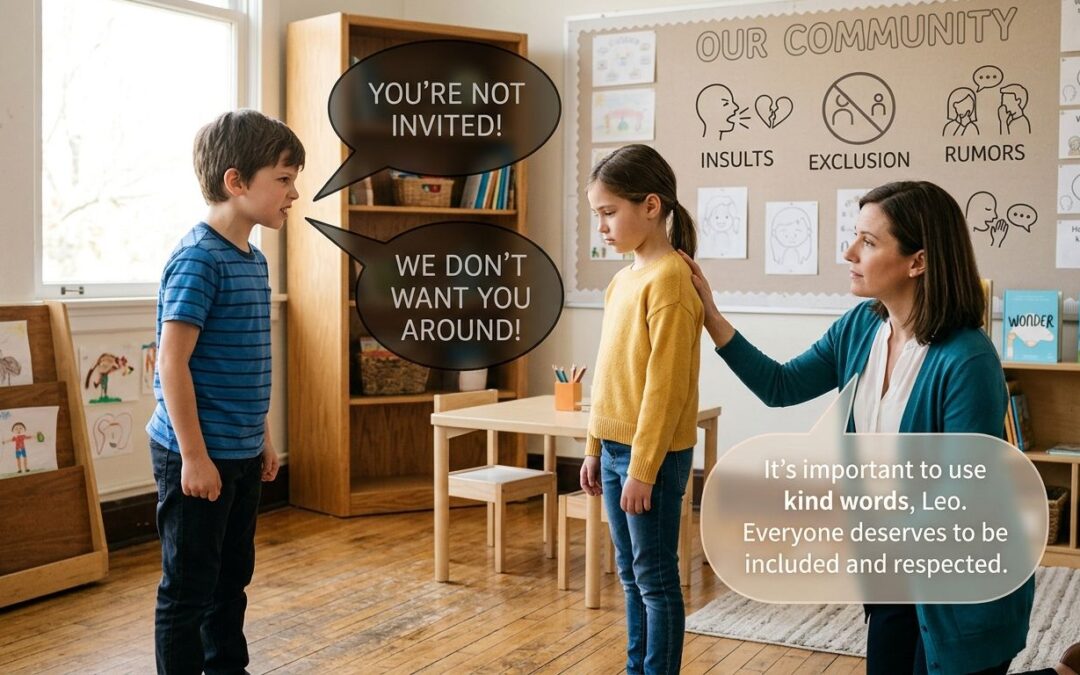
6. Exclusionary Language and Deliberate Isolation Comments
A student walks into lunch, tray in hand, and hears, “You can't sit here.” Then someone adds, “Nobody wants you anyway.” The table may stay quiet after that, but the message is loud. You do not belong.
Exclusionary bullying often sounds plain. “You can't play with us.” “Don't pick her.” “No one likes you.” Because the words are short and common, adults sometimes miss how much harm they carry. For many children, social belonging at school works like emotional oxygen. When peers keep cutting it off, shame and panic can show up fast.
This form of verbal bullying often appears in the least structured parts of the day: recess, lunch, group projects, clubs, bus lines, and birthday talk. A single social disappointment is part of childhood. A repeated pattern of shutting one child out, especially with comments meant to embarrass or isolate, is something different.
The difference between a boundary and a put-down
Children do get to choose friends. They do not get to use rejection as a weapon.
That distinction can be hard for adults to teach because both situations may involve the word no. The tone, purpose, and pattern matter. “I'm working with Leo today” sets a limit. “You're too annoying to work with anyone” attacks the child's social worth.
A useful rule for students is this: a boundary describes your choice, but bullying defines the other person as unwanted.
What adults can say in the moment
Start with a calm interruption. Keep it brief and concrete so students hear the limit, not a lecture.
Stop the exclusionary comment: “You may not tell someone they are unwanted.”
Separate choice from cruelty: “You can choose a partner. You cannot shame someone while you do it.”
Give replacement language: “Try, ‘We already have a group of four,’ or ‘I'm playing with Sam today.’”
Repair the belonging wound: “Everyone in this class has a place here.”
Then check on the student who was shut out. Do not assume they will ask for help. A quick private response matters: “I heard that. It was not okay. Let's make sure you're included right now.”
That step is easy to skip. It should not be skipped.
Classroom and home responses that actually help
Adults often focus on the seating chart or the game. The deeper issue is social power. Some students learn that they can raise their status by deciding who gets included. That is why simple redirection is not always enough.
Use a short repair process:
Name the impact. “Those words told him he didn't belong.”
Prompt reflection. “What were you trying to do in that moment?”
Practice a better script. “How can you say no without putting someone down?”
Require action. This might mean inviting the student into the activity, offering a respectful redo, or writing an apology with adult support.
Soul Shoppe's approach fits well here because it teaches belonging as a skill, not just a hope. Students need direct practice with inclusion, boundary-setting, noticing hurt, and repair. Those are SEL skills. They can be taught the same way adults teach lining up, turn-taking, or problem-solving.
Try teaching and practicing phrases such as:
“We already started this round. You can join the next one.”
“I want time with my close friend right now, but I can talk later.”
“Let's make room.”
“That sounded excluding. Try that again with respect.”
Prevention also needs structure. Rotate partners. Use cooperative learning roles. Assign mixed groups at times instead of letting the same social hierarchy decide every pairing. Hold class meetings where students practice how to join a group, how to say no kindly, and how to notice when someone is being left out.
Children should not have to decode whether adults see their social pain. Clear routines tell them, “Belonging is protected here.”
7. Negative Comments About Academic Performance and Ability
A student raises a hand, gets an answer wrong, and a classmate says, “Wow. Do you know anything?” The room may laugh for two seconds. The effect can last much longer.
Academic bullying attacks a child's identity as a learner. Comments like “You're stupid,” “You're so bad at math,” “Even the easy kids got it,” or “Don't ask her, she never gets it” send a clear message. Mistakes are unsafe, and ability decides worth. After enough of those messages, many students stop volunteering, stop asking for help, or stop trying in public.
This kind of verbal bullying is easy to miss because it can sound tied to schoolwork. Adults may hear it as teasing, competition, or blunt honesty. But there is a difference between feedback and humiliation. Feedback helps a student improve. Humiliation puts the student lower in the social order.
Watch for quiet forms of harm too. A child may shrug and say, “I'm just dumb,” before anyone else can say it first. That is often a shield. Students who expect ridicule often protect themselves by acting disengaged, clowning around, or refusing work they fear they cannot do perfectly.
What adults can say right away
Keep your response short, calm, and public enough to reset the norm.
Name the behavior: “That was a put-down about learning.”
Protect the target: “Everyone gets to make mistakes here.”
Reset the class value: “We respect effort, questions, and practice.”
Redirect the student who caused harm: “If you have something helpful to say, say it respectfully.”
Then follow up later with both students. The target needs reassurance and a path back into participation. The student who made the comment needs coaching, not only correction. Ask, “What were you trying to do with that comment?” Then teach the replacement skill. It may be giving peer feedback, managing frustration, or getting attention without putting someone down.
Classroom moves that lower academic shaming
Prevention works best when struggle is treated as a normal part of learning. A classroom runs like a practice space, not a stage. In a practice space, students expect retries, coaching, and visible growth.
Try supports such as turn-and-talk before whole-group answers, private wait time, anonymous question boxes, partner problem-solving, and sentence stems for respectful peer response. Model your own mistakes out loud. “I mixed that up. Let me fix it.” That simple routine teaches students that errors can be corrected without shame.
Parents can reinforce the same message at home. Praise persistence, specific strategies, and help-seeking. If a child's confidence is already shaky, these self-esteem building activities for kids can support repair alongside school-based interventions.
Children learn in the emotional climate around them. If that climate says, “Only smart kids speak,” many children go silent. If it says, “Learning includes not knowing yet,” students are more willing to risk, recover, and grow.
8. Targeting Students' Appearance, Body Size, and Physical Characteristics
A student walks into class wearing a new shirt. Another student says, loud enough for others to hear, “Why would you wear that?” A few kids laugh. No one uses profanity. No one makes a threat. Still, the message lands hard. Your body, your face, your clothes, or your size can be judged in public.
That is verbal bullying.
Comments about weight, skin, hair, height, teeth, disability-related differences, clothing, or other physical traits are often brushed off as teasing. Adults miss them because they sound ordinary. Children hear body talk so often that it can blend into the background. But repeated appearance-based comments work like small cuts. One may seem minor. A pattern changes how a child sees school, peers, and themselves.
The hidden message is simple and painful. You are safe only if you look the right way.
What makes this type of bullying different
Appearance-based bullying often hooks into shame fast. A child cannot leave their body at the classroom door. That is why these comments can linger long after the moment passes. The target may replay the words during lunch, at bedtime, or while getting dressed the next morning.
Adults should watch for behavior changes such as avoiding photos, refusing to participate in PE, asking to stay home on spirit days, changing eating habits, or becoming unusually focused on mirrors, makeup, hoodies, or baggy clothes. Some children start criticizing other students' looks. That does not mean they are unaffected. It can be a sign that they are absorbing the same harmful rules and passing them on.
A clear classroom norm helps here: We do not comment on other people's bodies or appearance.
How to respond in the moment
The first goal is to stop the harm without turning the incident into a performance.
Try language like this:
Interrupt clearly: “Stop. We do not make comments about someone's body, face, clothes, or appearance.”
Name the behavior: “That was a put-down about how someone looks.”
Close the joke loophole: “Humor does not make it respectful.”
Support the targeted student: “You did not deserve that. I'm checking in with you after class.”
Keep your tone calm and firm. Long lectures in front of peers often increase embarrassment for the student who was targeted. A short interruption works better in the moment. Then follow up privately with both students.
What to teach after the incident
Correction alone is not enough. The student who made the comment needs a replacement skill.
Ask questions that get underneath the behavior:
“What were you hoping would happen when you said that?”
“Were you trying to be funny, get attention, or fit in?”
“What could you say instead if you notice something different about someone?”
Then teach the missing skill. Some students need help with impulse control. Others need practice with empathy, boundaries, or how to join a group without targeting someone else. Soul Shoppe's approach works best when adults pair accountability with skill-building. Students need to repair harm and learn what respectful speech sounds like in real life.
For the targeted student, repair means more than comfort. It means restoring belonging. Check where the incident happened, who heard it, and whether the student now avoids that space or group. A child who was mocked in the locker room may need more support there than during math.
Prevention that works in classrooms and at home
Appearance-based bullying grows in places where body talk is common and unchecked. Adults can lower risk by setting rules before incidents happen. Avoid classroom activities that rank looks, joke about fashion, or invite public comments on bodies. Watch common hotspots such as PE, performances, dress-up days, group photos, and social media spillover from after school.
Teach students specific SEL skills: noticing impact, respecting differences, interrupting unkind humor, and giving compliments about effort, creativity, or character instead of bodies. Parents can reinforce the same message at home by avoiding negative body talk about themselves, their child, or other people. Children listen closely to what adults treat as normal.
If a child's confidence has taken a hit, structured self-esteem building activities for kids can support recovery while adults address the bullying directly. Confidence does not stop bullying on its own. It does give a child more footing while the adults around them work to stop the behavior, repair the harm, and reset the group norm.
Comparison of 8 Verbal Bullying Examples
Bullying Type
Implementation complexity
Resource requirements
Expected outcomes
Ideal use cases
Key advantages
Name-Calling and Insulting Language
Low, set rules and intervene quickly
Low, teacher time, classroom routines, parent contact
Quick reduction in incidents if enforced; improves classroom climate
Classroom management, SEL lessons on respectful speech
Easy to identify/document; clear teachable moments
Spreading Rumors and Social Exclusion Through Gossip
Aligns with academic goals; natural teachable moments to build resilience
Targeting Students' Appearance, Body Size, and Physical Characteristics
Medium, sensitive, influenced by media and culture
Medium, body-positive curriculum, counseling, media literacy
Improved self-esteem and body image over time; reduces health risks when addressed
Health/wellness classes, media literacy, body-image programs
Addresses health and media literacy; fosters self-compassion and safety
From Intervention to Prevention Building a Culture of Kindness
A student gets called a name during group work. The class laughs. The teacher stops it, gives a consequence, and the day keeps going. On paper, the problem was handled. In real life, the target may still feel unsafe, the student who caused harm may not know what to do differently next time, and the rest of the class just learned what gets attention.
That is why prevention has to do more than stop the moment. It has to teach the missing skill underneath the moment.
Across the examples in this article, the pattern is clear. Verbal bullying often grows where students have not yet learned how to handle embarrassment, social pressure, jealousy, difference, or conflict with respect. A rule can block a behavior for a minute. A skill gives a child another option.
Adults need both. Clear limits matter. So does direct instruction in self-regulation, perspective-taking, boundary-setting, repair language, and how to disagree without attacking someone's identity. A child who knows how to say, “I'm frustrated. I need space,” is less likely to reach for “You're so stupid.” A child who can ask, “Was that joke hurtful?” is better prepared to catch harm before it spreads.
The intervention process still matters. McMillen Health's verbal bullying guidance outlines practical steps adults can use in the moment: stop the behavior quickly, avoid humiliating the student in front of peers, apply consistent consequences, protect privacy, involve support staff when needed, contact caregivers, and model respectful language. That sequence works like first aid. It stabilizes the situation so real teaching can happen after emotions settle.
The larger goal is school safety and student well-being. As noted earlier, bullying is common enough that no school can treat verbal aggression as a small issue or a normal part of growing up. Students who are targeted can carry that stress into attendance, learning, mental health, and peer relationships. Early action gives children more protection, especially before patterns harden in upper grades.
Prevention works best when the whole community shares the same language. Students need to hear the same message in the classroom, on the playground, in the hallway, and at home. “We do not use words to rank people.” “If you cause harm, you repair it.” “If you see someone isolated, you include or get help.” Repetition matters because social behavior is learned the same way reading fluency is learned. Through modeling, practice, correction, and another chance to try again.
One often-missed area is sarcasm and so-called joking. Some students hide cruelty inside humor because it gives them cover. Some targets freeze because they know they were hurt but cannot explain why. The Girls Guide to End Bullying verbal bullying overview points out that many students struggle to tell the difference between joking and mean teasing. Adults can reduce that confusion by teaching a simple standard: intent matters, but impact matters too. If the comment lands as humiliation, exclusion, or fear, adults need to address it.
Soul Shoppe's approach fits this work well because it teaches relationship skills in ways students can use. The focus is not only on stopping hurtful words. It is on building belonging, shared language, and repair. Through workshops, assemblies, digital tools, and coaching, schools can teach students how to calm their bodies, name what happened, speak up clearly, listen without defending, and make things right. That gives teachers and parents a repeatable toolkit, not just a list of warnings.
For families, the job is similar. Notice changes early. Ask calm, specific questions. “Who were you with at lunch?” works better than “How was school?” Do not dismiss repeated teasing as normal if your child seems smaller, quieter, or more tense afterward. Children need adults who take verbal harm seriously and also show them what respectful, firm language sounds like.
If you're thinking about long-term protection, fostering confidence in children supports this work. Confidence does not prevent bullying by itself, but it can help children ask for help sooner, use clearer boundaries, and stay connected to supportive peers and adults.
A kinder culture is built in small, repeated moments. A teacher pauses a put-down and asks for a reset. A parent helps a child practice a repair script before the next school day. A class learns that belonging is something they protect together. That is how intervention turns into prevention. That is how words stop being weapons and start becoming tools for safety, dignity, and connection.
Soul Shoppe helps schools, families, and community partners turn bullying prevention into daily practice. Through Soul Shoppe, you can access social-emotional learning programs that teach students practical tools for empathy, communication, self-regulation, and conflict resolution so every child has a better chance to feel safe, connected, and ready to learn.
Monday morning starts with a teacher holding back tears after a rough class meeting, a principal trying to cover two absences, and a counselor hearing that another student “just shut down” during reading. In many K-8 schools, the pressure isn't only academic. It's emotional, relational, and constant. Teachers aren't asking for one more binder of strategies. They're asking for support they can use with real students in real classrooms.
That's where strong teacher coaching strategies matter. Good coaching doesn't sit on the sidelines. It helps a teacher respond when a child melts down during math, when a class can't handle partner talk, or when a staff team feels stretched thin and discouraged. It also helps adults build the kind of calm, connected classrooms that make learning possible.
The strongest coaching work is sustained, not one-and-done. A 2018 instructional coaching meta-analysis found effects on student achievement equivalent to roughly half a year to a full year of learning, and it described coaching as an ongoing partnership with support that evolves over time. That matters for SEL because emotional safety, trust, and relational skill-building also grow through repetition, reflection, and practice.
Schools are also investing more in this kind of support. The global teacher coaching platforms market reached USD 1.42 billion in 2024 and is projected to reach USD 3.99 billion by 2033, reflecting a projected CAGR of 12.1% as schools adopt more embedded professional learning tools. The opportunity isn't to chase trends. It's to build a coaching culture where teachers feel safe enough to grow and students feel safe enough to learn.
Here are 10 practical coaching approaches that can help K-8 schools move from surviving to thriving, with SEL woven through every one.
1. Cognitive Coaching
Cognitive coaching works best when a teacher doesn't need a speech. They need space to think. Instead of jumping in with fixes, the coach asks questions that help the teacher notice patterns, name concerns, and generate next steps that fit their students.
That matters in SEL work because teachers already make hundreds of emotional decisions each day. They decide whether to pause a lesson, whether to address a student's tone publicly, and whether to push through discomfort or slow down for connection. Cognitive coaching helps them examine those decisions without shame.
A strong example is a fourth-grade teacher who says, “My math block falls apart after the mini-lesson.” Instead of prescribing a brain break, the coach asks, “What did you notice about students' energy right before they drifted?” and “Which students stayed engaged longest?” The teacher realizes that participation drops when students don't get a turn to process with a partner. Together, they build in a quick feeling check and structured turn-and-talk before independent work.
Questions that open thinking
In SEL-focused coaching, the questions should stay grounded in what students did and felt. A coach might ask, “When the conflict started, what did you hope students would learn from your response?” or “Which part of the morning meeting helped students feel safest to contribute?”
Practical rule: Ask about evidence before interpretation. “What did you see and hear?” usually leads to better reflection than “Why do you think they were disrespectful?”
This works well in lesson planning too. A teacher preparing an empathy lesson may say, “I want students to understand different perspectives, but they freeze when I ask them to share.” The coach can guide reflection on scaffolds, such as sentence stems, partner rehearsal, or drawing before discussion.
A few habits make cognitive coaching stronger:
Start broad: Open with questions that invite reflection, not defense.
Use wait time: Teachers need thinking time just like students do.
Name the non-evaluative stance: Say clearly that coaching is for growth, not rating.
Capture growth over time: Keep short notes so teachers can see progress across cycles.
Instructional rounds help a school stop treating great teaching as private property. Instead of one coach carrying all the expertise, teams visit classrooms around a shared problem of practice and look for patterns together.
In an SEL-centered school, that shared focus might be “How do teachers create emotional safety during class discussions?” Observers might visit several classrooms and collect simple evidence: how teachers greet students, how they respond to mistakes, whether students get think time, and how conflict or discomfort is handled.
One elementary team might notice that in stronger classrooms, teachers normalize feelings without letting feelings take over the lesson. A teacher says, “You seem frustrated. Take a breath, and then tell us what's confusing,” and students stay engaged. In another room, the team may notice that students only volunteer when the teacher calls on the same few confident voices.
What to look for during rounds
Rounds become useful when the observation tool is tight and concrete. Keep the focus on visible practices, especially those that influence belonging and trust.
Track teacher language: Write down exact phrases that build or reduce safety.
Watch student access: Note who participates, who hesitates, and who gets invited in.
Notice routines: Pay attention to transitions, partner talk, and repair after mistakes.
Debrief by pattern: Discuss trends across rooms, not personalities.
A middle-grades team, for example, might observe several classrooms to study conflict resolution instruction. During the debrief, they may realize that students engage more when teachers ask them to generate repair options instead of handing them a script. That insight then shapes the next round of planning across the school.
The purpose of rounds isn't to find the best teacher in the building. It's to help the building learn what works.
Keep participation voluntary at first if trust is fragile. That often leads to better buy-in than launching rounds as a top-down initiative. Over time, teachers usually become more willing when they see that the process is descriptive, not evaluative.
3. Peer Coaching Partnerships
Some of the most useful teacher coaching strategies are also the most human. Peer coaching works because teachers often listen differently when the person beside them understands the daily rhythm of their grade level, curriculum, and students.
A strong partnership might pair two third-grade teachers who want to improve emotion-regulation routines. One teacher watches the other lead a morning reset after recess. She notes the exact script: “Feet on the floor, eyes soft, breathe in, breathe out, notice one feeling.” During the debrief, they discuss tone, pacing, and why the teacher didn't rush to quiet every fidgeting child.
Another useful pairing is a veteran teacher and a newer teacher working on restorative circles. The veteran models how to open the circle, how to invite quieter students in, and how to hold a boundary when one child turns the conversation into blame. The newer teacher then tries the routine while the partner collects notes on student responses.
What makes peer coaching feel safe
Peer coaching can turn sour if it becomes vague or personal. It gets better when the structure is simple and the focus is narrow.
Set one clear focus: For example, “student voice during partner talk” or “repair after conflict.”
Use a short note form: Track what students said, did, and how the teacher responded.
Keep debriefs reciprocal: Both teachers should reflect and learn, even if only one taught.
Protect confidentiality: What happens in the partnership stays there unless both agree to share.
A four-teacher group can work well too. One month, a teacher tries a cooperative structure for discussing a playground conflict scenario. The observers record who spoke first, who stayed silent, and which prompts helped students move from blame to problem-solving. The next month, another teacher tries a revised version.
Parents can use a similar idea at home. Two caregivers might compare how they guide sibling problem-solving, then talk about which phrases lower defensiveness and which ones escalate it. The principle is the same. Adults learn faster when they can observe, try, reflect, and try again together.
4. Data-Driven Coaching
Data-driven coaching sounds technical, but in practice it should feel clarifying. It helps a coach and teacher stop guessing. In SEL-rich classrooms, that means looking beyond test scores to the daily evidence of safety, belonging, participation, and regulation.
A coach might sit with a teacher and review notes from class meetings, observation records, student reflection sheets, or behavior patterns across the week. The question isn't “What's wrong with this class?” It's “What are students telling us through their behavior, participation, and responses?”
One especially useful angle comes from SEL-focused coaching research. In a study of coaching groups, teachers in SEL plus Equity groups received 9.86 coaching contacts compared with 3.53 in SEL-only groups. That finding points to a practical lesson for schools: when coaching explicitly addresses emotional safety and equity, teachers may engage more thoroughly with the process.
Use data that teachers trust
A teacher is more likely to lean in when the evidence feels close to daily practice. For example, a fifth-grade teacher may notice that one group of students rarely speaks during community circles. The coach can help gather specific evidence across several sessions: who volunteers, who needs prompting, and what kinds of prompts produce fuller responses.
Then the pair can test small changes. They might add silent reflection before sharing, offer drawing as a first step, or teach sentence frames such as “I felt ___ when ___ because ___.” In a later cycle, they compare participation patterns and student comfort.
Good coaching data should reduce blame, not increase it.
Data-driven coaching also helps schools tackle belonging gaps. If one group of students seems less connected, the coach can help teachers examine whose stories show up in lessons, who gets leadership opportunities, and whether routines allow different communication styles. Keep the data private, specific, and tied to action.
When schools use data this way, they move coaching away from opinion and toward shared inquiry. That's especially important in SEL work, where adults can slip into assumptions about motivation, attitude, or “buy-in” unless they anchor conversations in what students and teachers experience.
5. Strengths-Based Coaching
Teachers don't grow best by hearing a long list of what's missing. They grow when someone sees what's already working and helps them extend it. Strengths-based coaching does exactly that.
Consider a teacher who struggles with transitions but has warm, steady relationships with students. A deficit lens says, “You need stronger management.” A strengths lens says, “Your students respond to your one-on-one connection. Let's use that during transitions.” The coach helps the teacher build brief relational cues, greeting students by name before a shift, using a predictable check-in prompt, or assigning calming leadership roles to students who need movement.
That approach fits SEL because students feel the difference between control and connection. A teacher who already knows how to validate emotion has a strong foundation for restorative language, conflict repair, and classroom belonging.
Build from what the teacher already does well
One teacher may say she feels nervous about teaching empathy lessons because she doesn't want to “say the wrong thing.” But the coach notices that she naturally kneels beside upset students, names feelings without judgment, and asks gentle follow-up questions. Those are not small skills. They're core SEL practices.
A coach can say, “You already help students feel seen in unplanned moments. Let's bring that same instinct into your planned lesson.” Then they rehearse a few lines for read-aloud discussion, such as, “What might this character be carrying that we can't see?” or “Has anyone ever misunderstood your feelings?”
A practical feedback move comes from Instruction Partners' guidance on coaching conversations. Effective feedback begins by naming specific “glows” or strengths and then using evidence-based questions to help the teacher identify next steps in their own words, as described in this coaching reflection article.
For administrators, strengths-based coaching can improve morale without lowering expectations. For teachers, it often rebuilds confidence. For parents, the same idea works at home. If a child is kind with siblings but struggles with homework frustration, start by naming the existing strength: “You already know how to be patient with your sister. Let's use that same patience with yourself.”
This kind of coaching also supports self-efficacy in teaching, which matters when staff need to believe growth is possible before they'll risk trying something new.
6. Model Teaching and Demonstration Lessons
Sometimes a teacher doesn't need more explanation. They need to see the move. Demonstration lessons make invisible teaching decisions visible, especially in SEL work where tone, timing, and body language matter as much as the words.
A coach might model a restorative circle for a teacher who feels anxious after a conflict between students. The observing teacher can watch how the coach sets the room, opens with calm expectations, validates emotion without taking sides, and guides students toward listening before solution-making. Those details are hard to capture in a handout.
Modeling also helps with preventive SEL routines. If teachers want to start a daily grounding practice, the coach can demonstrate how to invite students into stillness without demanding perfection. The coach may use soft prompts, gentle pacing, and non-shaming redirection for students who giggle or fidget.
What to notice during a demo
Teachers often focus on the most visible part of the lesson, but the gold is in the micro-decisions.
Watch the setup: Notice how the coach frames the purpose and lowers anxiety.
Track language: Write down the exact phrases used to guide reflection or repair.
Observe regulation: Pay attention to voice, pace, facial expression, and silence.
Study student response: Look for who leans in, who resists, and what shifts participation.
A demonstration lesson works even better when it's followed quickly by teacher practice. The observing teacher might then lead a similar class meeting while the coach watches for one target, such as how the teacher invites multiple perspectives.
The broader evidence base supports this kind of sustained instructional support. A Brookings summary of meta-analytic evidence across 60 instructional coaching evaluations reported large positive effects on instructional practice at 0.49 standard deviations and smaller effects on student achievement at 0.18 standard deviations. That's one reason demonstration lessons should be part of an ongoing cycle, not treated as a one-time event.
Here's a short example in action:
After the demo, ask the teacher, “Which move felt most doable tomorrow?” That question usually leads to transfer.
7. Action Research and Inquiry Coaching
Action research gives teachers permission to be curious instead of discouraged. When a classroom challenge keeps repeating, inquiry coaching helps the teacher turn frustration into a question they can study.
A teacher might notice that a few students avoid peer interaction during group work. Instead of labeling them as shy or oppositional, the teacher asks, “What helps anxious students enter peer conversation with more confidence?” With a coach, she collects observation notes, reviews student reflections, and tests supports like assigned partners, visual sentence stems, and low-risk opening prompts.
This kind of inquiry works especially well for SEL because so many relational problems are complex. A class may not need a bigger consequence system. It may need clearer co-regulation, more predictable repair routines, or stronger student voice.
Keep the question small and teachable
A useful inquiry question is focused enough to change practice quickly. “How can I improve classroom culture?” is too broad. “What happens to student participation when I give quiet think time before circle sharing?” is much more workable.
One middle school teacher might study student choice during conflict resolution lessons. He offers two response options, writing or speaking, and watches how different students engage. Over a few weeks, he may notice that some students open up more when they can first write privately, then choose whether to share publicly.
Small inquiry cycles often lead to better implementation than giant schoolwide initiatives.
For schools, action research can become a healthy habit. A team of teachers might investigate what increases belonging in their grade band. They can test simple practices such as greeting students at the door, using partner structures that rotate access, or ending the day with student appreciations.
The coach's role is to keep the inquiry manageable. Help the teacher choose one question, one or two forms of evidence, and one short time frame. That's enough to generate learning without creating a second job. For parents, the same inquiry stance can help at home. If homework always ends in tears, a caregiver can test whether starting with a regulation routine changes the tone of the evening.
8. Feedback and Observation Coaching
A teacher finishes a community circle and feels unsure. The lesson stayed calm, but only a few students spoke, one student shut down, and the teacher walks away wondering, Was that connection or compliance? Feedback and observation coaching helps answer that question with evidence the teacher can use right away.
In SEL-centered coaching, observation is less like inspection and more like a mirror. The coach watches for the small teaching moves that shape safety, trust, and participation, then reflects those moves back clearly. That matters because many of the most important classroom shifts are easy to miss while you are teaching in real time.
A coach might observe a perspective-taking lesson and script exact moments: “When you asked students how the character might feel, several said ‘sad.’ Then you asked, ‘What else might they be feeling?’ and paused for five seconds. More hands went up, and students added frustrated, confused, and angry.” Feedback like that helps a teacher connect one concrete move, wait time plus a follow-up prompt, to a richer emotional vocabulary and broader student participation.
The same pattern shows up in classroom climate. A teacher may redirect a student quickly and assume the moment went fine. The coach may notice something more specific. “After you said, ‘I want to hear you, and I need you to wait until Maya finishes,’ the student leaned back, stopped interrupting, and rejoined the discussion two minutes later.” That kind of feedback shows how tone, sequencing, and respect can protect both structure and belonging.
A simple feedback structure
The feedback cycle works best when it is short, clear, and repeated often enough to build trust.
Start with a precise strength: Name one move that supported learning or connection.
Share evidence, not labels: Describe teacher actions and student responses without scoring the lesson.
Ask a reflection question: Invite the teacher to make meaning from the moment.
Choose one next step: Keep the adjustment narrow enough to try in the next lesson.
For example, after a conflict resolution lesson, a coach might say, “When Marco interrupted, you acknowledged him, asked him to hold his thought, and returned to him after Jasmine finished. Both students stayed engaged.” Then the coach can ask, “What do you think that communicated about fairness to the group?”
That question matters. Feedback should help the teacher study impact, not just hear praise or correction.
A good observation cycle also pays attention to students who are quieter, more guarded, or still learning how to trust adults. The coach might track who volunteers first, who only speaks in pairs, who disengages during emotionally loaded moments, or when the room settles after a regulation prompt. Those details help teachers adjust with care. They also connect coaching to the broader work of implementing social-emotional learning in the classroom in ways students can feel.
If you're coaching around behavior support, strong observation feedback pairs well with practical classroom management strategies for teachers that center regulation and relationships, not just compliance.
Speed helps here. Feedback is usually more useful when it happens soon after the lesson, while the teacher can still picture the faces, the pauses, and the turning points.
9. Collaborative Planning and Co-Teaching
Collaborative planning and co-teaching bring coaching into the actual work of teaching. Instead of talking about a lesson from a distance, the coach and teacher build it together and share responsibility in the room.
This is especially useful when a teacher is trying a socially complex lesson. For example, a teacher may want students to interview a community member and practice empathy through listening, but worry that the conversation could stay shallow or become awkward. The coach helps plan scaffolds, such as question stems, reflection pauses, and norms for respectful listening.
During the lesson, the coach might facilitate one portion while the teacher watches student thinking. Then they switch. The teacher leads the next round while the coach notes which prompts drew out deeper perspective-taking and which ones fell flat.
Co-teaching helps when risk is high
A teacher who feels nervous about facilitating a restorative conversation after a student conflict often benefits from shared presence. The coach can sit within the circle, support transitions, and help the teacher stay grounded. Students usually feel that support too.
Another example comes from small-group dialogue. If a class struggles with peer discussion, the coach and teacher can split the room. One models how to prompt quieter students and keep dominant voices from taking over. The other practices with a second group, then gets immediate feedback.
A content-specific angle matters here as well. Content-specific instructional coaching is more impactful than general support when coach and teacher identify a precise goal tied to standards and student learning data, then model and reflect on a targeted strategy together, as described in this content-specific coaching overview.
Schools doing strong SEL implementation often use this model to move from theory into practice. If you're building lessons around belonging, empathy, or conflict repair, collaborative planning can help turn those values into real classroom moves. This is one place where how to implement social-emotional learning in the classroom becomes much more practical when paired with shoulder-to-shoulder coaching.
10. Book Studies and Study Groups
Book studies can be energizing or lifeless. They work when the reading gives teachers language for what they're seeing in classrooms and when the discussion turns quickly toward practice.
A useful SEL-focused study group might choose a book on student voice, belonging, restorative practice, or brave conversations. At the meeting, teachers shouldn't just summarize chapters. They should bring classroom examples. One teacher might share that students open up during written reflection but freeze in circle discussion. Another may realize that her class rules are clear, but students haven't had enough chances to co-create norms.
Make the reading visible in classrooms
The coach can help the group choose one small practice to try between meetings. For example, after reading about student agency, every teacher agrees to add one routine that increases student voice. A first-grade teacher lets students choose from two regulation tools during reset time. A seventh-grade teacher invites students to help generate discussion norms for hard topics.
The best study groups also make room for emotion. Staff may need to talk openly about where they feel stuck, skeptical, or tired. That conversation matters because trust shapes implementation. One underserved challenge in coaching is resistance and distrust. ASCD highlighted that “how to effectively coach teachers who are resistant or distrustful of coaching” remains a frequently asked question with limited nuanced guidance, and some teachers express greater trust when coaches stay grounded in classroom reality, including teaching regularly, as discussed in this ASCD reflection on resistant teachers.
A practical way to keep study groups focused is to narrow annual growth targets. Marzano Resources recommends that teachers select exactly three growth goals per school year, ideally across different lesson segments and verified through joint video analysis. That structure can help study groups move from “interesting ideas” to “the next three things I'll practice.”
For families, a lighter version works at home too. Parents can read or listen to one short piece on emotional regulation, then try a single phrase or routine with their child during the week and reflect on what happened.
Moderate, consistent protocols and skilled observers needed
Moderate, frequent short observations, trained feedback providers
Faster improvement cycles, clearer link between teaching and student outcomes
Focused skill refinement, formative adjustments to SEL instruction
Provides concrete, timely evidence-based feedback for rapid adjustment
Collaborative Planning & Co-Teaching
High, intensive coordination and role clarity required
High, shared planning time, in-class co-teaching, skilled coach-teachers
Rapid skill development, real-time problem solving; risk of dependence if not faded
Intensive support for complex lessons, new teachers, gradual release of responsibility
Real-time modeling and support, deep planning collaboration, immediate coaching
Book Studies & Study Groups
Low, planning and facilitation of discussions
Low, books/resources, scheduled meeting time, facilitator
Shared knowledge base and language; translation to practice depends on follow-up
Building common SEL understanding, introducing research, team professional learning
Low-cost, broad engagement, connects research to classroom practice
Building a Culture of Coaching and Connection
Implementing any one of these teacher coaching strategies can improve practice. Building a true coaching culture does something bigger. It changes how adults experience growth inside the school. Instead of waiting for evaluation, teachers expect support. Instead of hiding hard moments, they bring them into reflective conversation. Instead of treating SEL as a separate program, they weave it into instruction, transitions, conflict repair, and everyday relationships.
That shift matters because students don't experience school in separate boxes. A child doesn't stop needing belonging when math begins. A teacher doesn't stop needing emotional support because the lesson plan is ready. When coaching takes SEL seriously, it helps adults respond to the whole reality of school life. Coaches and leaders can then support not only what teachers teach, but how they regulate themselves, build trust, and create safety when things get messy.
Schools often ask which coaching model is best. The better question is which model fits the challenge in front of you. Cognitive coaching is useful when a teacher needs reflection. Demonstration lessons work when a teacher needs to see a move in action. Peer coaching helps when a team wants reciprocal learning. Co-teaching helps when the stakes feel high and real-time support matters. Data-driven coaching helps when people need a shared picture of what students are experiencing.
Across all of them, the same conditions keep showing up. Coaching works better when it is sustained over time. It works better when trust is clear. It works better when goals are focused enough to practice and revisit. And it works better when teachers feel that the process is done with them, not to them.
For principals and district leaders, this means protecting time for coaching cycles, not just announcing them. It means training coaches to use descriptive evidence, reflective questions, and affirmation before correction. It means making room for confidentiality, so teachers don't experience every coaching conversation as a hidden evaluation. It also means paying attention to the emotional load teachers carry. A staff member who feels judged, isolated, or overwhelmed will struggle to take instructional risks, no matter how strong the strategy sounds on paper.
For teachers, a coaching culture offers relief. You don't have to solve every classroom challenge alone. You can ask for a model lesson, a planning partner, or a second set of eyes on student participation. You can say, “I'm not sure my class feels safe during discussion,” and trust that someone will help you study it without turning it into a deficit story.
For parents and caregivers, the ripple effect is real. When schools coach teachers to build calm routines, repair conflict well, and strengthen belonging, children carry those skills home. Families often notice the difference in the language students use, the way they name feelings, and the confidence they show in solving peer problems.
The long-term goal isn't perfect teaching. It's a community where adults keep learning and kids keep feeling known. That's what makes coaching worth the effort. If your school is ready to deepen that work, support from organizations that center connection and practical SEL can help. Soul Shoppe's on-site and digital coaching models are one example of the kind of partnership that can help schools move from isolated strategies to a consistent culture of belonging. The same principles that strengthen schools also apply in other settings. This guide to improving company culture offers a useful reminder that trust, clarity, and shared values shape how people grow together.
Soul Shoppe helps schools turn SEL from a good intention into daily practice. Through workshops, assemblies, coaching, and digital tools, Soul Shoppe supports educators, students, and families in building safer, more connected communities where empathy, regulation, and healthy relationships can grow.
A child can sit in your classroom every day, complete the worksheet, and still feel like a visitor. Another child can walk through the same door, hit a hard problem, make a mistake out loud, and stay engaged because they trust that they belong there.
Most teachers and parents know this difference when they see it. One student keeps their head down, avoids partners, and says “I'm fine” with a flat voice. Another raises a hand, joins the group, and recovers after a rough moment because they feel safe, known, and wanted.
That's why the question what is sense of belonging matters so much. It isn't a soft extra. It shapes whether a child risks, connects, persists, and learns. In school and at home, belonging changes how children interpret everyday moments. A redirection can feel like support, or like proof they don't fit. A group project can feel exciting, or threatening.
For educators and families, belonging is one of the clearest meeting points between emotional life and academic life. When we understand it well, we stop treating it like a mystery and start building it on purpose.
More Than a Feeling The True Meaning of Belonging
By 9:15, two students in Ms. Rivera's class have both finished the warm-up. On paper, they look much the same. In practice, their minds are having very different school days.
One child stays quiet, waits to be placed with a partner, and goes blank when the work becomes difficult. The other asks a classmate a question, tries an answer that may be wrong, and recovers after correction. The academic gap between those two students may not begin with skill. It often begins with whether the brain is busy learning or busy checking, over and over, “Am I safe here. Do I fit here. Will I be accepted if I struggle?”
That is why belonging deserves a more precise definition.
Belonging is the felt experience of being accepted, recognized, and included in a group or place in a way that allows a child to participate fully. It is social, but it is also cognitive. When children trust that they are legitimate members of a classroom or family system, they have more mental space for attention, memory, persistence, and problem-solving. If you support school communities through design or digital access, this same principle also shows up in accessibility guidelines for higher education, where inclusion affects whether people can participate with confidence.
A helpful way to explain this to adults is to compare belonging to bandwidth. Every child comes to school with a limited amount of attention for the day. If too much of that attention is spent scanning for exclusion, hiding mistakes, or guessing how others see them, less is available for reading, reasoning, listening, and taking healthy risks.
What belonging looks like in a child's day
Belonging appears in ordinary moments that adults can easily miss:
During discussion: A student offers an unfinished idea because being wrong does not feel socially dangerous.
In group work: A child expects there will be a place for them, not just a seat near others.
After correction: The message they hear is, “I can improve here,” rather than, “People like me do not fit here.”
At home later: They can describe a hard moment openly because they expect care instead of shame.
Belonging means a child can use energy to learn, instead of using that energy to defend their place in the room.
Many adults confuse belonging with friendliness, compliance, or popularity. Those signals can sit nearby, but they do not tell the whole story. A student may smile, follow every direction, earn strong grades, and still feel like a guest. That is one reason belonging can be missed in schools that appear successful from the outside.
For teachers and parents, this is an important diagnostic question: Does the child feel merely managed and praised, or known and included? The difference matters because belonging is not only about whether children feel good. It shapes how they interpret feedback, whether they ask for help, and how long they stay engaged when learning gets uncomfortable.
Belonging grows through repeated messages from adults and peers:
You are noticed.
You are respected.
You have a place here.
Your participation matters.
When those messages are consistent, children do not have to keep proving they deserve to be present. They can get on with the work of learning.
What Is Sense of Belonging in an Educational Context
A student walks into class on time, hangs up their backpack, and gets straight to work. From the outside, everything looks fine. But one child is settling in because school feels like a place built for them. Another is staying quiet, reading the room, and trying not to do anything that might expose them. The behavior can look similar. The learning experience is not.
In education, belonging is the lived experience of being accepted, included, and able to participate fully in the life of a school. It is social, but it is also cognitive. When a child trusts that they have a place in the room, they can put more attention toward listening, problem solving, remembering directions, and asking questions. When that trust is shaky, some of their mental energy gets pulled toward self-protection instead.
A useful way to understand belonging is to picture a house with four connected parts. If one part is weak, the whole structure feels less stable.
A child may want friends but not know how to enter a game. Another may have strong social skills but face routines that leave them out. A third may have both, yet still read the room as unsafe because of earlier experiences. That is why belonging is more than a warm feeling or a friendly classroom climate.
The four parts of the house
Part
What it means in daily school life
Example
Competencies
A child has the skills to join, respond, repair, and collaborate
A student knows how to ask, “Can I work with you?”
Opportunities
The environment makes connection possible
A teacher uses partner structures instead of letting the same social groups dominate
Motivations
The child wants to connect and sees value in trying
A student keeps showing up to morning meeting even after a hard social day
Perceptions
The child interprets the setting as accepting and safe
A student believes adults respect them and peers want them there
Why this matters for teachers and parents
This framework helps adults diagnose the actual barrier instead of making a quick judgment about personality or effort.
If a child rarely joins peers, the issue may be skill. It may be a classroom routine that rewards confident speakers. It may be subtle exclusion that adults have missed. It may also be perception, where the child expects rejection even when support is available. That last one often confuses adults, especially in schools that look successful on paper.
This is one reason belonging deserves attention alongside academics and the benefits of social-emotional learning. Belonging helps explain why two students with similar ability can show very different levels of participation, risk-taking, and follow-through.
Design choices shape that experience every day. Seating, transitions, group norms, wait time, feedback, and family routines all send messages about who is expected to participate. So does access. For example, strong accessibility guidelines for higher education can inform K to 12 practice. When schools review digital materials, parent communication, and student-facing platforms, removing barriers helps show that a space was built with all learners in mind.
A plain-language test
If you want a simple way to check for belonging, ask this:
Practical rule: Can this child participate, make mistakes, and stay fully themselves without losing status in the group?
If the answer is no, belonging is fragile, even if the room looks calm.
This defines what sense of belonging means in education. A child is not only present. The child experiences school as a place where they are accepted, expected, and able to contribute.
Why Belonging Is a Cornerstone of Student Success
A student walks into class after a hard morning. Nothing dramatic happens. No one is openly unkind. The lesson begins, partners turn to each other, and that student stays quiet, watches closely, and avoids raising a hand. By lunch, the child looks “fine.” By the end of the day, the child has learned less, asked for less help, and used a great deal of energy just trying to stay socially safe.
That is the academic side of belonging.
Belonging affects more than mood. It shapes how much working memory a child can use, how willing they are to take a learning risk, and how quickly they recover after confusion, correction, or conflict. In other words, belonging acts a lot like classroom oxygen. Children may not talk about it directly, but every learning task depends on it.
Belonging changes how the brain uses its energy
When a child is unsure, part of the mind shifts into surveillance mode. The child starts asking silent questions. Am I welcome here? What happens if I get this wrong? Who will notice if I fail?
That constant monitoring uses cognitive fuel.
Teachers often see the result before they name the cause. A capable student freezes during group work. A curious child stops volunteering. A strong reader suddenly rushes through assignments to avoid standing out. These are not always motivation problems. Often, they are signs that self-protection is competing with learning.
When children feel secure with the adults and peers around them, more mental energy stays available for attention, memory, language, and problem solving. The connection between belonging and learning is clear. Social safety supports cognitive stamina.
Academic success grows from social safety
Schools ask students to do hard things all day. Belonging makes those hard things more doable.
Healthy risk-taking: answering before being certain
Sustained effort: sticking with a frustrating task
Collaboration: listening, disagreeing, repairing
Self-advocacy: asking for help without shame
Each of these behaviors depends on more than skill. It also depends on the child's prediction of what will happen socially. If a student expects embarrassment, exclusion, or status loss, even simple participation can feel costly.
This helps explain a pattern many adults find confusing. Some students look successful on paper and still do not feel that they belong. They earn good grades, follow directions, and stay out of trouble, yet they rarely share an original idea, rarely ask for help, and rarely relax into the community. Performance can hide disconnection.
One useful classroom lens is accountability with support. Children follow through more consistently when they feel responsible to a group that also feels safe. Families and educators can borrow ideas from social accountability, not as pressure, but as shared commitment. A reading partner, a morning check in buddy, or a family goal chart works better when the child feels, “People are with me.”
Belonging supports achievement because it supports recovery
Learning is full of small disruptions. A wrong answer. A tough transition. A partner disagreement. A page of math that suddenly feels impossible.
A child with a steady sense of belonging usually returns to the task faster. The child can absorb feedback without hearing rejection in it. The child can make a mistake without deciding, “I am the problem.” That recovery speed has academic consequences. It affects practice time, persistence, revision, and willingness to try again tomorrow.
This is one reason belonging sits so close to the goals of social emotional learning benefits for students and classrooms. SEL gives children tools for self-awareness, relationships, and regulation. Belonging creates the conditions that make those tools easier to use under stress.
Belonging is a condition for learning, not a bonus feature
Schools sometimes treat belonging like a climate issue that lives off to the side of instruction. In practice, it is woven into instruction. It affects who participates, who persists, who asks for clarification, and who feels safe enough to think out loud.
Here's a short explanation many families appreciate:
In real life, a child who belongs may still have hard days. The difference is that the child stays reachable. After a correction, the child tries again. After a social misstep, the child comes back. After confusion, the child asks a question instead of disappearing into silence.
Children learn best when connection lowers the cost of trying.
That is why belonging stands underneath student success. It supports the emotional security, cognitive effort, and academic resilience that school asks for every single day.
How to Recognize and Assess Belonging in Your School
A student can earn A's, follow every rule, and still spend the day protecting themselves.
You may see it in the child who never volunteers unless they are certain of the answer. Or in the student who looks "easy" because they stay quiet, work alone, and never make trouble. From the outside, school seems to be working. Under the surface, that child may be using a great deal of mental energy to scan for risk, edit their words, or avoid standing out.
That is why schools need to assess belonging directly, not assume it from grades, attendance, or orderly classrooms. Belonging shows up in learning behaviors. It affects whether students ask questions, recover from mistakes, join peers, and use their attention for thinking instead of self-protection.
What high belonging often looks like
Belonging works like a sturdy floor under classroom life. Students do not have to test every step before they put their weight down.
You can often notice that floor in place before a child has language for it.
Students enter with ease: They know where to go and whom to approach.
Peer talk is open: Students invite others in without adult rescue every time.
Mistakes stay workable: Children can be corrected without spiraling into shame.
Voice is distributed: More than the same few students speak and lead.
Students show repair: After conflict, they can reconnect with support.
What low belonging can look like
Low belonging is often quiet. Adults can miss it because it does not always look like acting out.
A helpful rule is this: look twice at any pattern that seems like personality, maturity, or motivation. Sometimes the child is managing uncertainty about safety, status, or acceptance.
Signal
What adults sometimes assume
What may really be happening
Frequent stomachaches or nurse visits
Avoidance
School feels socially unsafe
Chronic silence in groups
Introversion
Fear of exposure or exclusion
Perfect compliance
Strong adjustment
Self-protection through invisibility
Resistance to partner work
Defiance
Past rejection or uncertainty about fit
Sharp reactions to small feedback
Oversensitivity
Low trust and fragile status
Simple tools that work in real schools
You do not need a large new program to begin. You need repeated chances to notice patterns and hear from students who are easy to overlook.
Try a few of these:
Anonymous exit tickets: Ask, “When did you feel most included today?” or “When was it hard to be yourself today?”
Fist-to-five check-ins: Students rate how connected they felt during a lesson or group task.
Listening conferences: A counselor, teacher, or principal meets briefly with students who are often quiet, new, or on the edges of groups.
Participation mapping: Track who speaks, who gets interrupted, and who gets chosen by peers.
Environment scans: Review walls, books, examples, names, celebrations, and routines for who is reflected and who is missing.
A school that wants more structure can pair these observations with a thoughtful plan for outcome measurement so climate goals become visible, trackable, and easier to improve over time.
Questions that uncover hidden exclusion
Belonging gaps often appear most clearly in schools that look successful on paper.
Ask a harder question: which students are achieving while staying guarded, overprepared, or socially invisible?
This question is important in high-functioning school cultures. A child may earn strong marks and still feel that parts of their identity are unwelcome, misunderstood, or constantly being evaluated. In that situation, academic success can hide emotional cost. The student is succeeding, but at a price that drains attention, flexibility, and confidence.
Ask staff to look for patterns such as:
Who gets praised for “fitting in”
Whose emotions are interpreted as maturity versus disrespect
Which families feel easy to contact and which seem harder to reach
Who receives second chances without having to earn them first
These patterns help adults see whether belonging is shared across the community or reserved for students who already match the culture.
Actionable Strategies to Cultivate Belonging in the Classroom
Belonging grows through repeated experiences, not occasional slogans. Children decide whether they belong by watching what adults do every day.
One of the clearest starting points is a welcome ritual. A belonging explainer recommends creating a daily practice such as a greeting circle where every student is named and acknowledged, because welcome and recognition are core ingredients of belonging (Scanlon Foundation explainer).
Start the day with recognition
A greeting ritual doesn't need to be elaborate. What matters is consistency.
A kindergarten teacher might stand at the door and offer three choices: wave, fist bump, or hello in the child's home language if they know it. A fifth-grade teacher might open with a circle where each student answers a simple prompt such as, “What's one thing helping you today?”
The SEL principle here is recognition. Children need evidence that adults notice them before adults direct them.
A child who is greeted by name starts the day with a social anchor.
Build structured peer connection
Some classrooms rely too heavily on organic friendship patterns. That leaves many students waiting to be chosen.
A stronger approach is to build short, predictable structures into the week:
Partner rotations: Change pairs often so children practice entry with many classmates.
Shared success tasks: Give pairs one product to complete together, such as a math explanation card or science observation sheet.
Listening roles: Assign one child to summarize a partner's idea before sharing their own.
Repair scripts: Teach phrases like “Can we try again?” and “I didn't mean it that way.”
These routines strengthen connection without putting all the social burden on the most confident students.
Make identity visible without making children perform it
Identity-affirming classrooms don't ask children to represent an entire group. They create many openings for students to be known in their own specificity.
That might look like name pronunciation practice, home language inclusion, family story projects, music from different traditions during transitions, or book choices that widen who gets reflected in the room. It also means adults checking whether examples, praise, and behavior interpretations land differently across students.
For schools that want practical community-building routines, how to build classroom community offers concrete ideas that can be folded into existing schedules. Programs such as Soul Shoppe also provide workshops and shared language for communication, conflict resolution, and peer connection, which some schools use alongside daily teacher-led routines.
Protect participation
One small change can shift belonging fast. Stop treating participation as only public speaking.
Offer multiple ways to join:
Instead of only this
Add this option
Hand-raising
Turn-and-talk, written response, or partner share
Whole-group debate
Silent discussion on chart paper
Open volunteer questions
Think time, then random but supportive selection
Immediate correction
Private conference or retry option
When students can contribute without social exposure every time, they stay in the learning community instead of withdrawing from it.
Extending Belonging From the School to the Home
Home can't control every peer dynamic at school, but it can do something just as important. It can give a child a steady base of validation, language, and connection.
One research summary offers a practical example for parents: encourage a child to join a school club where they perceive “fit,” because that supports the perception component of belonging. The same summary notes that when a student feels excluded, parents can use a validation strategy by first acknowledging the feeling and then helping the child reconnect (reviewed in this parent-relevant belonging article).
What to say when a child feels left out
Children often bring belonging struggles home in short, loaded sentences:
“Nobody played with me.”
“They already had a group.”
“I don't want to go tomorrow.”
“Everyone else is better at this.”
The first job isn't fixing. It's naming.
Try this sequence:
Validate the feeling “That sounds lonely.” “I can see why that hurt.”
Slow the interpretation “Let's talk about what happened before we decide what it means about you.”
Look for one next step “Who feels easiest to sit with tomorrow?” “Is there a club or activity where you feel more like yourself?”
That response teaches children that exclusion is painful, but it doesn't define their worth.
Mirror school rituals at home
Families build belonging through rhythm more than speeches.
A simple dinner check-in, bedtime gratitude exchange, or weekly walk can become a belonging practice when each person gets attention and respect. Some families like to create small recurring events for cousins, caregivers, or mixed households, and tools for organizing family events can help reduce the logistics so the focus stays on connection.
Here are home routines that work well:
Rose and thorn at dinner: Each person shares one good part and one hard part of the day.
Weekly one-on-one time: Ten focused minutes with one child and one adult.
Family welcome rituals: A special greeting after school or a consistent bedtime phrase.
Repair moments: Adults apologizing when they get it wrong, so children learn that belonging includes repair.
Help children find places of fit
Not every child finds belonging in the same setting. One child connects through soccer. Another finds it in art club, library helpers, robotics, choir, or a small lunch group.
Parents can gently watch for where a child seems more open, relaxed, and energized. That matters because belonging often grows where competence and comfort meet.
For families wanting conversation tools that deepen perspective-taking at home, how to teach empathy offers useful practices that pair well with belonging work.
When a child says, “I don't fit anywhere,” the most helpful adult response is often, “You may not have found your people yet, but we can keep looking together.”
Model the kind of belonging you want children to build
Children notice how adults talk about neighbors, teachers, relatives, service workers, and people who seem different from them. They also notice whether home feels safe for truth.
If you want a child to include others, let them hear you speak with respect. If you want them to ask for help, let them see you ask for help. If you want them to believe they matter, make room for their voice even when the schedule is full.
Belonging at home doesn't mean constant harmony. It means a child knows conflict won't cancel connection.
Soul Shoppe helps schools and families strengthen the everyday conditions that make belonging possible, including connection, safety, empathy, communication, and conflict resolution. If you want practical SEL support for your community, explore Soul Shoppe for workshops, programs, and tools that help kids and grownups build healthier relationships at school and at home.
A student is tapping their pencil faster and faster. The room is louder than usual. The assignment has several steps, and you can see the moment when effort starts to turn into overwhelm. Sometimes that student shuts down. Sometimes they argue. Sometimes they crumple the paper or leave their seat.
Most teachers know that moment.
What helps is rarely a lecture about making good choices. Students need a way to communicate before stress spills over. Break cards for students can offer that path. Used well, they give a child a simple, concrete way to say, “I need a pause,” without needing the perfect words at the perfect time.
That shift matters. A break card is not just about stopping behavior. It's about helping a student notice what's happening in their body, ask for support, and return with more control. That is self-regulation in action. It also makes the classroom safer and steadier for everyone else.
An Introduction to Proactive Classroom Support
Many classroom supports begin too late. A teacher responds after the chair tips back, after the refusal, after the tears, after another student gets pulled into the moment. By then, everyone is trying to recover.
A break card works earlier. It gives the student a visible, predictable signal they can use before they hit their limit. Instead of waiting for escalation, you teach a routine for regulation.
That proactive stance changes the tone of the room. The student learns, “My teacher wants me to notice my stress and use a tool.” The class learns, “Taking care of yourself is part of learning here.”
What this looks like in real life
A second grader is doing writing workshop and starts erasing every sentence. A middle schooler freezes during partner work because the room feels socially intense. A student coming back from lunch is already overloaded by noise and transition.
In each case, the break card can serve the same basic purpose. It helps the student communicate a need quickly and safely.
Breaks work best when they are treated as support, not as a reward and not as a punishment.
That distinction is important. If the card feels punitive, students avoid it. If it feels random, adults stop trusting it. If it becomes part of a calm routine, students start to build confidence using it.
Why teachers often hesitate
Most hesitation comes from two honest concerns:
Will students overuse it and try to escape work?
Will some students be unable to use it independently because of language, developmental level, or stress?
Those concerns are valid. They don't mean the tool is flawed. They mean the routine has to be designed carefully. A break card system needs boundaries, modeling, and follow-through. It also needs flexibility for students who don't all communicate in the same way.
What Are Break Cards and Why Do They Work
A break card is best understood as a visual request system. The Watson Institute describes a break card as a cue that tells a student to take a break from an activity in order to prevent behavior issues, and explains that it should be taught by honoring requests during training, then gradually reducing cards as behavior improves and using the system across settings like school routines Watson Institute guidance on break cards.
That definition clears up a common misunderstanding. A break card is not just a reminder sitting on a desk. It is a communication tool. For a student who can't easily say, “I'm overwhelmed,” handing over a card may be far easier than speaking.
The real reason they help
When students use a break card successfully, several things happen at once.
The student notices internal signals. They begin to connect body cues like tight shoulders, fast breathing, or irritability with the need for support.
The student makes a safer choice. Instead of yelling, bolting, or refusing, they use an agreed-upon signal.
The adult responds predictably. That predictability lowers anxiety because the student doesn't have to guess whether they'll be heard.
The class stays more settled. One student gets support without a power struggle swallowing the lesson.
This is why break cards align so well with SEL practice. They build self-awareness, self-management, and responsible decision-making in a form young people can use in the moment.
A simple classroom example
A student in fourth grade starts to get frustrated during multi-step math. Rather than ripping up the worksheet, they place a card on the corner of the teacher's desk. The teacher nods, points to the calm area, and the student takes a short reset with a visual timer. Then they return and complete the first problem with support.
That is a small interaction, but it teaches a lasting lesson. Stress can be noticed. Help can be requested. Regulation can happen without shame.
If you're supporting students who also struggle with sustained attention, it can help to pair break routines with broader attention supports like this guide on how to improve focus with ADHD. Attention and regulation often overlap in the classroom.
Why the system needs to feel concrete
Students don't use abstract advice under stress. “Make a good choice” is too vague. “Show me your break card, go to the beanbag, set the timer, come back when it rings” is usable.
A break card system becomes even stronger when it fits into a larger school language around regulation. Soul Shoppe shares practical ideas for building that kind of common language in its post on self-regulation strategies for students.
Here's the core takeaway. Break cards for students work because they turn an emotional moment into a teachable communication routine.
Designing and Differentiating Your Break Cards
The best break card is the one a student can use. That sounds obvious, but many systems fail because adults design for neatness instead of access. A card with tiny print won't help a kindergartener. A cartoon icon may feel childish to a seventh grader. A word-only card may not work for a student with limited language.
Available guidance points to the need for adaptation across learners. NoodleNook emphasizes clear icons, adult modeling, and consistent practice before stress occurs, especially for students with limited language, inconsistent attendance, or different home-school languages, while framing the goal as a shared schoolwide language for requesting a break NoodleNook guidance on break cards.
Match the design to the student
A good starting question is not “What should break cards look like?” It's “How does this student communicate best?”
Here's a practical comparison:
Student need
Card design that may help
Example
Early learner or non-reader
Simple icon with one short phrase
A picture of a resting child with “Break”
Student with stronger reading skills
Text-based card
“I need a break”
Student who feels self-conscious
Small, neutral card
Plain-color pass card kept in binder
Multilingual classroom
Icon plus home-school language support
“Break” with visual symbol and translated label
Student who struggles to initiate
Adult-prompt version nearby
Teacher points to card and offers choice
Wording matters more than people think
Try different phrases and listen to how the student responds. One child may feel comfortable with “I need a break.” Another may prefer “I need space” or “I need calm time.” Older students often respond better when the language feels respectful rather than babyish.
A few examples:
For primary grades: “Break please”
For upper elementary: “I need a quiet minute”
For middle school: “I need to reset”
For a student with anxiety around attention: a symbol card with no words at all
The card should reduce friction, not add it.
Format choices that change usability
Some students do best with a laminated card on a ring. Others lose loose materials constantly, so a velcro card on a desk strip works better. Some students need a digital icon on a tablet or a signal card tucked inside a notebook.
Consider these options:
Desk card: Good for quick access during independent work.
Lanyard card: Useful during transitions, lunch, specials, or recess.
Check-in board: Helpful in classrooms where several regulation tools are taught together.
Duplicate sets: Smart for students moving between home, school, and aftercare.
Practical rule: If a student can't find the card when they need it, the system isn't ready yet.
Examples for inclusive classrooms
A first grader who speaks more comfortably in a language other than English may use an icon card with one familiar word from home and one from school. A student with inconsistent attendance may need the same brief practice every Monday morning so the routine stays fresh. A child who doesn't self-advocate reliably may start with adult-initiated prompts before moving toward independent use.
The break card should also connect to the break itself. If the card says “break,” but every adult defines that differently, the student gets mixed messages. Consistency matters more than decoration.
For students who need calming options once they step away, a simple menu of regulation choices can help. Ideas from how to self-soothe can pair well with a break card routine, especially when students need a concrete action after they request the break.
Creating a Successful Break Card Routine in Your Classroom
A card alone won't change much. The routine does the heavy lifting. Students need to know what happens before, during, and after the break. Adults need to respond the same way often enough that the system feels trustworthy.
Here is the classroom flow I like to teach first.
Start with a calm practice conversation
Pick a neutral time. Not during the meltdown. Not in the middle of a conflict.
You might say:
“Sometimes school feels hard or noisy or frustrating. In our class, you can ask for a break before things get too big. This card is one way to ask. When you show me the card, I'll help you take your break.”
Then show the exact steps. Don't assume students understand what “take a break” means.
A sample routine that teachers can adapt
Student shows the card. They hand it over, place it on a spot, or hold it up.
Teacher responds briefly. A nod, a quiet “yes,” or a point toward the break area.
Student goes to the designated space. This might be a calm corner, hallway check-in with supervision, or another pre-set area.
A timer is used. The break has a clear beginning and ending.
Student returns through a simple routine. They come back, rejoin the task, or begin with one supported step.
That predictability lowers stress. The student doesn't need to negotiate while dysregulated.
The video below shows the kind of calm, explicit teaching that helps new routines stick.
Why immediate response matters
One of the biggest failure points is delay. Behaviour 101 notes that break requests need to be honored immediately, especially during the teaching phase, because waiting weakens the contingency and can increase escalation Behaviour 101 on break card timing.
That can feel inconvenient in a busy classroom. It's still critical. If a student reaches for the card and the adult says, “In a few minutes,” the student may learn that the card doesn't work when they really need it.
Build the physical routine
A clear space matters. So does a clear return.
Think through these practical pieces:
Break location: Where exactly does the student go?
Break activity: What is allowed there? Quiet sitting, breathing, fidget, drawing, water?
Return cue: What tells the student it's time to come back?
First step back: What is the easiest re-entry task?
Many teachers pair the break with one concrete calming tool such as a breathing visual. A simple support like box breathing visual can make the break more purposeful and less vague.
A teacher-student example
A student named Maya starts to tear up during reading groups. She places her break card on the teacher's table. The teacher says, “Yes, break.” Maya walks to the calm corner, flips a sand timer, squeezes a soft fidget, and takes breaths. When the timer ends, the teacher kneels beside her and says, “Come back and do the first sentence with me.”
Notice what didn't happen. No lecture. No public discussion. No argument over whether the feeling was real enough.
The routine carried the moment.
Troubleshooting Common Break Card Challenges
The hardest question teachers ask is usually some version of this: “What if the student uses the break card to get out of work?”
That can happen. It doesn't mean the support should disappear. It means the student needs stronger teaching and tighter boundaries.
Texas SPED Support highlights this concern directly. It notes that break cards can become escape-maintained behavior unless the system includes clear rules for where the break happens, how long it lasts, what happens after it, and how use will be gradually shaped over time Texas SPED Support on break card boundaries.
When breaks turn into avoidance
A student asks for a break every time math begins. Another asks the moment writing gets hard. Adults often respond by shutting the whole system down.
That reaction is understandable, but it skips the teaching step. The student may be telling you, in the clearest way they can, “This demand is where I lose regulation.”
Instead of asking, “How do I stop this?” ask, “How do I teach a healthier pattern?”
Boundaries that protect the purpose
You can honor the need for regulation and still prevent the break from becoming an all-purpose exit.
Useful boundaries include:
A fixed location: The student always goes to the same approved place.
A defined length: The break ends when the timer or agreed cue ends.
A clear return task: The student comes back to a manageable first step.
A calm check-in: If needed, the adult helps the student restart with support.
Here's the difference:
Less effective
More effective
“Take a break somewhere”
“Go to the calm chair and flip the timer”
“Come back when you're ready”
“When the timer ends, return and do the first problem with me”
Unlimited, undefined break use
Taught break use with structure and follow-up
Scripts for common problems
If a student asks for a break right when the task becomes challenging, try:
“Yes, you can take your break. When you come back, we'll start with just the first part together.”
If a student is asking very frequently:
“I can see you need support. Let's use the break, then I'll help you with the hard part so the work feels doable.”
If a student returns but still can't engage:
“You took the break. Good job noticing that you needed it. Let's make the next step smaller.”
That language protects dignity. It also keeps the break connected to coping rather than escape.
Students who can't ask on their own yet
Some students won't remember the card once they're already flooded. Others may not yet have the language, initiation, or self-awareness to request a break independently.
In those cases, adult-initiated breaks are appropriate. You might say, “Your body looks tight. Let's take a break,” while pointing to the card or walking with the student to the break spot. Over time, the adult prompt can fade as the student takes over more of the routine.
The goal isn't to prove independence immediately. The goal is to build it.
A sign the system needs revision
If the same student uses the card at the same point every day, don't just see misuse. See a pattern. The assignment may need scaffolding. The environment may be too loud. The break may be too appealing. The return task may be too abrupt.
A strong system treats those patterns as information, not defiance.
Tracking Progress and Fading Supports Over Time
Many educators skip tracking because it sounds like extra paperwork. In practice, a tiny bit of data saves time. It tells you whether the support is helping, whether the student is stuck, and what to adjust next.
You don't need a complicated form. A sticky note, clipboard, or class roster can be enough.
What to track simply
Pick a few practical observations:
When the break was used
What was happening right before it
How the student used the break
How the student returned
That information gives you patterns. Maybe a student only requests breaks during independent writing. Maybe they return smoothly after movement but not after unstructured quiet time. Maybe adult prompting is still doing most of the work.
A simple feelings tool can help students reflect on those patterns too. A classroom support like a feelings chart for kids can make it easier for students to connect emotions, triggers, and coping choices.
Fading the support without pulling it away
Break cards are not meant to stay exactly the same forever. The long-term aim is internal skill, not permanent dependence on the card. The Watson guidance discussed earlier describes gradual reduction of cards as appropriate behavior increases, and that same logic applies here.
Think of fading as scaffolding. If that term is useful in your planning, this explainer on scaffolding in child development offers a helpful frame for how adults slowly remove support as a child gains competence.
A teacher might fade support by:
reducing prompts
shifting from card-handing to a quieter signal
encouraging the student to name the need before taking the break
shortening the routine when the student no longer needs every step
What success really looks like
Success isn't “the student never needs a break again.” Success is that the student becomes more aware, more communicative, and more able to return to learning safely.
Sometimes progress looks like fewer crises. Sometimes it looks like better timing. Sometimes it looks like a student saying, “I need a minute,” without reaching for the card at all.
That's not a small thing. That's a child building a lifelong regulation skill.
If your school wants practical SEL tools that build shared language around regulation, communication, and classroom safety, Soul Shoppe offers programs and resources designed to help students and adults practice those skills together.