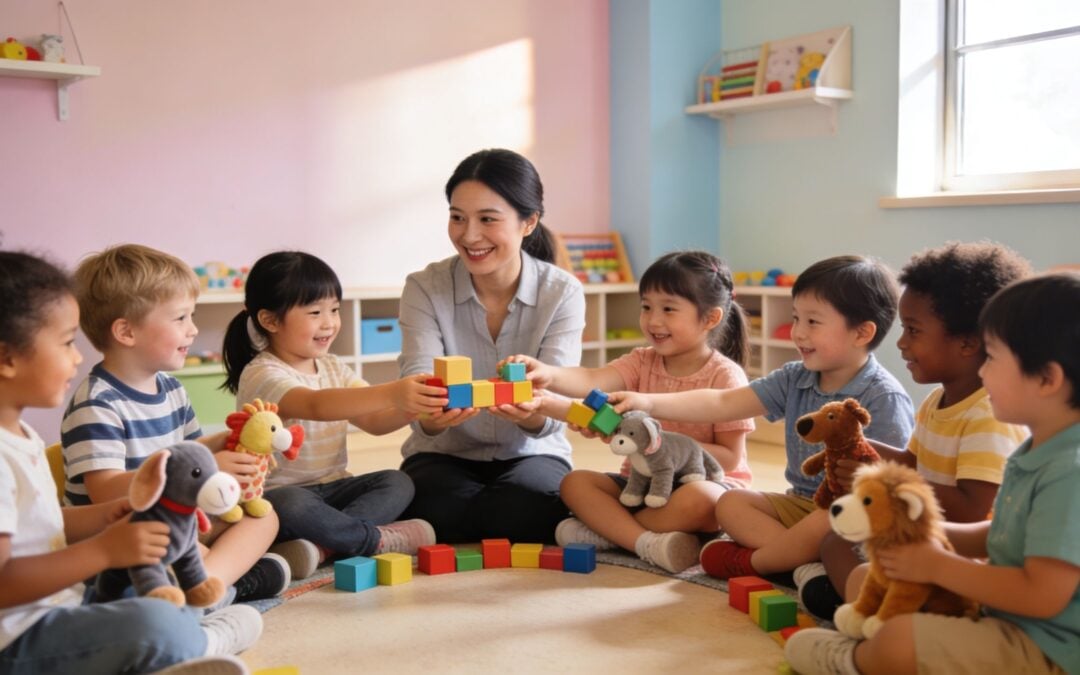
The block area is busy. One child is building a tall tower. Another reaches for the last long block. A third child bursts into tears because someone “looked at me mean.” If you work with preschoolers, that scene probably feels familiar.
These moments can look small to adults, but they’re where children learn some of their biggest life lessons. They’re learning how to wait, how to ask, how to notice another person’s feelings, and how to repair a hard moment. That’s social-emotional learning in real time, and it matters just as much as early literacy and number sense.
We know early social development has lasting importance. A 20-year study highlighted by RWJF followed nearly 800 kindergarteners and found that stronger early social competence was linked to better adult outcomes later on. That’s one reason so many educators now treat social skills as teachable, daily practice instead of “nice if there’s time.”
The good news is that preschoolers don’t need long lectures. They need repetition, play, modeling, and kind adults who know how to slow social moments down. The activities below are practical social skills activities for preschoolers you can use at school, in a counseling group, or at home. If you’re also thinking about the larger goal of helping children connect across differences, this idea of building social bridges for kids is a helpful lens.
1. Emotion Recognition Circle
Before children can solve problems together, they need words for what’s happening inside them. Emotion recognition gives them that starting point. When a child can say “I’m frustrated” instead of screaming or grabbing, you’ve already reduced the intensity of the moment.
This activity works best as a short, predictable ritual. I like it at morning meeting, after recess, or anytime the group needs to reconnect.
How to run it
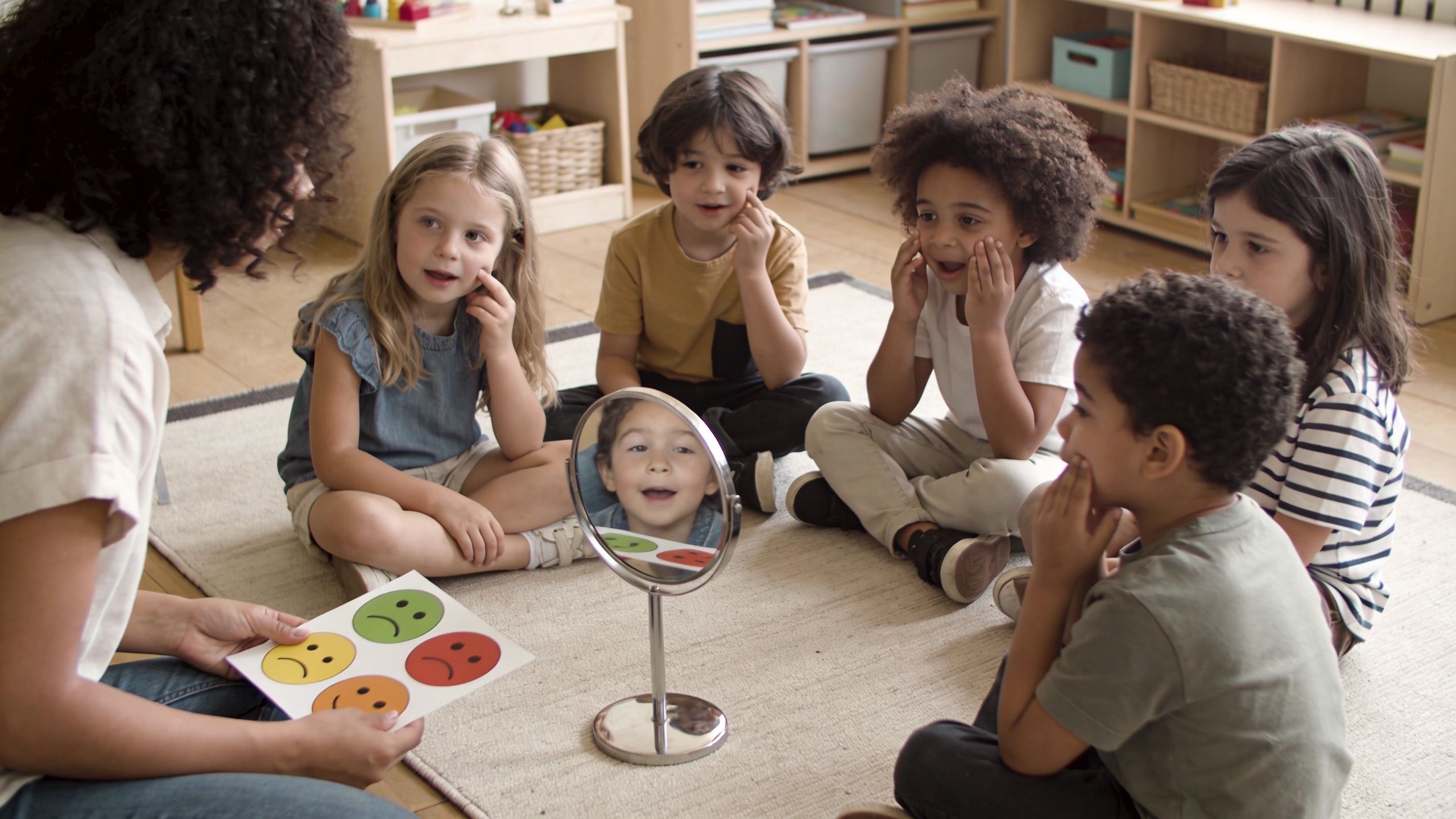
Gather children in a circle with a small set of feeling cards. Start with four basic feelings: happy, sad, mad, and scared. Hold up one card at a time and ask, “What do you notice about this face?” rather than “What is this?” That small shift helps children read clues instead of guessing a right answer.
Then invite mirror practice. Children look at themselves and try the face. You might say, “Show me a surprised face,” then ask, “What do your eyebrows do when you feel surprised?” Preschoolers love the physicality of this, and it helps them connect body signals to emotions.
A simple classroom example: “Jada wanted the blue marker, but Mateo was using it. How might Jada feel?” Let children offer more than one answer. Frustrated, sad, disappointed, impatient. That’s where emotional vocabulary grows.
Practical rule: Keep the pace gentle. If a child doesn’t want to share publicly, let them point to a card, whisper to you, or simply listen.
Easy adaptations for different children
Some children jump right in. Others need more safety.
- For shy children: Let them hold the card for you instead of speaking first.
- For children with limited language: Offer two choices, such as “sad or mad?”
- For children who become overwhelmed: Use real classroom situations later, one-on-one, rather than putting them on the spot in the group.
If you want a visual tool that children can keep using beyond circle time, a simple feelings chart for kids can help create shared language across the room.
2. Cooperative Games and Turn-Taking Activities
Some preschool games create winners and losers too quickly. Cooperative games do the opposite. They teach children that success can be shared, and that waiting, helping, and noticing others are part of the fun.
That matters because preschool social skills interventions can be especially effective. A 2024 meta-analysis in Frontiers in Psychology reviewed randomized controlled trials and found designed physical activities significantly improved preschoolers’ overall social skills, with the strongest effects seen in 12-week interventions.
Try these first
Start small. Two or three children can learn the rhythm of waiting and responding before you scale up to the full class.
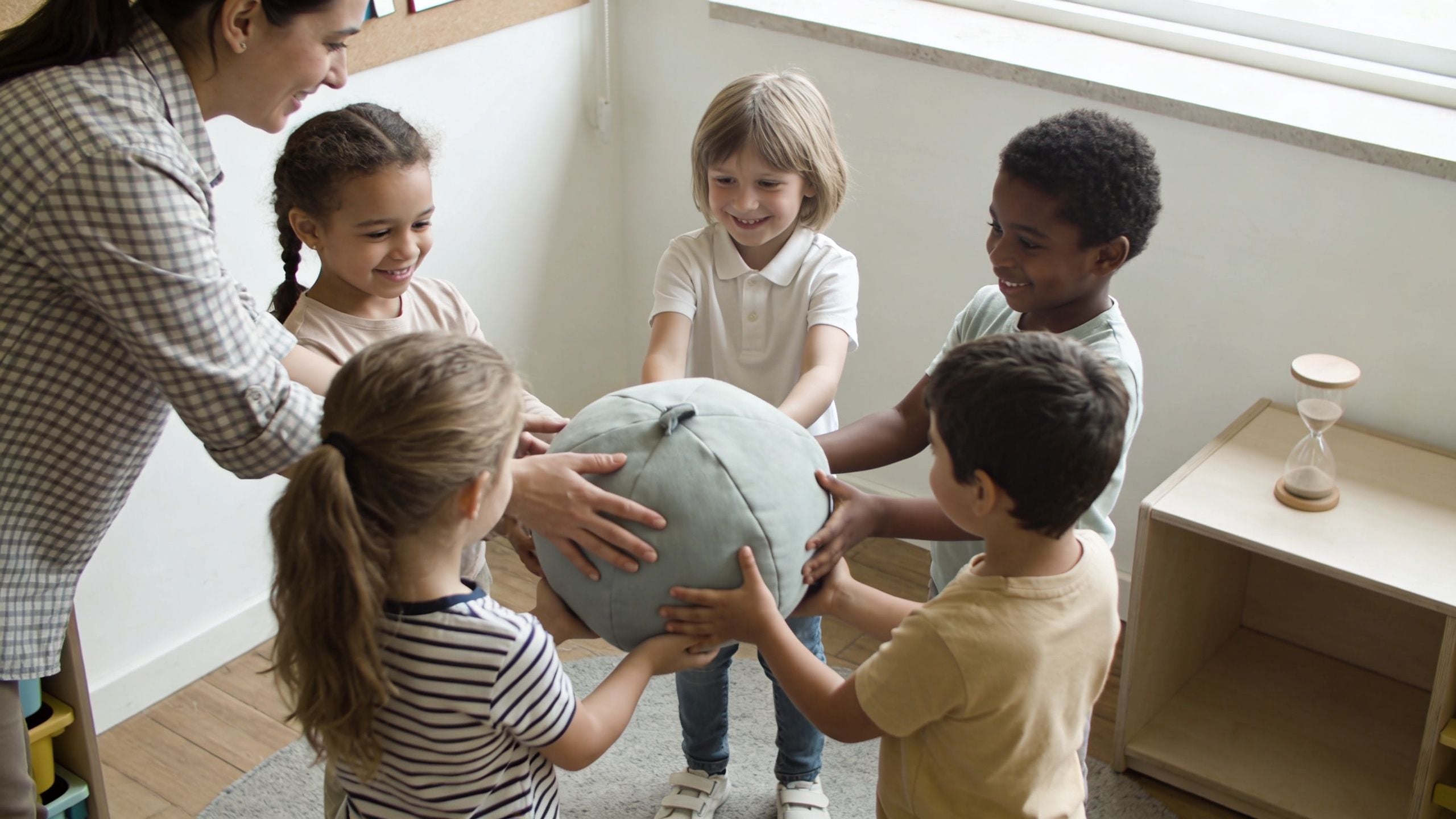
- Pass the soft ball: Sit in a circle and pass one ball with a simple script. “My turn, your turn.” Pause between passes so children feel the wait.
- Group tower: Give one tray of blocks to a small group and invite them to build one structure together. Narrate social moves you want to see: “You made space for her idea.”
- Parachute shake and freeze: Everyone holds the edge and works together to lift, lower, and freeze on cue.
I also like adapted movement games. In a cooperative version of Red Light, Green Light, the group’s job is to help everyone get across together. Children cheer for friends who stop successfully instead of racing to beat them.
What to say while they play
Your language shapes the learning. Use short narration that names the invisible skill.
- Notice waiting: “You had the ball and you remembered whose turn was next.”
- Notice repair: “He bumped your space, and you both kept going.”
- Notice inclusion: “You moved over so everyone could fit.”
For families trying to replace passive screen time with connection-rich play, this roundup on how to reduce screen time with these toys pairs well with cooperative routines.
If you want more game ideas you can simplify for younger children, Soul Shoppe’s collection of sharing games for elementary students offers structures you can adapt for preschool by shortening turns and adding visuals.
3. Peer Buddy System and Buddy Assignments
A buddy system gives children a simple message: no one has to do preschool alone. For children who tend to wander, cling to adults, or hover near the edges of play, a buddy can make the day feel more predictable and less lonely.
This isn’t about forcing friendship. It’s about creating repeated chances to practice friendly habits with support.
What buddying can look like in preschool
Keep the assignment concrete. “Buddy” is too vague if children don’t know what it means yet. Tie it to specific moments.
For example, buddies can:
- walk together to wash hands
- sit together during snack once a week
- help each other carry materials
- check whether their partner has what they need for an activity
One child might say, “Come with me to the rug.” Another might help by pointing to the cubby or waiting at the door. These are small acts, but they build responsibility and awareness.
A strong buddy system is structured, not sentimental. Preschoolers need to be shown what helping looks and sounds like.
Pair thoughtfully and teach the role
Be intentional with matches. Pair a confident child with a gentle one, not the loudest child with the quietest. Sometimes two children with similar interests work beautifully. Sometimes a child who loves routines is the perfect partner for a child who struggles during transitions.
Model the exact language you want buddies to use:
- “Do you want to come play?”
- “You can stand by me.”
- “Let’s ask the teacher together.”
- “It’s your turn first.”
Rotate pairings over time so children practice with more than one peer. And keep expectations modest. A successful buddy period might last only one transition or one center block.
If you’d like more ways to create intentional peer connection, these relationship building activities can help extend the buddy idea into the whole classroom culture.
4. Conflict Resolution and Problem-Solving Circles
Preschool conflict usually sounds repetitive. “She took it.” “He won’t let me.” “I had it first.” Adults can solve these disputes quickly, but if we always step in as judge, children miss the chance to learn how repair works.
A problem-solving circle slows the moment down. It teaches children that conflict is something we can talk through, not just react to.
A simple preschool script
Use the same sequence every time. Consistency matters more than eloquence.
Try this:
- What happened?
- How do you feel?
- What did you want?
- What can we do now?
Keep children close, calm, and brief. You’re not looking for perfect storytelling. You’re helping each child feel heard and guiding them toward one workable next step.
A classroom example: Two children both want the same dump truck. You sit with them and say, “Tell me what happened.” One says, “I had it.” The other says, “I wanted it.” You reflect both. “You were using it. You wanted a turn.” Then offer choices if needed: timer, trade, play together, or find a similar truck.
This short video can help adults picture restorative language in practice:
When children need more support
Not every child can enter a circle right away. Some need regulation before conversation.
- For children who are crying hard: Start with breathing or water, then return.
- For children who go silent: Let them point to feeling cards or repeat after you.
- For children who get stuck on blame: Keep returning to the present question, “What can help now?”
A meta-analysis on preschool social skills interventions found especially strong effects for preschool-aged children, including stronger outcomes on targeted skills like social initiation, turn-taking, and prosocial behaviors. That’s one reason direct teaching in moments like these can make such a difference.
If you want a fuller framework, these restorative circles in schools offer language and structure you can simplify for young children.
5. Empathy and Perspective-Taking Through Storytelling and Role-Play
Stories let children rehearse social life from a safe distance. A child who can’t yet talk about their own hurt feelings may readily explain why a puppet feels left out or why a story character needs help.
That’s why books, puppets, and dramatic play belong on any list of social skills activities for preschoolers. They make invisible feelings visible.

Use stories to ask better questions
Pick books with clear emotional moments. You don’t need a “social skills” label on the cover. You need characters who want something, lose something, worry, wait, or reconnect.
As you read, pause and ask:
- “How do you think he feels right now?”
- “What do you see that makes you think that?”
- “What could a friend do?”
- “Has our class ever had a moment like this?”
Children often give wonderfully concrete answers. “She’s sad because no one scooted over.” That’s empathy beginning to take shape.
Bring the story into play
After reading, move into role-play. Use puppets, stuffed animals, or dramatic play props. One puppet can say, “Can I play?” Another can say, “We need one more builder.” Practice both sides.
Dramatic role-play is especially useful because repeated pretend play gives children chances to revisit social themes. The preschool resource discussion from Begin Learning on social skills activities highlights dramatic role-play, group art, turn-taking games, and emotion charades as useful ways to build communication, empathy, and collaboration.
Children often show more empathy in pretend play than in direct conversation. Use that doorway.
For a child who resists joining group role-play, start with one adult and one puppet. Let the child be the audience first. Then invite them to hand the puppet a prop. Participation can grow in layers.
6. Mindfulness and Breathing Exercises for Group Calm
Some children need social coaching after they’re calm. Others need calming before any coaching can work. Mindfulness and breathing support that first step.
In preschool, this should stay concrete and brief. We’re not asking children to sit still for long periods. We’re helping them notice their bodies, slow down, and return to the group safely.
A few preschool-friendly calming routines
I like to teach two or three strategies and use them often.
- Belly breathing: Children place a small stuffed animal or their hands on their belly and watch it rise and fall.
- Butterfly breathing: Arms crossed over chest, hands on shoulders, slow breaths with gentle taps.
- Five-senses grounding: Name something you can see, hear, or feel in the room.
Use these when the group is already fairly calm, not only during meltdowns. That way the skill feels familiar instead of corrective.
A practical example: after an energetic transition, dim the lights slightly, ring a soft chime, and invite everyone to do three balloon breaths. “Smell the flower. Blow up the balloon.” Then move into story time or small groups.
Make it optional without making it invisible
Some children won’t close their eyes. Some dislike deep breathing cues. Some need movement more than stillness. That’s fine.
Offer choices such as:
- hands on belly or hands on knees
- sitting on the rug or standing at the back
- breathing with you or observing
Soul Shoppe has spent more than 20 years delivering research-based tools for mindfulness, communication, and self-regulation in school communities. That kind of shared language matters because calming strategies work best when adults and children both know what to call them and when to use them.
Keep your tone neutral. Mindfulness isn’t a consequence. It’s a support.
7. Gratitude and Appreciation Practices
Preschoolers often notice what feels unfair before they notice what feels kind. Appreciation practices gently rebalance that attention. They teach children to look for help, kindness, effort, and connection.
This isn’t about forced politeness. It’s about helping children recognize that other people’s actions affect them in good ways.
Start with specific appreciation
General praise stays fuzzy. Specific appreciation teaches social awareness.
Instead of “Say something nice to Leo,” try:
- “What did Leo do that helped today?”
- “Who made space for you at the table?”
- “Who helped fix a problem?”
Children’s answers become more meaningful right away. “Mila gave me the tape.” “Ethan waited for me.” “My teacher helped when I was sad.”
One easy ritual is an appreciation circle to conclude the day. Another is an “I noticed” board where children draw a picture of someone helping, sharing, or including. Nonverbal children can point to photos, choose symbols, or add a sticker to a class gratitude chart.
Keep the routine warm and balanced
Appreciation should feel steady, not performative.
- Model first: Let children hear adults appreciate each other.
- Spread it around: Make sure the same outgoing children don’t receive all the public recognition.
- Connect it to actions: Focus on what someone did, not who is “good.”
A lovely example is after cleanup. Pause and say, “Who noticed a helper?” One child might say, “Nora put the crayons back for everybody.” Another might add, “And she helped me find the lid.” That kind of noticing builds belonging over time.
Appreciation helps children see themselves as people who affect others positively. That identity matters.
8. Inclusive Play and Belonging Activities
Every class has children who don’t slide easily into group play. Some hover nearby. Some watch. Some want connection but become overwhelmed when it arrives. Social growth won’t happen if participation always depends on a child entering the group independently.
Inclusive play means building entry points on purpose. It’s one of the most important social skills activities for preschoolers because belonging is the soil where every other skill grows.
Create easier ways to join
Don’t rely on “Just go ask if you can play.” That’s a big leap for many preschoolers.
Instead, build supports:
- visual cards with phrases like “Can I build too?”
- assigned play partners during centers
- small interest-based groups, such as trains, sensory bins, or animal play
- adult-facilitated entry, such as “Sam has an idea for the bakery. Can we make room?”
For some children, joining is easier in a small, structured activity than in free play. A group mural, a cooking project, or a teacher-led block challenge can create natural roles and reduce social guesswork.
Adapt for anxious, autistic, or reluctant children
Many children need pacing and sensory support, not pressure. If a child has social anxiety, selective mutism, sensory sensitivities, or difficulty reading social cues, start with safety.
You might:
- practice the activity one-on-one first
- let the child participate beside the group before inside the group
- use a familiar peer as a bridge
- shorten the interaction and end while it still feels successful
Positive Action’s discussion of social activities for kids notes one example of reducing eye-contact pressure for some autistic children by starting with a sticker on the forehead rather than expecting direct gaze right away. That’s the kind of thoughtful scaffold many classrooms need. You can read more in their piece on social skills activities and games for kids.
Home-school consistency also helps children generalize these skills. Little Planet Preschool emphasizes that social development takes time, practice, and coaching from caring adults. Their article on building social skills in preschool is a useful reminder to keep language and expectations aligned across settings.
8-Activity Social Skills Comparison
| Activity | Implementation complexity | Resource requirements | Expected outcomes | Ideal use cases | Key advantages |
|---|---|---|---|---|---|
| Emotion Recognition Circle | Low–Medium (needs skilled facilitation) | Emotion cards, mirrors, charts; minimal prep | Increased emotion vocabulary, self-awareness, empathy | Daily check-ins, morning meetings, small groups | Builds foundational emotional intelligence; easy to adopt |
| Cooperative Games and Turn-Taking Activities | Low (clear rules & monitoring) | Simple props, visual timers, open space | Improved turn-taking, patience, collaborative skills | Recess, group playtime, social-skills lessons | Natural practice of sharing; reduces competition anxiety |
| Peer Buddy System and Buddy Assignments | Low–Medium (intentional matching, monitoring) | Time for pairing/rotation, tracking tools, brief training | Stronger one-on-one connections, belonging, peer support | Transitions, integrating isolated children, classroom helpers | Fosters consistent peer relationships and leadership skills |
| Conflict Resolution and Problem-Solving Circles | Medium–High (training required) | Trained facilitator, time per incident, structured prompts | Practical conflict-resolution skills, empathy, restorative culture | Restorative responses, recurring conflicts, community building | Teaches real-time problem solving; reduces punitive discipline |
| Empathy & Perspective-Taking (Storytelling / Role-Play) | Low–Medium (prep and facilitation) | Diverse books, puppets/props, discussion prompts | Enhanced perspective-taking, emotion language, engagement | Read-alouds, dramatic play centers, SEL lessons | Highly engaging; makes empathy concrete for young children |
| Mindfulness & Breathing Exercises | Low (consistency needed) | Quiet space, chimes/visuals, short scripts | Improved self-regulation, group calm, better focus | Transitions, before lessons, after recess | Quick, transferable calming tools; supports dysregulated children |
| Gratitude and Appreciation Practices | Low (requires routine & authenticity) | Boards, journals, tokens, routine time | Positive classroom culture, increased belonging, self-esteem | Morning or closing circles, weekly rituals, recognition times | Shifts focus to strengths; reinforces kindness and inclusion |
| Inclusive Play and Belonging Activities | Medium (planning, UDL adaptations) | Visual supports, adult coaching, environmental modifications | Increased participation, reduced isolation, inclusive culture | Play centers, supporting diverse learners, anti-exclusion efforts | Intentionally prevents exclusion; supports vulnerable children |
Weaving Social Skills into Your Daily Rhythm
The most effective social skills teaching rarely looks dramatic. It looks like a teacher pausing before stepping in. It looks like a parent helping two children find words instead of deciding the winner. It looks like a counselor giving a class the same simple script often enough that children start using it on their own.
That daily repetition matters because social development grows through lived experience. Children learn empathy when someone helps them notice another child’s face. They learn cooperation when a game is built so everyone needs each other. They learn self-regulation when adults treat calming down as a skill, not a punishment.
You don’t need to implement all eight activities at once. Start with the one your group needs most. If your class is quick to cry or grab, begin with emotion recognition. If transitions fall apart, try buddy assignments. If children are excluding one another, put your energy into inclusive play structures and appreciation routines.
Then stay with it long enough for the routine to become familiar. Preschoolers thrive on repetition. The first week may feel clunky. The third week often feels easier. Over time, children begin using the language and moves you’ve modeled: “You can have a turn after me.” “He looks sad.” “Want to be my buddy?” “Let’s fix it.”
Adults need support too. Teachers and families are more consistent when they share language, expectations, and a few go-to practices. That’s where a whole-community approach can help. Soul Shoppe’s work is built around practical, experiential SEL tools that support self-regulation, communication, conflict resolution, and belonging across both school and home. Their approach fits especially well for communities that want more than isolated lessons. They want habits, rituals, and shared language that children encounter again and again.
Keep the tone hopeful. Social mistakes are part of learning. Preschoolers aren’t “bad at friendship.” They’re learning friendship. And they learn best with calm adults, simple structures, and lots of chances to try again.
If you’re also looking for playful ideas for younger children and mixed-age family settings, these fun activities for toddlers can complement early SEL routines at home.
If you want help turning these ideas into a consistent, schoolwide or family-supported SEL practice, explore Soul Shoppe. Their programs, workshops, digital tools, and educator resources are designed to help children and the adults around them build empathy, communication, self-regulation, and real belonging.