

Teach Goal Setting for Preschoolers: Build Independence
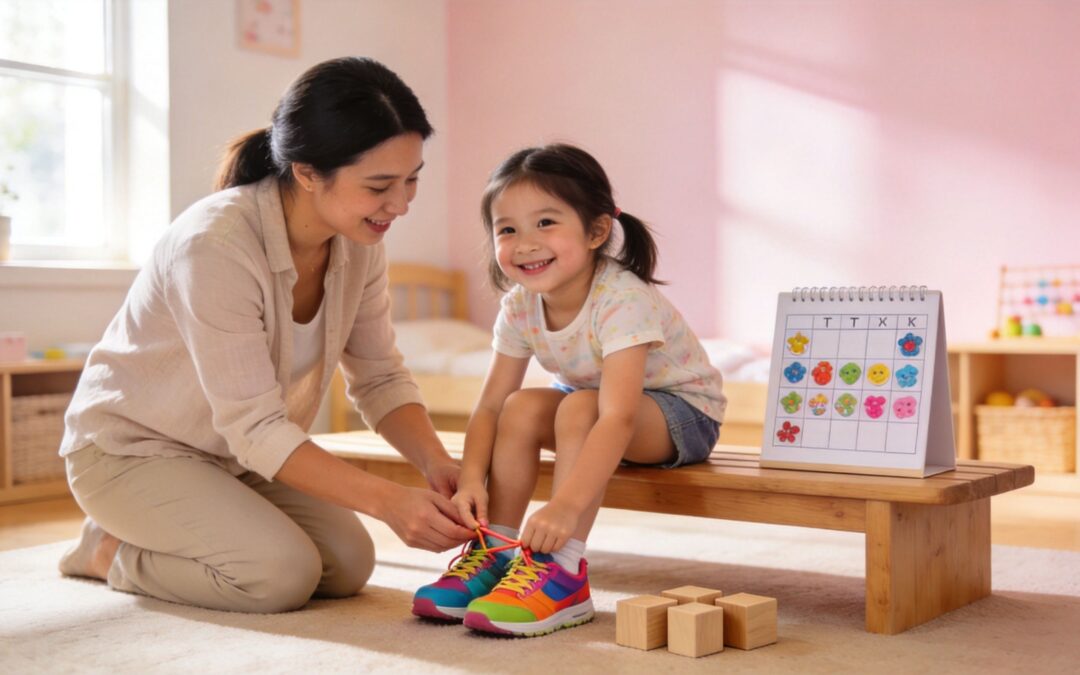
Most adults meet goal setting when they're already overwhelmed. A preschooler meets it while standing in one sock, refusing the other shoe, and melting down because the zipper feels “wrong.”
That's why goal setting for preschoolers has to look different. It can't feel like pressure. It has to feel like help.
In early childhood settings, I've found that the best goals are woven into ordinary moments. Getting dressed. Putting blocks away. Waiting for a turn. Carrying a napkin to the table. These small efforts teach children something bigger than task completion. They teach, “I can try. I can keep going. I can do one step at a time.”
Why Tiny Goals Lead to Big Confidence
A four-year-old doesn't wake up wanting a lecture about perseverance. They want to do what the big kids do, feel capable, and get through the day without everything turning into a struggle.
That's why tiny goals work so well. When a child hears, “Your job is to put both shoes by the door,” that feels doable. “Get ready by yourself” often doesn't. One is clear. The other is too big to hold in mind.

Everyday struggles are often hidden learning moments
Think about a common morning scene. A child can't get their coat on. An adult is late. Voices get tighter. The child shuts down.
Now shift the frame. Instead of “Come on, get dressed,” try a small mission: “Today your goal is to put one arm in your coat by yourself.” That changes the emotional tone right away. The child has a target they can reach.
Small success builds momentum. Children start to expect that effort leads somewhere. That mindset matters.
Practical rule: If a goal leads to instant frustration, it's probably too large. Shrink it until the child can act on it right away.
Confidence grows through repetition, not speeches
Preschoolers build confidence from doing, not from being told they're capable. When they repeat a manageable goal across several days, they begin to trust themselves.
That's especially important in social-emotional learning. A child who learns, “I can carry my cup to the sink,” is also learning to tolerate frustration, recover from mistakes, and stay with a task. Those are self-management muscles.
You can see this same idea in confidence from the inside out. Real confidence doesn't come from constant praise. It grows when children experience themselves as effective.
A few preschool-friendly goals that build this kind of confidence:
- Self-care goal: Put your socks in the hamper.
- Classroom goal: Push in your chair after snack.
- Friendship goal: Use words when you want a turn.
- Cleanup goal: Put three blocks in the bin.
None of these sound dramatic. That's the point. Tiny goals let children practice success often enough that “I can't” slowly becomes “I'll try.”
The Building Blocks of a Preschooler's Goal
Adults usually think of goals as future plans. Preschoolers need goals they can see, touch, and do today.
A developmentally appropriate goal for this age is small, concrete, visual, and close in time. “Be more responsible” won't mean much to a four-year-old. “Put your cup on the tray after snack” will.

What a good preschool goal looks like
A strong preschool goal usually has these features:
- It's observable: You can tell whether it happened. “Wash hands before snack” works. “Have better listening” is too vague.
- It's short-term: The child can experience it soon, often within the day or over several days.
- It's action-based: It focuses on what the child will do, not on a personality trait.
- It fits the routine: It lives inside real moments like arrival, cleanup, centers, snack, or bedtime.
A useful test is this. Can the child picture the goal in their mind? If not, simplify it.
Process goals beat broad outcome goals
For young children, process matters more than outcome. “Try both shoes before asking for help” is often a better goal than “Put on shoes perfectly.”
This approach protects motivation. Preschoolers are still developing planning, working memory, and frustration tolerance. When adults choose goals that are too broad, children can feel like they've failed before they've even started.
A helpful overview of how early learning goals fit into child development can be found where Grow With Me explains early years learning. It gives useful context for why daily routines matter so much in the early years.
A preschool goal should sound more like a next step than a life lesson.
Predictability helps children stay engaged
Routine matters even more than many adults realize. A 2023 study on preschoolers' goal adaptation found that children were more likely to adjust their approach when changes in a task were predictable, while unpredictable changes were more disruptive, especially for children under 4.5 years.
That finding matches what teachers see every day. If the goal-setting routine changes constantly, some children spend all their energy figuring out the format instead of doing the task.
Here's what predictability can look like in practice:
| Everyday setting | Less helpful approach | More helpful approach |
|---|---|---|
| Arrival | New chart, new language, new expectation each day | Same visual, same phrase, same first step |
| Cleanup | “Clean everything up” | “Put five cars in the basket” |
| Dressing | Rushed adult takeover | Same sequence each time, with one child-owned step |
| Circle time | Goal introduced only when behavior is hard | Goal named before the routine begins |
If you're supporting children's self-regulation alongside goal setting, self-management skills in young learners offers a useful companion lens.
How to Introduce and Model Goals Together
Many adults make goal setting sound heavier than it needs to be. Preschoolers respond best when it feels conversational, shared, and tied to something they already want to do.
Start with one real moment. Maybe your child wants to pour water without spilling. Maybe your students rush through cleanup. That's enough. You don't need a special unit or a formal meeting.
A simple visual can help make the idea concrete.

Say less, guide more
Use short sentences and invite the child into the plan.
Try language like this at home or in the classroom:
Name the goal
- “Our goal is to put the books back on the shelf.”
- “Your goal is to carry your plate to the counter.”
Ask for the first step
- “What do you do first?”
- “Which book will you pick up?”
Notice effort
- “You kept trying even when the zipper got stuck.”
- “You remembered the basket without me telling you again.”
Keep the next step small
- “Tomorrow, your goal is to do the first button.”
- “Next time, let's try two toys before cleanup help.”
This kind of language reduces power struggles. It also gives children practice thinking in sequence, which is a major part of early self-regulation.
Model your own goals out loud
Preschoolers learn a lot from hearing adults think aloud. You can model goals in ordinary language without turning it into a lesson.
For example:
- During snack prep: “My goal is to put all the cups on the table before I sit down.”
- During cleanup: “I'm going to finish putting the markers in the box.”
- During transitions: “My goal is to find my keys and my water bottle before we leave.”
When adults do this, children start to understand that goals aren't just demands adults place on kids. Goals are tools people use to help themselves.
Later in the section, this short video can reinforce the idea for families and educators who like to see concepts modeled in action.