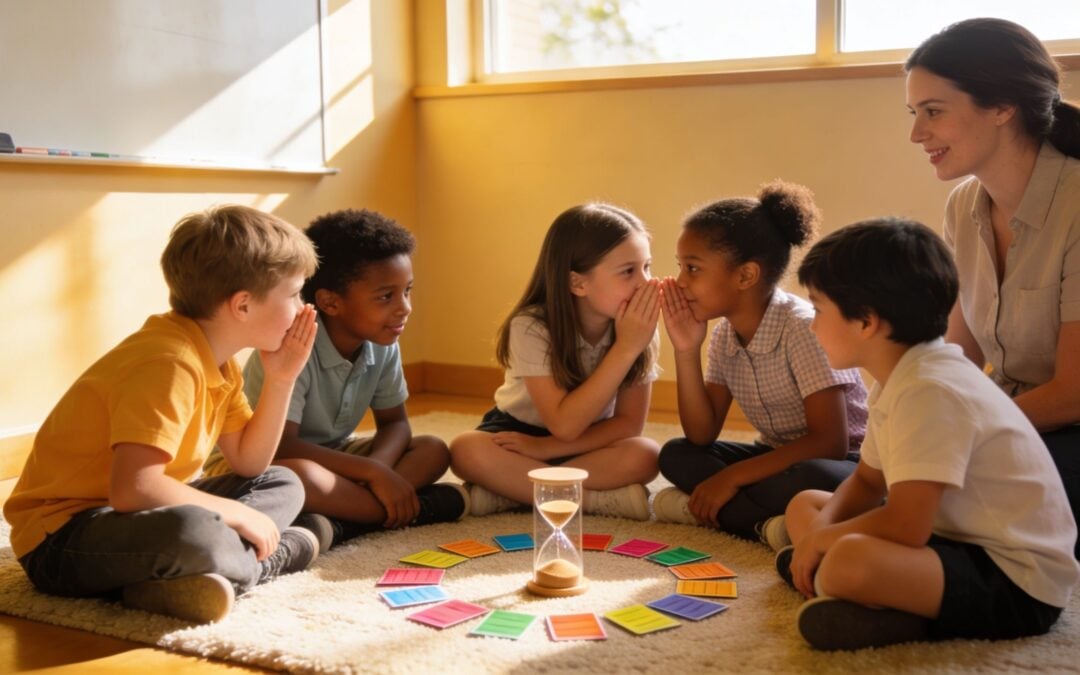
You've just explained the directions, and a few students are already asking what to do. At home, you've asked your child to put on shoes, grab a water bottle, and meet you at the door, but only one of those things happened. Those moments are easy to read as defiance, laziness, or distraction.

Usually, they're a listening problem. Not hearing, but listening. Filtering noise, holding information, noticing tone, reading emotion, and staying present long enough to respond well. In a busy classroom or a full family schedule, that's a big skill set.

That's why games for listening matter so much. They give children low-pressure practice with attention, self-regulation, empathy, and communication repair. They also help adults shift from “Why aren't they listening?” to “What support helps them listen better?” That question changes everything.

Many adults need that reminder too. Some of the same principles that help kids tune in also show up in strong leadership tips from Corporate Challenge Events. Clear expectations, emotional safety, and repetition work across ages.

Listening games have deep roots. Maria Montessori's sensory methods date back to 1912, and active listening games have remained part of early childhood education for decades. One example, documented by Mathful Play's Listen, Count, and Guess activity, describes a classic bucket-and-object game and cites sensory play research showing 85% improvement in auditory discrimination skills among children ages 3 to 5 after four weeks of regular play.

1. Circle Listening

Some games for listening are lively. This one is quiet on purpose.

In a talking circle, students sit in a circle, and only the person holding the talking piece speaks. Everyone else listens without interrupting. That single structure slows the room down and gives children a clear experience of what respectful attention feels like.

I've seen circles work best when adults stop treating them like a performance. Children don't need a perfect answer. They need time, predictable norms, and a real chance to be heard.

How to run it well

Start small. A group of 8 to 12 is usually easier to manage than a whole class if students are new to the format. Use a simple object as the talking piece, such as a smooth stone, a small stuffed animal, or a wooden stick.

Use low-stakes prompts first:

  • Easy entry prompt: “What's one sound you heard on the way here?”
  • Belonging prompt: “What helps you feel calm at school?”
  • Repair prompt: “What should someone do when they interrupt by accident?”

If you want a school-based model for this work, Soul Shoppe shares practical examples in its piece on restorative circles in schools.

Practical rule: Don't force every child to speak on the first round. Passing is often what makes the circle feel safe enough for honest participation later.

This practice aligns naturally with SEL because it teaches turn-taking, perspective-taking, and emotional restraint. The strongest circles aren't the ones with the most polished sharing. They're the ones where children begin responding to one another with less sarcasm, fewer interruptions, and more patience.

A practical classroom example: after recess conflict, don't begin with “What happened?” Start with “What do you need from others so you can listen right now?” That question lowers pressure and often gets better participation.

Later, you can deepen the prompts:

  • Conflict awareness: “What makes listening hard when you're upset?”
  • Community building: “What does respect sound like?”
  • Reflection: “When did someone listen to you this week?”

Here's a short visual introduction you can use if students need to see the structure before trying it.

2. Sound Mapping and Soundscaping

When a room feels overstimulated, children often need help noticing sound before they can manage it. Sound mapping is one of the simplest games for listening because it turns attention into something visible.

Ask students to sit still for a few minutes and listen for sounds near and far. Then invite them to draw a map of what they heard. A bird outside the window might go in the top left corner. A heater hum might sit near the bottom edge. A classmate's pencil tap might appear close by with jagged lines.

A young boy wearing headphones drawing sound wave illustrations on paper at a wooden desk.

Why this works

Some children process sound better when they can externalize it. Drawing, labeling, or sorting sounds gives them another pathway into listening. It also supports emotional regulation because it anchors attention in the present moment.

This works well:

  • Short first round: Try a brief listening window with younger students.
  • Choice in response: Let students draw, write, or talk through their sound map.
  • Feeling connection: Ask which sounds felt calming, annoying, surprising, or comforting.

This does not work well:

  • Overloading the task: Too many directions at once turns a mindful activity into a compliance test.
  • Mandatory eyes closed: Some students listen better with eyes open and a soft gaze.
  • Correcting their perception: If a child heard a “buzzing whirr” and another heard “air noise,” both may be accurately describing the same sound.

A strong example is using a rain recording, playground ambience, or a short nature soundscape after lunch. Students listen, map what they notice, then compare their drawings. That comparison matters. It teaches that two people can hear the same environment differently without either person being wrong.

Sometimes the most useful debrief question is, “Which sound was easiest for you to ignore, and which was hardest?”

For sensory-sensitive learners, lower the complexity. Use fewer sound layers, offer headphones if appropriate, and allow nonverbal responses such as pointing to icons or placing stickers on a printed page.

3. Telephone and Whisper Down the Lane

Telephone gets dismissed as a silly party game, but in practice it's one of the clearest ways to teach how communication breaks down. That makes it one of the most useful games for listening if you debrief it carefully.

The traditional version often rewards the funniest mistake. The better version rewards careful listening, kind repair, and curiosity. Instead of laughing at the person who “messed it up,” the group studies what changed and why.

Make the point bigger than the punchline

Use a meaningful sentence rather than random nonsense. Try something like, “After art, please put the brushes in water and place your painting on the drying rack.” That mirrors the kind of language children hear all day.

Then ask:

  • Where did the message shift?
  • What made it hard to hear clearly?
  • Did anyone make an assumption instead of checking?
  • What could a listener say if they need repetition?

The learning is in the analysis. Students start noticing that speed, embarrassment, background noise, and guessing all affect accuracy.

This is also where digital listening games can support practice. By 2025, 68% of U.S. K-8 classrooms use digital listening games, and a 2024 Journal of Educational Psychology study linked that use with 45% better attention spans among 5,200 students, as summarized in this overview of audio-based listening games on YouTube. In classrooms, that translates into a useful principle. Repetition and novelty help, but only when students stay emotionally relaxed enough to keep trying.

A good variation is “clarifying Telephone.” Before passing the message, each student may ask for one repeat. That tiny adjustment changes the game from gotcha to skill-building.

If children leave the game thinking, “Listening is hard for everyone sometimes,” you've done it right.

This game is especially useful after peer conflict. It gives students a concrete example of how quickly meaning changes when people assume instead of checking.

4. Tone Detective

Children often focus on words and miss the emotional message carried by tone. “I'm fine” can mean calm, embarrassed, irritated, or seriously hurt. Tone Detective teaches students to listen for pace, volume, pitch, and inflection, not just vocabulary.

Say the same short phrase several ways. “I didn't know that,” works well. Read it as excited, worried, annoyed, shy, playful, and disappointed. Then ask students to identify the feeling and explain what clues they heard.

A woman's profile is shown with sound wave graphics and emotion labels representing speech and listening perception.

Keep the emotion task concrete

Don't begin with unlimited answers. Offer a small set of choices if students are hesitant. This reduces performance anxiety and gives language to children who feel the emotion but can't name it yet.

For support, pair this game with a visual tool like Soul Shoppe's feelings chart for kids. Students can point to likely emotions before discussing the clues they heard.

A few strong prompts:

  • Clue hunt: “Was the voice fast or slow?”
  • Mismatch check: “Did the tone match the words?”
  • Personal link: “When have you heard that tone before?”
  • Repair practice: “What could you say if you weren't sure what the person meant?”

This is useful in classrooms, counseling groups, drama, and family meetings. It's also one of the best games for listening when students struggle with conflict because it trains them to notice emotional cues before reacting.

If you want recorded samples, teachers and creators sometimes use tools similar to professional AI voiceovers for creators to produce multiple versions of the same phrase. The key is not the technology. The key is discussing what students heard and how tone affects trust.

A trade-off worth naming: this game can tempt adults to act like there's always one correct answer. There often isn't. A voice can sound both nervous and irritated. Let students hold mixed interpretations when they can explain their reasoning.

5. Instruction Following and Simon Says

Simon Says survives for a reason. It asks children to pause, inhibit impulse, and hold verbal information in mind. Those are all real listening demands.

Still, the classic trick format can backfire. Some children love the speed and challenge. Others feel publicly caught making mistakes. If your goal is SEL, the better version is cooperative.

Shift from elimination to support

Instead of putting students “out,” keep everyone in and invite peer support. One student gives directions. The group succeeds together when everyone understands what to do.

Try commands like:

  • Movement plus sequence: “Touch your head, turn once, then sit.”
  • Mindful action: “Take a breath, tap your knees twice, then show me a quiet thumbs-up.”
  • Partner cue: “Point to your elbow, then check whether your partner needs the directions repeated.”

That last step matters. It turns listening into a shared responsibility.

Soul Shoppe offers related practice ideas in its active listening activity, and the structure transfers well to classrooms, counseling groups, and home routines.

What works:

  • Start short: Use two-step directions before increasing complexity.
  • Normalize repetition: Teach “Can you say that again?” as a strength, not a weakness.
  • Add visuals when needed: Gestures, icons, or a model student can reduce overload.

What doesn't work:

  • Fast rapid-fire commands: Students stop processing and start guessing.
  • Mean-spirited tricking: Shame shuts listening down.
  • One-size-fits-all expectations: Some children need movement or a visual cue to listen well.

The first commercial listening game, Simon, sold 25 million units by 1990, according to the same verified background summary that tracks the growth of digital listening play. That long popularity makes sense. Sequential listening taps a skill children use constantly, from lining up to solving math problems.

6. Partner Mirroring and Reflecting Back

If I had to choose one activity that most directly teaches listening as empathy, it would be this one. One child speaks. The partner listens and reflects back what they heard. Then the speaker confirms, corrects, or adds nuance.

The structure is simple, but the skill is not. Most children, and plenty of adults, rush to advise, defend, or tell their own story. Reflecting back interrupts that habit.

Two students sitting face to face in a classroom engaged in an active conversation.

Sentence stems help a lot

Give listeners language they can lean on:

  • Content stem: “What I heard was…”
  • Feeling stem: “It sounds like you felt…”
  • Accuracy stem: “Did I get that right?”
  • Repair stem: “What did I miss?”

Begin with easy topics. Favorite snacks. Weekend plans. A game they like. Only move into conflict or emotion after students understand the process.

Soul Shoppe's article on empathetic listening offers language that fits this kind of partner work well.

Listening back to someone is often harder than speaking. That's why the first rounds should be short.

This format is especially effective for peer mediation, counseling check-ins, and home conversations between siblings. One practical example: after a disagreement, ask each child to reflect the other person's concern before they explain their own. The pace slows immediately. The heat often drops with it.

There's a broader reason this structure matters. A 2022 CASEL meta-analysis cited in the verified background found SEL contexts like Soul Shoppe's programs can reduce classroom disruptions by 27% across 317 studies. Reflective listening isn't the only reason, but it's one of the practices that helps children feel heard enough to re-enter problem-solving.

7. Story Listening and Retelling

Read-alouds and audio stories are some of the most flexible games for listening because they let children practice attention, memory, inference, and emotional understanding all at once.

The format can be very simple. Read a short story, then ask students to retell what happened, draw one important scene, act out a part, or explain how a character felt. The variation in responses is part of the value. Children learn that good listening includes details, sequence, and perspective.

Build retelling around meaning

Pick stories with emotional texture. Friendship problems, exclusion, kindness, nervousness, repair. Then pause at useful moments and ask:

  • Prediction: “What do you think will happen next?”
  • Emotion check: “How is this character feeling right now?”
  • Personal connection: “Have you ever felt something similar?”
  • Perspective shift: “Would another character tell this story differently?”

One of my favorite classroom moves is to let one student retell the events and another retell the feelings. That distinction helps children notice that listening isn't only about plot.

This type of play-based listening has global relevance too. UNESCO's 2021 report, cited in the verified background, notes that 1.2 billion children benefit from play-based learning and that 65% in major markets show SEL gains. Story listening fits that pattern because it gives children a safe, shared experience to interpret together.

For extension, pair stories with creative media. Teachers who want examples of multi-format narrative experiences can borrow ideas from creative digital production insights, then adapt them in age-appropriate ways through audio, drawing, drama, and discussion.

A common mistake is over-quizzing comprehension. If every story turns into a test, listening becomes performative. A better approach is to mix one recall question with one feeling question and one open interpretation question.

8. Listening Walk and Mindful Observation

A listening walk is one of the cleanest resets for a noisy group. Students walk indoors or outdoors, paying attention to the soundscape around them. No talking during the observation phase. Just noticing.

Afterward, they share what they heard. A truck backing up. Shoes on gravel. A bird call. Ventilation. Distant laughter. Wind in leaves. The room usually feels different after this. More grounded. Less reactive.

Keep the structure tight

Before the walk, set a clear frame. Tell students how long they'll be quiet, where they'll walk, and what they should listen for. Near sounds. Far sounds. Human sounds. Nature sounds. Mechanical sounds.

Then debrief with prompts like:

  • Surprise: “What sound did you notice that you usually ignore?”
  • Emotion: “Which sound felt calming or irritating?”
  • Awareness: “What did silence help you hear?”
  • Connection: “What does this place sound like when people take care of it?”

For younger students, collect responses on chart paper. For older students, invite quick journaling or sketch notes.

This activity also supports children who don't want to speak right away. They get to listen first, then contribute from direct experience. That's a gift for quieter students and for those who need time to process language.

The verified background also highlights an underserved need here: adapting listening activities for neurodivergent and sensory-sensitive learners, including support with visual cues, reduced auditory complexity, movement breaks, and alternative ways to respond. That's especially important on listening walks. Some children may do better noticing one assigned category of sound rather than every sound at once.

Silence shouldn't feel punitive. It should feel purposeful.

8-Game Listening Comparison

Activity Implementation complexity Resource requirements Expected outcomes Ideal use cases Key advantages
Circle Listening (Talking Circles) Medium, needs trained facilitation and time Talking piece, clear norms, quiet space Equity of voice, trust, active listening, belonging Classroom community-building, restorative circles, conflict resolution Promotes psychological safety and equitable participation
Sound Mapping / Soundscaping Low, simple setup but requires controlled environment Quiet or curated soundscape, drawing materials Auditory awareness, mindfulness, sensory regulation, creativity Mindfulness breaks, sensory lessons, art-integration Low-prep, calming, bridges listening with creative expression
Telephone / Whisper Down the Lane (Intentional) Low, easy to run but needs careful framing Line formation, meaningful phrases, facilitator debrief Awareness of miscommunication, clarification skills, empathy Communication lessons, team-building, conflict-resolution drills Fun, illustrates listening barriers and need for clarification
Emotion Recognition from Voice / Tone Detective Medium, needs good audio and thoughtful debrief Recordings or live readers, playback device, emotion vocabulary tools Emotional attunement, perspective-taking, nonverbal cue recognition SEL lessons on empathy, drama activities, speech therapy Trains sensitivity to tone and improves emotional literacy
Instruction Following / Simon Says (Active Listening) Low–Medium, scalable, needs clear instructions Space for movement, clear speaker, optional visuals Sustained attention, working memory, clarity in communication Brain breaks, executive function practice, therapy sessions Engaging, objective success metrics, builds listening+memory
Partner Mirroring & Reflecting Back (Empathetic) Medium, requires trust and coaching Pairs, prompts, timing tool, facilitator modeling Validation skills, empathy, communication repair, perspective-taking Peer mediation, counseling, conflict resolution, mentoring Directly teaches validation and confirms understanding
Story Listening & Retelling (Narrative Comprehension) Medium, needs thoughtful selection and time Story audio/text, optional visuals, response options Sustained attention, comprehension, empathy, shared language Read-aloud sessions, SEL curriculum, literature circles Builds perspective-taking through rich, shared narratives
Listening Walk / Mindful Observation with Audio Low, simple logistics but needs supervision Safe walking route, signal (bell), journaling materials Grounding, present-moment awareness, sensory curiosity Outdoor education, mindfulness practice, calming transitions Inclusive, calming, connects students to environment

Putting Listening at the Heart of Your Community

These games for listening do more than fill five or ten minutes. They shape the emotional climate of a room. When children practice listening with structure, choice, and reflection, they learn that paying attention is not just about compliance. It's about care.

That shift matters in every setting. In classrooms, it helps students follow directions, join group work, and recover from conflict with less defensiveness. At home, it helps siblings hear one another more clearly and gives caregivers better tools than repeating the same instruction louder. In counseling and SEL spaces, it builds the conditions for honesty. Children speak more openly when they trust that someone will listen.

A pattern shows up across nearly all of these activities. Listening improves when the task is clear, the pressure is low, and the adult values understanding over speed. It gets worse when children are rushed, shamed, overloaded, or expected to show listening in only one acceptable way. That's the trade-off practitioners have to keep in view. A game can be engaging and still exclude a child if the format is too noisy, too fast, or too public.

That's why adaptation isn't an extra. It's part of good facilitation. Some children need visuals. Some need movement. Some need fewer sound layers, partner support, or the option to respond by drawing instead of speaking. Those adjustments don't water the activity down. They make the listening work more honest and more inclusive.

If you're choosing where to start, pick one game that matches your biggest need right now. If your group interrupts constantly, use Circle Listening. If directions fall apart, try the cooperative Simon Says variation. If conflict keeps escalating, use Partner Mirroring. If the room feels buzzy and dysregulated, start with Sound Mapping or a Listening Walk.

Then watch closely. Notice who settles. Notice who opens up. Notice which children do better when the pace slows and the expectations are named clearly. Those small observations will tell you more than any script.

Soul Shoppe is one option for schools that want to embed these kinds of SEL practices more intentionally through workshops, assemblies, coaching, and related resources. However you approach it, the core work stays the same. Teach children how to listen with empathy, attention, and regulation, and you change what becomes possible in that community.


If you want support building a school or family culture centered on empathy, communication, and psychological safety, explore Soul Shoppe for practical SEL programs and resources you can use with children and the adults who care for them.