A student walks in from recess with a scraped knee. A classmate shrugs and says it was an accident. The adult nearby heard laughter before the fall, but missed the moment of contact. At home that afternoon, the same child says, "I'm fine," yet starts asking to skip the bus, gym, or lunch line.

Physical bullying often hides inside those unclear moments. Adults usually picture a visible fight, but many physical bullying examples begin as quick acts that are easy to dismiss. A shove in a crowded line. A trip framed as clumsiness. Hair grabbed during a tense exchange. A backpack slapped from a student's hands while others watch. Like a smoke alarm that chirps before a full alarm sounds, these smaller incidents can signal a larger pattern.

What separates bullying from rough play or a single conflict is not just the contact. It is the repeated behavior, the intent to intimidate, and a power imbalance between the students involved.

Federal school crime and safety reporting summarized by the National Center for Education Statistics describes physical bullying among the forms students report at school, including being pushed, shoved, tripped, or spit on, as shown in NCES Indicators of School Crime and Safety reporting on bullying victimization. For many students, the injury is only part of the harm. The bigger change is often internal. They start scanning the hallway, avoiding transitions, or choosing isolation because school no longer feels predictable.

The examples below are designed for real decisions adults make every day. Each one pairs a physical bullying behavior with a three-part toolkit: signs you can observe early, prevention steps that reduce the chance of escalation, and SEL-based response scripts you can use in the moment. That structure helps teachers, caregivers, and school staff do more than label behavior. It helps them notice patterns sooner, respond calmly, and teach safer ways to handle conflict.

1. Hitting, Punching, and Striking

This is the form adults recognize fastest. One student hits another in the arm during math centers. A child gets punched in the back after days of taunting. A student uses an object, not just a hand, to strike someone and then claims they were “messing around.”

A documented school case from Boston Children's Hospital shows how serious this can become. In that account, a fifth-grade student named Samantha experienced ongoing bullying that escalated into a male classmate punching her in the back after repeated harassment. After the assault and an inadequate school response, she missed 30 days of school that year, described in Boston Children's Hospital's account of Samantha's story.

A close-up view of a clenched fist with a student's abandoned backpack and notebook in a school hallway.

What adults usually notice first

Students who are being hit often change their body language before they tell the full story. They may flinch when a certain peer gets close, protect one side of their body, ask to stay inside during recess, or suddenly want an adult nearby during transitions.

Teachers may also notice social warning signs. A peer group goes quiet when an adult approaches. Witnesses look at one another before answering. The targeted student minimizes what happened, but their face shows fear.

  • Check injury patterns: Bruises on upper arms, shoulders, ribs, or the back can signal targeted contact rather than ordinary play.
  • Watch for protective behavior: A child who turns sideways, ducks, or keeps distance from one student may be telling you something without words.
  • Protect witnesses: Students are more likely to report when they know adults won't name them publicly.

Practical rule: Don't ask only, “Did he hit you?” Ask, “Has this happened before, and who was nearby each time?”

Prevention and response script

Prevention starts with clear adult language. Students need to hear that striking someone is not a joke, not horseplay, and not something they have to solve alone. Staff also need a shared response: stop the behavior, separate students calmly, check for injury, gather statements privately, and document specifics.

Try language like this:

“I saw contact that wasn't safe. I'm separating you now. We'll talk privately, and I'm going to make sure everyone is okay.”

For the targeted student:

  • Name safety first: “You didn't deserve to be hit.”
  • Invite detail gently: “Tell me what happened right before, during, and after.”
  • Offer choice: “Would you like to talk here, with the counselor, or with another trusted adult?”

For the student who hit:

  • Set a firm boundary: “You may be upset, but you may not use your body to hurt someone.”
  • Build accountability: “You're going to tell me what choice you made, what impact it had, and what repair is needed.”

2. Pushing, Shoving, and Tripping

A student reaches the stairwell with the rest of the class, then hesitates. Another student brushes past and clips their shoulder just hard enough to throw them off balance. By the time an adult turns, it looks like clumsiness.

That is part of why pushing, shoving, and tripping are missed so often. The act is quick, the setup is easy to hide, and the target is often left looking like the one who “fell.” Yet the message lands with force. You are not safe when I am near you.

Unlike an isolated accident, bullying with body contact follows a pattern. It often shows up in motion. Hallways, lunch lines, dismissal areas, locker rows, and classroom doorways give a student cover because everyone is already squeezed together. For a child on the receiving end, each transition can start to feel like crossing a narrow bridge while someone keeps shaking the rails.

A common example is subtle but repeated. One student gets nudged off the walking path every morning. Another is tripped near the same table during lunch pickup. Nobody sees a punch, but one child keeps losing space, balance, and dignity.

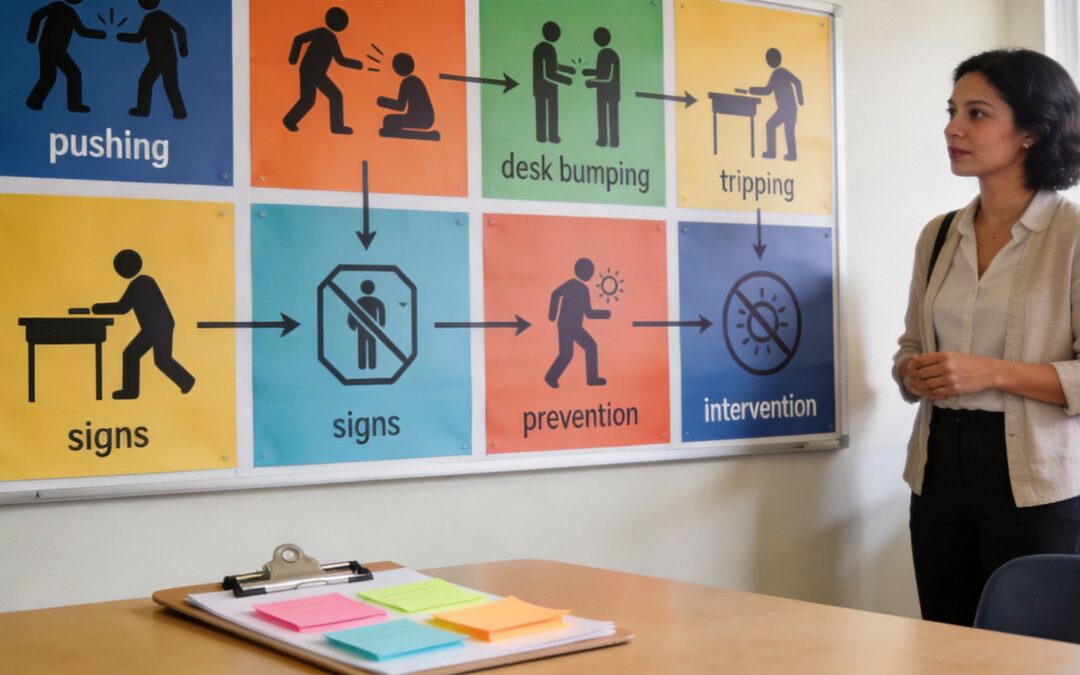
Here's a short visual resource that can support staff discussion during training meetings:

Signs adults can observe early

The first question is not just, “Did contact happen?” It is, “Who benefits from the confusion?” Rough play tends to be shared and stops when someone is uncomfortable. Bullying keeps one student in control and the other on alert.

Watch for these patterns:

  • Repeated loss of balance near the same peer: The same child stumbles, drops belongings, or arrives upset after passing one student or group.
  • Body language before contact: A student may tense up, slow down, hug the wall, or wait for others to go first.
  • Hot spots in transition spaces: Corners, bottlenecks, and crowded entry points make it easier to hide targeted contact.
  • Social fallout after the shove or trip: Snickering, glances between peers, or a chorus of “It was an accident” can signal coordination, not chance.

A useful adult question is: “If this were truly accidental, why does it keep happening to the same student in the same places?”

Prevention and response script

Prevention starts with supervision that matches the behavior. If adults only monitor the middle of a hallway, students learn to use the doorway, blind corner, or end of the line. Staff presence should move with the traffic pattern, much like crossing guards stand where collisions are most likely, not where the view is easiest.

Name the rule clearly before problems start. Students need to hear that using your body to move, block, or topple someone is physical bullying when it is repeated, targeted, or meant to intimidate.

Use language like this in the moment:

  • To stop the behavior: “Stop. Give each other space. I saw unsafe contact.”
  • To the targeted student: “Come with me. I want to check that you're okay and hear what happened.”
  • To the student who shoved or tripped: “You do not get to use your body to control someone else's movement. Tell me what you did.”
  • To witnesses: “If you saw the setup, tell me privately. Reporting safety concerns helps people stay safe.”

At home, caregivers can ask questions that uncover patterns instead of treating each incident as a random fall. Try, “Where were you right before it happened?” “Who was closest to you?” and “Has this happened with the same student before?”

That three-part response matters. Adults notice the signs, reduce risk in the places where it happens, and use calm, specific scripts that build accountability. That is how a “small shove” stops being brushed off and starts being addressed for what it is.

3. Spitting and Saliva-Based Attacks

A student gets to the classroom door, wipes their cheek with a sleeve, and says, “It's nothing.” An adult who misses that moment may miss the whole pattern. Spitting often happens fast, in public, and with just enough deniability to make a child doubt whether telling will help.

This form of physical bullying can leave little visible injury, but the impact is often intense. It violates personal boundaries and adds humiliation to the harm. For many students, that public disrespect is what lingers.

Spitting can happen in a lunch line, on a bus, across a table, or during a passing period when supervision is split between several directions at once. Shared spaces raise the risk because the behavior is quick and witnesses may laugh, freeze, or look away. The National Center for Education Statistics reports that students commonly experience bullying in places such as hallways, cafeterias, and classrooms, which helps explain why saliva-based attacks can be easy to carry out and hard to confirm without a prompt adult response (NCES report on student bullying locations).

What adults can watch for early

Students rarely announce this kind of harm directly. Shame often shuts the door before a child has words.

Look for signs that work like smoke before a fire becomes obvious:

  • Sudden cleanup behavior: wiping the face, shirt, backpack, or desk right after peer contact
  • A quick change in expression: disgust, freezing, or tearing up after laughter nearby
  • Avoidance of a specific seat or route: especially in lunch areas, bus seats, or crowded transitions
  • Peer audience behavior: laughing, recording, chanting, or gathering around the target
  • Minimizing language: “It was a joke,” “It's fine,” or “Don't tell anyone”

A targeted student may also ask to go to the bathroom immediately, stop eating, or become unusually quiet for the rest of the period.

Prevention that fits this behavior

Prevention needs to match how the behavior works. Spitting is opportunistic. It thrives in brief, public moments when adults are nearby but not tuned in.

Try these steps:

  • Cover high-risk transition points: stand where students bottleneck, turn corners, or bunch up while waiting
  • Teach the rule in plain language: tell students that spitting on a person or at a person is physical aggression and humiliation, not joking
  • Interrupt audience rewards: address laughing, filming, and crowding as part of the incident, because social payoff often keeps the pattern going
  • Create private reporting paths: some students will disclose on paper, by check-in, or after class more easily than in front of peers
  • Build repair into follow-up: consequences matter, and so do skills for impulse control, empathy, and respectful conflict

SEL-based response scripts adults can use right away

The first job is regulation. A child who has been spit on often feels exposed, angry, and ashamed at the same time. Adults help by lowering the temperature without lowering the seriousness.

Use language like this in the moment:

“Stop. Spitting on someone is physical aggression. I'm helping the student who was targeted first.”

For the targeted student:

  • Protect dignity: “Come with me. You do not need to explain this in front of other students.”
  • Restore control: “You can wash up now. I'll make sure you have privacy and support.”
  • Reduce self-blame: “This was done to you. You are not in trouble for reporting it.”

For witnesses:

  • Set responsibility: “If you saw what happened, tell me privately. Laughing or recording adds harm.”

For the student who spit:

  • Name the behavior: “You used your body to disrespect and humiliate someone.”
  • Prompt ownership: “Tell me exactly what you did.”
  • Set the next step: “You will be part of a follow-up process that includes accountability, repair, and a plan so this does not happen again.”

That three-part toolkit matters here. Adults need observable signs, prevention matched to the setting, and calm scripts that protect dignity while holding firm boundaries. Without that structure, spitting gets dismissed as a gross joke. With it, adults can identify the pattern early and respond with the seriousness it deserves.

4. Hair Pulling and Grabbing

Hair pulling is painful, sudden, and personal. In many schools, it appears during arguments, on the playground, in line, or as part of ongoing teasing about appearance. Some students describe it as feeling trapped, especially when the contact targets the head, scalp, or neck area.

For some children, hair has cultural, family, or identity significance. That means the harm isn't just physical. A student may feel exposed, disrespected, and singled out in ways adults miss if they focus only on whether there was a visible injury.

What makes this form especially distressing

A student may start avoiding hairstyles they normally love. They may become unusually protective of their head, refuse to sit near a certain peer, or react strongly when someone reaches behind them. Teachers sometimes notice this first during circle time, carpet work, or crowded transitions.

This is also a good place to remember a basic distinction. Bullying involves repetition and power imbalance. A one-time conflict between equally matched students still needs intervention, but repeated grabbing of one child by another is a different pattern. McMillen Health's explanation of physical bullying emphasizes those core features.

  • Observe appearance-based teasing: Hair pulling is often preceded by comments about texture, length, style, or grooming.
  • Ask in a low-pressure setting: Students may disclose more in a walk-and-talk than in a formal office meeting.
  • Document exact contact: “Grabbed braid,” “pulled ponytail,” or “held back of hood/hair” is more useful than “students got physical.”

Prevention and response script

Adults should interrupt immediately and avoid treating this as minor horseplay. Once hair is involved, many students experience the act as both pain and public control.

Try these scripts:

  • In the moment: “Hands off. Move back. Hair and head contact are not okay.”
  • To the targeted student: “I'm sorry that happened. Tell me where you were grabbed and whether this has happened before.”
  • To the student who grabbed: “You crossed a physical boundary. We'll address the harm and the pattern.”

A strong SEL response includes more than consequences. It teaches bodily boundaries, impulse control, and respectful repair.

5. Kicking, Stepping On, or Using Feet as Weapons

A kick under the table. A stomp on the heel in line. A student on the ground while another uses their feet to intimidate, strike, or pin space around them. These are some of the most alarming physical bullying examples because the force can be significant and the fear can spread quickly to bystanders.

In many schools, adults hear about these incidents after the fact because they happen during fast movement. Recess transitions, PE, dismissal, and crowded hallways create openings for this kind of aggression.

A student's backpack with loose papers left on a playground while someone walks away in the distance.

Why this form needs urgent attention

Kicking can signal escalation. Even when the visible injury looks small, the message is domination. Students who use their feet this way may also be testing how much they can get away with in spaces adults supervise loosely.

Global and U.S. patterns show physical bullying remains widespread. In a TIMSS analysis across 21 middle-income countries, bullying victimization increased from 2019 to 2023, with 4th graders reporting 56% and 8th graders 64%, according to the Center for Global Development analysis of TIMSS bullying data. Those figures include environments where physical aggression is part of the larger bullying pattern.

  • Look for targeted lower-body injuries: Shin bruises, stepped-on shoes, ankle complaints, and fear during line movement can all be clues.
  • Check group dynamics: A crowd closing in around the event often means intimidation is part of the act.
  • Assess environmental risk: Blind corners and loosely monitored exit points deserve immediate attention.

Prevention and response script

This kind of contact requires a high-alert response. Separate students, check for medical needs, and gather witness statements promptly. Don't let the situation get rewritten as “they were both playing” before facts are collected.

Use clear language:

“I saw unsafe contact with feet. Everyone step back. I need space, names, and witnesses now.”

Then move into support and accountability.

  • For the targeted student: “You're safe with me right now. Tell me where you were kicked or stepped on.”
  • For the aggressor: “Using your feet to hurt or intimidate someone is serious. We're addressing safety first, then responsibility.”
  • For the group: “Standing around, laughing, or surrounding someone makes the harm worse. If you saw it, your job is to report what you saw.”

6. Pinching, Scratching, and Skin-Targeted Attacks

This form often slips under adult radar because the marks can be small or fade quickly. A student pinches another under the lunch table. Someone scratches an arm during line-up. A child digs nails into a classmate when the teacher's back is turned.

Because the injury may not look dramatic, adults sometimes miss the pattern. The targeted student learns that reporting “small” pain doesn't get a big response. That silence gives the aggressor room to continue.

Small marks can still signal a big problem

Pinching and scratching are often deliberate, sneaky, and repeated. They can also overlap with relational aggression, especially when the aggressor smiles, whispers, or threatens the student not to tell. The physical act becomes one part of a larger control pattern.

A college case study on bullying described physical aggression as behavior that harms through physical damage or threats, and included severe incidents in unsupervised settings, as discussed in this collegiate bullying case study from Hanover College. While the setting is older, the lesson applies in K-8 schools: less visible forms of aggression often persist where adults assume nothing serious is happening.

  • Take every report seriously: Don't wait for a dramatic mark.
  • Invite specifics: Ask where on the body, when it happened, and whether the same student has done it before.
  • Track repeated complaints: “Keeps pinching me” matters even if each single incident seems minor.

Prevention and response script

Students need words for bodily boundaries. Many younger children can say “stop” but still need adult help to define what counts as harmful physical contact.

Try this language:

  • To the class or group: “If contact causes pain, fear, or humiliation, it's not a joke.”
  • To the targeted student: “Show me where it happened if you want to. I believe you, and I'm writing this down.”
  • To the aggressor: “Using your hands or nails to hurt someone in a hidden way is still physical bullying.”

Parents can support by noticing patterns at home. If a child says someone “always messes with me” but struggles to explain, ask whether that includes pinching, scratching, or quick painful touches others may not see.

7. Choking, Blocking Airways, and Neck-Targeted Violence

A recess aide turns and sees one student's forearm pressed across another child's neck near the play structure. A nearby group laughs because they think it is roughhousing. The child being held is not laughing. This kind of incident needs the same level of urgency adults would use for any breathing concern.

Choking, covering the mouth or nose, or putting pressure on the neck crosses far beyond ordinary conflict. Airway restriction can cause injury fast, and neck-targeted force can become dangerous before visible marks appear. For educators and caregivers, it helps to view this behavior as both a medical concern and a bullying concern. One response protects the body. The other protects the student's sense of safety at school.

What adults should look for

Observable signs are often easy to miss if adults expect a dramatic scene. A student may cough, gasp, hold their throat, cry without explaining why, or go unusually quiet after an incident. Some children avoid the cafeteria, bus line, locker room, or playground afterward because those are places where peers can corner them for a few seconds without much notice.

School avoidance can follow serious peer aggression. According to the CDC's 2023 Youth Risk Behavior Survey, many students report bullying at school, and many also report missing school because they felt unsafe. In a neck-targeted incident, fear often lasts longer than the physical contact itself.

A useful analogy for adults is this: pressure to the airway works like cutting off a fire alarm. The child's body reads immediate danger, even if the event is brief and even if peers dismiss it as a joke.

Prevention starts with fast adult recognition

Students need clear teaching that the neck, throat, mouth, and nose are off-limits in conflict and play. This should be stated plainly, not left inside a general rule like “keep hands to yourself,” which some children hear but do not fully apply during horseplay.

Prevention steps that help include:

  • Increase adult supervision in transition spaces, on playground edges, and in other spots where students cluster tightly.
  • Teach students to report breathing-related aggression right away, even if it lasted only a moment.
  • Correct joking language immediately. “I was just messing around” should not reduce the response.
  • Document location, students involved, witness names, and physical symptoms the same day.

SEL-based intervention script for staff and caregivers

Short, calm language helps because frightened students often cannot process long explanations.

  • In the moment: “Hands off. Step back. We are getting help now.”
  • To the targeted student: “I am with you. Breathe as comfortably as you can. We're going to the nurse.”
  • To witnesses: “Tell me only what you saw and heard, one person at a time.”
  • To the student who used force: “Pressure on the neck or blocking breathing is dangerous. You will be separated from this student now while we address safety.”

After the student is medically checked and regulated enough to talk, SEL support should focus on restoring predictability. Many children need a map for what happens next, just as they would after any serious scare.

  • Validate: “What happened was serious, and adults are taking it seriously.”
  • Name the safety plan: “Here is who you can go to, where you will check in, and how we will keep space between you and that student.”
  • Reduce performance pressure: “You do not need to tell the story perfectly right now. We can come back to details.”

For parents, one practical question can open the door: “Did anyone put hands near your neck, cover your mouth, or keep you from breathing comfortably?” Children do not always label that as choking, especially if peers called it playing.

8. Destruction of Property Paired with Physical Intimidation

A student reaches for their backpack and another child jerks it away, dumps the contents on the floor, and stands close enough that picking anything up feels unsafe. The broken item matters. The blocked body matters too. When damage to belongings is used to frighten, control, or corner a student, adults should treat it as physical bullying, not just a property issue.

This pattern often works like taking away a child's tools for belonging and learning at the same time. Glasses, lunch, headphones, class materials, medication pouches, mobility aids, and communication devices are not just objects. They help a student see, eat, participate, move, and stay regulated. If peers target those items while using physical presence, grabbing, crowding, or threats, the message is clear: “Your safety and access depend on me.”

Broken eyeglasses and a spilled lunch bag on a school floor with a student in the background.

What adults should look for

Students do not always report this directly. Some say they are “careless” or that they “lost” things. Others stop bringing valued items to school because avoiding the target feels safer than asking for help.

A National Center for Education Statistics report on student bullying shows that bullying remains a common school experience for students ages 12 to 18. In day-to-day practice, property intimidation can be easy to miss because adults see the torn notebook or broken glasses but not the body blocking the exit, the hand grabbing the bag, or the group closing in.

Watch for patterns such as these:

  • Repeated missing or damaged items: notebooks, pencils, lunch containers, jackets, chargers, or glasses come home broken or do not come home at all.
  • Avoidance around belongings: a student quits bringing favorite items, assistive tools, or needed school supplies.
  • Fear-based explanations: “It's fine,” “I dropped it,” or “I don't need it” said with visible tension.
  • Hot spot timing: losses that happen in hallways, buses, locker areas, cafeterias, or unsupervised transition times.
  • Bodily intimidation paired with damage: peers crowd the student, slap items away, stand over them, or prevent them from retrieving what was knocked down.

One useful question is simple and concrete: “Did someone touch your things while making you feel physically unsafe?” That wording helps children who would not use the word bullying but do recognize fear in their body.

Prevention and response script

Adults help most when they address the whole incident. Replacing a broken folder without naming the intimidation is like mopping up water while the faucet is still running.

Start with safety and access. Make sure the student can get through the school day with what they need, then document the object damage and the physical behavior that surrounded it.

Use clear language:

“Damaging or taking someone's things while using force, blocking, or threats is physical bullying. I am addressing the safety issue and the property loss.”

For the targeted student:

  • Reduce shame: “You did not cause this by bringing your things to school.”
  • Restore access: “Let's get what you need for class, lunch, or dismissal right now.”
  • Create predictability: “Here is where you can keep your belongings, who will check in with you, and what to do if someone comes near your things again.”

For the student who caused harm:

  • Name the behavior plainly: “You used another student's belongings to control and scare them.”
  • Connect action to impact: “That interfered with their learning, dignity, and sense of safety.”
  • Require repair: “You will be part of replacing or restoring the item, and you will follow a plan that keeps space and stops any further contact.”

For witnesses or peers nearby:

  • Coach bystander action: “If you see someone's things being grabbed or knocked down, get an adult right away. Do not join the crowd.”

This category deserves careful follow-up because the object is often only the surface. The deeper issue is power. When adults respond to both the damaged belonging and the intimidation around it, students learn that safety includes their body, their tools, and their right to participate in school without fear.

8-Point Comparison of Physical Bullying Examples

A quick chart can help adults sort out what they are seeing, but only if it answers the questions teachers and caregivers ask in the moment. What might this look like before it becomes obvious? What might a child say at home? What is my first goal in the first few minutes?

The table below works like a field guide. It does more than label the behavior. It helps adults notice early signs, respond with a clear first step, and choose language that protects safety and dignity.

Physical bullying example What a teacher might see What a parent might hear First response goal SEL-based script adults can use
Hitting, Punching, and Striking A student flinches when someone walks by, covers their face, or keeps unusual distance from one peer. You may also notice repeated "rough play" that only goes one way. "He keeps finding me at recess." "I don't want to go near the basketball court." "It was nothing, I just got hit." Stop contact, check for injury, and separate students without debate about blame in front of peers. "Hands are not for hurting. I am stopping this now. You will move with me, and we will sort out what happened once everyone is safe."
Pushing, Shoving, and Tripping One student gets knocked off balance in lines, doorways, stairs, or crowded transitions. The same child may start hanging back to avoid being near certain classmates. "I keep getting bumped." "They say it was an accident." "I don't want to walk in with them." Treat the body contact seriously, even if the student causing harm calls it a joke or accident. "A safe body keeps space. Whether it was called a joke or not, your body made school unsafe for someone else. We are fixing that now."
Spitting and Saliva-Based Attacks A student wipes their face or clothing, looks shocked, or suddenly goes quiet while nearby students laugh or recoil. Humiliation is often visible before details are shared. "Someone spit on me." "Don't make me go back." "Everybody saw." Protect dignity first. Move the student to privacy, help them clean up, and avoid making them retell the event in front of others. "What happened to you was not okay. Let's get you cleaned up and somewhere private, then I will handle the reporting and follow-up."
Hair Pulling and Grabbing A child reaches for another student's hair, hood, head covering, or backpack area near the neck. The targeted student may start changing hairstyles, seating spots, or routes through school. "They keep touching my hair." "She grabbed me from behind." "I don't want to wear my hair like this anymore." Stop the grabbing, name the boundary clearly, and recognize that this can also carry identity-based harm. "Your hands do not go on another person's hair, head, or clothing. That crossed a body boundary and a respect boundary. We are addressing both."
Kicking, Stepping On, or Using Feet as Weapons A student is kicked under a desk, stepped on in line, or cornered on the ground while others watch. Shoes may be used to dominate when adults are not looking directly. "They stomped on my foot on purpose." "He kicked me under the table." "I tried to move away." Check for pain or injury right away and interrupt any group dynamic that is turning one child into a target. "Feet stay on the floor and away from other people's bodies. I am checking for injury first, and you will not remain near this student right now."
Pinching, Scratching, and Skin-Targeted Attacks Small marks show up again and again. The student may struggle to explain them, especially if the harm happens in close quarters during centers, carpet time, or bus seating. "It didn't leave a big mark." "She keeps pinching me." "Nobody sees it happen." Take repeated low-visibility harm seriously before it becomes a pattern the child expects adults to miss. "Small injuries still matter. If someone keeps pinching or scratching you, that is not minor to me. I am documenting it and making a plan to stop it."
Choking, Blocking Airways, and Neck-Targeted Violence Hands near the throat, pressure on the neck, blocking the mouth or nose, or any report that a child could not breathe or speak normally. "He put his hands on my neck." "I couldn't breathe." "My throat hurts." Get immediate medical help and treat it as a high-danger event. Student safety comes before interviews or discipline discussions. "I am calling for medical support now. Anything involving breathing or the neck is treated as an emergency."
Destruction of Property Paired with Physical Intimidation A student's items are grabbed, thrown, stomped on, or hidden while the student is blocked, crowded, or threatened. Fear around the object matters as much as the object itself. "They took my stuff." "I couldn't get it back." "They broke it while I was right there." Restore access, reduce shame, and respond to the intimidation, not just the damaged item. "Your things should not be used to scare or control you. First, we are getting back what you need. Then I will address the force and the property damage together."

One useful pattern to remember is this: the less visible the injury, the easier it is for adults to minimize the behavior. Pinching, tripping, and stepping on feet often get brushed off because they can look small from across the room. For the targeted student, though, repeated low-level contact can feel like a dripping faucet. One drop may seem minor. Constant drops change how safe the whole room feels.

That is why a strong comparison chart should help adults notice, not just summarize. The best response is rarely complicated at first. Stop the behavior, protect the targeted student, use plain language, and follow up with the SEL tools that teach boundaries, repair, and accountability.

From Intervention to Prevention Building a Culture of Safety

Recognizing physical bullying examples is only the beginning. The deeper work is building a school culture where students know bodily boundaries matter, adults respond consistently, and peers understand that safety is a shared responsibility. Children are more likely to speak up when they trust that adults will stay calm, take action, and protect their dignity.

That means schools need more than a discipline policy on paper. They need shared language across classrooms, hallways, cafeterias, buses, and playgrounds. A student shouldn't hear one message from a counselor, another from a recess aide, and a third from a classroom teacher. Consistency lowers confusion and raises reporting.

Prevention also gets stronger when adults look beyond the visible injury. A shove, spit, or hair grab may last seconds. The impact can linger much longer in the form of dread, school avoidance, or constant scanning for danger. Students learn from adult reactions. When adults minimize patterns, students stop reporting. When adults notice, document, follow up, and teach repair, students begin to trust the system again.

SEL belongs at the center of that work. Empathy helps students understand harm. Self-regulation helps them pause before acting. Communication skills help them use words instead of force. Conflict resolution helps them handle frustration without turning another child into a target. None of that replaces accountability. It makes accountability more effective.

Schools can start with a few practical moves:

  • Teach clear definitions: Students should know the difference between conflict, rough play, and bullying.
  • Map hot spots: Review where incidents happen most often, especially transition spaces and loosely supervised areas.
  • Create easy reporting channels: Students need multiple trusted adults and simple ways to ask for help.
  • Follow through visibly: Without sharing private details, let students see that adults do act on reports.
  • Coach bystanders: Peers should know when to get help, what to say, and how to support the targeted student safely.

Families play a key role too. Parents and caregivers can ask specific questions, notice avoidance patterns, and partner with schools early. “Who were you with?” and “Has this happened before?” often open more useful conversations than “Was everything okay?”

A whole-school SEL approach can support this prevention work. Soul Shoppe is one example of an organization that helps school communities cultivate connection, safety, empathy, self-regulation, communication, and conflict resolution through experiential programming for students and adults. For schools trying to move from reactive discipline to a more preventive culture, that kind of support can be part of a broader safety plan.

When adults respond with clarity, warmth, and consistency, students learn an important truth. School is a place where harm is taken seriously, where repair is expected, and where every child's body deserves respect.


If your school or family is looking for practical SEL tools to prevent bullying and strengthen student safety, Soul Shoppe offers programs, workshops, and resources focused on empathy, connection, self-regulation, and conflict resolution.