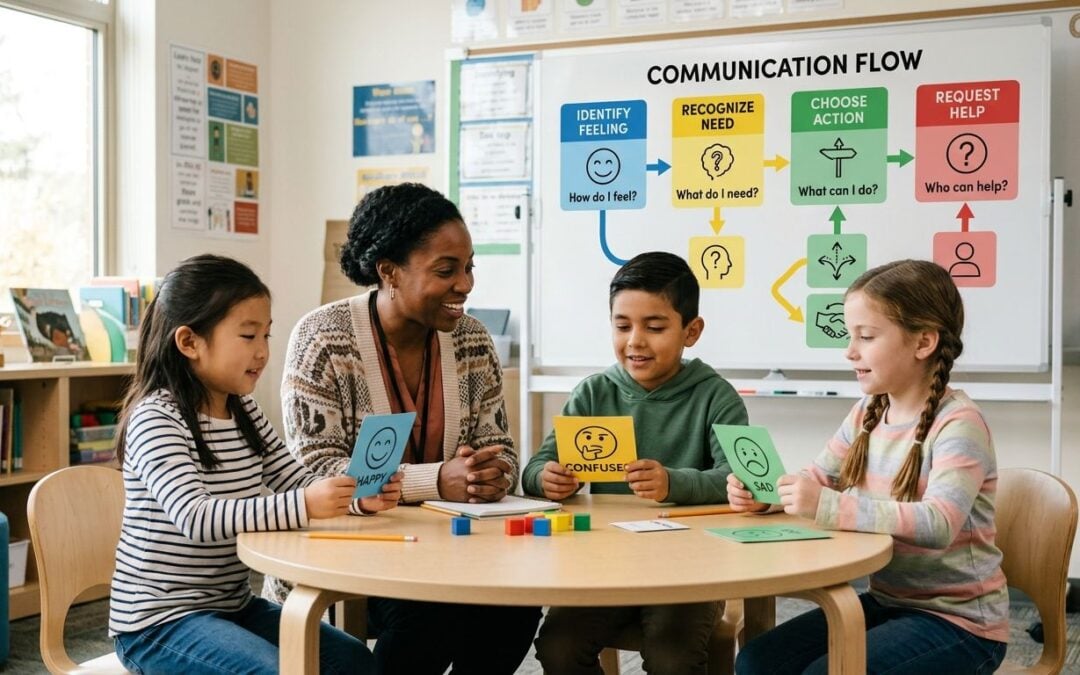
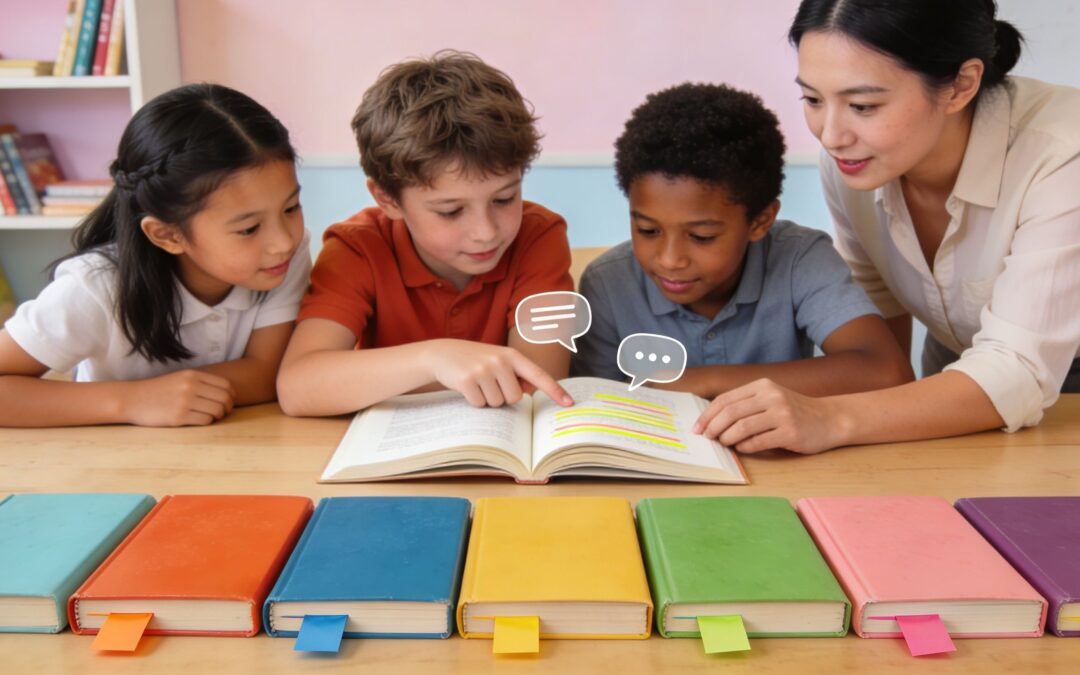
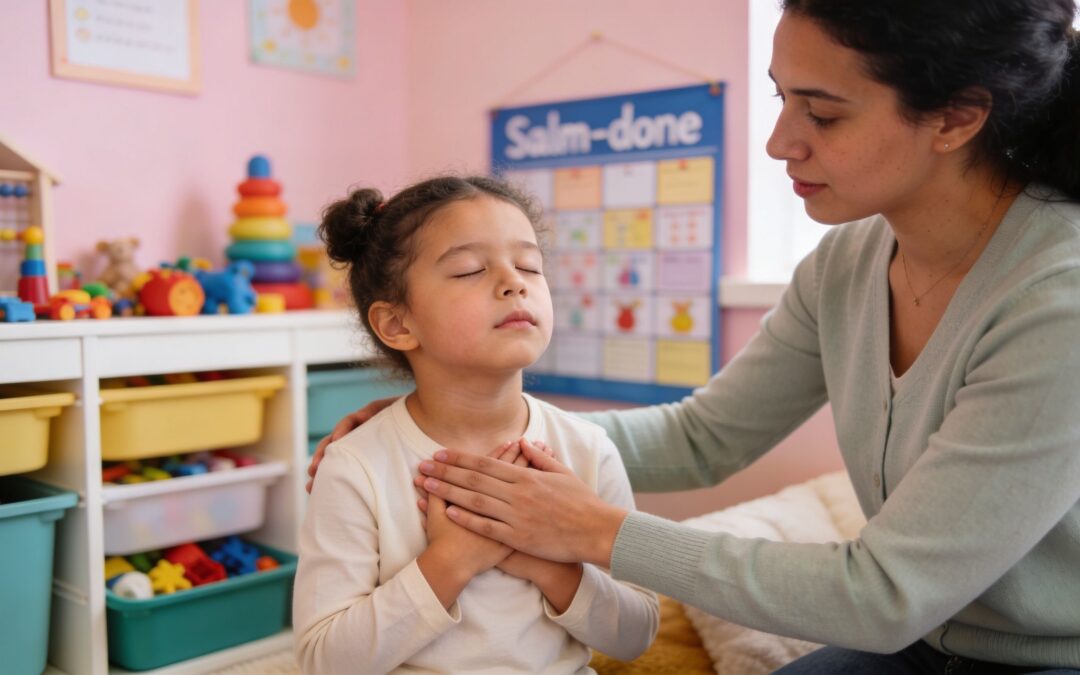
A child snaps, “You always ruin everything.” Another child fires back, “You never listen.” A teacher steps in, but the room is already tight with hurt feelings, crossed arms, and quick assumptions. Most adults who work with kids know this moment well. It happens over shared supplies, partner work, recess games, seating choices, and group chats that spill into the school day.
An i message gives children a more useful way to speak from their own experience instead of attacking someone else. That shift matters in classrooms, counseling offices, after-school programs, and homes. It helps kids name feelings, ask for what they need, and stay connected even when they're upset.
This is especially relevant because children communicate both in person and online. iMessage itself is one of the largest proprietary messaging platforms in the world, with an estimated 1.3 billion users globally in 2022, according to SignHouse's iMessage statistics summary. That doesn't mean every conflict happens on Apple devices, but it does highlight how normal device-based communication has become for families and students. If you're also working on stronger trust and belonging in your classroom, this building relationships with students playbook pairs well with the language tools below.
1. I Feel and I Felt Statements for Emotional Expression
Most adults start with “I feel…” because it's the clearest entry point. When a child can say what they felt, the conversation slows down. The focus moves from blame to experience.
A simple frame works well: “I feel ___ when ___.”
That sentence is short enough for younger students and flexible enough for older ones.
Classroom examples that sound natural
Instead of “You made me mad,” try:
Shared supplies: “I felt frustrated when you took my pencil without asking.”
Exclusion at recess: “I felt hurt when you didn't include me in the game.”
Group work: “I felt lonely during group work when no one responded to my ideas.”
These are strong i message examples because they name an emotion and connect it to a specific event. They don't attack the other child's character.
Practical rule: If the sentence starts to sound like blame in disguise, pause and replace judgment words with feeling words.
Children often default to three emotions: mad, sad, and happy. That's a start, but it's not enough for many real conflicts. A child who says “mad” might feel embarrassed, left out, worried, ignored, disappointed, or overwhelmed.
How adults can coach this skill
Use visual supports, sentence stems, and regular modeling. During calm moments, practice with low-stakes situations like losing a turn, waiting in line, or hearing “not yet.” A feelings chart or wheel can help children choose more accurate words, and naming feelings with kids can give adults more language to scaffold that process.
A few coaching moves help:
Validate first: “I hear that you felt hurt.”
Get specific: “What happened right before that feeling?”
Refine gently: “Was it angry, or more disappointed?”
When children can say what they feel, they're less likely to show it through yelling, shutting down, or blaming.
2. I Need Statements for Boundary Setting and Self-Advocacy
Some children can identify a feeling but still don't know what to do next. That's where “I need…” becomes powerful. It turns emotion into direction.
An effective frame is: “I need ___ so I can ___.”
This helps children speak clearly without demanding control over everyone else.
Useful scripts for school and home
A child who's overloaded by noise might say, “I need a quieter workspace so I can concentrate on my math.”
A student who's confused can say, “I need help understanding this before we move forward.”
A child nearing dysregulation might say, “I need a break right now so I can reset my feelings.”
Those are practical i message examples because they're concrete. Adults and peers can respond to them.
Some children need support learning the difference between a need and a want. “I need everyone to stop talking forever” isn't a workable need. “I need less noise” is.
What healthy boundaries sound like
Boundary language should be firm and respectful. It doesn't need an apology attached to it. Many children, especially children who try hard to please adults, benefit from hearing that it's okay to ask for space, help, time, or clarification.
Try coaching with prompts like:
For sensory needs: “I need less noise.”
For learning support: “I need another example.”
For emotional regulation: “I need a minute.”
For personal space: “I need you to stop touching my backpack.”
Kids don't need perfect wording. They need repeated chances to say what they need before their body says it for them.
Adults can reinforce this through routines such as break cards, quiet corners, or help signals. For more ways to teach this explicitly, boundary activities for children can support both classroom and home practice.
3. I Notice and I Observe Statements for Perspective-Taking and Feedback
"I notice…" is especially helpful when a child wants to talk about behavior without making assumptions about motive. This style lowers defensiveness because it sticks closer to what happened.
That matters in conflict. “You were rude” invites an argument. “I noticed you turned away when I came over” invites clarification.
Observation before interpretation
Teach students to describe what they saw or heard, not the story they instantly told themselves.
For example:
Lunch table: “I noticed you turned away when I tried to sit with you at lunch.”
Whole-class reminder: “I noticed the volume increased and people weren't raising hands.”
Peer concern: “I observed that several students didn't respond when you joined the group.”
These examples create room for a reply like, “I didn't hear you,” or “We thought you were still talking to someone else.” Not every hurtful moment is a misunderstanding, but many are.
A useful prompt is, “What did you notice with your eyes or ears?” That helps children separate fact from interpretation.
Here's a short teaching video you can use to reinforce calm communication language:
One practical pause question can help in heated moments: “Am I trying to teach, or am I trying to unload my anger?” That question creates just enough space to choose correction over humiliation.
Private correction is especially helpful at school. At home, a lowered voice often works better than a louder one. Children remember the emotional climate of correction long after they forget the exact words.
6. Isolation and Relationship Withdrawal as Punishment
Some authoritarian parenting examples use distance as discipline. A parent stops talking to the child for days. A child is excluded from family activities until they “earn” their way back in. A student is frozen out of a group to make a point.
This is more than a consequence. It turns connection itself into a weapon.
What the child often feels
Children depend on belonging. When adults withdraw relationship after conflict, many children feel panic, shame, or deep insecurity. They may not think, “I need to repair this behavior.” They may think, “I'm alone. I'm unwanted. I'm only accepted when I'm easy.”
That is a heavy lesson. It can also resemble relational aggression, the same kind of exclusion adults often tell children not to use with peers.
Belonging should never depend on perfect behavior.
This doesn't mean there should be no consequences. It means consequences should happen inside a relationship, not through the removal of the relationship.
Connected accountability
A connected response sounds different. “I'm upset, and we need to talk later when we're calm” is very different from silent treatment. “You can't join the game right now because you were hurting others, but I'm going to help you get ready to rejoin” is very different from exclusion with no path back.
Try these replacements:
Instead of silence: “I need ten minutes to cool down, then we'll talk.”
Instead of banishment: “You're taking a break from the group, and I'll check in with you soon.”
Instead of rejection: “What you did isn't okay. You still matter, and we're going to repair it.”
In schools, supervised re-entry matters. A child who loses access to a shared activity should also hear what skill they need to show in order to return safely.
Children can tolerate limits much better than they can tolerate feeling abandoned.
7. Dismissal of Emotions and Invalidation of Feelings
A child is already upset. Their face tightens, their body gets louder, and they hear, “Stop crying,” “You're fine,” or “That's not a big deal.” In that moment, the adult is often trying to shut the storm down fast. The problem is that children do not learn calm by having their feelings argued with. They learn calm when an adult helps them recognize the feeling, hold the limit, and move through it.
This authoritarian pattern shows up when an adult treats emotion as disobedience, weakness, or inconvenience. The message underneath is easy for a child to absorb. “Your feelings are too much.” “Your experience is wrong.” “Keep it inside.”
What the child often feels
Invalidation can make children doubt their own inner signals. Over time, some stop saying what they feel because it does not seem to matter. Others show feelings more intensely because the emotion has not been understood or organized.
That is why this pattern is so important to catch early.
Feelings work like dashboard lights in a car. The light is not the whole problem, but it tells you something needs attention. Covering the light does not fix the engine. In the same way, dismissing emotion may quiet the moment for a minute, but it does not teach self-awareness, regulation, or problem solving.
There is an important distinction here. Validating a feeling does not mean agreeing with every conclusion or allowing every behavior. A child can feel furious and still be expected to keep hands safe. A student can feel overwhelmed and still complete work with support. The goal is to respond to the emotion without surrendering the boundary.
A clearer, more compassionate alternative
An SEL-based response has three parts. Notice the feeling. Name it clearly. Hold the limit or offer support.
A parent might say, “You're really upset that screen time ended. I can see that. It's okay to feel mad. I'm not letting you throw the tablet.”
A teacher might say, “You seem nervous about this test. Let's slow your body down first, then we'll figure out what feels hardest.”
These responses do two jobs at once. They protect the relationship, and they build emotional literacy. Children begin to learn, “My feelings make sense. My actions still matter.”
Scripts adults can use right away
Instead of: “Stop being dramatic.” Try: “Your feelings are strong right now. Let's put words to them.”
Instead of: “There's nothing to be upset about.” Try: “It feels upsetting to you. Tell me what part is hardest.”
Instead of: “Get over it.” Try: “You're still hurting. I'm here, and we can work through it.”
Instead of: “Calm down.” Try: “I'm going to help your body settle. Breathe with me once.”
“I believe your feeling, even when I can't change the limit.”
Children usually cooperate more easily when they feel understood first. Seen feelings settle faster than rejected ones.
8. Unrealistic Expectations and Perfectionistic Standards
Some children live under standards they can't realistically meet. A young child is expected to perform academically beyond developmental readiness. A solid effort is dismissed because it wasn't flawless. A “B” is treated like failure. A child athlete is pushed toward elite performance despite low interest or clear stress.
This is authoritarian parenting when expectations stay rigid, mistakes are not tolerated, and the adult's response is dominated by pressure rather than support.
What the child often feels
Children under perfectionistic pressure often become afraid to try unless success is guaranteed. Some overwork constantly. Others avoid challenges because mistakes feel humiliating.
You can usually hear the internal story forming. “If I'm not the best, I'm disappointing people.” “If I can't do it perfectly, I shouldn't do it at all.”
High standards without perfectionism
Healthy expectations are clear, age-appropriate, and paired with coaching. Perfectionism demands outcomes without enough room for growth.
A more balanced adult response includes:
Effort-based feedback: “You used a new strategy and stuck with it.”
Developmental realism: “This skill is still emerging. Practice is the expectation, not mastery overnight.”
Normalizing mistakes: “Errors show me what to teach next.”
For teachers, this could sound like: “I'm looking for progress, not perfection.” For parents: “I care that you prepared, asked questions, and kept going. We can improve the result together.”
Children need to experience challenge. They also need repeated proof that mistakes do not end belonging. When adults hold high expectations with empathy, children are much more likely to develop resilience instead of fear.
Authoritarian Parenting: 8-Point Comparison
Approach
Implementation complexity
Resource requirements
Expected outcomes
Ideal use cases
Key advantages
Strict Rule Enforcement Without Explanation
Low, easy to implement consistently
Low, minimal training/time
Short-term compliance; long-term reduced autonomy and trust
Short, emergency situations requiring immediate order; otherwise not recommended
Provides clear boundaries and predictability
Punishment-Based Discipline Without Restorative Practices
Low, straightforward punitive actions
Low–moderate, consistent enforcement needed
Immediate behavior suppression; long-term fear, damaged relationships, no skill-building
Rare, safety-critical incidents where immediate deterrence is required
Quick behavioral cessation; simple to apply
Conditional Love and Approval Based on Achievement
Very limited, short-term boundary enforcement in severe cases
Enforces consequences using social leverage
Dismissal of Emotions and Invalidation of Feelings
Low, readily practiced in conversation
Low, requires no special resources
Immediate reduction in visible emotion; long-term poor emotional literacy and shame
None recommended; sometimes used to discourage excessive expression in specific contexts
May appear to create emotional toughness short-term
Unrealistic Expectations and Perfectionistic Standards
Moderate, sustained high demands and monitoring
High, ongoing pressure, oversight, possible extra services
Short-term high performance for some; long-term anxiety, avoidance, decreased motivation
High-stakes environments where performance is prioritized (developmental risk)
Can drive elevated achievement temporarily
From Control to Connection Choosing a More Empowering Path
Recognizing authoritarian patterns can feel uncomfortable, especially if you see some of your own stress responses in these examples. That doesn't mean you've failed. It usually means you're trying to create order, safety, or success, but the methods have drifted toward fear, rigidity, or disconnection.
The encouraging news is that the alternative isn't permissiveness. Children still need limits. Students still need routines. Families still need structure. The healthier shift is toward an authoritative style that combines firmness with warmth, explanation, and respect.
That shift often starts with small language changes. Explain the reason behind a rule. Validate the feeling before correcting the behavior. Offer structured choices instead of controlling every detail. Replace shame with accountability. Use consequences to teach repair, not just obedience. These are SEL skills in everyday form, and they work at home, in classrooms, and across school communities.
For educators, these patterns matter because the effects often show up in school first. You might see withdrawal, peer conflict, perfectionism, shutdown, aggression, or difficulty making independent decisions. Those behaviors can be easy to misread as laziness, defiance, or lack of motivation when they may reflect a child's experience with high control and low emotional safety.
For parents, it helps to remember that connection is not the opposite of authority. Connection makes authority more effective. A child who feels respected is more likely to listen, repair, and internalize values. A child who feels safe enough to talk is more likely to develop judgment, emotional literacy, and self-regulation.
If you're supporting children in a school or home setting, it may help to pair this work with practical SEL tools and community support. Soul Shoppe is one option that offers programs and resources focused on connection, safety, empathy, communication, and conflict resolution for school communities and families. If you're also thinking about age-appropriate autonomy, these expert-backed toddler independence strategies add a useful developmental lens.
Children don't need adults who never make mistakes. They need adults who can repair, reflect, and lead with both clarity and care. That is what helps them grow into resilient, emotionally intelligent people who can follow rules when needed, think for themselves when it counts, and stay connected through conflict.
If you want practical SEL support for families, classrooms, or whole-school communities, explore Soul Shoppe. Their resources and programs focus on communication, self-regulation, empathy, and conflict resolution, which can help adults move from control-based discipline toward connection-based guidance.
You can spot the need for a bullying lesson before a child names it. A student who usually joins every partner task asks to work alone. Recess conflict follows the class back inside. Someone stumbles over a word during read-aloud, a few kids laugh, and the room tightens.
Stories help because they give children enough space to talk about hard behavior without forcing anyone to disclose more than they are ready to share. They also help adults slow down and teach the skills that often get skipped in the moment: how to recognize repeated harm, how to respond as a bystander, how to ask for help, and how to repair harm when possible.
Bullying needs that kind of direct instruction. It is not the same as a single conflict or one rude comment. Children do better when adults teach the difference clearly and revisit it through discussion, modeling, and practice.
This guide goes beyond a simple book list. Each title is framed as a mini-lesson plan you can use right away, with a clear SEL focus, discussion prompts that lead to real conversation, extension ideas for classroom or home use, and notes that help teachers handle identity, belonging, and inclusion with care.
That practical piece matters. Some books open rich conversation but need adult coaching to turn insight into changed behavior. Others offer clearer language for younger students but leave less room for nuance. The strongest classroom picks do both well enough for your group, your time frame, and the kind of bullying concerns showing up in your setting.
1. FREE TO BE THE BOOK by Soul Shoppe
If you want one book that bridges school language and home follow-through, start with FREE TO BE: THE BOOK from Soul Shoppe. This is the most directly usable title on this list for adults who need words to say in the moment, especially when a child has experienced bullying and doesn't yet know how to explain what happened.
What stands out is the tone. It doesn't talk at children or panic adults. It gives compassionate language, practical tools, and simple ways to coach self-regulation, empathy, communication, and conflict resolution. That makes it especially useful when a school is trying to keep the same SEL messages alive after dismissal.
Best fit and trade-offs
This is the featured pick because it works in the space where many bullying books fall short. Plenty of books spark discussion. Fewer help a caregiver turn that discussion into repeatable practice the next morning, in the car, or after a hard recess.
Its biggest strength is also its limit. This is a guided support book, not a full intervention system. In serious bullying situations, adults still need school response protocols, counseling support when appropriate, and direct follow-up.
Best for home-school alignment: A counselor can read part of it with a student, then send a concrete takeaway home for the family to use.
Best for adults who want scripts: If a child says, “They keep doing it and I don't know what to do,” adults can move from reassurance to coaching.
Less ideal as a child-only independent read: Younger students will get more from it when a grownup pauses, models, and practices with them.
Practical rule: If a bullying book gives insight but no language for what to say next, it usually won't change behavior on its own.
A simple classroom-to-home example is a “pause, name, choose” routine. After reading, ask a child to name what happened, identify the feeling, and choose one next step such as asking for help, using an assertive statement, or moving toward a safe peer. In family use, a caregiver might practice: “I didn't like that. Please stop,” followed by, “I'm telling an adult because it kept happening.”
Mini-lesson you can use tomorrow
Use this with small groups, a counseling check-in, or a parent workshop.
SEL takeaway: Kids need both emotional safety and usable language.
Discussion prompt: “What is the difference between being upset once and something that keeps happening?”
Example response: “If someone bumps me by accident, that's one thing. If they keep calling me a name after I ask them to stop, that's different.”
Extension activity: Create a two-column chart called “Feelings I Notice” and “Words I Can Use.” Fill it with student-friendly phrases.
Diversity and inclusion note: Invite examples from different settings, including lunch, sports, online spaces, and sibling or peer groups. That helps children who don't see their experience reflected in a typical playground story.
For families who want a book that supports practice instead of stopping at awareness, this is the most functional choice on the list.
2. Wonder by R. J. Palacio
Wonder by R. J. Palacio works because it doesn't flatten bullying into heroes and villains. Students see social pressure, embarrassment, loyalty, exclusion, and growth from multiple perspectives. That's why it holds up in grades 4 through 6 and in schoolwide reading projects.
The trade-off is length. At 320 pages, it's not the quickest option for a busy class, and some readers need scaffolds such as partner reading, audio support, or chapter checkpoints. But if you can stay with it, the payoff is strong discussion around bystanders and school culture.
Where it works best
This is a strong fit for advisory, literature circles, or a class that needs to move beyond “be nice” language. It lets students examine how peer groups shape behavior. That's especially useful because bullying often involves witnesses, defenders, and reinforcers, not only the child doing harm and the child being targeted, as the American Federation of Teachers notes in its bullying prevention booklist for students.
The best conversations with Wonder usually start when students talk about what bystanders saw and why they stayed quiet.
Try this sequence after a read-aloud excerpt or chapter assignment:
SEL takeaway: Perspective-taking changes behavior.
Discussion prompt: “When does staying neutral become joining in?”
Example response: “If I laugh because I don't want attention on me, I still helped the teasing continue.”
Extension activity: Have students write a short scene from the point of view of a bystander who decides to act differently the second time.
Diversity and inclusion note: Keep the focus on dignity, belonging, and visible difference without asking any student to represent a condition or identity group.
A practical caution. Don't rush to a “choose kindness” poster before students wrestle with the harder part, which is social risk. Ask, “What makes it hard to defend someone when your own status might drop?” That's where the essential SEL work happens.
3. Each Kindness by Jacqueline Woodson
Each Kindness is one of the most effective books for teaching that exclusion hurts, even when nobody shouts or threatens. That's its special strength. Many children can recognize obvious teasing. Fewer can spot quiet social rejection as harmful behavior.
The ending is somber, and that's exactly why the book works. It doesn't offer a neat apology scene that lets the class move on too fast. Students have to sit with regret, missed chances, and the fact that kindness delayed can become kindness denied.
Best lesson angle
Use this title when your class is dealing with subtle meanness, friendship circles, or “we didn't do anything” behavior. It also works well for restorative circles because it invites reflection without immediately forcing confession.
SEL takeaway: Exclusion is an action, not an absence.
Discussion prompt: “What did Chloe do that looked small but had a big effect?”
Example response: “She didn't say the worst words, but she kept letting Maya be alone.”
Extension activity: Use a pebble-and-water metaphor. After reading, students name one small action that can create a ripple of belonging, such as saving a seat, inviting a partner, or using someone's name kindly.
Diversity and inclusion note: This book opens strong conversations about class, clothing, belonging, and assumptions. Keep students focused on observed actions rather than judging a character's worth.
The common mistake with Each Kindness is turning it into a generic “be kind” bulletin board. Better move: ask students to identify one repair action they can take this week when they notice someone on the edge of the group.
4. New Kid by Jerry Craft
Some bullying books lose older elementary readers because they feel too obvious. New Kid by Jerry Craft avoids that problem. The graphic novel format pulls students in fast, and the social dynamics feel current enough for upper elementary and middle school conversations.
This book is especially useful when bullying overlaps with bias, microaggressions, and belonging. Those situations often confuse adults because the harm may be denied, joked away, or framed as “not a big deal.” New Kid helps students examine impact without making the lesson feel like a lecture.
Why it fills an important gap
A content analysis of selected bullying picture books found that 71% targeted Preschool through Grade 3, while 29% targeted grades 4 through 8 in the Athens Journal of Education study on bullying picture books. That's one reason books like New Kid matter so much in practice. Older students still need accessible SEL texts, but they often need formats that respect their developmental stage.
Middle-grade students usually respond better when the book lets them notice social patterns on their own, then gives adults room to guide the conversation.
Try a panel analysis mini-lesson. Ask students to choose one illustrated scene and answer three questions: What happened? What message did the character receive? What could a peer do next?
SEL takeaway: Harm isn't always loud.
Discussion prompt: “How can a comment be framed as a joke but still isolate someone?”
Example response: “If everyone laughs and one person feels singled out, the joke may still be harmful.”
Extension activity: Have students create a short comic showing an upstander response in the cafeteria, hallway, or group project.
Diversity and inclusion note: Set norms before discussing race, class, and identity. Students need permission to talk openly without putting classmates on display.
This is one of the best bullying books for children who are old enough to notice layered social behavior and young enough to still benefit from concrete guided discussion.
5. Chrysanthemum by Kevin Henkes
For early grades, Chrysanthemum by Kevin Henkes remains one of the most teachable choices because the problem is immediately clear. Children understand name-based teasing. They also recognize how fast a joke about a name can turn into a class norm.
This is a short read-aloud, which makes it ideal for back-to-school routines or a quick reset after an unkind incident. The limitation is that older students may find it too simple unless you pair it with identity, belonging, or name-story writing.
A strong primary-grade mini-lesson
Many students first experience peer harm through words about their name, voice, clothes, or family. Chrysanthemum gives teachers a direct way to say that names deserve respect.
SEL takeaway: Respect starts with how we speak to and about one another.
Discussion prompt: “What should you do if you hear someone making fun of a name?”
Example response: “I can say, ‘We don't do that here,’ or I can go with the person and tell the teacher.”
Extension activity: Create a class “Names Matter” gallery. Students share the story of their name, who chose it, or what they like about it. If a child doesn't know the story, they can share a nickname they value or how they want their name pronounced.
Diversity and inclusion note: This book is especially helpful for affirming multilingual names, family traditions, and pronunciation respect.
National Bullying Prevention Month each October has helped schools normalize curated reading lists across age groups, and a KPBS recommended reading list for National Bullying Prevention Month shows how the field now spans preschool through high school. Chrysanthemum earns its place on the early-grade end because it gives very young children a concrete first lesson in dignity.
6. Confessions of a Former Bully by Trudy Ludwig
Confessions of a Former Bully is one of the few titles on this list that doesn't only center the child being hurt. That's valuable. In real schools, prevention gets stronger when students can examine the behavior of the aggressor, the social rewards around that behavior, and the possibility of repair.
Because it's told from the bully's perspective and includes back matter with practical strategies, this book works well in counseling groups, Tier 2 supports, and guided classroom lessons. It's less effective as a casual read-aloud for very young students because the discussion benefits from more emotional and social maturity.
When to choose this over a gentler title
Use this when your group needs direct language about responsibility, change, and social consequences. It helps children understand that harmful behavior isn't fixed identity. That's often a more productive frame than labeling a child and ending the conversation there.
A practical routine is a three-part reflection:
SEL takeaway: Accountability and empathy can be taught together.
Discussion prompt: “What is the difference between feeling sorry and repairing harm?”
Example response: “Saying sorry is a start. Repair means changing what I do and making things safer for the other person.”
Extension activity: Students complete a private reflection with three stems: “I notice…,” “I own…,” and “I can do differently by….”
Diversity and inclusion note: Keep the lesson behavior-focused. Don't invite classmates to identify a “real bully” in the room.
A major reason this matters is prevalence. A 2025 systematic review and meta-analysis pooling 116 studies and 603,231 participants estimated that 25% of children and adolescents are bullying victims, 16% are perpetrators, and 16% are bully-victims in the PubMed record for the bullying prevalence meta-analysis. In practice, that means your class discussion can't only speak to targets. It also needs language for students who caused harm, joined in, or watched.
7. The Juice Box Bully by Bob Sornson and Maria Dismondy
If your goal is to move a class from bystander language to shared group norms, The Juice Box Bully is the fastest starter on this list. It gives younger students a simple classroom promise and a direct story line they can remember when a real incident happens.
The trade-off is subtlety. This book is more didactic than literary. That isn't always a bad thing. In grade 1 through grade 3, directness can help. But students usually need role-play or class practice to transfer the message into real behavior.
A good pick for class meetings
This title shines when you want a short lesson with immediate follow-through. Read the book, build a class agreement, and rehearse what “standing up for others” sounds like.
“Don't stay silent” only works when children also know what words to use and who can help.
Try these after the read-aloud:
SEL takeaway: Classroom safety is a shared job.
Discussion prompt: “What can you say when you see someone being left out or picked on?”
Example response: “You can sit with us,” “That's not okay,” or “Let's get help together.”
Extension activity: Create a class pledge and practice it with scenario cards. Example: “A student is mocked for spilling water.” “A group says someone can't join a game.” “A child is targeted in a class group chat.” Students choose a safe response, then rehearse it.
Diversity and inclusion note: Include scenarios about exclusion, language differences, disability, online group chats, and friendship groups so students don't think bullying only happens in one obvious form.
This bystander focus matters because books often over-index on individual targets. In schools, the social climate changes faster when peers know how to interrupt harm together.
7-Book Comparison: Bullying Books for Children
Book
Implementation complexity
Resource requirements
Expected outcomes
Ideal use cases
Key advantages
FREE TO BE: THE BOOK, Soul Shoppe
Low, requires adult facilitation for practice
Single affordable paperback; caregiver/educator facilitation
Practical SEL skills: empathy, self‑regulation, conflict coaching
Family read‑alouds, at‑home coaching, complement to school SEL
Research‑based tools, concrete tips, accessible for families
Wonder (R. J. Palacio)
Moderate, works best with planned schoolwide or classroom rollout
Full novel (print/audio/ebook), time to read, educator guides
Deep empathy, inclusive culture conversations, sustained discussion
One School One Book, grades 4–6, advisory lessons
High engagement, extensive teacher resources, proven impact
Each Kindness (Jacqueline Woodson)
Low, short read; requires sensitive facilitation for somber ending
Picture book, optional publisher discussion guide
Increased awareness of exclusion and missed kindness opportunities
From Page to Practice Creating a Bully-Free Culture
A student gets laughed at during morning meeting for saying a classmate's name wrong. By lunch, three children are repeating the joke, one child is silent and uncomfortable, and the target has stopped participating. That is the moment when a book matters, but only if the class already knows what to do next.
Books support culture when they are tied to repeatable practice. A single read-aloud can build awareness. Culture shifts when students rehearse the same skills across the week, in class meetings, partner talk, recess repair, and family communication. Children need clear language for empathy, assertive responses, bystander action, and help-seeking before stress takes over.
Consistency across adults matters just as much. If one adult says “be kind,” another says “ignore it,” and another says “tell an adult,” students get three different directions for the same problem. In schools I support, the strongest results come from a shared script, a visible routine, and a short follow-up after incidents. That trade-off is real. It takes more planning on the front end, but it reduces confusion later.
Each title on this list works best as a mini-lesson, not a one-time message. After Chrysanthemum, teach students to ask and repeat a peer's name correctly, then practice it in pairs. After Each Kindness, set one class inclusion goal for the week and revisit it on Friday with examples of what students noticed. After Wonder, role-play two bystander lines students can say, such as “That's not funny” or “Come sit with us.” After The Juice Box Bully, create a class promise and use it during conflict repair instead of leaving it on the wall as decoration.
Some books need more teacher setup. New Kid opens strong conversations about bias, belonging, and microaggressions, but students need discussion norms before they can talk about those moments well. Confessions of a Former Bully is especially useful when a student needs accountability with dignity, because it gives adults a way to teach repair, not just apology. FREE TO BE THE BOOK extends well into home-school partnership work when families are given one simple script to reinforce.
The point is not to find one perfect anti-bullying title. Build a shelf with different jobs. Keep one book ready for exclusion, one for identity and belonging, one for bystanders, one for repair, and one for family follow-through.
That is how stories start doing classroom work.
If you want support beyond individual book lessons, Soul Shoppe offers practical SEL resources, experiential programs, and family-friendly tools that help school communities build the shared language children need to reduce bullying, strengthen empathy, and create safer classrooms every day.
A child is halfway through math when the pencil snaps. He shouts, pushes the paper away, and folds into tears. A teacher might see refusal. A parent might hear, “He knows better than this.” But in that moment, the more useful question is simpler. What skill is missing right now, and how can an adult help build it?
That question changes everything about how to have self control, especially for kids. It moves us away from labeling children as “good,” “bad,” “easy,” or “difficult,” and toward teaching, practicing, and supporting a developmental skill. Self-control grows in relationships, routines, and environments that make regulation possible.
Adults need that reminder too. Most children don't learn self-control because someone told them to “try harder.” They learn it because caring adults reduce overwhelm, name what's happening, model calm, and give them tools they can use when emotions spike.
Why Self-Control Is More Than Just Good Behavior
A child blurts out again during read-aloud. Another grabs materials instead of waiting. Another falls apart when it's time to clean up. These moments often get treated as behavior problems first.
Often, they're skill problems first.
Self-control is a teachable life skill
Self-control is not the same thing as blind obedience. It includes pausing, noticing an impulse, tolerating frustration, managing a strong feeling, and making a more helpful choice. That's why it belongs in the same conversation as reading, writing, and problem-solving. Children need instruction, practice, feedback, and support.
A major reason this matters is that self-control reaches far beyond classroom compliance. A 40-year study of 1,000 children in New Zealand found that childhood self-control was one of the strongest predictors of adult outcomes. Children in the top fifth for self-control had crime conviction rates of 13% versus 43% for those in the bottom fifth, and those patterns held regardless of initial intelligence or family socioeconomic status, as summarized in this American Scientist review of the Dunedin study.
That finding should shift the tone adults use. When we help a child wait, reset, recover, and choose again, we aren't only managing today's moment. We're strengthening a lifelong capacity.
Practical rule: Treat self-control lapses as information. They tell you where a child needs structure, modeling, or co-regulation.
What this looks like in real life
In practice, children often need adults to separate the feeling from the action.
A frustrated student can be upset without throwing supplies. The adult job is to help the child feel the feeling and contain the behavior.
A child can want to interrupt and still learn to pause. That pause usually begins with cues, routines, and repeated practice.
A child can struggle with transitions and still be capable. Needing support during change doesn't mean the child is manipulative.
This reframe matters for parents too. If your child melts down after school, that doesn't prove they're choosing chaos at home. It may mean they used up a lot of regulation during the day and need connection, food, rest, and fewer demands before they can access better skills.
Adults are not just correcting behavior
Adults are teaching children how to respond to inner experiences. That means helping them notice body signals, understand triggers, and use strategies before a problem grows. When schools and families approach self-control this way, discipline becomes more effective because it becomes more instructional.
A child who hears, “Let's slow your body down so your brain can think,” gets a path forward. A child who hears only, “What is wrong with you?” gets shame, and shame rarely improves regulation.
The Developing Brain and the Science of Self-Control
Many adults know the feeling of saying something they regret before they can stop themselves. Children live closer to that edge because their self-control system is still developing.
One simple way to explain it is the upstairs brain and downstairs brain idea. The upstairs brain handles planning, perspective-taking, decision-making, and inhibition. The downstairs brain reacts quickly to threat, frustration, excitement, and strong emotion. When a child is tired, hungry, embarrassed, overstimulated, or rushed, the reactive system can take over fast.
Self-control uses real mental energy
Self-control isn't a switch that stays on all day. It takes effort. Research summarized by the APA found that the average person spends three to four hours per day actively resisting desires, and when people attempted resistance, the rate of acting on those desires dropped from 70% to 17%, which shows both how powerful and how effortful self-control can be in everyday life, according to the APA overview on self-control research.
That matters in schools and homes because children are asked to regulate constantly. Sit still. Wait your turn. Ignore the noise. Keep trying. Use a calm voice. Share. Transition. Stop touching that. Start this instead.
By noon, many children are not being “lazy” or “defiant.” They're taxed.
Why empathy helps children build skill
When adults understand that self-control is effortful, our responses get smarter. Instead of assuming a child should already be able to handle a hard moment alone, we start offering support that helps the child borrow regulation.
That can sound like this:
Naming the state: “Your body looks revved up.”
Reducing language: “Pause. Breathe. Feet on floor.”
Offering structure: “First two calm breaths, then we solve the problem.”
Staying nearby: “I'm with you while you get regulated.”
For a deeper look at the broader set of abilities that support these moments, this piece on self-management skills for children is a useful companion.
Kids don't access self-control well when they feel unsafe, overwhelmed, or flooded. Connection helps reopen access to thinking.
A useful trade-off adults often miss
There's a difference between demanding regulation and building regulation. Demanding regulation may get short-term compliance from some children. Building regulation creates long-term capacity.
If a teacher says, “Calm down now,” that may raise pressure. If the teacher says, “Let's get your body settled first,” the child gets a usable step. If a parent launches into a lecture while a child is crying hard, the child usually can't process it. If the parent waits, co-regulates, and talks later, the lesson has a better chance of landing.
This is why routines, cues, and adult nervous-system steadiness matter so much. Children develop self-control partly through repeated experiences of being guided back into regulation.
Creating Environments That Build Self-Control
The most practical answer to how to have self control is not “use more willpower.” It's make self-control easier to use.
Research on self-control increasingly points to antecedent-focused strategies, which means changing the environment or cues before temptation, frustration, or overload takes over. That approach is about designing fewer battles, not just winning the battle after it has already started, as described in this discussion of antecedent-focused self-control strategies.
Start with friction and flow
When a child struggles repeatedly, look at the setup before you look at the consequence. Ask:
What's hard about this environment? Noise, clutter, waiting, confusing directions, too many choices.
What cue is missing? A visual schedule, a timer, a first-then card, a cleanup song.
What support is too far away? Water, fidgets, a break space, headphones, a calm adult.
Children usually do better when the expected behavior is visible and easy to start.
Here are examples that work in both classrooms and homes:
Use visual schedules. A child who argues at every transition often settles when they can see what comes next.
Prepare the body before the demand. Before homework, try snack, movement, water, and a quick preview of the task.
Limit open-ended clutter. Fewer materials in view can reduce distraction and conflict.
Create a calm-down spot before it's needed. A beanbag, feeling chart, paper to scribble on, stuffed animal, and breathing prompt can do a lot.
A calm-down corner is not a punishment chair. It's a place where a child can recover enough to think again. The difference is important.
A punitive space says, “Go away until you act right.” A supportive space says, “Here are tools to help your body settle.”
Good calm-down spaces usually include a few consistent options, not a giant menu. Try:
Breathing cue cards
A soft object to squeeze
A simple feelings chart
Paper and crayons
A sand timer or visual timer
Use the space during calm moments too. Practice before it's needed. Sit there together and say, “This is the place we go when our bodies need help.”
This quick video can help adults think more concretely about setting up those supports in everyday spaces.
Train for the moment before referral
Staff members don't need to become therapists. They do need to know how to respond when a child is panicking, dissociating, making hopeless statements, or escalating toward aggression.
The most useful training is scenario-based. Practice what to say, where to stand, how to lower stimulation, when to call for help, and how to document concerns afterward.
A workable school script might sound like this:
Regulate the space: lower voice, reduce audience, move peers away.
Name what you see: “I can tell this is a lot right now.”
Offer simple choices: “Would you like water, a quiet space, or for me to stay with you while we call support?”
Transfer carefully: connect the student to the counselor, nurse, or designated crisis responder.
Support adults too
Staff can't offer calm if they're depleted and unsupported. Secondary trauma is real in schools. So is emotional overload after repeated student crises.
One practical habit is ending serious incidents with a short adult debrief. What happened, what worked, who needs follow-up, and who needs a moment before returning to class coverage. Schools that normalize this protect both student safety and staff sustainability.
9. Parent and Family Engagement Workshops on School Safety and SEL
School safety gets stronger when families hear the same language children hear at school. Without that alignment, adults can end up working against each other. A school teaches regulation and repair, while home conversations focus only on punishment or fear. Students notice the mismatch.
Family workshops can close that gap. They don't need to be formal or long. They do need to be practical.
Focus on usable skills
Parents and caregivers show up when the content helps with tonight's problems, not only policy updates. Good workshop topics include calming routines for transitions, what to say after a bullying report, how to respond when a child says school feels unsafe, and how to tell the difference between conflict and targeted harm.
One useful format is a short evening session with role-play. Adults practice responses to common student statements:
“Nobody likes me.”
“They were joking, but it felt mean.”
“I don't want to tell the teacher.”
“I'm scared about the drill.”
That gives families language they can use immediately at home.
Remove participation barriers
The content matters, but access matters too. Offer sessions at more than one time. Provide a video option when possible. Translate handouts. Keep examples age-specific.
Older data from NCES on school-related fears and avoidance reminds us that some students avoid school or certain areas because they fear harm. Families often hear about that avoidance first. When schools help caregivers respond calmly and early, they catch problems before attendance, learning, and trust erode further.
A practical addition is a take-home one-pager with school contacts, reporting pathways, and two or three SEL phrases caregivers can repeat at home. Small tools often get used more than polished binders.
10. Peer Support and Student Leadership Programs
A new student walks into the cafeteria, scans the room, and freezes for half a second. Staff may not catch that moment. Other students do.
That is why peer support belongs in any serious school safety plan. Students notice exclusion, brewing conflict, and social withdrawal long before those patterns show up in an office referral. When schools connect that student insight to SEL skills such as empathy, help-seeking, boundary-setting, and responsible decision-making, safety work gets stronger at the relationship level, not only the procedural one.
Give students real roles, clear limits, and adult backup
Peer programs work when the role is specific and supervised. Students should know how to welcome a classmate, include someone who is alone, listen without promising secrecy, and hand off safety concerns to an adult quickly. They also need regular check-ins with staff, because even capable student leaders should not carry other students' pain by themselves.
In K-8 settings, the most usable models are usually the simplest:
buddy systems between older and younger students
peer welcome teams for new students
student climate or belonging committees
affinity groups with adult facilitation
peer mediators for minor conflict, with clear referral rules
Schools often invest heavily in cameras, access control, and assessment routines, as noted earlier in the article. Those measures matter. They do not build the student-to-student trust that determines whether a child speaks up, includes a peer, or asks for help before a problem grows.
Treat student voice as operational input
Token leadership programs fade fast. If students serve on a safety or climate team, ask for observations tied to real parts of the day: arrival, hall transitions, lunch, recess, bathrooms, dismissal, and online group chats that spill into school. Then respond visibly.
Students stay engaged when adults close the loop. If a concern can be fixed, fix it. If it cannot, explain why and name the next best option.
One elementary model that works well is a trained fifth-grade welcome crew. They greet new students, sit with them at lunch during the first week, notice early signs of isolation, and bring concerns to a designated counselor or administrator. It is low-cost, easy to supervise, and practical. More important, it teaches student leaders a core safety lesson: caring for peers starts with connection, and connection is often the first layer of prevention.
Watch the trade-off here. Peer leadership can strengthen belonging, but it can also overburden the same dependable students if adults are not careful. Rotate roles, keep expectations narrow, and build in adult debriefs. The goal is a safer school culture where students practice SEL skills in real situations, with adults still responsible for protection, intervention, and follow-through.
10 School Safety Activities: Side-by-Side Comparison
Program
Implementation complexity
Resource requirements
Expected outcomes
Ideal use cases
Key advantages
Active Shooter/Lockdown Drills with Trauma-Informed Debrief
High, detailed planning & trauma-informed skills
Significant staff training, counselors, coordination time
Improved preparedness with reduced psychological harm
Safety compliance, emergency readiness with mental health focus
Balances physical safety with student emotional well‑being
Bully Prevention and Peer Support Programs
Moderate–High, school‑wide sustained effort
Training for students/staff, reporting systems, ongoing coaching
Fewer bullying incidents; stronger school climate over time
Cost‑effective; leverages student influence and trust
Safety as a Shared Responsibility
A student comes in upset after a rough morning at home. By second period, that stress shows up as arguing, refusal, or shutting down. If the adults around that student only see behavior, they miss the safety issue developing in front of them. If they also see regulation, connection, and support as part of safety work, they have more ways to respond early and well.
That is the practical shift behind this whole list. School safety is not only about preparing for the worst-case event. It is also about reducing the everyday breakdowns that can grow into crisis if no one steps in skillfully. Drills, alert systems, family notification plans, and threat assessment processes all matter. So do peer support, restorative conversations, self-regulation routines, and clear emotional language that students can use under stress.
As noted earlier in the article, school violence and daily emergency response both remain real concerns for schools. That combination calls for a wider frame. Schools need protective procedures, and they need adults and students who can notice distress, slow conflict down, repair harm, and ask for help before a situation escalates.
For school leaders, the best next step is usually narrower than people expect. Choose one weak point and improve it all the way. Schools often make real progress by tightening one dismissal routine, adding a trauma-informed debrief after drills, or standardizing how staff respond to peer conflict. A focused change is easier to train, monitor, and sustain than a long safety plan that never reaches classrooms.
Teachers and counselors build culture through repetition. A brief check-in at the start of class. A posted script for resolving conflict. A calm-down routine students practice before they need it. A referral process every adult can explain the same way. Those habits do not replace formal safety protocols. They make those protocols more effective because students are already used to naming feelings, following directions, and seeking support.
Families are part of the same system. When home and school use similar language for reporting concerns, managing conflict, and calming the body, students get consistency instead of mixed signals. That consistency lowers confusion and helps children recover faster after mistakes, social problems, or frightening events.
If your school wants support connecting SEL with safety planning, Soul Shoppe is one option that offers experiential programs focused on self-regulation, mindfulness, communication, conflict resolution, and bullying prevention. The larger point is simple. Physical safety and emotional safety work better together than apart.
Strong schools prepare for emergencies and teach the daily skills that prevent many emergencies from growing. That is shared responsibility in practice.
If your school is ready to strengthen safety through connection, empathy, and practical SEL tools, explore Soul Shoppe for workshops, assemblies, courses, and resources that help students and adults build the shared language and everyday habits that make campuses safer.