Soul Shoppe's work is made possible by donors and partners who care deeply about the young people in their communities! We can't do this work without you. Support our work in classrooms and on playgrounds across the nation by donating here.
A principal stands at the front office window during morning drop-off. The doors are locked. The visitor badge system works. The camera feed is on. Yet what keeps pulling at her attention isn't the entrance. It's the student who's been eating alone for two weeks, the rising tension between two fourth graders, and the teacher who says her class feels “edgy” every afternoon.
That's where many schools are right now. They've handled parts of physical security, but they're still asking a harder question. What makes children feel safe enough to learn, connect, and ask for help?
For K-8 schools, that answer has to be bigger than hardware. Children are safest when adults notice patterns early, when classmates know how to include one another, when conflict has a repair process, and when students trust that speaking up will lead to help instead of shame. Safety starts to look less like a fortress and more like a healthy community with clear routines, strong relationships, and adults who respond consistently.
Rethinking What Makes a School Truly Safe
A lot of school leaders inherit a narrow version of safety. It focuses on entrances, procedures, and emergencies. Those matter. But principals and parents usually know, from lived experience, that a school can be physically secure and still feel socially unsafe.
A second grader may dread recess because of exclusion. A fifth grader may stop participating because classmates laugh when he gets an answer wrong. A middle-grade student may carry anger from home or the neighborhood into the classroom with no language for it. None of those situations begins with a lockdown. They begin with disconnection.
That's why many effective school safety programs now start with prevention. Long-term national data point in that direction. The nonfatal criminal victimization rate for students ages 12 to 18 at school fell from 181 per 1,000 students in 1992 to 22 per 1,000 in 2022, according to the U.S. Department of Education's Indicators of School Crime and Safety release. That long decline helps explain why the field has increasingly emphasized climate, behavioral supports, and conflict reduction before problems escalate.
A safe school isn't just a place where bad things are stopped. It's a place where students are taught how to belong, regulate, repair, and report concerns early.
For K-8 educators, this shift matters because younger students are still building the skills that shape how they handle frustration, embarrassment, peer pressure, and power. If adults treat every conflict as a rule violation only, children don't learn what to do differently next time. If adults teach emotional vocabulary, help students practice repair, and create routines for inclusion, they build safety from the inside out.
Parents often understand this immediately when it's framed in everyday terms. They want doors locked, yes. They also want their child to have a trusted adult, a clear plan for bullying, and a classroom where mistakes don't become social punishment.
That broader view is where modern school safety programs begin.
What Are Modern School Safety Programs
A modern school safety program works like an ecosystem. You don't get a healthy garden from one strong fence. You need soil, water, routines, early attention to problems, and people who know what they're looking at. Schools work the same way.
Safety is a system, not a single tool
Many schools already use visible security measures. In fact, nearly all schools use at least one security measure like visitor sign-ins. But the strongest evidence for reducing violence points to proactive approaches such as improving school climate, teaching social-emotional skills, and implementing anti-bullying programs, as outlined in the National Center for School Safety overview shared by NIJ.
That distinction clears up a common confusion. A camera can record an incident. A strong adult relationship may prevent it. A locked door controls entry. A classroom routine for calming down can stop a hallway conflict from turning into a fight. Both types of tools matter, but they do different jobs.
What this looks like in a K-8 school
A modern program usually includes layers that work together:
Prevention practices: SEL instruction, anti-bullying systems, predictable behavior expectations, and adult check-ins.
Student support: Counseling access, mental health referrals, re-entry support after crisis, and family communication.
Response structures: A way to report concerns, a team that reviews them, and clear follow-up.
A simple example helps. Suppose a student tells a lunch aide that another child has been making threatening comments during recess. In an older model, staff might wait to see whether something happens. In a modern model, the concern gets documented, reviewed, and addressed through both support and supervision. The student who reported it is taken seriously. The student of concern is not merely labeled “bad.” Adults ask what's driving the behavior, who needs support, and what immediate precautions are necessary.
Practical rule: If your safety plan only activates during a crisis, it's incomplete. Strong school safety programs are active on ordinary Tuesdays.
The strongest programs feel almost boring in the best way. Students know the routines. Adults share language. Families know whom to contact. Small concerns don't get ignored until they become big ones. That consistency is what creates trust.
The Three Pillars of Comprehensive School Safety
When schools try to improve safety, they often overinvest in what's easiest to see. Doors, radios, cameras, and checklists are concrete. Emotional safety is harder to measure in the moment, but it affects everything students do once they enter the building.
The U.S. Department of Education highlights school-based mental health services and climate improvement initiatives as core tools for preventing violence, which is why effective planning has to go beyond physical measures and include psychological and emotional safety as part of the whole system through Safe and Supportive Schools guidance.
Comparing the three pillars
Pillar
Primary Goal
K-8 Classroom Example
Physical safety and security
Protect students and staff through procedures, supervision, and environmental safeguards
A teacher keeps the classroom door protocol consistent, reviews evacuation routes, and uses a clear student pickup routine
Psychological and emotional safety
Help students feel safe to speak, participate, regulate emotions, and seek help
A class uses a Peace Corner where students can calm down, name feelings, and rejoin learning with support
Community and digital safety
Extend safety beyond the classroom through family partnership, online behavior norms, and shared expectations
A school teaches students how to respond to unkind group chats and gives families common language for reporting concerns
Pillar one: physical safety and security
This pillar includes the visible basics. Entry procedures, adult supervision, visitor management, emergency drills, and campus routines all belong here. In K-8 settings, consistency matters as much as equipment.
A practical example is arrival duty. If adults greet students by name while also scanning for distress, they're doing both safety and connection work at once. A child who looks upset, withdrawn, or unusually activated can be redirected to support before the school day unravels.
Pillar two: psychological and emotional safety
This is the pillar schools sometimes skip because it can sound soft. It isn't soft. It's operational. Students who feel humiliated, isolated, or chronically dysregulated don't learn well and don't always make safe choices.
Psychological safety shows up in small routines. A teacher starts the day with a check-in board where students place their name under “ready,” “need quiet,” or “need support.” A counselor teaches students how to use breathing, movement, and feeling words before conflict peaks. A playground supervisor helps children use a repair script instead of forcing a quick apology.
Schools looking for practical support in this area often explore social-emotional learning programs for schools that give staff and students a shared language for self-regulation and conflict resolution.
Pillar three: community and digital safety
Children don't leave their social world at the school gate. A lunchtime conflict may continue in a group text. Neighborhood stress may enter the classroom as irritability or fear. Family uncertainty may show up as withdrawal.
Community and digital safety means schools teach students what to do when online behavior turns mean, secretive, or threatening. It also means parents know how concerns get reported and who follows up. A fifth-grade teacher might say, “If something unsafe happens online at night and it affects school, bring it to us. Don't carry it alone.”
Safety often begins before first period and continues after dismissal. Schools need language and partnerships that travel with children across settings.
The pillars support one another. A child is more likely to follow procedures when they trust adults. A family is more likely to report a concern when they've been treated as partners. That's why multi-faceted school safety programs never rely on a single lane.
Core Components of an Effective Program
The strongest school safety programs are concrete. They don't stay at the level of mission statements. They translate into routines, tools, roles, and practice.
Prevention has to be visible in daily school life
Start with what students experience every day. If a school says it values safety, students should be able to point to where they learn it.
That might include:
A schoolwide SEL routine: Morning meetings, emotion check-ins, calming strategies, and shared language for feelings and needs.
Anti-bullying instruction: Direct teaching on exclusion, bystander action, rumor-spreading, and repair.
Restorative responses: Guided conversations after harm so students learn accountability, empathy, and next steps.
Adult relationship systems: Advisory, lunch bunches, check-in/check-out, or a trusted adult list for students who need extra connection.
A fourth-grade restorative circle is a good example. Two students have a conflict during art. Instead of sending both away with equal blame, the teacher gathers them later with a simple structure: What happened? Who was affected? What do you need now? What can repair look like? Students learn that conflict has a process. That lowers fear and increases fairness.
Schools that want practical prevention tools may also look at bullying prevention programs for schools that combine student instruction with staff training and school climate work. Soul Shoppe is one example of an SEL organization that teaches conflict resolution and shared language for peer support.
Reporting systems and response teams matter
Students often see warning signs before adults do. The key question is whether they trust the adults enough to say something, and whether the school has a system to act on that information.
In U.S. Secret Service research on averted school attacks, prevention happened in nearly all cases because someone reported concerning behavior before the attack was carried out, as described in a CISA school safety training featuring that research. That's why an effective program includes both a reporting path and a trained behavioral threat assessment team.
A strong setup includes:
Low-friction reporting: Students and families know how to report concerns without jumping through hoops.
Clear triage: Reports don't sit in an inbox. A team reviews them quickly.
Support plus safety planning: The response isn't only punitive. It also asks what support, supervision, and communication are needed.
Follow-through: The reporting student sees that adults took the concern seriously.
For younger students, “reporting system” may be as simple as a trusted adult board, a classroom worry box, or a counselor form that an adult helps complete. For older elementary and middle grades, it can include web-based or mobile options.
A school's physical spaces should support this work too. Recess zones, pickup areas, and play structures need clear supervision and upkeep. For a practical facilities lens, many schools review guidelines for school playground safety to make sure environment and behavior expectations match.
Later in the year, some teams find it helpful to revisit core response ideas through a short training video before staff planning days.
When students report a concern, they're testing whether adults mean what they say about safety.
Recovery is part of safety too
Schools sometimes prepare for incidents but not for the aftermath. Recovery includes re-entry meetings, classroom support after a scary event, family communication, and trauma-informed follow-up for affected students and staff.
A simple example is the day after a major conflict. Instead of pretending nothing happened, a principal gives teachers a brief script, counselors check on students who were involved, and families receive clear communication about support and next steps. That steadiness helps restore trust.
The Lifelong Benefits of a Safe School Climate
A safe school climate does more than reduce immediate problems. It changes how children think about themselves, other people, and learning.
When students feel emotionally safe, they take healthy risks. A quiet child raises a hand. A frustrated child tries a coping strategy before flipping a desk. A child who made a social mistake believes repair is possible instead of deciding, “I'm the bad kid now.” Those are not small changes. They shape identity.
What children gain when safety feels real
Students in connected classrooms usually show growth in areas that matter far beyond school:
Belonging: They feel less alone and more willing to participate.
Self-regulation: They learn what to do with anger, embarrassment, and worry.
Empathy: They notice the impact of their choices on peers.
Help-seeking: They're more likely to tell an adult when something feels wrong.
Resilience: They recover from conflict or mistakes without shutting down.
Consider a shy third grader who avoids group work because she's afraid classmates will laugh at her ideas. In a classroom with strong emotional safety, the teacher uses turn-taking structures, models respectful feedback, and checks in privately after tense moments. Over time, that student starts sharing. Then she starts leading. Her academic growth didn't come from a new worksheet. It came from feeling safe enough to be visible.
What adults gain too
School climate affects staff just as much as students. Teachers work better when behavior expectations are consistent, when they have language for de-escalation, and when they don't feel alone with every conflict. Parents also feel more grounded when the school communicates clearly and responds with both care and competence.
Children learn best in places where they don't have to spend all day protecting themselves.
This is why climate work belongs inside safety planning, not on a separate island. A child who feels known is easier to redirect. A parent who trusts the school is more likely to share concerns early. A teacher with good relational tools can prevent a power struggle from becoming a crisis.
That's the long game of school safety. It helps children become people who can manage feelings, build healthy relationships, and contribute to a community without fear running the show.
Implementing and Evaluating Your Program
A school doesn't build safety by buying a binder and holding one meeting. It builds safety by choosing a few clear practices, training adults well, and checking whether those practices are changing student experience.
The National Center for Education Statistics advises schools to systematically collect and analyze incident data on fights, bullying, and threats to identify patterns and guide prevention efforts. Without that kind of data use, even well-designed discipline systems are likely to be ineffective, as explained in NCES guidance on data-based decisionmaking for school safety.
A practical rollout process
Start small enough to do well. A school can phase in strong safety work with a sequence like this:
Build a representative team: Include administration, counseling, teachers, support staff, and family voice.
Clarify your biggest needs: Are you seeing recess conflict, peer cruelty, chronic dysregulation, vague threats, or inconsistent adult response?
Choose a few key practices: For example, one reporting process, one restorative routine, one SEL check-in structure, and one staff protocol for escalation.
Train adults with examples: Staff need role-play, scripts, and case discussion, not just slides.
Communicate with families: Explain what students are being taught and how concerns can be reported.
Review data on a schedule: Don't wait for a crisis to ask whether the system is working.
A principal might notice that most referrals come from recess and the last half hour of the day. That pattern suggests a supervision and transition issue, not a “bad kids” issue. The intervention might include retraining playground staff, reteaching games, assigning student peer leaders, and adjusting pickup routines.
What to track without overcomplicating it
Useful evaluation doesn't have to be fancy. It does have to be consistent.
Location patterns: Playground, cafeteria, hallway, bus line, online spillover into school
Time patterns: Arrival, lunch, dismissal, certain days of the week
Student voice: What students say about belonging, fairness, and trusted adults
Staff feedback: Where adults feel confident and where they need more support
If your team needs a planning starting point for crisis procedures, a customizable security incident response plan template can help organize roles and communication steps. Day-to-day prevention should sit alongside that document, not outside it.
Many schools also connect safety work to broader classroom management best practices so students experience the same expectations during instruction, transitions, and conflict.
A useful test: If you can't tell where incidents are happening, when they happen, and how adults respond, you can't improve the system with confidence.
Evaluation should lead to adjustment. If the worry box goes unused, students may not trust it. If hallway incidents drop but lunch conflict rises, supervision may need to shift. Effective school safety programs are living systems. They improve because adults keep learning from what children and data are showing them.
Your School Safety Checklist and Next Steps
The most productive next step is rarely “do everything.” It's usually “tighten the basics, then build.” Schools and families create safer environments when they act consistently and share the same message. Safety grows when children hear, “You belong here, your concerns matter, and there's a process for getting help.”
For school administrators
Review your prevention systems: Check whether SEL, bullying response, and reporting procedures are visible in daily practice.
Strengthen adult consistency: Train staff on de-escalation, referral pathways, and restorative follow-up so students get predictable responses.
Audit high-risk spaces: Look closely at recess, hallways, pickup, bathrooms, and digital spillover points.
Update emergency materials: Keep procedures current and easy to use. A practical actionable guide for facility emergencies can help teams review plan structure and readiness.
Give students voice: Ask them where they feel safe, where they don't, and which adults they trust.
Practice community-building routines: Many schools use simple school safety activities to help students rehearse inclusion, calming, and reporting skills.
For parents and families
Learn the reporting path: Know how your school handles bullying, threats, and concerning behavior.
Use emotional language at home: Help children name feelings and ask for help before problems snowball.
Practice conflict scripts: Teach phrases like “I didn't like that,” “Please stop,” and “I need help.”
Watch for behavior changes: Withdrawal, sudden avoidance, or angry outbursts can be signs a child doesn't feel safe.
Stay connected to school adults: Early partnership solves more than late crisis communication.
Treat online conflict as real: If a digital issue affects your child's sense of safety, bring it to the school.
School safety is shared work. Principals set the conditions. Teachers create the daily climate. Families reinforce the language. Students learn that safety includes speaking up, calming down, and repairing harm. That's how a school becomes not just protected, but connected.
If your school wants support building safety through empathy, self-regulation, conflict resolution, and belonging, Soul Shoppe offers SEL-based programs and resources for students, staff, and families.
A child sits alone at lunch. Two classmates whisper as the class heads to recess. Someone snaps a crayon, and the actual issue is hurt feelings, not school supplies. In those moments, children need more than a quick reminder about being nice. They need language for what happened, a model for what they could do next, and a low-pressure way to practice.
Picture books help because they slow the moment down. Students can notice exclusion, repair, courage, and empathy in a story before they have to handle those same choices with a classmate. In classrooms, I use kindness books as SEL tools, not as filler for a soft lesson. The strongest read-alouds give adults something concrete to teach, and they give children something concrete to say and do.
That practical focus shapes this list. Each book comes with read-aloud tips, discussion questions with sample prompts, and a simple extension activity you can use the same day to help build a kinder classroom community. Several also pair well with broader conversations about classroom expectations and teaching respect through everyday interactions.
Each Kindness by Jacqueline Woodson, illustrated by E. B. Lewis is one of the strongest choices when a class needs to talk openly about exclusion. It doesn't offer a tidy ending, and that's exactly why it stays with students. Children recognize the social choices in this story because they see versions of them every week.
This is the book I'd choose for a restorative circle after repeated teasing, side comments, or quiet social freezing out. It works especially well in grades K to 5 when students are ready to think about regret, not just rules.
What works in the room
The biggest strength here is realism. Students can discuss unkind behavior without the story becoming preachy. The trade-off is that younger listeners may need extra support because the ending feels heavy.
Practical rule: Don't rush to “What's the lesson?” Let the silence sit for a moment after the ending. Students often say something more honest on the second beat than on the first.
Try discussion prompts like these:
Notice the small choices: “What did Chloe do that looked small at the time but felt big to Maya?”
Name the missed chance: “When could one child have changed the story?”
Connect to repair: “If you can't redo a moment, what can you do next?”
Mini-lesson extension
Use a “Ripple Bowl” activity. Drop a pebble into a bowl of water and ask students to describe how one action travels beyond the first moment. Then have them finish one sentence stem on paper: “A small kindness at school could be…”
Pair this book with classroom work on teaching about respect. Respect gives students a practical next step when they start to understand the emotional cost of exclusion.
2. Be Kind
A child knocks over someone's crayons, another student laughs, and the room gets quiet. That is a common school moment. Be Kind by Pat Zietlow Miller, illustrated by Jen Hill helps students slow that moment down and ask the right question. What could I do next?
I use this title when a class needs practical, age-appropriate examples of kindness that go beyond sharing or saying sorry. The story starts with one relatable classroom mistake, then broadens students' thinking. Kindness can mean including, noticing, helping, listening, or choosing not to add to someone else's bad day.
What works in the room
This book is strongest in kindergarten through grade 3, especially early in the year when students are still building a shared picture of how a caring classroom looks and sounds. The examples are concrete enough for young children to apply right away.
The trade-off is that older elementary students may answer too quickly if the read-aloud stays at a surface level. They often say “just be nice” and move on. To get stronger SEL discussion, pause and ask students to explain what the character noticed, what feeling might have been underneath the moment, and what action would be helpful.
A good follow-up is to connect the story to teaching empathy in everyday classroom situations. Students need both parts. They need to recognize another child's experience, and they need a short list of actions they can take.
Read-aloud tips that increase impact
Read the opening pages without rushing to the solution. Give students a few seconds to sit with the spilled grape juice and the social discomfort around it. Then stop and ask, “What did the other kids notice? What did they do with what they noticed?”
That pause matters.
It shifts the conversation from kindness as a rule to kindness as a series of choices. For many classes, that is the difference between a pleasant read-aloud and a usable mini-lesson.
Try discussion prompts like these:
Focus on observation: “What clues told the character that her classmate was having a hard moment?”
Test realistic choices: “Which kind act in this story would work well in our classroom? Which one might feel harder here?”
Apply it to common routines: “What could kindness look like during clean-up, partner work, recess, or the bus line?”
Separate intention from impact: “Can someone mean well and still not be helpful? What would be more helpful instead?”
Mini-lesson extension
Create a “Kindness Ripple” chart with one action in the center, such as “invite someone to join your game” or “help without making a scene.” Then ask students to add the next possible effects around it. “That student feels included.” “The game goes better.” “Someone else copies the idea.” “The class feels safer.”
For a stronger close, have students complete one sentence stem on a sticky note: “One kind action I can try today is…” Post those notes around the chart and revisit them at the end of the week. This gives the book a clear classroom purpose. Students leave with language, examples, and one action they can practice the same day.
That makes it especially useful for lunch tables, partner work, birthday invite drama, and the quiet social patterns adults can miss. If your class has a child who rarely gets picked, rarely gets interrupted because they rarely get included, this book opens that door gently.
Read-aloud moves that matter
Pause on the illustrations. Students often notice changes in color and presence before they can explain the social dynamic. Let them talk about what Brian might be feeling without forcing him into a “sad” label too quickly.
Children usually understand exclusion before they have the vocabulary for it. This book gives them the words.
Discussion prompts that land well:
Spot the invisible moments: “Where do you see Brian being overlooked?”
Name the turning point: “What did Justin do that was small but important?”
Look inward: “How can you tell when someone wants to be included but doesn't know how to ask?”
Mini-lesson extension
Try a “Who's Missing?” routine during morning meeting. Before centers or group work, ask students to scan the room and notice who doesn't yet have a partner, seat, or conversation entry point. Then practice one sentence stem: “Do you want to join us?”
This title also supports explicit work on how to teach empathy. It's a strong follow-up when students need to move from noticing feelings to responding in a useful way.
4. I Walk with Vanessa
I Walk with Vanessa by Kerascoët is the one I'd use for allyship. Because it's nearly wordless, students have to do the social reading themselves. They notice posture, distance, facial expression, and the shift from one child acting alone to a community showing up together.
That makes it excellent for multilingual classrooms, mixed-age buddy reading, and counseling groups where some students need lower language demand with high emotional depth.
Why the format helps
Wordless books slow kids down. Instead of waiting for the text to tell them what happened, they infer. That's a real SEL skill. They have to read emotion, perspective, and intent from visual cues.
The trade-off is that the adult has to facilitate more actively. If you merely flip through the pages, some students will miss the bullying context or won't connect the ending to upstander behavior.
Use prompts like these:
Read the body language: “What tells you Vanessa doesn't feel safe or included?”
Track courage: “What risk did the other child take?”
Scale the idea: “What can one person do, and what can a group do?”
Mini-lesson extension
Invite students to create a “Walk With” plan for your setting. In pairs, they script what support can sound like in real school moments:
At arrival: “Want to walk in with me?”
At recess: “You can play with us.”
After conflict: “Do you want me to come with you to talk to the teacher?”
If kindness work in your school overlaps with peer harm and bystander moments, connect this title to how to stop bullying. This book gives children a picture of collective support, not just private sympathy.
5. Have You Filled a Bucket Today?
A class comes in from recess tense, chatty, and a little unkind. This is one of the few books that can give you shared language fast.
Have You Filled a Bucket Today? by Carol McCloud, illustrated by David Messing is less literary than some of the stronger picture books on this list, but it works well as a schoolwide SEL tool. The bucket metaphor is concrete. Young students remember it, families can use it at home, and staff can repeat it in ordinary moments like lining up, partner work, and lunch transitions.
The trade-off matters. If adults use the metaphor too loosely, children can start labeling classmates instead of naming choices. I teach this book as behavior language, not identity language. A student is not a “bucket dipper.” A student made a hurtful choice, and that choice can be repaired.
Why it works in classrooms
This title is especially useful in kindergarten through third grade, or any setting where you want a quick routine that sticks. It helps students connect kindness to daily actions they can see and repeat.
The read-aloud needs one extra step from the adult. Stop often and tie the metaphor back to observable behavior.
Try prompts like these:
Make it concrete: “What did this person do that would help someone feel included?”
Shift from labels to choices: “What is a kinder choice that person could make next?”
Connect to your classroom: “When do we have the hardest time filling buckets here. Arrival, group work, or recess?”
Mini-lesson extension
Start a “Bucket Notes” routine once a week. Students write one short note about a specific kind act they noticed.
Keep the directions tight:
Name the action: “You helped me pick up my pencils.”
Name the effect: “That helped me calm down.”
Avoid identity labels: Focus on what the person did, not “You are the nicest.”
A simple follow-up helps this lesson last. Create a class anchor chart with two columns: “Bucket-Filling Actions” and “How People Feel.” As students share examples, add language such as “invited me to join,” “waited for my turn to speak,” or “helped without being asked.” That turns the metaphor into a visible behavior bank students can use all year.
This book works best when it is paired later with a title that addresses regret, missed chances, or repair. Used that way, students learn two truths at once. Kindness can be practiced every day, and unkind moments can be addressed and changed.
6. The Rabbit Listened
The Rabbit Listened by Cori Doerrfeld fits a moment every teacher knows. A child's block tower crashes, a drawing rips, or a recess argument follows the class back inside. Adults often want to fix the problem fast. This story gives students a different model of kindness. Stay close, listen, and let the upset person lead.
That makes it one of my go-to read-alouds for teaching responsive support, not just general kindness. Children hear plenty about helping. They need separate practice in recognizing when help feels intrusive and when quiet presence feels safe.
Best use case
Use this book after a hard classroom moment, during a counseling lesson on empathy, or early in the year when students are still learning how to respond to peers' feelings. The illustrations do a lot of the teaching. Students can see the difference between big, busy reactions and the rabbit's calm attention.
The trade-off is clear. Many students will say, “Be a good listener,” then immediately interrupt, problem-solve, or tell their own story. That is developmentally normal. The lesson works better when the read-aloud is paired with explicit language stems and a short practice round.
Pause to ask questions like:
Track the impact: “How does Taylor look when each animal responds? What do you notice in the face or body?”
Name the turning point: “What changes once the rabbit sits still?”
Give students usable language: “If your classmate is upset, what is one sentence you could say that shows you are with them?”
Add choice: “How can you check whether someone wants help, wants space, or wants you to listen?”
Example prompts help here. If students answer vaguely, tighten it up with, “Would you rather hear, ‘Here's what you should do,’ or ‘I can stay with you'?” That keeps the conversation grounded in real social moments.
Mini-lesson extension
Try a brief lesson called Listen First, Fix Later. Post three response stems on the board:
Stay present: “I'm here.”
Reflect the feeling: “That seems really disappointing.”
Check what is needed: “Do you want help, or do you want me to listen?”
Then give pairs one low-stakes scenario, such as losing a turn in a game or spilling crayons. One student shares the problem. The other practices one listening stem and waits. Afterward, debrief with two questions: “Which response helped you feel understood?” and “Which response felt too fast?”
A good follow-up is a class chart called What Listening Looks Like. Students can help generate examples such as facing the speaker, keeping a calm body, waiting before responding, and asking what the person needs. That chart turns a gentle story into observable classroom behavior.
This book earns its place because it teaches a quieter form of kindness that many children, and adults, need spelled out. It is especially effective in classrooms where students are quick to talk, quick to advise, and still learning that empathy sometimes starts with silence.
7. Kindness Is My Superpower
Kindness Is My Superpower by Alicia Ortego is the most direct title on this list. It doesn't rely on subtle symbolism or a complex ending. It gives young children clear examples, predictable language, and a fast entry point into school and home expectations.
For preschool, kindergarten, and early first grade, that directness is helpful. For older students, it can feel a bit obvious, so I'd use it as an entry text rather than the only kindness read-aloud.
Best use case
This is a strong pick when you need a simple launch book for the beginning of the year, a family literacy night, or a classroom gift library. The rhyme supports participation, and the scenarios translate easily into practice.
What works best is reading a page, then stopping to ask students for one real-school version. If the page shows kindness generally, ask, “What would that look like in our class before math?” That keeps the book from staying abstract.
Mini-lesson extension
Try a “Superpower in Action” chart for one week. Give students three categories and let them add sticky notes as they notice examples.
At school: sharing materials, inviting someone in, helping after a spill
At home: including siblings, helping with cleanup, speaking kindly
In the community: greeting neighbors, thanking helpers, being patient in line
“Kindness” only changes behavior when children can picture the action before the moment arrives.
This title isn't as nuanced as some trade picture books, but that's not always a weakness. Sometimes a class needs a clean, usable starting point.
7-Book Comparison: Picture Books About Kindness
Title
Implementation complexity
Resource requirements
Expected outcomes
Ideal use cases
Key advantages
Each Kindness (Jacqueline Woodson)
Medium, guided discussion recommended
Book plus teacher-led restorative activities
Deep reflection on consequences, empathy development
SEL lessons K–5, restorative circles, anti-bullying units
Honest, realistic narrative that prompts rich reflection
Be Kind (Pat Zietlow Miller)
Low, straightforward, action-focused read
Book and simple classroom kindness projects (publisher resources available)
Concrete behavior changes and everyday kindness ideas
Primary grades, classroom "acts of kindness" projects
Accessible language and positive, actionable examples
Memorable metaphor with ready-to-use implementation resources
The Rabbit Listened (Cori Doerrfeld)
Low–Medium, needs prompts to apply concept
Book and discussion prompts or counseling follow-ups
Improved supportive listening and emotional regulation
Morning meetings, counseling, lessons on grief/frustration
Clear model of presence and listening versus "fixing"
Kindness Is My Superpower (Alicia Ortego)
Low, simple, read-aloud friendly
Book; suitable as classroom gift or book-bin addition
Introductory kindness concepts and actionable examples
Early-primary classrooms, family read-alouds
Rhyming, predictable text with concrete how-tos and diverse cast
Beyond the Book
It is 10:15 a.m. A student is left out during partner work, another child notices, and the room goes quiet for a beat. That is the moment these books are for. A strong read-aloud gives children language they can reach for under pressure, but true SEL growth comes from what adults do with the story afterward.
Use each title as a short, repeatable mini-lesson, not a one-time kindness event. Read aloud with a clear purpose. Stop at one illustration, one line of dialogue, or one turning point. Then ask a small set of discussion questions that lead to action: What did this character need right here? What could a classmate say? What could you do in our room, at recess, or at lunch? Example prompts help students transfer the story to real life. “Who could walk over with you?” “What words would sound kind and still feel true?” “How would you repair this if you were the character?”
The follow-up matters just as much as the conversation. After Each Kindness, students can add one action to a Kindness Ripple chart and track how one small choice affects others. After Be Kind, a class can practice apology and repair language with sentence stems. After The Invisible Boy, students can map inclusion moves they can use during centers, group projects, and free choice. I Walk with Vanessa works well for student-generated narration and role-play because children have to infer feelings from the pictures. Have You Filled a Bucket Today? gives younger students a concrete shared phrase they can use all week. The Rabbit Listened supports listening practice, especially for children who rush to fix a problem before they understand it.
Keep the routine simple enough that staff will use it. One book. Two or three discussion questions. One concrete extension activity. One chance to practice the skill later the same day.
That structure also helps families join in because children bring home the same language they hear at school. A phrase from a book can become a cue during sibling conflict, disappointment, or a rough transition before bed. Shared language lowers confusion and makes kindness easier to teach consistently across settings.
Schools get the best results when these read-alouds connect to existing SEL goals. A story about inclusion can support partner norms. A story about regret can lead into repair conversations. A story about listening can strengthen peer support and conflict coaching. Soul Shoppe is one relevant option for schools that want broader SEL support around empathy, respect, bullying prevention, and conflict resolution alongside classroom read-alouds.
Use these books across the year, especially after real classroom conflicts. Students learn more when the story becomes a practice tool instead of a theme-week activity.
If your school or family wants more practical SEL tools to build empathy, connection, and safer peer relationships, explore Soul Shoppe. Their programs, courses, and resources focus on shared language and everyday skills that pair naturally with read-alouds like these.
A second grader bursts into tears because a classmate cut in line. A fifth grader goes blank before a quiz and says their stomach hurts. A middle schooler slams a Chromebook shut after one confusing assignment and decides they are “just bad at school.” At home, the same stress can look different. A child melts down over homework, snaps at a sibling, or goes quiet after a hard day.
None of those moments are rare. They are the daily practice field for coping.
Children will feel frustrated, embarrassed, worried, disappointed, and left out. The next step is how they respond. Coping skills help them pause, name what is happening, and choose a response that fits the situation. A good coping skill works like a toolbox. Deep breathing will not solve every problem, and problem-solving will not calm every flooded nervous system. Children need more than one tool, and adults need to know when to offer which one.
Researchers often group coping into four broad categories: skills that address the problem, skills that regulate emotion, skills that help children make meaning, and skills that involve support from other people. That big picture is useful, but many adults need something more concrete in the moment. A teacher needs a phrase to use during math frustration. A caregiver needs a plan for bedtime anxiety. A school team may also want clear ways to teach these skills to families, including short videos or staff explainers, which is why practical resources for AI video production can fit naturally into parent communication and training systems.
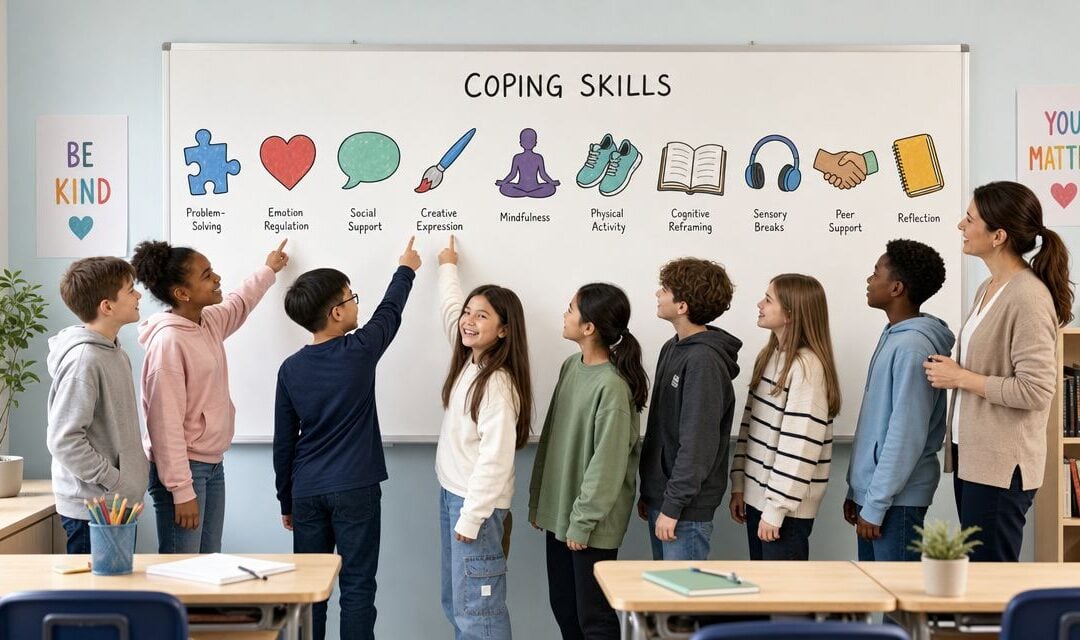
This guide breaks coping down into 10 clear types and turns each one into action for K-8 settings. For every type, you will see what it is, why it helps, what it can sound like, and how to use it in both classrooms and homes. You will also find age-appropriate examples, simple adult scripts, guided deep breathing practices, and child-friendly supports such as belly breathing activities for kids.
The goal is not constant happiness. The goal is a flexible set of habits children can carry into real conflicts, real mistakes, and real disappointment.
A kindergarten teacher might lead a two-minute breathing circle before morning meeting. A fourth grader might use starfish breathing before a spelling test. A parent might say, “Let's do three bubble breaths before we talk about what happened.”
What it looks like in practice
In the classroom, keep it short and visible. Put a breathing card on the wall, pair breathing with a hand signal, or build a predictable reset into transitions. At home, practice during calm moments so the child already knows the routine when emotions rise.
A few concrete examples work well:
Morning reset: “Hands on belly. Breathe in slowly. Feel your stomach rise. Breathe out like you're cooling soup.”
Before a challenge: “Your body looks tight. Try one slow breath before you start.”
After conflict: “We're not ignoring the problem. We're calming first so we can solve it.”
Many kids act out a feeling before they can name it. Emotional labeling slows that process down. Instead of “bad” or “fine,” children learn words like frustrated, left out, embarrassed, disappointed, worried, and overwhelmed.
That matters because language creates space between feeling and behavior. A child who can say, “I'm nervous,” is easier to support than a child who only knows how to refuse, yell, or shut down.
Build emotional vocabulary on purpose
In a classroom, use a feeling check-in during morning meeting or after recess. In counseling groups, let students point to an emotion wheel if speaking feels hard. At home, parents can ask with curiosity, “Was that anger, or was it more like disappointment?”
Try scripts like these:
Teacher script: “I can see something big is happening. Put a name on it if you can.”
Parent script: “You don't seem just mad. Are you hurt, worried, or frustrated?”
Student script: “I feel left out when no one saves me a spot.”
Books also help. Ask, “What is this character feeling right now? What clues do you notice?” Children often identify emotions in others before they can identify them in themselves.
That sentence helps adults stay compassionate and clear at the same time.
3. Physical Movement and Exercise
Some stress lives in the body. Kids bounce, fidget, slump, pace, or clench because their nervous systems are trying to manage load. Movement gives that energy somewhere to go.
Scottish Centre for Conflict Resolution groups physical exercise with emotional coping strategies in practical school-friendly categories, as summarized in the verified background above. That makes sense in K-8 settings, where a quick movement break can prevent a bigger blowup later.
A teacher might pause for a stretch between subjects. A counselor might invite a student to walk a lap before a repair conversation. A parent might suggest a scooter ride, dance break, or dog walk after school instead of launching straight into homework.
Here's one simple principle. Movement should be support, not punishment.
Classroom and home ideas
Low-pressure options: Offer chair stretches, wall pushes, hallway walks, or quiet yoga for students who don't enjoy competitive sports.
Routine movement: Add brain breaks before challenging tasks, not only after behavior problems.
Home reset: Say, “Let's move first, then talk,” after a long school day.
A quick visual can help adults think beyond traditional PE:
Older students sometimes like structured fitness options. If they're looking for ideas, these strength and hypertrophy exercises may offer variety, with adult guidance as needed.
4. Problem-Solving and Goal-Setting
A student is calm enough to talk, but the problem is still sitting there. The missing homework is still missing. The friendship issue is still happening at recess. The math page still looks impossible.
That is the moment for problem-solving coping.
This type of coping helps children address a stressor that can change, at least in part. It works like a map after the emotional storm has passed. Breathing and movement can lower the heat. Problem-solving gives the child a next step, which is often what reduces helplessness.
For adults, the challenge is knowing when to shift from comfort to structure. A useful question is, “Is there something we can do about this problem right now?” If the answer is yes, even partly, goal-setting can help.
Use a short routine children can remember
Keep the steps concrete and repeatable:
Name the problem: “What is happening?”
Find the part you can affect: “What part can you change?”
Brainstorm a few options: “What are three things you could try?”
Choose one small step: “What will you do first?”
Check the result: “Did it help, or do we need a new plan?”
Many children hear “solve the problem” as one giant task, making a short routine effective in turning an overwhelming situation into smaller pieces. A backpack full of mixed papers is not one problem. It may be three problems: unfinished work, no folder system, and rushing at dismissal.
In a classroom, a teacher might say, “You and Mateo both want the same marker. Let's list your choices.” At home, a parent might say, “Homework keeps ending in tears. Let's figure out which part is hardest first.”
Goals should be small enough to start today. A fourth grader stressed about a book report may not need the instruction to “finish it.” They may need, “Write the topic sentence and find one quote.” Small wins build traction because the child can see progress instead of only pressure.
You can also match the strategy to grade level. In K-2, use visuals, two choices, and adult-guided language. In grades 3-5, add written checklists and simple reflection. In middle school, involve the student in setting the goal, naming obstacles, and deciding how to track follow-through.
When a problem can be worked on, children often need a clear process, a short script, and one doable first step.
5. Social Connection and Support-Seeking
Coping isn't only an individual skill. One commonly missed truth is that many school stressors happen with other people present. Social coping reduces stress by seeking emotional or practical support from the community, and it's recognized as a core coping category in the verified research summary above.
This matters in K-8 schools because conflict, exclusion, bullying, and classroom dysregulation often require co-regulation. A child may not need another breathing reminder first. They may need a trusted adult, a buddy, or a clear invitation to reconnect.
Teach help-seeking as a script
Children often know they feel bad but don't know how to ask for support. Make the words visible and repeatable.
Try these:
“Can you stay with me for a minute?”
“I need help solving this.”
“Can I talk to you after class?”
“I'm upset and I don't want to make it worse.”
In classrooms, you can assign support roles such as partner check-ins, peace corners with adult follow-up, or classroom jobs that reconnect isolated students. At home, create a short list of safe people the child can go to when upset.
A middle school student who had a rough lunch period might use a support card to check in with a counselor. A third grader at home might text a grandparent emoji code that means, “Please call when you can.” The skill is not dependence. It's knowing when connection is the healthiest next move.
6. Creative Expression and Artistic Activities
Not every child wants to talk right away. Some children process by drawing, humming, writing, building, acting, or making. Creative expression gives feelings a place to land.
Child Mind Institute includes journaling and listening to music among commonly recommended healthy coping skills in the verified summary above. In practice, that means schools and families can treat creative activities as real coping tools, not as extras once “real work” is done.
Make the process safe, not performative
A first grader might draw what anger looks like as a storm cloud. A fifth grader might keep a feelings journal with sentence starters like “Today felt heavy when…” A middle schooler might make a playlist for calming down after social drama.
Adults can support this without over-directing it:
Skip grading: don't evaluate coping art for neatness or talent
Add reflection: “Want to tell me about it?” works better than “What is it?”
At home, parents can keep a small “reset basket” with paper, markers, stickers, and a notebook. In class, teachers can use free-write prompts after difficult transitions or community events.
Some children reveal more through a puppet, a sketch, or a song lyric than they can in direct conversation. That still counts as healthy coping.
7. Cognitive Reframing and Perspective-Taking
Thoughts shape feelings. If a child thinks, “Everyone hates me,” their body responds as if that thought is settled fact. Cognitive reframing teaches them to slow down, test the thought, and build a more balanced one.
In the verified background, Scottish Centre for Conflict Resolution includes cognitive restructuring, affirmations, and distraction under cognitive coping. The big school takeaway is simple. Children can learn to notice unhelpful thoughts instead of automatically obeying them.
A balanced thought is stronger than fake positivity
Don't replace one extreme with another. “I'm terrible at math” doesn't need to become “I'm amazing at math.” A more useful reframe is, “This part is hard, but I can ask for help and try one step.”
Use classroom and home questions like:
“What's the story your brain is telling?”
“What evidence do you have?”
“Is there another way to look at this?”
“What would you say to a friend in the same situation?”
A student left out of one game might decide, “Nobody likes me.” An adult can help reframe: “You felt excluded in that moment. That hurts. It doesn't tell the whole story about every friendship.”
Thoughts are important, but they aren't always accurate.
Perspective-taking also belongs here. During conflict, ask students to describe what each person may have wanted, feared, or misunderstood. This doesn't excuse hurtful behavior. It widens understanding enough for repair.
8. Mindful Self-Compassion and Positive Self-Talk
Many children are much harsher with themselves than adults realize. They mutter, “I'm dumb,” “I ruin everything,” or “Nobody wants me.” Positive self-talk and self-compassion interrupt that inner voice with something more honest and supportive.
In the verified summary, positive self-talk is listed among common healthy coping skills recommended across age groups. That's especially important for students who shut down after mistakes or hold themselves to impossible standards.
Teach children how to talk to themselves
A compassionate script should feel believable. Skip exaggerated praise and use grounded language instead.
Examples:
Before a test: “I'm nervous, and I can still try.”
After a mistake: “Messing up doesn't mean I can't fix it.”
During frustration: “This is hard right now. Hard doesn't mean impossible.”
Teachers can model this out loud. “I made a mistake on the board. I'm going to slow down and correct it.” Parents can do the same at home. “I forgot something at the store. That's frustrating, but I can handle it.”
Physical cues help younger children. A hand on the heart, a gentle squeeze of both hands, or wrapping in a blanket can pair body comfort with kind words.
One caution matters here. Supportive self-talk should not become denial. If a child is hurting, “I'm fine” isn't coping. “I'm upset, and I know what can help” is coping.
9. Boundary-Setting and Assertive Communication
Some children cope by staying silent until they explode. Others say yes to things they don't want, then feel resentful or unsafe. Boundary-setting helps them communicate needs and limits earlier.
This fits the solution-focused category described in the verified summary, where examples include collaborative problem-solving, time management, and boundary setting. In school and at home, boundaries are practical coping tools because they reduce repeated stress before it escalates.
Give students words they can actually use
Children need scripts that sound natural for their age:
“Please stop. I don't like that.”
“I need space right now.”
“I'm not ready to talk yet.”
“You can play with me, but not if you keep grabbing.”
For older students, expand the script: “I feel frustrated when my things are used without asking. I need you to check with me first.” That's assertive, not aggressive.
In class, boundary practice can happen through role-play. One student interrupts. Another practices saying, “I'm still talking.” At home, a child can practice asking for quiet during homework or naming a limit with a sibling.
The adult role is important. Respect the child's healthy boundary when possible. If adults ignore every early signal, children often learn to use louder ones.
10. Acceptance and Mindful Tolerance of Difficult Emotions
Some feelings can't be solved away. Grief, disappointment, jealousy, nerves, and sadness often need to be felt, not fixed. Acceptance-based coping teaches children to notice difficult emotions without immediately running from them.
That distinction matters because avoidance-based coping such as disengagement, withdrawal, or emotional suppression is generally treated as maladaptive in the verified EBSCO summary of coping strategies. Temporary relief isn't always healthy relief.
Help children stay with feelings safely
Acceptance sounds like:
“I notice anxiety is here.”
“This feeling is uncomfortable, not dangerous.”
“I can feel sad and still go to school.”
“I don't have to get rid of this feeling before I do the next right thing.”
A student anxious about a class presentation may still choose to present with shaky hands. A child sad after moving homes may still join family dinner instead of hiding in their room. The goal isn't comfort first. It's flexibility.
Some coping skills reduce feelings. Others help children carry feelings without letting those feelings run the whole day.
Adults can use child-friendly metaphors. Emotions are weather. Thoughts are clouds. Waves rise and fall. The child isn't the storm. They're the sky holding it.
One note matters for safety. Accepting feelings never means accepting harmful behavior from self or others. A child can accept anger and still be expected not to hit.
Top 10 Coping Skills Comparison
Strategy
Implementation complexity
Resource requirements
Expected outcomes
Ideal use cases
Key advantages
Mindfulness and Deep Breathing
Low (short guided practice; requires consistency)
Minimal (time, brief guidance, visual cues)
Immediate stress reduction; improved regulation and attention
In-the-moment distress, transitions, test anxiety, daily resets
Portable, easy to teach, evidence-backed
Emotional Labeling and Expression
Low (modeling and reinforcement needed)
Low (feeling charts, prompts, classroom routines)
Reduced emotional intensity; better communication and empathy
Check-ins, restorative circles, de-escalation, emotional literacy work
Quickly lowers intensity; builds vocabulary and shared language
Physical Movement and Exercise
Moderate (planning, scheduling, inclusion)
Moderate–high (space, equipment, time)
Physiological stress relief; improved mood, focus, and health
Brain breaks, recess, chronic stress management, group activities
Strong neurochemical benefits; supports attention and social connection
Problem-Solving and Goal-Setting
Moderate (teaching steps, scaffolding)
Low–moderate (facilitation time, templates)
Increased agency, practical solutions, improved executive function
Highly protective; provides practical help and emotional relief
Creative Expression and Artistic Activities
Low–moderate (facilitation for therapeutic depth)
Moderate (materials, space, facilitator)
Nonverbal emotional processing; increased self-efficacy and expression
Students who struggle with words, counseling, reflective projects
Inclusive expression; validates feelings without pressure to verbalize
Cognitive Reframing and Perspective-Taking
Moderate–high (skill-building and practice)
Low (instructional time, guided exercises)
Reduced rumination/anxiety; stronger resilience and problem-solving
Anxiety, negative thought patterns, growth-mindset interventions
Produces lasting changes in thinking; well-supported by research
Mindful Self-Compassion and Positive Self-Talk
Moderate (practice; cultural adaptation)
Low (guided scripts, brief exercises)
Less self-criticism; increased resilience and sustainable motivation
Perfectionism, setbacks, building internal supports
Builds internal encouragement; protects mental health better than self-esteem alone
Boundary-Setting and Assertive Communication
Moderate–high (skills training, role-play)
Low–moderate (coaching, practice time)
Reduced burnout and conflict; healthier relationships and autonomy
Peer pressure, interpersonal conflict, workload and accommodation requests
Protects wellbeing; establishes respect and clearer expectations
Acceptance and Mindful Tolerance of Difficult Emotions
Moderate–high (skilled facilitation and practice)
Low (teaching) but requires ongoing practice
Greater psychological flexibility; reduced avoidance and secondary distress
Chronic anxiety, grief, situations without immediate solutions
Promotes long-term emotional flexibility and values-aligned action
Putting Coping Skills into Practice Your Next Steps
Teaching these types of coping skills works best when adults stop treating them like emergency tools only. Children need practice when they're calm, support when they're activated, and reflection after the moment has passed. That rhythm matters in every setting, whether you're leading a classroom, running a counseling group, or helping with homework at the kitchen table.
Start smaller than you think you need to. Pick one or two coping skill types to teach explicitly this month. A kindergarten class might focus on breathing and naming feelings. A fourth-grade class might add problem-solving and assertive communication. At home, a family might start with one calming strategy, one help-seeking script, and one boundary phrase that everyone practices together.
Consistency beats intensity. A two-minute reset every morning can do more than a long one-time lesson that never returns. A feeling check-in after school builds more skill than waiting for the next meltdown. Children learn coping from repetition, modeling, and shared language. They also learn it from watching what adults do under pressure.
It helps to match the coping skill to the situation. If a stressor can be changed, problem-solving may help. If the feeling is big but the problem isn't immediately fixable, emotional coping may come first. If the moment is interpersonal, social coping and co-regulation may be the best entry point. If a child is trying hard to escape every uncomfortable feeling, acceptance-based strategies may be more useful than another distraction.
Adults also need to watch for when coping starts to backfire. A strategy that helps in one moment can become unhelpful in another. Distraction can be useful before a child returns to a task, but not if it becomes a way to avoid every hard conversation. Journaling can support expression, but some children may get stuck in rumination without guidance. The question isn't “Is this a good coping skill?” in the abstract. The better question is “Is this helping this child in this moment, in this setting, for this need?”
In schools, shared systems prove important. If teachers, counselors, support staff, and caregivers use similar language, children don't have to relearn the skill in every room. They begin to recognize patterns in themselves. They know what to try, how to ask for help, and what adults mean when they say, “Let's regulate first,” or “What part can you control?”
Soul Shoppe is one option schools may consider if they want support building that kind of shared SEL language. According to the publisher information provided, the organization offers experiential programs, workshops, assemblies, coaching, and family resources focused on self-regulation, mindfulness, communication, conflict resolution, and belonging. That kind of schoolwide approach can make coping skills easier to teach consistently across classrooms and home partnerships.
The long-term goal isn't a child who never feels upset. It's a child who knows what upset feels like, has more than one way to respond, and trusts that support is available. That is emotional resilience in everyday form. It starts with naming, practicing, modeling, and repeating. Then one day, a child who used to yell, hide, or give up says, “I'm frustrated. I need a minute. Then I'm ready to try again.”
If you want practical SEL support for coping skills, communication, and conflict resolution across your whole school community, explore Soul Shoppe for programs and resources designed for students, educators, and families.
It's late. You're replaying the day in your head. Maybe you snapped during homework, missed a school email, or felt distracted when your child wanted to tell you a long story about recess. A question slips in: Am I doing enough?
Most moms I meet, whether in schools, counseling rooms, or parent workshops, aren't asking because they don't care. They're asking because they care. They want to raise children who feel safe, capable, and loved. They also live in a world that asks them to earn, organize, notice, soothe, plan, remember, and keep going.
Moving Beyond the Myth of the Perfect Mom
The modern picture of motherhood is crowded. In the U.S., 40.5% of mothers with children under 18 are equal, primary, or sole income earners for their families, and in 2022 employed mothers spent 12.5 hours per week on active child care compared with 8.6 hours in 1975, which is over 40% more time on active child care while also working for pay, according to the U.S. Department of Labor's overview of mothers in the economy.
That matters because many ideas about the “good mom” still assume endless availability, endless patience, and endless memory. Real families don't run on endless anything. They run on skills, habits, repair, and support.
A healthier way to think about the qualities of a mom is this: not as a perfection checklist, but as a learnable social-emotional skill set. A good mom isn't the one who never gets tired, never misreads a moment, or always has the perfect words. She's the one who keeps building the conditions children need most. Safety. Connection. Structure. Repair.
If your brain feels full all the time, that's not a personal failure. It's often mental load. Many parents find it helpful to name the invisible planning work they're carrying, and this guide to managing mental load offers a practical starting point.
It also helps to shift from self-judgment to skill-building. Instead of asking, “Am I a good mom?” try asking, “What skill would help most in my family this week?” Maybe it's listening without fixing. Maybe it's holding a bedtime boundary. Maybe it's apologizing after a rough morning. Simple positive parenting tips can support that kind of steady, realistic growth.
Good-enough parenting gives children something they can actually use: a real relationship with a real adult who keeps coming back to connection.
When we translate big ideals into teachable behaviors, parents and educators can work from the same map. That shared map is where children often make their strongest gains.
Cultivating Emotional Safety as Your Foundation
Children learn best when they feel safe with the adults around them. Not spoiled. Not in charge. Safe.
Emotional safety means a child believes, “My feelings won't make this relationship disappear.” That belief changes how children talk, recover, and behave. It doesn't erase big feelings. It gives those feelings a place to land.
Empathy is the first signal of safety
Empathy is not agreeing with every reaction. It's showing your child that their inner experience makes sense to you.
A child says, “Nobody likes me.” The unsafe response is, “That's not true. Stop being dramatic.” The safer response is, “It sounds like you felt really left out today.” That second response doesn't lock in the child's conclusion. It opens the door for regulation and problem-solving.
Try this simple script:
Name what you hear: “You seem disappointed.”
Reflect the situation: “It happened when your partner picked someone else.”
Emotional regulation is the adult skill children borrow first
Children don't learn regulation from lectures. They learn it from nervous systems near them. When a mom lowers her voice, pauses before reacting, or says, “I'm upset, so I'm taking one breath before I answer,” she is teaching regulation in real time.
One easy home activity is a Feelings Thermometer. Draw a thermometer with four zones:
Zone
What it feels like
What helps
1 Calm
okay, focused
keep going
2 Stirring
annoyed, restless
drink water, stretch
3 Hot
mad, overwhelmed
breathing, quiet corner
4 Boiling
yelling, shut down
pause, co-regulate with an adult
Use it during calm moments first. Then, when your child is upset, ask, “What number are you right now?” That question is easier for many children than “How do you feel?”
Practical rule: Regulate first, teach second. A child in full distress can't absorb a lesson about behavior.
For families who like playful ways to build these skills, activities such as role-play, emotion cards, and guessing games can help. This roundup on how Playz helps develop emotional intelligence includes ideas parents can adapt for home.
What emotional safety looks like on a busy Tuesday
It often looks small:
At breakfast: “You're quiet today. Want me to just sit with you?”
After school: “Do you want help, or do you want me to listen first?”
At bedtime: “We had a hard moment earlier. I'm still here.”
Those ordinary responses teach a deep lesson. Feelings are manageable. Relationships can hold them. That's one of the strongest qualities of a mom a child can experience.
The Power of True Presence and Attunement
Some children have adults around them all day and still feel unseen. That's because presence is more than proximity.
Research on motherhood norms describes the “present mother” as someone with high attentional availability, accurate cue detection, and rapid response calibration, and that kind of attunement supports emotional co-regulation by helping adults step in before a child's needs escalate, as described in this research review on the “present mother” norm.
Presence is a noticing skill
Attunement sounds academic, but in daily life it often starts with one sentence: “I notice…”
“I notice you stopped eating after two bites.”
“I notice your shoulders got tight when we mentioned school.”
“I notice you're getting silly in that way that means you're overtired.”
That's not surveillance. It's informed caregiving. A child who feels accurately noticed is less likely to need to escalate to get understood.
A useful distinction for parents and teachers:
Being present in the room
Being attuned to the child
You hear noise
You notice a pattern
You react after a meltdown
You catch strain early
You say “Use your words”
You help the child find words
You focus on behavior only
You track cues, needs, and timing
This is why the qualities of a mom can be taught as observable skills. We can practice noticing. We can practice timing. We can practice listening for what behavior is trying to communicate.
How to strengthen attunement in small moments
Busy families don't need a three-hour ritual. They need repeatable micro-habits.
Try these:
Use device-free connection zones Pick one routine. Car ride. Bedtime. After-school snack. During that time, phones stay away.
Play the two-minute scan Before correcting behavior, pause and scan for cues. Hungry? Embarrassed? Overstimulated? Seeking connection?
Ask one observation before one question Say, “You got quiet when math came up,” before asking, “What happened?”
Mirror the child's pace Some children talk fast when upset. Others need long pauses. Matching pace helps them stay engaged.
If you want language that supports this kind of listening, these ideas on empathetic listening fit well in both home and school conversations.
A child doesn't always need an answer first. Often the child needs an accurate witness.
A school-age example
A fourth grader starts “forgetting” homework. An adult who only sees compliance may respond with pressure. An attuned adult notices the child has also become slower in the morning, more irritable at pickup, and less social after school.
That adult might say, “I'm noticing homework has been harder this week, and you seem more tired than usual. Is school feeling heavy right now?” That response gives the child a bridge into honesty.
Presence, then, is not just warmth. It's effective observation plus a timely response. Children feel that difference immediately.
Providing Structure with Consistency and Boundaries
Children relax when the adults act like they know what the guardrails are. They may protest those guardrails. They may test them daily. Still, structure helps children feel held.
Many parents worry that boundaries will damage connection. Usually the opposite is true. Kind, predictable limits tell a child, “You don't have to manage the whole world. I'm helping.”
Consistency lowers confusion
Consistency doesn't mean rigid sameness. It means your child can generally predict what matters, what happens next, and how adults respond.
That predictability supports regulation. A child who knows the bedtime sequence, homework routine, or morning expectation uses less energy guessing and more energy participating.
A simple structure often works better than a complicated system. Try this short family pattern:
After school: snack, movement, short check-in
Before homework: bathroom, water, supplies ready
Before bed: hygiene, connection, lights out routine
Children don't just need routine for tasks. They also need routine for relationships. For example, a daily five-minute check-in can become the emotional anchor of the day.
Boundaries are not punishments
A healthy boundary says what the adult will do to keep people safe, respectful, or regulated. It does not shame the child.
Compare these examples:
Less helpful: “If you don't stop whining right now, no tablet for a week.”
More helpful: “I want to hear you. I can listen when your voice is calmer.”
Less helpful: “You're being impossible.”
More helpful: “I won't let you hit. I'll stay close while you calm down.”
Less helpful: “Because I said so.”
More helpful: “The answer is no for today. You can be upset, and the limit is still no.”
Children borrow stability from adults who mean what they say and say it without cruelty.
A firm and kind script parents can use
Many moms need language more than theory. Here's a script for a common moment:
Child: “Play with me now!” Parent: “I want to play with you. I need quiet time for 15 minutes. When the timer rings, I'll join you.”
This script works because it does four jobs at once. It shows care. It sets a limit. It gives a clear timeline. It follows through.
You can also co-create family agreements, especially with elementary-age children:
Topic
Child input
Adult boundary
Screen time
choose show or game
adult sets start and stop
Chores
choose order
everyone contributes
Morning routine
pick music or outfit prep style
leaving time stays fixed
When children help shape part of the plan, they're more likely to cooperate with the plan.
One of the steady qualities of a mom is leadership without harshness. Not controlling every feeling. Not surrendering every limit. Just providing enough structure that a child can grow safely inside it.
Building Resilience Through Repair and Encouragement
Every parent will get it wrong sometimes. You'll misread a cue, answer too sharply, rush a child who needed more time, or enforce a limit in a tone you regret. That isn't evidence that you've failed. It's evidence that you're human.
What matters most after a hard moment is often repair. Parenting guidance identifies “repair when you make mistakes” as a hallmark quality, and a reliable sequence of acknowledging the event, naming the impact, apologizing, and offering a next step helps strengthen psychological safety and model accountability, as described in this guidance on traits of a good mom.
Repair teaches more than perfection ever could
A child who sees an adult repair learns powerful lessons:
Mistakes can be faced
Conflict can soften
Shame doesn't get the last word
Relationships can recover
That is resilience in action. Children don't build resilience by living in a mistake-free home. They build it by living in a home where people know how to come back together.
Here is a simple repair model parents and educators can both use.
Acknowledge “I yelled when you spilled the water.”
Name the impact “That probably felt scary and unfair.”
Apologize “I'm sorry.”
Offer a next step “Next time I'm frustrated, I'm going to pause before I speak.”
Reconnect “Do you want a hug, or do you want to sit together for a minute?”
Encouragement builds courage, not dependence
Repair helps children recover from relational stress. Encouragement helps them take healthy action afterward.
Encouragement is different from praise. Praise often focuses on the result. Encouragement focuses on effort, strategy, and persistence.
Compare:
Praise only
Encouragement
“You're so smart”
“You kept going when it got hard”
“Good job”
“You tried a new way to solve it”
“You're the best artist”
“You added details and stayed with it”
Children who hear encouragement start to internalize a message: I can try. I can learn. I can recover.
If you want a school-home lens on this, resources about building resilience in children can help adults use similar language across settings.
When a parent says, “I was wrong, and I'm fixing it,” the child learns accountability without humiliation.
A small shift toward autonomy
Encouragement also means stepping back enough for children to do manageable hard things. Let them answer the teacher's question themselves. Let them pack part of their school bag. Let them try the apology to a sibling with coaching instead of having you do it for them.
One of the most overlooked qualities of a mom is this balance: being supportive without taking over. That balance grows confidence.
Creating a Shared Language with Your Child's School
A child does better when home and school are not sending competing emotional messages. If a family says, “Talk about feelings,” but school mainly says, “Stop crying,” the child gets mixed signals. If both settings use similar language for safety, regulation, and repair, the child has a much easier job.
What shared language sounds like
Parents don't need clinical terms. Teachers don't need long family history. Both sides need usable language.
A parent might write:
“We're working on emotional regulation at home. When my child starts to shut down, a short pause and a simple choice helps more than lots of questions.”
A teacher might respond:
“We practiced ‘I feel' statements today during peer conflict, and your child participated well with a little support.”
That kind of exchange creates continuity. The child hears the same core message in both places: feelings are real, behavior has limits, and relationships can recover.
Scripts that help parents and teachers partner well
Here are a few examples families can use right away.
For a parent starting the conversation: “I'm noticing mornings have been harder. Have you seen any patterns at school that might help us understand what's going on?”
For a teacher sharing a useful strategy: “Your child responds well when I give a preview before transitions. You might try that before homework or bedtime too.”
For a parent naming a boundary approach: “We're trying to stay calm and consistent with limits at home. If there's language you use at school for redirection, I'd love to reinforce it.”
For a counselor or support staff member: “When conflict happens, we're helping students identify impact and practice repair. Using those same words at home can make the skill stick.”
Schools that want better family conversations often benefit from preparing adults with stronger question design. For leaders refining how they gather insight from families and staff, this resource on Comprehensive school interview questions can spark more thoughtful conversations.
A short video can also help adults align around what children need socially and emotionally.
One shared tool is better than five separate ones
If you're a school team or a family, start small. Pick one common tool and use it across settings for two weeks.
Examples:
Shared tool
Home use
School use
Feelings check-in
after school
morning meeting
Repair script
after sibling conflict
after peer conflict
Previewing transitions
before bedtime
before cleanup
Calm-down choices
bedroom or kitchen
regulation corner
This is one place where a structured SEL program can support consistency. For example, Soul Shoppe offers workshops and coaching that teach shared language for self-regulation, communication, and conflict resolution, which schools and families can reinforce together.
When adults coordinate, children don't have to decode two different emotional worlds. They can spend that energy learning, relating, and growing.
Embracing the Journey of a Good-Enough Mom
The most helpful qualities of a mom are not shiny traits that some people are born with and others are not. They are practices. You build them, lose them, return to them, and build them again.
Emotional safety tells a child, “Your feelings won't push me away.” Presence says, “I'm noticing you closely enough to help.” Structure says, “You are free inside clear guardrails.” Repair says, “This relationship can heal.” Those are not small gifts. They shape how children see themselves, other people, and the world.
A good-enough mom is not checked out, but she also isn't chasing flawless performance. She listens, notices, sets limits, repairs, and keeps learning. Some days that will look graceful. Some days it will look like apologizing in the carpool line and trying again after dinner.
If you're parenting and working, parenting and caregiving, parenting and carrying most of the invisible planning load, you do not need another impossible standard. You need a realistic picture of growth. Children don't need a perfect mother. They need a trustworthy one.
Keep the target close. Notice one cue earlier. Respond one step calmer. Hold one limit more clearly. Repair one hard moment more sincerely. That's how strong families are built.
If you want more support turning these everyday parenting moments into teachable SEL skills, explore Soul Shoppe. Their resources, workshops, and school-based programs focus on practical tools for empathy, regulation, communication, and conflict resolution that help children and grownups build safer, more connected relationships.
Have you ever heard yourself say, “Do it now because I said so,” then noticed your child go quiet, tense, or instantly defensive? Or maybe you work in a school and can tell when a student follows directions, but only because they're scared of getting in trouble. That pattern often comes from an authoritarian approach to discipline, where adults focus heavily on control and obedience while leaving very little room for warmth, explanation, or discussion.
Psychologist Diana Baumrind's work in the 1960s helped define authoritarian parenting as a strict, one-way style marked by high demandingness and low responsiveness, and that framework is still widely used in child development, family services, and school-based SEL work today in descriptions such as the NCBI overview of parenting styles. In practice, that means the issue isn't “being strict” alone. It's being consistently high-control and low-dialogue.
That distinction matters for families and schools. Some firmness is appropriate, especially in safety situations. But when a child regularly experiences punishment without explanation, fear-based compliance, or emotional shutdown, adults often see later problems with confidence, decision-making, peer relationships, or behavior. If you're trying to spot those patterns in real life, these tips for California parents managing child behavior offer a helpful companion read.
Below are 8 authoritarian parenting examples, what children often feel in those moments, and what to do instead if you want more cooperation, better self-regulation, and a stronger relationship.
1. Strict Rule Enforcement Without Explanation
A common authoritarian parenting example sounds simple: “You have to do it because I'm the parent.” The rule may be reasonable. Homework before screens, be home by curfew, no dessert before dinner. The problem is that the child gets no explanation, no chance to ask questions, and no help understanding the purpose behind the rule.
In schools, this can look similar. A student asks why a routine changed, and the adult treats the question itself like disrespect. The child learns that authority is not to be understood, only obeyed.
What the child often feels
Children in this dynamic may comply outwardly while feeling confused, resentful, or powerless. Over time, they may stop asking thoughtful questions, not because they understand the rule, but because they've learned that curiosity is risky.
That matters because authoritarian parenting is associated with high control and low responsiveness, not just strictness alone. The pattern can suppress independent decision-making rather than build it.
Practical rule: If a child is old enough to follow a rule, they're usually old enough to hear a short explanation for it.
A parent might say, “Homework first. No discussion.” A more connected version sounds like, “Homework comes first because your brain is fresher now, and finishing it early lowers stress later.”
What to do instead
You don't need to turn every household rule into a debate. You do want to make expectations understandable.
State the reason briefly: “Curfew is 8:30 because I need to know you're home safely and rested for school.”
Invite one question: “You can ask about the rule, but the rule still stands tonight.”
Use collaborative language: “Let's figure out what will help you remember this tomorrow.”
For educators, try: “This is the class routine because it helps everyone transition faster. If something isn't working for you, tell me after directions.”
For parents, try: “I'm not changing the boundary, but I do want you to understand why it's there.”
That shift builds buy-in. It also teaches a child that limits and respect can exist together.
2. Punishment-Based Discipline Without Restorative Practices
Your child shoves a sibling, and the room gets quiet. You send them to their room, take away screen time, and expect the lesson to sink in. An hour later, the behavior may stop for the moment, but the underlying problem is still sitting there untouched. The child has felt the consequence without learning the missing skill.
This is one of the clearest authoritarian parenting examples because the adult focuses on control first and repair last, or never. The message becomes, “Suffer for the mistake,” rather than, “Understand what happened, take responsibility, and make it right.” Punishment can interrupt behavior quickly. It does not automatically teach empathy, self-control, or problem-solving.
What the child often feels
A child on the receiving end of punishment-only discipline often feels cornered. If the consequence includes yelling, public embarrassment, or isolation, the nervous system shifts into defense. At that point, learning gets much harder.
That is why shame and accountability lead to different outcomes. Shame sounds like, “Something is wrong with me.” Accountability sounds like, “I made a poor choice, and I have a path to repair it.”
A student scolded in front of classmates for missing homework may focus on humiliation, not responsibility. A child punished for hitting may stop the behavior briefly but still have no plan for handling anger, frustration, or jealousy the next time it rises. It is a lot like punishing a child for not swimming well without ever teaching them how to float.
Parenting Science describes research trends linking harsh discipline and psychological control with worsening behavior over time, including more aggression and defiance, and it notes social costs for children raised with authoritarian patterns in this review of authoritarian parenting outcomes over time.
A compassionate, SEL-based alternative
The healthier question is not only, “What consequence fits?” It is also, “What skill is missing, who was affected, and how can this child repair the harm?”
That shift matters. Social and emotional learning treats behavior as communication plus skill-building. A child may need help with impulse control, emotional regulation, perspective-taking, or language for repair.
A restorative response can still include a firm boundary. If a child throws a toy, you stop the behavior and move the toy. Then you guide the next part.
Authoritarian scenario: A child grabs a marker from a classmate, and the adult snaps, “Give it back. You've lost art time.”
Emotional impact: The child may feel angry, embarrassed, or unfairly singled out. The classmate may still feel upset and unsafe.
SEL-based alternative: “You grabbed the marker from his hand. He looks upset. Let's fix this. Hand it back, take a breath, and ask, ‘Can I use it when you're done?’”
You can use the same roadmap at home or at school.
Name what happened: “You hit your brother when you were frustrated.”
Name the impact: “That hurt his body and scared him.”
Coach repair: “Check if he's okay. Then say, ‘I was mad, and I should not have hit you.’”
Practice the missing skill: “Next time, say, ‘I need space,’ or come get me before your body takes over.”
Make a plan: “What will you do first if this happens again?”
Schools using this mindset often draw from restorative practices in education. Parents can use the same structure at home in a simpler, everyday form.
Helpful scripts make this easier in the moment.
For parents: “You are responsible for what happened, and I'm going to help you repair it.”
For educators: “The rule still stands. Now let's work on the part that helps you do better next time.”
That is the goal. Less fear, more responsibility, and a clear path from harm to repair.
3. Conditional Love and Approval Based on Achievement
Some of the most painful authoritarian parenting examples don't sound harsh on the surface. They sound polished. “I'm proud of you when you perform.” “I only want what's best for you.” “Why did you get this grade when you're capable of more?”
The child quickly learns the pattern. Attention comes after the test score. Warmth returns after the trophy. Approval depends on performance.
What the child often feels
When affection and praise are tied too tightly to outcomes, children can start to believe their worth is conditional. They may become anxious, perfectionistic, or highly avoidant. Some work nonstop. Others stop trying because failure feels unbearable.
In one case study discussion, Sammy was described as having little open dialogue with parents, limited opportunity to express feelings, and reduced motivation and learning attitudes. The authors connect authoritarian parenting to poorer cognitive performance and lower grades, and they cite evidence from adolescents in the San Francisco Bay Area showing an association with lower grades across ethnic groups. The same review also describes broader costs such as higher anxiety, lower self-rated health, decreased cognitive functioning, increased depressive symptoms, school maladjustment, aggression, resentment, withdrawal, and conflict with parents and peers in this case study and review of authoritarian parenting effects.
What to do instead
Children need standards. They also need to know they belong before they achieve, during the struggle, and after mistakes.
Try shifting praise away from identity-by-outcome and toward process, character, and reflection.
Instead of grade-first questions: “How did that assignment feel for you?”
Instead of outcome-only praise: “You stayed with that even when it got frustrating.”
Instead of withdrawal after disappointment: “I love you. We can talk about what support you need.”
For teachers, this can sound like: “Your test score matters less to me than the habits you're building. Let's look at what worked and what didn't.”
Children do better when they feel safe enough to be imperfect. That safety supports both learning and resilience.
4. Excessive Control and Micromanagement of Child's Choices
Your child reaches for the green shirt. You hand them the blue one. They want to try art. You steer them toward piano. They start to solve a homework problem their way. You step in before they can finish. By the end of the day, the child has followed many directions and made very few real choices.
That pattern is excessive control.
It often grows out of care. Adults may want to prevent mistakes, save time, or keep life orderly. The problem is that children build decision-making the same way they build reading fluency or balance on a bike. They need practice. If an adult does all the choosing, the child may learn compliance, but not judgment.
What the child often feels
Micromanagement can leave a child feeling small, tense, or unsure of their own thinking. Some children become highly dependent and wait to be told what to do next. Others push back hard, not because they are irresponsible, but because autonomy is a normal developmental need.
The longer this pattern continues, the harder everyday decisions can feel. A child who rarely gets to choose may struggle to weigh options, tolerate uncertainty, or recover from a manageable mistake. That is part of why high control can backfire. It may produce short-term obedience while weakening the very skills the adult wants the child to develop.
A healthier alternative: structured choice
Children do best with freedom that has a frame. Structured choice works like training wheels. The adult sets the safety boundary, and the child gets meaningful room to practice agency inside it.
That can sound like this:
Authoritarian scenario: “Wear this. I already picked it.”
Emotional impact: “My preferences do not matter.”
SEL-based alternative: “It's cold today, so you need a warm top. Do you want the red sweater or the blue hoodie?”
Authoritarian scenario: “You are signing up for soccer. End of discussion.”
Emotional impact: “My interests are not mine to explore.”
SEL-based alternative: “You need one active activity this season. Which feels like a better fit, soccer, dance, or swimming?”
Authoritarian scenario: “Do the assignment exactly my way.”
Emotional impact: “Trying my own strategy is risky.”
SEL-based alternative for educators: “You need to show your thinking clearly. Do you want to start with the diagram or the written response?”
This approach teaches two skills at once. Children learn that limits exist, and they learn that their voice still has a place within those limits.
A useful parent script is: “I'm responsible for safety and the big boundaries. Inside those boundaries, I want you to practice making choices.”
For children who freeze when offered choice, start smaller. Too many options can feel like being dropped into deep water before learning to float. Offer two acceptable choices, keep the stakes low, and stay calm if the child picks differently than you would.
For parents and educators, it also helps to name feelings without giving up the limit. If a child protests, you might say, “You sound frustrated because you wanted more control here.” Then hold the boundary and offer the choice again. Resources on using I feel statements to reduce conflict and build communication can support that shift.
Children gain confidence by making decisions, seeing the outcome, and trying again. That is how self-trust grows.
5. Verbal Aggression, Criticism, and Shame-Based Language
A child spills juice, freezes, and hears, “What is wrong with you?” A student misses a direction and gets mocked in front of classmates. In both settings, the adult may believe they are correcting behavior. What the child often hears is something much larger: “You are the problem.”
Verbal aggression includes yelling, sarcasm, name-calling, contempt, and comments meant to sting. Shame-based language goes a step further. It targets identity instead of naming the behavior that needs to change. That difference matters. A child can repair a behavior. A child cannot productively repair being told they are “lazy,” “disrespectful,” or “impossible.”
The authoritarian scenario
This pattern often sounds like:
“You never listen.”
“You're embarrassing.”
“Only a baby would cry about that.”
“Can you do anything right?”
Adults usually reach for these lines when they are flooded, angry, or desperate for quick control. The words may stop a behavior for the moment, the same way slamming on the brakes stops a car. But it does not teach good driving. It teaches fear, self-protection, and sometimes counterattack.
What the child often feels
Many children do not sort the message into neat categories. They do not hear, “My parent disliked that choice.” They hear, “Something is wrong with me.”
That can lead to shame, anxiety, and defensiveness. Some children shrink and comply on the outside while feeling small inside. Others get louder, more oppositional, or more shut down. In classrooms, public criticism also adds an audience, which can intensify humiliation and make learning much harder in that moment.
Children also learn from tone. If an adult uses blame and contempt to handle stress, the child absorbs that as a model for conflict. The lesson becomes, “The more power you have, the harsher you get.”
A compassionate SEL-based alternative
The healthier goal is clear correction without character attack. Adults can stay firm and still protect the child's dignity.
A useful formula is simple: name what happened, name the limit, then coach the next step.
Shaming: “You're so rude.” SEL alternative: “You interrupted me. Pause, listen, then say your point again.”
Shaming: “You're impossible.” SEL alternative: “We are both upset. Let's reset and try this conversation again.”
Shaming: “You embarrassed me.” SEL alternative: “That choice was not okay in public. We'll talk privately about what to do differently next time.”
This approach works like a coach correcting form instead of insulting the player. The standard stays high. The relationship stays intact.
Scripts for parents and educators
Try language like this:
For parents: “I love you. I am upset about what happened, and we are going to fix it.”
For parents: “Spilling the juice was a mistake. Yelling will not help. Get a towel and I'll help you clean it up.”
For educators: “I'm not going to correct you in front of everyone. Step with me for a quick reset.”
For educators: “That comment was hurtful. Try again with respectful words.”
For either setting: “You're having a hard time. You still may not hurt people or speak cruelly.”
Children can also learn direct communication through I feel statements for kids, which gives adults and students a shared script for conflict.
If you want a quick model for calmer communication, this short video is a useful discussion starter for families and staff teams.
One practical pause question can help in heated moments: “Am I trying to teach, or am I trying to unload my anger?” That question creates just enough space to choose correction over humiliation.
Private correction is especially helpful at school. At home, a lowered voice often works better than a louder one. Children remember the emotional climate of correction long after they forget the exact words.
6. Isolation and Relationship Withdrawal as Punishment
Some authoritarian parenting examples use distance as discipline. A parent stops talking to the child for days. A child is excluded from family activities until they “earn” their way back in. A student is frozen out of a group to make a point.
This is more than a consequence. It turns connection itself into a weapon.
What the child often feels
Children depend on belonging. When adults withdraw relationship after conflict, many children feel panic, shame, or deep insecurity. They may not think, “I need to repair this behavior.” They may think, “I'm alone. I'm unwanted. I'm only accepted when I'm easy.”
That is a heavy lesson. It can also resemble relational aggression, the same kind of exclusion adults often tell children not to use with peers.
Belonging should never depend on perfect behavior.
This doesn't mean there should be no consequences. It means consequences should happen inside a relationship, not through the removal of the relationship.
Connected accountability
A connected response sounds different. “I'm upset, and we need to talk later when we're calm” is very different from silent treatment. “You can't join the game right now because you were hurting others, but I'm going to help you get ready to rejoin” is very different from exclusion with no path back.
Try these replacements:
Instead of silence: “I need ten minutes to cool down, then we'll talk.”
Instead of banishment: “You're taking a break from the group, and I'll check in with you soon.”
Instead of rejection: “What you did isn't okay. You still matter, and we're going to repair it.”
In schools, supervised re-entry matters. A child who loses access to a shared activity should also hear what skill they need to show in order to return safely.
Children can tolerate limits much better than they can tolerate feeling abandoned.
7. Dismissal of Emotions and Invalidation of Feelings
A child is already upset. Their face tightens, their body gets louder, and they hear, “Stop crying,” “You're fine,” or “That's not a big deal.” In that moment, the adult is often trying to shut the storm down fast. The problem is that children do not learn calm by having their feelings argued with. They learn calm when an adult helps them recognize the feeling, hold the limit, and move through it.
This authoritarian pattern shows up when an adult treats emotion as disobedience, weakness, or inconvenience. The message underneath is easy for a child to absorb. “Your feelings are too much.” “Your experience is wrong.” “Keep it inside.”
What the child often feels
Invalidation can make children doubt their own inner signals. Over time, some stop saying what they feel because it does not seem to matter. Others show feelings more intensely because the emotion has not been understood or organized.
That is why this pattern is so important to catch early.
Feelings work like dashboard lights in a car. The light is not the whole problem, but it tells you something needs attention. Covering the light does not fix the engine. In the same way, dismissing emotion may quiet the moment for a minute, but it does not teach self-awareness, regulation, or problem solving.
There is an important distinction here. Validating a feeling does not mean agreeing with every conclusion or allowing every behavior. A child can feel furious and still be expected to keep hands safe. A student can feel overwhelmed and still complete work with support. The goal is to respond to the emotion without surrendering the boundary.
A clearer, more compassionate alternative
An SEL-based response has three parts. Notice the feeling. Name it clearly. Hold the limit or offer support.
A parent might say, “You're really upset that screen time ended. I can see that. It's okay to feel mad. I'm not letting you throw the tablet.”
A teacher might say, “You seem nervous about this test. Let's slow your body down first, then we'll figure out what feels hardest.”
These responses do two jobs at once. They protect the relationship, and they build emotional literacy. Children begin to learn, “My feelings make sense. My actions still matter.”
Scripts adults can use right away
Instead of: “Stop being dramatic.” Try: “Your feelings are strong right now. Let's put words to them.”
Instead of: “There's nothing to be upset about.” Try: “It feels upsetting to you. Tell me what part is hardest.”
Instead of: “Get over it.” Try: “You're still hurting. I'm here, and we can work through it.”
Instead of: “Calm down.” Try: “I'm going to help your body settle. Breathe with me once.”
“I believe your feeling, even when I can't change the limit.”
Children usually cooperate more easily when they feel understood first. Seen feelings settle faster than rejected ones.
8. Unrealistic Expectations and Perfectionistic Standards
Some children live under standards they can't realistically meet. A young child is expected to perform academically beyond developmental readiness. A solid effort is dismissed because it wasn't flawless. A “B” is treated like failure. A child athlete is pushed toward elite performance despite low interest or clear stress.
This is authoritarian parenting when expectations stay rigid, mistakes are not tolerated, and the adult's response is dominated by pressure rather than support.
What the child often feels
Children under perfectionistic pressure often become afraid to try unless success is guaranteed. Some overwork constantly. Others avoid challenges because mistakes feel humiliating.
You can usually hear the internal story forming. “If I'm not the best, I'm disappointing people.” “If I can't do it perfectly, I shouldn't do it at all.”
High standards without perfectionism
Healthy expectations are clear, age-appropriate, and paired with coaching. Perfectionism demands outcomes without enough room for growth.
A more balanced adult response includes:
Effort-based feedback: “You used a new strategy and stuck with it.”
Developmental realism: “This skill is still emerging. Practice is the expectation, not mastery overnight.”
Normalizing mistakes: “Errors show me what to teach next.”
For teachers, this could sound like: “I'm looking for progress, not perfection.” For parents: “I care that you prepared, asked questions, and kept going. We can improve the result together.”
Children need to experience challenge. They also need repeated proof that mistakes do not end belonging. When adults hold high expectations with empathy, children are much more likely to develop resilience instead of fear.
Authoritarian Parenting: 8-Point Comparison
Approach
Implementation complexity
Resource requirements
Expected outcomes
Ideal use cases
Key advantages
Strict Rule Enforcement Without Explanation
Low, easy to implement consistently
Low, minimal training/time
Short-term compliance; long-term reduced autonomy and trust
Short, emergency situations requiring immediate order; otherwise not recommended
Provides clear boundaries and predictability
Punishment-Based Discipline Without Restorative Practices
Low, straightforward punitive actions
Low–moderate, consistent enforcement needed
Immediate behavior suppression; long-term fear, damaged relationships, no skill-building
Rare, safety-critical incidents where immediate deterrence is required
Quick behavioral cessation; simple to apply
Conditional Love and Approval Based on Achievement
Very limited, short-term boundary enforcement in severe cases
Enforces consequences using social leverage
Dismissal of Emotions and Invalidation of Feelings
Low, readily practiced in conversation
Low, requires no special resources
Immediate reduction in visible emotion; long-term poor emotional literacy and shame
None recommended; sometimes used to discourage excessive expression in specific contexts
May appear to create emotional toughness short-term
Unrealistic Expectations and Perfectionistic Standards
Moderate, sustained high demands and monitoring
High, ongoing pressure, oversight, possible extra services
Short-term high performance for some; long-term anxiety, avoidance, decreased motivation
High-stakes environments where performance is prioritized (developmental risk)
Can drive elevated achievement temporarily
From Control to Connection Choosing a More Empowering Path
Recognizing authoritarian patterns can feel uncomfortable, especially if you see some of your own stress responses in these examples. That doesn't mean you've failed. It usually means you're trying to create order, safety, or success, but the methods have drifted toward fear, rigidity, or disconnection.
The encouraging news is that the alternative isn't permissiveness. Children still need limits. Students still need routines. Families still need structure. The healthier shift is toward an authoritative style that combines firmness with warmth, explanation, and respect.
That shift often starts with small language changes. Explain the reason behind a rule. Validate the feeling before correcting the behavior. Offer structured choices instead of controlling every detail. Replace shame with accountability. Use consequences to teach repair, not just obedience. These are SEL skills in everyday form, and they work at home, in classrooms, and across school communities.
For educators, these patterns matter because the effects often show up in school first. You might see withdrawal, peer conflict, perfectionism, shutdown, aggression, or difficulty making independent decisions. Those behaviors can be easy to misread as laziness, defiance, or lack of motivation when they may reflect a child's experience with high control and low emotional safety.
For parents, it helps to remember that connection is not the opposite of authority. Connection makes authority more effective. A child who feels respected is more likely to listen, repair, and internalize values. A child who feels safe enough to talk is more likely to develop judgment, emotional literacy, and self-regulation.
If you're supporting children in a school or home setting, it may help to pair this work with practical SEL tools and community support. Soul Shoppe is one option that offers programs and resources focused on connection, safety, empathy, communication, and conflict resolution for school communities and families. If you're also thinking about age-appropriate autonomy, these expert-backed toddler independence strategies add a useful developmental lens.
Children don't need adults who never make mistakes. They need adults who can repair, reflect, and lead with both clarity and care. That is what helps them grow into resilient, emotionally intelligent people who can follow rules when needed, think for themselves when it counts, and stay connected through conflict.
If you want practical SEL support for families, classrooms, or whole-school communities, explore Soul Shoppe. Their resources and programs focus on communication, self-regulation, empathy, and conflict resolution, which can help adults move from control-based discipline toward connection-based guidance.