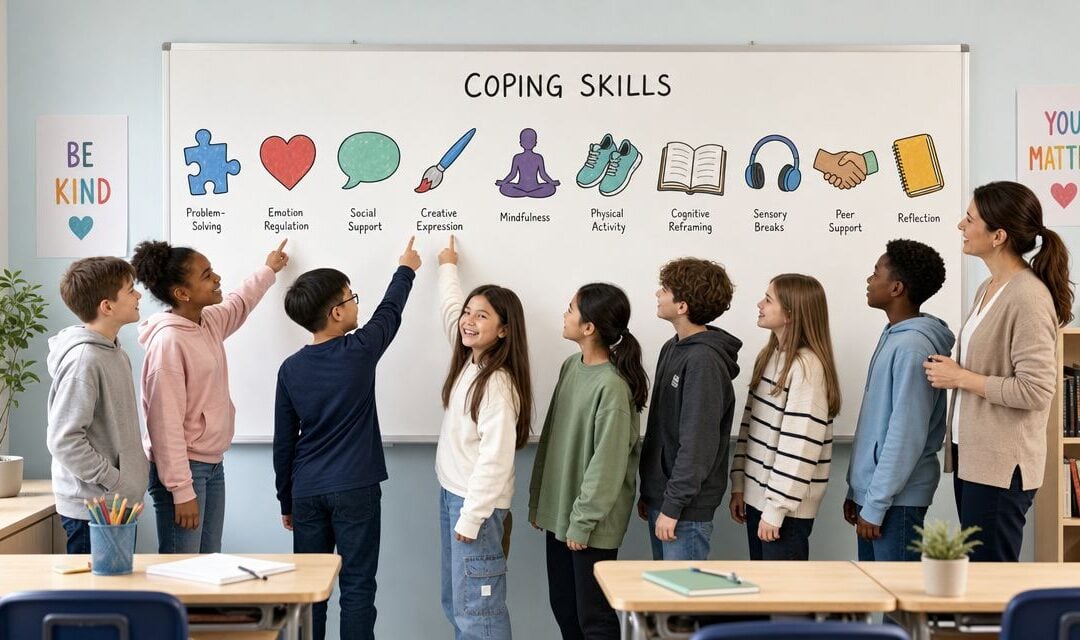
A second grader bursts into tears because a classmate cut in line. A fifth grader goes blank before a quiz and says their stomach hurts. A middle schooler slams a Chromebook shut after one confusing assignment and decides they are “just bad at school.” At home, the same stress can look different. A child melts down over homework, snaps at a sibling, or goes quiet after a hard day.

None of those moments are rare. They are the daily practice field for coping.

Children will feel frustrated, embarrassed, worried, disappointed, and left out. The next step is how they respond. Coping skills help them pause, name what is happening, and choose a response that fits the situation. A good coping skill works like a toolbox. Deep breathing will not solve every problem, and problem-solving will not calm every flooded nervous system. Children need more than one tool, and adults need to know when to offer which one.

Researchers often group coping into four broad categories: skills that address the problem, skills that regulate emotion, skills that help children make meaning, and skills that involve support from other people. That big picture is useful, but many adults need something more concrete in the moment. A teacher needs a phrase to use during math frustration. A caregiver needs a plan for bedtime anxiety. A school team may also want clear ways to teach these skills to families, including short videos or staff explainers, which is why practical resources for AI video production can fit naturally into parent communication and training systems.

This guide breaks coping down into 10 clear types and turns each one into action for K-8 settings. For every type, you will see what it is, why it helps, what it can sound like, and how to use it in both classrooms and homes. You will also find age-appropriate examples, simple adult scripts, guided deep breathing practices, and child-friendly supports such as belly breathing activities for kids.

The goal is not constant happiness. The goal is a flexible set of habits children can carry into real conflicts, real mistakes, and real disappointment.

1. Mindfulness and Deep Breathing

When a child is flooded, talking often won't work first. The body needs a reset. Deep breathing and mindfulness are common healthy coping skills recommended across age groups by Child Mind Institute's guidance on modeling healthy coping skills.

types of coping skills

A kindergarten teacher might lead a two-minute breathing circle before morning meeting. A fourth grader might use starfish breathing before a spelling test. A parent might say, “Let's do three bubble breaths before we talk about what happened.”

What it looks like in practice

In the classroom, keep it short and visible. Put a breathing card on the wall, pair breathing with a hand signal, or build a predictable reset into transitions. At home, practice during calm moments so the child already knows the routine when emotions rise.

A few concrete examples work well:

  • Morning reset: “Hands on belly. Breathe in slowly. Feel your stomach rise. Breathe out like you're cooling soup.”
  • Before a challenge: “Your body looks tight. Try one slow breath before you start.”
  • After conflict: “We're not ignoring the problem. We're calming first so we can solve it.”

For younger children, belly breathing activities for kids can make the skill feel concrete and playful.

Practical rule: Don't introduce breathing only when a child is already spiraling. Teach it when things are calm, then cue it during stress.

If you want another simple routine for adults or students, these guided deep breathing practices offer easy prompts.

2. Emotional Labeling and Expression

Many kids act out a feeling before they can name it. Emotional labeling slows that process down. Instead of “bad” or “fine,” children learn words like frustrated, left out, embarrassed, disappointed, worried, and overwhelmed.

That matters because language creates space between feeling and behavior. A child who can say, “I'm nervous,” is easier to support than a child who only knows how to refuse, yell, or shut down.

Build emotional vocabulary on purpose

In a classroom, use a feeling check-in during morning meeting or after recess. In counseling groups, let students point to an emotion wheel if speaking feels hard. At home, parents can ask with curiosity, “Was that anger, or was it more like disappointment?”

Try scripts like these:

  • Teacher script: “I can see something big is happening. Put a name on it if you can.”
  • Parent script: “You don't seem just mad. Are you hurt, worried, or frustrated?”
  • Student script: “I feel left out when no one saves me a spot.”

Books also help. Ask, “What is this character feeling right now? What clues do you notice?” Children often identify emotions in others before they can identify them in themselves.

For conflict moments, I-feel statements for kids can turn labeling into communication.

All emotions are allowed. Not all behaviors are.

That sentence helps adults stay compassionate and clear at the same time.

3. Physical Movement and Exercise

Some stress lives in the body. Kids bounce, fidget, slump, pace, or clench because their nervous systems are trying to manage load. Movement gives that energy somewhere to go.

Scottish Centre for Conflict Resolution groups physical exercise with emotional coping strategies in practical school-friendly categories, as summarized in the verified background above. That makes sense in K-8 settings, where a quick movement break can prevent a bigger blowup later.

A teacher might pause for a stretch between subjects. A counselor might invite a student to walk a lap before a repair conversation. A parent might suggest a scooter ride, dance break, or dog walk after school instead of launching straight into homework.

Here's one simple principle. Movement should be support, not punishment.

Classroom and home ideas

  • Low-pressure options: Offer chair stretches, wall pushes, hallway walks, or quiet yoga for students who don't enjoy competitive sports.
  • Routine movement: Add brain breaks before challenging tasks, not only after behavior problems.
  • Home reset: Say, “Let's move first, then talk,” after a long school day.

A quick visual can help adults think beyond traditional PE:

Older students sometimes like structured fitness options. If they're looking for ideas, these strength and hypertrophy exercises may offer variety, with adult guidance as needed.

4. Problem-Solving and Goal-Setting

A student is calm enough to talk, but the problem is still sitting there. The missing homework is still missing. The friendship issue is still happening at recess. The math page still looks impossible.

That is the moment for problem-solving coping.

This type of coping helps children address a stressor that can change, at least in part. It works like a map after the emotional storm has passed. Breathing and movement can lower the heat. Problem-solving gives the child a next step, which is often what reduces helplessness.

For adults, the challenge is knowing when to shift from comfort to structure. A useful question is, “Is there something we can do about this problem right now?” If the answer is yes, even partly, goal-setting can help.

Use a short routine children can remember

Keep the steps concrete and repeatable:

  • Name the problem: “What is happening?”
  • Find the part you can affect: “What part can you change?”
  • Brainstorm a few options: “What are three things you could try?”
  • Choose one small step: “What will you do first?”
  • Check the result: “Did it help, or do we need a new plan?”

Many children hear “solve the problem” as one giant task, making a short routine effective in turning an overwhelming situation into smaller pieces. A backpack full of mixed papers is not one problem. It may be three problems: unfinished work, no folder system, and rushing at dismissal.

In a classroom, a teacher might say, “You and Mateo both want the same marker. Let's list your choices.” At home, a parent might say, “Homework keeps ending in tears. Let's figure out which part is hardest first.”

Goals should be small enough to start today. A fourth grader stressed about a book report may not need the instruction to “finish it.” They may need, “Write the topic sentence and find one quote.” Small wins build traction because the child can see progress instead of only pressure.

You can also match the strategy to grade level. In K-2, use visuals, two choices, and adult-guided language. In grades 3-5, add written checklists and simple reflection. In middle school, involve the student in setting the goal, naming obstacles, and deciding how to track follow-through.

For ready-to-use practice, this problem-solving activity for students can help adults model each step in class or at home.

When a problem can be worked on, children often need a clear process, a short script, and one doable first step.

5. Social Connection and Support-Seeking

Coping isn't only an individual skill. One commonly missed truth is that many school stressors happen with other people present. Social coping reduces stress by seeking emotional or practical support from the community, and it's recognized as a core coping category in the verified research summary above.

This matters in K-8 schools because conflict, exclusion, bullying, and classroom dysregulation often require co-regulation. A child may not need another breathing reminder first. They may need a trusted adult, a buddy, or a clear invitation to reconnect.

types of coping skills

Teach help-seeking as a script

Children often know they feel bad but don't know how to ask for support. Make the words visible and repeatable.

Try these:

  • “Can you stay with me for a minute?”
  • “I need help solving this.”
  • “Can I talk to you after class?”
  • “I'm upset and I don't want to make it worse.”

In classrooms, you can assign support roles such as partner check-ins, peace corners with adult follow-up, or classroom jobs that reconnect isolated students. At home, create a short list of safe people the child can go to when upset.

A middle school student who had a rough lunch period might use a support card to check in with a counselor. A third grader at home might text a grandparent emoji code that means, “Please call when you can.” The skill is not dependence. It's knowing when connection is the healthiest next move.

6. Creative Expression and Artistic Activities

Not every child wants to talk right away. Some children process by drawing, humming, writing, building, acting, or making. Creative expression gives feelings a place to land.

Child Mind Institute includes journaling and listening to music among commonly recommended healthy coping skills in the verified summary above. In practice, that means schools and families can treat creative activities as real coping tools, not as extras once “real work” is done.

types of coping skills

Make the process safe, not performative

A first grader might draw what anger looks like as a storm cloud. A fifth grader might keep a feelings journal with sentence starters like “Today felt heavy when…” A middle schooler might make a playlist for calming down after social drama.

Adults can support this without over-directing it:

  • Offer choices: crayons, clay, collage, music, storytelling, comic strips
  • Skip grading: don't evaluate coping art for neatness or talent
  • Add reflection: “Want to tell me about it?” works better than “What is it?”

At home, parents can keep a small “reset basket” with paper, markers, stickers, and a notebook. In class, teachers can use free-write prompts after difficult transitions or community events.

Some children reveal more through a puppet, a sketch, or a song lyric than they can in direct conversation. That still counts as healthy coping.

7. Cognitive Reframing and Perspective-Taking

Thoughts shape feelings. If a child thinks, “Everyone hates me,” their body responds as if that thought is settled fact. Cognitive reframing teaches them to slow down, test the thought, and build a more balanced one.

In the verified background, Scottish Centre for Conflict Resolution includes cognitive restructuring, affirmations, and distraction under cognitive coping. The big school takeaway is simple. Children can learn to notice unhelpful thoughts instead of automatically obeying them.

A balanced thought is stronger than fake positivity

Don't replace one extreme with another. “I'm terrible at math” doesn't need to become “I'm amazing at math.” A more useful reframe is, “This part is hard, but I can ask for help and try one step.”

Use classroom and home questions like:

  • “What's the story your brain is telling?”
  • “What evidence do you have?”
  • “Is there another way to look at this?”
  • “What would you say to a friend in the same situation?”

A student left out of one game might decide, “Nobody likes me.” An adult can help reframe: “You felt excluded in that moment. That hurts. It doesn't tell the whole story about every friendship.”

Thoughts are important, but they aren't always accurate.

Perspective-taking also belongs here. During conflict, ask students to describe what each person may have wanted, feared, or misunderstood. This doesn't excuse hurtful behavior. It widens understanding enough for repair.

8. Mindful Self-Compassion and Positive Self-Talk

Many children are much harsher with themselves than adults realize. They mutter, “I'm dumb,” “I ruin everything,” or “Nobody wants me.” Positive self-talk and self-compassion interrupt that inner voice with something more honest and supportive.

In the verified summary, positive self-talk is listed among common healthy coping skills recommended across age groups. That's especially important for students who shut down after mistakes or hold themselves to impossible standards.

Teach children how to talk to themselves

A compassionate script should feel believable. Skip exaggerated praise and use grounded language instead.

Examples:

  • Before a test: “I'm nervous, and I can still try.”
  • After a mistake: “Messing up doesn't mean I can't fix it.”
  • During frustration: “This is hard right now. Hard doesn't mean impossible.”

Teachers can model this out loud. “I made a mistake on the board. I'm going to slow down and correct it.” Parents can do the same at home. “I forgot something at the store. That's frustrating, but I can handle it.”

Physical cues help younger children. A hand on the heart, a gentle squeeze of both hands, or wrapping in a blanket can pair body comfort with kind words.

One caution matters here. Supportive self-talk should not become denial. If a child is hurting, “I'm fine” isn't coping. “I'm upset, and I know what can help” is coping.

9. Boundary-Setting and Assertive Communication

Some children cope by staying silent until they explode. Others say yes to things they don't want, then feel resentful or unsafe. Boundary-setting helps them communicate needs and limits earlier.

This fits the solution-focused category described in the verified summary, where examples include collaborative problem-solving, time management, and boundary setting. In school and at home, boundaries are practical coping tools because they reduce repeated stress before it escalates.

Give students words they can actually use

Children need scripts that sound natural for their age:

  • “Please stop. I don't like that.”
  • “I need space right now.”
  • “I'm not ready to talk yet.”
  • “You can play with me, but not if you keep grabbing.”

For older students, expand the script: “I feel frustrated when my things are used without asking. I need you to check with me first.” That's assertive, not aggressive.

In class, boundary practice can happen through role-play. One student interrupts. Another practices saying, “I'm still talking.” At home, a child can practice asking for quiet during homework or naming a limit with a sibling.

If your students confuse assertiveness with meanness, this guide on teaching assertiveness versus aggressiveness can help.

The adult role is important. Respect the child's healthy boundary when possible. If adults ignore every early signal, children often learn to use louder ones.

10. Acceptance and Mindful Tolerance of Difficult Emotions

Some feelings can't be solved away. Grief, disappointment, jealousy, nerves, and sadness often need to be felt, not fixed. Acceptance-based coping teaches children to notice difficult emotions without immediately running from them.

That distinction matters because avoidance-based coping such as disengagement, withdrawal, or emotional suppression is generally treated as maladaptive in the verified EBSCO summary of coping strategies. Temporary relief isn't always healthy relief.

Help children stay with feelings safely

Acceptance sounds like:

  • “I notice anxiety is here.”
  • “This feeling is uncomfortable, not dangerous.”
  • “I can feel sad and still go to school.”
  • “I don't have to get rid of this feeling before I do the next right thing.”

A student anxious about a class presentation may still choose to present with shaky hands. A child sad after moving homes may still join family dinner instead of hiding in their room. The goal isn't comfort first. It's flexibility.

Some coping skills reduce feelings. Others help children carry feelings without letting those feelings run the whole day.

Adults can use child-friendly metaphors. Emotions are weather. Thoughts are clouds. Waves rise and fall. The child isn't the storm. They're the sky holding it.

One note matters for safety. Accepting feelings never means accepting harmful behavior from self or others. A child can accept anger and still be expected not to hit.

Top 10 Coping Skills Comparison

Strategy Implementation complexity Resource requirements Expected outcomes Ideal use cases Key advantages
Mindfulness and Deep Breathing Low (short guided practice; requires consistency) Minimal (time, brief guidance, visual cues) Immediate stress reduction; improved regulation and attention In-the-moment distress, transitions, test anxiety, daily resets Portable, easy to teach, evidence-backed
Emotional Labeling and Expression Low (modeling and reinforcement needed) Low (feeling charts, prompts, classroom routines) Reduced emotional intensity; better communication and empathy Check-ins, restorative circles, de-escalation, emotional literacy work Quickly lowers intensity; builds vocabulary and shared language
Physical Movement and Exercise Moderate (planning, scheduling, inclusion) Moderate–high (space, equipment, time) Physiological stress relief; improved mood, focus, and health Brain breaks, recess, chronic stress management, group activities Strong neurochemical benefits; supports attention and social connection
Problem-Solving and Goal-Setting Moderate (teaching steps, scaffolding) Low–moderate (facilitation time, templates) Increased agency, practical solutions, improved executive function Academic planning, recurring problems, counselor-guided sessions Empowers action; builds planning and persistence skills
Social Connection and Support-Seeking Low–moderate (culture-building and modeling) Low (relationships/time) but depends on reliable supports Reduced risk of depression/anxiety; increased belonging and perspective Isolation, crisis response, peer mentorship, community-building Highly protective; provides practical help and emotional relief
Creative Expression and Artistic Activities Low–moderate (facilitation for therapeutic depth) Moderate (materials, space, facilitator) Nonverbal emotional processing; increased self-efficacy and expression Students who struggle with words, counseling, reflective projects Inclusive expression; validates feelings without pressure to verbalize
Cognitive Reframing and Perspective-Taking Moderate–high (skill-building and practice) Low (instructional time, guided exercises) Reduced rumination/anxiety; stronger resilience and problem-solving Anxiety, negative thought patterns, growth-mindset interventions Produces lasting changes in thinking; well-supported by research
Mindful Self-Compassion and Positive Self-Talk Moderate (practice; cultural adaptation) Low (guided scripts, brief exercises) Less self-criticism; increased resilience and sustainable motivation Perfectionism, setbacks, building internal supports Builds internal encouragement; protects mental health better than self-esteem alone
Boundary-Setting and Assertive Communication Moderate–high (skills training, role-play) Low–moderate (coaching, practice time) Reduced burnout and conflict; healthier relationships and autonomy Peer pressure, interpersonal conflict, workload and accommodation requests Protects wellbeing; establishes respect and clearer expectations
Acceptance and Mindful Tolerance of Difficult Emotions Moderate–high (skilled facilitation and practice) Low (teaching) but requires ongoing practice Greater psychological flexibility; reduced avoidance and secondary distress Chronic anxiety, grief, situations without immediate solutions Promotes long-term emotional flexibility and values-aligned action

Putting Coping Skills into Practice Your Next Steps

Teaching these types of coping skills works best when adults stop treating them like emergency tools only. Children need practice when they're calm, support when they're activated, and reflection after the moment has passed. That rhythm matters in every setting, whether you're leading a classroom, running a counseling group, or helping with homework at the kitchen table.

Start smaller than you think you need to. Pick one or two coping skill types to teach explicitly this month. A kindergarten class might focus on breathing and naming feelings. A fourth-grade class might add problem-solving and assertive communication. At home, a family might start with one calming strategy, one help-seeking script, and one boundary phrase that everyone practices together.

Consistency beats intensity. A two-minute reset every morning can do more than a long one-time lesson that never returns. A feeling check-in after school builds more skill than waiting for the next meltdown. Children learn coping from repetition, modeling, and shared language. They also learn it from watching what adults do under pressure.

It helps to match the coping skill to the situation. If a stressor can be changed, problem-solving may help. If the feeling is big but the problem isn't immediately fixable, emotional coping may come first. If the moment is interpersonal, social coping and co-regulation may be the best entry point. If a child is trying hard to escape every uncomfortable feeling, acceptance-based strategies may be more useful than another distraction.

Adults also need to watch for when coping starts to backfire. A strategy that helps in one moment can become unhelpful in another. Distraction can be useful before a child returns to a task, but not if it becomes a way to avoid every hard conversation. Journaling can support expression, but some children may get stuck in rumination without guidance. The question isn't “Is this a good coping skill?” in the abstract. The better question is “Is this helping this child in this moment, in this setting, for this need?”

In schools, shared systems prove important. If teachers, counselors, support staff, and caregivers use similar language, children don't have to relearn the skill in every room. They begin to recognize patterns in themselves. They know what to try, how to ask for help, and what adults mean when they say, “Let's regulate first,” or “What part can you control?”

Soul Shoppe is one option schools may consider if they want support building that kind of shared SEL language. According to the publisher information provided, the organization offers experiential programs, workshops, assemblies, coaching, and family resources focused on self-regulation, mindfulness, communication, conflict resolution, and belonging. That kind of schoolwide approach can make coping skills easier to teach consistently across classrooms and home partnerships.

The long-term goal isn't a child who never feels upset. It's a child who knows what upset feels like, has more than one way to respond, and trusts that support is available. That is emotional resilience in everyday form. It starts with naming, practicing, modeling, and repeating. Then one day, a child who used to yell, hide, or give up says, “I'm frustrated. I need a minute. Then I'm ready to try again.”


If you want practical SEL support for coping skills, communication, and conflict resolution across your whole school community, explore Soul Shoppe for programs and resources designed for students, educators, and families.