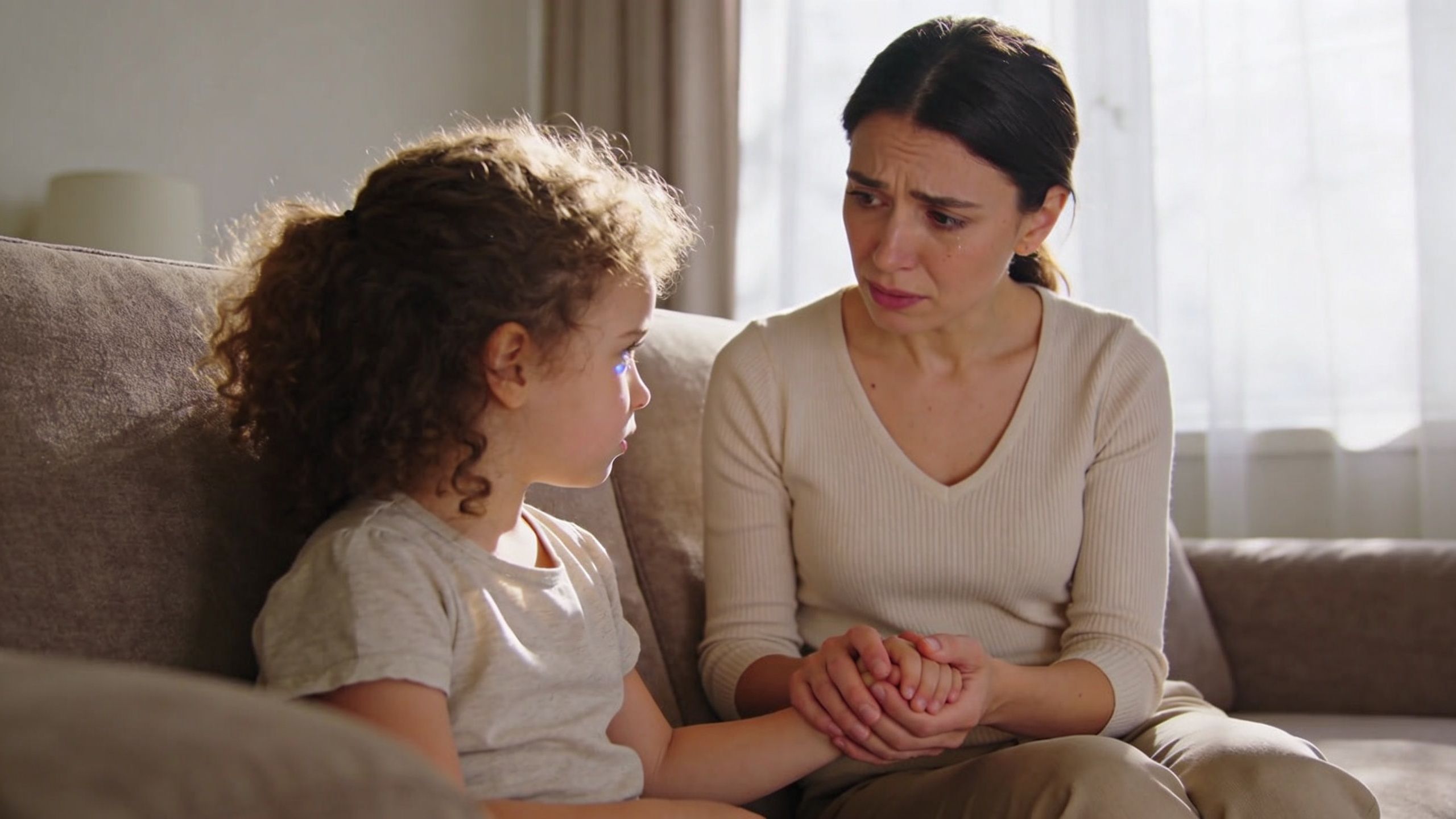
Soul Shoppe's work is made possible by donors and partners who care deeply about the young people in their communities! We can't do this work without you. Support our work in classrooms and on playgrounds across the nation by donating here.
Step into any kindergarten classroom and you'll see the same pattern by 9:15 a.m. Someone is beaming because they got the red marker. Someone else is in tears because a friend sat in “their” spot. Another child is trying hard to join a game but doesn't yet have the words. The day is full of reading, counting, lining up, cleaning up, waiting, sharing, losing, trying again, and all of the feelings that come with it.
That's why social emotional learning activities for kindergarten matter so much. They aren't extras for the end of the day if there's time left. They're part of how young children learn to be in school with other people. When children can name feelings, notice body signals, solve small conflicts, and reconnect after hard moments, the rest of the classroom runs better too.
The long view matters. A longitudinal study of over 9,000 elementary students in Baltimore City Public Schools found that kindergarteners rated “Not Ready” in social-emotional readiness were up to 80% more likely to be retained by fourth grade, up to 80% more likely to require special education services, and up to seven times more likely to face suspension or expulsion at least once, according to New America's summary of the research.
You don't need a complicated system to start. You need routines children can use. The seven activities below are built like a lesson plan in a box, with materials, directions, differentiation, and simple ways to tell whether they're working.
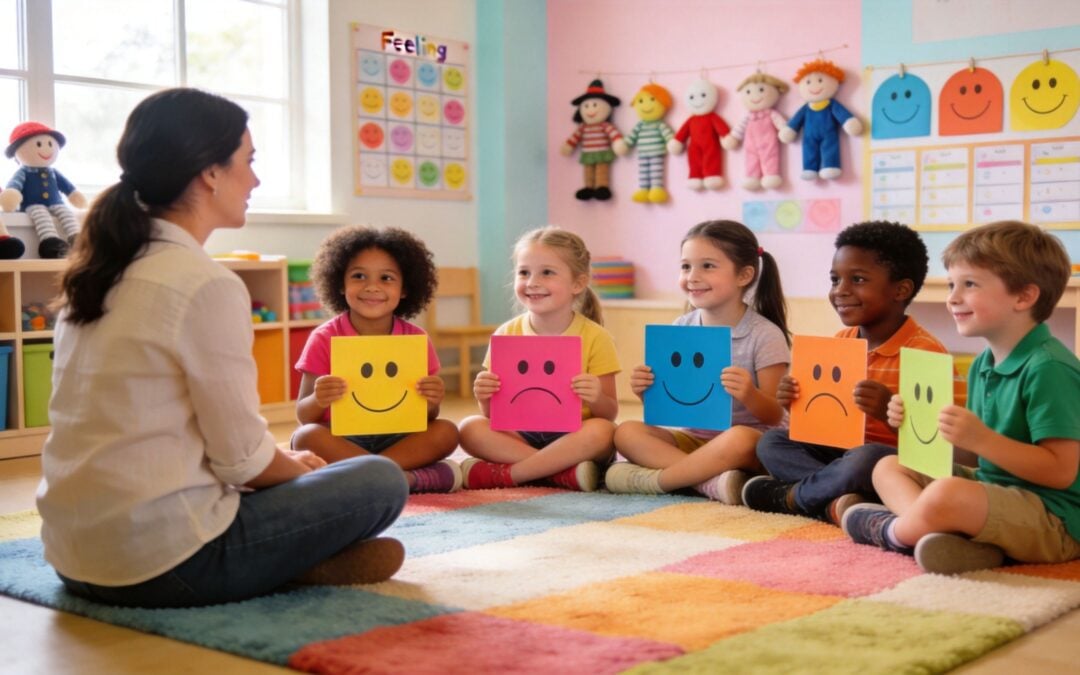
1. Emotion Recognition and Connection Circles
A good circle routine does two jobs at once. It builds emotional vocabulary, and it gives children a reliable place to belong. In kindergarten, that predictability matters as much as the feelings lesson itself.
This one works best when you keep it short and repeat it daily. Fifteen to twenty minutes is usually enough. Long circles lose children fast, especially if too much talking comes from adults.
Lesson plan in a box
Learning focus: Naming feelings, listening to peers, and making simple connections between emotions and experiences.
Materials: Feelings cards with clear faces, a talking piece, chart paper, and a class feelings chart for kids.
Directions:
Open with a ritual: Sit in a circle and pass the talking piece. Each child says their name and points to a feeling card or color.
Model a real check-in: The teacher goes first. “I feel disappointed because it's raining and we can't go outside yet. I know that feeling will pass.”
Add one connection question: Ask, “What helps when you feel frustrated?” or “What does your face look like when you feel proud?”
Build a class anchor chart: Record children's words and draw simple icons beside them for pre-readers.
What works and what doesn't
What works is structure. Children do better when the order stays the same, the visuals are concrete, and everyone knows the listening rules. A talking piece helps because it makes turn-taking visible.
What doesn't work is pushing children to disclose more than they want to share. Some children will point to a card, whisper, or say “pass.” That still counts as participation.
Practical rule: Don't correct a child's feeling. If a child says, “I'm mad and sad,” accept both and help them add words.
Differentiate it this way:
For emerging speakers: Let them point, hold up a card, or copy a sentence stem.
For children with big energy: Give them a fidget or assign a circle job like card helper.
For home use: Parents can do the same routine at dinner with three feeling choices instead of a full chart.
Simple assessment: Notice whether children move from generic words like “good” and “bad” toward more precise words like “nervous,” “lonely,” or “excited.” Also watch whether they begin responding to peers with comments such as “me too” or “that happened to me.”
2. Mindfulness and Breathing Practice Activities
Breathing practice gets dismissed when adults make it too abstract. Kindergarteners don't need a lecture on the nervous system. They need something they can see, feel, and copy.
Bubble breath, balloon belly, and smell-the-flower breathing all work because they are physical and playful. The best time to teach them is when children are calm, not in the middle of a meltdown.
Lesson plan in a box
Learning focus: Self-regulation, body awareness, and calming during transitions or rising frustration.
Materials: Bubbles, a stuffed animal for belly breathing, visual cue cards, and a child-friendly guide to belly breathing technique.
Directions:
Teach one breath first: Place a stuffed animal on a child's belly while they lie down or sit back. Breathe in slowly to “lift” the animal, then breathe out to lower it.
Practice with movement: Have children make their arms wide like a balloon while inhaling, then slowly hug themselves while exhaling.
Use it in real moments: Before lining up, after recess, or after a conflict, invite the class to choose one breath together.
Keep it brief: Two or three minutes is enough for the first few weeks.
A universal kindergarten study of the Fun FRIENDS program in Japan found significant reductions in problem behaviors, and the program used developmentally appropriate SEL practices such as emotional regulation, social skills, parent reinforcement, and play-based activities, according to the PMC article on Fun FRIENDS.
Common mistakes
The biggest mistake is treating breathing as compliance. If a child hears “go calm down” every time they're upset, the strategy starts to feel like punishment. Offer it as support, not a command.
The second mistake is offering only one way to regulate. Some children breathe better while standing, swaying, or pressing their hands together. Choice helps.
Breathing practice should feel like rehearsal, not correction.
Differentiate it this way:
For sensory-seeking children: Pair breathing with wall pushes or stretching.
For children who resist closing eyes: Keep eyes open and focus on a bubble wand, pinwheel, or teacher's hand signal.
For home use: Try one breathing cue before bed, before homework, or before leaving the house.
Simple assessment: Track whether children begin using breathing language on their own. You'll hear it in phrases like “I need balloon breaths” or see it when they pause before reacting during transitions.
3. Kindness and Empathy Building Activities
Kindness activities work best when they move beyond “be nice.” Kindergarteners need to see, hear, and practice what kindness looks like in real situations. Help, waiting, inviting, checking in, and noticing someone's feelings are all more teachable than the word nice.
A simple empathy routine can grow out of storytime, play, or a classroom problem. If one child is left out at blocks, that's your lesson right there.
Lesson plan in a box
Learning focus: Perspective-taking, caring actions, and inclusive language.
Materials: Read-aloud book about friendship, chart paper, sentence stems, and a short family resource on how to teach empathy.
Directions:
Read and stop often: Ask, “How does this character feel?” and “What might help?”
Role-play two versions: Act out an unkind response, then replay the same moment with a kinder choice.
Make it concrete: Build a “kindness looks like” chart with examples such as sharing tape, scooting over, asking “want to play?” and helping clean up.
Close with one action: Each child chooses one kind act to try during center time.
Make praise specific
General praise fades quickly. Descriptive feedback teaches. “You noticed Maya looked sad and offered her a seat” is more useful than “good job being nice.”
One practical trade-off is visibility. Public kindness chains and class shout-outs can motivate some children, but others start performing for praise. Keep some recognition quiet and direct.
Differentiate it this way:
For shy children: Let them draw a kind act rather than perform it.
For children who act before thinking: Use puppets first so they can rehearse at a safe distance.
For families: Send home one weekly prompt such as “Ask someone in your home what kind act helped them today.”
Simple assessment: Watch for transfer during play. Are children beginning to invite peers in, offer help, or use feeling language when someone is upset? That's the true test.
4. Conflict Resolution and Problem-Solving Role-Plays
Most kindergarten conflict is predictable. Someone grabs. Someone cuts in line. Someone says, “You can't come.” Because the conflicts repeat, the language should repeat too. Children need short phrases they can remember when upset.
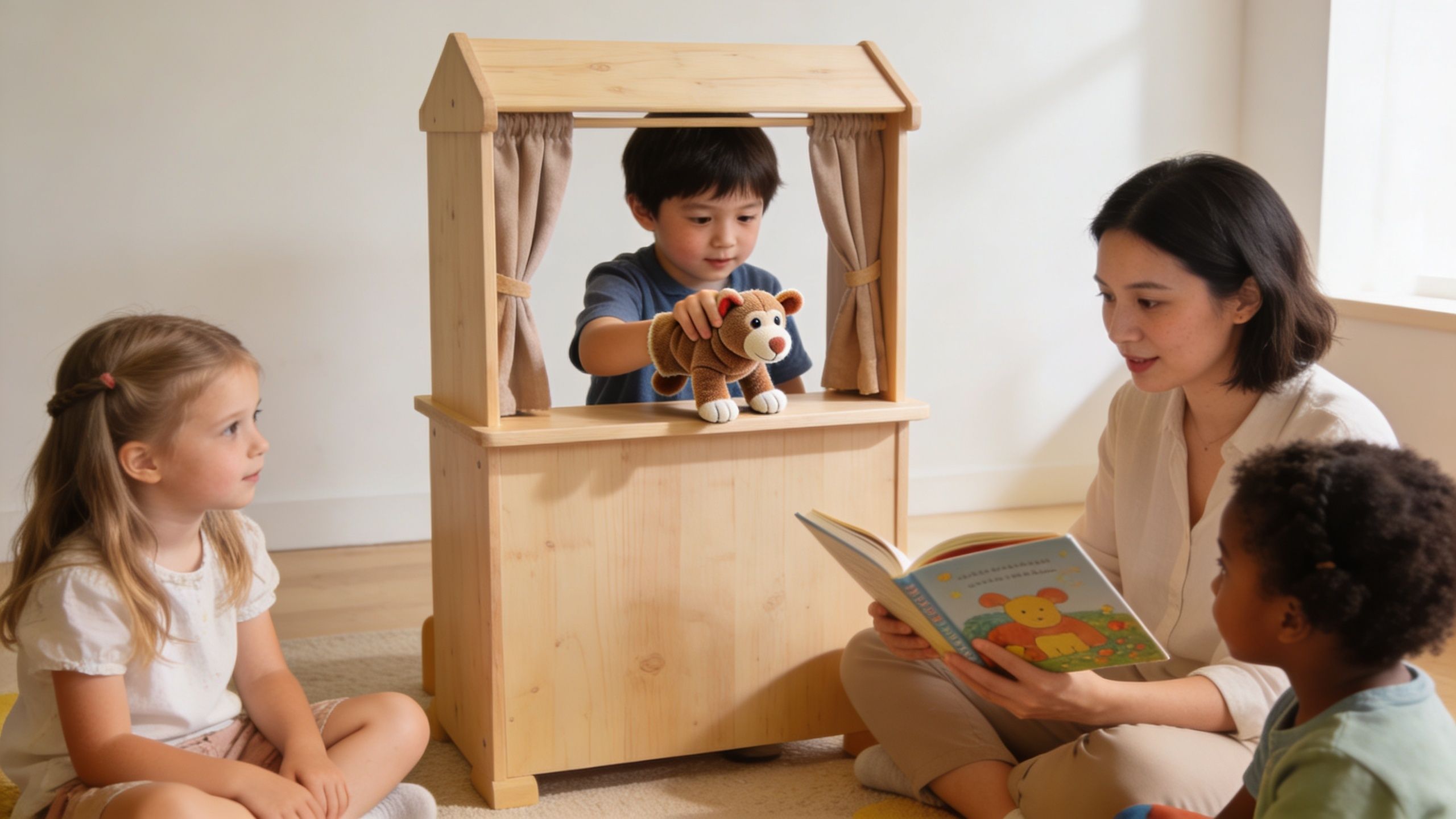
Start with puppets. Puppets lower the pressure, slow down the scene, and make it easier for children to notice what happened without feeling blamed.
Lesson plan in a box
Learning focus: Using words in conflict, listening to another person, and choosing a simple next step.
Materials: Two puppets, picture cards showing common school conflicts, visual prompts with phrases, and a classroom guide to conflict resolution activities for kids.
Directions:
Act out a familiar problem: A puppet grabs a block tower piece without asking.
Pause the scene: Ask children what each puppet might be feeling.
Teach two sentence frames: “I don't like when…” and “Can we solve this?”
Practice a few endings: Take turns, find another block, rebuild together, or ask for help.
This short video can support your modeling:
Keep the script simple
You don't need a long peace process for five-year-olds. Three steps are enough in most classrooms: say the problem, listen, pick a solution. If children are too escalated, step in and co-regulate first.
What doesn't work is forcing instant apologies. A child can say “sorry” and still have learned nothing. It's more effective to help them repair with action, like returning the marker, checking on a friend, or inviting someone back into play.
“Use the words before you need the words.” Practice at calm times so children can access them during stress.
Differentiate it this way:
For language learners: Add picture cards for key phrases.
For impulsive children: Let them physically hold a step card to pace the conversation.
For home use: Parents can role-play sibling conflicts using stuffed animals instead of direct correction.
Simple assessment: Listen for independent use of taught phrases and notice whether children need less adult mediation in recurring conflicts.
5. Self-Awareness and Personal Strength Activities
Kindergarteners often know what they like before they know what they're good at. That's a useful starting point. Preferences, interests, helpers, and proud moments all lead toward self-awareness.
An “All About Me” activity becomes SEL when it goes beyond favorite color. Children need chances to identify what helps them, what feels hard, and where they shine.
Lesson plan in a box
Learning focus: Recognizing strengths, preferences, support systems, and personal identity.
Materials: Mirrors, paper for self-portraits, family questionnaire, crayons, and sentence stems such as “I'm good at…” and “I feel proud when…”.
Directions:
Start with observation: Children look in a mirror and draw themselves.
Add personal details: Invite them to finish prompts about favorite play, people who help them, and something they're learning.
Use peer noticing: Pair children to share one strength they saw in a classmate, such as “you build carefully” or “you help people zip coats.”
Display the work: Put self-portraits and strength statements at child eye level.
What to watch for
Some children light up when asked about strengths. Others freeze because they aren't used to talking about themselves in positive ways. That's normal. Offer examples tied to observable behavior, not personality labels alone.
A useful trade-off here is between polish and authenticity. Adult-made projects may look beautiful, but they hide the child's real voice. Messier work often tells you more.
Differentiate it this way:
For children who struggle to generate ideas: Offer photo choices or oral interviews.
For children with limited fine motor stamina: Let them dictate while an adult scribes.
For families: Ask caregivers to contribute one “I notice…” statement about their child at home.
Simple assessment: Look for richer self-descriptions over time. “I like dinosaurs” can grow into “I keep trying when puzzles are hard” or “I ask friends to play.”
6. Cooperative Games and Team Building Activities
Not every game in kindergarten needs a winner. In fact, some of the best social emotional learning activities for kindergarten remove winning on purpose so children can focus on communication and shared goals.
Cooperative games help children practice waiting, noticing others, and solving problems together without the emotional spike of competition. That makes them especially useful early in the year or after social tension in the class.
Lesson plan in a box
Learning focus: Cooperation, turn-taking, shared attention, and group problem-solving.
Materials: Parachute or sheet, soft ball, blocks, painter's tape, or any simple movement props.
Directions:
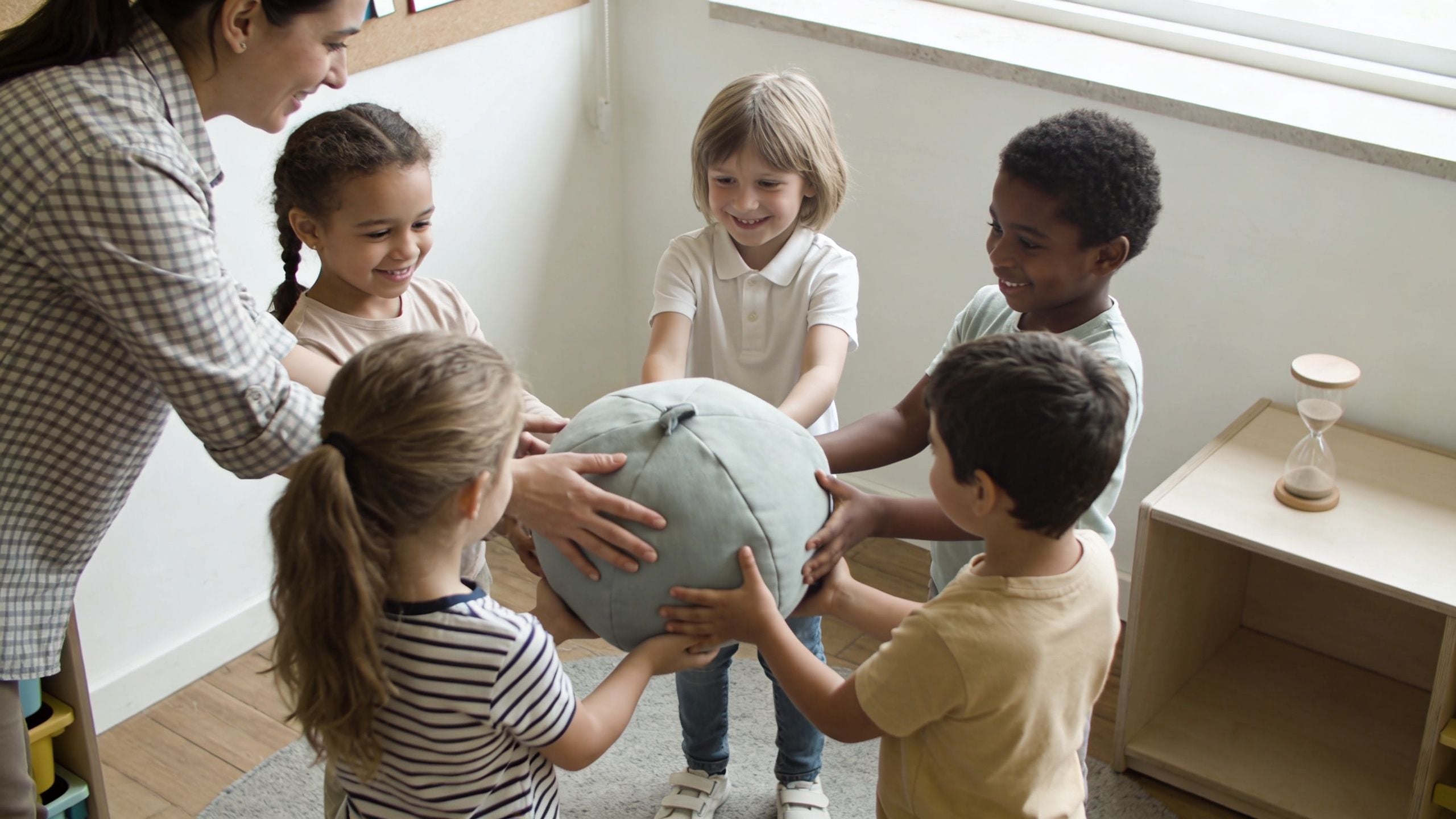
Choose one shared mission: Keep the ball on the parachute, build one class tower, or cross a taped “river” together using mats.
Name the success condition clearly: “We succeed if everyone stays in the game and we solve it together.”
Pause for reflection: After one round, ask what helped the group.
Repeat with one change: Add a challenge such as quieter voices, slower bodies, or a new partner.
Good competition versus bad friction
There's nothing wrong with occasional competitive play, but young children often need more coaching than adults expect when they lose. Cooperative formats reduce that friction and make room for children who usually withdraw.
The mistake is assuming children automatically know how to collaborate. They don't. You still need to model phrases like “your turn,” “let's try your idea,” and “we need everyone.”
A related implementation gap in SEL is measurement. One summary notes that many programs still don't include reliable assessment tools, which leaves schools looking for practical ways to track growth in skills like emotion regulation and empathy. The discussion of this gap in kindergarten SEL implementation points toward simple observation rubrics and checklists as an area educators still need.
Differentiate it this way:
For children who dominate: Give them a listening role or ask them to repeat another child's idea first.
For children who hesitate: Pair them with a steady peer and assign a clear job.
For home use: Families can do cooperative puzzles, blanket forts, or “build one tower together” challenges.
Simple assessment: Use a quick teacher checklist. Note who waits, who invites others in, who recovers after mistakes, and who can share materials without adult prompting.
7. Gratitude and Appreciation Practices
Gratitude routines can become shallow fast if they turn into forced positivity. In kindergarten, appreciation works when it stays specific, honest, and connected to relationships. Children don't need to be thankful all the time. They need practice noticing what is good while still having room for hard feelings.
This is a strong closing or transition routine because it helps children end the day connected rather than scattered.
Lesson plan in a box
Learning focus: Noticing support, expressing appreciation, and strengthening classroom belonging.
Materials: Paper leaves or sticky notes, a bulletin board or wall space, sentence stems, and markers.
Directions:
Set a narrow prompt: “Name one person, place, or moment from today you appreciate.”
Model specificity: “I appreciate Mateo because he held the door when my hands were full.”
Record it visibly: Add children's words to a thankfulness tree or appreciation board.
Invite response: Let the child receiving appreciation say “thank you” or smile and wave if they prefer.
Keep it grounded
Some children will say “my toys” or “ice cream” every time. That's fine at first. Then gently widen the lens with follow-up questions about people, effort, comfort, or help.
What doesn't work is using gratitude to bypass real problems. If a child had a hard day, let both things be true. “You were sad at cleanup, and you also appreciated playing with Ana” is a healthy message.
The market for SEL tools and programs continues to grow, with the global social and emotional learning market projected to rise from USD 2.71 billion in 2026 to USD 15.67 billion by 2034, according to Fortune Business Insights' SEL market projection. For schools, that growth is one more reason to choose routines that staff can sustain, not just purchase.
Appreciation lands best when children can connect it to a real action they saw or received.
Differentiate it this way:
For children who struggle to generate ideas: Offer stems like “I appreciated when…” or “Thank you for…”
For nonwriters: Let them dictate or draw the appreciated moment.
For families: Try a bedtime routine where each person thanks one other person for something specific from the day.
Simple assessment: Notice whether children begin offering appreciation without prompting and whether peer relationships soften around children who are often overlooked.
Morning meetings, end-of-day reflections, family routines
Low-cost way to reinforce positivity and appreciation
Weaving SEL into the Fabric of Your Classroom
These routines work because they fit real kindergarten life. They don't require a special week, a perfect class, or an hour carved out of an already full schedule. They work when they show up in morning meeting, transitions, play, conflict, cleanup, and dismissal.
Consistency matters more than variety. One teacher may get strong results from a daily feelings circle and one breathing routine. Another may lean on puppets for conflict role-play and a weekly appreciation board. Both approaches can work if children get repeated practice and adults use shared language across the day.
There's also a practical reason to treat this work as foundational. Some newer conversations in SEL point to a gap between standalone activities and classroom instruction. The discussion of SEL integrated with academics reflects what many educators already know firsthand. Children participate more fully in literacy, math, and play when they feel safe, connected, and capable of managing frustration.
If you're leading a classroom, start with one routine you can sustain for a month. If you're an administrator, look for schoolwide language and simple observation tools so teachers aren't each inventing their own system. If you're a parent, borrow one practice and repeat it at home in a low-pressure way. Repetition builds transfer.
These choices also support engagement. Children learn more when they feel that they belong, can take risks, and know what to do after mistakes. That's one reason classroom culture and how to increase student engagement are so closely connected.
For schools that want a more coordinated approach, Soul Shoppe is one relevant option. The organization offers SEL programs focused on connection, safety, empathy, self-regulation, mindfulness, communication, and conflict resolution for school communities. What matters most, though, isn't picking the fanciest program. It's choosing practices that adults will use, children can understand, and families can reinforce.
Kindergarteners are learning far more than letters and numbers. They're learning how to be with themselves and with other people. That deserves time on the schedule.
If you want support building a shared SEL language across classrooms, families, and school staff, explore Soul Shoppe for programs, tools, and practical strategies centered on connection, safety, and empathy.
A lot of adults are living this sentence every day without naming it: life is perspective.
You see it during morning meeting when one student says, “She ignored me,” and the other says, “I didn’t even hear you.” You hear it at home when one child says, “That’s not fair,” and a parent is thinking, “I’m trying to help everyone get out the door.” The facts of the moment may be the same. The experience of the moment is not.
For K-8 students, that gap matters. It shapes friendships, classroom trust, problem-solving, and how children make sense of setbacks. When adults teach kids how to pause, look again, and consider another point of view, we aren’t asking them to give up their own feelings. We’re helping them understand that more than one story can be happening at once.
That’s a core social-emotional skill. It helps children move from blame to curiosity, from defensiveness to communication, and from “I’m right” to “Help me understand.”
The Power of Seeing Things Differently
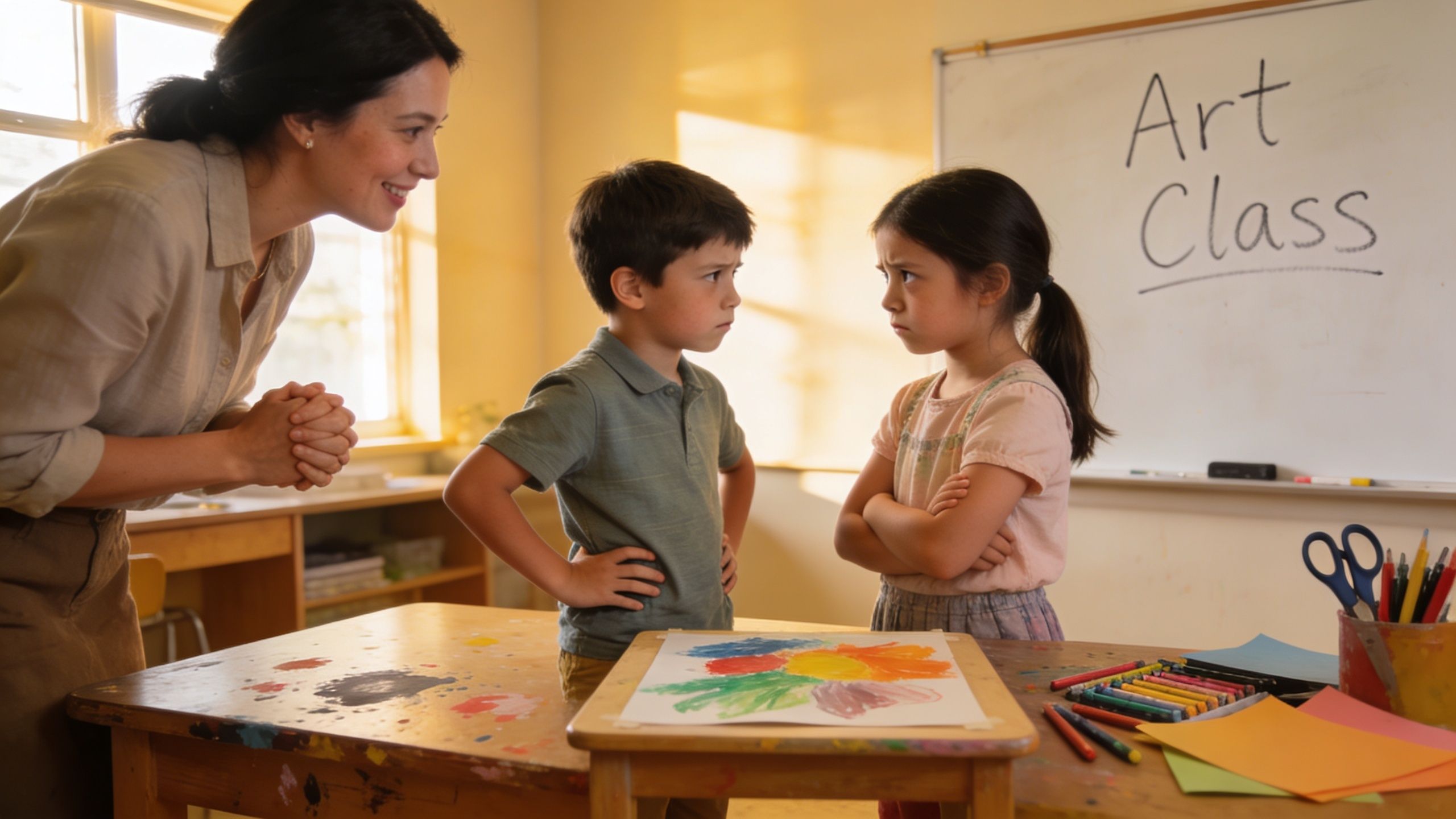
Two second graders are arguing over markers at the art table. One says, “He took it from me.” The other says, “I thought nobody was using it.” Both children are upset. Both feel certain. Both want the teacher to confirm their version.
That’s a small classroom moment, but it holds a big lesson. Children often think perspective means deciding who is correct. In practice, perspective-taking means noticing that each person has partial information, feelings, assumptions, and needs. Once kids learn that, conflict becomes easier to unpack.
What perspective means in a school day
In plain language, perspective is the way a person understands what’s happening. It includes what they noticed, what they missed, what they expected, and what they felt.
A child who says, “Nobody wants me on the team,” may be reacting to one missed invitation. Another child in the same game may be focused on rules and not realize someone feels left out. The event is shared. The meaning attached to it is different.
This is why “life is perspective” lands so strongly in SEL work. It reminds us that behavior doesn’t appear out of nowhere. A child reacts to the meaning they assign to the moment.
Practical rule: Start with, “Tell me what happened from your view,” before you move to correction or consequences.
That one sentence changes the temperature of the room. Kids feel heard, and adults get better information.
Why this matters beyond one conflict
Research from the Pew Research Center on what makes life meaningful across advanced economies shows that while priorities differ across cultures, core human values like family, friendships, and health are nearly universal sources of meaning. For educators and families, that’s a useful reminder. Children need help building connection, belonging, and resilience because those are part of what people consistently value most.
In school, perspective-taking supports exactly those outcomes. A child who can ask, “What else might be going on here?” is less likely to escalate a disagreement and more likely to repair a relationship.
You can even build this mindset into academic lessons. During a read-aloud about environmental care, for example, students can compare how different people see the same problem. If you want real-world visuals for that kind of discussion, these sources for plastic pollution images can help students talk about how the same image may spark sadness, responsibility, anger, or action depending on the viewer.
Where adults often get stuck
Many teachers and parents worry that validating perspective means approving hurtful behavior. It doesn’t.
You can say, “I believe you felt left out,” and also say, “You may not push when you’re angry.” Perspective-taking doesn’t remove boundaries. It makes boundaries more teachable because students are calmer and more able to reflect.
When children learn that other people have inner experiences just as real as their own, they begin to build empathy. That shift is one of the strongest foundations we can give them.
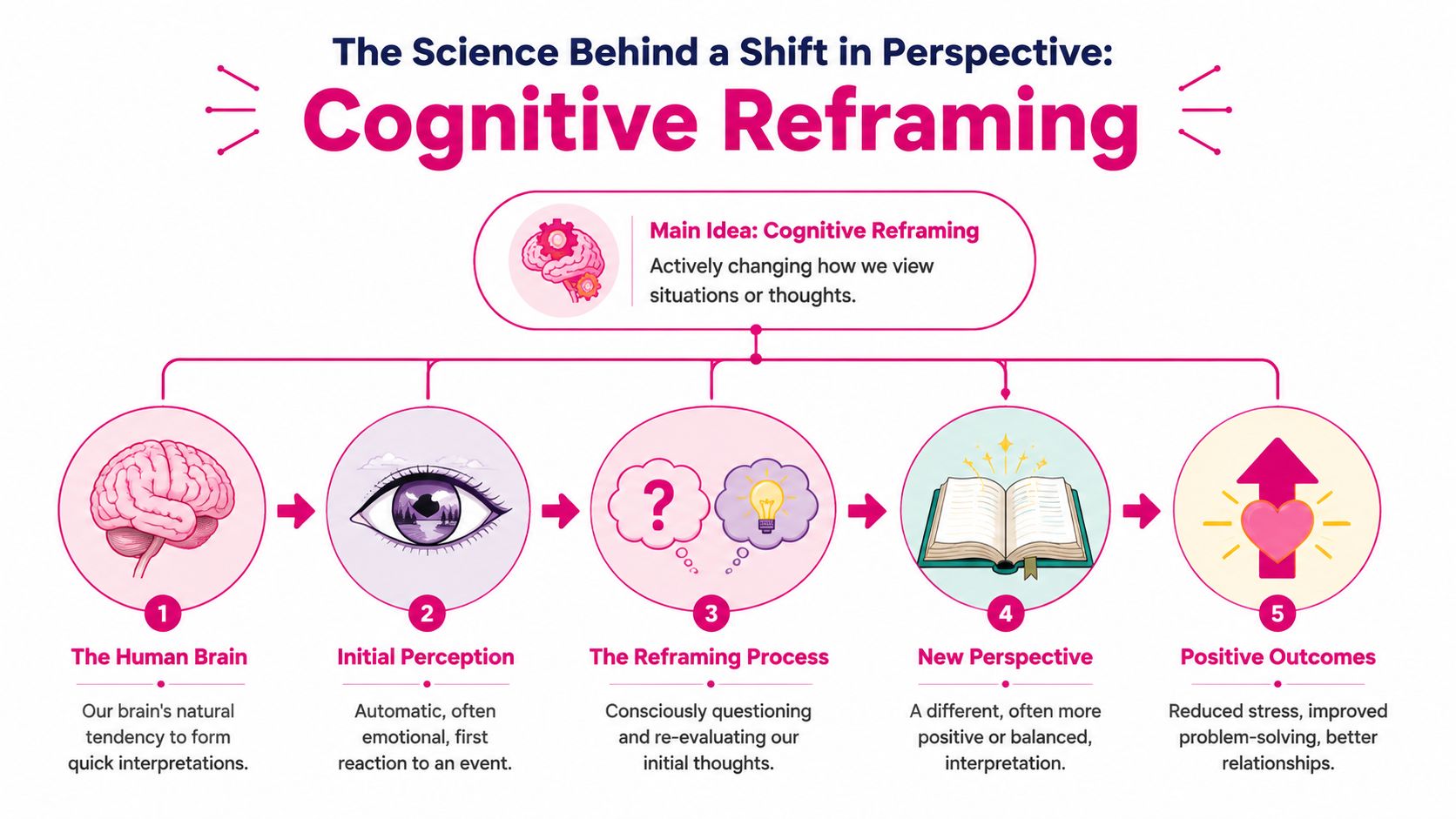
The Science Behind a Shift in Perspective
When I explain perspective-taking in staff workshops, I use a simple image. Think of the brain as using a fast camera. It snaps a quick picture of a situation and labels it immediately: threat, unfair, embarrassing, mean, boring.
That first picture isn’t always wrong. But it’s often incomplete.
The brain can learn a second look
Cognitive reframing means teaching students to take a second mental picture. Instead of stopping at “She’s ignoring me,” they learn to ask, “Could she be distracted, nervous, or unsure what to say?” That doesn’t erase their feeling. It widens their interpretation.
Neuroscientific studies described in this discussion of perspective-taking and empathy-related brain activity report that structured perspective-taking exercises can increase activation in brain regions responsible for empathy and improve conflict resolution outcomes in students by up to 31%. For educators, the takeaway is straightforward. Perspective-taking isn’t fluff. Practice changes how students respond.
Two brain regions often come up in this conversation: the anterior cingulate cortex and the temporoparietal junction. You don’t need students to memorize those names. What matters is the idea behind them. Parts of the brain involved in empathy and understanding other minds become more active when people intentionally consider another viewpoint.
A useful classroom analogy
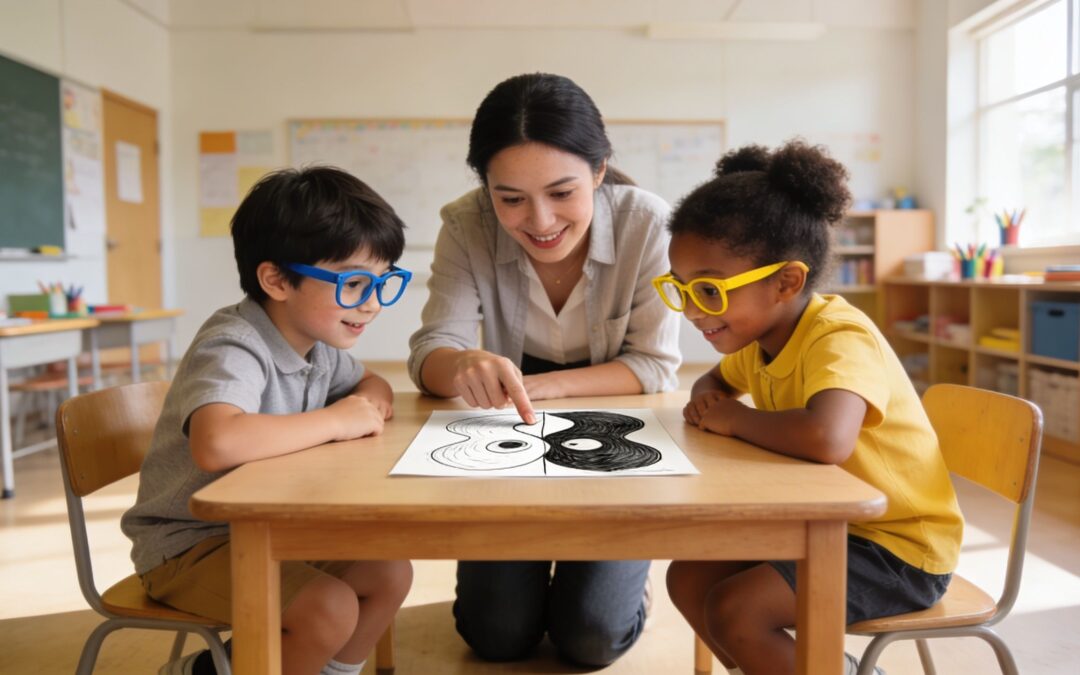
Try calling this “putting on perspective glasses.”
When a student is upset, ask:
What did you first see?
What might you have missed?
What could the other person be thinking or feeling?
What’s a more complete story?
That sequence is simple enough for elementary students and still useful for middle schoolers.
When kids can name their first interpretation, they’re more able to loosen their grip on it.
That’s the moment reframing begins.
Why repeated practice matters
Perspective-taking works like any other skill. One lesson won’t do it. Students need brief, repeated opportunities in real situations.
That’s why short daily routines often work better than waiting for a major conflict. You can build the habit with:
Morning prompts: “What’s one reason someone might have a hard time joining a group today?”
Read-aloud pauses: “How might the side character describe this scene?”
Repair conversations: “What did you assume, and what do you know now?”
Teachers who want a broader SEL foundation for this work may also find Soul Shoppe’s article on what social-emotional development is helpful because it connects perspective-taking to larger developmental skills children use every day.
For adults, a related framework from therapy can also be useful. If you support anxious students or family members, this overview of understanding ACT for anxiety offers language for noticing thoughts without letting them control every reaction. That mindset pairs well with perspective work.
What to say when students get confused
Children often hear “see the other side” as “your feelings don’t count.” Clear language helps.
Try these lines:
“Your feeling is real. We’re also going to look at the whole picture.”
“We’re not changing the facts. We’re checking our interpretation.”
“Two people can remember the same moment differently.”
That’s how we teach students that life is perspective without slipping into relativism or confusion. We help them keep their truth and stay open to someone else’s.
Why Teaching Perspective Boosts School Wellbeing
A school climate doesn’t improve because adults post kindness posters. It improves when students learn what to do in moments of misunderstanding, exclusion, embarrassment, and tension.
Perspective-taking belongs at the center of that work.
Friendship is not extra
An American Perspectives Survey on what matters for a fulfilling life found that 58% of Americans identify good friends as essential to a fulfilling life. That places friendship above several milestones adults are often taught to prioritize. For schools, that’s a practical message. Peer relationships are not a side issue. They are central to wellbeing.
If friendship matters that much in adult life, then teaching children how to listen, repair, include, and interpret each other generously is serious educational work. It affects recess, partner work, group projects, lunch, transitions, and the emotional safety students carry into academic tasks.
A child who trusts peers enough to take a risk in class is more available for learning than a child who is busy scanning for rejection.
What schools gain when perspective becomes common practice
When schools teach perspective consistently, adults often notice changes in the quality of daily interactions before they see changes on any formal measure. Hallway conflicts de-escalate faster. Students become more willing to explain rather than accuse. Teachers spend less energy sorting out social confusion and more energy teaching.
Some of the strongest arguments for SEL also support this work. CASEL research, summarized in this overview of the benefits of social-emotional learning, notes that students receiving evidence-based SEL instruction demonstrate an $11 return for every $1 spent, with gains linked to reduced behavioral referrals, improved attendance, and stronger academic outcomes.
That return makes sense on the ground. When students can interpret conflict with more flexibility, classrooms lose less time to emotional fallout.
What this looks like in practice
Schools don’t need a perfect initiative. They need shared language and consistent adult responses.
A perspective-rich school often sounds like this:
Teachers say: “What story are you telling yourself about that?”
Counselors ask: “What might the other student have intended?”
Administrators coach: “How can we repair impact while understanding perspective?”
Families hear: “We’re teaching students to notice feelings, assumptions, and needs.”
One option schools use to support that kind of shared language is Soul Shoppe, which offers workshops, assemblies, coaching, and digital tools focused on communication, self-regulation, conflict resolution, and empathy.
For teams that want to see how this language can be modeled with students, this short video is a useful conversation starter.
A leadership question worth asking
If students are struggling socially, ask this: Are we only telling them to be kind, or are we teaching them how to interpret each other more accurately?
Kindness matters. Skills make kindness usable.
Leadership move: Put perspective-taking into staff norms, classroom routines, and family communication so students hear the same language everywhere.
That’s how school wellbeing becomes more than a slogan. It becomes a pattern.
Classroom Activities to Cultivate Perspective
Teachers usually don’t need more theory. They need tomorrow’s lesson.
The activities below are designed for regular classrooms, advisory periods, counseling groups, or family workshops. Each one turns the phrase life is perspective into something students can practice with their bodies, voices, and choices.
Perspective-taking activities by grade level
Grade Level
Activity Name
Brief Description
K-2
Storybook Switch
Students retell a familiar story from the perspective of a side character or object.
K-2
Feelings Detective
Children look at a picture or short scenario and guess what different people might feel.
3-5
Two-View Replay
Students describe one playground or classroom moment from two different viewpoints.
3-5
Problem-Solving Circle
A class discusses a conflict and generates multiple interpretations before solutions.
6-8
Role-Play Rewind
Students act out a conflict, then replay it with each person voicing internal thoughts.
6-8
Assumption Check
Students identify the first story they told themselves and revise it using new information.
Kindergarten through grade 2
Young children learn perspective best through play, stories, and concrete prompts.
Storybook Switch works well during read-aloud time. Pause after a key event and ask, “How would the dog tell this story?” or “What does the little brother think is happening?” Students can draw their answer before sharing it aloud.
Feelings Detective is helpful during morning meeting. Show a picture of two children on a playground. Ask:
“What might this child be feeling?”
“What else could be true?”
“What clue helped you decide?”
Keep the tone light. The goal isn’t a single right answer. The goal is flexibility.
Sample teacher script:
“You noticed the face looked upset. Good observing. Now let’s stretch our thinking. Could that same face also mean worried or confused?”
Grades 3 through 5
Upper elementary students are ready to compare viewpoints more directly.
Use Two-View Replay after a mild classroom conflict. Invite two students, or two volunteers using a fictional example, to explain the same event separately. Then ask the class what each person noticed, assumed, and needed.
A Problem-Solving Circle can follow this structure:
Name the situation in one sentence.
Hear each viewpoint without interruption.
List possible feelings.
List possible misunderstandings.
Brainstorm one repair step each person can take.
This keeps the conversation from collapsing into blame. It also teaches students that perspective-taking includes listening for missing information.
Grades 6 through 8
Middle school students can handle more reflection and social nuance.
Role-Play Rewind is powerful because it makes hidden assumptions visible. Two students act out a conflict. Then they replay it, but this time each person pauses to say what they were thinking in the moment. Classmates often realize that what looked “rude” from the outside may have involved embarrassment, insecurity, or misreading tone.
Assumption Check works well in journals or advisory. Give students these prompts:
What happened?
What did I assume at first?
What else might explain it?
What would I say if I wanted clarity instead of conflict?
This routine also connects well to restorative conversations.
Making activities inclusive for neurodivergent learners
A critical gap in many SEL materials is that they don’t adapt perspective-taking instruction for students who process social information differently. Since 1 in 5 students may have a disability, differentiating for students with autism, ADHD, and other learning differences matters for inclusive practice, as noted in this reference connected to adapting perspective-taking for neurodivergent learners.
Some practical adjustments help right away:
Use visual supports: Draw thought bubbles, feeling faces, or simple sequence cards.
Reduce language load: Offer sentence stems such as “I thought ___ because ___.”
Preview social scenarios: Let students rehearse before a live role-play.
Allow multiple response modes: Students can point, write, draw, or use a graphic organizer instead of speaking on the spot.
Teach explicitly: Don’t assume students will infer hidden meaning. Name it.
A student with ADHD may need shorter turns and movement built into discussion. A student with autism may do better when perspective tasks begin with concrete clues instead of abstract guessing. That’s not lowering expectations. It’s making the skill teachable.
End conflict reflection with one question: “What do you understand now that you didn’t understand before?”
That question shifts the goal from winning to learning. Over time, students start asking it for themselves.
Bringing Perspective-Taking Practices Home
School helps the skill start. Home helps the skill stick.
When families use the same language children hear in class, perspective-taking becomes part of everyday life instead of a special lesson. That matters because most of a child’s real practice happens in ordinary moments: breakfast rushes, homework frustration, sibling disputes, car rides, and bedtime conversations.
Simple routines that work
You don’t need a long family meeting. You need a few repeatable questions.
Try these at dinner or in the car:
“Was there a moment today when you and someone else saw things differently?”
“What do you think your teacher was hoping students would understand today?”
“If your pet could describe your afternoon, what would it say?”
That last question is playful, which helps children practice perspective without feeling corrected.
Reading together also creates natural openings. During a story, stop and ask, “Why do you think that character made that choice?” Then add, “Would another character describe that moment differently?” Families who want more ideas for this kind of conversation can explore these practical suggestions on how to teach empathy at home and in daily life.
What to do during sibling conflict
Parents often move too fast to a verdict. That’s understandable. Everyone is tired.
A more effective pattern is:
Hear each child briefly.
Reflect each perspective.
Name the shared problem.
Ask for one repair step from each child.
For example:
“You thought your sister took your turn on purpose.”
“You were excited and didn’t realize he thought it was still his turn.”
“The problem is that both of you want fairness.”
“What can each of you do now?”
“I can understand your perspective without agreeing with how you handled it.”
That sentence helps children separate validation from approval.
Keep the language steady
Children benefit when adults use the same few phrases repeatedly. Pick two or three and stick with them.
Good options include:
“What’s your view?”
“What might be another explanation?”
“What does the other person need right now?”
Consistency matters more than sophistication. Kids learn perspective by hearing it modeled over and over, in calm moments and messy ones.
When families and schools share this language, children get a powerful message. Their feelings matter, and so do other people’s experiences. That balance is where empathy grows.
Building a Culture of Empathy Together
If there’s one idea I want teachers and families to hold onto, it’s this: perspective-taking is teachable.
Children aren’t born knowing how to pause, question their first interpretation, and consider another person’s inner world. They learn it from repeated practice with steady adults. They learn it when a teacher slows down a conflict instead of rushing to blame. They learn it when a parent says, “Tell me your side, and then let’s think about theirs.” They learn it when classrooms treat misunderstandings as chances to build skill.
Life is perspective, but that doesn’t mean truth is meaningless or that every behavior gets excused. It means children need help understanding that each person brings feelings, history, and assumptions into the same moment. Once they grasp that, empathy becomes more reachable. So does accountability.
Schools become safer when students can interpret one another with more generosity. Homes become calmer when family members stop arguing only about facts and start naming viewpoints. Communities become stronger when young people know how to stay grounded in their own experience while making room for someone else’s.
That work belongs to all of us. Teachers, counselors, administrators, caregivers, and community partners all shape the emotional vocabulary children carry into friendships, classrooms, and eventually adulthood.
Small shifts in language create large shifts in culture.
Every time you ask a child, “What else could be true?” you are helping build a more thoughtful, connected, and humane environment. That’s not a small act. It’s culture-building.
Soul Shoppe helps school communities cultivate connection, safety, and empathy through practical social-emotional learning experiences for students and adults. If you want support bringing perspective-taking, communication, and conflict resolution into your classrooms or family partnerships, visit Soul Shoppe.
The block area is busy. One child is building a tall tower. Another reaches for the last long block. A third child bursts into tears because someone “looked at me mean.” If you work with preschoolers, that scene probably feels familiar.
These moments can look small to adults, but they’re where children learn some of their biggest life lessons. They’re learning how to wait, how to ask, how to notice another person’s feelings, and how to repair a hard moment. That’s social-emotional learning in real time, and it matters just as much as early literacy and number sense.
We know early social development has lasting importance. A 20-year study highlighted by RWJF followed nearly 800 kindergarteners and found that stronger early social competence was linked to better adult outcomes later on. That’s one reason so many educators now treat social skills as teachable, daily practice instead of “nice if there’s time.”
The good news is that preschoolers don’t need long lectures. They need repetition, play, modeling, and kind adults who know how to slow social moments down. The activities below are practical social skills activities for preschoolers you can use at school, in a counseling group, or at home. If you’re also thinking about the larger goal of helping children connect across differences, this idea of building social bridges for kids is a helpful lens.
1. Emotion Recognition Circle
Before children can solve problems together, they need words for what’s happening inside them. Emotion recognition gives them that starting point. When a child can say “I’m frustrated” instead of screaming or grabbing, you’ve already reduced the intensity of the moment.
This activity works best as a short, predictable ritual. I like it at morning meeting, after recess, or anytime the group needs to reconnect.
How to run it
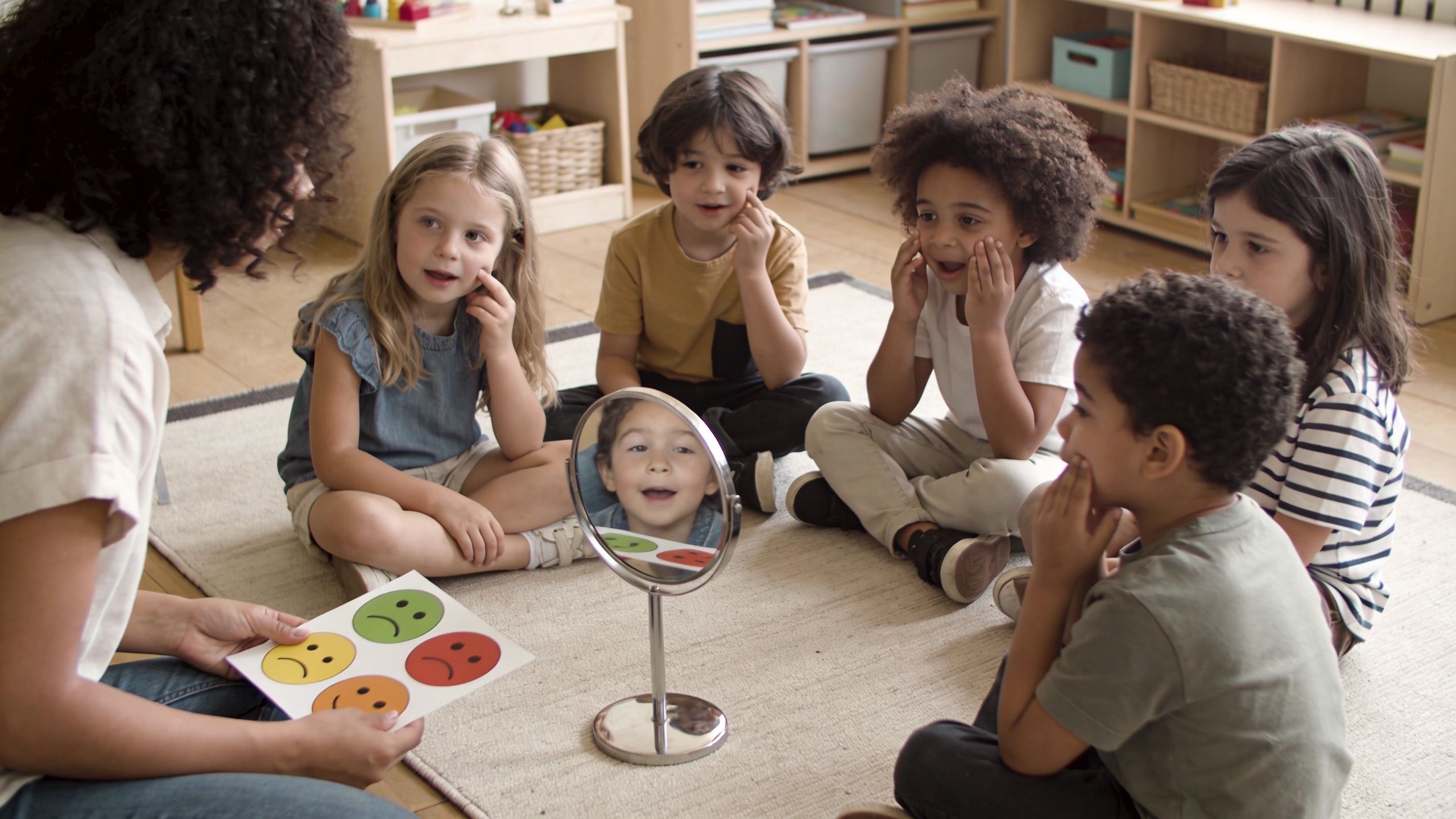
Gather children in a circle with a small set of feeling cards. Start with four basic feelings: happy, sad, mad, and scared. Hold up one card at a time and ask, “What do you notice about this face?” rather than “What is this?” That small shift helps children read clues instead of guessing a right answer.
Then invite mirror practice. Children look at themselves and try the face. You might say, “Show me a surprised face,” then ask, “What do your eyebrows do when you feel surprised?” Preschoolers love the physicality of this, and it helps them connect body signals to emotions.
A simple classroom example: “Jada wanted the blue marker, but Mateo was using it. How might Jada feel?” Let children offer more than one answer. Frustrated, sad, disappointed, impatient. That’s where emotional vocabulary grows.
Practical rule: Keep the pace gentle. If a child doesn’t want to share publicly, let them point to a card, whisper to you, or simply listen.
Easy adaptations for different children
Some children jump right in. Others need more safety.
For shy children: Let them hold the card for you instead of speaking first.
For children with limited language: Offer two choices, such as “sad or mad?”
For children who become overwhelmed: Use real classroom situations later, one-on-one, rather than putting them on the spot in the group.
If you want a visual tool that children can keep using beyond circle time, a simple feelings chart for kids can help create shared language across the room.
2. Cooperative Games and Turn-Taking Activities
Some preschool games create winners and losers too quickly. Cooperative games do the opposite. They teach children that success can be shared, and that waiting, helping, and noticing others are part of the fun.
That matters because preschool social skills interventions can be especially effective. A 2024 meta-analysis in Frontiers in Psychology reviewed randomized controlled trials and found designed physical activities significantly improved preschoolers’ overall social skills, with the strongest effects seen in 12-week interventions.
Try these first
Start small. Two or three children can learn the rhythm of waiting and responding before you scale up to the full class.
Pass the soft ball: Sit in a circle and pass one ball with a simple script. “My turn, your turn.” Pause between passes so children feel the wait.
Group tower: Give one tray of blocks to a small group and invite them to build one structure together. Narrate social moves you want to see: “You made space for her idea.”
Parachute shake and freeze: Everyone holds the edge and works together to lift, lower, and freeze on cue.
I also like adapted movement games. In a cooperative version of Red Light, Green Light, the group’s job is to help everyone get across together. Children cheer for friends who stop successfully instead of racing to beat them.
What to say while they play
Your language shapes the learning. Use short narration that names the invisible skill.
Notice waiting: “You had the ball and you remembered whose turn was next.”
Notice repair: “He bumped your space, and you both kept going.”
Notice inclusion: “You moved over so everyone could fit.”
For families trying to replace passive screen time with connection-rich play, this roundup on how to reduce screen time with these toys pairs well with cooperative routines.
If you want more game ideas you can simplify for younger children, Soul Shoppe’s collection of sharing games for elementary students offers structures you can adapt for preschool by shortening turns and adding visuals.
3. Peer Buddy System and Buddy Assignments
A buddy system gives children a simple message: no one has to do preschool alone. For children who tend to wander, cling to adults, or hover near the edges of play, a buddy can make the day feel more predictable and less lonely.
This isn’t about forcing friendship. It’s about creating repeated chances to practice friendly habits with support.
What buddying can look like in preschool
Keep the assignment concrete. “Buddy” is too vague if children don’t know what it means yet. Tie it to specific moments.
For example, buddies can:
walk together to wash hands
sit together during snack once a week
help each other carry materials
check whether their partner has what they need for an activity
One child might say, “Come with me to the rug.” Another might help by pointing to the cubby or waiting at the door. These are small acts, but they build responsibility and awareness.
A strong buddy system is structured, not sentimental. Preschoolers need to be shown what helping looks and sounds like.
Pair thoughtfully and teach the role
Be intentional with matches. Pair a confident child with a gentle one, not the loudest child with the quietest. Sometimes two children with similar interests work beautifully. Sometimes a child who loves routines is the perfect partner for a child who struggles during transitions.
Model the exact language you want buddies to use:
“Do you want to come play?”
“You can stand by me.”
“Let’s ask the teacher together.”
“It’s your turn first.”
Rotate pairings over time so children practice with more than one peer. And keep expectations modest. A successful buddy period might last only one transition or one center block.
If you’d like more ways to create intentional peer connection, these relationship building activities can help extend the buddy idea into the whole classroom culture.
4. Conflict Resolution and Problem-Solving Circles
Preschool conflict usually sounds repetitive. “She took it.” “He won’t let me.” “I had it first.” Adults can solve these disputes quickly, but if we always step in as judge, children miss the chance to learn how repair works.
A problem-solving circle slows the moment down. It teaches children that conflict is something we can talk through, not just react to.
A simple preschool script
Use the same sequence every time. Consistency matters more than eloquence.
Try this:
What happened?
How do you feel?
What did you want?
What can we do now?
Keep children close, calm, and brief. You’re not looking for perfect storytelling. You’re helping each child feel heard and guiding them toward one workable next step.
A classroom example: Two children both want the same dump truck. You sit with them and say, “Tell me what happened.” One says, “I had it.” The other says, “I wanted it.” You reflect both. “You were using it. You wanted a turn.” Then offer choices if needed: timer, trade, play together, or find a similar truck.
This short video can help adults picture restorative language in practice:
When children need more support
Not every child can enter a circle right away. Some need regulation before conversation.
For children who are crying hard: Start with breathing or water, then return.
For children who go silent: Let them point to feeling cards or repeat after you.
For children who get stuck on blame: Keep returning to the present question, “What can help now?”
A meta-analysis on preschool social skills interventions found especially strong effects for preschool-aged children, including stronger outcomes on targeted skills like social initiation, turn-taking, and prosocial behaviors. That’s one reason direct teaching in moments like these can make such a difference.
If you want a fuller framework, these restorative circles in schools offer language and structure you can simplify for young children.
5. Empathy and Perspective-Taking Through Storytelling and Role-Play
Stories let children rehearse social life from a safe distance. A child who can’t yet talk about their own hurt feelings may readily explain why a puppet feels left out or why a story character needs help.
That’s why books, puppets, and dramatic play belong on any list of social skills activities for preschoolers. They make invisible feelings visible.
Use stories to ask better questions
Pick books with clear emotional moments. You don’t need a “social skills” label on the cover. You need characters who want something, lose something, worry, wait, or reconnect.
As you read, pause and ask:
“How do you think he feels right now?”
“What do you see that makes you think that?”
“What could a friend do?”
“Has our class ever had a moment like this?”
Children often give wonderfully concrete answers. “She’s sad because no one scooted over.” That’s empathy beginning to take shape.
Bring the story into play
After reading, move into role-play. Use puppets, stuffed animals, or dramatic play props. One puppet can say, “Can I play?” Another can say, “We need one more builder.” Practice both sides.
Dramatic role-play is especially useful because repeated pretend play gives children chances to revisit social themes. The preschool resource discussion from Begin Learning on social skills activities highlights dramatic role-play, group art, turn-taking games, and emotion charades as useful ways to build communication, empathy, and collaboration.
Children often show more empathy in pretend play than in direct conversation. Use that doorway.
For a child who resists joining group role-play, start with one adult and one puppet. Let the child be the audience first. Then invite them to hand the puppet a prop. Participation can grow in layers.
6. Mindfulness and Breathing Exercises for Group Calm
Some children need social coaching after they’re calm. Others need calming before any coaching can work. Mindfulness and breathing support that first step.
In preschool, this should stay concrete and brief. We’re not asking children to sit still for long periods. We’re helping them notice their bodies, slow down, and return to the group safely.
A few preschool-friendly calming routines
I like to teach two or three strategies and use them often.
Belly breathing: Children place a small stuffed animal or their hands on their belly and watch it rise and fall.
Butterfly breathing: Arms crossed over chest, hands on shoulders, slow breaths with gentle taps.
Five-senses grounding: Name something you can see, hear, or feel in the room.
Use these when the group is already fairly calm, not only during meltdowns. That way the skill feels familiar instead of corrective.
A practical example: after an energetic transition, dim the lights slightly, ring a soft chime, and invite everyone to do three balloon breaths. “Smell the flower. Blow up the balloon.” Then move into story time or small groups.
Make it optional without making it invisible
Some children won’t close their eyes. Some dislike deep breathing cues. Some need movement more than stillness. That’s fine.
Offer choices such as:
hands on belly or hands on knees
sitting on the rug or standing at the back
breathing with you or observing
Soul Shoppe has spent more than 20 years delivering research-based tools for mindfulness, communication, and self-regulation in school communities. That kind of shared language matters because calming strategies work best when adults and children both know what to call them and when to use them.
Keep your tone neutral. Mindfulness isn’t a consequence. It’s a support.
7. Gratitude and Appreciation Practices
Preschoolers often notice what feels unfair before they notice what feels kind. Appreciation practices gently rebalance that attention. They teach children to look for help, kindness, effort, and connection.
This isn’t about forced politeness. It’s about helping children recognize that other people’s actions affect them in good ways.
Start with specific appreciation
General praise stays fuzzy. Specific appreciation teaches social awareness.
Instead of “Say something nice to Leo,” try:
“What did Leo do that helped today?”
“Who made space for you at the table?”
“Who helped fix a problem?”
Children’s answers become more meaningful right away. “Mila gave me the tape.” “Ethan waited for me.” “My teacher helped when I was sad.”
One easy ritual is an appreciation circle to conclude the day. Another is an “I noticed” board where children draw a picture of someone helping, sharing, or including. Nonverbal children can point to photos, choose symbols, or add a sticker to a class gratitude chart.
Keep the routine warm and balanced
Appreciation should feel steady, not performative.
Model first: Let children hear adults appreciate each other.
Spread it around: Make sure the same outgoing children don’t receive all the public recognition.
Connect it to actions: Focus on what someone did, not who is “good.”
A lovely example is after cleanup. Pause and say, “Who noticed a helper?” One child might say, “Nora put the crayons back for everybody.” Another might add, “And she helped me find the lid.” That kind of noticing builds belonging over time.
Appreciation helps children see themselves as people who affect others positively. That identity matters.
8. Inclusive Play and Belonging Activities
Every class has children who don’t slide easily into group play. Some hover nearby. Some watch. Some want connection but become overwhelmed when it arrives. Social growth won’t happen if participation always depends on a child entering the group independently.
Inclusive play means building entry points on purpose. It’s one of the most important social skills activities for preschoolers because belonging is the soil where every other skill grows.
Create easier ways to join
Don’t rely on “Just go ask if you can play.” That’s a big leap for many preschoolers.
Instead, build supports:
visual cards with phrases like “Can I build too?”
assigned play partners during centers
small interest-based groups, such as trains, sensory bins, or animal play
adult-facilitated entry, such as “Sam has an idea for the bakery. Can we make room?”
For some children, joining is easier in a small, structured activity than in free play. A group mural, a cooking project, or a teacher-led block challenge can create natural roles and reduce social guesswork.
Adapt for anxious, autistic, or reluctant children
Many children need pacing and sensory support, not pressure. If a child has social anxiety, selective mutism, sensory sensitivities, or difficulty reading social cues, start with safety.
You might:
practice the activity one-on-one first
let the child participate beside the group before inside the group
use a familiar peer as a bridge
shorten the interaction and end while it still feels successful
Positive Action’s discussion of social activities for kids notes one example of reducing eye-contact pressure for some autistic children by starting with a sticker on the forehead rather than expecting direct gaze right away. That’s the kind of thoughtful scaffold many classrooms need. You can read more in their piece on social skills activities and games for kids.
Home-school consistency also helps children generalize these skills. Little Planet Preschool emphasizes that social development takes time, practice, and coaching from caring adults. Their article on building social skills in preschool is a useful reminder to keep language and expectations aligned across settings.
Play centers, supporting diverse learners, anti-exclusion efforts
Intentionally prevents exclusion; supports vulnerable children
Weaving Social Skills into Your Daily Rhythm
The most effective social skills teaching rarely looks dramatic. It looks like a teacher pausing before stepping in. It looks like a parent helping two children find words instead of deciding the winner. It looks like a counselor giving a class the same simple script often enough that children start using it on their own.
That daily repetition matters because social development grows through lived experience. Children learn empathy when someone helps them notice another child’s face. They learn cooperation when a game is built so everyone needs each other. They learn self-regulation when adults treat calming down as a skill, not a punishment.
You don’t need to implement all eight activities at once. Start with the one your group needs most. If your class is quick to cry or grab, begin with emotion recognition. If transitions fall apart, try buddy assignments. If children are excluding one another, put your energy into inclusive play structures and appreciation routines.
Then stay with it long enough for the routine to become familiar. Preschoolers thrive on repetition. The first week may feel clunky. The third week often feels easier. Over time, children begin using the language and moves you’ve modeled: “You can have a turn after me.” “He looks sad.” “Want to be my buddy?” “Let’s fix it.”
Adults need support too. Teachers and families are more consistent when they share language, expectations, and a few go-to practices. That’s where a whole-community approach can help. Soul Shoppe’s work is built around practical, experiential SEL tools that support self-regulation, communication, conflict resolution, and belonging across both school and home. Their approach fits especially well for communities that want more than isolated lessons. They want habits, rituals, and shared language that children encounter again and again.
Keep the tone hopeful. Social mistakes are part of learning. Preschoolers aren’t “bad at friendship.” They’re learning friendship. And they learn best with calm adults, simple structures, and lots of chances to try again.
If you’re also looking for playful ideas for younger children and mixed-age family settings, these fun activities for toddlers can complement early SEL routines at home.
If you want help turning these ideas into a consistent, schoolwide or family-supported SEL practice, explore Soul Shoppe. Their programs, workshops, digital tools, and educator resources are designed to help children and the adults around them build empathy, communication, self-regulation, and real belonging.
More Than Words: Turning Self Love Mantras into Lifelong Skills
A child misses one math problem and whispers, “I’m so dumb.” Another gets left out at recess and decides it means nobody likes them. A middle schooler scrolls through photos, compares their life to everyone else’s, and grows quieter by the day. Most adults who care for kids have heard some version of this inner critic. It shows up in classrooms, on car rides home, at bedtime, and in the moments after a mistake.
Self love mantras can help, but only when we treat them as practices instead of posters. If a child says words they don’t believe, the phrase can feel fake. If an adult uses a mantra only after a meltdown, it becomes a rescue tool instead of a life skill. Kids need repetition, modeling, and language that matches their real experience.
That matters because self-affirmation isn’t just a trendy idea. A 2025 meta-analysis covering 17,748 participants across 129 independent studies found that self-affirmation interventions were linked with meaningful improvements in self-perception, general well-being, and social well-being, while also reducing psychological barriers like anxiety, according to this October 2025 review summary on positive affirmations. For educators and families, that’s a useful reminder that brief, low-cost practices can support emotional health when they’re taught well.
The key is teaching children how to use self love mantras in daily life. The eight mantras below work best when adults connect them to feelings, choices, relationships, and repair. That’s where they become part of SEL, not just positive talk.
1. I Am Enough
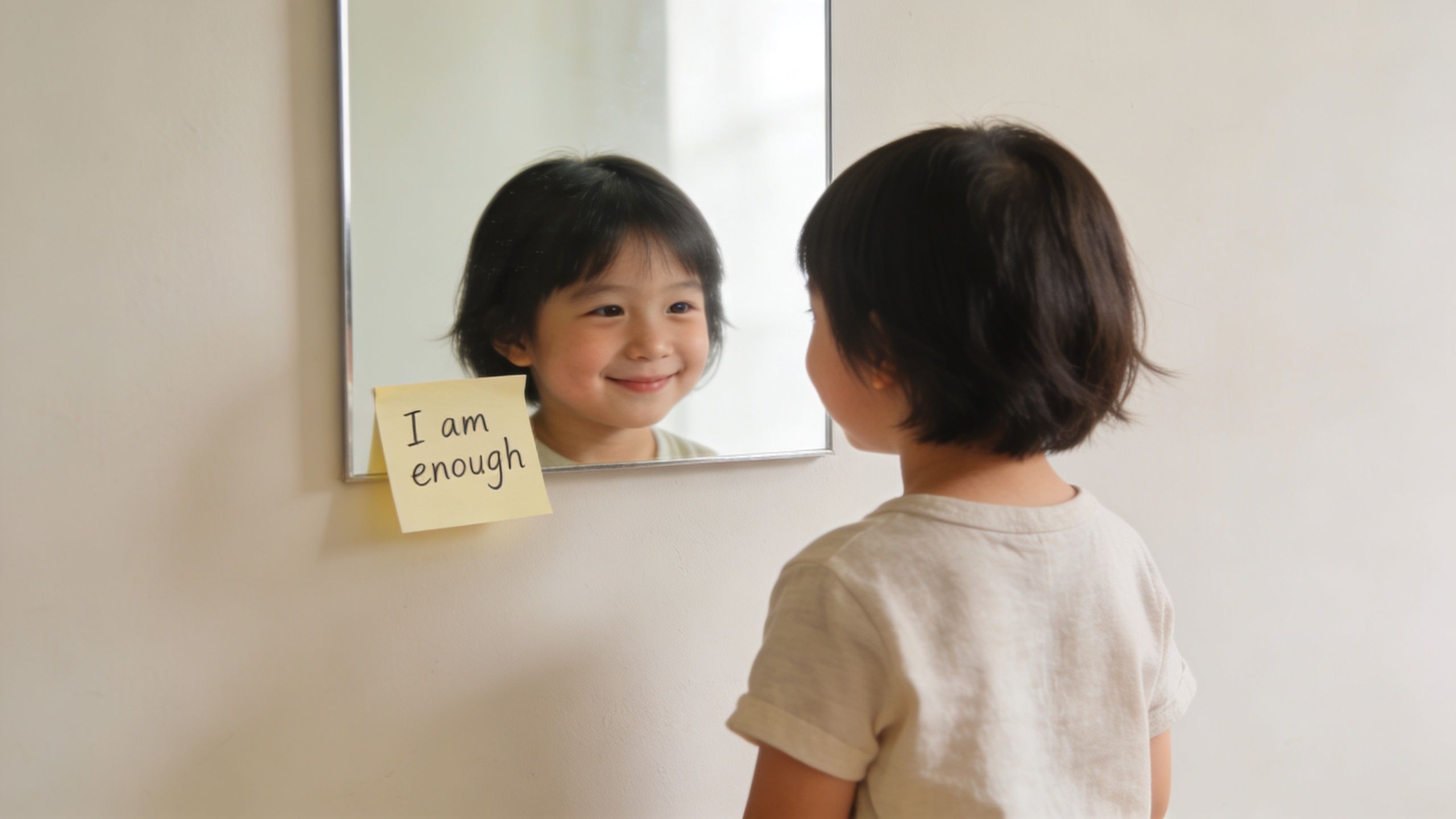
“I am enough” is often the first mantra kids need, especially the ones who think worth comes from grades, popularity, athletic skill, or always getting it right. This phrase pushes back on the belief that value must be earned. It tells a child, “You still belong, even when things are hard.”
For younger students, keep it concrete. “I am enough even when I spill paint.” “I am enough even when reading feels tricky today.” Older students can go deeper. “I am enough even if I’m not chosen first.” “I am enough even when I’m still figuring out who I am.”
How to teach it so kids believe it
Don’t ask students to chant this phrase with no context. Tie it to common school moments.
Morning meeting prompt: Ask, “What is one thing that makes you enough today, even before you achieve anything?”
After mistakes: Say, “You made an error. Your value didn’t change.”
At home: When a child says, “I’m bad at everything,” respond, “You’re disappointed. And you’re still enough.”
Practical rule: Pair the mantra with a real situation. Children trust specific language more than broad praise.
A teacher might say, “I didn’t explain that as clearly as I wanted. I’m still enough, and I can try again.” That kind of adult modeling matters. Kids learn self-acceptance when they hear adults practice it out loud.
This mantra also fits naturally with belonging work. A hallway poster can help, but daily language matters more. During partner work, class circles, or transitions, remind students that everyone enters the room with equal worth. If you want extra family-friendly language support, Kubrio's guide for parents offers confidence-building ideas that can complement this practice.
2. I Choose to Be Kind to Myself
Some children talk to themselves in ways they’d never use with a friend. They call themselves stupid, annoying, ugly, lazy, or behind. This mantra matters because it introduces agency. A child may not control every feeling, but they can learn to shift how they respond to themselves.
The phrase “I choose” is important. It turns self-kindness into an action, not a personality trait. Kids don’t have to wait until they naturally feel compassionate. They can practice it on purpose.
A simple classroom script
Try this after a student makes a mistake in front of others:
Teacher: “What did your inner voice just say?” Student: “That I messed everything up.” Teacher: “Would you say that to a friend?” Student: “No.” Teacher: “Try again with kindness.” Student: “I made a mistake, but I can keep going.”
That short exchange teaches more than the mantra alone.
Use the Friend Test: “Would you say this to a friend?”
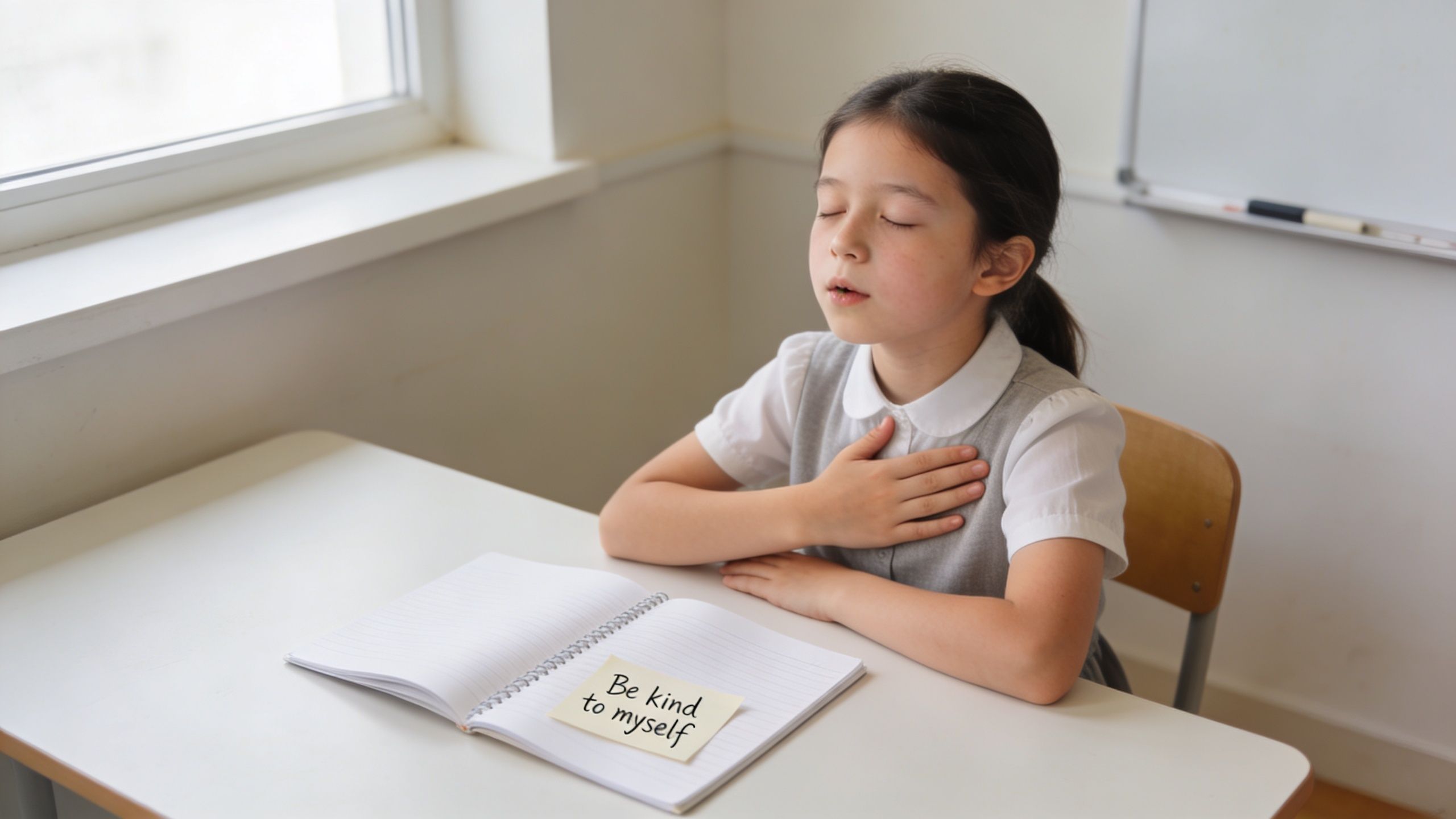
Add a body cue: Hand on heart, one slow breath, then the mantra.
Keep it brief: Long speeches rarely help in a dysregulated moment.
When children are upset, calm first and coach second.
At home, this often comes up after sports, homework, or social conflict. A parent can say, “It sounds like your inner voice is being rough. What would it sound like if you chose to be kind to yourself right now?” That question invites reflection without shaming the child for being hard on themselves.
Self love mantras work better when they sound believable. If “I love everything about myself” feels too far away, “I choose to be kind to myself” is often more honest and more usable. For adults who want language ideas rooted in compassionate self-talk, how to speak life over yourself offers prompts that can be adapted for older students and caregivers.
3. My Feelings Are Valid
Children often hear two unhelpful messages about feelings. One is “Don’t feel that.” The other is “Feel whatever you feel and do whatever comes next.” Neither teaches regulation. “My feelings are valid” gives kids a healthier middle path.
This mantra tells students that emotions are real and important, but emotions don’t get to run the whole room. A child can be angry and still not hit. They can feel jealous and still act respectfully. They can feel sad and still ask for help.
The sentence that should always follow
Teach this pair together:
All feelings are okay. Not all behaviors are okay.
That one line helps students separate emotion from action. It’s especially useful during conflict.
For example, a fourth grader says, “She didn’t pick me, and now I hate her.” Instead of correcting the feeling, an adult might say, “Your feelings are valid. It hurts to feel left out. Let’s find a safe way to say what you need.” That moves the child toward communication instead of suppression.
A counselor might use this mantra with a student who’s been told to “stop crying.” A teacher might use it when a student comes in upset after recess. A caregiver might use it after bedtime tears that seem too big for the situation. In each case, the message is the same. Your feelings make sense. You still need tools.
Practical SEL moves
Name the feeling first: frustrated, embarrassed, worried, disappointed, lonely
Connect feeling to need: space, comfort, repair, clarity, a break
Offer a safe action: breathe, draw, write, talk, ask for support
This mantra also supports psychological safety. Students are more likely to ask for help when they trust that adults won’t mock, minimize, or rush them. In a classroom community, that changes everything. Kids become more honest, more empathic, and more able to hear each other.
4. I Am Growing and Learning
Some students decide very early who they are. “I’m bad at math.” “I’m not a good reader.” “I’m the shy kid.” “I always mess up.” Once that story hardens, effort starts to drop. This mantra loosens the story.
“I am growing and learning” is one of the most useful self love mantras for school because it protects dignity while making room for change. It tells a child that struggle isn’t proof of failure. It’s part of development.
What this sounds like in real life
A kindergartener rebuilding a block tower can say, “I’m growing and learning how to make it steady.” A fifth grader revising an essay can say, “I’m learning how to organize my ideas.” A middle school student after an awkward peer interaction can say, “I’m growing in how I handle conflict.”
That language matters because it shifts identity from fixed to active.
Praise strategy: “You kept trying a new way.”
Praise persistence: “You stayed with it when it got hard.”
Praise reflection: “You noticed what wasn’t working and adjusted.”
When adults praise only talent, students often become more fragile. When adults praise process, students usually become more resilient.
A lesson snippet teachers can use
Write two statements on the board:
“I can’t do this.”
“I’m growing and learning.”
Ask students which statement helps the brain stay open to practice. Then invite them to rewrite common fixed thoughts.
“I’m bad at spelling” becomes “I’m learning spelling patterns.”
“I always ruin group work” becomes “I’m learning how to collaborate.”
“I’m not artistic” becomes “I’m growing my creative confidence.”
This mantra also works well in public repair. If an adult forgets directions or loses patience, they can say, “I’m growing and learning too.” That protects authority while modeling humility. Kids don’t need perfect adults. They need adults who can repair.
5. I Deserve Rest and Boundaries
Many children live in a constant state of “go.” School, homework, sports, activities, screens, social tension, and pressure to perform can wear them down. Adults often do the same to themselves. This mantra reminds kids that rest isn’t a reward for being productive enough. It’s part of being human.
Boundaries are a form of self-respect. Rest is a form of regulation. When we teach both together, children learn that caring for themselves helps them show up better for others.
What kids need to hear
Students often think rest means quitting. Reframe it.
Rest can be active: drawing, swinging, reading, building, listening to music
Rest can be quiet: alone time, breathing, lying down, looking out a window
Boundaries can be kind: “I need space,” “I’m not ready to talk yet,” “I can’t play right now”
A third grader might need a calm corner after lunch. A sixth grader might need fewer after-school commitments for a season. A parent might set a family boundary around device-free evenings so everyone can decompress.
The wider self-improvement app market shows how much people are looking for support in practices like affirmations, meditation, and positive self-talk. In the United States, that market reached $1.22 billion in 2024, up from $762 million in 2022, according to this WebWire report on self-improvement apps. That doesn’t mean an app replaces adult relationships. It does show that many families want accessible tools for emotional regulation and daily reflection.
Adult modeling counts most
Children notice when adults preach boundaries but never take them. If a teacher works through every lunch, kids absorb that. If a parent answers messages all evening while saying “rest matters,” kids absorb that too.
Say the boundary out loud. “I’m taking a few quiet minutes so I can reset.” “I can help after I finish this task.” “I’m resting because my body needs it.” That gives students permission to care for themselves without guilt.
6. I Celebrate My Unique Qualities
Comparison can flatten a child’s sense of self. One student wishes they were louder. Another wishes they were calmer. Another tries to hide a learning difference, cultural identity, family background, or personality trait just to fit in. “I celebrate my unique qualities” interrupts that pressure.
This mantra helps students notice what is distinct and valuable about them. Not better than others. Not more important. Distinct. That’s a powerful shift for identity and belonging.
Try an identity-based activity
Give students a page with the outline of a shield or a superhero badge. In different sections, ask them to fill in:
something they’re proud of
a way they help others
a quality that makes them unique
a challenge they’re learning to work with
a part of their identity they want respected
Then invite students to share only what feels safe to share. The goal isn’t performance. The goal is recognition.
An introverted student might write, “I notice things other people miss.” A highly energetic student might write, “I bring excitement and ideas.” A child with ADHD might identify creativity, humor, and quick thinking as strengths. A multilingual student might celebrate the ability to move between worlds.
Children build self-love faster when adults name strengths that are specific, observable, and not tied only to achievement.
This mantra is especially useful when correcting behavior. If a student interrupts constantly, you might say, “Your enthusiasm is a strength. We’re working on timing.” If a student withdraws, you might say, “Your thoughtfulness matters. I want to make sure your voice gets space too.” That protects identity while addressing the skill gap.
Schools can also support this through books, class discussions, heritage celebrations, and community norms that make difference visible and welcome. Self love mantras become more believable when the environment reinforces them.
7. I Am Responsible for My Choices, Not Everyone's Happiness
This mantra is more advanced, but many children need it. Some students feel responsible for keeping everyone okay. They monitor friends, absorb adult stress, over-apologize, or panic when someone is upset with them. Others get manipulated by peers who use guilt to control them.
This phrase helps students understand healthy responsibility. They are responsible for their own words, tone, actions, and repair. They are not responsible for controlling every other person’s emotional state.
A useful way to teach it
Draw two circles on the board or on paper.
In my control:
my choices
my words
my apology
whether I ask for help
whether I tell the truth
Not in my control:
another person’s mood
whether someone forgives me right away
another child’s friendship choices
how fast someone calms down
That visual is simple, and kids remember it.
A student might say, “I can invite them to play, but I can’t make them have a good day.” Another might say, “I’m responsible for apologizing for teasing. I’m not responsible for whether they want space afterward.” Those are healthy, grounded statements.
Care about people deeply. Don’t carry what belongs to them.
Use it in conflict resolution
In peer conflict, adults sometimes accidentally reinforce over-responsibility. They pressure one child to fix everything emotionally. A better script sounds like this: “Own your part. Speak respectfully. Make repair where you can. Let the other person have their own feelings.”
This mantra is especially helpful for natural caretakers, high achievers, and students affected by trauma, who may become hyper-focused on keeping others stable. For a short visual teaching tool on boundaries and emotional responsibility, this video can support older students and adults:
When students learn this distinction, empathy gets healthier. They can be kind without disappearing.
8. I Matter, and So Does Everyone Else
This may be the most community-centered of all the self love mantras. It holds two truths at once. I matter. Other people matter too. That balance is the heart of strong SEL work.
Some children hear messages that center only the self. Others are taught to disappear for the comfort of others. This mantra resists both extremes. It teaches dignity with empathy.
Where this shows up at school
Use this phrase when addressing exclusion, bullying, interruption, or social hierarchy.
If two students are in conflict, an adult might say, “You both matter in this conversation.” If a child is excluded from a game, a teacher might say, “Everyone here matters. How can we make space with fairness?” If a classroom is dominated by a few loud voices, the teacher can remind the group that quieter students matter too.
This idea also fits with whole-school belonging practices. In classrooms, every student can hold a visible role. In circles, every student can have the option to speak. In projects, every student can contribute in a meaningful way. The words need action beside them.
Why consistency matters
Google Trends and market reporting suggest that interest in self-improvement often spikes around moments like New Year’s and then fades, which is one reason schools and families need practices that last beyond a burst of motivation. One market summary notes that the broader U.S. self-improvement market was valued at $12.0 billion in 2024, with projections for growth through 2028, while behavior support is also shifting toward digital and hybrid formats, according to this self-love trend market overview. In schools, that’s a reminder to build routines, not one-off inspiration.
A practical classroom ritual is a closing circle where students complete one sentence stem: “Today I mattered when…” or “Someone else mattered to me when…” Those prompts move the mantra from abstract to lived.
“My voice matters, and your voice matters” is also a strong reset for class discussions. It slows defensiveness and invites listening. That’s how self-love grows into community care.
Promotes community-wide empathy, inclusion, and safety
Building a Culture of Self-Love, One Mantra at a Time
These eight mantras work best when adults treat them as skills to practice, not slogans to repeat. A child usually won’t internalize “I am enough” after hearing it once on a poster. They start to believe it when a teacher says it after a mistake, when a parent repeats it after disappointment, and when the school culture reflects it through belonging, repair, and respect.
The strongest approach is simple and steady. Pick one mantra for the week. Introduce it in plain language. Connect it to common student experiences. Practice it during calm moments, then return to it during hard ones. That rhythm helps children use the words when they need them.
Believability matters too. Some self love mantras fail because they ask kids to leap too far from their lived reality. Guidance on affirmation practice consistently points to the need for authenticity and belief alignment, especially for young people who quickly reject language that feels fake or performative, as discussed in this reflection on self-love mantras and authentic phrasing. In practice, that means “I’m learning to trust myself” may work better than “I never doubt myself.”
Development also matters. A second grader, a seventh grader, and a child recovering from peer exclusion won’t all connect with the same words in the same way. Age-specific and challenge-specific adaptation is one of the biggest gaps in common mantra advice, especially when schools want to align the practice with self-awareness, emotion regulation, relationship skills, and conflict resolution, as noted in this discussion of self-love mantras for different emotional needs. Teachers and caregivers can close that gap by adjusting the language, examples, and expectations.
A few habits make these practices stick:
Model the mantra yourself: Let children hear you recover from mistakes with respect.
Use it in ordinary moments: transitions, homework frustration, recess conflict, bedtime reflection
Keep it connected to behavior: validate feelings, then guide safe choices
Invite student ownership: let children rewrite mantras in words that sound like them
Revisit often: consistency matters more than intensity
This is the heart of social-emotional learning. We help children build an inner voice that is kinder, steadier, and more truthful. Over time, that voice supports resilience, empathy, and healthier relationships. A classroom or family that practices these mantras together doesn’t just raise confident kids. It builds a community where people know they matter, where repair is possible, and where belonging is practiced every day.
If you want help turning these ideas into shared language, schoolwide routines, and practical SEL experiences, Soul Shoppe offers programs, workshops, and resources that support connection, safety, empathy, and emotional skill-building for students, educators, and families.
A child hovers beside your desk, paper in hand, needing help but not asking. Or your own child says, “Nothing happened,” even though you can see the broken lamp and the worried face. Most adults read these moments as behavior problems first. In practice, they’re often trust problems.
When children don’t trust the people around them, they protect themselves. They hide mistakes. They test limits. They stay quiet when they’re confused. They act “fine” while their nervous system is working overtime. In a classroom, that looks like disengagement, perfectionism, tattling, shutdown, or quick conflict. At home, it can look like denial, blame, avoidance, or big reactions to small corrections.
That matters even more right now. The share of American adults who say "people generally can be trusted" fell from 46% in 1972 to 34% in 2024, according to Pew Research Center polling on Americans’ trust in one another. Children are growing up inside that climate. They absorb the tension, the guardedness, and the habit of expecting disappointment unless adults actively teach another way.
In schools and families, trust in relationship isn’t a soft extra. It’s the condition that makes honesty, learning, repair, and belonging possible. A child who trusts you is more likely to take academic risks, tell the truth sooner, recover after conflict, and let your guidance matter. A child who doesn’t trust yet will often need safety before they can use any skill you’re trying to teach.
This work also asks adults to widen the lens. Sometimes a child’s hesitation is connected to stress in the larger family system. For new parents especially, emotional strain can shape the tone of connection at home, which is why resources on understanding PPD symptoms can be part of trust-building, not separate from it. In schools, the adult relationship itself remains one of the strongest daily levers. Soul Shoppe has written helpfully about the power of a positive teacher-student relationship because children learn safety through repeated interactions, not speeches.
Introduction The Foundation of Learning and Safety
Trust starts long before a child says, “I trust you.” It shows up in whether they hand you the crumpled test, admit they were the one who pushed, or ask for help before they melt down. In practical terms, trust in relationship means a child expects your response to be safe, steady, and honest.
Adults sometimes try to speed this up with reassurance. We say, “You can tell me anything,” or “I’ll always be here.” Those words matter, but children believe patterns more than promises. They study tone, timing, follow-through, and whether you stay regulated when things get messy.
Why children read trust through behavior
A child rarely announces, “I don’t feel relationally safe with you right now.” They show you instead.
Common trust signals include:
Delayed honesty because the child expects blame, shame, or overreaction.
Constant checking because the child doesn’t know if rules or adult moods will change.
Refusal to try because mistakes feel too risky.
Over-helping or pleasing because staying in the adult’s good graces feels safer than being authentic.
When adults respond only to the visible behavior, trust can drop further. The child learns that the surface issue gets addressed, but the underlying fear does not.
Children don’t need perfect adults. They need adults whose responses are understandable.
Why this is central to learning
A trusting child can tolerate correction. A guarded child hears correction as danger. That one difference shapes everything from classroom participation to sibling conflict to bedtime honesty.
In schools, this affects whether students contribute ideas, recover after social bumps, and ask clarifying questions when they’re lost. At home, it affects whether children tell you about friendship problems, accidents, and worries before those problems grow.
That’s why trust-building has to be intentional. It isn’t built only in big talks after a problem. It’s built in transitions, check-ins, redos, and the ordinary moments adults are tempted to rush through.
What Trust Really Means in a Child's World
Adults often talk about trust as if it’s one thing. In a child’s world, it develops in layers. The child who follows directions because they want to avoid trouble is not yet trusting in the same way as the child who comes to you with tears, tells the truth, and expects care.
The first layer is rule-following
At the beginning, many children operate from deterrence-based trust. They follow rules because they know what happens if they don’t. This isn’t fake trust. It’s early trust. The child is learning whether adults are predictable and whether the environment has boundaries.
You can see this in a student who lines up properly when the teacher is watching but unravels during less supervised moments. Or a child at home who tells the truth only when the evidence is obvious. The child is still deciding whether honesty and vulnerability are safe.
This level needs structure. It does not need harshness.
Helpful adult moves at this stage:
Clear expectations stated in simple language.
Predictable consequences that aren’t shaming.
Calm repetition instead of surprise reactions.
Fast repair opportunities so mistakes don’t become identity.
The second layer is predictability
Next comes knowledge-based trust. Here, the child begins to relax because your responses become knowable. They’ve gathered enough experience to think, “When I’m upset, this adult doesn’t mock me. When I make a mistake, the correction is firm but safe. When they say they’ll come back, they do.”
Research discussed in a couples therapist’s guide to building trust in relationships highlights where many trust gains occur, pointing to a simple truth drawn from the work of Dr. John Gottman and Brené Brown. Trust grows in the “smallest moments” of consistency and reliability. Each fulfilled micro-commitment becomes a positive data point for the nervous system.
That nervous system piece matters. Children don’t evaluate trust only with logic. Their bodies keep score. If an adult is warm one day and explosive the next, the child stays vigilant. If the adult is consistent, the child begins to save less energy for self-protection and has more available for learning, play, and connection.
A useful lens: Every interaction adds a data point. Children don’t average your intentions. They react to your pattern.
The deepest layer is relational safety
The strongest form is identification-based trust. The child believes, at a deep level, “This adult sees me, cares about me, and wants to understand me.” At this stage, the relationship can hold more truth, more complexity, and more repair.
A few signs you’re moving into this layer:
The child volunteers hard information before you discover it.
They tolerate disagreement without assuming rejection.
They accept guidance because they feel respected, not controlled.
They seek connection after conflict instead of avoiding you.
This level doesn’t mean the child always agrees, complies, or stays calm. It means the relationship remains intact even when limits, feelings, and accountability are present.
What this looks like in daily life
A second grader spills paint and freezes. In a low-trust moment, they deny it and blame a classmate. In a growing-trust moment, they whisper, “I messed up.” In a strong-trust moment, they say, “I knocked it over. Can you help me fix it?”
A middle schooler gets left out by friends. In low trust, they say school was “fine” and carry it alone. In stronger trust, they say, “Something happened, but I don’t know how to explain it.” That opening is huge. Adults often miss it because they want the full story right away.
Trust in relationship grows when adults recognize these small openings and respond with steadiness, not interrogation.
Core Strategies for Building Foundational Trust
The most effective trust-building work is ordinary. It doesn’t look dramatic. It looks like doing what you said you’d do, keeping your tone understandable, and protecting a child’s dignity when they’re struggling.
Build the day so children can predict it
Children trust adults faster when the environment feels legible. They want to know what happens next, what the rules are, and how adults respond under stress.
In a classroom, that means stable opening routines, visible transition cues, and consistent responses to common disruptions. At home, it means bedtime that follows a familiar order, correction that doesn’t depend on the adult’s mood, and follow-up after hard moments rather than pretending they didn’t happen.
A simple example from coaching: if a student often escalates during writing, don’t wait for the refusal. Start with a two-minute preview. “First brainstorm, then one sentence, then check in.” You’re not lowering expectations. You’re lowering uncertainty.
What doesn’t work is using unpredictability to gain an advantage. Surprise consequences, public call-outs, or warmth that vanishes the moment a child struggles all weaken trust.
Follow through on the small stuff
Adults often think trust breaks happen only in major moments. Most trust erosion is smaller. You said you’d check their drawing and forgot. You promised one more story and changed your mind without explanation. You told a student you’d revisit a conflict after lunch and never came back.
Those moments count because children are collecting evidence.
Practical micro-commitments that matter:
Time promises like “I’ll come back in five minutes.”
Attention promises like “I want to hear the rest after I finish helping this group.”
Boundary promises like “I won’t share that with the class.”
Repair promises like “We’ll redo this when we’re both calm.”
When you can’t follow through, name it directly. “I said I’d come back before recess and I missed that. I’m sorry. I’m here now.” That response protects trust more than silence.
Field rule: Never make a promise just to calm a child down. Make fewer promises and keep them.
Validate before you problem-solve
Validation is not agreement. It’s the act of showing the child that their internal experience makes sense from where they stand. This is one of the fastest ways to reduce defensiveness.
Many adults skip this because they’re trying to be efficient. A child says, “It’s not fair.” The adult replies, “Life isn’t always fair.” True, but unhelpful in the moment. The child now has two problems: the original frustration and the feeling of not being understood.
Try language like this instead:
“That felt embarrassing.”
“You really wanted a different outcome.”
“I can see why your body got big right there.”
“You don’t have to like the limit to know I’m staying with you.”
These statements settle the nervous system because they communicate, “I get your experience.” Once the child feels met, they’re more able to hear a limit, a correction, or a next step.
Keep a vault for vulnerability
Children watch what adults do with private information. If a student tells you who they have a crush on, who excluded them, or what they’re scared of, they’re handing you something fragile. If that information turns into gossip, teasing, or unnecessary public discussion, trust drops fast.
Confidentiality with children doesn’t mean secrecy about safety concerns. It means discernment. Share only what needs to be shared, with the people who need to know, and tell the child when you must widen the circle.
Examples:
In class: Don’t use one child’s personal story as a lesson example unless you’ve gotten clear permission.
At home: Don’t retell your child’s embarrassing moment to relatives while they’re in the room.
In counseling or support roles: Tell the child upfront when privacy has limits.
A useful script is: “I’m glad you told me. I’m going to be careful with this.”
Use consistent language across settings
Shared phrases make trust portable. When a child hears the same core messages at school and at home, the world feels more coherent.
Useful repeated language includes:
For mistakes: “We tell the truth and fix what we can.”
For conflict: “Slow down. What happened, what did you feel, what do you need now?”
For emotional intensity: “Your feelings are welcome. Unsafe behavior isn’t.”
For reassurance: “You’re not in trouble for telling the truth.”
Later in the day, this short video can help adults reflect on how relationship habits shape trust over time.
Choose connection before correction when possible
Correction matters. Children need limits. But the order matters too. A connected correction sounds different from a disconnected one.
Compare these:
Less helpful: “How many times have I told you?”
More helpful: “Pause. Try that again with respect.”
Less helpful: “Stop crying. It’s not a big deal.”
More helpful: “Your feelings are big. I’m going to help you get steady.”
Less helpful: “Why would you do that?”
More helpful: “Tell me what was happening right before.”
One option schools use for this kind of shared language is Soul Shoppe’s Tools of the Heart, an online course designed to help young people identify, manage, and express feelings and needs in ways that support healthy relationships. The broader principle is what matters most: children need practical language for emotions and conflict, not just reminders to “be nice.”
Actionable Activities for Classroom and Home
Trust grows faster when it has a routine place to live. If adults only address it after conflict, children start to associate trust with damage control. The better approach is to build small rituals that make honesty, listening, and peer support normal.
Start with a simple meeting ritual
In classrooms, one of the strongest low-prep practices is a brief circle or morning meeting prompt that asks for a little truth without forcing disclosure.
Try prompts like:
One thing I need today
A time someone helped me recently
A mistake I fixed
Something that helps me feel calm
The key is pace. Don’t rush to fill silence. Don’t praise only polished answers. Thank students for honesty, especially when it’s small and awkward.
A teacher might model first: “One thing I need today is patience with technology.” That kind of answer shows students they don’t need a perfect response to participate.
Use peer-support structures, not just adult support
Children build trust in relationship not only with adults but with one another. A field-tested approach is to create regular moments where students notice and name support.
One activity inspired by Soul Shoppe’s “I Got Your Back” philosophy works well in elementary and middle grades:
Invite students to think of a time someone included, helped, or stood up for them.
Give them one sentence frame: “I felt supported when you…”
Let students share in pairs or write notes.
End by asking, “What kind of class do we become when people do this more often?”
This changes the social norm. Instead of only tracking harm, students start tracking care.
Try role-play when words disappear in real conflict
Children rarely access their best language in the middle of a heated moment. Practice has to happen before conflict.
Good role-play scenarios include:
A friend breaks your pencil and says it was an accident.
You weren’t picked for a game and think it was on purpose.
You told a secret and now regret it.
An adult corrected you in front of others and you felt embarrassed.
Keep the first round short. Then ask:
What did you feel first
What made trust go down
What words would help trust come back
That last question is where learning sticks.
Create one dependable family ritual
At home, trust-building works best when it’s woven into an existing routine. Dinner, car rides, bedtime, and weekend walks are all strong containers.
A favorite is Rose, Thorn, Bud:
Rose means something good from the day.
Thorn means something hard.
Bud means something you’re hoping for.
This ritual helps children learn that a relationship can hold joy, struggle, and uncertainty all at once. That’s a major trust lesson. It tells them they don’t have to perform “fine” to belong.
Trust-building activities at a glance
Activity
Best For (Age)
Context
Time Required
Morning meeting check-in
K-8
Classroom
5 to 10 minutes
“I felt supported when…” partner share
Grades 2-8
Classroom or group program
10 minutes
Conflict role-play with redo
Grades 3-8
Classroom, counseling, home
10 to 15 minutes
Rose, Thorn, Bud
K-8
Home dinner or bedtime
5 minutes
Promise tracker
Grades 1-8
Classroom or home
Ongoing, brief daily review
Private note box for concerns
Grades 3-8
Classroom
5 minutes to set up, brief follow-up
One activity that often surprises adults
A promise tracker sounds simple, but it can shift a relationship quickly. Put one sticky note or small card where the child can see it. Write one commitment for the day from the adult and one from the child.
Examples:
Adult: “I’ll check your work before recess.”
Child: “I’ll tell the truth if I need help.”
Ultimately, ask only two questions: “Did we do what we said?” and “If not, what happened?” No lecture. Just accountability and repair. Children learn that trust isn’t magic. It’s built through visible follow-through.
Navigating Trust Breaks and Rebuilding Connection
Adults break trust. Teachers lose patience. Parents say they’ll stay calm and then snap. A staff member shares something too publicly. A child reaches for honesty and gets met with intensity. The break may be brief, but the impact can linger.
A structured repair process matters because trust isn’t evenly distributed among children. Research summarized in an open-access review on cognitive trust, relationship beliefs, and attachment notes that insecure attachment styles can account for 42% of the variance in trust levels, and children from divorced homes often score lower on dyadic trust. For those children especially, an inconsistent apology can feel like one more proof point that adults aren’t reliable.
What repair sounds like
A useful repair has four parts.
Name the impact clearly “I raised my voice, and that probably felt scary and embarrassing.”
Give brief context without defending yourself “I was frustrated, but that wasn’t your job to carry.”
Make room for the child’s experience “What was that like for you?”
State a concrete behavior change “Next time I’m going to pause before I respond, and if I need a minute, I’ll say that.”
That’s stronger than “Sorry, okay?” because it restores clarity. The child learns what happened, why it mattered, and what will be different.
Repair sentence: “You didn’t deserve that version of me.”
A classroom example
One upper elementary teacher I supported got overwhelmed during a noisy transition and spoke sharply to the whole class. The room went quiet, but not in a good way. Several students withdrew for the rest of the morning. Instead of moving on, the teacher repaired after lunch.
She said, “I spoke to you in a way that didn’t feel respectful. The noise level needed to change, but my tone wasn’t okay. If that made you shut down or feel mad, I understand. Next time I’m going to stop and use our signal instead of yelling.”
The class softened almost immediately. A few students nodded. One said, “I thought we were all in trouble.” That was the opening. The teacher clarified the behavior expectation, then invited a reset. Trust didn’t return because she was perfect. It returned because she was accountable.
What doesn’t help
Some repair attempts fail because adults rush to relieve their own discomfort.
Avoid these patterns:
Forced forgiveness by asking, “We’re good now, right?”
Long explanations that sound like self-justification
Buying back trust with treats, privileges, or sudden softness
Repeating the same apology without changing behavior
Children watch for congruence. If the adult says the right words and repeats the same rupture, trust stays thin.
For a more detailed look at repairing after relational mistakes, Soul Shoppe’s guidance on how to earn trust back after it’s been damaged is a useful companion for educators and caregivers.
Measuring and Sustaining a Culture of Trust
Trust becomes culture when it’s visible in how a group functions, not just in one strong relationship. You can hear it in the hallway, see it in partner work, and feel it in how adults handle mistakes.
A practical reason to measure it is urgency. A recent counseling article notes that the CDC reports 60% of U.S. youth experience loneliness, which makes targeted trust-building especially important in school communities and families. That same discussion argues that progressive trust-building can reduce isolation and bullying by addressing relational safety at the root, as described in this piece on why trust matters in relationships and youth development.
Signs you can observe without a survey
Look for behavior shifts that suggest children expect safety.
Strong indicators include:
Students ask for help earlier instead of waiting until they’re overwhelmed.
Peers step in supportively rather than watching conflict escalate.
Children admit mistakes faster with less elaborate covering.
Adults hear more honest disagreement and less silent compliance.
At home, the equivalents are just as telling. Children start volunteering more of their day. Siblings recover faster after conflict. Family members use shared language instead of defaulting to blame.
Simple ways to track progress
You don’t need a formal instrument to notice movement. A few lightweight checks can reveal a lot.
Try these:
Fist-to-five safety check Ask, “How safe does it feel to share openly in this class or family?” Keep it quick and repeat periodically.
Repair log Track whether conflicts end with punishment only, or with understanding and a next step.
Help-seeking count Notice whether students increasingly ask questions, request clarification, or seek support before behavior escalates.
Peer-support noticing Record moments when children include, defend, help, or comfort one another without adult prompting.
If a school wants to sustain this work over time, restorative structures help. Soul Shoppe’s article on what restorative practices in education are and how they work offers a practical frame for turning isolated trust moments into shared community habits.
Trust is measurable when honesty becomes less costly.
The Lifelong Impact of Early Trust
The child who learns trust early carries that lesson into friendships, classrooms, teams, and future family life. They don’t become conflict-free. They become more able to tell the truth, ask for repair, and stay connected when something goes wrong.
That’s why trust in relationship belongs at the center of SEL work. Small moments matter. Predictability matters. Repair matters. Children don’t need adults who get it right every time. They need adults who are clear, steady, and willing to come back after a rupture with humility and action.
For teachers, that may mean changing the first two minutes of a hard conversation. For parents, it may mean keeping one promise more carefully, listening one beat longer, or repairing one sharp moment before bedtime. Those choices look small. In a child’s nervous system, they’re not small at all.
When adults build trust on purpose, children stop spending so much energy on protection. They can use that energy to learn, connect, create, and grow.
Soul Shoppe helps school communities build the kind of trust children can feel through experiential SEL programs, shared language, and practical tools for communication, conflict resolution, and belonging. If you want support bringing this work into your classroom, campus, or home community, explore Soul Shoppe.