Bystander intervention is a purposeful action by a witness to de-escalate a situation that could cause harm, and it can be learned as a sequence of noticing, interpreting, and acting safely. The classic research found 85% helped when they were alone, but only 31% helped when others were around, which is why students can freeze even when they care about a classmate who's being left out or teased.
A third grader sees two kids whispering and laughing while another child sits alone at lunch. A middle schooler notices hurtful comments in a group chat and wonders whether to say anything. Those moments are where what is bystander intervention stops being an abstract idea and becomes a practical skill adults can teach, practice, and reinforce.
Understanding Bystander Intervention in Schools
A student at lunch sees a classmate's tray shoved aside, or hears a joke in a group chat that lands as cruel instead of funny. An adult may spot the problem right away, while a child may feel the social pressure first and the harm second. Bystander intervention gives students a simple path from noticing harm to choosing a safe response.
From passive bystanding to purposeful action
The older bystander effect literature came out of social psychology and showed that people are often less likely to help when other people are nearby. That finding matters because silence in a crowd is not the same thing as indifference, it often reflects hesitation, uncertainty, or a quick assumption that someone else will step in. Modern bystander intervention takes that research and turns it into a teachable behavior sequence, one that starts with notice, moves to interpret, and ends with act.
That shift matters in schools because children do not need to perform like rescuers. They need to recognize when something feels wrong, decide whether help is needed, and choose a response that fits their age, role, and safety. A student can support a peer without confronting another child head-on, just as a crossing guard can help traffic move safely without stepping into the middle of it.
The same idea also fits well with developmental versus behavioural interventions, because young children often need concrete language, practice, and repetition before they can act under social pressure.
A shared language adults can use
When adults use the same words, kids learn faster. A bystander is the person who sees the situation unfold. An upstander is the person who chooses a safe way to help. That language gives a child a way to say, “I saw it, but I wasn't sure what counted as helping,” which is a much better starting point than shame.
Practical rule: hesitation is normal. The goal is not to blame a child for freezing. It is to help them notice what happened and practice a safer next step.
Parents and teachers can use this language in everyday life, at recess, in hallways, in class meetings, and online. A teacher might pause after a hurtful comment and ask, “What could a bystander do here that keeps everyone safe?” A parent might use a similar question after a sibling conflict. The more familiar the words become, the more likely students are to treat intervention as a learned habit rather than a moral test.
The Five-Step Decision Process Behind Intervention
A child who sees rude comments in a group chat may still stay silent, not because the child agrees, but because one step in the decision chain breaks down. Latané and Darley's five-step bystander intervention model shows that intervention depends on five linked steps, notice the situation, label it as a problem, accept responsibility, choose a response, and carry out the action (Latané and Darley's five-step bystander intervention model). If any step stalls, the whole process stalls.
Where students get stuck
A student may notice the message but read it as a joke, so the brain never moves from noticing to interpreting. Another student may think, “Someone else will tell the teacher,” so responsibility gets handed off to the crowd. That is why adults should listen closely when a child says, “I didn't know what to do.” The better question is, which step broke?
A useful way to coach kids is to teach each step separately. First, help them notice the moment. Then practice identifying what counts as harm, including low-level teasing, exclusion, or whispering that isolates another child. After that, help them name responsibility in simple words, like “If I saw it, I can do something small.” A short role-play or a game from this decision-making games collection can make the sequence easier to remember in advisory, counseling, or family time.
The American Psychological Association's guidance also distinguishes direct, distract, delegate, delay, and document responses, which helps children and adults match the action to the setting (APA guidance). A classroom conversation can start with a simple prompt, “What's the safest next move here?” That question teaches judgment, not just courage.
Teacher lens: if a student knows harm is happening but still freezes, do not jump straight to “be braver.” Ask what the student thought was happening, who they believed should respond, and whether they knew a safe option.
For educators looking for a developmental lens on decision-making, developmental versus behavioural interventions can be a useful companion read because it reinforces the idea that kids need skills built over time, not just reminders to “do better.”
A quick diagnostic example
A fourth grader sees two friends laughing at a classmate's backpack. The child notices the laughter, but interprets it as harmless. That is a step-two problem. If the child thinks, “I'm not the adult, so I can't help,” that is a step-three problem. Adults who can pinpoint the breakdown coach more effectively and avoid vague advice.
Five Safe Strategies for Students and Adults
A child who notices rude comments may still do nothing when one step in the decision chain breaks down. Maybe the child does not read the situation clearly. Maybe the child sees a problem but feels too small to intervene. Maybe speaking up would put the child at greater risk. That is why direct, distract, delegate, delay, and document need to stay in the toolkit. Each option gives students and adults a way to respond without forcing one unsafe script on every situation.
Strategy
What It Looks Like
Best For
Direct
Calmly naming the behavior, like “That's not okay” or “Please stop.”
Situations where the bystander has enough authority, time, and safety to speak plainly.
Distract
Redirecting attention, inviting the target away, or changing the activity.
Young children, playground conflicts, or moments where confrontation might escalate.
Delegate
Getting a trusted adult, supervisor, counselor, or another responsible person.
Hallways, lunchrooms, bus lines, and any setting with an adult who can step in.
Delay
Checking in afterward, offering support, or following up privately.
Moments where speaking up in the moment would be unsafe or would disrupt supervision.
Document
Recording what happened, especially if there's a pattern of exclusion or harm.
Repeated incidents, online behavior, or cases that need evidence for follow-up.
The right choice depends on age, power, setting, and risk. A kindergartener does not need a confrontation script. That child may be coached to say, “Come play with me,” which is a form of distraction. A teacher, by contrast, may need to keep supervision intact and delegate to another adult right away.
A simple way to teach this is to ask, “What is the safest next move here?” That question helps students slow down and choose an action that fits the moment, the same way you would choose the right tool from a toolbox instead of using a hammer for everything.
Safety first: if a response could make the situation worse, choose the lowest-risk option that still protects the target.
For teachers and parents who want more examples of prosocial choices, examples of prosocial behavior can be a useful companion resource when you are modeling helpful actions in class discussions or family conversations. The goal is not for every child to respond the same way. The goal is for students to practice choosing a response that matches the situation, the relationship, and the level of power in the room.
Real-World Examples for Classrooms and Homes
A teacher notices a child sitting alone at lunch while a small group keeps pulling chairs away. The teacher steps in right away, separates the students causing the problem, checks on the child who was isolated, and gets help from another adult if needed. That is bystander intervention in real school life, calm, concrete, and centered on safety.
What it looks like at school
In a second-grade classroom, one child notices another being left out of a game. A teacher can coach the child to use distract, saying, “Come be on my team,” or delegate, by telling an adult on duty. In a fifth-grade hallway, a student who hears mean comments can use delay by checking in later and saying, “I heard that, and it didn't seem okay. Are you alright?”
Those responses are small, but adults can see them. That matters because schools should track real behaviors, like warning, distraction, seeking adult help, and post-incident support, instead of relying only on attitude surveys (APA event-specific behavior measurement guidance). If a child can describe what they did afterward, teachers and families get a clearer sense of whether the practice is taking hold.
What it looks like at home
Parents can practice the same skills at dinner or during car rides. If a child says a friend was left out of a game, the parent can ask, “What could you do that helps without making it a big scene?” The child might suggest inviting the friend over, getting another adult, or checking in later. Rehearsing those choices makes them easier to use when the moment feels real.
The language does not need to sound formal. Younger children usually do better with short scripts they can remember quickly:
“Come with me.” A quick distract move for a child who wants to pull someone out of the moment.
“I'm getting Ms. Lee.” A delegate response that shifts responsibility to a trusted adult.
“Are you okay?” A delay response that offers care after the incident.
“I'm going to write this down.” A document response for repeated or online harm.
For more examples of everyday pro-social behavior, this collection from Soul Shoppe can help adults notice the small actions that deserve praise. The United We Transform activities can also give teachers and families concrete ways to practice helpful behavior together. Children repeat what adults notice, so naming these moments out loud helps them stick.
Building a Pro-Social Bystander Culture
A single lesson will not change school culture. Students step in more often when adults model the language, practice the skills, and treat intervention as part of everyday community life. That is how a building shifts from “mind your business” to “we help each other.”
Culture grows through repetition
A hallway pause, a lunchroom comment, or a quick check-in after recess can do more for bystander habits than a one-time assembly. Children learn what to repeat by watching what adults repeat, and that includes how adults respond when someone is left out, teased, or put on the spot.
Older research on the bystander effect showed that people are less likely to help when others are present, but later real-world studies found that intervention often happens in visible public conflicts, with at least one bystander stepping in in 90.9% of 219 filmed situations across the United Kingdom, the Netherlands, and South Africa (cross-national study). A related analysis found at least one bystander intervened in 85.0% of 81 filmed conflicts, with 217 intervening bystanders in total (related filmed-conflict analysis). The lesson is straightforward. Context matters, and people act when the environment makes action feel possible.
Schools can strengthen that environment by using the same words in morning meetings, classroom norms, conflict resolution, and family communication. Adults can model phrases like “I noticed that looked uncomfortable” and “Let's get help.” Those repeated cues matter, especially in early grades, where children are still learning how to read social risk and decide whether to speak up, get help, or stay close to the person who needs support.
A school-wide approach also gives adults a shared framework for low-level bullying, exclusion, and online harm. The line between “small” teasing and something that needs action is often clear only after someone names it. Adults who make that naming routine help children see the pattern sooner and respond before harm grows.
Culture note: students do not need every adult to respond the same way. They do need every adult to respond in a way that makes safety, support, and follow-up feel predictable.
Programs that build positive norms can reinforce this. United We Transform activities can support class-level conversations about community expectations, and Soul Shoppe's peer-support program resources can help schools connect those expectations to daily practice without making intervention feel abstract.
When Intervention Is Not Safe or Appropriate
A common mistake is treating bystander action like a moral test. It isn't. Some students and staff can't safely intervene directly because of their age, their role, or the power dynamics in the room. A child may risk retaliation. A teacher may need to keep supervising the whole group. A caregiver may need to document patterns instead of confronting someone in the moment.
Safety comes before bravery
Research-based guidance explicitly notes that not everyone has the same social position or privilege in a conflict, and that indirect methods may be more appropriate (Waterloo resource). That nuance matters in schools. A student who feels unsafe speaking up isn't failing. They may need a different strategy and a stronger adult backstop.
The right question is not, “Did the child do the boldest thing?” It's, “Did the child choose the safest helpful thing available?” Sometimes that means getting a trusted adult. Sometimes it means waiting and checking in later. Sometimes it means writing down what happened so a pattern can be addressed.
Quiet truth: indirect action still counts. Getting help, documenting harm, and supporting a target afterward are all part of intervention.
If a child gets stuck on fear, shame, or uncertainty, a family or school counselor can help them sort out what felt unsafe. Trauma-informed support can make a big difference here, especially when students have lived through repeated conflict or humiliation.
Coaching should validate the hesitation first, then problem-solve the next step. That's how children learn that caution and care can coexist.
Practical Resources and Next Steps for Implementation
Schools and families do not need a full program overhaul to begin. They need a shared script, repeated practice, and a simple way to notice whether children are using the skill in real moments. Experiential SEL programming, staff training, and basic behavior tracking can work together here, like three legs on the same stool.
A practical rollout for schools and homes
A single classroom or grade-level pilot is often the best place to start. Teach the five-step model, practice the five safe responses, and ask students to name what they would do in realistic scenarios. Then watch for event-specific behaviors, warning, distraction, seeking adult help, and post-incident support, because those actions show whether the lesson stayed at the level of agreement or became usable in the moment, as described in the event-specific measurement guidance.
For schools exploring program options, Soul Shoppe offers experiential social-emotional learning supports, including workshops, assemblies, coaching, community events like the Peaceful Warriors Summit, and the Junior Giants Strike Out Bullying partnership. Its bullying prevention resources give students shared language for self-regulation, communication, and conflict resolution, which fits naturally with bystander intervention practice. Families can reinforce the same ideas at home with role-play, short check-ins, and simple reflection after playground or online conflicts.
A good next step is straightforward.
For educators: schedule staff training, choose a grade-band pilot, and weave intervention scenarios into health or advisory time.
For families: practice one script at dinner, use age-appropriate videos, and build a small family plan for what to do when a child sees exclusion.
For everyone: keep a common language for noticing, naming, and acting.
For a school-ready starting point, Soul Shoppe's bullying prevention program for schools can serve as one structured option among others, especially when adults want practical tools instead of one-off assemblies. The strongest programs do the same three things over and over. They teach the steps, rehearse the responses, and check what changed.
If your school or family wants a clear, compassionate way to teach students how to step in safely, Soul Shoppe offers experiential SEL programs that fit this work. Their workshops, coaching, and bullying prevention resources help children and adults build the shared language and practice needed for real bystander intervention.
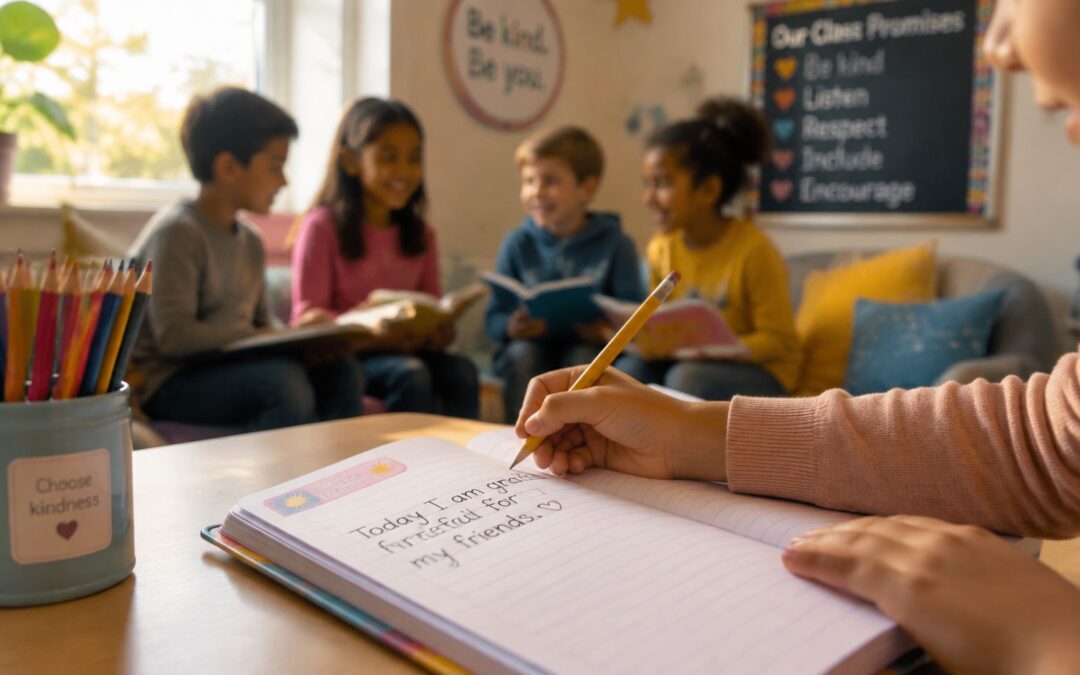
You know the moment. The room is noisy, someone's backpack is half-open on the floor, and a child who's been bright and chatty all morning suddenly goes quiet during writing time. At home, it's the same kind of shift at the dinner table, one word answers, shoulders tight, eyes on the plate. A sentence a day works in those moments because it gives children one small, predictable place to land, with language that's short enough to manage and meaningful enough to matter.
Why One Sentence Can Change a School Day
A lot of adults want a big opening, a full journal page, or a deep conversation before kids feel safe enough to share. Most children don't start there. They start with one thought, one feeling, or one small observation, and a sentence a day gives that first step a place to go without asking for a performance.
In a classroom, that can look like a morning meeting where the teacher writes, “I felt nervous before I came in, but I'm glad I stayed,” and invites students to respond with their own line. At home, it can be the child who usually says “fine” at bedtime suddenly offering, “I felt left out when my friends picked teams.” That single sentence doesn't solve everything, but it gives the adult something real to respond to, and that changes the emotional tone fast.
Practical rule: If a child can say it once, don't make them say it five different ways. The goal is connection, not repetition.
A sentence a day also works because it's small enough to feel safe. Kids who are unsure about sharing, or who shut down when asked to “talk more,” often do better when the task is narrow and familiar. They can focus on naming a feeling, a moment, or a need, then move on with the day instead of getting stuck in it.
The true SEL value is the rhythm. Children learn that emotions can be named, not hidden, and that adults will notice patterns without turning every feeling into a crisis. That predictable check-in helps build psychological safety in classrooms and homes, especially for kids who need a gentle way to enter communication.
The Research Behind Daily Sentence Practice
The reason this routine feels manageable is partly linguistic. English sentences used to run much longer, with research summarized in linguistic studies showing averages of about 63 words in 1525, 41.41 words by 1595, around 26 words in the 1820s, and roughly 14.4 words by 1950. A later corpus study found a decline from 33 words in 1876–1900 to 27 words in 1976–2000 (arxiv.org/pdf/2502.04321v1.pdf). The long arc points toward brevity, clarity, and compact expression, which is exactly why a one-sentence format feels so accessible for younger writers and busy families.
Why the format fits real life
Daily speech has also shrunk. A 2026 analysis of audio recordings from more than 2,000 people found that the average person uttered about 16,600 words per day in 2005, and that figure fell to below 12,000 words per day by 2019, a decline of about 28% over 14 years (Time). The researchers estimated the drop at roughly 330 fewer words spoken per day for each year in that period, about 120,000 fewer words per year. In plain terms, kids and adults are often carrying more of their inner life in shorter bursts, texts, and fragmented conversations, so a short written sentence can become a useful bridge back to reflection.
That bridge matters in SEL because language shapes regulation. A child who can name “frustrated,” “left out,” or “relieved” is already doing more emotional work than a child who only says “bad.” One sentence gives room for that naming without overwhelming the writer or the listener.
There's also a steadying effect in the format itself. It asks for just enough effort to create a habit, but not so much that adults abandon it after a busy week. That's why the routine can support belonging, self-awareness, and calm without needing to become a full journaling unit.
A short daily sentence doesn't replace deeper writing. It lowers the door so more children can walk through it.
Setting Up a Low-Lift Daily Routine
The first question teachers ask is usually practical, and it should be. If a routine adds copying, chart prep, and new management headaches, it won't last. A sentence a day works best when it fits inside something you already do, like morning meeting, advisory, arrival, dismissal, dinner, or bedtime.
Start with one visible place and one repeated cue. A chart paper on the wall, a notebook at the family table, or a shared digital doc can do the job. The point is not to create a polished system, it's to create a repeatable one that takes the least amount of thinking from the adult.
Keep the setup simple
Use one prompt for the whole day, or one weekly theme with tiny daily variations. If you're a teacher, write the sentence stem before students arrive. If you're a parent, put the notebook next to the dish soap, the coffee mug, or the bedtime lamp so you're not hunting for it when energy is low. For families who like extra support, tips for a writing journal can help you think through materials, spacing, and keeping the routine visible without overdoing it.
The structure should feel light enough to survive busy weeks. A child can dictate to an adult, write independently, or draw first and then turn the drawing into one sentence. The adult's job is to keep the routine moving, not to correct every detail in the moment.
A simple weekly flow looks like this:
Monday: Model a sentence about a feeling or event.
Tuesday: Let children answer the same kind of prompt in their own words.
Wednesday: Invite a partner share or quick read-aloud.
Thursday: Ask for one revision, maybe a clearer verb or a stronger feeling word.
Friday: Read back one sentence from the week and notice growth.
A few materials go a long way. Chart paper, sticky notes, pencils, a class notebook, or a phone note can all work. If you want a broader routine anchor for emotionally steady classrooms, this overview on routines for kids that help children feel emotionally grounded pairs well with a sentence a day because it treats predictability as a support, not a burden.
For teachers worried about prep, the hidden win is that repetition reduces decisions. Once the sentence frame is familiar, students spend less time asking what to do next, and more time thinking.
Prompts and Templates for Every Age Group
A sentence a day gets stronger when the prompt matches the child. Younger students need concrete language and a lot of modeling. Older students can handle perspective, conflict, and reflection, but they still need a frame that doesn't feel like a test.
The easiest way to keep it fresh is to rotate the type of prompt across the week. Use one day for a feeling, one for an event, one for a relationship, one for a problem, and one for a small success. That pattern keeps the routine stable while giving students new content to work with.
Sample A Sentence a Day Prompts by Grade Band
Grade Band
Prompt Example
Expected Response
K–2
“Today I felt ___ when ___.”
“Today I felt proud when I tied my shoes.”
K–2
“My favorite part of today was ___.”
“My favorite part of today was reading with my partner.”
3–5
“A kind choice I saw today was ___.”
“A kind choice I saw today was when Maya shared her markers.”
3–5
“One hard moment today was ___, and I handled it by ___.”
“One hard moment today was losing my page, and I handled it by asking for help.”
6–8
“I noticed myself reacting by ___, and next time I want to ___.”
“I noticed myself reacting by shutting down, and next time I want to ask a question first.”
6–8
“A situation I want to understand better is ___ because ___.”
“A situation I want to understand better is group work because I get frustrated when roles aren't clear.”
For K–2, keep the choices tight and concrete. A teacher might say, “Finish this sentence, ‘I felt __ when __.’” A child might answer, “I felt nervous when it was my turn,” or “I felt happy when my buddy smiled at me.” That's enough.
For 3–5, the sentence can stretch a little farther. A student might write, “I noticed I calmed down after I took a breath,” or “I felt included when my group saved me a spot.” At this age, kids start seeing the social pattern behind the feeling.
For 6–8, the best prompts invite reflection without becoming a lecture. Try, “What happened, what did you notice in yourself, and what do you want to do next time?” One student might write, “I got loud when I felt ignored, and next time I want to wait before I speak.” That kind of line is useful because it names behavior and choice in the same breath.
A useful companion resource for older students and home routines is journal entry prompts, especially when you want ideas that move beyond gratitude and toward self-awareness, perspective-taking, and conflict repair.
Keep the language specific. “Good day” tells you almost nothing. “I was proud when I asked for help” gives you a doorway into conversation.
Assessing Growth Without Killing the Joy
A sentence a day should not feel like a graded assignment with red ink waiting at the end. If students think every line will be scored, they'll start writing for approval instead of honesty. The better move is to watch for patterns that show growth over time and use those patterns to support conversation.
Notice change in the small things
Look for shifts in emotional vocabulary, willingness to share, and how much support a child needs to get started. A child who once wrote “mad” might later write “frustrated,” “disappointed,” or “embarrassed.” Another child may move from copied sentence stems to original thoughts, or from silence to one honest line in the notebook.
That kind of progress is easier to catch when you keep lightweight notes. A teacher might mark the date, the prompt, and one quick observation in a log. A parent might jot a note after bedtime, like “needed help starting” or “used a feeling word without prompting.” That's enough to see trends without turning the practice into paperwork.
For students who benefit from seeing their own growth, a short reflection every few weeks helps. Ask, “Which sentence felt most like you?” or “What's one word you use more now than you did before?” These questions keep the focus on voice, not compliance.
If you want a more formal lens, it can help to think about the practice as part of a broader outcome picture, especially when you're connecting SEL and literacy goals. This overview on outcome measurement is useful for educators who want to track change without flattening the relationship piece.
Use reflection, not pressure
Try one simple check-in every few weeks:
Student reflection: “What's easier to say now?”
Family reflection: “What do you notice your child talks about more often?”
Teacher reflection: “Who is participating more, and who still needs a model?”
Those questions help adults notice whether the routine is opening communication or becoming mechanical. If the sentences are getting shorter because the child is tired, that's useful information too. It may mean the prompt needs to be simpler, the time of day needs to shift, or the adult needs to model a little more.
Integrating the Practice Into Schoolwide SEL
A sentence a day works best when it lives inside a shared SEL language, not off to the side as one more isolated activity. If a school already uses advisory, community meetings, or a common calm-down framework, the daily sentence can echo those routines in a form students already recognize. That lowers the lift for teachers and families, because they are not building a separate system from scratch.
Make the routine part of the ecosystem
At the school level, the strongest use is as a low-lift routine builder. It gives students one shared place to practice vocabulary from assemblies, classroom agreements, peer support efforts, or bullying prevention work. That matters because public-facing materials for sentence routines often explain the steps, the chart paper, and the five daily segments, but they rarely answer the question busy educators ask first, how much prep and management this adds to an already full day.
That concern is real. A routine can look appealing on paper and still be hard to keep going if it depends on repeated copying or heavy teacher modeling every day. The version that lasts is modest, steady, and easy to repeat, so teachers can use it without turning it into another prep-heavy literacy task.
A schoolwide version can look like this:
Advisory: One shared prompt each week that matches the advisory theme.
Classrooms: A quick daily sentence that uses the same emotional vocabulary.
Families: A home version that mirrors the school prompt at dinner or bedtime.
Digital tools: A simple app or shared document for students who need typing or audio support.
For administrators, the main question is not whether the routine is flashy. It is whether students hear the same language in more than one place so the skill sticks. When a child practices naming feelings in class, then again in advisory, then again at home, the language starts to feel normal instead of academic. For a broader view of how structured SEL programs support this kind of routine, see our overview of social-emotional learning programs for schools.
Used this way, a sentence a day supports community without trying to replace deeper SEL lessons, counseling, or conflict resolution work. It works like a small daily thread that helps those larger systems hold together.
If you want a school partner that understands how small daily routines can strengthen belonging, self-regulation, and shared language, visit Soul Shoppe and explore programs that help kids and grownups practice connection in real classrooms and homes. Their SEL approach fits naturally with a sentence a day because it treats consistency, empathy, and community as daily habits, not one-time events.
A child is crying over a missing shoe. A student is snapping at a classmate over a pencil. A parent is standing in the kitchen, trying to get homework started while everyone is already tired. In moments like that, what matters is often not the behavior you see first, but whether the child can notice what they feel, name it clearly, and make sense of it before the moment snowballs.
That capacity is emotional awareness, and it sits underneath a lot of what adults hope kids will eventually do well, from calming down to solving conflict to asking for help. It's also more teachable than many people assume, which is why it shows up in research as something measurable, not just a personality trait or a vague “good with feelings” quality. A useful starting point is to think of it as the skill of noticing emotions in yourself and others, then sorting them well enough to respond instead of react. For a wider early-childhood lens, this overview of emotional development in early childhood helps place emotional awareness in the larger picture of growth.
A Moment Every Teacher and Parent Recognizes
A student slams a book shut and says, “I'm fine,” which usually means they are very much not fine. A second-grader melts down because the shoe they wanted isn't in the cubby, and the tears seem bigger than the problem. A parent hears, “I hate homework,” and knows the sentence is carrying more than frustration.
Those moments are where emotional awareness becomes visible. Before a child can calm down, explain themselves, or ask for support, they have to register that something is happening inside them. Research on emotional awareness treats it as a measurable capability, not a vague trait, and recent global tracking even shows that it can rise or fall over time rather than staying fixed as part of someone's personality Six Seconds research on emotional intelligence.
What adults usually miss first
Adults often jump straight to behavior. We see the shout, the slam, the refusal, or the tears. The child, though, may only be aware of a body signal, like a tight chest or hot face, and not yet know what that signal means.
Practical rule: when a child is escalating, start by asking what they notice inside, not what they did wrong.
That shift matters because emotional awareness is the foundation under the rest of social-emotional learning. If a child can't notice the feeling in time, every later strategy starts too late. If they can notice it, even roughly, you have something to work with before the whole interaction tips into a power struggle.
A Working Definition You Can Use Today
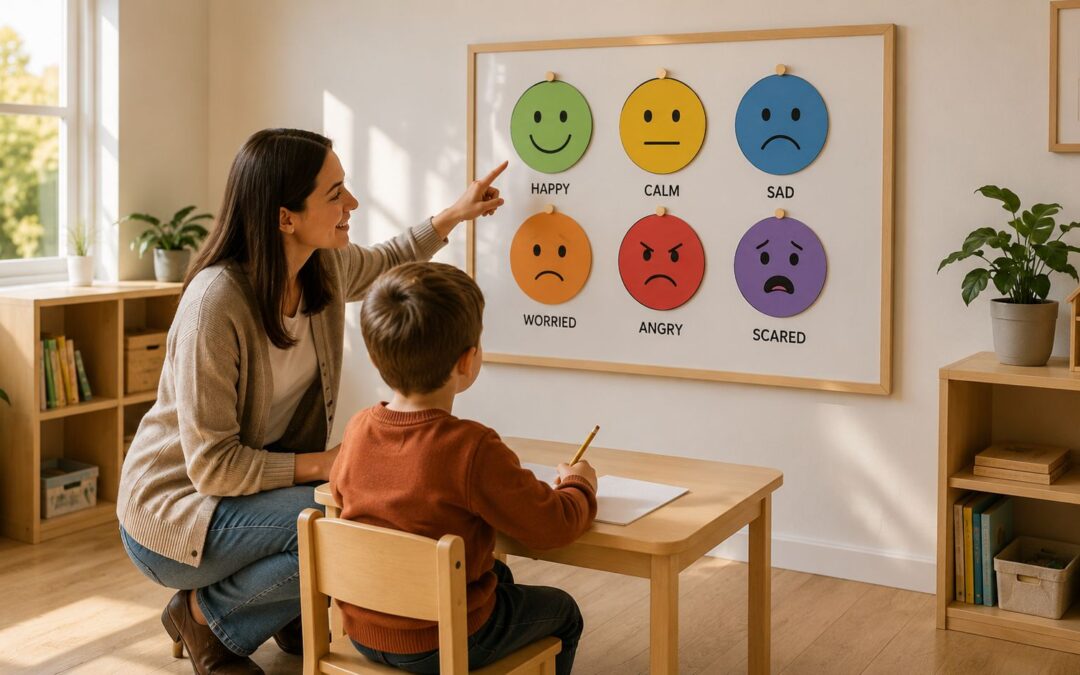
Emotional awareness is the capacity to notice, label, and differentiate emotions in yourself and in other people. That sounds academic, but it becomes practical the minute a teacher asks, “Are you frustrated, embarrassed, or disappointed?” instead of settling for “You're upset.” The difference is not just vocabulary, it's precision.
A simple way to explain it at pickup is this. Emotional awareness is the skill of recognizing what you feel, figuring out what kind of feeling it is, and understanding how it's shaping what you're about to do. That makes it related to emotional intelligence, but not identical to it. It also comes before self-regulation, because you can't manage a feeling well if you haven't noticed it clearly enough to name it.
For a parent-friendly companion to that broader umbrella, this guide to emotional intelligence helps separate the pieces without making the concept feel fuzzy.
Concept
Core Question It Answers
Where It Fits
Emotional Awareness
“What am I feeling, and what does it mean?”
The noticing and understanding piece
Emotional Intelligence
“How do I understand and use emotions well?”
The broader set of emotional skills
Self-Regulation
“What do I do now that I know how I feel?”
The response and control piece
How it differs from empathy and self-regulation
Empathy is about reading someone else's inner world. Self-regulation is what happens after awareness, when a child uses a strategy to settle, pause, or choose differently. Emotional awareness sits earlier than both. It helps a child tell the difference between “I'm angry,” “I'm hurt,” and “I'm overwhelmed,” which is the level of detail most kids need before they can act with any steadiness.
Why Naming a Feeling Is Not the Whole Story
A child saying “I feel bad” has started the process, but they haven't finished it. That sentence could mean embarrassed, lonely, irritated, scared, disappointed, or just flooded. Research makes an important distinction here between attention to emotions, which is noticing that something is happening, and emotional clarity, which is understanding what that feeling means and why it matters emotional self-knowledge profiles.
From vague body cue to usable language
A teacher might hear, “My stomach hurts, I want to go home.” A parent might hear, “I'm mad,” when the child really means ashamed after being corrected in front of peers. The first move is to slow the moment down and ask for one more detail, not to correct the child's wording.
A helpful scaffold looks like this. First, notice the body cue. Then offer two or three feeling words. Then connect the feeling to the situation.
“Your shoulders are tight, and your voice got loud. That can happen when someone feels frustrated or embarrassed. Which one fits better?”
Tools like a digital reflection journal can be useful for older kids who need a low-pressure way to sort through what they felt after the moment has passed.
Sometimes low awareness is protection
It's tempting to treat every lack of clarity as a skill gap. Sometimes it is. Sometimes a child has learned that tuning out feelings helps them stay safe, stay invisible, or avoid shame. A 2021 study linked emotional-awareness difficulties with distress, loneliness, and distress concealment, which is a reminder that shutting down can be a coping strategy, not just a deficit Frontiers in Psychology. In those cases, the work isn't just vocabulary. It's trust, patience, and repeated experiences of being taken seriously.
For a deeper look at helping children find emotion words without forcing them, this piece on naming feelings is a useful companion.
How Emotional Awareness Develops from K Through 8
Kindergarteners often live in broad labels. They can usually say mad, sad, or happy, but they may not yet explain why the feeling showed up. By second or third grade, many kids can add words like scared or surprised and give a one-word reason, such as “test” or “fight.” That's a real step forward, because the child is beginning to connect feeling with event.
By fourth and fifth grade, some children can handle mixed feelings. They might say they're excited about a field trip and nervous about the bus ride, which shows they're no longer treating emotions as one-at-a-time. In middle school, a student may be able to identify a trigger, link it to a reaction, and use a coping move without adult prompting. That's the stage where emotional awareness starts to look like self-management in the wild.
The research is clear that this development is uneven. One longitudinal study described emotional awareness as attentional monitoring and differentiation of discrete emotions, and found that the dimension of differentiating emotions uniquely predicted internalizing symptoms in the sample longitudinal study on emotional awareness. In plain English, some kids need much more explicit support in moving from “something feels off” to “this is embarrassment, and it started when I got corrected in front of everyone.”
Red flags worth noticing
A child who frequently complains of stomachaches or headaches without a clear cause may be signaling stress through the body. A student who suddenly withdraws from peers, goes quiet in group work, or gets unusually reactive after small corrections may need more explicit emotional support, not more punishment. A middle schooler who can describe body tension but can't connect it to a feeling word may be stuck at attention without clarity.
The goal isn't to label every child by grade. It's to notice what they can already do, then meet them there.
Bringing the Same Skills Home With Real Routines
The school day ends, but emotional practice doesn't. Home is where children get the most repetition of the same skills, often with more fatigue, more sibling friction, and fewer buffers. That's why the language has to stay simple enough to use when everyone's tired.
One evening meltdown, handled without escalation
A caregiver is making dinner when a child sees that game time is over and begins to scream. The adult says, “You wanted more time. You're angry that we're stopping.” Then, before saying anything else, the adult lowers their own voice and points to the next step, “First shoes off, then we can sit on the couch together for two minutes.”
If the child throws a toy, the adult sets the limit without a speech. “I won't let you throw. The toy can wait on the shelf.” After the child calms, the adult circles back: “You were upset. Next time, you can stomp, squeeze a pillow, or ask for one more minute.” That repair matters because it turns the meltdown into practice instead of shame.
The same pattern works in car rides, bath time, and cooking. A child can name the smell of dinner, wait for a turn with the spoon, or notice a sibling's face and guess how they feel. Those tiny moments build labeling, waiting, and perspective-taking without making the child sit through a formal lesson.
For families looking for a structured play-based support option, find play therapy in Arizona can be a useful starting point when everyday routines aren't enough and a child needs more guided help.
Try this tonight: name the feeling, state the limit, and offer one replacement action.
Adult regulation still comes first. Before responding, ask yourself, “Am I calm enough to teach, or am I about to react?” Then ask, “What do I want this child to practice right now, obedience or recovery?” The second question usually leads to better support.
What Schools and Districts Need to Build Around the Child
A strong SEL routine in one classroom can still get crushed by a school system that treats emotional support as optional. Children need more than a poster, more than a one-off assembly, and more than a teacher trying to do it all alone. They need adults, structures, and time.
Staffing and training shape what children feel
Counselors, SEL coaches, paraprofessionals, and classroom teachers all see different parts of a child's day. When those adults share the same language, children don't have to relearn the system in every room. Training also matters when it goes beyond a single workshop, because adults need practice in using the same calm script under stress.
The equity piece is essential. The OECD notes that cumulative disadvantages, such as family stress, poor neighborhood conditions, lower access to health services, trauma, neglect, and chronic stress, can disrupt cognitive and emotional development in the first years of life, especially for socioeconomically disadvantaged children, and it also flags sleep as an overlooked factor in emotional and cognitive development OECD report. That means district plans have to account for what children are carrying before they walk in the door.
A school can ask three blunt questions
Do we have a shared SEL language? If every adult names feelings differently, children spend energy translating.
Do caregivers have a real way in? Family partnership can't be a one-way handout.
Do we respond to stress in context? A child's behavior often makes more sense when adults consider the setting, not just the moment.
One thing to notice in school planning is whether the SEL effort is a program, a culture, or just a poster on the wall. A program has tools and training. A culture has consistent adult behavior. A poster without follow-through is decoration.
Soul Shoppe belongs in the category of a practical school-based option here, because it offers interactive SEL workshops focused on self-regulation, mindfulness, communication, and conflict resolution for school communities. Used well, that kind of support can sit alongside counseling, coaching, and family engagement rather than replacing them.
Frequently Asked Questions From Parents and Teachers
How long does it take for a new emotion strategy to show results? Usually long enough that adults get impatient. Children need repeated practice in calm moments before they can use the same skill under stress, so look for small signs first, like pausing, copying the adult's language, or recovering more quickly.
What if a child refuses to use the feeling words I've introduced? Don't force the vocabulary. Say the word yourself, connect it to body language, and keep going. A child can absorb the idea before they can say it back. For example, “Your fists are tight. You look angry. Let's breathe and then fix the problem.”
How do I get a resistant co-parent or colleague on board? Start with one shared script, not a full philosophy. Pick one phrase, one transition cue, and one repair routine, then use it consistently for two weeks. Adults often agree faster when the ask is concrete and brief.
When should I seek outside help? If behaviors are persistent, intensifying, or interfering with learning, relationships, or safety, talk with a pediatrician, school counselor, or licensed mental health provider. Bring specific notes, not just worry, and describe what you see across time.
Soul Shoppe helps school communities build the shared language and routines that emotional development needs to grow. If you're looking for practical SEL tools that connect classroom practice, home support, and relationship-based learning, visit Soul Shoppe and explore what can fit your campus or family next.