Emotional Development in Early Childhood: A 2026 Guide

You've seen it. A child in the backseat melts down because the snack wrapper tore the wrong way. A preschooler says, “I'm mad,” then hits anyway. A kindergartner suddenly cries when a friend won't share, and the adult nearby wonders whether this is ordinary growing up or a sign the child needs more support. Emotional development in early childhood lives in those moments, not in a neat chart.
The early years are a sensitive period for building emotional competence, the capacity to identify, understand, express, and regulate emotion. Research synthesized in early-childhood literature shows that infants begin with basic emotions in the first year of life, more complex self-referential emotions emerge toward the end of the second year, and by ages 4 to 5 children can perceive and describe multiple or ambivalent emotions, a major milestone in emotional understanding PMC review on early emotional development. That timing matters at home and in school because it overlaps with the years when children are learning how to belong, listen, wait, and recover.
What Emotional Development Really Looks Like in the Early Years
A child who says, “I'm frustrated,” and then throws a block has still made progress in emotional development. The feeling has been named, and the next skill, calming the body and choosing what to do, is still under construction. Adults often fold emotional competence, emotional regulation, and behavior into one bucket, then respond as if a child is either “good” or “defiant.” That shortcut skips the different layers children are building.

The four pieces adults can observe
Recognizing emotions shows up when a child notices a face, a tone, or a change in their own body. Expressing emotions shows up in words, tears, laughter, turning away, or clinging. Understanding emotions is the child beginning to connect feeling to cause, like realizing a friend left because it was time for pickup. Regulating emotions is the harder part, slowing the feeling down, keeping the body safe, and choosing a response that fits the moment.
Practical rule: if a child can name a feeling but cannot yet stop their body, you are seeing development, not dishonesty.
The mistake many adults make is treating a feeling word as proof of self-control. A child can say “angry” and still need co-regulation, structure, and repetition before self-regulation starts to stick. Harvard's Center on the Developing Child describes emotional development as part of brain architecture from birth, and by the end of the preschool years children should be able to identify and understand feelings, read emotions in others, manage strong emotions constructively, regulate behavior, develop empathy, and sustain relationships Harvard Center on the Developing Child.
That is how the emotional ladder is built rung by rung. Emotional growth is not a personality label. It is a set of skills children use to learn, play, solve conflicts, and stay connected to the adults who keep them safe.
Age-by-Age Milestones from Infant to Early Elementary
A child may light up at a familiar voice and still melt down when a turn is delayed. Another child may use careful feeling words and still need an adult close by when frustration hits. Those uneven patterns are part of normal emotional growth in the early years.
Infants and toddlers start with co-regulation
In the first years, infants are working with basic emotions such as joy, fear, anger, sadness, surprise, and interest, and more complex self-referential emotions emerge later in toddlerhood PMC review on early emotional development. A baby's emotions show up through crying, gaze, movement, and changes in body tension, and they are usually settled by an adult who notices quickly. A toddler begins to point, protest, hide, cling, or use a few words, but still borrows the adult's calm.
A simple example helps. A 15-month-old reaches for a cup, misses, and bursts into tears. An adult says, “You're upset. I've got it,” then hands over the cup and stays close. That response does not spoil the child. It gives the child repeated experience with being soothed, and that is how the earliest emotional skills start to take shape.
Preschoolers begin to talk about feelings and causes
Emotion understanding rises sharply through the preschool years. In a longitudinal cohort study of 231 children followed from ages 1 to 5, researchers found that children acquired about two additional emotion-understanding components per year starting at age 2. In everyday terms, a 3-year-old may identify “sad” or “mad,” while a 4- or 5-year-old starts to understand mixed feelings, false-belief emotions, and why one event can trigger two reactions.
Pretend play matters here. A child feeding a stuffed bear, acting out a doctor visit, or playing “teacher” is rehearsing perspective-taking in a low-stakes way. If a child says the doll is “scared” before the doctor visit, they are practicing emotion language for a real-life experience they do not fully control yet.
That same skill shows up at home and in class in small, practical ways. A preschooler who can say, “He's mad because I took the block,” is beginning to link feeling to cause, which helps adults coach the next step instead of guessing at the behavior.
Early elementary children begin carrying skills into groups
Children in early elementary settings can usually reflect more, but they still need support to use those skills consistently. In one study of 749 early school-age children, the first year of schooling, typically ages 4 to 5, showed stronger emotional competence than Year 2, typically ages 5 to 6, with mean scores of 38.17 versus 34.54, a statistically significant difference, p < .001, Cohen's d = .31 early school-age study. Older children have not regressed. Context, demands, and self-control expectations shift fast once school routines get harder.
By this stage, emotional growth starts to look more public. A child may use words after a conflict, recover after being corrected, or ask for help instead of shutting down. The same skill can look different from one setting to another, which is why adults often see better regulation at one moment and a bigger reaction the next.
| Age band | Key skills emerging | Example behavior |
|---|---|---|
| Infants, 0 to 18 months | Basic emotions, attachment, co-regulation | Calms when a familiar adult picks them up |
| Toddlers, 18 months to 3 years | Naming simple feelings, protesting, beginning turn-taking | Says “no,” then needs help settling after a limit |
| Preschoolers, 3 to 5 years | Mixed feelings, emotion causes, pretend-play perspective-taking | Tells a story about why a character feels left out |
| Early elementary, 5 to 8 years | Better language for feelings, growing regulation in groups, repair after conflict | Tries to use words after an argument, but still needs reminders |
For adults who want a simple bridge into practice, emotional growth also connects closely with daily social routines. A child who can label, calm, and consider someone else's view is easier to support in play, cleanup, group time, and family transitions. For a closer look at how those skills fit together, this explanation of social-emotional development is a useful companion, and teachers who want concrete classroom ideas can browse these learning examples.
How Emotional Growth Connects to Social-Emotional Learning
A child who melts down at cleanup time, avoids a peer after being corrected, or shuts down when asked to join a group is showing emotional growth in action. Those moments are the day-to-day place where social-emotional learning, or SEL, meets real life.

Weather, umbrella, and the child in the middle
Emotions work like weather. Some days are clear, some are stormy, and some are mixed. Regulation works like an umbrella. It does not stop the feeling, but it helps a child keep moving without getting knocked over by the moment.
That is why the five SEL competencies fit so naturally with emotional growth. Self-awareness helps a child notice the feeling rising. Self-management helps the child steady the body enough to respond. Social awareness helps the child read a classmate's face or tone. Relationship skills help with repair, sharing, and asking for help. Responsible decision-making helps a child choose what to do next when the feeling is loud.
The common mistake is to treat emotion learning as if naming a feeling is the finish line. A child who says “I'm angry” still needs practice with what to do while angry. A simple routine, repeated in the classroom and at home, gives children one path to try instead of asking them to invent a new plan in the middle of conflict. For teachers who want concrete examples they can adapt, browse these learning examples.
Children learn emotion skills most quickly in relationships, because that is where feelings show up.
Developmental research points in the same direction. From birth through age 8, socioemotional competence includes understanding and managing emotions and behavior, making decisions and working toward goals, and keeping positive relationships NIH book chapter. As noted earlier, the Harvard Center on the Developing Child describes emotional development as part of brain development, and by the end of the preschool years children should be growing in empathy, regulation, and sustained relationships Harvard Center on the Developing Child.
A useful way to see this is to match the same skill to different ages. An infant depends on an adult to calm a flooded body. A toddler needs help naming the feeling and tolerating a limit. A preschooler starts to understand another child's point of view. An early elementary child begins using language and repair after conflict, even if reminders are still needed. For a plain-language overview of how these pieces fit together in everyday settings, what social-emotional development looks like in everyday settings is a helpful companion.
The classroom version and the home version are not identical, but they are built from the same parts. A child who can pause, name a feeling, and consider someone else's view has a better chance of joining play, handling correction, and recovering after disappointment.
Red Flags and How Adults Can Assess Without Diagnosing
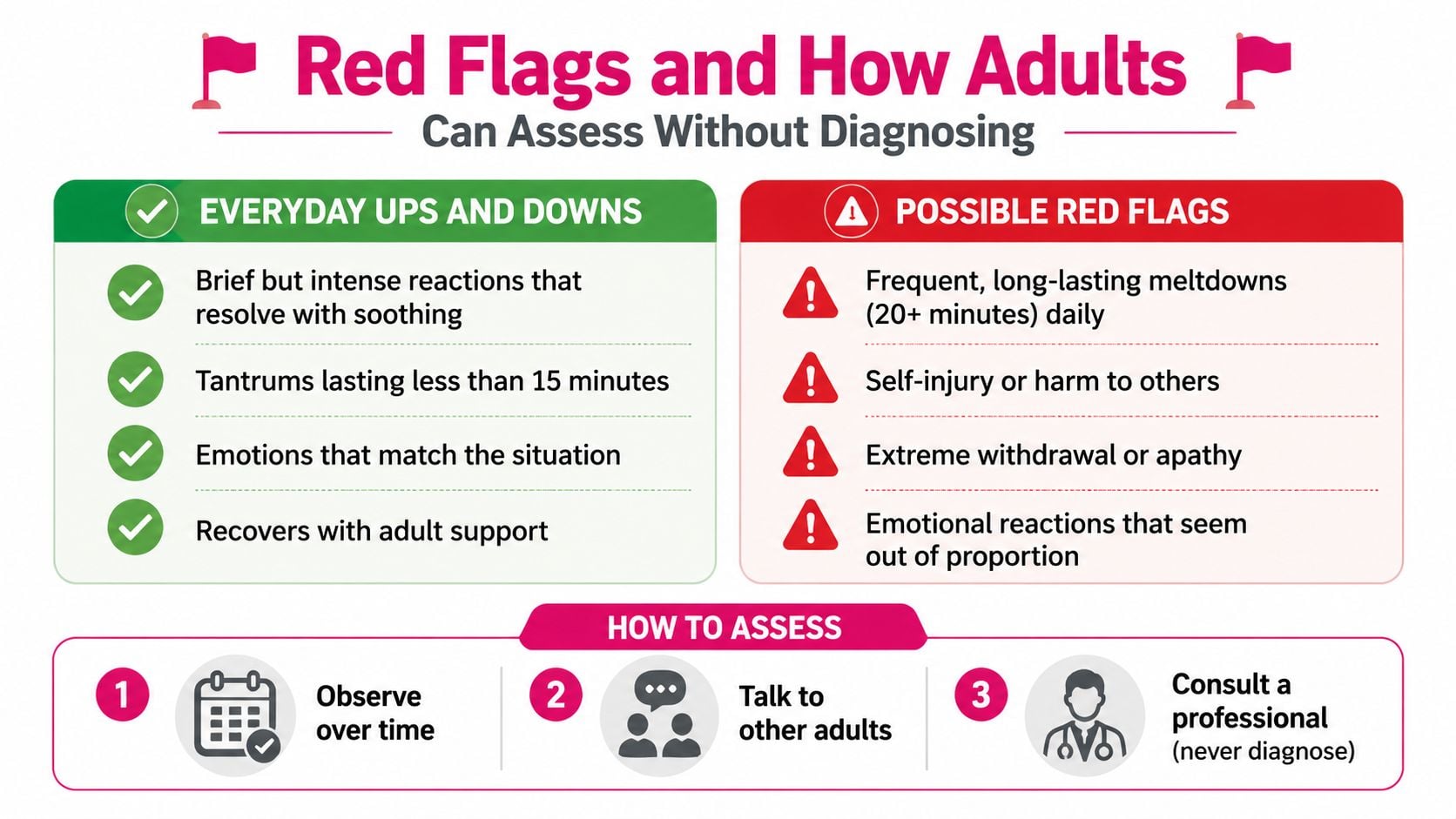
Most children have rough patches. They cry, cling, refuse, or explode when tired, hungry, overstimulated, or disappointed. The question isn't whether a child ever struggles, it's whether the pattern is becoming more frequent, more intense, or harder to recover from over time.
What to watch and what to write down
Look first for change in pattern, not one hard day. A child who usually settles with support but suddenly stops recovering, withdraws from peers, or shows emotional reactions that seem out of proportion across many settings deserves closer attention. If the behavior is frequent, persistent, or starting to affect learning and relationships, it's time to loop in a counselor, pediatrician, or other professional for screening, not self-diagnosis.
Child Trends reviewed 72 distinct measures for children ages 0 to 5 to support federal-level reporting, which is a reminder that assessment is not one thing Child Trends measure review. Observation is what adults do every day. Screening is a brief look using a tool. Full assessment is more detailed and belongs with trained professionals.
For families and schools, practical tools often include DECA, ASQ:SE, and teacher rating scales. Use them as conversation starters, not labels. A weekly two-minute check-in can be as simple as: “What happened before the big reaction? What helped? Did the child recover the same day?” That note can reveal slow drifts that are easy to miss in the rush of the week.
The Guiding Growth resource on visual tools for emotional learning can help adults who need a clearer way to track what they're seeing without turning every hard moment into a crisis.
Practical rule: if you're worried, document behavior across time, across adults, and across settings before you jump to conclusions.
A good internal companion is signs of stress in children, because stress often shows up first as emotion and behavior shifts, not as a neat explanation.
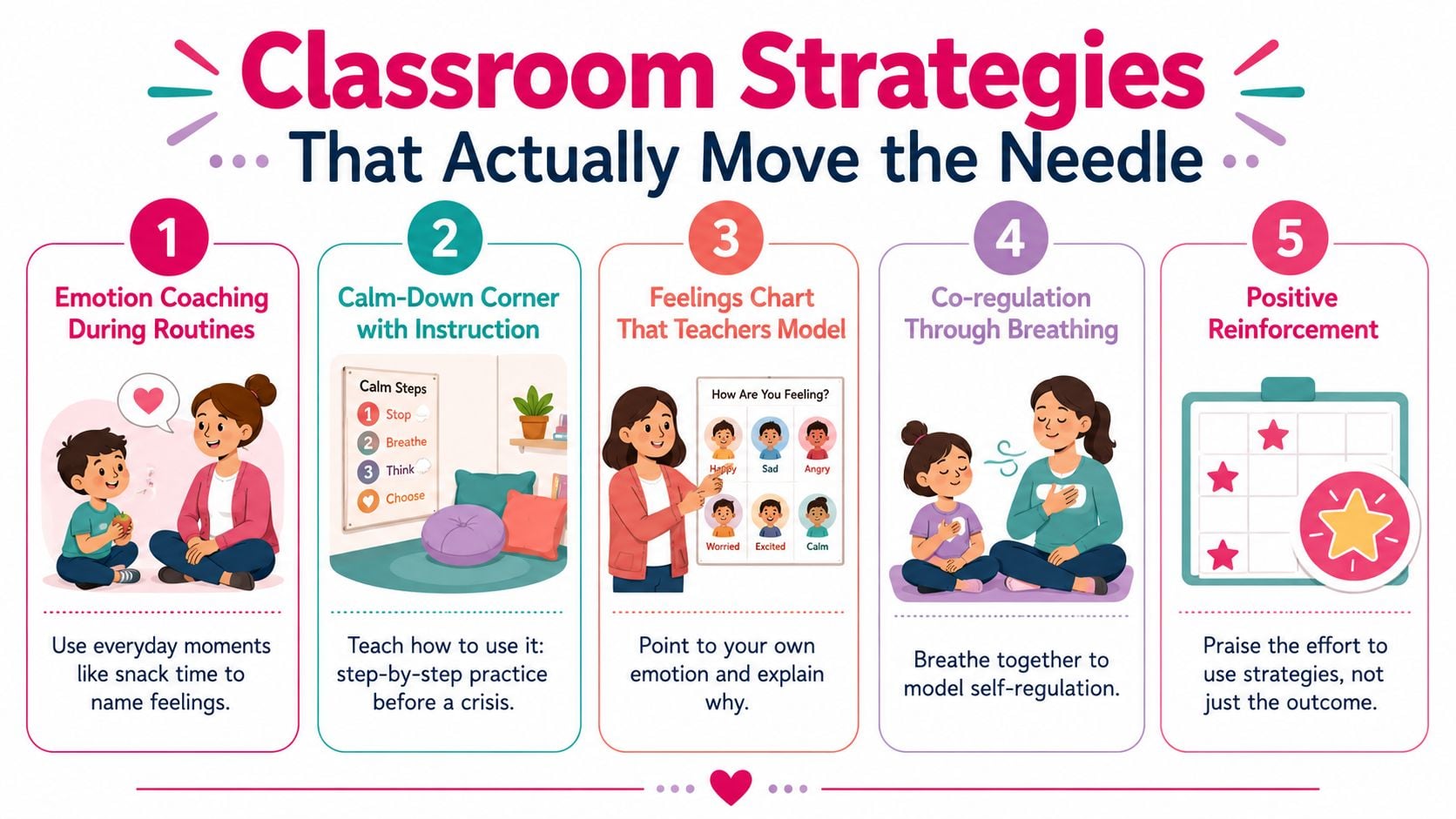
Classroom Strategies That Move the Needle
A calm-down corner will not help if children have never practiced using it. A feelings chart will not help if adults only point to it when everything is already falling apart. The strategies that stick are the ones built into ordinary routines, because ordinary routines are where children have emotions, test limits, and learn what to do next.
Start with language the whole class can share
Use the same few words across the day. “You look frustrated.” “Your body needs a break.” “Breathe, name it, choose it.” Shared language gives children a steady script they can hear at snack, during cleanup, or after a hard turn in play. Research on early-childhood social-emotional learning supports classroom-wide routines because children learn best when adults respond the same way in repeated moments, not only after behavior has already escalated.
One simple model is for adults to use the language themselves first. A teacher might say during snack, “I'm feeling rushed because we need to clean up soon. I'm taking one breath.” That sentence does more than teach vocabulary. It shows children what regulation sounds like in real life.
Put emotion coaching inside routines, not beside them
Circle time, transitions, centers, lunch, and pickup all give children chances to practice the same skill in different ways. A preschooler may need help saying, “I'm disappointed,” while an early-elementary child may need help slowing down enough to explain why a choice felt unfair. The skill is similar, but the support has to match the age and the moment.
At circle time, a child mutters, “I hate this.” The teacher responds, “You're disappointed. We'll stay for two more songs, then you can choose the next job.” The adult has named the feeling, held the limit, and shown that feelings and boundaries can live together.
Here are five practices that tend to change what children do because they teach the next move, not just the feeling:
- Emotion coaching during routines. Use snack, cleanup, arrival, and line-up to label feelings in real time.
- Predictable transitions. Warn before change, then repeat the same transition language so children know what comes next.
- Structured peer play. Put the language of turn-taking, repair, and asking into games, not only into conflict moments.
- Restorative responses after conflict. Focus on what happened, who was hurt, and how to make it right.
- Shared visual cues. Use one calm-down chart, one breath cue, one class script.
A practical guide to how to implement social-emotional learning in the classroom can help adults keep these routines simple and consistent, which is usually where strong ideas either take hold or fade away.
“Name it, hold the boundary, then help the child practice the next move.”
Children do not need every response to be new. They need the same skill repeated in small, ordinary moments, with language that fits their age. That is how labeling turns into regulation, and regulation turns into better choices.
For families looking for a structured play-based support option, find play therapy in Arizona can be a useful next step when a child needs more guided practice than daily routines can provide.