

What Is Bystander Intervention and How to Teach It
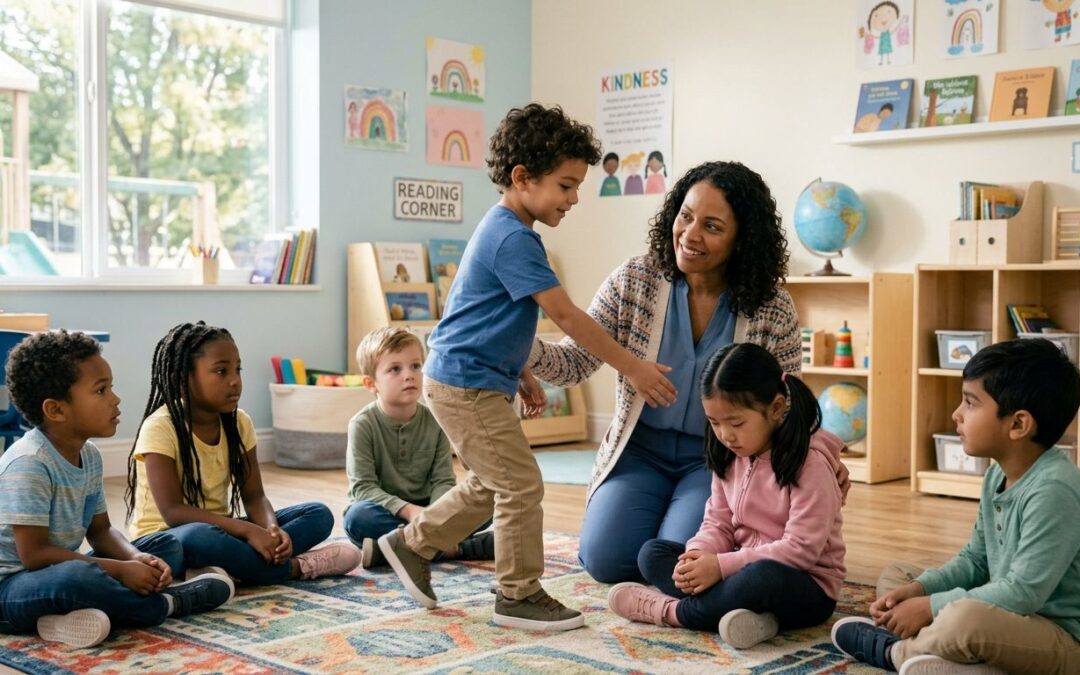
Bystander intervention is a purposeful action by a witness to de-escalate a situation that could cause harm, and it can be learned as a sequence of noticing, interpreting, and acting safely. The classic research found 85% helped when they were alone, but only 31% helped when others were around, which is why students can freeze even when they care about a classmate who's being left out or teased.
A third grader sees two kids whispering and laughing while another child sits alone at lunch. A middle schooler notices hurtful comments in a group chat and wonders whether to say anything. Those moments are where what is bystander intervention stops being an abstract idea and becomes a practical skill adults can teach, practice, and reinforce.
Understanding Bystander Intervention in Schools
A student at lunch sees a classmate's tray shoved aside, or hears a joke in a group chat that lands as cruel instead of funny. An adult may spot the problem right away, while a child may feel the social pressure first and the harm second. Bystander intervention gives students a simple path from noticing harm to choosing a safe response.
From passive bystanding to purposeful action
The older bystander effect literature came out of social psychology and showed that people are often less likely to help when other people are nearby. That finding matters because silence in a crowd is not the same thing as indifference, it often reflects hesitation, uncertainty, or a quick assumption that someone else will step in. Modern bystander intervention takes that research and turns it into a teachable behavior sequence, one that starts with notice, moves to interpret, and ends with act.
That shift matters in schools because children do not need to perform like rescuers. They need to recognize when something feels wrong, decide whether help is needed, and choose a response that fits their age, role, and safety. A student can support a peer without confronting another child head-on, just as a crossing guard can help traffic move safely without stepping into the middle of it.
The same idea also fits well with developmental versus behavioural interventions, because young children often need concrete language, practice, and repetition before they can act under social pressure.

A shared language adults can use
When adults use the same words, kids learn faster. A bystander is the person who sees the situation unfold. An upstander is the person who chooses a safe way to help. That language gives a child a way to say, “I saw it, but I wasn't sure what counted as helping,” which is a much better starting point than shame.
Practical rule: hesitation is normal. The goal is not to blame a child for freezing. It is to help them notice what happened and practice a safer next step.
Parents and teachers can use this language in everyday life, at recess, in hallways, in class meetings, and online. A teacher might pause after a hurtful comment and ask, “What could a bystander do here that keeps everyone safe?” A parent might use a similar question after a sibling conflict. The more familiar the words become, the more likely students are to treat intervention as a learned habit rather than a moral test.
The Five-Step Decision Process Behind Intervention
A child who sees rude comments in a group chat may still stay silent, not because the child agrees, but because one step in the decision chain breaks down. Latané and Darley's five-step bystander intervention model shows that intervention depends on five linked steps, notice the situation, label it as a problem, accept responsibility, choose a response, and carry out the action (Latané and Darley's five-step bystander intervention model). If any step stalls, the whole process stalls.
Where students get stuck
A student may notice the message but read it as a joke, so the brain never moves from noticing to interpreting. Another student may think, “Someone else will tell the teacher,” so responsibility gets handed off to the crowd. That is why adults should listen closely when a child says, “I didn't know what to do.” The better question is, which step broke?
A useful way to coach kids is to teach each step separately. First, help them notice the moment. Then practice identifying what counts as harm, including low-level teasing, exclusion, or whispering that isolates another child. After that, help them name responsibility in simple words, like “If I saw it, I can do something small.” A short role-play or a game from this decision-making games collection can make the sequence easier to remember in advisory, counseling, or family time.
The American Psychological Association's guidance also distinguishes direct, distract, delegate, delay, and document responses, which helps children and adults match the action to the setting (APA guidance). A classroom conversation can start with a simple prompt, “What's the safest next move here?” That question teaches judgment, not just courage.
Teacher lens: if a student knows harm is happening but still freezes, do not jump straight to “be braver.” Ask what the student thought was happening, who they believed should respond, and whether they knew a safe option.
For educators looking for a developmental lens on decision-making, developmental versus behavioural interventions can be a useful companion read because it reinforces the idea that kids need skills built over time, not just reminders to “do better.”
A quick diagnostic example
A fourth grader sees two friends laughing at a classmate's backpack. The child notices the laughter, but interprets it as harmless. That is a step-two problem. If the child thinks, “I'm not the adult, so I can't help,” that is a step-three problem. Adults who can pinpoint the breakdown coach more effectively and avoid vague advice.
Five Safe Strategies for Students and Adults
A child who notices rude comments may still do nothing when one step in the decision chain breaks down. Maybe the child does not read the situation clearly. Maybe the child sees a problem but feels too small to intervene. Maybe speaking up would put the child at greater risk. That is why direct, distract, delegate, delay, and document need to stay in the toolkit. Each option gives students and adults a way to respond without forcing one unsafe script on every situation.
| Strategy | What It Looks Like | Best For |
|---|---|---|
| Direct | Calmly naming the behavior, like “That's not okay” or “Please stop.” | Situations where the bystander has enough authority, time, and safety to speak plainly. |
| Distract | Redirecting attention, inviting the target away, or changing the activity. | Young children, playground conflicts, or moments where confrontation might escalate. |
| Delegate | Getting a trusted adult, supervisor, counselor, or another responsible person. | Hallways, lunchrooms, bus lines, and any setting with an adult who can step in. |
| Delay | Checking in afterward, offering support, or following up privately. | Moments where speaking up in the moment would be unsafe or would disrupt supervision. |
| Document | Recording what happened, especially if there's a pattern of exclusion or harm. | Repeated incidents, online behavior, or cases that need evidence for follow-up. |
The right choice depends on age, power, setting, and risk. A kindergartener does not need a confrontation script. That child may be coached to say, “Come play with me,” which is a form of distraction. A teacher, by contrast, may need to keep supervision intact and delegate to another adult right away.
A simple way to teach this is to ask, “What is the safest next move here?” That question helps students slow down and choose an action that fits the moment, the same way you would choose the right tool from a toolbox instead of using a hammer for everything.
Safety first: if a response could make the situation worse, choose the lowest-risk option that still protects the target.
For teachers and parents who want more examples of prosocial choices, examples of prosocial behavior can be a useful companion resource when you are modeling helpful actions in class discussions or family conversations. The goal is not for every child to respond the same way. The goal is for students to practice choosing a response that matches the situation, the relationship, and the level of power in the room.
Real-World Examples for Classrooms and Homes
A teacher notices a child sitting alone at lunch while a small group keeps pulling chairs away. The teacher steps in right away, separates the students causing the problem, checks on the child who was isolated, and gets help from another adult if needed. That is bystander intervention in real school life, calm, concrete, and centered on safety.

What it looks like at school
In a second-grade classroom, one child notices another being left out of a game. A teacher can coach the child to use distract, saying, “Come be on my team,” or delegate, by telling an adult on duty. In a fifth-grade hallway, a student who hears mean comments can use delay by checking in later and saying, “I heard that, and it didn't seem okay. Are you alright?”
Those responses are small, but adults can see them. That matters because schools should track real behaviors, like warning, distraction, seeking adult help, and post-incident support, instead of relying only on attitude surveys (APA event-specific behavior measurement guidance). If a child can describe what they did afterward, teachers and families get a clearer sense of whether the practice is taking hold.
What it looks like at home
Parents can practice the same skills at dinner or during car rides. If a child says a friend was left out of a game, the parent can ask, “What could you do that helps without making it a big scene?” The child might suggest inviting the friend over, getting another adult, or checking in later. Rehearsing those choices makes them easier to use when the moment feels real.
The language does not need to sound formal. Younger children usually do better with short scripts they can remember quickly:
- “Come with me.” A quick distract move for a child who wants to pull someone out of the moment.
- “I'm getting Ms. Lee.” A delegate response that shifts responsibility to a trusted adult.
- “Are you okay?” A delay response that offers care after the incident.
- “I'm going to write this down.” A document response for repeated or online harm.
For more examples of everyday pro-social behavior, this collection from Soul Shoppe can help adults notice the small actions that deserve praise. The United We Transform activities can also give teachers and families concrete ways to practice helpful behavior together. Children repeat what adults notice, so naming these moments out loud helps them stick.
Building a Pro-Social Bystander Culture
A single lesson will not change school culture. Students step in more often when adults model the language, practice the skills, and treat intervention as part of everyday community life. That is how a building shifts from “mind your business” to “we help each other.”
Culture grows through repetition
A hallway pause, a lunchroom comment, or a quick check-in after recess can do more for bystander habits than a one-time assembly. Children learn what to repeat by watching what adults repeat, and that includes how adults respond when someone is left out, teased, or put on the spot.
Older research on the bystander effect showed that people are less likely to help when others are present, but later real-world studies found that intervention often happens in visible public conflicts, with at least one bystander stepping in in 90.9% of 219 filmed situations across the United Kingdom, the Netherlands, and South Africa (cross-national study). A related analysis found at least one bystander intervened in 85.0% of 81 filmed conflicts, with 217 intervening bystanders in total (related filmed-conflict analysis). The lesson is straightforward. Context matters, and people act when the environment makes action feel possible.
Schools can strengthen that environment by using the same words in morning meetings, classroom norms, conflict resolution, and family communication. Adults can model phrases like “I noticed that looked uncomfortable” and “Let's get help.” Those repeated cues matter, especially in early grades, where children are still learning how to read social risk and decide whether to speak up, get help, or stay close to the person who needs support.
A school-wide approach also gives adults a shared framework for low-level bullying, exclusion, and online harm. The line between “small” teasing and something that needs action is often clear only after someone names it. Adults who make that naming routine help children see the pattern sooner and respond before harm grows.
Culture note: students do not need every adult to respond the same way. They do need every adult to respond in a way that makes safety, support, and follow-up feel predictable.
Programs that build positive norms can reinforce this. United We Transform activities can support class-level conversations about community expectations, and Soul Shoppe's peer-support program resources can help schools connect those expectations to daily practice without making intervention feel abstract.
When Intervention Is Not Safe or Appropriate
A common mistake is treating bystander action like a moral test. It isn't. Some students and staff can't safely intervene directly because of their age, their role, or the power dynamics in the room. A child may risk retaliation. A teacher may need to keep supervising the whole group. A caregiver may need to document patterns instead of confronting someone in the moment.
Safety comes before bravery
Research-based guidance explicitly notes that not everyone has the same social position or privilege in a conflict, and that indirect methods may be more appropriate (Waterloo resource). That nuance matters in schools. A student who feels unsafe speaking up isn't failing. They may need a different strategy and a stronger adult backstop.
The right question is not, “Did the child do the boldest thing?” It's, “Did the child choose the safest helpful thing available?” Sometimes that means getting a trusted adult. Sometimes it means waiting and checking in later. Sometimes it means writing down what happened so a pattern can be addressed.
Quiet truth: indirect action still counts. Getting help, documenting harm, and supporting a target afterward are all part of intervention.
If a child gets stuck on fear, shame, or uncertainty, a family or school counselor can help them sort out what felt unsafe. Trauma-informed support can make a big difference here, especially when students have lived through repeated conflict or humiliation.
Coaching should validate the hesitation first, then problem-solve the next step. That's how children learn that caution and care can coexist.
Practical Resources and Next Steps for Implementation
Schools and families do not need a full program overhaul to begin. They need a shared script, repeated practice, and a simple way to notice whether children are using the skill in real moments. Experiential SEL programming, staff training, and basic behavior tracking can work together here, like three legs on the same stool.

A practical rollout for schools and homes
A single classroom or grade-level pilot is often the best place to start. Teach the five-step model, practice the five safe responses, and ask students to name what they would do in realistic scenarios. Then watch for event-specific behaviors, warning, distraction, seeking adult help, and post-incident support, because those actions show whether the lesson stayed at the level of agreement or became usable in the moment, as described in the event-specific measurement guidance.
For schools exploring program options, Soul Shoppe offers experiential social-emotional learning supports, including workshops, assemblies, coaching, community events like the Peaceful Warriors Summit, and the Junior Giants Strike Out Bullying partnership. Its bullying prevention resources give students shared language for self-regulation, communication, and conflict resolution, which fits naturally with bystander intervention practice. Families can reinforce the same ideas at home with role-play, short check-ins, and simple reflection after playground or online conflicts.
A good next step is straightforward.
- For educators: schedule staff training, choose a grade-band pilot, and weave intervention scenarios into health or advisory time.
- For families: practice one script at dinner, use age-appropriate videos, and build a small family plan for what to do when a child sees exclusion.
- For everyone: keep a common language for noticing, naming, and acting.
For a school-ready starting point, Soul Shoppe's bullying prevention program for schools can serve as one structured option among others, especially when adults want practical tools instead of one-off assemblies. The strongest programs do the same three things over and over. They teach the steps, rehearse the responses, and check what changed.
If your school or family wants a clear, compassionate way to teach students how to step in safely, Soul Shoppe offers experiential SEL programs that fit this work. Their workshops, coaching, and bullying prevention resources help children and adults build the shared language and practice needed for real bystander intervention.