
The last five minutes of the day often tell the truth. A student is still carrying hurt from recess. Another is proud and restless after finally finishing a project. Backpacks slam shut, chairs scrape, and an adult asks, “How was your day?” The response is usually short because many children need a better doorway into reflection than a broad question or an empty page.
Journal entry prompts give them that doorway.
A useful prompt lowers the pressure without lowering the thinking. It gives students enough structure to get started and enough choice to answer honestly. That balance matters in SEL work. If a prompt is too vague, students freeze. If it is too scripted, they write what they think adults want to hear. The goal is not polished writing. The goal is helping students notice what happened, name what they felt, and decide what to do next.
That’s because reflection supports emotional regulation, mindfulness, and self-awareness. In practice, I have seen the same prompt work differently across ages and even across different days with the same child. A kindergartner may need to draw first and talk second. An upper elementary student may be ready to connect feelings to a specific event. A middle schooler can often handle a prompt that asks for patterns, choices, and repair.
This article is built for actual use, not just inspiration. The ten prompt types below function as mini lesson plans within a larger SEL framework. Each one includes grade-level adaptations for K-2, 3-5, and 6-8, sample student responses, and classroom or home variations such as exit tickets, partner shares, and quick write routines. For families and teachers who want to extend the work beyond the notebook, simple ways to show gratitude in daily interactions can reinforce what students write about.
There are trade-offs to keep in mind. Some prompts fit best during morning meeting, while others are more effective after conflict, during advisory, or at bedtime. Some students open up in writing. Others need to speak, sketch, or dictate first. Good SEL journaling stays flexible, predictable, and emotionally safe. Done well, it gives children and adolescents a repeatable way to understand themselves, relate to others, and carry insight from one day into the next.
1. Gratitude and Appreciation Reflection
A student walks in upset after a hard bus ride, and a broad prompt like “What are you grateful for?” falls flat. Gratitude reflection works better when it starts with something specific the student can name from the last few hours.

This prompt helps students notice support, comfort, effort, and small positive moments that are easy to miss during a busy day. It also builds a habit of paying attention to relationships, which makes it useful as more than a feel-good writing task. In practice, that matters. Students who struggle with regulation, including those affected by the link between ADHD and feelings, often need concrete reflection tools rather than vague requests to “be positive.”
Grade-level adaptations
K-2: “Draw a picture of someone who helped you today. Tell them, or write one word, why you are thankful.”
Sample response: a drawing of a friend sharing a crayon, with the word “sharing.”
3-5: “Write about three things that went well today, big or small. Why did they make you feel good?”
Sample response: “I’m grateful my friend sat with me at lunch because I was lonely. I’m also grateful for the sunny weather at recess and that I understood the math lesson.”
6-8: “Describe a time someone showed you support when you didn’t expect it. How did it change how you saw that person or the situation?”
What works in practice
Keep the writing brief. One to three sentences is often enough, especially at the start. Longer entries can produce richer thinking for some students, but they can also turn gratitude into a compliance task. A quick, specific reflection usually gets more honest responses than a polished paragraph.
Adult modeling matters here. “I appreciated how Maya held the door when my hands were full” gives students a usable example. “Be thankful” does not.
This prompt also works best when teachers and caregivers allow different response modes. Younger children may draw and label. Some students will talk first and write second. Others do better with a sentence stem, a partner share, or an exit ticket. If gratitude writing starts to sound forced, switch the question. Ask, “Who made today easier?” or “What helped you get through a hard part of the day?” That keeps the focus grounded in real experience.
A strong classroom variation is a pair-share after writing, with a clear boundary that students only share what feels comfortable. At home, a family gratitude jar keeps the routine short and visible. To connect reflection to action, Soul Shoppe’s ways to show gratitude offers family- and school-friendly examples, and these self-regulation strategies for students pair well with gratitude prompts on tougher days.
Start with what was helpful, not what was perfect.
2. Emotion Identification and Self-Regulation
Many students can feel a big emotion before they can name it. That gap matters. If a child can’t tell the difference between frustration, embarrassment, disappointment, and anger, it’s much harder to choose a helpful response.
This prompt slows the moment down. Instead of asking kids to explain everything, it asks them to notice what they felt, what set it off, and what they did next.
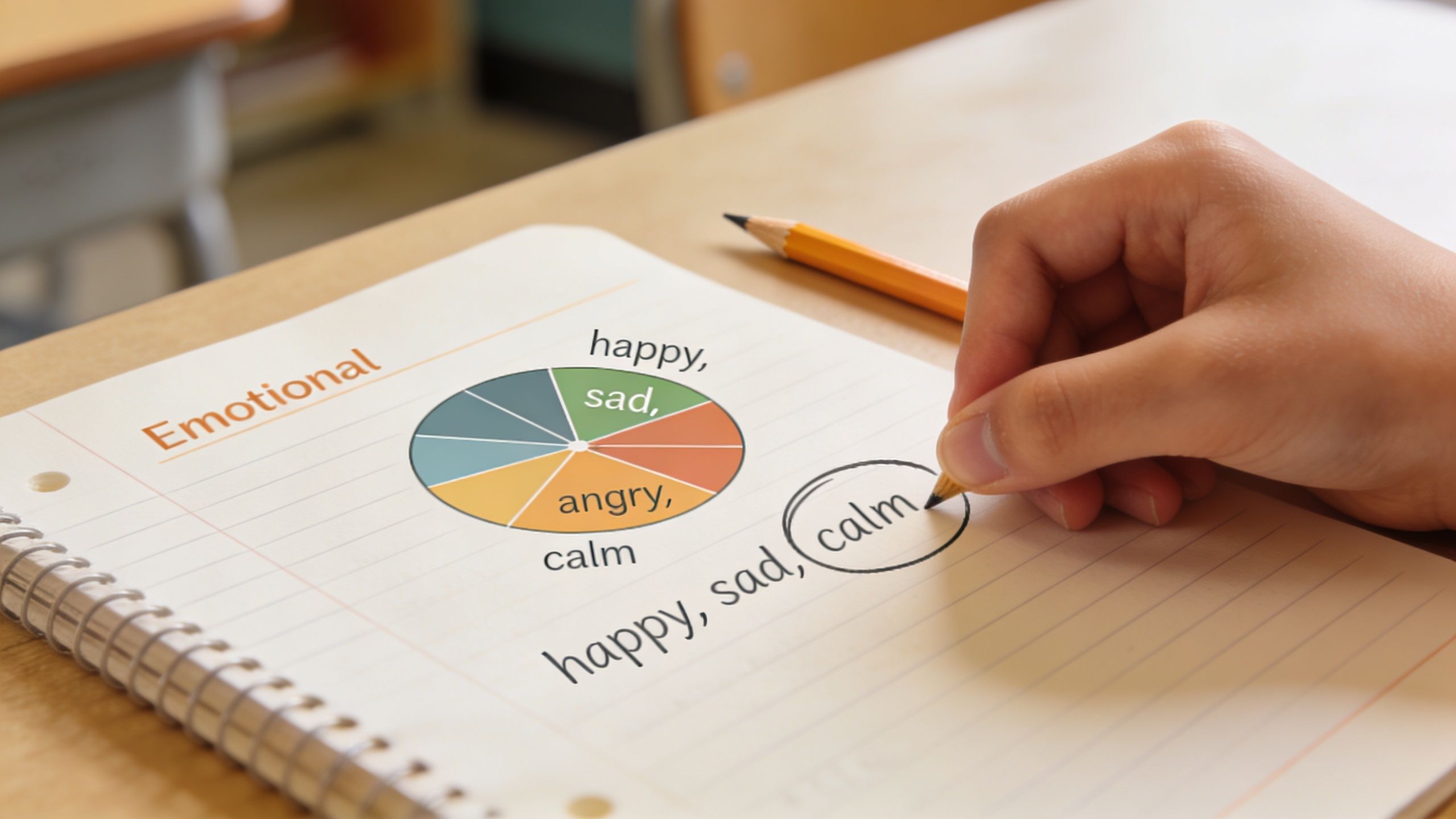
Grade-level adaptations
K-2: Use an emotion chart with faces. “Circle the face that shows how you felt when you couldn’t build your tower. What did you do to feel better?”
Sample response: the student circles “angry” and draws three deep breaths.
3-5: “Today, I felt ___ when ___. To help myself, I tried ___.”
Sample response: “Today, I felt frustrated when I couldn’t solve the word problem. To help myself, I tried asking a friend for a hint.”
6-8: “Reflect on a moment you felt a strong emotion. What signs did you notice in your body? Was your response helpful or unhelpful? What could you do differently next time?”
What helps and what doesn’t
What helps is normalizing the full range of emotions. What doesn’t help is rewarding only calm, tidy answers. Students need to know that “I was really mad” is acceptable language if it’s followed by reflection.
A co-created calming strategies chart gives students something concrete to reference in their writing. In many classrooms, a fast emotional check-in at the start of the day also helps adults catch patterns before behavior escalates. If you’re supporting students who have a harder time reading and managing emotional intensity, this discussion of the link between ADHD and feelings offers useful context for caregivers.
Practical rule: Don’t ask for regulation before you teach regulation.
For families and schools that want a shared toolbox, Soul Shoppe’s self-regulation strategies for students can pair well with this kind of journaling. The journal becomes the reflection space. The strategy chart becomes the action space.
3. Growth Mindset and Challenge Reflection
A challenge prompt helps students move from “I’m bad at this” to “I’m learning how to do this.” That shift sounds small, but it changes behavior. Students who can reflect on effort, strategy, and next steps usually stay engaged longer than students who read every mistake as proof that they can’t succeed.
This kind of journaling is especially useful after tests, group work, performances, and social setbacks. The writing doesn’t need to celebrate struggle. It needs to help students make sense of it.
Try these versions
K-2: “Draw a picture of something that was hard for you. Now draw what you did to keep trying.”
Sample response: a student draws struggling to tie a shoe, then practicing with a parent.
3-5: “Write about a ‘beautiful oops,’ a mistake that taught you something. What did you learn?”
Sample response: “My beautiful oops was spelling a word wrong in my story, but it gave me an idea for a funnier word to use instead.”
6-8: “Describe a recent academic or social challenge. What strategies did you use? What happened after you kept trying? What will you try next time?”
The trade-off
There’s a common mistake with growth mindset journaling. Adults sometimes push students to end every reflection with a neat success story. That can make the writing feel fake. A stronger prompt leaves room for partial progress.
Students can write, “I still don’t get fractions, but I asked a better question today.” That’s honest growth. It respects effort without pretending the problem disappeared.
A useful classroom exit ticket is one sentence: “One thing I learned from a mistake today was…” At home, parents can model their own imperfect learning. A child is more likely to write truthfully if the adults around them do too.
If you want language and activities that support this reflection style, Soul Shoppe’s growth mindset activities for kids that truly stick gives practical ways to reinforce the “not yet” mindset outside the journal.
4. Acts of Kindness and Empathy Exploration
A student holds the door for a classmate who is carrying a project, then sits down without saying a word. No adult praises it. By dismissal, the moment is gone unless someone helps the class notice why it mattered.
That is the job of this prompt type. It teaches students to pay attention to how everyday choices affect other people. Over time, that shifts kindness from a rule adults repeat to a habit students can name, reflect on, and choose again.
This category works especially well for students who do not see themselves as leaders. They may never volunteer to be the “helper,” but they still include, wait, notice, and repair. Journaling helps them see that empathy often shows up in small, quiet actions.
Prompt examples by age
K-2: “Who helped someone today? Draw what happened. How do you think the other person felt?”
Sample response: a drawing of a classmate picking up spilled crayons, with the teacher writing, “She felt better because she was not alone.”
3-5: “Be a kindness detective. Write about one kind thing you saw today. What happened before it? What changed after it?”
Sample response: “I saw Maria invite the new student to play at recess. Before that, he was standing by himself. After that, he was smiling and running with the group.”
6-8: “Describe a time you chose kindness when it would have been easier to ignore someone, join in, or stay silent. What helped you make that choice? What impact did it have?”
What actually helps students go deeper
The strongest empathy journals stay concrete. “Someone was nice” is too vague to teach much. Students learn more from prompts that ask who was affected, what changed, and what clues showed the other person’s feelings.
That same principle matters when adults respond. Specific feedback builds awareness. “You noticed that your partner looked embarrassed and waited for them” gives students language for empathy. General praise does not.
A useful follow-up question is: “What did that action change for someone else?” That question moves the reflection past good behavior and into perspective-taking.
There is a trade-off here. Public kindness routines such as a “Kindness Caught” wall can build a strong class norm, but they can also make some students perform kindness for recognition. Private journaling often gets more honest reflection, especially for older students who are sensitive to peer judgment. In practice, I use both. Public noticing sets the culture. Private writing helps students examine motive, impact, and missed chances.
These prompts are easy to adapt into mini-lessons instead of using them only as independent writing:
- Exit ticket: “One kind thing I noticed today was ___, and it mattered because ___.”
- Pair-share: Students read one sentence from their journal, then their partner adds, “The feeling I heard in that story was ___.”
- Morning meeting follow-up: Invite students to write about a time they wished someone had noticed their feelings.
- Home connection: Ask caregivers to share one small act of kindness they saw at home, then have the child reflect on how it affected the family.
If students need more direct teaching before they write, Soul Shoppe’s how to teach empathy with clear, student-friendly practices pairs well with this prompt type. It gives teachers and caregivers language they can model before asking students to reflect independently.
5. Conflict Resolution and Perspective-Taking
Students often replay a conflict in one direction only: what the other person did. Journaling gives them a safer place to sort out the whole interaction before speaking aloud. That matters because many kids can think more clearly on paper than in the heat of the moment.
This prompt is best used after a cooldown, not during peak upset. Reflection before regulation usually backfires.
How to phrase it
K-2: “Draw the problem. Now draw what each person wanted. What is a fair solution?”
3-5: “Write the story from two sides. First, tell what happened from your point of view. Then tell it from the other person’s point of view. What did each person want?”
6-8: “Rewrite your side of the conflict using an I-statement: ‘I felt ___ when you ___ because ___. Next time, I would like ___.’ Then reflect: what might make it hard for the other person to agree?”
What actually works
Private writing before a restorative conversation often produces better repair than immediate forced sharing. Students have time to move from blame to clarity. They can spot what they wanted, what the other person may have wanted, and what still needs repair.
What doesn’t work is using the journal as a punishment. “Go write about what you did wrong” turns reflection into compliance. A better invitation is: “Write so you can understand what happened and what you want to do next.”
Useful follow-up questions include:
- What were you hoping would happen? This helps students identify unmet needs, not just surface behavior.
- What do you think the other person was hoping for? This builds perspective-taking without requiring agreement.
- What repair is possible now? This keeps the writing connected to action.
At home, this prompt can help after sibling conflict if each child gets separate time and space to write or draw first. In school, it pairs well with a Peace Path or any restorative routine students already know.
6. Body Awareness and Mindfulness Reflection
A student comes in from recess rubbing their stomach. Another starts tapping a foot faster right before a quiz. A third looks calm until shutdown hits all at once. Body-awareness journaling helps students catch stress earlier, name what they notice, and choose a regulating strategy before behavior takes over.
Used well, this is more than a prompt. It is a short SEL routine: notice, name, respond, reflect. That structure matters because students often need direct teaching here, not just an open-ended question on a page.

Age-based prompt ideas
K-2: “After we did our starfish breaths, where in your body feels calm? Color that spot on this body outline.”
Classroom variation: Use it as a 2-minute morning check-in or calm-down corner activity. Some children will draw instead of write, and that is often the better fit.
Sample response: “My hands feel slow now. My belly feels better.”
3-5: “Think about a time you felt worried. Where did you feel it in your body? What helps that part of your body relax?”
Classroom variation: Try this as an exit ticket after a test, performance task, or class meeting. Pair-share can work if students are allowed to pass.
Sample response: “I feel worry in my tummy like butterflies. Taking a drink of water helps.”
6-8: “What are your body’s early warning signs for stress? What are the signs you’re feeling relaxed and focused? How can you use that information during a busy school week?”
Classroom variation: Ask students to make a two-column list: “stress signals” and “reset strategies.” That format feels more private and concrete than a long personal reflection.
What actually works
Keep the focus on patterns, not disclosure. Students do not need to explain why they feel activated in order to learn what their body is telling them. For many kids, especially those carrying stress outside school, that difference is what makes the activity usable instead of overwhelming.
Choice is required here. A student should always be able to switch from internal sensations to external grounding: what they see, hear, touch, or do to settle. That flexibility matters because there is still a gap in many journaling resources around developmental specificity and trauma-informed practice, as noted in this discussion of missing guidance in common journal prompt resources.
Before journaling, a short guided reset helps. This quick video can support that transition:
A few trade-offs are worth naming. Body scans can help some students slow down, but they can also increase distress for students who do not feel safe focusing inward. Younger students usually do better with concrete body maps, colors, and simple sentence stems. Older students often want privacy, shorter prompts, and the option to keep their writing unread.
If body-focused reflection increases stress, switch the prompt immediately. Safety comes first.
7. Identity and Belonging Exploration
Students do better when they feel seen. They also do better when they can see themselves clearly. Identity journaling helps with both. It gives students language for their values, interests, communities, traditions, and strengths, and it creates room for complexity.
This prompt is especially helpful for students who feel flattened by labels. The child who’s “the quiet one,” “the math kid,” or “the one who gets in trouble” often has much more to say when the prompt opens wider.
Prompts that invite belonging
K-2: “Draw yourself in the middle of the page. Around you, draw and label the people, places, and things that are important to you.”
3-5: “Create an identity web. Put ‘Me’ in the center, then add family traditions, hobbies, favorite foods, languages you speak, and other important parts of who you are.”
6-8: “Where do you feel most like your true self? Describe that group or place. What makes it feel safe and real for you?”
Practical use in classrooms and homes
Literature helps here. After reading a story with themes of identity, culture, friendship, or belonging, students can compare the character’s experience with their own. That gives them some distance, which often leads to more honest reflection.
A gallery walk can also work if sharing is optional. Some students love displaying an identity web. Others don’t. Belonging grows when students have choice, not when disclosure is expected.
This is also a strong family prompt. Caregivers can ask about family values, traditions, and the communities a child feels part of. Those conversations help students connect private identity with public belonging.
8. Peer Support and Social Connection Reflection
A student has a hard morning, walks into class quiet, and says they are fine. By the end of the day, one classmate has shared supplies, another has invited them into a group, and a teacher has checked in twice. Many children miss those moments unless we teach them how to notice support, name it, and use it.
Peer support journaling helps students map relationships, practice help-seeking, and recognize that they also matter to other people. That shift matters in SEL work. Students who can identify safe people and small connection points are often better prepared to join groups, repair hurt feelings, and ask for help before a problem grows.
Prompts that build social awareness and support-seeking
K-2: “Draw a picture of a time someone helped you at school. What did they do? How did it make you feel?”
3-5: “Make a support map with three circles: friends, family, and school adults. Write one way each person can help you.”
6-8: “Write about a recent moment when you felt supported, included, or checked on. What made that moment feel real? What could you do to offer that kind of support to someone else?”
How to use this prompt well
This prompt works best when students get concrete categories. “Who supports you?” is too broad for many children. “Who helps you when you are confused, left out, upset, or stuck?” gives them a way in.
It also helps to treat social connection as teachable behavior, not personality. A student does not need to be outgoing to build connection. They need practice with specific moves such as asking to join, thanking a peer, checking on someone, or naming one trusted adult.
For classroom use, this can become a quick exit ticket, a partner share, or a private journal entry. In K-2, students can draw and dictate. In grades 3-5, a support map usually works better than a full paragraph. In grades 6-8, I would add one planning question: “What is one small social step you could take this week?” That turns reflection into action without forcing public sharing.
A sample response from an upper elementary student might sound like this: “I wrote my counselor because I was nervous about a friendship problem. She helped me think of what to say first. I also realized my friend Maya helped by saving me a seat at lunch.”
A middle school response might be more understated: “My friend asked why I was quiet in science. It was only one sentence, but it helped because it showed someone noticed.”
At home, caregivers can keep this simple. Ask, “Who helped you today?” and “Who did you help?” Those two questions build reciprocity, which is different from popularity.
Some students cannot name a support person yet. Start with possibility instead: “Who might be safe to ask next time?” That response still gives you useful information and can guide follow-up support.
9. Values and Purpose Reflection
Students make better choices when they have words for what matters to them. Values journaling helps children and adolescents connect behavior to identity. Instead of only asking, “What did you do?” the prompt asks, “What kind of person do you want to be?”
That shift is powerful for motivation. It also makes SEL more durable. Rules can be followed when adults are present. Values travel with the student.
Prompt examples
K-2: “What are our class rules, like be kind or be safe? Draw a picture of you following one. Why is it important?”
3-5: “What are three words you want people to use to describe you, like kind, honest, or creative? Write about one thing you did today that shows one of those words.”
6-8: “If you could make one positive change at our school, what would it be and why? What value, like fairness, community, or fun, does that change connect to?”
Useful structures
A values sort works well before writing. Students can choose a few value words from a larger list, then explain why those words matter right now. That’s often easier than asking them to generate values from scratch.
Another option is to connect values to current events, stories, or media. Ask, “What value did this character act on?” Then invite students to compare. The journal becomes a place for thinking, not just reporting.
In classrooms, a values word wall helps students find language they might not use on their own. At home, families can connect the prompt to everyday moments: honesty after a mistake, courage before a tryout, fairness during a disagreement, generosity during sharing.
10. Feedback Integration and Growth Planning
A student gets a paper back, sees three correction marks, and decides, “I’m bad at this.” That reaction is common. A good journal prompt slows the moment down and teaches a different habit. Students learn to name the feedback, sort their feelings, and choose one next step they can try.
This prompt works best after graded work, conferences, peer review, performances, or behavior coaching. The goal is not to make feedback feel pleasant. The goal is to make it usable.
Prompt examples
K-2: “Your teacher said, ‘Try to make your letters sit on the line.’ Practice three letters on this page. Circle the one that matches the line best. What helped you do that one well?”
3-5: “What did I do well? What is one part I need to improve? What is one step I will try on my next assignment?”
6-8: “Look at feedback from your last project, discussion, or behavior reflection. Which comment was hardest to accept? Which comment can help you improve most? Write two specific actions you will take next time.”
What makes this work
Students often need help separating identity from performance. “You need stronger evidence” is about the draft, not the student. “Wait to speak until your classmate finishes” is about a skill, not character. Writing gives enough distance for students to respond with more thought and less defensiveness.
Specificity matters here. “Try harder” rarely changes anything. “Add one example from the text before turning in my paragraph” gives the student something visible and measurable. For younger children, that may mean practicing one letter, one transition, or one breathing strategy. For older students, it may mean setting a process goal, such as checking the rubric before submission or asking one clarifying question during revision time.
I have found that this prompt is strongest when the journal entry ends with a plan the student can revisit within a few days. Keep the plan small. If the next step is too big, students avoid it. If it is concrete and close in time, they are more likely to follow through and notice progress.
Useful structures
A simple template helps students who freeze after receiving criticism:
- What feedback did I get?
- How did I feel when I heard it?
- What part do I agree with?
- What will I do next?
You can also vary the format so it fits the setting. Use it as an exit ticket after a writing conference. Turn it into a pair-share where students practice restating feedback in neutral language. At home, caregivers can ask, “What is one thing you want to keep doing, and what is one thing you want to change next time?” That keeps the conversation focused on growth instead of shame.
Sample student responses
K-2 sample: “My best letter is m because it sits on the line. I went slow.”
3-5 sample: “I explained my idea clearly. I need to use more details from the text. Next time I will highlight two details before I start writing.”
6-8 sample: “The hardest feedback was that I interrupted during group work because I did not notice I was doing it. The most helpful part was the suggestion to write my idea down first. Next time I will jot notes while others talk and wait until one person finishes before I speak.”
Over time, these entries show students a pattern. Feedback stops being a one-time reaction and becomes part of an ongoing learning plan. That shift matters in academics, behavior, and relationships.
Comparison of 10 Journal Entry Prompt Types
| Prompt | Implementation complexity | Resource requirements | Expected outcomes | Ideal use cases | Key advantages |
|---|---|---|---|---|---|
| Gratitude and Appreciation Reflection | Low, simple prompts, easy to scale | Minimal, journals/paper, brief prompts | Improved mood, increased resilience, empathy foundations | Daily check-ins, whole-class routines, all K-8 levels | Easy to implement; immediate mood-lifting effects |
| Emotion Identification and Self-Regulation | Medium, needs scaffolding and follow-up systems | Emotion charts, staff training, privacy protocols | Greater emotional literacy, reduced impulsivity, better regulation | Emotional check-ins, behavior supports, SEL lessons | Builds self-awareness and personalized coping strategies |
| Growth Mindset and Challenge Reflection | Medium, requires culture shift and modeling | Time for reflection, teacher modeling, prompts | Increased persistence, reduced perfectionism, academic resilience | After setbacks, goal-setting, skill practice units | Promotes learning-oriented mindset and documents growth |
| Acts of Kindness and Empathy Exploration | Low, straightforward observation/reflection prompts | Minimal, paper/journal, optional bulletin board | More prosocial acts, stronger community belonging | Community-building, anti-bullying, classroom culture work | Strengthens belonging and motivates prosocial behavior |
| Conflict Resolution and Perspective-Taking | High, needs structure, emotional safety, facilitation | Restorative practice training, private space, follow-up time | Improved conflict skills, repaired relationships, fewer incidents | Post-conflict processing, restorative circles, mediation prep | Teaches repair, accountability, and multi-perspective thinking |
| Body Awareness and Mindfulness Reflection | Medium, needs guided practice and alternatives | Quiet time, brief guided scripts/audio, trained facilitation | Better interoception, early stress detection, grounding skills | Mindfulness sessions, trauma-informed classrooms, calming routines | Links body signals to regulation; supports somatic awareness |
| Identity and Belonging Exploration | Medium, requires culturally responsive facilitation | Time, safe environment, materials for identity activities | Increased self-acceptance, clearer sense of belonging, cultural awareness | Diversity lessons, identity units, community-building activities | Promotes inclusion and helps students locate belonging |
| Peer Support and Social Connection Reflection | Low–Medium, simple prompts but needs follow-up for isolated students | Support-mapping tools, opportunities for peer connection | Stronger peer networks, reduced isolation, increased mutual aid | Mentoring, social skills groups, community-building | Maps support systems and fosters reciprocal support |
| Values and Purpose Reflection | Medium, needs developmental readiness and integration | Values lists, guided prompts, discussion time | Greater intrinsic motivation, clearer decision-making, purpose | Upper elementary/middle grades, advisory, leadership work | Anchors behavior in values and boosts engagement |
| Feedback Integration and Growth Planning | Medium–High, requires skillful feedback practices and follow-up | Teacher feedback training, time for goal setting, tracking tools | Better receptivity to critique, actionable growth steps, tracked progress | After assessments, peer review, conferences, goal-setting periods | Turns feedback into concrete plans and accountability |
Putting Prompts into Practice Your Next Step
It is 2:10 p.m. The class just came back from recess. Two students are upset, one is withdrawn, and the group is louder than usual. That is not the moment for a long, open-ended writing task. It is the moment for one prompt, a clear routine, and a response format students already know.
Start there. Choose one prompt type that fits the need in front of you, then use it long enough to see patterns. In classrooms and at home, I usually see stronger results when adults stay with one category for two to four weeks instead of rotating constantly. Emotion identification works well during dysregulated stretches. Growth mindset prompts help after frustration or academic setbacks. Kindness, conflict resolution, and peer support prompts fit periods of social friction. The goal is not to cover all ten categories. It is to build a reflection habit students can use.
This article is built to support that kind of implementation. Each prompt type can function as a mini-lesson, not just a writing question. Teachers and caregivers can adjust the same core prompt for K-2, grades 3-5, and grades 6-8, then shift the format based on time and energy. A prompt can become an exit ticket, a pair-share, a morning meeting opener, a restorative follow-up, or a private journal entry. That flexibility matters because SEL works best when it fits real routines, not ideal ones.
Keep the structure predictable. Use the same notebook, half-sheet, or digital form each time. Tell students whether the response is private, optional to share, or expected to be discussed with a partner. Offer more than one response path. Drawing, sentence stems, checkboxes, dictation, and bullet points all count if they help students notice what happened, name what they felt, and decide what to do next.
Consistency matters more than length.
Research on expressive writing has long suggested that repeated reflection can support emotional processing and stress reduction. School journaling usually looks different from formal expressive writing studies. It is shorter, more scaffolded, and often tied to community routines. The practical takeaway still holds. Students get more from a steady practice than from a one-time “big reflection” activity.
Digital tools can help adults plan, but they should stay in a supporting role. One 2025 projection in PromptDrive’s article on AI prompts in research workflows says generative AI prompt adoption among education and market research professionals stands at 65% in 2025, up from 33% the prior year. That may help with drafting prompt banks, sorting themes, or organizing teacher notes. It does not replace adult judgment about developmental fit, cultural responsiveness, privacy, or signs that a student needs a conversation instead of another written response.
That trade-off is easy to miss. Efficient planning is useful. Over-automated SEL is not.
Younger students, multilingual learners, and students with trauma histories often need more adaptation than generic journaling resources provide. A first grader may need a picture prompt and one sentence stem. A fourth grader may do better with a feelings scale and a partner share before writing. A middle school student may need the option to pass, write privately, or respond to an outward-facing prompt such as, “What helps our class feel respectful during group work?” Flexibility is part of strong implementation, not a watered-down version of it.
It also helps to decide ahead of time what adults will do with what students write. If students disclose conflict, fear, or isolation, someone needs a follow-up plan. If entries are never revisited, students quickly learn that the routine is performative. Strong practice includes simple response systems: brief teacher check-ins, a note home when appropriate, a reteach for the whole group, or a small goal-setting conference. Reflection should lead to support, not just documentation.
You can also place prompts where they solve real problems. Use them after recess, after peer conflict, before tests, after read-alouds, during advisory, or at the close of the school day. Families can use the same prompt at dinner or bedtime with oral responses instead of writing. For older students and adults who want broader reflection ideas, meaningful self-discovery journaling prompts may offer additional inspiration. For schools and families seeking SEL support that includes practical tools for self-regulation, empathy, communication, and conflict resolution, Soul Shoppe is one relevant option to explore.
Start with one prompt type. Teach the routine clearly. Watch how students respond, then adjust the scaffolds, format, and follow-up. That is how journal prompts become a usable SEL practice instead of one more good idea that never sticks.
If you want support turning journal entry prompts into a consistent SEL practice, explore Soul Shoppe for programs, courses, and tools designed to help school communities and families build connection, empathy, safety, and practical self-regulation skills.