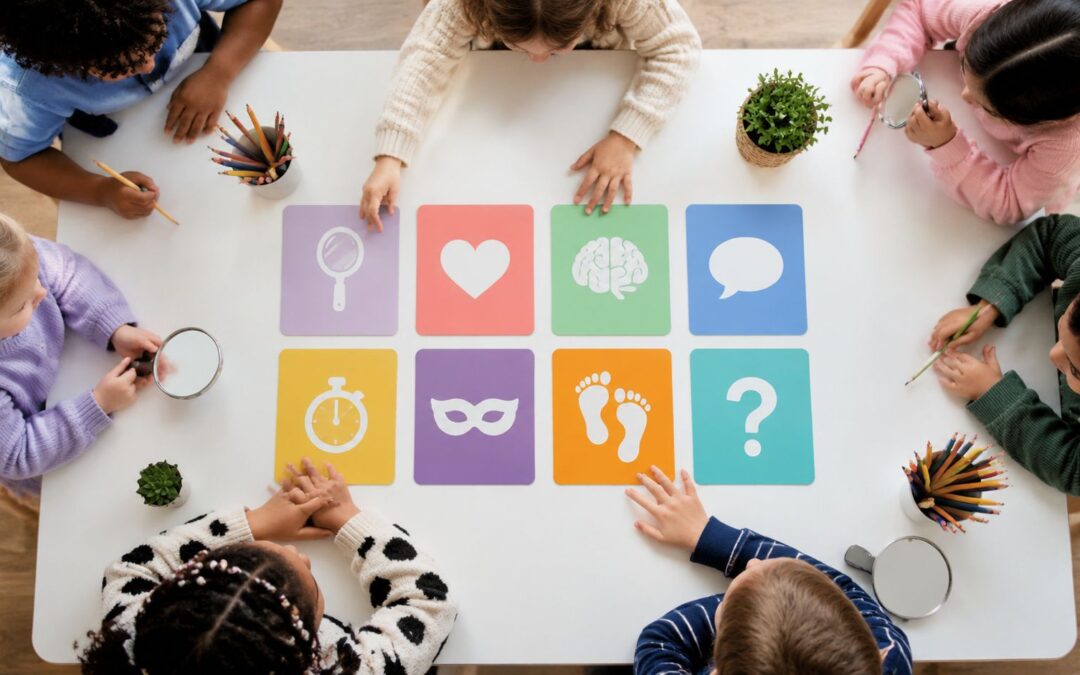
From Big Feelings to Big Insights: Why Self-Awareness Matters

Ever wonder what's really going on inside a child's head when they can't find the words for their big feelings? A student who suddenly withdraws, a child who lashes out in frustration, these are often signs of a gap in self-awareness. Self-awareness is the foundation of emotional intelligence. It's the ability to recognize our own emotions, thoughts, and values, and notice how they shape behavior.

That sounds simple, but it rarely happens automatically. Research highlighted by Tasha Eurich found that while 95% of people believe they're self-aware, only about 10% to 15% are, which is why children need structured practice instead of being told to “just reflect” (self-awareness statistics summary). In schools and homes, that gap shows up when a child says “I'm fine” with clenched fists, watery eyes, and a shut-down voice.

The good news is that self awareness exercises can be taught in concrete, kid-friendly ways. When adults give students repeated chances to notice body signals, name emotions, reflect on choices, and hear feedback safely, children start building language for what's happening inside them. That helps with behavior, yes, but it also helps with relationships, learning, and confidence.

Below are eight practical, evidence-informed self awareness exercises for K-8 settings. Each one includes age adaptations, classroom and home variations, examples, and simple ways to notice whether it's helping.

1. Body Scan Meditation

A body scan is one of the fastest ways to help children notice that emotions live in the body, not just in their thoughts. An upset child may not be able to say, “I'm overwhelmed,” but they can learn to notice a tight jaw, shaky hands, a heavy stomach, or buzzing legs.

That kind of noticing matters because self-perception is often inaccurate. A mixed-methods study in the NIH database reported that the connection between how self-aware people think they are and their actual observed behavior is less than 30% in some findings, which is one reason structured practices like mindfulness are so useful (NIH article on measuring the effects of self-awareness).

How to use it with kids

Ask students to sit, stand, or lie down comfortably. Then guide their attention slowly through the body. “Notice your forehead. Notice your jaw. Notice your shoulders. Are they tight, loose, warm, heavy, still, or wiggly?”

For younger children, keep it short. Three minutes is enough. For older elementary and middle school students, you can stretch it to five or even ten minutes once they know the routine.

Practical rule: Start shorter than you think you need. A calm 3-minute routine done consistently works better than an occasional 12-minute one that feels too long.

A 3rd-grade teacher might use a five-minute body scan every Monday morning before academics begin. A parent might guide a worried 5th grader through one before bed by saying, “Let's check what your shoulders, chest, and stomach are telling you.”

Age adaptations and ways to measure impact

  • K-2 version: Use concrete language. “Do your hands feel like spaghetti or rocks?”
  • Grades 3-5 version: Add an emotion link. “What feeling might match that tightness?”
  • Grades 6-8 version: Ask for pattern noticing. “When do you usually feel this in your body?”

Afterward, students can draw where they felt tension or write one sentence such as “My body felt jumpy before math.” If you're teaching mindfulness regularly, the Soul Shoppe guide to teaching mindfulness to children offers child-centered language that fits nicely with this practice.

A simple way to measure impact is to keep a quick teacher or parent log. Note what students were like before the scan and after it. Over time, you may see smoother transitions, better focus, or earlier recognition of stress signals.

2. Emotion Wheel and Feelings Vocabulary Mapping

A child placing a name tag on an emotions wheel chart for self-awareness and emotional identification exercises.

When children only know four feeling words, every hard feeling becomes “mad” or “sad.” An emotion wheel gives them a wider emotional map. That extra language can change behavior because a child who can say “I'm disappointed” is often easier to support than a child who only knows how to slam a pencil down.

In practice, this exercise can be very simple. Put an emotion wheel near the door. Invite students to place a clothespin, magnet, or sticky note near the feeling that matches their current state when they arrive.

Practical examples for school and home

A 4th-grade teacher might notice that several students choose “nervous” on presentation day and decide to begin with partner rehearsals. A parent of a 2nd grader might make a home version with drawings and examples like “frustrated when my tower falls” or “proud when I help set the table.”

During a peer conflict, a counselor can ask, “Were you irritated, embarrassed, left out, or furious?” That question slows the moment down and helps the child respond in proportion to what occurred.

Sometimes the best intervention is a better word.

For families who want a ready-made visual support, this feelings chart for kids from Soul Shoppe can work as a home or classroom companion.

Make it developmentally appropriate

  • K-2: Start with happy, sad, angry, scared. Add facial expressions and colors.
  • Grades 3-5: Add words like disappointed, worried, proud, lonely, calm.
  • Grades 6-8: Add intensity and nuance, such as irritated versus enraged, uneasy versus anxious.

Try pairing the wheel with body clues. “Frustrated feels hot in my face.” “Nervous feels fluttery in my stomach.” That's where self-awareness gets deeper.

To measure impact, listen for language growth. Are students moving from broad labels to precise ones? Are they needing less adult prompting to identify what's going on? Those are meaningful signs that the exercise is working.

3. Journaling and Reflective Writing

A hand writes the question "When did you feel proud today?" in a journal on a desk.

Journaling gives children a private place to notice patterns. A student may not speak openly in a circle, but they might write, “I always get mad when people laugh and I think it's about me.” That sentence alone is valuable. It gives the child and the adult something specific to work with.

This exercise also helps distinguish useful reflection from rumination. Structured reflection paired with outside perspective tends to support better outcomes, while unstructured rumination can lead to fewer benefits, as summarized in the same self-awareness statistics overview cited earlier.

Prompts that actually work

The best prompts are open but concrete. “When did you feel proud today?” works better than “How was your day?” “What happened right before you got upset?” works better than “Why were you bad?”

A 5th-grade teacher might do Monday growth journals where students reflect on a challenge from last week. A parent and child could keep paired feelings journals and share one line each at dinner. A counselor might use conflict reflection sheets after a disagreement to help a student replay the event with less blame and more awareness.

  • For emerging writers: Let them draw first, then label feelings.
  • For elementary students: Use sentence stems such as “I felt ___ when ___.”
  • For middle schoolers: Add prompts about patterns, values, and choices.

The journal prompts for students collected by Soul Shoppe can help adults move beyond repetitive questions.

Keep the writing safe and useful

Don't require students to share everything they write. Journals work best when children know the goal is awareness, not performance. If you review them, be clear about boundaries and safety expectations.

A simple way to make journaling more actionable is to end with one small next step: “Next time I feel left out, I can ask to join instead of walking away.” Schools that are thinking about documentation and systems in helping professions sometimes look to tools outside education too, such as the PracticeReady compliance platform, for ideas about structured reflection and record keeping.

Track impact by looking for stronger self-description over time. Are students identifying triggers more clearly? Are they connecting feelings, behavior, and consequences with more accuracy?

4. Strength and Values Identification Activities

Some children know their mistakes better than their strengths. They can tell you exactly where they struggle, but they freeze when asked what kind of person they are or what they contribute. Strength and values work corrects that imbalance.

Self-awareness extends beyond merely noticing difficult emotions. It also encompasses recognizing what is important to you, what your strengths are, and how you aim to present yourself to others.

What it can look like in real life

In a 2nd-grade classroom, each child might make a “Strength Star” with one strength in the middle. Then classmates add kind, specific observations around the edges: “You include people,” “You keep trying,” “You explain math clearly.”

At home, a parent could ask a 4th grader, “Tell me about a time you helped someone. What strength did you use?” Then they could build a simple strength collage with drawings or magazine images. In middle school, advisory groups can sort value cards such as honesty, friendship, courage, creativity, fairness, and kindness, then talk about which ones guide their choices most often.

A child who knows “I am persistent” has something solid to stand on during a hard week.

Age adaptations and impact checks

  • K-2: Use picture cards and observable strengths like helpful, brave, kind, curious.
  • Grades 3-5: Add evidence. “What did you do that shows that strength?”
  • Grades 6-8: Connect strengths and values to decisions, friendships, and leadership.

Keep this grounded in what adults and peers observe. Instead of asking only, “What are your strengths?” say, “I noticed you kept trying three strategies during writing. That shows persistence.” That's far easier for many students to believe.

To measure impact, notice whether students can name a strength during frustration. A child who says, “I'm stuck, but I'm also creative,” is using self-awareness in a practical way. You can also compare early-year and later-year reflections to see if students move from generic traits to clearer, evidence-based self-knowledge.

5. Mindful Movement and Body Awareness Activities

Some children don't access calm by sitting still. They access it by moving with intention. That's where mindful movement helps. It combines physical activity with noticing breath, balance, muscle tension, and internal state.

This approach is especially useful for students who get dysregulated during transitions, after recess, or before tests. Movement gives them something concrete to do while also turning attention inward.

Start with simple routines

A kindergarten teacher might begin the day with animal walks and stretches. “Stomp like a bear. Stretch like a cat. Freeze and notice your breathing.” A 4th-grade teacher could lead a three-minute stretch-and-breathe routine between subjects.

For older students, yoga, tai chi-inspired flow, or slow standing sequences can work well. The focus isn't perfect form. It's noticing. “How do your legs feel in mountain pose?” “What changes when you exhale slowly?”

This short classroom-friendly video can support that kind of routine:

Keep the focus on inner cues

  • Younger children: Use imagination. “Grow like a tree.” “Melt like ice.”
  • Older children: Add reflection. “Which movement helped you feel more settled?”
  • Home variation: Create a short “calm body routine” before homework or bedtime.

Offer options. Some students prefer seated stretches. Others do better standing by their desks. Students should never feel forced into a position that hurts or embarrasses them.

You can measure impact with a quick before-and-after check-in. Ask students to rate their energy as low, medium, or high, or choose words like buzzy, steady, sleepy, tense, calm. Over time, you'll often see students become more accurate at matching movement to what their bodies need.

6. Goal-Setting and Progress Monitoring

Self-awareness grows when children compare intention with action. Goal-setting helps them do exactly that. Instead of drifting through the week, they begin to ask, “What am I trying to improve? What's getting in the way? What helped me succeed today?”

This works best when goals are small, meaningful, and visible. “Be better” is too vague. “Use my calm-down strategy before I yell” gives a child something they can monitor.

Turn goals into self-knowledge

A 3rd grader might set a goal to use a breathing strategy when frustrated. The teacher can help the student mark each day with a simple smiley, checkmark, or quick reflection. A parent and 2nd grader might set a home goal such as helping with dinner on specific nights and then talk about what made it easier or harder.

For older students, quarterly conferences can include one academic goal, one social-emotional goal, and one personal goal. That combination helps students see themselves as whole people, not just test takers.

Global interest in self-awareness supports this kind of structured practice. The self-awareness segment within the personal development industry is projected to grow at a 13.8% CAGR through 2033, according to Market Data Forecast's personal development market report. In schools, the key takeaway isn't the market itself. It's that structured, actionable tools are getting more attention than vague motivational advice.

Make tracking simple

  • Choose 1 to 3 goals: Too many goals usually leads to shallow follow-through.
  • Use visible tracking: Charts, checklists, and graphs help children see growth.
  • Review without shame: If a goal wasn't met, ask what the child learned.

A practical measure of impact is goal accuracy. Are students getting better at setting realistic goals? Are they naming obstacles before they happen? That's a strong sign their self-awareness is becoming more honest and more useful.

7. Peer Feedback and Reflection Circles

Children don't build self-awareness alone. They also learn it by hearing how others experience them. Reflection circles create a safe structure for that. They help students notice the gap between intention and impact.

This is especially important because many people overestimate their own self-awareness. Hearing from peers, in a respectful format, gives children access to an outside mirror they can't create by themselves.

What circles can sound like

A 3rd-grade class might hold weekly compliment circles where each child hears one specific appreciation. “You helped me when I dropped my markers.” “You invited me to play when I was alone.” Those moments teach children what others notice and value in them.

In a 4th-grade conflict circle, students might say, “When you grabbed the ball, I felt ignored,” or “I thought you were mad at me, so I got defensive.” A 6th-grade advisory might use monthly check-in circles where students name one challenge and one support they need from the group.

Because high-stress moments are often where students struggle most, this matters beyond connection alone. A 2025 study in the Journal of School Psychology found that 74% of students who experienced bullying said their self-awareness training was too theoretical to help them de-escalate in real time. Reflection circles can help close that gap when they include practice with in-the-moment language and repair.

Circle norms that make it safe

  • Use clear rules: One person speaks at a time. Students can pass.
  • Teach sentence frames: “When ___ happened, I felt ___.”
  • Begin with appreciation: It sets a grounded tone before harder topics.

If your school uses restorative practices, this format pairs naturally with community-building work. Soul Shoppe's community-centered SEL approach is one example many educators explore when they want shared language around empathy, communication, and repair.

A good measure of impact is the quality of student feedback. Are comments becoming more specific, respectful, and behavior-focused? Are students showing more ability to listen without interrupting or defending? Those are strong indicators that self-awareness is expanding socially, not just privately.

8. Sensory and Emotion Regulation Awareness

A flatlay of a folded beige blanket, noise-canceling headphones, a fidget cube, a note saying Breathe, and a stone.

A child often shows dysregulation before they can explain it. Their face gets hot. Their hands clench. Their voice changes. Sensory and regulation awareness helps them spot those early signals and choose support before the situation escalates.

This is one of the most practical self awareness exercises for K-8 because it connects directly to conflict prevention and daily functioning. The same self-awareness statistics summary referenced earlier also notes gains linked to SEL implementation, including an 11 percentile point gain in academic achievement and a 10% improvement in literacy rates for children with higher baseline scores when these skills are taught in meaningful ways.

Build a regulation toolkit with the child

A 2nd-grade classroom might have calm-down bins with textured items, fidgets, and simple breathing cards. A 4th grader could make an “early warning signs” poster that says, “My jaw gets tight. My breathing gets fast. My face feels hot.” At home, a parent and child might assemble a kit with a soft blanket, headphones, a breathing cue card, and a chosen calming scent.

The most important piece is choice. What helps one student organize their nervous system may irritate another. One child needs movement. Another needs quiet. Another needs an adult to sit nearby without talking much.

For practical classroom supports, teachers may find ideas in Soul Shoppe's self-regulation strategies for kids and in these practical ideas for sensory regulation.

Notice the signs early, practice the tool while calm, then use it under stress.

Make this usable in the moment

Current resources often miss real-time application, which schools urgently need. The 2024 CDC Youth Risk Behavior Survey reported a 15% rise in school-based aggression, and schools also reported a 50% lack of practical tools for in-the-moment self-regulation. That tells us students need more than retrospective reflection. They need routines they can use while upset.

Try short scripts such as “Pause. Feet on floor. Name one body signal. Pick one tool.” Measure impact by watching whether students begin accessing supports earlier. If a child starts asking for headphones before a meltdown rather than after, that's meaningful progress.

8-Point Comparison of Self-Awareness Exercises

Practice Implementation complexity Resource requirements Expected outcomes Ideal use cases Key advantages
Body Scan Meditation Low, simple scripts and short sessions Minimal, quiet space, time, optional guided audio Increased interoceptive awareness, reduced anxiety, relaxation Transitions, test stress, daily calming routines (K–12) Easy to implement, no equipment, grounding technique
Emotion Wheel & Feelings Vocabulary Mapping Medium, requires teaching and scaffolding Low–Moderate, visual charts, classroom time, progressive lessons Improved emotional literacy, clearer communication of feelings Morning check-ins, conflict resolution, vocabulary development Builds nuanced vocabulary and shared emotional language
Journaling & Reflective Writing Medium, needs prompts and routine establishment Low, notebooks or digital tools, protected time, privacy safeguards Greater metacognition, pattern recognition, documented growth Individual reflection, counseling, growth-mindset activities Tangible record of progress; supports introspection and writing skills
Strength & Values Identification Activities Medium, structured exercises and feedback processes Low–Moderate, assessment tools, facilitation time, peer activities Increased self-confidence, resilience, clearer identity and values Community-building, identity work, motivation supports Asset-based approach that boosts belonging and intrinsic motivation
Mindful Movement & Body Awareness Activities Medium–High, requires instruction to ensure safety Moderate, space, instructor knowledge, optional props/music Improved body awareness, regulation of energy/tension, focus Kinesthetic learners, movement breaks, trauma-sensitive classrooms Engages active students; combines physical and emotional benefits
Goal-Setting & Progress Monitoring Medium–High, needs structure, coaching, and follow-up Moderate, tracking tools, regular check-ins, mentor time Greater agency, measurable growth, improved self-assessment Personalized learning, behavior plans, long-term skill building Develops planning skills and visible evidence of progress
Peer Feedback & Reflection Circles High, requires skilled facilitation and clear norms Moderate, protected time, trained facilitator, safe environment Increased empathy, perspective-taking, external mirrors for self-awareness Restorative practices, conflict resolution, community building Creates peer accountability and strengthens classroom community
Sensory & Emotion Regulation Awareness Medium–High, assessment and individualized planning Moderate–High, sensory tools, practice time, possible specialist input Better self-monitoring, early detection of dysregulation, effective strategies Neurodivergent students, trauma-informed settings, regulation supports Personalized regulation toolkit; practical and autonomy-building

Putting Awareness into Action Your Next Steps

Building self-awareness is a journey, not a destination. These eight exercises offer a strong starting point, but genuine change comes from repetition in ordinary moments. A child doesn't become self-aware because of one excellent lesson. They become self-aware because the adults around them keep giving them language, structure, and safe practice.

If you're a teacher, pick one routine that fits naturally into your day. A body scan at morning meeting, an emotion wheel at the door, or a two-minute reflection prompt before dismissal is enough to begin. If you're a parent, choose one moment you already have, such as bedtime, after school, or dinner, and attach a simple reflection practice to it.

One reason consistency matters is that broad reflection alone often isn't enough. Earlier in the article, we noted the large gap between how self-aware people think they are and how accurately they understand themselves. Children are no different. They need guided, repeated opportunities to notice feelings, body signals, strengths, values, and the impact of their choices.

For schools, this is also about implementation. Generic adult-style checklists don't always work for K-8 learners. Developmentally sequenced practice matters. In fact, a 2024 report described in the verified research notes found that 68% of current SEL resources were either too abstract for young learners or too simplistic for adolescents, and engagement dropped by 45% when programs weren't age-graded. That's why these exercises work best when they're adapted for the child's developmental stage, not copied and pasted across every grade.

Keep your measurement simple. Watch for better feeling words, earlier use of regulation tools, more realistic goals, and stronger reflection after conflicts. Those signs often show up before dramatic behavior change does.

If you're leading a schoolwide effort, it may help to choose a shared framework so teachers, counselors, and families use common language. Soul Shoppe is one option many schools explore for experiential SEL programming focused on self-regulation, mindfulness, communication, and conflict resolution. The important part isn't finding a perfect activity. It's choosing a doable one and using it consistently enough that children start to recognize themselves more clearly.

Start small. Stay steady. That's how big insights grow from big feelings.


If you're ready to strengthen self-awareness, empathy, and regulation across your school community, explore Soul Shoppe. Their programs, workshops, and family resources can help educators and caregivers build shared SEL language that students can use in daily life.