Soul Shoppe's work is made possible by donors and partners who care deeply about the young people in their communities! We can't do this work without you. Support our work in classrooms and on playgrounds across the nation by donating here.
Dinner often gets reduced to logistics. Plates are cleared, homework is half-finished, someone's already thinking about tomorrow, and the room goes quiet except for chewing. That silence is exactly where dinner time conversation starters can change the mood. They give families and classrooms a simple way to move from “How was your day?” to something more honest, more specific, and easier for kids to answer.
The best prompts don't force a big talk. They create a small opening, then let children step through it in their own way. That's why university and parenting guidance has treated mealtime as a repeatable communication ritual for years, with one public-university extension even compiling a 50-question dinner toolkit that includes prompts about gratitude, worries, goals, and reflection, all designed for low-pressure sharing and connection (University of Tennessee extension conversation starters). The strongest family routines work the same way at home and in class. They are brief, predictable, and emotionally safe.
For Soul Shoppe families, teachers, and counselors, these prompts also fit SEL in a natural way. They support belonging, self-regulation, communication, and empathy without turning the table into a lecture. For more family bonding context, see Bornbir's mother son bonding tips.
1. The Gratitude Gem
A gratitude prompt changes the tone at the table fast. Children stop scanning for the right answer and start noticing one thing that went well. That might be an accomplishment, a kind gesture, or a small comfort from the day. The goal is not forced cheerfulness. It is positive reflection that becomes easier with practice.
Start by naming your own gratitude gem first. When a parent says, “Mine was finishing that project at work,” or a teacher says, “I was grateful when one student helped another clean up,” children hear the shape of the prompt and get a model they can follow. Keep the bar low. A younger child saying, “I liked playing on the swings,” matters just as much as an older child saying, “I'm grateful my math group helped me understand fractions.”
How to make gratitude feel real
Practical rule: accept small answers without correcting them. A child does not need to name a life-changing moment. “My snack was good,” or “My friend smiled at me,” is enough to keep the ritual going.
Keep the follow-up concrete. Ask, “What made that moment special?” or “When did you know it was a good day?” If the room feels flat, change the prompt before it turns stale. Try, “When did you help someone today?” or “What made you laugh?” For a fuller set of family-friendly gratitude ideas, Soul Shoppe's gratitude resources offer a useful starting point, and the broader dinner conversation approach described earlier follows the same low-pressure pattern.
When children are tired, gratitude can sound forced if adults push too hard. Slow down, answer first, and let silence do some of the work. A child who needs a minute to think is not resisting, they are warming up.
2. The Choice Conundrum
Decision-making prompts work best when they feel close to real life. Instead of abstract moral questions, give children a situation they can picture from school, sports, the playground, or the lunch line. That turns dinner into a place to rehearse judgment safely. A child can explore what they might do before they're under pressure to do it.
Use scenarios with more than one reasonable answer. For example, “Your friend copies your homework. What would you do?” invites options like telling the friend, telling the teacher, or doing nothing. A younger child might hear, “Someone cuts in line at lunch. What would you do?” and start thinking about assertiveness, fairness, and when adult help is needed. The value is in the discussion, not in hunting for one perfect response.
Link this to real classroom life when it makes sense. A teacher might use the same prompt during a lunch bunch or advisory period, then ask students how their choice could affect trust, safety, or teamwork. Soul Shoppe's decision-making resource frames this kind of reflection as part of practical problem solving and communication (Soul Shoppe games for decision making).
A simple facilitation pattern
Offer two to four choices: This lowers the pressure to invent an answer from scratch.
Ask consequences out loud: “What would happen if you ignored it?” keeps the thinking visible.
Validate the first response: Even a messy answer can open a useful conversation.
Bring it back to real settings: A classroom example often helps children connect the dots faster.
The biggest mistake is making the prompt feel like a quiz. Kids shut down when adults already sound certain. Stay curious, because curiosity keeps the table collaborative.
3. The Challenge Champion
Challenge prompts matter because children need to hear that struggle is normal. A strong dinner routine doesn't only celebrate wins, it also gives people a place to say, “That was hard, and I kept going.” That message builds resilience without sugarcoating the day. It tells children that difficulty is information, not failure.
Lead with your own example. “I struggled with staying patient in traffic today. I took deep breaths and listened to music instead.” That kind of sharing makes room for honest answers from kids. A child might say, “I had trouble with the math test, so I asked my teacher to explain it again,” while a younger child says, “I couldn't zip my jacket, so I asked my brother to help.” Older children can talk through disappointment, like not making a team or needing to try again.
Keep the focus on effort and strategy
Ask, “What did you learn?” rather than, “Did you win?” That one shift changes the tone of the whole conversation. It helps children notice the part of their response they can control, such as asking for help, pausing, or trying a new approach. Soul Shoppe's problem-solving resource reflects this same growth-oriented mindset (Soul Shoppe problem solving activity).
Share the story of the struggle, then name the strategy that helped. Children remember the strategy longer than the complaint.
A challenge journal can help when your family or class wants a visible record of growth. Keep it simple, one line per person, and revisit it after a hard week. The point is not to produce a polished reflection. The point is to show that people can learn from setbacks and keep moving.
4. The Connection Question
This prompt helps children shift attention outward. Instead of only reporting what happened to them, they notice someone else. That grows empathy in a way children can practice. It also helps families and classrooms become places where caring is visible, not just assumed.
Ask, “Who did you notice today?” or “When did you see someone struggle?” The answers might be ordinary, and that's the point. A parent might say they noticed a coworker who looked worried and asked if they were okay. A child might say they saw someone at recess who looked lonely and invited them to play. Even younger children can name small moments, like helping pick up a dropped lunch.
Move from noticing to action
Follow up with, “What did you do?” or “What could help them?” That keeps the conversation from staying abstract. It also teaches children that empathy is not only a feeling, it's a response. Soul Shoppe's empathy resource aligns with that exact idea of teaching children to notice and respond with care (Soul Shoppe how to teach empathy).
You can also use the prompt to discuss times when someone else was struggling in a way that was hard to name. Older children often understand nuance better than adults give them credit for. A teen might say a friend was quiet because of problems at home, and that can open a thoughtful conversation about privacy, support, and when to involve an adult.
The best responses are concrete, not grand. Small acts of noticing build the family habit you want most, people paying attention to one another.
5. The Feelings Thermometer
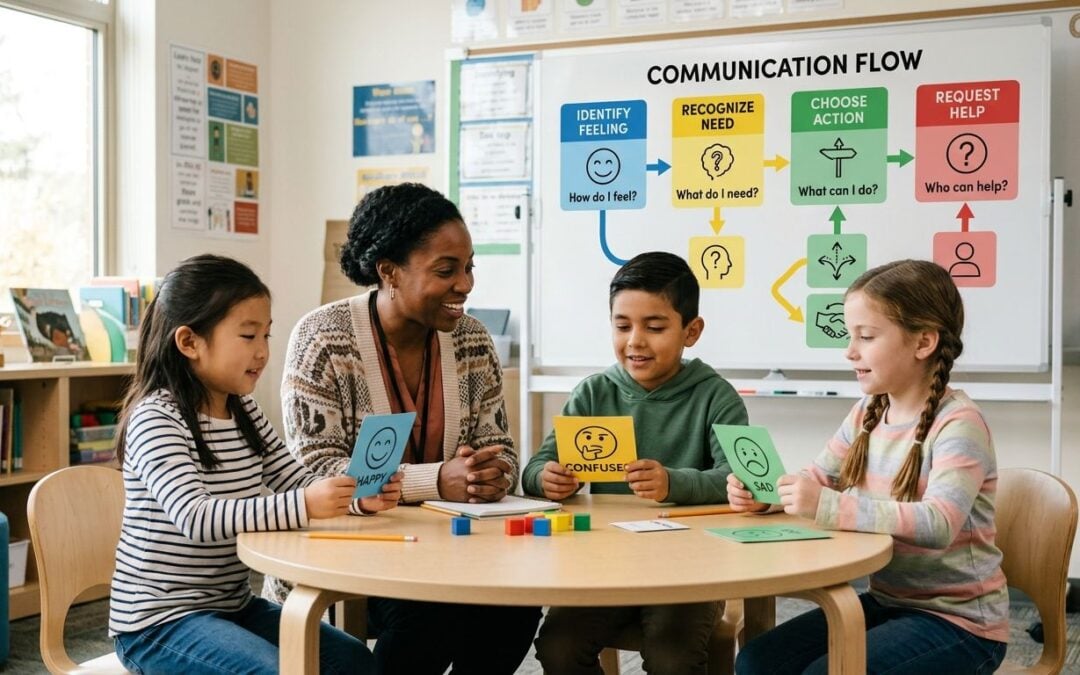
A feelings scale gives children a simple structure for naming emotion, even when they do not have the perfect word yet. That matters because some kids know they feel “off” long before they can tell you whether they are anxious, sad, overwhelmed, or tired. A number, color, or emoji gives them a place to start. It also fits the practical side of dinner conversation, where families and classrooms need a shared language that is quick enough to use at the table and clear enough to revisit later.
A parent might say, “I'm at about a 7 today, productive at work but tired.” A child might answer, “I'm a 5, some parts of school were fun, but I was frustrated with my friend.” Younger children can use colors, like “I'm green today,” while older children may be ready for a number plus a reason, such as “I'm a 3 because I'm anxious about that test tomorrow.”
Make the scale useful, not performative
Ask, “Where are you on the feelings scale?” and then pause. If adults rush straight into advice, children often stay at the surface. Better follow-ups are, “What pushed you to a 7?” or “What would help move you to an 8?” Those questions connect emotion to coping, which is where self-regulation grows. A child who says, “I'm at a 4 because math was confusing,” can then name one small next step, like asking for help before homework starts.
Use one language consistently: numbers, colors, thermometer, or emoji faces.
Normalize the full range: a lower score is information, not failure.
Teach one strategy at a time: breathing, a quiet break, a drink of water, or a reset before homework.
Notice patterns gently: “Mondays are often lower. Did the schedule feel rushed today, or was something else weighing on you?” That kind of question helps children connect a feeling to a real cause without feeling examined.
The strongest version of this prompt stays calm and ordinary. It works because it gives children a shared language they can use again tomorrow.
6. The Strength Spotlight
Strength prompts work because children need more than correction. They need to hear what is going well, in themselves and in other people. That builds confidence without pretending everything is easy. It also teaches children to see value in classmates, siblings, and adults beyond test scores or behavior charts.
Be specific. “You were kind when you waited for your turn,” lands better than “You're nice.” A parent can model with, “I noticed I was really patient today with you.” A child might say a classmate was great at including people, or that a friend was brave speaking up in class even while nervous. Younger children can identify physical or playful strengths too, like being strong on the playground.
Keep the spotlight broad
Include non-academic strengths like kindness, creativity, persistence, and humor. Children need to learn that strength is bigger than correctness. Ask, “What strength did you see in yourself today?” and “Who do you admire and why?” Those questions help kids practice positive observation without turning the table into a competition.
Write the strengths down if your family tends to forget them under stress. A note on the fridge or a card in a classroom basket can become a helpful reminder later. The next time a child feels discouraged, you can point back to an actual example instead of giving generic reassurance.
This prompt works best when it names behavior, not identity. “You kept trying even when that was tricky” is more useful than a label. Children can repeat a behavior. Labels are harder to live up to.
7. The Mindfulness Moment
Dinner can be one of the few times children stop moving enough to notice themselves. A mindfulness prompt uses that pause well. It asks them to notice what they saw, heard, touched, tasted, or smelled, or to remember a moment when they felt calm and present. That kind of reflection makes mindfulness less abstract and more usable.
A parent might say, “During my commute, I noticed the trees were really green and it calmed me down.” A child might say, “At lunch, I really tasted my food and it felt nice to slow down.” Younger children often respond well to texture, like “I felt the soft blanket when I was reading.” Older children might describe noticing their breathing while waiting for test results.
Use the senses to slow the room down
Start with a simple question. “What did you see, hear, feel, taste, or smell today?” That keeps the prompt accessible for mixed ages. If the table is restless, teach a grounding practice like 5-4-3-2-1, where people name five things they see, four they can touch, three they hear, two they smell, and one they taste. You don't need to make it a formal lesson. One round is enough.
A slower voice helps more than a fancy explanation. Invite one mindful breath before dinner or one thoughtful bite before conversation starts. That small pause often helps children settle enough to answer openly.
The goal is not to make dinner serene every night. The goal is to give children a repeatable way to come back to themselves when the day has been loud.
8. The Boundary Builder
Boundaries deserve a place at the dinner table because children need practice naming limits before they are under social pressure. A boundary prompt helps them notice when they said no, wished they could say no, or needed help protecting their space. That builds autonomy and respect at the same time.
A parent might say, “I said no to extra work today to protect my evening.” A child might share, “I told my friend I wasn't ready to share my feelings yet.” Younger children can practice with body boundaries, such as “I didn't want to hug someone, so I waved instead.” Older children may talk about needing adult help when someone touched them in a way that felt wrong at recess.
Make the language plain
Ask, “Did anyone disrespect your boundaries today?” or “Did you need to set a boundary?” Those words may sound serious, and they are. Keep your tone steady so the child doesn't feel they're being interrogated. Say, “Your body belongs to you,” and teach phrases they can use, such as “Stop, I don't like that” or “I need space.”
Discuss how to decline hugs, touches, borrowed items, or group activities respectfully, but don't make politeness more important than safety. If a child describes a boundary violation, respond supportively and take it seriously. The dinner table is not the place to minimize it or turn it into a joke.
This prompt works best when adults model the behavior in their own lives. Children notice when parents protect their time, their bodies, and their energy. That observation matters more than any speech.
9. The Kindness Tracker
Kindness prompts give children a way to see how small actions change a day. The important lesson is not that they need applause. The important lesson is that generosity has a ripple effect, even when the act is tiny. A child who notices that can start to view themselves as part of a caring community.
A parent might say, “I held the door for someone with their hands full.” A child might say, “I helped my classmate find their lost pencil and they smiled so big.” Younger children can report sharing crayons, while older children might say they sat with someone new at lunch because that person looked lonely. Those are all useful examples because they stay close to daily life.
Make kindness visible without turning it into a prize
Ask, “Who did you help today?” and “When did you see someone help another person?” Then go one step further and ask, “How do you think that made them feel?” That keeps the focus on impact, not reward. If your family likes physical reminders, keep a kindness jar or wall where people can add notes about small good deeds.
Kindness grows faster when adults name it in real time. “I helped because I saw they needed an extra hand” teaches the motive as clearly as the act.
Avoid using kindness as a scoreboard. If children start competing for points, the sincerity disappears. The better goal is a household or classroom culture where helping is expected, noticed, and appreciated.
10. The Growth Game
A dinner table can do more than review the day. It can help children see mistakes as information they can use next time. That shift matters because many kids read a wrong answer, a messy moment, or an awkward choice as proof that they are “not good at” something. A calm conversation can interrupt that habit and show that learning often starts with confusion, frustration, or a bad first try.
A parent might say, “I sent an email before I checked it carefully, so I had to fix a typo later.” A child might say, “I missed the math step at first, then I found the pattern after I tried again.” A younger child might talk about stacking blocks that kept falling and adjusting the base. An older child might describe feedback on an essay, then explain how revision made the work clearer.
Keep the language focused on learning
Ask, “What did you try?” and “What did that mistake teach you?” Those questions point the child toward the process instead of the embarrassment. Follow with, “What will you do differently next time?” or “What clue did you notice after the mistake?” If a child starts with harsh self-talk, answer with “You have not learned it yet” or “You found a useful clue” instead of repeating the criticism back.
A simple language swap can change the tone of the whole conversation.
Common self-talk
Growth-focused swap
I can't do this.
I can't do this yet.
I messed everything up.
I made one mistake I can fix.
I'm bad at this.
I'm still learning this.
I failed.
I learned what to try next.
The value of this prompt is that adults use it too. When a parent names a mistake and explains what they changed, a child sees that competence and imperfection can sit in the same room. A family poster with examples of “mistake, lesson, next try” can keep that lesson visible in a way children can revisit.
Soul Shoppe's SEL approach supports that idea by treating setbacks as useful information for growth, reflection, and resilience. Soul Shoppe problem solving activity
The Kindness Tracker: Spreading Positivity Intentionally
Low, regular sharing with optional tracking
Kindness jar, notes, or chart (optional)
Increased prosocial behavior and intrinsic motivation
Building community values, reinforcing acts of service
Cultivates intentional generosity and ripple effects
The Growth Game: Learning from Mistakes and Setbacks
Medium, needs consistent growth-language practice
Prompts, examples, poster or journal optional
Reduced fear of failure, improved problem-solving, persistence
After mistakes, learning reviews, performance feedback
Reframes errors as learning and promotes perseverance
Keeping the Conversation Going
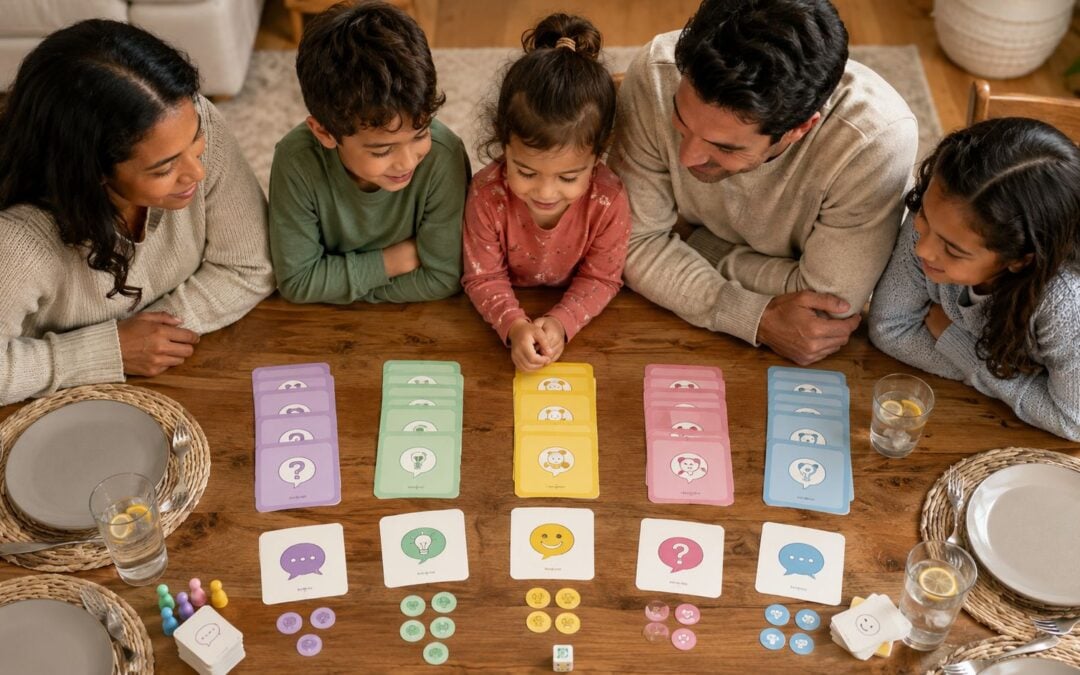
The best dinner time conversation starters are the ones you can repeat. A family ritual works better than a perfect one-time question, because children learn through familiarity. If the same prompt shows up every night, it becomes easier to answer openly, and easier to trust the table as a safe place. That repeatability also matters in classrooms, where students often need structure before they'll take social risks.
Printed prompt cards make the routine easier to maintain. So does a small jar with folded questions, or a mini-game where each person draws one starter before the meal begins. A rotating format keeps the table from feeling stale without adding much work for the adult. In homes with mixed ages, you can keep one set of simple prompts and one set of deeper ones, then let children choose. In classrooms, a basket of cards works well during advisory, lunch bunch, or calm-down time.
What works best is not intensity, it's consistency. A child who gives one-word answers this week may start adding details later, especially if adults keep answering first and keep the tone gentle. Celebrate that small shift. A longer answer, a more honest feeling, or a kinder observation is progress.
Adapt the prompts to the season of your family or class. Some weeks, gratitude will feel easier. Other weeks, boundaries, kindness, or growth language may be more useful. Revisit favorites often, but don't be afraid to retire prompts that have gone flat. The goal is shared language, not novelty for its own sake.
Over time, these little SEL moments become more than conversation practice. They become a pattern of noticing, naming, listening, and responding. That's the kind of dinner ritual that can shape how children relate to themselves and each other long after the plates are cleared.
From Big Feelings to Big Insights: Why Self-Awareness Matters
Ever wonder what's really going on inside a child's head when they can't find the words for their big feelings? A student who suddenly withdraws, a child who lashes out in frustration, these are often signs of a gap in self-awareness. Self-awareness is the foundation of emotional intelligence. It's the ability to recognize our own emotions, thoughts, and values, and notice how they shape behavior.
That sounds simple, but it rarely happens automatically. Research highlighted by Tasha Eurich found that while 95% of people believe they're self-aware, only about 10% to 15% are, which is why children need structured practice instead of being told to “just reflect” (self-awareness statistics summary). In schools and homes, that gap shows up when a child says “I'm fine” with clenched fists, watery eyes, and a shut-down voice.
The good news is that self awareness exercises can be taught in concrete, kid-friendly ways. When adults give students repeated chances to notice body signals, name emotions, reflect on choices, and hear feedback safely, children start building language for what's happening inside them. That helps with behavior, yes, but it also helps with relationships, learning, and confidence.
Below are eight practical, evidence-informed self awareness exercises for K-8 settings. Each one includes age adaptations, classroom and home variations, examples, and simple ways to notice whether it's helping.
1. Body Scan Meditation
A body scan is one of the fastest ways to help children notice that emotions live in the body, not just in their thoughts. An upset child may not be able to say, “I'm overwhelmed,” but they can learn to notice a tight jaw, shaky hands, a heavy stomach, or buzzing legs.
That kind of noticing matters because self-perception is often inaccurate. A mixed-methods study in the NIH database reported that the connection between how self-aware people think they are and their actual observed behavior is less than 30% in some findings, which is one reason structured practices like mindfulness are so useful (NIH article on measuring the effects of self-awareness).
How to use it with kids
Ask students to sit, stand, or lie down comfortably. Then guide their attention slowly through the body. “Notice your forehead. Notice your jaw. Notice your shoulders. Are they tight, loose, warm, heavy, still, or wiggly?”
For younger children, keep it short. Three minutes is enough. For older elementary and middle school students, you can stretch it to five or even ten minutes once they know the routine.
Practical rule: Start shorter than you think you need. A calm 3-minute routine done consistently works better than an occasional 12-minute one that feels too long.
A 3rd-grade teacher might use a five-minute body scan every Monday morning before academics begin. A parent might guide a worried 5th grader through one before bed by saying, “Let's check what your shoulders, chest, and stomach are telling you.”
Age adaptations and ways to measure impact
K-2 version: Use concrete language. “Do your hands feel like spaghetti or rocks?”
Grades 3-5 version: Add an emotion link. “What feeling might match that tightness?”
Grades 6-8 version: Ask for pattern noticing. “When do you usually feel this in your body?”
Afterward, students can draw where they felt tension or write one sentence such as “My body felt jumpy before math.” If you're teaching mindfulness regularly, the Soul Shoppe guide to teaching mindfulness to children offers child-centered language that fits nicely with this practice.
A simple way to measure impact is to keep a quick teacher or parent log. Note what students were like before the scan and after it. Over time, you may see smoother transitions, better focus, or earlier recognition of stress signals.
2. Emotion Wheel and Feelings Vocabulary Mapping
When children only know four feeling words, every hard feeling becomes “mad” or “sad.” An emotion wheel gives them a wider emotional map. That extra language can change behavior because a child who can say “I'm disappointed” is often easier to support than a child who only knows how to slam a pencil down.
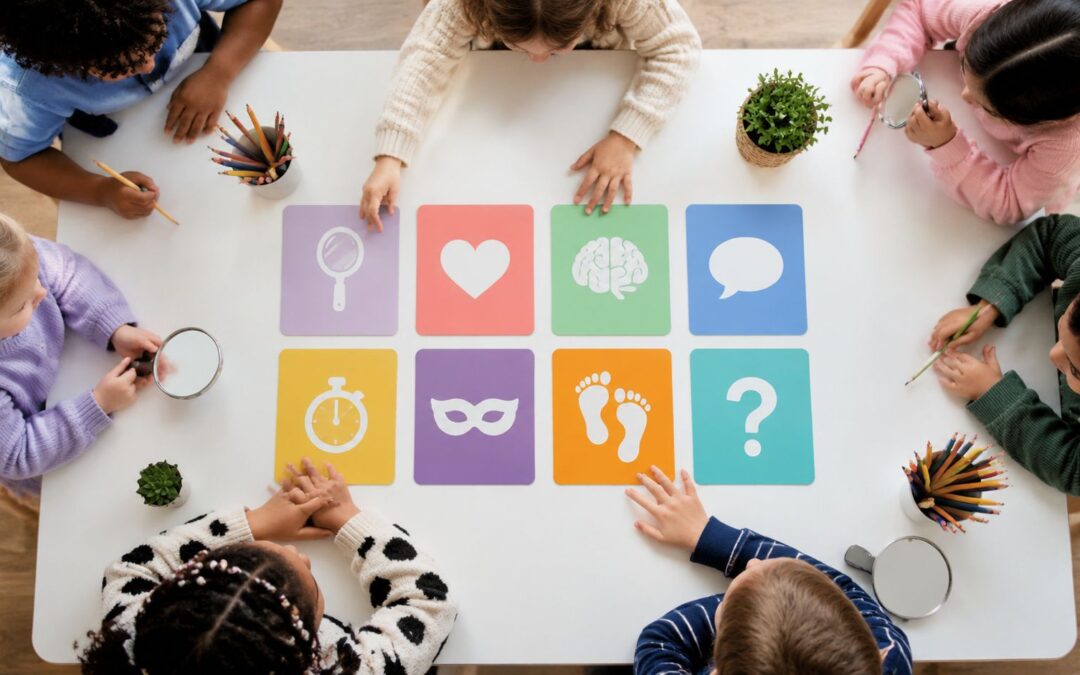
In practice, this exercise can be very simple. Put an emotion wheel near the door. Invite students to place a clothespin, magnet, or sticky note near the feeling that matches their current state when they arrive.
Practical examples for school and home
A 4th-grade teacher might notice that several students choose “nervous” on presentation day and decide to begin with partner rehearsals. A parent of a 2nd grader might make a home version with drawings and examples like “frustrated when my tower falls” or “proud when I help set the table.”
During a peer conflict, a counselor can ask, “Were you irritated, embarrassed, left out, or furious?” That question slows the moment down and helps the child respond in proportion to what occurred.
K-2: Start with happy, sad, angry, scared. Add facial expressions and colors.
Grades 3-5: Add words like disappointed, worried, proud, lonely, calm.
Grades 6-8: Add intensity and nuance, such as irritated versus enraged, uneasy versus anxious.
Try pairing the wheel with body clues. “Frustrated feels hot in my face.” “Nervous feels fluttery in my stomach.” That's where self-awareness gets deeper.
To measure impact, listen for language growth. Are students moving from broad labels to precise ones? Are they needing less adult prompting to identify what's going on? Those are meaningful signs that the exercise is working.
3. Journaling and Reflective Writing
Journaling gives children a private place to notice patterns. A student may not speak openly in a circle, but they might write, “I always get mad when people laugh and I think it's about me.” That sentence alone is valuable. It gives the child and the adult something specific to work with.
This exercise also helps distinguish useful reflection from rumination. Structured reflection paired with outside perspective tends to support better outcomes, while unstructured rumination can lead to fewer benefits, as summarized in the same self-awareness statistics overview cited earlier.
Prompts that actually work
The best prompts are open but concrete. “When did you feel proud today?” works better than “How was your day?” “What happened right before you got upset?” works better than “Why were you bad?”
A 5th-grade teacher might do Monday growth journals where students reflect on a challenge from last week. A parent and child could keep paired feelings journals and share one line each at dinner. A counselor might use conflict reflection sheets after a disagreement to help a student replay the event with less blame and more awareness.
For emerging writers: Let them draw first, then label feelings.
For elementary students: Use sentence stems such as “I felt ___ when ___.”
For middle schoolers: Add prompts about patterns, values, and choices.
Don't require students to share everything they write. Journals work best when children know the goal is awareness, not performance. If you review them, be clear about boundaries and safety expectations.
A simple way to make journaling more actionable is to end with one small next step: “Next time I feel left out, I can ask to join instead of walking away.” Schools that are thinking about documentation and systems in helping professions sometimes look to tools outside education too, such as the PracticeReady compliance platform, for ideas about structured reflection and record keeping.
Track impact by looking for stronger self-description over time. Are students identifying triggers more clearly? Are they connecting feelings, behavior, and consequences with more accuracy?
4. Strength and Values Identification Activities
Some children know their mistakes better than their strengths. They can tell you exactly where they struggle, but they freeze when asked what kind of person they are or what they contribute. Strength and values work corrects that imbalance.
Self-awareness extends beyond merely noticing difficult emotions. It also encompasses recognizing what is important to you, what your strengths are, and how you aim to present yourself to others.
What it can look like in real life
In a 2nd-grade classroom, each child might make a “Strength Star” with one strength in the middle. Then classmates add kind, specific observations around the edges: “You include people,” “You keep trying,” “You explain math clearly.”
At home, a parent could ask a 4th grader, “Tell me about a time you helped someone. What strength did you use?” Then they could build a simple strength collage with drawings or magazine images. In middle school, advisory groups can sort value cards such as honesty, friendship, courage, creativity, fairness, and kindness, then talk about which ones guide their choices most often.
A child who knows “I am persistent” has something solid to stand on during a hard week.
Age adaptations and impact checks
K-2: Use picture cards and observable strengths like helpful, brave, kind, curious.
Grades 3-5: Add evidence. “What did you do that shows that strength?”
Grades 6-8: Connect strengths and values to decisions, friendships, and leadership.
Keep this grounded in what adults and peers observe. Instead of asking only, “What are your strengths?” say, “I noticed you kept trying three strategies during writing. That shows persistence.” That's far easier for many students to believe.
To measure impact, notice whether students can name a strength during frustration. A child who says, “I'm stuck, but I'm also creative,” is using self-awareness in a practical way. You can also compare early-year and later-year reflections to see if students move from generic traits to clearer, evidence-based self-knowledge.
5. Mindful Movement and Body Awareness Activities
Some children don't access calm by sitting still. They access it by moving with intention. That's where mindful movement helps. It combines physical activity with noticing breath, balance, muscle tension, and internal state.
This approach is especially useful for students who get dysregulated during transitions, after recess, or before tests. Movement gives them something concrete to do while also turning attention inward.
Start with simple routines
A kindergarten teacher might begin the day with animal walks and stretches. “Stomp like a bear. Stretch like a cat. Freeze and notice your breathing.” A 4th-grade teacher could lead a three-minute stretch-and-breathe routine between subjects.
For older students, yoga, tai chi-inspired flow, or slow standing sequences can work well. The focus isn't perfect form. It's noticing. “How do your legs feel in mountain pose?” “What changes when you exhale slowly?”
This short classroom-friendly video can support that kind of routine:
Keep the focus on inner cues
Younger children: Use imagination. “Grow like a tree.” “Melt like ice.”
Older children: Add reflection. “Which movement helped you feel more settled?”
Home variation: Create a short “calm body routine” before homework or bedtime.
Offer options. Some students prefer seated stretches. Others do better standing by their desks. Students should never feel forced into a position that hurts or embarrasses them.
You can measure impact with a quick before-and-after check-in. Ask students to rate their energy as low, medium, or high, or choose words like buzzy, steady, sleepy, tense, calm. Over time, you'll often see students become more accurate at matching movement to what their bodies need.
6. Goal-Setting and Progress Monitoring
Self-awareness grows when children compare intention with action. Goal-setting helps them do exactly that. Instead of drifting through the week, they begin to ask, “What am I trying to improve? What's getting in the way? What helped me succeed today?”
This works best when goals are small, meaningful, and visible. “Be better” is too vague. “Use my calm-down strategy before I yell” gives a child something they can monitor.
Turn goals into self-knowledge
A 3rd grader might set a goal to use a breathing strategy when frustrated. The teacher can help the student mark each day with a simple smiley, checkmark, or quick reflection. A parent and 2nd grader might set a home goal such as helping with dinner on specific nights and then talk about what made it easier or harder.
For older students, quarterly conferences can include one academic goal, one social-emotional goal, and one personal goal. That combination helps students see themselves as whole people, not just test takers.
Global interest in self-awareness supports this kind of structured practice. The self-awareness segment within the personal development industry is projected to grow at a 13.8% CAGR through 2033, according to Market Data Forecast's personal development market report. In schools, the key takeaway isn't the market itself. It's that structured, actionable tools are getting more attention than vague motivational advice.
Make tracking simple
Choose 1 to 3 goals: Too many goals usually leads to shallow follow-through.
Use visible tracking: Charts, checklists, and graphs help children see growth.
Review without shame: If a goal wasn't met, ask what the child learned.
A practical measure of impact is goal accuracy. Are students getting better at setting realistic goals? Are they naming obstacles before they happen? That's a strong sign their self-awareness is becoming more honest and more useful.
7. Peer Feedback and Reflection Circles
Children don't build self-awareness alone. They also learn it by hearing how others experience them. Reflection circles create a safe structure for that. They help students notice the gap between intention and impact.
This is especially important because many people overestimate their own self-awareness. Hearing from peers, in a respectful format, gives children access to an outside mirror they can't create by themselves.
What circles can sound like
A 3rd-grade class might hold weekly compliment circles where each child hears one specific appreciation. “You helped me when I dropped my markers.” “You invited me to play when I was alone.” Those moments teach children what others notice and value in them.
In a 4th-grade conflict circle, students might say, “When you grabbed the ball, I felt ignored,” or “I thought you were mad at me, so I got defensive.” A 6th-grade advisory might use monthly check-in circles where students name one challenge and one support they need from the group.
Because high-stress moments are often where students struggle most, this matters beyond connection alone. A 2025 study in the Journal of School Psychology found that 74% of students who experienced bullying said their self-awareness training was too theoretical to help them de-escalate in real time. Reflection circles can help close that gap when they include practice with in-the-moment language and repair.
Circle norms that make it safe
Use clear rules: One person speaks at a time. Students can pass.
Teach sentence frames: “When ___ happened, I felt ___.”
Begin with appreciation: It sets a grounded tone before harder topics.
If your school uses restorative practices, this format pairs naturally with community-building work. Soul Shoppe's community-centered SEL approach is one example many educators explore when they want shared language around empathy, communication, and repair.
A good measure of impact is the quality of student feedback. Are comments becoming more specific, respectful, and behavior-focused? Are students showing more ability to listen without interrupting or defending? Those are strong indicators that self-awareness is expanding socially, not just privately.
8. Sensory and Emotion Regulation Awareness
A child often shows dysregulation before they can explain it. Their face gets hot. Their hands clench. Their voice changes. Sensory and regulation awareness helps them spot those early signals and choose support before the situation escalates.
This is one of the most practical self awareness exercises for K-8 because it connects directly to conflict prevention and daily functioning. The same self-awareness statistics summary referenced earlier also notes gains linked to SEL implementation, including an 11 percentile point gain in academic achievement and a 10% improvement in literacy rates for children with higher baseline scores when these skills are taught in meaningful ways.
Build a regulation toolkit with the child
A 2nd-grade classroom might have calm-down bins with textured items, fidgets, and simple breathing cards. A 4th grader could make an “early warning signs” poster that says, “My jaw gets tight. My breathing gets fast. My face feels hot.” At home, a parent and child might assemble a kit with a soft blanket, headphones, a breathing cue card, and a chosen calming scent.
The most important piece is choice. What helps one student organize their nervous system may irritate another. One child needs movement. Another needs quiet. Another needs an adult to sit nearby without talking much.
Notice the signs early, practice the tool while calm, then use it under stress.
Make this usable in the moment
Current resources often miss real-time application, which schools urgently need. The 2024 CDC Youth Risk Behavior Survey reported a 15% rise in school-based aggression, and schools also reported a 50% lack of practical tools for in-the-moment self-regulation. That tells us students need more than retrospective reflection. They need routines they can use while upset.
Try short scripts such as “Pause. Feet on floor. Name one body signal. Pick one tool.” Measure impact by watching whether students begin accessing supports earlier. If a child starts asking for headphones before a meltdown rather than after, that's meaningful progress.
Personalized regulation toolkit; practical and autonomy-building
Putting Awareness into Action Your Next Steps
Building self-awareness is a journey, not a destination. These eight exercises offer a strong starting point, but genuine change comes from repetition in ordinary moments. A child doesn't become self-aware because of one excellent lesson. They become self-aware because the adults around them keep giving them language, structure, and safe practice.
If you're a teacher, pick one routine that fits naturally into your day. A body scan at morning meeting, an emotion wheel at the door, or a two-minute reflection prompt before dismissal is enough to begin. If you're a parent, choose one moment you already have, such as bedtime, after school, or dinner, and attach a simple reflection practice to it.
One reason consistency matters is that broad reflection alone often isn't enough. Earlier in the article, we noted the large gap between how self-aware people think they are and how accurately they understand themselves. Children are no different. They need guided, repeated opportunities to notice feelings, body signals, strengths, values, and the impact of their choices.
For schools, this is also about implementation. Generic adult-style checklists don't always work for K-8 learners. Developmentally sequenced practice matters. In fact, a 2024 report described in the verified research notes found that 68% of current SEL resources were either too abstract for young learners or too simplistic for adolescents, and engagement dropped by 45% when programs weren't age-graded. That's why these exercises work best when they're adapted for the child's developmental stage, not copied and pasted across every grade.
Keep your measurement simple. Watch for better feeling words, earlier use of regulation tools, more realistic goals, and stronger reflection after conflicts. Those signs often show up before dramatic behavior change does.
If you're leading a schoolwide effort, it may help to choose a shared framework so teachers, counselors, and families use common language. Soul Shoppe is one option many schools explore for experiential SEL programming focused on self-regulation, mindfulness, communication, and conflict resolution. The important part isn't finding a perfect activity. It's choosing a doable one and using it consistently enough that children start to recognize themselves more clearly.
Start small. Stay steady. That's how big insights grow from big feelings.
If you're ready to strengthen self-awareness, empathy, and regulation across your school community, explore Soul Shoppe. Their programs, workshops, and family resources can help educators and caregivers build shared SEL language that students can use in daily life.
A child snaps, “You always ruin everything.” Another child fires back, “You never listen.” A teacher steps in, but the room is already tight with hurt feelings, crossed arms, and quick assumptions. Most adults who work with kids know this moment well. It happens over shared supplies, partner work, recess games, seating choices, and group chats that spill into the school day.
An i message gives children a more useful way to speak from their own experience instead of attacking someone else. That shift matters in classrooms, counseling offices, after-school programs, and homes. It helps kids name feelings, ask for what they need, and stay connected even when they're upset.
This is especially relevant because children communicate both in person and online. iMessage itself is one of the largest proprietary messaging platforms in the world, with an estimated 1.3 billion users globally in 2022, according to SignHouse's iMessage statistics summary. That doesn't mean every conflict happens on Apple devices, but it does highlight how normal device-based communication has become for families and students. If you're also working on stronger trust and belonging in your classroom, this building relationships with students playbook pairs well with the language tools below.
1. I Feel and I Felt Statements for Emotional Expression
Most adults start with “I feel…” because it's the clearest entry point. When a child can say what they felt, the conversation slows down. The focus moves from blame to experience.
A simple frame works well: “I feel ___ when ___.”
That sentence is short enough for younger students and flexible enough for older ones.
Classroom examples that sound natural
Instead of “You made me mad,” try:
Shared supplies: “I felt frustrated when you took my pencil without asking.”
Exclusion at recess: “I felt hurt when you didn't include me in the game.”
Group work: “I felt lonely during group work when no one responded to my ideas.”
These are strong i message examples because they name an emotion and connect it to a specific event. They don't attack the other child's character.
Practical rule: If the sentence starts to sound like blame in disguise, pause and replace judgment words with feeling words.
Children often default to three emotions: mad, sad, and happy. That's a start, but it's not enough for many real conflicts. A child who says “mad” might feel embarrassed, left out, worried, ignored, disappointed, or overwhelmed.
How adults can coach this skill
Use visual supports, sentence stems, and regular modeling. During calm moments, practice with low-stakes situations like losing a turn, waiting in line, or hearing “not yet.” A feelings chart or wheel can help children choose more accurate words, and naming feelings with kids can give adults more language to scaffold that process.
A few coaching moves help:
Validate first: “I hear that you felt hurt.”
Get specific: “What happened right before that feeling?”
Refine gently: “Was it angry, or more disappointed?”
When children can say what they feel, they're less likely to show it through yelling, shutting down, or blaming.
2. I Need Statements for Boundary Setting and Self-Advocacy
Some children can identify a feeling but still don't know what to do next. That's where “I need…” becomes powerful. It turns emotion into direction.
An effective frame is: “I need ___ so I can ___.”
This helps children speak clearly without demanding control over everyone else.
Useful scripts for school and home
A child who's overloaded by noise might say, “I need a quieter workspace so I can concentrate on my math.”
A student who's confused can say, “I need help understanding this before we move forward.”
A child nearing dysregulation might say, “I need a break right now so I can reset my feelings.”
Those are practical i message examples because they're concrete. Adults and peers can respond to them.
Some children need support learning the difference between a need and a want. “I need everyone to stop talking forever” isn't a workable need. “I need less noise” is.
What healthy boundaries sound like
Boundary language should be firm and respectful. It doesn't need an apology attached to it. Many children, especially children who try hard to please adults, benefit from hearing that it's okay to ask for space, help, time, or clarification.
Try coaching with prompts like:
For sensory needs: “I need less noise.”
For learning support: “I need another example.”
For emotional regulation: “I need a minute.”
For personal space: “I need you to stop touching my backpack.”
Kids don't need perfect wording. They need repeated chances to say what they need before their body says it for them.
Adults can reinforce this through routines such as break cards, quiet corners, or help signals. For more ways to teach this explicitly, boundary activities for children can support both classroom and home practice.
3. I Notice and I Observe Statements for Perspective-Taking and Feedback
"I notice…" is especially helpful when a child wants to talk about behavior without making assumptions about motive. This style lowers defensiveness because it sticks closer to what happened.
That matters in conflict. “You were rude” invites an argument. “I noticed you turned away when I came over” invites clarification.
Observation before interpretation
Teach students to describe what they saw or heard, not the story they instantly told themselves.
For example:
Lunch table: “I noticed you turned away when I tried to sit with you at lunch.”
Whole-class reminder: “I noticed the volume increased and people weren't raising hands.”
Peer concern: “I observed that several students didn't respond when you joined the group.”
These examples create room for a reply like, “I didn't hear you,” or “We thought you were still talking to someone else.” Not every hurtful moment is a misunderstanding, but many are.
A useful prompt is, “What did you notice with your eyes or ears?” That helps children separate fact from interpretation.
Here's a short teaching video you can use to reinforce calm communication language:
A strong pattern for adults
Adults can pair observation with curiosity:
Teacher to student: “I noticed your paper stayed blank for several minutes. I'm wondering if you felt stuck.”
Counselor to child: “I observed that you got quiet when teams were chosen. Do you want to tell me about that?”
Parent to sibling pair: “I noticed both of you started talking louder when the game ended.”
This format is also useful in digital communication. Text and app-based messages can be misread easily, and media sharing changes the communication load quickly. According to Roamless's overview of iMessage data use, text-only conversations are light on data, while photos, voice notes, and videos increase usage substantially. For adults working with families, that's a reminder to keep digital conflict-repair messages short, clear, and simple when possible.
4. I Appreciate and I Admire Statements for Building Connection and Gratitude
Conflict repair is only one part of SEL. Children also need language for warmth, recognition, and belonging. “I appreciate…” helps kids notice what is working between them.
Many adults give praise that's broad, like “Good job” or “Nice work.” Appreciation lands better when it names the exact action and its impact.
Appreciation that feels genuine
Try scripts like these:
Peer support: “I appreciate how you helped me understand the math problem because it made me feel supported.”
Whole group: “I admire how our class stayed patient when the technology didn't work.”
Inclusion: “I appreciate when you include everyone in games because it makes recess feel safe.”
These i message examples strengthen classroom culture because they point children toward specific prosocial behaviors they can repeat.
Appreciation is most useful when it answers two questions: What did the person do, and why did it matter?
Simple ways to build the habit
You don't need a big lesson every time. Short routines work well.
Morning meeting: “I appreciate…” partner shares
Closing circle: one class appreciation
Sticky notes: quick peer recognition
Adult modeling: “I appreciated how you waited while I helped another student”
Children often learn gratitude best by hearing it spoken regularly and specifically. If you want more ideas for routines and prompts, ways to show gratitude with kids offers practical extensions.
5. I Choose and I Decided Statements for Agency and Responsibility
When children are upset, they often talk as if they had no choice at all. “He made me do it.” “I had to.” “There was nothing else I could do.” “I choose…” interrupts that pattern and builds accountability without shame.
This language can be uncomfortable at first. It asks a child to own a response, not just report what happened to them. But that's exactly why it's useful.
Agency language in real moments
Here are examples that keep dignity intact:
Escalating conflict: “I chose to walk away because I didn't want to make it worse.”
Repair after harm: “I decided to apologize because I care about our friendship.”
Academic persistence: “I choose to try another strategy because I want to improve.”
Recess conflict: “I decided to ask for help instead of pushing back.”
Children don't need to pretend every situation was easy. They can still say, “I was really angry, and I chose to step away.” That sentence holds both truth and responsibility.
Reflection questions that help
Adults can strengthen this kind of i message with follow-up questions:
Choice awareness: “What choice did you make?”
Alternative paths: “What else could you have chosen?”
Values check: “Which choice matches the kind of friend you want to be?”
A useful caution belongs here. Sometimes an I-message isn't enough because the problem isn't ordinary conflict. It may involve power, repeated harm, intimidation, or safety concerns. The U.S. State Department educational guidance on I-messages aligns with a broader truth many educators know well: calm communication can reduce blame, but it doesn't replace adult follow-through when harmful behavior continues. In those moments, children need protection, boundaries, and clear escalation paths, not pressure to phrase things more politely.
6. I Understand and I Recognize Statements for Validation and Empathy
Empathy language is often what allows a hard conversation to continue. A child who feels seen is more likely to stay engaged. A child who feels dismissed usually shuts down or strikes back.
“I understand…” and “I recognize…” work best when they reflect the other person's experience without rushing to fix it.
Validation before problem-solving
Examples:
Peer to peer: “I recognize that you felt excluded when we chose teams, and that must have hurt.”
Teacher to student: “I understand this feels really hard right now, and I see you trying.”
Friend support: “I recognize that you're nervous about the presentation, and that's a big feeling.”
Notice what these do well. They don't argue about whether the feeling is reasonable. They acknowledge it.
Use “and” more often than “but.” “I know you're upset, but…” usually erases the validation that came first.
Adults can also model reflective listening:
“I hear that you felt embarrassed.”
“I understand that you thought people were laughing at you.”
“I recognize that waiting felt unfair.”
What empathy does and doesn't mean
Empathy isn't agreement. You can understand a child's fear, anger, or disappointment and still hold a boundary. That distinction helps adults stay warm and steady at the same time.
This is also where text-based communication gets tricky. Digital messages are now part of family and school life, yet many traditional i message examples focus only on face-to-face conflict. The Act for Youth guide on using I-messages reflects the common pattern of in-person examples and points toward an important gap for educators: younger children and digital communicators often need shorter, more scaffolded versions. For example, “I felt left out when I saw that message. I want us to talk in person” may work better than a long emotional paragraph. As children build accountability alongside empathy, adults can reinforce that with teaching responsibility in age-appropriate ways.
7. I Hope and I Believe Statements for Encouragement and Future Focus
Some moments call for repair. Others call for strength. “I hope…” and “I believe…” help children look forward when they feel stuck, ashamed, or discouraged.
These statements matter because many students carry a quick story about themselves: I'm bad at this. Nobody likes me. I always mess up. Encouraging i message examples can interrupt that spiral without sounding fake.
Encouragement that children can trust
A few strong models:
Academic struggle: “I believe in your ability to learn this. You've kept trying before.”
Friendship pain: “I hope things get better for you because you deserve kindness.”
Family stress: “I believe you have the strength to handle this, and I'm here to support you.”
Behavior repair: “I believe you can make this right.”
Children can tell when encouragement is empty. “You can do anything” often feels too broad. “I believe you can get through this because I've seen you ask for help and keep going” feels more grounded.
Pair belief with support
Hope language works best when it includes a next step.
Teacher: “I believe you can finish this first part. I'll stay with you for the first problem.”
Parent: “I hope tomorrow feels easier. Let's make a plan for the morning.”
Counselor: “I believe this friendship can heal if both of you are ready to listen.”
There's also a practical systems lesson for adults here. In high-volume support settings, clear language and strong response paths matter. In one case described by Crescendo.ai's business examples, Rachio used AI agents to handle more than 1 million support queries across chat, voice, and email, while keeping a human escalation layer for more complex issues. In schools and youth settings, the parallel is simple: encouraging language helps, but children also need reliable follow-through when a problem is ongoing or complex.
7 I-Message Types Comparison
Statement type
Implementation complexity
Resource requirements
Expected outcomes
Ideal use cases
Key advantages
I Feel / I Felt (Emotional Expression)
Low–Medium, simple format but needs modeling
Emotion charts, repeated practice time, teacher modeling
Improved emotional vocabulary, less blaming, safer classrooms
Teaching emotion naming, de-escalation, K–8 SEL lessons
Separates feelings from blame; builds self-awareness
I Need (Boundary Setting & Self-Advocacy)
Medium, teaches requests and negotiation
Classroom systems for requests, adult willingness to negotiate, practice
Greater self-advocacy, clearer boundaries, reduced anxiety asking for help
Requesting accommodations, asserting personal needs
Teaches assertiveness without aggression; promotes agency
I Notice / I Observe (Perspective-Taking & Feedback)
Medium, requires training in objective language
Practice prompts, mindfulness exercises, vocabulary scaffolds
More accurate communication, reduced assumptions, better feedback
Low–Medium, must be genuine and paired with action
Teacher modeling, specific praise, follow-through supports
Increased resilience, motivation, confidence
Encouragement during setbacks, growth-mindset coaching
Builds hope and optimism; supports persistence
Making I-Messages a Daily Habit
The best i message examples don't live on a poster alone. They become part of the daily language children hear, practice, and repair with over time. That means adults need to model them in ordinary moments, not only during conflict. “I felt concerned when the line got crowded.” “I need everyone to freeze so we can stay safe.” “I appreciate how you waited.” Repetition makes the language usable when emotions run high.
It also helps to teach these seven types as different tools, not one script. A child might need “I feel” in one moment and “I need” in the next. Another child may be ready for “I notice” or “I choose.” Giving students more than one frame respects their developmental stage, communication style, and the kind of situation they're in.
For younger children, keep it short. One or two sentences is enough. For older students, add reflection and repair: “I felt embarrassed when that happened. I need us not to joke about it again.” In digital situations, shorter is often better because tone is easier to misread and long messages can escalate quickly. If families are sending plain text, that communication is lightweight, while images and videos can add much more data use, as noted earlier. That practical detail matters for some households and is one more reason to teach children that not every conflict needs a flood of screenshots or voice notes.
Adults should also remember the limit of the tool. An I-message can support conflict resolution, but it can't solve repeated cruelty, coercion, or unsafe behavior by itself. In those moments, children need adults to step in, document concerns, set boundaries, and protect the student who was harmed. Communication skills and safety procedures should work together.
If your school wants shared language around empathy, self-regulation, and conflict resolution, Soul Shoppe is one relevant option. Its work centers on helping school communities build connection, safety, and practical SEL habits that children and adults can use every day. That kind of consistency is what turns a sentence frame into a culture.
If you want support bringing these tools into your school or home community, Soul Shoppe offers SEL programs and resources focused on communication, empathy, belonging, and conflict resolution for children and the adults who care for them.
A rough morning at school rarely announces itself in a big way. It often starts with a student going silent before a quiz, a child crying over a missing pencil, or a parent hearing “I’m fine” in a voice that clearly means something else. In those moments, adults usually do not need a perfect speech. They need a few steady words that help a child pause, breathe, name the feeling, and choose what to do next.
That is where mental health quotes can help. A short, clear sentence works like a handrail on a staircase. It does not carry a child up the steps, but it gives them something steady to hold onto while they regain balance. In a classroom or at home, the right quote can reduce shame, start a conversation, and give students language for feelings that still feel confusing or too big.
For educators and caregivers, the core question is not which quote sounds nicest. The better question is how to use a quote to build self-awareness, empathy, coping skills, and connection. That shift matters. A quote on a poster may be pleasant to read once. A quote used as an SEL tool can shape a morning meeting, support a calm-down routine, prompt reflection in a journal, or help a student repair after conflict.
This list is built with that purpose in mind. Each quote is treated as something practical for K-8 students, not just something inspiring for adults. You will see ways to turn wise words into classroom prompts, calm-corner language, discussion starters, and small routines that children can use. If your school is also working on building resilience and perseverance through growth mindset in the classroom, these quotes can support that work by giving students simple language for hard moments.
If you want to turn a favorite line into a poster or calm-corner card, this client-side quote maker tool can help you make it classroom-ready.
1. It is not the mountain we conquer, but ourselves. – Edmund Hillary
This quote works well with students who think success only counts if it looks big from the outside. Many children focus on the visible result. The grade. The goal. The performance. Hillary’s words shift attention inward, where a lot of real growth happens.
A student who uses belly breathing before a math test has done something important, even if they still feel nervous. A child who raises a hand to ask for help after sitting in confusion has made a real gain in self-awareness. Those are “conquer ourselves” moments.
How to use it with students
Put this quote into plain school language: “The hardest part is often managing what’s happening inside us.” Then ask students to name a recent inner challenge. Maybe it was frustration, fear, jealousy, or the urge to quit.
In a classroom meeting, try a prompt like, “What’s one thing you handled inside yourself this week?” You’ll often hear more meaningful answers than you would from asking about accomplishments alone.
Practical rule: Praise regulation, reflection, and repair, not just performance.
A teacher might say, “I noticed you wanted to shout when the game didn’t go your way, but you stopped and took a breath. That was a victory.” A parent might say, “You were upset about homework, but you came back after a break. That matters.”
A simple SEL routine
Use the quote during a Monday advisory, counseling session, or morning meeting with a three-part reflection:
Name the mountain: “What felt hard?”
Name the self-skill: “What did you do inside yourself?”
Name the next step: “What will you try again next time?”
This pairs nicely with classroom conversations about perseverance and self-regulation. Schools already building these habits can connect the quote to a broader growth mindset in the classroom approach.
2. You are not alone. – Multiple sources
Few messages matter more to a struggling child than this one. Isolation makes problems feel bigger. A student may believe they’re the only one who feels left out, panicky, homesick, angry, or embarrassed. This quote interrupts that story.
That’s especially important in student settings where mental health needs are significant. Between 2020 and 2021, over 60% of college students met the criteria for one or more mental health issues, according to these student mental health statistics. K-8 students are younger, but school adults can still take the same lesson seriously. Students need language that reduces shame and invites support.
Make the message visible and real
A quote like this only helps if adults back it up with action. A poster that says “You are not alone” means very little if students don’t know whom they can talk to, where to go, or what happens when they ask for help.
Try a “Support Map” activity. Students write or draw trusted people at school, at home, and in the community. Younger children can use circles and simple labels like teacher, auntie, coach, counselor, or neighbor.
You are not alone should always be followed by “and here’s who can help.”
In class, a teacher might say, “Lots of people feel overwhelmed sometimes. If that happens to you, you can tell me, the counselor, or another trusted grownup.” At home, a parent can say, “You don’t have to solve every hard feeling by yourself.”
A community-building example
Create a bulletin board titled “We all need support sometimes.” Instead of asking students to share private struggles publicly, invite them to post anonymous notes finishing one sentence: “It helps me when…” Responses often build empathy fast. Children start to see that many classmates need comfort, quiet, movement, reassurance, or a friend.
If families need outside support, it can also help to have a trusted local care option available, such as this expert guide to Vernon help.
3. Comparison is the thief of joy. – Theodore Roosevelt
Children compare constantly. Who finished first. Who got invited. Who reads at a higher level. Who has more likes, better shoes, a newer lunchbox, a stronger team, a closer friend group. Comparison can shift normal school life into a running self-critique.
This quote gives adults a clean way to name the problem without shaming the child. It doesn’t say ambition is bad. It says that constant measuring against other people can steal satisfaction from our own growth.
What to say when comparison shows up
Suppose a student says, “Maya’s project is way better than mine.” Instead of offering empty reassurance, try: “Let’s compare your work to your last draft, not to someone else’s final product.” That redirects attention to progress and effort.
At home, if a child says, “Everyone else is better at soccer than me,” a parent can answer, “Who are you compared to last month?” That question teaches self-reference, which is a healthier habit than social ranking.
A useful classroom activity is “My one good thing.” Each student names one strength, interest, or improvement that belongs to them. Not the best in class. Just theirs.
Help students build self-esteem instead
Comparison shrinks when students have practice noticing their own strengths. That can happen through partner compliments, identity webs, portfolio reflections, or goal-setting tied to previous personal work.
Later in the week, you can revisit the message with a media literacy conversation. Ask, “How do you feel after you scroll or watch people show only their best moments?” Even younger students understand that what we see isn’t always the whole story.
A short video can help launch that discussion:
4. It's okay to not be okay. – Various mental health advocates
Students often get the message that being “good” means being pleasant, calm, and easy to manage. This quote pushes back on that. It tells children that hard feelings don’t make them bad. They make them human.
That kind of normalization matters because many people still hesitate to seek support due to stigma, even though mental health challenges are common, as noted in the BetterHelp background cited earlier. In schools, this quote can reduce the pressure students feel to hide distress until it bursts out as shutdown, avoidance, or behavior.
Validation first, problem-solving second
If a student is unusually quiet, an adult might say, “You seem off today. It’s okay to not be okay. I’m here if you want to talk or sit in silence.” That response creates safety without demanding disclosure.
With younger children, pair the quote with a feelings chart. A child who can point to worried, disappointed, frustrated, lonely, or tired has a much better chance of getting support before a problem escalates.
Saying “it’s okay to not be okay” doesn’t mean leaving a child alone in distress. It means starting with acceptance so guidance can work.
Turn the quote into a routine
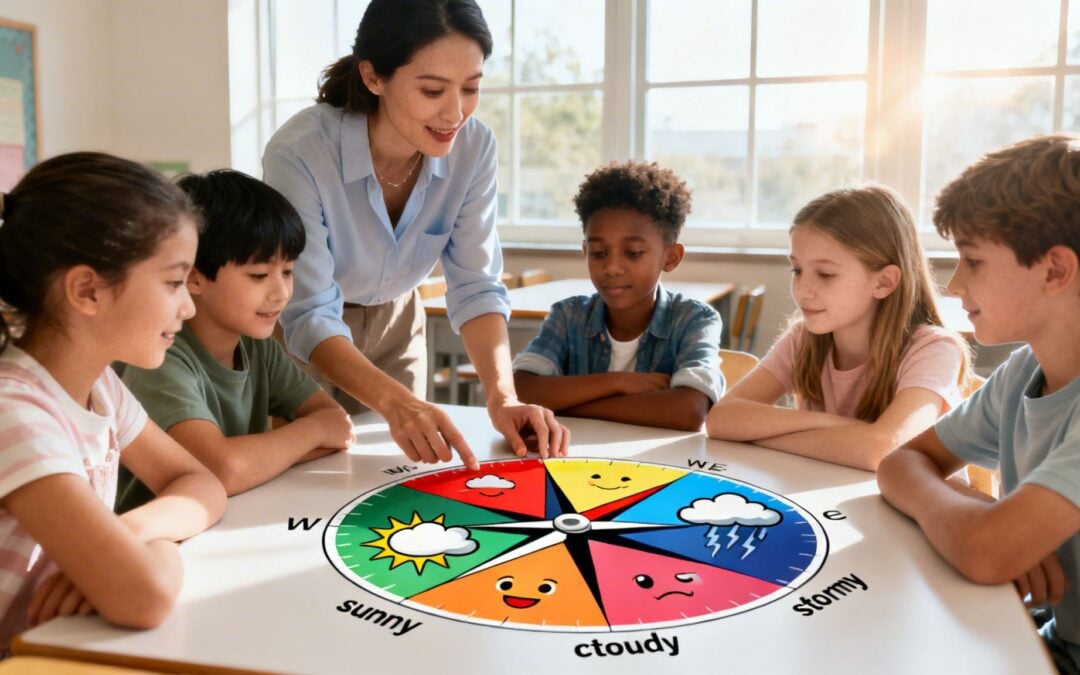
Use a daily check-in where students choose a color, emoji, or weather word for their mood. Then teach follow-up choices. Red might mean “I need space.” Cloudy might mean “I need help getting started.” This moves the quote from comfort to skill-building.
At home, during a tantrum or shutdown, a parent can say, “It’s okay to feel upset. We still need a safe way to handle it.” That’s a strong SEL message because it validates emotion while guiding behavior.
If your school is helping students name feelings and respond to them more skillfully, this emotion-focused coping examples resource offers useful language for that work.
5. Progress, not perfection. – Recovery and wellness communities
Perfectionism shows up early. Some students erase holes through their paper. Some won’t turn in work unless it feels flawless. Some fall apart over small mistakes because they equate error with failure.
This quote softens that rigid thinking. It reminds children that healthy growth usually looks uneven. Better choices happen in steps. Learning happens in drafts. Emotional regulation improves over time, not all at once.
What this looks like in school and at home
A student who used to shout during conflict now walks away, but still slams the door. That’s not perfect. It is progress. If adults only respond to what’s still wrong, students may stop trying. If adults notice the step forward, they reinforce change.
A teacher handing back quizzes can say, “Circle one thing that improved from last time.” A parent helping with room cleanup can break the task into smaller wins: books first, then clothes, then desk. Small visible steps make progress concrete.
Language that lowers pressure
Try replacing “Did you get it all right?” with “What did you improve?” Replace “Why can’t you do this yet?” with “What’s one part you can do now?” These small language shifts reduce fear and make effort feel worthwhile.
This quote also works well in behavior plans. Instead of expecting instant transformation, track one target skill at a time, such as asking for a break, using a calm-down strategy, or rejoining a group after conflict.
For teachers: Praise the specific step forward, like “You started your work even though you felt stuck.”
For parents: Name the process, like “You kept going after a hard moment.”
For counselors: Help students graph their own growth with simple reflection notes.
When adults model this language for themselves, students notice. “I’m still learning how to stay patient when plans change” is much more helpful than pretending grownups always have it together.
6. Your feelings make you human. Even the unpleasant ones have a purpose. – Sabaa Tahir
Many children sort emotions into two piles. Good feelings are allowed. Bad feelings are a problem. That idea leads to hiding, exploding, or feeling ashamed of normal reactions.
This quote teaches a better frame. Feelings carry information. Anger may point to a crossed boundary. Anxiety may signal uncertainty or importance. Sadness may show that something mattered. The feeling itself isn’t the enemy. The next choice is what needs guidance.
Teach the message directly
In class, say something like, “All feelings are welcome. Not all behaviors are.” That short sentence is one of the clearest ways to teach emotional literacy.
If a child says, “I’m mad,” you can follow with, “What is the feeling trying to tell you?” Maybe they wanted fairness. Maybe they felt embarrassed. Maybe they needed space. The answer helps the adult respond more wisely.
Feelings are signals. Students need help reading them, not judging themselves for having them.
Practical examples students understand
Suppose a student gets angry because a classmate grabbed a marker. You might say, “That anger makes sense. It tells you a boundary was crossed. Let’s practice a safe response.” Then model a sentence like, “Please ask before taking my things.”
In a counseling office, if a student feels anxious before a presentation, the adult can reframe it: “Your body knows this matters to you. Let’s help that energy work for you.” Then they can rehearse breathing, positive self-talk, or the first line of the speech.
A strong literacy connection is to pause during read-alouds and ask, “What is this feeling doing for the character?” Students begin to see emotions as useful information, not just disruptions.
7. Be kind to yourself. You're doing the best you can. – Unknown/Various sources
Some students speak to themselves in ways they’d never speak to anyone else. “I’m dumb.” “I ruin everything.” “Nobody likes me.” Those thoughts can become habits unless adults actively teach self-compassion.
This quote is simple enough for young children and still meaningful for older students. It offers a gentler inner voice, especially after mistakes, conflict, or disappointment.
A classroom self-compassion practice
Try a one-minute reset after a hard test or social bump. Invite students to place a hand on their chest or lap, take a slow breath, and say to themselves, “This is hard. I’m doing my best. I can try again.” Keep it optional and low-pressure.
For children who resist affirmations, use the “friend test.” Ask, “What would you say to a friend in your situation?” Then help them offer the same words to themselves. That often feels more believable than direct praise.
Everyday ways adults can model it
When you make a mistake in front of students, don’t perform perfection. Say, “I messed that up. I’m going to fix it and be patient with myself.” That shows children what healthy recovery sounds like.
At home, after a rough day, a parent might say, “You handled a lot today. Let’s do one kind thing for ourselves before bed.” That could be reading, stretching, coloring, or resting.
For younger kids: Keep the phrase short, like “Kind words for me.”
For older students: Use journaling prompts such as “What do I need to hear right now?”
For families: Build a small self-care menu with quiet choices, movement choices, and connection choices.
Some families also connect self-kindness with physical routines that support calm. For example, caregivers exploring wellness habits may be interested in reading about ways to improve sleep and reduce stress naturally.
8. Strength doesn't mean you never break. It means you break and you rebuild. – Various sources
Children often think strong people never cry, never struggle, and never need help. That belief can make vulnerable students feel weak when life gets messy. This quote offers a healthier definition. Strength includes repair.
That idea fits well with school communities that want to normalize recovery after conflict, disappointment, grief, or big transitions. Students don’t need the message that pain disappears quickly. They need to know that support and rebuilding are possible.
Rebuild after the hard moment
A friendship conflict is a good example. After a painful argument, a teacher can say, “It may feel broken right now. The strong thing is to slow down, own your part, listen, and rebuild.” That teaches repair over avoidance.
In family life, rebuilding might mean returning to a conversation after everyone has calmed down. A child learns that relationships can bend and still be cared for.
Help students see resilience in action
One way to teach this quote is through stories. Share age-appropriate examples of people who struggled, asked for help, practiced again, and kept going. In art, students can explore the idea through repaired objects, memory books, or “before and after” reflection pages.
This message also fits broader resilience work. Adults supporting students through challenge can use ideas from this building resilience in children guide.
Strength isn’t pretending nothing hurts. Strength is staying connected to support while healing.
For schools using digital tools, there’s growing interest in mental health apps that deliver check-ins, reflection prompts, and supportive messaging. The global mental health apps market was valued at USD 7.48 billion in 2024 and is projected to reach USD 17.52 billion by 2030, according to Grand View Research’s mental health apps market report. Even with that growth, adults still matter most. A tool can prompt reflection. A trusted grownup helps a child rebuild.
8 Mental Health Quotes Comparison
Quote
Implementation complexity
Resource requirements
Expected outcomes
Ideal use cases
Key advantages
"It is not the mountain we conquer, but ourselves."
Low–Moderate, reflective activities and modeling
Low, journaling, brief lessons, facilitator time
Increased self-awareness and self-regulation
SEL lessons, self-regulation workshops, assemblies
Promotes agency and growth mindset
"You are not alone."
Moderate, needs sustained community actions and follow-up
Crisis response, resilience curricula, peer support groups
Reframes strength as recovery and promotes rebuilding
From Words to Wellbeing: Integrating Quotes into Your School Community
A Monday morning starts with a small moment. A student walks in upset after a rough weekend. Another freezes over a mistake on a math page. A third says nothing at all, but puts their head down. In those moments, a quote can give adults and students a simple place to begin.
That is the value of quotes for mental health. They give children and adults shared language for skills that can otherwise feel abstract. “I’m not okay today” supports self-awareness. “I need help” supports help-seeking. “Progress, not perfection” supports self-management. “I can rebuild” supports resilience. For K-8 schools and families, the quote is not the lesson by itself. It works more like a sentence stem in writing class. It gives students a structure they can use until the skill feels natural.
Repetition helps that language stick. If one quote shows up during morning meeting, in a counseling check-in, during a restorative conversation, and again at home, students start to treat it like a tool instead of a poster. The message becomes familiar. Familiar language is easier to reach for during stress.
School communities also need a shared approach, not just private encouragement. As noted in this discussion of mental health awareness quotes and school culture gaps, quotes matter more when adults use them to build belonging and emotional safety across the day. A quote on the wall has limited value by itself. A quote connected to class agreements, peer support, reflection routines, and conflict repair gives students a clear path from words to action.
A few simple practices help:
Use one quote for one week: Keep it visible and return to it with one brief prompt each day, such as “What could this look like at recess?” or “When might this help during class?”
Match the quote to a routine: Use “Progress, not perfection” during drafting and revision. Use “You are not alone” during community circles or after a hard event.
Teach the skill under the quote: Pair “It’s okay to not be okay” with a script for asking for help, naming a feeling, or taking a break.
Model the language yourself: Students trust phrases they hear adults use in real situations, such as “I made a mistake, and I’m going to try again.”
Invite family partnership: Send home one quote with a short discussion question so children hear the same language in school and at home.
Used this way, quotes become SEL tools. They help adults respond with consistency and help students practice naming feelings, asking for support, and repairing after setbacks. In a school community with strong SEL habits, words are not decoration. They are part of how children learn safety, empathy, and connection.
If you want more practical ways to turn everyday moments into SEL learning, Soul Shoppe offers programs, workshops, and resources that help school communities build connection, safety, and empathy so kids and grownups can thrive.
We hear the term “emotional intelligence” all the time, but what does it really mean for our kids? At its heart, emotional intelligence, or EQ, is the ability to recognize and manage your own emotions, while also understanding and navigating the feelings of others.
Think of it as an internal compass helping a child make sense of their complex social and academic worlds. It’s the set of skills that fosters resilience, empathy, and the strong relationships every child needs to thrive.
Decoding Emotional Intelligence in Your School and Home
We often praise kids for being book-smart—what’s known as their Intelligence Quotient, or IQ. But EQ is about a different kind of smarts. It’s the kind that helps a child make a new friend on the playground, bounce back from a disappointing grade, or work cooperatively on a group project.
To clarify how these two concepts fit together, here’s a quick comparison:
Emotional Intelligence (EQ) vs. Intelligence Quotient (IQ)
Aspect
Emotional Intelligence (EQ)
Intelligence Quotient (IQ)
What It Measures
The ability to understand, manage, and express emotions in healthy ways.
Cognitive abilities like logic, reasoning, and problem-solving.
Key Skills
Empathy, self-awareness, social skills, self-regulation, motivation.
Memory, analytical skills, mathematical ability, language comprehension.
Is It Fixed?
No. EQ is a flexible set of skills that can be taught and developed over time.
Generally considered more stable throughout a person's life.
Primary Role
Governs social interactions, resilience, and personal well-being.
Predicts academic performance and the ability to process complex information.
The best news for parents and educators is that unlike IQ, which is relatively fixed, EQ is a collection of practical skills. They can be taught, practiced, and strengthened over time. This means we can all play an active role in helping our kids build these essential emotional capacities.
The Origins and Importance of EQ
The idea of EQ first emerged in 1990 from researchers Peter Salovey and John Mayer, and was later made famous by psychologist Daniel Goleman. Their work was a game-changer, shifting our focus from pure academics to a more holistic view of what it takes to succeed in life. For schools and families, this has paved the way for creating safer, more supportive environments where kids feel seen and understood.
It’s also crucial to recognize the unique challenges faced by some students, including the link between neurodivergence and emotional dysregulation. A deeper understanding of these realities helps us build more inclusive and effective support for every single learner.
Emotional intelligence isn't about shutting feelings down; it’s about understanding them well enough to make wise choices. It’s the skill that allows a student to say, "I'm feeling frustrated with this math problem, so I'll take a few deep breaths before trying again," instead of just giving up.
Why EQ Matters More Than Ever
In schools, where organizations like Soul Shoppe bring experiential programs to K-8 students, EQ gives kids the tools they need for self-regulation, mindfulness, and resolving conflicts peacefully. This work directly fosters safer, more connected communities where bullying goes down and collaboration goes up.
The payoff extends far beyond the classroom walls. For instance, 71% of employers now say they value emotional intelligence over IQ. Research also shows that for every one-point increase in a person's EQ score, their annual salary goes up by an average of $1,300.
By teaching these skills early, we aren't just helping kids with today’s homework or friendships—we are preparing them for a more successful and fulfilling future. You can dive deeper into these statistics and their impact. Read the full research about EQ's professional benefits.
The Five Core Skills of Emotional Intelligence
Emotional intelligence isn't one big, abstract idea. It's more like a toolkit filled with five core skills that help children—and adults—navigate their world with more kindness and awareness. These skills, which are part of the well-known CASEL framework, don't exist in a vacuum. They build on one another, creating a sturdy foundation for a child's entire social and emotional life.
Think of them as building blocks. When kids develop these abilities, they’re better equipped to handle everything from classroom challenges to playground friendships.
As you can see, it all starts with what’s happening inside us. Understanding ourselves is the first step toward managing our actions and connecting meaningfully with others.
1. Self-Awareness: The Internal Weather Report
Self-awareness is the ability to check in with yourself and know what’s going on inside. It’s about recognizing your own emotions, thoughts, and values—and seeing how they shape what you do. For a child, it’s like having an "internal weather report." Are they feeling bright and sunny, or is a storm of frustration starting to brew?
This is the bedrock skill. Without it, managing big feelings or understanding a friend's perspective is nearly impossible. This also includes understanding the fight, flight, freeze, or fawn response—our body's automatic reaction to stress—which is a huge part of knowing ourselves.
Practical Example for Parents/Teachers: Before a spelling test, a second-grader named Alex notices his stomach feels tight and his hands are balled into fists. He tells his teacher, "I feel nervous." That's self-awareness in action. He connected his physical feelings to an emotion.
2. Self-Management: Steering Your Ship
Once a child can read their internal weather, self-management is about learning to steer their ship through it. This skill is all about handling emotions in healthy ways, controlling impulses, and working toward goals. It's where a student takes the information from their self-awareness and does something constructive with it.
This doesn't mean bottling up feelings. It means navigating the emotional storm without letting it capsize the ship. A child with strong self-management can stay focused under pressure and bounce back when things don't go their way.
Self-management is the crucial pause between feeling an emotion and reacting to it. It’s the difference between a student yelling out in frustration and one who takes a deep breath before asking for help.
Practical Example for Parents/Teachers: After recognizing his nervousness, Alex uses a strategy from class. He takes three slow, deep "belly breaths" to calm himself down before the spelling test starts. That’s a clear win for self-management.
3. Social Awareness: Reading the Room
Social awareness is the skill of looking outward. It’s the ability to understand other people's feelings and perspectives, especially those from different backgrounds. It’s about being able to "read the room" by noticing body language, tone of voice, and other social cues that tell us how someone else might be feeling.
A socially aware child can sense when a friend is feeling down, even if they say, "I'm fine." They notice the unspoken rules of a group and can navigate social situations with kindness and respect.
Practical Example for Parents/Teachers: At recess, fourth-grader Maria sees a new student, Leo, standing by himself with his head down. Maria notices his slumped shoulders and sad look, guesses he might be feeling lonely, and walks over to ask if he wants to play.
4. Relationship Skills: Building Bridges
Relationship skills are where all the other EQ tools come together to build and maintain healthy friendships. This means communicating clearly, listening well, working with others, resolving conflicts peacefully, and knowing when to ask for or offer help. It’s the art of building bridges, not walls.
Practical Example for Parents/Teachers: Two fifth-graders are arguing over who gets to use the new set of markers. Instead of yelling, they use "I-statements" they've practiced. One says, "I feel frustrated when I don't get a turn." This opens the door for a real conversation so they can work out a fair solution, like setting a timer.
5. Responsible Decision-Making: Choosing the Right Path
This final skill is about putting it all into practice. Responsible decision-making is the ability to make choices that are caring, constructive, and safe for everyone involved. It requires thinking about the consequences of an action before you take it.
When a child uses this skill, they're weighing their options. They consider ethics, safety, and how their choice will affect themselves and others. They're learning to choose the path that is both helpful and thoughtful.
Practical Example for Parents/Teachers: A group of middle schoolers finds a wallet on the playground. One friend suggests they should keep the cash. But another, using empathy (social awareness), points out how worried the owner must be. After talking it over, they decide together to do the right thing and turn it in to the office.
Navigating the Decline in Student Emotional Wellness
While the five core skills of emotional intelligence give us a clear road map, the journey for our kids has gotten a lot harder. Today’s students are growing up in a world where their emotional well-being is under constant strain, which makes these skills more critical than ever. Understanding what is emotional intelligence now means recognizing it as a crucial lifeline for children.
Many educators and parents have felt a shift in children's behavior and moods since 2020. Students seem more stressed, are quicker to disengage, and find it harder to connect with their friends. This isn't just a feeling; it's a real pattern that shows how much our world has changed.
The Rise of the Emotional Recession
The ripple effects of the pandemic and the huge increase in digital life have created new hurdles for K-8 students. Some have started calling this period an "Emotional Recession"—a time where our shared ability to manage feelings and connect with one another has taken a hit. Kids are especially vulnerable, soaking up the stress and uncertainty around them during their most important developmental years.
This isn't just an observation. Startling global data shows that emotional intelligence scores dropped by 5.79% worldwide between 2019 and 2024. This study, which looked at thousands of adults, points to a weakening of the very relational skills that shape the environments where our children learn and grow. You can discover more insights about these EQ findings and what they might mean for all of us.
For K-8 students, this "recession" often shows up as:
Increased Anxiety: More worry about school, grades, and fitting in.
Lower Frustration Tolerance: Giving up faster when things get tough.
Social Disconnection: Struggling to make and keep friends, which can lead to loneliness.
An Opportunity for Resilience
This emotional decline isn't a dead end—it's a clear call to action. It proves that social-emotional learning is no longer a "nice-to-have" extra. It's an essential tool for helping kids succeed, both in school and in life. Schools are in a unique position to turn these trends around by actively teaching the skills that build resilience from the ground up.
This challenge presents a powerful opportunity. By teaching practical tools for empathy and connection, schools can directly counteract the effects of isolation and stress, equipping students not just to cope, but to thrive.
This is exactly what programs like those from Soul Shoppe are designed to do. With over 20 years of experience, we use research-based methods to give students a shared language and hands-on tools to rebuild what’s been eroding. When an entire school community learns how to handle conflict and practice empathy, it creates a foundation of true psychological safety.
Ultimately, by focusing on emotional intelligence, we’re preparing students for a future where these skills are more valuable than ever. We’re giving them the internal compass they need to navigate a complex world with confidence, connection, and strength.
Practical Ways to Teach Emotional Intelligence at School
Knowing what emotional intelligence is is one thing. Actually bringing it to life in a busy classroom? That’s where the magic happens. When schools actively teach EQ, they’re doing more than just checking a box on the curriculum. They're creating an environment where kids feel safer, more connected, and truly ready to learn.
The trick is to use practical, age-appropriate strategies that feel like a natural part of the school day, not just another lesson. These methods give students a shared language and consistent tools to navigate their own feelings and their friendships.
Strategies for Early Learners (Grades K-2)
For our youngest students, emotional intelligence starts with the absolute basics: putting a name to a feeling and learning a simple way to handle it. The goal here is to build their first emotional vocabulary and introduce self-regulation in a way they can see and feel.
Feelings Wheel Check-ins: Kick off the morning by having students point to a face on a "Feelings Wheel" that matches how they feel. A teacher might say, "I see you pointed to 'sad,' Liam. Thank you for sharing that with us." This simple act shows that all emotions are okay and helps build self-awareness.
Puppet Role-Playing: Grab a couple of puppets and act out common social hiccups, like wanting the same toy or feeling left out. This lets kids explore different points of view (social awareness) and practice solutions in a fun, low-pressure way.
Breathing Buddies: To make self-management tangible, have students lie down and place a small stuffed animal—their "breathing buddy"—on their stomachs. They can watch their buddy gently rise and fall as they breathe, giving them a visual anchor for calming breaths.
These simple routines make abstract ideas like "empathy" feel real and doable for little learners.
Building Skills in Upper Elementary (Grades 3-5)
As kids hit the upper elementary years, they're ready for more complex social situations and a bit more self-reflection. Now, the focus can shift toward using their EQ skills to actually solve problems, especially when conflicts pop up with their friends.
A critical step for this age group is moving from simply naming a feeling to understanding its cause and choosing a productive response. This is where students learn to connect their internal experience with their external actions.
Practicing "I-Statements": When a disagreement happens, guide students to use the "I-statement" formula: "I feel ______ when you ______ because ______." Instead of yelling, "You're so annoying!" a child learns to say, "I feel frustrated when you talk while I'm trying to read because I can't concentrate." This is a huge step for relationship skills, teaching clear, non-blaming communication.
Problem-Solving Scenarios: Give the class a common problem to chew on, like two friends who both want to play different games at recess. Brainstorm a list of possible solutions as a group and talk through the pros and cons of each one. This is responsible decision-making in action.
Giving students these practical communication tools is like handing them a script for navigating tricky social moments with respect. For even more great ideas, check out our guide on emotional intelligence activities for kids.
Fostering EQ in Middle School (Grades 6-8)
Middle schoolers are in the thick of it—navigating a super complex social world while their own emotions are intensifying. The strategies for this group need to respect their growing independence and connect directly to the real-world drama they face every day, focusing on things like perspective-taking and making ethical choices.
This is where a school-wide approach really shines, creating a consistent culture of respect that can genuinely reduce bullying and cliques.
Key School-Wide Initiatives
Initiative
Description & Practical Example
Establish a Cool-Down Corner
Create a designated quiet space in classrooms with tools like stress balls, journals, or mindfulness cards. A student who feels overwhelmed can use the space for a few minutes to regulate their emotions (self-management) before rejoining the class, ready to learn.
Create a Shared Emotional Language
Adopt a consistent set of "feeling words" that are used in every classroom, from science to P.E. When everyone from the principal to the students uses the same vocabulary, it reinforces emotional literacy and makes it easier for kids to express themselves clearly.
Implement Peer Mediation
Train older students to be neutral helpers who can guide younger students through resolving conflicts. This not only builds leadership and social skills in the mediators but also empowers all students to solve their own problems peacefully.
These strategies don't just tell students what emotional intelligence is; they create a campus where EQ is lived out every single day. By embedding these tools into the school culture, we build a foundation of psychological safety that allows every child to thrive, both in their friendships and their report cards.
How to Nurture Emotional Intelligence at Home
The skills kids learn in the classroom really come to life when they’re practiced and supported at home. As a parent or caregiver, you’re your child’s first and most important teacher, especially when it comes to emotions.
When you create a bridge between the emotional language used at school and the conversations you have at home, you build an incredible support system for your child’s growth.
It all starts with modeling. Children are always watching, and they absorb far more from what you do than from what you say. When you handle your own big feelings with honesty and a sense of calm, you’re handing them a real-life blueprint for navigating their own.
Use Feeling Words Every Day
One of the simplest and most effective ways to build EQ is to help your child build their emotional vocabulary. This means going beyond the basics like "sad," "mad," and "happy." The goal is to get more specific to help them name the subtle shades of what they’re feeling inside.
Practical Example: Instead of "Don't be sad," try saying, "It sounds like you’re feeling disappointed that we can't go to the park."
Practical Example: Instead of "You're fine," you could say, "I can see you're feeling frustrated with that puzzle. It does look tricky."
Practical Example: Instead of "Calm down," try, "You seem really overwhelmed right now. Let's take a break together."
Using these "feeling words" helps your child connect a name to their inner world. That’s the first real step toward self-awareness and learning how to manage those feelings. For more ideas, you might like our guide on teaching emotional vocabulary to kids using games and charts.
Create a Calm-Down Space at Home
Just like schools have a "Cool-Down Corner," you can set up a similar space in your home. This isn't a timeout spot for punishment. It’s a safe, comforting place your child can choose to go when they feel overwhelmed and need to regulate.
A calm-down space teaches a vital lesson: it's okay to have big feelings, and it's smart to have a plan for what to do with them. It gives your child a sense of control and a healthy coping strategy.
This space can be simple. Think a cozy corner with a beanbag, a few favorite books, a soft blanket, or a glitter jar to watch. The goal is to create a positive feeling around self-regulation, showing your child that taking space to calm their body and mind is a sign of strength.
Open the Door to Deeper Conversations
Knowing how to talk about feelings is a skill that takes practice. Sometimes, kids just need a gentle invitation to share what’s on their minds. Using open-ended questions can help you explore friendship challenges, celebrate wins, and work through disappointments together.
Here are a few practical examples of questions to try:
Friendship Challenges: "What was one kind thing a friend did for you today? Was there a time when someone was unkind?"
Celebrating Success: "Tell me about something you did today that made you feel proud."
Handling Disappointment: "What was the hardest part of your day? What did you do to handle it?"
By actively listening during these talks—putting your phone down and giving them your full attention—you show your child that their feelings matter. This consistent support at home is the foundation for all other EQ skills, helping you raise a resilient, emotionally intelligent child.
The Lifelong Benefits of Emotionally Intelligent Schools
When a school fully commits to nurturing emotional intelligence, it does so much more than just improve the campus climate. It’s giving every student a toolkit for life, equipping them with skills to thrive long after they’ve left the classroom. The ability to understand and manage our emotions isn't just about feeling good—it’s a powerful compass for navigating our careers and personal lives.
This focus on EQ is what prepares kids for the real world they’ll enter as adults. The benefits aren't just ideas on paper; they show up as stronger leadership, better job performance, and even higher earnings over a lifetime.
From the Classroom to the Conference Room
For school leaders, the connection between a child's emotional skills and their future career success is becoming impossible to ignore. It’s the ‘why’ behind investing in programs that build these abilities from the ground up. When you teach a student what emotional intelligence is through hands-on practice, you’re not just helping them make friends—you’re preparing them for their first job interview, their first team project, and their first leadership role.
The business world has certainly caught on. In fact, 75% of Fortune 500 companies now actively invest in EQ training for their teams. They know that skills like empathy, self-regulation, and collaboration are the secret sauce for building effective teams and compassionate leaders. By teaching these skills in K-8, we’re giving our students a huge head start.
An emotionally intelligent school doesn't just produce successful graduates; it cultivates a healthier, more connected community. The skills learned on the playground today are the same ones that will lead to a promotion tomorrow.
The Data on High-EQ Organizations
The ripple effect of emotional intelligence goes beyond individual success—it can transform entire organizations. This has huge implications for the kind of learning environments we create in our schools. Research clearly shows that when companies embed EQ at every level, from the front desk to the C-suite, they see incredible gains.
This link between EQ and performance is well-documented. A 2025 global report found that employees in high-EQ companies are 13x more likely to excel and 18x more successful in their roles. For school leaders, this data highlights how programs like Soul Shoppe's, which foster belonging and teamwork, directly prepare students for these kinds of outcomes. You can learn more about the powerful emotional intelligence statistics that drive today’s top companies.
Building Healthier School Communities
The benefits also circle right back to the school community itself. An emotionally intelligent campus isn’t just a better place for students—it's a better place for the adults, too. Schools with strong social-emotional learning programs often report:
Higher Teacher Retention: Educators feel more supported and less burned out when they work in a positive, collaborative environment.
Stronger Parent Engagement: When a school prioritizes the whole child, parents and guardians feel more connected and want to be more involved.
A Culture of Safety: A shared language for handling emotions and resolving conflict naturally reduces bullying and creates a space where everyone feels psychologically safe.
These results prove that EQ is not a "soft skill" but a foundational pillar for lifelong achievement and well-being. To discover more about how these skills create positive school environments, you might be interested in the key benefits of social-emotional learning. By investing in emotional intelligence, schools are building a legacy of success that truly lasts a lifetime.
Frequently Asked Questions About Emotional Intelligence
Once you start digging into emotional intelligence, a lot of questions pop up. That’s a good thing! It means you're thinking about how these ideas work in the real world with real kids. Here, we’ll tackle some of the most common questions we hear from parents, teachers, and school leaders.
Getting curious about EQ is the first and most important step. Let’s get you some clear answers.
Is Emotional Intelligence Something You Are Born With?
This is a great question, and the answer is incredibly hopeful. No, emotional intelligence isn't a fixed trait like eye color. It's a flexible set of skills that anyone can learn, practice, and get better at over their entire life.
You might notice some kids seem more naturally tuned in to their own feelings or the emotions of others. But with the right guidance and practice, every single child can strengthen their EQ.
Think of it like learning to play an instrument. Some people might have a natural ear for music, but no one becomes a skilled musician without practice. Emotional intelligence works the same way—it grows with effort and repetition.
How Can We Measure a Child’s Progress in EQ?
Measuring emotional intelligence isn't like giving a spelling test where you get a clear score. Instead, we track progress through behavioral observations over time. You’re looking for positive changes in how a child navigates their day-to-day social and emotional world.
Here are a few key shifts parents and teachers can look for:
Practical Example (Improved Frustration Tolerance): A student who used to rip up their paper when a math problem got hard now takes a deep breath and asks for help instead. That's a huge win.
Practical Example (Greater Empathy): A child spots a classmate sitting alone at recess (social awareness) and invites them to play. This shows they can recognize and respond to someone else’s feelings.
Practical Example (Using Emotional Vocabulary): Instead of just saying, "I'm mad," a child might be able to say, "I feel annoyed because my tower fell down." This points to growing self-awareness.
When you start noticing these small but significant shifts, you know a child's EQ skills are taking root.
What Is the First Step for a School to Implement an EQ Program?
Bringing an emotional intelligence program to your entire school can feel like a massive project, but the first step is actually quite simple: establish a shared language and a common goal.
Before you roll out any new curriculum, bring your staff together. Ask the question, "What do we want our school to feel like?" This discussion gets everyone on the same page and builds the buy-in you need to succeed. From there, you can introduce a few foundational tools—like a common set of feeling words or a consistent strategy for resolving conflict—that all classrooms can start using right away.
Ready to bring the power of emotional intelligence to your school community? Soul Shoppe provides research-based, experiential programs that equip students, teachers, and parents with the tools they need to thrive. Explore our assemblies, workshops, and school-wide programs at https://www.soulshoppe.org.