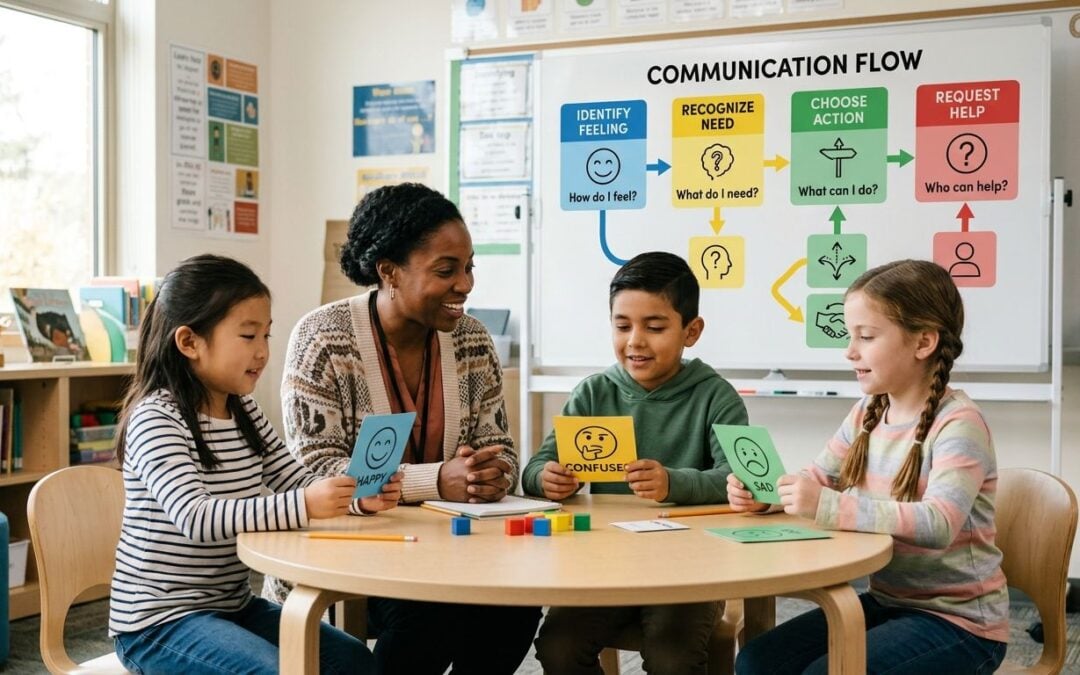
From Blame to Connection: A Guide to I-Messages

A child snaps, “You always ruin everything.” Another child fires back, “You never listen.” A teacher steps in, but the room is already tight with hurt feelings, crossed arms, and quick assumptions. Most adults who work with kids know this moment well. It happens over shared supplies, partner work, recess games, seating choices, and group chats that spill into the school day.

An i message gives children a more useful way to speak from their own experience instead of attacking someone else. That shift matters in classrooms, counseling offices, after-school programs, and homes. It helps kids name feelings, ask for what they need, and stay connected even when they're upset.

This is especially relevant because children communicate both in person and online. iMessage itself is one of the largest proprietary messaging platforms in the world, with an estimated 1.3 billion users globally in 2022, according to SignHouse's iMessage statistics summary. That doesn't mean every conflict happens on Apple devices, but it does highlight how normal device-based communication has become for families and students. If you're also working on stronger trust and belonging in your classroom, this building relationships with students playbook pairs well with the language tools below.

1. I Feel and I Felt Statements for Emotional Expression

Most adults start with “I feel…” because it's the clearest entry point. When a child can say what they felt, the conversation slows down. The focus moves from blame to experience.

A simple frame works well:
“I feel ___ when ___.”

That sentence is short enough for younger students and flexible enough for older ones.

Classroom examples that sound natural

Instead of “You made me mad,” try:

  • Shared supplies: “I felt frustrated when you took my pencil without asking.”
  • Exclusion at recess: “I felt hurt when you didn't include me in the game.”
  • Group work: “I felt lonely during group work when no one responded to my ideas.”

These are strong i message examples because they name an emotion and connect it to a specific event. They don't attack the other child's character.

Practical rule: If the sentence starts to sound like blame in disguise, pause and replace judgment words with feeling words.

Children often default to three emotions: mad, sad, and happy. That's a start, but it's not enough for many real conflicts. A child who says “mad” might feel embarrassed, left out, worried, ignored, disappointed, or overwhelmed.

How adults can coach this skill

Use visual supports, sentence stems, and regular modeling. During calm moments, practice with low-stakes situations like losing a turn, waiting in line, or hearing “not yet.” A feelings chart or wheel can help children choose more accurate words, and naming feelings with kids can give adults more language to scaffold that process.

A few coaching moves help:

  • Validate first: “I hear that you felt hurt.”
  • Get specific: “What happened right before that feeling?”
  • Refine gently: “Was it angry, or more disappointed?”

When children can say what they feel, they're less likely to show it through yelling, shutting down, or blaming.

2. I Need Statements for Boundary Setting and Self-Advocacy

Some children can identify a feeling but still don't know what to do next. That's where “I need…” becomes powerful. It turns emotion into direction.

An effective frame is:
“I need ___ so I can ___.”

This helps children speak clearly without demanding control over everyone else.

A young boy writing at his school desk with a teacher observing in the background.

Useful scripts for school and home

A child who's overloaded by noise might say, “I need a quieter workspace so I can concentrate on my math.”

A student who's confused can say, “I need help understanding this before we move forward.”

A child nearing dysregulation might say, “I need a break right now so I can reset my feelings.”

Those are practical i message examples because they're concrete. Adults and peers can respond to them.

Some children need support learning the difference between a need and a want. “I need everyone to stop talking forever” isn't a workable need. “I need less noise” is.

What healthy boundaries sound like

Boundary language should be firm and respectful. It doesn't need an apology attached to it. Many children, especially children who try hard to please adults, benefit from hearing that it's okay to ask for space, help, time, or clarification.

Try coaching with prompts like:

  • For sensory needs: “I need less noise.”
  • For learning support: “I need another example.”
  • For emotional regulation: “I need a minute.”
  • For personal space: “I need you to stop touching my backpack.”

Kids don't need perfect wording. They need repeated chances to say what they need before their body says it for them.

Adults can reinforce this through routines such as break cards, quiet corners, or help signals. For more ways to teach this explicitly, boundary activities for children can support both classroom and home practice.

3. I Notice and I Observe Statements for Perspective-Taking and Feedback

"I notice…" is especially helpful when a child wants to talk about behavior without making assumptions about motive. This style lowers defensiveness because it sticks closer to what happened.

That matters in conflict. “You were rude” invites an argument. “I noticed you turned away when I came over” invites clarification.

Observation before interpretation

Teach students to describe what they saw or heard, not the story they instantly told themselves.

For example:

  • Lunch table: “I noticed you turned away when I tried to sit with you at lunch.”
  • Whole-class reminder: “I noticed the volume increased and people weren't raising hands.”
  • Peer concern: “I observed that several students didn't respond when you joined the group.”

These examples create room for a reply like, “I didn't hear you,” or “We thought you were still talking to someone else.” Not every hurtful moment is a misunderstanding, but many are.

A useful prompt is, “What did you notice with your eyes or ears?” That helps children separate fact from interpretation.

Here's a short teaching video you can use to reinforce calm communication language:

A strong pattern for adults

Adults can pair observation with curiosity:

  • Teacher to student: “I noticed your paper stayed blank for several minutes. I'm wondering if you felt stuck.”
  • Counselor to child: “I observed that you got quiet when teams were chosen. Do you want to tell me about that?”
  • Parent to sibling pair: “I noticed both of you started talking louder when the game ended.”

This format is also useful in digital communication. Text and app-based messages can be misread easily, and media sharing changes the communication load quickly. According to Roamless's overview of iMessage data use, text-only conversations are light on data, while photos, voice notes, and videos increase usage substantially. For adults working with families, that's a reminder to keep digital conflict-repair messages short, clear, and simple when possible.

4. I Appreciate and I Admire Statements for Building Connection and Gratitude

Conflict repair is only one part of SEL. Children also need language for warmth, recognition, and belonging. “I appreciate…” helps kids notice what is working between them.

Many adults give praise that's broad, like “Good job” or “Nice work.” Appreciation lands better when it names the exact action and its impact.

A young girl receives a thank you card from a boy while sitting at a classroom desk.

Appreciation that feels genuine

Try scripts like these:

  • Peer support: “I appreciate how you helped me understand the math problem because it made me feel supported.”
  • Whole group: “I admire how our class stayed patient when the technology didn't work.”
  • Inclusion: “I appreciate when you include everyone in games because it makes recess feel safe.”

These i message examples strengthen classroom culture because they point children toward specific prosocial behaviors they can repeat.

Appreciation is most useful when it answers two questions: What did the person do, and why did it matter?

Simple ways to build the habit

You don't need a big lesson every time. Short routines work well.

  • Morning meeting: “I appreciate…” partner shares
  • Closing circle: one class appreciation
  • Sticky notes: quick peer recognition
  • Adult modeling: “I appreciated how you waited while I helped another student”

Children often learn gratitude best by hearing it spoken regularly and specifically. If you want more ideas for routines and prompts, ways to show gratitude with kids offers practical extensions.

5. I Choose and I Decided Statements for Agency and Responsibility

When children are upset, they often talk as if they had no choice at all. “He made me do it.” “I had to.” “There was nothing else I could do.” “I choose…” interrupts that pattern and builds accountability without shame.

This language can be uncomfortable at first. It asks a child to own a response, not just report what happened to them. But that's exactly why it's useful.

Agency language in real moments

Here are examples that keep dignity intact:

  • Escalating conflict: “I chose to walk away because I didn't want to make it worse.”
  • Repair after harm: “I decided to apologize because I care about our friendship.”
  • Academic persistence: “I choose to try another strategy because I want to improve.”
  • Recess conflict: “I decided to ask for help instead of pushing back.”

Children don't need to pretend every situation was easy. They can still say, “I was really angry, and I chose to step away.” That sentence holds both truth and responsibility.

Reflection questions that help

Adults can strengthen this kind of i message with follow-up questions:

  • Choice awareness: “What choice did you make?”
  • Alternative paths: “What else could you have chosen?”
  • Values check: “Which choice matches the kind of friend you want to be?”

A useful caution belongs here. Sometimes an I-message isn't enough because the problem isn't ordinary conflict. It may involve power, repeated harm, intimidation, or safety concerns. The U.S. State Department educational guidance on I-messages aligns with a broader truth many educators know well: calm communication can reduce blame, but it doesn't replace adult follow-through when harmful behavior continues. In those moments, children need protection, boundaries, and clear escalation paths, not pressure to phrase things more politely.

6. I Understand and I Recognize Statements for Validation and Empathy

Empathy language is often what allows a hard conversation to continue. A child who feels seen is more likely to stay engaged. A child who feels dismissed usually shuts down or strikes back.

“I understand…” and “I recognize…” work best when they reflect the other person's experience without rushing to fix it.

Validation before problem-solving

Examples:

  • Peer to peer: “I recognize that you felt excluded when we chose teams, and that must have hurt.”
  • Teacher to student: “I understand this feels really hard right now, and I see you trying.”
  • Friend support: “I recognize that you're nervous about the presentation, and that's a big feeling.”

Notice what these do well. They don't argue about whether the feeling is reasonable. They acknowledge it.

Use “and” more often than “but.” “I know you're upset, but…” usually erases the validation that came first.

Adults can also model reflective listening:

  • “I hear that you felt embarrassed.”
  • “I understand that you thought people were laughing at you.”
  • “I recognize that waiting felt unfair.”

What empathy does and doesn't mean

Empathy isn't agreement. You can understand a child's fear, anger, or disappointment and still hold a boundary. That distinction helps adults stay warm and steady at the same time.

This is also where text-based communication gets tricky. Digital messages are now part of family and school life, yet many traditional i message examples focus only on face-to-face conflict. The Act for Youth guide on using I-messages reflects the common pattern of in-person examples and points toward an important gap for educators: younger children and digital communicators often need shorter, more scaffolded versions. For example, “I felt left out when I saw that message. I want us to talk in person” may work better than a long emotional paragraph. As children build accountability alongside empathy, adults can reinforce that with teaching responsibility in age-appropriate ways.

7. I Hope and I Believe Statements for Encouragement and Future Focus

Some moments call for repair. Others call for strength. “I hope…” and “I believe…” help children look forward when they feel stuck, ashamed, or discouraged.

These statements matter because many students carry a quick story about themselves: I'm bad at this. Nobody likes me. I always mess up. Encouraging i message examples can interrupt that spiral without sounding fake.

Encouragement that children can trust

A few strong models:

  • Academic struggle: “I believe in your ability to learn this. You've kept trying before.”
  • Friendship pain: “I hope things get better for you because you deserve kindness.”
  • Family stress: “I believe you have the strength to handle this, and I'm here to support you.”
  • Behavior repair: “I believe you can make this right.”

Children can tell when encouragement is empty. “You can do anything” often feels too broad. “I believe you can get through this because I've seen you ask for help and keep going” feels more grounded.

Pair belief with support

Hope language works best when it includes a next step.

  • Teacher: “I believe you can finish this first part. I'll stay with you for the first problem.”
  • Parent: “I hope tomorrow feels easier. Let's make a plan for the morning.”
  • Counselor: “I believe this friendship can heal if both of you are ready to listen.”

There's also a practical systems lesson for adults here. In high-volume support settings, clear language and strong response paths matter. In one case described by Crescendo.ai's business examples, Rachio used AI agents to handle more than 1 million support queries across chat, voice, and email, while keeping a human escalation layer for more complex issues. In schools and youth settings, the parallel is simple: encouraging language helps, but children also need reliable follow-through when a problem is ongoing or complex.

7 I-Message Types Comparison

Statement type Implementation complexity Resource requirements Expected outcomes Ideal use cases Key advantages
I Feel / I Felt (Emotional Expression) Low–Medium, simple format but needs modeling Emotion charts, repeated practice time, teacher modeling Improved emotional vocabulary, less blaming, safer classrooms Teaching emotion naming, de-escalation, K–8 SEL lessons Separates feelings from blame; builds self-awareness
I Need (Boundary Setting & Self-Advocacy) Medium, teaches requests and negotiation Classroom systems for requests, adult willingness to negotiate, practice Greater self-advocacy, clearer boundaries, reduced anxiety asking for help Requesting accommodations, asserting personal needs Teaches assertiveness without aggression; promotes agency
I Notice / I Observe (Perspective-Taking & Feedback) Medium, requires training in objective language Practice prompts, mindfulness exercises, vocabulary scaffolds More accurate communication, reduced assumptions, better feedback Reporting concerns, peer feedback, conflict mediation Fact-based approach that reduces defensiveness
I Appreciate / I Admire (Connection & Gratitude) Low, cultural shift to regular practice Routines (circles, notes), modeling, prompts Increased belonging, strengthened relationships, positive climate Community-building, recognition activities, gratitude practice Reinforces positive behavior; fosters connection
I Choose / I Decided (Agency & Responsibility) Medium–High, needs reflection and sensitivity Reflection prompts, scaffolding, restorative practices, adult guidance Greater responsibility, internal locus of control, improved decision-making Behavior reflection, accountability conversations, goal-setting Promotes agency and metacognition; reframes consequences
I Understand / I Recognize (Validation & Empathy) Medium, requires genuine listening skills Active listening training, modeling, time to listen De-escalation, trust building, feeling heard Emotional support, peer support, pre-problem-solving interactions Validates experience; builds psychological safety
I Hope / I Believe (Encouragement & Future Focus) Low–Medium, must be genuine and paired with action Teacher modeling, specific praise, follow-through supports Increased resilience, motivation, confidence Encouragement during setbacks, growth-mindset coaching Builds hope and optimism; supports persistence

Making I-Messages a Daily Habit

The best i message examples don't live on a poster alone. They become part of the daily language children hear, practice, and repair with over time. That means adults need to model them in ordinary moments, not only during conflict. “I felt concerned when the line got crowded.” “I need everyone to freeze so we can stay safe.” “I appreciate how you waited.” Repetition makes the language usable when emotions run high.

It also helps to teach these seven types as different tools, not one script. A child might need “I feel” in one moment and “I need” in the next. Another child may be ready for “I notice” or “I choose.” Giving students more than one frame respects their developmental stage, communication style, and the kind of situation they're in.

For younger children, keep it short. One or two sentences is enough. For older students, add reflection and repair: “I felt embarrassed when that happened. I need us not to joke about it again.” In digital situations, shorter is often better because tone is easier to misread and long messages can escalate quickly. If families are sending plain text, that communication is lightweight, while images and videos can add much more data use, as noted earlier. That practical detail matters for some households and is one more reason to teach children that not every conflict needs a flood of screenshots or voice notes.

Adults should also remember the limit of the tool. An I-message can support conflict resolution, but it can't solve repeated cruelty, coercion, or unsafe behavior by itself. In those moments, children need adults to step in, document concerns, set boundaries, and protect the student who was harmed. Communication skills and safety procedures should work together.

If your school wants shared language around empathy, self-regulation, and conflict resolution, Soul Shoppe is one relevant option. Its work centers on helping school communities build connection, safety, and practical SEL habits that children and adults can use every day. That kind of consistency is what turns a sentence frame into a culture.


If you want support bringing these tools into your school or home community, Soul Shoppe offers SEL programs and resources focused on communication, empathy, belonging, and conflict resolution for children and the adults who care for them.