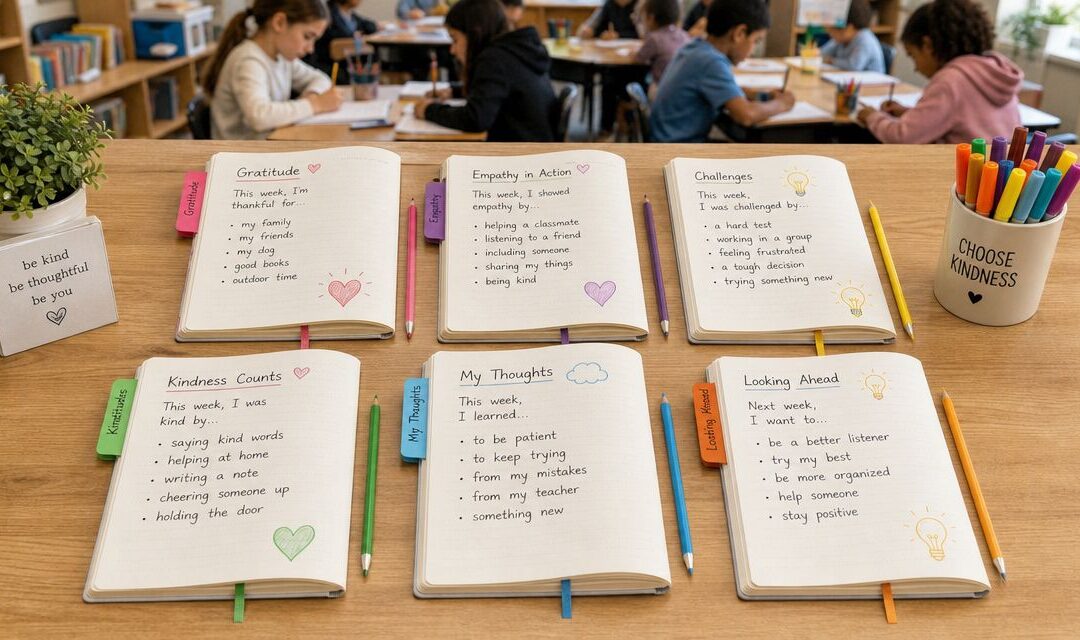
A lot of adults want students to journal, but the moment they try to make it happen, the same problems show up. A blank page feels too open-ended. Some students write one sentence and stop. Others turn the notebook into a play-by-play of their day without doing much reflection. And when a prompt gets too personal, participation drops fast.

That's why journal prompts for students work best when they're structured, brief, and tied to a clear purpose. Prompts have a long classroom history as a structured writing tool, including documented use in statistics education, where a 1998 study discussed in the Association for Psychological Science's article on incorporating writing into an introductory statistics course links periodic journal writing about fears and anxieties with reduced statistics anxiety. In schools today, that same core idea still holds up. Give students a low-stakes way to put thoughts into words, then connect that reflection to learning, relationships, and self-regulation.

For K-8 educators and families, journaling is more than a diary. It can support emotional regulation, problem solving, identity development, and classroom belonging. If you also want literacy support alongside SEL, these practical reading comprehension methods pair well with reflective writing.

The prompt types below are organized by SEL theme and grade band, with examples you can use this week. Keep what fits. Skip what doesn't. A good journaling routine should feel doable, not idealized.

1. Gratitude and Appreciation Journaling

A young girl with long brown hair writes in a spiral notebook at her school desk.

Gratitude prompts are often the easiest place to start, especially with younger students. They're concrete, emotionally safe for most children, and simple to repeat without feeling stale. A student who can't yet write a full paragraph can still answer, “Who helped me today?” or “What made me smile at recess?”

For K-2, keep it highly specific. “I'm thankful for my family” is fine, but “I'm thankful Maya saved me a seat at lunch” builds stronger emotional awareness because the child is naming a real interaction. In grades 3-5, students can expand to weekly reflections such as “What's something hard that turned out better than I expected?” In middle school, appreciation journals work well when they include peers, teachers, routines, and small moments, not just big life blessings.

Prompts that work in real settings

  • K-2 classroom prompt: “Draw one thing that felt good today and write one sentence about it.”
  • Grades 3-5 prompt: “Who made your day easier this week, and what did they do?”
  • Middle school prompt: “What's one part of your life you usually overlook but appreciate more now?”
  • Home routine prompt: “What is one thing from today you want to remember because it felt kind, calm, or fun?”

A gratitude journal doesn't need to become performative. Students shouldn't feel pressure to sound cheerful or deep.

Practical rule: Start with one honest thing. Forced gratitude usually produces flat writing and eye-rolls.

If you want to tie this theme to concrete community habits, Soul Shoppe's ideas for ways to show gratitude can help students move from reflection into action. That shift matters. Writing “I appreciate my bus driver” is useful. Writing it, then making a thank-you note, is even better.

What doesn't work is overloading the practice. “List ten things you're grateful for” can feel repetitive fast. One or two meaningful responses is usually stronger than a long list of filler.

2. Self-Regulation and Emotional Check-In Journaling

Some students don't need another open-ended question. They need a format. Emotional check-in journaling works because it gives structure to feelings that otherwise come out sideways through shutdowns, blurting, conflict, or tears.

Start with a simple tracking method. Younger students often do best with colors, faces, or a traffic-light system. Older students can handle a short written reflection: “I felt frustrated in math because I didn't know what to do next. I asked for help after sitting in silence for too long.” That kind of sentence builds self-awareness and gives adults insight without turning the journal into therapy.

A quick visual can help launch the habit.

Good structures for daily use

  • Red, yellow, green check-in: “What color am I right now? What happened?”
  • Emotion thermometer: “Where is my stress level this morning?”
  • Trigger and response frame: “What set me off? What did I do next?”
  • Reset reflection: “What helped me calm down, even a little?”

This format becomes much stronger when students are taught feeling words first. “Bad” and “fine” won't take them far. Build vocabulary such as disappointed, left out, tense, embarrassed, relieved, and proud. Then connect the writing to a routine. Soul Shoppe's strategies for daily check-ins for students with mood meters and reflection tools fit naturally here.

One caution matters. If you ask students to write about feelings, you need a plan for privacy and follow-up. Some prompt collections focus on emotional expression but don't address opt-in participation, alternatives, or sensitive disclosures, even though student mental health strain remains an active concern, as noted in this college journal prompt resource discussing classroom prompt gaps and student well-being concerns. In practice, that means students need options such as drawing, using a code, writing only to themselves, or choosing a less personal prompt.

3. Mindfulness and Present-Moment Awareness Journaling

A young child sitting in a peaceful lotus position on a wooden bench at a quiet playground.

Mindfulness journaling is useful when students seem scattered, overstimulated, or rushed from one task to the next. The writing itself should come after a short experience. A breathing pause, a sensory scan, a quiet observation walk, or a body check gives students something real to notice.

For K-2, use five senses language. “I hear…” “I see…” “I feel…” works well after a calm minute by the window or on the rug. In grades 3-5, students can reflect on what distracted them and what helped them refocus. Middle school students can handle more nuanced prompts about mental noise, stress, or what it feels like to slow down.

Prompt ideas by grade band

  • K-2: “What are three things you noticed when the room got quiet?”
  • Grades 3-5: “What did your body feel like before and after breathing slowly?”
  • Grades 6-8: “What kept pulling your attention away today, and what helped you return to the present moment?”
  • Home use: “Where in your day did you feel most calm, even briefly?”

A common mistake is expecting students to become serene on command. That's not how this works. Some children will feel calmer. Some will feel restless and annoyed. Both responses are usable.

Wandering thoughts aren't a failure. They're the material students can write about.

If you want a schoolwide bridge between calm-down routines and reflection, Soul Shoppe's article on mindfulness for students offers language adults can adapt. Keep the activity short. Two or three quiet minutes followed by one solid prompt usually beats a long guided exercise that students tune out.

4. Conflict Resolution and Problem-Solving Journaling

Conflict journals work best after a real disagreement, not as an abstract character lesson. A student had an argument during group work. Someone felt excluded at recess. A sibling grabbed a game controller and the evening blew up. Those are the moments when writing can slow the story down enough for problem solving.

Instead of asking, “How did that make you feel?” and stopping there, use a sequence. What happened first? What did I think it meant? What did I do? What could I try next time? The structure matters because students often jump straight from event to blame.

A simple reflection sequence

  • Step 1: “What happened?”
  • Step 2: “What was I feeling?”
  • Step 3: “What might the other person have been feeling?”
  • Step 4: “What did I do that helped or hurt the situation?”
  • Step 5: “What's one better next step?”

For grades 1-3, keep it oral first, then write a sentence or draw a sequence. In grades 4-5, students can do a two-column reflection with “my view” and “their view.” Middle school students can prepare for a restorative conversation by drafting what they want to say, what they want to own, and what they need moving forward.

When families or teachers skip the perspective-taking part, these entries become complaint logs. That doesn't build much. The more useful version asks students to hold two truths at once: “I was upset” and “the other person also had a perspective.”

Soul Shoppe's guidance on conflict resolution strategies for kids pairs well with this type of journaling because students need language they can use out loud after they write. The journal is preparation. It shouldn't be the end point.

5. Growth Mindset and Learning From Mistakes Journaling

This category is where journal prompts for students can connect SEL to academics without feeling forced. Students make mistakes all day. They misread directions, bomb a quiz, forget materials, overestimate how long homework will take, and freeze when work gets hard. If journaling only celebrates strengths, it misses one of the best uses of reflection.

The trick is keeping the writing practical. “Write about a failure” can feel dramatic or vague. “Describe one mistake you made this week, what it taught you, and what you'll try next” is much more usable.

Better prompts than “What did you do wrong?”

  • Primary grades: “What was tricky today, and who or what helped you keep going?”
  • Upper elementary: “What mistake taught you something important this week?”
  • Middle school: “Where did you get stuck, and what strategy will you use next time?”
  • Academic version: “What part of this assignment showed you what you still need to practice?”

I've seen teachers get better results when they occasionally model their own learning frustration. A short example like, “I rushed directions and confused everyone, so next time I'll chunk them,” gives students permission to write authentically instead of pretending they always know what to do.

A youth-focused journaling guide from Waterford shows how broad student prompts have become for children and adolescents, including prompts related to emotional regulation, problem solving, identity, gratitude, and relationships, while framing journaling as something that helps people “big and small alike” feel better in its guide to journal prompts for kids. That range matters here because mistake-reflection prompts don't need to stay academic. A student can learn from blowing up at a friend just as much as from missing five spelling words.

What doesn't work is grading the vulnerability. Assess completion, stamina, or use of reflection routines if you must assess something. Don't score the student's inner life.

6. Kindness, Empathy, and Peer Connection Journaling

Some students struggle to notice kindness unless it's dramatic. Journaling can train attention toward the smaller moments that build community. A partner waited. Someone invited another student into a game. A classmate noticed a dropped pencil and picked it up. Those details matter because they make empathy visible.

With younger students, start with observation before expectation. Asking a child to perform kindness for the journal can turn it into point-scoring. Asking, “What kind thing did you notice today?” usually gets more genuine responses.

Prompts that build peer awareness

  • K-2: “Who helped someone today? What did they do?”
  • Grades 3-5: “When did you notice someone else's feelings and respond kindly?”
  • Grades 6-8: “Describe a time you could've ignored something but chose to include, support, or speak up.”
  • Family version: “How did someone in our home make life easier today?”

This theme also works well with appreciation notes, partner interviews, and brief reflection after community circles. Students who don't like long writing can still complete a strong entry by finishing sentence starters such as “I felt connected when…” or “Someone showed empathy when…”

Classroom note: Celebrate specific behaviors, not “nice kids.” Students need to see that empathy is something they do, not a trait only some people have.

A weak version of this practice stays generic. “Be kind” isn't enough. A stronger version names actions, context, and impact: “I noticed Eli was alone, asked him to join us, and then he smiled and started talking.” That kind of journaling strengthens social memory. It helps students recognize what belonging looks like.

7. Identity, Values, and Belonging Journaling

Identity prompts can be some of the most meaningful and some of the most mishandled. When adults rush them, students feel exposed. When adults make them too broad, students produce shallow answers. The safest and most useful approach is choice.

A child can write about family traditions, favorite places, names they're proud of, languages they hear at home, values they want to live by, or times they felt included. They should also be able to pass on topics that feel too personal. That's especially important in diverse classrooms where students may be grieving, newly immigrated, questioning parts of identity, or are private.

Safer ways to invite self-expression

  • Offer options: Let students pick from identity, values, interests, or belonging prompts.
  • Allow multiple formats: Writing, drawing, lists, labeled pictures, or sentence frames all count.
  • Avoid assumptions: Don't require students to write about “mom and dad,” holidays they may not celebrate, or cultural traditions they may not want to explain.
  • Keep sharing optional: Reflection can still be powerful when it stays private.

A few examples work well across grade bands. K-2 students can complete “One thing that makes me me is…” Grades 3-5 can respond to “What do you want people to understand about you?” Middle school students can write about where they feel most like themselves and what values they want others to notice in their actions.

This is also where psychological safety matters most. Prompt lists often give ideas but not enough guidance on accessibility, alternatives, or how to respond to sensitive content. In practice, adults need to think ahead. What will a multilingual student do if the prompt is emotionally rich but language-heavy? What's the alternative for a student who doesn't want to disclose? Those design choices matter as much as the prompt itself.

8. Goal-Setting and Progress Tracking Journaling

A top-down view of a desk featuring a journal with goals, a calendar, and a coffee mug.

Goal journals are useful because they move reflection toward agency. Instead of only processing feelings after something happens, students begin naming what they want to work on and how they'll know they're making progress.

Keep the goal small enough to see. “Be better at math” is too vague. “Show my work on every multi-step problem this week” is clear. The same applies to SEL goals. “Be nicer” won't help much. “Invite one classmate into a game at recess” gives the student a behavior they can try.

A realistic journal routine

One education resource recommends 30-minute journaling sessions one or two days per week, with prompts selected from a jar and entry length adjusted to age and stamina. You don't have to copy that exact routine, but the underlying idea is solid. Put journaling on the calendar, give students a format, and scale the writing load to their developmental level.

Try prompts like these:

  • Primary grades: “What is one thing you want to get better at this week?”
  • Upper elementary: “What goal did you work on today, and what helped?”
  • Middle school: “What got in the way of your goal this week, and what will you adjust?”
  • Home use: “What's one habit our family is practicing together?”

The most common mistake is setting goals and never revisiting them. A goal journal without check-ins becomes a storage bin for abandoned intentions. Weekly review matters. So does flexibility. If a student chose the wrong goal, help them revise it instead of turning that into another failure story.

9. Social Skills and Communication Journaling

Students often know they had a rough interaction, but they can't yet explain why it went badly. Communication journals slow that moment down. They help students notice timing, tone, word choice, body language, and whether they listened.

This works well after partner work, class discussions, friendship problems, or difficult conversations at home. A student might write, “I interrupted because I thought my idea would be forgotten,” or “I said ‘whatever' when I felt embarrassed.” That kind of reflection creates better insight than a generic reminder to “use kind words.”

Prompts for conversation awareness

  • Listening prompt: “When did you really listen today? How do you know?”
  • Assertiveness prompt: “What did you need to say but almost didn't?”
  • Repair prompt: “Did you need to fix a conversation today? What happened next?”
  • Friendship prompt: “What helps you feel heard by other people?”

A good communication journal isn't about scripting perfect social behavior. It's about pattern recognition. Students begin to see, for example, that they shut down when they feel corrected, or that they talk over peers when they're excited, or that they avoid asking for help because they don't want to seem confused.

This is one of the strongest categories for role-play plus reflection. Let students practice a sentence stem such as “I felt left out when…” or “Can we try that again?” Then ask them to journal afterward about what felt easy, awkward, or effective. The writing becomes a bridge between social-skills instruction and real-life use.

10. Wellness, Self-Care, and Mental Health Journaling

Wellness journals can be helpful, but they need careful boundaries. A school or home journal isn't a diagnostic tool, and students shouldn't feel responsible for turning private distress into polished writing for adults. Keep the focus on awareness, routines, stress signals, coping tools, and help-seeking.

That means prompts like “What helps your body feel ready for the day?” are often more useful than broad invitations to unpack everything. Students can track sleepiness, energy, movement, overwhelm, calm-down choices, breaks, hydration, or what routines help them reset after school.

Stronger prompts for support and prevention

  • K-2: “What helps your body feel calm?”
  • Grades 3-5: “What are your clues that you need a break?”
  • Grades 6-8: “What coping strategy helped this week, and when didn't it work?”
  • Help-seeking prompt: “If you needed support, which grownup could you talk to?”

There's also an important implementation question here. Schools often want journaling to support SEL, behavior, reflection, and wellness all at once. But prompt routines work better when adults are clear about their purpose. A recent discussion of self-care prompts and school-related reflection gaps points to a real issue in journal prompts for better self-care: educators need ways to support mental health and SEL without overreaching, invading privacy, or pretending every benefit can be neatly measured from the writing itself.

If a student writes something concerning, the response should come from school or family support systems, not from deeper journaling prompts. The journal can open a door. It shouldn't be asked to carry the whole load.

10 Student Journal Prompt Types Compared

Journal Type Implementation Complexity Resource Requirements Expected Outcomes Ideal Use Cases Key Advantages
Gratitude and Appreciation Journaling Low, simple routine, easy to start Minimal, paper/digital journals, occasional prompts Increased positivity, resilience; reduced anxiety Daily/weekly classroom warm-ups; K-8 routines; family practice Easy to implement; builds belonging and optimism
Self-Regulation and Emotional Check-In Journaling Moderate, needs explicit instruction and follow-up Mood meters, emotion vocabulary charts, privacy protocols, apps Greater self-awareness, pattern recognition, fewer behavioral incidents Daily check-ins, students needing regulation supports Teaches practical regulation; yields actionable data
Mindfulness and Present-Moment Awareness Journaling Moderate, requires quiet space and guided practice Timers/audio, guided scripts, sensory prompts Improved focus, reduced anxiety, stronger attention span After guided mindfulness sessions; short class breaks Deepens mindfulness practice; accessible to diverse learners
Conflict Resolution and Problem-Solving Journaling Moderate–High, structured frameworks and facilitation needed Problem-solving templates, restorative prompts, adult support Better conflict skills, perspective-taking, fewer repeat disputes Post-conflict reflection, restorative prep, mediation follow-up Develops empathy and concrete resolution strategies
Growth Mindset and Learning From Mistakes Journaling Low–Moderate, needs modeling and supportive culture Reflection prompts, tracking sheets, teacher modeling Increased resilience, willingness to take risks, improved effort After setbacks, skill-building units, academic reflections Reframes failure as learning; documents measurable growth
Kindness, Empathy, and Peer Connection Journaling Low, prompt-based and easy to integrate Journals/prompts, peer reflection activities Stronger peer relationships, reduced isolation and bullying Community-building routines, empathy lessons, morning circles Builds empathy and classroom connection; family-friendly
Identity, Values, and Belonging Journaling High, requires culturally safe facilitation Inclusive prompts, training for staff, alternative expression options Greater self-awareness, sense of belonging, reduced marginalization Equity work, identity exploration units, belonging initiatives Supports identity-affirming practice and psychological safety
Goal-Setting and Progress Tracking Journaling Moderate, needs instruction on goal frameworks Goal templates (SMART), progress trackers, regular check-ins Increased agency, planning skills, documented progress Long-term projects, personal/academic goal cycles Teaches self-monitoring and celebrates milestones
Social Skills and Communication Journaling Moderate, requires explicit social skills teaching Conversation prompts, role-play supports, debrief time Improved communication, confidence, reduced social anxiety Social skills groups, debriefing difficult conversations Strengthens interpersonal skills and shared language
Wellness, Self-Care, and Mental Health Journaling Moderate–High, sensitive facilitation and protocols required Wellness trackers, referral pathways, staff training Normalized mental health talk, early identification of concerns Wellness promotion, at-risk student monitoring, prevention work Encourages self-care; connects students to supports

Putting Prompts into Practice Your Next Steps

The best journaling routines aren't the most elaborate ones. They're the ones students will do. In a busy classroom, that often means one prompt, a clear time limit, and a predictable structure. At home, it might mean a shared notebook at the dinner table, a bedtime check-in card, or a quiet weekend reflection page.

Start with the need in front of you. If your class feels dysregulated, begin with emotional check-ins or mindfulness prompts. If friendships are fraying, use kindness, empathy, or conflict-resolution writing. If a student shuts down after mistakes, try growth reflections tied to specific school tasks. Journal prompts for students work better when they respond to a real moment instead of an ideal plan.

Keep expectations realistic. Some students will write paragraphs. Some will draw and label. Some will need sentence starters for months before they can write independently. That isn't a sign the practice is failing. It's a sign that support should match readiness.

A few routines consistently help:

  • Model the kind of reflection you want: Short, honest examples beat polished speeches.
  • Protect privacy: Don't require public sharing of personal entries.
  • Offer choices: Give students an alternative prompt or non-writing format when needed.
  • Stay clear about purpose: A prompt for writing fluency is different from a prompt for emotional regulation.
  • Use journals to notice patterns, not control students: Reflection should build agency.

One practical question comes up often. Should journals be graded? In most SEL-centered uses, grading the content backfires. It can make students perform insight instead of practicing it. If accountability matters, grade completion, participation in the routine, or use of a structure. Leave the student's private meaning-making alone unless they choose to share.

Another question is frequency. More isn't always better. A sustainable routine is better than a burst of enthusiasm that disappears in two weeks. If you're new to journaling, choose one prompt type and repeat it long enough for students to understand the pattern. Once the habit feels normal, add another category.

For school leaders, this is also where implementation matters more than prompt quantity. Staff need a shared understanding of what journaling is for, what happens when a student discloses something serious, how privacy is handled, and how prompts are adapted for multilingual learners, neurodivergent students, and reluctant writers. The prompt list is the easy part. The adult response system is what makes the practice safe and sustainable.

If you want outside support, Soul Shoppe is one relevant option for schools and families looking to strengthen self-regulation, mindfulness, communication, and conflict resolution through SEL programming and practical tools. That kind of support can help adults connect journaling to a wider shared language, so the notebook isn't a stand-alone activity but part of daily community practice.

Choose one prompt type. Try it for a few weeks. Notice what students respond to, where they need more structure, and what kinds of reflection help them function better with themselves and with other people. That's when journaling becomes more than writing. It becomes a usable skill.


If you want help turning journal prompts into a broader SEL practice, explore Soul Shoppe for programs, tools, and resources that support connection, safety, empathy, and practical student reflection at school and at home.