A student crumples a math paper, shoves the pencil to the floor, and says, “I can’t do this.” The room tightens. Another child stares. A teacher has about five seconds to decide whether this is defiance, avoidance, embarrassment, or pure overload.
Most of us have lived some version of that moment.
When I think about emotional intelligence in education, I do not think first about theory. I think about those ordinary school-day moments when a child’s feelings either block learning or open the door to it. I think about the student who looks “unmotivated” but is really afraid of getting it wrong, the child who grabs a marker because they do not yet have language for frustration, and the adult who wants to help but is running on empty.
Emotional intelligence gives us a workable path. It helps children notice what they feel, name it, regulate it, and respond in ways that protect both learning and relationships. It also helps adults create classrooms where students feel safe enough to try again. The work becomes practical here. Not abstract. Not one more initiative. Practical.
Why Emotional Skills Are the New Foundation for Learning
A second grader loses a game at recess and comes back furious. He bumps his chair, snaps at a classmate, and refuses to open his reading folder. If we only look at behavior, we may see disrespect. If we look one layer deeper, we often see a child whose nervous system is still stuck in the loss from ten minutes ago.
That is why emotional skills matter so much. They are not extra. They are the conditions that help academic instruction land.
A child who cannot settle after disappointment will struggle to listen to directions. A child who does not know how to ask for help may avoid work altogether. A child who assumes every correction means “I’m bad at school” will start protecting themselves instead of taking risks.
What this looks like in real school life
Teachers see it every day:
During independent work: A student shuts down after one mistake.
During partner work: Two children argue because neither knows how to disagree calmly.
During transitions: Noise, crowding, and uncertainty push a student into tears or anger.
During assessment: Anxiety takes over, even when the student knows the material.
Parents see the same pattern at home.
At homework time: “This is stupid” really means “I feel overwhelmed.”
After school: Meltdowns often come after a full day of holding it together.
With siblings: Grabbing, yelling, or blaming can signal weak self-regulation, not bad character.
Emotional intelligence gives adults a way to respond with both compassion and clarity. We can teach skills instead of just reacting to symptoms.
A useful reframe for adults is this. “What skill is missing right now?” That question often leads to better support than “What punishment fits this behavior?”
Children do not become resilient because we ask them to “calm down.” They become resilient because we repeatedly show them how.
Understanding Emotional Intelligence in an Educational Context
Emotional intelligence is a child’s ability to recognize feelings, understand what those feelings are signaling, manage emotional responses, and relate well to other people. In school, I like to describe it as an emotional toolkit.
A strong toolkit helps a student do things like:
notice “I’m getting frustrated”
pause before blurting out
recover after a mistake
read a classmate’s facial expression
ask for help without shame
solve a conflict without making it bigger
IQ and emotional intelligence are not competitors. They work together. IQ may help a student understand the lesson. Emotional intelligence helps the student stay present long enough to use what they know.
Why it matters for academics
This is not just a feel-good idea. A 2025 Frontiers in Education study found that trait emotional intelligence, alongside academic engagement, accounted for 49.9% of the variance in academic achievement. The same study found a positive effect of trait EI on engagement and achievement, pointing to the role of self-regulation, interpersonal skills, and stress management in student success (Frontiers in Education study on trait emotional intelligence and academic achievement).
That matters because many readers get stuck on one common question. “Isn’t emotional intelligence separate from real school performance?” In practice, it is strongly connected.
A student may know how to multiply fractions. But if panic shows up during a quiz, that knowledge can disappear behind stress. A student may have rich ideas about a novel. But if group work feels socially threatening, those ideas may never get spoken.
A simple way to explain EI to children
Try an internal weather forecast.
You can say:
“What is your weather right now? Sunny, foggy, stormy, windy?”
“What does your body feel like when the storm starts?”
“What helps your weather shift?”
This gives children a concrete way to talk about inner states before those states turn into conflict.
What EI is not
Emotional intelligence does not mean:
never feeling angry
always being agreeable
avoiding hard conversations
lowering expectations for behavior
It means helping children handle big feelings in ways that support learning, safety, and connection. That is a high expectation, and a teachable one.
The Research-Backed Benefits of Nurturing EI in Schools
When schools invest in emotional intelligence, the benefits show up at several levels at once. The student changes. The classroom changes. Over time, the whole school climate changes.
A major reason educators keep returning to emotional intelligence in education is that the impact does not stay confined to one counseling lesson or one morning meeting. It spreads through daily routines.
For individual students
A landmark 2019 meta-analysis of over 42,000 students found that students with higher emotional intelligence earned better grades and achievement test scores, even after controlling for IQ. The analysis also noted that managing test anxiety, boredom, and disappointment was a key part of that academic advantage (Education Week coverage of the 2019 emotional intelligence meta-analysis).
That research matches what many teachers observe.
A student with stronger emotional skills is more likely to:
recover after a wrong answer
stay engaged through a tedious task
handle feedback without collapsing
keep trying when work gets hard
Those are learning behaviors, not just “soft skills.”
For the classroom climate
One child’s regulation affects everybody else. So does one adult’s regulation.
When students can identify feelings and use shared language, conflict becomes easier to interrupt early. Instead of a shouting match, you hear: “I felt left out when you changed the groups.” Instead of silent resentment, you hear: “Can we start over?”
Teachers often notice classroom shifts such as:
Less escalation: Students catch frustration earlier.
Better partner work: Children have words for turn-taking, repair, and disagreement.
More academic risk-taking: Students feel safer making mistakes in front of peers.
Stronger belonging: Children see that feelings are manageable, not shameful.
If you want a broader view of how SEL supports school life, this overview of the benefits of social-emotional learning connects emotional growth to everyday student outcomes.
Emotional intelligence does not remove hard moments from a classroom. It gives students and adults better moves during those moments.
For the school community
School culture is built from repeated interactions. Hallway corrections. Cafeteria conflicts. Front office conversations. Family meetings. All of those exchanges either reinforce dignity or erode it.
When a school teaches emotional intelligence consistently, children get more than a lesson. They get a shared operating system.
That can support:
calmer transitions across settings
more respectful problem-solving
stronger student-adult trust
fewer peer conflicts turning into lasting social damage
a more inclusive environment for students who are easily overwhelmed
Why this matters to leaders
Administrators often ask whether this work is worth doing at scale. The answer is yes, if the goal is better learning conditions.
Emotional intelligence supports attention, persistence, communication, and recovery after setbacks. Those are not side benefits. They are part of the foundation schools depend on every day.
The Five Core Competencies of Emotional Intelligence
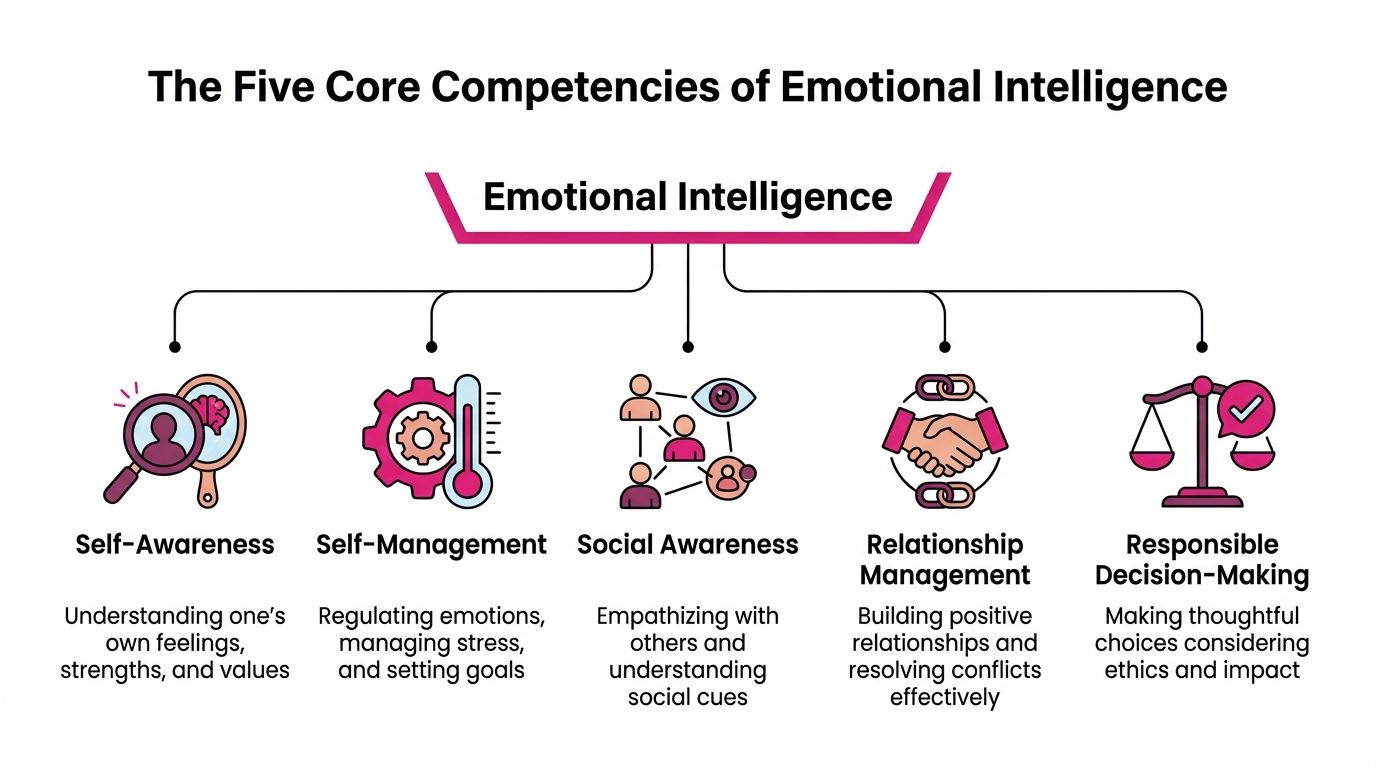
In K-8 settings, emotional intelligence becomes easier to teach when we break it into visible, coachable skills. The most practical framework for many schools includes five core competencies: self-awareness, self-management, social awareness, relationship skills, and responsible decision-making.
These competencies are easier to understand when we attach them to behavior we can see.
What each competency means
Self-awareness means noticing your own feelings, triggers, strengths, and needs.
Self-management means handling emotions, impulses, and stress in ways that help rather than harm.
Social awareness means reading the room, noticing how others may be feeling, and responding with empathy.
Relationship skills means communicating clearly, listening well, resolving conflict, and building trust.
Responsible decision-making means making choices that consider safety, fairness, consequences, and impact on others.
A child does not master these all at once. They grow over time, with repetition and support.
Age-Appropriate Emotional Intelligence Competencies in K-8
Competency
What It Looks Like (Grades K-2)
What It Looks Like (Grades 3-5)
What It Looks Like (Grades 6-8)
Self-Awareness
Names basic feelings like mad, sad, excited, worried. Can point to where a feeling shows up in the body.
Identifies mixed feelings and simple triggers. Can say, “I’m frustrated because this feels hard.”
Reflects on patterns, triggers, and identity. Can recognize stress, embarrassment, jealousy, or pressure before behavior escalates.
Self-Management
Uses a taught strategy such as deep breathing, counting, squeezing hands, or asking for a break.
Chooses from several regulation tools and can return to learning with support.
Uses coping strategies more independently, delays impulses, and plans ahead for stressful situations.
Social Awareness
Notices when a peer is crying or left out. Begins to understand that others feel differently.
Reads tone, body language, and group dynamics with growing accuracy.
Considers perspective, context, and social pressure. Can discuss fairness and impact in more nuanced ways.
Relationship Skills
Takes turns, uses simple feeling words, practices apology and repair with adult coaching.
Uses I-statements, listens to another viewpoint, and works through minor conflict with prompts.
Handles disagreement with more maturity, sets boundaries, collaborates, and repairs harm with less adult mediation.
Responsible Decision-Making
Chooses between simple options like “grab or ask.” Understands basic classroom rules and safety.
Thinks through consequences and can explain why a choice was kind, fair, or unsafe.
Weighs peer influence, ethics, and long-term consequences before acting.
What adults sometimes misunderstand
Adults often expect older students to have a skill just because they can explain it. A sixth grader may know the words “I need to calm down” and still slam a locker when embarrassed. Knowledge is not the same as embodied skill.
That is why practice matters.
A first grader may role-play asking for a turn with a marker. A fourth grader may rehearse what to say when a friend excludes them from a game. A seventh grader may practice how to disagree in a group project without shutting down or taking over.
A quick way to use this framework
Pick one competency for two weeks and make it visible.
For example, if the focus is self-management:
post three calming strategies
model when you use one yourself
praise the process, not just the outcome
give students a sentence stem such as “I need a reset, then I can rejoin”
Children grow faster when adults name the exact skill they are using. “You noticed you were frustrated and asked for space.” That is more helpful than “Good job.”
Once adults start looking through this lens, student behavior becomes more readable. And when behavior becomes more readable, teaching gets more precise.
Practical Classroom Strategies and Lesson Examples
The most effective emotional intelligence practices rarely require a separate hour-long block. They work best when they are woven into the day children already have.
A classroom can teach emotional intelligence from the first greeting to the final pack-up.
Start the day with emotional visibility
In many classrooms, the first useful move is a quick check-in.
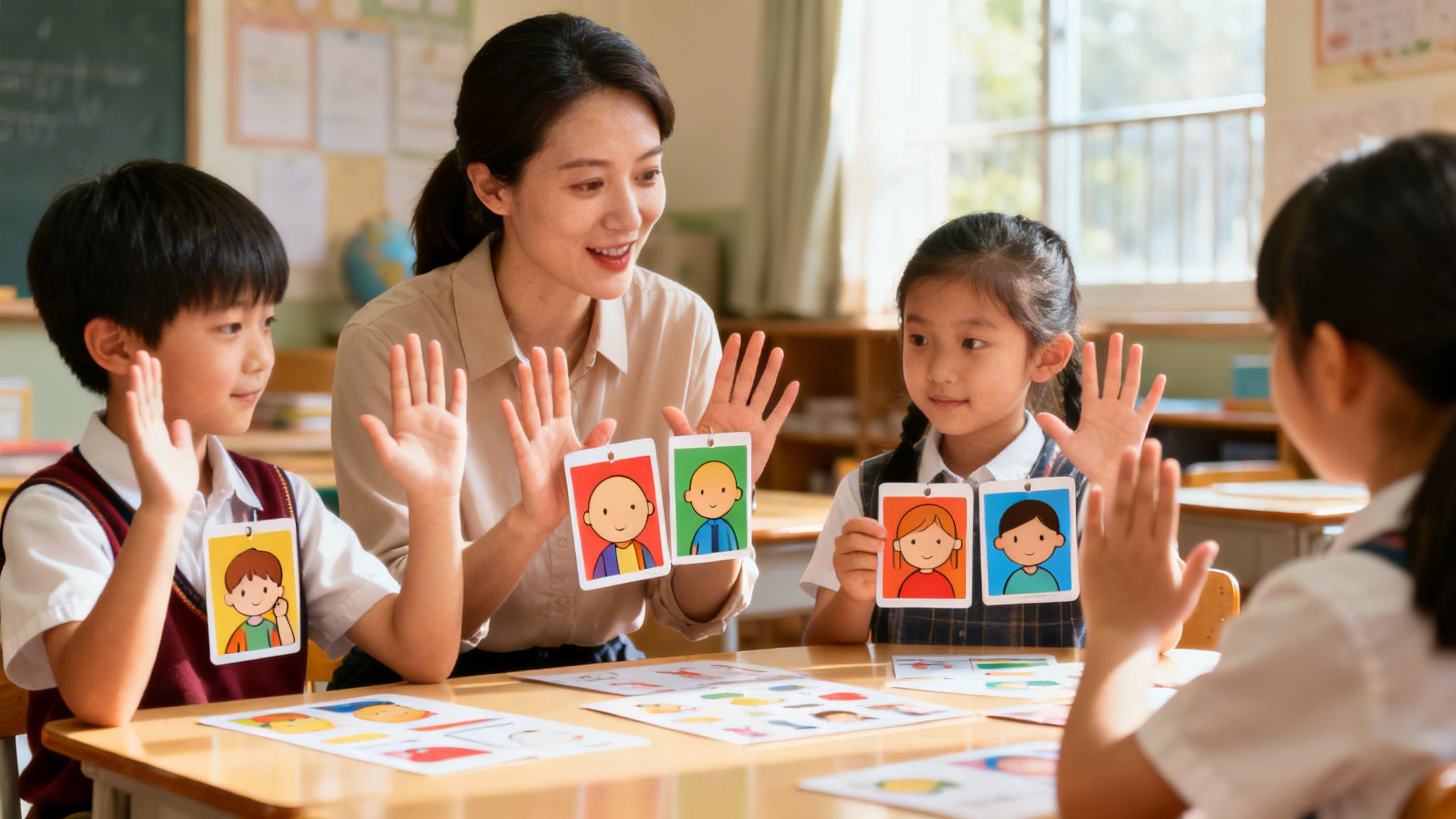
A student places their name on a mood meter. Another circles “ready,” “tired,” or “worried” on a clipboard. Younger students point to a face card. Middle schoolers may respond to a journal prompt such as, “What kind of support do you need from yourself today?”
This helps in two ways. Children practice self-awareness, and adults get early information before a hard moment explodes.
A teacher might notice:
one student picked “frustrated” before math
another chose “lonely” after a friendship issue
three students marked “tired” after a late school event
That information shapes how we teach.
Build regulation into normal routines
A calm-down corner works best when it is not treated like punishment. It should feel like a place for regulation, not exile.
Keep it simple:
Visual tools: Feeling cards, breathing prompts, or a short reset checklist
Sensory options: A soft object, coloring sheet, or quiet fidget
Re-entry language: “I’m ready to come back and try again”
For younger students, I like brief scripts. “My body is too fast. I need to slow it down.” For older students, a reflection card can help. “What happened, what am I feeling, what do I need next?”
Use conflict as instruction, not interruption
Two children argue over who got the last turn on the swing. Later, the same pattern appears over markers at a table. That is not bad luck. It is curriculum.
A simple conflict tool like a Peace Path can guide students through:
what happened
how each person feels
what each person needs
what repair looks like
For example:
“I felt mad when you cut in front.”
“I thought you were done. I should have checked.”
“Next time ask me first.”
“Okay. Do you want the next turn?”
Children need many rounds of this before it becomes natural. That repetition is the point.
Teach empathy through stories and the arts
A 2025 analysis argued that emotional intelligence should be integrated with the humanities and arts so it does not become a set of “hollow skills.” In that analysis, some CRP-EI hybrid models increased student agency by 20-30%, using narrative and history to build ethical empathy (Inside Higher Ed analysis on emotional intelligence, humanities, and student agency).
That idea is especially helpful in K-8 classrooms.
When students discuss a character’s fear, exclusion, pride, or regret, they practice perspective-taking in a safer space. In art, drama, and storytelling, they can explore emotion with less defensiveness.
Try prompts like:
“Why do you think this character hid the truth?”
“What might this scene feel like from another person’s view?”
Here is a short video that can support classroom discussion and staff reflection.
Let's be honest: we all make mistakes. A promise gets broken in the chaos of a busy week, a temper flares unexpectedly, or a responsibility is simply forgotten. These moments can sting, and it's easy to feel like you've damaged a connection with a child beyond repair.
But what if we saw these moments not as failures, but as powerful teaching opportunities? Repairing a breach of trust isn't about pretending it never happened. It's about showing a child, step-by-step, how to mend a relationship with honesty and care. And it always starts with the adult taking the first step.
Take Full Ownership and Apologize Sincerely
The single most important part of rebuilding trust is offering a genuine apology—one that’s completely free of excuses. A real apology focuses on your actions and their impact, not your intentions. Phrases like "I'm sorry, but…" or "I'm sorry you felt that way" immediately shift the blame and signal that you're not truly taking responsibility.
A sincere apology is specific and owns the action completely.
For Teachers: Instead of a vague, "I'm sorry I got frustrated," try pulling the student aside later. Say something like, "I raised my voice at you earlier, and that wasn't okay. I was feeling overwhelmed, but it's my job to manage that. I am truly sorry I spoke to you that way."
For Parents: Instead of, "I'm sorry I missed your game, I was so busy," try, "I know I promised I would be there, and I broke that promise. I am so sorry I let you down. Your game was important, and I should have made it a priority."
This kind of vulnerability shows the child you respect their feelings and are accountable for what you did. It sends a clear message: our relationship is more important than my pride.
Talk About the Impact and Make a Plan Together
After the apology, the next step is to open the door for the child to share how it felt for them. This validates their experience and helps them process the hurt. You can ask a simple, open-ended question like, “How did it feel when I did that?”
Then, just listen. Don't interrupt, explain, or get defensive. Your only job here is to show them their feelings are heard and legitimate.
Finally, you can turn a mistake into a moment of collaborative problem-solving. Work together on a plan to prevent it from happening again. For example, a parent could say, “Next time I’m feeling overwhelmed, I’m going to take three deep breaths before I speak. What’s something you could do if you notice I’m starting to get frustrated?”
This process of radical honesty and repair is the foundation of strong, resilient relationships. When a child sees you model accountability, you're giving them an invaluable roadmap for navigating their own future friendships and connections.
While trust between a teacher and a student is powerful, creating a truly trusting school environment takes more than just one-on-one connections. It means shifting the entire campus culture. It’s about moving trust from being an occasional nice moment to being the very air everyone breathes.
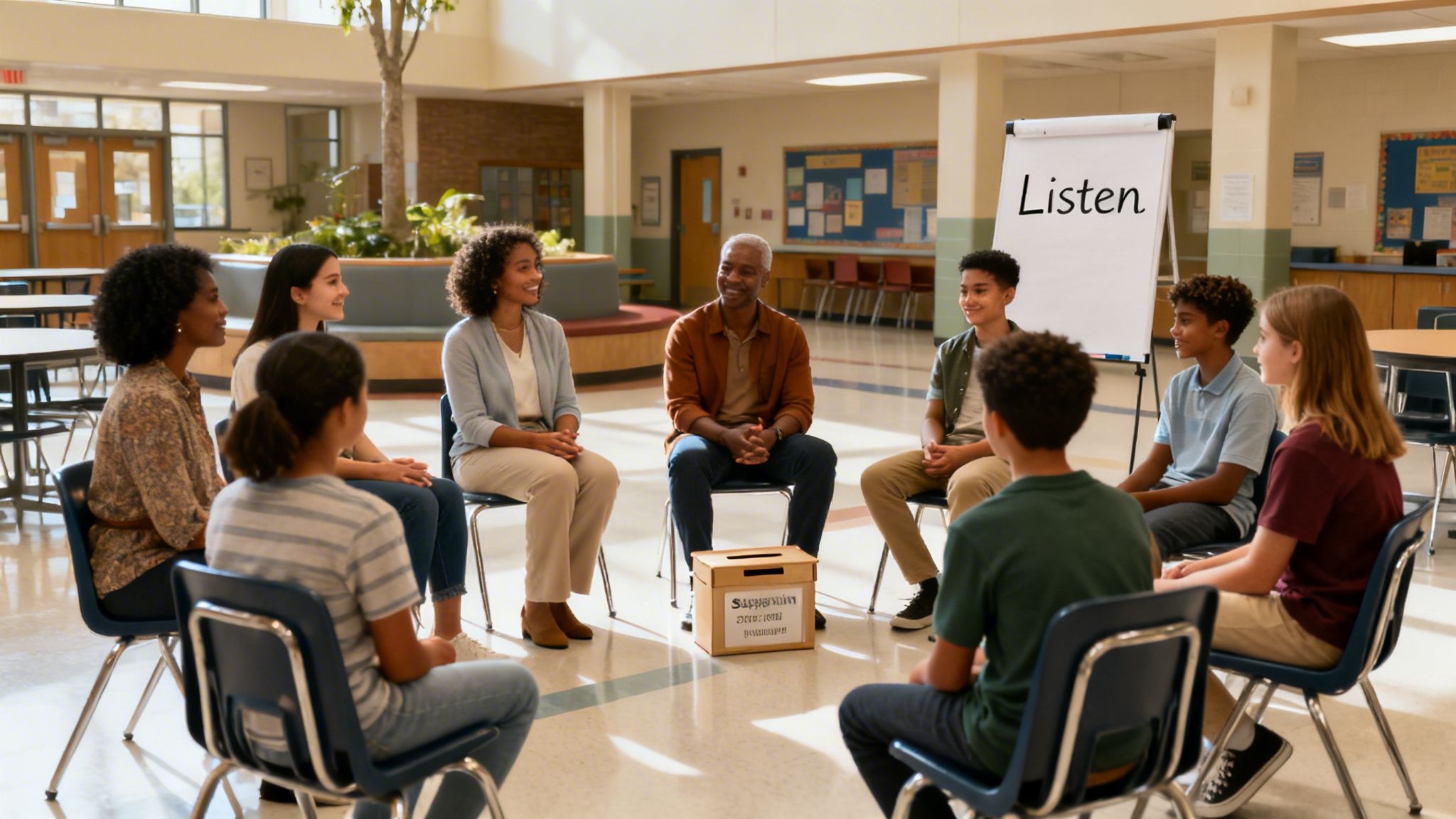
This kind of deep, systemic trust isn’t built in a single assembly or with a new poster in the hallway. It grows from consistent, school-wide practices that make psychological safety a given for every single person—students, staff, and families alike.
Model Vulnerability and Connection from the Top
If you want a culture of trust, the leadership team has to go first. When principals and administrators are open, prioritize connection, and aren't afraid to be vulnerable, they give everyone else permission to do the same. That feeling trickles down from the staff lounge right into the classrooms.
Kick off staff meetings with connection. Before you even touch the agenda, start with a simple check-in. Ask something like, “What’s one small win you’ve had this week?” or “Share something you’re feeling challenged by.” This small habit makes it normal to be human and builds real bonds between colleagues.
Meet one-on-one with your staff. Real trust isn’t built in big, formal meetings. It’s built in personal conversations. Taking the time to connect individually shows your teachers you value their perspective and creates a foundation for honest dialogue when things get tough.
In a room of twelve, people posture. One-on-one, they think out loud. They get excited. They take risks. Good leadership depends on building personal relationships that create trust.
This approach turns a group of individual educators into a genuinely collaborative team. When your staff feels seen and trusted by you, they are so much better equipped to create that same supportive space for their students. For more ideas on this, our guide on how to improve school culture is a great resource.
Create Authentic Opportunities for Student Voice
For students to trust the adults and the "system," they need to feel like they’re a real part of it. When we create genuine ways for them to give feedback, we’re sending a clear message: your opinions matter, and we’re listening. It shifts students from being passive recipients of rules to active partners in shaping their own community.
Here are a few ways to make that happen:
Student Advisory Councils: Form a representative group of students who meet regularly with school leadership. Let them talk about school climate, policies, and what’s really on their minds. For example, a council might discuss hallway traffic issues and propose a "one-way" system, which leadership then implements.
Feedback Surveys: Use anonymous surveys to get honest input on everything from the cafeteria food to how safe they feel in the hallways. The most important step? Share the results and what you’re doing about them.
A Shared Language for Conflict: Adopt a school-wide framework for resolving disagreements. When everyone—from the playground aide to the principal—uses the same tools and vocabulary, it creates consistency. Soul Shoppe programs do just this, equipping entire schools with a shared approach to communication and empathy.
By weaving these practices into the daily life of your school, trust stops being an abstract goal and becomes a structural part of your community. It’s how you build a resilient, connected campus where everyone feels they truly belong.
Common Questions About Building Trust with Students
As educators and parents, we know building trust isn't a one-and-done activity. It's a daily practice full of complex situations that can leave even the most experienced among us searching for the right approach.
When things get tricky, it’s natural to have questions. Here are a few of the most common ones we hear, along with some real-world strategies that work.
How Can I Build Trust with a Student Who Has a History of Trauma?
Building trust with a child who has experienced trauma is a delicate process that calls for extra patience, consistency, and a deep commitment to creating safety. The goal is to slowly build a foundation of security through small, predictable interactions.
It starts with the simple things. Greet them by name at the door, every single day. Notice their effort on an assignment, not just the final score. More than anything, be a reliable presence and always do what you say you will do.
A powerful way to do this is by offering choices, which helps restore a sense of control that trauma often takes away. Instead of saying, "You need to finish this worksheet now," you could try, "Would you rather start with the math problems or the reading questions?" This small shift gives them agency.
Over time, this consistent, predictable, and safe presence helps rewire their expectations of adults, creating the psychological safety they need to truly learn and connect.
What if I Make a Mistake and Break a Student's Trust?
It happens to all of us. The good news is that repairing a rupture in a relationship is not only possible but also an incredibly powerful life lesson for a child. The key is a genuine, prompt, and private apology where you take full ownership.
Acknowledging your mistake and its impact shows respect and humility. Often, this act of authentic repair strengthens a relationship even more than if the mistake had never happened in the first place.
Pull the student aside when you're both calm. You could say, "I was wrong to raise my voice earlier. I was feeling frustrated, but that's not how I should have handled it. I am sorry."
It's crucial to avoid excuses like, "I'm sorry, but you weren't listening." A clean, direct apology shows the child that your relationship is more important than your pride.
How Do I Get My Cynical Middle Schoolers to Trust Me?
Adolescent cynicism is often just a protective shield. To get past it, you have to prove you're a trustworthy adult who respects their growing need for autonomy and sees them as capable young people.
Be Authentic: Share your own appropriate struggles to show you're human. You might say, "I remember how stressful group projects were in 8th grade. Let's talk about how we can make sure everyone does their part."
Listen Actively: When they share an opinion, even one you disagree with, validate their perspective. Try saying, "I can see why you feel that way. Tell me more." It shows you're hearing them, not just waiting to talk.
Respect Their Intelligence: Avoid sarcasm, which can be easily misinterpreted as disrespect. Treat them like the smart, perceptive people they are becoming. For example, when discussing a novel, ask them for their interpretations of a character's motives instead of just telling them the "right" answer.
With middle schoolers, being fair, authentic, and respectful of their intelligence is the fastest way to earn their trust and show them you are a reliable ally.
At Soul Shoppe, we believe these skills are essential for creating thriving school communities. Our programs provide students, staff, and families with the tools to build and repair relationships, fostering empathy and psychological safety for everyone. Discover how Soul Shoppe can support your school.
In the bustling worlds of classrooms and homes, creating space for quiet reflection can feel like a luxury. Yet, it's in these moments of stillness that children begin the essential journey of understanding who they are. This guide provides eight powerful types of self discovery journal prompts specifically designed for K-8 students, transforming a simple notebook into a profound instrument for personal growth.
For teachers and parents, this is not just about giving kids writing assignments. It's about providing a structured, safe, and effective tool to cultivate critical social-emotional learning (SEL) skills like self-awareness, empathy, and resilience. We will move beyond generic questions, offering practical, age-appropriate examples and facilitation tips to help you guide learners as they explore their values, strengths, emotions, and relationships.
You will find actionable strategies to implement these prompts, including:
Age-appropriate examples for early elementary (K-2), upper elementary (3-5), and middle school (6-8).
Sample student responses to illustrate a range of possible reflections.
Quick facilitation tips for both classroom and at-home settings.
These prompts are designed to build a foundation for psychological safety, creating environments where students feel seen, valued, and ready to thrive. This resource will equip you to turn a blank page into a meaningful opportunity for connection, self-understanding, and lasting insight.
1. The Values Clarification Prompt
A foundational exercise in self-awareness, the Values Clarification Prompt guides individuals to identify their core principles. This is more than just picking words from a list; it’s an introspective process of connecting personal beliefs to real-life experiences. By reflecting on moments of pride, authenticity, or deep satisfaction, students and adults can uncover what truly matters to them. This understanding forms the bedrock of personal identity and influences future decisions.
This prompt is a powerful tool for social-emotional learning, helping students navigate the complex social dynamics of school. As emphasized in the research of Brené Brown and frameworks from CASEL, living in alignment with one's values is central to well-being and resilience.
Why This Prompt Works
The strength of this prompt lies in its connection to concrete memories. It asks learners not to think about abstract ideals but to mine their own history for evidence of their values in action. This makes the concept of "values" tangible and personal, rather than a theoretical school lesson.
By anchoring values to specific past moments, students can see that their principles are not just ideas they hold, but truths they have already lived. This builds a strong, evidence-based sense of self.
How to Use This Prompt: Examples and Adaptations
This exercise can be adapted for various ages and settings, making it one of the most flexible self discovery journal prompts available.
For Lower Elementary (Grades K-2): Use simplified language. Ask, “Think of a time you felt super happy and proud of yourself. What were you doing? Who were you with?” After they share, you can help them name the value: “It sounds like helping your friend was really important to you. That’s called kindness.”
Practical Example: A teacher asks a 1st grader this prompt. The student draws a picture of themself giving a classmate a bandage on the playground. The teacher says, "You felt proud when you helped them. That shows you value being a caring friend."
For Upper Elementary (Grades 3-5): Introduce a list of value words (e.g., honesty, respect, creativity, friendship). Prompt them: “Write about a time you felt most like the ‘real you.’ What was happening? Look at this list. Which of these words best describes what was important to you in that moment?”
Practical Example: A 4th-grade student writes, "I felt like the real me when I showed my comic book to my friends, even though I was nervous. That felt like courage."
For Middle School (Grades 6-8): Students can handle more complex reflection. Use a two-part prompt:
“Describe a time you were proud of a choice you made, even if it was difficult.”
“What does this story tell you about what you believe is most important?”
Practical Example: A 7th grader writes about choosing not to join in when friends were gossiping. Their reflection might be: "It was hard, but it shows I value loyalty and respect for people, even when they aren't around."
For Caregivers at Home: Journal alongside your child. Share a story about a time you stood up for one of your values, like integrity or family. This modeling shows that identifying values is a lifelong process.
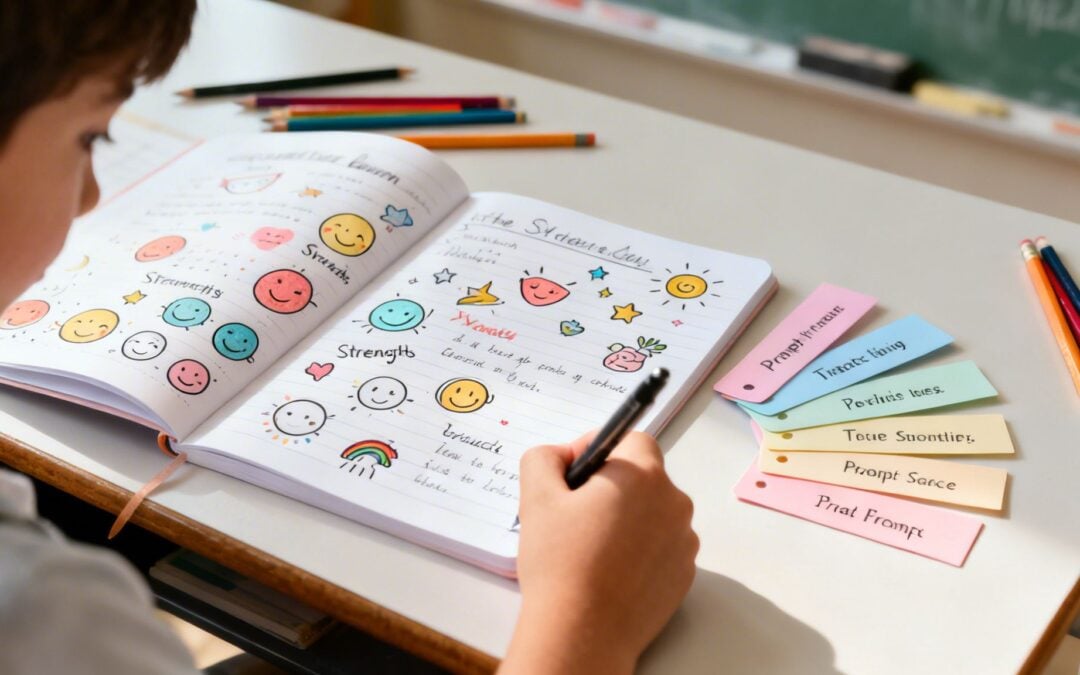
2. The Strengths and Superpowers Inventory
This empowering exercise shifts focus from deficits to assets, guiding individuals to identify personal strengths and talents they often undervalue. Instead of asking "what's wrong with me," this prompt encourages students and adults to catalog their 'superpowers'—both obvious talents and hidden strengths. This asset-based approach builds a positive self-concept by helping individuals recognize the unique value they bring to their communities.
Popularized by positive psychology pioneers like Martin Seligman and frameworks from Marcus Buckingham, this prompt is a core component of many asset-based educational approaches. By inventorying strengths, learners develop a vocabulary to describe their capabilities, which is a foundational step in building self-esteem and resilience.
Why This Prompt Works
The power of the Strengths and Superpowers Inventory lies in its concrete, evidence-based approach to self-worth. It encourages learners to move beyond vague feelings and identify specific, observable abilities. This process makes abstract concepts like "confidence" tangible by connecting them to real-world skills, whether it's a knack for making people laugh or a talent for organizing group projects.
When a student can name their strengths, like "I am a good listener" or "I am persistent," they are building a mental toolkit they can draw from during challenging times. It reframes their identity around what they can do, not what they can't.
How to Use This Prompt: Examples and Adaptations
This inventory is one of the most affirming self discovery journal prompts and can be easily adapted for any age. It’s a great way to kick off group activities and build a positive classroom culture.
For Lower Elementary (Grades K-2): Use the "superpower" metaphor. Ask, “If you were a superhero, what would your special power be? Is it being a super helper? A super-fast runner? A super kind friend?” Create a class poster with drawings of each child's superpower.
Practical Example: A kindergartener says her superpower is "making people smile." The teacher can respond, "That's a wonderful superpower! It's called humor or cheerfulness."
For Upper Elementary (Grades 3-5): Have students create a "Strengths Resume." Prompt them: “List three things you are good at, inside or outside of school. For each one, write a sentence about a time you used that strength.” Strengths could include humor, creativity, or being a loyal friend.
Practical Example: A student's resume might include: "Strength: Problem-solving. Example: I figured out how to fix our Lego tower when it kept falling over."
For Middle School (Grades 6-8): Introduce more nuance. Use a prompt like:
“Describe something you do that seems to come easily to you, even if others find it difficult.”
“What is a non-academic skill you have that you are proud of (e.g., patience, problem-solving, empathy)?”
Practical Example: An anxious student might identify that their "worry" is actually a strength in careful planning and attention to detail, writing, "I worry a lot about group projects, but it means I always make sure we have everything we need before we start."
For Caregivers at Home: Regularly "catch" your child using their strengths. Say, "I saw how you kept trying with that puzzle even when it was hard. That's your persistence superpower showing up!" This external validation is a key part of many effective self-esteem building activities.
3. The Emotion Explorer and Mindfulness: Understanding Feelings, Triggers, and Present-Moment Awareness
This dual-focus exercise develops both emotional literacy and present-moment awareness. It guides individuals to identify, name, and understand their feelings, patterns, and triggers while simultaneously practicing non-judgmental observation of their current experience. By combining journaling with mindfulness, learners build a detailed map of their inner world, see the links between thoughts and feelings, and create the crucial space needed to choose thoughtful responses over automatic reactions.
This approach draws on foundational concepts from Daniel Goleman's work on emotional intelligence and Jon Kabat-Zinn's Mindfulness-Based Stress Reduction (MBSR). Journaling actively promotes present-moment awareness and emotional regulation, aligning perfectly with the principles of mindfulness and overall well-being.
Tips for Success
Practice When Calm: The most critical tip is to introduce and practice these exercises when children are happy and relaxed. It's a skill that must be learned before it can be used in a moment of anger.
Use Visual Cues: Use your hands to "hold" the imaginary hot chocolate or flower. For "Bubble Breaths," you can use a real bubble wand to show how a slow, steady exhale creates the best bubbles.
Name the Feeling: When a child is upset, calmly say, "You look so frustrated. Your body is tight. Let's try our Hot Chocolate Breaths together to help your body feel calm again." This connects the technique directly to the feeling. For instance, if a child is crying because their block tower fell, you can get down to their level and say, "That is so sad and frustrating. I see your fists are clenched. Let's blow out some imaginary birthday candles to help those feelings move."
By making breathing exercises a playful and consistent part of their day, you are giving preschoolers a foundational life skill for emotional regulation. To explore a core technique in more detail, you can get practical tips from our guide on the belly breathing technique.
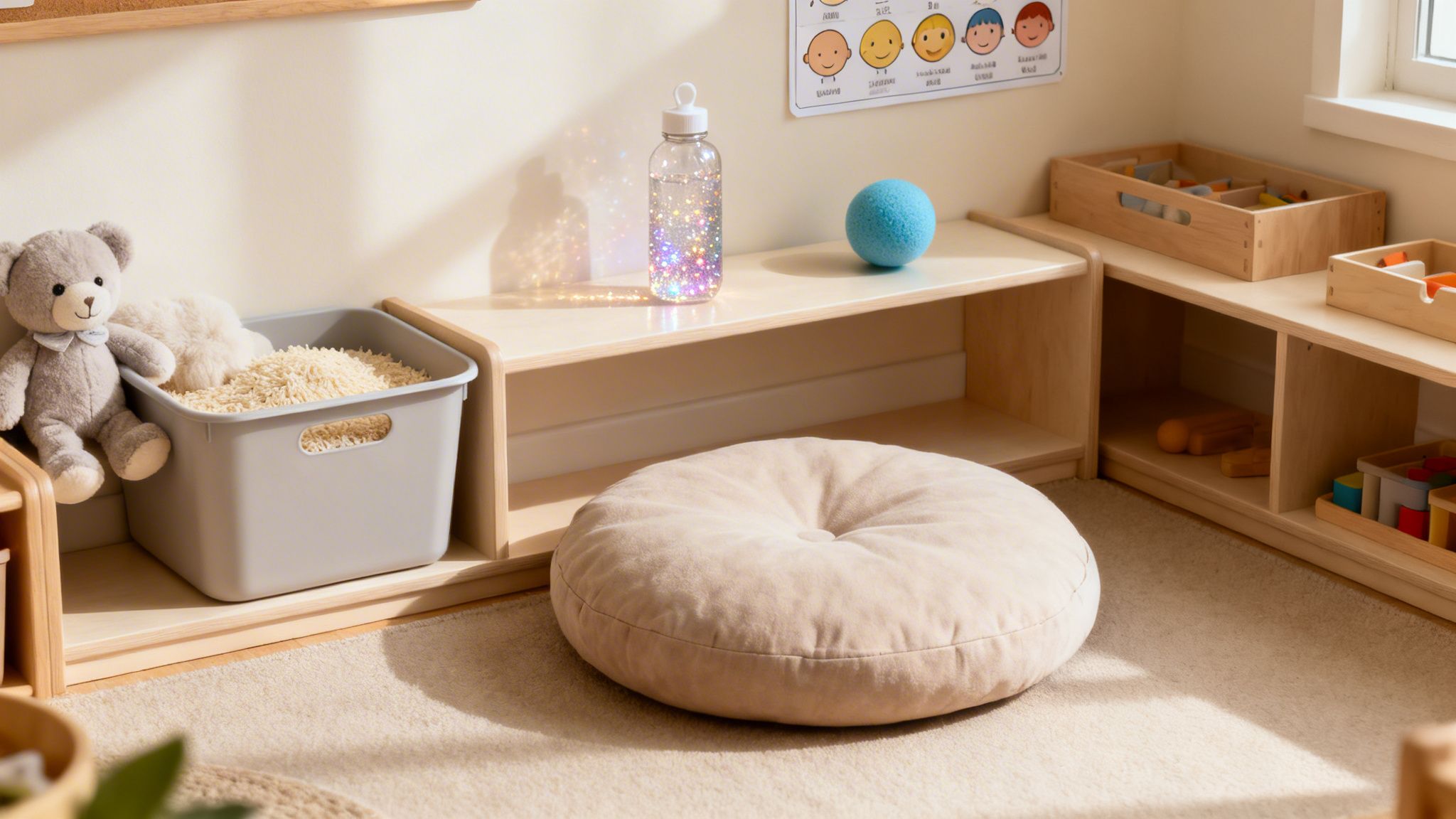
Creating a designated calm corner or sensory station gives preschoolers a safe, independent space to go when they feel overwhelmed by anger. This physical area, stocked with carefully chosen sensory tools, is one of the most effective anger management activities for preschoolers because it honors their individual sensory needs and empowers them to self-regulate. It moves the focus from punishment for big feelings to providing support for them.
These spaces, often called 'peace corners' in Montessori schools, offer a multisensory approach that addresses diverse regulatory styles. One child may need to squeeze a stress ball (proprioceptive input), while another may need to watch a glitter jar settle (visual input). Providing these options gives children agency and teaches them a critical life skill: how to recognize what their body needs and take action to feel better.
How It Works
A calm corner is not a "time-out" spot; it is a "time-in" space for self-regulation. It is a quiet, comfortable area in the classroom or home filled with tools that help a child's nervous system return to a state of calm. The items provide tactile, visual, auditory, and proprioceptive input that can de-escalate feelings of frustration, overstimulation, and anger.
The goal is for children to learn to recognize their rising anger and voluntarily use the space to manage their emotions before they become explosive. For example, a child who feels themselves getting "hot" might choose to go to the corner and knead play-doh, redirecting their physical energy in a safe way.
Key Insight: This activity teaches children that their big feelings are acceptable and that they have the power to manage them. The corner is a tool, not a punishment, which builds internal motivation for self-regulation.
Implementation Guide
Objective: To provide a safe, accessible space with sensory tools that help preschoolers self-soothe and manage feelings of anger independently.
Materials: A soft rug or cushion, a small tent or canopy for privacy, and a variety of sensory items like: squishy balls, play-doh, sensory bins (with rice or beans), glitter jars, headphones with calming music, soft blankets, and textured books.
Step-by-Step:
Co-Create the Space: Involve the children in designing the corner. Let them help pick the spot and decorate it. Ask, "What things help you feel calm? What colors feel peaceful?" This builds ownership and makes the space more inviting.
Introduce During Calm Times: Present the calm corner as a special, wonderful place. During a circle time, say, "This is our new Calm Corner! It's a place we can go when our bodies feel too busy or our hearts feel upset." Let them explore the items freely when they are relaxed.
Model and Role-Play: Demonstrate how to use the space. You might say, "I'm feeling a little frustrated because my blocks fell over. I think I'll go to the calm corner and look at the glitter jar to help my body feel better." Role-play a scenario: "Let's pretend Leo is feeling angry because it's time to clean up. What could Leo do in the calm corner to help his body feel ready?"
Guide, Don't Force: When you see a child struggling, gently suggest the corner. "You seem upset. Would you like to go to the calm corner and squeeze the squishy ball for a few minutes?"
Tips for Success
Rotate the Items: Keep the station engaging by rotating the sensory tools every few weeks. Novelty prevents boredom and encourages exploration.
Label with Pictures: For pre-readers, use picture labels on bins and shelves. This helps them find what they need independently and builds pre-literacy skills.
Observe and Adapt: Pay attention to which items children use most. If everyone loves the play-doh but ignores the textured books, swap the books for something else.
Home Adaptation: A calm corner at home can be as simple as a basket of sensory toys in a quiet part of a room. Parents can say, "Let's take a break with your calm basket," when they notice frustration building during playtime. For example, before a tantrum over screen time ending, a parent could say, "I know you're sad the show is over. Let's go to your calm corner and build with the magnetic tiles for five minutes."
Sensory stations are powerful because they directly address how a child’s brain and body experience stress. To explore this connection further, see how you can apply these principles with a simple 5 senses activity that helps ground children in the present moment.
4. Angry Feelings Picture Books and Bibliotherapy
Using picture books to explore big emotions, a practice known as bibliotherapy, is a gentle yet powerful anger management activity for preschoolers. Stories provide a safe distance for children to observe characters who are feeling angry, which normalizes the emotion and models a variety of coping strategies. This approach builds emotional vocabulary, empathy, and problem-solving skills in a low-pressure, engaging way.
When a child sees a beloved character like Sophie from When Sophie Gets Angry feel overwhelmed, it validates their own feelings. Discussing the story afterward helps them connect the character's experience to their own life, giving them language for their emotions and ideas for what to do when they feel that "roaring, red-hot" anger.
How It Works
Bibliotherapy for young children involves reading a story that features a specific emotional challenge and then facilitating a discussion that helps them process it. The narrative acts as a mirror, reflecting the child's own potential feelings, and as a window, showing them how others might handle similar situations. This process turns a simple storytime into a meaningful social-emotional learning opportunity.
By asking thoughtful questions, you guide children to think critically about emotions and behavior. This is not about finding the "right" answer but about exploring possibilities. For instance, you can discuss what a character did, what else they could have tried, and how their actions affected others.
Key Insight: Stories create a "third space" where children can talk about a character's anger without feeling the shame or pressure of talking directly about their own. This makes it a perfect entry point for discussing difficult emotions.
Implementation Guide
Objective: To use children's literature to normalize anger, teach emotional vocabulary, and model healthy coping strategies.
Materials: A curated selection of age-appropriate books about anger, such as When Sophie Gets Angry by Molly Bang, The Color Monster by Anna Llenas, or In My Heart: A Book of Feelings by Jo Witek.
Step-by-Step:
Select a Relevant Book: Choose a book that depicts anger in a relatable way. Ensure the illustrations and story are clear and not overly frightening.
Read with Intention: Read the story once through for enjoyment. On a second or third reading, pause at key moments. Use your tone of voice to match the character's feelings to make the emotion more tangible. For example, when reading about a character getting angry, you might speed up your words and speak a little louder, then slow down and soften your voice as they calm down.
Ask Open-Ended Questions: After reading, start a conversation. Ask questions like, "How do you think the little bear was feeling on this page? What made him so angry?" and "What did he do to calm down? Have you ever tried that?"
Connect to Their World: Bridge the story to their own lives. Say, "I remember you felt frustrated yesterday when the blocks fell over. The rabbit in our story also got frustrated. What could we do next time that happens?"
Act It Out: Use dramatic play to re-enact scenes. Let children take on the role of the angry character and practice the coping strategy from the book, like taking a deep breath or finding a quiet corner.
Tips for Success
Repeat and Revisit: Preschoolers thrive on repetition. Reading the same book multiple times allows for deeper understanding and new conversations as they become more familiar with the story.
Choose Diverse Books: Select books that show a range of characters from different backgrounds and feature various coping strategies, from physical actions like stomping feet to quiet activities like drawing.
Create a "Cozy Corner Library": Designate a small, comfortable area in the classroom or home with a basket of "feelings books" that children can access independently when they need a moment.
Home Adaptation: Send books home on a rotating basis with a simple activity sheet. A prompt like, "Talk about a time you felt like the grumpy squirrel. Draw what helped you feel better," can involve families in the learning process.
5. Movement and Physical Activity for Anger Release
When a preschooler feels angry, their body often fills with a surge of physical energy. Structured movement is one of the most effective anger management activities for preschoolers because it provides a safe, constructive way to release this energy. Instead of suppressing the physical sensations of anger, activities like dancing, jumping, or stomping help children channel them into productive motion.
This approach teaches children that the physical feelings of anger are normal and manageable. By giving them a designated way to "get the wiggles out," we help them process stress hormones and connect with their bodies without resorting to hitting, kicking, or other aggressive behaviors.
How It Works
Structured physical activity gives anger a job to do. When a child feels overwhelmed, their fight-or-flight response is activated. Vigorous movement helps complete this stress cycle, allowing their nervous system to return to a calmer state. Activities like a designated "angry dance," stomping walks, or squeezing a foam ball provide immediate physical and sensory feedback.
Following these high-energy moments with a calming cool-down, such as stretching or deep breathing, teaches a crucial self-regulation skill: how to shift from a state of high arousal to one of rest and recovery. This helps build the mind-body connection.
Key Insight: Movement doesn't just burn off energy; it helps a child's brain and body process the physiological experience of anger, turning a potentially destructive impulse into a constructive action.
Implementation Guide
Objective: To provide a safe and acceptable physical outlet for the energy that accompanies anger, and to teach children how to transition from high energy back to a calm state.
Introduce the Concept: During a calm moment, explain the idea. Say, "Sometimes our bodies feel full of angry energy, like a shaken-up soda bottle. It’s okay to feel that way! We can do a 'Stomping Walk' or an 'Angry Dance' to let that energy out safely."
Designate a Safe Space: Identify an area where vigorous movement is okay, like a corner with soft mats, an outdoor space, or a clear area in a room. This boundary is crucial for safety.
Model the Movements: Demonstrate specific, acceptable actions. Show them how to stomp their feet like a dinosaur, punch a pillow, or jump up and down. Frame it positively: "Let’s help our bodies get the mad feelings out!"
Practice and Cool Down: Turn on some upbeat music for a short "energy release" session. After a minute or two of vigorous activity, transition to slower, calmer music and lead them through cool-down stretches or breathing exercises. For example, after an "angry dance," say, "Great dancing! Now let's pretend we are melting ice cream. Slowly, slowly, let's melt all the way to the floor."
Tips for Success
Frame as Healthy, Not Punitive: Never present movement as a punishment (e.g., "Go run until you calm down"). Instead, use inviting language like, "Your body has a lot of energy right now. Let's go to the movement spot and let it out together."
Integrate into Routines: Use short movement breaks during transitions, which can be challenging times for preschoolers. A quick session of jumping jacks can preempt frustration.
Home Adaptation: Parents can create an "energy release kit" with a soft foam ball to squeeze and a special playlist for "dance it out" moments. For example, engaging in various motor skills activities for preschoolers can provide a healthy outlet for pent-up energy and help improve coordination, which can indirectly aid in self-regulation.
6. Creative Art Expression and Anger Artwork
Creative art expression provides a powerful nonverbal outlet for preschoolers to process anger. Open-ended art activities like painting, drawing, or sculpting allow children to externalize big feelings in a safe, tangible way. This makes it one of the most effective anger management activities for preschoolers, as it validates their emotions without needing complex vocabulary and produces a concrete artifact they can reflect on later.
This method helps children channel their physical energy and emotional intensity into a creative act. Instead of suppressing anger or acting it out destructively, they learn to transform it. The focus is on the process of creation, not the final product, giving them a healthy and constructive way to explore what they are feeling.
How It Works
This activity works by connecting physical action to emotional release. The vigorous brush strokes of painting, the forceful squeezing of clay, or the quick, sharp lines of a crayon drawing can mirror the physical sensations of anger. This tactile and visual process helps externalize the emotion, making it feel less overwhelming and more manageable.
Creating "anger artwork" allows a child to give their feeling a shape, color, and form. Afterward, the artwork can serve as a talking point. A teacher or parent can ask gentle, open-ended questions about the piece, helping the child build a narrative around their experience and connect their feelings to the events that caused them.
Key Insight: The value of anger artwork is not in its aesthetic quality but in its function as a bridge between a nonverbal emotional experience and verbal processing. It gives a child something concrete to point to and say, "This is what my anger looks like."
Implementation Guide
Objective: To provide a nonverbal, physical, and creative outlet for preschoolers to express and process feelings of anger.
Materials: Washable tempera paints, large sheets of paper, thick brushes, modeling clay or play-doh, chunky crayons or markers, collage materials (scrap paper, fabric scraps, glue sticks).
Step-by-Step:
Set Up an Invitation: Create an inviting art station, perhaps in a calm-down corner or a designated art area. Lay out the materials on an easel or a covered table.
Offer Minimal Direction: When a child is feeling angry or frustrated, guide them to the art station. Say something simple like, "It looks like you have some big feelings. Would you like to paint your anger?" or "Here is some clay you can squeeze and pound."
Allow for Free Expression: Let the child lead the way. Avoid giving instructions like "Use this color" or "Draw a picture of what happened." The goal is pure, unfiltered expression. Vigorous, messy, and bold actions are welcome and part of the process.
Engage After Creation: Once the child seems calmer and has finished their artwork, open a gentle dialogue. Ask, "Can you tell me about your art?" or "What's happening in this picture?" For example, if they used a lot of red, you might say, "I see a lot of powerful red here. That looks like a very strong feeling."
Tips for Success
Embrace Boldness: Use large paper and provide thick paints and brushes to encourage big, physical movements. Don't worry about the mess; focus on the expression.
Offer Texture Variety: Different textures appeal to different children. Some may find squeezing clay more satisfying, while others prefer the smooth glide of paint. When encouraging preschoolers to express their anger through art, consider incorporating structured yet flexible creative art projects for preschoolers.
Home Adaptation: Designate an "angry art" box at home with special crayons or a specific notepad. When a child is upset, they can go to their box. Families can also keep a portfolio of this artwork to look back on, noticing patterns or progress over time.
7. Positive Discipline and Restorative Practices Conversations
Shifting the focus from punishment to learning, restorative conversations are a cornerstone of positive discipline. This approach guides preschoolers through their big feelings after an outburst, helping them understand the situation, their emotions, and the impact of their actions on others. It is one of the most meaningful anger management activities for preschoolers because it teaches accountability, empathy, and problem-solving skills instead of simply punishing a behavior.
These conversations are not about blame but about repair. By creating a safe space for reflection, adults help children connect their feelings to their actions and discover more constructive ways to handle anger in the future. This method builds a child's internal moral compass and strengthens the parent-child or teacher-child relationship.
How It Works
Positive discipline and restorative practices use guided, curious questioning to help a child process an anger-driven incident after they have calmed down. Instead of asking "Why did you do that?", which can feel accusatory, the focus is on understanding and healing. The conversation moves from what happened to how everyone felt, what was needed, and how to make things right.
This method transforms conflict into a teachable moment. For example, after a conflict over a toy, a restorative conversation helps both children express their feelings and work together on a solution, such as taking turns or finding another toy.
Key Insight: The goal is connection before correction. By validating the child's anger ("It's okay to feel mad") while setting a boundary on the action ("but it's not okay to hit"), you teach that all feelings are acceptable, but not all behaviors are.
Implementation Guide
Objective: To help preschoolers reflect on their anger, understand its impact on others, and learn how to repair relationships and solve problems constructively.
Materials: A quiet, private space; a calm and regulated adult.
Step-by-Step:
Wait for Calm: Never initiate a restorative conversation in the heat of the moment. Wait until the child is completely calm and regulated. This might be 10 minutes or an hour later.
Find a Private Space: Choose a neutral, comfortable setting where you won't be interrupted. Sit at the child's level to create a feeling of safety and respect.
Start with Curiosity: Begin with an open, non-judgmental tone. Say something like, "I saw what happened earlier and wanted to check in. Can you tell me about it?"
Use Guided Questions: Gently guide the child through reflection with key restorative questions:
"What happened?" (Let them tell their story.)
"What were you feeling right before that happened?" (Helps connect feeling to action.)
"How do you think [the other person] felt when that happened?" (Builds empathy.)
"What can we do to make things better?" (Promotes accountability and repair.)
Brainstorm and Co-create Solutions: Help the child think of a way to make amends. This could be a hug, a drawing, helping to fix a broken toy, or simply saying, "I'm sorry I pushed you. Can we play?"
Tips for Success
Validate the Emotion: Always start by acknowledging the feeling. "I can see you were very angry when your block tower fell down." This shows the child they are understood.
Focus on Repair, Not Punishment: The outcome should be about fixing the harm done, not about a punitive consequence. The natural consequence is having to repair the relationship. For example, if a child scribbled on their sibling's drawing out of anger, the repair isn't a time-out; it's helping their sibling make a new drawing.
Model the Process: When you, as the adult, make a mistake, model a restorative apology. "I'm sorry I raised my voice. I was feeling frustrated. Next time, I will take a deep breath."
This approach helps children build essential life skills. To see how these principles are applied in group settings, you can learn more about how to implement restorative circles in schools.
8. Family Engagement and Home-School Consistency Strategies
Creating a united front between home and school is a powerful strategy for reinforcing emotional learning. When parents and caregivers use the same anger management language and tools as educators, it provides a consistent, predictable environment for preschoolers. This approach validates a child's learning by showing that these skills are important everywhere, not just in the classroom.
This alignment transforms isolated lessons into a shared culture of emotional awareness. It empowers families to become active partners in their child's social-emotional development, extending the benefits of anger management activities for preschoolers far beyond school hours and building a stronger community around the child.
How It Works
Home-school consistency involves equipping parents with the same knowledge, vocabulary, and strategies used in the classroom. This is achieved through a variety of resources, such as parent workshops, take-home toolkits with printable breathing cards, and regular communication that shares specific techniques.
When a child learns to use a "calm-down corner" at school, a similar space at home reinforces the strategy. If a teacher uses the phrase "I see you're in the red zone, let's take a dragon breath," and a parent uses the same phrase later that day, the child's brain makes a stronger connection, making the skill easier to access during a moment of anger.
Key Insight: Consistency is the bridge that turns a classroom activity into a life skill. When a child hears the same emotional language at home and school, the concepts become deeply ingrained and more accessible during moments of high emotion.
Implementation Guide
Objective: To create a consistent emotional support system for preschoolers by aligning the strategies used at home and school, reinforcing emotional regulation skills.
Materials: Printable resources (e.g., feeling thermometers, breathing exercise cards), parent newsletters, digital communication apps, workshop presentation materials.
Step-by-Step:
Host Family Workshops: Offer workshops that teach parents the core anger management strategies you use. Cover topics like co-regulation, validating feelings, and setting up a "peace corner" at home. Offer them at various times (mornings, evenings) to accommodate different schedules.
Create 'Take-Home Toolkits': Assemble simple kits for families. Include a laminated feelings chart, a few illustrated breathing technique cards, and a one-page guide explaining how to use them.
Establish a Communication Rhythm: Send a weekly or monthly newsletter. Each edition can highlight one specific strategy, such as "This week, we are practicing 'smelling the flower, blowing out the candle' breaths when we feel frustrated."
Use a Home-School Log: For children needing extra support, a simple communication log can be very effective. A teacher might note, "Sam used the glitter jar to calm down today," giving the parent a specific success to build on at home. The parent could write back, "We practiced our hot chocolate breathing at bedtime, and it worked well!"
Tips for Success
Keep it Simple: Parents are busy. Provide tools that are easy to understand and can be used immediately without much preparation. One-page guides are more likely to be used than lengthy handbooks.
Celebrate Parent Efforts: Acknowledge and praise parents for their partnership. Create a parent support group or a section in the newsletter where families can share what's working for them.
Provide Accessible Materials: Offer all resources in multiple languages and consider different literacy levels. Use visuals and videos to convey concepts whenever possible. For an example of how to build a comprehensive program, see how Soul Shoppe's family engagement model supports schools.
Preschool Anger Management: 8-Strategy Comparison
Intervention
Implementation complexity
Resource requirements
Expected outcomes
Ideal use cases
Key advantages
Feelings Thermometer Activity & Check-In Circles
Moderate — needs routine and skilled facilitation
Low–Moderate — visual tools, regular time block
Better emotional identification, early intervention, stronger classroom community
Daily morning meetings, preschool classrooms, family check-ins
Concrete visual scale; builds shared language and belonging
Breathing and Mindfulness Exercises (Calm Down Breathing)
Low–Moderate — requires modeling and practice
Minimal — time, optional audio/video
Immediate calming, improved self-regulation, increased body awareness
Transitions, individual practice, group calming moments
Evidence-based, immediately accessible without props
Promotes repair over punishment; builds empathy and responsibility
Family Engagement and Home-School Consistency Strategies
High — coordination, outreach, sustained follow-through
High — staff time, workshops, materials, translation
Greater consistency of strategies, extended learning, stronger partnerships
Whole-school SEL initiatives, vulnerable families, scaling programs
Amplifies impact across environments; empowers caregivers to reinforce skills
Building a Community of Calm and Connection
Guiding preschoolers through the powerful emotion of anger is one of the most fundamental tasks we undertake as educators, administrators, and caregivers. The collection of anger management activities for preschoolers detailed in this article-from building a Feelings Thermometer to engaging in restorative conversations-is not about suppressing a "bad" emotion. Instead, it’s about building a robust emotional vocabulary and a toolkit of healthy coping mechanisms that will serve children throughout their entire lives.
The journey to emotional regulation is a marathon, not a sprint. Consistency and patience are your most important allies. A single breathing exercise or one session in a Calm Corner will not instantly resolve every outburst. True progress comes from embedding these practices into the daily rhythm of the classroom and home, creating a predictable and safe environment where all feelings are acknowledged and validated.
From Individual Skills to a Shared Culture
The real power of these strategies is unlocked when they move beyond isolated activities and become part of a shared culture. When a teacher uses the same "Calm Down Breathing" technique that a parent reinforces at home, the child receives a unified message of support. This consistency is critical for preschoolers, who thrive on predictability.
Consider the ripple effect:
A child who learns to identify their anger level on a Feelings Thermometer can ask for help before an explosive moment, preventing disruption and building self-awareness.
A classroom that regularly uses bibliotherapy with stories about anger normalizes the feeling, reducing shame and encouraging open discussion among peers.
A school that adopts restorative practices shifts the focus from punishment to understanding, teaching children that their actions have an impact and giving them a chance to make things right.
This collective approach transforms a set of individual anger management activities for preschoolers into a community-wide commitment to emotional well-being. It sends a clear message to children: "Your big feelings are welcome here, and we will help you learn how to handle them."
The Long-Term Impact of Early Intervention
The skills children develop through these activities extend far beyond managing tantrums. They are laying the foundation for critical life competencies. A preschooler who can take a deep breath instead of hitting is learning impulse control. A child who uses "I feel…" statements is practicing assertive communication. A student who participates in a restorative circle is developing empathy and problem-solving skills.
Key Takeaway: The goal is not to raise children who never get angry. The goal is to raise children who know what to do with their anger. We are equipping them to face future challenges-disagreements with friends, academic frustrations, and personal disappointments-with resilience and emotional intelligence.
By intentionally teaching these skills, we are proactively building a more compassionate and connected school community. Children who feel understood and have the tools to manage their emotions are better learners, kinder friends, and more engaged citizens of the classroom. This work is the bedrock of creating a positive school climate, reducing behavioral issues, and fostering an environment where every child can thrive academically and socially. The investment you make today in teaching these foundational skills will pay dividends for years to come, shaping more empathetic and self-aware adults.
Ready to bring a structured, school-wide approach to social-emotional learning into your community? Soul Shoppe provides the programs, training, and resources that turn these powerful anger management activities for preschoolers into a cohesive and sustainable culture of peace. Explore our evidence-based programs and see how we can help you build a safer, more connected school at Soul Shoppe.