

Emotional intelligence in education: Emotional Intelligence
A student crumples a math paper, shoves the pencil to the floor, and says, “I can’t do this.” The room tightens. Another child stares. A teacher has about five seconds to decide whether this is defiance, avoidance, embarrassment, or pure overload.
Most of us have lived some version of that moment.
When I think about emotional intelligence in education, I do not think first about theory. I think about those ordinary school-day moments when a child’s feelings either block learning or open the door to it. I think about the student who looks “unmotivated” but is really afraid of getting it wrong, the child who grabs a marker because they do not yet have language for frustration, and the adult who wants to help but is running on empty.
Emotional intelligence gives us a workable path. It helps children notice what they feel, name it, regulate it, and respond in ways that protect both learning and relationships. It also helps adults create classrooms where students feel safe enough to try again. The work becomes practical here. Not abstract. Not one more initiative. Practical.
Why Emotional Skills Are the New Foundation for Learning
A second grader loses a game at recess and comes back furious. He bumps his chair, snaps at a classmate, and refuses to open his reading folder. If we only look at behavior, we may see disrespect. If we look one layer deeper, we often see a child whose nervous system is still stuck in the loss from ten minutes ago.
That is why emotional skills matter so much. They are not extra. They are the conditions that help academic instruction land.
A child who cannot settle after disappointment will struggle to listen to directions. A child who does not know how to ask for help may avoid work altogether. A child who assumes every correction means “I’m bad at school” will start protecting themselves instead of taking risks.
What this looks like in real school life
Teachers see it every day:
- During independent work: A student shuts down after one mistake.
- During partner work: Two children argue because neither knows how to disagree calmly.
- During transitions: Noise, crowding, and uncertainty push a student into tears or anger.
- During assessment: Anxiety takes over, even when the student knows the material.
Parents see the same pattern at home.
- At homework time: “This is stupid” really means “I feel overwhelmed.”
- After school: Meltdowns often come after a full day of holding it together.
- With siblings: Grabbing, yelling, or blaming can signal weak self-regulation, not bad character.
Emotional intelligence gives adults a way to respond with both compassion and clarity. We can teach skills instead of just reacting to symptoms.
A useful reframe for adults is this. “What skill is missing right now?” That question often leads to better support than “What punishment fits this behavior?”
Children do not become resilient because we ask them to “calm down.” They become resilient because we repeatedly show them how.
Understanding Emotional Intelligence in an Educational Context
Emotional intelligence is a child’s ability to recognize feelings, understand what those feelings are signaling, manage emotional responses, and relate well to other people. In school, I like to describe it as an emotional toolkit.
A strong toolkit helps a student do things like:
- notice “I’m getting frustrated”
- pause before blurting out
- recover after a mistake
- read a classmate’s facial expression
- ask for help without shame
- solve a conflict without making it bigger
IQ and emotional intelligence are not competitors. They work together. IQ may help a student understand the lesson. Emotional intelligence helps the student stay present long enough to use what they know.
Why it matters for academics
This is not just a feel-good idea. A 2025 Frontiers in Education study found that trait emotional intelligence, alongside academic engagement, accounted for 49.9% of the variance in academic achievement. The same study found a positive effect of trait EI on engagement and achievement, pointing to the role of self-regulation, interpersonal skills, and stress management in student success (Frontiers in Education study on trait emotional intelligence and academic achievement).
That matters because many readers get stuck on one common question. “Isn’t emotional intelligence separate from real school performance?” In practice, it is strongly connected.
A student may know how to multiply fractions. But if panic shows up during a quiz, that knowledge can disappear behind stress. A student may have rich ideas about a novel. But if group work feels socially threatening, those ideas may never get spoken.
A simple way to explain EI to children
Try an internal weather forecast.
You can say:
- “What is your weather right now? Sunny, foggy, stormy, windy?”
- “What does your body feel like when the storm starts?”
- “What helps your weather shift?”
This gives children a concrete way to talk about inner states before those states turn into conflict.
What EI is not
Emotional intelligence does not mean:
- never feeling angry
- always being agreeable
- avoiding hard conversations
- lowering expectations for behavior
It means helping children handle big feelings in ways that support learning, safety, and connection. That is a high expectation, and a teachable one.
The Research-Backed Benefits of Nurturing EI in Schools
When schools invest in emotional intelligence, the benefits show up at several levels at once. The student changes. The classroom changes. Over time, the whole school climate changes.
A major reason educators keep returning to emotional intelligence in education is that the impact does not stay confined to one counseling lesson or one morning meeting. It spreads through daily routines.

For individual students
A landmark 2019 meta-analysis of over 42,000 students found that students with higher emotional intelligence earned better grades and achievement test scores, even after controlling for IQ. The analysis also noted that managing test anxiety, boredom, and disappointment was a key part of that academic advantage (Education Week coverage of the 2019 emotional intelligence meta-analysis).
That research matches what many teachers observe.
A student with stronger emotional skills is more likely to:
- recover after a wrong answer
- stay engaged through a tedious task
- handle feedback without collapsing
- keep trying when work gets hard
Those are learning behaviors, not just “soft skills.”
For the classroom climate
One child’s regulation affects everybody else. So does one adult’s regulation.
When students can identify feelings and use shared language, conflict becomes easier to interrupt early. Instead of a shouting match, you hear: “I felt left out when you changed the groups.” Instead of silent resentment, you hear: “Can we start over?”
Teachers often notice classroom shifts such as:
- Less escalation: Students catch frustration earlier.
- Better partner work: Children have words for turn-taking, repair, and disagreement.
- More academic risk-taking: Students feel safer making mistakes in front of peers.
- Stronger belonging: Children see that feelings are manageable, not shameful.
If you want a broader view of how SEL supports school life, this overview of the benefits of social-emotional learning connects emotional growth to everyday student outcomes.
Emotional intelligence does not remove hard moments from a classroom. It gives students and adults better moves during those moments.
For the school community
School culture is built from repeated interactions. Hallway corrections. Cafeteria conflicts. Front office conversations. Family meetings. All of those exchanges either reinforce dignity or erode it.
When a school teaches emotional intelligence consistently, children get more than a lesson. They get a shared operating system.
That can support:
- calmer transitions across settings
- more respectful problem-solving
- stronger student-adult trust
- fewer peer conflicts turning into lasting social damage
- a more inclusive environment for students who are easily overwhelmed
Why this matters to leaders
Administrators often ask whether this work is worth doing at scale. The answer is yes, if the goal is better learning conditions.
Emotional intelligence supports attention, persistence, communication, and recovery after setbacks. Those are not side benefits. They are part of the foundation schools depend on every day.
The Five Core Competencies of Emotional Intelligence
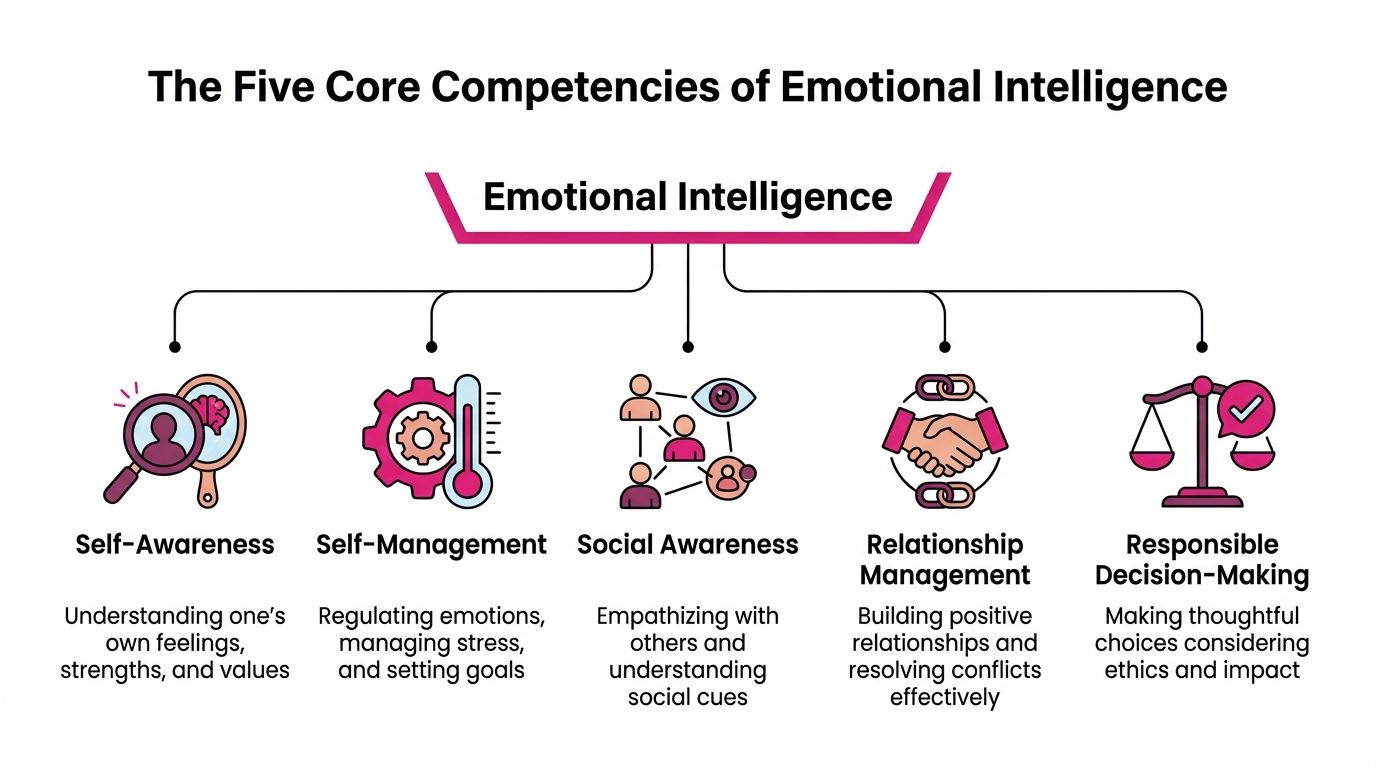
In K-8 settings, emotional intelligence becomes easier to teach when we break it into visible, coachable skills. The most practical framework for many schools includes five core competencies: self-awareness, self-management, social awareness, relationship skills, and responsible decision-making.
These competencies are easier to understand when we attach them to behavior we can see.
What each competency means
Self-awareness means noticing your own feelings, triggers, strengths, and needs.
Self-management means handling emotions, impulses, and stress in ways that help rather than harm.
Social awareness means reading the room, noticing how others may be feeling, and responding with empathy.
Relationship skills means communicating clearly, listening well, resolving conflict, and building trust.
Responsible decision-making means making choices that consider safety, fairness, consequences, and impact on others.
A child does not master these all at once. They grow over time, with repetition and support.
Age-Appropriate Emotional Intelligence Competencies in K-8
| Competency | What It Looks Like (Grades K-2) | What It Looks Like (Grades 3-5) | What It Looks Like (Grades 6-8) |
|---|---|---|---|
| Self-Awareness | Names basic feelings like mad, sad, excited, worried. Can point to where a feeling shows up in the body. | Identifies mixed feelings and simple triggers. Can say, “I’m frustrated because this feels hard.” | Reflects on patterns, triggers, and identity. Can recognize stress, embarrassment, jealousy, or pressure before behavior escalates. |
| Self-Management | Uses a taught strategy such as deep breathing, counting, squeezing hands, or asking for a break. | Chooses from several regulation tools and can return to learning with support. | Uses coping strategies more independently, delays impulses, and plans ahead for stressful situations. |
| Social Awareness | Notices when a peer is crying or left out. Begins to understand that others feel differently. | Reads tone, body language, and group dynamics with growing accuracy. | Considers perspective, context, and social pressure. Can discuss fairness and impact in more nuanced ways. |
| Relationship Skills | Takes turns, uses simple feeling words, practices apology and repair with adult coaching. | Uses I-statements, listens to another viewpoint, and works through minor conflict with prompts. | Handles disagreement with more maturity, sets boundaries, collaborates, and repairs harm with less adult mediation. |
| Responsible Decision-Making | Chooses between simple options like “grab or ask.” Understands basic classroom rules and safety. | Thinks through consequences and can explain why a choice was kind, fair, or unsafe. | Weighs peer influence, ethics, and long-term consequences before acting. |
What adults sometimes misunderstand
Adults often expect older students to have a skill just because they can explain it. A sixth grader may know the words “I need to calm down” and still slam a locker when embarrassed. Knowledge is not the same as embodied skill.
That is why practice matters.
A first grader may role-play asking for a turn with a marker. A fourth grader may rehearse what to say when a friend excludes them from a game. A seventh grader may practice how to disagree in a group project without shutting down or taking over.
A quick way to use this framework
Pick one competency for two weeks and make it visible.
For example, if the focus is self-management:
- post three calming strategies
- model when you use one yourself
- praise the process, not just the outcome
- give students a sentence stem such as “I need a reset, then I can rejoin”
Children grow faster when adults name the exact skill they are using. “You noticed you were frustrated and asked for space.” That is more helpful than “Good job.”
Once adults start looking through this lens, student behavior becomes more readable. And when behavior becomes more readable, teaching gets more precise.
Practical Classroom Strategies and Lesson Examples
The most effective emotional intelligence practices rarely require a separate hour-long block. They work best when they are woven into the day children already have.
A classroom can teach emotional intelligence from the first greeting to the final pack-up.
Start the day with emotional visibility
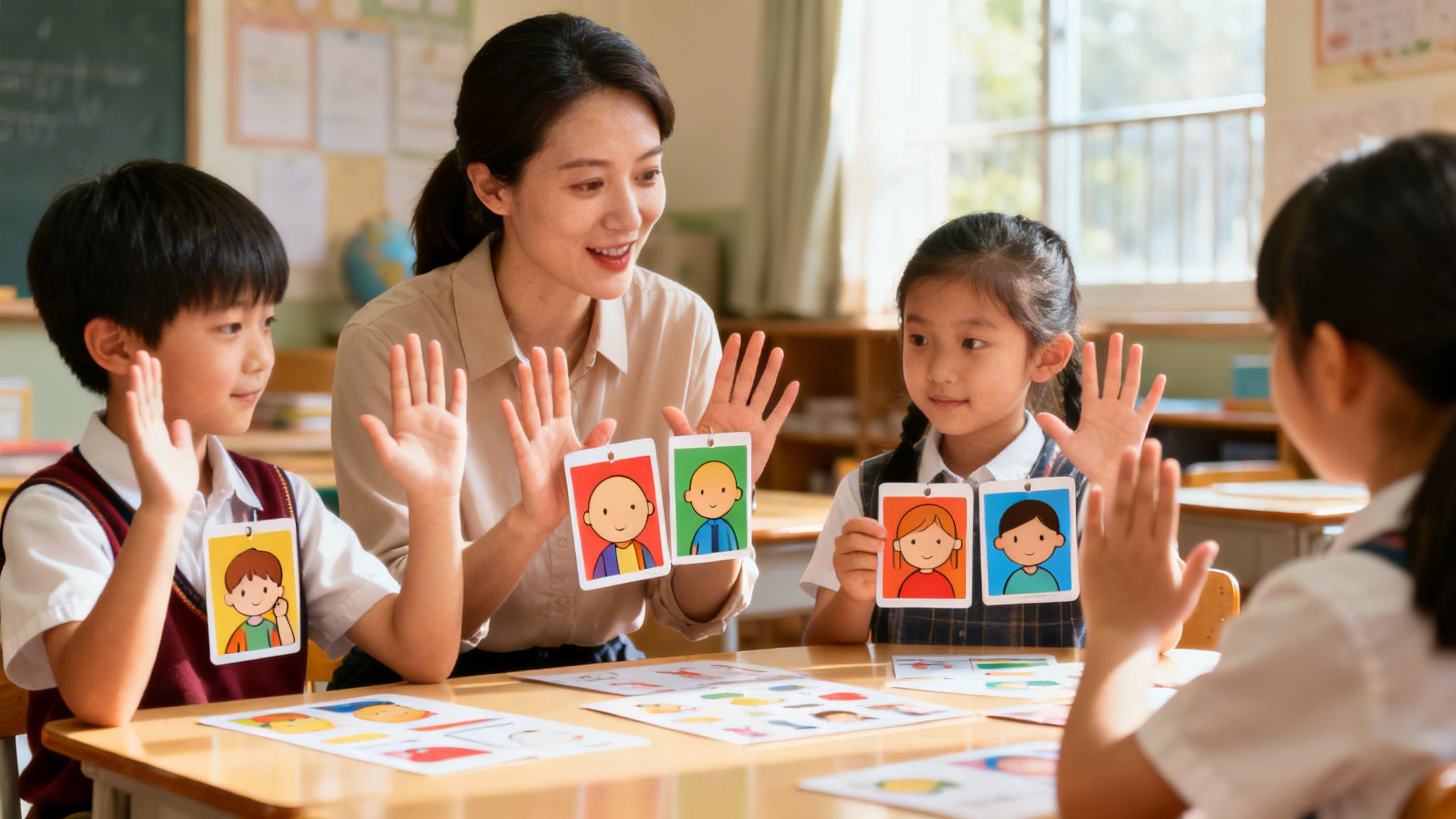
In many classrooms, the first useful move is a quick check-in.
A student places their name on a mood meter. Another circles “ready,” “tired,” or “worried” on a clipboard. Younger students point to a face card. Middle schoolers may respond to a journal prompt such as, “What kind of support do you need from yourself today?”
This helps in two ways. Children practice self-awareness, and adults get early information before a hard moment explodes.
A teacher might notice:
- one student picked “frustrated” before math
- another chose “lonely” after a friendship issue
- three students marked “tired” after a late school event
That information shapes how we teach.
Build regulation into normal routines
A calm-down corner works best when it is not treated like punishment. It should feel like a place for regulation, not exile.
Keep it simple:
- Visual tools: Feeling cards, breathing prompts, or a short reset checklist
- Sensory options: A soft object, coloring sheet, or quiet fidget
- Re-entry language: “I’m ready to come back and try again”
For younger students, I like brief scripts. “My body is too fast. I need to slow it down.” For older students, a reflection card can help. “What happened, what am I feeling, what do I need next?”
Use conflict as instruction, not interruption
Two children argue over who got the last turn on the swing. Later, the same pattern appears over markers at a table. That is not bad luck. It is curriculum.
A simple conflict tool like a Peace Path can guide students through:
- what happened
- how each person feels
- what each person needs
- what repair looks like
For example:
- “I felt mad when you cut in front.”
- “I thought you were done. I should have checked.”
- “Next time ask me first.”
- “Okay. Do you want the next turn?”
Children need many rounds of this before it becomes natural. That repetition is the point.
Teach empathy through stories and the arts
A 2025 analysis argued that emotional intelligence should be integrated with the humanities and arts so it does not become a set of “hollow skills.” In that analysis, some CRP-EI hybrid models increased student agency by 20-30%, using narrative and history to build ethical empathy (Inside Higher Ed analysis on emotional intelligence, humanities, and student agency).
That idea is especially helpful in K-8 classrooms.
When students discuss a character’s fear, exclusion, pride, or regret, they practice perspective-taking in a safer space. In art, drama, and storytelling, they can explore emotion with less defensiveness.
Try prompts like:
- “Why do you think this character hid the truth?”
- “What might this scene feel like from another person’s view?”
- “What would repair look like in this story?”
A practical collection of emotional intelligence activities for kids can help teachers and families turn those ideas into short, repeatable routines.
Here is a short video that can support classroom discussion and staff reflection.