

8 Anger Management Activities for Preschoolers (2026 Guide)
The fiery intensity of a preschooler's anger can be overwhelming for them and the adults who care for them. While meltdowns, stomping feet, and shouts of 'No!' are a normal part of development, they also present a crucial opportunity. This isn't just about stopping 'bad behavior'; it's about building the foundational skills of emotional intelligence that will support a child for a lifetime. Helping young children understand and manage their anger is one of the most important social-emotional learning (SEL) tasks they will face.
This guide moves beyond generic advice to provide eight specific, evidence-based, and playful anger management activities for preschoolers. Designed for both classroom and home settings, these strategies will equip educators and parents with practical tools to turn challenging moments into powerful lessons in self-regulation, empathy, and resilience.
You will learn how to implement actionable strategies such as:
- Creating a "Feelings Thermometer" for emotional check-ins.
- Teaching "Calm Down Breathing" through simple, memorable exercises.
- Building effective "Calm Corners" or sensory stations.
- Using picture books to discuss and normalize big feelings.
Each activity includes step-by-step instructions, materials lists, and specific language to use, making it easy to put these ideas into practice immediately. These are not just activities, but building blocks for creating an environment where every child feels understood and can learn to navigate their emotions constructively.
1. Feelings Thermometer Activity & Check-In Circles
Combining a visual feelings thermometer with regular check-in circles gives preschoolers a concrete tool and a structured routine to understand and manage their emotions. This two-part approach is one of the most effective anger management activities for preschoolers because it teaches emotional awareness and builds a supportive community simultaneously. The thermometer makes an abstract concept, the intensity of anger, visible and understandable for young children.
Check-in circles provide a safe, predictable space to practice using this new emotional vocabulary. By normalizing discussions about feelings, children learn that emotions are a normal part of life and that there are healthy ways to express them.
How It Works
A feelings thermometer is a visual scale, often color-coded, that helps a child identify the intensity of their emotions. It might range from blue (calm) at the bottom, to yellow (frustrated), orange (upset), and finally red (furious) at the top. The goal is to help children recognize when their feelings are starting to "heat up" before they reach the red zone.
Check-in circles are short, structured group gatherings where each child gets an opportunity to share how they are feeling using the thermometer as a guide. This routine builds empathy, listening skills, and a sense of belonging.
Key Insight: The power of this activity lies in the connection between the visual tool and the social routine. The thermometer gives children the language, and the circle gives them a safe place to use it.
Implementation Guide
- Objective: To help preschoolers identify the intensity of their anger and practice sharing their feelings in a supportive group setting.
- Materials: Large chart paper or poster board, markers, crayons, or paint in various colors (blues, greens, yellows, oranges, reds), optional clothespins or magnets with children's names.
- Step-by-Step:
- Create the Thermometer Together: Involve the children in making the feelings thermometer. Draw a large thermometer shape and assign colors to different feeling levels. Ask them, "What color feels calm? What color feels a little mad? What about very, very angry?" This co-creation builds ownership.
- Introduce the Concept: During a calm time, show them the thermometer. Say, "This is our Feelings Thermometer. When we are feeling great, we might be down here in the cool blue. Sometimes, things make us feel frustrated, and we start to warm up to yellow."
- Establish Circle Norms: Before the first check-in, set simple rules: "We listen with our ears and hearts," "It's okay to pass," and "What we share in the circle stays in the circle."
- Model and Practice: Begin the circle by modeling. "I'm feeling yellow today because I couldn't find my favorite pen. I am going to take a deep breath to help myself cool down." Then, go around the circle, inviting each child to share their "color" for the day. Keep it brief, just 5-10 minutes.
Tips for Success
- Practice When Calm: Introduce and practice using the thermometer when children are relaxed. Don't wait for a moment of intense anger to teach the tool.
- Use "Pass" Options: Always allow children the option to pass. Forcing a child to share can increase anxiety. A simple "pass" is a valid and respected choice.
- Home Adaptation: Families can use a smaller, portable thermometer on the fridge. During dinner or bedtime, ask, "What was your color today? What made you feel that way?" For example, a parent could say, "I felt yellow today when I was stuck in traffic, but now I feel blue because I am home with you."
This activity provides a foundational skill set for emotional self-regulation. To dive deeper into using visual aids, explore different types of charts and their benefits with our guide to using a feelings chart for kids.
2. Breathing and Mindfulness Exercises (Calm Down Breathing)
Teaching structured, age-appropriate breathing and mindfulness exercises gives preschoolers a powerful, portable tool for self-regulation. Techniques like "Bubble Breaths" or "Hot Chocolate Breathing" are exceptional anger management activities for preschoolers because they directly activate the body's relaxation response. These simple, playful exercises use visualization to help children calm their nervous systems when big feelings like anger start to take over.
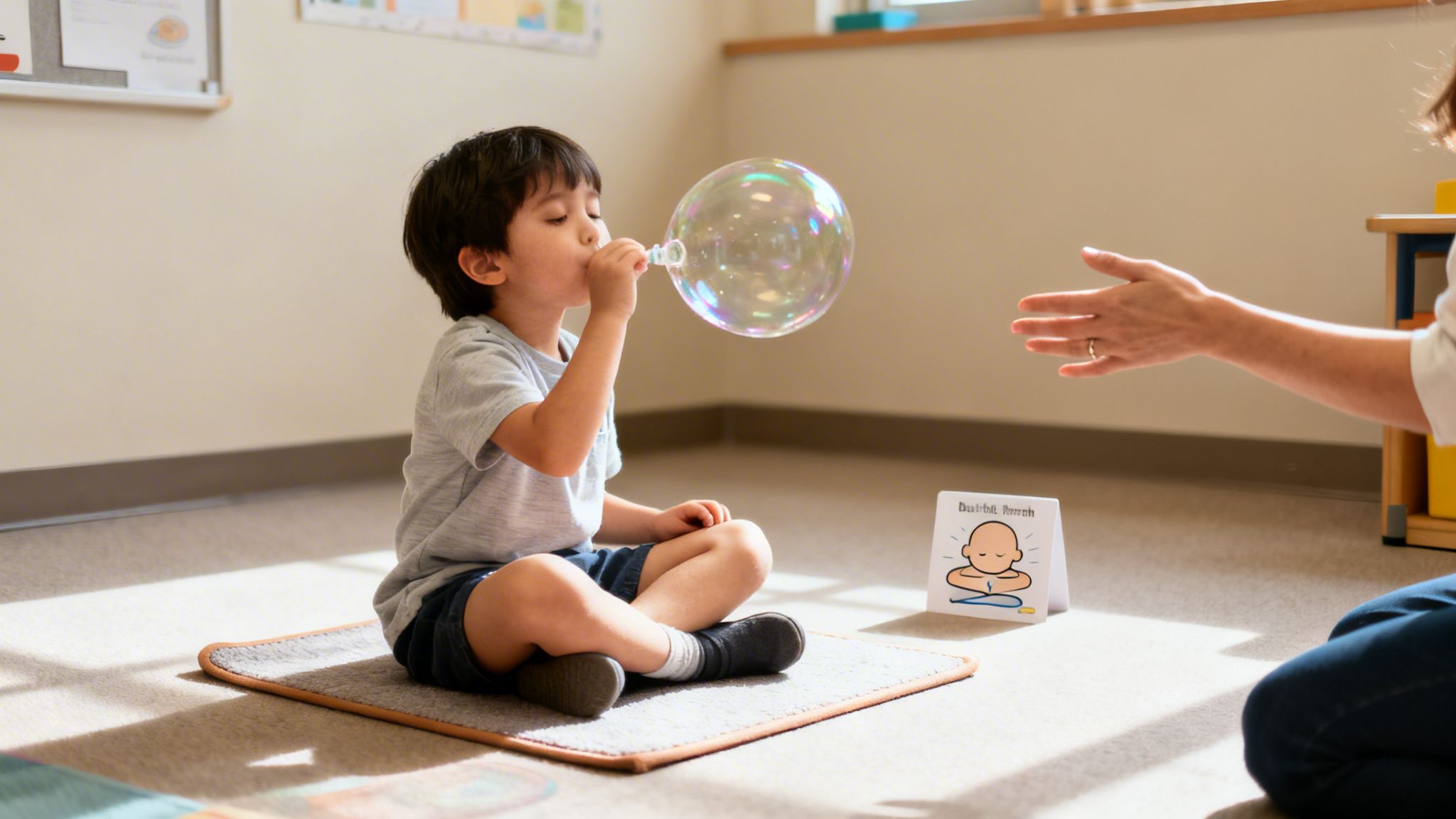
Unlike other strategies that require materials or specific locations, breathing is always available. By practicing these techniques during calm moments, children build the neural pathways needed to access this skill during times of stress, frustration, or anger. It empowers them with a sense of control over their bodies and emotions.
How It Works
Mindful breathing interrupts the body's fight-or-flight response, which is triggered by anger. Slow, deep breaths send a signal to the brain that the danger has passed, lowering the heart rate and allowing the prefrontal cortex-the thinking part of the brain-to come back online. Using child-friendly imagery makes this biological process accessible and engaging.
For example, "Flower and Candle" breathing involves pretending to smell a flower (deep inhale through the nose) and then blowing out a candle (slow exhale through the mouth). This gives children a concrete action to focus on, making the abstract concept of deep breathing easy to grasp.
Key Insight: The goal is not to stop anger but to give children a way to pause and create space between a feeling and a reaction. This pause is where self-control begins.
Implementation Guide
- Objective: To teach preschoolers simple, memorable breathing techniques to calm their bodies when they feel angry or overwhelmed.
- Materials: Optional visual aids like a real or toy flower, bubbles, or a picture of hot chocolate.
- Step-by-Step:
- Choose an Engaging Technique: Select a method with imagery that will appeal to your children. "Hot Chocolate Breathing" is a great start: "Let's pretend we have a big cup of hot chocolate. It's too hot to drink! First, smell the yummy chocolate (breathe in slowly through the nose). Now, cool it off (breathe out slowly through the mouth)."
- Model and Exaggerate: During a calm group time, model the exercise yourself. Make your inhales and exhales audible and your movements big. Say, "Watch me! I'm breathing in… 1, 2, 3… and now I'm blowing out… 1, 2, 3, 4, 5."
- Practice Together: Guide the children through three to five repetitions. Make it a fun, gentle game.
- Integrate into Routines: Practice for a few minutes daily, such as during morning circle, before transitions, or after active play. This routine makes the skill second nature.