Soul Shoppe's work is made possible by donors and partners who care deeply about the young people in their communities! We can't do this work without you. Support our work in classrooms and on playgrounds across the nation by donating here.
Peer mediation is a structured student-led process where trained students help classmates resolve minor conflicts peacefully, and research found a 93% agreement rate across 4,028 mediations and an 88% satisfaction rate across 4,739 mediations in a meta-analytic review. If you're a teacher or parent dealing with the same argument for the third time this week, peer mediation gives kids a way to talk it through, understand what each person needs, and make their own workable agreement.
A lot of school conflicts start small. Two students argue over a game at recess. Partners in class blame each other for a messy project. Friends stop speaking because of a rumor, and by lunch the whole table has taken sides.
Adults can step in and stop the immediate problem. We often need to. But many families and educators want something more than a quick fix. They want students to learn how to handle conflict without shaming, stonewalling, or waiting for an adult to solve everything.
That's where peer mediation fits. At its best, it helps students move from accusation to conversation. It also supports the larger work of building a campus where listening, repair, and accountability are part of daily life, much like the relationship-building goals behind the benefits of social-emotional learning.
Introduction From Disagreements to Dialogue
If you work in a K-8 school, you already know how fast a simple disagreement can grow legs. One child says, “She cut in line.” Another says, “He started it.” A teacher tries to sort out the facts while the rest of the class watches, and now a two-minute problem has become a twenty-minute disruption.
Parents see a version of this too. A child comes home upset, tells one piece of the story, and expects the adult to declare a winner by dinner.
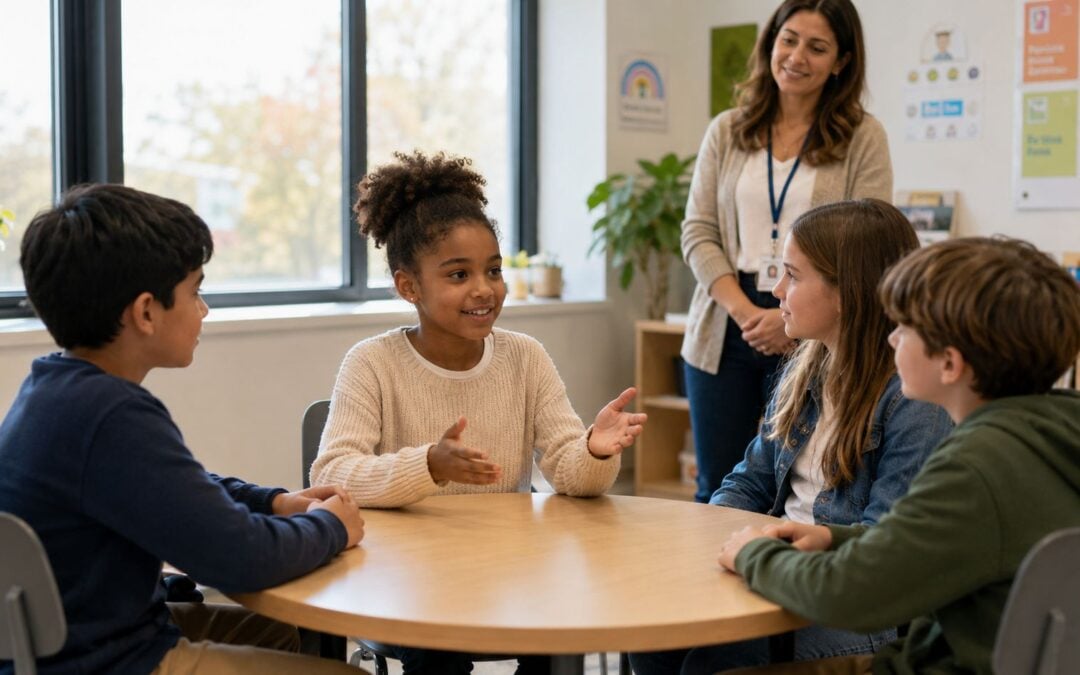
Peer mediation is a student-led process in which trained students help peers talk through a conflict, name what's bothering them, and work toward a solution they both accept. That definition matters because peer mediation isn't just “kids helping kids be nice.” It's a structured way to practice communication, self-control, perspective-taking, and repair.
Why schools use it
When children are taught how to slow down and speak truthfully, several good things can happen at once:
Conflict gets clearer: Students separate facts, feelings, and assumptions.
Ownership increases: Instead of hearing a punishment from an adult, they help build the plan.
Skills transfer: What they practice in mediation can show up later in the classroom, on the playground, and at home.
Peer mediation works best when the goal is not to prove who's “the bad kid,” but to help both students leave with dignity and a realistic next step.
A simple example
A fourth grader says, “She never lets me play with them.” The other student says, “That's not true. You boss everyone around.”
In a typical hallway intervention, an adult may tell both students to apologize and move on. Sometimes that's enough. Sometimes it isn't.
In peer mediation, trained student mediators would help them slow the moment down. One student speaks without interruption. Then the other does the same. The mediators help them identify the underlying issue beneath the surface, maybe feeling left out, maybe feeling controlled, maybe both. From there, the students create a plan they can implement.
That shift matters. Kids aren't only ending one conflict. They're building a way of handling the next one better.
The Core Principles of Peer Mediation
Peer mediation only works when the adults and students share the same basic ground rules. Without those principles, it turns into a mini-courtroom, a forced apology session, or a popularity contest.
Neutrality matters
A student mediator is not a judge. Think of the role more like a referee who keeps the process fair and calm without deciding who deserves to win.
That distinction helps teachers too. If adults present mediation as a way to find out who's right, students quickly stop trusting it. The mediator's job is to guide the conversation, not to hand down a verdict.
A mediator might say:
“We're here to help both of you talk and listen.”
“We won't pick sides.”
“You'll make the agreement, not us.”
Voluntary participation changes the tone
Peer mediation is generally voluntary. That's important because a forced conversation rarely leads to an honest one. If a child is dragged into a session, the result is often silence, sarcasm, or a fake agreement that falls apart by recess.
Voluntary participation doesn't mean schools ignore conflict. It means mediation is used when students are willing and able to engage in problem-solving. If they aren't, adults need a different response.
Confidentiality builds trust
Students speak more openly when they believe the session won't become lunchroom gossip. Confidentiality tells them, “This conversation is for repair, not for entertainment.”
Of course, adults should explain limits in child-friendly language. Privacy is part of the process, but safety comes first. If a student reveals something that signals harm or danger, an adult has to step in.
Practical rule: Tell students that mediation is private, but not secret when someone's safety is at risk.
Student ownership is the engine
A strong mediation process centers student voice. The point isn't to coach children into repeating adult-approved phrases. The point is to help them understand what happened, say what they need, and build an agreement they can live with.
This is one reason peer mediation connects so naturally with restorative practices in education. Both approaches ask students to take responsibility through dialogue and repair rather than simple compliance.
Here's the heart of it:
Principle
What it looks like in school
Neutrality
Mediators guide the talk without deciding who is right
Voluntary participation
Students agree to take part rather than being cornered into it
Confidentiality
The conversation stays private within clear safety limits
Ownership
Students create the solution instead of receiving an adult-imposed answer
When readers ask what is peer mediation, these principles are the true answer underneath the label. They're what make the process feel safe enough, fair enough, and useful enough to try.
The Peer Mediation Process Step by Step
One reason educators hesitate to use peer mediation is that it sounds vague. In practice, it isn't vague at all. A school-based process is usually structured and predictable.
A helpful visual can make that sequence easier to picture.
According to a school protocol summary from Nebraska MTSS, peer mediation is a structured, voluntary conflict-resolution process in which two trained student mediators help students move from positional arguments to interest-based problem solving through ground rules, uninterrupted storytelling, issue identification, and student-generated solutions, while the mediators facilitate rather than impose outcomes, as described in this peer mediation protocol overview.
Step 1 creates safety
The mediators begin by introducing themselves and setting ground rules. These usually include listening without interrupting, speaking respectfully, and staying focused on solving the problem.
This opening matters more than people think. It tells students, “This won't be a shouting match.”
A mediator might say:
“Each person will get a turn.”
“Please talk about what happened from your point of view.”
“We're looking for a solution both of you can accept.”
Step 2 slows the conflict down
Each student tells their story without interruption. That sounds simple, but it's often the first time each child has actually heard the other person all the way through.
Teachers can support this skill in everyday classroom life by teaching I-feel statements for kids. A student who can say, “I felt embarrassed when you laughed,” is much easier to understand than a student who only says, “You're mean.”
Step 3 finds the real issue
After both stories are shared, the mediators help identify what's really at stake. The fight may look like it's about a seat, a ball, or a rumor. Underneath, it may be about fairness, belonging, respect, or hurt feelings.
This is the turning point. Students move from “You did this” to “Here's what I needed.”
Sometimes the conflict is not about the object at all. It's about how the student felt in that moment.
Step 4 generates options
Now the students brainstorm solutions. The mediators don't hand them an answer. They ask questions that help the students do the thinking.
Examples include:
“What would make tomorrow go better?”
“What can each of you agree to do differently?”
“Which solution feels fair to both of you?”
At this point, a short example helps. Two fifth graders argue about materials during art. One keeps grabbing shared supplies. In mediation, they agree to divide tools before the lesson starts and ask before borrowing. That's a small agreement, but it's specific enough to use.
A video example can help educators picture the tone and pacing of a student-centered conflict conversation.
Step 5 puts it in writing
Many schools end with a simple written agreement. The language should be concrete, brief, and realistic.
Good agreement language sounds like this:
Weak agreement
Stronger agreement
“We'll be nicer.”
“We will use kind words during group work and ask before joining the game.”
“We won't fight.”
“If we get upset, we'll ask for a break and talk after lunch.”
Step 6 includes follow-up
A short check-in later helps everyone see whether the agreement is working. This doesn't need to be dramatic. It can be a quick conversation with the coordinator, teacher, or mediators.
Follow-up sends a powerful message to students. Repair isn't just a one-time performance. It's something the school community takes seriously.
Key Roles in Peer Mediation
People sometimes picture peer mediation as students running a meeting with no adult structure. That's not what effective programs look like. Good mediation is student-led and adult-supported, with each person holding a clear role.
The student mediators
Student mediators guide the conversation. They don't investigate, punish, rescue, or lecture. Their main job is to keep the process respectful and moving.
You'll often hear language like:
“Tell us what happened from your point of view.”
“Let's make sure each person gets a turn.”
“What do you need going forward?”
A strong mediator listens for the feelings under the complaint. If one student says, “He always leaves me out,” the mediator might reflect, “It sounds like you felt excluded.”
That small move can change the whole tone of the session.
The students in conflict
The disputants do the hardest part of the work. They have to tell the truth as they experienced it, listen to something they may not like hearing, and take part in creating a next step.
A classroom example makes this concrete. Two middle elementary students are upset after one posted an unkind comment in a shared online space for homework. In mediation, one says, “I was joking.” The other says, “I felt humiliated because other kids saw it.” The process gives both students a chance to move beyond defense and toward accountability.
Helpful coaching for disputants includes:
Use “I” language: “I felt left out” lands better than “You always ruin everything.”
Stay specific: “During science group” is easier to solve than “You do this all the time.”
Ask for something doable: “Please don't talk about me in the lunch line” is clearer than “Be a better person.”
The students in conflict are not passive recipients of a solution. They are the authors of it.
The adult coordinator
Adults make the program safe and sustainable. They train mediators, review referrals, decide which cases fit, and provide backup when students need support.
The adult role should stay mostly in the background during an appropriate mediation. That restraint can be hard for educators, especially when we're used to solving problems quickly. But stepping back is part of what gives students room to practice.
An adult coordinator might:
Adult responsibility
What it looks like
Screening referrals
Deciding whether the issue is appropriate for mediation
Training students
Practicing listening, neutrality, and agreement-writing
Supervising sessions
Staying available without taking over
Following up
Checking whether agreements are being honored
When these roles stay clear, students gain confidence and adults keep the guardrails in place.
How Peer Mediation Builds SEL Skills
Peer mediation is often discussed as a behavior support. That's true, but it's only part of the picture. It's also a practical, repeated way to teach social-emotional skills in real time.
Students practice empathy, not just hear about it
A child develops empathy when they must sit still long enough to hear how their actions affected someone else. That doesn't mean they instantly agree with every detail. It means they practice understanding another perspective.
Self-awareness grows at the same time. A student starts to notice, “When I feel embarrassed, I lash out,” or “When I think I'm being excluded, I interrupt.”
Communication becomes more usable
Students in mediation learn to speak with more precision. Instead of global statements like “Nobody likes me,” they're coached toward language that can be understood and addressed.
Problem-solving grows too. Students move from blame to options. They consider what each person can do tomorrow, not just what they wish had happened yesterday.
Here's a simple way to see the SEL connection:
Empathy: Listening to another student's experience
Self-management: Pausing before reacting
Communication: Speaking openly without attacking
Responsible decision-making: Choosing a realistic agreement
The research points to meaningful outcomes
In a meta-analytic review, researchers found a 93% agreement rate across 4,028 mediations and an 88% satisfaction rate across 4,739 mediations, suggesting that school peer mediation often ends with a mutually accepted agreement rather than an adult-imposed one, as reported in this review of peer mediation outcomes in education.
Those numbers matter because satisfaction and agreement are closely tied to student buy-in. When students feel heard and help shape the outcome, they're more likely to see the process as fair.
A child may forget the exact words used in a mediation session. They're less likely to forget the experience of being listened to and being expected to listen in return.
This is why peer mediation belongs in SEL conversations. It doesn't just talk about skills. It gives students a place to use them while the stakes are real, but still manageable.
Implementing a Program in Your School
Starting a peer mediation program doesn't require a perfect campus or a giant initiative. It requires clarity, consistency, and adults who agree on what the program is for.
A practical starting point is this: define which conflicts belong in mediation, decide who screens referrals, train a small group of students well, and build a routine people can trust. If the process feels mysterious, staff won't refer students. If it feels loose, families won't trust it.
For schools that want a broader communication plan when introducing a new initiative to families or community partners, this comprehensive resource for event PR can help shape a clear rollout message without overcomplicating it.
Start small and train carefully
Choose student mediators based on readiness, not popularity. Look for students who can listen, stay calm, and keep confidence. They don't need to be perfect. They do need coaching.
Training usually includes role-play, listening practice, how to ask neutral questions, and how to end with a clear agreement. Some schools build this internally. Others use outside support. For example, Soul Shoppe offers a peer mediation program and Peacemaker Trainer Certification that schools can use as one structured option for training adults and students.
Build a simple referral path
Teachers need to know exactly what to do when a conflict is a fit for mediation. A referral process can be as straightforward as a short form, a counselor check-in, or a designated time during the week.
Use plain language with staff:
Refer minor peer conflicts
Do not refer safety concerns
Check willingness first
Route all cases through the coordinator
Schools doing this work often pair peer mediation with wider conflict resolution for schools so staff and students share common language.
Plan for age differences
A second grader and a seventh grader can both use mediation, but the format won't look identical.
Aspect
Grades K-3
Grades 4-8
Language
Short sentences, concrete prompts, visual supports
More detailed reflection and student-generated language
Session length
Brief, focused, often with more redirection
Longer conversations with greater student stamina
Common issues
Turn-taking, game disputes, line conflicts, exclusion
Rumors, group chats, friendship shifts, collaborative work conflicts
Mediator support
More adult proximity and coaching
More student autonomy with adult backup
Agreement style
Simple verbal or picture-supported plan
Written agreement with specific next steps
Get staff and families on the same page
Teachers need to know that mediation is not “being soft.” Parents need to know that it's not replacing adult responsibility. It's a structured response for the right kind of conflict.
A few practical moves help:
Share the boundaries early: Explain what mediation is for and what it isn't.
Use common scripts: Give teachers language they can use when offering mediation.
Protect space and privacy: Choose a quiet area where students can speak without an audience.
Review the program regularly: Adults should look at referrals, agreements, and common challenges.
Schools don't need a flashy launch. They need a dependable one.
When Peer Mediation Is Not the Answer
This is the part many guides skip, and it's one of the most important. Peer mediation is not for every conflict.
A public school district description of the process notes that peer mediation is generally designed for minor conflicts, is voluntary, and is typically screened through an intake process. Cases are reviewed for appropriateness, and the program is most commonly used for rumors, friendship conflict, and minor bullying, rather than serious safety issues, coercion, or threats, as outlined in this district peer mediation guidance.
Cases that need adult-led action
If there is a strong power imbalance, ongoing intimidation, harassment, threats, or fear, mediation is the wrong tool. A child cannot negotiate freely when they don't feel safe.
That includes situations such as:
Threats of harm: Any statement or behavior suggesting danger
Coercion: One student pressuring another through fear or control
Serious bullying: Repeated targeted harm with a power imbalance
Harassment or discrimination: Incidents that require formal adult response
Physical aggression: Fights or assault-related concerns
A useful screening question
Ask this before scheduling mediation: Can both students participate freely, safely, and voluntarily?
If the answer is no, stop there. The student needs protection, investigation, discipline, counseling support, or another adult-led intervention.
Responsible schools don't use peer mediation to avoid hard adult decisions. They use it when the situation fits.
That boundary strengthens a program. It tells staff and families that mediation is a skilled response for the right cases, not a catch-all solution.
Conclusion Building a More Peaceful School
Peer mediation gives schools a practical way to teach conflict resolution through experience, not just advice. When students learn to listen, speak openly, and build their own agreements, they don't just settle one argument. They develop habits that support empathy, accountability, and healthier relationships across the school day.
For teachers, parents, and school leaders asking what is peer mediation, the simplest answer is this: it's a structured way for kids to solve the right kinds of conflicts with support, dignity, and clear boundaries.
If your school wants help building student conflict-resolution skills in a structured, age-appropriate way, Soul Shoppe offers SEL programs, peer mediation support, and educator training designed to help school communities create more connection, safety, and empathy.
A child stands at the edge of the soccer field, the classroom door, the birthday party circle, or the top of the slide and says the same thing in different words: “What if I mess up?” Adults usually feel the urge to answer fast. We say, “You'll be fine,” “Just be confident,” or “Don't worry so much.”
That response is kind, but it usually isn't enough.
Building confidence in kids works better when we stop treating confidence like a mood and start treating it like a set of experiences. Children build it when they feel safe enough to try, connected enough to belong, and capable enough to recover when something doesn't go smoothly. At home and at school, that means confidence grows through routines, language, and relationships far more than through pep talks alone.
Why True Confidence Is More Than Just Praise
A lot of adults are trying hard to encourage children, but many kids still hesitate, avoid, melt down, or quit quickly when something feels uncertain. That gap matters. A child can hear “good job” all day and still believe, deep down, “I can't do hard things.”
The modern view of confidence is much more useful. Guidance from Nationwide Children's Hospital on building healthy self-esteem emphasizes that confidence is built through repeatable behaviors such as praising effort, setting realistic goals, normalizing mistakes, and teaching problem-solving. That shift matters because it moves adults away from vague praise and toward concrete experiences of mastery.
Praise helps, but mastery sticks
Children borrow our words for a while. Then they test those words against real life.
If a student hears “you're amazing” but never gets to struggle, adjust, and succeed on their own, the praise feels thin. If a child hears “you're so smart” and then gets one answer wrong, that label can crack fast. By contrast, when a child thinks, “I didn't know how to do this, then I learned,” confidence starts to root.
A simple way to frame it is this:
Empty praise says: “Feel good.”
Real confidence says: “You can handle hard things.”
Healthy support says: “I'll stay with you while you practice.”
Confidence is not the absence of doubt. It's the memory of having done something hard before.
This is also why a growth mindset approach for kids can be so helpful when adults use it well. The value isn't in repeating “yet” as a slogan. The value is in helping children connect effort, strategy, and progress.
Why this matters right now
Emotional distress isn't rare. In 2023, 40% of U.S. high school students reported persistent sadness or hopelessness, while 20% seriously considered attempting suicide, according to the CDC data cited in They Are the Future's teen self-esteem statistics roundup. Those are older students, but the message for K-8 adults is clear. Children need environments where risk-taking feels emotionally safe.
The same source reports that the average 2-year-old hears 432 negative statements per day versus 32 positive statements, a roughly 13.5-to-1 imbalance, in cited family-level research. That doesn't mean adults are unkind all day. It means correction, hurry, limits, and frustration can easily outnumber language that builds competence.
What works better than general encouragement
Try replacing broad praise with specific reflection:
Instead of this
Try this
“Good job”
“You kept trying even when that was frustrating.”
“You're a natural”
“You used a new strategy and it helped.”
“Don't be shy”
“You can start with one small step.”
“Just believe in yourself”
“What part feels doable first?”
That's the heart of building confidence in kids. Adults don't create it by convincing children to feel fearless. We help children earn it.
The Unspoken Foundation of Confidence Safety and Belonging
Some children look “unconfident” when the issue is not feeling safe. Others seem defiant or checked out when they feel exposed, excluded, or unsure where they fit. In both cases, pushing performance before connection usually backfires.
Confidence grows faster in environments where children can make mistakes without shame, ask questions without being mocked, and participate without worrying they'll be socially punished for it. That applies in classrooms, on teams, at lunch tables, and at home.
KidsHealth's guidance notes that confidence grows when children feel they matter to others and have healthy friendships, and that confidence is shaped by exclusion, bullying, and classroom climate, not just by praise from adults. You can read that perspective in KidsHealth's guide to boosting self-esteem.
What psychological safety looks like in real life
Psychological safety sounds abstract until you watch for it. You can usually spot it by listening to what children are willing to do.
In a safe classroom, a student says, “I'm confused,” without scanning the room first. In a safe home, a child admits, “I forgot,” without bracing for humiliation. On a healthy team, a player can try, miss, and stay included.
Here are signs an environment supports confidence:
Mistakes stay small: Adults correct behavior without attacking identity.
Participation is flexible: Children can start with a partner, a smaller role, or a quieter entry point.
Adults notice inclusion: Who gets picked, ignored, interrupted, or laughed at is taken seriously.
Repair happens: Conflict, teasing, and social harm are addressed instead of minimized.
Practical rule: If a child spends more energy protecting themselves than engaging, confidence-building strategies won't land.
A lot of school adults find it helpful to strengthen the environment before asking a child to take bigger social or academic risks. Soul Shoppe has useful ideas in this safe space guide for classrooms and communities, especially for building shared norms around listening, inclusion, and repair.
Belonging is social, not private
Many articles treat confidence like a private trait inside the child. That's too narrow. Children build self-trust partly through other people's responses.
Consider two students with the same skill level. One is greeted by name, paired with kind peers, and invited in when they hesitate. The other is corrected publicly, left out at recess, and teased when they make mistakes. Their “confidence level” will not develop the same way, even if both receive the same academic instruction.
That's why belonging has to be built intentionally.
Home and school routines that raise belonging
Opening check-ins: Ask, “What's one word for how you're coming in today?” This gives children a low-pressure way to be themselves.
Private connection: A quick one-on-one moment often changes a child's whole day. “I'm glad you're here” is simple and powerful.
Structured partner work: Pair children thoughtfully. Don't let social confidence depend only on who is already popular.
Family rituals: Try rose-thorn-bud at dinner. One good thing, one hard thing, one thing you're looking forward to.
For coaches and activity leaders, peer safety matters just as much. If sports are part of a child's life, adults may also find this director's guide on sports bullying useful for recognizing how team culture affects participation and self-worth.
A quick reflection tool for adults
Ask these questions about your classroom, home, or program:
Can this child make a mistake here without losing status?
Does this child have at least one reliable connection with an adult?
Do peers treat this child like they belong?
Are we asking for courage before we've built enough safety?
When the answer is no, confidence work should start with the ecosystem, not the child.
Actionable Strategies for Building Everyday Competence
Once safety is in place, confidence grows through practice. Not giant, dramatic breakthroughs. Small wins. Repeated effort. Real ownership. Adults often underestimate how much children need visible, doable success.
One especially useful method is to create micro-goals with a 70% to 95% success rate, then pair them with specific process feedback. That recommendation comes from Dr. Paul McCarthy's guide to building child confidence in sports. The idea is simple. The task should be challenging enough to stretch the child, but not so hard that they keep hitting a wall.
Start with the next smallest step
Adults often assign the whole task when the child only has the capacity for the first slice of it.
A few examples:
A child who says “I can't clean my room” may only need to start with put books on the shelf.
A student who avoids writing may begin with say your idea out loud, then write one sentence.
A child nervous about joining recess can start with stand near the game for two minutes, then choose whether to join.
This is where goal-setting routines for kids become practical. Good goals are concrete, visible, and small enough that the child can tell whether they did the step.
Adults should support the step, not steal the step.
That means resisting the urge to over-help. If you organize the backpack, fix the homework error, speak for the child, or finish the project, the task may get done, but the child doesn't get the mastery experience.
A simple planning tool:
Situation
Too big
Better micro-goal
Homework avoidance
“Finish all your homework”
“Do the first two problems, then check in”
Friendship stress
“Go make friends”
“Ask one classmate to sit together”
Sports hesitation
“Play confidently”
“Call for the ball one time”
Morning routine
“Be more responsible”
“Put lunchbox by the door before bed”
Use process feedback, not identity labels
Children listen closely to what adults highlight. If we mostly praise outcomes or traits, children often become more fragile around mistakes. If we praise process, they learn what to repeat.
Try these swaps:
Instead of: “You're so smart.” Say: “You stuck with that when it got tricky.”
Instead of: “You're such a good artist.” Say: “You kept revising until it matched your idea.”
Instead of: “You're the brave one.” Say: “You felt nervous and still took the first step.”
Notice what changes. The child is no longer protecting a label. They're learning a method.
Create visual proof of success
Children forget their competence when they're upset, embarrassed, or comparing themselves to others. That's why visual reminders help.
A few options work well at home and in school:
Confidence CV: A page titled “Things I've learned to do.” Include school, social, and life skills.
Success jar: Write small wins on slips of paper. “Asked for help.” “Tried again.” “Read out loud.”
Highlight reel folder: Save drawings, kind notes, photos of projects, and reflection sheets.
Achievement collage or journal: This is one area where Soul Shoppe's confidence-building activities can be useful, especially reflective tools like goals journaling or an achievements collage.
A child who says, “I never do anything right,” often needs evidence, not argument.
Here's a helpful video for parents and teachers thinking about competence-building in everyday situations.
Give responsibility that means something
Confidence grows when children contribute. The job doesn't need to be impressive to adults. It needs to be real to the child.
Try responsibilities like:
Home role Feed the pet, portion snacks, match socks, or check the weather and report it.
Classroom role Hand out supplies, greet new students, water plants, or monitor cleanup.
Peer role Be the partner who explains directions, invites someone in, or helps reset materials.
In sports and movement settings, this same principle applies. A child doesn't need to be the standout performer to grow in confidence. Skill-building drills that match developmental level can help, and coaches may find this guide to drills for all skill levels useful when they want challenge without overload.
Age-Specific Approaches from Kindergarten to Middle School
Confidence work should change as children grow. A six-year-old usually needs support around routines, expression, and basic independence. A middle schooler often needs help with identity, peer dynamics, and taking healthy risks in public.
Across child-development guidance, the benchmark is calibrated challenge. ZERO TO THREE describes the scaffolding rule this way in its guidance on developing self-confidence from 24 to 36 months: keep tasks within the child's current skill range, be specific about the objective, and fade adult support as the child gains ownership. Too hard leads to helplessness. Too easy creates empty success.
Kindergarten through grade 2
At this stage, confidence grows through repetition, predictability, and “I can do it myself” moments.
Good targets include:
putting on shoes or backpack with minimal help
asking for a turn or help with words
cleaning up one category of toys or materials
choosing between two appropriate options
A useful adult script is short and concrete: “First put the crayons in the bin. Then I'll check.” That works better than “Clean this up” or “You know what to do.”
Grades 3 through 5
Upper elementary students care more about comparison and peer approval. They also have more capacity for reflection, responsibility, and repair.
Helpful confidence builders here include:
Area
Practical example
Schoolwork
Let the child correct one mistake independently before stepping in
Friendships
Practice how to enter a group, invite someone, or repair a misunderstanding
Home responsibility
Give a steady chore the family relies on
Self-advocacy
Rehearse one sentence to ask a teacher for clarification
This age often benefits from post-challenge reflection: “What part did you handle well?” and “What would you try differently next time?”
The goal is not to remove struggle. It's to size it so the child can own it.
Grades 6 through 8
Middle schoolers need more privacy, more dignity, and more voice. Public praise can embarrass them. Public correction can shut them down.
Support confidence by offering:
Choice in how to participate: speak, write, lead a small group, or contribute behind the scenes
Real responsibility: planning part of a project, managing materials, mentoring a younger student
Coaching around social complexity: navigating exclusion, group texts, and shifting friendships
Room to recover: a bad day shouldn't become a fixed identity
A middle schooler may reject help that feels childish, but still need scaffolding. Try, “Do you want me to listen, help you plan, or just sit with you for a minute?” That preserves autonomy while keeping connection.
How to Support Anxious or Perfectionistic Children
Standard confidence advice can land badly with anxious or perfectionistic kids. “Just try.” “Mistakes help you grow.” “Go ahead, you'll be fine.” Those phrases aren't wrong, but they can feel too big for a child whose nervous system reads uncertainty as danger.
Guidance highlighted by Happily Family's article on building kids' confidence points to a common gap: mainstream advice often doesn't answer how much challenge is too much for a child who freezes under uncertainty. That's the right question.
What backfires
These children often don't need more pressure. They need better calibration.
What tends to fail:
Surprise exposure: putting them on the spot to “build resilience”
Over-reassurance: answering every fear for them, which can accidentally reinforce dependence
High-stakes language: “This is easy,” “There's nothing to worry about,” or “Don't make a big deal out of it”
All-or-nothing expectations: asking for full participation when partial participation is the appropriate next step
An anxious child may look oppositional. A perfectionistic child may look highly capable. Both can be terrified of getting it wrong.
Better ways to build confidence gently
Use language that validates emotion and shrinks the task.
Try scripts like these:
“It makes sense that this feels hard.”
“You don't have to do the whole thing right now.”
“What would make this a just-right challenge?”
“Let's make a version small enough to practice.”
Instead of calling a mistake a failure, call it information. “Now we know what part needs more practice.” That reduces shame and keeps the child engaged with the process.
A useful routine is to separate the child from the worry:
Name the worry voice. “Your worry is telling you everyone will laugh.”
Answer it without arguing too much. “That worry is loud right now.”
Choose one action. “Let's decide on one small move anyway.”
For some children, leadership is easier to practice in supportive, low-spotlight ways. This article on how to be a team leader offers useful examples of contribution that don't depend on being the most visible or most skilled.
Build the challenge with the child, not for the child
Anxious and perfectionistic children usually do better when they help design the plan. Ask:
What part feels hardest?
What would make it feel safer?
Do you want to practice privately first?
What's a version you can complete even if you still feel nervous?
For families and educators supporting kids with bigger worry patterns, these anxiety coping skills for kids can pair well with confidence-building work.
The key is not to eliminate discomfort. It's to keep the discomfort within a range the child can survive, learn from, and remember.
Conclusion Turning Confidence into a Daily Practice
Confidence isn't something adults can hand to a child. It isn't a speech, a compliment, or a personality trait some kids have and others don't. It grows from repeated experiences of safety, belonging, effort, and recovery.
Children build it when they know mistakes won't cost them connection. They build it when adults give them real responsibility instead of doing everything for them. They build it when the challenge fits their current capacity. They build it when peers include them, when teachers notice them, and when caregivers respond with steadiness instead of panic.
That's why building confidence in kids works best as a daily practice.
Some days that practice looks like letting a child struggle with one zipper before helping. Some days it looks like protecting a child from public embarrassment. Some days it looks like helping a perfectionistic student attempt a smaller version of the assignment. Some days it looks like teaching a class how to include the child who always hangs back on the edge of the group.
What matters is the pattern.
A confident child is not a child who never doubts themselves. It's a child who starts to believe, “Even when I feel unsure, I can take one step. Even when I make a mistake, I still belong. Even when something is hard, I'm not alone in it.”
That is a stronger goal than confidence as performance. It gives children something sturdier. Self-trust. Flexibility. Courage with support. Those are the qualities that carry from kindergarten into adolescence, and from school into life.
If you want support bringing these kinds of SEL practices into your home, classroom, or school community, Soul Shoppe offers practical tools, workshops, and relationship-based programs that help kids build safety, connection, and everyday confidence from the inside out.
Somewhere between the math block and dismissal, it happens. Two students snap at each other over a pencil. One child puts their head down and won't try the assignment. Another keeps making jokes because that's easier than saying, "I'm overwhelmed."
Most teachers don't need a lecture on why behavior matters. You live it all day. What you need is a way to respond that helps kids settle, reconnect, and keep learning.
That's where social emotional learning fits. It isn't extra fluff, and it isn't a reward for classes that are already calm. It's a practical way to teach students how to notice feelings, manage stress, solve problems, and stay connected to the people around them. If you've been wondering how to implement social emotional learning in the classroom without adding one more impossible task to your plate, start small and think in layers: routines, lessons, relationships, and schoolwide support.
Creating a Classroom Where Every Student Thrives
A third grader rips up her paper after making a mistake. Two classmates start whispering about it, and now the whole table is off track. In another room, a middle school student shrugs and says, "I don't care," even though you can tell he does. These moments look different on the surface, but they often point to the same missing skills: naming emotions, handling frustration, reading social cues, and repairing conflict.
Social emotional learning gives teachers a way to teach those skills directly. Instead of only reacting after problems explode, you build habits that help students pause sooner and recover faster. That changes the feel of the room. Kids get more language for what they're feeling, and teachers get more options than "stop" and "sit down."
A 2018 meta-analysis reviewing 50 years of studies found that SEL programs produced significant gains in reading, mathematics, and science for PreK to 12 students, and the benefits were observed across grade levels and across student groups, as summarized in Northern University's overview of SEL research. That matters because it tells us SEL isn't a side project. It belongs in real classrooms with real academic demands.
What this looks like in an ordinary week
In practice, SEL can be as simple as greeting students by name, running a quick feelings check-in, teaching one sentence stem for conflict, and giving students a calm place to reset. Those moves don't solve everything. They do create enough safety and predictability for learning to happen more often.
If you want a child-friendly way to extend these ideas into resilience conversations, this story-based guide for young readers offers accessible language families and teachers can borrow. For the classroom environment itself, this piece on what makes a peaceful and welcoming classroom pairs well with daily SEL practice.
SEL works best when students experience it as part of the day, not as a special event that disappears when things get busy.
Building the Foundation with Core SEL Routines
The strongest classrooms don't rely on one great lesson. They rely on repeated routines. Students need the same emotional tools practiced again and again when they're calm, so those tools are available when they're upset.
A strong foundation for SEL starts with the five core competencies from CASEL: self-awareness, self-management, social awareness, relationship skills, and responsible decision-making. Research syntheses covering hundreds of studies, summarized by the Learning Policy Institute's report on evidence for social and emotional learning, found that this approach supports stronger social-emotional competencies, better behavior, and gains in academic performance.
Make the five competencies visible and simple
You don't need to introduce the CASEL language like a formal unit. Translate it into classroom language students can use.
Self-awareness means "I can notice what I'm feeling."
Self-management means "I can calm my body and make a plan."
Social awareness means "I can think about how someone else might feel."
Relationship skills means "I can listen, speak respectfully, and work things out."
Responsible decision-making means "I can choose a response that helps, not harms."
Post those ideas on the wall in student-friendly words. Refer to them when something real happens. If a student is frustrated during writing, say, "Let's use self-management." If two students interrupt each other, say, "This is relationship skills practice."
Start the day with one predictable check-in
Morning meeting doesn't have to be elaborate. In many classrooms, a five-minute routine is enough. The key is consistency.
Check-in: "Show with fingers, colors, or a one-word answer how you're arriving today."
Mini skill: one brief breathing, listening, or speaking routine.
Preview: "Today, we'll practice asking for help respectfully during partner work."
Here are a few check-in prompts you can use tomorrow:
For K to 2: "Point to the face that matches how you feel."
For 3 to 5: "What's one word for your energy right now?"
For 6 to 8: "What's something that might help you focus today?"
If you need help building routines that calm students before instruction starts, this guide on routines for kids and emotional grounding offers practical ideas that transfer well to classrooms.
Practical rule: Keep the routine short enough that you'll actually use it on busy days.
Teach one calming strategy until everyone knows it
Many teachers make the mistake of offering six coping tools at once. Start with one. Practice it when no one is upset. Then coach students to use it during mild frustration.
You can use this script:
"Let's take a turtle breath. Pretend you're a turtle pulling into your shell. Tuck your head down, breathe in slowly through your nose, and as you breathe out, slowly peek your head back out."
That works especially well in K to 3, but older students often respond if you present it plainly and skip babyish tone. For middle grades, you might call it "slow in, slower out" and have students track the breath with a hand on the desk.
Other low-prep regulation routines include:
Desk reset: Students put both feet down, relax shoulders, and take three quiet breaths.
Hand trace breathing: Trace one finger up and down the other hand while breathing in and out.
Count and choose: "Name what you're feeling. Rate it low, medium, or high. Choose one calm strategy."
Create a calm-down space that teaches, not punishes
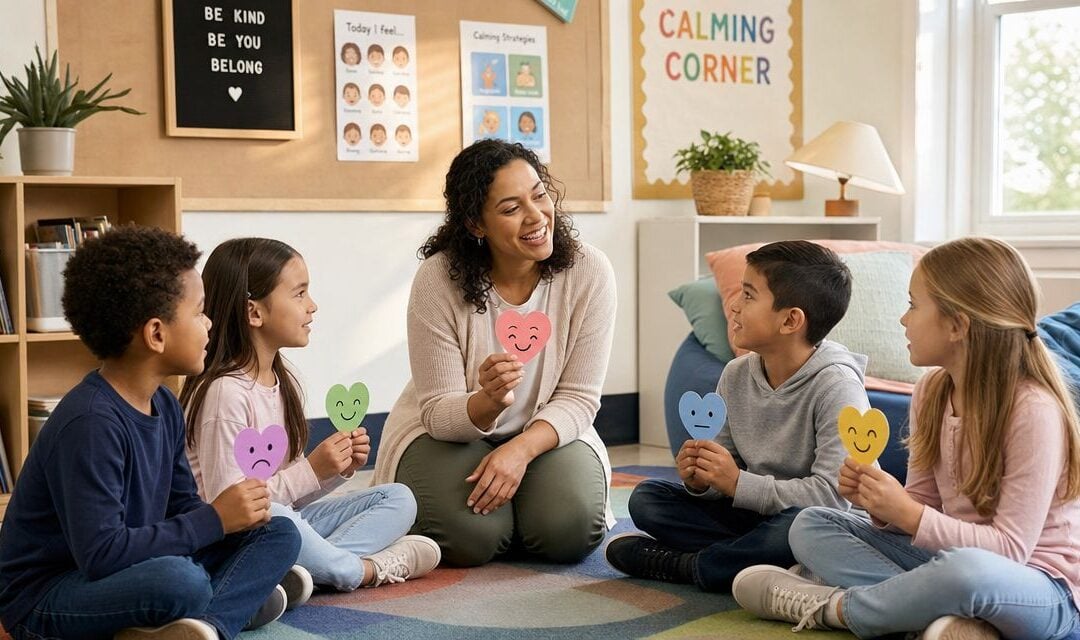
A Peace Corner isn't time-out with softer decor. It should be a brief reset space students use to regulate and return.
Keep it simple. Add a small visual feelings chart, one breathing prompt, a reflection card, and a clear expectation such as: "Calm body. Quiet reset. Return when ready." A clipboard with sentence starters can help:
"I am feeling…"
"What happened was…"
"What I need next is…"
"When I go back, I will…"
For younger students, use pictures. For older students, use a short written reflection or a dry-erase board.
Build shared language for conflict
Students need actual words. "Use your words" is too vague. Give them sentence stems they can practice during low-stakes moments.
Try these:
I-statement: "I feel frustrated when you grab the marker because I wasn't finished."
Boundary: "Please don't touch my work without asking."
Repair: "I want to fix this. Can we start over?"
Request: "Next time, can you ask first?"
Role-play these during class meetings. Keep the scenarios ordinary: line cutting, teasing, interrupting, not sharing materials. Students are much more likely to use language they've rehearsed.
Weaving SEL into Your Academic Lessons
One of the biggest misconceptions about SEL is that it requires a separate block you don't have. In most classrooms, the more sustainable move is to build social and emotional skills into the lessons you're already teaching.
That means you use reading discussions to practice perspective-taking, math problem solving to practice frustration tolerance, and social studies to practice empathy and ethical thinking. SEL becomes part of how students learn, not one more thing stacked on top.
What SEL looks like during instruction
In literacy, ask students to support emotional inferences with evidence. "What clues in the text tell you how she was feeling?" moves the conversation beyond guessing. It teaches careful reading and emotional awareness at the same time.
In math, normalize productive struggle. Before students tackle a challenging problem, you might say, "If you feel stuck, that's the moment to use self-management. Pause, breathe, reread, and try one part." During partner work, coach them to ask, "Can you explain how you started?" instead of "What's the answer?"
In social studies, SEL often shows up through perspective. When students study a community, a migration, a protest, or a historical decision, invite them to ask: "What pressures might this group have faced?" or "How might two people have experienced this event differently?"
For more classroom-ready examples, this collection of social emotional learning strategies can help teachers expand beyond standalone activities.
Sample SEL Integration Activities by Grade Band
Grade Band
Literacy (Relationship Skills)
Math (Self-Management)
Social Studies (Social Awareness)
K-2
Read a picture book and ask, "How did the character know their friend was upset?" Then have students practice one kind response.
Before independent work, teach a "try, breathe, ask" routine. Students try one strategy, take one slow breath, then ask for help.
When learning about helpers in the community, ask, "What does this person do to care for others?"
3-5
During character analysis, ask students to compare two characters' communication choices and discuss what made one more respectful.
After a hard problem, students reflect: "What did I do when I got stuck?" Share useful coping moves with a partner.
When studying communities or regions, ask students to consider how people with different roles may see the same issue differently.
6-8
Use discussion stems such as "I hear your point, and I see it differently because…" during text-based conversation.
Teach students to notice stress signals during multi-step tasks and choose a reset move before giving up.
During historical inquiry, have students examine whose voices are centered, whose are missing, and how perspective shapes understanding.
Questions that pull double duty
A good integration question strengthens both the subject and the SEL skill. Here are a few that work across grade levels:
In reading: "What does this character need but isn't saying out loud?"
In writing: "How can you disagree respectfully in your response?"
In math: "What do you tell yourself when the first strategy doesn't work?"
In science: "How does your group decide whose idea to test first?"
In social studies: "What might seem fair to one group and unfair to another?"
Ask SEL questions during content lessons when students are already engaged. That's when the skill feels useful instead of abstract.
Fostering a Culture of Empathy and Connection
Some classrooms feel settled the moment students walk in. Not silent. Not rigid. Just steady. Students know how to join a group, how to disagree without escalating, and how to recover after a rough moment.
That kind of room is built through repeated human choices. The teacher notices tone. Students learn how to repair harm. Everyone shares some responsibility for belonging.
Use restorative conversations after conflict
When a conflict happens, many students expect one thing: blame. A restorative approach still holds students accountable, but it also teaches them how to understand impact and repair relationships.
A simple four-question script works well:
What happened?
What were you feeling at the time?
Who was affected, and how?
What needs to happen to make things right?
This can happen in a quiet corner, at a back table, or after class. Keep your voice steady. Don't rush to solve it for them. Let students do the thinking.
Here is what that might sound like with upper elementary students:
Student A: "He kept interrupting me."
Student B: "I thought you were ignoring me."
Teacher: "Who was affected?"
Student A: "Both of us. We stopped working."
Teacher: "What's one repair step?"
Student B: "I'll let you finish, then ask."
Give students jobs that build community
Not every class job has to involve papers or pencils. Some of the best jobs strengthen the social life of the room.
Consider roles like these:
Inclusion Ambassador: notices when someone is left out during partner or group work.
Peacemaker: reminds classmates to use agreed-upon sentence stems during small conflicts.
Welcome Greeter: helps new or absent students rejoin routines.
Calm Corner Manager: checks that reflection tools are put back and ready.
These roles matter because they tell students that empathy and responsibility aren't private virtues. They are part of how the classroom runs.
Let students see you practice SEL too
Years ago, I snapped at a class after a loud transition. I wasn't cruel, but my tone was sharper than I wanted. A minute later, I stopped, took a breath, and said, "That came out harsher than I meant. I was feeling frustrated, and I didn't handle it the way I want us to handle frustration here. I'm sorry. Let me try that again."
The room softened immediately. Not because I was perfect, but because I showed them what repair looks like.
A short video can help teachers picture this kind of relational work in action.
When teachers model calm correction, apology, and repair, students learn that SEL isn't something adults demand from kids. It's how the whole community treats one another.
Scaling SEL Beyond Your Classroom Walls
A classroom can do a lot. It can't do everything alone. SEL sticks when students hear similar language from teachers, support staff, and families, and when schools connect universal practice with extra support for students who need more.
That doesn't require a giant new initiative to begin. It does require coordination.
Bring families into the language
Many caregivers want to support emotional growth but aren't sure what language the school is using. A short weekly message can help. Keep it simple.
You might send:
Question of the week: "What helps you calm down when you're frustrated?"
Shared sentence stem: "I feel ___ when ___ because ___."
One family practice: take one breath before solving a sibling conflict.
For families with younger children, it can also help to connect SEL language with play. This article on understanding cooperative play for toddlers is a useful example of how relationship skills begin early and grow through guided interaction.
Support teachers with repetition, not one-off inspiration
Teachers usually don't need more posters. They need time to practice routines, see examples, reflect on what worked, and adjust. A schoolwide SEL effort is more likely to last when leaders create regular professional learning and common language across classrooms.
One option schools can consider is SEL programs for schools, including approaches that offer workshops, shared language, and coaching. Keep the focus practical. Ask: What will teachers be able to use next Monday morning?
Connect SEL to existing school systems
A peer-reviewed implementation guide described a schoolwide model that uses a leadership team, ongoing staff development, stakeholder communication, classroom consistency, and tiered supports. It also recommends universal screening of all elementary students three times per year to identify who may need Tier 2 or Tier 3 support, helping schools treat SEL as a data-informed MTSS process rather than a standalone lesson series, as outlined in this implementation guide available through PubMed Central.
That schoolwide frame matters. It means teachers aren't left carrying every need by themselves. A child who struggles with peer conflict in class might need small-group practice. A student who shuts down daily may need more individualized support. SEL works best when universal routines and targeted interventions fit together.
Keep progress monitoring manageable
You don't need a complex dashboard to notice growth. Start with tools teachers will use:
Observation notes: Can the student name a feeling, use a strategy, or rejoin after conflict?
Student reflections: "What helped me today?" or "What will I try next time?"
Team check-ins: Brief grade-level conversations about patterns and supports.
The point isn't to reduce children to checkboxes. It's to notice whether the supports are helping and whether some students need more.
Common Challenges and Your Next Steps
The most common obstacle is time. Teachers often think SEL means a separate lesson they can't fit. It doesn't have to. Start with two minutes at the beginning of the day, one shared sentence stem for conflict, or one calm-down strategy before independent work.
Another challenge is student buy-in. Some students, especially older ones, may act like SEL is cheesy. Usually, they resist the packaging, not the skill. Drop the overly cute language. Use direct wording like, "This is how you reset when you're frustrated in group work," and tie it to real classroom moments.
A third barrier is uneven school support. If your whole campus isn't aligned yet, you can still build consistency inside your room. Keep your routines simple enough to repeat every day. Invite colleagues to observe a check-in or borrow your sentence stems. Small visible wins often spread faster than formal mandates.
Quick fixes for common bumps
You don't have enough time: Start with a two-minute check-in or one breathing routine before a difficult transition.
Students think it's silly: Use age-respectful language and connect the skill to a current problem they care about.
It falls apart when you're stressed: Put your scripts on a card or slide so you don't have to improvise.
Families are confused: Send home the exact phrases students are learning in class.
You aren't seeing change yet: Look for small signs first. Faster recovery, fewer repeated arguments, or better help-seeking all count.
Start with the routine you'll still use on your hardest day. That's the one that becomes culture.
If you're deciding what to do next week, choose one thing only. A morning feeling check. An I-statement chart. A Peace Corner. A restorative script. Use it consistently before adding anything else.
SEL doesn't become sustainable because a teacher tries everything at once. It becomes sustainable because a teacher repeats a few useful practices until students trust them, use them, and begin offering them to one another.
If you're ready for deeper support, Soul Shoppe offers social-emotional learning programs, workshops, and resources designed to help school communities teach self-regulation, communication, mindfulness, and conflict resolution in practical ways. That can be useful if you want structured support for classrooms, staff, and families while you keep building a calmer, more connected school culture.
A student walks into class every day with a bright smile, but by the second transition, something falls apart. They argue when it's time to clean up. They freeze when a classmate changes the game rules. They blurt out answers, then shut down when corrected. You can tell this isn't about “being difficult.” It's a child asking for support without having the words to ask.
That moment is familiar to teachers, counselors, and parents. You notice a pattern before anyone has a label for it. You feel the pull to act early, before peer conflict hardens into isolation or frustration turns into a reputation the child can't shake.
That's where early intervention programs matter. In the formal sense, they are structured supports for very young children with developmental delays or disabilities. In the day-to-day life of schools, the same principle still applies. Notice early. Respond early. Support in the environments where children live and learn.
For a principal, that may mean building a system so teachers don't wait until behavior becomes a crisis. For a parent, it may mean documenting what you see at home and asking better questions at school. For a classroom teacher, it may mean shifting from “How do I stop this behavior?” to “What skill is missing, and how can I teach it?”
Early support works best when adults feel calm, clear, and connected. That's the spirit of this guide. It's meant to help you understand formal early intervention, and also translate its most useful ideas into practical social-emotional support for children in K-8 settings.
The Moment You Know a Student Needs More
Ms. Rivera teaches fourth grade. One of her students, Malik, reads above grade level and can explain science concepts with ease. But every afternoon, when the class moves from independent work to group projects, he spirals. He talks over peers, gets stuck on fairness, and sometimes leaves the table in tears.
At first, adults around him describe separate problems. One teacher says he struggles with transitions. Another says he's rigid with peers. A parent says homework ends in conflict if plans change. None of those observations are wrong. But they can keep adults focused on isolated moments instead of the full pattern.
What adults usually notice first
The first sign is often not a diagnosis-level concern. It's friction.
Transition trouble: A child melts down when the schedule changes.
Peer conflict: Small misunderstandings become big arguments.
Low frustration tolerance: One mistake leads to quitting.
Hidden anxiety: A student looks compliant at school, then unravels at home.
Those signs can look behavioral on the surface, but they often point to lagging skills in self-regulation, communication, flexibility, or emotional awareness.
Children rarely say, “I need help with regulation and problem-solving.” They show you through patterns.
The question behind the concern
Most caring adults ask some version of the same question. “What can I do now, before this becomes bigger?”
That question matters. It shifts the goal from punishment to prevention. It also keeps adults from waiting for a formal crisis meeting before offering support.
In schools, early help doesn't have to start with a referral packet. It can start with one teacher tracking when the struggle happens, one counselor helping the child name feelings, or one family and school team agreeing on a shared response plan. For example, a student who gets overwhelmed during partner work may do better with a preview of the task, a sentence stem for entering the group, and a calm check-in afterward.
What early support looks like in real life
Early support is often simple at first.
A second grader who shoves in line may need rehearsal for waiting and asking. A middle schooler who shuts down after feedback may need an adult to model how to recover from mistakes. A child who keeps getting into lunch conflicts may need guided practice using “I felt left out when…” instead of “You always…”
The point isn't to overreact. It's to respond while the problem is still teachable.
What Exactly Are Early Intervention Programs
In the formal U.S. sense, early intervention programs are tied to IDEA Part C, a public system for infants and toddlers from birth through age 2 who have developmental delays, disabilities, or are at high risk of delay. A major milestone in this system is that more than 770,000 children received services in 2021, with national participation around 7%, and state participation ranging from about 2% to about 20%, according to this IDEA Part C overview and data summary.
That formal definition matters because it gives families legal pathways to support. It also grounds the phrase in a real public system, not just a general idea.
The formal meaning and the everyday meaning
In practice, many readers are talking about something broader when they search for early intervention programs. They want to know what to do when a child starts struggling early, whether the issue is speech, regulation, social skills, anxiety, behavior, or school adjustment.
A useful way to think about it is this. Formal early intervention is a program. Early intervention as a school mindset is a principle.
If a child encounters a small step, you build a ramp right away. You don't wait until they're standing in front of a staircase with no way up.
For toddlers, that ramp may include developmental services. In elementary and middle school, that ramp may include:
Predictable routines: Clear start-of-day and transition supports.
Skill teaching: Direct lessons in naming feelings, asking for help, and repairing conflict.
Adult coaching: Helping teachers and caregivers respond consistently.
Environment changes: Adjusting sensory load, task structure, or peer grouping.
Why this broader view helps schools
School leaders often get stuck because “intervention” sounds clinical, expensive, or separate from normal instruction. But the core idea is much more practical. Support should arrive when a child first shows sustained difficulty, not only after repeated failure.
That's especially helpful when supporting students who think, feel, and communicate differently. If you want a plain-language resource on respectful language and Support for neurodivergent individuals, that guide can help adults speak with more care and clarity.
Here's the key distinction. Not every struggling student needs a formal special education pathway. But every struggling student benefits when adults notice patterns early, build support into daily routines, and treat skill gaps as teachable.
Practical rule: If a need shows up across time, settings, or relationships, don't wait for it to “blow over.” Start supports while you gather more information.
The Lasting Impact of Early Support
A second grader starts dreading recess because every small disagreement turns into a big reaction. By middle school, that same pattern can look like defiance, withdrawal, or a student who assumes conflict is coming before anyone says a word. Early support changes that path because it gives children practice while habits are still forming.
In birth-to-three systems, the basic idea is straightforward. Respond early, teach skills in real life, and build support around the child before stress patterns become harder to shift. That same logic matters in K-8 settings, especially for social, emotional, and behavioral needs that often get missed until they disrupt learning.
Why early action changes trajectories
Early support works like correcting a bike's direction with a small turn of the handlebars instead of waiting until the rider is headed for the curb. A child who struggles with frustration does not usually need louder reminders to “calm down.” That child needs repeated coaching in what to notice, what to say, and what to do next.
Consider two different school experiences.
In one, a student keeps getting corrected for yelling, shutting down, or arguing. Adults respond after the problem appears, but no one teaches the missing skill in a calm moment. Over time, peers pull away, the student expects failure, and the behavior starts to look more fixed than it really is.
In the other, adults catch the pattern early. They teach body signals, practice a pause routine, rehearse repair language, and coach the student through real conflicts with steady follow-through. The child still feels upset sometimes. The difference is that the child now has a path back.
That is the long-term value of early support. It lowers the chance that a temporary lag in regulation, communication, or social problem-solving becomes part of a student's identity.
The system impact is real
This approach also matters for school systems. A recent analysis from the Prenatal-to-3 Policy Impact Center found that early intervention services helped between 760 and 3,000 children per state avoid special education at age 3, with estimated 1-year cost avoidance ranging from $7.6 million to $68.2 million depending on the state.
District leaders often need that kind of evidence. It shows that early support can reduce strain on later services, especially when schools address concerns before they grow into repeated referrals, chronic discipline issues, or academic disengagement.
Some students will still need individualized therapy alongside school-based support. For families exploring that option, services like Interactive Counselling for autism may offer another path for children who benefit from more focused counseling.
The human payoff matters most
Families usually notice the impact in ordinary moments first.
A child walks into class without scanning for trouble. A student who used to flip a game board says, “I need a break.” Classmates begin to read overwhelm more accurately and respond with more patience. Those moments may look small, but they are signs that a child is building safety, self-awareness, and trust.
In this context, the bridge from clinical early intervention to school-based early support becomes so useful. In K-8 schools, we are often not treating a diagnosed delay in the formal Part C sense. We are applying the same early-action principle to the skills children need in classrooms, hallways, lunch lines, group work, and friendships.
That is also why SEL belongs in this conversation. School-wide instruction in emotion naming, communication, boundary-setting, and conflict repair creates a prevention layer that supports every student while giving struggling students more chances to practice. For teams building that foundation, this overview of the benefits of social-emotional learning shows how shared SEL routines can strengthen early support long before a problem becomes a crisis.
From Clinical Treatment to Classroom Coaching
Many adults still picture intervention as a child leaving class, working with a specialist, then returning “fixed.” Sometimes that kind of service is necessary. But it's not the only model, and it's often not the most sustainable one for day-to-day school challenges.
Many modern systems have shifted toward support in natural routines. State guidance increasingly emphasizes coaching families and enhancing everyday learning opportunities, rather than focusing only on deficit-based therapy, as described in Pennsylvania's early intervention services guidance.
Two approaches side by side
Approach
What it looks like
Strength
Limitation
Clinical model
Pull-out sessions, specialist-led work, skill practice in separate settings
Focused expertise
Skills may not transfer easily to classroom, lunch, recess, or home
Classroom coaching
Adults embed support into routines, language, transitions, and relationships
High relevance to daily life
Requires adult consistency and collaboration
The strongest school-based support often combines both when needed. A child may still receive therapy, but the adults around that child also learn how to reinforce those skills all day long.
What coaching looks like in practice
A clinical model might target expressive language during a scheduled session.
A coaching model asks, “How can the teacher prompt more language during morning meeting? How can a paraprofessional pause long enough for the child to answer? How can a parent build turn-taking talk during dinner?”
The same goes for emotional regulation. Instead of treating regulation as something taught only in a counseling office, adults can build it into normal school moments:
Before stress: Preview changes and rehearse coping tools.
During stress: Use a shared script such as “Pause, breathe, say what you need.”
After stress: Repair the interaction and reflect on what helped.
Adults create the learning environment. When adults change the environment, children often gain access to skills they already had trouble showing.
Why this fits K-8 settings better
Most school struggles happen in context. During group work. At recess. In the hallway. At dismissal. That's why classroom coaching often works better for social, emotional, and behavioral goals than isolated support alone.
A trauma-aware approach helps here too. If your staff is trying to move from compliance language to relational support, these trauma-informed teaching strategies offer practical ways to reduce shame and build safety.
When adults stop asking, “How do we fix this child?” and start asking, “How do we coach this child in real situations?” intervention becomes more humane and more usable.
Putting Early Intervention into Practice at School
School teams need a structure, not just good intentions. A practical way to organize support is through a Multi-Tiered System of Supports, or MTSS. That means you offer some supports to everyone, more targeted supports to some students, and individualized supports to a smaller group with greater need.
A visual can make the tiers easier to hold onto.
Tier 1 for all students
Tier 1 is your prevention base. If this layer is weak, too many students get pushed into higher levels of support.
In a K-8 setting, Tier 1 might include:
Shared feeling language: Teachers use the same words for emotions and problem-solving across classrooms.
Routine community practices: Morning meetings, closing circles, partner check-ins, and class agreements.
Direct SEL instruction: Students learn how to listen, disagree respectfully, calm their bodies, and repair mistakes.
A school might also bring in structured SEL support such as assemblies, workshops, or staff coaching. Social-emotional learning programs for schools can help leaders see what that can look like across a campus.
This short video gives another lens on how school supports can be organized in practice.
Tier 2 for some students
Tier 2 is for children who need more than universal instruction but don't yet need highly individualized intervention.
Examples include:
Lunch groups: A counselor or trained staff member runs a small group on friendship skills or emotion regulation.
Check-in routines: A student meets briefly with an adult at the start and end of the day.
Conflict practice groups: Students rehearse listening, turn-taking, and apology skills with support.
A fifth grader who repeatedly gets into recess conflict may join a small group that practices entering games, handling “no,” and using repair language. The key is that the skill gets taught, practiced, and revisited.
Tier 3 for a few students
Tier 3 is individualized. The student may need an individualized support plan, counseling, formal evaluation, behavior support, or a coordinated team response.
That can include:
A clear problem statement: “Transitions after lunch lead to dysregulation and class refusal.”
Specific supports: Visual schedule, quiet arrival routine, adult check-in, break plan, and family communication.
Regular review: Adults meet, notice patterns, and adjust.
This is the one section where naming a concrete provider makes sense. Soul Shoppe offers school-based social-emotional learning workshops, assemblies, and coaching that schools can use as part of universal and targeted support, especially around self-regulation, communication, and conflict resolution.
The strongest MTSS systems don't wait for children to fail loudly. They build steady layers of support so students can succeed earlier and with less distress.
A Parent Guide to Partnering for Early Support
Parents often sense a problem before they know what to call it. You may notice that your child handles school all day, then falls apart at home. Or maybe playdates keep ending in tears, homework turns into panic, or your child says, “Nobody likes me,” even when the teacher reports a mostly normal day.
That uncertainty is hard. It gets harder when you ask for help and hear vague answers, or when services feel slow to access. Research on access barriers notes that even eligible families can run into waitlists, staffing shortages, hesitation, and coordination challenges, which is why strong school-family partnership matters so much, as discussed in this peer-reviewed review of early intervention access barriers.
Start with observations, not labels
A strong first step is to describe what you see as specifically as possible.
Instead of saying:
“My child is selfish.”
“She's always anxious.”
“He can't handle anything.”
Try:
During playdates: “She gets upset when another child changes the rules.”
At homework time: “He tears up when he makes a mistake and wants to stop.”
Before school: “She complains of stomachaches most on days with presentations or group work.”
Specific examples help school staff respond to patterns. Labels alone can trigger defensiveness or confusion.
How to open the conversation with school
You don't need a perfect script. You need a collaborative tone.
You could say:
I'm noticing some patterns at home and I'm wondering if you see anything similar at school. I'd love to compare notes and think together about what support might help.
That phrasing does three useful things. It shares concern without blame. It invites the teacher's perspective. It keeps the focus on support, not fault.
If the teacher says they don't see the same level of struggle, don't assume that means nothing is wrong. Some children hold it together at school and release tension at home. Others struggle in one setting because the demands are different.
Simple supports families can try at home
You don't need to turn home into therapy. Small routines can make a big difference.
Create a calm-down spot: Include paper, soft items, or sensory tools. Present it as a place to reset, not a punishment space.
Practice feeling words during neutral times: “You looked disappointed when the game ended.” This builds language before a hard moment hits.
Use one repair phrase consistently: “Try again with respect” or “Tell me what happened, not who's bad.”
Rehearse hard moments ahead of time: Before a birthday party or sports practice, talk through what your child can do if they feel left out or frustrated.
If worry is a major part of the picture, these anxiety coping skills for kids can give families simple, age-appropriate ideas to practice at home.
Parents don't need to solve everything alone. Your role is to notice, communicate, and help create consistency between home and school.
Measuring Success Beyond the Data
A school team can do every formal step correctly and still miss the question families care about most. Is this child doing better in real life?
Timelines, eligibility labels, and support plans help adults respond promptly. Those structures matter, especially in birth-to-three systems where quick follow-through is part of good practice. In a K-8 setting, though, school leaders and families also need to watch for quieter signs of progress. A student may still have hard days and still be growing in meaningful ways.
Growth in social and emotional development often works like physical therapy after an injury. The first sign of healing is not always a dramatic leap. Sometimes it is steadier balance, faster recovery, or a little more confidence using a skill that used to fall apart under stress.
Signs that support is working
Look for patterns like these over time:
Faster recovery after a setback: The student still gets frustrated, but returns to learning or connection with less adult support.
Clearer communication: They name a feeling, ask for space, or tell an adult what happened before the moment turns into conflict.
Stronger participation: They join the group, stay with a task longer, or try again after making a mistake.
More relationship repair: They apologize, accept feedback, or reconnect with peers after tension.
Growing belief in their own skills: They begin to expect that a hard moment can be handled.
A lower incident count can be one useful sign. It is not the whole picture. Real success also looks like a child feeling safer, more capable, and more connected at school.
Keep the record useful and human
Documentation helps when it answers practical questions. What is getting easier? What still sets this student off? Which support works with this teacher, in this class, at this time of day?
Some teams use brief behavior notes or meeting logs. Some use student support platforms to track enrollments and student progress so patterns do not live only in one adult's memory. The best record is one that helps adults notice change early, adjust support, and stay consistent across classrooms and home.
That is especially important when schools adapt early intervention principles for older students. In a clinical model, progress may be tied to eligibility or treatment goals. In an SEL-focused school model, progress may show up in daily moments. A fifth grader uses a calming strategy before a conflict. A seventh grader asks for a reset instead of walking out. Those are small moments on paper. In practice, they are turning points.
Soul Shoppe's approach fits that everyday view of growth. The goal is not merely to document fewer problems. The goal is to help children build the relationship skills, self-awareness, and self-regulation that make learning and belonging more possible.
You're probably looking for something better than another family game night that ends with one child crying, one child gloating, and an adult saying, “Let's just clean up.” That's exactly where cooperative games for families can help. Instead of putting players against each other, they put everyone on the same side of the problem.
That simple shift changes the tone of play. Kids can practice taking turns, sharing ideas, and handling frustration without the pressure of beating a sibling. Adults can guide the experience without feeling like referees. For mixed-age groups, that matters even more, because a good co-op game gives younger children a real role instead of asking them to keep up with older players.
There's a broader reason these games keep showing up in homes, classrooms, and school counseling spaces. Historians widely describe The Landlord's Game as the first commercial cooperative board game, and in digital gaming, annual co-op releases on Steam rose from 647 in 2020 to 799 in 2023, a gain of 152 releases, or about 23.5 percent over three years, according to the historical overview summarized in this cooperative games history video. The format isn't a niche anymore. Families now have many more options across ages and skill levels.
The list below focuses on games that parents and educators can use. Each one includes practical examples, likely sticking points, and simple ways to keep all players involved.
1. Pandemic Board Game
Pandemic works well for families who want a true team challenge. Every player takes on a specialist role and the group tries to contain outbreaks and discover cures before the board spirals out of control. Because the game rewards planning out loud, it creates natural chances to practice listening, turn-taking, and shared decision-making.
In older elementary, middle school, or family groups with adults and tweens, this can become more than a board game. One child notices where the biggest threat is building, another tracks cards, and an adult helps the group think ahead without taking over. That division of attention gives each player a meaningful job.
For readers looking for simpler entry points before trying a strategy game like this, Soul Shoppe also shares cooperative games for kids that work well for younger groups.
Here's a quick look at the game in action:
How to keep it family-friendly
The biggest risk in Pandemic isn't the board. It's the strongest player taking over every turn. That can turn a cooperative game into a lecture.
Practical rule: Give every player a short “thinking turn” before anyone offers advice. Ask, “What do you see?” before saying, “Here's what you should do.”
A few small adjustments help:
Start easy: Use the easiest setup first so younger players learn the rhythm before the pressure ramps up.
Assign manageable roles: Give younger players roles with clearer tasks so they can contribute without tracking too many moving parts.
Debrief after play: Ask, “What helped us work together?” and “When did we stop listening?”
A school counselor or after-school leader could use Pandemic with a small group and pause twice during the game to ask students how they're making decisions. At home, parents can do the same thing in a lighter way. “Who noticed the next problem?” is often a better question than “Who had the best move?”
2. Hoot Owl Hoot Board Game
For younger children, Hoot Owl Hoot is one of the easiest ways to introduce cooperative games for families. Players help owls get back to the nest before sunrise by playing color cards and moving the owls together. There's no reading load, the turns are short, and the shared goal is easy for a five-year-old to understand.
That simplicity is a strength, not a limitation. In a mixed-age family, a preschooler can match colors, an older sibling can help plan the order of moves, and an adult can model calm teamwork language. Nobody has to “go easy” on the youngest player because everyone is already on the same team.
Why it works with early learners
Children ages four to six are especially relevant here. In a study of 65 children ages four to six, researchers found that children enjoyed cooperative games more than competitive ones, and the paper also cites experimental findings showing cooperative play increased cooperative behavior and decreased aggressive behavior during play and later free play. It also reports a statistically significant condition effect for competitive behavior after competitive games, with F ∼ 4.91 and p = 0.028, as described in the open-access child development study on cooperative and competitive board games.
That doesn't mean every co-op game automatically creates harmony. It does mean the structure supports the kind of behavior most adults want to practice with young children.
Try these classroom or home moves:
Celebrate progress: Say, “We moved two owls closer,” instead of waiting only for the final win.
Model useful language: Use phrases like, “Let's help this owl first,” or “What do we need together?”
Add a reflection: After the game, ask, “How did we help each other?”
A kindergarten teacher can use Hoot Owl Hoot in a morning meeting center. At home, it works well when one sibling is still learning how to lose and another gets bored by very simple games. The older child can become a helper without becoming the boss.
3. Forbidden Island Cooperative Game
Forbidden Island is a strong next step when children are ready for more planning and more tension. Players work together to collect treasures and escape before the island sinks. The game asks the group to prioritize, share resources, and decide which danger matters most right now.
That makes it useful for upper elementary and middle school families, especially when siblings are learning how to disagree without melting down. In this game, disagreement is normal. The group often has several reasonable choices, which creates room to practice respectful talk instead of rushing to the loudest answer.
A better way to manage group decisions
One of the biggest gaps in advice about cooperative games is mixed-age fairness. Many family roundups talk about teamwork, but they don't explain how to keep the oldest or most verbal player from dominating. That practical challenge is highlighted in this discussion of choosing Peaceable Kingdom cooperative family board games for mixed ages, which points to the need for low-reading games, open-hand play, and adjustable difficulty when age ranges are wide.
That idea matters in Forbidden Island. If one player always dictates the plan, younger players stop participating meaningfully.
When a child says, “I disagree because we'll lose that tile,” that's social-emotional learning in real time.
Try a simple family protocol:
One idea each: Every player offers one suggestion before the group chooses.
Use reasoning stems: Encourage phrases such as, “I suggest this because…” and “Let's consider another option.”
Match roles thoughtfully: Give a cautious child a role that rewards planning. Give an impulsive child a role that encourages patience.
For school use, Forbidden Island fits nicely into small counseling groups or advisory periods focused on collaborative problem solving. A counselor can watch how students negotiate and which voices get heard. At home, parents can borrow the same lens and notice whether the group is solving the problem together or just following one leader.
4. Outfoxed! Cooperative Deduction Game
If your family likes mysteries, Outfoxed! is often an easy win. Players act as detectives, gather clues, and rule out suspects before the fox escapes. The deduction is simple enough for early elementary children, but the game still feels clever because each clue changes the group's thinking.
This one works especially well for children who don't love direct competition. There's still urgency, but no one has to outplay a sibling. The tension stays on the puzzle.
What children practice while playing
The best moments in Outfoxed! usually sound like this: “Wait, we know the fox doesn't have boots,” or “That clue means we should remove these suspects.” Those are clear acts of information sharing and collective reasoning.
A parent or teacher can make that thinking more visible with a few small moves:
Think aloud: Model statements like, “This clue tells me we can cross out anyone with that feature.”
Keep clues visible: Make a simple “evidence board” with the cards where everyone can see them.
Praise specific behaviors: Say, “You listened carefully to that clue,” instead of giving general praise.
A child who struggles to speak up in free play will often contribute more easily when the evidence is right in front of them.
In a library program, Outfoxed! can follow a read-aloud mystery story. In a K to 2 classroom, it can support listening and speaking goals. At home, it's especially useful when one child likes to solve everything quickly and another needs more processing time. The visible clues slow the pace down in a helpful way and give quieter players something concrete to point to.
5. Splendor Cooperative Variant Rules
Splendor is usually a competitive game, but many families create a cooperative house version after everyone learns the base rules. In that version, players work toward a shared market goal, discuss purchases together, and treat resources as part of a group plan instead of individual progress.
This kind of adaptation works best with older elementary and middle school players who enjoy strategy but need practice with fairness and negotiation. Because the original game wasn't designed as a children's SEL tool, adults should be ready to scaffold the conversation more intentionally.
How to make the variant work
Start by teaching the standard rules so everyone understands card costs, gem collection, and long-term planning. Then shift one piece at a time. For example, the family can decide that all players are building one shared engine and must agree on priority buys.
That setup gives you a natural way to talk about economic cooperation. One child might want a card that helps them immediately. Another might notice that a different card helps the group more.
Use a few guardrails:
Set negotiation norms: Everyone gets to propose a move before the group decides.
Track shared goals visually: A simple notepad can help younger players follow the plan.
Debrief fairness: Ask, “Did everyone get heard?” and “Did we choose what helped the group most?”
A social studies teacher could adapt this style of play when discussing trade, resource sharing, or group priorities. At home, this is a strong option for academically engaged kids who enjoy systems and patterns but need support learning that being right isn't the same as being collaborative.
6. Race to the Treasure Cooperative Game
Race to the Treasure is one of the clearest examples of a game that teaches “we win together.” Players build a path, collect keys, and try to reach the treasure before the ogre does. The rules are straightforward, the visual goal is obvious, and younger children can understand success almost immediately.
For families with preschoolers and early elementary children, that clarity matters. The youngest player can still participate in the plan, even if an older sibling notices strategy first. Everyone sees the same path growing on the table.
Good for short, repeatable practice
Some games are best because they're deep. Race to the Treasure is good because you can play it, talk about it, and play again without much setup. That makes it especially useful in classrooms, therapy waiting rooms, and busy homes.
Try these simple teaching moves:
Repeat the core message: Use phrases like, “We all made the path,” and “We all beat the ogre.”
Keep the reflection short: Ask, “What helped us today?” or “How did we build it together?”
Use it during transitions: It fits well before dinner, after school, or at the end of a preschool center block.
A kindergarten class could use this with new students during the first weeks of school. A family with a three-year-old and a seven-year-old could use it to build the habit of shared success before trying heavier strategy games. If your goal is belonging rather than challenge, this is a very practical place to start.
7. Cascadia Board Game
Cascadia is often known as a thoughtful tile-laying game, and families who enjoy nature themes can adapt it into a cooperative experience by building toward shared habitat goals together. Instead of focusing on individual scoring, players talk through placements and try to create balanced habitats for animals such as salmon, bears, elk, and owls.
That shift makes the game especially useful for older kids who like strategy but also benefit from a broader discussion about systems. Habitat placement becomes more than a puzzle. It becomes a conversation about how parts of an environment connect.
Strong fit for family learning
This kind of cooperative adaptation also lines up with broader market movement. The global board games market is projected to grow from USD 17.22 billion in 2025 to USD 30.06 billion by 2031, and cooperative or legacy titles are forecast to be the fastest-growing game format at a 10.74 percent CAGR through 2031. The children segment is projected to grow at 10.39 percent CAGR through 2031, according to the global board games market forecast from Mordor Intelligence.
For families and schools, the practical point is simple. More games are being designed or adapted for shared, social play.
Try using Cascadia like this:
Post a shared habitat goal: “Let's create connected spaces for these animals.”
Ask systems questions: “Where would salmon fit best?” and “What happens if we crowd this habitat?”
This is a good choice for a family that wants game night to feel calm, thoughtful, and discussion-based instead of loud and fast.
8. Magical Peaceable Kingdom Cooperative Games Collection
Sometimes the best choice isn't one game. It's a small shelf of age-matched options. Peaceable Kingdom's cooperative line is useful for that because families and schools can choose different titles based on reading level, attention span, and social goals. A preschooler might be ready for a simple shared-path game, while an older child can handle more memory, planning, or deduction.
That matters because cooperative games for families aren't automatically fair just because they are cooperative. The fit has to be right. A game that works beautifully for two six-year-olds may fall apart when a ten-year-old starts optimizing every move.
Build a collection with purpose
In the educational board game segment, cooperative games are estimated to account for 28 percent of new product launches in 2025, up from about 18 percent in 2020, according to the educational board games market report from Dataintelo. That shift suggests designers and publishers are putting more attention on shared problem-solving formats.
For parents, teachers, and counselors, the practical takeaway is to choose by developmental fit rather than popularity alone.
A useful collection might include:
A low-reading game: Best for younger children or mixed-age siblings.
An open-information game: Useful when adults want to coach openly and model language.
A variable-difficulty game: Helpful when older children need challenge without leaving younger players behind.
The educational value of a cooperative game depends on whether every player can participate meaningfully, not just whether everyone is sitting at the same table.
A school counselor might keep two or three Peaceable Kingdom games in a calm corner for lunch groups. A family might add one title a year and rotate them based on the season, the children's ages, or the skill they want to practice most.
Family Cooperative Games: 8-Game Comparison
Game
Implementation complexity
Resource requirements
Expected outcomes
Ideal use cases
Key advantages
Pandemic Board Game
Medium–High, multi-rule cooperative play and role management
Board, role cards, 45–60 min sessions, 2–4 players, initial facilitation
Systems thinking, spatial reasoning, environmental awareness
Science classes, environmental clubs, family nights
Combines ecology education with cooperative planning; visually engaging
Magical Peaceable Kingdom Collection
High, multiple systems and progressive selection
Multiple titles, budget for collection, varying play times, teacher training
Developmental progression in cooperation, consistent SEL scaffolding
K–8 districts, classroom game libraries, SEL program integration
Age-pathway approach; publisher expertise; versatile for many grades
Final Thoughts
Cooperative games for families work best when adults treat them as both play and practice. The play matters because children learn more when the activity feels enjoyable and low-pressure. The practice matters because these games create repeated chances to share ideas, wait, compromise, recover from mistakes, and solve a problem with other people instead of against them.
The strongest game for your family depends less on popularity and more on fit. If you have preschoolers, simple shared-goal games often work better than games with deep strategy. If you have a wide age spread, look for low-reading rules, visible information, and ways to adjust difficulty. If you have older kids, games with planning and respectful disagreement can be especially useful. In every case, the main question is the same: can each person contribute in a real way?
That's also why the adult role matters. Parents and educators don't need to control the whole experience. They do need to protect space for every voice. Sometimes that means pausing before giving advice. Sometimes it means asking a quieter child what they notice. Sometimes it means choosing a simpler game so the group can cooperate rather than just watch the most confident player lead.
The broader trend supports this direction. Cooperative games have moved from a relatively narrow format into a more visible part of family and educational play, and product development continues to reflect that growth. But the value at home is still very practical. A good co-op game gives children a safe place to practice the same skills adults want during homework, sibling conflict, classroom teamwork, and everyday routines.
If you use these games in a school or family setting, keep the reflection short and concrete. Ask what helped, what got in the way, and who made room for others. Over time, those conversations matter as much as the wins.
For families and schools that want more social-emotional learning support around communication, conflict resolution, and connection, Soul Shoppe offers programs and resources designed for those goals.
If you want more practical SEL tools that support connection at school and at home, explore Soul Shoppe for workshops, family-friendly resources, and ideas you can use alongside cooperative play.