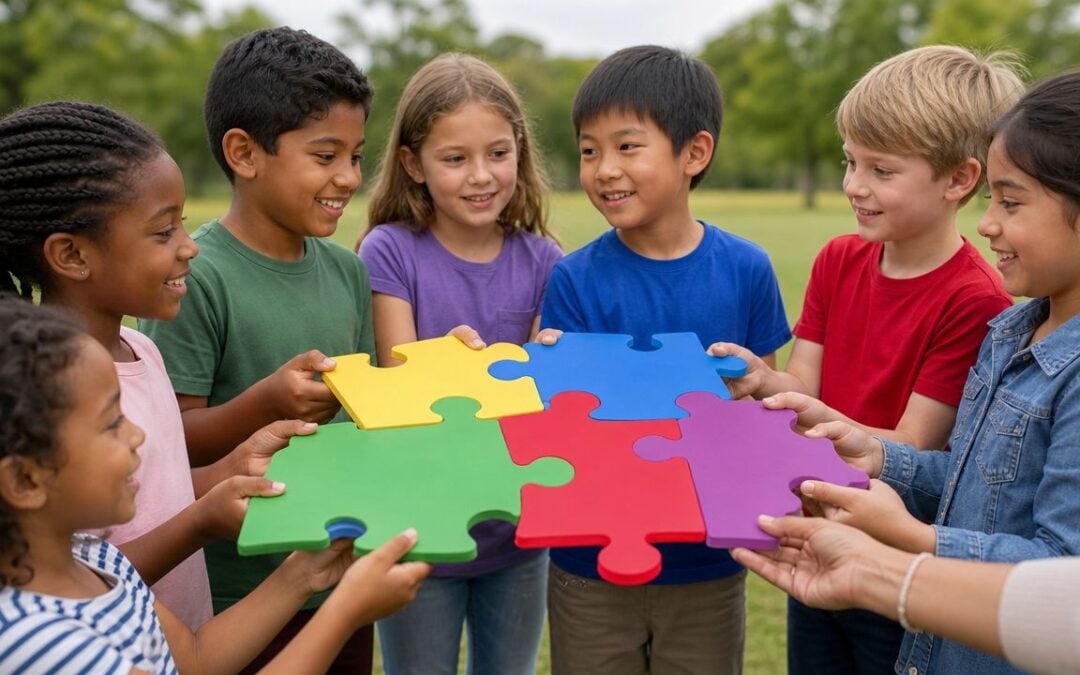
You can feel when a group of young people isn't really a group yet. A few students carry every discussion. A few stay silent. Someone gets left out during partner work. A small disagreement at recess or practice somehow follows everyone back indoors. Adults often respond by adding a quick icebreaker and hoping the energy shifts.

Sometimes it helps. Often it doesn't.

The missing piece usually isn't effort. It's skill-building. Young people need repeated practice with listening, turn-taking, self-regulation, problem-solving, repair after conflict, and shared responsibility. That's why the best team building activities for youth do more than fill time. They teach social-emotional skills in a form kids can use with classmates, teammates, siblings, and friends.

That matters even more now. A peer-reviewed meta-analysis found team-building interventions in sports significantly improve team cohesion, with the strongest effects on task cohesion, and the benefits were most pronounced for participants aged 15 to 20 and for collegiate teams. In practice, that points facilitators toward shared goals, role interdependence, and repeated problem-solving instead of random novelty games (peer-reviewed meta-analysis on team-building and cohesion).

The list below is built from that lens. Each activity connects directly to SEL, includes facilitation moves that work in real settings, and offers ways to adapt for K-8 students, including virtual formats. If you're planning a field trip or off-campus bonding day, this Perth school outing planning guide can also help with logistics.

1. Circle Discussions and Talking Circles

A talking circle works because it slows the room down. Instead of rewarding the loudest student or the fastest answer, it gives each child a clear turn and a reason to listen. That builds self-awareness, respectful communication, and the sense that everyone belongs in the space.

This is one of the most reliable team building activities for youth when a class feels fragmented. It's especially useful after transitions, after conflict, or at the start of a new term when students need structure more than hype.
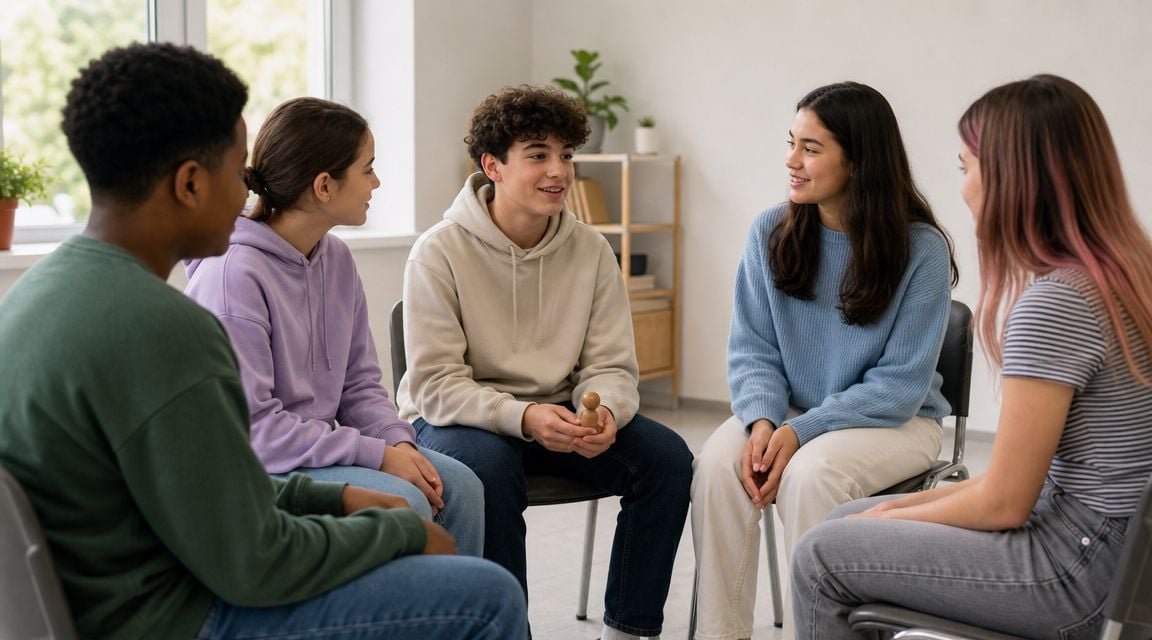
A diverse group of teenagers sitting in a circle during a team building activity in a bright room.

How to lead it well

Seat everyone in a real circle if possible. Use a visible talking piece such as a small ball, smooth stone, or classroom mascot. Only the person holding it speaks, and passing is always allowed.

Start with low-risk prompts:

  • K-2: “What's one thing that helps you feel ready to learn?”
  • 3-5: “What's one way a classmate can show kindness during group work?”
  • 6-8: “What helps you feel included in a group, and what shuts you down?”

Keep the first rounds short. In elementary settings, I'd rather end a circle while students still feel successful than stretch it until they get restless.

Practical rule: Don't begin with “share a vulnerable moment.” Begin with “share a preference, a strength, or a hope.” Safety grows before honesty deepens.

Real examples and adaptations

A morning meeting circle in a second-grade classroom might use sentence stems like “Today I can help my class by…” A middle school advisory can use circles to repair tension after group project drama. In after-school programs, circles work well before a cooperative challenge, because they create the listening culture the challenge will require.

For virtual groups, keep the circle shape symbolically. Put students in gallery view, use a digital speaking order, and invite responses with sentence stems in chat for students who aren't ready to speak out loud.

2. Cooperative Games and Low-Ropes Courses

Not every physical challenge builds teamwork. Some just expose who is fastest, strongest, or most comfortable taking over. Cooperative games work when the task requires everyone, and when the facilitator treats reflection as part of the activity, not an optional extra.

The strongest youth team-building work usually comes from structured, facilitation-led experiences rather than one-off games. That broader demand is showing up beyond schools too. The global team building service market is estimated at USD 6.99 billion in 2026 and projected to reach USD 40.35 billion by 2035, implying a 21.52% CAGR, according to Business Research Insights on the team building service market.
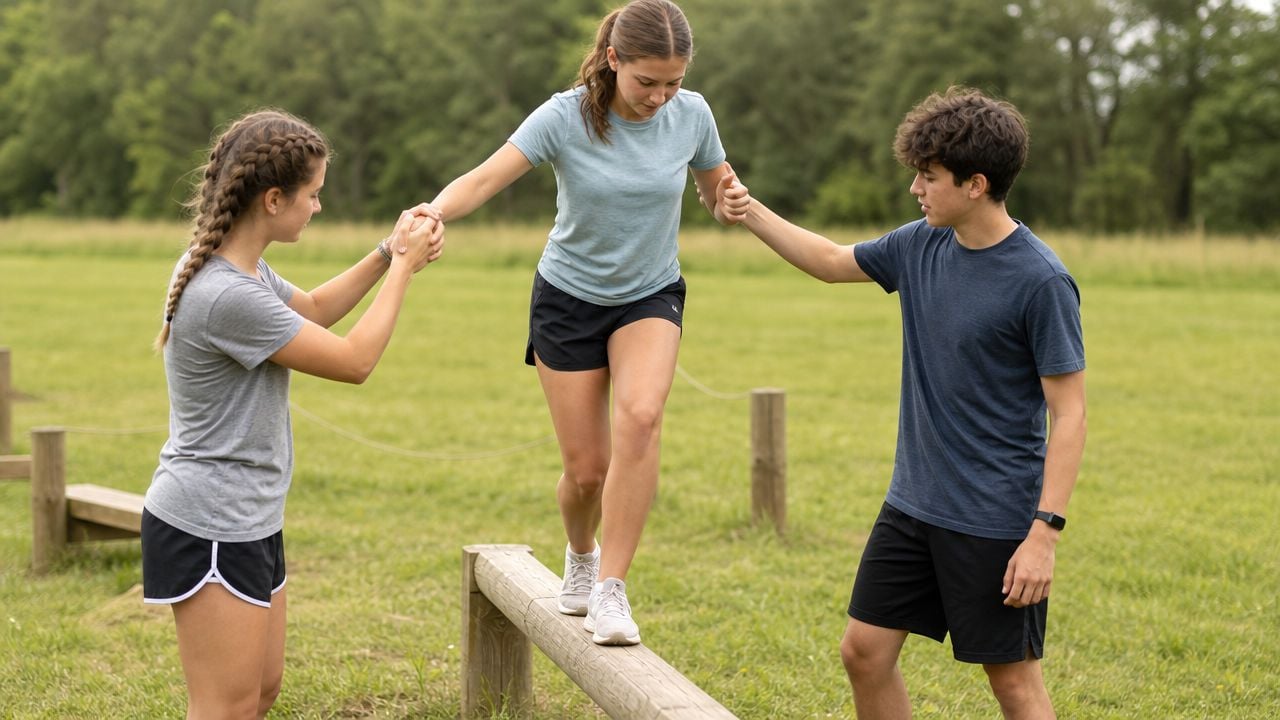
Two teenagers assisting another girl as she balances on a wooden log in a grassy field.

What builds skill instead of just excitement

A low-ropes style challenge, cup-stacking relay, group balance task, or “cross the river” game teaches planning under pressure. Students have to assign roles, notice who hasn't spoken, and adjust when the first plan fails.

Good facilitation sounds like this:

  • Before: “How will you make sure everyone has a job?”
  • During: “Pause. Who has an idea we haven't heard yet?”
  • After: “What did your team do when the first strategy stopped working?”

That sequence is where the SEL learning lives. Without it, students just remember whether they won.

For indoor options, cooperative board games can do similar work with lower physical demand. Families looking for calmer formats can find teamwork board games that reward planning and shared decision-making.

A short video can help staff picture the setup before running a challenge:

K-8 adjustments

With K-2, use very short tasks and obvious roles such as holder, watcher, encourager, and checker. Grades 3-5 can handle layered rules. Middle schoolers usually need challenge-by-choice language, because forced participation can quickly become performative or unsafe.

3. Empathy Mapping and Perspective-Taking Exercises

When students say, “She was being rude,” they're usually naming impact, not understanding perspective. Empathy mapping helps them pause long enough to ask what another person might be thinking, feeling, hearing, and needing.

That matters in classrooms because many youth activities focus on fun but skip the mechanism that actually builds connection. Empathy work helps students separate intent from impact and move from blame to curiosity.

A simple format that works

Put a scenario in the center of a chart. Examples:

  • A student is left out during recess.
  • A new classmate doesn't join the group project.
  • Two friends stop talking after one interrupts the other in front of the class.

Then divide the page into four areas: says, thinks, feels, and needs. Have students work in pairs or trios and fill in each area for one person in the scenario.

Keep the room grounded with reminders:

  • Understanding isn't agreement.
  • We're exploring possibilities, not mind-reading.
  • Avoid stereotypes. Stay close to the actual situation.

A fourth-grade class might map the feelings of a student who loses a turn and reacts loudly. An eighth-grade advisory might examine a group-chat conflict and identify where assumptions took over.

Understanding another student's perspective doesn't excuse hurtful behavior. It gives the group a better shot at repairing it.

Age adaptations and virtual use

For younger students, use pictures and sentence stems such as “They might feel…” and “They may need…” Older students can compare multiple perspectives from the same event, which is often where the richest discussion happens.

If you want more structured classroom prompts, these perspective-taking activities offer useful follow-up ideas. Online, students can complete shared empathy maps in Google Slides or Jamboard-style tools, then discuss what changed when they looked beyond first impressions.

4. Mindfulness and Grounding Practices for Group Regulation

A dysregulated group can't collaborate well. Students who are overstimulated, frustrated, or embarrassed often look “uncooperative” when what they need is help returning to baseline. Group mindfulness gives everyone a shared reset without singling anyone out.

This is also an inclusion issue. Many popular lists of team building activities for youth lean heavily on loud, physical, high-energy games. That can leave out neurodivergent, disabled, or sensory-sensitive students. It's worth noting that Playmeo's activity guidance explicitly favors movement-heavy formats and warns against long periods of sitting still, which is useful in some settings but not a fit for every learner. A better approach is to offer lower-arousal options alongside active ones, especially because a global youth mental-health overview notes that 1 in 7 adolescents aged 10 to 19 lives with a mental disorder (Playmeo activity guidance).

Grounding practices that don't feel forced

You don't need a long meditation. You need a repeatable routine students can trust.

Try one of these:

  • Breathing with an object: Students place a beanbag or stuffed animal on their lap or desk and watch it rise and fall.
  • Five-senses scan: Name one thing you can see, hear, feel, smell, and notice in your body.
  • Wall push or chair press: Students use light physical pressure to settle their systems before group work.
  • Quiet doodle minute: Students draw repeated shapes while breathing slowly.

For K-2, keep language concrete. “Let's get our bodies ready.” For middle school, explain the purpose plainly. “We're taking two minutes so your brain can shift out of reaction mode.”

Virtual options and facilitation notes

In online groups, use brief grounding at the start and before breakout rooms. Invite camera-off participation if needed. Students can trace a square on their desk, hold an object with texture, or do a short hand stretch while listening.

These mindfulness group exercises can help adults build a routine that feels age-appropriate instead of overly scripted.

5. Collaborative Project-Based Learning

Short activities reveal team habits. Longer projects reshape them.

Collaborative project-based learning asks students to work together toward something that matters beyond the game itself. A class garden, student-run kindness campaign, buddy reading event, or school mural requires planning, patience, and follow-through. Students learn that teamwork isn't only about getting along. It's about coordinating strengths over time.

Why it works so well for SEL

Projects make interdependence visible. The student who struggles during whole-group discussion may shine when designing posters. The student who talks constantly may learn that deadlines, materials, and listening matter just as much as enthusiasm.

A good project also creates natural moments for SEL instruction:

  • Self-awareness: “What role suits me?”
  • Self-management: “How do I handle frustration when our plan changes?”
  • Relationship skills: “How do we disagree without stalling the whole group?”
  • Responsible decision-making: “What serves the shared goal?”

A practical elementary example is a fifth-grade kindness week planned by student teams. One group handles announcements, another designs visuals, another prepares welcome cards for younger students. In middle school, a service-learning project can include a reflection protocol every week so the process gets as much attention as the product.

What adults often get wrong

The common mistake is assigning a group project without teaching collaboration. Students then reenact every unhealthy pattern they already have.

Build in role clarity, midpoint check-ins, and conflict repair. Ask teams to name one contribution from each member before each milestone. If one student is doing everything, intervene early. “Equal” doesn't always mean identical, but every student should be meaningfully necessary.

6. Peer Mentorship and Buddy Programs

Some students open up faster to another young person than to an adult. That's why buddy systems and peer mentorship can be so powerful. They create belonging through relationship, not just through activity design.

For younger children, cross-age buddies reduce anxiety and make large school environments feel more navigable. For older students, mentoring builds leadership with real responsibility attached to it.

Practical examples that hold up in real schools

A kindergarten and fifth-grade reading buddy program is a classic because it's predictable and easy to sustain. The older students practice patience, encouragement, and modeling. The younger students get individual attention and a familiar face in the hallway.

In middle school, a sixth-grade transition buddy program can help new students learn routines, lunch procedures, and social norms. The best pairings usually come from shared interests, not just convenience.

Use structure:

  • Shared activity: Read together, solve a challenge, make a poster, or play a cooperative game.
  • Predictable routine: Same day, same place, same opening and closing ritual.
  • Adult oversight: Staff should coach mentors, not just assign them.

Give mentors scripts before you give them responsibility. “How can I help?” and “Do you want advice or just someone to listen?” go a long way.

K-8 and virtual adaptations

Primary-grade buddies may need side-by-side tasks with clear materials. Older students can handle more open-ended check-ins, but they still need boundaries. Mentors aren't counselors. They're trained peers who offer welcome, consistency, and encouragement.

Virtual buddy programs work best with short shared tasks like reading a page together, playing a drawing game, or responding to a prompt in a shared slide deck. Keep sessions brief and supervised.

7. Restorative Circles and Conflict Resolution Practices

When conflict happens, many adults want a fast answer. Who started it. What rule was broken. What consequence fits. That may stop the moment, but it often doesn't repair the relationship.

Restorative circles work differently. They help students name harm, hear impact, take responsibility, and make specific agreements for what happens next. That's team building in its most honest form, because real groups aren't bonded by avoiding conflict. They're bonded by learning how to move through it.

What this sounds like in practice

A restorative process might include questions such as:

  • What happened from your point of view?
  • Who was affected?
  • What were you thinking and feeling at the time?
  • What needs to happen now to make things as right as possible?

A third-grade circle after repeated recess exclusion will sound different from a middle school circle about a rumor or group chat issue. The structure stays the same. The language changes.

Preparation matters. Meet with students first. Make sure everyone understands the process and has support. A circle shouldn't become a stage for surprise accusations.

These restorative circles in schools are most effective when they sit inside a broader relationship-centered culture.

What not to do

Don't use restorative language as a softer punishment script. Students can tell the difference. Don't force immediate vulnerability either. Some children need time, co-regulation, or a separate conversation before they're ready to participate meaningfully.

A practical school example is a lunchroom conflict where two students agree not only to stop the behavior, but to change seating, use a check-in adult, and practice a repair phrase when tension rises again. That level of specificity is what makes the circle useful.

8. Creative Expression and Arts-Based Team-Building

Some children communicate best with words. Others don't. Arts-based team-building creates another door into connection. A mural, skit, rhythm piece, collage, or group movement task lets students contribute through image, sound, gesture, and design.

This can be especially effective with shy students, multilingual learners, and students who tense up during direct discussion. Art gives them a role before it asks for a speech.

A diverse group of young friends collaborating on a colorful, abstract floral mural painting together.

SEL benefits hidden inside creative work

A collaborative mural teaches negotiation. A class poem teaches attentive listening. A short skit about playground conflict teaches perspective-taking and repair.

One effective format is “identity squares.” Each student decorates one square to show strengths, interests, family, or hopes. Then the group arranges all squares into one display. Younger students can draw favorite places or feelings. Older students can add words or symbols tied to values and community agreements.

Keep the message clear. The standard isn't artistic talent. The standard is contribution, respect, and reflection.

Facilitation moves that help

Use prompts that invite voice without forcing disclosure:

  • K-2: “Draw what helps our class feel kind.”
  • 3-5: “Create a symbol for teamwork.”
  • 6-8: “Show what inclusion looks like, and what gets in its way.”

Afterward, ask students to describe one choice they made and one contribution they noticed from someone else. That simple reflection turns a craft into community-building.

9. Social-Emotional Learning Curriculum Integration

A single activity can warm up a group. It can't carry a school culture on its own.

The most durable results come when adults teach shared SEL language across classrooms, grade levels, and routines. That's what helps team building activities for youth stick. Students hear the same ideas in a morning meeting, during recess repair, in project work, and when a counselor supports a friendship issue.

Why consistency matters

Many schools use strong activities but weak follow-through. A class does a trust game on Tuesday, then adults handle Thursday's conflict with sarcasm, public correction, or inconsistent expectations. Students notice the mismatch immediately.

When SEL is integrated, adults can reference familiar tools:

  • Name the feeling
  • Pause and regulate
  • State impact
  • Ask for what you need
  • Make a repair plan

That consistency helps the whole community. Guidance linked through CDC school connectedness materials has emphasized that school connectedness is associated with lower rates of bullying, violence, substance use, emotional distress, and suicide risk. The practical implication is simple. Connection isn't an extra. It's protective when schools build it on purpose.

For schools wanting a deeper grounding, these benefits of social-emotional learning connect the classroom practice to the broader developmental picture.

A real implementation example

An elementary school might teach one communication tool per month, use it in assemblies, and post the language in classrooms. A middle school advisory program might pair weekly SEL mini-lessons with peer discussion circles and common conflict-resolution scripts.

That's less flashy than a one-day event. It works better.

10. Digital Connection and Virtual Team-Building

Virtual team-building often fails for one reason. Adults copy an in-person activity and move it onto a screen. The result feels flat, awkward, or exhausting.

Online connection needs tighter structure, shorter segments, and more participation pathways. Chat, annotation, polls, reaction icons, and breakout rooms can help quieter students contribute in ways they might avoid in person.

Formats that translate well online

A few options work especially well:

  • Virtual check-in circles: One prompt, one sentence, one shared norm about listening.
  • Collaborative slide decks: Each student adds one page about strengths, goals, or support needs.
  • Digital empathy scenarios: Small groups discuss a conflict case, then report back with repair ideas.
  • Shared creative challenges: Draw a mascot, co-write a story, or build a class playlist with a reason for each choice.

For K-2, keep adults nearby if possible and use visual prompts. For grades 3-5, use partner breakout rooms with a clear task card. For middle school, give students a job in the session, such as chat host, timekeeper, or recap reporter.

Inclusion and pacing

Virtual settings can increase access for students who struggle with transportation, sensory overload, or medical barriers. They can also increase disconnection if sessions are too long or too talk-heavy.

Keep expectations visible and humane. Not every student wants a camera on all the time. Participation can include speaking, typing, drawing, reacting, or contributing to a shared document. The point is meaningful presence, not one rigid performance style.

Youth Team-Building Activities: 10-Point Comparison

Activity Implementation complexity Resource requirements Expected outcomes Ideal use cases Key advantages
Circle Discussions and Talking Circles Low–Moderate; requires skilled facilitation for sensitive topics Minimal: quiet space, talking piece, facilitator time Improved listening, empathy, belonging, conflict de-escalation Class meetings, morning circles, community healing, restorative settings Equal voice, low cost, builds psychological safety
Cooperative Games and Low-Ropes Courses Moderate–High; needs safety planning and facilitator training Equipment, trained facilitators, appropriate indoor/outdoor space Increased trust, teamwork, problem-solving, group cohesion Retreats, outdoor education, team-building days Kinesthetic engagement, memorable shared challenges
Empathy Mapping and Perspective-Taking Exercises Low–Moderate; needs structured guides and facilitation Visual materials, scenarios, facilitator with empathy training Enhanced perspective-taking, reduced prejudice, better conflict insight Anti-bullying lessons, SEL units, conflict prevention workshops Directly builds cognitive and emotional empathy; adaptable
Mindfulness and Grounding Practices for Group Regulation Low; benefits require regular practice Minimal: time, quiet space, trained leader or recordings Better self-regulation, reduced anxiety, improved focus and group calm Daily routines, transitions, stress reduction, group regulation Scalable, low-cost, transferable individual skills
Collaborative Project-Based Learning High; requires long-term planning and accountability systems Significant: time, coordination, materials, adult oversight Leadership, responsibility, sustained collaboration, tangible outcomes Community projects, year-long class projects, service learning Real-world impact, deep engagement, role differentiation
Peer Mentorship and Buddy Programs Moderate; requires careful matching and ongoing oversight Training for mentors, scheduling, supervision resources Increased belonging, leadership in mentors, support for mentees Transition years, cross-grade support, mentoring initiatives Sustainable peer support network; develops leadership
Restorative Circles and Conflict Resolution Practices High; needs intensive facilitator training and protocols Trained facilitators, time for preparation and follow-up, participant buy-in Accountability, repaired relationships, reduced repeat harm Serious conflicts, disciplinary alternatives, community repair Focuses on repair and accountability; fosters empathy
Creative Expression and Arts-Based Team-Building Moderate; facilitator skill in arts facilitation helpful Art/music/theater materials, space, facilitator with arts experience Emotional expression, confidence, creative collaboration, engagement Engaging shy youth, emotional processing, public showcases Nonverbal participation, high engagement, accessible modalities
Social-Emotional Learning (SEL) Curriculum Integration Very High; requires system-wide commitment and PD Curriculum materials, sustained professional development, leadership support Long-term culture shift, improved school climate, academic and behavioral gains Whole-school reform, district initiatives, sustained SEL goals Systematic, measurable, foundational for other practices
Digital Connection and Virtual Team-Building Moderate; requires adaptation of in-person methods to digital Reliable platforms, devices, facilitator digital skills, tech support Maintained cohesion remotely, flexible participation, documented progress Hybrid learning, remote students, distributed programs Increases accessibility and flexibility; supports remote inclusion

Putting Connection at the Center of Your Community

The strongest team building activities for youth don't ask students to pretend conflict doesn't exist. They give young people tools to handle it better. They don't assume belonging will appear just because children share a room. They build routines, language, and experiences that make belonging more likely.

That's why the “why” matters as much as the activity itself. A talking circle teaches equal voice. A low-stakes cooperative challenge teaches role interdependence. Empathy mapping teaches perspective-taking before judgment hardens. Mindfulness helps a group return to regulation. Restorative practice teaches that mistakes can be addressed without giving up on the relationship. Project-based learning shows students that shared work can produce something meaningful. Buddy systems prove that welcome can be organized, not left to chance. Arts-based collaboration widens the definition of participation. SEL integration keeps all of it from becoming random.

For school leaders, the practical question isn't which one is best in the abstract. It's which one your community is ready to do consistently. If a class is emotionally flooded, start with grounding and brief circles. If students are polite but disconnected, try collaborative projects and buddy structures. If conflict keeps resurfacing, invest in restorative routines and adult facilitation skills. If inclusion is a concern, audit every activity for sensory load, communication demands, and hidden barriers before you launch it.

The trade-off is simple. One-off events feel easy to schedule, but they rarely shift group culture on their own. Repeated practice takes more planning, but it gives students a real chance to build habits. In my experience, children don't need perfect facilitation. They need adults who are consistent, respectful, and willing to slow the group down enough for learning to happen.

Families can use many of these approaches at home too. A short dinner-table circle, sibling collaboration project, or repair conversation after conflict teaches the same core habits. Schools and caregivers don't need separate playbooks. Young people benefit most when the adults around them reinforce the same messages about empathy, regulation, communication, and repair.

If your school wants more support, Soul Shoppe is one relevant option. The organization offers workshops, assemblies, coaching, and resources focused on connection, safety, empathy, mindfulness, communication, and conflict resolution for school communities.


If you want support building a more connected school culture, explore Soul Shoppe for workshops, resources, and practical SEL tools that help students and adults practice empathy, communication, self-regulation, and conflict repair together.