A student crumples a worksheet, mutters “I'm dumb,” and shuts down before you can get to their desk. Another child bumps a classmate in line, then insists, with total sincerity, “I didn't do anything.” At home, a parent asks, “How was school?” and gets the usual answer: “Fine.” Underneath that one-word reply might be embarrassment, loneliness, stress, or a friendship problem the child doesn't yet know how to name.
That's where Social-Emotional Learning, or SEL, matters.
When people ask why SEL is important, they're usually not asking for a definition. They're asking about real life. They want to know why some students melt down over small frustrations, why conflict spreads so fast in a classroom, why bright kids stop trying, or why a school can feel tense even when adults are working hard. SEL gives us a way to teach the missing skills behind those moments.
The same truth shows up in school after school. Most challenging behavior is communication. Most conflict is a skills gap. Most disconnection starts small. SEL helps children notice what they feel, manage what they feel, and act in ways that protect both themselves and the people around them.
More Than Just Behavior Management
A third-grader slams a book shut during math. A kindergarten student grabs a marker and refuses to give it back. Two fifth-graders stop speaking because one felt left out at recess. These moments can look like defiance, disrespect, or immaturity.
Often, they're something else. They're moments when a child doesn't yet have the words, the pause, or the problem-solving tools they need.
That's why SEL matters. It's not a reward for students who are already calm and cooperative. It's the teaching of the exact skills students need when life feels hard, unfair, embarrassing, or confusing. When we treat every upset as a discipline problem, we miss the lesson hidden inside it.
Practical rule: If a student can't yet identify a feeling, calm their body, hear another point of view, or repair harm, that student needs instruction, not just correction.
In schools, people sometimes reduce SEL to “helping kids behave.” That's too small. Behavior is only the visible part. Under it are attention, emotion regulation, confidence, empathy, communication, and decision-making. Those are learnable skills.
Here's what that looks like in practice:
In the classroom: A student who says “This is stupid” may be feeling lost and trying to protect themselves from looking incapable.
On the playground: A child who cuts in line may be excited, impulsive, or unsure how to join a group appropriately.
At home: A child who explodes after school may have held it together all day and finally run out of emotional energy.
SEL gives adults a roadmap in those moments. Instead of only asking, “How do I stop this behavior?” we also ask, “What skill is missing, and how can I teach it?” That shift changes everything. It moves us from control to coaching, from punishment alone to growth.
What Social-Emotional Learning Actually Is
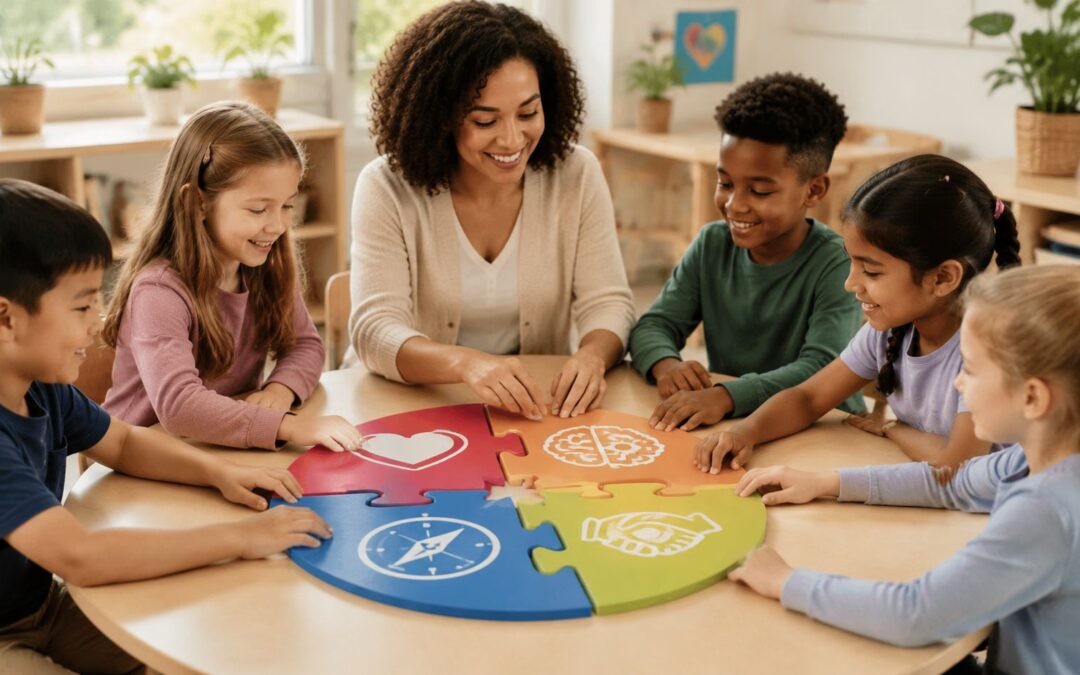
Social-emotional learning is the process of helping students understand themselves, manage emotions, relate well to others, and make thoughtful choices. CASEL organizes SEL around five core competencies. If you've ever felt that SEL sounds broad or fuzzy, this framework makes it concrete.
Self-awareness is the child's internal weather report. It's the ability to notice, “I'm frustrated,” “I'm nervous,” or “I'm proud of how I handled that.” A self-aware second-grader might say, “My stomach feels tight before spelling tests.” That's a huge step, because children can't manage what they can't name.
Self-management is the emotional brake pedal. It helps students pause before they react, use coping strategies, and keep going when things are difficult. In real life, this might look like a first-grader taking three breaths before responding, or a middle schooler asking for a short break instead of storming out.
Some students need extra support with these skills because the connection between attention, regulation, and emotion can be more complex. For families or teachers trying to understand that overlap, this article on ADHD, autism, and emotions offers helpful context.
Social awareness and relationship skills
Social awareness is the empathy lens. It helps children notice that other people have feelings, backgrounds, and perspectives different from their own. A socially aware student starts to think, “She wasn't ignoring me. Maybe she was nervous too.”
Relationship skills are the friendship-building tools. They include listening, taking turns, resolving conflict, apologizing sincerely, and asking for help. When a fourth-grader says, “I felt upset when you changed the rules. Can we start over?” that's relationship skill in action.
Children don't magically absorb these abilities. They learn them through modeling, repetition, practice, mistakes, and repair.
Responsible decision-making
Responsible decision-making is the ethical compass. It's what helps a student pause and consider, “Is this safe? Is it fair? What might happen next?” For younger children, that may be choosing not to blurt out a hurtful comment. For older students, it may be deciding how to respond when a group chat turns mean.
A simple way to remember the five competencies is this:
Competency
Simple image
What it looks like in daily life
Self-awareness
Internal weather report
Naming emotions and strengths
Self-management
Brake pedal
Calming down and staying on track
Social awareness
Empathy lens
Noticing others' feelings and perspectives
Relationship skills
Friendship tools
Listening, communicating, repairing conflict
Responsible decision-making
Ethical compass
Choosing actions with care
When adults understand SEL this way, it stops feeling abstract. It becomes visible in morning routines, partner work, recess conflicts, sibling arguments, and after-school conversations.
The Research-Backed Case for SEL
A principal is reviewing the budget. A teacher is looking at a class that keeps losing learning time to conflict, shutdown, and frustration. A caregiver is wondering why school feels harder for their child than the homework itself. All three are asking the same question. Will SEL make a real difference, or is it one more program with good intentions and thin results?
Research gives a clear answer. CASEL describes SEL as an evidence-based approach connected to better school outcomes and stronger long-term outcomes, based on many independent studies in its summary of what the research says about SEL.
Two findings often get attention quickly because they speak to both resources and results.
An analysis of six evidence-based programs shows a return of $11 for every $1 invested in SEL.
A 2011 meta-analysis of 213 K-12 programs found an average 11 percentile-point increase in academic achievement for participating students.
Those results make sense in day-to-day school life. Learning asks a lot of children. They have to listen when they are distracted, keep going when work feels hard, recover after mistakes, cooperate with classmates, and ask for help before frustration spills over. SEL supports those learning moves directly.
It helps to picture academics and SEL as two pedals on the same bike. Content knowledge helps students move forward. Social-emotional skills help them balance, steer, and keep going after a wobble. Without that second set of skills, even strong instruction can lose momentum.
Teachers usually see this before they read a research summary. A student who can calm their body after getting an answer wrong is more likely to try again. A pair of students who can solve a disagreement respectfully are more available for partner work. A classroom with predictable routines for listening, reflection, and repair protects instructional time.
For school leaders, the practical question is not only whether SEL works. It is whether the school is giving staff enough training, time, and consistency to teach these skills well. For teachers, the question becomes, “What routines can I repeat every day so students practice these skills?” For caregivers, it becomes, “What language can I use at home that matches what my child is hearing at school?” This role-by-role connection is where SEL starts to stick.
If you want a practical overview of how these outcomes show up in daily school life, Soul Shoppe offers a helpful article on the benefits of social-emotional learning.
Implementation quality matters just as much as good intentions. A feelings chart on the wall will not change much by itself. A one-time kindness lesson usually will not either. Students build these skills the same way they build reading fluency or math confidence. They need direct teaching, guided practice, repetition, feedback, and chances to use the skill in real moments.
That matters for every adult in a child's world. School leaders can choose materials and schedules that make practice possible. Teachers can build short, repeatable routines into transitions, meetings, and conflict repair. Caregivers can reinforce the same habits at home with simple questions such as, “What were you feeling?” “What happened next?” and “How can you make it right?”
The strongest case for SEL is not just that research supports it. It is that the findings match what experienced educators and families see every day. When children learn how to manage emotions, work through conflict, and make thoughtful choices, school runs better, relationships get stronger, and students are more ready to learn.
How SEL Transforms School Culture and Equity
A school doesn't become calm, inclusive, or connected because people put those words on a poster. Culture changes when adults and students share skills, language, and routines that make safety and belonging more likely.
When SEL is part of daily life, students start hearing and using the same language across settings. “Take a breath.” “Use an I-statement.” “What was your impact?” “How can you repair this?” That shared language lowers confusion and gives everyone a way back from conflict.
Safety and belonging are not side benefits
One of the most important findings in this area comes from CASEL's overview of SEL research. A 2023 review found that the largest effect of SEL programs was on students' perceptions of safety and inclusion at school, and the positive effects lasted six months or more after the program ended, as summarized in CASEL's SEL fundamentals page.
That finding rings true in school hallways. Students learn better when they aren't scanning for threat, embarrassment, exclusion, or social danger. Belonging isn't extra. It's part of readiness to learn.
When students believe, “I'm safe here, I matter here, and adults will help me repair mistakes,” they take more healthy risks in learning.
SEL also supports bullying prevention in a practical way. It helps children recognize emotions in themselves and others, interrupt impulsive behavior, and respond to hurt with accountability instead of escalation. CASEL notes that SEL helps reduce bullying and aggression while strengthening coping skills and resilience. Those are culture-building tools, not just student traits.
Here's a short video that shows how these ideas come alive in schools.
Why immediate response matters
One of the biggest failure points is delay. Behaviour 101 notes that break requests need to be honored immediately, especially during the teaching phase, because waiting weakens the contingency and can increase escalation Behaviour 101 on break card timing.
That can feel inconvenient in a busy classroom. It's still critical. If a student reaches for the card and the adult says, “In a few minutes,” the student may learn that the card doesn't work when they really need it.
Build the physical routine
A clear space matters. So does a clear return.
Think through these practical pieces:
Break location: Where exactly does the student go?
Break activity: What is allowed there? Quiet sitting, breathing, fidget, drawing, water?
Return cue: What tells the student it's time to come back?
First step back: What is the easiest re-entry task?
Many teachers pair the break with one concrete calming tool such as a breathing visual. A simple support like box breathing visual can make the break more purposeful and less vague.
A teacher-student example
A student named Maya starts to tear up during reading groups. She places her break card on the teacher's table. The teacher says, “Yes, break.” Maya walks to the calm corner, flips a sand timer, squeezes a soft fidget, and takes breaths. When the timer ends, the teacher kneels beside her and says, “Come back and do the first sentence with me.”
Notice what didn't happen. No lecture. No public discussion. No argument over whether the feeling was real enough.
The routine carried the moment.
Troubleshooting Common Break Card Challenges
The hardest question teachers ask is usually some version of this: “What if the student uses the break card to get out of work?”
That can happen. It doesn't mean the support should disappear. It means the student needs stronger teaching and tighter boundaries.
Texas SPED Support highlights this concern directly. It notes that break cards can become escape-maintained behavior unless the system includes clear rules for where the break happens, how long it lasts, what happens after it, and how use will be gradually shaped over time Texas SPED Support on break card boundaries.
When breaks turn into avoidance
A student asks for a break every time math begins. Another asks the moment writing gets hard. Adults often respond by shutting the whole system down.
That reaction is understandable, but it skips the teaching step. The student may be telling you, in the clearest way they can, “This demand is where I lose regulation.”
Instead of asking, “How do I stop this?” ask, “How do I teach a healthier pattern?”
Boundaries that protect the purpose
You can honor the need for regulation and still prevent the break from becoming an all-purpose exit.
Useful boundaries include:
A fixed location: The student always goes to the same approved place.
A defined length: The break ends when the timer or agreed cue ends.
A clear return task: The student comes back to a manageable first step.
A calm check-in: If needed, the adult helps the student restart with support.
Here's the difference:
Less effective
More effective
“Take a break somewhere”
“Go to the calm chair and flip the timer”
“Come back when you're ready”
“When the timer ends, return and do the first problem with me”
Unlimited, undefined break use
Taught break use with structure and follow-up
Scripts for common problems
If a student asks for a break right when the task becomes challenging, try:
“Yes, you can take your break. When you come back, we'll start with just the first part together.”
If a student is asking very frequently:
“I can see you need support. Let's use the break, then I'll help you with the hard part so the work feels doable.”
If a student returns but still can't engage:
“You took the break. Good job noticing that you needed it. Let's make the next step smaller.”
That language protects dignity. It also keeps the break connected to coping rather than escape.
Students who can't ask on their own yet
Some students won't remember the card once they're already flooded. Others may not yet have the language, initiation, or self-awareness to request a break independently.
In those cases, adult-initiated breaks are appropriate. You might say, “Your body looks tight. Let's take a break,” while pointing to the card or walking with the student to the break spot. Over time, the adult prompt can fade as the student takes over more of the routine.
The goal isn't to prove independence immediately. The goal is to build it.
A sign the system needs revision
If the same student uses the card at the same point every day, don't just see misuse. See a pattern. The assignment may need scaffolding. The environment may be too loud. The break may be too appealing. The return task may be too abrupt.
A strong system treats those patterns as information, not defiance.
Tracking Progress and Fading Supports Over Time
Many educators skip tracking because it sounds like extra paperwork. In practice, a tiny bit of data saves time. It tells you whether the support is helping, whether the student is stuck, and what to adjust next.
You don't need a complicated form. A sticky note, clipboard, or class roster can be enough.
What to track simply
Pick a few practical observations:
When the break was used
What was happening right before it
How the student used the break
How the student returned
That information gives you patterns. Maybe a student only requests breaks during independent writing. Maybe they return smoothly after movement but not after unstructured quiet time. Maybe adult prompting is still doing most of the work.
A simple feelings tool can help students reflect on those patterns too. A classroom support like a feelings chart for kids can make it easier for students to connect emotions, triggers, and coping choices.
Fading the support without pulling it away
Break cards are not meant to stay exactly the same forever. The long-term aim is internal skill, not permanent dependence on the card. The Watson guidance discussed earlier describes gradual reduction of cards as appropriate behavior increases, and that same logic applies here.
Think of fading as scaffolding. If that term is useful in your planning, this explainer on scaffolding in child development offers a helpful frame for how adults slowly remove support as a child gains competence.
A teacher might fade support by:
reducing prompts
shifting from card-handing to a quieter signal
encouraging the student to name the need before taking the break
shortening the routine when the student no longer needs every step
What success really looks like
Success isn't “the student never needs a break again.” Success is that the student becomes more aware, more communicative, and more able to return to learning safely.
Sometimes progress looks like fewer crises. Sometimes it looks like better timing. Sometimes it looks like a student saying, “I need a minute,” without reaching for the card at all.
That's not a small thing. That's a child building a lifelong regulation skill.
If your school wants practical SEL tools that build shared language around regulation, communication, and classroom safety, Soul Shoppe offers programs and resources designed to help students and adults practice those skills together.
A principal opens the staff meeting with a familiar question: “Why are so many students being flagged for extra support this fall?” The reading specialist points to decoding gaps. A classroom teacher brings up behavior during transitions. The counselor names friendship drama, shutdowns, and students who seem on edge before the day even gets going. Everyone cares. Everyone is working hard. Yet the work can start to feel fragmented.
That's where MTSS Tier 1 helps. Not as one more initiative to layer on top of everything else, but as the shared base that holds the whole school together. It gives teachers, specialists, counselors, and families a common way to think about support before students are in crisis and before small struggles grow into bigger ones.
In K-8 schools, that matters every single day. A kindergartener needs predictable routines. A fourth grader needs clear reading instruction and a way to reset after recess conflict. A seventh grader needs structure, belonging, and adults who notice when missing work is really a sign of stress. Tier 1 creates the conditions for all of that to happen schoolwide.
When schools strengthen the universal layer, students feel it. Hallways feel calmer. Expectations make sense. Classrooms become more predictable. Adults stop reacting to every problem as if it belongs to one student alone and start asking a better question: what are we building for everyone?
Building a School Where Every Student Thrives
On many campuses, the warning signs show up before anyone names them. Teachers are reteaching routines in October. Office referrals come from the same parts of the day. Families say their child “used to like school” but now feels lost, bored, or overwhelmed. Staff members care immensely, but each team may be solving only its own slice of the problem.
A grade-level team might say, “Our students need stronger reading support.” The counselor may say, “They also need better self-regulation.” The assistant principal may focus on lunchroom behavior. All three can be right. The trouble starts when the school treats those as separate problems instead of connected signals.
A familiar school meeting
I've sat in those meetings as a teacher and as an SEL coach. The room is full of smart people. Someone suggests another intervention group. Someone else proposes a behavior chart. A parent asks what they can do at home. The conversation gets busy fast.
Then one steadying question changes the tone: what if the core experience of school needs to be more consistent, more proactive, and more supportive for everyone?
That's the heart of Tier 1. It brings academic instruction, behavior expectations, and social-emotional supports into one schoolwide system. It's the daily experience every student walks into, not the safety net that appears later.
Tier 1 works best when adults stop thinking in silos and start designing one predictable, caring experience across classrooms, hallways, and home-school communication.
A school with a strong universal layer usually feels different before you ever study a spreadsheet. Students know what happens when they enter class. Teachers use common language for problem solving. Families hear the same core messages from multiple adults. If you're already working on climate and connection, this kind of school culture improvement work fits naturally inside Tier 1.
What this looks like in daily practice
In a K-8 setting, Tier 1 often shows up through simple, repeatable moves:
Shared routines: Every class starts with a calm, known entry routine.
Common expectations: Staff teach what respect, safety, and readiness look like in concrete ways.
Early support: Teachers notice concerns early instead of waiting for failure.
Family partnership: Caregivers know the language the school is using and can reinforce it at home.
For parents, Tier 1 means your child shouldn't need to struggle loudly to be noticed. For teachers, it means you're not expected to invent support systems from scratch in every room. For principals, it means the school's first line of support is also its most important one.
What Is MTSS Tier 1 Really
The simplest way to explain MTSS Tier 1 is this: it's the foundation of the school house. If the foundation is solid, the whole structure has a better chance of holding steady. If the foundation is uneven, cracks show up everywhere. In classrooms, those cracks can look like behavior referrals, widening skill gaps, chronic confusion about expectations, or too many students needing help beyond the core.
The universal layer for every student
Tier 1 is the universal foundation of support provided to every student. Effective schools aim for Tier 1 to successfully support at least 80% of their student population, which signals that the core instruction and environment are meeting the needs of most students, as explained in Panorama's overview of MTSS tiers.
That sentence carries a lot of meaning, so it helps to slow it down.
Tier 1 is not a reading intervention group. It isn't a behavior plan for a few students. It isn't only for students who are struggling. It is the core experience all students receive through classroom instruction, schoolwide expectations, and proactive support.
In practical terms, that includes things like:
Strong core teaching: Clear modeling, checks for understanding, and chances to practice.
Predictable routines: Students know how class begins, how help works, and how transitions happen.
Positive behavior support: Expectations are taught, practiced, and reinforced.
Belonging and safety: Students feel seen, welcomed, and emotionally safe enough to learn.
How Tier 1 differs from Tiers 2 and 3
This is one of the places people get tangled.
Think of the tiers as levels of intensity, not levels of student worth. Tier 1 is for everyone. Tier 2 adds targeted support for students who need more than the universal layer. Tier 3 provides intensive, individualized intervention. Multiple MTSS explanations describe the framework as having three tiers, with Tier 1 for all students, Tier 2 for targeted support, and Tier 3 for intensive individualized intervention.
Practical rule: If your school is leaning on Tier 2 and Tier 3 to solve needs that show up across many classrooms, the universal layer probably needs attention first.
For families, a useful translation is this: Tier 1 is what every child should be able to count on each day. For teachers, it means the basics aren't basic at all. They're the backbone. For school leaders, it means universal systems deserve the same care and planning as interventions.
A strong Tier 1 doesn't remove the need for more support. It makes that support more precise, more equitable, and more sustainable.
The Four Core Components of Tier 1
Tier 1 gets clearer when you stop treating it as a vague philosophy and start naming its moving parts. In schools, I think of it as a four-part engine. If one part is missing, the ride gets rough fast.
The MTSS model evolved by integrating Response to Intervention (RTI) for academics and Positive Behavioral Interventions and Supports (PBIS) for behavior. That history helps explain why modern Tier 1 addresses the whole child and relies on universal screening at least twice a year to monitor progress and the effectiveness of core instruction, as described in LightSpeed Systems' MTSS framework guide.
High-quality core instruction
This is the teaching every student receives. It should be clear, intentional, and accessible to a wide range of learners. In a Tier 1 classroom, teachers don't wait for confusion to pile up before adjusting. They build in supports from the start.
A first grade teacher, for example, might model a phonics skill out loud, give students a visual anchor chart, let them practice with a partner, and quickly reteach for a small group during independent work. That's still Tier 1 because the design of the lesson assumes student variability from the beginning.
Universal screening
Screening is a school's regular checkup. It helps adults identify which students may be at risk and whether the universal layer is doing its job. Screening should happen early, not after months of struggle.
A practical example: a school screens reading, math, and behavior at the start of the year, reviews the patterns by grade level, and notices one grade needs stronger vocabulary support across classrooms. That finding points the team back to core instruction.
Universal screening is not about sorting kids into labels. It's about asking whether the school is noticing needs early enough to respond wisely.
Evidence-based practices
Teachers need strategies and materials with a strong instructional rationale behind them. In plain language, schools should use approaches that are grounded in research, taught consistently, and implemented well.
This can be as concrete as using explicit modeling during a new math routine, a predictable partner-talk structure, or a schoolwide approach to repairing harm after conflict. If your staff is building shared student language, conflict resolution practices for schools fit naturally into this part of Tier 1.
Data-based decision making
Without data, adults often default to hunches. Sometimes those hunches are right. Sometimes they lead schools to over-refer students when the larger issue sits in the core.
Data-based decision making means teams study screening results, classwork patterns, attendance, behavior concerns, and implementation consistency. Then they decide what to strengthen.
Here's a one-sentence classroom example for each component:
Instruction: A teacher preteaches vocabulary before a science text so more students can access the lesson the first time.
Screening: A school notices early literacy screening concerns across one grade and responds with stronger shared routines, not immediate pull-out referrals for everyone.
Evidence-based practice: A class uses a daily explicit routine for teaching discussion norms instead of assuming students already know how to collaborate.
Data use: A team compares missing-work patterns across classrooms and finds one unclear assignment system that can be fixed schoolwide.
Integrating SEL and Behavior into Tier 1
Academic learning doesn't happen in a vacuum. Students learn through their nervous systems, their relationships, and their sense of safety. If a child is bracing for embarrassment, recovering from conflict, or unsure how to ask for help, even excellent academic instruction can miss the mark.
That's why Tier 1 needs social-emotional learning and positive behavior support woven into the day, not saved for an assembly or a crisis response.
What students need before they can show what they know
A strong Tier 1 classroom answers quiet but powerful questions for students:
Am I safe here
Do I belong here
What happens when I make a mistake
How do people solve problems here
When schools answer those questions clearly, behavior support becomes more preventive and less reactive. Teachers spend less energy on constant correction and more on instruction, coaching, and connection.
In practice, this can look very simple:
Morning meetings: Students greet one another, preview the day, and practice listening.
Feelings check-ins: A teacher learns who may need a quiet check-in before math starts.
Shared language: Students use sentence stems such as “I felt…” or “I need…” during peer conflict.
Reset spaces: A calm corner helps students regulate without shame or exile.
For families, this matters at home too. If a school teaches students how to name feelings, pause, and repair harm, parents can echo that language after school. A child who hears “Take a breath and use your words” in both places gets more traction than a child navigating two completely different systems.
SEL is not extra
One of the most common misunderstandings is that SEL steals time from academics. In reality, it supports access to academics. Students who can follow routines, recover after frustration, and communicate needs are more available for learning.
That's also why many schools look for practical social-emotional learning programs for schools that can support universal classroom practice. Soul Shoppe is one example. It offers live SEL lessons by grade level and professional development that schools can use as part of a broader Tier 1 approach.
This short video gives a useful feel for how relationship-centered support can come alive in school settings:
What Safety Looks and Sounds Like in School
Psychological safety isn't hidden once you know what to watch for. You can hear it in the tone of feedback. You can see it in how students respond when someone gets something wrong.
In the classroom
Here are some school-based look-fors.
Looks like
Sounds like
A student volunteers an unusual answer
“That's an interesting way to think about it. Say more.”
A child admits, “I don't get it yet”
“Thanks for saying that. I think others may need that explanation too.”
A pair of students disagree during partner work and stay engaged
“I see it differently. Can I explain why?”
A teacher revises directions after student confusion
“I think my directions weren't clear. Let me try that again.”
A class returns to a mistake and studies it
“What can this error teach us?”
Notice what's missing. There's no shaming, no quick rescue, and no pretending everything is fine. The room stays honest and steady.
Across grade levels
A kindergarten example might be a child knocking over paint water and bracing for anger. In a psychologically safe room, the adult says, “Spills happen. Let's clean it up together.” The child learns responsibility without panic.
In upper elementary, it may look like a student reading a rough draft and hearing specific, respectful feedback from peers. Nobody has to fake praise. The safety is in knowing the feedback will help, not humiliate.
In middle school, it often shows up during social tension. One student says, “That joke bothered me.” Another student listens, even if embarrassed. An adult supports repair instead of rushing to punishment or dismissal.
“A safe space isn't a place where nothing hard happens. It's a place where hard things can be handled without cruelty.”
In hallways, meetings, and the office
Psychological safety also shows up outside class instruction.
At a staff meeting a teacher says, “I'm not sure this routine is working for my class.”
In the counseling office a student admits they excluded someone at recess.
During dismissal a parent says, “My child comes home worried about partner work. Could we discuss this?”
In the principal's office a staff member raises a concern without fearing they'll be labeled difficult.
Schools that want more of these moments often focus on shared language and shared norms. If you're building that kind of culture, this guide on how to create a safe space can support the day-to-day practices that make safety visible.
Common Myths About Psychological Safety
The biggest myth is simple. People hear “psychological safety” and think it means being nice all the time.
It doesn't. McKinsey's explanation emphasizes that psychological safety is the permission to take interpersonal risks, which includes the discomfort of respectful conflict, correction, and accountability (McKinsey on what psychological safety is).
This, not that
Myth
Reality
Safety means everyone agrees
Safety means people can disagree respectfully
Safety means no one feels uncomfortable
Safety allows productive discomfort without humiliation
Safety means lower standards
Safety supports high standards because people can ask for help and recover from mistakes
Safety means soft feedback
Safety makes honest feedback possible
Safety means children are protected from all frustration
Safety helps children face challenge with support
Where adults get tripped up
Parents sometimes worry that emphasizing safety will make children fragile. Teachers sometimes worry it will weaken authority. Both concerns make sense if safety is confused with emotional cushioning.
But psychological safety doesn't ask adults to remove expectations. It asks adults to remove unnecessary threat.
A teacher can still say, “You need to revise this paragraph.” A parent can still say, “You broke trust, and we need to repair it.” The key question is whether the child experiences correction as guidance or as humiliation.
Not safe: “How many times do I have to tell you this?”
Safer: “You're still learning this. Let's slow it down.”
Not safe: “That's wrong.”
Safer: “I see where you were going. Let's check one part together.”
The standard can stay high. The relationship stays intact.
How to Build Psychological Safety at School and Home
Psychological safety is a group climate, not an individual trait, so the work is not to convince one child to feel brave. The work is to shape norms, routines, and response patterns that make risk feel manageable across the whole group (psychological safety as a group climate).
For school leaders
Leaders set the emotional weather.
If a principal reacts defensively when staff raise concerns, people learn to edit themselves. If a principal says, “Tell me what I'm missing,” and responds calmly, people bring more truth into the room.
A few high-impact moves:
Model fallibility in public. Say, “I made the wrong call on that schedule change,” or “I need your input before we decide.”
Respond predictably to bad news. Staff should know that surfacing a problem leads to problem-solving, not blame.
Interrupt ridicule fast. One dismissive comment in a meeting can shrink participation for weeks.
Study patterns, not just incidents. If the same staff members speak up every time, ask whose voice the system still doesn't invite.
For classroom teachers
Children learn safety from repetition. One warm moment helps. Repeated, predictable moments build trust.
Try routines like these:
Normalize “not yet.” When a student is stuck, use language that keeps them in the learning process.
Teach sentence stems for disagreement. “I'd like to build on that.” “I see it another way.” “Can you explain what you mean?”
Publicly value revision. Show your own draft, your own mistake, or a changed plan.
Pause before correction. Tone matters as much as content.
Use repair language after conflict. “What happened?” “What was the impact?” “What needs to happen next?”
For teachers: If students only feel safe when they're right, the room isn't safe enough for learning.
Some schools support this through structured SEL routines. Soul Shoppe, for example, offers workshops and coaching focused on communication, self-regulation, mindfulness, and conflict resolution, which are all practical conditions that support safer group interactions.
For parents and caregivers
Home is often where children first learn what happens after a mistake.
A child spills milk, lies about homework, snaps at a sibling, or forgets a backpack. In those moments, adults teach either “Tell the truth and we'll handle it” or “Hide the problem until you can't.”
Try these swaps:
Instead of
Try
“Why did you do that?”
“Walk me through what happened.”
“You know better.”
“What got hard here?”
“Stop crying and explain.”
“Take a breath. Then we'll talk.”
“That's no excuse.”
“I want the truth, even if it's messy.”
This doesn't remove accountability. It increases honesty.
Families who want extra support sometimes benefit from tools outside school, including emotional intelligence coaching that helps adults strengthen self-awareness, regulation, and communication. Those adult skills matter because children borrow their sense of safety from how grownups respond under stress.
Small systems matter more than big speeches
Psychological safety grows through habits people can count on:
Opening routines that let everyone enter the day predictably
Discussion norms that protect turn-taking and respectful challenge
Repair processes after harm or conflict
Feedback habits that stay specific and calm
Consistent adult responses across classrooms and home settings
If you're strengthening relational trust across a school community or family system, building trust in relationships offers practical ways to make connection more dependable over time.
The Foundation for Every Learner's Success
Psychological safety may sound like a workplace phrase, but in schools and homes it names something children feel immediately. Can I ask? Can I try? Can I tell the truth? Can I recover if I get it wrong?
When the answer is yes, learners participate more fully in their own growth. They can tolerate correction, stay engaged after mistakes, and contribute to the group instead of guarding themselves from it.
That matters for every child. It matters even more for children who already carry extra social risk because of temperament, identity, language, learning differences, or past experiences. Resources from outside education, such as this neurodiverse team building guide, can still be useful reminders that group norms need to support different ways of participating and processing.
Schools that care about empathy, belonging, and healthy conflict already have the right goal. Psychological safety is the daily condition that helps those values become visible. If you want that work to last, it helps to ground it in explicit SEL practices and shared language, like the approaches discussed in social-emotional learning programs for schools.
Start with one small move tomorrow. Respond calmly to a mistake. Invite a quieter voice. Thank a student for an honest question. Those moments look ordinary. They build the climate where learning becomes possible.
If you want practical support for building safer, more connected classrooms and school communities, explore Soul Shoppe. Their programs focus on communication, self-regulation, empathy, and conflict resolution, which are the everyday skills students and adults use to create the trust that learning depends on.
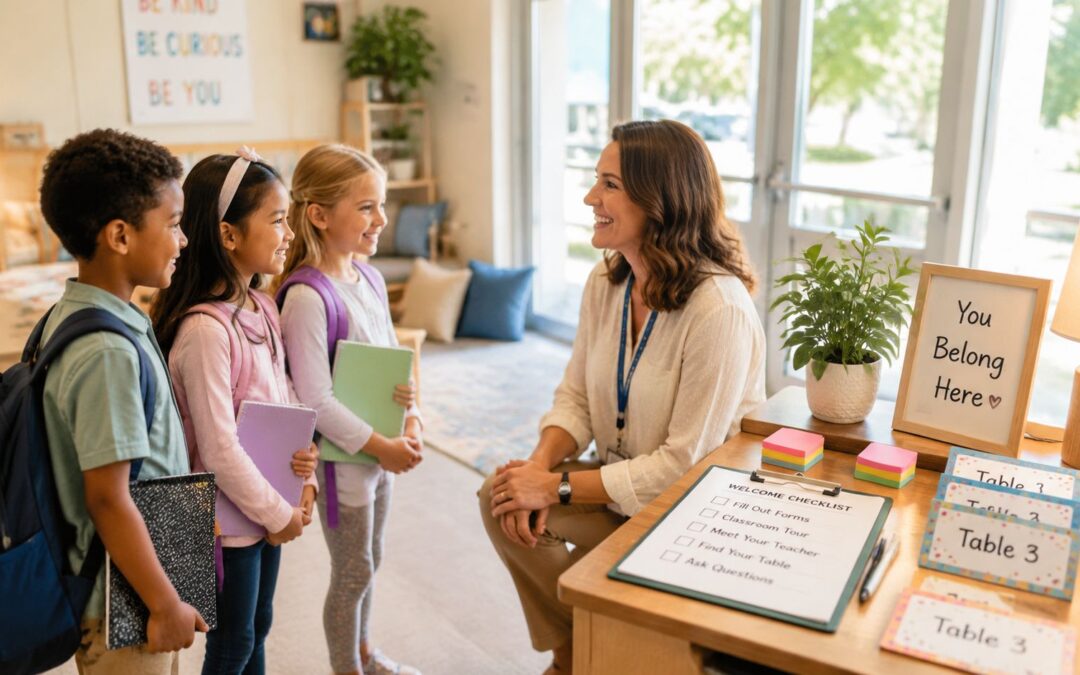
A new student steps into class at 10:17 on a Tuesday. The teacher is already mid-lesson. A few students look up, a few do not, and the student has to make fast judgments. Where do I sit? Who will talk to me? How embarrassed will I be if I get this wrong?
Educators and families see that moment all year, not just on the first day of school. New enrollments, midyear transfers, housing changes, schedule shifts, and delayed starts all put students into unfamiliar rooms with social rules they do not yet know. As noted earlier, enrollment data shows schools and campuses are continually receiving new students. Welcome practices need to work in August, in January, and during an ordinary week in October.
The problem is not only logistical. It is relational. As noted earlier, recent school climate reporting found that many students do not feel welcome enough to fully be themselves at school. That gap shows up quickly. A student who is unsure about belonging is less likely to ask for help, join a group, take an academic risk, or recover well from a mistake.
A smile at the door helps. It does not give a student a map.
Strong welcome systems do more than create a friendly first impression. They show students what to expect, who to go to, how adults will respond, and how families will be included. In practice, that means planning for three groups at once: the student entering the building, the staff members responsible for the transition, and the caregivers trying to make sense of a new setting.
That is the angle of this guide. It is not a list of vague reminders to be kind. It is an SEL-based set of school routines, family-facing supports, staff moves, age-specific adaptations, and simple tools educators can use in real conditions, including busy mornings, tight staffing, and mixed student needs. Schools that already use restorative circles in schools often understand this trade-off well. Warmth matters, but structure is what makes warmth dependable.
The eight strategies that follow are designed to help schools build a welcome process students can feel, staff can repeat, and families can trust.
1. Structured Welcome Circles and Community Meetings
A new student should not have to decode the social rules of a class by watching from the edge. A short, structured circle makes the norms visible right away. Students hear names, practice listening, and learn that this classroom expects people to notice one another.
In practice, this can look simple. The class gathers in a circle for ten minutes. The teacher opens with a prompt such as “share your name and one thing you enjoy after school,” then invites the new student to opt in at their comfort level rather than forcing a full introduction.
How to run the first circle well
Start light. If adults jump too quickly into “tell us about your feelings,” many students shut down, especially older ones. Safer prompts work better first: favorite snack, music, pets, a place you like, or one thing that helps you focus.
Then teach the listening behaviors explicitly. Look toward the speaker. Let people pass. Don't pile on advice. Thank people for sharing. Schools that use restorative circles in schools often do this well because the routine is not random. It has roles, agreements, and repetition.
Practical rule: Never make the new student the centerpiece of the activity. Make them part of a structure everyone uses.
A few examples by age group help:
K-2: Use a greeting song, a name ball toss, or “show with your fingers how you're feeling today.”
3-5: Add partner shares before whole-group sharing so the student rehearses with one peer first.
Middle school: Use sentence stems on the board such as “A class helps me feel welcome when…” or “One thing I wish people knew about starting somewhere new is…”
Later in the week, revisit the circle and ask what's helping and what's still confusing. That second touchpoint matters. One welcome circle feels nice. A repeated community meeting feels safe.
Before moving on, some teams like to model the process in action: