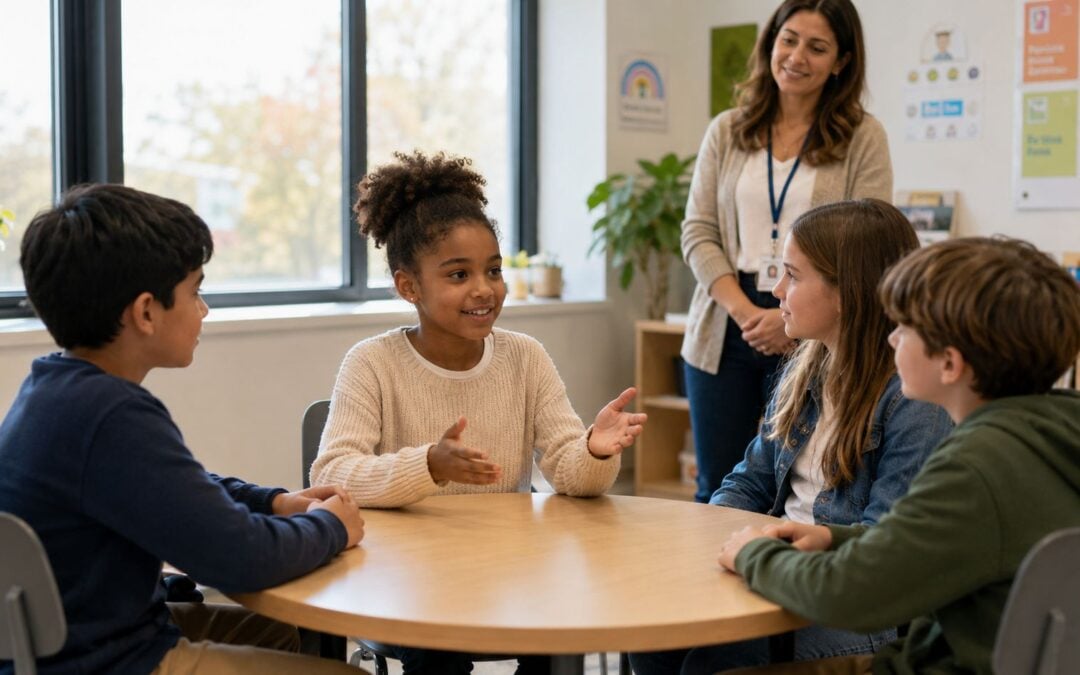
Peer mediation is a structured student-led process where trained students help classmates resolve minor conflicts peacefully, and research found a 93% agreement rate across 4,028 mediations and an 88% satisfaction rate across 4,739 mediations in a meta-analytic review. If you're a teacher or parent dealing with the same argument for the third time this week, peer mediation gives kids a way to talk it through, understand what each person needs, and make their own workable agreement.
A lot of school conflicts start small. Two students argue over a game at recess. Partners in class blame each other for a messy project. Friends stop speaking because of a rumor, and by lunch the whole table has taken sides.
Adults can step in and stop the immediate problem. We often need to. But many families and educators want something more than a quick fix. They want students to learn how to handle conflict without shaming, stonewalling, or waiting for an adult to solve everything.
That's where peer mediation fits. At its best, it helps students move from accusation to conversation. It also supports the larger work of building a campus where listening, repair, and accountability are part of daily life, much like the relationship-building goals behind the benefits of social-emotional learning.
Introduction From Disagreements to Dialogue
If you work in a K-8 school, you already know how fast a simple disagreement can grow legs. One child says, “She cut in line.” Another says, “He started it.” A teacher tries to sort out the facts while the rest of the class watches, and now a two-minute problem has become a twenty-minute disruption.
Parents see a version of this too. A child comes home upset, tells one piece of the story, and expects the adult to declare a winner by dinner.
Peer mediation is a student-led process in which trained students help peers talk through a conflict, name what's bothering them, and work toward a solution they both accept. That definition matters because peer mediation isn't just “kids helping kids be nice.” It's a structured way to practice communication, self-control, perspective-taking, and repair.
Why schools use it
When children are taught how to slow down and speak truthfully, several good things can happen at once:
- Conflict gets clearer: Students separate facts, feelings, and assumptions.
- Ownership increases: Instead of hearing a punishment from an adult, they help build the plan.
- Skills transfer: What they practice in mediation can show up later in the classroom, on the playground, and at home.
Peer mediation works best when the goal is not to prove who's “the bad kid,” but to help both students leave with dignity and a realistic next step.
A simple example
A fourth grader says, “She never lets me play with them.”
The other student says, “That's not true. You boss everyone around.”
In a typical hallway intervention, an adult may tell both students to apologize and move on. Sometimes that's enough. Sometimes it isn't.
In peer mediation, trained student mediators would help them slow the moment down. One student speaks without interruption. Then the other does the same. The mediators help them identify the underlying issue beneath the surface, maybe feeling left out, maybe feeling controlled, maybe both. From there, the students create a plan they can implement.
That shift matters. Kids aren't only ending one conflict. They're building a way of handling the next one better.
The Core Principles of Peer Mediation
Peer mediation only works when the adults and students share the same basic ground rules. Without those principles, it turns into a mini-courtroom, a forced apology session, or a popularity contest.
Neutrality matters
A student mediator is not a judge. Think of the role more like a referee who keeps the process fair and calm without deciding who deserves to win.
That distinction helps teachers too. If adults present mediation as a way to find out who's right, students quickly stop trusting it. The mediator's job is to guide the conversation, not to hand down a verdict.
A mediator might say:
- “We're here to help both of you talk and listen.”
- “We won't pick sides.”
- “You'll make the agreement, not us.”
Voluntary participation changes the tone
Peer mediation is generally voluntary. That's important because a forced conversation rarely leads to an honest one. If a child is dragged into a session, the result is often silence, sarcasm, or a fake agreement that falls apart by recess.
Voluntary participation doesn't mean schools ignore conflict. It means mediation is used when students are willing and able to engage in problem-solving. If they aren't, adults need a different response.
Confidentiality builds trust
Students speak more openly when they believe the session won't become lunchroom gossip. Confidentiality tells them, “This conversation is for repair, not for entertainment.”
Of course, adults should explain limits in child-friendly language. Privacy is part of the process, but safety comes first. If a student reveals something that signals harm or danger, an adult has to step in.
Practical rule: Tell students that mediation is private, but not secret when someone's safety is at risk.
Student ownership is the engine
A strong mediation process centers student voice. The point isn't to coach children into repeating adult-approved phrases. The point is to help them understand what happened, say what they need, and build an agreement they can live with.
This is one reason peer mediation connects so naturally with restorative practices in education. Both approaches ask students to take responsibility through dialogue and repair rather than simple compliance.
Here's the heart of it:
| Principle | What it looks like in school |
|---|---|
| Neutrality | Mediators guide the talk without deciding who is right |
| Voluntary participation | Students agree to take part rather than being cornered into it |
| Confidentiality | The conversation stays private within clear safety limits |
| Ownership | Students create the solution instead of receiving an adult-imposed answer |
When readers ask what is peer mediation, these principles are the true answer underneath the label. They're what make the process feel safe enough, fair enough, and useful enough to try.
The Peer Mediation Process Step by Step
One reason educators hesitate to use peer mediation is that it sounds vague. In practice, it isn't vague at all. A school-based process is usually structured and predictable.
A helpful visual can make that sequence easier to picture.
According to a school protocol summary from Nebraska MTSS, peer mediation is a structured, voluntary conflict-resolution process in which two trained student mediators help students move from positional arguments to interest-based problem solving through ground rules, uninterrupted storytelling, issue identification, and student-generated solutions, while the mediators facilitate rather than impose outcomes, as described in this peer mediation protocol overview.
Step 1 creates safety
The mediators begin by introducing themselves and setting ground rules. These usually include listening without interrupting, speaking respectfully, and staying focused on solving the problem.
This opening matters more than people think. It tells students, “This won't be a shouting match.”
A mediator might say:
- “Each person will get a turn.”
- “Please talk about what happened from your point of view.”
- “We're looking for a solution both of you can accept.”
Step 2 slows the conflict down
Each student tells their story without interruption. That sounds simple, but it's often the first time each child has actually heard the other person all the way through.
Teachers can support this skill in everyday classroom life by teaching I-feel statements for kids. A student who can say, “I felt embarrassed when you laughed,” is much easier to understand than a student who only says, “You're mean.”
Step 3 finds the real issue
After both stories are shared, the mediators help identify what's really at stake. The fight may look like it's about a seat, a ball, or a rumor. Underneath, it may be about fairness, belonging, respect, or hurt feelings.
This is the turning point. Students move from “You did this” to “Here's what I needed.”
Sometimes the conflict is not about the object at all. It's about how the student felt in that moment.
Step 4 generates options
Now the students brainstorm solutions. The mediators don't hand them an answer. They ask questions that help the students do the thinking.
Examples include:
- “What would make tomorrow go better?”
- “What can each of you agree to do differently?”
- “Which solution feels fair to both of you?”
At this point, a short example helps. Two fifth graders argue about materials during art. One keeps grabbing shared supplies. In mediation, they agree to divide tools before the lesson starts and ask before borrowing. That's a small agreement, but it's specific enough to use.
A video example can help educators picture the tone and pacing of a student-centered conflict conversation.
Step 5 puts it in writing
Many schools end with a simple written agreement. The language should be concrete, brief, and realistic.
Good agreement language sounds like this:
| Weak agreement | Stronger agreement |
|---|---|
| “We'll be nicer.” | “We will use kind words during group work and ask before joining the game.” |
| “We won't fight.” | “If we get upset, we'll ask for a break and talk after lunch.” |
Step 6 includes follow-up
A short check-in later helps everyone see whether the agreement is working. This doesn't need to be dramatic. It can be a quick conversation with the coordinator, teacher, or mediators.
Follow-up sends a powerful message to students. Repair isn't just a one-time performance. It's something the school community takes seriously.
Key Roles in Peer Mediation
People sometimes picture peer mediation as students running a meeting with no adult structure. That's not what effective programs look like. Good mediation is student-led and adult-supported, with each person holding a clear role.
The student mediators
Student mediators guide the conversation. They don't investigate, punish, rescue, or lecture. Their main job is to keep the process respectful and moving.
You'll often hear language like:
- “Tell us what happened from your point of view.”
- “Let's make sure each person gets a turn.”
- “What do you need going forward?”
A strong mediator listens for the feelings under the complaint. If one student says, “He always leaves me out,” the mediator might reflect, “It sounds like you felt excluded.”
That small move can change the whole tone of the session.
The students in conflict
The disputants do the hardest part of the work. They have to tell the truth as they experienced it, listen to something they may not like hearing, and take part in creating a next step.
A classroom example makes this concrete. Two middle elementary students are upset after one posted an unkind comment in a shared online space for homework. In mediation, one says, “I was joking.” The other says, “I felt humiliated because other kids saw it.” The process gives both students a chance to move beyond defense and toward accountability.
Helpful coaching for disputants includes:
- Use “I” language: “I felt left out” lands better than “You always ruin everything.”
- Stay specific: “During science group” is easier to solve than “You do this all the time.”
- Ask for something doable: “Please don't talk about me in the lunch line” is clearer than “Be a better person.”
The students in conflict are not passive recipients of a solution. They are the authors of it.
The adult coordinator
Adults make the program safe and sustainable. They train mediators, review referrals, decide which cases fit, and provide backup when students need support.
The adult role should stay mostly in the background during an appropriate mediation. That restraint can be hard for educators, especially when we're used to solving problems quickly. But stepping back is part of what gives students room to practice.
An adult coordinator might:
| Adult responsibility | What it looks like |
|---|---|
| Screening referrals | Deciding whether the issue is appropriate for mediation |
| Training students | Practicing listening, neutrality, and agreement-writing |
| Supervising sessions | Staying available without taking over |
| Following up | Checking whether agreements are being honored |
When these roles stay clear, students gain confidence and adults keep the guardrails in place.
How Peer Mediation Builds SEL Skills
Peer mediation is often discussed as a behavior support. That's true, but it's only part of the picture. It's also a practical, repeated way to teach social-emotional skills in real time.
Students practice empathy, not just hear about it
A child develops empathy when they must sit still long enough to hear how their actions affected someone else. That doesn't mean they instantly agree with every detail. It means they practice understanding another perspective.
Self-awareness grows at the same time. A student starts to notice, “When I feel embarrassed, I lash out,” or “When I think I'm being excluded, I interrupt.”
Communication becomes more usable
Students in mediation learn to speak with more precision. Instead of global statements like “Nobody likes me,” they're coached toward language that can be understood and addressed.
Problem-solving grows too. Students move from blame to options. They consider what each person can do tomorrow, not just what they wish had happened yesterday.
Here's a simple way to see the SEL connection:
- Empathy: Listening to another student's experience
- Self-management: Pausing before reacting
- Communication: Speaking openly without attacking
- Responsible decision-making: Choosing a realistic agreement
The research points to meaningful outcomes
In a meta-analytic review, researchers found a 93% agreement rate across 4,028 mediations and an 88% satisfaction rate across 4,739 mediations, suggesting that school peer mediation often ends with a mutually accepted agreement rather than an adult-imposed one, as reported in this review of peer mediation outcomes in education.
Those numbers matter because satisfaction and agreement are closely tied to student buy-in. When students feel heard and help shape the outcome, they're more likely to see the process as fair.
A child may forget the exact words used in a mediation session. They're less likely to forget the experience of being listened to and being expected to listen in return.
This is why peer mediation belongs in SEL conversations. It doesn't just talk about skills. It gives students a place to use them while the stakes are real, but still manageable.
Implementing a Program in Your School
Starting a peer mediation program doesn't require a perfect campus or a giant initiative. It requires clarity, consistency, and adults who agree on what the program is for.
A practical starting point is this: define which conflicts belong in mediation, decide who screens referrals, train a small group of students well, and build a routine people can trust. If the process feels mysterious, staff won't refer students. If it feels loose, families won't trust it.
For schools that want a broader communication plan when introducing a new initiative to families or community partners, this comprehensive resource for event PR can help shape a clear rollout message without overcomplicating it.
Start small and train carefully
Choose student mediators based on readiness, not popularity. Look for students who can listen, stay calm, and keep confidence. They don't need to be perfect. They do need coaching.
Training usually includes role-play, listening practice, how to ask neutral questions, and how to end with a clear agreement. Some schools build this internally. Others use outside support. For example, Soul Shoppe offers a peer mediation program and Peacemaker Trainer Certification that schools can use as one structured option for training adults and students.
Build a simple referral path
Teachers need to know exactly what to do when a conflict is a fit for mediation. A referral process can be as straightforward as a short form, a counselor check-in, or a designated time during the week.
Use plain language with staff:
- Refer minor peer conflicts
- Do not refer safety concerns
- Check willingness first
- Route all cases through the coordinator
Schools doing this work often pair peer mediation with wider conflict resolution for schools so staff and students share common language.
Plan for age differences
A second grader and a seventh grader can both use mediation, but the format won't look identical.
| Aspect | Grades K-3 | Grades 4-8 |
|---|---|---|
| Language | Short sentences, concrete prompts, visual supports | More detailed reflection and student-generated language |
| Session length | Brief, focused, often with more redirection | Longer conversations with greater student stamina |
| Common issues | Turn-taking, game disputes, line conflicts, exclusion | Rumors, group chats, friendship shifts, collaborative work conflicts |
| Mediator support | More adult proximity and coaching | More student autonomy with adult backup |
| Agreement style | Simple verbal or picture-supported plan | Written agreement with specific next steps |
Get staff and families on the same page
Teachers need to know that mediation is not “being soft.” Parents need to know that it's not replacing adult responsibility. It's a structured response for the right kind of conflict.
A few practical moves help:
- Share the boundaries early: Explain what mediation is for and what it isn't.
- Use common scripts: Give teachers language they can use when offering mediation.
- Protect space and privacy: Choose a quiet area where students can speak without an audience.
- Review the program regularly: Adults should look at referrals, agreements, and common challenges.
Schools don't need a flashy launch. They need a dependable one.
When Peer Mediation Is Not the Answer
This is the part many guides skip, and it's one of the most important. Peer mediation is not for every conflict.
A public school district description of the process notes that peer mediation is generally designed for minor conflicts, is voluntary, and is typically screened through an intake process. Cases are reviewed for appropriateness, and the program is most commonly used for rumors, friendship conflict, and minor bullying, rather than serious safety issues, coercion, or threats, as outlined in this district peer mediation guidance.
Cases that need adult-led action
If there is a strong power imbalance, ongoing intimidation, harassment, threats, or fear, mediation is the wrong tool. A child cannot negotiate freely when they don't feel safe.
That includes situations such as:
- Threats of harm: Any statement or behavior suggesting danger
- Coercion: One student pressuring another through fear or control
- Serious bullying: Repeated targeted harm with a power imbalance
- Harassment or discrimination: Incidents that require formal adult response
- Physical aggression: Fights or assault-related concerns
A useful screening question
Ask this before scheduling mediation: Can both students participate freely, safely, and voluntarily?
If the answer is no, stop there. The student needs protection, investigation, discipline, counseling support, or another adult-led intervention.
Responsible schools don't use peer mediation to avoid hard adult decisions. They use it when the situation fits.
That boundary strengthens a program. It tells staff and families that mediation is a skilled response for the right cases, not a catch-all solution.
Conclusion Building a More Peaceful School
Peer mediation gives schools a practical way to teach conflict resolution through experience, not just advice. When students learn to listen, speak openly, and build their own agreements, they don't just settle one argument. They develop habits that support empathy, accountability, and healthier relationships across the school day.
For teachers, parents, and school leaders asking what is peer mediation, the simplest answer is this: it's a structured way for kids to solve the right kinds of conflicts with support, dignity, and clear boundaries.
If your school wants help building student conflict-resolution skills in a structured, age-appropriate way, Soul Shoppe offers SEL programs, peer mediation support, and educator training designed to help school communities create more connection, safety, and empathy.