

Why Is SEL Important? Research, Examples, and Next Steps
A student crumples a worksheet, mutters “I'm dumb,” and shuts down before you can get to their desk. Another child bumps a classmate in line, then insists, with total sincerity, “I didn't do anything.” At home, a parent asks, “How was school?” and gets the usual answer: “Fine.” Underneath that one-word reply might be embarrassment, loneliness, stress, or a friendship problem the child doesn't yet know how to name.
That's where Social-Emotional Learning, or SEL, matters.
When people ask why SEL is important, they're usually not asking for a definition. They're asking about real life. They want to know why some students melt down over small frustrations, why conflict spreads so fast in a classroom, why bright kids stop trying, or why a school can feel tense even when adults are working hard. SEL gives us a way to teach the missing skills behind those moments.
The same truth shows up in school after school. Most challenging behavior is communication. Most conflict is a skills gap. Most disconnection starts small. SEL helps children notice what they feel, manage what they feel, and act in ways that protect both themselves and the people around them.
More Than Just Behavior Management
A third-grader slams a book shut during math. A kindergarten student grabs a marker and refuses to give it back. Two fifth-graders stop speaking because one felt left out at recess. These moments can look like defiance, disrespect, or immaturity.
Often, they're something else. They're moments when a child doesn't yet have the words, the pause, or the problem-solving tools they need.
That's why SEL matters. It's not a reward for students who are already calm and cooperative. It's the teaching of the exact skills students need when life feels hard, unfair, embarrassing, or confusing. When we treat every upset as a discipline problem, we miss the lesson hidden inside it.
Practical rule: If a student can't yet identify a feeling, calm their body, hear another point of view, or repair harm, that student needs instruction, not just correction.
In schools, people sometimes reduce SEL to “helping kids behave.” That's too small. Behavior is only the visible part. Under it are attention, emotion regulation, confidence, empathy, communication, and decision-making. Those are learnable skills.
Here's what that looks like in practice:
- In the classroom: A student who says “This is stupid” may be feeling lost and trying to protect themselves from looking incapable.
- On the playground: A child who cuts in line may be excited, impulsive, or unsure how to join a group appropriately.
- At home: A child who explodes after school may have held it together all day and finally run out of emotional energy.
SEL gives adults a roadmap in those moments. Instead of only asking, “How do I stop this behavior?” we also ask, “What skill is missing, and how can I teach it?” That shift changes everything. It moves us from control to coaching, from punishment alone to growth.
What Social-Emotional Learning Actually Is
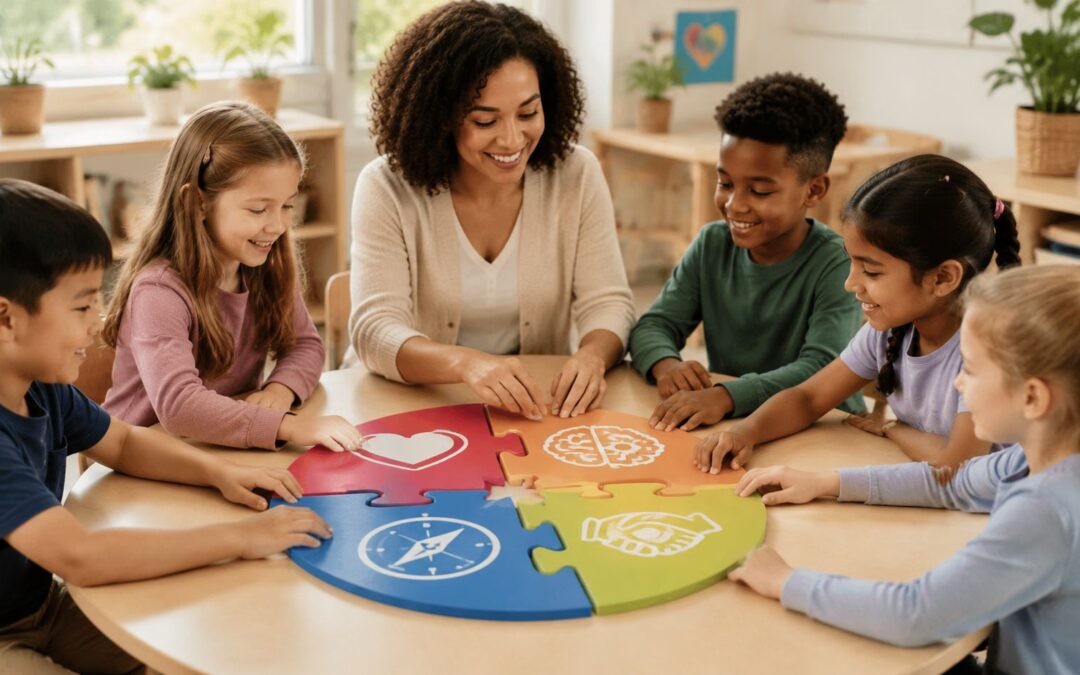
Social-emotional learning is the process of helping students understand themselves, manage emotions, relate well to others, and make thoughtful choices. CASEL organizes SEL around five core competencies. If you've ever felt that SEL sounds broad or fuzzy, this framework makes it concrete.

For a fuller breakdown of the framework, this guide on the five core SEL competencies explained is a useful companion.
Self-awareness and self-management
Self-awareness is the child's internal weather report. It's the ability to notice, “I'm frustrated,” “I'm nervous,” or “I'm proud of how I handled that.” A self-aware second-grader might say, “My stomach feels tight before spelling tests.” That's a huge step, because children can't manage what they can't name.
Self-management is the emotional brake pedal. It helps students pause before they react, use coping strategies, and keep going when things are difficult. In real life, this might look like a first-grader taking three breaths before responding, or a middle schooler asking for a short break instead of storming out.
Some students need extra support with these skills because the connection between attention, regulation, and emotion can be more complex. For families or teachers trying to understand that overlap, this article on ADHD, autism, and emotions offers helpful context.
Social awareness and relationship skills
Social awareness is the empathy lens. It helps children notice that other people have feelings, backgrounds, and perspectives different from their own. A socially aware student starts to think, “She wasn't ignoring me. Maybe she was nervous too.”
Relationship skills are the friendship-building tools. They include listening, taking turns, resolving conflict, apologizing sincerely, and asking for help. When a fourth-grader says, “I felt upset when you changed the rules. Can we start over?” that's relationship skill in action.
Children don't magically absorb these abilities. They learn them through modeling, repetition, practice, mistakes, and repair.
Responsible decision-making
Responsible decision-making is the ethical compass. It's what helps a student pause and consider, “Is this safe? Is it fair? What might happen next?” For younger children, that may be choosing not to blurt out a hurtful comment. For older students, it may be deciding how to respond when a group chat turns mean.
A simple way to remember the five competencies is this:
| Competency | Simple image | What it looks like in daily life |
|---|---|---|
| Self-awareness | Internal weather report | Naming emotions and strengths |
| Self-management | Brake pedal | Calming down and staying on track |
| Social awareness | Empathy lens | Noticing others' feelings and perspectives |
| Relationship skills | Friendship tools | Listening, communicating, repairing conflict |
| Responsible decision-making | Ethical compass | Choosing actions with care |
When adults understand SEL this way, it stops feeling abstract. It becomes visible in morning routines, partner work, recess conflicts, sibling arguments, and after-school conversations.
The Research-Backed Case for SEL
A principal is reviewing the budget. A teacher is looking at a class that keeps losing learning time to conflict, shutdown, and frustration. A caregiver is wondering why school feels harder for their child than the homework itself. All three are asking the same question. Will SEL make a real difference, or is it one more program with good intentions and thin results?
Research gives a clear answer. CASEL describes SEL as an evidence-based approach connected to better school outcomes and stronger long-term outcomes, based on many independent studies in its summary of what the research says about SEL.

Two findings often get attention quickly because they speak to both resources and results.
An analysis of six evidence-based programs shows a return of $11 for every $1 invested in SEL.
A 2011 meta-analysis of 213 K-12 programs found an average 11 percentile-point increase in academic achievement for participating students.
Those results make sense in day-to-day school life. Learning asks a lot of children. They have to listen when they are distracted, keep going when work feels hard, recover after mistakes, cooperate with classmates, and ask for help before frustration spills over. SEL supports those learning moves directly.
It helps to picture academics and SEL as two pedals on the same bike. Content knowledge helps students move forward. Social-emotional skills help them balance, steer, and keep going after a wobble. Without that second set of skills, even strong instruction can lose momentum.
Teachers usually see this before they read a research summary. A student who can calm their body after getting an answer wrong is more likely to try again. A pair of students who can solve a disagreement respectfully are more available for partner work. A classroom with predictable routines for listening, reflection, and repair protects instructional time.
For school leaders, the practical question is not only whether SEL works. It is whether the school is giving staff enough training, time, and consistency to teach these skills well. For teachers, the question becomes, “What routines can I repeat every day so students practice these skills?” For caregivers, it becomes, “What language can I use at home that matches what my child is hearing at school?” This role-by-role connection is where SEL starts to stick.
If you want a practical overview of how these outcomes show up in daily school life, Soul Shoppe offers a helpful article on the benefits of social-emotional learning.
Implementation quality matters just as much as good intentions. A feelings chart on the wall will not change much by itself. A one-time kindness lesson usually will not either. Students build these skills the same way they build reading fluency or math confidence. They need direct teaching, guided practice, repetition, feedback, and chances to use the skill in real moments.
That matters for every adult in a child's world. School leaders can choose materials and schedules that make practice possible. Teachers can build short, repeatable routines into transitions, meetings, and conflict repair. Caregivers can reinforce the same habits at home with simple questions such as, “What were you feeling?” “What happened next?” and “How can you make it right?”
The strongest case for SEL is not just that research supports it. It is that the findings match what experienced educators and families see every day. When children learn how to manage emotions, work through conflict, and make thoughtful choices, school runs better, relationships get stronger, and students are more ready to learn.
How SEL Transforms School Culture and Equity
A school doesn't become calm, inclusive, or connected because people put those words on a poster. Culture changes when adults and students share skills, language, and routines that make safety and belonging more likely.

When SEL is part of daily life, students start hearing and using the same language across settings. “Take a breath.” “Use an I-statement.” “What was your impact?” “How can you repair this?” That shared language lowers confusion and gives everyone a way back from conflict.
Safety and belonging are not side benefits
One of the most important findings in this area comes from CASEL's overview of SEL research. A 2023 review found that the largest effect of SEL programs was on students' perceptions of safety and inclusion at school, and the positive effects lasted six months or more after the program ended, as summarized in CASEL's SEL fundamentals page.
That finding rings true in school hallways. Students learn better when they aren't scanning for threat, embarrassment, exclusion, or social danger. Belonging isn't extra. It's part of readiness to learn.
When students believe, “I'm safe here, I matter here, and adults will help me repair mistakes,” they take more healthy risks in learning.
SEL also supports bullying prevention in a practical way. It helps children recognize emotions in themselves and others, interrupt impulsive behavior, and respond to hurt with accountability instead of escalation. CASEL notes that SEL helps reduce bullying and aggression while strengthening coping skills and resilience. Those are culture-building tools, not just student traits.
Here's a short video that shows how these ideas come alive in schools.