Two children reach for the same red block. One grabs it, the other shouts, and suddenly your calm morning tubs turn into a full-class lesson on waiting, words, and hurt feelings. Across the room, a quieter child circles the dramatic play area but doesn't know how to ask, “Can I play too?” A few minutes later, someone says something unkind and now you're helping both children name feelings they can barely describe.
These moments aren't side issues. They are kindergarten curriculum.
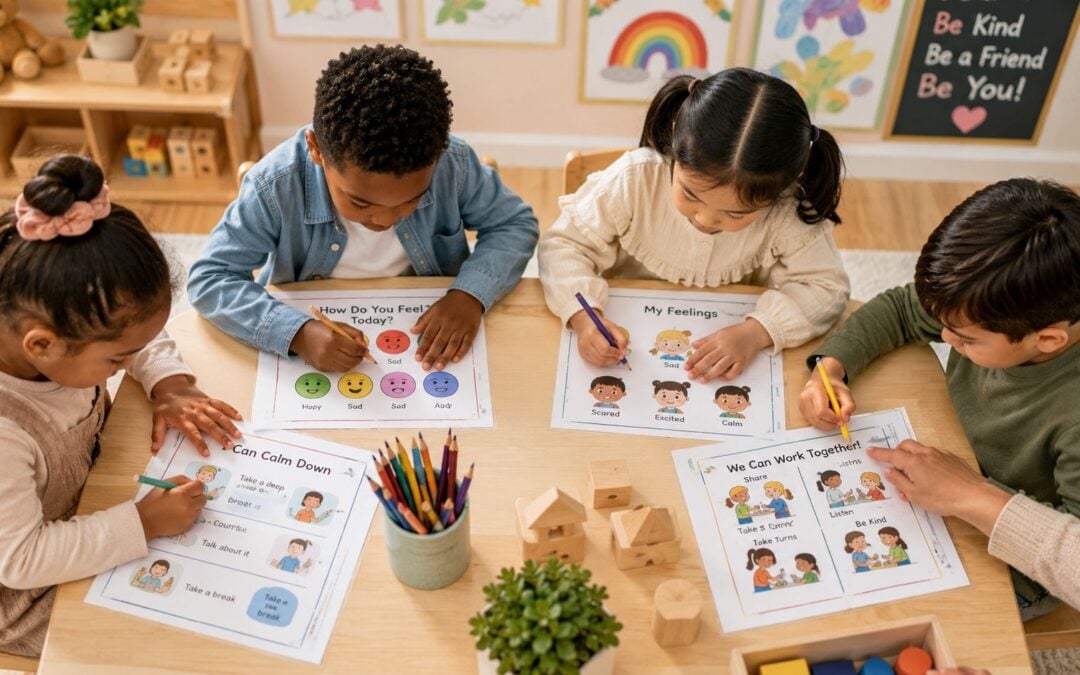
That's why strong social skills worksheets for kindergarten matter. They give children simple language, visual supports, and a repeatable structure for practicing empathy, turn-taking, self-control, and conversation. Used well, a worksheet isn't the lesson by itself. It's the launch point for modeling, role-play, and real interaction. If you're also building out content-area support for families, this parent guide for Iowa social studies is a useful example of how home-school connections can stay practical and simple.
Social-emotional learning programs that use structured activities such as worksheets are associated with average academic gains of 11 percentile points, according to K5 Learning's SEL overview. In kindergarten, that structure matters even more because young children need visual cues and predictable routines before they can apply a skill independently.
1. Cool Tools For Schools Digital
Soul Shoppe's Cool Tools For Schools Digital stands out because it treats worksheets as part of a wider relationship-building system, not as isolated printables. That difference matters in kindergarten. A page about conflict resolution helps more when the whole class already shares words for feelings, calming down, listening, and repair.
Soul Shoppe's approach is especially strong for schools that want consistency across classrooms, counselor support, and family reinforcement. The organization has more than 20 years of research-based, experiential work behind it, and that shows in the way the tools are designed for actual school routines rather than one-off activities.
How It Works Best in Kindergarten
Use this when you want a short, repeatable SEL block that can fit into morning meeting, a transition, or a reset after recess. Instead of handing out a worksheet and hoping the lesson sticks, pair the printable or digital prompt with a concrete classroom action.
For example, if children complete a page about taking turns, don't stop at circling the “right choice.” Hand one child a red ball and coach the exchange physically. For preschool and kindergarten ages, visual prompts and brief sessions work best when adults read the prompt aloud and let children point, color, or draw rather than write, as described in this practical worksheet guidance for preschool social skills.
Practical rule: In kindergarten, the worksheet should name the skill. The adult should stage the moment where the child practices it.
This is also where Soul Shoppe aligns with a community-centered SEL model. If a class uses shared phrases for conflict, calming down, and belonging, the worksheet becomes a reminder of something children already experience in live interactions.
Trade-Offs to Know
Best for shared language: It works well when a school wants common routines across teachers, counselors, and families.
Best with facilitation: Adults still need to model, prompt, and revisit the skill during the day.
Less ideal for grab-and-go only: If you want random free pages with no planning, this is more intentional than that.
Stronger as part of a system: It pairs naturally with schoolwide workshops, assemblies, and other Soul Shoppe supports.
One practical extra. If you're assembling packets for classroom, counseling, and home use, a simple PDF splitting tool helps break larger files into shorter skill-based sets.
2. K5 Learning
K5 Learning is one of the easiest places to start if you need free social skills worksheets for kindergarten today, not next week. The pages are simple, picture-supported, and easy to send home without a lot of explanation.
That simplicity is the strength and the limitation. You can grab an emotions worksheet or friendship page quickly, but you'll need to build the actual lesson sequence yourself.
Best Classroom Use
Use K5 Learning for one-skill practice. A good example is an “identifying feelings” page during arrival. Set up a small feelings check-in area by the door with emotion cards, a mirror, and name sticks or magnets. Children complete the page or point to a face, then move their name to the feeling that matches how they arrived. That routine mirrors the kind of visual emotion check-in described in this teaching social skills routine guide.
Works well for: Morning work, take-home reinforcement, centers, sub plans
Less strong for: Full-unit pacing, differentiation, neurodivergent adaptations
Helpful pattern: Print one page, model one sentence stem, then practice in pairs
K5 also fits schools where budget matters. Print-based supplemental SEL materials remain a primary low-cost entry point for over 70% of K-5 classrooms, according to K5 Learning's worksheet overview. That tracks with classroom reality. Teachers need materials they can copy, explain fast, and use again tomorrow.
3. Twinkl (USA)
Twinkl USA is for the teacher who wants options. Lots of them. If you're building a week on friendship, a month on classroom community, or a whole set of turn-taking visuals for centers, Twinkl gives you enough pieces to make the unit feel coherent.
The risk is overload. A huge library can save time or waste it, depending on how clear you are about the skill you're teaching.
Where Twinkl Shines
Twinkl is especially useful when you want matching materials across formats. You might print a sharing worksheet for table work, add a social story for read-aloud, and use a visual prompt card in the block area. That consistency helps children connect the same idea across settings.
A practical kindergarten example is a “joining play” sequence. Start with a picture-based page showing children entering a game. Then model the exact phrase, “Can I play with you?” Finally, send children into choice time with a visual card on a lanyard for the students who still need the sentence starter.
Worksheets help children recognize a skill. Real play shows whether they can use it.
Twinkl is also a good fit for teachers who need U.S. curriculum filters and want materials that look polished without creating everything from scratch.
What Doesn't Work as Well
Too much browsing: If you don't narrow by one SEL target, you can lose planning time.
Membership barrier: Full access requires a subscription.
Needs adult transfer: The worksheet alone won't move the skill into recess or centers.
If your team likes building thematic units with matching visuals, Twinkl is a practical choice. If you want a tighter, prebuilt SEL sequence, another platform may feel easier.
4. Education.com
Education.com is one of the better mixed-format choices because it gives you printable and digital options in the same ecosystem. That's useful when one teacher wants paper at the small group table and another wants a tablet-based center.
Its kindergarten social skills content covers familiar territory such as feelings, kindness, class rules, and taking turns. The design tends to be kid-friendly and accessible, which matters when children need immediate visual clarity.
A Good Fit for Home and School
This platform works well when you want a worksheet to travel between classroom and home. A teacher can introduce “kind words versus hurtful words” in class, then send a companion printable home with a simple note asking families to role-play two examples at dinner.
For conversation skills, don't let children just fill in bubbles or draw lines. Teach the “throwing it back” pattern. If one child asks, “Do you have a pet?” the responding child answers and asks a question back. That reciprocal mechanic is explained clearly in this conversation worksheet guide from Positive Psychology, and it's one of the fastest ways to make a page become an actual social exchange.
Strong mix: Printable and digital options make it flexible.
Teacher support: Companion lesson materials help if you don't want to build every prompt yourself.
Free limits: The free tier restricts downloads.
Best features cost more: Unlimited access sits behind membership.
If you're teaching in a hybrid environment, sharing with families, or rotating between paper and screen, Education.com is one of the more practical platforms on this list.
5. Scholastic Teachables
Scholastic Teachables feels familiar to many teachers for a reason. The visuals are polished, the materials are classroom-ready, and the literacy connection is usually stronger than in generic worksheet libraries.
That's the big advantage here. Social skills don't have to sit in a separate bin labeled “SEL.” You can fold them into read-aloud response, mini-books, and discussion pages that still feel age-appropriate.
Best Use for Whole Group
Scholastic Teachables works well for a whole-group mini lesson followed by a small-group extension. For example, read a book about sharing, pause at a conflict point, then use a related printable where students identify what each character could say next.
This is especially helpful for children who understand social ideas better through story than through direct explanation. If a child can say, “The bear should ask for a turn,” that's often the bridge to saying, “Can I have a turn when you're done?” during centers.
Best for: Teachers who like literacy-linked SEL
Best setting: Whole-group introduction with small-group reteaching
Less ideal for: People looking for fully free, fully open access
Watch for: Site navigation takes a little practice
Scholastic is a strong middle-ground option. It doesn't reinvent kindergarten SEL, but it packages it in ways teachers can use without much cleanup.
6. Centervention
Centervention is practical, especially if you want quick one-page supports for counseling groups, morning meeting, or a classroom reset after a rough transition. The free library is broad enough that most teachers can find something usable without a long search.
The worksheets tend to be direct. That makes them easier to plug into a school day, even if they don't create a full kindergarten SEL pathway by themselves.
How I'd Use It in a Busy Week
Centervention is a good “I need something for tomorrow morning” resource. Say your class has had repeated trouble with teamwork at the block center. Pull a one-page cooperation worksheet, use it during morning meeting, and then revisit the same language before center time.
You can keep the transfer concrete by naming the center expectation before children move. “Today in blocks, teamwork means one person builds, one person passes pieces, then you switch.” Kindergarteners need that level of plain, visible structure.
A lot of teachers also appreciate that these pages can pair with game-based extensions if they want to go further later.
What to Keep in Mind
Fast implementation: Good for one-day or one-week skill reinforcement
Counselor-friendly: Easy for short push-in or pull-out sessions
Not a full sequence: You'll still need your own pacing map
Extensions may point to paid content: The free library sometimes acts as a doorway into the larger platform
If your current need is simple, clear social skills worksheets for kindergarten that you can use immediately, Centervention earns its spot.
7. Everyday Speech
Everyday Speech is one of the stronger choices when you know a worksheet alone won't be enough. Its value comes from the combination of modeling, games, and printable supports. That combination matters because many kindergarten social skills resources still lean too heavily on static individual tasks and don't explain how to move a skill into real play, a gap noted in this Everyday Speech discussion of kindergarten interactive learning.
That's where this platform is different. It's built for teaching, not just printing.
Best for Skill Transfer
If a child can identify “sharing” on paper but still melts down during dramatic play, use Everyday Speech to bridge the knowing-doing gap. Start with a targeted worksheet or visual. Then show a model, practice the script, and move into a short role-play.
A concrete example: children complete a page about asking to join a game. Then two students and an adult act out a pretend kitchen scene. One child practices, “Can I cook with you?” The others practice either welcoming or offering a role.
Don't let the page be the finish line. Use it as rehearsal before the social moment children actually struggle with.
Trade-Offs
Strong modeling: Helpful for SLPs, counselors, and teachers who want examples children can imitate
Low-prep lessons: Easier than building every role-play from scratch
Subscription required for full access: The best breadth sits behind paid access
May be more than one classroom needs: The library is wide, so some teams will only use part of it
For students who need explicit practice beyond coloring and circling, Everyday Speech is one of the more complete choices.
8. Emotional ABCs (Classroom)
Emotional ABCs Classroom is a good option for teachers who want a sequence, not just a stack of printables. The program organizes feelings recognition, self-regulation, and relationship skills in a way that feels accessible for early childhood classrooms.
Its print library is easy to use, which matters more than it sounds. If you only have a few minutes before class, you need to find the right support fast.
Strong for Routine Building
This platform works well with repeated kindergarten structures. One example is an “all about me” and “all about my feelings” sequence at the start of the year. Students complete a simple identity page, then connect that to a class feelings routine and a regulation tool they can use during the day. This All About Me kindergarten activity guide pairs naturally with that kind of launch.
For younger children, brevity still matters. Effective kindergarten worksheet design often fits a short attention window and benefits from interactive matching or coloring components. In one benchmarking summary, curriculum developers reported stronger engagement when pages included interactive coloring or matching rather than text-only formats, as noted in this Vedantu worksheet overview.
Limits to Expect
Best with routines: The printables make more sense when the class already uses the program language
Good for early childhood: The visuals and sequence are approachable
Premium tiers hold the deeper library: Free sampling won't show the full system
Less useful as random standalone pages: It's more coherent when used as intended
If you want social skills worksheets for kindergarten that connect to a clear emotional vocabulary and predictable classroom routines, Emotional ABCs is worth a close look.
9. Second Step (Committee for Children)
Second Step is a district-friendly choice. Many school leaders recognize the name, and that matters when you're trying to get buy-in across classrooms, specialists, and administration.
The materials are structured and sequenced, which helps teams that don't want every teacher inventing SEL from scratch. For kindergarten, that usually means explicit lessons on empathy, listening, sharing, and problem-solving with printable pages that reinforce the script.
Best for Consistency Across a School
Second Step fits schools that want common routines and common language. If every kindergarten teacher introduces the same feeling words, the same calm-down process, and the same conflict steps, children experience less confusion moving between classrooms and support staff.
A practical example is using a feelings visual from a classroom pack during arrival, then revisiting it after recess. If a child points to “frustrated,” the teacher can prompt a coping tool and connect it to a class feelings chart. This feelings chart for kids works as a complementary visual for that kind of routine.
Second Step also aligns with recognized SEL competencies, which helps if your district wants a framework that can be discussed clearly with families and leadership.
Possible Friction Points
Easy to justify in a district setting: The structure supports adoption
Free samples help: You can test activity packs before a full commitment
Scripts can feel rigid: Some teachers will adapt the wording
Requires implementation planning: A sequence is only useful if staff uses it consistently
This is a strong choice for schools that value system-wide alignment over teacher-by-teacher improvisation.
10. Random Acts of Kindness (Kindness in the Classroom)
Random Acts of Kindness offers something many schools need more of. Free resources that are usable, values-centered, and broad enough to support kindness, empathy, inclusion, and respect without feeling shallow.
The design is less flashy than some commercial kindergarten products, but don't mistake that for weakness. The content is often clear, practical, and easy to adapt for classroom community lessons.
Where It Helps Most
This is a strong pick for morning meeting and class culture work. A kindergarten teacher can use a kindness reflection page on Monday, model one class kindness goal, and revisit it during Friday circle with examples from the week.
It also supports bilingual access through English and Spanish downloads, which can make home reinforcement easier. That's useful when you want caregivers to use the same simple kindness language children hear at school.
One important caveat is inclusion. Many social skills worksheets still assume a neurotypical baseline and don't build in enough support for children with developmental differences. Helpful Professor notes that current worksheet content often fails to address the needs of the 15 to 20% of kindergarteners with developmental differences, and that gap matters when you're choosing or adapting materials for belonging and psychological safety in the classroom, as discussed in this social skills worksheet review.
How to Adapt It Better
Use literal language: Replace abstract prompts with direct choices and visual examples.
Add movement: If the page is about asking for help, act out walking to the teacher and raising a hand.
Trim the task: One page is often enough for this age.
Avoid isolation: Use the worksheet before partner practice or cooperative play, not instead of it.
For schools that want kindness-centered social skills worksheets for kindergarten without a major budget lift, this is one of the strongest free options.
Top 10 Kindergarten Social Skills Worksheets Comparison
Product
Key features
Best for
Strengths / Unique selling points
Price / Access
Cool Tools For Schools (Digital)
Classroom-ready digital SEL toolkit; short repeatable practices; integrates with app/workshops
Cultivating a Classroom Community, One Skill at a Time
Building strong social skills in kindergarten takes repetition, modeling, patience, and a lot of small course corrections. No worksheet can do that job by itself. What a good worksheet can do is give children a visual anchor, a few clear words, and a predictable starting point when feelings are big and social situations move fast.
That's why the best resources on this list don't just offer cute pages. They help adults turn a page into a routine, a role-play, a partner exchange, or a calmer way to solve a conflict. In practice, that might look like an emotions page paired with a morning check-in board, a turn-taking sheet followed by passing a red ball, or a conversation prompt turned into a “throw it back” game with a classmate.
Kindergarten teachers know what works and what doesn't. What works is short, visual, concrete instruction. What works is practicing one skill at a time. What works is revisiting the same language in block center, on the rug, at lunch, and during dismissal. What doesn't work is expecting a child to color a picture about kindness at 9:00 and independently resolve a friendship conflict at 10:15 without adult coaching.
That matters even more for children who need extra support. For neurodivergent learners, the strongest social skills worksheets for kindergarten use literal language, clear visuals, and direct modeling. They also connect immediately to action. If a child sorts “telling a teacher” versus “yelling” on paper, the next step should be acting that moment out with an adult, rather than moving on. Practical implementation guidance for neurodivergent learners emphasizes pairing printables with physical objects or movement rather than using the worksheet in isolation, as described in this adaptation guide for kids' social skills worksheets.
Schools also need to think beyond individual classrooms. A strong SEL culture grows faster when students hear the same vocabulary from teachers, counselors, specialists, and families. That's where a more connected approach becomes valuable. Some teachers will do well with free one-page resources from K5 Learning, Centervention, or Random Acts of Kindness. Others will want a more structured pathway from platforms like Second Step, Everyday Speech, or Emotional ABCs.
For schools ready to build a deeper culture of connection, belonging, and psychological safety, Soul Shoppe's programs such as Cool Tools For Schools can help embed these skills into daily life across classrooms and campuses. The goal isn't more paper. The goal is a classroom where children know how to join a game, repair hurt feelings, wait for a turn, and ask for help with confidence. That kind of classroom feels kinder because it is more teachable, more connected, and more human.
If your school is ready to move from isolated SEL activities to a shared culture of empathy, connection, and practical conflict resolution, explore Soul Shoppe. Their workshops, digital tools, and schoolwide supports help students and adults build the common language and everyday routines that make social skills stick.
You're probably seeing one of two scenes right now. A child says something cutting on the playground and then shrugs, “I was just being honest.” Or a student does something helpful only after asking, “Do I get a sticker?” Both moments tell the truth about teaching kindness to kids. Kindness isn't automatic, and it isn't the same as compliance.
It also doesn't grow well from one assembly, one read-aloud, or one “be nice” poster on the wall. Children learn kindness when adults treat it as a skill set, a shared norm, and a daily practice that shows up in classrooms, kitchens, hallways, and conflict.
The most effective work is bigger than a list of activities. It builds self-awareness, empathy, emotional regulation, responsibility, and belonging all at once. It also respects reality. Some children are socially confident and ready to help. Some are overwhelmed, guarded, or recovering from bullying. They won't all enter kindness lessons from the same place, so they shouldn't all be taught the same way.
Why Teaching Kindness Is More Than Just Being Nice
A child can say “please,” avoid conflict, and look polite while still excluding a classmate at recess. Another child can speak up when a friend is being mocked, even if that creates discomfort in the moment. Only one of those is kindness.
Being nice is often about approval, smooth interactions, and avoiding tension. Kindness asks more. It requires noticing what someone else may be feeling, managing your own response, and choosing action that protects dignity and connection. That makes kindness a social-emotional skill, not just a manners lesson.
In schools, this matters because children don't learn well when they feel unsafe, disconnected, or socially on guard. Kindness supports classroom learning by strengthening peer trust, reducing friction, and giving students practical ways to repair relationships.
Kindness sits inside core SEL skills
Kindness depends on several teachable capacities working together:
Self-awareness: A child notices, “I'm annoyed right now, and I want to snap.”
Social awareness: The child reads another person's cues and realizes, “He looks left out.”
Relationship skills: The child knows how to enter, offer help, apologize, include, or check in.
Self-regulation: The child can pause long enough to act intentionally instead of impulsively.
A 2026 scoping review of 17 studies found that school-based kindness programs, with 71% using SEL approaches, led to significant increases in prosocial behaviors and emotion regulation. Nearly half of these effective programs incorporated mindfulness techniques. That finding matches what practitioners see every day. Kids are more likely to act kindly when they can notice feelings, regulate stress, and stay connected under pressure.
For educators who want a concise way to explain the emotional difference between similar terms, DeTalks on compassion and empathy is a useful resource. It helps adults choose clearer language when teaching children what it means to feel with someone, care about them, and respond helpfully.
Practical rule: Don't ask children to “be nice” when what you really mean is “notice, understand, and act with care.”
What this looks like in real life
In a second grade classroom, “be nice” often turns into forced sharing, fake apologies, or silence around hurt feelings. A stronger prompt sounds like this: “Pause. What do you think your partner needed in that moment? What can you do now that helps?”
In middle school, the distinction gets even sharper. A student may laugh along with a cruel joke to stay socially safe. Nice behavior protects status. Kind behavior risks using it well.
If you want a wider view of why these skills matter across school life, the benefits of social-emotional learning offer a helpful foundation. Kindness works best when adults see it as part of how children learn to belong, regulate, and collaborate, not as a side topic for spirit week.
Building the Core Components of Kindness
Children don't need a vague speech about “being a good person.” They need a structure they can understand and practice. The clearest one is this: awareness, empathy, and action.
That sequence matters. A child first notices. Then the child makes meaning. Then the child chooses what to do.
Awareness
Awareness is the starting point. Kids can't respond to needs they don't notice.
With younger children, keep the language concrete: “What do you see on her face?” “What happened right before he got upset?” “Who's by themselves right now?” With older students, move toward interpretation: “What might be going on beneath that reaction?” “What is this group dynamic asking someone to carry?”
A validated methodology for K-8 instruction guides students to first define kindness, then build skills like self-awareness and empathy, and finally carry out a real-world experiment to increase kindness in their community, targeting regulatory, emotional, and motivational processes. That approach is described in the Learn Kind framework.
Try this at home or in class: place a simple prompt where children can see it. “Who might need support today?” The point isn't to force rescuing. It's to train attention.
Empathy
Empathy is where children connect what they notice to another person's inner experience. This doesn't mean every child must feel someone else's emotions intensely. It means they learn to understand that other people have feelings, histories, and needs that matter.
A few strong conversation starters:
For K-2: “How do you think that felt?”
For grades 3-5: “What clues helped you figure that out?”
For grades 6-8: “What else could be true from their point of view?”
If you want support teaching this layer directly, how to teach empathy offers classroom-friendly language and practice ideas.
Children don't need to agree with someone to understand that their feelings are real.
Action
Action is the part adults often rush to first. That's a mistake. If a child hasn't developed awareness and empathy, the “kind act” can become performative, controlling, or random.
Action should be specific and appropriate to the situation. Sometimes it means helping clean up spilled markers. Sometimes it means sitting next to the new student. Sometimes it means giving space, getting an adult, or repairing harm after saying something hurtful.
Use prompts that help children think in choices:
Ask: “What's one helpful thing you could do?”
Check fit: “Would that feel supportive to the other person?”
Reflect: “What happened after you tried it?”
For older kids, this can become a mini inquiry cycle. They identify a need in their class or neighborhood, plan a realistic response, try it, and then reflect on impact. That's how kindness moves from a slogan to a practiced habit.
Weaving Kindness into Daily Classroom Life
The most durable kindness work is low-drama and repeatable. It lives in routines, not special events. Teachers don't need a separate curriculum block every day. They need ways to make kindness visible in how students enter the room, speak to one another, solve problems, and participate in learning.
A common failure point is treating kindness as an abstract ideal while the classroom itself feels unpredictable or socially unsafe. That doesn't work. Emerging SEL frameworks emphasize that for children who've experienced trauma or bullying, psychological safety and a sense of belonging must come before empathy-focused instruction, as discussed in this culture of kindness resource. A child in defense mode often can't access generous perspective-taking on demand.
Morning routines that build readiness
Start with short, predictable openings. These don't need to be sentimental. They need to be consistent.
Useful prompts include:
Connection check-in: “What's one way you want classmates to treat you today?”
Memory prompt: “Share a time someone helped you when you needed it.”
Repair mindset: “What can a person do after making a mistake with a friend?”
Inclusion lens: “What helps someone feel welcome in a new group?”
For children who are hesitant to speak publicly, offer options. They can draw, turn-and-talk, use a feelings card, or pass. Choice protects dignity and lowers pressure.
Kindness calisthenics for two-minute resets
Short practice bursts work well between academic tasks. They help children rehearse prosocial habits before stress rises.
Try a few:
Silent notice: Students look around the room and identify one person who may need encouragement today.
Partner reframe: In pairs, students finish the sentence, “A kind interpretation of that behavior might be…”
Micro-help plan: Each student writes one realistic action they can take before lunch.
Appreciation relay: One student names a helpful act they observed, then chooses the next speaker.
These work because they're brief, concrete, and tied to real behavior rather than moral language.
If a routine takes ten minutes to explain, most classrooms won't sustain it. Build kindness practices that fit inside the day you actually have.
Use academics as a practice field
Literature is an obvious entry point, but it shouldn't stop at “Was the character kind?” Ask sharper questions: “What did the character notice?” “What stopped them from helping sooner?” “What was the cost of speaking up or staying silent?”
Social studies offers strong opportunities too. Students can examine community responsibility, fairness, exclusion, and how groups either protect or ignore vulnerable members. In science or group projects, kindness shows up in turn-taking, listening, credit-sharing, and how students respond when someone makes an error.
Children need different language and tasks at different ages. The table below helps teachers adjust the same core goal without flattening it into one-size-fits-all instruction.
Grade Level
Focus Area
Sample Activity
Discussion Prompt
K-2
Noticing feelings and needs
Read a short story, pause at key moments, and ask students to point to a face card that matches how a character feels
“What do you think this person needs right now?”
3-5
Perspective-taking and inclusion
During morning meeting, students brainstorm ways to include someone who is new, upset, or left out at recess
“How can you tell the difference between helping and taking over?”
6-8
Integrity, repair, and bystander choices
Students role-play social situations such as group chat exclusion, hallway teasing, or project conflict, then practice responses
“What does kindness look like when being kind is socially risky?”
Trauma-informed adjustments that matter
Kindness activities can backfire when they demand emotional exposure from children who don't yet feel secure. A few adaptations make a real difference:
Give private options: Let students journal, draw, or respond one-on-one instead of sharing publicly.
Avoid forced vulnerability: Don't require children to disclose personal pain to prove empathy.
Offer controlled choices: “Would you rather write a kind note, partner with someone, or help set up materials?”
Teach regulation first: A dysregulated child may need breathing space, movement, or co-regulation before any reflection about impact.
Many adults often find themselves frustrated. They think a child is “resisting kindness.” Often the child is protecting themselves. When adults slow down, create predictability, and lower the emotional demand, participation usually becomes more genuine.
Nurturing a Culture of Kindness at Home
Parents often ask the wrong first question: “How do I get my child to be more kind?” The more useful question is, “What does my child see kindness look like in this home?”
Children watch how adults respond when tired, irritated, disappointed, or rushed. That's where their model comes from.
Modeling beats lecturing
Research shows that when students observe adults modeling compassion and understand their responsibility to the community, they exhibit more consistent caring behaviors than when they're rewarded for good behavior, as described in this mindfulness-based kindness research. In practical terms, that means children learn more from how adults treat a cashier, a co-parent, a neighbor, or an overwhelmed sibling than from a long speech about values.
A parent on hold with customer service has a real-time teaching moment. So does the caregiver who says, “I'm frustrated, but I'm going to speak respectfully.” So does the adult who notices, “Your brother looks disappointed. Let's slow down and check what happened before we react.”
Families looking for steady, doable ways to build this tone may appreciate these positive parenting tips, especially when kindness work starts to feel tangled up with discipline, stress, or sibling conflict.
Turn chores into contribution, not punishment
One of the simplest ways to teach kindness at home is to frame family responsibilities as acts of care for the shared community. Cleaning the table, feeding a pet, bringing water to a grandparent, or helping a sibling find shoes are not just tasks. They're participation in family life.
That framing matters. “You have to do this because I said so” teaches obedience. “We all help because everyone in this home matters” teaches responsibility with belonging.
Try language like this:
At cleanup time: “What's one job you can do that helps everyone reset?”
After school: “Who in this house might need extra patience today?”
During conflict: “What would repair look like here?”
Use conversation, not performance charts
Dinner or bedtime can become the home version of a morning meeting. Keep the questions short and honest.
A few that work well:
“When did someone make your day easier today?”
“Did you notice anyone left out?”
“What's one kind thing you did that nobody asked you to do?”
“What's one moment you wish you handled differently?”
Later in the week, a short video reflection can help families keep the conversation going.
What public mockery does to a child
Public embarrassment teaches fast. A student who is mocked during a presentation may stop raising a hand, avoid reading out loud, or try to disappear into the group. Adults sometimes miss that shift because the child is no longer causing any visible problem. They are protecting themselves.
The audience matters too. When classmates laugh and no adult interrupts, children can absorb the wrong lesson. They may decide that humiliation is a good way to get attention, or that staying silent is safer than helping. That is why adults need to respond to both the speaker and the crowd.
What to do right away
Start by resetting the room. Then address the student who caused harm.
To the class: “Stop. We do not laugh at someone when they are vulnerable.”
To the student who mocked: “That comment was meant to embarrass. It stops now.”
To the targeted student, privately: “I saw what happened. You did not deserve that. What do you need right now?”
If the group is unsettled: “We are going to reset and try again respectfully.”
That immediate response does two jobs at once. It protects the targeted student, and it teaches every bystander what this classroom stands for.
Later, circle back with a repair plan. Public humiliation often needs a public correction and a private follow-up. Depending on the situation, that might mean a brief acknowledgment in front of the group, a restorative conversation, or a coached apology that names the behavior clearly. Soul Shoppe's guidance on how to stop bullying at school and at home can help adults choose a response that stops the pattern instead of only reacting to one moment.
Prevention works best when adults teach the skill underneath the behavior. Many students mock others because they want laughs, belonging, or social power and do not yet know safer ways to get those needs met. Practice helps. Teach students how to get attention appropriately, how to repair harm, and how to respond when a peer becomes the punchline. Role-play, class agreements, and direct coaching from resources about how to teach empathy give students language they can use.
Parents can reinforce the same lesson at home. If a child says, “I was only kidding,” ask, “How did the other person seem to feel?” That question shifts the focus from intent to impact. Over time, children learn an important social rule. Humor builds connection when everyone feels included. It becomes bullying when one child has to carry the shame for everyone else's laugh.
4. Threats, Intimidation, and Coercive Language
Some verbal bullying is meant to control, not just insult. A student says, “If you tell, you'll regret it,” or “Do my homework or I'll tell everyone your secret.” That's intimidation. It creates fear and teaches the target that speaking up might make things worse.
These are some of the most serious examples of verbal bullying because they often silence reporting. The child may look calm on the outside while feeling trapped inside. Threats can involve safety, reputation, friendships, belongings, or embarrassing information.
Common examples
Social threats: “If you tell the teacher, nobody will sit with you.”
Reputation threats: “I'll spread rumors about you if you don't do what I say.”
Physical threats: “My friends will take care of you after school.”
Digital threats: “I'll post the screenshot unless you do what I want.”
A workplace case study from WorkSafe Victoria described a 16-year-old apprentice whose supervisor used homophobic language, encouraged group name-calling, and manipulated the victim's phone. The victim filed a formal complaint after a 24-month pattern, as described in this WorkSafe bullying case study. Even though that case involved an older teen in a workplace, the pattern is familiar to schools. Verbal bullying often grows when adults underestimate early warning signs.
Take every threat seriously, even when the student later says, “I didn't mean it.”
How schools and families should respond
Start with safety, not debate. Don't ask the targeted child to confront the aggressor alone. Don't force a same-day face-to-face conversation while fear is still high.
Use a response sequence:
Document exact words: Write down what was said as closely as possible.
Separate students if needed: The target's sense of safety comes first.
Report through school channels: Involve administration and counseling support.
Protect confidentiality: Don't reveal who reported unless required by policy.
Follow up: Check on the student again after the first report.
If you need schoolwide tools and staff language for intervention, how to stop bullying offers practical starting points. The core message to children should be simple. Threats are not conflict. Threats are coercion, and adults must step in.
5. Demeaning Comments About Family, Socioeconomic Status, or Background
Some of the most painful verbal bullying targets a child's home life. A student gets mocked for wearing the same sweatshirt twice, bringing a different kind of lunch, having divorced parents, speaking another language at home, or practicing a religion classmates don't understand. These comments hit hard because children cannot easily change these parts of their lives.
One common example is a comment about clothing or money, such as “Are you poor?” Another is using family circumstances as an insult, like “No wonder you're messed up.” These aren't random remarks. They send the message that a child's family or background makes them lesser.
Why identity-based comments need a stronger response
Bias-based verbal bullying targets identity, including race, language, or gender. The American Psychological Association identifies it as a distinct category, and 2024 to 2025 data cited in the APA primer says bias-based verbal incidents have risen 27% in U.S. K-8 schools in the APA bullying primer. That means schools can't treat every hurtful comment as the same kind of peer conflict.
When a student insults a child's accent, immigration story, religion, or family income, adults need to address both the cruelty and the bias underneath it. A generic “be nice” response isn't enough.
What to say and teach
Try language like this:
Interrupt clearly: “We do not insult people's families, culture, language, or identity.”
Name the stereotype: “That comment made an unfair assumption about what poverty means.”
Affirm the target: “There is nothing wrong with your family, your culture, or your background.”
Teach the group: “Differences are part of our community. They are not material for jokes.”
At home and at school, include books, examples, and celebrations that reflect different family structures and communities. Children need regular exposure to belonging, not only correction after harm.
A student who uses this kind of language also needs guided reflection. Ask, “What did you assume? Where did that message come from? Who was hurt by it?” Those questions move the conversation from denial to accountability.
6. Exclusionary Language and Deliberate Isolation Comments
A student walks into lunch, tray in hand, and hears, “You can't sit here.” Then someone adds, “Nobody wants you anyway.” The table may stay quiet after that, but the message is loud. You do not belong.
Exclusionary bullying often sounds plain. “You can't play with us.” “Don't pick her.” “No one likes you.” Because the words are short and common, adults sometimes miss how much harm they carry. For many children, social belonging at school works like emotional oxygen. When peers keep cutting it off, shame and panic can show up fast.
This form of verbal bullying often appears in the least structured parts of the day: recess, lunch, group projects, clubs, bus lines, and birthday talk. A single social disappointment is part of childhood. A repeated pattern of shutting one child out, especially with comments meant to embarrass or isolate, is something different.
The difference between a boundary and a put-down
Children do get to choose friends. They do not get to use rejection as a weapon.
That distinction can be hard for adults to teach because both situations may involve the word no. The tone, purpose, and pattern matter. “I'm working with Leo today” sets a limit. “You're too annoying to work with anyone” attacks the child's social worth.
A useful rule for students is this: a boundary describes your choice, but bullying defines the other person as unwanted.
What adults can say in the moment
Start with a calm interruption. Keep it brief and concrete so students hear the limit, not a lecture.
Stop the exclusionary comment: “You may not tell someone they are unwanted.”
Separate choice from cruelty: “You can choose a partner. You cannot shame someone while you do it.”
Give replacement language: “Try, ‘We already have a group of four,’ or ‘I'm playing with Sam today.’”
Repair the belonging wound: “Everyone in this class has a place here.”
Then check on the student who was shut out. Do not assume they will ask for help. A quick private response matters: “I heard that. It was not okay. Let's make sure you're included right now.”
That step is easy to skip. It should not be skipped.
Classroom and home responses that actually help
Adults often focus on the seating chart or the game. The deeper issue is social power. Some students learn that they can raise their status by deciding who gets included. That is why simple redirection is not always enough.
Use a short repair process:
Name the impact. “Those words told him he didn't belong.”
Prompt reflection. “What were you trying to do in that moment?”
Practice a better script. “How can you say no without putting someone down?”
Require action. This might mean inviting the student into the activity, offering a respectful redo, or writing an apology with adult support.
Soul Shoppe's approach fits well here because it teaches belonging as a skill, not just a hope. Students need direct practice with inclusion, boundary-setting, noticing hurt, and repair. Those are SEL skills. They can be taught the same way adults teach lining up, turn-taking, or problem-solving.
Try teaching and practicing phrases such as:
“We already started this round. You can join the next one.”
“I want time with my close friend right now, but I can talk later.”
“Let's make room.”
“That sounded excluding. Try that again with respect.”
Prevention also needs structure. Rotate partners. Use cooperative learning roles. Assign mixed groups at times instead of letting the same social hierarchy decide every pairing. Hold class meetings where students practice how to join a group, how to say no kindly, and how to notice when someone is being left out.
Children should not have to decode whether adults see their social pain. Clear routines tell them, “Belonging is protected here.”
7. Negative Comments About Academic Performance and Ability
A student raises a hand, gets an answer wrong, and a classmate says, “Wow. Do you know anything?” The room may laugh for two seconds. The effect can last much longer.
Academic bullying attacks a child's identity as a learner. Comments like “You're stupid,” “You're so bad at math,” “Even the easy kids got it,” or “Don't ask her, she never gets it” send a clear message. Mistakes are unsafe, and ability decides worth. After enough of those messages, many students stop volunteering, stop asking for help, or stop trying in public.
This kind of verbal bullying is easy to miss because it can sound tied to schoolwork. Adults may hear it as teasing, competition, or blunt honesty. But there is a difference between feedback and humiliation. Feedback helps a student improve. Humiliation puts the student lower in the social order.
Watch for quiet forms of harm too. A child may shrug and say, “I'm just dumb,” before anyone else can say it first. That is often a shield. Students who expect ridicule often protect themselves by acting disengaged, clowning around, or refusing work they fear they cannot do perfectly.
What adults can say right away
Keep your response short, calm, and public enough to reset the norm.
Name the behavior: “That was a put-down about learning.”
Protect the target: “Everyone gets to make mistakes here.”
Reset the class value: “We respect effort, questions, and practice.”
Redirect the student who caused harm: “If you have something helpful to say, say it respectfully.”
Then follow up later with both students. The target needs reassurance and a path back into participation. The student who made the comment needs coaching, not only correction. Ask, “What were you trying to do with that comment?” Then teach the replacement skill. It may be giving peer feedback, managing frustration, or getting attention without putting someone down.
Classroom moves that lower academic shaming
Prevention works best when struggle is treated as a normal part of learning. A classroom runs like a practice space, not a stage. In a practice space, students expect retries, coaching, and visible growth.
Try supports such as turn-and-talk before whole-group answers, private wait time, anonymous question boxes, partner problem-solving, and sentence stems for respectful peer response. Model your own mistakes out loud. “I mixed that up. Let me fix it.” That simple routine teaches students that errors can be corrected without shame.
Parents can reinforce the same message at home. Praise persistence, specific strategies, and help-seeking. If a child's confidence is already shaky, these self-esteem building activities for kids can support repair alongside school-based interventions.
Children learn in the emotional climate around them. If that climate says, “Only smart kids speak,” many children go silent. If it says, “Learning includes not knowing yet,” students are more willing to risk, recover, and grow.
8. Targeting Students' Appearance, Body Size, and Physical Characteristics
A student walks into class wearing a new shirt. Another student says, loud enough for others to hear, “Why would you wear that?” A few kids laugh. No one uses profanity. No one makes a threat. Still, the message lands hard. Your body, your face, your clothes, or your size can be judged in public.
That is verbal bullying.
Comments about weight, skin, hair, height, teeth, disability-related differences, clothing, or other physical traits are often brushed off as teasing. Adults miss them because they sound ordinary. Children hear body talk so often that it can blend into the background. But repeated appearance-based comments work like small cuts. One may seem minor. A pattern changes how a child sees school, peers, and themselves.
The hidden message is simple and painful. You are safe only if you look the right way.
What makes this type of bullying different
Appearance-based bullying often hooks into shame fast. A child cannot leave their body at the classroom door. That is why these comments can linger long after the moment passes. The target may replay the words during lunch, at bedtime, or while getting dressed the next morning.
Adults should watch for behavior changes such as avoiding photos, refusing to participate in PE, asking to stay home on spirit days, changing eating habits, or becoming unusually focused on mirrors, makeup, hoodies, or baggy clothes. Some children start criticizing other students' looks. That does not mean they are unaffected. It can be a sign that they are absorbing the same harmful rules and passing them on.
A clear classroom norm helps here: We do not comment on other people's bodies or appearance.
How to respond in the moment
The first goal is to stop the harm without turning the incident into a performance.
Try language like this:
Interrupt clearly: “Stop. We do not make comments about someone's body, face, clothes, or appearance.”
Name the behavior: “That was a put-down about how someone looks.”
Close the joke loophole: “Humor does not make it respectful.”
Support the targeted student: “You did not deserve that. I'm checking in with you after class.”
Keep your tone calm and firm. Long lectures in front of peers often increase embarrassment for the student who was targeted. A short interruption works better in the moment. Then follow up privately with both students.
What to teach after the incident
Correction alone is not enough. The student who made the comment needs a replacement skill.
Ask questions that get underneath the behavior:
“What were you hoping would happen when you said that?”
“Were you trying to be funny, get attention, or fit in?”
“What could you say instead if you notice something different about someone?”
Then teach the missing skill. Some students need help with impulse control. Others need practice with empathy, boundaries, or how to join a group without targeting someone else. Soul Shoppe's approach works best when adults pair accountability with skill-building. Students need to repair harm and learn what respectful speech sounds like in real life.
For the targeted student, repair means more than comfort. It means restoring belonging. Check where the incident happened, who heard it, and whether the student now avoids that space or group. A child who was mocked in the locker room may need more support there than during math.
Prevention that works in classrooms and at home
Appearance-based bullying grows in places where body talk is common and unchecked. Adults can lower risk by setting rules before incidents happen. Avoid classroom activities that rank looks, joke about fashion, or invite public comments on bodies. Watch common hotspots such as PE, performances, dress-up days, group photos, and social media spillover from after school.
Teach students specific SEL skills: noticing impact, respecting differences, interrupting unkind humor, and giving compliments about effort, creativity, or character instead of bodies. Parents can reinforce the same message at home by avoiding negative body talk about themselves, their child, or other people. Children listen closely to what adults treat as normal.
If a child's confidence has taken a hit, structured self-esteem building activities for kids can support recovery while adults address the bullying directly. Confidence does not stop bullying on its own. It does give a child more footing while the adults around them work to stop the behavior, repair the harm, and reset the group norm.
Comparison of 8 Verbal Bullying Examples
Bullying Type
Implementation complexity
Resource requirements
Expected outcomes
Ideal use cases
Key advantages
Name-Calling and Insulting Language
Low, set rules and intervene quickly
Low, teacher time, classroom routines, parent contact
Quick reduction in incidents if enforced; improves classroom climate
Classroom management, SEL lessons on respectful speech
Easy to identify/document; clear teachable moments
Spreading Rumors and Social Exclusion Through Gossip
Aligns with academic goals; natural teachable moments to build resilience
Targeting Students' Appearance, Body Size, and Physical Characteristics
Medium, sensitive, influenced by media and culture
Medium, body-positive curriculum, counseling, media literacy
Improved self-esteem and body image over time; reduces health risks when addressed
Health/wellness classes, media literacy, body-image programs
Addresses health and media literacy; fosters self-compassion and safety
From Intervention to Prevention Building a Culture of Kindness
A student gets called a name during group work. The class laughs. The teacher stops it, gives a consequence, and the day keeps going. On paper, the problem was handled. In real life, the target may still feel unsafe, the student who caused harm may not know what to do differently next time, and the rest of the class just learned what gets attention.
That is why prevention has to do more than stop the moment. It has to teach the missing skill underneath the moment.
Across the examples in this article, the pattern is clear. Verbal bullying often grows where students have not yet learned how to handle embarrassment, social pressure, jealousy, difference, or conflict with respect. A rule can block a behavior for a minute. A skill gives a child another option.
Adults need both. Clear limits matter. So does direct instruction in self-regulation, perspective-taking, boundary-setting, repair language, and how to disagree without attacking someone's identity. A child who knows how to say, “I'm frustrated. I need space,” is less likely to reach for “You're so stupid.” A child who can ask, “Was that joke hurtful?” is better prepared to catch harm before it spreads.
The intervention process still matters. McMillen Health's verbal bullying guidance outlines practical steps adults can use in the moment: stop the behavior quickly, avoid humiliating the student in front of peers, apply consistent consequences, protect privacy, involve support staff when needed, contact caregivers, and model respectful language. That sequence works like first aid. It stabilizes the situation so real teaching can happen after emotions settle.
The larger goal is school safety and student well-being. As noted earlier, bullying is common enough that no school can treat verbal aggression as a small issue or a normal part of growing up. Students who are targeted can carry that stress into attendance, learning, mental health, and peer relationships. Early action gives children more protection, especially before patterns harden in upper grades.
Prevention works best when the whole community shares the same language. Students need to hear the same message in the classroom, on the playground, in the hallway, and at home. “We do not use words to rank people.” “If you cause harm, you repair it.” “If you see someone isolated, you include or get help.” Repetition matters because social behavior is learned the same way reading fluency is learned. Through modeling, practice, correction, and another chance to try again.
One often-missed area is sarcasm and so-called joking. Some students hide cruelty inside humor because it gives them cover. Some targets freeze because they know they were hurt but cannot explain why. The Girls Guide to End Bullying verbal bullying overview points out that many students struggle to tell the difference between joking and mean teasing. Adults can reduce that confusion by teaching a simple standard: intent matters, but impact matters too. If the comment lands as humiliation, exclusion, or fear, adults need to address it.
Soul Shoppe's approach fits this work well because it teaches relationship skills in ways students can use. The focus is not only on stopping hurtful words. It is on building belonging, shared language, and repair. Through workshops, assemblies, digital tools, and coaching, schools can teach students how to calm their bodies, name what happened, speak up clearly, listen without defending, and make things right. That gives teachers and parents a repeatable toolkit, not just a list of warnings.
For families, the job is similar. Notice changes early. Ask calm, specific questions. “Who were you with at lunch?” works better than “How was school?” Do not dismiss repeated teasing as normal if your child seems smaller, quieter, or more tense afterward. Children need adults who take verbal harm seriously and also show them what respectful, firm language sounds like.
If you're thinking about long-term protection, fostering confidence in children supports this work. Confidence does not prevent bullying by itself, but it can help children ask for help sooner, use clearer boundaries, and stay connected to supportive peers and adults.
A kinder culture is built in small, repeated moments. A teacher pauses a put-down and asks for a reset. A parent helps a child practice a repair script before the next school day. A class learns that belonging is something they protect together. That is how intervention turns into prevention. That is how words stop being weapons and start becoming tools for safety, dignity, and connection.
Soul Shoppe helps schools, families, and community partners turn bullying prevention into daily practice. Through Soul Shoppe, you can access social-emotional learning programs that teach students practical tools for empathy, communication, self-regulation, and conflict resolution so every child has a better chance to feel safe, connected, and ready to learn.
A student has stopped making eye contact. He shrugs when you ask a question, turns work in half-done, and says “I don't know” even when you know he does. At home, a child who used to talk freely now gives one-word answers after school. Most adults respond by pushing harder on effort, compliance, or consequences. But when trust is shaky, more pressure usually gets you less connection.
That's why building trust with students has to come before most of the things we want from them. Before participation. Before risk-taking. Before honest communication. Before repair after conflict. Children learn best when they feel safe with the adults guiding them.
Trust can feel mysterious when you're busy, stretched thin, and trying to hold a room together. It isn't mysterious. It's built through repeated experiences that tell a child, “You matter here. I mean what I say. I will treat you fairly. I can handle your feelings without rejecting you.”
Why Building Trust Is the Foundation of Learning
Ms. Rivera had a student who barely spoke during the first month of school. He kept his hood up, stared at his desk, and avoided group work. Nothing she tried academically seemed to land. Then she changed her goal. She stopped trying to “get him engaged” and started trying to make him feel safe. She greeted him by name every morning. She checked in without pushing. She gave feedback privately instead of across the room. By October, he still wasn't the most vocal student in class, but he was attempting work, asking for help, and staying present.
That shift matters. Students don't only learn from lessons. They learn inside relationships.
Research by University of Chicago scholars Bryk and Schneider established that relational trust is a critical predictor of student achievement. Their multi-year analysis of over 400 Chicago elementary schools found that schools with high trust saw significantly faster improvement, with math score gains of 1.5 to 2 times greater than low-trust schools over a five-year period. The researchers argued that trust acts as the “hidden infrastructure” of school improvement because students engage more fully when educators show personal regard, respect, and competence, as summarized in this overview of relational trust in schools.
What trust looks like in real life
Trust isn't only about whether students “like” an adult. It shows up in daily moments:
Academic risk-taking: A student raises a hand even when unsure.
Honest communication: A child tells the truth about missing homework instead of hiding it.
Emotional regulation: A student accepts correction without spiraling because the relationship feels steady.
Family partnership: A parent is more willing to respond when school communication feels respectful rather than reactive.
Trust tells a student, “I can stay connected here, even when I struggle.”
Parents see the same pattern at home. A child is more open to guidance when the adult relationship feels predictable and warm. The principles that support school trust also show up in early childhood work around connection, co-regulation, and responsive care. If you want a developmental lens on those foundations, this piece on fostering toddler development is a helpful companion.
The Four Pillars of Trust in an Educational Setting
Trust gets easier to build when adults can name what it's made of. I use four pillars with teachers and families because they turn a fuzzy idea into something you can notice, practice, and strengthen.
A 2022 grounded model study in a high-performing urban high school found that trust starts forming from the first moments of interaction. Students especially trusted educators who showed motivation, empathy, respect, self-awareness, credibility, and professional commitment, and who established clear norms while showing flexibility and patience early in the year, as described in this study on how educators build trust with students.
Reliability
A student needs to know what version of you they're going to get.
Reliability means your responses are steady. You follow through. You don't ignore a behavior one day and explode about it the next. At home, it means bedtime, screens, and consequences don't change based on adult mood.
In practice: “I told you I'd check back after recess, and I'm here.”
When it's missing: A child starts scanning for danger and tests the edges because the environment feels unpredictable.
Competence
Students trust adults who seem capable. That doesn't mean perfect. It means prepared, fair, and clear.
A competent teacher explains directions well, notices confusion, and corrects mistakes without becoming defensive. A competent caregiver knows when to set a limit and when to pause and listen. Children relax when they believe the adult can handle the situation.
Pillar
What students notice
Simple example
Competence
“This adult knows what they're doing.”
“I can see the directions were unclear. Let me reteach that.”
Lack of competence
“I'm not sure this is fair or organized.”
Work changes without explanation and students get blamed for confusion.
Benevolence
This pillar is about genuine care. Students need evidence that you see them as a whole person, not just as a behavior, grade, or problem to solve.
That can sound like, “You seem quieter than usual. Want to talk now or later?” It can look like noticing who never volunteers, who always packs up slowly, or who gets loud when embarrassed.
Practical rule: Correct with dignity. A child can handle a limit much better than humiliation.
Openness
Openness is honest, respectful communication. Students don't need every detail, but they do need truthful explanations they can understand.
If the seating chart changes, explain why. If you made a mistake, say so. If a family rule is changing, give the reason in calm language. Openness lowers anxiety because children don't have to guess what's happening.
A quick self-check
Ask yourself these four questions:
Reliability: Do students know what I'll do when things go wrong?
Competence: Do I communicate clearly and correct fairly?
Benevolence: Do my students feel known beyond performance?
Openness: Do I explain decisions transparently and clearly?
If one pillar is weak, trust usually wobbles there first.
Actionable Routines for Building Daily Trust
It is 8:07 a.m. A student walks in late, avoids eye contact, and drops into a seat with yesterday still hanging on them. You have attendance to take, materials to pass out, and a lesson to start. In moments like that, trust is built or repaired through small routines that tell a child, “You are safe here, and we can start again.”
Daily trust works like a bridge you cross over and over. Each routine adds another board. If a board cracked yesterday because of a sharp correction, a missed promise, or a hard interaction, today's routines help reinforce it. That is why the best trust-building habits also support trust repair. They give adults a clear way to reconnect after strain, not just a way to start strong.
Start at the door
A greeting at the threshold sets the emotional temperature before instruction begins. Stand where students can see you, use their name, and offer one brief, specific signal that you notice them. OSSE's relationship-building toolkit describes this kind of intentional relationship practice as a concrete way to strengthen connection.
The key is consistency, not performance. A student does not need a big pep talk. They need a predictable moment of contact.
Try language like this:
For a quiet student: “I'm glad you're here.”
For a student after a tough day: “You get a fresh start with me today.”
For dismissal: “I saw you keep going during writing. That took effort.”
At home, the same principle helps. The first minute after school or at wake-up often works better as connection before correction. A calm “Good to see you. Want a snack first or a minute alone?” can lower friction fast.
Use a short morning meeting
Students settle faster when the start of the day has a shape they can count on. A brief meeting or check-in gives everyone a landing place. WGU's morning meeting idea list offers practical ways to structure that time.
Keep the routine simple enough to use on busy days:
Open with a quick feeling check
Invite one short share
Preview the day
End with one repeated ritual
A third-grade version might sound like this: “Show thumbs up, sideways, or down for your energy. If you want, tell us one thing that would help you focus today.”
That routine does more than create belonging. It also gives you an early read on who may need repair. If a student who usually jokes goes silent, or a child who usually participates shuts down, you have a cue to reconnect before the day slides off track.
Try the 2×10 strategy
Some students need a more focused routine, especially after conflict, repeated correction, or a stretch of mutual frustration. The 2×10 strategy is simple. Spend two minutes a day for ten school days talking with that student about something other than behavior, grades, or unfinished work. Edutopia describes the 2×10 relationship-building strategy as a practical way to rebuild connection with students who feel distant from school adults.
This works because trust usually weakens in narrow moments and repairs in repeated ones. A short conversation about fishing, cousins, skateboards, anime, or who makes the best pancakes can do quiet relational work that a formal conference cannot.
Good prompts include:
Interest-based: “What's something you could teach me?”
Choice-based: “What part of the day feels easiest to you?”
Strength-based: “When do you feel proud of yourself at school?”
For caregivers, the same routine can happen during a drive, while washing dishes, or on a short walk. The topic matters less than the message: “I want time with you that is not about fixing you.”
If you work with families who want a broader lens on connection patterns between adults, this article on building trust in relationships can help them understand why consistency matters so much.
Protect two anchor rituals
Stress tests trust. On the rushed days, the class after lunch that comes in loud, or the week when everyone is tired, adults often drop the very routines that steady children.
Choose two anchor rituals and keep them even when the schedule gets messy. For many classrooms, that means a doorway greeting and a short check-in. For families, it might be a predictable after-school reconnection and a calm bedtime closing. If you want more examples of routines for kids that help children feel emotionally grounded, Soul Shoppe offers a useful set of ideas.
Small routines do not look dramatic. They work more like watering a plant than flipping a switch. And when trust has been bruised, these repeated moments of warmth, clarity, and follow-through give you a practical way to start repairing it every single day.
Differentiating Trust-Building by Age and Stage K–8
A kindergartener and a seventh grader both need trust. They just read adult behavior differently. If your approach doesn't match development, even good intentions can miss.
K–2
Young children trust through repetition, tone, and body language. They don't need long explanations. They need signals that the adult is safe, warm, and predictable.
Good choices for this age:
Predictable transitions: Use the same words at cleanup, lining up, and dismissal.
Nonverbal reassurance: Kneel to eye level, soften your voice, and use a calm facial expression.
Immediate repair: If you sounded sharp, circle back quickly. “That felt loud. Let me try again.”
A kindergarten example: “First we put away blocks, then we sit on the rug, then I'll read our story.” The sequence matters as much as the words.
At home, trust-building might sound like: “After pajamas, we read. After reading, lights out. I'll sit with you for one minute.”
Grades 3–5
Children in this stage watch fairness closely. They compare. They remember. They care whether the adult means what they say and whether rules apply evenly.
Three strong moves here:
Co-create class promises: Ask, “What helps everyone feel respected here?”
Praise effort with specifics: “You kept going when the math felt frustrating.”
Listen before solving: “Tell me what happened from your side.”
A fourth-grade teacher might ask students to build a short classroom agreement using language like “We let people finish speaking” and “We fix harm when we cause it.” Because students help shape it, they're more likely to trust the system behind it.
When children care about fairness, don't answer only with authority. Answer with clarity.
At home, this age group responds well to collaborative language: “Let's figure out a homework plan that feels fair and doable.”
Grades 6–8
Middle schoolers often pull back from adults while still needing adults a great deal. They want dignity, privacy, and room to think for themselves. Trust-building with students in this age group depends on respecting growing autonomy without stepping away emotionally.
Helpful approaches include:
Age band
What builds trust
Sample script
6–8
Respect for opinion
“I'm wondering how you see this.”
6–8
Private correction
“Step into the hallway with me for a minute.”
6–8
Real choice
“You can start with the reading or the reflection. Which works better?”
Other examples work well, too:
Show interest in their world: Ask about music, sports, games, clubs, or creative interests without mocking or overdoing it.
Explain the reason behind limits: “I'm not taking your phone to punish you. I'm protecting attention during instruction.”
Offer responsibility: Let students lead a check-in, pass out materials, or help shape group norms.
If you want a broader reflection on how trust develops over time in relationships, this piece on trust in relationship is a useful companion.
How to Repair Trust After a Breach
Adults break trust. We raise our voice, make the wrong assumption, embarrass a student publicly, forget a promise, or apply a rule unevenly. The biggest mistake isn't the breach itself. It's acting like repair isn't necessary.
A major gap in education guidance is what to do after trust has been damaged. Higher education coaching models point to “gentle truth-telling”, which pairs honesty with empathy, and a useful repair framework includes acknowledging the breach, validating the student's emotional response, explaining the why, and offering a tangible path forward, as outlined in this discussion of rebuilding student trust.
Before the steps, it helps to hear another voice on the topic:
Scripts students can actually use
Teacher script: “Pencil down. Hands under desk. Feet on the floor. Breathe in. Hold. Breathe out slowly.”
Parent script: “Your body feels revved up. That doesn't mean you can't do this. Let's slow your breath first.”
Student self-talk: “I'm safe. I can breathe slowly. I can take one question at a time.”
For classes that respond well to visuals, teachers can display a breathing shape or use a cue card. Families can try a child-friendly visual from Soul Shoppe's box breathing visual guide, or older students can master the 4-4-4-4 box breathing pattern with a simple square traced by finger on the desk.
3. Progressive Muscle Relaxation and Grounding Exercises
Some students don't respond to words first. They respond to body-based tools. If a child's jaw is tight, fists are clenched, or legs are bouncing under the desk, grounding and muscle relaxation can interrupt the stress cycle quickly.
Grounding helps students reconnect to the present moment instead of spiraling into “What if I fail?” Progressive muscle relaxation helps them notice and release tension. Both are practical, concrete, and easy to model.
Two techniques that work well with kids
A grounding routine many students remember is the 5-4-3-2-1 method. Students name five things they see, four they feel, three they hear, two they smell, and one they taste. It shifts attention away from fear and back to the room they're in.
Progressive muscle relaxation is equally useful. A parent might guide a 2nd-grader the night before a test with, “Squeeze your toes tight. Now let go. Squeeze your legs. Let go. Scrunch your face. Let go.” Younger children often like imagery. “Pretend you're squeezing a lemon. Now drop the juice.”
When a child is flooded, don't ask for perfect thinking first. Help their body feel safe enough to think again.
Classroom and home examples
In class: Before a standardized test, a teacher says, “Look around. Name five blue things. Press your feet into the floor. Relax your shoulders.”
At home: A parent notices raised shoulders during homework and says, “Pause. Let's unclench your hands and soften your jaw.”
With counselor support: A student can keep a small card in their desk with a simple 5-4-3-2-1 prompt.
Teachers who want a schoolwide routine can teach these as part of classroom culture, not only during crisis moments. Families can reinforce the same language using grounding techniques for kids from Soul Shoppe. Repetition matters. Students use what they've practiced.
4. Cognitive Reframing and Growth Mindset Messaging
A student sits down for a test, reads the first question, and their brain jumps straight to a verdict. “I don't know this.” Then, “I'm going to fail.” Then, “I was never good at this anyway.” That chain can happen in seconds.
Cognitive reframing teaches students to catch that chain early and replace it with a thought that is more accurate, calmer, and more useful. Growth mindset messaging adds one more layer. Skills are not fixed. A hard test can show where a student is still growing, not who they are as a person.
For children, this idea needs plain language. Anxious thinking works like a smoke alarm that goes off when the toast burns. The alarm is real, but the house is not on fire. In the same way, a worried thought can feel urgent without being true.
What reframing sounds like
A 5th-grade teacher hears, “I'm bad at math.” Instead of arguing or offering empty praise, the teacher says, “This part feels hard right now. Show me the first step you do know.” That response lowers the pressure and points the student back to action.
At home, a parent hears, “I'm going to bomb this test,” and answers, “You're worried. Let's separate the feeling from the facts. What have you studied that you do understand?” The goal is not to talk a child out of emotion. The goal is to help them see the full picture.
That shift matters. Students can feel nervous and still remember, reason, and problem-solve.
Growth mindset messages that actually help
Children often hear “Do your best,” but anxious students need language that is more specific. They need words they can borrow when their own thoughts become harsh.
Instead of: “I can't do this.” Try: “I can start with what I know.”
Instead of: “If I get one wrong, I'm done.” Try: “One hard question does not decide the whole test.”
Instead of: “I'm just not smart at this.” Try: “I'm still building this skill.”
Instead of: “I feel scared, so I must be unprepared.” Try: “Feeling scared does not prove I can't do it.”
Notice the pattern. These statements are not sugary. They are steady, believable, and easier for a stressed brain to accept.
Classroom and home scripts
Teachers can build reframing into everyday instruction, not only test day. Before quizzes, a teacher might say, “Your job is not to know everything instantly. Your job is to read carefully, use your strategies, and keep going when something feels tricky.” Posted sentence stems also help: “This is hard, but I can try one part,” or “I don't know it yet, but I know what to do first.”
Parents can use the same approach during homework or the night before a test. A simple script is, “Tell me the worried thought. Now let's make it fairer.” If a child says, “I always mess up,” the parent can respond, “Always is a big word. What happened last time that went better than you expected?”
Repeated calmly, these messages help students replace global, fixed conclusions with smaller, truer thoughts they can use in the moment.
5. Metacognitive Awareness Training and Self-Compassion Practices
Some students know the material and still melt down because they start fighting themselves internally. Their thoughts pile on top of the test. “I'm blanking.” “I'm so stupid.” “Everyone else is done.” That second layer of shame can do as much damage as the anxiety itself.
Metacognition helps students notice what their mind is doing. Self-compassion helps them respond without cruelty. Together, they create enough emotional space for a student to recover and keep going.
What it sounds like during a hard moment
A 5th-grader freezes during a test. Instead of spiraling, the student has been taught to pause and think, “I'm having the thought that I can't do this. That's a thought, not a fact.” Then they add, “This is hard, and I can try the next question.”
That language is simple, but powerful. It teaches students not to fuse with every anxious thought. They can observe it, name it, and choose what to do next.
A useful reminder for adults: Don't rush to cheer a child out of anxiety. Help them notice it kindly, then return to the next small action.
Ways adults can teach this gently
Use the friend test: Ask, “If your best friend got this score, what would you say to them?” Then ask, “Can you talk to yourself that way?”
Name the thought: “You just had the thought, ‘I always fail.’ Let's slow down and check if that thought is accurate.”
Offer a reset line: “This is a tough moment. I can breathe, be kind to myself, and keep going.”
A school counselor might have students write short notes to themselves before a major test. A teacher might normalize phrases like, “I'm stuck right now,” instead of, “I'm dumb.” At home, a parent can reflect after a test with curiosity: “What did your brain do when you got nervous? What helped even a little?”
Students don't need perfect confidence. They need a kinder inner voice when confidence drops.
6. Mindfulness and Present-Moment Awareness Practices
Mindfulness is often misunderstood as making students empty their minds or sit still for long stretches. That's not necessary. In school settings, mindfulness is practiced noticing. Students learn to notice breath, sounds, body sensations, or thoughts without getting swept away by them.
That matters because anxious students tend to jump into the future. They imagine failing, disappointing someone, or forgetting everything. Mindfulness gently brings them back to what's happening now.
Small practices work best
A K-2 teacher can start the day with a brief body check. “Notice your feet. Notice your hands. Notice whether your shoulders are tight or soft.” Older students can do a short “worry watching” exercise and imagine thoughts floating by like clouds.
In the classroom, this doesn't have to feel separate from academics. A teacher can say before independent work, “Take one slow breath. Feel your pencil in your hand. Read only the first question. Stay with this one moment.”
Practical examples for school and home
Teacher routine: Begin each test day with one minute of silent noticing. “Feet on the floor. Breathe in. Breathe out. Notice five sounds.”
Parent routine: Before leaving for school, invite your child to eat the first bite of breakfast slowly and notice texture, taste, and smell.
Counselor routine: Guide students to notice thoughts with the phrase, “A worry is here, but I don't have to chase it.”
One practical strategy from Oregon State is to have students write down their worries before a test, including why the test matters and what they fear, then throw the paper away in this page on test anxiety strategies and writing out worries. That ritual can free up attention. For some students, mindfulness starts with that exact act. Notice the worry. Put it somewhere. Return to the task.
7. Physical Activity and Movement-Based Stress Release
Test anxiety lives in the body, so movement can help release it. Some students need to think with their feet, not just with their thoughts. A quick walk, a stretch break, or a brief dance can reduce restlessness and help students settle enough to focus.
This isn't about turning every test day into recess. It's about giving the nervous system a chance to discharge tension before asking the brain to sustain attention.
Movement can be brief and still helpful
A 3rd-grade teacher might do one song's worth of movement before a math quiz. Students shake out their arms, stretch overhead, and do a few cross-body motions. Then they sit. The room often feels different after that. Less buzzy. More grounded.
At home, a parent can take a child for a short walk on the morning of a test. The point isn't athletic training. The point is releasing nervous energy and arriving at school more centered.
Easy options for different students
For energetic groups: Dance, marching in place, jumping jacks, or a quick hallway walk.
For students who need quiet: Wall push-ups, chair stretches, forward folds, or child's pose.
For home mornings: Walk the dog, stretch while getting dressed, or do a few yoga poses before breakfast.
Food can also support the body side of anxiety. Guidance from LSU Health notes that eating foods high in protein before an exam can increase mental alertness, while avoiding high-sugar and highly processed foods may help prevent anxiety from getting worse in their academic success strategies for test anxiety. A teacher can remind students to bring a protein-rich snack if school policy allows. A parent can choose oatmeal with almonds and berries over a sugary pastry on test morning.
8. Collaborative Support Systems and Test Anxiety Normalization
Students do better when they don't feel alone in their stress. Shame grows in silence. Support grows when adults and peers talk about test anxiety plainly, kindly, and without judgment. That's why one of the most overlooked ways to reduce test anxiety is changing the environment around the student.
Low-stakes quizzes and practice tests can help here too. A meta-analytic benchmark across 24 independent studies found that integrating practice tests and low-stakes quizzes can reduce test anxiety while improving achievement, as summarized in this report on classroom test anxiety interventions. Frequent practice makes the test setting feel more familiar and less threatening.
Community lowers the temperature
A 4th-grade teacher might hold a short weekly circle before Friday quizzes. Students can share one thing they're worried about and one thing they did to prepare. Another teacher might normalize nervousness by saying, “Lots of strong students feel anxious before tests. That feeling doesn't mean you're not ready.”
Parents can normalize too. A simple message like, “Nerves happen. Let's talk about what helps,” keeps anxiety from becoming a secret.
Support structures that actually help
Teacher check-ins: Ask, “How are you feeling about Friday's test, and what would help?”
Peer support: Pair an anxious student with a calm, organized classmate for review.
Family communication: Send a brief pre-test note home with what was studied and how adults can help without adding pressure.
Outside help when needed:
There's another group that needs especially thoughtful support. The Mayo Clinic notes that test anxiety often improves when underlying issues that interfere with focus are addressed, which matters for students with ADHD or learning disabilities, in their guidance on test anxiety and underlying conditions. Those students may need accommodations like extended time, a separate room, or closer coordination with school counselors. For them, normalization alone isn't enough. Support has to be specific.
Comparison of 8 Test-Anxiety Reduction Strategies
Strategy
Implementation complexity
Resource requirements
Expected outcomes
Ideal use cases
Key advantages
Strategic Test Preparation & Spaced Repetition Study Plans
Moderate–High (requires planning and coaching)
Time for lesson planning, study guides, spaced‑repetition apps/tools, teacher guidance
Improved long‑term retention and test performance; reduced prep‑related anxiety
Long‑term test prep, students with poor study habits, family-supported study routines
Builds competence and metacognition; reduces cramming; transferable study skills
Deep Breathing & Box Breathing Techniques
Low (easy to teach and practice)
Minimal, instruction, optional visual aids or apps
Rapid physiological calming; usable during tests to reduce acute symptoms
Immediate pre‑test or in‑test anxiety; quick classroom interventions
Fast, portable, evidence‑backed; accessible to all ages
Quiet time, guided scripts/audio, teacher or counselor facilitation
Reduced somatic tension; quicker reorientation from panic to present
Pre‑test preparation, students with somatic anxiety, short in‑class grounding
Directly targets physical symptoms; discrete and grounding; increases body awareness
Cognitive Reframing & Growth Mindset Messaging
Moderate–High (ongoing reinforcement needed)
Teacher/parent training, classroom time, worksheets or thought‑records
Reduced catastrophic thinking; greater resilience and motivation
Students with negative self‑talk; culture change toward learning from mistakes
Builds long‑term emotional coping; shifts focus to effort and learning
Metacognitive Awareness Training & Self‑Compassion Practices
High (sustained practice and modeling)
Regular instruction, counselor support, practice prompts/anchoring tools
Less shame and rumination; improved internal support and resilience
Students prone to perfectionism or harsh self‑criticism; deeper emotional work
Reduces self‑criticism; fosters lasting resilience; complements other strategies
Mindfulness & Present‑Moment Awareness Practices
Moderate (requires regular short practice)
Brief daily time, guided recordings/apps, teacher facilitation
Lower baseline and in‑the‑moment anxiety; improved attention and cognitive defusion
Whole‑class routines, baseline anxiety reduction, attention support
Evidence‑backed, scalable, enhances focus and metacognition
Physical Activity & Movement‑Based Stress Release
Moderate (scheduling and space needed)
Space/time, PE collaboration, adaptations for mobility
Immediate reduction in stress hormones; improved focus and mood long term
Kinesthetic learners, pre‑test movement rituals, schools emphasizing wellness
Addresses bodily activation directly; enjoyable and health‑promoting
Collaborative Support Systems & Test Anxiety Normalization
High (culture‑building and facilitation)
Teacher time, structured peer groups, parent communication, counselor involvement
Reduced shame/isolation; increased peer and adult support; earlier identification of needs
Schoolwide culture change, students needing peer accountability/support
Leverages social belonging; normalizes anxiety; strengthens community
Building Resilient Learners, One Test at a Time
A student walks into class on test day with studied notes, a tight stomach, and the quiet fear that one hard moment will erase all their effort. A parent sees the same child at home the night before, staring at the page but not really taking anything in. In both places, the message the child needs is the same. You are not broken. You need tools, practice, and steady support.
Lasting progress usually comes from working on several parts of the problem at once. Students need ways to prepare their minds through study routines, settle their bodies through breathing and movement, and soften the thoughts that turn stress into panic. They also need adults to shape the space around them so school and home feel predictable, calm, and supportive. When those pieces line up, test anxiety becomes more manageable because the child is no longer carrying it alone.
Adults often mean well and still miss the mark. Phrases like “Just relax” or “You're fine” can feel to a worried student like being told to stop limping on a sprained ankle. The feeling is real, and it needs care. A teacher might say, “I can see your body is on high alert. Let's do two slow breaths and start with the easiest question.” A parent might say, “Your brain is sounding an alarm. Let's use your plan, then take the next small step.”
That kind of response teaches a skill, not just a slogan.
Some students will need more support than a few classroom or home strategies can provide, especially if tests trigger panic, shutdown, or intense physical distress. In those cases, school counselors, psychologists, or outside clinicians can help build a more structured plan over time. That reminder matters for families and educators. Serious anxiety usually changes through repeated practice and the right support, not a single pep talk before first period.
A good starting point is simple. Pick one preparation strategy, one body-based calming tool, and one shared phrase adults will use in both settings. For example, a teacher may post, “Pause. Breathe. Begin with what you know,” while a parent uses the same words during homework or the night before a quiz. Repetition builds familiarity. Familiarity builds trust.
This is how resilience grows in real life. A child studies in smaller chunks, notices rising tension, loosens clenched muscles, replaces “I'm going to fail” with “I can use my steps,” and reaches out sooner when they need help. Bit by bit, the student learns that stress is a signal, not a verdict.
That lesson reaches far beyond one test. Students begin to see that effort, recovery, support, and self-talk all shape how they handle pressure. They learn they can prepare for hard moments instead of fearing them.
When schools and families teach these skills together, they help children become steadier, kinder to themselves, and more ready to face challenge with confidence.
If you want support building those kinds of emotionally safe, skill-rich school communities, explore Soul Shoppe. Their programs help students, educators, and families build shared language for self-regulation, mindfulness, empathy, and connection so kids can meet academic challenges with more confidence and calm.