Your student is crying because a classmate “said it weird.” Your child is stomping down the hall because a sibling “never listens.” A small misunderstanding has turned into silence, yelling, or a shove. Most adults in that moment don't need another reminder that communication matters. They need words, routines, and activities that help kids use language when feelings get big.
That's why communication skills for kids deserve the same attention we give reading practice, math facts, and behavior plans. Communication isn't just talking more. It's listening with care, naming feelings, reading body language, taking turns, asking for what you need, and disagreeing without tearing a relationship apart. Those are learnable skills.
Why Communication Is Your Child's Superpower
A child who can say, “I'm mad that you cut in line,” is using a stronger life skill than a child who only knows how to glare, grab, or shut down. That single sentence protects friendships, keeps classrooms calmer, and helps adults respond with support instead of guesswork.
Communication shapes almost every part of a child's day. It affects how they join a game, ask a question, explain an answer, repair a mistake, and recover after conflict. It also affects whether adults understand what's really going on beneath behavior. A child who can put inner experience into words is easier to teach, easier to help, and more likely to feel understood.
The public clearly recognizes how central this skill is. The National Education Association reports that 90% of Americans consider communication skills the most important attribute for students to “get ahead in the world today,” ahead of reading at 85%, math at 80%, and writing at 78% in perceived value for long-term success, as noted by the National Education Association's report on communication as the most important skill.
For older students, that growth can eventually extend into structured speaking settings such as debate, student leadership, or Model UN. Families and educators looking for that next step may find this guide to MUN communication excellence useful because it shows what clear, organized speaking can look like when kids are ready for more formal practice.
Communication is often the hidden skill underneath behavior, belonging, and academic confidence.
When adults teach communication on purpose, children don't just become more polite. They become more capable. They learn that feelings can be expressed, needs can be named, and disagreements can be handled with words.
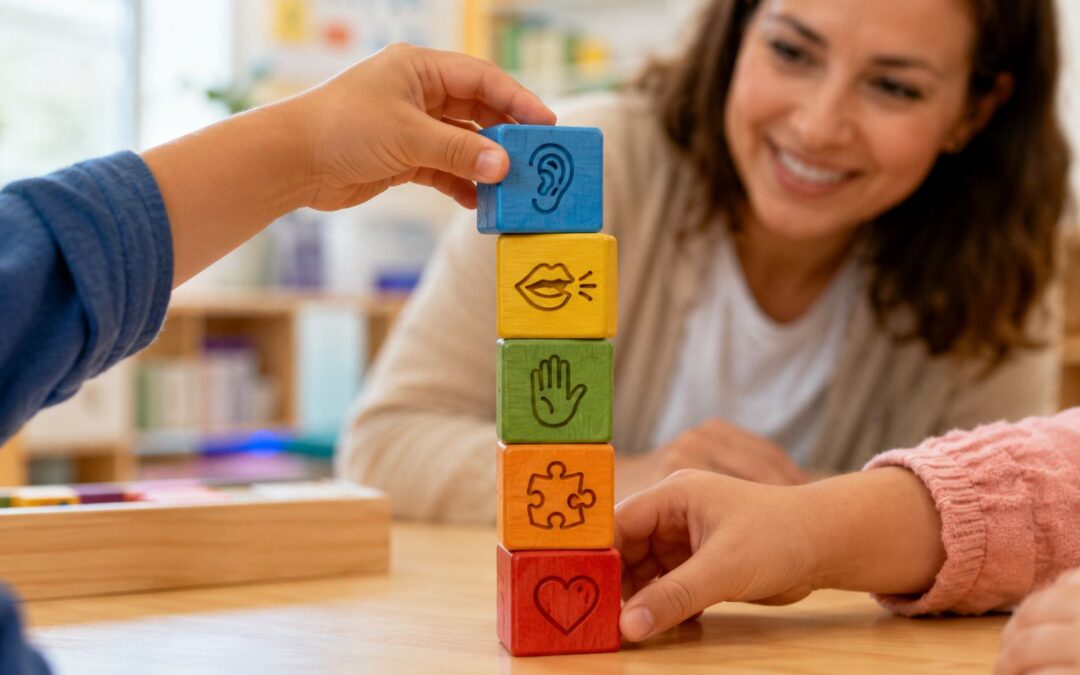
The Five Pillars of Youth Communication
When adults say a child “needs better communication,” that can feel too broad to teach. It helps to break communication into five parts that kids can practice one at a time.
A useful starting point is this: many children feel stronger in private conversation than in more formal speaking situations. A 2025 Literacy Trust report found that over 81% of young people believe they are good listeners in private, yet they feel substantially less competent in formal or public-speaking contexts, according to the Literacy Trust's 2025 speaking and listening report. That gap matters. A child may seem socially capable at home or with a friend, then freeze during class discussion, group work, or conflict.
Active Listening
Think of active listening as being a thought detective. The child's job isn't just to hear words. It's to notice meaning.
A teacher might say, “Tell me what your partner is worried about before you answer.” A parent might ask, “What do you think your brother wanted when he grabbed the marker?” Those questions slow kids down and teach perspective-taking.
Signs a child is practicing active listening include:
Looking toward the speaker: Not perfect eye contact every second, but clear attention.
Responding to the idea: “So you wanted a turn” instead of changing the subject.
Asking a follow-up: “Did that happen at recess or in class?”
Clear Expression
This is the pillar many adults focus on first. Kids need simple, direct language for thoughts, feelings, and needs.
Instead of “Use your words,” try more specific coaching:
For feelings: “Say, ‘I'm frustrated.’”
For needs: “Say, ‘I need space.’”
For help: “Say, ‘Can you explain that again?’”
Clear expression isn't about sounding fancy. It's about being understandable. If a second grader says, “I don't like it when you laugh when I'm talking,” that's successful communication.
Nonverbal Cues
Children communicate long before they finish a sentence. Their shoulders, face, voice, and distance from others all send messages.
A child may say “I'm fine” while crossing their arms, looking down, and using a sharp tone. That's why adults need to teach kids to read nonverbal information and to notice their own signals too.
Practical rule: If the words and the body don't match, pause and help the child name both.
You might say, “Your words say you're okay, but your face looks upset. Want help finding the words?”
Conversational Flow
Conversation is a rhythm. Kids have to learn when to start, when to pause, when to ask a question, and how to stay connected.
This includes:
Taking turns
Not interrupting
Adding on-topic comments
Ending a conversation kindly
A common home example is the child who blurts into an adult conversation. A common classroom example is the student who gives a strong idea but doesn't respond to anyone else's idea. Both children need practice with flow, not punishment for “being rude.”
Conflict Language
This pillar is often skipped, but it's the one many children need most. Conflict language means knowing how to disagree, protest, set a boundary, and stay respectful at the same time.
Useful phrases include:
“I see it differently.”
“Please stop. I don't like that.”
“I'm upset, and I need a minute.”
“Can we solve this another way?”
When kids build all five pillars together, communication becomes more balanced. They don't just talk more. They understand more, express more clearly, and recover from hard moments faster.
Communication Milestones for Grades K-8
Children don't all develop at the same pace, but there are patterns adults can watch for. The most helpful way to think about milestones is not “Can this child talk a lot?” but “Can this child listen, express, connect, and repair?”
Daily practice matters. Developmental research shows that children who participate in daily practice conversations, where adults ask specific questions and role-play scenarios, demonstrate 35% higher proficiency in active listening and emotional regulation than peers, as described in the Virtual Lab School's communication and language development lesson. That's one reason brief, steady routines work better than occasional lectures.
For readers who want a broader SEL foundation behind these communication milestones, this overview of social emotional development in children helps connect language growth with self-awareness and relationships.
Communication Skill Milestones and Support Strategies
Age Group
Key Communication Milestones
Teacher & Parent Prompts
K-2
Takes turns in simple conversations. Names basic feelings. Retells short events in order. Begins noticing facial expressions and tone. Needs support waiting, interrupting respectfully, and using words during frustration.
“What happened first?” “Show me your calm voice.” “Tell your friend what you need.” “What do you think their face is saying?”
3-5
Explains ideas with more detail. Asks clarifying questions. Starts adjusting language for peers and adults. Can describe a problem but may still blame, overtalk, or shut down during conflict.
“Say the problem in one sentence.” “What's your reason?” “What could you ask instead of assume?” “Can you tell that story in order?”
6-8
Tracks longer conversations. Notices subtext, mixed feelings, and social nuance. Can disagree more thoughtfully when coached. May struggle with sarcasm, peer pressure, embarrassment, or public speaking.
“What message do you want them to hear?” “What's the respectful disagreement?” “Can you summarize their point before yours?” “How could you say that in a stronger, calmer way?”
What adults often misread
A quiet child isn't always a strong listener. Sometimes they're confused or anxious.
A talkative child isn't always a strong communicator. Sometimes they're speaking quickly because they don't yet know how to organize a thought or tolerate pause.
That's why prompts matter so much. Specific prompts give kids a ladder to climb. “How was school?” often gets nothing. “Who did you sit with at lunch, and what did you talk about?” gives a child something concrete to answer.
Easy daily practice conversations
Try one of these during a car ride, transition, or closing circle:
Best part and hard part: “What was the best part of your day? What was the hardest?”
Retell with detail: “Tell me what happened from the beginning.”
Perspective switch: “How do you think the other person saw it?”
Rehearsal for later: “If that happens again, what could you say?”
These moments don't need to be long. They need to be consistent and specific. That's what helps communication skills for kids move from theory into habit.
Activities to Build Active Listening and Clear Expression
Children build communication through doing. A worksheet can support the process, but it can't replace live interaction. Kids need chances to listen, guess, retell, organize, clarify, and try again.
Giving children a conversation structure helps. One simple frame is PREP — Point, Reason, Example, Point — which gives a child a shape to fall back on when they are flustered. In practice, that means structure helps children think under stress.
If you want one activity focused especially on hearing and reflecting meaning, this active listening activity for students pairs well with the games below.
Feelings Charades
A parent writes simple emotions on scraps of paper: frustrated, proud, disappointed, excited, worried. A child picks one and acts it out without speaking. Everyone else guesses the feeling and explains which clues helped.
This works because it makes invisible emotions visible. Kids start noticing clenched jaws, slumped shoulders, quick breathing, and bright eyes. After the guess, ask, “What words might go with that face and body?” A child acting frustrated might practice saying, “I need help,” or “This is harder than I expected.”
A classroom version works well during morning meeting. Students can act out a feeling and classmates can respond with one supportive sentence.
One-Minute Storyteller
Choose a familiar topic such as recess, a soccer game, a science experiment, or losing a tooth. The child gets one minute to tell the story clearly.
Then the adult asks three questions:
What was your main point?
What detail helped me picture it?
What could you say more clearly next time?
This game teaches children that a good story needs sequence and focus. If the child starts everywhere at once, help them reset: “Start with where you were. Then tell me what happened. Then tell me why it mattered.”
Barrier Game
Place a few blocks, crayons, or shapes between two children with a small divider so they can't see each other's materials. One child gives directions. The other has to recreate the arrangement by listening only.
This game quickly reveals vague language. “Put it over there” doesn't work. “Place the red block next to the blue one” works better.
Good communication gets more precise when the listener can't rely on guessing.
After a round, ask, “What helped?” Kids often discover that slower speech, specific words, and checking for understanding make a huge difference.
Story Chain
One child begins with a sentence such as, “The dog ran into the library.” The next child adds a sentence that fits. The story continues around the circle.
This game rewards listening because each new sentence has to connect to the last one. It also helps impulsive children practice waiting and helps hesitant children contribute in manageable pieces.
Try these sentence supports if kids get stuck:
“Then the character decided…”
“But there was a problem…”
“So they asked…”
PREP for kids
PREP sounds formal, but it's simple when taught with kid-friendly language:
Point: “I think we should line up again.”
Reason: “Because people were pushing.”
Example: “A few kids got bumped near the door.”
Point: “So I think we should try it more calmly.”
This is especially useful when children feel emotional and their thoughts scatter. A teacher can write PREP on the board. A parent can hold up four fingers and coach one part at a time.
A child arguing over game rules might say:
“I think we need a new turn.”
“Because the rule wasn't clear.”
“You went twice when I thought it was my turn.”
“So let's restart that round.”
These activities don't require expensive materials. They require repetition, warmth, and specific coaching. That's how communication skills for kids become stronger in both the classroom and the living room.
Teaching Kids How to Talk Through Disagreements
Many children can greet politely, answer questions, and share a story. Then conflict appears, and their language disappears. That's not a character flaw. It's a stress response.
Research from the education sector shows a significant gap in structured support for children who struggle with communication during conflict, with many SEL programs offering too little practical guidance for verbalizing disagreement without aggression, as discussed in this article on helping children build strong communication skills.
That gap shows up everywhere. A student says, “He's being mean,” but can't explain what happened. A child screams “Stop!” then hits. An older student knows they disagree but only has two settings: silence or sarcasm. Kids need actual scripts.
Children do better in conflict when adults reduce language demands. A simple sentence frame gives them something stable to hold.
Try this pattern:
I feel _____ when _____ because _____. I need _____ .
Examples:
“I feel frustrated when you interrupt because I lose my turn. I need you to wait.”
“I feel left out when you change the game without me because I don't know the rules. I need you to explain.”
“I feel angry when you grab my pencil because I'm still using it. I need you to ask first.”
This isn't robotic. It's training wheels.
Teach the difference between aggression and assertiveness
Many children think strong words are rude. Others think loud words are strong. Neither is true.
Use this quick comparison:
Style
What it sounds like
Passive
“It's fine.”
Aggressive
“You're so annoying. Stop it.”
Assertive
“Stop. I don't like that.”
Assertive language is direct, respectful, and clear. It doesn't attack the person. It names the problem and the boundary.
Give kids exact phrases for common conflicts
Children need short scripts they can remember in the moment.
For interruption:
“I'm still talking.”
“Please wait. You can go next.”
For unwanted behavior:
“Stop. I don't like that.”
“Don't touch my things.”
For disagreement:
“I see it differently.”
“I disagree, and here's why.”
For escalation:
“I'm too upset to solve this right now.”
“I need a minute, then I can talk.”
Adults often tell kids to “use your words” without first giving them the words.
Role-play the hard part
Children rarely access new language for the first time in a heated moment. Practice has to happen before the next conflict.
Try a quick role-play:
Adult plays the annoying classmate or sibling.
Child practices one assertive sentence.
Adult responds appropriately.
Child repeats with stronger posture and calmer tone.
Reverse roles too. Let the child play the upset one while you model the words. This lowers pressure and helps them hear what effective conflict language sounds like.
A short video can help adults hear how conflict language can be modeled in a calm, teachable way.
Sample wording you can lift into your own form
Here's a simple version that works in both classrooms and homes.
Section
Sample prompt
Situation
“What happened?”
Trigger
“What happened right before that?”
Feelings
“What were you feeling in your body and mind?”
Impact
“How did your choice affect you and other people?”
Better choice
“What could you do next time in a similar moment?”
Repair
“What needs to happen to make this right?”
The best custom forms sound like the adults who use them. If your classroom language includes “reset,” “repair,” or “rejoin,” use those words. If your family says “take space” or “start over,” build that in. A behavior think sheet works better when it matches the culture around it.
A Guide to Using Think Sheets Effectively
The form itself matters less than the way you introduce and use it. A behavior think sheet should never be thrust into a child's hands in the heat of conflict with, “Fill this out because you made bad choices.” That turns reflection into compliance.
A more effective approach starts with regulation. The child needs enough distance from the incident to think, speak, and write with some clarity.
Use a calm space and clear language
Centervention notes that the behavior think sheet should be used in a designated Cool Down Corner away from other students, and that the teacher should explain the problem explicitly. Their example is direct and specific: after an outburst, the teacher says, “You yelled when Jamie asked for help,” then gives the student 10 minutes for reflection before reviewing the sheet together in a joint conversation, as described in this behavior reflection exercise.
That example captures two things teachers often miss. First, privacy matters. Students rarely reflect well when peers are watching. Second, the adult should describe the behavior, not label the child.
A useful script sounds like this:
“I can see you're upset. We're going to step over here, get settled, and use the sheet to figure out what happened.”
That kind of language lowers the temperature. It also keeps the adult in a coaching role.
Don't skip the scheduled follow-up
The strongest implementation isn't random. Reflection should happen intentionally. One practical model is to set a specific date and time for the conversation, then return to the incident with purpose. WhyLiveSchool gives the example of a student who disrupts math on Monday, then completes the reflection on Tuesday at 9:00 AM, with guidance to examine whether the behavior came from peer pressure or lack of understanding and to list three better choices for next time in this think sheet planning example.
That structure helps adults avoid two common mistakes: trying to force deep reflection too early, and forgetting to follow up at all.
If a student often needs a pause before they can reflect, break cards for students can support the front end of the process.
What works and what backfires
Some implementation choices consistently help. Others gradually ruin the tool.
What works
Neutral tone: “Tell me what was happening before this.”
Shared review: Adult and child read the sheet together.
Specific repair: “Check in with Marcus and help rebuild the block tower.”
Short revisit later: “How did your plan work during centers today?”
What backfires
Public completion: A child writing while classmates stare.
Lecture on top of the form: The adult talks through the whole reflection.
Using it for every minor issue: The process becomes noise.
Treating it as proof: “I need this in writing so your parent sees what you did.”
A think sheet is a catalyst for dialogue. If the conversation never happens, the sheet did only half its job.
Adapting Think Sheets for Different Ages and Settings
A first grader, a fifth grader, and a seventh grader don't need the same behavior think sheet. Their language is different, their self-awareness is different, and their reasons for acting out are often different too. The format should change with them.
That doesn't mean creating an entirely new system for every age. It means adjusting the prompts, level of support, and adult role so the reflection feels doable.
Think Sheet Adaptations by Age Group
Age Group
Focus
Sample Prompt
Adult Role
K-2
Naming feelings and simple cause-and-effect
“What happened?” “How did you feel?” “Draw a better choice.”
Sit beside the child, read questions aloud, scribe or invite drawing
3-5
Triggers, impact, and repair
“What happened right before the problem?” “Who was affected?” “What can you do next time?”
Prompt with follow-up questions, help connect behavior to class expectations
6-8
Perspective-taking, peer influence, and planning
“What were you thinking at the time?” “Did pressure from others affect your choice?” “What's your plan if this happens again?”
Facilitate discussion, challenge vague answers, support realistic action steps
Home use
Family rules, sibling conflict, and repair routines
“What happened in our family space?” “What do you need to make it right?”
Keep tone calm, revisit later, focus on re-entry into family routines
What adaptation looks like in practice
With younger children, less writing usually gets better results. A kindergartener who shoved during line-up may circle a feeling face, draw the moment, and practice a replacement phrase such as “Can I have space?” That's enough. You're building emotional vocabulary and pattern recognition.
Upper elementary students can handle more sequence. If a fourth grader tears up a worksheet after getting corrected, they can usually identify the event before the behavior, their emotional reaction, and the effect on the room. This age group often benefits from prompts that separate accident from intention.
Middle school students need dignity. A childish-looking sheet can create instant resistance. Give them prompts that respect complexity. A student who joins in on teasing may need to reflect on status, embarrassment, or peer alignment. The question isn't only “What did you do?” It's also “What were you trying to avoid?”
Older students usually open up more when the form sounds reflective, not juvenile.
Think sheets work better inside a larger system
A think sheet shouldn't carry your whole behavior system by itself. The strongest use is inside a broader routine that includes relationship-building, reteaching expectations, calm spaces, and proactive supports.
That's where complementary tools matter. A 2012 study by Sims at Northwest Missouri State University found that using target sheets alongside behavior think sheets significantly reduced both the number of think sheets issued and inappropriate classroom behaviors. That's a practical reminder that reflection works best when students also have tools for preventing the same pattern from repeating.
At home, adaptation matters just as much. Families already know that routines must match development. The same way parents adjust bedtime expectations across different baby sleep routines, reflection tools should change as children grow. A preschool-style prompt won't fit a middle school conflict, and a dense middle school form will overwhelm a younger child.
Troubleshooting Common Challenges and Measuring Success
Even a thoughtful behavior think sheet can flop if the child feels cornered, tired, embarrassed, or mistrustful. That doesn't mean the tool is wrong. It usually means the process needs adjustment.
Common problems and better responses
The child refuses to write
Try this: Offer choices. “You can write, draw, or tell me and I'll scribe.”
Avoid this: “You're not leaving until it's finished.” That turns reflection into a standoff.
The child gives one-word answers
Try this: Ask narrower follow-ups such as, “What happened right before that?” or “Which feeling fits best, angry, worried, embarrassed, or left out?”
Avoid this: Repeating the same broad question louder.
The sheet feels like punishment
Try this: Change your entry language. “This helps us understand and make a plan.”
Avoid this: Assigning it publicly or attaching it to shame.
Nothing seems to change right away
Try this: Look for smaller signs of growth. Faster recovery. Better feeling words. More honest reflection. A stronger repair attempt.
For adults who coach children in sports or other performance settings, this guide for sports coaches and parents offers useful ideas about giving corrective feedback without damaging connection. The same principle applies here. Children listen better when feedback is specific, calm, and future-focused.
What success actually looks like
Success doesn't mean behavior problems vanish overnight. It means the child gets better at catching the moment earlier. They begin to say, “I was frustrated,” instead of exploding with no words at all. They start recognizing triggers. They accept repair more readily. They need fewer adult guesses because they can explain themselves more clearly.
That's the long game. A behavior think sheet earns its place when it helps children build emotional insight, not when it produces a perfect form.
If you want practical SEL tools that help students, educators, and families build empathy, repair conflict, and create safer school communities, explore Soul Shoppe. Their programs, workshops, and resources are designed to turn skills like reflection, communication, and self-regulation into everyday practice.
Building a Toolbox for Big Feelings: A Guide for Educators and Families
You've probably seen the moment already today. A student shuts down after a hard math page. Two children argue over a game at recess and one bursts into tears. A child who looked fine at breakfast suddenly says they can't go into school. Big feelings don't wait for the perfect lesson block, and that's exactly why a strong coping toolkit matters.
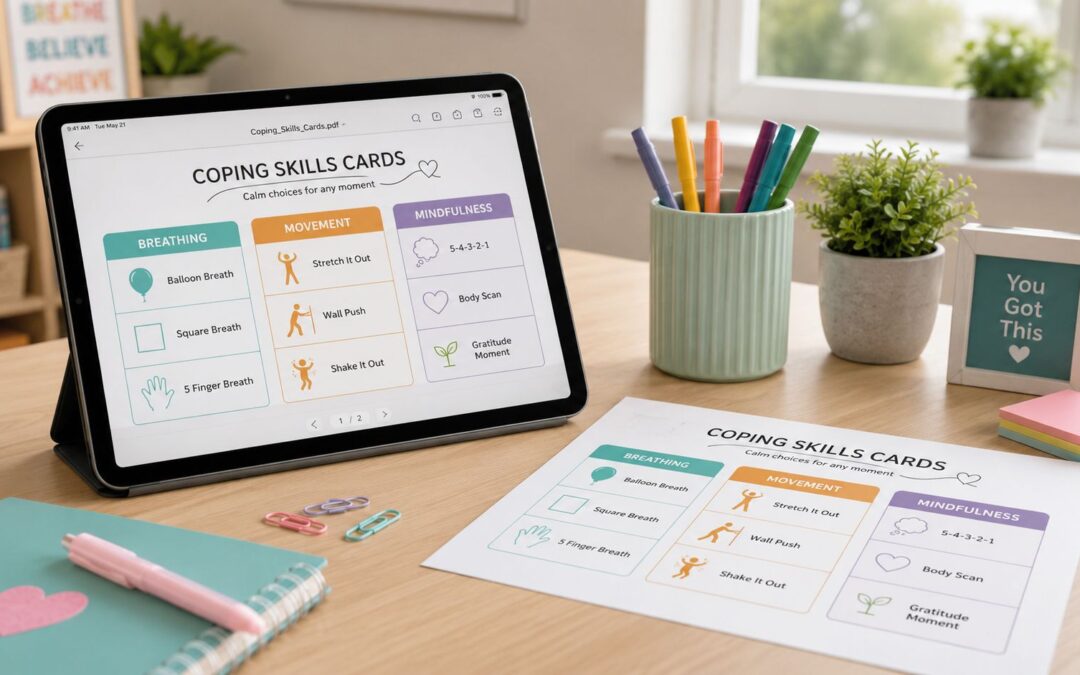
A good list of coping skills PDF gives kids something concrete to reach for when words are hard to find. It also helps adults teach emotional regulation in small, repeatable ways. One longitudinal study of more than 1,500 university students found that using a wider range of coping strategies was linked with better adjustment, and students who used 10 or more distinct strategies showed a 35% higher rate of successful adjustment than those using fewer than 5, according to the coping diversity study published in PMC. The takeaway for K-8 settings is simple. Kids need more than one calming trick.
That's where printable tools shine. A poster near the calm corner, a short handout in a family newsletter, or a small-group worksheet can turn abstract SEL language into something students can practice. The list below focuses on resources you can print, teach, and adapt right away for classrooms, counseling spaces, and home routines.
1. Tools Of The Heart Online Course
If you're not looking for one more disconnected handout, Tools Of The Heart Online Course deserves the featured spot. It's built for adults who want children to learn coping skills in context, with shared language, routines, and relationship repair woven into everyday school life.
Soul Shoppe's approach stands out because it doesn't treat self-regulation as an isolated intervention. The course is grounded in more than 20 years of school-based SEL practice and focuses on teachable habits like mindfulness, compassionate communication, self-awareness, and conflict resolution. That matters when you want the classroom teacher, counselor, recess aide, and caregiver all using the same language.
Best Use Case
This is the strongest fit for schools that want campus-wide consistency, and for families who want more than a static list of coping skills PDF. It works especially well when a principal or SEL lead wants common routines such as breathing, noticing feelings, repair conversations, and peer support woven across grade levels.
A practical example: a second-grade team can teach a short morning regulation routine, while a middle school advisory group uses the same language during peer conflict. At home, caregivers can reinforce the same reset steps before homework or bedtime.
Practical rule: Use this course when your challenge isn't access to coping ideas. It's consistency, adult modeling, and shared language.
What Educators Will Appreciate
Schoolwide language: Students hear the same phrases across classrooms, support staff, and family communication.
Flexible delivery: Teachers, counselors, and caregivers can learn on their own schedule.
Better implementation path: The course connects naturally with Soul Shoppe's workshops, assemblies, coaching, app support, and community programming.
There are a couple tradeoffs. The public page doesn't show a detailed syllabus or sample lessons, so some teams will want a closer look before committing. It also works best when adults practice the routines regularly. Like any SEL training, it builds capacity, but it doesn't replace clinical mental health support for students who need it.
For K-2, keep the language concrete. “Smell the flower, blow out the candle” works better than “activate self-regulation.” For grades 3-5, add reflection prompts like “What helped your body feel safe again?” For middle school, connect coping to belonging, conflict repair, and self-advocacy.
2. Therapist Aid, Coping Skills Worksheets
Therapist Aid coping skills worksheets are some of the easiest print-and-go materials for educators who want clean, professional PDFs. The library includes general coping sheets plus more targeted topics like anxiety, triggers, healthy versus unhealthy coping, and DBT-style tools.
This option is strongest for upper elementary and middle school students who can handle more clinical language. Many worksheets are fillable, which makes them useful for counseling sessions, check-in/check-out folders, and student support plans.
Where It Fits Best
Use Therapist Aid when you need structure, not decoration. A school counselor might hand a coping skills worksheet to a fifth grader who keeps saying “nothing works,” then help the student sort strategies into categories like body, mind, and connection.
Best for small groups: Students can circle three coping skills they'll try this week and reflect on which one helped most.
Best for student folders: Keep a printed page in a binder for quick access during stressful parts of the day.
Best for older students: The language is usually clearer for grades 4-8 than for kindergarten or first grade.
One limitation is tone. Some sheets feel written for therapy settings first, schools second. For younger children, you'll likely need to simplify wording and pair the worksheet with modeling.
A classroom example: turn a dense coping list into a choice board. Instead of asking, “Which strategy will you use?” ask, “Do you want a body break, a quiet activity, or someone to talk to?” That simple shift helps students choose faster.
3. Akron Children's Hospital, 99 Healthy Coping Skills PDF
If you want one sheet you can print in under a minute and use all week, the Akron Children's Hospital 99 Healthy Coping Skills PDF is a strong pick. It's a single-page list packed with concrete ideas across movement, creativity, sensory input, breathing, and connection.
This is the kind of list of coping skills PDF that works well when students freeze and say, “I don't know what to do.” The options are short, scan-friendly, and easy to highlight.
Best Use in a School Day
A teacher can post it in a calm corner and ask students to choose one strategy before returning to work. A counselor can send it home with three items already starred so caregivers know what the child has practiced at school.
Keep this one visible, but don't stop at visibility. Have students rehearse two or three favorites when they're calm, not just when they're upset.
A practical example for grades 1-3: ask students to use colored dots. Green means “I can do this by myself,” yellow means “I need an adult to remind me,” and red means “this one isn't for me.” For grades 4-8, have students build a “top five for school” and a separate “top five for home.”
The downside is that it isn't differentiated by age. Some items will fit an eight-year-old better than a kindergartner, and some will need adult judgment based on setting. It's also a list, not a lesson sequence, so it works best when paired with direct teaching.
4. Children's Healthcare of Atlanta Strong4Life, Coping Skills Tip Sheets
The Strong4Life coping skills tip sheets from Children's Healthcare of Atlanta do something many printable resources miss. They teach the skill, not just the name of the skill. You'll find handouts on grounding, journaling, progressive muscle relaxation, and other concrete techniques, with English and Spanish options for broader family access.
That bilingual availability makes these handouts especially useful for family newsletters, parent nights, and district resource hubs. They're also friendly enough to send home without a long explanation.
Why the How-To Matters
A lot of children can name a coping strategy but can't apply it when stress spikes. Recent concerns in SEL materials often come back to a simple issue. Lists name too many ideas without showing students when or how to use them. That's why Strong4Life's step-by-step style helps.
For example, instead of telling a student to “ground yourself,” you can print a handout, practice it during morning meeting, then rehearse the same sequence before a test. In a family setting, a caregiver can keep one page on the fridge and walk through it after a rough sibling conflict.
For K-2: Turn one tip sheet into a picture-supported mini-lesson with gestures.
For grades 3-5: Have students annotate the sheet with “when I could use this.”
For middle school: Ask students to rate which steps feel realistic in class versus at home.
The only inconvenience is navigation. The materials live across several pages, so gathering a full set takes a few extra clicks. Some handouts also lean toward parent coaching, which means teachers may want to trim or adapt the wording for classroom use.
Visual learners often need more than a text-heavy handout. Sanford Fit's Kids' Coping Strategies Poster Packs give you colorful, classroom-ready supports that teach breathing, mindfulness, grounding, and positive self-talk in a format young children can use.
These packs shine in elementary settings, especially calm corners, counseling offices, and transition spaces. Spanish versions add flexibility for schoolwide use.
Best for Calm Corners and Routines
This resource works well when you want coping practice to feel normal, not remedial. A poster by the classroom door can cue a reset before rejoining group work. A set of Mindful Moments cards can become part of your post-recess routine.
One reason multisensory strategies matter is that cues tied to sensory anchors can be more effective in moments of acute stress. Guidance linked through the NIMH Bookshelf overview on relaxation and stress reduction supports the value of body-based, sensory-grounded calming techniques, which is exactly the kind of thing these posters make easy to teach.
A pinwheel, bubble breath visual, or tracing card often works faster with younger students than a verbal reminder to “calm down.”
A practical example: in kindergarten, let students point to a breathing card instead of explaining their feeling. In fourth grade, add a reflection strip that says, “What changed in my body after one minute?” That turns a poster into a habit.
This set is primarily elementary-focused. Middle school students may find the design too young unless you select the more neutral visuals and pair them with advisory discussion.
6. Boys Town, 50 Coping Skills for Children
The Boys Town 50 Coping Skills for Children PDF is concise, positive, and easy to share. If you need a handout for planners, family packets, or student support binders, this one is straightforward and practical.
Boys Town also pairs the list with coping toolbox guidance for caregivers, which makes it stronger than a list that stops at “try these.” The tone is especially parent-friendly.
Best for Family Communication
This is one of the easiest resources to send home because it doesn't feel clinical. A school can include it in a beginning-of-year SEL packet, or a teacher can laminate it for students who need quick prompts during the day.
Here's a simple home-school example. A child circles three school-friendly skills such as drawing, taking deep breaths, or asking for a break. At home, the caregiver circles three evening-friendly skills such as listening to music, talking, or taking a quiet reset. The overlap becomes that child's core coping set.
Use in planners: Tape a reduced-size copy inside the cover.
Use in newsletters: Highlight one “family skill of the week.”
Use in conferences: Ask adults and children to each pick the same two strategies they'll reinforce.
The limitation is depth. It doesn't segment skills by setting or provide much instruction on how to teach them. For that reason, it's best as a companion handout after you've modeled the strategies.
7. PESI Publishing, Free Coping Skills for Kids PDF Sampler
If you want materials that feel kid-centered right away, the PESI Publishing coping skills PDF sampler is worth a look. It includes a printable checklist, calming strategy pages, coping menus, and planning templates designed for ages 4 to 12.
The sampler format is useful when you're deciding whether a larger workbook would fit your setting. You can test the tone, visuals, and student response before buying anything else.
Best for Personalizing a Student Plan
This resource is a nice fit for calm-down kits and individual coping menus. A student can sort options into “works at school,” “works at home,” and “I want to try this with help.”
The personalization piece matters because broad lists can overwhelm children. The ISSUP compilation of 117 healthy coping skills shows the value of concrete, measurable actions such as going for a brisk 10-minute walk or doing a counted routine. That same principle applies here. Students usually do better when the strategy is specific and doable.
For example, don't just hand over a menu and say “pick one.” Try this instead:
For younger students: “Choose one quiet hand activity and one breathing activity.”
For grades 3-5: “Pick two strategies you can do in under five minutes.”
For older elementary and middle school students: “Pick one strategy for frustration and one for social stress.”
The drawback is that it's only a sampler and the landing page includes marketing elements. Still, for many teachers and counselors, the free pages are enough to pilot routines before expanding.
8. Centervention, Coping Skills and Emotional Regulation Worksheets
Centervention coping skills and emotional regulation worksheets are built with school use in mind. That shows up in the grade-banded materials, facilitation notes, and practical focus on skills like square breathing, grounding, and evaluating whether a strategy helped.
If you run Tier 1 lessons, small groups, or Tier 2 check-ins, this resource is one of the most classroom-oriented options on the list.
Best for Small Group Practice
Centervention works well when students need guided repetition. A counselor can teach 5-4-3-2-1 grounding to a small group, then send each student back with a matching worksheet and cue card for class.
A practical example for grade bands:
Elementary: Use one body-based worksheet per week and practice it before transitions.
Upper elementary: Add a reflection prompt such as “What problem was my body trying to solve?”
Middle school: Compare short-term calming skills with longer-term coping plans.
This grade-band distinction matters because many generic PDFs don't clearly separate immediate regulation from later problem-solving. In practice, students often need to calm their bodies first and think later. Centervention's materials lend themselves to that sequence better than a simple all-purpose list.
There's some extra navigation on a few downloads, and the visual style varies across resources. Even so, the ease of facilitation makes this a strong option for educators who want more than a poster.
9. Child Mind Institute, Managing Intense Emotions for Kids
Some resources are better at coaching adults than listing student strategies. Child Mind Institute's managing intense emotions guides are strong because they help caregivers and educators understand what to do before, during, and after a child is dysregulated.
The printable activity sheets support grounding, co-regulation, and calm-time practice. That makes this a good bridge between home and school.
Best for Home-School Alignment
Use these guides when a child's coping skills break down across settings. A student may use a breathing tool successfully in the counselor's office but forget it during lunch conflict or at bedtime. Adult coaching helps close that gap.
Children often need a calm adult, a practiced script, and a familiar cue before they can use a coping skill independently.
A practical example: send one printable sheet home after a support meeting and ask the family to practice it at a neutral time, not during a meltdown. Then have the teacher use the same language in class. “Hands on belly, slow exhale, name one thing you see” works better when children hear it in both places.
The tradeoff is format. These are guide-first resources, so if you want a standalone list of coping skills PDF, you may need to pull out the printable parts yourself. Still, for students who need co-regulation and consistency, that extra context is often what makes the strategy stick.
10. National Child Traumatic Stress Network, Coping Fact Sheets
The National Child Traumatic Stress Network coping fact sheets are especially useful when schools need trauma-informed family support. These handouts are more text-heavy than a poster pack, but they bring credibility and a steady tone that works well in difficult seasons.
They're a smart choice for district family resource pages, re-entry packets, crisis response communication, and parent education events.
Best for District and Family Support
Use NCTSN when the message needs to be calm, trustworthy, and broad enough for many situations. Parent and youth versions support whole-family learning, which is helpful when stress affects routines at school and at home.
A practical school example: after a community stressor, a principal can send the parent fact sheet with one short note from the school counselor explaining which two coping routines teachers will also use in class. That creates continuity without overwhelming families.
For younger grades: Pull out two or three strategies and turn them into visuals.
For upper grades: Use the handout during advisory or counseling check-ins.
For caregivers: Highlight one section and invite them to practice it during a calm moment.
The main limitation is readability for younger children. The language is stronger for adults and older students than for primary classrooms, so teachers will often need to adapt it into simpler scripts or visuals.
Top 10 Coping Skills PDF Resources Comparison
Resource
Core features
Target audience / setting
Unique selling point
Format & cost
Tools Of The Heart Online Course (Soul Shoppe)
Research-based SEL course; scaffolded tools for self-regulation, mindfulness, compassionate communication
High authority on child trauma; suitable for district-wide distribution
Printable fact sheets (PDF); free
Putting Your Coping Skills PDFs into Practice
A PDF is a starting point, not a destination. Students don't build regulation skills by glancing at a poster once. They build them by practicing when they're calm, hearing the same language from trusted adults, and using simple routines often enough that those routines become familiar.
That's why the best list of coping skills PDF is the one you teach. Print fewer pages and use them more consistently. A single breathing card, a short menu of body-based options, and one reflection routine can do more for a classroom than a giant binder nobody opens.
Here are practical ways to make these resources work in real life:
Build a personal calm-down kit: Let students choose three printed tools and three physical items, such as a breathing card, a coping menu, paper for drawing, a sensory object, and a visual timer.
Teach in calm moments: Introduce one skill during morning meeting, advisory, or counseling group before students need it under pressure.
Use scenario practice: Role-play common moments like losing a game, feeling stuck on homework, or getting corrected in front of peers.
Match the skill to the setting: A child may use wall pushes at school, journaling at home, and a help script in the hallway.
Model it yourself: Teachers and caregivers can say, “I'm frustrated, so I'm taking one slow breath before I answer.”
One common mistake is treating all coping skills as interchangeable. They aren't. Some help a child calm their body right now. Others help them reflect, reconnect, or solve a problem later. When you organize your resources that way, students start to understand when to use which tool.
It also helps to prepare your files before sharing them. If you send home handouts or post them online, you may want to remove PDF metadata on Mac and Windows so family-facing documents stay tidy and privacy-conscious.
If you're leading a school or district, think beyond isolated downloads. The strongest results usually come from a shared SEL language across classrooms, counseling spaces, and homes. That's where Soul Shoppe can help. Their programs support the shift from individual coping strategies to a wider culture of belonging, empathy, conflict repair, and emotional safety. When adults across a campus use the same language and routines, students don't just manage stress more effectively. They feel more connected, more capable, and more ready to learn.
If you want more than a printable list and you're ready to build a shared SEL culture, explore Soul Shoppe. Their school and family programs help children and adults practice self-regulation, mindfulness, communication, and conflict resolution in ways that fit real classrooms and real relationships.
A second grader is crying because a partner grabbed the markers. A fourth grader gives up during math after one wrong answer. At home, a child says “fine” through clenched teeth, then falls apart over homework five minutes later. Adults can usually spot the feeling before the child can name it. The harder part is knowing what to teach in that moment, and what to practice later so the next moment goes better.
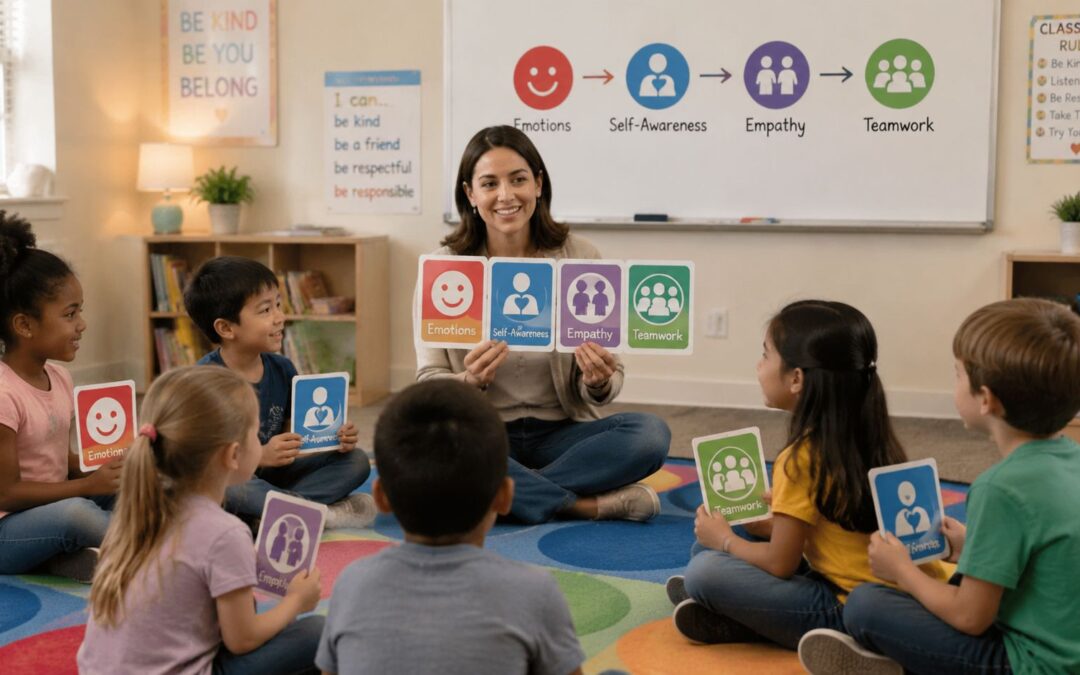
Strong SEL in elementary school grows through routines children can repeat, language they can use, and practice during calm parts of the day. Posters, one-off lessons, and vague reminders to “use your words” rarely hold up when a child is frustrated, embarrassed, left out, or overwhelmed. Kids need skills taught the same way we teach reading or math. Brief modeling. Clear scripts. Guided practice. A chance to try again.
That is the approach in this guide. Each strategy is set up as a mini lesson plan you can use right away, with sample teacher language, differentiation ideas, simple ways to check whether the skill is sticking, and home-connection activities that help families carry the same language across settings. The goal is not to add one more program to an already full day. The goal is to give teachers and parents a practical toolkit for ordinary moments, because ordinary moments are where SEL habits are built.
Some strategies will click quickly. Others take longer, especially for children with limited language, sensory needs, trauma histories, or big stress outside school. Start small and stay consistent. If you want one simple practice to begin with, a kid-friendly belly breathing routine for elementary students is an easy entry point. Use what fits your classroom, your child, and the moment in front of you.
1. Mindfulness and Deep Breathing Techniques
The fastest way to lose kids with mindfulness is to make it too long, too abstract, or too quiet. Elementary students usually do better with brief, concrete practice they can feel in their bodies. Start with one minute. Keep both feet on the floor or let kids sit on a carpet square.
A simple script works well: “Put one hand on your belly. Smell the flower through your nose. Blow out the candle through your mouth.” For younger students, use props like a pinwheel, a Hoberman sphere, or even an imaginary birthday cake. For older elementary students, name the purpose clearly: “We're slowing our bodies down so our brains can think.”
Mini lesson plan
Teach during a calm part of the day, not right after a conflict. Try this sequence:
Teacher prompt: “Let's practice belly breathing before we need it.”
Model first: Take one exaggerated breath so students can see your shoulders stay soft and your belly expand.
Student practice: Three slow rounds together.
Reflection question: “Did your body feel faster, slower, or the same?”
If you want a kid-friendly variation, this belly breathing technique gives teachers and families another easy routine to reinforce.
Practical rule: Don't ask a dysregulated child to “go be mindful” alone if they haven't practiced the skill with support first.
Assessment should stay simple. Notice whether students can begin the breathing cue within a few seconds, whether they need visual modeling, and whether they return to task more smoothly afterward. You're looking for growing independence, not perfection.
Some children won't like closing their eyes or sitting still. That's fine. Let them stare at a spot on the wall, trace a finger, squeeze a fidget, or breathe while standing. Neurodivergent students often respond better when breathing is paired with rhythm, visuals, or sensory grounding instead of verbal processing alone. Recent analysis has also highlighted that standard SEL strategies can miss many neurodivergent learners without differentiation (EdSurge reporting on differentiated SEL).
Show students what it can look like in action:
Sixth through eighth grade with disrespect toward a teacher
A seventh grader mutters an insult when corrected in class, then knocks a notebook off the desk while leaving the room. A purely punitive response might stop there with removal and a referral.
A restorative response still takes the disruption seriously, but it also asks the student to face the human impact. Later, with an administrator present, the teacher facilitates a structured conversation.
She asks:
“What was happening for you right before the comment?”
“What impact did your words and actions have on me and the class?”
“What do you think needs to happen to make this right?”
The student admits he felt embarrassed after being corrected publicly. That doesn't excuse the behavior, but it gives the adults useful information. He apologizes to the teacher, writes a brief plan for what he'll do when he feels activated, and agrees to restore the classroom space before the next class period.
When students participate in the repair plan, they're more likely to follow through on it.
Across ages, the process changes in language and complexity, but the core remains the same. Kids tell the truth about harm, hear one another, and practice repair with adult support.
Proven Benefits for Your School Community
For school teams, the practical question isn't only what is restorative justice. It's whether the approach improves daily life for students and staff. The answer, in many schools, is yes.
Early-adopting districts that implemented restorative justice reported major reductions in suspension and expulsion rates, with some seeing up to 50% fewer exclusions within two years, and in one Chicago high school restorative circles were associated with a 40% drop in disciplinary incidents and a 25% increase in student attendance over one year, according to Edutopia's summary of restorative justice resources.
Those outcomes make sense when you look at what restorative practices build. They don't just respond to conflict. They strengthen relationships, improve communication, and give students repeated chances to practice empathy and self-regulation.
What schools tend to notice first
Often, the first visible change is a calmer tone. Students begin to expect that adults will listen, ask questions, and guide repair instead of escalating every problem into a power struggle.
Schools also report improvements in areas that matter a great deal to families and staff:
School climate: Students often feel safer and more connected when adults use consistent, relational responses.
Attendance and belonging: When children feel respected, they're more likely to want to be at school.
Social-emotional growth: Students practice perspective-taking, emotional language, and problem solving in real situations.
That connection to SEL is important. Restorative work doesn't sit off to the side from emotional development. It gives students a place to use the skills SEL tries to teach. This overview of the benefits of social-emotional learning pairs well with a restorative approach because both center belonging, self-awareness, and healthy relationships.
Schools don't become restorative because they hold a few circles. They become restorative when students trust that harm will be addressed fairly and humanely.
Your Roadmap to Introducing Restorative Practices
Many schools stall out because they try to launch everything at once. A better path is gradual, visible, and well supported.
Start with shared purpose
Before anyone runs a circle, adults need agreement on why the school is making this shift. Is the goal to reduce exclusionary discipline? Improve climate? Build stronger conflict skills? Usually it's all of the above, but leaders should say that clearly.
A small core team helps. Include an administrator, classroom teachers, counseling staff, and if possible, family voices. In K-8 settings, this team often becomes the anchor for consistency.
Train adults before expecting students to do it well
Restorative practice is not intuitive for every adult. Teachers need support with facilitation, regulation, bias awareness, and developmentally appropriate expectations.
Foundational training should help staff:
Use restorative language: Questions such as “Who was affected?” and “What needs to happen now?”
Know when not to circle up immediately: Students may need cooling-off time first.
Tell the difference between accountability and forced apology: Repair should be meaningful, not performative.
Begin with informal routines
Schools often make the work too formal too soon. Start smaller. Use restorative check-ins, affective statements, and quick problem-solving conversations in classrooms and common spaces.
Examples include:
At arrival: “What kind of day are you bringing into the room?”
After interruption: “What happened, and what do you need to rejoin well?”
After peer conflict: “How can you make this right before we move on?”
These small moves teach the language of repair before major incidents occur.
Build Tier 1 circles into the week
Community-building circles are where many schools find their footing. They help students practice listening, turn-taking, perspective-taking, and classroom belonging in low-stakes moments.
A second grade teacher might use a Monday circle prompt like, “What helps you feel included?” A middle school team might use advisory to ask, “How do you want people to treat you when you've made a mistake?”
One practical option schools sometimes use is Soul Shoppe's Student Peacemakers model, which trains students in a structured restorative process for peer conflict. That kind of peer-based support can complement adult-led circles and classroom SEL work when a campus wants students to share responsibility for repair.
Add formal responses carefully
Once adults have experience with informal practice, the school can build capacity for more formal restorative meetings. These require more preparation, clearer safety structures, and stronger facilitation.
A simple rollout sequence works well:
Assess current patterns in discipline, climate, and staff readiness.
Train all staff in common language and basic processes.
Pilot in one grade band or with one trained team.
Collect feedback from students, families, and staff.
Scale gradually with coaching and follow-up.
Leadership move: Protect time for staff reflection. Schools lose momentum when adults are expected to implement restorative practices without space to learn from mistakes.
Navigating Challenges and Measuring True Success
Restorative justice isn't a quick fix, and schools run into trouble when they treat it like one. The most common misstep is assuming it works the same way for every child and every situation.
A recent California OYCR brief found that restorative justice is less effective with younger youth and lower-level cases when schools default to it without developmental screening, and noted that practitioners have begun integrating restorative justice with SEL frameworks in the last 12 months to address that gap, as described in the California OYCR restorative justice brief. In K-8 schools, that means adults need judgment. A kindergartener who grabbed a toy may need co-regulation and direct coaching more than a formal restorative process. A middle school pattern of exclusion may need both a circle and explicit SEL instruction on empathy and group dynamics.
The challenges are real
Some staff worry restorative work takes too much time. It does take time. But unresolved conflict also takes time, often again and again.
Some adults fear it will seem soft. It isn't soft when done well. Asking a student to listen to impact, accept responsibility, and follow through on repair is demanding work.
Measure more than discipline referrals
Schools should absolutely track formal outcomes, but those numbers don't tell the whole story. True success also shows up in quieter indicators:
Belonging: Do students say they feel known and included?
Trust: Do families believe the school handles harm fairly?
Repair quality: Are agreements realistic, completed, and followed up on?
Classroom climate: Are students becoming more honest, more regulated, and more able to solve conflict with support?
The most ethical restorative schools keep asking not only, “Did behavior stop?” but also, “Did healing begin?”
If your school wants support turning restorative ideas into daily SEL practice, Soul Shoppe offers programs, workshops, and school community tools focused on connection, empathy, conflict resolution, and belonging for students and adults alike.