

K-8 Trust in Relationship: Teacher and Parent Guide

A child hovers beside your desk, paper in hand, needing help but not asking. Or your own child says, “Nothing happened,” even though you can see the broken lamp and the worried face. Most adults read these moments as behavior problems first. In practice, they’re often trust problems.
When children don’t trust the people around them, they protect themselves. They hide mistakes. They test limits. They stay quiet when they’re confused. They act “fine” while their nervous system is working overtime. In a classroom, that looks like disengagement, perfectionism, tattling, shutdown, or quick conflict. At home, it can look like denial, blame, avoidance, or big reactions to small corrections.
That matters even more right now. The share of American adults who say "people generally can be trusted" fell from 46% in 1972 to 34% in 2024, according to Pew Research Center polling on Americans’ trust in one another. Children are growing up inside that climate. They absorb the tension, the guardedness, and the habit of expecting disappointment unless adults actively teach another way.

In schools and families, trust in relationship isn’t a soft extra. It’s the condition that makes honesty, learning, repair, and belonging possible. A child who trusts you is more likely to take academic risks, tell the truth sooner, recover after conflict, and let your guidance matter. A child who doesn’t trust yet will often need safety before they can use any skill you’re trying to teach.
This work also asks adults to widen the lens. Sometimes a child’s hesitation is connected to stress in the larger family system. For new parents especially, emotional strain can shape the tone of connection at home, which is why resources on understanding PPD symptoms can be part of trust-building, not separate from it. In schools, the adult relationship itself remains one of the strongest daily levers. Soul Shoppe has written helpfully about the power of a positive teacher-student relationship because children learn safety through repeated interactions, not speeches.
Introduction The Foundation of Learning and Safety
Trust starts long before a child says, “I trust you.” It shows up in whether they hand you the crumpled test, admit they were the one who pushed, or ask for help before they melt down. In practical terms, trust in relationship means a child expects your response to be safe, steady, and honest.
Adults sometimes try to speed this up with reassurance. We say, “You can tell me anything,” or “I’ll always be here.” Those words matter, but children believe patterns more than promises. They study tone, timing, follow-through, and whether you stay regulated when things get messy.
Why children read trust through behavior
A child rarely announces, “I don’t feel relationally safe with you right now.” They show you instead.
Common trust signals include:
- Delayed honesty because the child expects blame, shame, or overreaction.
- Constant checking because the child doesn’t know if rules or adult moods will change.
- Refusal to try because mistakes feel too risky.
- Over-helping or pleasing because staying in the adult’s good graces feels safer than being authentic.
When adults respond only to the visible behavior, trust can drop further. The child learns that the surface issue gets addressed, but the underlying fear does not.
Children don’t need perfect adults. They need adults whose responses are understandable.
Why this is central to learning
A trusting child can tolerate correction. A guarded child hears correction as danger. That one difference shapes everything from classroom participation to sibling conflict to bedtime honesty.
In schools, this affects whether students contribute ideas, recover after social bumps, and ask clarifying questions when they’re lost. At home, it affects whether children tell you about friendship problems, accidents, and worries before those problems grow.
That’s why trust-building has to be intentional. It isn’t built only in big talks after a problem. It’s built in transitions, check-ins, redos, and the ordinary moments adults are tempted to rush through.
What Trust Really Means in a Child's World
Adults often talk about trust as if it’s one thing. In a child’s world, it develops in layers. The child who follows directions because they want to avoid trouble is not yet trusting in the same way as the child who comes to you with tears, tells the truth, and expects care.
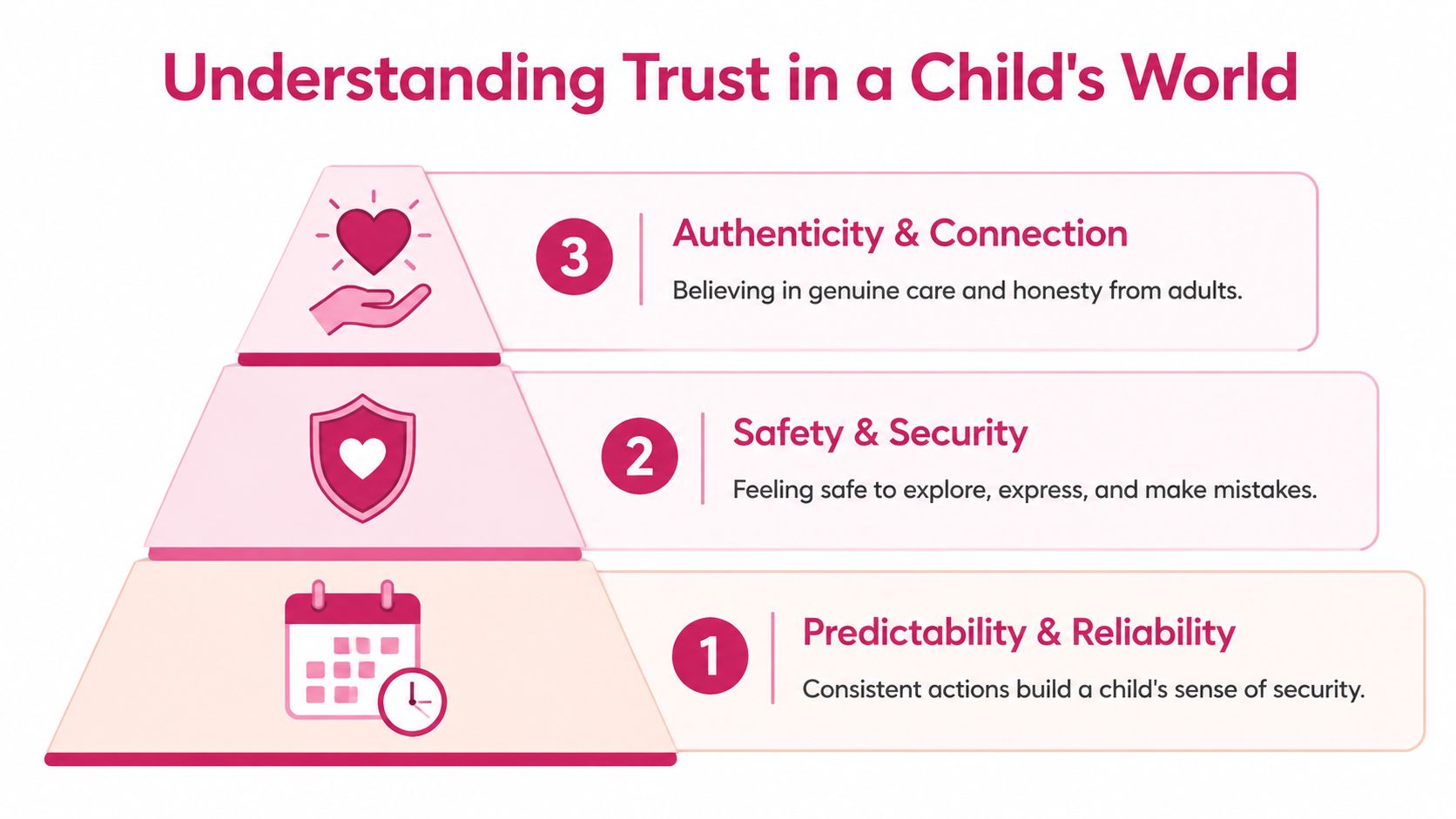
The first layer is rule-following
At the beginning, many children operate from deterrence-based trust. They follow rules because they know what happens if they don’t. This isn’t fake trust. It’s early trust. The child is learning whether adults are predictable and whether the environment has boundaries.
You can see this in a student who lines up properly when the teacher is watching but unravels during less supervised moments. Or a child at home who tells the truth only when the evidence is obvious. The child is still deciding whether honesty and vulnerability are safe.
This level needs structure. It does not need harshness.
Helpful adult moves at this stage:
- Clear expectations stated in simple language.
- Predictable consequences that aren’t shaming.
- Calm repetition instead of surprise reactions.
- Fast repair opportunities so mistakes don’t become identity.
The second layer is predictability
Next comes knowledge-based trust. Here, the child begins to relax because your responses become knowable. They’ve gathered enough experience to think, “When I’m upset, this adult doesn’t mock me. When I make a mistake, the correction is firm but safe. When they say they’ll come back, they do.”
Research discussed in a couples therapist’s guide to building trust in relationships highlights where many trust gains occur, pointing to a simple truth drawn from the work of Dr. John Gottman and Brené Brown. Trust grows in the “smallest moments” of consistency and reliability. Each fulfilled micro-commitment becomes a positive data point for the nervous system.
That nervous system piece matters. Children don’t evaluate trust only with logic. Their bodies keep score. If an adult is warm one day and explosive the next, the child stays vigilant. If the adult is consistent, the child begins to save less energy for self-protection and has more available for learning, play, and connection.
A useful lens: Every interaction adds a data point. Children don’t average your intentions. They react to your pattern.
The deepest layer is relational safety
The strongest form is identification-based trust. The child believes, at a deep level, “This adult sees me, cares about me, and wants to understand me.” At this stage, the relationship can hold more truth, more complexity, and more repair.
A few signs you’re moving into this layer:
- The child volunteers hard information before you discover it.
- They tolerate disagreement without assuming rejection.
- They accept guidance because they feel respected, not controlled.
- They seek connection after conflict instead of avoiding you.
This level doesn’t mean the child always agrees, complies, or stays calm. It means the relationship remains intact even when limits, feelings, and accountability are present.
What this looks like in daily life
A second grader spills paint and freezes. In a low-trust moment, they deny it and blame a classmate. In a growing-trust moment, they whisper, “I messed up.” In a strong-trust moment, they say, “I knocked it over. Can you help me fix it?”
A middle schooler gets left out by friends. In low trust, they say school was “fine” and carry it alone. In stronger trust, they say, “Something happened, but I don’t know how to explain it.” That opening is huge. Adults often miss it because they want the full story right away.
Trust in relationship grows when adults recognize these small openings and respond with steadiness, not interrogation.
Core Strategies for Building Foundational Trust
The most effective trust-building work is ordinary. It doesn’t look dramatic. It looks like doing what you said you’d do, keeping your tone understandable, and protecting a child’s dignity when they’re struggling.
Build the day so children can predict it
Children trust adults faster when the environment feels legible. They want to know what happens next, what the rules are, and how adults respond under stress.
In a classroom, that means stable opening routines, visible transition cues, and consistent responses to common disruptions. At home, it means bedtime that follows a familiar order, correction that doesn’t depend on the adult’s mood, and follow-up after hard moments rather than pretending they didn’t happen.
A simple example from coaching: if a student often escalates during writing, don’t wait for the refusal. Start with a two-minute preview. “First brainstorm, then one sentence, then check in.” You’re not lowering expectations. You’re lowering uncertainty.
What doesn’t work is using unpredictability to gain an advantage. Surprise consequences, public call-outs, or warmth that vanishes the moment a child struggles all weaken trust.
Follow through on the small stuff
Adults often think trust breaks happen only in major moments. Most trust erosion is smaller. You said you’d check their drawing and forgot. You promised one more story and changed your mind without explanation. You told a student you’d revisit a conflict after lunch and never came back.
Those moments count because children are collecting evidence.
Practical micro-commitments that matter:
- Time promises like “I’ll come back in five minutes.”
- Attention promises like “I want to hear the rest after I finish helping this group.”
- Boundary promises like “I won’t share that with the class.”
- Repair promises like “We’ll redo this when we’re both calm.”
When you can’t follow through, name it directly. “I said I’d come back before recess and I missed that. I’m sorry. I’m here now.” That response protects trust more than silence.
Field rule: Never make a promise just to calm a child down. Make fewer promises and keep them.
Validate before you problem-solve
Validation is not agreement. It’s the act of showing the child that their internal experience makes sense from where they stand. This is one of the fastest ways to reduce defensiveness.
Many adults skip this because they’re trying to be efficient. A child says, “It’s not fair.” The adult replies, “Life isn’t always fair.” True, but unhelpful in the moment. The child now has two problems: the original frustration and the feeling of not being understood.
Try language like this instead:
“That felt embarrassing.”
“You really wanted a different outcome.”
“I can see why your body got big right there.”
“You don’t have to like the limit to know I’m staying with you.”
These statements settle the nervous system because they communicate, “I get your experience.” Once the child feels met, they’re more able to hear a limit, a correction, or a next step.
Keep a vault for vulnerability
Children watch what adults do with private information. If a student tells you who they have a crush on, who excluded them, or what they’re scared of, they’re handing you something fragile. If that information turns into gossip, teasing, or unnecessary public discussion, trust drops fast.
Confidentiality with children doesn’t mean secrecy about safety concerns. It means discernment. Share only what needs to be shared, with the people who need to know, and tell the child when you must widen the circle.
Examples:
- In class: Don’t use one child’s personal story as a lesson example unless you’ve gotten clear permission.
- At home: Don’t retell your child’s embarrassing moment to relatives while they’re in the room.
- In counseling or support roles: Tell the child upfront when privacy has limits.
A useful script is: “I’m glad you told me. I’m going to be careful with this.”
Use consistent language across settings
Shared phrases make trust portable. When a child hears the same core messages at school and at home, the world feels more coherent.
Useful repeated language includes:
- For mistakes: “We tell the truth and fix what we can.”
- For conflict: “Slow down. What happened, what did you feel, what do you need now?”
- For emotional intensity: “Your feelings are welcome. Unsafe behavior isn’t.”
- For reassurance: “You’re not in trouble for telling the truth.”
Later in the day, this short video can help adults reflect on how relationship habits shape trust over time.