A student gets in the car after school and says, “It was fine.” Then dinner is quiet. Homework takes twice as long. The next morning, that same child suddenly has a stomachache and does not want to go to school.
This is often how verbal bullying shows up. Adults may not hear the comment in the hallway or see the group chat message. What you do see is the aftershock. A child goes silent, avoids classmates, stops volunteering in class, or starts believing cruel words are true.
Verbal bullying can sound small to bystanders because there is no visible injury. But words shape a child's sense of safety. They can shrink a student's voice, damage friendships, and make school feel like a place to survive instead of a place to learn.
That is why adults need more than a list of mean phrases. You need a way to recognize patterns, respond without escalating, and teach children what to do instead. A good response works like first aid. It stops the harm in the moment, then helps repair what happened underneath.
This guide is built for that job. It breaks verbal bullying into clear types, shows what each one sounds like, and explains why children use it. It also gives parents and teachers practical response scripts, classroom and home interventions, and social-emotional skills to teach for prevention and repair. For example, children can learn to speak up without attacking by practicing I-statements for kids.
You will see concrete examples throughout. The goal is simple. Help adults respond with clarity, help students build empathy and boundaries, and help school communities create a culture where respect is taught, practiced, and expected.
1. Name-Calling and Insulting Language
Name-calling is one of the clearest examples of verbal bullying because it turns a child into a label. Instead of addressing a behavior or a conflict, the speaker attacks the person. Words like “stupid,” “ugly,” “loser,” or repeated cruel nicknames can stick with a student long after the moment ends.
In one junior high school study, 23 students experienced verbal bullying, and name-calling was the most dominant form at 60.9%, followed by mocking at 34.8% and direct insults at 4.3% in the junior high verbal bullying case study. That same study connected these behaviors with loss of concentration, sleep problems, and reduced interest in learning.
What it sounds like
A student misses a question and another says, “You're so dumb.”
A child walks into class and hears, “Here comes the weird kid.”
A group starts using a nickname for one student, and everyone knows the point is humiliation, not affection.
Practical rule: If the nickname embarrasses the child, and the child didn't freely choose it, treat it as bullying.
Adults sometimes ask whether kids should “toughen up.” That usually misses the issue. The problem isn't only the word. It's the repeated message that a child is less worthy, less capable, or less welcome.
What to say in the moment
Use short, steady language:
- Stop the behavior: “We don't call people names here.”
- Name the impact: “That comment was hurtful and disrespectful.”
- Redirect the student: “Try again and speak about the problem, not the person.”
- Support the target: “I heard what was said. I'm checking in with you.”
Later, teach students better replacement language. If a child is frustrated, they can say, “I didn't like that,” or “I need space,” instead of attacking the other person. Helpful sentence stems from I-statements for kids can give children concrete language when emotions are high.
A final step matters too. Follow up privately with both students. The child who was targeted needs reassurance and safety. The child who used the insult needs accountability, coaching, and a chance to repair harm.
2. Spreading Rumors and Social Exclusion Through Gossip
A student walks into lunch and something has shifted. Friends stop talking. Seats that were open yesterday are suddenly “saved.” No one says the rumor out loud, but the child can feel it in the room.
That is part of what makes gossip so harmful. It travels through whispers, side comments, screenshots, and “just telling you what I heard.” The target often faces the consequences before they even know the accusation.
This form of verbal bullying can sound quiet, but its social force is strong. A student might repeat private information that was shared in confidence, tell others that someone's family is “strange,” or say, “Don't invite her. She's annoying and desperate.” Sometimes the words are false. Sometimes they mix one true detail with exaggeration. Either way, the goal is often the same: lower one child's social standing and pull the group away from them.
Why gossip hurts so much
Rumors attack belonging. For many children, belonging feels as basic as safety. Once gossip starts, a student may begin scanning every interaction. Who believes it? Who started it? Who is pretending nothing happened?
Adults also need to look past the student who first said the words. Gossip works like a chain. One child starts it, another repeats it, a third adds a detail, and a fourth excludes the target based on the story. By the time it reaches the larger group, the rumor can feel “true” because so many people have heard it.
That is why bystanders matter here more than adults sometimes realize.
What adults can say and teach
Children need a simple rule they can remember before they speak. A practical classroom or family filter is:
- Is it true?
- Is it kind?
- Is it necessary?
This gives students a pause point. It also helps adults stay consistent. If the answer is no to any of the three, the conversation needs to stop.
If a student is sharing information to embarrass, isolate, or turn peers against someone, that is bullying.
Use direct scripts in the moment:
- To the student spreading it: “Stop. We do not pass stories about people when they are not here to speak for themselves.”
- To the group: “You do not need to listen to this or repeat it.”
- To a bystander who wants help: “You can say, ‘I'm not talking about them,’ or ‘Let's ask them directly instead of guessing.’”
- To the targeted student: “I heard what is happening. You do not have to handle this alone. Let's make a plan.”
Then teach the skill underneath the behavior. Many students gossip because they want attention, status, or connection. They need better ways to get those needs met. Class meetings, role-play, and explicit practice with perspective-taking can help. This guide on teaching empathy to children in everyday situations fits well here because students are more likely to interrupt gossip when they can picture its impact on the person being discussed.
At school, address the social system, not only the speaker. Check in with the target. Identify who repeated the story. Interrupt exclusion quickly. If the situation is calm enough and the targeted student wants it, a restorative conversation can help students name harm, correct false information, and repair trust.
At home, parents can coach children to save messages, write down what happened, and tell an adult early. Gossip grows when everyone treats it like a private drama. It loses power when adults respond clearly, protect the targeted child, and teach the whole group how to handle social conflict without turning a person into a story.
3. Public Humiliation and Mocking
A student stands at the front of the room to read aloud. They stumble over a word. Another child copies their voice, someone claps sarcastically, and a few classmates laugh. In less than ten seconds, a learning moment turns into a social threat.
That is what makes public humiliation different from a private insult. It uses an audience. The goal is not only to hurt the target, but also to win attention, status, or control through the reaction of the group. For many children, the laughter is the part they remember most.
This kind of verbal bullying can sound like exaggerated mimicry, fake applause, stage whispers, repeated quoting, or comments such as, “Wow, great job,” said in a cutting tone. It often gets dismissed as joking. A simple test helps. Shared humor feels safe to everyone involved. Mocking leaves one child exposed.
Here's a short video that can help adults open a classroom conversation about empathy and peer behavior.
What public mockery does to a child
Public embarrassment teaches fast. A student who is mocked during a presentation may stop raising a hand, avoid reading out loud, or try to disappear into the group. Adults sometimes miss that shift because the child is no longer causing any visible problem. They are protecting themselves.
The audience matters too. When classmates laugh and no adult interrupts, children can absorb the wrong lesson. They may decide that humiliation is a good way to get attention, or that staying silent is safer than helping. That is why adults need to respond to both the speaker and the crowd.
What to do right away
Start by resetting the room. Then address the student who caused harm.
- To the class: “Stop. We do not laugh at someone when they are vulnerable.”
- To the student who mocked: “That comment was meant to embarrass. It stops now.”
- To the targeted student, privately: “I saw what happened. You did not deserve that. What do you need right now?”
- If the group is unsettled: “We are going to reset and try again respectfully.”
That immediate response does two jobs at once. It protects the targeted student, and it teaches every bystander what this classroom stands for.
Later, circle back with a repair plan. Public humiliation often needs a public correction and a private follow-up. Depending on the situation, that might mean a brief acknowledgment in front of the group, a restorative conversation, or a coached apology that names the behavior clearly. Soul Shoppe's guidance on how to stop bullying at school and at home can help adults choose a response that stops the pattern instead of only reacting to one moment.
Prevention works best when adults teach the skill underneath the behavior. Many students mock others because they want laughs, belonging, or social power and do not yet know safer ways to get those needs met. Practice helps. Teach students how to get attention appropriately, how to repair harm, and how to respond when a peer becomes the punchline. Role-play, class agreements, and direct coaching from resources about how to teach empathy give students language they can use.
Parents can reinforce the same lesson at home. If a child says, “I was only kidding,” ask, “How did the other person seem to feel?” That question shifts the focus from intent to impact. Over time, children learn an important social rule. Humor builds connection when everyone feels included. It becomes bullying when one child has to carry the shame for everyone else's laugh.
4. Threats, Intimidation, and Coercive Language
Some verbal bullying is meant to control, not just insult. A student says, “If you tell, you'll regret it,” or “Do my homework or I'll tell everyone your secret.” That's intimidation. It creates fear and teaches the target that speaking up might make things worse.
These are some of the most serious examples of verbal bullying because they often silence reporting. The child may look calm on the outside while feeling trapped inside. Threats can involve safety, reputation, friendships, belongings, or embarrassing information.
Common examples
- Social threats: “If you tell the teacher, nobody will sit with you.”
- Reputation threats: “I'll spread rumors about you if you don't do what I say.”
- Physical threats: “My friends will take care of you after school.”
- Digital threats: “I'll post the screenshot unless you do what I want.”
A workplace case study from WorkSafe Victoria described a 16-year-old apprentice whose supervisor used homophobic language, encouraged group name-calling, and manipulated the victim's phone. The victim filed a formal complaint after a 24-month pattern, as described in this WorkSafe bullying case study. Even though that case involved an older teen in a workplace, the pattern is familiar to schools. Verbal bullying often grows when adults underestimate early warning signs.
Take every threat seriously, even when the student later says, “I didn't mean it.”
How schools and families should respond
Start with safety, not debate. Don't ask the targeted child to confront the aggressor alone. Don't force a same-day face-to-face conversation while fear is still high.
Use a response sequence:
- Document exact words: Write down what was said as closely as possible.
- Separate students if needed: The target's sense of safety comes first.
- Report through school channels: Involve administration and counseling support.
- Protect confidentiality: Don't reveal who reported unless required by policy.
- Follow up: Check on the student again after the first report.
If you need schoolwide tools and staff language for intervention, how to stop bullying offers practical starting points. The core message to children should be simple. Threats are not conflict. Threats are coercion, and adults must step in.
5. Demeaning Comments About Family, Socioeconomic Status, or Background
Some of the most painful verbal bullying targets a child's home life. A student gets mocked for wearing the same sweatshirt twice, bringing a different kind of lunch, having divorced parents, speaking another language at home, or practicing a religion classmates don't understand. These comments hit hard because children cannot easily change these parts of their lives.
One common example is a comment about clothing or money, such as “Are you poor?” Another is using family circumstances as an insult, like “No wonder you're messed up.” These aren't random remarks. They send the message that a child's family or background makes them lesser.
Why identity-based comments need a stronger response
Bias-based verbal bullying targets identity, including race, language, or gender. The American Psychological Association identifies it as a distinct category, and 2024 to 2025 data cited in the APA primer says bias-based verbal incidents have risen 27% in U.S. K-8 schools in the APA bullying primer. That means schools can't treat every hurtful comment as the same kind of peer conflict.
When a student insults a child's accent, immigration story, religion, or family income, adults need to address both the cruelty and the bias underneath it. A generic “be nice” response isn't enough.
What to say and teach
Try language like this:
- Interrupt clearly: “We do not insult people's families, culture, language, or identity.”
- Name the stereotype: “That comment made an unfair assumption about what poverty means.”
- Affirm the target: “There is nothing wrong with your family, your culture, or your background.”
- Teach the group: “Differences are part of our community. They are not material for jokes.”
At home and at school, include books, examples, and celebrations that reflect different family structures and communities. Children need regular exposure to belonging, not only correction after harm.
A student who uses this kind of language also needs guided reflection. Ask, “What did you assume? Where did that message come from? Who was hurt by it?” Those questions move the conversation from denial to accountability.
6. Exclusionary Language and Deliberate Isolation Comments
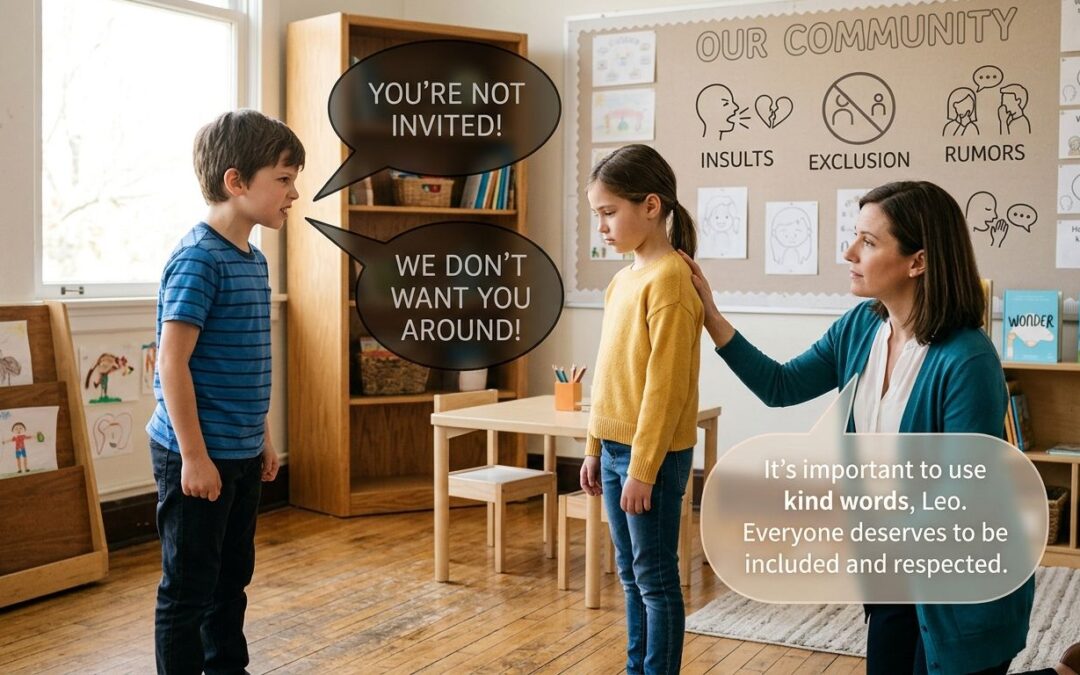
A student walks into lunch, tray in hand, and hears, “You can't sit here.” Then someone adds, “Nobody wants you anyway.” The table may stay quiet after that, but the message is loud. You do not belong.
Exclusionary bullying often sounds plain. “You can't play with us.” “Don't pick her.” “No one likes you.” Because the words are short and common, adults sometimes miss how much harm they carry. For many children, social belonging at school works like emotional oxygen. When peers keep cutting it off, shame and panic can show up fast.
This form of verbal bullying often appears in the least structured parts of the day: recess, lunch, group projects, clubs, bus lines, and birthday talk. A single social disappointment is part of childhood. A repeated pattern of shutting one child out, especially with comments meant to embarrass or isolate, is something different.
The difference between a boundary and a put-down
Children do get to choose friends. They do not get to use rejection as a weapon.
That distinction can be hard for adults to teach because both situations may involve the word no. The tone, purpose, and pattern matter. “I'm working with Leo today” sets a limit. “You're too annoying to work with anyone” attacks the child's social worth.
A useful rule for students is this: a boundary describes your choice, but bullying defines the other person as unwanted.
What adults can say in the moment
Start with a calm interruption. Keep it brief and concrete so students hear the limit, not a lecture.
- Stop the exclusionary comment: “You may not tell someone they are unwanted.”
- Separate choice from cruelty: “You can choose a partner. You cannot shame someone while you do it.”
- Give replacement language: “Try, ‘We already have a group of four,’ or ‘I'm playing with Sam today.’”
- Repair the belonging wound: “Everyone in this class has a place here.”
Then check on the student who was shut out. Do not assume they will ask for help. A quick private response matters: “I heard that. It was not okay. Let's make sure you're included right now.”
That step is easy to skip. It should not be skipped.
Classroom and home responses that actually help
Adults often focus on the seating chart or the game. The deeper issue is social power. Some students learn that they can raise their status by deciding who gets included. That is why simple redirection is not always enough.
Use a short repair process:
- Name the impact. “Those words told him he didn't belong.”
- Prompt reflection. “What were you trying to do in that moment?”
- Practice a better script. “How can you say no without putting someone down?”
- Require action. This might mean inviting the student into the activity, offering a respectful redo, or writing an apology with adult support.
Soul Shoppe's approach fits well here because it teaches belonging as a skill, not just a hope. Students need direct practice with inclusion, boundary-setting, noticing hurt, and repair. Those are SEL skills. They can be taught the same way adults teach lining up, turn-taking, or problem-solving.
Try teaching and practicing phrases such as:
- “We already started this round. You can join the next one.”
- “I want time with my close friend right now, but I can talk later.”
- “Let's make room.”
- “That sounded excluding. Try that again with respect.”
Prevention also needs structure. Rotate partners. Use cooperative learning roles. Assign mixed groups at times instead of letting the same social hierarchy decide every pairing. Hold class meetings where students practice how to join a group, how to say no kindly, and how to notice when someone is being left out.
Children should not have to decode whether adults see their social pain. Clear routines tell them, “Belonging is protected here.”
7. Negative Comments About Academic Performance and Ability
A student raises a hand, gets an answer wrong, and a classmate says, “Wow. Do you know anything?” The room may laugh for two seconds. The effect can last much longer.
Academic bullying attacks a child's identity as a learner. Comments like “You're stupid,” “You're so bad at math,” “Even the easy kids got it,” or “Don't ask her, she never gets it” send a clear message. Mistakes are unsafe, and ability decides worth. After enough of those messages, many students stop volunteering, stop asking for help, or stop trying in public.
This kind of verbal bullying is easy to miss because it can sound tied to schoolwork. Adults may hear it as teasing, competition, or blunt honesty. But there is a difference between feedback and humiliation. Feedback helps a student improve. Humiliation puts the student lower in the social order.
Watch for quiet forms of harm too. A child may shrug and say, “I'm just dumb,” before anyone else can say it first. That is often a shield. Students who expect ridicule often protect themselves by acting disengaged, clowning around, or refusing work they fear they cannot do perfectly.
What adults can say right away
Keep your response short, calm, and public enough to reset the norm.
- Name the behavior: “That was a put-down about learning.”
- Protect the target: “Everyone gets to make mistakes here.”
- Reset the class value: “We respect effort, questions, and practice.”
- Redirect the student who caused harm: “If you have something helpful to say, say it respectfully.”
Then follow up later with both students. The target needs reassurance and a path back into participation. The student who made the comment needs coaching, not only correction. Ask, “What were you trying to do with that comment?” Then teach the replacement skill. It may be giving peer feedback, managing frustration, or getting attention without putting someone down.
Classroom moves that lower academic shaming
Prevention works best when struggle is treated as a normal part of learning. A classroom runs like a practice space, not a stage. In a practice space, students expect retries, coaching, and visible growth.
Try supports such as turn-and-talk before whole-group answers, private wait time, anonymous question boxes, partner problem-solving, and sentence stems for respectful peer response. Model your own mistakes out loud. “I mixed that up. Let me fix it.” That simple routine teaches students that errors can be corrected without shame.
Parents can reinforce the same message at home. Praise persistence, specific strategies, and help-seeking. If a child's confidence is already shaky, these self-esteem building activities for kids can support repair alongside school-based interventions.
Children learn in the emotional climate around them. If that climate says, “Only smart kids speak,” many children go silent. If it says, “Learning includes not knowing yet,” students are more willing to risk, recover, and grow.
8. Targeting Students' Appearance, Body Size, and Physical Characteristics
A student walks into class wearing a new shirt. Another student says, loud enough for others to hear, “Why would you wear that?” A few kids laugh. No one uses profanity. No one makes a threat. Still, the message lands hard. Your body, your face, your clothes, or your size can be judged in public.
That is verbal bullying.
Comments about weight, skin, hair, height, teeth, disability-related differences, clothing, or other physical traits are often brushed off as teasing. Adults miss them because they sound ordinary. Children hear body talk so often that it can blend into the background. But repeated appearance-based comments work like small cuts. One may seem minor. A pattern changes how a child sees school, peers, and themselves.
The hidden message is simple and painful. You are safe only if you look the right way.
What makes this type of bullying different
Appearance-based bullying often hooks into shame fast. A child cannot leave their body at the classroom door. That is why these comments can linger long after the moment passes. The target may replay the words during lunch, at bedtime, or while getting dressed the next morning.
Adults should watch for behavior changes such as avoiding photos, refusing to participate in PE, asking to stay home on spirit days, changing eating habits, or becoming unusually focused on mirrors, makeup, hoodies, or baggy clothes. Some children start criticizing other students' looks. That does not mean they are unaffected. It can be a sign that they are absorbing the same harmful rules and passing them on.
A clear classroom norm helps here: We do not comment on other people's bodies or appearance.
How to respond in the moment
The first goal is to stop the harm without turning the incident into a performance.
Try language like this:
- Interrupt clearly: “Stop. We do not make comments about someone's body, face, clothes, or appearance.”
- Name the behavior: “That was a put-down about how someone looks.”
- Close the joke loophole: “Humor does not make it respectful.”
- Support the targeted student: “You did not deserve that. I'm checking in with you after class.”
Keep your tone calm and firm. Long lectures in front of peers often increase embarrassment for the student who was targeted. A short interruption works better in the moment. Then follow up privately with both students.
What to teach after the incident
Correction alone is not enough. The student who made the comment needs a replacement skill.
Ask questions that get underneath the behavior:
- “What were you hoping would happen when you said that?”
- “Were you trying to be funny, get attention, or fit in?”
- “What could you say instead if you notice something different about someone?”
Then teach the missing skill. Some students need help with impulse control. Others need practice with empathy, boundaries, or how to join a group without targeting someone else. Soul Shoppe's approach works best when adults pair accountability with skill-building. Students need to repair harm and learn what respectful speech sounds like in real life.
For the targeted student, repair means more than comfort. It means restoring belonging. Check where the incident happened, who heard it, and whether the student now avoids that space or group. A child who was mocked in the locker room may need more support there than during math.
Prevention that works in classrooms and at home
Appearance-based bullying grows in places where body talk is common and unchecked. Adults can lower risk by setting rules before incidents happen. Avoid classroom activities that rank looks, joke about fashion, or invite public comments on bodies. Watch common hotspots such as PE, performances, dress-up days, group photos, and social media spillover from after school.
Teach students specific SEL skills: noticing impact, respecting differences, interrupting unkind humor, and giving compliments about effort, creativity, or character instead of bodies. Parents can reinforce the same message at home by avoiding negative body talk about themselves, their child, or other people. Children listen closely to what adults treat as normal.
If a child's confidence has taken a hit, structured self-esteem building activities for kids can support recovery while adults address the bullying directly. Confidence does not stop bullying on its own. It does give a child more footing while the adults around them work to stop the behavior, repair the harm, and reset the group norm.
Comparison of 8 Verbal Bullying Examples
| Bullying Type | Implementation complexity | Resource requirements | Expected outcomes | Ideal use cases | Key advantages |
|---|---|---|---|---|---|
| Name-Calling and Insulting Language | Low, set rules and intervene quickly | Low, teacher time, classroom routines, parent contact | Quick reduction in incidents if enforced; improves classroom climate | Classroom management, SEL lessons on respectful speech | Easy to identify/document; clear teachable moments |
| Spreading Rumors and Social Exclusion Through Gossip | High, covert, harder to trace and stop | Medium–High, monitoring (digital), restorative circles, counseling | Slower trust repair; requires sustained culture change to reduce harm | Digital citizenship, bystander training, restorative practices | Opportunity to teach media literacy and critical evaluation of information |
| Public Humiliation and Mocking | Medium, visible but must avoid further harm when addressing | Medium, immediate adult intervention, follow-up support, class norms | Immediate reduction when addressed; can restore dignity with careful repair | Whole-group empathy lessons; real-time intervention scenarios | Visible to adults; easier to document and interrupt in the moment |
| Threats, Intimidation, and Coercive Language | High, requires safety protocols and careful investigation | High, documentation, administration, counseling, possible law enforcement | Urgent safety response; potential disciplinary/legal outcomes | Incidents needing administrative action and trauma-informed response | Clear grounds for intervention; prompts immediate protective measures |
| Demeaning Comments About Family, Socioeconomic Status, or Background | Medium–High, sensitive, rooted in bias and systemic issues | Medium, diversity curriculum, restorative work, family engagement | Gradual improvement in inclusivity; reduces stigma with sustained effort | Diversity, equity and inclusion lessons; bias-awareness activities | Teachable moment to address implicit bias and build inclusive culture |
| Exclusionary Language and Deliberate Isolation Comments | Medium, requires culture-building and structured interventions | Medium, cooperative learning structures, peer support, monitoring | Increased sense of belonging if consistently addressed; may need ongoing work | Cooperative learning, belonging-focused SEL, peer-inclusion strategies | Directly targets belonging; good opportunity for peer-led inclusion |
| Negative Comments About Academic Performance and Ability | Low–Medium, teach growth mindset and feedback norms | Low, teacher modeling, growth mindset activities, academic supports | Improved academic confidence and risk-taking when norms change | Growth mindset lessons, feedback training, tutoring supports | Aligns with academic goals; natural teachable moments to build resilience |
| Targeting Students' Appearance, Body Size, and Physical Characteristics | Medium, sensitive, influenced by media and culture | Medium, body-positive curriculum, counseling, media literacy | Improved self-esteem and body image over time; reduces health risks when addressed | Health/wellness classes, media literacy, body-image programs | Addresses health and media literacy; fosters self-compassion and safety |
From Intervention to Prevention Building a Culture of Kindness
A student gets called a name during group work. The class laughs. The teacher stops it, gives a consequence, and the day keeps going. On paper, the problem was handled. In real life, the target may still feel unsafe, the student who caused harm may not know what to do differently next time, and the rest of the class just learned what gets attention.
That is why prevention has to do more than stop the moment. It has to teach the missing skill underneath the moment.
Across the examples in this article, the pattern is clear. Verbal bullying often grows where students have not yet learned how to handle embarrassment, social pressure, jealousy, difference, or conflict with respect. A rule can block a behavior for a minute. A skill gives a child another option.
Adults need both. Clear limits matter. So does direct instruction in self-regulation, perspective-taking, boundary-setting, repair language, and how to disagree without attacking someone's identity. A child who knows how to say, “I'm frustrated. I need space,” is less likely to reach for “You're so stupid.” A child who can ask, “Was that joke hurtful?” is better prepared to catch harm before it spreads.
The intervention process still matters. McMillen Health's verbal bullying guidance outlines practical steps adults can use in the moment: stop the behavior quickly, avoid humiliating the student in front of peers, apply consistent consequences, protect privacy, involve support staff when needed, contact caregivers, and model respectful language. That sequence works like first aid. It stabilizes the situation so real teaching can happen after emotions settle.
The larger goal is school safety and student well-being. As noted earlier, bullying is common enough that no school can treat verbal aggression as a small issue or a normal part of growing up. Students who are targeted can carry that stress into attendance, learning, mental health, and peer relationships. Early action gives children more protection, especially before patterns harden in upper grades.
Prevention works best when the whole community shares the same language. Students need to hear the same message in the classroom, on the playground, in the hallway, and at home. “We do not use words to rank people.” “If you cause harm, you repair it.” “If you see someone isolated, you include or get help.” Repetition matters because social behavior is learned the same way reading fluency is learned. Through modeling, practice, correction, and another chance to try again.
One often-missed area is sarcasm and so-called joking. Some students hide cruelty inside humor because it gives them cover. Some targets freeze because they know they were hurt but cannot explain why. The Girls Guide to End Bullying verbal bullying overview points out that many students struggle to tell the difference between joking and mean teasing. Adults can reduce that confusion by teaching a simple standard: intent matters, but impact matters too. If the comment lands as humiliation, exclusion, or fear, adults need to address it.
Soul Shoppe's approach fits this work well because it teaches relationship skills in ways students can use. The focus is not only on stopping hurtful words. It is on building belonging, shared language, and repair. Through workshops, assemblies, digital tools, and coaching, schools can teach students how to calm their bodies, name what happened, speak up clearly, listen without defending, and make things right. That gives teachers and parents a repeatable toolkit, not just a list of warnings.
For families, the job is similar. Notice changes early. Ask calm, specific questions. “Who were you with at lunch?” works better than “How was school?” Do not dismiss repeated teasing as normal if your child seems smaller, quieter, or more tense afterward. Children need adults who take verbal harm seriously and also show them what respectful, firm language sounds like.
If you're thinking about long-term protection, fostering confidence in children supports this work. Confidence does not prevent bullying by itself, but it can help children ask for help sooner, use clearer boundaries, and stay connected to supportive peers and adults.
A kinder culture is built in small, repeated moments. A teacher pauses a put-down and asks for a reset. A parent helps a child practice a repair script before the next school day. A class learns that belonging is something they protect together. That is how intervention turns into prevention. That is how words stop being weapons and start becoming tools for safety, dignity, and connection.
Soul Shoppe helps schools, families, and community partners turn bullying prevention into daily practice. Through Soul Shoppe, you can access social-emotional learning programs that teach students practical tools for empathy, communication, self-regulation, and conflict resolution so every child has a better chance to feel safe, connected, and ready to learn.