8 Emotion Focused Coping Examples for Kids & Teens

8 Emotion Focused Coping Examples for Kids & Teens

A child storms off after recess because a friend wouldn’t share. Another freezes before a math test and says their stomach hurts. A middle schooler shrugs and mutters, “I don’t care,” when you can tell they absolutely do. In those moments, adults often reach for the same phrase: calm down.

The problem is that “calm down” isn’t a tool. It’s a request.

Children need actual strategies they can use when frustration, worry, embarrassment, grief, or disappointment rush in faster than their thinking brain can catch up. That’s where emotion focused coping comes in. These strategies help kids work with the feelings created by a hard situation, especially when they can’t fix the situation right away. A student can’t undo a conflict, erase a mistake, or control a family change in the moment. They can learn how to notice, express, soothe, and move through the emotions that come with it.

That matters. A 2015 meta-analysis on emotion-focused coping found that people who actively processed and expressed emotions, rather than avoiding them, showed measurable improvements in resilience and well-being. That’s an important distinction for adults in schools and homes. Not all emotion-focused coping helps. Suppressing feelings tends to backfire, while healthy emotional processing can support stronger coping.

These emotion focused coping examples are designed for real classrooms, real homes, and real kids. They’ll also strengthen the emotional intelligence that children need to handle relationships, stress, and setbacks with more confidence.

1. Mindfulness and Present-Moment Awareness

A young person with eyes closed, sitting in a meditative pose on a mat in a bright, quiet classroom.

Mindfulness gives a child something concrete to do when feelings start to spike. Instead of getting pulled deeper into panic, anger, or shame, they practice noticing what’s happening right now. Breath. Feet on the floor. Hands on the desk. Sounds in the room. That pause can keep emotion from taking over behavior.

In school, this often looks simple. A third grader takes three slow breaths before opening a test packet. A teacher starts the morning with one minute of quiet noticing. A parent kneels beside a crying child and says, “Let’s feel your belly rise and fall together.”

What it sounds like with kids

You don’t need long meditations. Short, repeatable routines work better.

  • For early elementary: “Name three things you see, two things you hear, one thing you feel in your body.”
  • For upper elementary: “Put one hand on your chest and one on your belly. Breathe in slowly. Breathe out even slower.”
  • For middle school: “Notice the thought. Don’t argue with it yet. Just label it: worried thought, mad thought, embarrassed thought.”

Practical rule: Practice mindfulness when kids are calm, not only when they’re upset. Skills learned during peaceful moments are easier to use during hard ones.

Classroom and home adaptations

A mindfulness routine works best when it’s built into the day. Try it before tests, after lunch, after conflict, or during transitions. If you want students to understand why this matters, tie it to the idea of living in the now, which helps kids shift attention away from spiraling “what if” thoughts.

Teachers can say, “We’re not trying to make every feeling disappear. We’re helping our bodies get steady enough to think.” Parents can use the same language at bedtime, before sports, or after a sibling conflict.

2. Emotional Expression and Creative Outlets

A young child creatively painting vibrant colors on white paper using a paintbrush while sitting on the floor.

Some children can tell you exactly what they feel. Many can’t. They show it in drawings, movement, music, pretend play, or the way they slam a marker onto paper. Creative expression gives emotion a safe exit. It helps a child process feelings without needing perfect words first.

This is one of the most useful emotion focused coping examples for younger students and for older kids who shut down when asked direct questions. A child might draw “what anger looks like,” create a playlist for different moods, or act out a problem with puppets before they’re ready to talk.

Ways to use it without turning it into an assignment

The key is to focus on expression, not performance. Don’t correct the art. Don’t ask for neatness. Don’t force sharing.

  • Art option: “Use color and shape to show how today feels.”
  • Writing option: “Finish this sentence three times: Right now I wish…”
  • Movement option: “Show me with your body what nervous feels like, then show me what steady feels like.”
  • Drama option: “Let the puppet say what the student can’t say yet.”

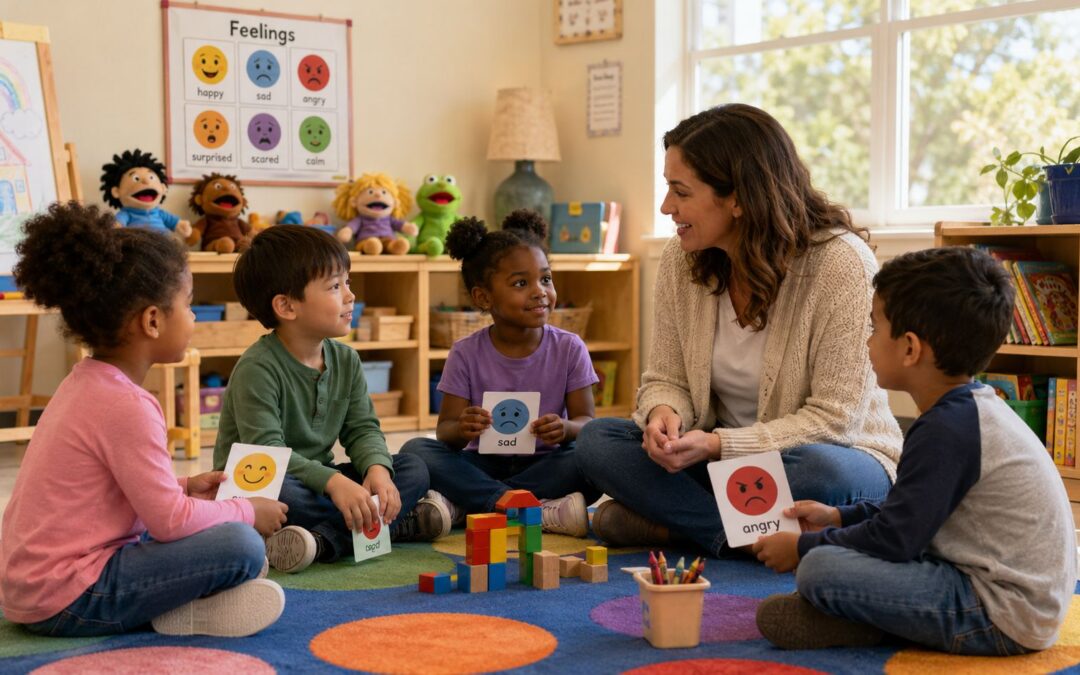
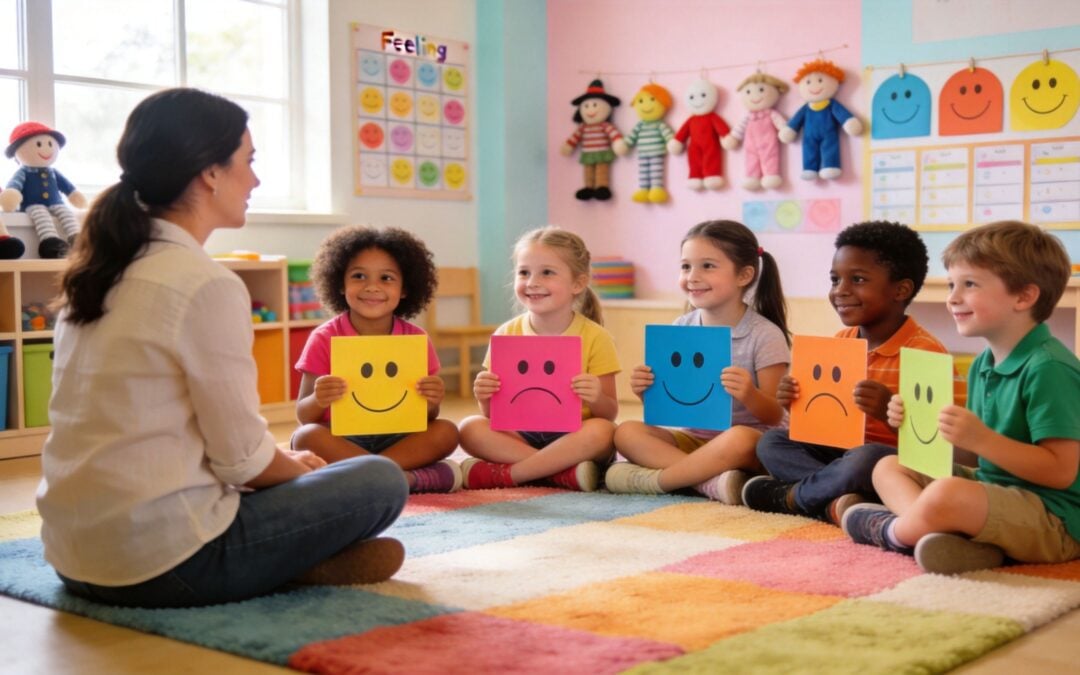
A feelings chart for kids can help children move from broad labels like mad or sad to more accurate words like left out, embarrassed, worried, or disappointed. That added precision often lowers intensity because the feeling becomes easier to understand.

Sample adult script

Try: “You don’t have to explain it right away. You can draw it, write it, or move it.”

That kind of permission matters. A randomized trial described in this positive affect journaling overview found that journaling was linked with significant reductions in mental distress, anxiety, and perceived stress after an 8-week intervention, with benefits that persisted at follow-up. For children, the school version can be much simpler: a short reflection page, a feelings doodle, or a gratitude journal they return to regularly.

3. Social Support and Connection-Building

A teenage boy and girl sitting on a school bench sharing an emotion focused coping moment together.

Kids regulate better in relationship. Even very independent children often need another nervous system nearby before they can settle their own. That’s why connection is one of the strongest emotion focused coping examples you can teach.

For some students, support means talking. For others, it means sitting next to a trusted adult, walking a lap with the counselor, or knowing there’s one peer who’ll save them a seat at lunch. The message is the same: you don’t have to carry big feelings alone.

Build support before a child is in crisis

Waiting until a student is overwhelmed is too late. Connection has to be part of the routine.

  • Teacher check-ins: Greet students by name and notice changes in mood.
  • Peer structures: Use partner shares, lunch groups, or buddy systems.
  • Family routines: Set a daily “tell me one hard thing and one good thing” conversation.
  • Counselor support: Give students a clear path for asking for help without shame.

Research summarized in this overview of coping patterns in students found that girls reported higher overall coping levels than boys, and that self-efficacy and family support influenced which coping strategies students used. The same review also noted that withdrawal was associated with depressed mood. For adults, that’s a reminder to teach help-seeking directly instead of assuming children will do it on their own.

Sample scripts for adults and peers

A supportive response sounds like this:

“You don’t have to fix it right now. Tell me what feels hardest.”

A peer can learn simple language too: “Do you want advice, or do you want me to just stay with you?” Activities that strengthen trust and belonging make these moments more likely. Schools can support that through intentional relationship-building activities woven into the week.

4. Self-Compassion and Positive Self-Talk

Many kids are much harder on themselves than adults realize. You see it after a wrong answer, a missed goal, a social mistake, or a small correction. “I’m dumb.” “Nobody likes me.” “I ruin everything.” That inner voice can turn one hard moment into a much bigger emotional crash.

Self-compassion teaches children to talk to themselves the way they’d talk to a friend. It doesn’t mean pretending everything is fine. It means meeting struggle with honesty and kindness.

Replace harsh self-talk with helpful language

Children usually need this modeled out loud. They don’t automatically know what compassionate self-talk sounds like.

Try these swaps:

  • Instead of: “I’m terrible at this.”
    Try: “This is hard for me right now.”
  • Instead of: “I messed up everything.”
    Try: “I made a mistake, and I can repair it.”
  • Instead of: “Everyone else gets it.”
    Try: “I’m still learning, just like everybody else.”

A teacher can model this after making a mistake on the board: “I don’t love getting things wrong, but mistakes help me see what to fix.” That lands because it’s real.

A quick self-compassion routine

Give students three steps they can remember:

  1. Name it: “This is a hard moment.”
  2. Normalize it: “Other people feel this way too.”
  3. Support yourself: “What do I need to hear right now?”

Parents can keep this concrete: “You’re disappointed. That makes sense. What would help you talk to yourself kindly?” Teachers can post positive affirmations for kids and revisit them after mistakes, not just during morning meetings.

Speak to the child in a way you hope they’ll eventually speak to themselves.

That’s one of the quietest and strongest forms of SEL teaching.

5. Reframing and Cognitive Perspective-Taking

A child’s first interpretation of an event is often the most painful one. “She didn’t wave back because she hates me.” “The teacher corrected me because I’m bad.” “I failed one quiz, so I’m going to fail everything.” Reframing helps children slow down and consider another possible explanation.

This doesn’t mean arguing kids out of their feelings. If a child feels hurt, they feel hurt. Reframing comes after validation, not instead of it.

Start with the feeling, then widen the lens

A good adult response sounds like this: “I can see why that felt embarrassing. Let’s look at what else might be true.”

Then ask questions that invite perspective:

  • “What’s one other explanation?”
  • “What would you say to a friend in this situation?”
  • “Is this a forever problem, or a right-now problem?”
  • “What facts do you know for sure?”

For younger children, use visual choices. “Do you think your friend was being mean on purpose, distracted, or upset about something else?” For older students, introduce thinking traps such as mind-reading, catastrophizing, and all-or-nothing thinking.

Real school examples

A student gets feedback on an essay and says, “My teacher thinks I’m bad at writing.” Reframing sounds like: “Your teacher spent time on comments because your writing matters and can grow.”

A student isn’t picked for a game and says, “Nobody wants me.” Reframing might be: “That felt personal. It may also have been a quick choice between friends.”

This strategy pairs well with journaling, class discussions, and restorative conversations. Adults can model it openly: “My first thought was that the meeting went badly. My second thought is that people were tired and distracted.”

6. Relaxation Techniques and Somatic Awareness

Sometimes the fastest way to help a child with big feelings is through the body, not through words. An anxious child may have tight shoulders, shaky hands, or a stomachache. An angry child may clench fists or breathe fast. Somatic coping teaches kids to notice those signals and respond before they escalate.

That’s useful because many children don’t recognize stress until it’s already overflowing. Body awareness gives them an earlier warning system.

Here’s a simple practice to introduce:

Simple body-based tools that work in classrooms

Relaxation doesn’t have to be elaborate. The best tools are short, repeatable, and easy to do without drawing attention.

  • Box breathing: Inhale, hold, exhale, hold using the same count.
  • Hand squeeze and release: Tighten fists, then relax them.
  • Shoulder reset: Lift shoulders to the ears, hold, then drop.
  • Grounding through touch: Press feet into the floor or hands onto the desk.
  • Stretch break: Reach high, fold forward, then roll back up slowly.

For younger children, make it playful. “Pretend you’re squeezing lemons in both hands.” For older students, explain the purpose directly: “Your body is activated. We’re helping it come back to steady.”

Sample script for tense moments

Try: “Before we talk, let’s help your body feel safer.”

Some families also like calming sensory rituals at home, including scents tied to bedtime or quiet time. If that interests you, this piece on Aroma Warehouse essential oils insights offers ideas adults can consider alongside breathing, stretching, and other relaxation habits. In school settings, keep it simple and inclusive, since not every student can tolerate scent-based supports.

7. Acceptance and Emotional Validation

A lot of children think a feeling is a problem that must be erased immediately. Adults sometimes reinforce that without meaning to. We rush to distract, fix, persuade, or explain away. But feelings often settle faster when children feel understood.

Acceptance means helping a child notice, “I feel angry,” or “I feel scared,” without piling shame on top of the feeling itself. Validation means saying that the emotion makes sense in context, even if the behavior still needs limits.

Validation is not the same as permission

This distinction matters. You can validate a feeling and still stop harmful behavior.

  • Validate the feeling: “You’re really angry that the game ended.”
  • Hold the limit: “I won’t let you throw the marker.”
  • Offer support: “Let’s figure out what your anger needs right now.”

Children learn that emotions are allowed, but not every action is. That’s a powerful lesson for school culture and family life.

Phrases adults can keep ready

Use short statements that sound natural:

“It makes sense that you feel that way.”

“You don’t have to like this feeling for it to be real.”

“We can make room for the feeling and still choose a safe next step.”

A child who hears these messages repeatedly starts to internalize them. Over time, that reduces the urge to suppress emotions or act them out. A longitudinal study on emotion-oriented coping found that emotion-oriented coping played a meaningful role in change over time among women in treatment, underscoring the value of emotional expression and processing in difficult, hard-to-control circumstances. In child-friendly terms, feelings often need attention before growth can happen.

8. Meaning-Making and Values-Based Action

Some emotional experiences stay with children because the event touched something important. A bullying incident may affect a child profoundly because belonging matters to them. A failed project may sting because they care about competence. Meaning-making helps kids connect the feeling to what matters, instead of seeing pain as random or pointless.

This is especially helpful after disappointment, loss, exclusion, or unfairness. The question shifts from “How do I get rid of this feeling?” to “What does this feeling tell me about what I care about?”

Help children connect feelings to values

Ask open-ended questions:

  • “Why did this matter so much to you?”
  • “What does this show you care about?”
  • “What kind of person do you want to be in response to this?”

A child upset about a friend conflict may realize they value loyalty. A student crushed by a poor grade may realize they care deeply about improvement. Once values are clear, action becomes possible.

Turn insight into a next step

Values-based action doesn’t require a grand gesture. It can be small and concrete.

A student who felt excluded might choose to include someone else tomorrow. A child hurt by teasing might help create kinder class norms. A middle schooler discouraged by a setback might make a study plan that reflects persistence.

This is one place where emotion-focused and problem-focused coping meet. First the child names and processes the feeling. Then they act in a way that lines up with who they want to be. That combination builds resilience with real staying power.

8-Point Comparison: Emotion-Focused Coping Strategies

Technique Implementation complexity Resource requirements Expected outcomes Ideal use cases Key advantages
Mindfulness and Present-Moment Awareness Low–Moderate, needs regular practice and teacher modeling Minimal, time, optional guided audio/apps, occasional facilitator training Reduced anxiety, improved attention and self-regulation over time Classroom transitions, test prep, daily SEL routines Accessible anywhere, no equipment, builds metacognitive awareness
Emotional Expression and Creative Outlets Low–Moderate, structure and safe facilitation increase effectiveness Art/music supplies, space, and trained facilitators for deeper work Emotional processing, increased engagement, confidence and reflection Grief support, students who struggle with verbal expression, arts integration Bypasses cognitive barriers, highly engaging, produces tangible artifacts for reflection
Social Support and Connection-Building Moderate, requires program design, norms, and ongoing staffing Staff time, mentoring frameworks, safe spaces and adult training Greater belonging, reduced isolation, practical support and resilience Peer support groups, mentoring, check-in systems for at-risk students Strongest predictor of resilience; reciprocal benefits for community
Self-Compassion and Positive Self-Talk Low, easily taught and modeled in short practices Minimal, curricula/examples, teacher modeling, brief exercises Reduced shame, increased persistence, healthier self-evaluation Addressing perfectionism, setbacks, performance anxiety Easy to practice, improves motivation and emotional recovery
Reframing and Cognitive Perspective-Taking Moderate–High, requires cognitive skill-building and practice Trained educators/counselors, lesson time, journaling tools Reduced negative thinking, improved problem-solving and agency Older elementary/middle students, feedback processing, CBT-informed lessons Teaches critical thinking about thoughts; prevents rumination
Relaxation Techniques and Somatic Awareness Low–Moderate, guided practice and safety considerations needed Quiet space, guided scripts/videos, trauma-informed facilitation Immediate physiological calming, reduced tension and somatic complaints Panic/anxiety episodes, transitions, test days, trauma-sensitive settings Rapid, measurable calming effects; accessible across ages
Acceptance and Emotional Validation Moderate, requires cultural shift and consistent modeling Adult training, classroom norms, time for validation practices Lower emotional escalation, increased psychological flexibility Emotional crises, classroom climate work, trauma-informed approaches Normalizes emotions, reduces shame, pairs well with other strategies
Meaning-Making and Values-Based Action Moderate–High, reflective facilitation and time required Skilled facilitators, journaling/reflection time, community rituals Increased purpose, resilience, potential post-traumatic growth Post-loss, collective trauma processing, identity and value work Transforms suffering into purposeful action and sustained motivation

Putting It All Together: Blending Strategies for Resilient Kids

The strongest coping toolkit isn’t built around one perfect strategy. It’s built around options. A child might need mindfulness before a test, journaling after a friendship conflict, body-based relaxation during a shutdown, and self-compassion after making a mistake. Different moments call for different supports.

That’s why these emotion focused coping examples work best when adults treat them as flexible tools, not rigid programs. Start by helping the child regulate the emotional storm. Breathe. Draw. Name the feeling. Sit with a trusted adult. Once the child is steadier, move toward problem-solving. Make the plan. Repair the friendship. Practice the skill. Ask for help.

This sequence matters because dysregulated children usually can’t reason their way out of distress first. They need to feel safe, seen, and settled enough to think clearly. Emotion-focused coping creates that opening. Then problem-focused coping can do its job.

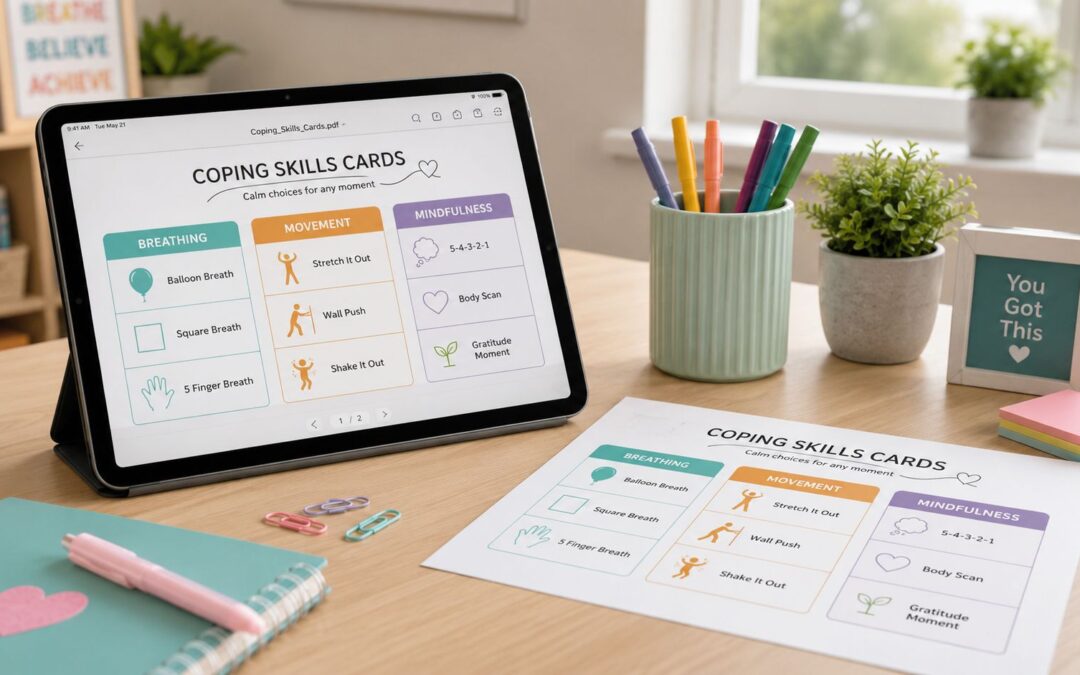
For teachers, this may mean building a few routines into the day instead of waiting for crisis. A calm corner. A check-in ritual. A class breathing pause after recess. A feelings chart near the meeting rug. A regular writing prompt that lets students process emotion without being put on the spot.

For parents, it often means changing the first response. Instead of “You’re fine” or “Go calm down,” try “I can see this is a lot” or “Let’s help your body first.” That small shift teaches children that emotions are manageable, not dangerous.

Research also supports the idea that adaptive emotional processing matters more than suppression. The distinction is important in schools and homes alike. We don’t want children to stuff feelings down. We want them to learn how to notice, express, and move through them safely.

If a child’s distress is persistent, severe, or interfering with daily life, bring in more support. A school counselor, pediatrician, or licensed mental health professional can help assess what’s going on and what level of care is needed. Some schools also look to SEL organizations such as Soul Shoppe for workshops, courses, and community-based support that give children and adults shared language for self-regulation, empathy, and connection.

And if you’re helping a child prepare for a big transition, emotional coping belongs there too, right alongside academic skills. Practical readiness includes the ability to handle frustration, ask for support, and recover from mistakes. This InchBug guide to kindergarten readiness is a useful reminder that school success depends on more than letters and numbers.


If you want more support teaching kids how to name feelings, regulate big emotions, and build safer relationships, explore Soul Shoppe. Their SEL resources and programs are built to help school communities and families practice these skills in everyday life.

Living in the Now: A Guide for Kids & Grownups

Living in the Now: A Guide for Kids & Grownups

You’re probably reading this in the middle of real life. A student is tapping a pencil. Another is asking for help while half the class is still settling down. At home, dinner is on the table, but everyone’s attention is somewhere else. One child is replaying what happened at recess. A grownup is thinking about tomorrow’s schedule.

That’s usually where “living in the now” gets misunderstood. It can sound vague, lofty, or unrealistic. In schools and homes, it’s not any of those things. It’s the practical skill of noticing what is happening inside and around you, then returning your attention to this moment with enough steadiness to make a wise next choice.

As educators and caregivers, we don’t need children to become perfectly calm or meditative. We need them to notice, “My body is tight.” “My mind is racing.” “I’m not listening.” “I need a reset.” That kind of presence changes how kids learn, how adults respond, and how relationships recover after stress.

From Scattered Moments to Mindful Connection

The quiz papers are face down. A teacher says, “Begin,” and the room looks ready. Still, one student is frozen after a hard recess moment. Another is on a third trip to the sharpener. A third has already decided, “I’m bad at math,” before reading question one.

At home, the pattern can look quieter but feel just as familiar. A caregiver asks about the day while packing lunches in their head for tomorrow. A child shrugs, says “fine,” and carries worry from the bus ride, the group project, or the lunch table into the evening.

These are ordinary moments of attention slipping away.

Researchers Matthew Killingsworth and Daniel Gilbert found that people spend about 47% of their waking hours thinking about something other than what they are doing, a pattern they linked with lower happiness in their published study in Science. In classrooms and homes, that drift shows up in ways adults know well. Directions need repeating. Conflict escalates fast. A child’s body is in the room, but their attention is stuck in a different moment.

A diverse group of students sitting at desks in a classroom, attentively looking towards the front.

What living in the now actually means

Living in the now means bringing attention back to what is happening here, in this body, in this room, at this moment, so a child or adult can choose the next action with more care.

That sounds abstract until you watch it in practice. Presence works like putting both feet back on the ground before taking the next step. You are not erasing the past. You are not ignoring what comes next. You are helping the nervous system register, “I am here now, and I can notice what is true before I act.”

In Soul Shoppe programs, that often starts with something simple and concrete, because children learn this skill best by doing it, not by hearing a lecture about mindfulness.

In a classroom, that might sound like:

  • Before a lesson: “Check in with your body. Are your shoulders up or down? Let them drop.”
  • During conflict: “Pause. Tell me what happened in one sentence. Then tell me what you feel right now.”
  • Before speaking: “Put a hand on your chest or desk. Feel the surface. Now say your words.”

At home, it might look like:

  • At pickup: “Do you want to start with your mind, your body, or your feelings?”
  • At dinner: “Let’s each name one thing we notice right now. A sound, a smell, or how our body feels in the chair.”
  • At bedtime: “What is one thing your body is still holding from today? What would help it settle?”

For restless children, “notice your breath” can feel too vague or too hard. A better entry point is often sensory and external. “Find three blue things.” “Press your feet into the floor.” “Push your hands together for five seconds.” These are present-moment practices too.

For children who resist, the goal is not perfect participation. It is a small return of attention. A muttered answer counts. One second of eye contact counts. A child tapping their knees while listening counts.

For children who have experienced trauma, presence needs to feel safe, predictable, and chosen. Some children do better looking at a spot on the wall than closing their eyes. Some need movement before reflection. Some need the adult to say, “You do not have to share. Just notice whether your body feels fast, slow, tight, or loose.”

That is what mindful connection looks like in real life. It is brief, teachable, and repeatable. And over time, these small routines help children build the inner pause that makes learning, repair, and relationship more possible.

The SEL Science of Being Present

A student walks in from recess still carrying the argument that happened on the blacktop. Their body is in the classroom, but their attention is still outside. Then math starts. A classmate bumps their chair. The pencil drops. The student snaps.

That sequence is common in K to 8 spaces. It is also teachable.

Present-moment awareness gives children a way to notice what is happening inside them before the feeling takes over their words or actions. In SEL terms, it supports the skills underneath the skills. A child needs to notice frustration before they can manage it. They need to catch the tightening shoulders, hot face, or racing thoughts before they can make a different choice.

Research has linked school-based SEL to stronger emotional skills, behavior, and academic functioning, and mindfulness-informed approaches are often studied as part of that picture. If you work in a school or support a busy home, the takeaway is practical. Presence helps children get to regulation, connection, and learning faster because it gives them a small pause between experience and reaction.

A diagram illustrating the connection between Social Emotional Learning skills and the concept of living in the now.

How presence supports each SEL skill

Educators often ask, “What does being present change?” A simple way to explain it is to picture a traffic light. Presence helps a child notice the yellow light. Without that moment of noticing, they go straight from feeling to action.

Here is how that shows up across SEL:

  • Self-awareness starts with noticing. “My stomach feels tight.” “My hands want to grab.” “I am getting embarrassed.”
  • Self-management follows awareness. “I can press my feet down.” “I can ask for a break.” “I can try again instead of tearing the page.”
  • Social awareness gets stronger when a child has enough steadiness to notice another person’s face, tone, or need.
  • Relationship skills improve when students can stay in the moment long enough to listen, repair, and respond.
  • Responsible decision-making depends on a brief pause. Even two seconds can change what happens next.

A principal may talk about school climate. A counselor may talk about co-regulation. A teacher may say, “I need the class back with me.” These are different names for the same human capacity.

A classroom example

A student gets a problem wrong and embarrassment rises fast. If no one has taught present-moment skills, that feeling often turns into behavior right away. The paper gets crumpled. A peer gets blamed. The student checks out.

With practice, the sequence can look different:

  1. The student notices heat in the face and tightness in the chest.
  2. They hear a familiar cue such as, “Pause and plant your feet.”
  3. They press both feet down or place a hand on the desk.
  4. They take one slower breath or ask for help.

That is observable SEL. It is not a theory. It is a routine the nervous system can learn through repetition.

This matters even more for children who are restless, resistant, or carrying stress from hard experiences. For those students, “pay attention” is often too vague. A concrete cue works better. “Feel your shoes on the floor.” “Look for two corners in the room.” “Push your palms together.” Soul Shoppe’s approach works well here because it gives children simple tools they can try in real time, instead of asking them to understand a big idea first.

Adults need the same practice. A teacher who notices, “My voice is getting sharp,” can reset before correction turns into power struggle. A parent who realizes, “I am asking questions too fast,” can slow the conversation and help a child feel safer.

For a wider school-based view, Soul Shoppe also explains the benefits of social emotional learning in concrete, everyday terms.

Where readers often get confused

People sometimes hear “be present” and picture a calm child sitting still with folded hands. That picture leaves out real life.

A child can be present while angry. A teacher can be present while frustrated. Presence means noticing what is here with enough clarity to respond on purpose.

That distinction matters in classrooms and homes. The goal is not a performance of calm. The goal is a return to awareness.

For children with trauma histories, that return must feel safe and chosen. Some students regulate better with eyes open. Some need movement before reflection. Some will only tolerate a five-second check-in, and that still counts. The science matters because it points us toward practice. Children build presence through repeated, supported experiences of noticing, naming, and returning.

Core Practices for Building Present-Moment Awareness

The strongest classroom and home routines are concrete. Children do better when the practice is short, repeatable, and tied to something they can feel in their body.

Start there.

Three people relaxing together, practicing meditation, watering a houseplant, and drinking tea in a bright room.

Sensory grounding that works in real time

Sensory grounding helps restless students because it gives attention a job. Instead of saying, “Calm down,” you say, “Notice.”

Try a Sound Scavenger Hunt when the room is buzzy.

Script:

  1. “Let your body get still enough to hear.”
  2. “Find one sound close to you.”
  3. “Now one sound far away.”
  4. “Now one sound you didn’t notice at first.”
  5. “Open your eyes and tell me just one.”

This works well before independent work, after recess, or during a noisy transition at home.

Another favorite is Color Find.

Script:

  • “Look around and find three things that are blue.”
  • “Now two things that are soft.”
  • “Now one thing that helps this room feel safe.”

That last prompt matters. It helps children connect presence with safety, not just compliance.

Breathwork kids can actually do

Some children love breathing exercises. Some feel awkward or resistant. Keep the language simple and avoid making it feel performative.

Five-Finger Breathing is often a good entry point.

Script:

  • “Hold up one hand like a star.”
  • “Use one finger from your other hand to trace up a finger as you breathe in.”
  • “Trace down as you breathe out.”
  • “Keep going until you reach the thumb again.”

For younger children, I say, “Smell the flower, blow the pinwheel.” For older students, I say, “Match your breath to your hand and let your shoulders drop if they want to.”

If you want more ready-to-use activities, Soul Shoppe’s article on mindfulness exercises for kids offers classroom-friendly ways to build this habit.

Movement for children who don’t want to sit still

Some students connect to the present through movement faster than through stillness. That’s not a problem. It’s useful information.

Try Robot to Ragdoll.

Script:

  1. “Stand tall like a robot. Tight arms, tight legs, tight face.”
  2. “Freeze.”
  3. “Now melt into a ragdoll. Loose shoulders, loose knees, loose jaw.”
  4. “Do that two more times and notice which feels better for learning.”

You can also use Push the Wall.

Script:

  • “Place your hands on the wall.”
  • “Push slowly and feel your muscles turn on.”
  • “Take one breath.”
  • “Step back and notice if your body feels more ready.”

For many children, especially after conflict or overstimulation, pressure and movement are more regulating than verbal reminders.

When a child can’t access quiet attention, offer a body-based path into the moment.

A reflection tool for older students and adults

For upper elementary, middle school, and grownups, structured reflection can help uncover what keeps pulling attention away from the present. One useful approach is the Wheel of Life. According to this explanation of the Wheel of Life coaching tool, K-8 adaptations such as a Student Wheel show 70% self-regulation gains in SEL programs.

A simple Student Wheel might include:

  • Friendships
  • Schoolwork
  • Family
  • Rest
  • Play
  • Body and health
  • Hobbies
  • Feelings

Ask students to rate how each area feels right now, then choose one small improvement. Not a total life overhaul. Just one next step.

Examples:

  • “Friendships feels low. I will sit with one safe person at lunch.”
  • “Schoolwork feels stressful. I will ask the teacher my first question instead of waiting.”
  • “Rest feels low. I will put my backpack away before snack so my body can settle.”

This works because presence grows when children can name what is pulling on them.

Later in the day, you can pair that reflection with a communication routine. If you’re helping students or family members respond with more care, this guide to active listening is a helpful companion. Presence and listening reinforce each other.

A short guided practice for busy days

Use this when you have two minutes and not a second more.

  1. “Put both feet on the floor.”
  2. “Notice where your body touches the chair.”
  3. “Take one breath in.”
  4. “Take one slower breath out.”
  5. “Name one feeling in your mind.”
  6. “Look at one thing in the room that stays still.”
  7. “Begin.”

A simple video can help adults and children practice outside the moment of stress too.

What to remember

Not every practice fits every child every day. One student settles with breath. Another needs movement. Another needs to draw before talking.

That isn’t inconsistency. That’s responsive teaching.

Weaving 'Now' Moments into Your Classroom and Home

The most effective presence practices don’t live in a special binder. They live inside the day you already have.

A teacher doesn’t need a new 30-minute block. A caregiver doesn’t need a perfect evening routine. What helps most is attaching a small “now” moment to places that already repeat.

That’s also how habits become part of a group culture. Children learn by watching one another, borrowing language, and repeating shared routines. If you want a useful overview of how that process works, this explanation of social learning concepts gives a clear frame for why modeling matters so much.

In the classroom

Try matching practices to predictable moments:

  • Morning arrival
    Greet students, then offer one settling choice: hand on heart, wall push, or three quiet breaths.

  • Before transitions
    Ring a chime or give a verbal cue such as, “Notice your feet before you move.”

  • Before assessments
    Invite students to unclench hands, drop shoulders, and look at one corner of the paper before starting.

  • After recess or lunch
    Use sound noticing, stretching, or one sentence stem: “Right now my body feels…”

  • After conflict
    Don’t rush to a full discussion. Start with regulation. “Can you feel your feet? Are you ready to talk now or in two minutes?”

For teachers wanting additional age-appropriate ideas, this Soul Shoppe piece on teaching mindfulness to children offers practical ways to fold these routines into school life.

At home

Families can build the same habit without calling it mindfulness if that word doesn’t fit.

Try these anchors:

  • In the car
    “Before we talk, let’s each notice one thing we can see outside.”

  • At meals
    “What does your first bite taste like?”
    “What does your body feel like today?”

  • During homework frustration
    “Stop. Shake out your hands. Tell me what your brain is saying right now.”

  • At bedtime
    “What happened today that your body is still holding?”
    “What is over now?”

The routine matters more than the label. A one-minute reset done daily teaches more than a long lesson done rarely.

Activity adaptations for living in the now

Practice Grades K-2 (Ages 5-7) Grades 3-5 (Ages 8-10) Grades 6-8 (Ages 11-14)
Sound noticing Listen for one near sound and one far sound Identify three layers of sound in the room Notice sound without judging it as annoying or good
Breathing practice Smell the flower, blow the pinwheel Five-finger breathing with slower exhale Silent counted breathing before tests or transitions
Body check-in “My body feels wiggly, sleepy, or tight” Name body sensations and choose a reset tool Track body cues linked to stress, conflict, or avoidance
Mindful movement Stretch high, fold low, shake out arms Robot to Ragdoll or wall push before work time Short movement reset, then self-direct back into focus
Reflection Draw the feeling with color Sentence stem: “Right now I need…” Brief journal entry on what is pulling attention away
Conflict repair “I didn’t like that” with adult support Pause, breathe, say what happened Pause, regulate, then use respectful problem-solving language

A few ready-made routines

Some readers get stuck because they like the idea but can’t picture when to use it. Here are examples.

Morning Meeting Starter
“Show me with your fingers how ready your body feels for learning. One means not ready yet. Five means ready. If you’re below a three, choose a reset.”

Transition Tamer
“When you hear the signal, freeze your feet, soften your face, and take one breath before moving.”

Pre-Test Focuser
“Your job is not to feel perfect. Your job is to arrive. Eyes on the page. One inhale. Longer exhale. Start with the easiest problem.”

Bedtime Wind-Down
“Let’s tell the truth about the day. What felt good? What felt hard? What can your body let go of now?”

These small scripts help children trust the routine. Over time, they begin to use the language without being prompted.

Troubleshooting Resistance and Deepening the Practice

Many children don’t respond to “let’s be mindful” with calm appreciation. They giggle. They groan. They stare at you. Some become more activated when asked to be still.

That response makes sense.

The brain doesn’t naturally rest in the present for long stretches. A key challenge is that the present moment is neurologically hard to inhabit, and our brains may spend 50-75% of waking hours mind-wandering, as described in this discussion of why the present is hard to access. That difficulty can be even more pronounced for children, who are still developing the skills that support impulse control and attention.

A happy young girl and her mother sitting on the wooden floor and playing together at home.

When children say it’s silly

Don’t argue. Translate the practice into plain purpose.

Instead of:

  • “We’re doing mindfulness now.”

Try:

  • “We’re helping our brains get back.”
  • “We’re giving your body a reset.”
  • “We’re making it easier to learn.”
  • “We’re noticing what’s happening before it gets bigger.”

For some students, naming the benefit lowers resistance. For others, choice lowers resistance more than explanation does.

Offer options:

  • Sit or stand
  • Eyes open or lowered
  • Breathe, stretch, draw, or listen
  • Join now or watch first

Choice protects dignity.

When a child is restless or dysregulated

Stillness is not the first intervention for every nervous system. If a child is bouncing, agitated, or close to a meltdown, start with action.

Try this sequence:

  1. Orient by looking around the room.
  2. Press hands together or push against a wall.
  3. Move with marching, stretching, or carrying books.
  4. Name one body sensation.
  5. Then invite one breath if it feels accessible.

That order matters. Regulation often moves from body to breath, not the other way around.

Some children need to arrive through motion before they can arrive through attention.

A trauma-informed approach

For children who have experienced chronic stress, the phrase “just be in the moment” can feel impossible. If the body is scanning for danger, calm attention won’t come from pressure.

Use these trauma-informed principles:

  • Lead with safety
    Keep your voice steady. State what will happen next.

  • Offer predictability
    Repeat the same short routine often.

  • Avoid forced participation
    Invite. Don’t demand.

  • Use external anchors
    Sounds, objects, textures, and movement can feel safer than closing eyes or focusing inward.

  • Respect the no
    A child who declines may still be learning by watching.

If a student says, “I hate this,” you can respond with, “Thanks for telling me. You can keep your eyes open and just listen for one sound.” That keeps the door open.

For neurodiverse learners

Many neurodiverse students benefit from present-moment practices, but they may need adaptation.

Consider:

  • shorter directions
  • visual prompts
  • tactile supports
  • movement before reflection
  • concrete language instead of metaphor
  • reduced emphasis on silence

For one child, a fidget may support focus. For another, doodling while listening may be the pathway to staying present. Don’t confuse a nontraditional regulation strategy with disengagement.

Reflection without judgment

Adults often turn mindfulness into another performance metric. Children can feel that instantly.

Instead of asking, “Did you do it right?” ask:

  • “What did you notice?”
  • “Was your body more settled, less settled, or the same?”
  • “Which tool helped a little?”
  • “What should we try next time?”

For adults, useful reflection sounds like:

  • “When did I feel most available today?”
  • “What pulled me out of the moment?”
  • “What helped me return without force?”
  • “Did I ask children for presence that I wasn’t practicing myself?”

These questions build awareness without shame.

The grownup obstacle

Many adults say, “I don’t have time.”

Often what they mean is, “I don’t have capacity for one more thing.” That’s real. So don’t add another thing. Put presence inside what you already do.

Try:

  • one breath before answering a hard email
  • both feet on the floor before speaking to a child in distress
  • one moment of silence before starting the car
  • noticing your jaw during a tense meeting

Living in the now becomes sustainable when it stops being a performance and starts becoming a return.

Your Soul Shoppe Toolkit for Lasting Change

Children learn presence through repetition, relationship, and shared language. Adults do too. That’s why one-off reminders rarely create lasting change. A school or family needs routines, cues, and tools people can use when emotions are calm and when emotions are big.

A structured practice helps. According to this presentation on cultivating presence through daily protocols, 70% of participants sustain more than 30 minutes of daily presence after 30 days, with a 25% drop in cortisol. The same source reports that bringing 10-minute daily Now Circles into K-8 settings has led to 60% gains in peer empathy. For educators, that points to something practical. Presence grows when it is taught as a repeatable routine, not treated as a one-time inspiration.

What lasting implementation looks like

In schools, lasting change usually includes:

  • Shared language
    Students and staff use the same words for noticing feelings, needs, and regulation tools.

  • Predictable practice
    Presence shows up during arrival, transitions, conflict repair, and academic stress.

  • Adult modeling
    Students see grownups pause, reset, and repair in real time.

  • Family connection
    The same simple tools travel home in accessible ways.

  • Reflection
    Teachers and caregivers track what helps different children return to the moment.

A defined toolkit matters more than enthusiasm alone.

One practical option for schools and families

Soul Shoppe is one resource schools use to teach self-regulation, mindfulness, communication, and conflict resolution through experiential SEL programs, workshops, assemblies, coaching, and family-facing supports. If you’re looking for materials that help turn these ideas into repeatable school and home routines, their overview of social-emotional learning tools is a useful starting point.

For principals and SEL leaders, the practical question is often not “Does presence matter?” It’s “How do we help busy adults teach it consistently?” The answer usually includes scripts, modeling, and a small set of rituals that can be used across grade levels.

A simple action plan

If you want this to stick, keep it narrow at first.

  1. Pick one moment of the day
    Arrival, before tests, after recess, dinner, or bedtime.

  2. Choose one routine
    Sound noticing, wall push, five-finger breathing, or a one-sentence body check-in.

  3. Use the same words for two weeks
    Consistency helps children feel safe enough to participate.

  4. Offer choice
    Let children engage through breath, movement, drawing, or listening.

  5. Reflect briefly
    Ask, “What helped?” instead of “Did it work?”

Small daily practice beats occasional intensity. Children trust what adults repeat.

What success really looks like

Success is not a perfectly serene classroom or a child who always pauses before reacting.

Success looks more like this:

  • a student notices they’re overwhelmed sooner
  • a teacher catches tension before snapping
  • a parent chooses curiosity instead of immediate correction
  • a class returns to focus faster after disruption
  • a child uses one learned phrase during conflict instead of shutting down

Those are meaningful signs of growth. They are also the building blocks of belonging.

Living in the now is not about escaping real life. It’s about meeting real life with more awareness, steadiness, and care. In schools and homes, that changes the climate one small moment at a time.


If you want support turning these ideas into daily practice, explore Soul Shoppe for school-based SEL programs, family resources, and experiential tools that help kids and grownups build presence, empathy, and connection together.

8 Anger Management Activities for Preschoolers (2026 Guide)

8 Anger Management Activities for Preschoolers (2026 Guide)

The fiery intensity of a preschooler's anger can be overwhelming for them and the adults who care for them. While meltdowns, stomping feet, and shouts of 'No!' are a normal part of development, they also present a crucial opportunity. This isn't just about stopping 'bad behavior'; it's about building the foundational skills of emotional intelligence that will support a child for a lifetime. Helping young children understand and manage their anger is one of the most important social-emotional learning (SEL) tasks they will face.

This guide moves beyond generic advice to provide eight specific, evidence-based, and playful anger management activities for preschoolers. Designed for both classroom and home settings, these strategies will equip educators and parents with practical tools to turn challenging moments into powerful lessons in self-regulation, empathy, and resilience.

You will learn how to implement actionable strategies such as:

  • Creating a "Feelings Thermometer" for emotional check-ins.
  • Teaching "Calm Down Breathing" through simple, memorable exercises.
  • Building effective "Calm Corners" or sensory stations.
  • Using picture books to discuss and normalize big feelings.

Each activity includes step-by-step instructions, materials lists, and specific language to use, making it easy to put these ideas into practice immediately. These are not just activities, but building blocks for creating an environment where every child feels understood and can learn to navigate their emotions constructively.

1. Feelings Thermometer Activity & Check-In Circles

Combining a visual feelings thermometer with regular check-in circles gives preschoolers a concrete tool and a structured routine to understand and manage their emotions. This two-part approach is one of the most effective anger management activities for preschoolers because it teaches emotional awareness and builds a supportive community simultaneously. The thermometer makes an abstract concept, the intensity of anger, visible and understandable for young children.

Check-in circles provide a safe, predictable space to practice using this new emotional vocabulary. By normalizing discussions about feelings, children learn that emotions are a normal part of life and that there are healthy ways to express them.

How It Works

A feelings thermometer is a visual scale, often color-coded, that helps a child identify the intensity of their emotions. It might range from blue (calm) at the bottom, to yellow (frustrated), orange (upset), and finally red (furious) at the top. The goal is to help children recognize when their feelings are starting to "heat up" before they reach the red zone.

Check-in circles are short, structured group gatherings where each child gets an opportunity to share how they are feeling using the thermometer as a guide. This routine builds empathy, listening skills, and a sense of belonging.

Key Insight: The power of this activity lies in the connection between the visual tool and the social routine. The thermometer gives children the language, and the circle gives them a safe place to use it.

Implementation Guide

  • Objective: To help preschoolers identify the intensity of their anger and practice sharing their feelings in a supportive group setting.
  • Materials: Large chart paper or poster board, markers, crayons, or paint in various colors (blues, greens, yellows, oranges, reds), optional clothespins or magnets with children's names.
  • Step-by-Step:
    1. Create the Thermometer Together: Involve the children in making the feelings thermometer. Draw a large thermometer shape and assign colors to different feeling levels. Ask them, "What color feels calm? What color feels a little mad? What about very, very angry?" This co-creation builds ownership.
    2. Introduce the Concept: During a calm time, show them the thermometer. Say, "This is our Feelings Thermometer. When we are feeling great, we might be down here in the cool blue. Sometimes, things make us feel frustrated, and we start to warm up to yellow."
    3. Establish Circle Norms: Before the first check-in, set simple rules: "We listen with our ears and hearts," "It's okay to pass," and "What we share in the circle stays in the circle."
    4. Model and Practice: Begin the circle by modeling. "I'm feeling yellow today because I couldn't find my favorite pen. I am going to take a deep breath to help myself cool down." Then, go around the circle, inviting each child to share their "color" for the day. Keep it brief, just 5-10 minutes.

Tips for Success

  • Practice When Calm: Introduce and practice using the thermometer when children are relaxed. Don't wait for a moment of intense anger to teach the tool.
  • Use "Pass" Options: Always allow children the option to pass. Forcing a child to share can increase anxiety. A simple "pass" is a valid and respected choice.
  • Home Adaptation: Families can use a smaller, portable thermometer on the fridge. During dinner or bedtime, ask, "What was your color today? What made you feel that way?" For example, a parent could say, "I felt yellow today when I was stuck in traffic, but now I feel blue because I am home with you."

This activity provides a foundational skill set for emotional self-regulation. To dive deeper into using visual aids, explore different types of charts and their benefits with our guide to using a feelings chart for kids.

2. Breathing and Mindfulness Exercises (Calm Down Breathing)

Teaching structured, age-appropriate breathing and mindfulness exercises gives preschoolers a powerful, portable tool for self-regulation. Techniques like "Bubble Breaths" or "Hot Chocolate Breathing" are exceptional anger management activities for preschoolers because they directly activate the body's relaxation response. These simple, playful exercises use visualization to help children calm their nervous systems when big feelings like anger start to take over.

A preschooler blows colorful bubbles during a mindful breathing exercise with an adult.

Unlike other strategies that require materials or specific locations, breathing is always available. By practicing these techniques during calm moments, children build the neural pathways needed to access this skill during times of stress, frustration, or anger. It empowers them with a sense of control over their bodies and emotions.

How It Works

Mindful breathing interrupts the body's fight-or-flight response, which is triggered by anger. Slow, deep breaths send a signal to the brain that the danger has passed, lowering the heart rate and allowing the prefrontal cortex-the thinking part of the brain-to come back online. Using child-friendly imagery makes this biological process accessible and engaging.

For example, "Flower and Candle" breathing involves pretending to smell a flower (deep inhale through the nose) and then blowing out a candle (slow exhale through the mouth). This gives children a concrete action to focus on, making the abstract concept of deep breathing easy to grasp.

Key Insight: The goal is not to stop anger but to give children a way to pause and create space between a feeling and a reaction. This pause is where self-control begins.

Implementation Guide

  • Objective: To teach preschoolers simple, memorable breathing techniques to calm their bodies when they feel angry or overwhelmed.
  • Materials: Optional visual aids like a real or toy flower, bubbles, or a picture of hot chocolate.
  • Step-by-Step:
    1. Choose an Engaging Technique: Select a method with imagery that will appeal to your children. "Hot Chocolate Breathing" is a great start: "Let's pretend we have a big cup of hot chocolate. It's too hot to drink! First, smell the yummy chocolate (breathe in slowly through the nose). Now, cool it off (breathe out slowly through the mouth)."
    2. Model and Exaggerate: During a calm group time, model the exercise yourself. Make your inhales and exhales audible and your movements big. Say, "Watch me! I'm breathing in… 1, 2, 3… and now I'm blowing out… 1, 2, 3, 4, 5."
    3. Practice Together: Guide the children through three to five repetitions. Make it a fun, gentle game.
    4. Integrate into Routines: Practice for a few minutes daily, such as during morning circle, before transitions, or after active play. This routine makes the skill second nature.

Tips for Success

  • Practice When Calm: The most critical tip is to introduce and practice these exercises when children are happy and relaxed. It's a skill that must be learned before it can be used in a moment of anger.
  • Use Visual Cues: Use your hands to "hold" the imaginary hot chocolate or flower. For "Bubble Breaths," you can use a real bubble wand to show how a slow, steady exhale creates the best bubbles.
  • Name the Feeling: When a child is upset, calmly say, "You look so frustrated. Your body is tight. Let's try our Hot Chocolate Breaths together to help your body feel calm again." This connects the technique directly to the feeling. For instance, if a child is crying because their block tower fell, you can get down to their level and say, "That is so sad and frustrating. I see your fists are clenched. Let's blow out some imaginary birthday candles to help those feelings move."

By making breathing exercises a playful and consistent part of their day, you are giving preschoolers a foundational life skill for emotional regulation. To explore a core technique in more detail, you can get practical tips from our guide on the belly breathing technique.

3. Anger Management Sensory Stations / Calm Corners

Creating a designated calm corner or sensory station gives preschoolers a safe, independent space to go when they feel overwhelmed by anger. This physical area, stocked with carefully chosen sensory tools, is one of the most effective anger management activities for preschoolers because it honors their individual sensory needs and empowers them to self-regulate. It moves the focus from punishment for big feelings to providing support for them.

A calm corner for preschoolers with a sensory bin, glitter bottle, and floor cushion for quiet play.

These spaces, often called 'peace corners' in Montessori schools, offer a multisensory approach that addresses diverse regulatory styles. One child may need to squeeze a stress ball (proprioceptive input), while another may need to watch a glitter jar settle (visual input). Providing these options gives children agency and teaches them a critical life skill: how to recognize what their body needs and take action to feel better.

How It Works

A calm corner is not a "time-out" spot; it is a "time-in" space for self-regulation. It is a quiet, comfortable area in the classroom or home filled with tools that help a child's nervous system return to a state of calm. The items provide tactile, visual, auditory, and proprioceptive input that can de-escalate feelings of frustration, overstimulation, and anger.

The goal is for children to learn to recognize their rising anger and voluntarily use the space to manage their emotions before they become explosive. For example, a child who feels themselves getting "hot" might choose to go to the corner and knead play-doh, redirecting their physical energy in a safe way.

Key Insight: This activity teaches children that their big feelings are acceptable and that they have the power to manage them. The corner is a tool, not a punishment, which builds internal motivation for self-regulation.

Implementation Guide

  • Objective: To provide a safe, accessible space with sensory tools that help preschoolers self-soothe and manage feelings of anger independently.
  • Materials: A soft rug or cushion, a small tent or canopy for privacy, and a variety of sensory items like: squishy balls, play-doh, sensory bins (with rice or beans), glitter jars, headphones with calming music, soft blankets, and textured books.
  • Step-by-Step:
    1. Co-Create the Space: Involve the children in designing the corner. Let them help pick the spot and decorate it. Ask, "What things help you feel calm? What colors feel peaceful?" This builds ownership and makes the space more inviting.
    2. Introduce During Calm Times: Present the calm corner as a special, wonderful place. During a circle time, say, "This is our new Calm Corner! It's a place we can go when our bodies feel too busy or our hearts feel upset." Let them explore the items freely when they are relaxed.
    3. Model and Role-Play: Demonstrate how to use the space. You might say, "I'm feeling a little frustrated because my blocks fell over. I think I'll go to the calm corner and look at the glitter jar to help my body feel better." Role-play a scenario: "Let's pretend Leo is feeling angry because it's time to clean up. What could Leo do in the calm corner to help his body feel ready?"
    4. Guide, Don't Force: When you see a child struggling, gently suggest the corner. "You seem upset. Would you like to go to the calm corner and squeeze the squishy ball for a few minutes?"

Tips for Success

  • Rotate the Items: Keep the station engaging by rotating the sensory tools every few weeks. Novelty prevents boredom and encourages exploration.
  • Label with Pictures: For pre-readers, use picture labels on bins and shelves. This helps them find what they need independently and builds pre-literacy skills.
  • Observe and Adapt: Pay attention to which items children use most. If everyone loves the play-doh but ignores the textured books, swap the books for something else.
  • Home Adaptation: A calm corner at home can be as simple as a basket of sensory toys in a quiet part of a room. Parents can say, "Let's take a break with your calm basket," when they notice frustration building during playtime. For example, before a tantrum over screen time ending, a parent could say, "I know you're sad the show is over. Let's go to your calm corner and build with the magnetic tiles for five minutes."

Sensory stations are powerful because they directly address how a child’s brain and body experience stress. To explore this connection further, see how you can apply these principles with a simple 5 senses activity that helps ground children in the present moment.

4. Angry Feelings Picture Books and Bibliotherapy

Using picture books to explore big emotions, a practice known as bibliotherapy, is a gentle yet powerful anger management activity for preschoolers. Stories provide a safe distance for children to observe characters who are feeling angry, which normalizes the emotion and models a variety of coping strategies. This approach builds emotional vocabulary, empathy, and problem-solving skills in a low-pressure, engaging way.

When a child sees a beloved character like Sophie from When Sophie Gets Angry feel overwhelmed, it validates their own feelings. Discussing the story afterward helps them connect the character's experience to their own life, giving them language for their emotions and ideas for what to do when they feel that "roaring, red-hot" anger.

How It Works

Bibliotherapy for young children involves reading a story that features a specific emotional challenge and then facilitating a discussion that helps them process it. The narrative acts as a mirror, reflecting the child's own potential feelings, and as a window, showing them how others might handle similar situations. This process turns a simple storytime into a meaningful social-emotional learning opportunity.

By asking thoughtful questions, you guide children to think critically about emotions and behavior. This is not about finding the "right" answer but about exploring possibilities. For instance, you can discuss what a character did, what else they could have tried, and how their actions affected others.

Key Insight: Stories create a "third space" where children can talk about a character's anger without feeling the shame or pressure of talking directly about their own. This makes it a perfect entry point for discussing difficult emotions.

Implementation Guide

  • Objective: To use children's literature to normalize anger, teach emotional vocabulary, and model healthy coping strategies.
  • Materials: A curated selection of age-appropriate books about anger, such as When Sophie Gets Angry by Molly Bang, The Color Monster by Anna Llenas, or In My Heart: A Book of Feelings by Jo Witek.
  • Step-by-Step:
    1. Select a Relevant Book: Choose a book that depicts anger in a relatable way. Ensure the illustrations and story are clear and not overly frightening.
    2. Read with Intention: Read the story once through for enjoyment. On a second or third reading, pause at key moments. Use your tone of voice to match the character's feelings to make the emotion more tangible. For example, when reading about a character getting angry, you might speed up your words and speak a little louder, then slow down and soften your voice as they calm down.
    3. Ask Open-Ended Questions: After reading, start a conversation. Ask questions like, "How do you think the little bear was feeling on this page? What made him so angry?" and "What did he do to calm down? Have you ever tried that?"
    4. Connect to Their World: Bridge the story to their own lives. Say, "I remember you felt frustrated yesterday when the blocks fell over. The rabbit in our story also got frustrated. What could we do next time that happens?"
    5. Act It Out: Use dramatic play to re-enact scenes. Let children take on the role of the angry character and practice the coping strategy from the book, like taking a deep breath or finding a quiet corner.

Tips for Success

  • Repeat and Revisit: Preschoolers thrive on repetition. Reading the same book multiple times allows for deeper understanding and new conversations as they become more familiar with the story.
  • Choose Diverse Books: Select books that show a range of characters from different backgrounds and feature various coping strategies, from physical actions like stomping feet to quiet activities like drawing.
  • Create a "Cozy Corner Library": Designate a small, comfortable area in the classroom or home with a basket of "feelings books" that children can access independently when they need a moment.
  • Home Adaptation: Send books home on a rotating basis with a simple activity sheet. A prompt like, "Talk about a time you felt like the grumpy squirrel. Draw what helped you feel better," can involve families in the learning process.

5. Movement and Physical Activity for Anger Release

When a preschooler feels angry, their body often fills with a surge of physical energy. Structured movement is one of the most effective anger management activities for preschoolers because it provides a safe, constructive way to release this energy. Instead of suppressing the physical sensations of anger, activities like dancing, jumping, or stomping help children channel them into productive motion.

This approach teaches children that the physical feelings of anger are normal and manageable. By giving them a designated way to "get the wiggles out," we help them process stress hormones and connect with their bodies without resorting to hitting, kicking, or other aggressive behaviors.

How It Works

Structured physical activity gives anger a job to do. When a child feels overwhelmed, their fight-or-flight response is activated. Vigorous movement helps complete this stress cycle, allowing their nervous system to return to a calmer state. Activities like a designated "angry dance," stomping walks, or squeezing a foam ball provide immediate physical and sensory feedback.

Following these high-energy moments with a calming cool-down, such as stretching or deep breathing, teaches a crucial self-regulation skill: how to shift from a state of high arousal to one of rest and recovery. This helps build the mind-body connection.

Key Insight: Movement doesn't just burn off energy; it helps a child's brain and body process the physiological experience of anger, turning a potentially destructive impulse into a constructive action.

Implementation Guide

  • Objective: To provide a safe and acceptable physical outlet for the energy that accompanies anger, and to teach children how to transition from high energy back to a calm state.
  • Materials: Energetic music, open space, soft objects (pillows, foam balls, stuffed animals), optional obstacle course items (cushions, hula hoops).
  • Step-by-Step:
    1. Introduce the Concept: During a calm moment, explain the idea. Say, "Sometimes our bodies feel full of angry energy, like a shaken-up soda bottle. It’s okay to feel that way! We can do a 'Stomping Walk' or an 'Angry Dance' to let that energy out safely."
    2. Designate a Safe Space: Identify an area where vigorous movement is okay, like a corner with soft mats, an outdoor space, or a clear area in a room. This boundary is crucial for safety.
    3. Model the Movements: Demonstrate specific, acceptable actions. Show them how to stomp their feet like a dinosaur, punch a pillow, or jump up and down. Frame it positively: "Let’s help our bodies get the mad feelings out!"
    4. Practice and Cool Down: Turn on some upbeat music for a short "energy release" session. After a minute or two of vigorous activity, transition to slower, calmer music and lead them through cool-down stretches or breathing exercises. For example, after an "angry dance," say, "Great dancing! Now let's pretend we are melting ice cream. Slowly, slowly, let's melt all the way to the floor."

Tips for Success

  • Frame as Healthy, Not Punitive: Never present movement as a punishment (e.g., "Go run until you calm down"). Instead, use inviting language like, "Your body has a lot of energy right now. Let's go to the movement spot and let it out together."
  • Integrate into Routines: Use short movement breaks during transitions, which can be challenging times for preschoolers. A quick session of jumping jacks can preempt frustration.
  • Home Adaptation: Parents can create an "energy release kit" with a soft foam ball to squeeze and a special playlist for "dance it out" moments. For example, engaging in various motor skills activities for preschoolers can provide a healthy outlet for pent-up energy and help improve coordination, which can indirectly aid in self-regulation.

6. Creative Art Expression and Anger Artwork

Creative art expression provides a powerful nonverbal outlet for preschoolers to process anger. Open-ended art activities like painting, drawing, or sculpting allow children to externalize big feelings in a safe, tangible way. This makes it one of the most effective anger management activities for preschoolers, as it validates their emotions without needing complex vocabulary and produces a concrete artifact they can reflect on later.

A young child in a colorful smock joyfully paints a vibrant rainbow swirl on an easel.

This method helps children channel their physical energy and emotional intensity into a creative act. Instead of suppressing anger or acting it out destructively, they learn to transform it. The focus is on the process of creation, not the final product, giving them a healthy and constructive way to explore what they are feeling.

How It Works

This activity works by connecting physical action to emotional release. The vigorous brush strokes of painting, the forceful squeezing of clay, or the quick, sharp lines of a crayon drawing can mirror the physical sensations of anger. This tactile and visual process helps externalize the emotion, making it feel less overwhelming and more manageable.

Creating "anger artwork" allows a child to give their feeling a shape, color, and form. Afterward, the artwork can serve as a talking point. A teacher or parent can ask gentle, open-ended questions about the piece, helping the child build a narrative around their experience and connect their feelings to the events that caused them.

Key Insight: The value of anger artwork is not in its aesthetic quality but in its function as a bridge between a nonverbal emotional experience and verbal processing. It gives a child something concrete to point to and say, "This is what my anger looks like."

Implementation Guide

  • Objective: To provide a nonverbal, physical, and creative outlet for preschoolers to express and process feelings of anger.
  • Materials: Washable tempera paints, large sheets of paper, thick brushes, modeling clay or play-doh, chunky crayons or markers, collage materials (scrap paper, fabric scraps, glue sticks).
  • Step-by-Step:
    1. Set Up an Invitation: Create an inviting art station, perhaps in a calm-down corner or a designated art area. Lay out the materials on an easel or a covered table.
    2. Offer Minimal Direction: When a child is feeling angry or frustrated, guide them to the art station. Say something simple like, "It looks like you have some big feelings. Would you like to paint your anger?" or "Here is some clay you can squeeze and pound."
    3. Allow for Free Expression: Let the child lead the way. Avoid giving instructions like "Use this color" or "Draw a picture of what happened." The goal is pure, unfiltered expression. Vigorous, messy, and bold actions are welcome and part of the process.
    4. Engage After Creation: Once the child seems calmer and has finished their artwork, open a gentle dialogue. Ask, "Can you tell me about your art?" or "What's happening in this picture?" For example, if they used a lot of red, you might say, "I see a lot of powerful red here. That looks like a very strong feeling."

Tips for Success

  • Embrace Boldness: Use large paper and provide thick paints and brushes to encourage big, physical movements. Don't worry about the mess; focus on the expression.
  • Offer Texture Variety: Different textures appeal to different children. Some may find squeezing clay more satisfying, while others prefer the smooth glide of paint. When encouraging preschoolers to express their anger through art, consider incorporating structured yet flexible creative art projects for preschoolers.
  • Home Adaptation: Designate an "angry art" box at home with special crayons or a specific notepad. When a child is upset, they can go to their box. Families can also keep a portfolio of this artwork to look back on, noticing patterns or progress over time.

7. Positive Discipline and Restorative Practices Conversations

Shifting the focus from punishment to learning, restorative conversations are a cornerstone of positive discipline. This approach guides preschoolers through their big feelings after an outburst, helping them understand the situation, their emotions, and the impact of their actions on others. It is one of the most meaningful anger management activities for preschoolers because it teaches accountability, empathy, and problem-solving skills instead of simply punishing a behavior.

These conversations are not about blame but about repair. By creating a safe space for reflection, adults help children connect their feelings to their actions and discover more constructive ways to handle anger in the future. This method builds a child's internal moral compass and strengthens the parent-child or teacher-child relationship.

How It Works

Positive discipline and restorative practices use guided, curious questioning to help a child process an anger-driven incident after they have calmed down. Instead of asking "Why did you do that?", which can feel accusatory, the focus is on understanding and healing. The conversation moves from what happened to how everyone felt, what was needed, and how to make things right.

This method transforms conflict into a teachable moment. For example, after a conflict over a toy, a restorative conversation helps both children express their feelings and work together on a solution, such as taking turns or finding another toy.

Key Insight: The goal is connection before correction. By validating the child's anger ("It's okay to feel mad") while setting a boundary on the action ("but it's not okay to hit"), you teach that all feelings are acceptable, but not all behaviors are.

Implementation Guide

  • Objective: To help preschoolers reflect on their anger, understand its impact on others, and learn how to repair relationships and solve problems constructively.
  • Materials: A quiet, private space; a calm and regulated adult.
  • Step-by-Step:
    1. Wait for Calm: Never initiate a restorative conversation in the heat of the moment. Wait until the child is completely calm and regulated. This might be 10 minutes or an hour later.
    2. Find a Private Space: Choose a neutral, comfortable setting where you won't be interrupted. Sit at the child's level to create a feeling of safety and respect.
    3. Start with Curiosity: Begin with an open, non-judgmental tone. Say something like, "I saw what happened earlier and wanted to check in. Can you tell me about it?"
    4. Use Guided Questions: Gently guide the child through reflection with key restorative questions:
      • "What happened?" (Let them tell their story.)
      • "What were you feeling right before that happened?" (Helps connect feeling to action.)
      • "How do you think [the other person] felt when that happened?" (Builds empathy.)
      • "What can we do to make things better?" (Promotes accountability and repair.)
    5. Brainstorm and Co-create Solutions: Help the child think of a way to make amends. This could be a hug, a drawing, helping to fix a broken toy, or simply saying, "I'm sorry I pushed you. Can we play?"

Tips for Success

  • Validate the Emotion: Always start by acknowledging the feeling. "I can see you were very angry when your block tower fell down." This shows the child they are understood.
  • Focus on Repair, Not Punishment: The outcome should be about fixing the harm done, not about a punitive consequence. The natural consequence is having to repair the relationship. For example, if a child scribbled on their sibling's drawing out of anger, the repair isn't a time-out; it's helping their sibling make a new drawing.
  • Model the Process: When you, as the adult, make a mistake, model a restorative apology. "I'm sorry I raised my voice. I was feeling frustrated. Next time, I will take a deep breath."

This approach helps children build essential life skills. To see how these principles are applied in group settings, you can learn more about how to implement restorative circles in schools.

8. Family Engagement and Home-School Consistency Strategies

Creating a united front between home and school is a powerful strategy for reinforcing emotional learning. When parents and caregivers use the same anger management language and tools as educators, it provides a consistent, predictable environment for preschoolers. This approach validates a child's learning by showing that these skills are important everywhere, not just in the classroom.

This alignment transforms isolated lessons into a shared culture of emotional awareness. It empowers families to become active partners in their child's social-emotional development, extending the benefits of anger management activities for preschoolers far beyond school hours and building a stronger community around the child.

How It Works

Home-school consistency involves equipping parents with the same knowledge, vocabulary, and strategies used in the classroom. This is achieved through a variety of resources, such as parent workshops, take-home toolkits with printable breathing cards, and regular communication that shares specific techniques.

When a child learns to use a "calm-down corner" at school, a similar space at home reinforces the strategy. If a teacher uses the phrase "I see you're in the red zone, let's take a dragon breath," and a parent uses the same phrase later that day, the child's brain makes a stronger connection, making the skill easier to access during a moment of anger.

Key Insight: Consistency is the bridge that turns a classroom activity into a life skill. When a child hears the same emotional language at home and school, the concepts become deeply ingrained and more accessible during moments of high emotion.

Implementation Guide

  • Objective: To create a consistent emotional support system for preschoolers by aligning the strategies used at home and school, reinforcing emotional regulation skills.
  • Materials: Printable resources (e.g., feeling thermometers, breathing exercise cards), parent newsletters, digital communication apps, workshop presentation materials.
  • Step-by-Step:
    1. Host Family Workshops: Offer workshops that teach parents the core anger management strategies you use. Cover topics like co-regulation, validating feelings, and setting up a "peace corner" at home. Offer them at various times (mornings, evenings) to accommodate different schedules.
    2. Create 'Take-Home Toolkits': Assemble simple kits for families. Include a laminated feelings chart, a few illustrated breathing technique cards, and a one-page guide explaining how to use them.
    3. Establish a Communication Rhythm: Send a weekly or monthly newsletter. Each edition can highlight one specific strategy, such as "This week, we are practicing 'smelling the flower, blowing out the candle' breaths when we feel frustrated."
    4. Use a Home-School Log: For children needing extra support, a simple communication log can be very effective. A teacher might note, "Sam used the glitter jar to calm down today," giving the parent a specific success to build on at home. The parent could write back, "We practiced our hot chocolate breathing at bedtime, and it worked well!"

Tips for Success

  • Keep it Simple: Parents are busy. Provide tools that are easy to understand and can be used immediately without much preparation. One-page guides are more likely to be used than lengthy handbooks.
  • Celebrate Parent Efforts: Acknowledge and praise parents for their partnership. Create a parent support group or a section in the newsletter where families can share what's working for them.
  • Provide Accessible Materials: Offer all resources in multiple languages and consider different literacy levels. Use visuals and videos to convey concepts whenever possible. For an example of how to build a comprehensive program, see how Soul Shoppe's family engagement model supports schools.

Preschool Anger Management: 8-Strategy Comparison

Intervention Implementation complexity Resource requirements Expected outcomes Ideal use cases Key advantages
Feelings Thermometer Activity & Check-In Circles Moderate — needs routine and skilled facilitation Low–Moderate — visual tools, regular time block Better emotional identification, early intervention, stronger classroom community Daily morning meetings, preschool classrooms, family check-ins Concrete visual scale; builds shared language and belonging
Breathing and Mindfulness Exercises (Calm Down Breathing) Low–Moderate — requires modeling and practice Minimal — time, optional audio/video Immediate calming, improved self-regulation, increased body awareness Transitions, individual practice, group calming moments Evidence-based, immediately accessible without props
Anger Management Sensory Stations / Calm Corners Moderate — setup, supervision, and maintenance Moderate — sensory items, dedicated space, upkeep Independent regulation, accommodates sensory needs, quick de-escalation Classrooms with diverse sensory profiles, calm-down needs Choice and autonomy; multisensory regulation options
Angry Feelings Picture Books and Bibliotherapy Low — select texts and facilitate discussion Low — books and discussion time Expanded emotional vocabulary, empathy, normalized feelings Read-alouds, circle time, library or counseling sessions Story-based learning creates safe distance to explore emotions
Movement and Physical Activity for Anger Release Moderate — requires structure, safety and transitions Moderate–High — space, equipment, supervision Reduced physiological arousal, energy release, improved mood Outdoor play, brain breaks, high-energy de-escalation moments Directly addresses bodily sensations; highly engaging
Creative Art Expression and Anger Artwork Low–Moderate — materials prep and brief processing Moderate — art supplies, dedicated area, cleanup Nonverbal expression, tactile processing, artifacts for reflection Art sessions, calm corners, therapeutic follow-ups Accessible to nonverbal learners; fosters agency and expression
Positive Discipline and Restorative Practices Conversations High — needs trained facilitators and timing post-incident Low–Moderate — time, trained staff Accountability, relationship repair, improved problem-solving Post-incident debriefs, conflict resolution, relationship rebuilding Promotes repair over punishment; builds empathy and responsibility
Family Engagement and Home-School Consistency Strategies High — coordination, outreach, sustained follow-through High — staff time, workshops, materials, translation Greater consistency of strategies, extended learning, stronger partnerships Whole-school SEL initiatives, vulnerable families, scaling programs Amplifies impact across environments; empowers caregivers to reinforce skills

Building a Community of Calm and Connection

Guiding preschoolers through the powerful emotion of anger is one of the most fundamental tasks we undertake as educators, administrators, and caregivers. The collection of anger management activities for preschoolers detailed in this article-from building a Feelings Thermometer to engaging in restorative conversations-is not about suppressing a "bad" emotion. Instead, it’s about building a robust emotional vocabulary and a toolkit of healthy coping mechanisms that will serve children throughout their entire lives.

The journey to emotional regulation is a marathon, not a sprint. Consistency and patience are your most important allies. A single breathing exercise or one session in a Calm Corner will not instantly resolve every outburst. True progress comes from embedding these practices into the daily rhythm of the classroom and home, creating a predictable and safe environment where all feelings are acknowledged and validated.

From Individual Skills to a Shared Culture

The real power of these strategies is unlocked when they move beyond isolated activities and become part of a shared culture. When a teacher uses the same "Calm Down Breathing" technique that a parent reinforces at home, the child receives a unified message of support. This consistency is critical for preschoolers, who thrive on predictability.

Consider the ripple effect:

  • A child who learns to identify their anger level on a Feelings Thermometer can ask for help before an explosive moment, preventing disruption and building self-awareness.
  • A classroom that regularly uses bibliotherapy with stories about anger normalizes the feeling, reducing shame and encouraging open discussion among peers.
  • A school that adopts restorative practices shifts the focus from punishment to understanding, teaching children that their actions have an impact and giving them a chance to make things right.

This collective approach transforms a set of individual anger management activities for preschoolers into a community-wide commitment to emotional well-being. It sends a clear message to children: "Your big feelings are welcome here, and we will help you learn how to handle them."

The Long-Term Impact of Early Intervention

The skills children develop through these activities extend far beyond managing tantrums. They are laying the foundation for critical life competencies. A preschooler who can take a deep breath instead of hitting is learning impulse control. A child who uses "I feel…" statements is practicing assertive communication. A student who participates in a restorative circle is developing empathy and problem-solving skills.

Key Takeaway: The goal is not to raise children who never get angry. The goal is to raise children who know what to do with their anger. We are equipping them to face future challenges-disagreements with friends, academic frustrations, and personal disappointments-with resilience and emotional intelligence.

By intentionally teaching these skills, we are proactively building a more compassionate and connected school community. Children who feel understood and have the tools to manage their emotions are better learners, kinder friends, and more engaged citizens of the classroom. This work is the bedrock of creating a positive school climate, reducing behavioral issues, and fostering an environment where every child can thrive academically and socially. The investment you make today in teaching these foundational skills will pay dividends for years to come, shaping more empathetic and self-aware adults.


Ready to bring a structured, school-wide approach to social-emotional learning into your community? Soul Shoppe provides the programs, training, and resources that turn these powerful anger management activities for preschoolers into a cohesive and sustainable culture of peace. Explore our evidence-based programs and see how we can help you build a safer, more connected school at Soul Shoppe.

Emotion vs Mood Unlocking Student Well-Being

Emotion vs Mood Unlocking Student Well-Being

It’s easy to use the words “emotion” and “mood” interchangeably, but in the world of social-emotional learning, they mean very different things. Think of it this way: an emotion is like a sudden, intense rain shower—it hits hard but passes quickly. A mood is more like the weather for the entire day—a lingering sense of sunniness or a persistent gray gloom that colors everything.

Understanding the Key Difference Between Emotion and Mood

A smiling boy presents in a sunlit classroom while a teacher watches.

For educators and parents, telling them apart is the key to supporting a child’s well-being effectively. Whether a student is navigating a fleeting emotion or a persistent mood changes everything—how you respond, the words you use, and which strategies will actually help. This awareness is a cornerstone of building strong social-emotional skills.

Let’s look at a real-world example. Imagine Maria aces a tough math test she studied hard for. That immediate burst of pride and joy she feels? That’s an emotion. It’s a direct, powerful reaction to a specific event—the good grade—and it will probably fade as she heads to her next class.

Now, think about David, who comes to school feeling irritable and just plain "blah." He can’t pinpoint why; he just feels off. This low-grade, generalized feeling that follows him all morning is a mood. It acts as a background filter, making him less patient with friends and less able to focus during lessons. A teacher might notice he's sighing a lot, dropping his pencil, and not engaging in a class discussion he'd normally enjoy.

This distinction is critical. We respond to a brief emotional flare-up differently than we do a lingering, undefined mood. One requires in-the-moment validation, while the other calls for a broader look at potential underlying factors.

Understanding this difference empowers you to give more targeted, effective support. Instead of a one-size-fits-all approach, you can tailor your response to what the child is actually experiencing. This helps children learn to identify and manage their inner worlds, a vital skill for resilience. This ties directly into the bigger picture of a child’s growth, which you can learn more about in our guide to what social-emotional development is.

Emotion vs Mood A Quick Comparison Guide

To help you quickly tell the difference in the moment, we’ve put together a simple guide. Think of this as your cheat sheet for understanding a child’s inner state.

Characteristic Emotion Mood
Cause Caused by a specific, identifiable event or trigger. Often lacks a clear, specific trigger; can be general.
Duration Short-lived, lasting from seconds to a few minutes. Longer-lasting, persisting for hours, days, or more.
Intensity High intensity; a strong and powerful feeling. Lower intensity; a more subtle, background feeling.
Awareness We are usually aware of the emotion and its cause. We may not be aware of the mood or its origin.

Having this breakdown handy makes it easier to pause and assess what's really going on, allowing for a much more thoughtful and helpful response.

A Deeper Comparison of How Feelings Work

Two images of a student: one joyfully running in a sunny hall, the other sadly walking in a dim hall.

While the definitions are a great start, the real magic happens when we can see the difference between an emotion and a mood in a child’s daily life. It helps to have a handle on concepts like what emotional regulation entails, because this knowledge lets us read a student’s inner world with more accuracy and compassion.

By looking at four key areas—the cause, the timeline, the intensity, and what’s happening in the body—we can get a much clearer picture and learn how to spot the difference in our students.

The Cause: Was There a Trigger?

The most straightforward way to tell an emotion from a mood is to look for a specific trigger. Emotions are almost always a direct reaction to something that just happened.

  • Emotion Example: A fifth-grader feels a sharp pang of disappointment (emotion) right after learning the class field trip was canceled. The cause is obvious and immediate. The teacher can directly link the student's sad face to the announcement they just made.
  • Mood Example: A seventh-grader is quiet and withdrawn all afternoon. He can't name one single thing that's wrong, but he just feels a general sense of gloominess (mood). This could be from a poor night’s sleep or the slow build-up of stress over the week. His parent might notice he's been dragging his feet and sighing since he woke up.

An emotion answers the question, "What just happened?" A mood often leaves a child wondering, "Why do I feel this way?" This distinction is your first clue for figuring out how to help.

The Timeline: How Long Does It Last?

The lifespan of a feeling is another huge clue. Emotions are like a flash of lightning—intense but quick. Moods are more like the day's weather forecast; they tend to settle in and hang around for a while.

  • Emotion Example: A student's flash of anger when a classmate accidentally knocks over their project is powerful, but it's also short-lived. Once the mess is cleaned up and an apology is made, the anger usually fades within minutes.
  • Mood Example: A child might wake up feeling irritable and carry that low-grade frustration all the way from breakfast to their after-school activities, affecting everything they do. At school, a teacher notices they are snippy with friends during group work, and at home, a parent sees them slam their bedroom door for no apparent reason.

The Intensity: How Loud Is the Feeling?

When it comes to the difference between emotion vs mood, think about volume. Emotions are loud. They're often too big to ignore. Moods are more like a low hum in the background.

  • Emotion Example: The burst of joy a student feels when they’re picked for the team is powerful and all-consuming in that moment. You'll see it in a huge smile, a fist pump, or them excitedly telling a friend. The spike of fear right before a presentation demands their full attention.
  • Mood Example: A student in a contented mood has a gentle sense of well-being that makes it easier to learn and get along with others. A child in a melancholy mood might just feel "blah," without the energy or drive to really participate. A teacher might observe them doodling instead of taking notes or staring out the window.

The Body: What Are the Physical Signs?

Finally, emotions and moods show up differently in our bodies. Emotions often trigger immediate, noticeable physical reactions that are easy for anyone to see.

  • Emotion (Fear): A child's heart starts racing, their breathing gets shallow, and their palms might get sweaty right before they have to perform. A parent might see their child wringing their hands before a piano recital.
  • Emotion (Embarrassment): A student’s face flushes bright red after they answer a question wrong. The physical reaction is involuntary and immediate.

Moods have more subtle physical tells. It's less about a big, dramatic reaction and more about a general state of being.

  • Mood (Anxious): A student might be restless and fidgety for hours, with a constant feeling of being on edge. A teacher might notice them tapping their pen, shaking their leg, or asking to go to the bathroom repeatedly.
  • Mood (Sluggish): A child might complain about being tired, move more slowly than usual, or have a hard time focusing. They might rest their head on their desk or respond to questions with a delay.

By paying attention to these four aspects, we can move beyond just putting a name to a feeling. We start to understand how it works, which is the first step toward offering support that truly helps.

How to Spot the Difference in Children and Teens

Is your student just having a bad moment, or is it a bad day? Knowing the difference between a passing emotion and a lingering mood is one of the most important skills we can have as parents and educators. It changes everything about how we respond.

Think of it this way: a student’s sharp, quick burst of frustration after losing a game is an emotion. It’s a direct, fiery reaction to something specific that just happened. But a student who is quiet, disengaged, and sighing through the entire school day? That’s likely a mood. The feeling is running in the background, coloring their whole experience without a single, obvious trigger.

Spotting the difference helps us respond with more empathy and precision. It's the first step in making a child feel truly seen and understood.

Recognizing Expressions Across Different Age Groups

How kids show their inner worlds changes dramatically as they grow. Younger children tend to wear their feelings on the outside, physically and immediately. Older students, on the other hand, often turn inward, making our observations a bit more like detective work.

For Younger Students (Kindergarten – 2nd Grade):

  • Emotions are physical: When a kindergartener’s favorite crayon breaks, their anger might look like a full-body tantrum—crying, stomping, or even throwing the broken pieces. Their joy is just as big and physical, with jumping, clapping, and happy shouts after winning a game.
  • Moods drain their energy: A low mood often shows up as unusual quietness during circle time. A teacher might notice they lose interest in things they usually love, like recess, or start complaining about being tired. A parent might see them pushing food around their plate at dinner instead of eating. They don't have the words for "I feel down," but their body language is shouting it.

For Older Students (3rd – 8th Grade):

  • Emotions get more verbal: A fourth-grader might slam their textbook shut and mutter, “This is so unfair!” after a disagreement with a friend. The reaction is still tied to an event, but now it’s expressed with more words and less physical drama.
  • Moods become more internal and social: An eighth-grader’s bad mood can look like social withdrawal—headphones on during lunch, one-word answers to a parent's questions, and avoiding friends in the hallway. It can also manifest as a persistent irritability or a cynical attitude that hangs around for days.

A child psychologist might say, "Pay attention to the pattern, not just the single event. A single outburst is data, but a week of quiet withdrawal is a story. Nuanced observation is about learning to read that story."

Key Observational Cues for Adults

To get better at telling an emotion from a mood, the biggest clue is time. How long does it last? According to the work of psychologist Paul Ekman, emotions are like quick sparks—lasting just seconds or minutes. They’re often ignited by a clear trigger, like getting praised by a teacher or having a conflict on the playground. Moods, however, can stretch for hours or even days, often without a single cause you can point to. They can be influenced by bigger things like stress, sleep, or even the weather. You can read more from Paul Ekman about this distinction on his website.

Here are a few practical questions to ask yourself:

  • Look for the Trigger: Can you connect the behavior to something that just happened (e.g., a friend took their toy)? If yes, you’re probably looking at an emotion. If not, it could be a mood.
  • Check the Clock: Did the behavior start and end fairly quickly (within minutes)? That’s an emotion. Has it been hanging around all morning, or for a few days? That’s a mood.
  • Assess the Impact: Is the feeling disrupting a single moment or activity (e.g., they cried but then rejoined the game)? That’s likely an emotion. Is it affecting their friendships, their focus, and their overall engagement in school (e.g., they've been sitting alone at lunch all week)? That points to a mood.

When you consistently use these observational filters, you’ll get much better at figuring out what a child is experiencing. This also helps you guide them toward building their own self-awareness, an essential skill we explore in our article on helping kids find the words they need for their feelings.

Practical Strategies for Responding at School and Home

Once you’ve spotted the difference between a fleeting emotion and a persistent mood, you can finally tailor your response to be truly helpful. The way we support a child in a sudden flash of anger is worlds away from how we help one navigating a week of gloominess. The right strategy at the right time is what empowers students to build genuine resilience.

Think of it this way: responding effectively comes down to whether you're addressing the "in the moment" feeling or the "over time" feeling. That distinction between emotion and mood is your guide. One requires immediate, focused tools, while the other needs broader, more holistic support.

Strategies for Immediate Emotions

When a child is in the grip of a powerful emotion, our goal is to help them move through it safely—without ever dismissing the feeling itself. Your role is to be a calm anchor in their storm.

  • Validate the Feeling: The first and most critical step is to simply acknowledge what you see. This isn't about agreeing with their reaction, but about showing you recognize their internal state. It’s about connection before correction.
  • Practice Co-Regulation: Young children, and even older students, often need an adult to help them find their calm. This means staying calm yourself, using a soft tone, and offering a steady, reassuring presence. For a young child, this might mean getting down on their level.
  • Use Quick Mindfulness Exercises: Simple, in-the-moment exercises can help a child reset. These don’t need to be long or complicated—just enough to break the emotional spiral.

The core principle for responding to emotions is validation before problem-solving. Saying, "I can see you're really frustrated with that puzzle," is far more effective than, "It's just a puzzle, don't get so upset."

Example Conversation Starter (Teacher):
"Leo, I see your fists are clenched and your face is red. It looks like you’re feeling really angry that your tower fell. Let’s take three deep 'lion breaths' together, and then we can talk about what to do next."

Example Conversation Starter (Parent):
"It seems like you're incredibly disappointed that the sleepover was canceled. I get it. It’s okay to feel sad about that. Let's sit together for a minute."

These quick-response tools are essential for managing those emotional spikes. You can find more practical, in-the-moment tools in our guide to self-regulation strategies for students.

Strategies for Persistent Moods

Managing a lingering mood requires a totally different, more investigative approach. Since moods often lack a clear, single trigger, the goal is to play detective, identify patterns, and introduce positive influences over time.

This flowchart is a great tool for helping you and the students you work with start to untangle what’s going on inside.

A flowchart titled 'Spot the Feeling' helps differentiate emotions like frustration, sadness, and tiredness.

Here are some proactive ways to address those persistent moods:

  1. Encourage Journaling: A simple notebook where a child can write or draw their feelings can reveal surprising patterns. For a younger child, this might be a "feelings weather chart" where they draw a sun, cloud, or raincloud each day to show how they feel.
  2. Discuss Underlying Factors: Open a gentle, non-judgmental conversation about potential causes. You can ask about sleep ("I've noticed you seem extra tired lately, how has your sleep been?"), friendships, schoolwork, or screen time without trying to "fix" anything immediately. Just listen.
  3. Introduce Mood-Boosting Activities: Intentionally integrate activities that are known to improve mood. This could mean scheduling regular physical exercise, setting aside time for creative pursuits like painting or music, or simply spending more time outdoors. For a student, this might be a five-minute "brain break" with music.

Example Conversation Starter (Teacher):
"Hey, Sam. I've noticed you've been pretty quiet this week, which is a little different for you. Everything okay? I'm here if you want to talk about anything at all, big or small."

Example Conversation Starter (Parent):
"I've sensed you've been in a bit of a gloomy mood lately. I get that way sometimes too. I was thinking we could go for a bike ride this weekend to get some fresh air. What do you think?"

Building Emotional Literacy with Proven SEL Tools

It’s one thing to understand the difference between an emotion and a mood. It’s another thing entirely to know what to do about them in the middle of a chaotic school day. This is where the real work of emotional literacy begins—when students and staff have a shared, practical vocabulary and concrete tools to navigate their inner worlds.

Soul Shoppe programs are designed to bridge that exact gap, moving past definitions to offer real-world resources for managing both the flash of an emotion and the lingering weight of a mood. By embedding these tools into the school day, we help create a space where every child feels seen, heard, and ready to handle their feelings constructively.

Tools for In-the-Moment Emotions

When a big, powerful emotion like anger or frustration erupts from a conflict, kids need a clear path forward. A shared script and a physical process can turn a moment of conflict into a powerful learning opportunity, de-escalating the situation while teaching vital problem-solving skills.

One of our most effective tools for this is the Peace Path.

Think of it as a roadmap for resolving conflict. When two students have a disagreement on the playground—a clear trigger for strong feelings—a teacher or peer leader guides them to the Path. They walk through designated steps, each designed to help them talk, listen, and find a resolution together. The structure gives them the safety to process their anger or hurt, practice using "I-statements" ("I felt sad when you said you wouldn't play with me"), and take responsibility for their part.

The immediate emotion is handled, the conflict gets resolved, and most importantly, the students walk away with a repeatable skill for the next time a big feeling shows up.

Tools for Tracking Long-Term Moods

Dealing with a persistent, low-grade mood is a different challenge. It’s not about a single event but about building self-awareness over time. Students, especially as they get older, need ways to identify and understand the patterns behind why they might feel "blah" or irritable for days on end.

The goal isn't to eliminate bad moods but to understand them. When a student can connect their low mood to a lack of sleep or stress about a project, they gain a sense of control and can make positive changes.

For this, we find that guided journaling can be incredibly powerful. Our digital programs use prompts designed to help middle schoolers track their moods in a way that encourages reflection, not just venting.

A student might get a prompt like, “On a scale of 1-5, what’s your energy level today? What's one thing that might be affecting it?” or “Describe your ‘inner weather’ today. Is it sunny, cloudy, or stormy? Why?” A teacher could use this as a quick morning check-in to get a sense of the room's overall climate.

Over time, this simple practice helps students connect the dots between their moods and other factors like sleep, friendships, or school stress. This is metacognition in action, and it’s a cornerstone of developing high-level emotional intelligence and how we teach it.

By equipping a school with tools like these, Soul Shoppe helps create a supportive ecosystem where feelings are not just felt, but understood. To keep the learning going, incorporating varied and engaging Social Emotional Learning Activities is a great way to reinforce these skills.

When everyone—from the principal to the students—is using the same language and strategies, navigating the complex world of feelings becomes a shared and empowering journey.

Of course. Here is the rewritten section, crafted to match the specified human-written style, tone, and formatting.


Knowing When a Child Might Need More Support

Understanding the difference between an emotion and a mood is a huge step in supporting our kids. But what do we do when a child's low mood just won't lift, or their emotional reactions feel consistently dialed up to eleven?

Knowing when to ask for more help is a critical part of being a caring adult in a child's life. This isn't about sounding the alarm for every off-day. It’s about recognizing patterns that tell us something more might be going on, allowing us to step in before a struggle becomes a crisis.

Clear Signs That More Support Is Needed

Every child is unique, but some signs are universal signals that a child needs a closer look. This goes beyond the simple emotion vs. mood debate and into the territory of duration, intensity, and impact.

Here are a few specific things to watch for, both at home and in the classroom:

  • Persistent Moods: A sad, irritable, or worried mood that sticks around for more than two weeks without a break is a major flag. For example, a student who has been withdrawn and weepy most days for three weeks, not just after a specific sad event.
  • Significant Behavioral Changes: Has a once-social butterfly started spending recess alone? Has a curious student lost all interest in their favorite subjects? A parent might notice their normally talkative teen now gives only one-word answers at dinner every night.
  • Disproportionate Emotional Reactions: We're talking about a pattern of meltdowns or outbursts that are way out of proportion to the trigger. A minor mistake like spilling water leading to inconsolable crying on a regular basis is a sign.
  • Impact on Daily Functioning: The child’s emotional state is getting in the way of their life. This could mean they’re having trouble sleeping, eating, getting to school, or keeping up with their friendships. A teacher might hear from a parent that their child is having stomachaches every morning before school.

Remember, you are an expert on your child or student. If your gut tells you something is fundamentally different and has been for a while, listen to it. Trust what you're seeing.

A Step-by-Step Guide for What to Do Next

If you're noticing these signs, the idea of taking action can feel overwhelming. Try to see it not as a crisis, but as a loving, proactive step toward getting your child what they need. Asking for professional guidance is a sign of strength.

Here is a clear process to follow:

  1. Document Your Observations: Before you make a call, spend a few days jotting down what you see. Be specific and non-judgmental. Note the behavior, time of day, and context (e.g., "For the past three weeks, Leo has refused to join friends at recess and has been tearful after school most days"). This kind of log is incredibly helpful for professionals.
  2. Speak with the School Counselor: For teachers, the school counselor is your first stop. For parents, they are an invaluable partner. Share your documented notes and work together on a plan for in-school support and monitoring.
  3. Consult with a Pediatrician: It's always a good idea to connect with your child's doctor. They can help rule out any underlying medical issues that might be causing the mood or behavior changes. Don't forget to bring your notes to this appointment.
  4. Seek a Child Therapist or Psychologist: If concerns continue, your pediatrician or school counselor can refer you to a mental health professional who specializes in working with kids. They can provide a formal assessment and teach your child targeted skills to cope with their feelings and address what's going on underneath the surface.

Answering Your Questions About Emotions and Moods

It’s a journey to truly get the nuances between emotions and moods, especially when you’re trying to help a child navigate them. We often hear these questions from teachers and parents, so we’ve put together some answers to help you feel more confident in supporting the kids in your life.

Can a Big Emotion Turn into a Lingering Mood?

Absolutely. Think of it this way: when a powerful feeling isn't processed, it doesn't just disappear. It can hang around, coloring the rest of the day.

Practical Example: A student gives a presentation and fumbles their words, feeling a sudden flash of embarrassment (emotion). If there's no space to shake it off or get a little reassurance from the teacher, that fleeting feeling can curdle into a withdrawn, anxious mood that lasts all afternoon. They might avoid eye contact and refuse to participate in other classes, the original trigger long past. This is exactly why having tools to handle emotions in the moment is so vital.

How Do I Explain Moods to a Little Kid?

The best way is to use simple, concrete comparisons that they can immediately grasp. The abstract idea of a "mood" is really tricky for young minds.

Practical Example: A great place to start is with a weather analogy. You could explain that an emotion is like a big, loud clap of thunder—it’s powerful and grabs your attention, but it’s over pretty quickly. A mood, on the other hand, is like a long, drizzly gray day that makes everything feel a bit slower and heavier. You could even create a "feelings forecast" chart together, where they can point to a sun, cloud, or raincloud to show their "inner weather" each morning.

When you give kids a simple metaphor like the weather, you’re handing them a language to talk about a complex inner world. It makes the experience less intimidating and much easier to manage.

Is It a Feeling or Just a Behavior I’m Seeing?

This is such an important distinction to make. Behavior is what we can see on the outside, but the feeling is what's driving it from the inside. We have to look past the action to understand the emotion behind it.

Practical Example: Imagine a child who rips up their drawing after making one small mistake. Tearing the paper is the behavior. The emotion fueling it could be intense frustration, disappointment, or even anger at themselves. If we only address the behavior ("We don't rip our things"), we miss the real teaching moment.

Instead, try to validate the feeling first: "It's so frustrating when your drawing doesn't look the way you want it to. I get it. Let's take a deep breath together before we try again." This approach teaches them how to manage the feeling, not just suppress the action.


At Soul Shoppe, we believe that giving students and educators a shared language for feelings is the first step toward building a thriving, supportive community. Explore our programs to bring these powerful, practical skills to your school.

7 Practical Example of Self-Regulation Strategies for Parents & Teachers in 2026

7 Practical Example of Self-Regulation Strategies for Parents & Teachers in 2026

Self-regulation is the cornerstone of learning, resilience, and emotional well-being. It is the core ability to manage emotions, thoughts, and behaviors to achieve a specific goal. But what does it actually look like in practice, especially in a busy classroom or a hectic home environment? For many parents and educators, moving from abstract theory to tangible action can feel like a significant challenge.

This guide is designed to bridge that gap. We will provide clear, actionable examples of self-regulation that work for students across different ages and settings. Instead of just theory, you'll get specific tactics you can implement immediately.

We will break down seven powerful techniques, from in-the-moment breathwork to long-term problem-solving skills. Each section includes practical scripts, quick implementation tips, and brief notes on how to teach or reinforce each skill. By the end of this article, you will have a toolkit of replicable strategies to help children build the emotional intelligence they need to handle challenges and succeed. Let's dive into the first powerful example of self-regulation.

1. Breathwork and Mindfulness (Deep Breathing, Box Breathing, and Present-Moment Awareness)

Breathwork and mindfulness are foundational self-regulation strategies that directly influence the body's physiological stress response. By consciously controlling our breathing, we can activate the parasympathetic nervous system, which slows the heart rate and creates a sense of calm. This technique is a powerful example of self-regulation because it provides an immediate, accessible tool for managing overwhelming emotions like anxiety, anger, or frustration.

Mindfulness expands on this by training the brain to focus on the present moment without judgment. It helps children and adults notice their thoughts and feelings as temporary events rather than getting swept away by them. This builds the mental muscle needed to pause before reacting, a core component of emotional control. Combining these two practices offers both an in-the-moment rescue tool (breathwork) and a long-term preventative skill (mindfulness).

Strategic Breakdown and Implementation

Why It Works: Deliberate, slow breathing sends a signal to the brain that there is no immediate danger, counteracting the "fight or flight" response. This is especially effective for children, whose nervous systems are still developing. Simple diaphragmatic breathing, often called belly breathing, is a great starting point. To learn more about this specific technique, you can explore this detailed guide on the belly breathing technique.

When to Use It:

  • Proactively: Before known triggers, like a test, a public speaking event, or a difficult conversation. For example, a teacher can lead the class in one minute of quiet breathing before a math quiz.
  • Reactively: When feeling overwhelmed, angry, anxious, or unable to focus. For example, a parent can say, "I see you're getting frustrated. Let's take three deep 'lion breaths' together."
  • Routinely: As a daily practice to build baseline resilience and emotional awareness. For example, starting each morning with "Five Finger Breathing" where a child traces their hand while breathing in and out.

Key Insight: The goal isn't to stop thoughts or eliminate feelings, but to notice them without getting stuck. Teach kids that their mind will wander-the "work" is gently bringing their attention back to their breath each time.

Actionable Examples and Prompts

  • For the Classroom (Ages 5-8): Use a visual like an animated "breathing bubble" on a screen or a physical Hoberman Sphere. Say, "Let's all be breathing buddies. Watch the ball get bigger as we breathe in through our noses, and see it get smaller as we breathe out of our mouths."
  • For Home (Ages 9-12): Introduce "Box Breathing" before homework or after a frustrating moment. Use a simple prompt: "Let's make a square with our breath. Breathe in for 4, hold for 4, breathe out for 4, and hold for 4. Let's trace the square in the air with our finger as we go."
  • For Teens: Encourage the use of guided meditation apps like Calm or Headspace for 5-10 minutes daily. Frame it as mental training for sports, academics, or managing social stress. Prompt: "Let's try a 5-minute guided session to hit reset before we start this next task."

2. Mindful Movement and Body Scanning

Mindful movement integrates physical activity with present-moment awareness, helping individuals connect their minds and bodies. This practice is a powerful example of self-regulation as it teaches learners to notice physical sensations like tension, tightness, or relaxation without judgment. By paying attention to the body through simple stretches, yoga, or systematic body scanning, individuals gain conscious control over their physiological state and learn to release stored stress.

A child practicing yoga as an example of self-regulation.

This approach is particularly effective because it addresses the physical manifestation of emotions. When we feel anxious or angry, our muscles often tense up. Mindful movement provides a direct pathway to interrupt this cycle, offering a physical outlet that simultaneously calms the nervous system. Whether through a "brain break" in the classroom or a guided relaxation session at home, it builds interoceptive awareness, the ability to sense what is happening inside your own body.

Strategic Breakdown and Implementation

Why It Works: Mindful movement and body scanning activate the mind-body connection, a key pathway for regulating the nervous system. As noted by trauma experts like Bessel van der Kolk, movement can help process and release stress that is held in the body. Progressive Muscle Relaxation (PMR), for example, involves intentionally tensing and then releasing muscle groups, teaching the brain the difference between tension and calm.

When to Use It:

  • Proactively: As a morning routine to start the day grounded or before transitions between subjects in a classroom. For example, a teacher could lead a two-minute "chair yoga" stretch between math and reading.
  • Reactively: When a child shows signs of restlessness, fidgeting, or emotional escalation. For example, a parent could say, "You have a lot of energy in your body right now. Let's do 10 wall pushes to help it settle."
  • Routinely: To build body awareness and provide a healthy outlet for physical energy, especially in settings with limited movement. For example, scheduling a "dance party" break during a long homework session.

Key Insight: The goal is not perfect poses or complex movements, but mindful attention. Encourage students to notice how their body feels, for example, "Notice the stretch in your arms," or "Feel your feet on the floor," without pressure to perform.

Actionable Examples and Prompts

  • For the Classroom (Ages 5-8): Use "Animal Yoga." Say, "Let's be stretchy cats! Get on your hands and knees and arch your back up to the ceiling. Now let's be floppy dogs, reaching our hands forward and wagging our tails." Use guided video platforms like GoNoodle for structured brain breaks.
  • For Home (Ages 9-12): Introduce a simple body scan at bedtime. Prompt: "Lie down and close your eyes. Let's send our attention to our toes. Can you wiggle them and then let them get heavy and relaxed? Now let's move up to your legs. Notice how they feel against the bed."
  • For Teens: Frame Progressive Muscle Relaxation as a tool for sports recovery or test-anxiety relief. Prompt: "Let's try a technique to release tension. Squeeze your hands into fists as tight as you can for five seconds… Now, release and feel the difference. Let’s do that with our shoulders next, raising them to our ears."

3. Emotional Labeling and Feelings Vocabulary

The practice of putting feelings into words, known as emotional labeling, is a powerful example of self-regulation that builds emotional intelligence from the inside out. Championed by experts like Dr. Daniel Siegel as "name it to tame it," this strategy involves using a rich feelings vocabulary to accurately identify what one is experiencing. The act of labeling an emotion activates the prefrontal cortex, the brain's regulatory center, which in turn calms the amygdala, the emotional alarm system. This reduces the intensity of feelings like anger, sadness, or frustration, making them more manageable.

A colorful emotions wheel showing different feeling words, an example of self-regulation.

This practice moves a child from a vague state of distress ("I feel bad") to a more specific understanding ("I feel disappointed and left out"). This clarity is the first step toward problem-solving and choosing a healthy response instead of reacting impulsively. By developing a broad emotional vocabulary, children and adults gain the precision needed to communicate their needs effectively, build empathy for others, and gain control over their internal world.

Strategic Breakdown and Implementation

Why It Works: Naming an emotion externalizes it, creating mental distance between the person and the feeling itself. This prevents emotional flooding and allows for more rational thought. It validates the person's experience, sending the message that feelings are normal and survivable. For individuals struggling with intense emotions, specialized approaches like Dialectical Behavior Therapy (DBT) can significantly enhance emotional labeling and regulation skills.

When to Use It:

  • Proactively: During calm moments, use emotion charts or read books to build vocabulary before a crisis hits. For example, a teacher might read "The Color Monster" and discuss each feeling.
  • Reactively: When a child is upset, gently prompt them to name their feeling. For example, a parent could say, "It looks like you're feeling frustrated. Is that right?"
  • Routinely: Incorporate feeling words into daily check-ins. For example, at the dinner table, each person shares a feeling they had that day and why.

Key Insight: The goal is not just to name basic emotions like "sad" or "mad," but to build emotional granularity. Introduce more nuanced words like "irate," "annoyed," "disappointed," or "lonely" to help children identify the specific flavor of their feelings.

Actionable Examples and Prompts

  • For the Classroom (Ages 5-8): Create a "Feelings Wall" with pictures of faces showing different emotions and simple labels. During morning circle, ask: "Point to the feeling that's most like yours today. I'll start-I'm feeling cheerful because the sun is out."
  • For Home (Ages 9-12): Use characters in movies or books to practice. Pause and ask, "How do you think that character is feeling right now? What clues tell you that?" This builds a bridge to discussing their own feelings. For more activities, you can find helpful resources for teaching emotional vocabulary using games and charts.
  • For Teens: Introduce an "Emotion Wheel" with tiers of feelings, from general to specific. Prompt: "You said you're stressed. Let's look at the wheel. Is it more like feeling overwhelmed, pressured, or anxious?" This encourages deeper self-reflection.

4. Cognitive Reframing and Thought Shifting

Cognitive reframing involves recognizing and challenging unhelpful thought patterns to develop more balanced, realistic perspectives. Our automatic thoughts directly influence our feelings and actions, and this technique teaches us to become detectives of our own minds. This is a powerful example of self-regulation because it addresses the root cause of many emotional reactions, empowering individuals to move from rigid, catastrophic thinking to flexible problem-solving.

This process, rooted in cognitive-behavioral therapy (CBT), helps both children and adults understand that their initial interpretation of an event isn't always the only one. By learning to identify "thinking traps" like all-or-nothing thinking or jumping to conclusions, they gain the ability to pause, question their assumptions, and choose a more constructive viewpoint. This practice builds mental agility and emotional resilience, preventing small setbacks from spiraling into major emotional crises.

Strategic Breakdown and Implementation

Why It Works: Our brains are wired for efficiency, often relying on mental shortcuts that can lead to biased or negative conclusions. Cognitive reframing creates a conscious "check-in" point, interrupting this automatic process. For children, this skill helps them understand that feelings like anxiety or anger are often fueled by their thoughts, and that they have the power to change those thoughts. As pioneered by researchers like Carol Dweck with the growth mindset, reframing mistakes as learning opportunities is a fundamental shift that supports academic and personal growth.

When to Use It:

  • Proactively: When discussing goal-setting or preparing for a new challenge, framing potential obstacles as part of the learning process. For example, saying, "When we learn to ride a bike, we will probably fall. Falling is how our body learns to balance."
  • Reactively: After a student experiences a setback, feels anxious about a social situation, or expresses self-critical thoughts. For example, if a child says, "I'm bad at drawing," a parent can respond, "You're feeling disappointed in this drawing. Let's look at it like a scientist. What part do you want to improve?"
  • Routinely: During morning meetings or advisory periods to practice identifying thinking traps using hypothetical scenarios. For example, "Scenario: Your friend didn't sit with you at lunch. What's a 'Jumping to Conclusions' thought? What's a more balanced thought?"

Key Insight: The goal is not to force "positive thinking" or ignore negative feelings. Instead, it's about finding a more accurate and helpful way to see a situation, which naturally leads to more manageable emotions. Acknowledge the initial feeling first before guiding a reframe.

Actionable Examples and Prompts

  • For the Classroom (Ages 5-8): Introduce "Thought Buddies." Use two puppets: a "Worry Worm" that says things like, "No one will play with me," and a "Wise Owl" that reframes it: "I feel worried, but maybe I can ask to join their game." Ask students, "What would the Wise Owl say to the Worry Worm right now?"
  • For Home (Ages 9-12): Teach the concept of "thinking traps." When your child says, "I'm terrible at math," identify it as all-or-nothing thinking. Prompt them with a reframe: "That test was really hard, and you're disappointed with the score. What's one part of the test you did understand? What can we practice for the next one?"
  • For Teens: Use guided worksheets that help them process a specific event. The sheet can have columns for: 1) The Situation, 2) My Automatic Thought, 3) The Feeling, 4) Evidence That Supports My Thought, 5) Evidence That Doesn't, and 6) My New, Balanced Thought. Prompt: "Let's walk through this worksheet to see if there's another way to look at what happened."

5. Peer Support and Social Connection Strategies

Humans are social beings, and our ability to regulate our emotions is deeply connected to our relationships with others. Peer support strategies formalize this connection, turning social interaction into a powerful tool for emotional stability. This approach is an excellent example of self-regulation because it moves beyond individual coping skills and builds a supportive environment where co-regulation can happen naturally. By creating structures like buddy systems and peer mediation, we teach children that seeking help and offering support are both signs of strength.

Social connection acts as a buffer against stress and isolation, which are major triggers for emotional dysregulation. When students feel seen, heard, and valued by their peers, their sense of safety and belonging increases, making it easier to manage difficult feelings. These strategies shift the focus from solely individual responsibility to a shared community effort, fostering empathy and collective well-being.

Strategic Breakdown and Implementation

Why It Works: Based on the concept of co-regulation, these strategies recognize that one person's calm, regulated nervous system can help soothe another's. For children, learning from a peer can be less intimidating than learning from an adult. It creates a culture where students are empowered to help each other, reducing the burden on teachers and building essential leadership and social skills. For a deeper look into building these foundational abilities, you can review some effective kids' social skills activities.

When to Use It:

  • Proactively: To build a positive school climate from the start of the year and prevent conflicts before they escalate. For example, a teacher could assign "reading buddies" from different grade levels.
  • Reactively: When a student is struggling with social isolation, low-level conflict, or needs a friendly face during a tough time. For example, asking a responsible student to be a "lunch buddy" for a new student.
  • Routinely: Integrated into daily or weekly school life through classroom jobs, group projects, and circle practices. For example, starting class with a "greeting circle" where each student makes eye contact and greets another by name.

Key Insight: The success of peer support isn't accidental; it requires clear structure and training. Both the supporter and the supported student need to understand their roles, boundaries, and when to get an adult involved.

Actionable Examples and Prompts

  • For the Classroom (Ages 5-8): Implement a "Peace Corner Buddy" system. When a child uses the calm-down corner, a designated buddy can quietly join them after a minute to offer a book or just sit nearby. Prompt: "It looks like our friend needs some space. Maya, you're our Peace Corner Buddy today. In a moment, would you like to see if they want to look at a book with you?"
  • For Home (Ages 9-12): Encourage collaborative problem-solving with siblings or friends. If a conflict arises over a game, guide them through it. Prompt: "It sounds like you both have different ideas. Let's take a break. Can you each come up with one solution that might work for both of you? Let's share them in five minutes."
  • For Teens: Support student-led clubs or peer mediation programs. Programs like the Junior Giants' Strike Out Bullying model teach bystander intervention skills that empower teens to support each other safely. Prompt to students: "We're starting a peer support group to help students navigate social challenges. What issues do you think are most important for us to address?"

6. Sensory Regulation and Environmental Design

Sensory regulation involves deliberately adjusting one's environment and using specific sensory inputs to manage arousal levels, focus, and emotional states. This approach, rooted in sensory integration theory, recognizes that our ability to process sensory information directly impacts our capacity for self-control. This method is a powerful example of self-regulation because it helps individuals, especially children, proactively manage their internal state by modifying their external world, rather than waiting for dysregulation to occur.

Creating a sensory-supportive environment acknowledges that each person processes sound, sight, touch, and movement differently. For some, a bustling classroom is overstimulating and anxiety-provoking; for others, the same environment may not be stimulating enough to maintain focus. By intentionally designing spaces and providing tools like fidgets or weighted lap pads, we give children tangible ways to meet their unique sensory needs, which is a foundational skill for managing emotions and behavior.

Strategic Breakdown and Implementation

Why It Works: Our nervous system is constantly taking in sensory information. For children with sensory processing differences, this input can quickly become overwhelming, triggering a "fight or flight" response. Environmental and sensory-based tools provide predictable, calming, or alerting input that helps the nervous system feel organized and safe. This allows cognitive resources to be freed up for learning and emotional control.

When to Use It:

  • Proactively: Before transitions, high-focus tasks, or social situations that may be overstimulating. For example, a teacher can dim the lights and play soft music after a loud recess period.
  • Reactively: When a child appears fidgety, distracted, withdrawn, or emotionally escalated. For example, a parent can offer a child a crunchy snack or a cold drink to help them "reset" their nervous system.
  • Routinely: By incorporating sensory-friendly elements into daily spaces (classrooms, bedrooms) to support baseline regulation. For example, placing a stretchy resistance band on the front legs of a student's chair for them to push against.

Key Insight: Sensory regulation is not about rewards or punishments; it's about meeting a biological need. The goal is to teach children to recognize their own sensory signals (e.g., "My body feels wiggly and I can't focus") and empower them to use a tool or space that helps them feel "just right."

Actionable Examples and Prompts

  • For the Classroom (Ages 5-8): Establish a "Calm Corner" or "Peace Place" with soft pillows, a weighted blanket, and a small bin of quiet fidgets. Introduce it by saying, "This is our room's cozy corner. If you ever feel too wiggly, sad, or overwhelmed, you can choose to take a 5-minute break here to help your body feel calm and ready to learn again."
  • For Home (Ages 9-12): Create a "Sensory Toolkit" for homework time. Include items like noise-reducing headphones, scented putty, a textured seat cushion, and a stress ball. Prompt your child by asking, "What does your body need to focus on this math worksheet? Let's pick a tool from our kit to help."
  • For Teens: Support their need for sensory input in a discreet, age-appropriate way. Suggest listening to ambient music or white noise with headphones while studying or using a subtle fidget like a spinner ring or textured pencil grip. Frame it as a performance tool: "Sometimes a little background sound can help the brain lock in. Let's see if that works for you."

7. Problem-Solving and Executive Function Strategies

Teaching structured approaches to problem-solving is a powerful method for building self-regulation. By breaking down challenges into manageable steps, children learn to activate their executive functions-planning, organizing, and inhibiting impulses-instead of reacting with immediate frustration or shutdown. This strategy is an excellent example of self-regulation because it shifts the focus from the emotional weight of a problem to a clear, actionable process for addressing it.

This method equips children and teens with a mental toolkit for navigating conflicts, academic hurdles, and social dilemmas. Rather than being overwhelmed by a large issue, they learn to dissect it, brainstorm solutions, and consider consequences before acting. This deliberate process builds cognitive control and emotional resilience, reducing the likelihood of impulsive or emotionally driven responses.

Strategic Breakdown and Implementation

Why It Works: Executive functions are the brain's "air traffic control" system, but they are still developing in children and teens. Explicitly teaching a problem-solving framework provides the external structure needed to build these internal skills. When a child has a clear plan, their cognitive load is reduced, freeing up mental resources to manage their emotions. Understanding how different environments and activities can aid in self-regulation, for example, exploring the benefits and a practical example of self-regulation through the importance of sensory play, is also crucial for a well-rounded approach.

When to Use It:

  • Proactively: Practice with low-stakes, hypothetical scenarios during calm moments. For example, using a social story about sharing and asking, "What are three things the character could do?"
  • Reactively: Guide a child through the steps when a real problem arises, acting as a coach rather than a rescuer. For example, if a child forgot their homework, you can say, "Okay, that's a problem. What's step one to solving it?"
  • Routinely: Integrate problem-solving language into daily conversations about homework, chores, or disagreements with friends. For example, using a visual planner to break a book report into smaller steps.

Key Insight: The goal is to make thinking visible. Use flowcharts, checklists, or simple "STOP & THINK" posters to externalize the process. Celebrate the effort and the process, not just a successful outcome, to encourage repeated attempts.

Actionable Examples and Prompts

  • For the Classroom (Ages 5-8): Use a simple three-step visual chart: 1. What is my problem? 2. What are some solutions? 3. Which solution will I try? Role-play common scenarios like someone cutting in line. Prompt: "It looks like there's a problem. Let's be detectives and figure out some solutions together."
  • For Home (Ages 9-12): Introduce a "Collaborative Problem-Solving" conversation for bigger issues. Sit down together and say, "I've noticed it's been hard getting homework done before screen time. I want to solve this with you. What's your perspective on what's getting in the way?"
  • For Teens: Use goal-setting worksheets for long-term projects or personal goals. Guide them to break a big project into mini-steps, set deadlines, and identify potential obstacles. Prompt: "This research paper feels huge. Let's map it out and create a plan of attack so it doesn't feel so overwhelming." For more ideas, explore this engaging problem-solving activity.

7 Self-Regulation Strategies Compared

Approach Implementation complexity Resource requirements Expected outcomes Ideal use cases Key advantages
Breathwork and Mindfulness (Deep Breathing, Box Breathing, Present-Moment Awareness) Low–moderate; easy to teach but needs regular practice Minimal (time, occasional visual aids or apps, facilitator training) Immediate physiological calming; long‑term attention and emotion regulation gains Acute stress moments (tests, transitions) and daily classroom routines Rapid downregulation of stress, portable, low cost
Mindful Movement and Body Scanning Moderate; needs routines, space, and facilitator guidance Mats/space, guided videos or instructors, scheduling Reduced physical tension, improved focus and interoception Movement breaks, PE integration, trauma‑informed classrooms Engages body and mind; suits kinesthetic learners
Emotional Labeling and Feelings Vocabulary Low–moderate; consistent modeling and reinforcement required Visual charts, books, teacher modeling time Greater emotional awareness, improved communication and reduced outbursts Morning check‑ins, literature discussions, SEL lessons Builds shared language for regulation and empathy
Cognitive Reframing and Thought Shifting Moderate–high; requires explicit instruction and practice Trained facilitators/resources (worksheets), time for repetition Reduced anxiety and rumination; increased cognitive flexibility Upper elementary and older students; targeted anxiety or maladaptive thinking Empowers adaptive thinking and problem‑solving
Peer Support and Social Connection Strategies Moderate–high; needs program design, training, and oversight Training for peers/adults, coordination, adult supervision Increased belonging, sustained co‑regulation, improved school climate Mentoring programs, peer mediation, community‑building efforts Leverages relationships for resilience and scalability
Sensory Regulation and Environmental Design Moderate; planning and individualized understanding needed Calm spaces, sensory tools, possible budget for environment changes Lower arousal, better focus—especially for neurodiverse learners Calm corners, sensory breaks, classrooms for diverse sensory needs Nonverbal regulation options; inclusive for varied sensory profiles
Problem-Solving and Executive Function Strategies Moderate; explicit teaching and repeated scaffolding Visual aids, lesson time, adult coaching Improved planning, reduced overwhelm, stronger impulse control Goal‑setting, collaborative problem solving, academic tasks Concrete frameworks that build agency and executive skills

Putting It All Together: Building a Culture of Self-Regulation

Throughout this article, we have explored a detailed collection of strategies, moving from the foundational calm of breathwork to the complex social reasoning of peer support. The journey through each example of self-regulation reveals a central truth: emotional management is not an innate trait but a learned skill. It is a toolkit of practical actions that children, and even adults, can build over time. The power lies not in mastering one single technique, but in developing a flexible, go-to menu of options that can be applied to different situations.

From mindful movement that reconnects a child to their body to cognitive reframing that empowers them to change their own narrative, these tools are interconnected. A child who can label their frustration (emotional vocabulary) is better equipped to choose a calming strategy (like box breathing) instead of reacting impulsively. This process is about creating space between a feeling and a reaction.

From Examples to Everyday Practice

The most important takeaway for parents, educators, and administrators is that building this capacity in children starts with us. Our role is to model these behaviors consistently and create environments where practicing them is safe, encouraged, and normalized. This doesn't require grand, time-consuming programs. It starts with small, intentional actions integrated into daily life.

  • Actionable Takeaway: Instead of asking "How was your day?", try a more specific feelings check-in: "What was a 'rose' (a good moment) and a 'thorn' (a challenging moment) from your day?" This directly uses emotional labeling.
  • Actionable Takeaway: When a child is overwhelmed, resist the urge to immediately solve their problem. First, co-regulate with them. Say, "This feels big. Let's take three deep breaths together, and then we can think about what to do next." This models a clear self-regulation sequence.

By weaving this language and these practices into our interactions, we shift the culture from one of pure reaction to one of mindful response. We show children that feelings are not emergencies but are simply information. Every example of self-regulation we’ve covered offers a pathway to this understanding.

The ultimate value of teaching these skills extends far beyond preventing a single meltdown in the classroom or at home. We are giving children the internal architecture to face academic challenges, navigate complex social dynamics, and build resilience for a lifetime. When a school community or a family adopts a shared language of emotional awareness, it fosters a profound sense of psychological safety and connection. Children feel seen, heard, and capable, creating the ideal conditions for learning, growth, and authentic self-expression. The final goal is to build communities of care where both children and adults feel supported, competent, and ready to engage with the world.


Ready to bring a structured, campus-wide approach to emotional intelligence to your school? The programs from Soul Shoppe are designed to equip entire communities with the shared language and practical tools discussed here, fostering empathy and creating peaceful learning environments. Discover how Soul Shoppe can help you build a culture of self-regulation from the ground up.