

Emotion vs Mood Unlocking Student Well-Being
It’s easy to use the words “emotion” and “mood” interchangeably, but in the world of social-emotional learning, they mean very different things. Think of it this way: an emotion is like a sudden, intense rain shower—it hits hard but passes quickly. A mood is more like the weather for the entire day—a lingering sense of sunniness or a persistent gray gloom that colors everything.
Understanding the Key Difference Between Emotion and Mood

For educators and parents, telling them apart is the key to supporting a child’s well-being effectively. Whether a student is navigating a fleeting emotion or a persistent mood changes everything—how you respond, the words you use, and which strategies will actually help. This awareness is a cornerstone of building strong social-emotional skills.
Let’s look at a real-world example. Imagine Maria aces a tough math test she studied hard for. That immediate burst of pride and joy she feels? That’s an emotion. It’s a direct, powerful reaction to a specific event—the good grade—and it will probably fade as she heads to her next class.
Now, think about David, who comes to school feeling irritable and just plain "blah." He can’t pinpoint why; he just feels off. This low-grade, generalized feeling that follows him all morning is a mood. It acts as a background filter, making him less patient with friends and less able to focus during lessons. A teacher might notice he's sighing a lot, dropping his pencil, and not engaging in a class discussion he'd normally enjoy.
This distinction is critical. We respond to a brief emotional flare-up differently than we do a lingering, undefined mood. One requires in-the-moment validation, while the other calls for a broader look at potential underlying factors.
Understanding this difference empowers you to give more targeted, effective support. Instead of a one-size-fits-all approach, you can tailor your response to what the child is actually experiencing. This helps children learn to identify and manage their inner worlds, a vital skill for resilience. This ties directly into the bigger picture of a child’s growth, which you can learn more about in our guide to what social-emotional development is.
Emotion vs Mood A Quick Comparison Guide
To help you quickly tell the difference in the moment, we’ve put together a simple guide. Think of this as your cheat sheet for understanding a child’s inner state.
| Characteristic | Emotion | Mood |
|---|---|---|
| Cause | Caused by a specific, identifiable event or trigger. | Often lacks a clear, specific trigger; can be general. |
| Duration | Short-lived, lasting from seconds to a few minutes. | Longer-lasting, persisting for hours, days, or more. |
| Intensity | High intensity; a strong and powerful feeling. | Lower intensity; a more subtle, background feeling. |
| Awareness | We are usually aware of the emotion and its cause. | We may not be aware of the mood or its origin. |
Having this breakdown handy makes it easier to pause and assess what's really going on, allowing for a much more thoughtful and helpful response.
A Deeper Comparison of How Feelings Work

While the definitions are a great start, the real magic happens when we can see the difference between an emotion and a mood in a child’s daily life. It helps to have a handle on concepts like what emotional regulation entails, because this knowledge lets us read a student’s inner world with more accuracy and compassion.
By looking at four key areas—the cause, the timeline, the intensity, and what’s happening in the body—we can get a much clearer picture and learn how to spot the difference in our students.
The Cause: Was There a Trigger?
The most straightforward way to tell an emotion from a mood is to look for a specific trigger. Emotions are almost always a direct reaction to something that just happened.
- Emotion Example: A fifth-grader feels a sharp pang of disappointment (emotion) right after learning the class field trip was canceled. The cause is obvious and immediate. The teacher can directly link the student's sad face to the announcement they just made.
- Mood Example: A seventh-grader is quiet and withdrawn all afternoon. He can't name one single thing that's wrong, but he just feels a general sense of gloominess (mood). This could be from a poor night’s sleep or the slow build-up of stress over the week. His parent might notice he's been dragging his feet and sighing since he woke up.
An emotion answers the question, "What just happened?" A mood often leaves a child wondering, "Why do I feel this way?" This distinction is your first clue for figuring out how to help.
The Timeline: How Long Does It Last?
The lifespan of a feeling is another huge clue. Emotions are like a flash of lightning—intense but quick. Moods are more like the day's weather forecast; they tend to settle in and hang around for a while.
- Emotion Example: A student's flash of anger when a classmate accidentally knocks over their project is powerful, but it's also short-lived. Once the mess is cleaned up and an apology is made, the anger usually fades within minutes.
- Mood Example: A child might wake up feeling irritable and carry that low-grade frustration all the way from breakfast to their after-school activities, affecting everything they do. At school, a teacher notices they are snippy with friends during group work, and at home, a parent sees them slam their bedroom door for no apparent reason.
The Intensity: How Loud Is the Feeling?
When it comes to the difference between emotion vs mood, think about volume. Emotions are loud. They're often too big to ignore. Moods are more like a low hum in the background.
- Emotion Example: The burst of joy a student feels when they’re picked for the team is powerful and all-consuming in that moment. You'll see it in a huge smile, a fist pump, or them excitedly telling a friend. The spike of fear right before a presentation demands their full attention.
- Mood Example: A student in a contented mood has a gentle sense of well-being that makes it easier to learn and get along with others. A child in a melancholy mood might just feel "blah," without the energy or drive to really participate. A teacher might observe them doodling instead of taking notes or staring out the window.
The Body: What Are the Physical Signs?
Finally, emotions and moods show up differently in our bodies. Emotions often trigger immediate, noticeable physical reactions that are easy for anyone to see.
- Emotion (Fear): A child's heart starts racing, their breathing gets shallow, and their palms might get sweaty right before they have to perform. A parent might see their child wringing their hands before a piano recital.
- Emotion (Embarrassment): A student’s face flushes bright red after they answer a question wrong. The physical reaction is involuntary and immediate.
Moods have more subtle physical tells. It's less about a big, dramatic reaction and more about a general state of being.
- Mood (Anxious): A student might be restless and fidgety for hours, with a constant feeling of being on edge. A teacher might notice them tapping their pen, shaking their leg, or asking to go to the bathroom repeatedly.
- Mood (Sluggish): A child might complain about being tired, move more slowly than usual, or have a hard time focusing. They might rest their head on their desk or respond to questions with a delay.
By paying attention to these four aspects, we can move beyond just putting a name to a feeling. We start to understand how it works, which is the first step toward offering support that truly helps.
How to Spot the Difference in Children and Teens
Is your student just having a bad moment, or is it a bad day? Knowing the difference between a passing emotion and a lingering mood is one of the most important skills we can have as parents and educators. It changes everything about how we respond.
Think of it this way: a student’s sharp, quick burst of frustration after losing a game is an emotion. It’s a direct, fiery reaction to something specific that just happened. But a student who is quiet, disengaged, and sighing through the entire school day? That’s likely a mood. The feeling is running in the background, coloring their whole experience without a single, obvious trigger.
Spotting the difference helps us respond with more empathy and precision. It's the first step in making a child feel truly seen and understood.
Recognizing Expressions Across Different Age Groups
How kids show their inner worlds changes dramatically as they grow. Younger children tend to wear their feelings on the outside, physically and immediately. Older students, on the other hand, often turn inward, making our observations a bit more like detective work.
For Younger Students (Kindergarten – 2nd Grade):
- Emotions are physical: When a kindergartener’s favorite crayon breaks, their anger might look like a full-body tantrum—crying, stomping, or even throwing the broken pieces. Their joy is just as big and physical, with jumping, clapping, and happy shouts after winning a game.
- Moods drain their energy: A low mood often shows up as unusual quietness during circle time. A teacher might notice they lose interest in things they usually love, like recess, or start complaining about being tired. A parent might see them pushing food around their plate at dinner instead of eating. They don't have the words for "I feel down," but their body language is shouting it.
For Older Students (3rd – 8th Grade):
- Emotions get more verbal: A fourth-grader might slam their textbook shut and mutter, “This is so unfair!” after a disagreement with a friend. The reaction is still tied to an event, but now it’s expressed with more words and less physical drama.
- Moods become more internal and social: An eighth-grader’s bad mood can look like social withdrawal—headphones on during lunch, one-word answers to a parent's questions, and avoiding friends in the hallway. It can also manifest as a persistent irritability or a cynical attitude that hangs around for days.
A child psychologist might say, "Pay attention to the pattern, not just the single event. A single outburst is data, but a week of quiet withdrawal is a story. Nuanced observation is about learning to read that story."
Key Observational Cues for Adults
To get better at telling an emotion from a mood, the biggest clue is time. How long does it last? According to the work of psychologist Paul Ekman, emotions are like quick sparks—lasting just seconds or minutes. They’re often ignited by a clear trigger, like getting praised by a teacher or having a conflict on the playground. Moods, however, can stretch for hours or even days, often without a single cause you can point to. They can be influenced by bigger things like stress, sleep, or even the weather. You can read more from Paul Ekman about this distinction on his website.
Here are a few practical questions to ask yourself:
- Look for the Trigger: Can you connect the behavior to something that just happened (e.g., a friend took their toy)? If yes, you’re probably looking at an emotion. If not, it could be a mood.
- Check the Clock: Did the behavior start and end fairly quickly (within minutes)? That’s an emotion. Has it been hanging around all morning, or for a few days? That’s a mood.
- Assess the Impact: Is the feeling disrupting a single moment or activity (e.g., they cried but then rejoined the game)? That’s likely an emotion. Is it affecting their friendships, their focus, and their overall engagement in school (e.g., they've been sitting alone at lunch all week)? That points to a mood.
When you consistently use these observational filters, you’ll get much better at figuring out what a child is experiencing. This also helps you guide them toward building their own self-awareness, an essential skill we explore in our article on helping kids find the words they need for their feelings.
Practical Strategies for Responding at School and Home
Once you’ve spotted the difference between a fleeting emotion and a persistent mood, you can finally tailor your response to be truly helpful. The way we support a child in a sudden flash of anger is worlds away from how we help one navigating a week of gloominess. The right strategy at the right time is what empowers students to build genuine resilience.
Think of it this way: responding effectively comes down to whether you're addressing the "in the moment" feeling or the "over time" feeling. That distinction between emotion and mood is your guide. One requires immediate, focused tools, while the other needs broader, more holistic support.
Strategies for Immediate Emotions
When a child is in the grip of a powerful emotion, our goal is to help them move through it safely—without ever dismissing the feeling itself. Your role is to be a calm anchor in their storm.
- Validate the Feeling: The first and most critical step is to simply acknowledge what you see. This isn't about agreeing with their reaction, but about showing you recognize their internal state. It’s about connection before correction.
- Practice Co-Regulation: Young children, and even older students, often need an adult to help them find their calm. This means staying calm yourself, using a soft tone, and offering a steady, reassuring presence. For a young child, this might mean getting down on their level.
- Use Quick Mindfulness Exercises: Simple, in-the-moment exercises can help a child reset. These don’t need to be long or complicated—just enough to break the emotional spiral.
The core principle for responding to emotions is validation before problem-solving. Saying, "I can see you're really frustrated with that puzzle," is far more effective than, "It's just a puzzle, don't get so upset."
Example Conversation Starter (Teacher):
"Leo, I see your fists are clenched and your face is red. It looks like you’re feeling really angry that your tower fell. Let’s take three deep 'lion breaths' together, and then we can talk about what to do next."
Example Conversation Starter (Parent):
"It seems like you're incredibly disappointed that the sleepover was canceled. I get it. It’s okay to feel sad about that. Let's sit together for a minute."
These quick-response tools are essential for managing those emotional spikes. You can find more practical, in-the-moment tools in our guide to self-regulation strategies for students.
Strategies for Persistent Moods
Managing a lingering mood requires a totally different, more investigative approach. Since moods often lack a clear, single trigger, the goal is to play detective, identify patterns, and introduce positive influences over time.
This flowchart is a great tool for helping you and the students you work with start to untangle what’s going on inside.
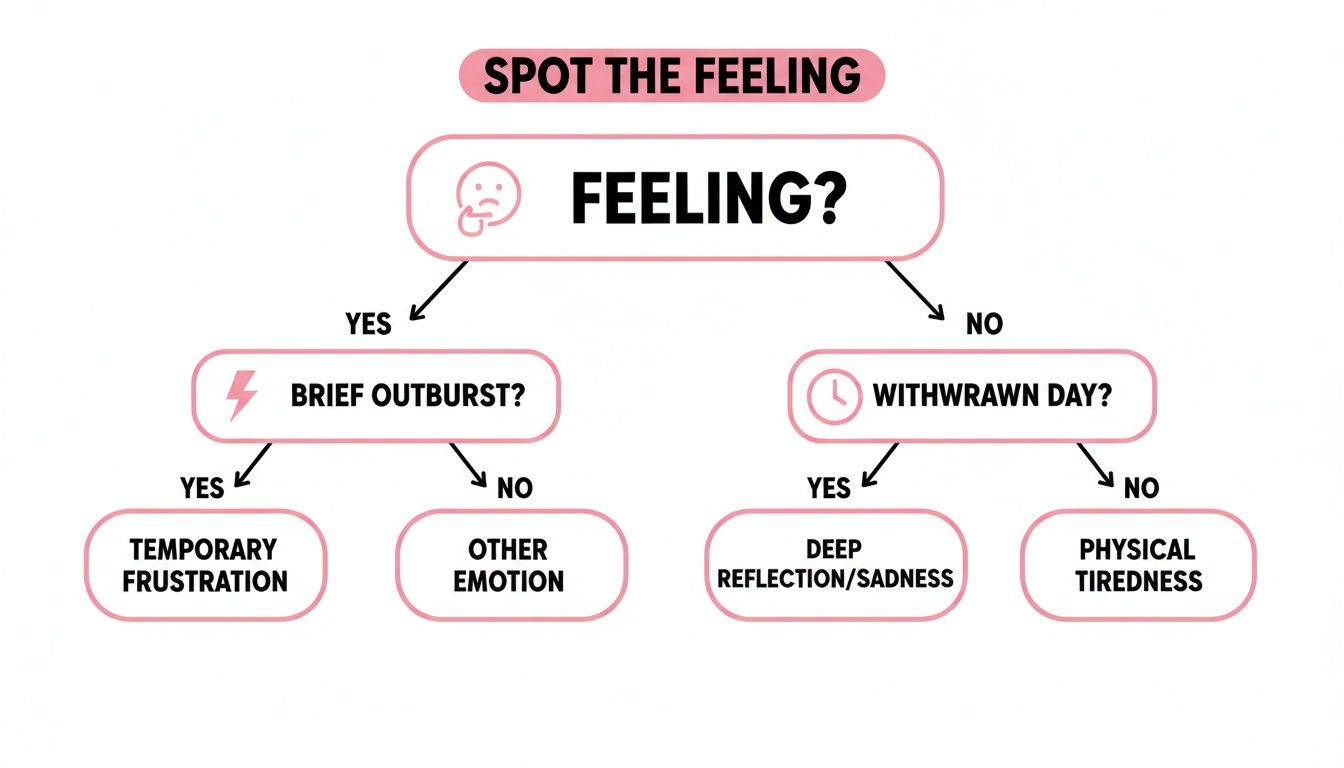
Here are some proactive ways to address those persistent moods:
- Encourage Journaling: A simple notebook where a child can write or draw their feelings can reveal surprising patterns. For a younger child, this might be a "feelings weather chart" where they draw a sun, cloud, or raincloud each day to show how they feel.
- Discuss Underlying Factors: Open a gentle, non-judgmental conversation about potential causes. You can ask about sleep ("I've noticed you seem extra tired lately, how has your sleep been?"), friendships, schoolwork, or screen time without trying to "fix" anything immediately. Just listen.
- Introduce Mood-Boosting Activities: Intentionally integrate activities that are known to improve mood. This could mean scheduling regular physical exercise, setting aside time for creative pursuits like painting or music, or simply spending more time outdoors. For a student, this might be a five-minute "brain break" with music.
Example Conversation Starter (Teacher):
"Hey, Sam. I've noticed you've been pretty quiet this week, which is a little different for you. Everything okay? I'm here if you want to talk about anything at all, big or small."
Example Conversation Starter (Parent):
"I've sensed you've been in a bit of a gloomy mood lately. I get that way sometimes too. I was thinking we could go for a bike ride this weekend to get some fresh air. What do you think?"