Soul Shoppe's work is made possible by donors and partners who care deeply about the young people in their communities! We can't do this work without you. Support our work in classrooms and on playgrounds across the nation by donating here.
Picture this: a child so excited to share an answer they blurt it out before the teacher finishes the question. Or a toddler who, overcome with frustration, snatches a toy from a friend. These moments aren't about being "bad"—they're windows into a developing skill called impulse control.
Think of it less as a switch for good behavior and more like learning to ride a bike. It takes time, practice, and a whole lot of guidance to find that balance.
Why Impulse Control Is a Skill Every Child Needs
At its core, impulse control is the ability to hit the pause button between feeling an urge and acting on it. It’s the brain's internal braking system. For kids, that system is still being built, which is why they so often seem to act first and think second.
This skill is the bedrock for making friends, doing well in school, and handling all the big emotions that come with growing up. When we actively teach impulse control, we’re helping children strengthen that internal pause button, leading to calmer classrooms and more cooperative homes.
The Real-World Impact of Impulse control
A child who can manage their impulses can wait their turn for the slide instead of pushing ahead. They can raise their hand instead of shouting. These might seem like small things, but they are huge victories in their social and emotional journey.
This ability to pause and think has a ripple effect on a child's entire world. Strong impulse control helps children:
Build Healthier Friendships: They learn to share, take turns, and talk through disagreements instead of grabbing or hitting. For example, instead of snatching a toy, they learn to say, "Can I have a turn when you're done?"
Succeed Academically: They're better able to focus on instructions, stay on task, and resist the constant distractions of a busy classroom. For example, they can listen to all the directions for an art project before immediately starting to paint.
Manage Big Emotions: They find ways to use their words to express frustration rather than defaulting to a meltdown. For example, instead of throwing their blocks when a tower falls, they can say, "I'm so mad it fell over!"
A child’s capacity for self-control is one of the most important predictors of positive outcomes. It's more than just behavior management; it's about giving them the tools for lifelong well-being.
It's a Foundational Life Skill
Ultimately, helping kids with impulse control is about preparing them to handle life's frustrations and setbacks with grace. It’s a cornerstone of social-emotional learning that helps them feel seen, understood, and in charge of their own actions.
Activities that require focus and respect for others can be a huge help. For example, exploring how structured physical programs aid in building confidence and discipline in children shows how external routines can build internal strength. When we model and teach this skill, we’re not just correcting a behavior—we're building a child's resilience from the inside out.
How a Child's Developing Brain Shapes Impulsive Behavior
To really get why a child might snatch a toy or blurt out an answer, we have to look under the hood at their developing brain. It helps to think of it as a team with two very different players: one is a speedy, emotional "first responder," and the other is a thoughtful, slower "planning manager." The dynamic between these two is the secret to understanding impulse control.
The first responder is the limbic system, which you can think of as the brain's emotional core. It's where big feelings like excitement, frustration, and fear come from. This part of the brain is fully formed and running the show from a very young age, which is why toddlers and young children have such powerful, immediate reactions to everything.
The planning manager is the prefrontal cortex, located right behind the forehead. This is the brain's CEO, responsible for logic, thinking ahead, and most importantly, hitting the brakes on those sudden urges. But here's the catch: the prefrontal cortex is the very last part of the brain to fully mature. Its major development continues well into a person's early 20s.
The Accelerator and the Brakes
Picture a car with a super-sensitive gas pedal but brakes that are still being installed. In a child's brain, the emotional limbic system is that powerful accelerator, while the developing prefrontal cortex is the unreliable brake. This imbalance is exactly why children so often act first and think later.
Their emotional engine revs high with excitement or curiosity, and the impulse to do something is immediate. The thoughtful "planning manager" simply hasn't built up the strength or speed to consistently jump in and say, "Hang on, let's think this through."
Practical Example: A five-year-old sees a colorful cupcake on the kitchen counter. Their limbic system (the first responder) practically shouts, "I want that now!" and sends an urgent signal to grab it. Their prefrontal cortex (the planning manager) is supposed to intervene with, "Wait, we should ask first," but that connection is still a bit slow and weak. The result? The child's hand is already reaching for the cupcake before the "stop" signal even has a chance to arrive.
Building Brain Connections Through Co-Regulation
Knowing about this developmental gap completely changes how we should look at discipline. When a child acts impulsively, it isn't a sign of bad behavior or defiance. It's a signal that their brain's braking system needs a helping hand. This is where co-regulation comes in. By acting as their external "brakes," we help children navigate overwhelming feelings and impulses they can't yet manage on their own.
Co-regulation isn't just about stopping a single impulsive act. It's the process of lending a child your own calm and logic, which actively helps build and strengthen the neural pathways between their emotional brain and their thinking brain.
This process is a fundamental part of developing crucial self-management skills. You can learn more about these foundational abilities by checking out our guide on what are self-management skills.
Here’s what co-regulation looks like in action:
Lending Your Calm: When a child is getting worked up, you make a point to stay calm yourself. This gives them a steady emotional anchor in their storm. Practical example: Your child starts crying loudly because their sibling won't share. Instead of matching their volume, you get down on their level and speak in a soft, steady voice.
Narrating the Feeling: You give them the words for what they're feeling. For instance, "You seem really frustrated that your turn is over." Practical example: "I can see you're very angry that the block tower fell. It's okay to feel that way."
Guiding the Next Step: You offer a clear, simple solution. "How about we take three deep breaths together before we decide what to play next?" Practical example: "It’s not okay to hit. Let's use our strong hands to squeeze this pillow instead, and then we can talk about it."
Every single time you guide a child through this process, you’re doing so much more than just correcting a behavior. You are physically helping to build the brain architecture they need for lasting impulse control. You're not just correcting them; you are essentially being their prefrontal cortex until their own is strong enough to take the wheel.
Realistic Milestones for Impulse Control Development
It’s one thing to know that impulse control develops over time, but it’s another to know what’s “normal” for a specific age. We don’t expect a toddler to read a chapter book, so we shouldn’t expect them to have the same self-restraint as a ten-year-old. Setting realistic expectations is the very first step in offering support that actually works.
Think of this as a developmental map. It’s here to help you recognize what’s age-appropriate and spot when a child might need a little extra coaching.
The brain's emotional center and its logical "planning center" mature at very different speeds. This timeline gives you a great visual of how that gap influences a child's ability to manage their impulses from moment to moment.
As you can see, the emotional, reactive part of the brain is online and ready to go from early on. The thoughtful, planning part? That takes years to fully connect. This is exactly why our patience and consistent coaching are so critical.
To help you set appropriate expectations, here's a look at the typical journey of impulse control, from grabbing toys in preschool to navigating social situations in middle school.
Impulse Control Milestones From Preschool to Middle School
Age Group
Common Impulsive Behaviors
Emerging Self-Regulation Skills
Preschool (3-5)
Grabbing toys, blurting out thoughts, big emotional reactions (tantrums) to small problems.
Beginning to understand simple rules, can wait for very short periods with reminders, starts to label feelings.
Early Elementary (6-8)
Acting out when tired or excited, interrupting conversations, difficulty losing games gracefully.
More awareness of social rules, can follow multi-step directions, can use simple calming strategies (like taking a deep breath).
Upper Elementary (9-11)
Rushing through work, occasional sarcastic or unfiltered comments, getting distracted by peers.
Better at thinking before acting, can understand another person’s perspective, starts to use problem-solving skills independently.
These milestones aren't rigid rules but gentle guides. Every child develops at their own pace, and skills can look strong one day and disappear the next—especially when a child is tired, hungry, or overwhelmed.
A Closer Look at Each Stage
Preschoolers (Ages 3-5)
At this age, the world is all about immediate wants and needs. Their brain’s emotional "first responder" is in the driver's seat, while the logical "planning manager" is just learning to give directions. Impulsive behavior isn't just common; it's their default setting.
Practical example: A four-year-old sees a shiny red truck in another child's hands. Their brain screams, "I want it!" and their hand grabs it. They aren’t being mean—they simply haven't built the neural wiring yet to pause, consider the other child, and ask for a turn.
Early Elementary (Ages 6-8)
As kids start school, their "planning manager" starts to get stronger. They have a better grasp of rules and are more aware of others' feelings, but their impulse control is still pretty inconsistent. It takes a lot of mental energy for them to manage their urges.
Practical example: Think of a seven-year-old in a board game. They know the rules say to wait for their turn, and they manage for a few rounds. But as the game gets exciting, they might forget and roll the dice early. They have the knowledge, but consistent follow-through is still a work in progress.
This is a perfect time to focus on a child’s emotional literacy. Digging into the full spectrum of child emotional development gives you a much richer context for all the changes happening under the surface.
During these years, impulse control is like a flickering lightbulb. It shines brightly in moments of calm but can easily go out when a child is tired, hungry, or overstimulated. Consistency and gentle reminders are your best friends.
Upper Elementary (Ages 9-11)
This stage often brings a major leap in self-regulation. The prefrontal cortex—the brain’s CEO—is making huge strides. This allows kids to think more logically about consequences and get a better handle on their immediate desires.
Practical example: You'll notice they can hold back impulses more reliably, even when they're excited or upset. A nine-year-old working on a group project might disagree with a friend's idea. Instead of blurting out, "That's a dumb idea!" (something they might have done a few years ago), they're now more capable of pausing to say, "What if we tried it this way instead?"
This shows a real ability to filter that first reaction and choose a more constructive path. It's a huge milestone that shows all that earlier groundwork is finally paying off.
Effective Classroom Strategies for Impulse Control
Building a classroom that supports impulse control isn't about stamping out every single outburst. It’s about creating a predictable, supportive space where kids can practice hitting their own internal "pause button" with you as their guide. These techniques are designed to be woven right into your daily classroom life, turning ordinary moments into powerful learning opportunities.
The real key is to shift from correcting impulsive behaviors after they happen to proactively teaching the skills that prevent them in the first place. This simple change helps create a calmer, more focused, and cooperative learning environment for everyone.
Implement the Stop, Think, Act Framework
The "Stop, Think, Act" model is a simple but incredibly powerful mental script. It helps children interrupt their own impulses, and your job is to make this internal process visible and external until they can manage it on their own.
It works because it gives kids a concrete, three-step process to follow when they feel that sudden urge. It breaks down a really complex self-regulation skill into small, memorable parts.
You can use consistent verbal cues throughout the day for those common challenges:
Lining up for recess: "Okay, everyone, before we all jump up, let's Stop and look at the door. Think about what a quiet, safe line looks like. Now, let's Act by pushing in our chairs and walking."
Answering a question: "I see so many excited hands! Remember to Stop before you call out. Think about your answer. I'll call on someone to Act and share it with us."
Starting a new activity: "Pencils down for a moment. Let's all Stop and listen to the directions. Think about the very first step. When I say 'go,' you can Act."
Make Waiting Concrete with Visual Timers
For a child who struggles with waiting, being told to "wait five minutes" can feel like an eternity. Waiting is an abstract concept, but you can make it tangible and way less frustrating with visual timers.
A visual timer physically shows the passage of time, which reduces anxiety. Kids can see that the waiting period has a clear, predictable end, making it much easier to manage their patience.
Try these in your classroom:
Practical example: Use a simple sand timer for short waits, like when students are taking turns in a game.
Practical example: A Time Timer (the kind where the red disk slowly disappears) is great for longer stretches, like during independent reading.
Practical example: For class-wide transitions, project a large digital countdown timer on the board so everyone can see it.
"I can see you're excited to use the computer. Let's set the timer for five minutes. When all the sand is at the bottom, it will be your turn."
Use Role-Playing for Common Conflicts
Practicing how to handle tough situations when everyone is calm is one of the best ways to prepare students for real-life disagreements. Think of role-playing as building muscle memory for positive social behaviors.
It works because students can safely try out communication and problem-solving skills without the pressure of a real, emotional conflict. This helps them build a script for what to say and do when they feel frustrated or unheard.
Set up short, simple scenarios based on common classroom problems:
Scenario: Two students both reach for the last green marker.
Script: Have one student practice saying, "Can I use it when you're done?" instead of just grabbing it. Then, have the other student practice responding, "Sure, you can have it in two minutes."
Debrief: Ask the class, "What did you notice? How did that feel better than just grabbing the marker?"
Structured classroom management programs can be incredibly effective at reducing impulsivity. For instance, research from Johns Hopkins trials on the Good Behavior Game—a classroom intervention for disruptive behaviors—found that kids in the program showed lasting reductions in impulsive and aggressive actions all the way through adolescence. It’s proof that consistent, structured strategies yield powerful, long-term benefits for impulse control in children.
Proactive Environmental and Instructional Support
Beyond direct instruction, the way you set up your classroom and deliver your lessons can make a huge difference in reducing impulsive behaviors. For students who need more support, consider these self-regulation strategies for students.
Here are a few key adjustments you can make:
Provide Seating Options: Offer wobble stools or resistance bands on chair legs to give students a quiet outlet for their physical energy.
Break Down Instructions: Instead of giving all the directions at once, deliver them one or two steps at a time.
Preview Transitions: Give a heads-up five minutes before a change. Say, "In five minutes, we will clean up our art supplies and get ready for math."
Offer Brain Breaks: Schedule short, 2-3 minute movement breaks between periods of focused work to help everyone reset.
Fun Home Activities That Build Self-Regulation
You don't need workbooks or rigid lessons to build impulse control in children. In fact, some of the most powerful opportunities are hiding in plain sight—in your playroom, in your kitchen, and in your daily routines.
The real key is to make practicing self-regulation feel like a game, not a chore. When you do, you help your child build the mental muscles for patience, listening, and thinking before they act, all in a safe and playful space.
Games That Teach the "Pause" Button
Classic childhood games are perfect for practicing response inhibition—the ability to stop an action that’s already in motion. It’s all about hitting that internal "pause button" on command.
Red Light, Green Light: This one is a classic for a reason. When you yell "Red Light!", a child has to fight the powerful urge to keep running and freeze in place. It’s a direct, physical way to practice stopping an impulse.
Freeze Dance: This works the same muscle. Kids have to dance with abandon until the very second the music stops, training them to pay close attention and control their bodies instantly.
Want to add a challenge? Try changing the rules. For a practical twist, tell them to "freeze" when the music starts and "dance" when it stops. This makes them inhibit their old habits and adapt on the fly, adding another layer of cognitive control.
Activities for Following Steps and Delaying Gratification
So many household activities are natural lessons in patience and following a sequence. These are the skills that help counter that powerful "I want it now!" urge that every child feels.
Building self-control isn't about rigid discipline; it's about playful practice. When a child learns to wait for a cookie to bake or a turn in a game, they are building the foundation for bigger life skills like waiting to speak or thinking before acting.
Baking Together
Following a recipe to bake cookies or a cake is a fantastic, multi-step lesson in managing impulses. Your child can’t just dump everything into the bowl at once and expect a good result.
Patience: They have to wait for each ingredient to be measured and added.
Following Directions: They learn that steps must be followed in a specific order to get the treat they want.
Delayed Gratification: And of course, the ultimate test is waiting for the cookies to bake and cool before they can finally take a bite.
Building with Blocks or LEGOs
When a child is following instructions to build a specific model, they have to resist the urge to just start clicking random bricks together. They have to slow down, find the correct pieces, and connect them in the right order. This activity strengthens their ability to manage frustration and stick with a plan.
When to Be Concerned About Your Child's Impulsivity
All children act on impulse sometimes—it’s just a normal part of growing up. But as a parent or educator, how do you know when that impulsive behavior crosses the line from typical development to a potential red flag?
The answer isn't about a single action, but about the bigger picture. We need to look at the frequency, intensity, and impact of the behavior. A four-year-old grabbing a toy is pretty standard stuff. A ten-year-old who still can't wait their turn despite repeated coaching, however, might need a different kind of support. The goal isn’t to pathologize childhood energy, but to recognize patterns that get in the way of a child’s ability to learn, make friends, or stay safe.
Distinguishing High Energy from Concerning Impulsivity
It’s incredibly easy to confuse a highly energetic kid with one whose impulsivity points to an underlying issue. A high-energy child might be fidgety and talkative, but they can usually dial it back when they need to. A child with significant impulse control challenges struggles to put on the brakes, even when they know the rules and genuinely want to follow them.
Think about these key differences:
Context Matters: Is the impulsivity happening everywhere—at home, at school, and on the playground? Or does it only pop up when the child is tired or overstimulated? Challenges that show up across different environments are more concerning.
Impact on Relationships: Is the child’s impulsivity consistently hurting their friendships? Constant interruptions, physical scuffles, or an inability to play cooperatively can quickly lead to social isolation. Practical example: A child is repeatedly left out of games at recess because others are tired of them not following the rules.
Safety Concerns: Does the child’s impulsivity put them or others in real physical danger? This includes things like running into the street without looking, climbing in unsafe places, or acting aggressively without any clear trigger. Practical example: A child bolts away from a parent in a crowded parking lot, despite repeated warnings.
If you feel like you’re constantly managing a child's behavior just to prevent disaster, rather than simply guiding them, that’s a sign that more support might be needed. It’s the difference between coaching a new driver and having to grab the wheel every few seconds.
When to Seek Professional Guidance
So, you’ve consistently tried strategies at home and in the classroom, but you’re not seeing any improvement. This might be the time to seek professional guidance. A pediatrician, school psychologist, or child therapist can help figure out if the impulsivity is a symptom of a condition like ADHD, Oppositional Defiant Disorder (ODD), or even a learning disability.
Gender can also play a role in how these behaviors show up. For example, research on over 2,000 children found that girls often develop self-control skills earlier than boys. Understanding these developmental differences helps us make sure our support strategies are as effective as possible. You can discover more insights about these gender-based differences in self-control development.
Consider seeking an evaluation if your child's impulsivity:
Persists Despite Support: You've tried visual timers, role-playing, and consistent routines, but the challenging behavior isn't getting better.
Severely Impacts Learning: The child can't focus long enough to finish their work or follow simple classroom instructions.
Leads to Significant Social Isolation: Other kids are actively avoiding your child because of their unpredictable or aggressive actions.
Causes Harm: The behavior results in injury to themselves or others, or significant damage to property.
Reaching out for help isn't a sign of failure; it's a proactive step toward getting your child the right tools. It brings clarity and opens the door to a support plan that can make a real, meaningful difference in their school and home life.
Common Questions About Impulse Control in Children
Even when you have a good handle on the strategies and developmental milestones, real-world questions about impulse control in children always pop up. Let's tackle some of the most common concerns we hear from parents and teachers.
Are Screen Time and Impulsivity Related?
This is a question on nearly every parent's mind, and the short answer is yes, there’s a link. Think about it: many of the apps, games, and shows our kids love are built on a loop of instant rewards and non-stop stimulation. This can make the real world—where you have to wait for your turn or listen to a story—feel painfully slow to a developing brain.
Of course, this doesn't mean all screen time is harmful. It just means balance is key.
Practical example: Imagine a child spends an hour on a tablet game, racking up points every second. When they come to the classroom carpet for a 20-minute read-aloud, it can feel like shifting from a speedboat to a snail. Their brain is wired for that immediate feedback, making it a real struggle to settle into an activity that requires patience.
To help create that balance, you can:
Mix it up. Make sure screen time is balanced with activities that naturally build patience, like board games, building with LEGOs, or just playing outside.
Watch together. When you can, co-view content with your child and chat about what you’re seeing. This shifts them from being a passive viewer to an active, thinking participant.
What Is the Difference Between Impulsivity and ADHD?
This is a really important distinction. All kids are impulsive sometimes—especially when they're young, tired, or super excited. But with Attention-Deficit/Hyperactivity Disorder (ADHD), that impulsivity is a persistent, core symptom of a neurodevelopmental condition.
The real difference comes down to the frequency, severity, and how it impacts their life.
Practical example: A child might get excited and blurt out an answer once or twice during a lesson. A child with ADHD, however, might do so constantly, struggling to stop even when they know the rule and are trying their best to follow it. The behavior isn't just a one-off; it shows up across different settings, from the classroom to the playground to home.
A child with ADHD often has other challenges with focus and/or hyperactivity that go beyond what’s typical for their age. While the strategies in this guide can absolutely help, a child with suspected ADHD needs a full evaluation from a professional. This allows for a targeted support plan, which might include things like behavioral therapy or specific classroom accommodations.
How Can I Reinforce School Lessons at Home?
Consistency is your superpower here. When kids hear the same language and use the same tools at school and at home, those self-regulation skills start to click into place much faster.
The best place to start is by simply talking to your child's teacher. A quick email or chat asking, "What specific words or techniques are you using for calming down or waiting?" can make a world of difference.
Practical example: Maybe the teacher says they use a "calm-down corner" and a "take five" breathing exercise. Later that day, when homework frustration hits, you can say, "It looks like your brain is getting tangled up. Let's try that 'take five' breathing your teacher showed you." You've just built a seamless bridge between their two worlds.
You can also model it yourself. Narrate your own moments of impulse control out loud.
"Wow, I really want to eat this cookie right now, but I am going to pause and wait until after dinner."
"Ugh, I'm so frustrated I can't find my keys. I'm going to take three deep breaths before I look again."
This gives your child a peek into the internal monologue behind self-control. And don't forget to celebrate their small wins! When you notice them waiting for their turn without a reminder, point it out. It shows them their hard work is paying off and that you see their effort.
At Soul Shoppe, we believe in equipping every child with the tools they need to understand their emotions and build healthy relationships. Our programs provide schools with a shared language and practical strategies to foster self-regulation, empathy, and resilience in every student.
Prosocial behavior, which consists of actions intended to help others, is the bedrock of a kind, safe, and collaborative community. For parents and educators, fostering these skills is more critical than ever. It is about moving beyond simply telling children to 'be nice' and instead giving them a concrete toolkit for empathy, cooperation, and support. To begin cultivating a prosocial mindset, it is essential to understand the core principles of social responsibility and how individual actions contribute to the well-being of the group.
This guide provides a detailed look at ten powerful examples of prosocial behavior, offering practical, grade-appropriate strategies for K-8 students. We will break down not just what these behaviors are, but exactly how to teach, model, and reinforce them in various settings. You will find actionable takeaways for implementing peer support, conflict resolution, kindness campaigns, and more. The goal is to provide a clear roadmap for building connected, empathetic school cultures where children are equipped with the skills they need to thrive both socially and academically. From the classroom to the playground and into the community, these strategies are the building blocks for creating a more supportive environment for every child.
1. Active Listening and Empathetic Responding
Active listening is a foundational prosocial behavior where a person focuses entirely on what someone else is saying, rather than just waiting for their turn to speak. This practice involves paying attention to verbal and non-verbal cues, reflecting back what was heard to confirm understanding, and responding with empathy. It requires suspending judgment and validating the other person's feelings before offering solutions, creating a sense of psychological safety and belonging.
This skill is a cornerstone of positive social interaction and a powerful tool against isolation and conflict. When students learn to truly listen, they build stronger, more meaningful connections with their peers. This is one of the most powerful examples of prosocial behavior because it directly builds empathy and community.
Practical Applications and Tips
To put active listening into practice, educators and parents can model it and provide structured opportunities for children to learn.
Model the Behavior: During classroom discussions or family meetings, adults should demonstrate active listening by making eye contact, nodding, and paraphrasing what a child says. For example: "It sounds like you felt frustrated when your tower fell. Is that right?"
Use Sentence Starters: Provide scaffolding with phrases like, "What I hear you saying is…" or "It seems like you're feeling…" to help children structure their empathetic responses. For instance, have students practice this after a partner shares something about their weekend.
Practice with Role-Play: Use role-playing scenarios to give students a safe space to practice. A teacher can set up a scenario where one student pretends they lost their favorite pencil and the other student practices listening and responding with empathy. For a hands-on guide, check out this simple and effective active listening activity.
2. Peer Support and Buddy Systems
Structured peer support programs intentionally pair students to offer academic help, emotional encouragement, and social companionship. These buddy systems are a powerful way to connect isolated or struggling students with empathetic peers who can model positive behaviors and provide informal mentorship. This approach reduces student isolation, fosters a sense of belonging, and uses the strong influence of peer relationships for positive growth.
These programs formalize the act of helping one another, transforming it into a reliable school resource. By creating structured opportunities for students to connect, schools can build a more inclusive and supportive community. This is one of the most effective examples of prosocial behavior because it systematically builds social skills and a network of support for all students involved.
Practical Applications and Tips
To implement a successful buddy system, clear structure and training are essential for both students and supervising adults.
Define Clear Roles: Provide written guidelines that outline the purpose and expectations for all participants. For example, a "New Student Buddy" might be tasked with showing a new classmate around, sitting with them at lunch for the first week, and explaining classroom routines.
Train Your Buddies: Equip student volunteers with the necessary skills. Training should cover active listening, maintaining role boundaries, and knowing when to seek help from a trusted adult. For example, role-play a scenario where a buddy doesn't know the answer to a question and needs to ask a teacher for help.
Match for Success: Pair students based on compatible personalities and shared interests, not just academic standing. A good character fit is often more important for building a genuine connection than matching high-achievers with struggling students.
Schedule Regular Check-ins: A teacher can hold a 5-minute meeting with the buddy pair once a week to ask, "What's one good thing that happened this week?" and "Is there anything you need help with?" This helps address any challenges and reinforces the program's value.
3. Cooperative Learning and Collaborative Projects
Cooperative learning moves beyond simple group work by structuring activities so students must rely on one another to succeed. This approach requires interdependence to achieve shared academic and social goals. By working together, students naturally develop empathy, perspective-taking, and mutual support as they navigate group dynamics, assign tasks based on strengths, and solve problems as a team.
This method is one of the most effective examples of prosocial behavior because it integrates social skill development directly into academic learning. When students see that their individual success is tied to the group's success, they become more motivated to help, listen to, and encourage their peers. This builds a classroom culture where collaboration is valued over competition.
Practical Applications and Tips
To successfully integrate cooperative projects, educators should intentionally teach and reinforce the necessary social skills alongside the academic content.
Assign and Rotate Roles: Structure group projects with specific roles like "Researcher," "Recorder," "Presenter," and "Materials Manager." For a history project, one student researches dates, another writes down the group's findings, a third manages the art supplies, and a fourth presents the final poster. Rotating these roles ensures every student develops different skills.
Use Structured Protocols: Implement strategies like "Jigsaw," where each student becomes an expert on one piece of information and then teaches it to their home group. For a science unit on planets, each student in a group could learn about a different planet and then teach the others, ensuring equal participation and individual accountability.
Build in Reflection Time: After a project, guide groups to discuss their collaborative process. A parent can do this at home after a family chore by asking, "What went well when we cleaned the kitchen together?" and "What could we do differently next time?"
Practice at Home: For students learning to work together, engaging in activities like playing the best cooperative board games or building a large LEGO creation together can be an excellent way to practice teamwork in a low-stakes, fun environment.
4. Kindness Campaigns and Recognition Programs
Kindness campaigns are organized school-wide initiatives that encourage, track, and celebrate acts of kindness. These programs use positive reinforcement and peer recognition to make prosocial behavior a visible and valued part of the school culture. By creating a system to highlight helpfulness, schools show students that these actions are both expected and appreciated.
These programs make empathy and care tangible and public. Initiatives like a "kindness chain," where each link represents a kind act, or a gratitude wall for thank-you notes, provide visual proof of a caring community. These are powerful examples of prosocial behavior because they shift the school's focus toward positive actions, building a culture of mutual support and belonging.
Practical Applications and Tips
To implement a successful kindness campaign, the focus should be on accessibility, inclusion, and extending the practice beyond the school walls.
Define Kindness Broadly: Encourage students to notice quiet acts, not just grand gestures. For example, a student might be recognized for inviting someone to play at recess, offering help with a difficult math problem, or giving a genuine compliment.
Create Simple Systems: Use low-barrier methods for recognition. A classroom "kindness jar" where students drop notes describing a kind act they witnessed is a great example. A "Kindness Rocks" project, where students paint positive messages on rocks and hide them around the playground for others to find, is another easy and engaging activity.
Connect to SEL: Tie the campaign directly to social-emotional learning competencies. For example, during a unit on social awareness, challenge students to notice and report acts of kindness they observe. At home, a parent could start a "Caught Being Kind" chart on the fridge.
5. Conflict Resolution and Restorative Practices
Conflict resolution and restorative practices shift the focus from punishment to accountability and healing. Instead of simply penalizing a student who caused harm, this approach brings together all affected parties to discuss the impact of the actions and collaboratively decide on a path to repair relationships. This structured method teaches students to understand the consequences of their behavior, take responsibility, and work together toward a positive resolution.
By centering on dialogue and mutual understanding, these practices transform conflict into an opportunity for growth. This is one of the most powerful examples of prosocial behavior because it equips students with the tools to manage disagreements constructively, fostering a school culture rooted in empathy, respect, and community repair rather than retribution.
Practical Applications and Tips
To implement restorative practices, schools and parents can start with small, manageable conflicts and build capacity over time.
Start with Peer Mediation: Train a group of students as peer mediators to handle low-stakes conflicts. For example, two students arguing over a game could meet with a trained mediator who guides them to explain their perspectives and agree on new rules for sharing the game.
Establish Restorative Circles: Use restorative circles to address classroom-wide issues. If a student's property was damaged, the teacher could facilitate a circle where everyone, including the person responsible, discusses how it affected the class and what can be done to make things right. At home, a family meeting can resolve a sibling dispute over a shared toy.
Provide Comprehensive Training: Ensure teachers, administrators, and student mediators receive thorough training. A practical example is teaching them to use "I-statements" ("I felt hurt when…") instead of "you-statements" ("You were mean…") to de-escalate tension and create a safe environment for all participants. Learn more about the foundations of what restorative practices are in education.
6. Inclusive Friendship, Leadership, and Accessibility Advocacy
This advanced form of prosocial behavior moves beyond simple kindness to actively dismantling social and environmental barriers. It involves intentionally creating social opportunities, such as "lunch bunch" groups or shared-interest clubs, where students can develop friendship skills in a supported setting. More importantly, it empowers students, particularly those with disabilities or from marginalized groups, to become leaders who advocate for accessibility and inclusion, ensuring the school community is welcoming for everyone.
These initiatives combine direct social skill instruction with real-world advocacy. For example, a student accessibility committee might evaluate whether school events are sensory-friendly or a neurodiversity-affirming buddy system might pair students to navigate social situations together. This is one of the most impactful examples of prosocial behavior because it fosters both individual friendships and systemic change, creating a culture of genuine belonging.
Practical Applications and Tips
To cultivate this deep level of inclusion, educators must create structured opportunities that empower student voice and leadership.
Form Interest-Based Groups: Instead of labeling a group "social skills," a teacher can create a "Gaming Club" or "Art Crew." This recruits students based on genuine shared interests, reducing stigma and naturally fostering connection while a teacher provides social coaching on turn-taking and positive communication.
Empower Student Leadership: Create a student-led accessibility committee. Task them with conducting a "school walkthrough" to identify physical barriers (like a blocked ramp) or with creating a guide for inclusive recess games that kids in wheelchairs can play. This positions students as expert problem-solvers.
Teach and Model Advocacy: Provide students with sentence starters for advocating for themselves and others. A student can learn to say, "Could we try playing it this way so everyone can join?" or "I need a quiet space for a few minutes." A teacher models this by asking, "Is the music too loud for everyone?"
7. Gratitude and Appreciation Practices
Gratitude practices involve creating structured routines for students to notice and express appreciation for others' actions, character, or presence. From simple thank-you notes to daily gratitude circles, these habits shift focus toward recognizing the good in a community. This regular acknowledgment of others' contributions strengthens relationships, improves school climate, and helps students develop a more positive outlook.
These routines are powerful examples of prosocial behavior because they move beyond passive feelings of thankfulness and turn gratitude into an active, shared experience. When students consistently see and name the positive actions of peers and adults, it reinforces those behaviors and builds a culture of mutual respect and kindness.
Practical Applications and Tips
To cultivate gratitude, educators and parents can integrate simple, consistent practices into daily and weekly schedules.
Model Specific Thanks: Adults should model expressing genuine, specific gratitude. Instead of a generic "thanks," a parent could say: "Thank you, Sarah, for helping me carry in the groceries. That was really helpful and kind."
Create Gratitude Rituals: Establish a regular time for sharing. A teacher could create a "Harvest of Thanks" wall where students post gratitudes on paper leaves. At home, a family can start each dinner by having everyone share one good thing that happened that day.
Teach Meaningful Appreciation: Guide students to understand the difference between a general compliment and specific appreciation. A practical exercise is to have students write thank-you notes to a school custodian or lunch staff member, mentioning one specific thing they appreciate. For more ideas on how to foster this skill, explore these practical ways to show gratitude.
8. Peer Tutoring and Academic Support
Peer tutoring involves students providing academic help to their classmates, a process that merges teaching with relationship-building. This prosocial behavior not only boosts academic achievement for both the tutor and the tutee but also cultivates patience, empathy, and clear communication skills. Tutors often find they can explain concepts in a more relatable way, while also experiencing the personal reward of helping a peer succeed.
This practice is one of the most effective examples of prosocial behavior because it creates a supportive learning environment where students see each other as resources, not just competitors. When students teach students, they reinforce their own knowledge and build a stronger, more collaborative school culture.
Practical Applications and Tips
Educators and parents can create structured opportunities for peer tutoring to flourish, ensuring it's a positive experience for everyone involved.
Provide Tutor Training: Before starting, train tutors on more than just the subject matter. Teach them how to explain concepts in multiple ways, offer positive encouragement ("You're so close! Try it this way."), and practice patience. A simple role-play activity can help them practice.
Establish Clear Structures: Create formal programs like a "Homework Help Club" during lunch or after school. A great practical example is implementing "Buddy Reading," where a fourth-grade class partners with a first-grade class weekly to read books together and support literacy.
Recognize the Effort: Celebrate the contributions of tutors publicly. A teacher can acknowledge their hard work in a school assembly, a classroom newsletter, or with a "Tutor of the Month" certificate. This recognition validates their effort and encourages others to participate.
9. Community Service and Service-Learning Projects
Community service and service-learning projects involve student-led initiatives where young people address real community needs. These efforts go beyond simple volunteering by integrating meaningful service with structured reflection, directly connecting the prosocial action to specific learning outcomes. This approach helps students develop empathy for those they serve and a sense of personal agency in solving problems larger than themselves.
When students participate in a school-wide food drive or a neighborhood beautification project, they are not just helping; they are learning about social responsibility firsthand. These initiatives are powerful examples of prosocial behavior because they bridge the gap between abstract concepts like compassion and tangible, real-world action, building a foundation for lifelong civic engagement.
Practical Applications and Tips
To successfully implement service-learning, educators should focus on authentic needs and student ownership of the process.
Partner with Community Organizations: Connect with local groups to identify genuine needs. For instance, a class could partner with a local animal shelter to make chew toys for dogs or hold a blanket drive in the winter. This ensures the project has a real impact.
Encourage Student Leadership: Empower students to help identify the problem and design the solution. If students are concerned about litter on the playground, a teacher can help them research the issue, create posters, and organize a cleanup day.
Integrate Structured Reflection: Create consistent opportunities for students to discuss their experiences. Use journal prompts or classroom discussions after the activity. A teacher can ask, "How did it feel to help?" or "What did you learn about our community from this project?"
10. Mindfulness and Perspective-Taking Exercises
Mindfulness and perspective-taking exercises are structured practices that guide students to mentally place themselves in another person's situation. By using tools like guided visualization, literature discussions, and role-play, students can explore different viewpoints, feelings, and experiences. These activities help build the neural pathways necessary for empathy, allowing children to see beyond their own lens and reducing personal bias.
These skills are vital for developing a compassionate and inclusive mindset. When students regularly practice seeing the world from multiple viewpoints, they become more thoughtful and understanding peers. This makes it one of the most important examples of prosocial behavior because it directly cultivates the cognitive side of empathy, which is crucial for genuine connection.
Practical Applications and Tips
Educators and parents can integrate these exercises into daily routines to make perspective-taking a natural habit for children.
Model the Behavior: When a conflict arises, model curiosity about others' feelings. A parent can say, "I wonder what your brother was experiencing that made him get so upset," instead of assigning blame.
Use Literature and History: When reading a book, a parent or teacher can pause and ask, "What do you think that character is feeling right now? Why?" or "How would the story be different if it were told from the villain's point of view?"
Practice with Scenarios: Use social-emotional scenarios and ask probing questions. A teacher can present a situation like, "A new student is sitting alone at lunch." Then ask, "What might they be feeling?" and "What's one small thing you could do to help?" For more ideas, explore these powerful perspective-taking activities.
SEL lessons, literature/historical analysis, bias reduction work
Builds durable perspective-taking skills adaptable across contexts
Putting It All Together: Building a Culture of Prosocial Behavior
Throughout this article, we have explored a wide range of practical examples of prosocial behavior, from active listening in the classroom to community service projects that extend learning beyond the school walls. We've seen how simple acts, when intentionally taught and consistently reinforced, can build a foundation of empathy, cooperation, and respect. The journey from understanding these concepts to seeing them flourish in children is not about a single, grand gesture; it's about the cumulative power of small, consistent actions.
The examples provided, whether it's a second grader sharing their crayons without being asked or a seventh grader organizing a peer tutoring session, all point to a core truth: prosocial skills are not innate for everyone. They must be modeled, taught, and practiced. For educators and parents, this means creating an environment where these behaviors are the norm, not the exception.
Key Takeaways for Sustainable Change
Moving forward, the goal is to weave these threads into the fabric of your daily interactions. The most impactful strategies are those that become routine.
Consistency is Crucial: A one-off kindness assembly is a good start, but a daily gratitude circle at the beginning of class creates a lasting habit. When children see and experience prosocial actions every day, these behaviors become internalized.
Intentionality Drives Results: Don't just hope for kindness; plan for it. Structure a collaborative project with clear roles to teach cooperation. Explicitly teach conflict resolution steps instead of just intervening. Intentional teaching turns abstract virtues into concrete skills.
Modeling is Your Most Powerful Tool: Children are keen observers. When they see adults actively listening, admitting mistakes, and showing appreciation, they learn that this is how members of a community treat one another. Your actions provide the most compelling and memorable examples.
Start by selecting one or two strategies that feel manageable and relevant to your setting. Perhaps it's introducing a "buddy bench" on the playground or starting each family dinner by sharing one thing you are grateful for. As these small practices take root, they build momentum.
Strategic Insight: The most effective approach is creating a positive feedback loop. An act of kindness strengthens a relationship, which builds trust. A trusting environment makes children feel safe enough to take social risks, like offering help or standing up for a peer, which in turn generates more positive interactions. This cycle is the engine of a truly prosocial culture.
Ultimately, by providing children with a shared language for empathy and a toolbox of practical social skills, we do more than just improve classroom management or reduce bullying. We are equipping them with the essential tools for a connected, compassionate, and fulfilling life. These examples of prosocial behavior are not just items on a checklist; they are the building blocks of a better community and a more hopeful future.
Ready to bring a structured, engaging, and powerful social-emotional learning framework to your school? Soul Shoppe provides dynamic programs and practical tools designed to help students master the very skills discussed in this article, creating safer and more connected school communities.
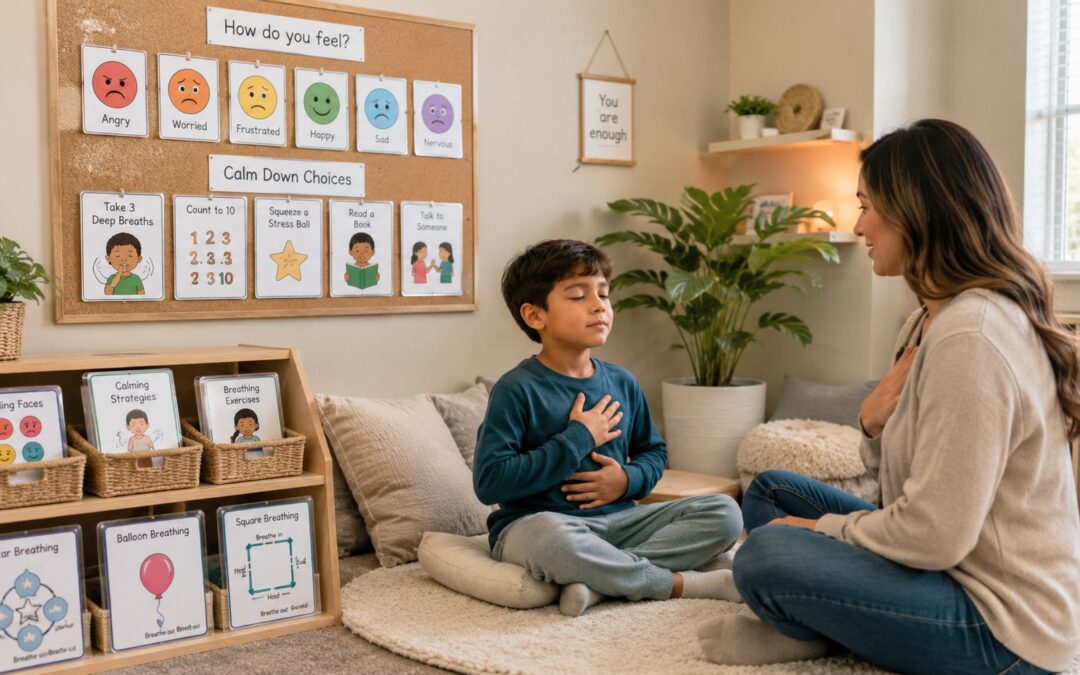
A feelings chart for kids is one of the simplest, most effective tools in the social-emotional learning (SEL) toolkit. You've probably seen them—posters with faces showing a range of emotions, from happy and excited to sad and frustrated. But they're so much more than just a piece of classroom decor.
A good feelings chart gives children a concrete way to identify, name, and begin to understand their own complex emotions. It provides a shared language for those big, messy internal experiences that can be so hard to put into words.
More Than a Poster: Why Feelings Charts Work
Think of a feelings chart as a bridge. It connects what a child is feeling on the inside to something tangible they can see, point to, and talk about. This simple act of giving an emotion a name and a face is a game-changer for building emotional intelligence.
When a child can match their internal storm to a word like "disappointed" or "worried," they take the first crucial step toward self-awareness. That feeling is no longer a scary, overwhelming force. It’s something real that can be understood and, eventually, managed.
Giving Kids the Words for Their Feelings
Imagine a first-grader with clenched fists and a scowl. They can't explain why they're upset. Maybe a friend didn't want to play, or they're struggling with a math problem. Without the right words, that frustration just builds.
This is where the feelings chart comes in.
By gently guiding them to the chart, you can ask, "Can you show me which face looks like how you feel right now?" This one question opens the door. It helps the child shift from a reactive state of distress to a more expressive one. They're no longer just feeling the anger; they are starting to understand it.
The goal isn't just to get a label for the feeling—it's to validate it. When we acknowledge an emotion, we're telling a child, "What you're feeling is real, it's okay, and we can figure this out together." This builds the trust and psychological safety every child needs.
This growing vocabulary empowers kids to advocate for themselves. A child who once might have pushed or cried can begin to say, "I feel sad because I miss my mom," or "I'm worried about the assembly." You can learn more about naming feelings to help kids find the words they need in our dedicated guide.
Building a Foundation for Empathy and Self-Regulation
The benefits don't stop at self-awareness. When children get comfortable recognizing their own emotions, they get better at spotting them in others, too. This is the very foundation of empathy. They start to realize that their friends also have a rich, complex inner world.
For example, a teacher might say, "Leo pointed to 'frustrated' on our chart. Has anyone else ever felt frustrated when their block tower fell down?" This simple question helps other children connect Leo's experience to their own, building a shared emotional understanding.
This skill is absolutely vital for building a kind and connected community, whether at home or in the classroom. It's a bit startling, but recent studies suggest only about 36% of people globally score high in emotional intelligence. This highlights just how important it is to start early with simple tools like a feelings chart.
By building this foundational skill, we’re not just managing today's behavior—we're equipping kids for a lifetime of healthier relationships and greater well-being. You can explore the latest global findings on child well-being to see just how critical these early skills are.
Creating a Feelings Chart That Kids Will Actually Use
For a feelings chart to be more than just wallpaper, it needs to feel alive and relevant to a child. A generic, downloaded poster might work in a pinch, but the charts that truly make a difference are the ones kids feel a real connection to.
So, how do we create a feelings chart that children will be genuinely excited to use?
The secret is surprisingly simple: involvement. When children are part of the creation process, they develop a sense of ownership. It becomes their tool, not just another poster the adults put up.
Tailor Emotions to the Right Age
The first move is to choose emotions that match your kids' developmental stage. A chart that’s too simple will bore older kids, while one that’s too complex will just overwhelm the younger ones.
For Early Years (Ages 3-6): Start with the absolute basics. Stick to 4-6 core emotions that are easy to spot and happen often. Think happy, sad, mad, and surprised. The goal here isn't a huge vocabulary; it's about introducing the foundational language of feelings.
For Lower Elementary (Ages 7-9): Now you can start expanding their emotional world. Bring in more nuanced feelings like proud, frustrated, worried, and excited. Kids at this age are starting to grasp that they can feel more than one thing at a time, and your chart can begin to reflect that complexity.
For Upper Elementary (Ages 10-12): Older kids are ready for even more sophisticated words. You can introduce concepts like anxious, overwhelmed, lonely, jealous, and hopeful. For this group, a simple chart might evolve into a "mood meter" or a feelings wheel that shows a wider range of emotional states.
Visuals are the heart of any feelings chart, but they don't have to be limited to yellow smiley faces. In fact, the more personal and relatable the images are, the better.
A key insight from working with children is that they connect deeply with authenticity. Using photos of real human faces—or even their own—makes the concept of emotions feel much more real and less abstract than a cartoon character.
Here are a few powerful alternatives to consider:
Use Photographs of the Kids: With permission, of course, hold a "feelings photoshoot." Ask each child to show you their best "surprised face" or "frustrated face." Print these to create a chart that’s a true reflection of your specific group.
Draw Your Own Faces: Turn it into an art project. Give each child a paper plate and an emotion to illustrate. This kind of collaborative work builds community and gets buy-in from every single child.
Cutouts from Magazines: For a fun collage activity, have kids look through old magazines to find pictures of people showing different emotions. This sparks incredible conversations about how we read feelings in others' body language and facial expressions.
Get Creative with the Design
The format of the chart itself can be a game-changer. A static poster is good, but a dynamic, interactive tool is even better. This invites children to physically engage with the chart, turning the emotional check-in into an active experience rather than a passive one.
Here are a few practical examples to get your ideas flowing:
Feelings Thermometer A "feelings thermometer" is a fantastic way to help kids visualize emotional intensity.
Example for a 2nd Grade Classroom: Draw a large thermometer on poster board. Label the bottom "Cool & Calm" (in blue), the middle "Getting Warm" (yellow/orange), and the top "Hot & Angry" (red). Students can move a clothespin with their name up or down to show where they are, which helps them notice when their big feelings are starting to escalate.
Feelings Wheel with Clothespins This design is perfect for helping children pinpoint a specific feeling with more accuracy.
Example for a Home Setting: Make a wheel from a paper plate and divide it into wedges for different feelings like 'Peaceful,' 'Silly,' 'Worried,' and 'Disappointed.' Your child can clip a clothespin to the feeling that best describes their state, creating a natural and easy opening for a conversation.
Weaving the Feelings Chart into Your Daily Routine
A feelings chart hanging on the wall is a great start, but it's just a poster until you breathe life into it. Its real magic unfolds when it becomes a living, breathing part of your daily rhythm—as automatic as grabbing a snack or starting a lesson.
This isn’t about adding another task to your already full plate. It's about finding natural moments to connect and make checking in on emotions a normal, everyday habit. When you do that, the chart stops being just a piece of paper and becomes a powerful tool for building emotional awareness.
Creating Predictable Check-in Times
The secret to making the chart a habit is to build it into moments you already have. For kids, routines create safety, and a safe-feeling child is far more likely to open up and share what’s really going on inside.
For teachers, the morning check-in is a perfect opportunity.
Here’s how it looks: As students come into the room and unpack, they can move a clothespin with their name to the feeling that fits their morning. One child might place their pin on "tired" after a restless night, while another puts it on "excited" for a friend's birthday party. This gives you a quiet, immediate snapshot of your classroom’s emotional temperature without ever putting a single child on the spot.
For parents, an after-school check-in can become a treasured ritual.
Here’s how it looks: As you’re both unpacking backpacks and settling in with a snack, you can simply ask, “Let’s see where our feelings landed after today.” A child might point to "proud" for acing a math quiz or "lonely" because recess was tough. This small gesture cracks the door open for bigger conversations about their day.
These simple, consistent touchpoints normalize talking about feelings. If you're looking for more ideas on building these kinds of structures, our guide on how effective routines for kids can help them feel emotionally grounded is a great resource.
Guiding Kids to the Chart in Real Time
Beyond your planned check-ins, some of the most powerful moments to use a feelings chart will be the unplanned ones—right when big emotions are bubbling over. The trick is to approach these moments with curiosity, not as a chance to discipline.
Instead of a reactive, "Stop crying!" try gently guiding them toward the chart. You can say something like, "Wow, that looks like a really big feeling. Can you show me on the chart what's happening inside you right now?"
This simple pivot does two amazing things at once:
It co-regulates. Your calm focus on the chart helps soothe their activated nervous system.
It empowers. You're giving them a tool to communicate when their words are lost in the emotional storm.
The most important rule of thumb? The chart must always be a safe, judgment-free zone. It’s a tool for understanding, not for correction. If a child points to "angry" or "jealous," the right response is always one of validation: "Thank you for showing me you feel frustrated. I get it."
This approach transforms a meltdown into a teachable moment, helping kids learn to identify and handle their feelings before they become overwhelming.
Connecting the Chart to Positive Outcomes
Using a feelings chart consistently does far more than just help a child name an emotion. It's a foundational skill in emotional intelligence (EI) that has a direct, measurable impact on their behavior and even their academics.
Research has shown that teaching EI with tools like feelings charts can dramatically reduce aggression and boost a child's chances of success in school. One study of over 400 primary students discovered a direct link between higher emotional intelligence and lower aggressive behaviors. In fact, the children with the highest EI scores showed 35% lower aggression rates.
For example, a school that implements a daily feelings check-in might see a drop in playground conflicts. A student who can identify feeling "annoyed" can then use a calm-down strategy, like taking five deep breaths, instead of shoving the person who cut in line. This proactive self-regulation, learned through the chart, directly reduces aggressive incidents.
This happens because naming an emotion is the first step toward taming it. A child who can point to "angry" is less likely to express that anger by hitting or yelling. This skill also pays off in the classroom, as children with higher EI have been found to have 25% better attention spans and form 40% more positive peer relationships. You can read the full research about these emotional intelligence findings and their impact on student behavior.
From Naming Feelings to Building Real Resilience
It’s a huge win when a child can confidently point to the "angry" or "sad" face on a feelings chart. That’s a massive step in self-awareness. But that’s only half the battle.
The real magic happens when we teach them what to do with that big, powerful emotion. This is how a simple feelings chart transforms from an identification tool into a powerful engine for problem-solving and resilience. The goal is to connect their feeling to an underlying need, empowering them to see emotions as helpful messengers, not something to be pushed away.
Connecting Feelings to Needs and Actions
When a child shares a big feeling, they’re opening a door for connection. By responding with gentle curiosity instead of judgment, you help them forge the neural pathways for self-regulation. You guide them from simply saying, "I feel," to discovering, "I need."
Here’s what this can look like in the moment:
When a child indicates 'Angry': "I see you're feeling angry. Thank you for showing me that. It looks like your fists are tight, too. Do you need a minute alone in the calm-down corner, or would you like to try that tough puzzle again with my help?"
When a child points to 'Sad': "You're feeling sad today. I'm so sorry you feel that way. Would a hug help right now, or would you rather draw a picture about what’s making you sad?"
When a child shows they're 'Worried': "It's okay to feel worried. I see you’re pointing to that feeling. Is it about the test later? Do you want to take five deep 'dragon breaths' with me, or would looking at our schedule help you know what's coming next?"
This simple routine can help you weave these check-ins into the fabric of your day.
These consistent touchpoints create a predictable structure where kids can safely practice moving from identifying an emotion to managing it constructively.
To make this even more concrete, we've found it helps to explicitly link common feelings to healthy coping strategies. The right strategy often depends on a child's developmental stage.
Taking deep "smell the flower, blow out the candle" breaths, holding a smooth "worry stone"
Making a list of what they can and can't control, practicing a 5-senses grounding exercise
Overwhelmed
Covering ears or eyes, shutting down, saying "I can't do it"
Going to a quiet "calm-down corner," looking at a sensory bottle
Taking a short break, breaking a big task into smaller steps, listening to a short guided meditation
This isn't about prescribing a single "fix," but rather expanding a child's toolkit. Over time, they'll start to recognize what works best for them, building genuine self-regulation skills.
Using the Chart to Grow Empathy
A feelings chart doesn't just build self-awareness; it’s a fantastic tool for cultivating a caring community. When one child's feelings are made visible in a safe way, it becomes an opportunity for everyone to learn how to show up for each other.
You can gently nudge this process by extending the conversation to the group.
Teacher Prompt: "Friends, I see that Sarah has her name on 'sad' this morning. Let's think. What is one kind thing our class could do to show Sarah we care?"
This simple question turns a personal emotion into a chance for collective kindness. The other kids might suggest drawing her a picture, inviting her to play a special game, or just offering a friendly wave. They learn to not only notice how others feel but to respond with compassion—a skill that will serve them for their entire lives.
Fostering Self-Esteem and Long-Term Well-Being
This emotional work does more than just manage tough moments; it lays the foundation for lasting self-esteem and resilience. When children feel seen and equipped to handle their feelings, their confidence grows. For more on this, check out these great tips for Raising Confident Kids.
This isn't just a nice-to-have. The World Happiness Report 2024 found that while 10-year-olds in Spain report high life satisfaction (8.25/10), these scores often plummet during adolescence. Kids with higher emotional intelligence are simply better equipped to navigate these turbulent years.
A 2023 OECD study backs this up, finding that self-awareness—the very skill a feelings chart builds—predicts 66% of the variance in a child’s empathy and social skills. Those with top scores are also 25% more collaborative. This work matters.
Solving Common Problems with Your Feelings Chart
So you've introduced a feelings chart for kids, but it's not quite going as planned. Don't worry. Even with the best intentions, you might run into some resistance or see kids using it in ways you didn't expect.
These moments aren't failures—they're valuable feedback. When a child interacts with the chart in an unusual way, they're telling you something. Let's walk through some of the most common hurdles I've seen in classrooms and homes, and how to navigate them with confidence.
When a Child Always Stays on 'Happy'
It’s a classic scenario: a child who keeps their marker on "happy" day after day, even when their slumped shoulders or the situation itself tells a different story. It’s easy to get frustrated and think they aren't taking it seriously.
But often, this is a form of self-protection. For some kids, admitting to feeling sad, angry, or scared feels incredibly risky. They might worry about disappointing you, getting in trouble, or being seen as a "problem." Sticking with "happy" is the safest bet they can make.
The key here is to build trust without any pressure.
Acknowledge their choice. Start by validating what they've shared. "I see you're on 'happy' again today! It’s wonderful when we feel happy."
Create emotional safety. In a quiet, private moment, you could gently say, "I just want you to know, it’s safe to feel all your feelings here. It's okay to be sad or frustrated, too. We'll figure it out together."
Model your own vulnerability. Share your own emotional shifts. "My name is on 'calm' right now, but this morning I was feeling 'frustrated' because I couldn't find my keys anywhere."
The goal isn't to get them to pick another feeling. It's to reinforce that every emotion is okay and welcome in your space. When they truly believe that, the authentic sharing will follow.
Sometimes, a physical tool can make this process feel safer. Objects like Cuddle Kind handmade dolls can become a bridge, giving kids a way to act out and understand their feelings through play when words feel too hard.
When Older Kids Say It's 'Babyish'
As kids move into the upper elementary and middle school grades, a chart full of simple smiley faces can feel condescending. A 10-year-old wrestling with social anxiety isn't going to connect with a tool that looks like it was made for their little sister.
If you hear, "This is for babies," listen up. They're giving you crucial feedback. It's your cue to adapt the tool to meet them where they are. The idea of an emotional check-in is still vital, but the presentation needs to mature along with them.
Practical Adaptations for Older Kids:
Upgrade the Vocabulary: Swap the simple faces for a more sophisticated "Mood Meter." This can be a quadrant chart with an X-axis for "Energy" (low to high) and a Y-axis for "Pleasantness" (low to high). This opens up a world of nuanced words like serene, agitated, lethargic, or elated.
Introduce a Feelings Wheel: A detailed feelings wheel with dozens of specific emotions—from "insecure" and "betrayed" to "inspired" and "optimistic"—respects their growing intellect and emotional depth.
Go Digital: A simple Google Form or a dedicated check-in app can feel more private and age-appropriate for tech-savvy kids.
Use a Journal: Shift the focus to writing. Provide a journal with prompts like, "What was a high point and a low point of your day?" or "What's taking up the most space in your mind right now?"
The secret is to be flexible. By evolving your tools, you show older kids you respect their maturity. You're teaching them that emotional awareness isn't a lesson you outgrow—it's a skill you refine for life.
Frequently Asked Questions About Feelings Charts
As you start bringing a feelings chart for kids into your classroom or home, a few common questions always seem to pop up. It's one thing to have the tool, but it's another to use it in a way that truly clicks for your kids. Let's walk through some of those frequent questions with practical answers I've picked up over the years.
At What Age Can I Start Using a Feelings Chart?
You can start much earlier than most people realize—even with toddlers as young as two or three. The trick is to keep it super simple. A chart with just three or four basic emotions like happy, sad, and mad, shown with really clear, simple facial expressions, works perfectly.
The goal isn't deep emotional analysis; it's just about building that first layer of emotional vocabulary. You can make connections in the moment. If your toddler is giggling, you might say, “You’re laughing so much! That looks just like the ‘happy’ face on our chart.” As kids get into kindergarten and elementary school, you can slowly introduce a wider range of feelings like surprised, frustrated, and proud.
How Can a Feelings Chart Help with Hitting or Yelling?
This is a big one. A feelings chart works best as a teaching tool before and after a big behavior, not as a punishment during it. Big actions like hitting or yelling are often what happens when a child's feelings get too big for their words. The emotion spills out physically because they don't know what else to do with it.
Once everyone is calm after an incident, the chart becomes your bridge. You can use it to help them connect their action to the feeling that was underneath it all.
You could say, "When you threw the block, what was that big feeling inside you? Were you feeling angry?" Just giving the feeling a name is the first step toward helping them recognize their own triggers. Over time, you can start to intervene earlier: "I see your face looks like the 'frustrated' face. Let's take three big breaths before that feeling gets any bigger."
This doesn't excuse the behavior. It gets to the root cause and teaches the incredibly important skill of self-regulation.
What if My Child Only Ever Points to 'Happy'?
Don't panic—this is really common and it’s giving you important information. When a child always defaults to "happy," even when they clearly aren't, it’s often a sign that they don't feel completely safe expressing those "negative" emotions yet. They might be worried about getting in trouble or disappointing you.
Your job here is to build that emotional safety. First, validate what they showed you: "I see you're on 'happy' today." Then, later, in a quiet, low-pressure moment, you can open the door for more. "You know, it's always okay to feel other things here, too. It's safe to feel sad or angry with me."
How Do I Adapt a Feelings Chart for an Older Child?
It's almost a guarantee that a middle schooler will look at a chart with smiley faces and say it's "for little kids." And they're not wrong! To keep the concept useful, you have to level it up to meet them where they are. The idea of checking in on emotions is still vital, but the tool itself needs to mature.
Here are a few ways to make it work for older kids:
Use a Mood Meter: Instead of cartoon faces, try a quadrant-style "Mood Meter." It uses more sophisticated vocabulary like serene, agitated, or lethargic that respects their intelligence.
Introduce a Feelings Wheel: A detailed feelings wheel shows dozens of specific emotions, acknowledging the complex feelings they're starting to navigate.
Go Digital: A simple check-in app or even a shared private document can feel more appropriate and tech-friendly for this age group.
When you frame it as a tool for managing stress or improving focus—skills they know are important—it feels less like a kid's activity and more like a strategy for success.
At Soul Shoppe, we believe that giving children the tools to understand their emotions is foundational to building kinder, safer school communities. Our programs are designed to equip students, teachers, and parents with practical strategies for empathy and connection.
Explore our SEL programs and resources to bring these essential skills to your school or home: https://www.soulshoppe.org
In a world of constant distraction and pressure, how can we help young people build the emotional foundation for resilience, connection, and success? While academic skills are crucial, social-emotional learning (SEL) provides the bedrock for everything else. Gratitude isn't just about good manners; it's a powerful SEL practice that can reshape school culture, strengthen family bonds, and equip K-8 students with the tools to navigate life's challenges.
Research shows that consistent gratitude practices can increase happiness, improve mental health, and foster empathy. But how do we move beyond a simple 'thank you' and embed genuine appreciation into the daily lives of children? The key is to make it an active, visible, and consistent part of their world, both at school and at home. This requires more than just saying the words; it demands structured, intentional activities that make gratitude a habit. By focusing on specific ways to show gratitude, we can teach students to recognize the good in their lives and in others, which in turn builds a more positive and supportive community.
This comprehensive guide provides ten powerful and practical ways to cultivate gratitude, designed specifically for K-8 principals, teachers, and parents. Each strategy is backed by actionable steps, age-specific adaptations, and conversation starters. Drawing from over 20 years of SEL work by Soul Shoppe, these methods offer a clear roadmap to cultivate a thriving environment where every child feels seen, valued, and connected. From peer-to-peer appreciation circles to integrating gratitude into family routines, you will find concrete tools to build a lasting culture of thankfulness.
1. Gratitude Journaling in the Classroom
Gratitude journaling is a structured practice where students regularly write down things they are thankful for. This evidence-based social-emotional learning tool helps rewire the brain toward positivity, reduces anxiety, and builds emotional awareness. In a school setting, it creates a shared language around appreciation and belonging, making it particularly effective for K-8 students who are developing foundational emotional intelligence.
This practice is one of the simplest yet most powerful ways to show gratitude because it makes reflection a concrete, repeatable habit. The physical act of writing or drawing focuses a child's attention, moving appreciation from an abstract thought to a tangible expression. It gives students a private space to explore their feelings and recognize the good in their lives, from a sunny day to a friend's kind word.
How to Implement Gratitude Journaling
Make it a Ritual: Consistency is key. Dedicate a specific time, such as during morning meetings or the last five minutes of the day, for journaling. This predictability helps build a lasting habit. For example, a "Five-Minute Friday" write before dismissal allows students to end the week on a positive note.
Provide Structure and Flexibility: Offer sentence starters for younger students (K-2), such as "I'm grateful for… because…" or "Today, I felt happy when…". For older students, provide more open-ended prompts like, "Write about a challenge you're grateful for and what you learned from it." Allow students to express themselves through drawing, writing, or even creating a list of words.
Create a Shared Space (Optional): Establish a "Gratitude Wall" or a community jar where students can anonymously submit entries they wish to share. Reading these aloud can reinforce a culture of appreciation and show students they are part of a grateful community.
Practical Example: A third-grade teacher noticed her class struggled with negative self-talk. She introduced a daily gratitude journaling practice using the prompt, "What's one small thing you're grateful for today?" She observed students not only writing about big events but also small moments, like "I'm grateful for my sharp pencil because it helps me draw" or "I'm grateful Sarah shared her snack with me." This shift in focus helped them appreciate effort and everyday resources.
This practice directly supports SEL competencies like self-awareness and relationship skills. By regularly identifying positive aspects of their lives, students build resilience and empathy. To explore more gratitude activities for kids, you can find additional ideas for changing the way kids see the world.
2. Peer-to-Peer Gratitude Circles
Peer-to-peer gratitude circles are structured small-group conversations where students express appreciation for one another in a safe, facilitated setting. This practice directly addresses belonging and psychological safety by creating intentional opportunities for students to give and receive acknowledgment. In a classroom, these circles build empathy, strengthen peer relationships, and reduce feelings of isolation, making them an excellent way to show gratitude and build community.
This method is powerful because it makes gratitude a shared, verbal experience. Unlike private journaling, gratitude circles teach students the social-emotional skills of articulating appreciation and gracefully accepting it. It moves gratitude from an internal feeling to a public affirmation, which validates students and shows them their positive actions are noticed by their peers. This is especially important for building a culture where kindness is the norm.
How to Implement Gratitude Circles
Establish Norms First: Before the first circle, co-create guidelines with the students. Essential norms include one person speaking at a time, listening without judgment, and keeping what's shared in the circle confidential. This ensures a foundation of trust and respect.
Use Sentence Starters: Provide clear and simple prompts to guide students, especially when the practice is new. Use phrases like, "I appreciate you for…" or "I noticed when you… and I was grateful because…". This helps students focus on specific behaviors and actions rather than general personality traits.
Start with Consistency, Then Rotate: Initially, keep the small groups consistent to build deep trust. Once students are comfortable with the process, rotate the groups. This allows students to connect with a wider range of classmates, breaking down cliques and fostering a more inclusive classroom environment.
Practical Example: During an advisory period, a sixth-grade teacher used gratitude circles to address social friction. He had students pass a "talking stick" and use the sentence starter, "I want to thank [student's name] because…" One student shared, "I want to thank Marco because he helped me pick up my books when they fell, even though we don't usually talk." This small, specific acknowledgment helped bridge a social gap and visibly improved the classroom dynamic.
By facilitating these circles, educators can directly teach and reinforce core SEL competencies like social awareness and relationship skills. Students learn to see the good in others and communicate it constructively, which is a fundamental skill for building healthy, supportive relationships throughout their lives.
3. Teacher-to-Student Gratitude Notes
Teacher-to-student gratitude notes are personalized expressions of appreciation from educators to students, highlighting specific strengths, growth, or character qualities. This practice directly uses the powerful influence of teacher-student relationships to build a child’s confidence and sense of belonging. Research shows that when students feel seen and valued by adults in their school, their academic engagement, behavior, and mental health all improve.
This method is one of the most effective ways to show gratitude because it singles out positive actions, making appreciation specific and memorable. A simple note can shift a student’s entire perspective on their school day, especially for those who may not often receive positive affirmation. By moving beyond generic praise, teachers communicate that they are paying close attention to each child's unique contributions and character.
How to Implement Teacher-to-Student Gratitude Notes
Create a Sustainable System: Don't leave appreciation to chance. Create a system to ensure every student receives a note regularly. Use a class roster checklist or set a goal to write three to five notes each day. This prevents educators from only noticing the most outgoing or highest-achieving students.
Be Specific and Authentic: Vague praise like "You're a good student" is less impactful than a specific observation. Instead, try, "I noticed how you helped Marcus with his math problem even when you were finished," or "Your thoughtful question during our science discussion helped the whole class think differently." Specificity shows you are truly paying attention.
Integrate, Don't Isolate: Weave gratitude notes into regular communications. Send a "Friday Postcard" home celebrating a student's weekly growth or use a digital platform to quickly send a positive message to a student and their family. This separates appreciation from behavioral correction and reinforces that the student is valued as a whole person.
Practical Example: A middle school advisory teacher made a commitment to write one specific gratitude note on a sticky note for a different student each day, leaving it on their desk before they arrived. He noticed students would often save the notes in their binders. One student, who had been struggling with motivation, told him, "Your note said, 'I'm proud of how hard you worked on that essay, even when it was tough.' That was the first time a teacher said they were proud of me for trying, not just for my grade."
This practice builds strong connections and directly supports a student’s sense of self-worth. By modeling specific appreciation, teachers also teach students how to recognize and value positive qualities in others. You can explore more about the power of a positive teacher-student relationship and its effects on school climate.
4. Family Gratitude Rituals and Home Integration
Family gratitude rituals extend social-emotional learning beyond the classroom, creating a bridge between school and home. These are structured, repeatable practices that families adopt to reinforce appreciation as a shared value. When schools and families work together on these ways to show gratitude, the impact is multiplied, creating a consistent environment where children feel seen, heard, and valued. This approach empowers parents as essential SEL partners, ensuring gratitude becomes part of a child's core identity.
This method is powerful because it makes gratitude a lived experience rather than just a school lesson. Simple, consistent home practices, like sharing "highs and lows" at dinner or a bedtime thank-you, help children connect appreciation to their daily lives. It provides a safe space for families to communicate openly, build stronger bonds, and collectively focus on the positive, supporting the work done in the classroom.
How to Implement Family Gratitude Rituals
Start Small and Be Consistent: Encourage families to begin with a simple, five-minute activity. For example, a "Rose, Thorn, Bud" conversation at dinner where each person shares a highlight (rose), a challenge (thorn), and something they're looking forward to (bud). Consistency is more important than duration.
Create a Gratitude Jar: Provide families with instructions for a "Gratitude Jar." Each family member writes down things they are grateful for on small slips of paper throughout the week. During a weekly family meeting or Sunday dinner, they can read the notes aloud, celebrating the good things that happened.
Establish Bedtime Reflections: For younger children, a simple bedtime routine can be very effective. Parents can ask, "What was one thing that made you smile today?" or "Who helped you today, and how did it feel?" This calms the mind before sleep and ends the day on a positive note.
Practical Example: A school counselor shared a parent newsletter with a monthly gratitude challenge, including a template for a family gratitude jar. One family reported that their nightly "thankfuls" conversation helped their anxious first-grader feel more secure. Her dad would ask, "What was the best part of your day?" She started by saying, "recess," but eventually began sharing specifics like, "I'm thankful that Emily pushed me on the swing today." This helped her focus on positive social interactions at school.
Integrating gratitude into family life directly supports self-awareness and relationship skills. By creating these shared rituals, families build a common language of appreciation that strengthens their connection. For more ideas on bridging school and home, explore parent resources that offer practical gratitude activities.
5. Service-Based Gratitude and Acts of Kindness
Service-based gratitude moves appreciation from a feeling into tangible action. This approach teaches students to express thankfulness by helping others, fostering a deep understanding of interdependence and community. Service-learning, whether through small acts of kindness or organized projects, is a powerful way to show gratitude that builds empathy, reduces bullying, and gives students a sense of purpose.
This method is one of the most impactful ways to show gratitude because it connects students directly to their community. When students actively contribute, they see firsthand how their efforts make a difference, reinforcing that they have the power to create positive change. It shifts their perspective from being passive recipients of kindness to becoming active agents of appreciation.
How to Implement Service-Based Gratitude
Start Within the School: Begin with projects that serve the immediate school community. This makes the impact visible and personal. For example, older students could mentor younger ones, or a class could organize a "Staff Appreciation Day" where they write thank-you notes and perform small chores for teachers and custodians.
Connect Service to Reflection: After any act of kindness or service project, guide a reflection. Use prompts like, "How did it feel to help someone today?" or "Who benefits from our work, and who are we grateful to for this opportunity?" This step is crucial for connecting the action back to the feeling of gratitude.
Empower Student Ownership: Let students lead the way by identifying needs within their community. A class might notice the local park needs a cleanup or that a nearby animal shelter requires supplies. When students drive the project, their engagement and sense of accomplishment are much higher. Additionally, acknowledging the efforts of educators through gestures like thoughtful gifts for teachers can reinforce a culture of appreciation within the school community.
Practical Example: A fifth-grade class launched a "Kindness Campaign" that involved leaving anonymous sticky notes with positive messages on lockers. The teacher provided prompts like, "I noticed you were a good friend when…" One student, who was often quiet and withdrawn, wrote that finding a note saying "You have a great smile" was the highlight of his week. This simple act showed students how small, intentional gestures can have a big impact on their peers.
By participating in service, students develop crucial SEL competencies like social awareness and responsible decision-making. They learn to recognize the needs of others and take initiative to help, building a foundation for lifelong compassion. To explore this further, you can discover more about teaching kindness and building habits of compassion in kids.
6. Visual Gratitude Displays and Community Boards
Visual gratitude displays are physical or digital spaces where students and staff post appreciations, creating a visible culture of gratitude. These displays, like gratitude walls, thankfulness trees, or digital boards, serve as constant, public reminders of appreciation and belonging. They are one of the most effective ways to show gratitude because they make an abstract feeling concrete and communal.
This practice is powerful because it brings gratitude out of individual journals and into the shared environment. A hallway "Thankfulness Tree" with leaves displaying student appreciations or a classroom gratitude wall with daily sticky notes becomes a community touchstone. It reinforces positive school culture by making appreciation visible, accessible, and a part of the school’s daily fabric.
How to Implement Visual Gratitude Displays
Make it Visible and Accessible: Place displays in high-traffic areas like hallways, the cafeteria, or the school entrance for maximum visibility. Create low-barrier submission options so every student can participate, using written notes, drawings, or even pre-made stickers for younger children.
Keep it Fresh and Engaging: Change the prompt monthly to maintain interest. For example, one month the prompt could be, "Who are you grateful for in our school community?" and the next could be, "What part of our playground are you thankful for?" This keeps the practice dynamic and encourages students to look for new things to appreciate.
Build Student Ownership: Involve students in the installation, maintenance, and promotion of the display. Assigning a small group of students to collect, post, and organize the appreciations gives them a sense of responsibility and pride in the project. They become gratitude ambassadors for their peers.
Practical Example: At a middle school, the counselor created a "Gratitude Graffiti Wall" on a large paper roll in the main hall. Initially, posts were simple, like "pizza day." After modeling how to write specific notes— "I'm grateful for Mr. Evans because he stays after school to help with our math project"— the submissions became more meaningful. Students started writing notes like, "Thank you to the cafeteria staff for always being so friendly," strengthening staff-student connections.
By creating a public forum for thanks, visual displays directly support social awareness and relationship skills. Students learn to recognize and articulate the positive contributions of others, building empathy and a stronger sense of community. This practice turns individual feelings of gratitude into a collective celebration of the good within the school.
7. Strength-Based Feedback and Appreciation Meetings
Strength-based feedback is a structured conversation model that shifts the focus from deficit-based critiques to intentional appreciation of a student's inherent qualities. It reframes how students see themselves and how schools communicate with families. By intentionally highlighting strengths, character traits, and effort alongside growth areas, educators build confidence and resilience while maintaining high standards.
This approach is one of the most direct ways to show gratitude because it communicates, "I see you, and I value your unique contributions." Instead of starting with what’s wrong, it starts with what’s strong. This practice is especially powerful during one-on-one meetings or family-teacher conferences, as it builds a foundation of trust and respect, making it easier to discuss challenges productively.
How to Implement Strength-Based Feedback
Start with Strengths First: Begin every feedback session, whether with a student or their family, by identifying at least two or three specific strengths. For example, during a family-teacher conference, start by saying, "Before we discuss grades, I want to share how much I appreciate Maria's persistence. I saw her work through a very difficult math problem this week without giving up."
Use Specific, Actionable Language: Avoid generic praise like "You're smart." Instead, focus on observable behaviors and character strengths. Use concrete examples: "I noticed how you included a new student in your group at recess" or "Your focus during our science experiment was excellent; you followed every step carefully."
Connect Strengths to Growth: Frame challenges as opportunities to apply existing strengths. For a student who struggles with writing but is a great storyteller, you could say, "You have an amazing imagination. Let's work on using that strength to organize your fantastic ideas on paper." This empowers the student by giving them tools they already possess.
Practical Example: A middle school advisory group used this model for peer feedback on presentations. Instead of just pointing out errors, students were required to start with the "3 C's": one comment on Clarity ("I understood your main point because…"), one on Creativity ("I liked how you used…"), and one on Courage ("It was brave to…"). This protocol transformed peer review from a source of anxiety into a genuine exercise in mutual support and appreciation.
By focusing on what students do well, this practice reinforces key SEL competencies like self-awareness and social awareness. It teaches them to recognize their own value and appreciate the strengths in others, creating a more supportive and grateful school climate.
8. Gratitude-Based Conflict Resolution and Restorative Practices
Gratitude-based conflict resolution integrates appreciation into restorative processes, shifting the focus from blame to healing and connection. Instead of concentrating solely on wrongdoing, this approach encourages all parties to recognize positive qualities in one another, even amidst conflict. It provides a structured way to show gratitude as a tool for rebuilding trust, repairing relationships, and fostering empathy in a school community.
This method is powerful because it reframes conflict as an opportunity for growth rather than a purely negative event. By creating space for mutual appreciation, it helps students see the humanity in others, which is essential for genuine reconciliation. This practice moves beyond a simple apology to actively repair the social fabric, making it one of the most profound ways to show gratitude and rebuild community after harm has occurred.
How to Implement Gratitude-Based Conflict Resolution
Establish Safety First: Acknowledge the harm and validate feelings before introducing gratitude. The goal is not to dismiss the incident but to build a bridge toward repair. For example, a facilitator might start by saying, "We all agree that what happened was not okay. Now, let's talk about how we can move forward together."
Use Structured Prompts: In a restorative circle, after the harm has been discussed, guide students with specific prompts. For younger students (K-3), try: "Even though we are upset, what is one good thing you know about [person's name]?" For older students (4-8), a prompt could be: "What is a strength you see in this person that could help them make a better choice next time?"
End Peer Mediations with Appreciation: Conclude peer mediation sessions by having each student share one thing they appreciate about the other. This could be related to the process itself, like, "I appreciate that you listened to my side of the story," which reinforces positive communication and ends the session on a constructive note.
Practical Example: A middle school used gratitude in a restorative circle after a conflict involving social exclusion. After discussing the hurt caused, the facilitator asked each student to share something they secretly admired about the others using the prompt, "Even when we disagree, I appreciate that you…" One student admitted, "I appreciate that you always make people laugh, even when I felt left out." This moment opened the door for genuine apologies and a plan to be more inclusive.
This approach directly builds SEL competencies like social awareness and relationship management by teaching students to hold two truths at once: that someone can make a mistake and still possess admirable qualities. By practicing this, students learn that conflict does not have to be the end of a relationship. You can explore how this fits into a wider strategy by learning more about what restorative practices in education entail.
9. Gratitude Mentorship and Buddy Systems
Gratitude mentorship and buddy systems are structured pairing programs where one student or adult is intentionally matched with another to provide guidance, support, and a sense of belonging. The core of this practice is training mentors to actively notice, name, and appreciate their mentees' strengths, efforts, and growth. These relationships create a powerful, ongoing feedback loop of gratitude and positive connection, which is especially important for students who may feel disconnected or overlooked.
This approach is one of the most impactful ways to show gratitude because it moves appreciation from a one-time event to a sustained, relational practice. By design, it provides students with a dedicated person who is focused on seeing the good in them. This consistent validation helps build self-worth, improves social skills, and creates a safety net of support within the school community.
How to Implement Gratitude Mentorship
Train Mentors in Appreciation: Before pairing them, explicitly train mentors on how to give specific, meaningful praise. Instead of saying "good job," teach them to say, "I really appreciate how you kept trying on that math problem, even when it got frustrating." Provide sentence stems like, "I noticed you…" or "I was grateful when you…".
Structure the Relationship: Create a predictable schedule for meetings, whether it's a weekly lunch with a "Kindness Buddy" or a check-in before school with a teacher-mentor. Provide reflection prompts for mentors to consider between meetings, such as, "What is one strength my mentee showed this week?" or "What am I grateful for about our connection?".
Match with Purpose: Whenever possible, match mentors and mentees based on shared experiences or interests. A high school student who successfully navigated middle school social challenges can be an effective mentor for a current middle schooler. Pairing students in affinity groups, such as for students of color or LGBTQ+ youth, can also foster a deep sense of understanding and validation.
Practical Example: A middle school paired eighth-graders with sixth-graders for a "Kindness Buddies" program. Mentors were tasked with leaving one anonymous note of appreciation for their buddy each week. An eighth-grader, who was a mentor, wrote, "I'm grateful you're my buddy because you always say hi to me in the hall. It makes me feel seen as a leader." The simple, reciprocal act transformed the school's climate, reducing hallway anonymity and building cross-grade friendships.
These programs directly support SEL competencies like social awareness and relationship skills. The mentor learns empathy and leadership, while the mentee experiences a consistent source of encouragement, reinforcing their value within the community.
10. Gratitude-Infused School Assemblies and Ceremonies
Gratitude-infused assemblies are large-scale school events intentionally designed to celebrate appreciation and community. These high-visibility gatherings shift the focus from individual achievement to collective recognition, creating powerful, shared moments that reinforce a positive school culture. By embedding gratitude into ceremonies, schools make appreciation a public value and a cornerstone of the community's identity.
This approach is one of the most impactful ways to show gratitude because it models appreciation on a grand scale. When students see staff, peers, and community members publicly recognized for their contributions and character, it validates the importance of kindness and effort. These events serve as cultural touchstones, influencing how the entire school community relates to one another and celebrating the diverse ways people contribute to a positive environment.
How to Implement Gratitude-Infused Assemblies
Center on Inclusive Recognition: Ensure equity by celebrating a wide range of students and staff, not just those with perfect grades or attendance. Track recognition to include students from diverse backgrounds and those who demonstrate growth, resilience, or kindness. For example, a monthly "Peaceful Warrior" assembly can highlight students who resolved a conflict or supported a friend.
Involve Student Leadership: Empower students to help plan and facilitate the event. Student leaders can suggest themes, introduce speakers, or create segments that feel authentic to their peers. This co-creation gives students ownership and makes the message of gratitude more resonant.
Incorporate Peer-to-Peer Appreciation: Move beyond adult-led recognition. Create moments where students can thank each other, such as a "shout-out" segment where peers can publicly acknowledge a classmate's help or a "gratitude chain" where students write notes of thanks that are read aloud.
Practical Example: A middle school principal replaced a traditional awards ceremony with a "Community Celebration" assembly. Instead of just honoring academic achievements, they used student-made videos to showcase "unsung heroes" like the cafeteria staff who know students' names, the custodian who always says hello, and a bus driver who decorates the bus for holidays. This simple shift taught students that everyone's contribution is valuable and worthy of gratitude.
These events directly support social awareness and relationship skills by making gratitude a visible, communal practice. By consistently celebrating acts of kindness and contribution, schools build a culture where appreciation becomes second nature.
10 Gratitude Practices: Quick Comparison
Practice
Implementation complexity
Resource requirements
Expected outcomes
Ideal use cases
Key advantages
Gratitude Journaling in the Classroom
Low–Medium — regular routines and teacher facilitation
Minimal — journals/paper, prompts, brief class time
Improved mood, resilience, self-reflection, focus
K–8 morning meetings, daily SEL blocks, whole-class routines
Low-cost, scalable, creates tangible record of growth
Peer-to-Peer Gratitude Circles
Medium–High — needs facilitation and norms
Trained facilitator or peer leader, small-group time/space
Stronger belonging, empathy, peer trust
Advisory, restorative groups, targeted social skills work
Deep relational impact; elevates marginalized voices
Teacher-to-Student Gratitude Notes
Low–Medium — simple practice needing systemization
Teacher time, stationery or digital messaging, tracking system
High-visibility community moments; memorable culture-setting
Start Small, Build a Culture: Your Next Step Toward Gratitude
We’ve explored a wide range of practical ways to show gratitude, from the quiet introspection of Gratitude Journaling to the communal celebration of Gratitude-Infused School Assemblies. Each strategy, whether it's a Peer-to-Peer Gratitude Circle or a simple Teacher-to-Student Gratitude Note, offers a unique entry point for building a more connected and appreciative environment for children. The power isn't in adopting all ten methods at once; it's in recognizing that a profound cultural shift begins with a single, consistent action.
The journey toward a gratitude-rich community is a marathon, not a sprint. It’s built through small, repeatable moments that accumulate over time. Think of it like this: a single Strength-Based Feedback conversation might make one student’s day, but a school-wide commitment to this practice changes the very nature of student-teacher interactions. Similarly, a one-time Service-Based Gratitude project is valuable, but integrating regular acts of kindness into the curriculum builds a lasting foundation of empathy and community responsibility.
From Ideas to Action: Your Starting Point
The key takeaway is to avoid feeling overwhelmed by the possibilities. Instead, choose one strategy that feels both manageable and meaningful for your specific context.
For the busy classroom teacher: You might start with a Visual Gratitude Display. This requires minimal daily time but offers a constant, physical reminder of thankfulness. It can be as simple as a "Gratitude Graffiti Wall" where students can add a quick note with a sticky pad whenever they feel thankful.
For the engaged parent or caregiver: Consider implementing a Family Gratitude Ritual. This doesn't need to be complex. It could be a simple "Rose, Bud, Thorn" sharing at dinner, where each person names a highlight (rose), something they're looking forward to (bud), and a challenge (thorn) from their day, always ending by sharing one thing they are grateful for.
For the school administrator or counselor: Championing a Gratitude Mentorship program can create powerful cross-grade connections. Pairing older students with younger ones to work on gratitude activities gives both parties a sense of purpose and belonging, reinforcing positive behaviors across the school.
The goal is to select one of these ways to show gratitude and commit to it. Try it for four weeks. Observe the small shifts in attitude, language, and interaction. Notice if students using Gratitude-Based Conflict Resolution are quicker to find common ground or if a Community Gratitude Board encourages more positive hallway conversations. These small victories are the building blocks of a true culture of appreciation. For continuous inspiration and practical advice on integrating gratitude into daily life and educational settings, consider exploring the gleetime blog.
By weaving these intentional practices into the daily fabric of school and home, we do more than just teach children to say "thank you." We equip them with the emotional tools to see the good in their lives, to value the contributions of others, and to build resilience in the face of challenges. We are actively shaping a generation of individuals who are not only academically prepared but also emotionally intelligent, compassionate, and genuinely grateful. This is the ultimate goal, and it starts with your next small, courageous step.
Ready to bring a structured, expert-led approach to social-emotional learning to your school? Soul Shoppe provides proven programs that give students the tools to stop bullying, build empathy, and practice gratitude. Explore our workshops and resources to see how we can help you build a safer, more connected school community. Soul Shoppe
Engaging a child's five senses is more than just a fun classroom activity; it's a powerful gateway to social-emotional learning (SEL). When we guide students to intentionally see, hear, touch, taste, and smell, we help them build the foundational skills for self-awareness, self-regulation, and empathy. A well-designed 5 senses activity isn't just about sensory input. It's about processing that input to understand ourselves and our connections to others better.
For parents and educators, these activities are practical tools for creating moments of calm and deep learning. To fully grasp how sensory play can foster these skills, it's beneficial to first understand What Is Emotional Intelligence and its significance. This article moves beyond generic ideas to provide a curated roundup of five powerful, research-backed sensory experiences.
Each activity is designed for K-8 settings and homes, complete with step-by-step instructions, specific SEL connections, and practical tips for implementation. We'll explore how to turn simple sensory exploration into profound lessons in emotional intelligence, creating the kind of safe, connected environments where every child can thrive. You'll find actionable strategies to help students connect colors to feelings, sounds to gratitude, and textures to empathy.
1. Color Emotion Mapping (Sight)
Color Emotion Mapping is a visual sensory activity that helps individuals connect colors to their feelings. Participants choose colors that represent their current emotional state, creating a visual map of their internal world. This simple yet profound exercise makes it easier to talk about complex feelings, especially for those who struggle to find the right words. By focusing on the sense of sight, this 5 senses activity provides a concrete way to explore abstract emotions.
Popularized by social-emotional learning (SEL) programs like the Zones of Regulation curriculum, the activity is grounded in color psychology. It gives students and adults a shared, non-verbal language for expressing how they feel, fostering greater self-awareness and empathy within a group.
How to Implement Color Emotion Mapping
This activity requires minimal materials and can be adapted for various ages and settings.
Suggested Time: 15-25 minutes
Appropriate Ages: Kindergarten through 8th Grade (and beyond)
Materials: Colored paper, markers, crayons, colored pencils, or even digital color palettes. A blank sheet of paper or a pre-drawn body outline for each participant.
Step-by-Step Directions:
Introduce the Concept: Explain that colors can be connected to feelings. For example, a teacher could ask a K-2 class, "If your happiness was a color, what color would it be? What about feeling grumpy?" For older students (grades 6-8), you might ask, "What color represents feeling stressed? What color feels like calm?"
Provide Materials: Give each participant a blank paper and access to a wide range of colors.
Prompt for Reflection: Ask participants to quietly think about how they are feeling right now. They can think about their body, their thoughts, and their overall mood.
Create the Map: Instruct them to choose colors that match their current feelings and draw or color on their paper. They can fill the whole page, draw abstract shapes, or color inside a body outline to show where they feel sensations. For example, a student might color their stomach red to show anxiety or their head blue to show sadness.
Facilitate Sharing (Optional): Invite volunteers to share their color map. Use gentle, open-ended questions like, "Can you tell me about the colors you chose?" or "What does blue mean for you today?"
Key Insight: The goal is not to interpret the colors for the student but to create a safe space for them to assign their own meaning. Emphasize that there are no "wrong" colors for any emotion.
Actionable Tips for Educators and Parents
You can integrate Color Emotion Mapping into daily routines to build emotional literacy.
Classroom Check-In: Use it during morning meetings. A second-grade teacher could have a "Color of the Day" chart where students place a colored sticky note next to their name to show how they are starting their day. This gives the teacher a quick visual of the classroom's emotional climate.
Conflict Resolution: When students have a disagreement, a school counselor can use this activity to help them identify the feelings underneath the conflict. For example, two middle school friends in an argument might both use gray to represent feeling misunderstood, which can be a starting point for finding common ground.
Journaling Prompt: After creating a color map, provide a follow-up journal prompt: "Write about a time you felt this color before." or "What could help you move from this color to a different one?"
At-Home Temperature Check: A parent can keep a set of colored markers on the fridge. During a busy evening, they can ask their child, "Can you draw me a quick shape showing the color of your day?" This opens a low-pressure conversation about their experiences.
For a deeper look at how colors and feelings are discussed with children, this video offers a simple, engaging explanation.
Mindful Sound Listening is a guided auditory practice where participants focus their full attention on sounds, either from their immediate environment or a specific instrument like a singing bowl. This 5 senses activity trains the brain to stay in the present moment, sharpens listening skills, and promotes a state of calm. By concentrating on the sense of hearing, it helps individuals quiet internal chatter and regulate their nervous system.
This method is central to programs like the Mindfulness in Schools Project (MiSP) and Calm Classroom, which use sound as an anchor for attention. The predictable, resonant tone of a bell or bowl can signal a transition, reset a classroom's energy, and create psychological safety. It’s a powerful tool for building foundational self-regulation and focus, especially in busy school environments.
How to Implement Mindful Sound Listening
This auditory activity is highly adaptable and requires only a single sound-making tool to start.
Suggested Time: 2-10 minutes
Appropriate Ages: Kindergarten through 8th Grade (and beyond)
Materials: A singing bowl, a small bell, chimes, or a digital recording of one of these sounds.
Step-by-Step Directions:
Introduce the Activity: Explain that you will be practicing listening with full attention. Say, "We're going to use our sense of hearing to listen to a special sound. Your only job is to listen until you can't hear the sound anymore."
Prepare for Listening: Invite participants to find a comfortable but alert posture. They can sit upright in their chairs with their feet on the floor or lie down. They might close their eyes or look softly at the floor.
Create the Sound: Ring the bell or play the singing bowl once, letting the sound resonate.
Guide the Listening: Instruct participants to raise a hand quietly when they can no longer hear the sound. This helps them maintain focus.
Facilitate Reflection (Optional): After the sound has completely faded, ask students to notice what they are feeling. You can invite them to share what the experience was like, what other subtle sounds they noticed, or what thoughts came up. For example, a student might share, "After the bell stopped, I heard the clock ticking and the fan humming."
Key Insight: The goal isn't silence of the mind but rather a gentle redirection of attention. If students report that their minds wandered, congratulate them for noticing. That act of noticing is mindfulness in action.
Actionable Tips for Educators and Parents
You can easily integrate sound-based mindfulness into daily routines to foster a calmer, more focused environment.
Signal Transitions: A first-grade teacher can ring a chime to signal the end of "center time" and the start of "clean-up time." The sound becomes a predictable, non-verbal cue that helps students switch tasks peacefully, replacing loud verbal reminders.
Start the Day: Use a gratitude bell during a morning meeting. A school counselor leading a small group could ring a bell, and each student could share one thing they are grateful for when it's their turn. This combines mindfulness with positive reflection.
Pre-Test Reset: Before a test or a challenging academic task, a fifth-grade teacher can lead a one-minute listening exercise with a singing bowl. This helps students settle their nerves and focus their minds for the work ahead.
Bedtime Routine: A parent can use a recording of a singing bowl on their phone as part of a bedtime routine. The child's task is to lie still and listen until the sound is gone, helping them wind down and prepare for sleep.
3. Texture Exploration & Tactile Empathy Building (Touch)
Texture Exploration is a hands-on activity where participants investigate various textures like smooth, rough, bumpy, and soft. By focusing on the sense of touch, this 5 senses activity builds sensory awareness and connects tactile input to emotions. The exercise helps individuals recognize that just as people have different comfort textures, they also have different emotional needs and sensitivities.
This activity is often used in occupational therapy and sensory-friendly classrooms to promote self-regulation and emotional understanding. It provides a concrete way to discuss abstract concepts like empathy and acceptance, creating a space where differences are explored with curiosity rather than judgment. For example, a student might use a 'texture bag' with a favorite soft fabric as a calming tool during a stressful test.
How to Implement Texture Exploration
This activity can be easily adapted for different age groups and requires simple, accessible materials.
Suggested Time: 20-30 minutes
Appropriate Ages: Kindergarten through 8th Grade
Materials: A collection of items with distinct textures (e.g., sandpaper, cotton balls, smooth stones, bubble wrap, corduroy, foil, sponges). Blindfolds or "mystery bags" are optional.
Step-by-Step Directions:
Introduce the Concept: Explain that you will be exploring the sense of touch. Start with an open exploration, allowing participants to see and feel the different items.
Guided Exploration: Ask participants to close their eyes or use a blindfold (if comfortable). Hand them one textured item at a time.
Prompt for Description: Ask them to describe what they feel. Use sensory-focused questions like, "Is it rough or smooth? Soft or hard? Warm or cold?" For example, when feeling sandpaper, a student might say "It feels scratchy and bumpy."
Connect to Feelings: Once they've described the texture, ask how it makes them feel. For instance, "Does this bumpy texture feel surprising? Does the soft one feel calming?" A student might say the soft cotton ball "feels like a fluffy cloud and makes me feel sleepy."
Facilitate a Discussion: After exploring several textures, lead a group conversation about their experiences. Discuss how some people loved the rough texture while others preferred the smooth one, linking this to personal preferences and needs.
Key Insight: The main goal is to build a bridge between physical sensations and emotional responses. Emphasize that there is no "right" way to feel about a texture, which teaches acceptance of diverse perspectives.
Actionable Tips for Educators and Parents
You can integrate texture-based activities into daily routines to foster empathy and self-regulation.
Create a Texture Palette: A third-grade teacher could set up a "sensory station" with a 'texture palette' where students can go to touch different materials when they feel overwhelmed or need a brain break. This gives students a tangible self-regulation strategy.
Use Texture Metaphors: During conflict resolution, a school counselor can ask students to describe the situation using textures. A student might say, "Their words felt like sandpaper," helping them articulate the emotional impact in a new way.
Design 'Comfort Kits': Help students identify a personal "comfort texture" they can keep at their desk, like a smooth stone or a small piece of faux fur. This becomes a discreet calming tool during anxious moments. A parent can help a child create a similar kit at home for homework time.
Empathy Building Exercise: In an anti-bullying lesson, a fourth-grade teacher could have students pass around a piece of rough sandpaper and a smooth stone. Then, they can discuss which texture unkind words feel like and which texture kind words feel like, making the concept of emotional impact more concrete.
4. Mindful Tasting & Gratitude for Nourishment (Taste)
Mindful Tasting is a sensory activity that uses a small piece of food to anchor attention to the present moment. Participants slowly eat an item like a raisin or apple slice, focusing intently on the taste, texture, and aroma. This foundational mindfulness exercise turns the simple act of eating into a powerful 5 senses activity, building self-awareness and regulation skills. By slowing down, students learn to notice details they usually miss and develop a sense of gratitude for their food.
This practice is a cornerstone of established mindfulness programs like Mindfulness-Based Stress Reduction (MBSR) and is widely used in social-emotional learning (SEL) curricula. It provides students with a tangible tool to calm an anxious mind, focus their attention, and connect with their bodies in a positive way.
How to Implement Mindful Tasting
This activity requires very few materials and can be a quiet, calming experience for any group. Crucially, always check for food allergies and sensitivities beforehand.
Suggested Time: 5-15 minutes
Appropriate Ages: Kindergarten through 8th Grade (and beyond)
Materials: A small food item for each participant. Good options include a single raisin, a small piece of dark chocolate, a cranberry, a thin apple slice, or a pretzel.
Step-by-Step Directions:
Introduce the Concept: Explain that you will be exploring a piece of food using all your senses, as if for the very first time. Frame it as a fun experiment to see what you can notice.
Provide Materials: Give one food item to each participant. Ask them not to eat it yet.
Guide the Sensory Exploration: Lead students through a slow, deliberate process using gentle prompts.
Sight: "Look at the item in your hand. Notice its color, its shape, and the tiny lines or wrinkles on its surface." (e.g., "Look at how the light shines on the raisin.")
Touch: "Feel its texture between your fingers. Is it rough, smooth, sticky, or hard?"
Sound: "Hold it up to your ear. Does it make a sound if you roll it between your fingers?"
Smell: "Bring it to your nose and take a slow breath in. What do you smell? Is it sweet, earthy, or something else?"
Taste: "Slowly place it in your mouth but don't chew yet. Notice the sensation on your tongue. Now, take one slow bite and notice the burst of flavor. Chew slowly and see how the taste and texture change."
Facilitate Reflection: After everyone has finished, ask open-ended questions like, "What was that like for you?" or "Did you notice anything surprising about your raisin?"
Key Insight: The goal is not to rush but to experience each moment of eating. Remind students there is no right or wrong thing to notice; the practice is simply about paying attention. Offer a "dignified opt-out" where students can choose to just observe.
Actionable Tips for Educators and Parents
You can use Mindful Tasting to create moments of calm and build gratitude in various settings.
Classroom Transition: Use this activity to help students settle down after recess or before a test. A third-grade teacher could lead a three-minute mindful tasting with a small pretzel to help the class transition from a noisy lunchroom to quiet independent reading time.
Anxiety Regulation: A school counselor can guide an anxious student through a mindful chocolate tasting. The intense sensory focus on the melting chocolate can ground the student in the present, interrupting a cycle of worried thoughts.
Dinner Time Routine: At home, a parent can start a meal by mindfully eating the first bite. For example, with spaghetti, everyone can silently taste the first forkful, noticing the texture of the pasta and the tangy flavor of the sauce before starting their conversation.
Gratitude Practice: After the tasting, extend the reflection. A teacher could ask a class after eating an apple slice, "Let's thank the tree that grew the apple, the sun that made it sweet, and the farmer who picked it." This connects the simple act of eating to a larger system of nourishment.
5. Scent Journeys & Emotional Anchoring (Smell)
Scent Journeys & Emotional Anchoring is a guided sensory activity where individuals explore different scents to build olfactory awareness and create powerful connections between smell and emotional states. Because the olfactory system links directly to the brain's memory and emotion centers, this 5 senses activity uses scent as a potent tool for emotional regulation and creating psychological safety. Participants learn to use specific scents as portable self-regulation tools, helping them manage stress or anxiety in real-world situations.
This approach is supported by neuroscience research on olfaction and emotion, as well as practices from trauma-informed care and mindfulness programs. It recognizes that scent can be an "emotional anchor," a sensory cue that helps ground a person in a feeling of calm or focus. For example, a student might learn to associate the smell of lavender with deep breathing exercises, creating a reliable shortcut to a calmer nervous system.
How to Implement Scent Journeys
This activity can be a calming group experience or a personalized tool for individual students. Always prioritize safety and be mindful of potential sensitivities.
Suggested Time: 10-20 minutes
Appropriate Ages: Kindergarten through 8th Grade
Materials: Cotton balls or fabric scraps, small containers, and a variety of mild, natural scents such as lemon peels, lavender buds, fresh mint leaves, or drops of vanilla extract.
Step-by-Step Directions:
Introduce the Concept: Explain that our sense of smell is strongly connected to our memories and feelings. Ask, "Have you ever smelled something that reminded you of a person or a place, like cookies baking at home?"
Prepare the Scents: Place a few drops of an essential oil or a small piece of the scented item (e.g., a mint leaf) onto a cotton ball and put it in a container. Prepare several different scents.
Guide the Exploration: Pass one scent around at a time. Instruct participants to close their eyes, take a gentle sniff, and notice what thoughts, feelings, or sensations come up.
Facilitate Discussion: Ask open-ended questions like, "What does this scent make you think of?" or "How does this smell make your body feel- energized, relaxed, or something else?" For example, smelling cinnamon, a student might say, "It reminds me of my grandma's house at Christmas and makes me feel warm."
Create an Anchor (Optional): Guide students to choose a scent they find particularly calming or focusing. Pair the scent with a simple breathing exercise, creating a personal "scent anchor" for future use.
Key Insight: The power of this activity comes from personal association. Respect individual preferences and aversions, as a scent that is calming for one person may be overstimulating for another. Always offer the choice to opt out.
Actionable Tips for Educators and Parents
You can integrate scent-based regulation into daily routines to support emotional well-being.
Calm-Down Corner: A school counselor can stock a calm-down corner with a few approved scents (like lavender or chamomile) on cotton balls in sealed jars. Students can choose one to smell while practicing their coping strategies.
Focus Tool: During independent work, a third-grade teacher might use a diffuser with a drop of peppermint or lemon scent for a short period to help students feel more alert and focused.
Transition Support: A parent can use a consistent, pleasant scent during a transition that is often challenging, like getting ready for school. A spritz of a calming room spray can signal it's time to get dressed, creating a predictable and soothing morning ritual.
Personal Regulation Kit: Help students create their own portable scent anchor. A student who experiences anxiety before tests could carry a small cloth with a drop of their chosen calming scent (like lavender) to smell discreetly at their desk, helping to ground them in the moment. You can also use scented products like aromatic mixer melts at home to create a consistent calming or invigorating atmosphere.
5-Senses Mindful Activities Comparison
Activity
Implementation complexity
Resource requirements
Expected outcomes
Ideal use cases
Key advantages
Color Emotion Mapping (Sight)
Low — simple setup but needs guided reflection
Low — colored paper, markers, paint
Builds emotional vocabulary, visual records of feelings, nonverbal expression
Strong neurological tie to emotion, highly personalizable, portable tools
Putting It All Together: Weaving Sensory SEL into Your Daily Routine
Throughout this guide, we've explored five distinct yet interconnected pathways for building social-emotional skills through sensory engagement. From mapping our feelings with Color Emotion Mapping to grounding ourselves with Mindful Sound Listening, each 5 senses activity offers a practical tool for K-8 students. We’ve seen how Texture Exploration can build tactile empathy, how Mindful Tasting cultivates gratitude, and how Scent Journeys can create powerful emotional anchors for self-regulation.
The true value of these practices, however, lies not in their occasional use but in their consistent integration into the fabric of your classroom or home. This isn't about adding another complex item to your already packed schedule. It’s about reframing moments you already have into powerful opportunities for connection, self-awareness, and growth.
Making Sensory SEL a Sustainable Habit
Integrating any new 5 senses activity successfully hinges on starting small and building momentum. The goal is to create a sustainable routine that becomes second nature for both you and your children or students.
Consider these practical starting points:
Transition Times: Use a gratitude bell or a brief Mindful Sound Listening exercise to signal the end of one activity and the beginning of another. This creates a moment of calm, helping students reset their focus instead of carrying chaotic energy into the next task.
Morning Meetings or Check-Ins: Begin the day with a Scent Journey. Pass around a cotton ball with a calming scent like lavender and ask students to share one word about how it makes them feel. This simple ritual starts the day with mindfulness and emotional sharing.
Snack or Lunch Time: Introduce Mindful Tasting once a week. Instead of a formal, lengthy exercise every day, choose one day to guide students through mindfully eating the first bite of their snack, noticing the texture, taste, and smell.
Art & Creative Writing: Weave Color Emotion Mapping directly into your existing art curriculum. When studying a painting, ask, "What emotions do you think the artist was feeling based on these color choices?" This connects art history to personal emotional expression.
Key Insight: The most effective implementation doesn't feel like a separate "SEL lesson." It feels like a natural part of how your group communicates, solves problems, and supports one another. A consistent, simple 5 senses activity done daily has a greater impact than a complex one done sporadically.
By embedding these sensory tools into daily routines, you create a shared language and a predictable structure for emotional exploration. Students learn that their feelings are valid and that they possess tangible strategies to manage them. This consistency builds a foundation of psychological safety, empowering them to take emotional risks, practice empathy, and build resilience. You are not just teaching them an activity; you are giving them lifelong skills for a more connected and self-aware existence.
Ready to build a more connected and compassionate school culture? For over two decades, Soul Shoppe has helped schools implement practical, student-centered tools that reduce conflict and build empathy, much like the sensory activities discussed. Explore our programs and see how we can help your students thrive at Soul Shoppe.
In an increasingly interconnected world, the ability to understand and empathize with others is not just a soft skill; it is a fundamental competency for academic and life success. Social awareness, a core component of Social-Emotional Learning (SEL), empowers students to recognize diverse perspectives, show empathy, and understand social norms. For educators and parents, fostering this skill is crucial for creating inclusive, safe, and collaborative learning environments where every child feels they belong.
This article moves beyond theory to provide a concrete collection of 10 effective, practical social awareness activities for students from kindergarten through middle school. Cultivating this awareness also builds other essential life competencies, including critical diplomacy skills for students that foster understanding and collaboration in group settings.
You will find a curated list designed for direct classroom or home implementation. We break down each activity into:
Actionable, step-by-step instructions.
Clear learning objectives and time estimates.
Practical tips for differentiation and assessment.
Remote-friendly variations to support all learning models.
These strategies, aligned with frameworks from organizations like CASEL, are designed to build a culture of connection. The goal is to turn classrooms into communities of emotionally intelligent, resilient, and compassionate individuals. Let's explore the activities that will help your students develop this essential superpower.
1. Empathy-Building Circle Discussions
Empathy-Building Circle Discussions are structured conversations where students sit in a circle to share experiences and listen to one another without judgment. This trauma-informed practice, rooted in restorative justice principles, creates a safe, equitable space where every student has an opportunity to speak and be heard. The format itself promotes connection and is a powerful tool for developing social awareness in students by exposing them to diverse viewpoints and personal stories from their peers.
These discussions are more than just informal chats; they follow a specific structure to build community and resolve conflict. Organizations like Soul Shoppe have refined this into an experiential method for emotional literacy, while districts like Oakland Unified have used restorative circles to improve school climate.
How to Implement Circle Discussions
Establish Clear Agreements: Begin by co-creating guidelines with students. These often include rules like "Listen with respect," "Speak from the heart," "One person speaks at a time" (often using a talking piece), and "What's said in the circle stays in the circle." This step is critical for building trust.
Practical Example: A teacher might say, "Let's agree on our circle rules. One rule is 'Listen with your eyes, ears, and heart.' What does that look like?" Students might add, "Don't interrupt," or "Look at the person who is talking."
Use a Talking Piece: Pass an object around the circle. Only the person holding the object may speak. This slows the conversation and encourages thoughtful responses rather than immediate reactions.
Practical Example: Use a special stone, a small stuffed animal, or a colorful ball as the talking piece. The teacher can introduce it by saying, "This is our talking piece. It helps us remember to listen when it's not our turn to speak."
Start with a Prompt: Pose a focused question to the group.
For K-2: "Share a time someone was kind to you."
For 3-5: "Talk about a time you felt left out. What did that feel like?"
For 6-8: "Describe a time you saw something unfair happen. What made it feel unfair?"
Practice Active Listening: Before tackling deep topics, run a mini-lesson on active listening. Ask students to practice restating what the person before them said before adding their own thoughts.
Practical Example: For younger students, the teacher can model this: "I heard Maria say she felt happy when her friend shared a crayon. That reminds me of a time…" For older students, you can make it a rule: "Before you share, start by saying, 'What I heard [student's name] say was…'"
Circles are effective because they flatten classroom hierarchies. The physical act of sitting at the same level, with no desks as barriers, communicates that every person's voice and experience are equally important.
This practice is one of the most direct and effective social awareness activities for students, fostering genuine human connection and reducing feelings of isolation. To see how schools are using this method for everything from community building to conflict resolution, you can learn more about restorative circles in schools.
2. Empathy-Building Circle Discussions
Empathy-Building Circle Discussions are structured conversations where students sit in a circle to share experiences and listen to one another without judgment. This trauma-informed practice, rooted in restorative justice principles, creates a safe, equitable space where every student has an opportunity to speak and be heard. The format itself promotes connection and is a powerful tool for developing social awareness in students by exposing them to diverse viewpoints and personal stories from their peers.
These discussions are more than just informal chats; they follow a specific structure to build community and resolve conflict. Organizations like Soul Shoppe have refined this into an experiential method for emotional literacy, while districts like Oakland Unified have used restorative circles to improve school climate.
How to Implement Circle Discussions
Establish Clear Agreements: Begin by co-creating guidelines with students. These often include rules like "Listen with respect," "Speak from the heart," "One person speaks at a time" (often using a talking piece), and "What's said in the circle stays in the circle." This step is critical for building trust.
Practical Example: A teacher might say, "Let's agree on our circle rules. One rule is 'Listen with your eyes, ears, and heart.' What does that look like?" Students might add, "Don't interrupt," or "Look at the person who is talking."
Use a Talking Piece: Pass an object around the circle. Only the person holding the object may speak. This slows the conversation and encourages thoughtful responses rather than immediate reactions.
Practical Example: Use a special stone, a small stuffed animal, or a colorful ball as the talking piece. The teacher can introduce it by saying, "This is our talking piece. It helps us remember to listen when it's not our turn to speak."
Start with a Prompt: Pose a focused question to the group.
For K-2: "Share a time someone was kind to you."
For 3-5: "Talk about a time you felt left out. What did that feel like?"
For 6-8: "Describe a time you saw something unfair happen. What made it feel unfair?"
Practice Active Listening: Before tackling deep topics, run a mini-lesson on active listening. Ask students to practice restating what the person before them said before adding their own thoughts.
Practical Example: For younger students, the teacher can model this: "I heard Maria say she felt happy when her friend shared a crayon. That reminds me of a time…" For older students, you can make it a rule: "Before you share, start by saying, 'What I heard [student's name] say was…'"
Circles are effective because they flatten classroom hierarchies. The physical act of sitting at the same level, with no desks as barriers, communicates that every person's voice and experience are equally important.
This practice is one of the most direct and effective social awareness activities for students, fostering genuine human connection and reducing feelings of isolation. To see how schools are using this method for everything from community building to conflict resolution, you can learn more about restorative circles in schools.
3. Community Service and Volunteer Projects
Community Service and Volunteer Projects offer students structured opportunities to contribute to meaningful causes, directly connecting them to the world beyond their classroom walls. These hands-on experiences, from working at food banks to participating in environmental cleanups, help students develop social responsibility, empathy, and a sense of self-efficacy. By engaging in service, students see firsthand how their actions can create positive change, building their understanding of interconnectedness and civic duty.
These projects move social awareness from a theoretical concept to a lived experience. Initiatives like the National Service-Learning Partnership and platforms such as Ashoka's Changemakers champion this model, integrating service with academic learning and reflection. Through community service, students can explore practical ways the community can help homeless families, understanding immediate needs and contributing to solutions.
How to Implement Service Projects
Connect to Curriculum: Align service projects with classroom learning.
Practical Example: After a science unit on ecosystems, a third-grade class could organize a "Campus Cleanup Day" to pick up litter and sort recyclables. Or, after learning about local government, a middle school class could write letters to city council about the need for a new crosswalk near the school.
Offer Choice and Voice: Provide multiple volunteer options that cater to different interests and skills. Allow students to have a say in choosing or designing the project to foster a greater sense of ownership and motivation.
Practical Example: A teacher could propose three project ideas: 1) a canned food drive, 2) making blankets for an animal shelter, or 3) writing thank-you cards to community helpers. The class then votes on which project they are most passionate about pursuing.
Start with a Guiding Question: Frame the project around an inquiry-based question to deepen its impact.
For K-2: "How can we make our school playground a friendlier place for everyone?"
For 3-5: "What does our local food bank need, and how can our class help fill that need?"
For 6-8: "How do environmental issues affect our community, and what is one step we can take to address them?"
Incorporate Reflection: Schedule time for students to discuss their experiences after the service activity. Use journal prompts or circle discussions to guide them in thinking about what they did, why it mattered, and how it made them feel.
Practical Example: Use prompts like, "What part of the project made you feel proud?" or "What was one challenge we faced, and how did we solve it together?" for a post-project class discussion.
Service learning is powerful because it answers the "Why do I need to learn this?" question with a tangible, real-world purpose. When students see their efforts make a difference, their engagement with both academics and their community grows.
This approach is one of the most effective social awareness activities for students because it builds character, reinforces academic concepts, and demonstrates the direct impact of empathy in action. To get started, consider partnering with established local nonprofits to ensure a well-structured and meaningful experience.
4. Anti-Bullying and Bystander Intervention Training
Anti-Bullying and Bystander Intervention Training provides students with the explicit skills to recognize bullying behavior and act as upstanders rather than passive bystanders. This approach reframes bullying prevention as a community responsibility, empowering students with concrete, safe strategies to intervene. It directly builds social awareness by teaching students to identify social injustice in real-time and understand their role in shaping a positive school climate.
These programs move beyond simple "don't be a bully" messages by focusing on the 85% of students who witness bullying. Evidence-based curricula like the Olweus Bullying Prevention Program and Steps to Respect, along with community partnerships like the Junior Giants Strike Out Bullying, provide structured lessons to build these crucial skills.
How to Implement Bystander Intervention Training
Define Roles Clearly: Teach students the difference between a bully, a target, a bystander (someone who sees it and does nothing), and an upstander (someone who sees it and does something to help). Use simple graphics and stories to illustrate these roles.
Practical Example: Use four corners of the classroom, each labeled with a role. Read a short scenario and have students walk to the corner that represents each character's role in the story. Discuss their choices.
Role-Play Scenarios: Practice is essential for building confidence. Guide students through role-playing common situations. Give them specific, safe phrases to use.
For K-2: Scenario: A student grabs a toy from another. Upstander response: "Let's play together." (Inviting the targeted student away). "That's not a kind thing to say."
For 3-5: Scenario: A student is teased on the playground. Upstander response: "Hey, stop that." (Direct intervention). "Let's go tell a teacher." (Getting help).
For 6-8: Scenario: A mean comment is posted in a group chat. Upstander response: "I'm not going to be part of this group chat if you're making fun of people." "Are you okay? What I saw/read wasn't right." (Supporting the target afterward).
Teach the "Four Ds" of Intervention: Give students a memorable framework for action: Direct (speak up), Distract (create a diversion), Delegate (get an adult), and Delay (check in with the person afterward).
Practical Example: For Distract, role-play a scenario where one student is being left out. Another student can walk up and say, "Hey, want to come help me with this puzzle?" or "Did you see that funny bird outside?" to change the subject and de-escalate the situation.
Connect to School-Wide Norms: Regularly celebrate instances of upstander behavior in class meetings or school announcements. This reinforces that standing up for others is a valued part of the school's culture.
Practical Example: Create an "Upstander Shout-Out" board where students or teachers can write a brief note recognizing a student who helped someone else. Read them aloud each Friday.
Bystander intervention training shifts the focus from punishment to prevention. It equips the silent majority with the tools to actively create a culture of respect and safety, making it one of the most effective social awareness activities for students.
By empowering peers to support one another, these programs build a foundation of collective responsibility and empathy. To discover more about selecting the right approach, you can explore different bullying prevention programs for schools.
5. Student-Led Mindfulness and Self-Regulation Clubs
Student-Led Mindfulness and Self-Regulation Clubs are peer-organized groups where students teach and practice techniques like focused breathing and emotional regulation. This approach is powerful because it shifts the ownership of social-emotional learning directly to the students. When peers lead these practices, it normalizes conversations around mental health, reduces stigma, and boosts engagement in a way adult-led instruction sometimes cannot.
This model fosters social awareness by creating a safe, student-driven space for emotional exploration and practice. As student facilitators guide their peers, they develop leadership, empathy, and a deeper understanding of group dynamics. Organizations like Soul Shoppe have championed similar peer-led programs, and the Calm Schools initiative provides resources that can be adapted for student leadership.
How to Implement a Student-Led Mindfulness Club
Provide Facilitator Training: Before launching, equip student leaders with the necessary skills. Train them in basic mindfulness principles, group facilitation techniques, and how to create a safe and inclusive environment.
Practical Example: The school counselor can run a 4-session training for student leaders, teaching them three different breathing exercises and one guided meditation script. They can practice leading each other before the club starts.
Start Small and Be Consistent: Begin with short, manageable sessions. A 10-minute club meeting during lunch or before school is more sustainable than an hour-long commitment. Consistency is key to building a routine and seeing benefits.
Practical Example: A "Mindful Monday" club could meet for 10 minutes at the start of lunch recess. Student leaders can ring a chime, lead a 3-minute breathing exercise, and end with a positive affirmation for the week.
Use Simple, Guided Prompts: Student leaders can start with basic exercises.
For K-2: "Let's practice 'balloon breathing.' We'll breathe in to fill our bellies like a balloon and breathe out slowly to let the air out."
For 3-5: "Today, we'll do a 'mindful minute.' Let's close our eyes and just listen. What is the farthest sound you can hear? What is the closest?"
For 6-8: "Let's try a 'body scan.' Starting with your toes, notice how each part of your body feels without trying to change anything."
Offer Multiple Access Points: To ensure all students can join, consider offering the club at various times, such as during different lunch periods, before school, or as part of an after-school program. This makes participation more equitable.
Practical Example: Have the club meet on Tuesdays for 6th-grade lunch and on Thursdays for 7th-grade lunch. This allows more students to access the club without overcrowding the space.
When students teach self-regulation, they are not just sharing a skill; they are modeling vulnerability and courage. This peer-to-peer demonstration makes mindfulness feel authentic and accessible, not like another top-down requirement.
Placing students at the center of their own emotional learning makes these clubs one of the most effective social awareness activities for students, building a culture of well-being from the ground up.
6. Diversity and Inclusion Awareness Campaigns
Diversity and Inclusion Awareness Campaigns are student-led initiatives designed to celebrate differences, promote a sense of belonging, and directly address harmful stereotypes and biases within the school community. These campaigns move beyond passive learning, empowering students to use posters, assemblies, social media, and peer-led discussions to raise awareness about diverse cultures, identities, and perspectives. This approach is a powerful way to build social awareness by challenging assumptions and making space for authentic representation.
These campaigns give students ownership over the school's culture. For example, a middle school diversity club might organize a "Cultural Heritage Week" where students share food, music, and stories from their backgrounds. In another school, students could create a poster campaign with messages like "Kindness is our language" or "All are welcome here." Such projects are central to the work of organizations like Learning for Justice, which provides resources for creating inclusive school environments.
How to Implement Awareness Campaigns
Form a Student Leadership Team: Invite students from a wide range of backgrounds to form a planning committee. Ensure their voices are central to every decision, from the campaign's theme to its execution. This authentic leadership is key.
Practical Example: A teacher sponsor can put out a call for volunteers for a new "Belonging Committee" and ensure the group includes students from different grades, social circles, and backgrounds.
Choose a Focus and a Goal: Decide on a specific, achievable goal. Is the campaign meant to celebrate a heritage month, address a specific type of bias seen in the school, or promote inclusive language?
Practical Example: The committee notices that new students often feel lonely. Their campaign goal becomes: "Help every new student make at least one friend in their first month." The campaign could be called "The Friendship Project."
Plan Actionable Steps: Brainstorm concrete activities.
For K-2: Create a "Friendship Quilt" where each square, decorated by a student, represents their unique family or identity.
For 3-5: Organize a "Living Library" where students or community volunteers act as "books" and share their personal stories about their culture or identity with small groups.
For 6-8: Develop a student-led assembly on microaggressions, using skits to show their impact and discuss respectful alternatives.
Connect to the Curriculum: Integrate the campaign's themes into regular lessons.
Practical Example: If a student campaign focuses on celebrating different family structures, a first-grade teacher can read books like And Tango Makes Three and The Family Book during story time. A middle school health class could discuss the different ways families provide support.
The real power of student-led campaigns is that they shift the focus from adults telling students to be inclusive to students creating a culture of inclusion themselves. They learn social awareness by actively practicing it.
By giving students the tools to advocate for a more equitable school, these campaigns become some of the most meaningful social awareness activities for students. They build empathy, critical thinking, and leadership skills that last a lifetime. For more ideas on fostering these conversations, programs from Facing History and Ourselves offer excellent frameworks.
7. Peer Mentoring and Buddy Systems
Peer Mentoring and Buddy Systems are structured programs that pair older or more experienced students with younger or new students to provide guidance and support. These relationships focus on everything from academic help to navigating social situations, creating a strong sense of belonging for the mentee. This approach serves as one of the most practical social awareness activities for students, as it builds leadership, responsibility, and empathy in mentors while reducing isolation for mentees.
These programs formalize the positive influence that peers can have on one another. Organizations like Big Brothers Big Sisters have demonstrated the power of mentoring for decades, and schools can adapt this model to foster a supportive community. Whether it's a high schooler guiding a middle schooler through their first year or a fifth grader acting as a "reading buddy" to a first grader, these systems create a powerful network of peer support.
How to Implement a Peer Mentoring Program
Define the Program's Goal: Be clear about the purpose. Is it to help new students acclimate, support academic skills, or ease the transition between grade levels? A clear goal helps with mentor matching and activity planning.
Practical Example: The goal for a "Reading Buddies" program is "to increase reading confidence and fluency in first-graders." The goal for a "Middle School Transition" program is "to reduce anxiety and answer questions for incoming 6th graders."
Train Your Mentors: Mentoring is a skill. Provide mentors with training on active listening, giving constructive feedback, and maintaining confidentiality. You can even incorporate communication skills training from programs like Soul Shoppe.
Practical Example: During training, have mentors role-play scenarios like "What do you do if your buddy is sad?" or "How can you give a compliment about their reading even if they make mistakes?"
Establish a Structure: Create a consistent schedule and designated space for meetings. Provide structured agendas or conversation starters to guide their time together.
For K-2 (Buddy System): Pair a second grader with a kindergartener to be "playground pals" or "reading buddies" who meet every Friday for 20 minutes.
For 3-5 (Academic Buddies): Match fifth graders with third graders for 20 minutes twice a week to practice math facts or edit writing assignments.
For 6-8 (Transition Mentors): Pair eighth graders with sixth graders to meet monthly. The eighth grader can answer questions about middle school, share organization tips, and serve as a friendly face in the hallway.
Provide Adult Oversight: An adult facilitator should be available to check in with both mentors and mentees, offer guidance, and help troubleshoot any challenges that arise. Regular reflection sessions for mentors are crucial for their growth.
Practical Example: The adult coordinator can give mentors a short reflection sheet to fill out after each meeting with prompts like, "One thing that went well today was…" and "One thing I need help with is…"
A well-structured buddy system does more than just help the younger student. It gives older students a profound sense of purpose and responsibility, reinforcing the idea that their actions can positively impact someone else's life.
By creating these deliberate connections, schools empower students to support one another, building a culture of empathy and mutual respect. For more resources on setting up a program, the National Mentoring Resource Center offers valuable guides and research.
8. Social-Emotional Learning (SEL) Integration in Classroom Curriculum
Social-Emotional Learning (SEL) Integration is an approach where core emotional competencies are woven directly into the fabric of daily school life, rather than being taught as a separate, isolated subject. It infuses academic instruction, classroom routines, and school-wide culture with practices that build self-awareness, social awareness, and responsible decision-making. This method treats emotional intelligence as a critical component of academic success and overall student well-being.
Instead of a once-a-week lesson, SEL becomes part of the school's DNA. Prominent frameworks from organizations like CASEL (Collaborative for Academic, Social, and Emotional Learning) provide a foundation, while programs like Second Step and Responsive Classroom offer practical applications. Soul Shoppe has been a leader in this area for over two decades, using research-based, experiential methods to embed SEL into school culture, significantly improving school climate and belonging.
How to Implement SEL Integration
Secure Teacher Buy-In and Training: Effective integration begins with professional development. When educators understand the 'why' behind SEL and feel equipped with the right tools, they become its biggest champions. Ongoing support, such as coaching from Soul Shoppe, helps teachers refine their practice.
Practical Example: A school could dedicate one professional development day to SEL, where teachers from the same grade level work together to map out where SEL concepts can fit into their existing lesson plans for the next month.
Establish a Common Language: Create a shared vocabulary for emotions and social skills across all grade levels. When words like "empathy," "perspective-taking," and "self-regulation" are used consistently in every classroom, students develop a deeper and more fluent understanding of these concepts.
Practical Example: The school could choose a "Word of the Month," such as "respect." In every classroom, teachers would explicitly define the word, discuss examples, and recognize students who demonstrate it.
Embed SEL into Daily Routines: Look for natural points of integration.
Morning Meetings: Start the day with a check-in question like, "What is one goal you have for yourself today?" or "How can you show kindness to someone this morning?"
Academic Subjects: During a literature lesson, ask, "How do you think the character felt in this situation? Why?" In history, discuss the different perspectives of groups involved in a historical event.
Practical Example (Math): When students are working on a challenging word problem in pairs, the teacher can say, "I see you're getting frustrated. Let's take three deep breaths together before we try a new strategy. It's okay to feel stuck; we can work through it."
Model and Reinforce: Teachers and staff must consistently model the desired social and emotional behaviors. Acknowledge and praise students when they demonstrate empathy, cooperation, or responsible decision-making to reinforce these skills.
Practical Example: A teacher might say, "John, I noticed you invited the new student to join your group. That was a very empathetic and inclusive choice. Thank you for making our classroom a welcoming place."
Integrating SEL is not about adding more to a teacher's plate; it's about changing the plate itself. When SEL is part of how we teach math, how we manage transitions, and how we speak to one another, it becomes a powerful lever for both academic and personal growth.
This systemic approach makes social awareness a lived experience, not just a lesson. For more ideas on weaving these skills into your day, you can discover other social-emotional learning activities.
9. Student-Led Assembly and Performance Events
Student-Led Assembly and Performance Events are large-scale school gatherings where students take the lead in planning, organizing, and delivering performances centered on social-emotional themes. Topics often include kindness, empathy, belonging, and anti-bullying messages. This approach shifts the focus from adult-led lectures to authentic student voices, making the social awareness lessons more resonant and impactful for the entire student body.
These events transform traditional assemblies into powerful platforms for community building and peer-to-peer education. By taking ownership, students develop leadership and organizational skills while reinforcing key SEL concepts. Programs like Soul Shoppe's Peaceful Warriors Summit have shown how student-led events can normalize conversations about mental health and create a positive school climate.
How to Implement Student-Led Assemblies
Form a Planning Committee: Create a diverse student committee early in the school year. This group will brainstorm themes, organize logistics, and recruit participants, ensuring the event reflects genuine student interests and concerns.
Practical Example: The committee can conduct a simple survey (e.g., via Google Forms) asking students, "What is one topic you'd like to see an assembly about?" This ensures the theme is relevant.
Offer Diverse Participation Roles: Not every student wants to be on stage. Provide multiple ways to contribute, such as scriptwriting, creating scenery, managing sound and lighting, designing promotional posters, or serving as ushers. This makes the project inclusive.
Practical Example: A student who loves art but not public speaking can be in charge of creating a large banner with the assembly's theme to hang in the auditorium. A tech-savvy student can run the slideshow presentation.
Choose a Central Theme: Select a relevant and focused topic for the assembly.
For K-2: A "Kindness Campaign" assembly where students perform short skits about helping a friend or sharing.
For 3-5: An "Anti-Bullying Awareness" event featuring student-written poems and songs about standing up for others.
For 6-8: A "Belonging" summit with student speeches or short films about celebrating diversity and reducing social isolation.
Connect to Classroom Learning: Use the assembly as a catalyst for deeper conversations. Follow up with classroom activities or discussions that explore the themes presented, reinforcing the messages and making them part of the school's culture.
Practical Example: After an assembly on digital citizenship, advisory classes can spend 15 minutes discussing their own rules for positive online communication in their class group chat.
When students are the ones delivering the message, their peers listen differently. It’s not just an adult talking about a rule; it’s a friend sharing an experience. This peer-to-peer connection is the key to making social awareness stick.
This method is one of the most visible and community-oriented social awareness activities for students, celebrating student leadership and making SEL principles a shared school-wide value. Learn more about character education programs to see how student involvement drives success.
10. Student Mental Health Advocacy and Wellness Committees
Student Mental Health Advocacy and Wellness Committees are student-led groups that actively promote a culture of well-being and advocate for mental health resources within the school. These committees empower students to identify needs, design solutions, and lead initiatives that address psychological safety and reduce stigma. By taking ownership of their school's environment, students develop a profound sense of social awareness, learning to recognize systemic issues and advocate for the collective good.
This approach gives students a genuine voice in shaping their school climate. Organizations like the National Alliance on Mental Illness (NAMI) support youth-led mental health movements, recognizing that student input is critical for creating effective support systems. When students lead wellness fairs or peer support networks, they aren't just participating; they are building a responsive and caring community from the inside out.
How to Implement a Student Wellness Committee
Establish a Clear Structure: Create a formal charter with defined roles (e.g., chairperson, secretary, outreach coordinator) and responsibilities. Work with students to outline the committee's mission, goals, and decision-making processes. This provides a framework for productive action.
Practical Example: The committee could create a mission statement together, such as: "The Wellness Committee's mission is to make sure every student at Northwood Middle School feels supported and knows where to go for help."
Provide Foundational Training: Equip student leaders with knowledge. Partner with the school counselor or a community mental health organization to offer workshops on topics like active listening, recognizing signs of distress, leadership skills, and confidentiality.
Practical Example: A training session could focus on the difference between being a supportive friend (listening, showing empathy) and trying to be a therapist (giving advice, trying to solve the problem). This helps set safe boundaries.
Start with Achievable Initiatives: Guide the committee to identify and execute tangible projects.
For 3-5: Organize a "Kindness Week" where students create posters promoting positive self-talk and empathy.
For 6-8: Develop a "Stress-Less" campaign before exams, creating and sharing resources like breathing exercise guides, study break tips, and links to calming music playlists.
Practical Example: The committee could create "Calm Down Kits" for classrooms, which are small boxes containing items like stress balls, fidget toys, and cards with breathing exercises.
Create Multiple Participation Levels: Not every student wants a leadership role. Offer various ways to contribute, such as volunteering at a wellness fair, designing a social media post, or simply providing feedback through a survey. This makes involvement accessible to all.
Practical Example: Before planning an event, the committee could set up a "suggestion box" in the library where any student can anonymously submit ideas for improving school wellness.
Empowering students to lead mental health initiatives shifts the dynamic from adults solving student problems to a collaborative partnership. It shows students that their observations are valid and their voices can create meaningful change.
This model is one of the most impactful social awareness activities for students because it moves beyond individual feelings into community-level action. It teaches them to identify needs, organize, and advocate for others, building skills they will use throughout their lives. To learn more about youth advocacy, you can explore NAMI's resources for students and young adults.
Comparison of 10 Student Social Awareness Activities
Initiative
Implementation complexity
Resource requirements
Expected outcomes
Ideal use cases
Key advantages
Peer Mediation and Conflict Resolution Programs
Moderate — structured training and protocols
Trainer time, student training, designated space, coordination with discipline systems
Empowers students, surfaces real needs, can drive systemic change with support
Putting Social Awareness into Practice: Your Next Steps
The journey to cultivate a socially aware school community is built one intentional step at a time. The ten detailed social awareness activities for students outlined in this article are not just isolated exercises; they are foundational blocks for creating an environment where empathy, respect, and understanding are the norm. From the collaborative problem-solving of Peer Mediation to the quiet introspection of Student-Led Mindfulness Clubs, each strategy provides a unique pathway to help students look beyond themselves and connect with the world around them.
The power of these activities lies in their consistent and authentic application. Simply completing a single community service project or holding one anti-bullying assembly will not create lasting change. True social awareness is fostered when these concepts are woven into the very fabric of the school day, becoming a part of the shared language and culture of the entire community.
Key Takeaways for Immediate Action
To move from inspiration to implementation, consider these core principles drawn from the activities we've explored:
Student Agency is Paramount: Activities like Student-Led Wellness Committees and peer mentoring programs succeed because they empower students to take ownership. When young people lead, they are more invested in the outcomes, and their peers are more receptive to the message.
Empathy is a Teachable Skill: Empathy Circles and conflict resolution training provide structured, safe spaces for students to practice perspective-taking. These are not abstract concepts but practical skills that can be developed with guidance, repetition, and real-world application.
Integration Beats Isolation: The most impactful approach is embedding social-emotional learning directly into your core curriculum. Instead of treating SEL as a separate subject, find opportunities to discuss character motivations in literature, ethical considerations in science, and diverse perspectives in history.
Your First Steps: Making Social Awareness a Reality
Feeling overwhelmed by the options is natural. The key is to start small and build momentum. Choose one or two initiatives that align with your school's current needs and resources.
For a classroom teacher: You might begin with weekly Empathy-Building Circle Discussions. This requires minimal materials and can be adapted to fit a 20-minute slot in your schedule. A simple starting point could be a prompt like, "Share a time someone helped you when you were feeling down. How did it make you feel?"
For a school administrator: Consider launching a Peer Buddy System. This structured program can have an immediate, positive impact on school climate, especially for new students or those who feel isolated. Pairing older students with younger ones for reading sessions or recess activities creates a visible culture of support and kindness.
A Practical Insight: The goal is not perfection but progress. An imperfectly run student-led assembly that gets students talking about inclusion is more valuable than a perfectly planned initiative that never gets off the ground. Celebrate the effort and the small victories along the way.
Ultimately, these social awareness activities for students do more than just improve classroom dynamics or reduce bullying incidents. They equip young people with the essential life skills needed to become compassionate leaders, responsible citizens, and resilient individuals. By investing in social awareness, you are giving students the tools to build healthier relationships, navigate complex social situations, and contribute positively to their communities for years to come. The work you do today to plant these seeds of empathy and understanding will create a kinder, more connected world tomorrow.
Ready to bring a comprehensive, research-based social-emotional learning program to your entire school? Soul Shoppe provides the tools, training, and support to build a positive school climate from the ground up. Explore their programs and resources to see how they can help you implement powerful social awareness activities for students. Soul Shoppe