

7 Best Bullying Books for Children: An Educator’s Guide
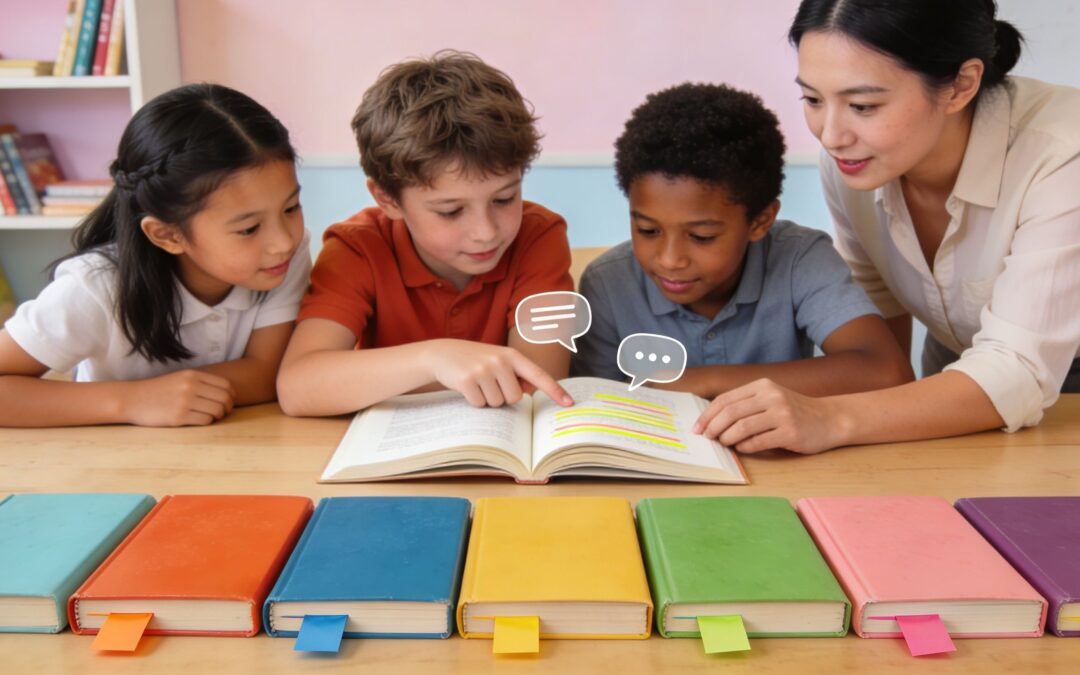
You can spot the need for a bullying lesson before a child names it. A student who usually joins every partner task asks to work alone. Recess conflict follows the class back inside. Someone stumbles over a word during read-aloud, a few kids laugh, and the room tightens.
Stories help because they give children enough space to talk about hard behavior without forcing anyone to disclose more than they are ready to share. They also help adults slow down and teach the skills that often get skipped in the moment: how to recognize repeated harm, how to respond as a bystander, how to ask for help, and how to repair harm when possible.
Bullying needs that kind of direct instruction. It is not the same as a single conflict or one rude comment. Children do better when adults teach the difference clearly and revisit it through discussion, modeling, and practice.
This guide goes beyond a simple book list. Each title is framed as a mini-lesson plan you can use right away, with a clear SEL focus, discussion prompts that lead to real conversation, extension ideas for classroom or home use, and notes that help teachers handle identity, belonging, and inclusion with care.
That practical piece matters. Some books open rich conversation but need adult coaching to turn insight into changed behavior. Others offer clearer language for younger students but leave less room for nuance. The strongest classroom picks do both well enough for your group, your time frame, and the kind of bullying concerns showing up in your setting.
1. FREE TO BE THE BOOK by Soul Shoppe
If you want one book that bridges school language and home follow-through, start with FREE TO BE: THE BOOK from Soul Shoppe. This is the most directly usable title on this list for adults who need words to say in the moment, especially when a child has experienced bullying and doesn't yet know how to explain what happened.
What stands out is the tone. It doesn't talk at children or panic adults. It gives compassionate language, practical tools, and simple ways to coach self-regulation, empathy, communication, and conflict resolution. That makes it especially useful when a school is trying to keep the same SEL messages alive after dismissal.
Best fit and trade-offs
This is the featured pick because it works in the space where many bullying books fall short. Plenty of books spark discussion. Fewer help a caregiver turn that discussion into repeatable practice the next morning, in the car, or after a hard recess.
Its biggest strength is also its limit. This is a guided support book, not a full intervention system. In serious bullying situations, adults still need school response protocols, counseling support when appropriate, and direct follow-up.
- Best for home-school alignment: A counselor can read part of it with a student, then send a concrete takeaway home for the family to use.
- Best for adults who want scripts: If a child says, “They keep doing it and I don't know what to do,” adults can move from reassurance to coaching.
- Less ideal as a child-only independent read: Younger students will get more from it when a grownup pauses, models, and practices with them.
Practical rule: If a bullying book gives insight but no language for what to say next, it usually won't change behavior on its own.
A simple classroom-to-home example is a “pause, name, choose” routine. After reading, ask a child to name what happened, identify the feeling, and choose one next step such as asking for help, using an assertive statement, or moving toward a safe peer. In family use, a caregiver might practice: “I didn't like that. Please stop,” followed by, “I'm telling an adult because it kept happening.”
Mini-lesson you can use tomorrow
Use this with small groups, a counseling check-in, or a parent workshop.
- SEL takeaway: Kids need both emotional safety and usable language.
- Discussion prompt: “What is the difference between being upset once and something that keeps happening?”
- Example response: “If someone bumps me by accident, that's one thing. If they keep calling me a name after I ask them to stop, that's different.”
- Extension activity: Create a two-column chart called “Feelings I Notice” and “Words I Can Use.” Fill it with student-friendly phrases.
- Diversity and inclusion note: Invite examples from different settings, including lunch, sports, online spaces, and sibling or peer groups. That helps children who don't see their experience reflected in a typical playground story.
For families who want a book that supports practice instead of stopping at awareness, this is the most functional choice on the list.
2. Wonder by R. J. Palacio

Wonder by R. J. Palacio works because it doesn't flatten bullying into heroes and villains. Students see social pressure, embarrassment, loyalty, exclusion, and growth from multiple perspectives. That's why it holds up in grades 4 through 6 and in schoolwide reading projects.
The trade-off is length. At 320 pages, it's not the quickest option for a busy class, and some readers need scaffolds such as partner reading, audio support, or chapter checkpoints. But if you can stay with it, the payoff is strong discussion around bystanders and school culture.
Where it works best
This is a strong fit for advisory, literature circles, or a class that needs to move beyond “be nice” language. It lets students examine how peer groups shape behavior. That's especially useful because bullying often involves witnesses, defenders, and reinforcers, not only the child doing harm and the child being targeted, as the American Federation of Teachers notes in its bullying prevention booklist for students.
The best conversations with Wonder usually start when students talk about what bystanders saw and why they stayed quiet.
Try this sequence after a read-aloud excerpt or chapter assignment:
- SEL takeaway: Perspective-taking changes behavior.
- Discussion prompt: “When does staying neutral become joining in?”
- Example response: “If I laugh because I don't want attention on me, I still helped the teasing continue.”
- Extension activity: Have students write a short scene from the point of view of a bystander who decides to act differently the second time.
- Diversity and inclusion note: Keep the focus on dignity, belonging, and visible difference without asking any student to represent a condition or identity group.
A practical caution. Don't rush to a “choose kindness” poster before students wrestle with the harder part, which is social risk. Ask, “What makes it hard to defend someone when your own status might drop?” That's where the essential SEL work happens.
3. Each Kindness by Jacqueline Woodson

Each Kindness is one of the most effective books for teaching that exclusion hurts, even when nobody shouts or threatens. That's its special strength. Many children can recognize obvious teasing. Fewer can spot quiet social rejection as harmful behavior.
The ending is somber, and that's exactly why the book works. It doesn't offer a neat apology scene that lets the class move on too fast. Students have to sit with regret, missed chances, and the fact that kindness delayed can become kindness denied.
Best lesson angle
Use this title when your class is dealing with subtle meanness, friendship circles, or “we didn't do anything” behavior. It also works well for restorative circles because it invites reflection without immediately forcing confession.
- SEL takeaway: Exclusion is an action, not an absence.
- Discussion prompt: “What did Chloe do that looked small but had a big effect?”
- Example response: “She didn't say the worst words, but she kept letting Maya be alone.”
- Extension activity: Use a pebble-and-water metaphor. After reading, students name one small action that can create a ripple of belonging, such as saving a seat, inviting a partner, or using someone's name kindly.
- Diversity and inclusion note: This book opens strong conversations about class, clothing, belonging, and assumptions. Keep students focused on observed actions rather than judging a character's worth.
The common mistake with Each Kindness is turning it into a generic “be kind” bulletin board. Better move: ask students to identify one repair action they can take this week when they notice someone on the edge of the group.
4. New Kid by Jerry Craft

Some bullying books lose older elementary readers because they feel too obvious. New Kid by Jerry Craft avoids that problem. The graphic novel format pulls students in fast, and the social dynamics feel current enough for upper elementary and middle school conversations.
This book is especially useful when bullying overlaps with bias, microaggressions, and belonging. Those situations often confuse adults because the harm may be denied, joked away, or framed as “not a big deal.” New Kid helps students examine impact without making the lesson feel like a lecture.
Why it fills an important gap
A content analysis of selected bullying picture books found that 71% targeted Preschool through Grade 3, while 29% targeted grades 4 through 8 in the Athens Journal of Education study on bullying picture books. That's one reason books like New Kid matter so much in practice. Older students still need accessible SEL texts, but they often need formats that respect their developmental stage.
Middle-grade students usually respond better when the book lets them notice social patterns on their own, then gives adults room to guide the conversation.
Try a panel analysis mini-lesson. Ask students to choose one illustrated scene and answer three questions: What happened? What message did the character receive? What could a peer do next?
- SEL takeaway: Harm isn't always loud.
- Discussion prompt: “How can a comment be framed as a joke but still isolate someone?”
- Example response: “If everyone laughs and one person feels singled out, the joke may still be harmful.”
- Extension activity: Have students create a short comic showing an upstander response in the cafeteria, hallway, or group project.
- Diversity and inclusion note: Set norms before discussing race, class, and identity. Students need permission to talk openly without putting classmates on display.
This is one of the best bullying books for children who are old enough to notice layered social behavior and young enough to still benefit from concrete guided discussion.
5. Chrysanthemum by Kevin Henkes

For early grades, Chrysanthemum by Kevin Henkes remains one of the most teachable choices because the problem is immediately clear. Children understand name-based teasing. They also recognize how fast a joke about a name can turn into a class norm.
This is a short read-aloud, which makes it ideal for back-to-school routines or a quick reset after an unkind incident. The limitation is that older students may find it too simple unless you pair it with identity, belonging, or name-story writing.
A strong primary-grade mini-lesson
Many students first experience peer harm through words about their name, voice, clothes, or family. Chrysanthemum gives teachers a direct way to say that names deserve respect.
- SEL takeaway: Respect starts with how we speak to and about one another.
- Discussion prompt: “What should you do if you hear someone making fun of a name?”
- Example response: “I can say, ‘We don't do that here,’ or I can go with the person and tell the teacher.”
- Extension activity: Create a class “Names Matter” gallery. Students share the story of their name, who chose it, or what they like about it. If a child doesn't know the story, they can share a nickname they value or how they want their name pronounced.
- Diversity and inclusion note: This book is especially helpful for affirming multilingual names, family traditions, and pronunciation respect.
National Bullying Prevention Month each October has helped schools normalize curated reading lists across age groups, and a KPBS recommended reading list for National Bullying Prevention Month shows how the field now spans preschool through high school. Chrysanthemum earns its place on the early-grade end because it gives very young children a concrete first lesson in dignity.
6. Confessions of a Former Bully by Trudy Ludwig

Confessions of a Former Bully is one of the few titles on this list that doesn't only center the child being hurt. That's valuable. In real schools, prevention gets stronger when students can examine the behavior of the aggressor, the social rewards around that behavior, and the possibility of repair.
Because it's told from the bully's perspective and includes back matter with practical strategies, this book works well in counseling groups, Tier 2 supports, and guided classroom lessons. It's less effective as a casual read-aloud for very young students because the discussion benefits from more emotional and social maturity.
When to choose this over a gentler title
Use this when your group needs direct language about responsibility, change, and social consequences. It helps children understand that harmful behavior isn't fixed identity. That's often a more productive frame than labeling a child and ending the conversation there.
A practical routine is a three-part reflection:
- SEL takeaway: Accountability and empathy can be taught together.
- Discussion prompt: “What is the difference between feeling sorry and repairing harm?”
- Example response: “Saying sorry is a start. Repair means changing what I do and making things safer for the other person.”
- Extension activity: Students complete a private reflection with three stems: “I notice…,” “I own…,” and “I can do differently by….”
- Diversity and inclusion note: Keep the lesson behavior-focused. Don't invite classmates to identify a “real bully” in the room.
A major reason this matters is prevalence. A 2025 systematic review and meta-analysis pooling 116 studies and 603,231 participants estimated that 25% of children and adolescents are bullying victims, 16% are perpetrators, and 16% are bully-victims in the PubMed record for the bullying prevalence meta-analysis. In practice, that means your class discussion can't only speak to targets. It also needs language for students who caused harm, joined in, or watched.
7. The Juice Box Bully by Bob Sornson and Maria Dismondy

If your goal is to move a class from bystander language to shared group norms, The Juice Box Bully is the fastest starter on this list. It gives younger students a simple classroom promise and a direct story line they can remember when a real incident happens.
The trade-off is subtlety. This book is more didactic than literary. That isn't always a bad thing. In grade 1 through grade 3, directness can help. But students usually need role-play or class practice to transfer the message into real behavior.
A good pick for class meetings
This title shines when you want a short lesson with immediate follow-through. Read the book, build a class agreement, and rehearse what “standing up for others” sounds like.
“Don't stay silent” only works when children also know what words to use and who can help.
Try these after the read-aloud:
- SEL takeaway: Classroom safety is a shared job.
- Discussion prompt: “What can you say when you see someone being left out or picked on?”
- Example response: “You can sit with us,” “That's not okay,” or “Let's get help together.”
- Extension activity: Create a class pledge and practice it with scenario cards. Example: “A student is mocked for spilling water.” “A group says someone can't join a game.” “A child is targeted in a class group chat.” Students choose a safe response, then rehearse it.
- Diversity and inclusion note: Include scenarios about exclusion, language differences, disability, online group chats, and friendship groups so students don't think bullying only happens in one obvious form.
This bystander focus matters because books often over-index on individual targets. In schools, the social climate changes faster when peers know how to interrupt harm together.
7-Book Comparison: Bullying Books for Children
| Book | Implementation complexity | Resource requirements | Expected outcomes | Ideal use cases | Key advantages |
|---|---|---|---|---|---|
| FREE TO BE: THE BOOK, Soul Shoppe | Low, requires adult facilitation for practice | Single affordable paperback; caregiver/educator facilitation | Practical SEL skills: empathy, self‑regulation, conflict coaching | Family read‑alouds, at‑home coaching, complement to school SEL | Research‑based tools, concrete tips, accessible for families |
| Wonder (R. J. Palacio) | Moderate, works best with planned schoolwide or classroom rollout | Full novel (print/audio/ebook), time to read, educator guides | Deep empathy, inclusive culture conversations, sustained discussion | One School One Book, grades 4–6, advisory lessons | High engagement, extensive teacher resources, proven impact |
| Each Kindness (Jacqueline Woodson) | Low, short read; requires sensitive facilitation for somber ending | Picture book, optional publisher discussion guide | Increased awareness of exclusion and missed kindness opportunities | Whole‑class read‑alouds, restorative circles, kindness campaigns | Concise emotional impact, award‑recognized |
| New Kid (Jerry Craft) | Moderate, needs prepared facilitation around race/bias topics | Graphic novel, teaching guides, multimedia resources | Engagement with microaggressions, belonging, bystander choices | Upper‑elementary/middle school bias and SEL discussions | Accessible graphic format, contemporary relevance, award‑winning |
| Chrysanthemum (Kevin Henkes) | Low, straightforward for primary classrooms | Picture book, free classroom guides | Understanding name‑based teasing, early empathy and respect | PreK–2 SEL lessons, back‑to‑school routines | Developmentally aligned, short and easy to use |
| Confessions of a Former Bully (Trudy Ludwig) | Low–Moderate, effective in small groups or Tier 2 supports | Short illustrated book, strong back matter and classroom materials | Perspective‑taking, concrete strategies for targets/bystanders/aggressors | Small‑group lessons, counseling, restorative practice | Skill‑based framing, practical classroom tools |
| The Juice Box Bully (Sornson & Dismondy) | Low, easy to implement with a class pledge; benefits from follow‑up activities | Picture book, free lesson guide and printable pledge | Greater bystander‑to‑upstander action, shared classroom norms | Grades 1–3 class meetings, school pledges and character ed | Simple repeatable language, immediate pledge implementation |
From Page to Practice Creating a Bully-Free Culture
A student gets laughed at during morning meeting for saying a classmate's name wrong. By lunch, three children are repeating the joke, one child is silent and uncomfortable, and the target has stopped participating. That is the moment when a book matters, but only if the class already knows what to do next.
Books support culture when they are tied to repeatable practice. A single read-aloud can build awareness. Culture shifts when students rehearse the same skills across the week, in class meetings, partner talk, recess repair, and family communication. Children need clear language for empathy, assertive responses, bystander action, and help-seeking before stress takes over.
Consistency across adults matters just as much. If one adult says “be kind,” another says “ignore it,” and another says “tell an adult,” students get three different directions for the same problem. In schools I support, the strongest results come from a shared script, a visible routine, and a short follow-up after incidents. That trade-off is real. It takes more planning on the front end, but it reduces confusion later.
Each title on this list works best as a mini-lesson, not a one-time message. After Chrysanthemum, teach students to ask and repeat a peer's name correctly, then practice it in pairs. After Each Kindness, set one class inclusion goal for the week and revisit it on Friday with examples of what students noticed. After Wonder, role-play two bystander lines students can say, such as “That's not funny” or “Come sit with us.” After The Juice Box Bully, create a class promise and use it during conflict repair instead of leaving it on the wall as decoration.
Some books need more teacher setup. New Kid opens strong conversations about bias, belonging, and microaggressions, but students need discussion norms before they can talk about those moments well. Confessions of a Former Bully is especially useful when a student needs accountability with dignity, because it gives adults a way to teach repair, not just apology. FREE TO BE THE BOOK extends well into home-school partnership work when families are given one simple script to reinforce.
The point is not to find one perfect anti-bullying title. Build a shelf with different jobs. Keep one book ready for exclusion, one for identity and belonging, one for bystanders, one for repair, and one for family follow-through.
That is how stories start doing classroom work.
If you want support beyond individual book lessons, Soul Shoppe offers practical SEL resources, experiential programs, and family-friendly tools that help school communities build the shared language children need to reduce bullying, strengthen empathy, and create safer classrooms every day.