

Top 10 List of Coping Skills PDF Resources for 2026
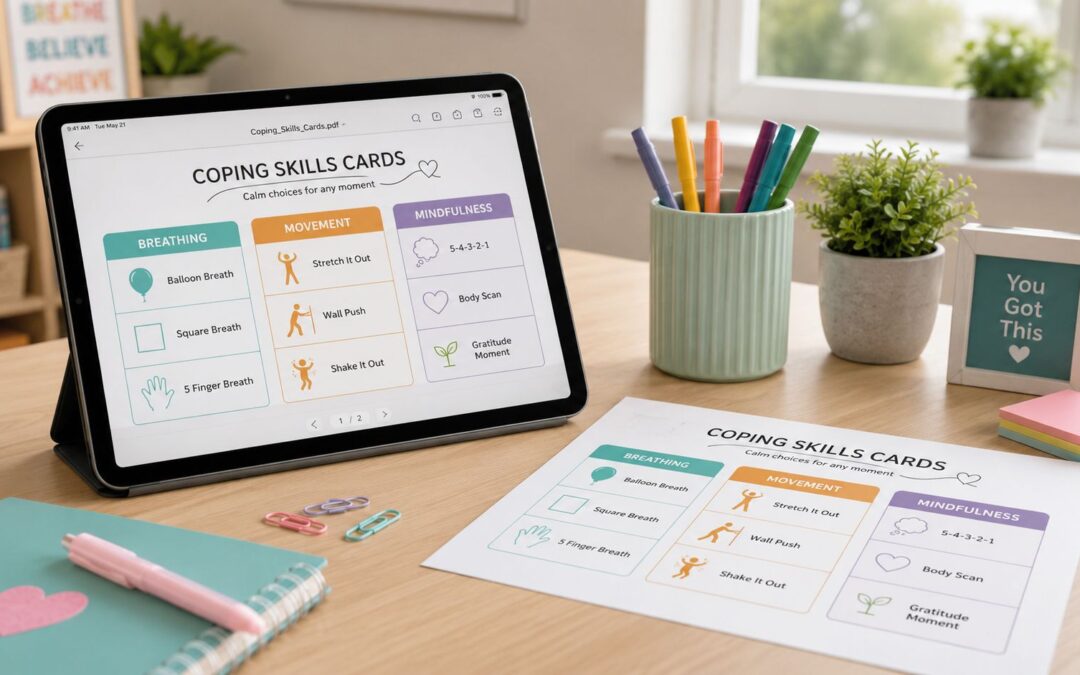
Building a Toolbox for Big Feelings: A Guide for Educators and Families
You've probably seen the moment already today. A student shuts down after a hard math page. Two children argue over a game at recess and one bursts into tears. A child who looked fine at breakfast suddenly says they can't go into school. Big feelings don't wait for the perfect lesson block, and that's exactly why a strong coping toolkit matters.
A good list of coping skills PDF gives kids something concrete to reach for when words are hard to find. It also helps adults teach emotional regulation in small, repeatable ways. One longitudinal study of more than 1,500 university students found that using a wider range of coping strategies was linked with better adjustment, and students who used 10 or more distinct strategies showed a 35% higher rate of successful adjustment than those using fewer than 5, according to the coping diversity study published in PMC. The takeaway for K-8 settings is simple. Kids need more than one calming trick.
That's where printable tools shine. A poster near the calm corner, a short handout in a family newsletter, or a small-group worksheet can turn abstract SEL language into something students can practice. The list below focuses on resources you can print, teach, and adapt right away for classrooms, counseling spaces, and home routines.
1. Tools Of The Heart Online Course

If you're not looking for one more disconnected handout, Tools Of The Heart Online Course deserves the featured spot. It's built for adults who want children to learn coping skills in context, with shared language, routines, and relationship repair woven into everyday school life.
Soul Shoppe's approach stands out because it doesn't treat self-regulation as an isolated intervention. The course is grounded in more than 20 years of school-based SEL practice and focuses on teachable habits like mindfulness, compassionate communication, self-awareness, and conflict resolution. That matters when you want the classroom teacher, counselor, recess aide, and caregiver all using the same language.
Best Use Case
This is the strongest fit for schools that want campus-wide consistency, and for families who want more than a static list of coping skills PDF. It works especially well when a principal or SEL lead wants common routines such as breathing, noticing feelings, repair conversations, and peer support woven across grade levels.
A practical example: a second-grade team can teach a short morning regulation routine, while a middle school advisory group uses the same language during peer conflict. At home, caregivers can reinforce the same reset steps before homework or bedtime.
Practical rule: Use this course when your challenge isn't access to coping ideas. It's consistency, adult modeling, and shared language.
What Educators Will Appreciate
- Schoolwide language: Students hear the same phrases across classrooms, support staff, and family communication.
- Flexible delivery: Teachers, counselors, and caregivers can learn on their own schedule.
- Better implementation path: The course connects naturally with Soul Shoppe's workshops, assemblies, coaching, app support, and community programming.
There are a couple tradeoffs. The public page doesn't show a detailed syllabus or sample lessons, so some teams will want a closer look before committing. It also works best when adults practice the routines regularly. Like any SEL training, it builds capacity, but it doesn't replace clinical mental health support for students who need it.
For K-2, keep the language concrete. “Smell the flower, blow out the candle” works better than “activate self-regulation.” For grades 3-5, add reflection prompts like “What helped your body feel safe again?” For middle school, connect coping to belonging, conflict repair, and self-advocacy.
2. Therapist Aid, Coping Skills Worksheets
Therapist Aid coping skills worksheets are some of the easiest print-and-go materials for educators who want clean, professional PDFs. The library includes general coping sheets plus more targeted topics like anxiety, triggers, healthy versus unhealthy coping, and DBT-style tools.
This option is strongest for upper elementary and middle school students who can handle more clinical language. Many worksheets are fillable, which makes them useful for counseling sessions, check-in/check-out folders, and student support plans.
Where It Fits Best
Use Therapist Aid when you need structure, not decoration. A school counselor might hand a coping skills worksheet to a fifth grader who keeps saying “nothing works,” then help the student sort strategies into categories like body, mind, and connection.
- Best for small groups: Students can circle three coping skills they'll try this week and reflect on which one helped most.
- Best for student folders: Keep a printed page in a binder for quick access during stressful parts of the day.
- Best for older students: The language is usually clearer for grades 4-8 than for kindergarten or first grade.
One limitation is tone. Some sheets feel written for therapy settings first, schools second. For younger children, you'll likely need to simplify wording and pair the worksheet with modeling.
A classroom example: turn a dense coping list into a choice board. Instead of asking, “Which strategy will you use?” ask, “Do you want a body break, a quiet activity, or someone to talk to?” That simple shift helps students choose faster.
3. Akron Children's Hospital, 99 Healthy Coping Skills PDF
If you want one sheet you can print in under a minute and use all week, the Akron Children's Hospital 99 Healthy Coping Skills PDF is a strong pick. It's a single-page list packed with concrete ideas across movement, creativity, sensory input, breathing, and connection.
This is the kind of list of coping skills PDF that works well when students freeze and say, “I don't know what to do.” The options are short, scan-friendly, and easy to highlight.
Best Use in a School Day
A teacher can post it in a calm corner and ask students to choose one strategy before returning to work. A counselor can send it home with three items already starred so caregivers know what the child has practiced at school.
Keep this one visible, but don't stop at visibility. Have students rehearse two or three favorites when they're calm, not just when they're upset.
A practical example for grades 1-3: ask students to use colored dots. Green means “I can do this by myself,” yellow means “I need an adult to remind me,” and red means “this one isn't for me.” For grades 4-8, have students build a “top five for school” and a separate “top five for home.”
The downside is that it isn't differentiated by age. Some items will fit an eight-year-old better than a kindergartner, and some will need adult judgment based on setting. It's also a list, not a lesson sequence, so it works best when paired with direct teaching.
4. Children's Healthcare of Atlanta Strong4Life, Coping Skills Tip Sheets

The Strong4Life coping skills tip sheets from Children's Healthcare of Atlanta do something many printable resources miss. They teach the skill, not just the name of the skill. You'll find handouts on grounding, journaling, progressive muscle relaxation, and other concrete techniques, with English and Spanish options for broader family access.
That bilingual availability makes these handouts especially useful for family newsletters, parent nights, and district resource hubs. They're also friendly enough to send home without a long explanation.
Why the How-To Matters
A lot of children can name a coping strategy but can't apply it when stress spikes. Recent concerns in SEL materials often come back to a simple issue. Lists name too many ideas without showing students when or how to use them. That's why Strong4Life's step-by-step style helps.
For example, instead of telling a student to “ground yourself,” you can print a handout, practice it during morning meeting, then rehearse the same sequence before a test. In a family setting, a caregiver can keep one page on the fridge and walk through it after a rough sibling conflict.
- For K-2: Turn one tip sheet into a picture-supported mini-lesson with gestures.
- For grades 3-5: Have students annotate the sheet with “when I could use this.”
- For middle school: Ask students to rate which steps feel realistic in class versus at home.
The only inconvenience is navigation. The materials live across several pages, so gathering a full set takes a few extra clicks. Some handouts also lean toward parent coaching, which means teachers may want to trim or adapt the wording for classroom use.
5. Sanford Fit, Kids' Coping Strategies Poster Packs

Visual learners often need more than a text-heavy handout. Sanford Fit's Kids' Coping Strategies Poster Packs give you colorful, classroom-ready supports that teach breathing, mindfulness, grounding, and positive self-talk in a format young children can use.
These packs shine in elementary settings, especially calm corners, counseling offices, and transition spaces. Spanish versions add flexibility for schoolwide use.
Best for Calm Corners and Routines
This resource works well when you want coping practice to feel normal, not remedial. A poster by the classroom door can cue a reset before rejoining group work. A set of Mindful Moments cards can become part of your post-recess routine.
One reason multisensory strategies matter is that cues tied to sensory anchors can be more effective in moments of acute stress. Guidance linked through the NIMH Bookshelf overview on relaxation and stress reduction supports the value of body-based, sensory-grounded calming techniques, which is exactly the kind of thing these posters make easy to teach.
A pinwheel, bubble breath visual, or tracing card often works faster with younger students than a verbal reminder to “calm down.”
A practical example: in kindergarten, let students point to a breathing card instead of explaining their feeling. In fourth grade, add a reflection strip that says, “What changed in my body after one minute?” That turns a poster into a habit.
This set is primarily elementary-focused. Middle school students may find the design too young unless you select the more neutral visuals and pair them with advisory discussion.
6. Boys Town, 50 Coping Skills for Children
The Boys Town 50 Coping Skills for Children PDF is concise, positive, and easy to share. If you need a handout for planners, family packets, or student support binders, this one is straightforward and practical.
Boys Town also pairs the list with coping toolbox guidance for caregivers, which makes it stronger than a list that stops at “try these.” The tone is especially parent-friendly.
Best for Family Communication
This is one of the easiest resources to send home because it doesn't feel clinical. A school can include it in a beginning-of-year SEL packet, or a teacher can laminate it for students who need quick prompts during the day.
Here's a simple home-school example. A child circles three school-friendly skills such as drawing, taking deep breaths, or asking for a break. At home, the caregiver circles three evening-friendly skills such as listening to music, talking, or taking a quiet reset. The overlap becomes that child's core coping set.
- Use in planners: Tape a reduced-size copy inside the cover.
- Use in newsletters: Highlight one “family skill of the week.”
- Use in conferences: Ask adults and children to each pick the same two strategies they'll reinforce.
The limitation is depth. It doesn't segment skills by setting or provide much instruction on how to teach them. For that reason, it's best as a companion handout after you've modeled the strategies.
7. PESI Publishing, Free Coping Skills for Kids PDF Sampler

If you want materials that feel kid-centered right away, the PESI Publishing coping skills PDF sampler is worth a look. It includes a printable checklist, calming strategy pages, coping menus, and planning templates designed for ages 4 to 12.
The sampler format is useful when you're deciding whether a larger workbook would fit your setting. You can test the tone, visuals, and student response before buying anything else.
Best for Personalizing a Student Plan
This resource is a nice fit for calm-down kits and individual coping menus. A student can sort options into “works at school,” “works at home,” and “I want to try this with help.”
The personalization piece matters because broad lists can overwhelm children. The ISSUP compilation of 117 healthy coping skills shows the value of concrete, measurable actions such as going for a brisk 10-minute walk or doing a counted routine. That same principle applies here. Students usually do better when the strategy is specific and doable.
For example, don't just hand over a menu and say “pick one.” Try this instead:
- For younger students: “Choose one quiet hand activity and one breathing activity.”
- For grades 3-5: “Pick two strategies you can do in under five minutes.”
- For older elementary and middle school students: “Pick one strategy for frustration and one for social stress.”
The drawback is that it's only a sampler and the landing page includes marketing elements. Still, for many teachers and counselors, the free pages are enough to pilot routines before expanding.
8. Centervention, Coping Skills and Emotional Regulation Worksheets

Centervention coping skills and emotional regulation worksheets are built with school use in mind. That shows up in the grade-banded materials, facilitation notes, and practical focus on skills like square breathing, grounding, and evaluating whether a strategy helped.
If you run Tier 1 lessons, small groups, or Tier 2 check-ins, this resource is one of the most classroom-oriented options on the list.
Best for Small Group Practice
Centervention works well when students need guided repetition. A counselor can teach 5-4-3-2-1 grounding to a small group, then send each student back with a matching worksheet and cue card for class.
A practical example for grade bands:
- Elementary: Use one body-based worksheet per week and practice it before transitions.
- Upper elementary: Add a reflection prompt such as “What problem was my body trying to solve?”
- Middle school: Compare short-term calming skills with longer-term coping plans.
This grade-band distinction matters because many generic PDFs don't clearly separate immediate regulation from later problem-solving. In practice, students often need to calm their bodies first and think later. Centervention's materials lend themselves to that sequence better than a simple all-purpose list.
There's some extra navigation on a few downloads, and the visual style varies across resources. Even so, the ease of facilitation makes this a strong option for educators who want more than a poster.
9. Child Mind Institute, Managing Intense Emotions for Kids

Some resources are better at coaching adults than listing student strategies. Child Mind Institute's managing intense emotions guides are strong because they help caregivers and educators understand what to do before, during, and after a child is dysregulated.
The printable activity sheets support grounding, co-regulation, and calm-time practice. That makes this a good bridge between home and school.
Best for Home-School Alignment
Use these guides when a child's coping skills break down across settings. A student may use a breathing tool successfully in the counselor's office but forget it during lunch conflict or at bedtime. Adult coaching helps close that gap.
Children often need a calm adult, a practiced script, and a familiar cue before they can use a coping skill independently.
A practical example: send one printable sheet home after a support meeting and ask the family to practice it at a neutral time, not during a meltdown. Then have the teacher use the same language in class. “Hands on belly, slow exhale, name one thing you see” works better when children hear it in both places.
The tradeoff is format. These are guide-first resources, so if you want a standalone list of coping skills PDF, you may need to pull out the printable parts yourself. Still, for students who need co-regulation and consistency, that extra context is often what makes the strategy stick.
10. National Child Traumatic Stress Network, Coping Fact Sheets

The National Child Traumatic Stress Network coping fact sheets are especially useful when schools need trauma-informed family support. These handouts are more text-heavy than a poster pack, but they bring credibility and a steady tone that works well in difficult seasons.
They're a smart choice for district family resource pages, re-entry packets, crisis response communication, and parent education events.
Best for District and Family Support
Use NCTSN when the message needs to be calm, trustworthy, and broad enough for many situations. Parent and youth versions support whole-family learning, which is helpful when stress affects routines at school and at home.
A practical school example: after a community stressor, a principal can send the parent fact sheet with one short note from the school counselor explaining which two coping routines teachers will also use in class. That creates continuity without overwhelming families.
- For younger grades: Pull out two or three strategies and turn them into visuals.
- For upper grades: Use the handout during advisory or counseling check-ins.
- For caregivers: Highlight one section and invite them to practice it during a calm moment.
The main limitation is readability for younger children. The language is stronger for adults and older students than for primary classrooms, so teachers will often need to adapt it into simpler scripts or visuals.
Top 10 Coping Skills PDF Resources Comparison
| Resource | Core features | Target audience / setting | Unique selling point | Format & cost |
|---|---|---|---|---|
| Tools Of The Heart Online Course (Soul Shoppe) | Research-based SEL course; scaffolded tools for self-regulation, mindfulness, compassionate communication | Schools, teachers, counselors, caregivers; schoolwide implementation | Practitioner-tested 20+ years; integrates with workshops, coaching, app for sustained culture change | Online on-demand course; paid (school/family purchase) |
| Therapist Aid, Coping Skills Worksheets | Large library (anxiety, addictions, DBT TIPP); many fillable PDFs; professional formatting | Clinicians, counselors, teachers; upper elementary–middle school | Many free, clinician-created, instant downloads | PDF downloads; many free, some premium paid |
| Akron Children's, 99 Healthy Coping Skills (PDF) | Single-page list of 99 concrete coping ideas across body, breath, senses, connection | Students and families; handouts, locker inserts, calm-corner posters | One-page, zero-prep; hospital-backed and up-to-date | Single-page PDF; free |
| Children's Healthcare of Atlanta Strong4Life, Tip Sheets | Bilingual tip sheets teaching grounding, PMR, journaling with how-to steps | Schools, families, bilingual districts | English/Spanish materials with step-by-step instructions for teaching skills | Printable PDFs; free |
| Sanford Fit, Kids' Coping Strategies Poster Packs | Colorful K–5 posters, Mindful Moments cards, caregiver cheat-sheets; linked SEL activities | Elementary classrooms, calm corners, caregivers | Classroom-ready visuals that normalize coping practice; Spanish versions | Printable poster/card packs; free |
| Boys Town, 50 Coping Skills for Children | Concise list of 50 ideas + coping toolbox guidance for caregivers | Children, tweens, families, classroom handouts | Trusted national organization; positive, family-friendly framing | PDF handout; free |
| PESI Publishing, Free Coping Skills Sampler | Printable checklist, calming strategies, coping menu, planning templates (ages 4–12) | Educators and caregivers trialing research-based activities | Free sampler to preview materials before buying full workbook | Sampler PDF on publisher page; free (marketing content present) |
| Centervention, Coping Skills & Regulation Worksheets | Grade-banded lessons (breathing, grounding, strategy evaluation) with facilitation notes | Classrooms, small groups, Tier 1 & Tier 2 interventions | Strong classroom orientation and facilitation-ready materials | Printable worksheets; mostly free |
| Child Mind Institute, Managing Intense Emotions for Kids | Guides + printable activities for grounding and co-regulation; trauma-informed tone | Caregivers and educators; home–school alignment | Expert nonprofit guidance focused on coaching adults and alignment | Guides and activity sheets online; free |
| NCTSN, Coping Fact Sheets | Evidence-informed, trauma-aware coping lists for youth and parents; aligned with MTSS | Districts, families, crisis communications, universal supports | High authority on child trauma; suitable for district-wide distribution | Printable fact sheets (PDF); free |
Putting Your Coping Skills PDFs into Practice
A PDF is a starting point, not a destination. Students don't build regulation skills by glancing at a poster once. They build them by practicing when they're calm, hearing the same language from trusted adults, and using simple routines often enough that those routines become familiar.
That's why the best list of coping skills PDF is the one you teach. Print fewer pages and use them more consistently. A single breathing card, a short menu of body-based options, and one reflection routine can do more for a classroom than a giant binder nobody opens.
Here are practical ways to make these resources work in real life:
- Build a personal calm-down kit: Let students choose three printed tools and three physical items, such as a breathing card, a coping menu, paper for drawing, a sensory object, and a visual timer.
- Teach in calm moments: Introduce one skill during morning meeting, advisory, or counseling group before students need it under pressure.
- Use scenario practice: Role-play common moments like losing a game, feeling stuck on homework, or getting corrected in front of peers.
- Match the skill to the setting: A child may use wall pushes at school, journaling at home, and a help script in the hallway.
- Model it yourself: Teachers and caregivers can say, “I'm frustrated, so I'm taking one slow breath before I answer.”
One common mistake is treating all coping skills as interchangeable. They aren't. Some help a child calm their body right now. Others help them reflect, reconnect, or solve a problem later. When you organize your resources that way, students start to understand when to use which tool.
It also helps to prepare your files before sharing them. If you send home handouts or post them online, you may want to remove PDF metadata on Mac and Windows so family-facing documents stay tidy and privacy-conscious.
If you're leading a school or district, think beyond isolated downloads. The strongest results usually come from a shared SEL language across classrooms, counseling spaces, and homes. That's where Soul Shoppe can help. Their programs support the shift from individual coping strategies to a wider culture of belonging, empathy, conflict repair, and emotional safety. When adults across a campus use the same language and routines, students don't just manage stress more effectively. They feel more connected, more capable, and more ready to learn.
If you want more than a printable list and you're ready to build a shared SEL culture, explore Soul Shoppe. Their school and family programs help children and adults practice self-regulation, mindfulness, communication, and conflict resolution in ways that fit real classrooms and real relationships.