CHECK OUT OUR 2026-27 SCHOOL YEAR PROGRAMMING

A child has just snapped at a classmate. Papers are crooked, voices are tight, and everyone in the room is waiting to see what happens next. At home, it might look different but feel the same. A slammed door, a shouted “no,” a sibling argument that went from small to explosive in seconds.

In that moment, many adults reach for consequence first. Remove the child. Send them out. Tell them to fill something out and come back when they're “ready.” The problem is that a worksheet used that way often becomes one more piece of discipline theater. It records the mistake, but it doesn't help the child understand it.

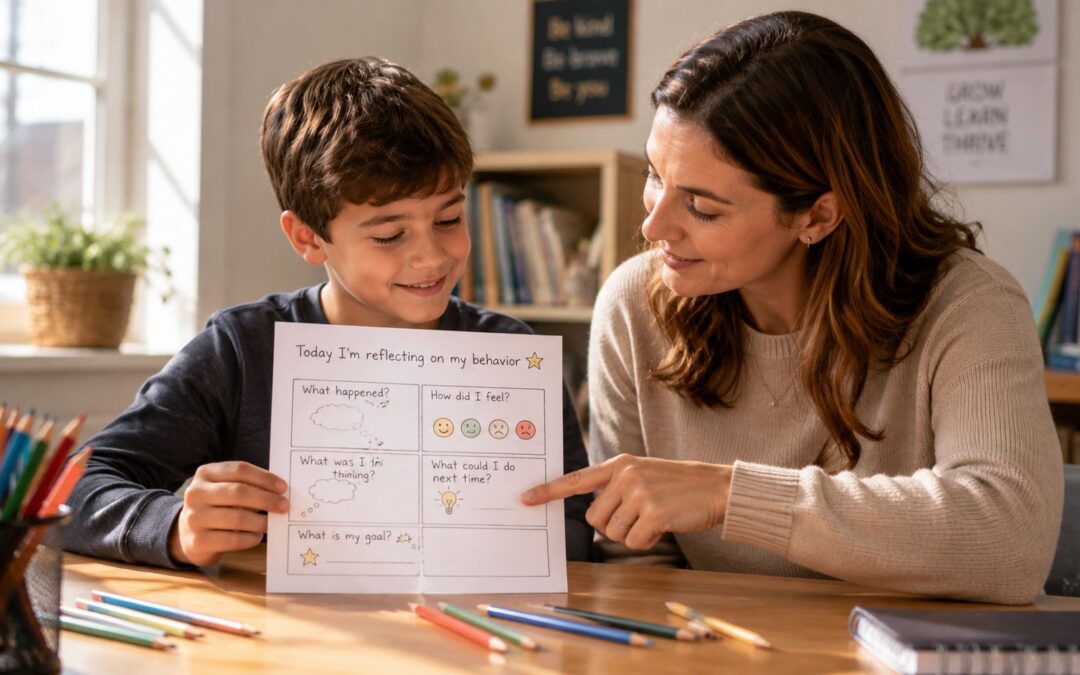
A behavior think sheet works best when it does the opposite. It slows the moment down, gives the child language for what happened, and opens a conversation that can effectively repair harm. Used well, it isn't a punishment form. It's a guided pause that helps a student or child move from reaction to reflection.

From Timeout to Time-In with a Behavior Think Sheet

A behavior problem rarely starts with the visible behavior. The pushing, yelling, refusing, or storming off is usually the last step in a chain. Something happened before it. A feeling showed up. A need went unspoken. The adult's job is to help the child see that chain clearly.

That's why I think of the behavior think sheet as a time-in tool. The child isn't being pushed away from the relationship. They're being brought back into it with structure. Instead of “Go sit there until you can behave,” the message becomes, “Let's figure out what happened so you can rejoin us with a plan.”

A classroom example makes the difference obvious. During group work, one student shouts, “You never listen!” and knocks a pencil box off the table. In a punitive model, the student gets removed, loses a privilege, and may be told to write about what they did wrong. In a restorative model, the adult still addresses the disruption, but the next step is reflection and repair. The sheet helps the student name the broken expectation, describe what led up to the outburst, and consider what needs to happen now.

At home, the same tool works after a child yells at a sibling over a game controller. Instead of forcing an immediate apology while everyone is still upset, a parent can pause the interaction and use a short reflection form later. That helps the child move past “He started it” and toward “I felt left out, then I grabbed, then I yelled.”

A good think sheet doesn't ask, “How do I get this child to admit fault?” It asks, “How do I help this child understand the moment and rebuild trust?”

This approach fits squarely inside restorative practice and SEL. Children build self-awareness when they identify what they felt. They build self-management when they name what they could do differently next time. They build responsible decision-making when they connect their action to its effect on other people. If you want a broader frame for that work, this overview of restorative practices in education is a useful companion.

What this looks like in real life

A strong response sounds calm and specific.

  • In class: “You were frustrated when your partner took over. You yelled and the group stopped working. Let's use the sheet to sort out what happened.”
  • At home: “You were upset when your sister changed the channel. Hitting isn't okay. We're going to pause, then talk and write through it together.”
  • With repeat behaviors: “We've seen this pattern before. That means we need better information, not a harsher lecture.”

What doesn't work is handing over a form with irritation in your voice. Kids read that instantly. If the sheet feels like a paper punishment, they'll either rush through it, refuse it, or tell you what they think you want to hear.

The Core Components of an Effective Think Sheet

The strongest think sheets are simple, but they aren't random. According to The Art of Education's six-part model for an effective think sheet, the form should include identifying the broken expectation, unpacking antecedent events, allowing the student to explain their behavior in their own words, recognizing the natural effects of their actions, including a call to action, and providing teacher suggestions for future alternatives.

A six-step infographic detailing the core components of an effective think sheet for emotional behavior management.

Start with the broken expectation

Children need help linking behavior to a shared norm, not just an adult's annoyance. “What rule did you break?” can sound shaming. “What expectation wasn't met?” is more neutral and clearer.

A student prompt might read: “What was the expectation during partner reading?”
A student answer might be: “Use a quiet voice and take turns.”

That matters because it anchors the conversation in community, not personality. The issue isn't “you are rude.” The issue is “the class expectation was interrupted.”

Name what happened before the behavior

The antecedent section is where a lot of adults rush. Don't. In this section, students start seeing triggers, patterns, and pressure points.

Examples of prompts:

  • Before the problem started: “What was happening right before you got upset?”
  • For peer conflict: “Did someone say or do something that made the feeling stronger?”
  • For work avoidance: “Were you confused, embarrassed, bored, or distracted?”

A child might write, “I thought they were laughing at me,” or “I didn't understand the directions and didn't want to ask.” Those are very different situations, even if the visible behavior looked the same.

Let the student tell the story

This is the section many pre-made forms miss. Children need room to explain the event in their own words. That doesn't excuse the behavior. It gives the adult better information.

Practical rule: If the sheet only captures the adult's version of the event, it won't build ownership.

A useful prompt is, “Tell what happened from your point of view.” Another is, “What were you trying to make happen?” That second question often reveals the child's goal. To get space. To get fairness. To avoid embarrassment. To get control back.

For richer prompts that support this kind of reflection, teachers often benefit from a bank of student reflection questions.

Cover impact, repair, and next steps

A think sheet should also ask the student to notice the natural effects of their choice. “Who was affected?” and “What happened because of your action?” move the child beyond self-protection.

Then comes the call to action. That might be an apology, helping reset materials, checking in with a classmate, or practicing a replacement script. Last, the teacher adds future alternatives. This is the coaching part. “Next time, ask for a break.” “Next time, say ‘I need a turn when you're done.’”

Those final pieces make the sheet restorative. Without them, it becomes documentation. With them, it becomes a plan.

How to Create Your Own Behavior Think Sheet

You don't need a fancy template to make a useful behavior think sheet. You need a clear sequence, language children can answer, and enough space for authentic responses. A good form feels like a conversation printed on paper.

A person writing in a Behavior Think Sheet notebook on a desk with colored pens and a plant.

Build the form around short sections

Keep each section focused on one task. If you cram too many questions into one block, children start guessing or shutting down.

A practical layout includes:

  1. What happened
  2. What I was feeling
  3. What happened because of my choice
  4. What I can do next time
  5. How I will repair or rejoin

This is also where design matters. Younger students often need emoji faces, drawing boxes, or sentence starters. Older students usually respond better to open lines and fewer cartoon visuals. Either way, leave white space. Crowded forms feel like tests.

Use prompts that invite honesty

A weak prompt asks, “Why did you do that?” Most children hear blame in that question. A better prompt narrows the reflection and reduces defensiveness.

Try language like this:

  • For early elementary: “Draw what happened first.” “Circle the feeling you had.” “What can you do next time?”
  • For upper elementary: “What was happening right before the problem?” “What did you need in that moment?” “Who was affected?”
  • For middle grades: “What story were you telling yourself?” “What choice did you make under pressure?” “What would have protected your goal without causing harm?”

At home, a parent might change “class expectation” to “family rule.” A question could become: “Which house agreement did you forget?” That small shift makes the form feel natural instead of schoolish.

Add support for students who struggle to write

Not every child can reflect well in writing, especially when emotions are still high. Your form should make room for alternatives.

  • Offer sentence stems: “I felt ___ when ___.”
  • Allow drawing: “Sketch the problem and a better next step.”
  • Use checkboxes: “I felt angry / worried / embarrassed / left out.”
  • Scribe when needed: Adult writes exactly what the child says.

If you want a related resource for children who act before they can think, these impulse control worksheets can pair well with a reflection process.

One useful model for tone and pacing is seeing the process in action:

Sample wording you can lift into your own form

Here's a simple version that works in both classrooms and homes.

Section Sample prompt
Situation “What happened?”
Trigger “What happened right before that?”
Feelings “What were you feeling in your body and mind?”
Impact “How did your choice affect you and other people?”
Better choice “What could you do next time in a similar moment?”
Repair “What needs to happen to make this right?”

The best custom forms sound like the adults who use them. If your classroom language includes “reset,” “repair,” or “rejoin,” use those words. If your family says “take space” or “start over,” build that in. A behavior think sheet works better when it matches the culture around it.

A Guide to Using Think Sheets Effectively

The form itself matters less than the way you introduce and use it. A behavior think sheet should never be thrust into a child's hands in the heat of conflict with, “Fill this out because you made bad choices.” That turns reflection into compliance.

A more effective approach starts with regulation. The child needs enough distance from the incident to think, speak, and write with some clarity.

A five-step guide on how to use think sheets effectively to support behavioral development and communication.

Use a calm space and clear language

Centervention notes that the behavior think sheet should be used in a designated Cool Down Corner away from other students, and that the teacher should explain the problem explicitly. Their example is direct and specific: after an outburst, the teacher says, “You yelled when Jamie asked for help,” then gives the student 10 minutes for reflection before reviewing the sheet together in a joint conversation, as described in this behavior reflection exercise.

That example captures two things teachers often miss. First, privacy matters. Students rarely reflect well when peers are watching. Second, the adult should describe the behavior, not label the child.

A useful script sounds like this:

“I can see you're upset. We're going to step over here, get settled, and use the sheet to figure out what happened.”

That kind of language lowers the temperature. It also keeps the adult in a coaching role.

Don't skip the scheduled follow-up

The strongest implementation isn't random. Reflection should happen intentionally. One practical model is to set a specific date and time for the conversation, then return to the incident with purpose. WhyLiveSchool gives the example of a student who disrupts math on Monday, then completes the reflection on Tuesday at 9:00 AM, with guidance to examine whether the behavior came from peer pressure or lack of understanding and to list three better choices for next time in this think sheet planning example.

That structure helps adults avoid two common mistakes: trying to force deep reflection too early, and forgetting to follow up at all.

If a student often needs a pause before they can reflect, break cards for students can support the front end of the process.

What works and what backfires

Some implementation choices consistently help. Others gradually ruin the tool.

  • What works

    • Neutral tone: “Tell me what was happening before this.”
    • Shared review: Adult and child read the sheet together.
    • Specific repair: “Check in with Marcus and help rebuild the block tower.”
    • Short revisit later: “How did your plan work during centers today?”
  • What backfires

    • Public completion: A child writing while classmates stare.
    • Lecture on top of the form: The adult talks through the whole reflection.
    • Using it for every minor issue: The process becomes noise.
    • Treating it as proof: “I need this in writing so your parent sees what you did.”

A think sheet is a catalyst for dialogue. If the conversation never happens, the sheet did only half its job.

Adapting Think Sheets for Different Ages and Settings

A first grader, a fifth grader, and a seventh grader don't need the same behavior think sheet. Their language is different, their self-awareness is different, and their reasons for acting out are often different too. The format should change with them.

That doesn't mean creating an entirely new system for every age. It means adjusting the prompts, level of support, and adult role so the reflection feels doable.

Think Sheet Adaptations by Age Group

Age Group Focus Sample Prompt Adult Role
K-2 Naming feelings and simple cause-and-effect “What happened?” “How did you feel?” “Draw a better choice.” Sit beside the child, read questions aloud, scribe or invite drawing
3-5 Triggers, impact, and repair “What happened right before the problem?” “Who was affected?” “What can you do next time?” Prompt with follow-up questions, help connect behavior to class expectations
6-8 Perspective-taking, peer influence, and planning “What were you thinking at the time?” “Did pressure from others affect your choice?” “What's your plan if this happens again?” Facilitate discussion, challenge vague answers, support realistic action steps
Home use Family rules, sibling conflict, and repair routines “What happened in our family space?” “What do you need to make it right?” Keep tone calm, revisit later, focus on re-entry into family routines

What adaptation looks like in practice

With younger children, less writing usually gets better results. A kindergartener who shoved during line-up may circle a feeling face, draw the moment, and practice a replacement phrase such as “Can I have space?” That's enough. You're building emotional vocabulary and pattern recognition.

Upper elementary students can handle more sequence. If a fourth grader tears up a worksheet after getting corrected, they can usually identify the event before the behavior, their emotional reaction, and the effect on the room. This age group often benefits from prompts that separate accident from intention.

Middle school students need dignity. A childish-looking sheet can create instant resistance. Give them prompts that respect complexity. A student who joins in on teasing may need to reflect on status, embarrassment, or peer alignment. The question isn't only “What did you do?” It's also “What were you trying to avoid?”

Older students usually open up more when the form sounds reflective, not juvenile.

Think sheets work better inside a larger system

A think sheet shouldn't carry your whole behavior system by itself. The strongest use is inside a broader routine that includes relationship-building, reteaching expectations, calm spaces, and proactive supports.

That's where complementary tools matter. A 2012 study by Sims at Northwest Missouri State University found that using target sheets alongside behavior think sheets significantly reduced both the number of think sheets issued and inappropriate classroom behaviors. That's a practical reminder that reflection works best when students also have tools for preventing the same pattern from repeating.

At home, adaptation matters just as much. Families already know that routines must match development. The same way parents adjust bedtime expectations across different baby sleep routines, reflection tools should change as children grow. A preschool-style prompt won't fit a middle school conflict, and a dense middle school form will overwhelm a younger child.

Troubleshooting Common Challenges and Measuring Success

Even a thoughtful behavior think sheet can flop if the child feels cornered, tired, embarrassed, or mistrustful. That doesn't mean the tool is wrong. It usually means the process needs adjustment.

Common problems and better responses

  • The child refuses to write

    • Try this: Offer choices. “You can write, draw, or tell me and I'll scribe.”
    • Avoid this: “You're not leaving until it's finished.” That turns reflection into a standoff.
  • The child gives one-word answers

    • Try this: Ask narrower follow-ups such as, “What happened right before that?” or “Which feeling fits best, angry, worried, embarrassed, or left out?”
    • Avoid this: Repeating the same broad question louder.
  • The sheet feels like punishment

    • Try this: Change your entry language. “This helps us understand and make a plan.”
    • Avoid this: Assigning it publicly or attaching it to shame.
  • Nothing seems to change right away

    • Try this: Look for smaller signs of growth. Faster recovery. Better feeling words. More honest reflection. A stronger repair attempt.

For adults who coach children in sports or other performance settings, this guide for sports coaches and parents offers useful ideas about giving corrective feedback without damaging connection. The same principle applies here. Children listen better when feedback is specific, calm, and future-focused.

What success actually looks like

Success doesn't mean behavior problems vanish overnight. It means the child gets better at catching the moment earlier. They begin to say, “I was frustrated,” instead of exploding with no words at all. They start recognizing triggers. They accept repair more readily. They need fewer adult guesses because they can explain themselves more clearly.

That's the long game. A behavior think sheet earns its place when it helps children build emotional insight, not when it produces a perfect form.


If you want practical SEL tools that help students, educators, and families build empathy, repair conflict, and create safer school communities, explore Soul Shoppe. Their programs, workshops, and resources are designed to turn skills like reflection, communication, and self-regulation into everyday practice.