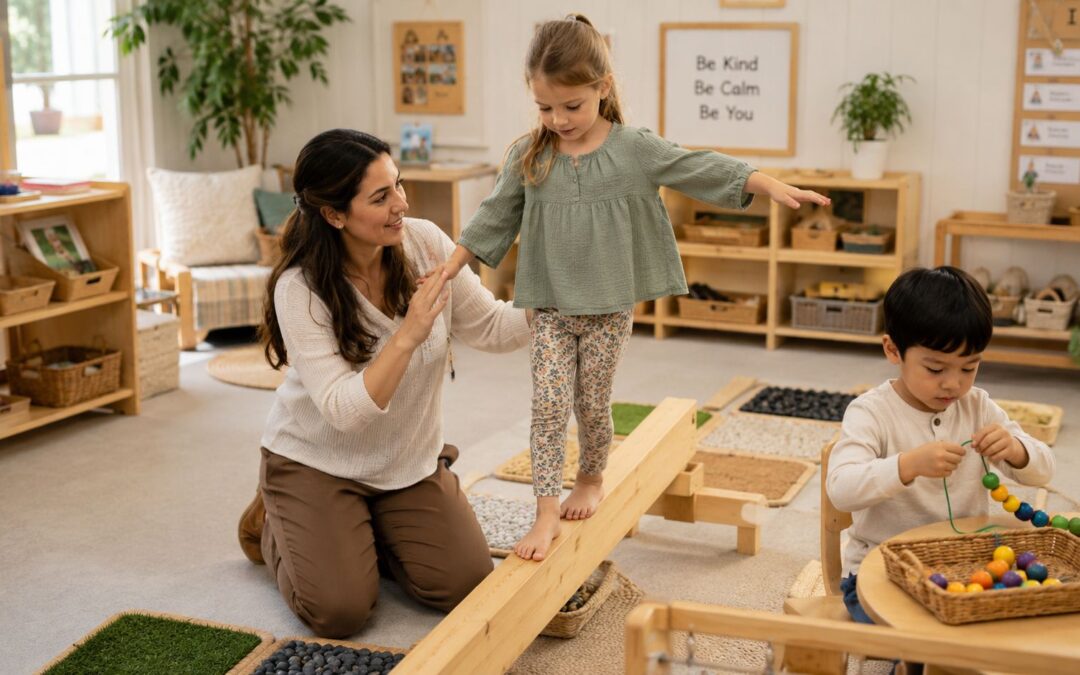
A teacher notices it first at the edges of the day. One child can't settle on the rug unless he's twisting his shoelaces, another avoids the playground ladder, and a third spends recess fighting with a zipper instead of joining friends. Those moments can look like inattention, stubbornness, or shyness, but they're often sensory motor development signals, the body telling us a child needs a different kind of support.
What Sensory Motor Development Really Looks Like in a Classroom
A classroom gives you the clearest view of sensory-motor life because the demands never stop. Children have to sit, stand, carry, reach, listen, shift, grip, wait, and rejoin the group again and again. When one of those pieces is hard, adults usually notice the behavior first, not the body-based reason underneath.
A kindergartner who keeps slipping out of circle time may not be trying to defy anyone. He may be using his shoelaces, a chair edge, or the pressure of his own hands to help his body stay organized. A student who skips the climbing wall or hangs back during games may be protecting herself from balance demands she can't yet trust.
Practical rule: When a child seems “off,” look at movement, posture, and sensory load before you look at motivation.
The same pattern shows up in the small routines that make school life run. Lining up requires balance and body spacing. Holding a pencil asks for hand strength, finger control, and the ability to stay regulated while focused. Joining a partner game asks for timing, coordination, turn-taking, and enough body comfort to stay with peers instead of withdrawing.
That's why sensory-motor challenges often get mislabeled as behavior problems. A child who fidgets, bumps into things, avoids messy materials, or falls apart during transitions may be telling you that the task is too hard for the body right now. A warm, observant adult can hear that message without shame and respond with support instead of correction.
This simple 5-senses activity can help children notice their bodies in a calm, playful way, which is often the first step toward better self-awareness in the classroom.
The Core Concepts Behind Sensory Motor Development
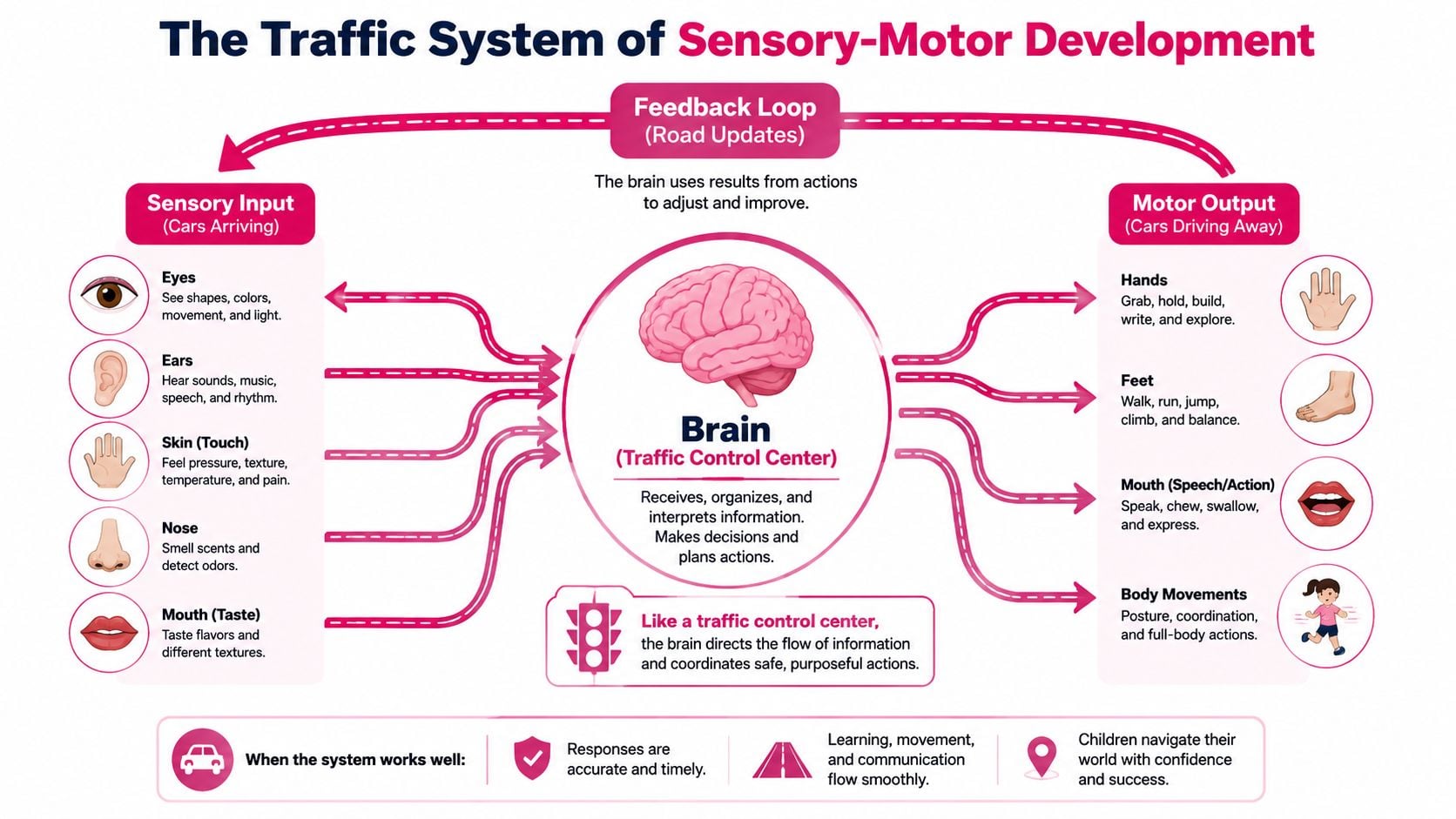
Think of the body like a busy traffic system. Sensory input is the traffic coming in, sights, sounds, touch, movement, taste, smell, and body position. The brain is the intersection, where all of that information gets organized. Motor output is the traffic leaving, hands writing, feet balancing, mouths speaking, bodies moving through space.
What the loop actually does
Children are never just “taking in” the world or “doing” something with it, they're doing both at once. A child feels the chair under her legs, hears the teacher, notices the pencil in her hand, and then adjusts her grip or posture. That feedback loop keeps learning practical, not abstract.
This is why gross-motor skills and fine-motor skills matter so much. Gross-motor skills include running, jumping, balancing, and climbing. Fine-motor skills include cutting, buttoning, opening containers, and writing. Sensory processing sits underneath both, because the nervous system has to register input well enough to use it.
Piaget's sensorimotor stage helps make this concrete. It spans from birth to about age 2, followed by the preoperational stage from ages 2 to 7, the concrete operational stage from ages 7 to 11, and the formal operational stage from about 11 into adulthood, with sub-stages that include reflexes, primary circular reactions, secondary circular reactions, coordination of reactions, tertiary circular reactions, and early representational thought (Piaget stage overview). In plain language, young children learn through touching, moving, repeating, and experimenting before they can explain ideas in words.
Children under 2 don't learn by sitting still and listening first. They learn by acting, noticing, and trying again.
That's why a toddler shaking a rattle, stacking blocks, or opening and closing a lid isn't “just playing.” She's building the foundation for later thinking. The brain learns with the body, not apart from it.
Age-Based Milestones You Can Use
Milestone charts often overwhelm adults because they pack too many skills into one page. A simpler way to read development is to watch how children move through a range, not a single date. The World Health Organization study of gross motor milestones is useful here because it gives global windows of achievement instead of one “right” age for each skill (WHO motor development study).
Sensory-Motor Milestones by Age
Age Range
Gross Motor
Fine Motor
Sensory Regulation
Birth to 2 years
Sitting, standing, crawling, walking emerge within broad windows
Grasping, releasing, stacking, feeding self begin to sharpen
Calms with touch, rhythm, movement, and predictable routines
2 to 4 years
Jumps, climbs, pedals, balances with more control
Scribbles, snips, strings, buttons with help
Needs adult support to shift between activity and calm
4 to 7 years
Hops, coordinates both sides of the body, holds posture longer
Writes, cuts, colors, copies shapes, manages self-care more independently
Can begin naming body needs and using movement breaks with guidance
The WHO data show that the 1st to 99th percentile windows are wide but bounded, which is why a child walking at 14 months may still be well within typical development. The study found windows from 3.8 to 9.2 months for sitting without support, 4.8 to 11.4 months for standing with assistance, 5.2 to 13.5 months for hands-and-knees crawling, 5.9 to 13.7 months for walking with assistance, 6.9 to 16.9 months for standing alone, and 8.2 to 17.6 months for walking alone, as noted in the WHO study above.
A second key finding helps schools understand timing. In normative testing of children ages 2 to 15 years, the most rapid development happened between ages 4 and 7, and 76% of sensory-motor tasks had reached a plateau by age 7 (PubMed study). That lines up with what teachers see every day, the years when children are still growing fast, but classroom expectations for sitting, writing, and self-control rise quickly.
For comparison points beyond early childhood, a youth training progressions guide can help adults think about how skills build over time in age-appropriate ways, even outside the school setting. The point is to match the task to the child's current body skills, not to judge them for not being there yet.
Small sensory supports can also make these milestones easier to read in real life. A calm setup such as a glitter sensory bottle gives children something concrete to watch, shake, and settle with while adults notice how movement and regulation work together.
How Sensory Motor Skills Connect to SEL and School Readiness
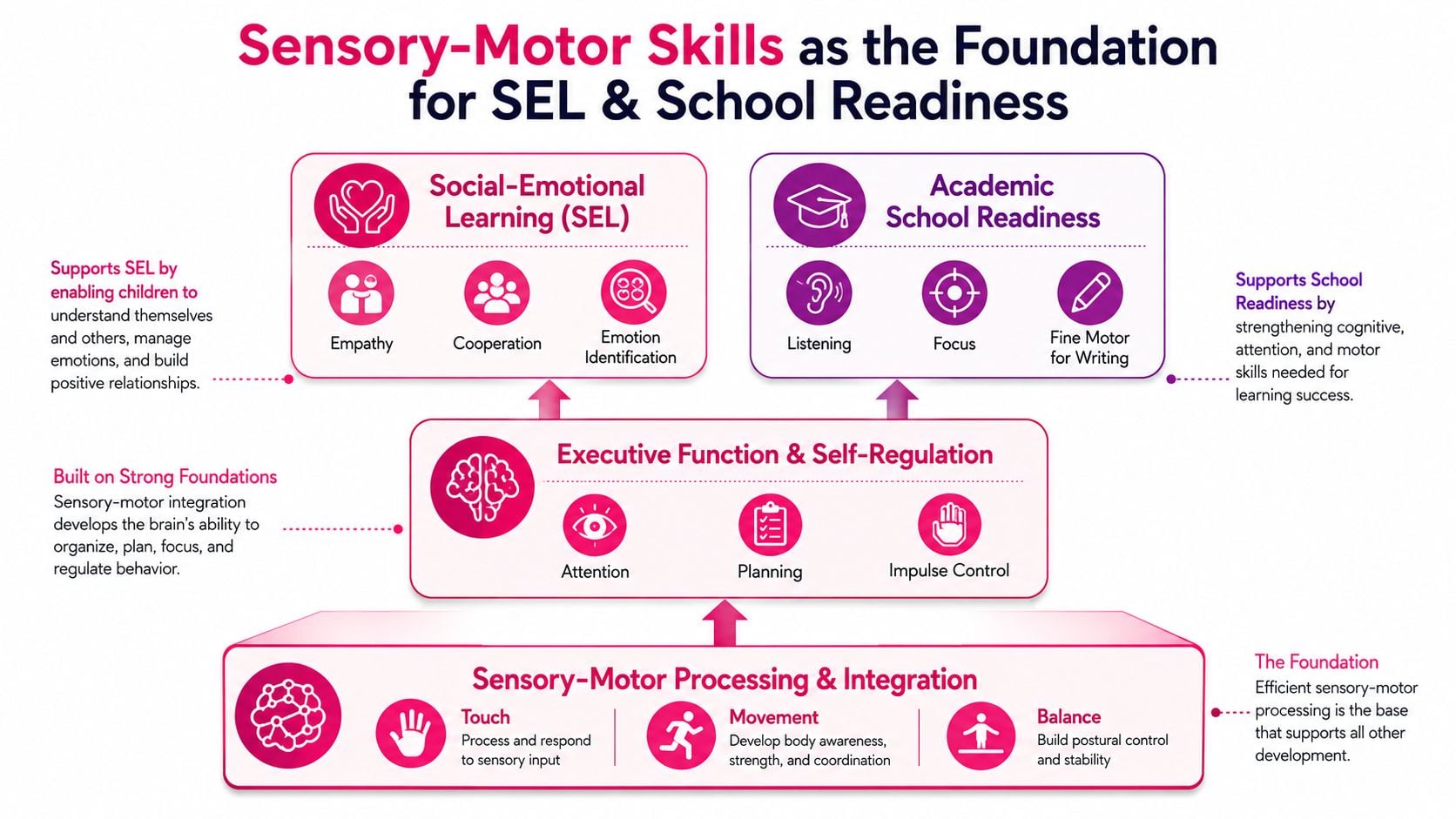
A child is asked to sit still, listen, share space, and try again after making a mistake. Those tasks look social on the surface, but they depend on the body underneath. If movement feels shaky, if sounds and touch feel too much, or if the child cannot organize the body well enough to stay comfortable in a group, SEL becomes harder to practice. Movement, regulation, and belonging belong in the same plan.
What the research shows
A 2024 study found that both gross-motor and fine-motor scores on the PDMS-2 were significantly and positively correlated with total sensory processing scores, tactile deep-pressure response, and oculomotor control (2024 sensory processing study). In classroom terms, children who process sensory input more smoothly often show stronger movement skills, and children who move more skillfully often handle sensory demands with less strain.
That fits with what development researchers have argued for years. Motor development can shape cognition in two ways, directly through the information a child gathers through action, and indirectly through the information social partners provide while the child is acting on objects (motor development and cognition review). When a child reaches, manipulates, and explores an object, adults naturally name, point, model, and respond. Learning grows on both sides of that exchange.
The classroom version is easy to recognize. A child who cannot tolerate input may avoid group time. A child who struggles with balance may skip playground games and lose practice with peers. A child who has trouble coordinating hand use may shut down during writing because the effort takes all of the attention. These are not separate problems, they are connected pressures on participation.
The DCU briefing paper on sensorimotor support in schools argues for occupational therapist collaboration, direct teaching of self-regulation strategies, and closer attention to handwriting and PE outcomes, especially in the early years (DCU briefing). That is the whole-school view many campuses still miss. It also helps explain why families often ask about start nursery at what age and school readiness in the same conversation, because body comfort, self-regulation, and group participation are already linked before formal academics begin.
A child does not have to be “behind” to need more movement, more predictability, or more sensory support. The classroom only has to ask enough of the body for the gap to show.
This glitter sensory bottle activity gives children something concrete to watch, shake, and settle with, while adults notice how visual focus and calming input work together.
When Strengths Based Language Becomes Performative
Strengths language can go wrong fast if adults use it to decorate the same old system. Saying “You're resilient” while leaving a child in a chaotic classroom or a family without support is not strengths based practice, it's polite avoidance. The critique from i2insights is blunt on this point, the approach should not pretend problems don't exist or ignore inequality i2insights on strengths-based approaches.
That warning matters in schools because too many problems are structural. Chronic absenteeism, behavior referrals, and family stress rarely come from mindset alone. If the environment stays unsafe, unpredictable, or disconnected, then naming strengths without changing conditions becomes performative.
A quick diagnostic for staff meetings
Ask three questions before saying the plan is strengths based.
Did we change the environment? If not, the child may still be carrying the same barrier.
Did we name the child's real context? If not, we may be using generic praise instead of actual support.
Did we honor identity-specific strengths? If not, we may be erasing culture, language, or survival knowledge.
Recent work on identity-specific strengths makes that last point especially important for multilingual families, students with disabilities, and racially marginalized youth identity-specific strengths research. A child's strength might be caring for siblings, translating for family members, navigating public systems, or staying loyal to a community that has not always been loyal back.
Schools can answer that by widening what counts. A strength is not only reading fast or sitting still. It can be persistence, humor, memory, leadership, translation, self-protection, or the ability to calm a younger child. The more accurately staff name those strengths, the more likely the student is to trust the process.
Coaching Tips and Simple Ways to Measure Progress
Instructional coaches and principals don't need a thick binder to know whether strengths based work is taking root. They need a few honest observation points. Look for student voice in conferences, teacher use of strength-based reframes, family participation, and whether the adult's language is shifting from problem labeling to goal language.
A coach can listen for one clear question in a classroom or support meeting, “What already helps this student succeed?” That question is a good sign the adult is working from strengths instead of only deficits. It also creates a practical path into outcome measurement guidance without turning the conversation into paperwork.
Useful check: If a teacher can describe a student's goal, a strength, and one next step, the practice is probably more than a slogan.
Keep the measurement simple. Student self-reflection, quick family feedback, and a short teacher practice rubric tell you more than standardized scores do about whether the approach is being used well. A semester check can track whether adults are asking better questions, whether children are naming strengths on their own, and whether families are showing up with more trust.
Soul Shoppe's workshops and coaching support this kind of schoolwide language because they help students, teachers, and families practice communication, empathy, and conflict resolution in real time. That makes it one practical option for schools that want help building a strengths based routine into daily life.
Frequently Asked Questions From Principals Teachers and Parents
A strengths based approach doesn't replace PBIS or behavior charts, it changes the lens and the goal. If staff are skeptical, start with one classroom script and one family meeting question, then let them see the response. At home, use natural language, not a script, by asking what helped and what the child wants to try next. If a child needs clinical support or a structural fix, use those too, strengths based practice works best as part of a wider response.
Soul Shoppe helps school communities build shared language for empathy, self-regulation, and conflict resolution, which fits naturally with strengths based practice. If you want practical tools that teachers and families can use right away, visit Soul Shoppe and explore programs, workshops, and coaching that help kids build on what's already strong.
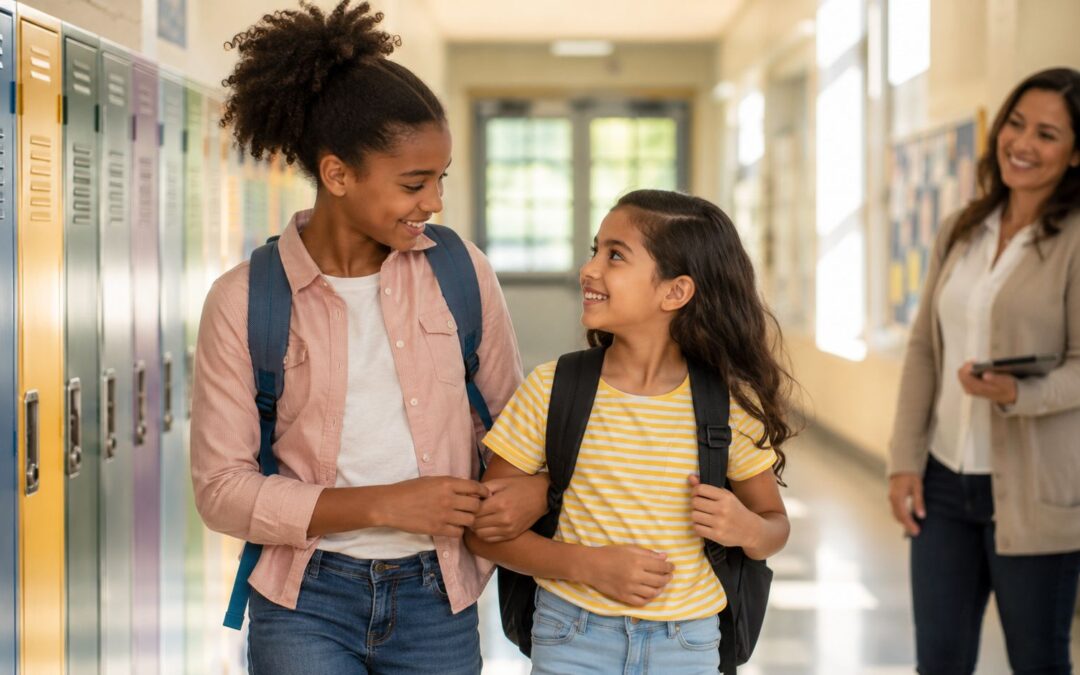
It's the first week of school, and a fifth grader is walking a nervous new second grader to the classroom door, showing her where to put her backpack, how to line up for lunch, and which bathroom pass to grab if she needs it. That tiny exchange can look ordinary from the hallway, but it often does more for a child's sense of safety than a pile of posters about kindness ever will. Peer mentoring programs work because they turn those small, repeated moments into a structure schools can rely on.
The strongest versions aren't casual buddy systems. They're planned SEL systems with trained mentors, adult supervision, and regular check-ins that help students feel known before anyone expects grades or behavior to shift. A recent systematic review found that formal peer mentoring programs were most consistently linked with positive academic outcomes when participation was voluntary, mentors were trained, matches were made with a formal model, programs had institutional support, and faculty were involvedsystematic review. That matters in a real school, because the difference between “we paired them up” and “we built a support loop” is usually the difference between a program that fades and one that sticks.
For a school counselor, the question isn't whether students like helping each other. They usually do. The question is whether the adults have built enough structure so the helping stays safe, useful, and equitable. That's what makes peer mentoring feel less like an add-on and more like part of the school's belonging strategy.
What Peer Mentoring Looks Like in a K-8 School
A second grader tears up at the backpack hooks on Monday morning. A fifth grader, wearing a mentor badge, walks over, kneels down, and says, “I'll show you where our class line starts.” That's peer mentoring in a K-8 building, not a flashy leadership program, just an older student offering advice, support, and knowledge to a younger one in a way that feels close enough to trust and simple enough to use peer mentoring definition.
The model works especially well in elementary and middle school because kids often listen differently to a near-age peer than they do to an adult. A trained sixth grader can remind a fourth grader how to organize a binder, where to go after dismissal, or what to do when a friend says something hurtful. That's not counseling, and it's not remediation. It's a relationship with clear limits that helps a child settle into the day.
Practical rule: If the match is doing heavy emotional work, the adult system is too far back. Mentors can listen and notice, but they can't carry a peer's crisis alone.
What it is not deserves equal attention. It's not a substitute for counseling, so a student in grief, panic, or family instability still needs a licensed adult's response. It's not a remediation track for the students who are “behind.” And it's not an unstructured buddy system where two kids are told to be nice and figure it out.
A better way to think about it is as a predictable school relationship with three structural ingredients, a trained older mentor, a consistent meeting rhythm, and a supervising adult. When those pieces are present, the program has a chance to support belonging instead of just adding another meeting to the calendar. For a clear parallel to schoolwide peer support language, this overview of peer support programs is worth a look alongside the planning work.
If your staff includes licensed clinicians or counselors who want to sharpen the mental-health side of the work, it can also help to browse continuing education for licensed clinicians from Be Your Best Self & Thrive Counseling, PLLC. That kind of training is useful when mentors need to recognize the line between supportive listening and a concern that belongs with an adult.
The cleanest K-8 programs usually sound like one another in practice. A mentor greets a younger student, follows a routine, asks one or two focused questions, and ends on time. The routine is what makes the relationship feel safe enough for a child to return to it next week.
Choosing the Right Program Model for Your Campus
A principal doesn't need a perfect model. She needs the one her building can supervise on a Tuesday afternoon when testing schedules, parent pickups, and a substitute shortage collide. The right choice depends on what problem you're trying to solve first, social adjustment, academic scaffolding, or a small, steady space for SEL practice.
Here's the simplest way to sort the options. Cross-age buddies fit best when younger students need help with routines, transitions, and school confidence. Near-peer tutors fit when students need academic language and a model that feels close to their own experience. Small-group circles fit when a counselor wants students to practice friendship skills, stress regulation, or respectful problem-solving in a more structured space.
Comparing Peer Mentoring Models for K-8 Schools
Grade Pairing
Best For
Supervision Load
Cross-age buddies
Older and younger students, often 2 or more grades apart
Routines, belonging, school navigation
Moderate
Near-peer tutors
One to two grade levels apart
Academic scaffolding and homework habits
Moderate to high
Small-group circles
Mixed grades, usually four to six students
Friendship, SEL skills, and shared problem-solving
High
A counselor I worked with on a busy elementary campus used cross-age buddies for morning arrival and reading time. The older students loved having a role, but the key win was that the younger children stopped treating the building like a maze. That was enough to justify the structure, because the school's biggest need was not tutoring, it was making the day feel predictable.
Near-peer tutoring looks different. A sixth grader sitting beside a fourth grader can explain how to break a long assignment into smaller parts, but the adult still needs to watch for skill mismatch. If the tutor is only two steps ahead academically, the pair can work beautifully. If the gap is too wide, the mentor slips into teacher mode and the relationship gets stiff.
For schools that want SEL practice more than academic support, small-group circles often make the most sense. They are less personal, more supervised, and easier to align with a schoolwide language around emotions and conflict. If you're weighing whether a peer mediation layer belongs on campus, this school-based mediation guide pairs well with the model decision.
Before you choose, run a short leadership-team check. Ask which grade span is most stable, which staff member can supervise consistently, and whether your students need connection, academic help, or both. If the answer is fuzzy, start smaller. A reliable pilot beats an ambitious rollout every time.
Decision filter: If you can't explain who supervises, how often they meet, and what outcome comes first, the model isn't ready yet.
Recruiting Mentors and Matching Mentees With Care
Recruitment is where many programs get stuck, because adults assume the “good kids” will volunteer and the rest will sort themselves out. That's backwards. The strongest mentor pools come from a broad invitation, clear expectations, and a short screening process that looks for empathy and reliability, not perfect behavior or top grades.
Start with a schoolwide announcement that names the job in plain language. Then ask teachers for nominations, but give them a simple prompt so they don't default to the most visible students in the room. A nomination note can say, “Name students who are kind, steady, curious about younger children, and able to follow directions.” That keeps the process from turning into a popularity contest.
A short mentor interview can be just five questions. Ask, “Why do you want to do this?” “What would you do if your mentee got upset?” and “How will you remember your weekly meeting?” A good answer doesn't have to be polished. It has to show the student can listen, show up, and ask for help when needed. For schools that want a platform-style workflow to manage applications and matching, these features tutoring businesses actually need are a useful reminder of how much the right system can simplify scheduling, communication, and follow-through.
Family note: “Your child has been invited to participate in a peer mentoring program that pairs students for regular, adult-supervised support. The meetings are designed to build belonging, confidence, and school routines. Mentors are trained to listen, keep boundaries, and get an adult when a concern is bigger than the program.”
Matching works best when you weigh shared interests, language needs, and social context instead of just who's available. A student who loves drawing and a younger child who talks nonstop about animals may connect quickly, even if they aren't in the same homeroom. A mismatch often shows up by week three, when one child does all the talking, the other goes quiet, or the pair can't settle into a routine. Re-pairing isn't failure. It's part of the design.
A family welcome note should explain what a mentee will experience in concrete terms. Parents want to know who is meeting their child, how often, and who to contact if the pairing feels off. The clearer you are at the start, the less likely you are to spend week four repairing confusion.
A practical matching rubric keeps the process honest. Give shared interests one check, language or family context another, and schedule fit a third. If the rubric says a pair is weak in two or more areas, pause before matching them and look again.
A teacher email families can actually use
You don’t need a long newsletter. A short note works better.
Sample family message
Hello families, This week our class is practicing respect. Students are learning that respect means using words and actions that show care for people, space, and differences. You can support this at home by trying one simple routine: during dinner or bedtime, ask your child, “What did respect look like today?” If conflict comes up, encourage this script: “What happened, how do you feel, and what do you need?” Thank you for using the same language with us.
That kind of message helps families mirror school expectations without feeling judged.
What families often misunderstand
Some adults hear “respect” and think it means instant obedience. Others hear it and think it only means being nice. Children need a more balanced message.
Respect includes:
listening
boundaries
tone
honesty
repair
care for shared space
room for disagreement without cruelty
It also includes adult modeling. If grownups interrupt, shame, or mock, children absorb that pattern faster than any lesson.
Practical Tips for Differentiation and Assessment of Respect Skills
Respect is observable, but only if adults agree on what they’re looking for. Many programs struggle here. A source summarizing CASEL-related findings reported that 68% of K to 8 programs lack assessment tools, while schools using respect rubrics saw 28% better conflict resolution outcomes in classroom observations, according to this summary discussing respect rubrics and SEL assessment.
Different learners need different access points
A student may understand the idea of respect but need another path to show it.
For students who need visual support
Use picture cards, sentence stems, and first-then charts. During role-play, place the script where everyone can see it.
For students with language delays
Reduce the verbal load. Let them point to feeling cards, choose from two response options, or rehearse one key phrase such as “Stop” or “My turn next.”
For students who need movement or sensory regulation
Build in short resets before partner work. A more regulated body makes respectful interaction more likely.
For advanced learners
Add complexity. Ask them to compare respectful disagreement in person and online, or to lead peer mediation with adult support.
How to assess without making it awkward
Use quick, low-pressure checks during normal routines.
Exit tickets. “One respectful action I used today.”
Peer observations. Partners note one listening move they saw.
Teacher tally. Track interruptions, repair attempts, and respectful requests.
Respect journals. Students reflect on progress and setbacks.
Family check-ins. A short note home asks what respectful behavior looked like outside school.
Assessment works best when it notices patterns, not isolated mistakes.
Sample Respect Assessment Rubric
Skill Level
Indicator
Evidence Source
Beginning
Needs frequent adult prompting to wait, listen, or use respectful language
Teacher observation during class routines
Developing
Shows respectful behavior in structured activities but struggles during conflict or transitions
Don’t rely only on self-report. Children often know the “right” answer before they can apply it under stress. Pair student reflection with observation from adults and peers. That gives you a fuller picture and helps you adjust instruction instead of guessing.
Integrating Respect into Schoolwide SEL and Soul Shoppe Programs
A respect lesson works better when the whole campus uses the same language. If the classroom teaches calm repair, but the hallway runs on public shaming or inconsistent discipline, students get mixed messages fast.
A teacher-focused aggression prevention workshop described proactive modeling of respect and structured routines as part of a dignity-centered approach, and reported a 30% increase in on-task behavior along with sustained reductions in classroom aggression, according to this ERIC-hosted article on the workshop.
A schoolwide rollout that feels manageable
A full-campus plan doesn’t need to start huge. It needs to be coordinated.
Month one
Staff agree on a shared definition of respect.
Teachers identify three observable behaviors all classrooms will reinforce.
Counselors create common repair scripts for conflict moments.
Month two
Classrooms teach the same core routines.
Families receive one-page language guides.
Admin teams look for consistency during walk-throughs.
Month three
Students practice peer support and repair in real settings like recess, lunch, and transitions.
Staff review patterns and adjust supports for classes or groups that need more structure.
What shared language should sound like
Adults need phrases they can use under pressure. Long lectures usually fail in the moment.
Useful schoolwide phrases include:
“Pause and listen.”
“Try that again respectfully.”
“What happened?”
“What do you need now?”
“How will you repair the harm?”
If your staff is exploring relationship-centered discipline, this overview of what is restorative practices in education can help connect respect instruction with repair and accountability.
Roles across the campus
Respect culture doesn’t belong only to counselors or classroom teachers.
Role
Practical responsibility
Teachers
Teach, model, and reinforce respectful routines daily
Counselors
Support small groups, coach repair conversations, help interpret behavior patterns
Administrators
Align discipline responses, protect staff consistency, and keep respect visible in school priorities
Support staff
Use the same language in cafeterias, buses, hallways, and playgrounds
Families
Reinforce the same scripts and expectations at home
One structured option among many
Some schools choose to build this work through assemblies, classroom follow-up, coaching, and digital tools. Soul Shoppe offers research-based SEL programs, workshops, and app-supported tools focused on self-regulation, communication, mindfulness, and conflict resolution, which can give schools a common set of routines and language across settings.
That kind of alignment matters most when students move between classrooms, specialists, recess, aftercare, and home. Consistency lowers confusion. It also makes respect feel like a lived norm instead of a lesson adults mention only after someone gets hurt.
A respectful culture grows when adults respond predictably, not perfectly.
Sustaining a Respectful Culture at School and Home
Respect fades when adults treat it like a one-week theme. It grows when it becomes part of routines, language, and repair.
Schools can keep momentum by revisiting a few basics each month. Morning meetings can include one respect prompt. Staff meetings can review common language. Family newsletters can share one script and one reflection question. Student recognition can name specific actions like listening, boundary-setting, or repairing harm.
At home, the same idea applies. Keep the dinner prompt. Keep the sibling reset routine. Keep asking children to try again respectfully instead of turning every mistake into a power struggle.
Leadership matters too. When administrators, teachers, and caregivers review rubric notes, behavior patterns, and family feedback together, they can see what’s improving and where students still need support. Respect becomes more durable when adults commit to steady practice, not occasional reminders.
Teaching about respect is long-term work. It asks adults to be clear, calm, and consistent. The payoff is worth it. Students feel safer, families get stronger tools, and classrooms become better places to learn.
If your school wants structured support for building connection, safety, empathy, and respectful conflict resolution, explore Soul Shoppe. Their programs, workshops, and family-facing resources can help educators and caregivers use shared SEL language across classrooms and homes.