Sensory Motor Development: A Practical Guide for Teachers
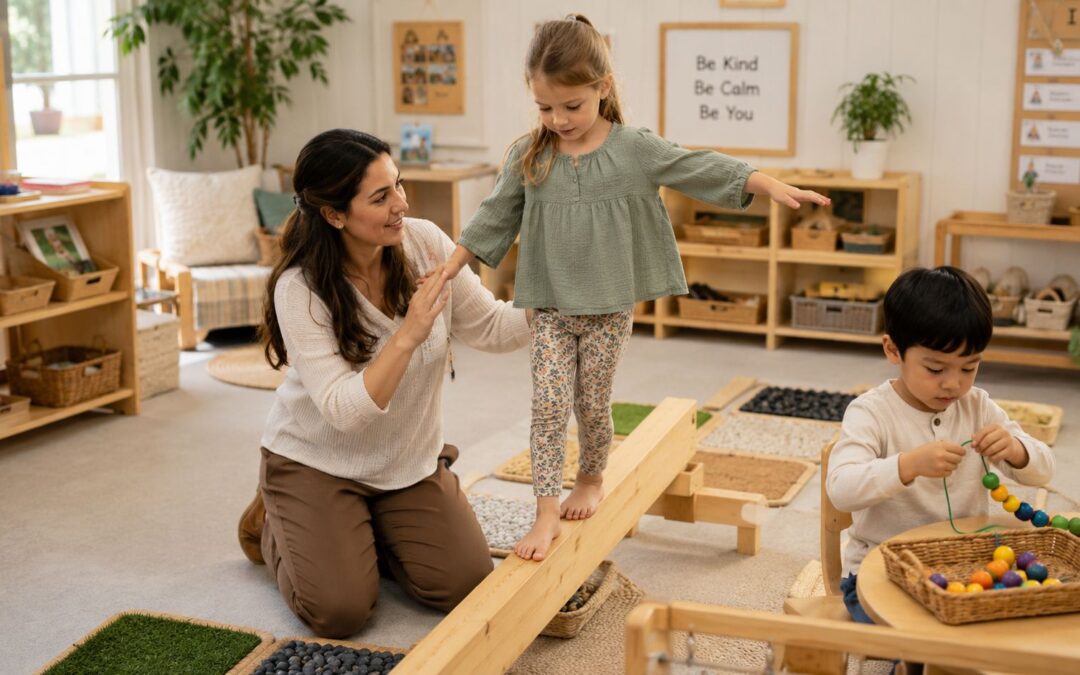
A teacher notices it first at the edges of the day. One child can't settle on the rug unless he's twisting his shoelaces, another avoids the playground ladder, and a third spends recess fighting with a zipper instead of joining friends. Those moments can look like inattention, stubbornness, or shyness, but they're often sensory motor development signals, the body telling us a child needs a different kind of support.
What Sensory Motor Development Really Looks Like in a Classroom
A classroom gives you the clearest view of sensory-motor life because the demands never stop. Children have to sit, stand, carry, reach, listen, shift, grip, wait, and rejoin the group again and again. When one of those pieces is hard, adults usually notice the behavior first, not the body-based reason underneath.
A kindergartner who keeps slipping out of circle time may not be trying to defy anyone. He may be using his shoelaces, a chair edge, or the pressure of his own hands to help his body stay organized. A student who skips the climbing wall or hangs back during games may be protecting herself from balance demands she can't yet trust.
Practical rule: When a child seems “off,” look at movement, posture, and sensory load before you look at motivation.
The same pattern shows up in the small routines that make school life run. Lining up requires balance and body spacing. Holding a pencil asks for hand strength, finger control, and the ability to stay regulated while focused. Joining a partner game asks for timing, coordination, turn-taking, and enough body comfort to stay with peers instead of withdrawing.
That's why sensory-motor challenges often get mislabeled as behavior problems. A child who fidgets, bumps into things, avoids messy materials, or falls apart during transitions may be telling you that the task is too hard for the body right now. A warm, observant adult can hear that message without shame and respond with support instead of correction.
This simple 5-senses activity can help children notice their bodies in a calm, playful way, which is often the first step toward better self-awareness in the classroom.
The Core Concepts Behind Sensory Motor Development
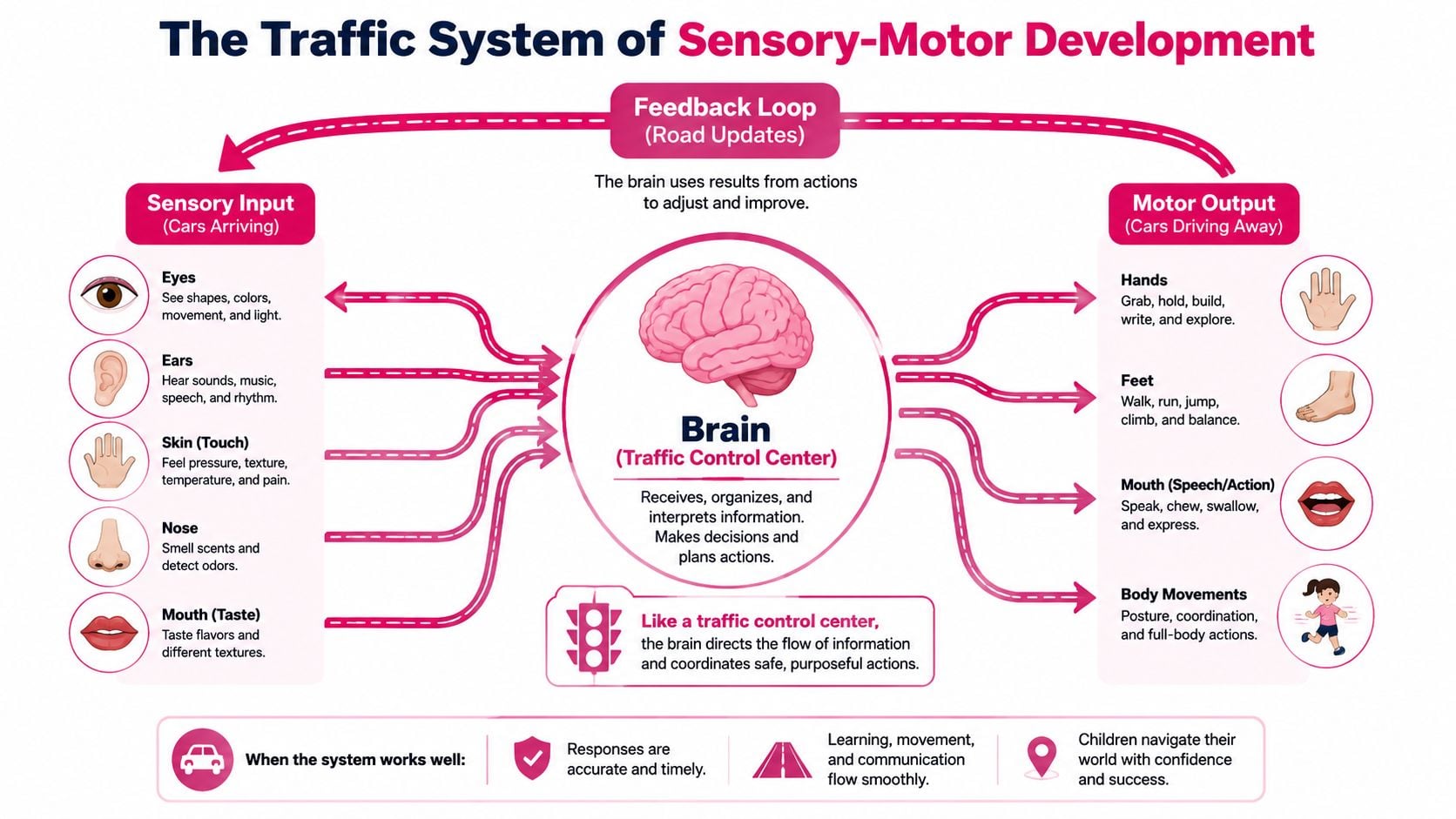
Think of the body like a busy traffic system. Sensory input is the traffic coming in, sights, sounds, touch, movement, taste, smell, and body position. The brain is the intersection, where all of that information gets organized. Motor output is the traffic leaving, hands writing, feet balancing, mouths speaking, bodies moving through space.
What the loop actually does
Children are never just “taking in” the world or “doing” something with it, they're doing both at once. A child feels the chair under her legs, hears the teacher, notices the pencil in her hand, and then adjusts her grip or posture. That feedback loop keeps learning practical, not abstract.
This is why gross-motor skills and fine-motor skills matter so much. Gross-motor skills include running, jumping, balancing, and climbing. Fine-motor skills include cutting, buttoning, opening containers, and writing. Sensory processing sits underneath both, because the nervous system has to register input well enough to use it.
Piaget's sensorimotor stage helps make this concrete. It spans from birth to about age 2, followed by the preoperational stage from ages 2 to 7, the concrete operational stage from ages 7 to 11, and the formal operational stage from about 11 into adulthood, with sub-stages that include reflexes, primary circular reactions, secondary circular reactions, coordination of reactions, tertiary circular reactions, and early representational thought (Piaget stage overview). In plain language, young children learn through touching, moving, repeating, and experimenting before they can explain ideas in words.
Children under 2 don't learn by sitting still and listening first. They learn by acting, noticing, and trying again.
That's why a toddler shaking a rattle, stacking blocks, or opening and closing a lid isn't “just playing.” She's building the foundation for later thinking. The brain learns with the body, not apart from it.
Age-Based Milestones You Can Use
Milestone charts often overwhelm adults because they pack too many skills into one page. A simpler way to read development is to watch how children move through a range, not a single date. The World Health Organization study of gross motor milestones is useful here because it gives global windows of achievement instead of one “right” age for each skill (WHO motor development study).
Sensory-Motor Milestones by Age
| Age Range | Gross Motor | Fine Motor | Sensory Regulation |
|---|---|---|---|
| Birth to 2 years | Sitting, standing, crawling, walking emerge within broad windows | Grasping, releasing, stacking, feeding self begin to sharpen | Calms with touch, rhythm, movement, and predictable routines |
| 2 to 4 years | Jumps, climbs, pedals, balances with more control | Scribbles, snips, strings, buttons with help | Needs adult support to shift between activity and calm |
| 4 to 7 years | Hops, coordinates both sides of the body, holds posture longer | Writes, cuts, colors, copies shapes, manages self-care more independently | Can begin naming body needs and using movement breaks with guidance |
The WHO data show that the 1st to 99th percentile windows are wide but bounded, which is why a child walking at 14 months may still be well within typical development. The study found windows from 3.8 to 9.2 months for sitting without support, 4.8 to 11.4 months for standing with assistance, 5.2 to 13.5 months for hands-and-knees crawling, 5.9 to 13.7 months for walking with assistance, 6.9 to 16.9 months for standing alone, and 8.2 to 17.6 months for walking alone, as noted in the WHO study above.
A second key finding helps schools understand timing. In normative testing of children ages 2 to 15 years, the most rapid development happened between ages 4 and 7, and 76% of sensory-motor tasks had reached a plateau by age 7 (PubMed study). That lines up with what teachers see every day, the years when children are still growing fast, but classroom expectations for sitting, writing, and self-control rise quickly.
For comparison points beyond early childhood, a youth training progressions guide can help adults think about how skills build over time in age-appropriate ways, even outside the school setting. The point is to match the task to the child's current body skills, not to judge them for not being there yet.
Small sensory supports can also make these milestones easier to read in real life. A calm setup such as a glitter sensory bottle gives children something concrete to watch, shake, and settle with while adults notice how movement and regulation work together.
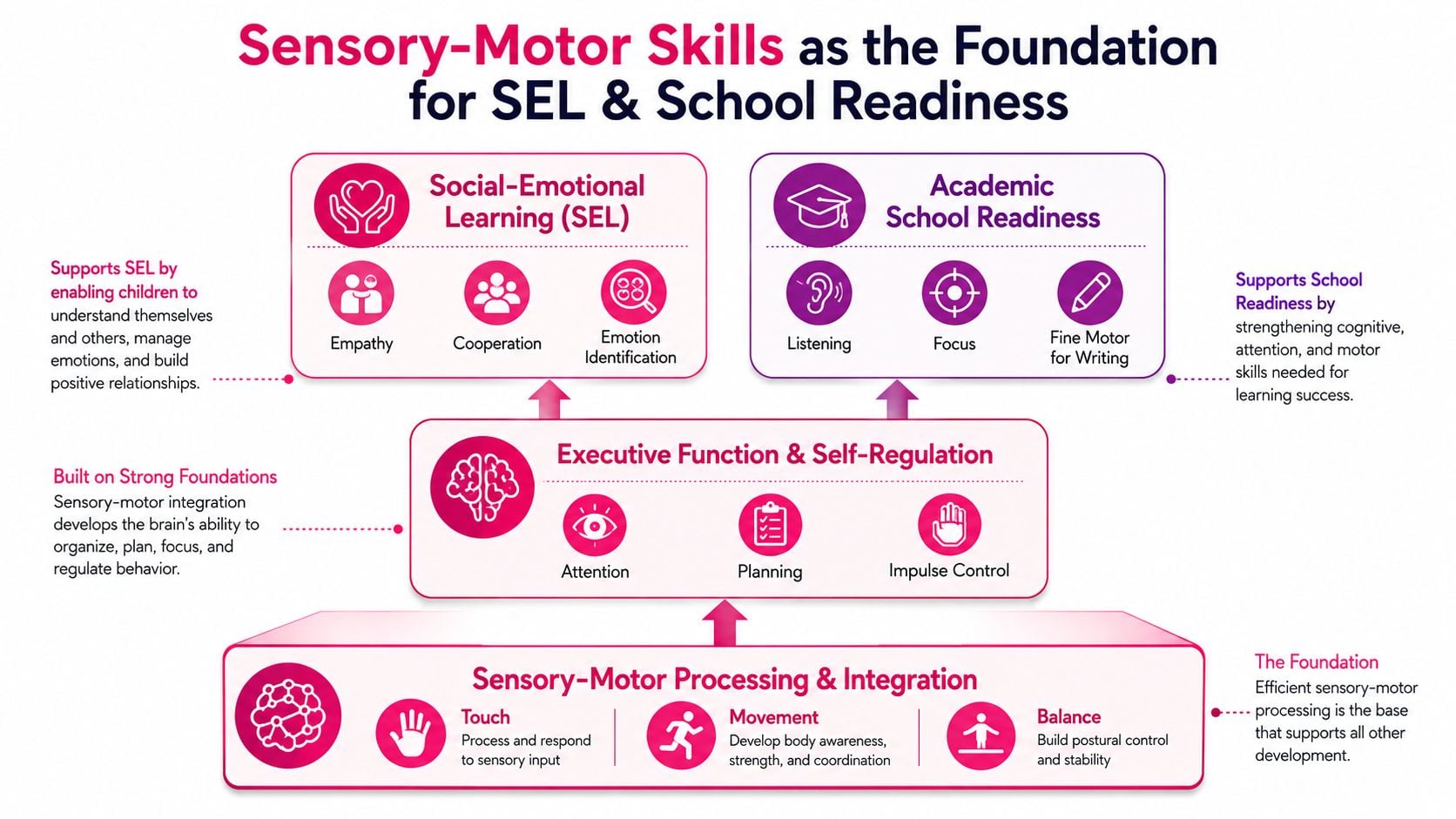
How Sensory Motor Skills Connect to SEL and School Readiness
A child is asked to sit still, listen, share space, and try again after making a mistake. Those tasks look social on the surface, but they depend on the body underneath. If movement feels shaky, if sounds and touch feel too much, or if the child cannot organize the body well enough to stay comfortable in a group, SEL becomes harder to practice. Movement, regulation, and belonging belong in the same plan.
What the research shows
A 2024 study found that both gross-motor and fine-motor scores on the PDMS-2 were significantly and positively correlated with total sensory processing scores, tactile deep-pressure response, and oculomotor control (2024 sensory processing study). In classroom terms, children who process sensory input more smoothly often show stronger movement skills, and children who move more skillfully often handle sensory demands with less strain.
That fits with what development researchers have argued for years. Motor development can shape cognition in two ways, directly through the information a child gathers through action, and indirectly through the information social partners provide while the child is acting on objects (motor development and cognition review). When a child reaches, manipulates, and explores an object, adults naturally name, point, model, and respond. Learning grows on both sides of that exchange.
The classroom version is easy to recognize. A child who cannot tolerate input may avoid group time. A child who struggles with balance may skip playground games and lose practice with peers. A child who has trouble coordinating hand use may shut down during writing because the effort takes all of the attention. These are not separate problems, they are connected pressures on participation.
The DCU briefing paper on sensorimotor support in schools argues for occupational therapist collaboration, direct teaching of self-regulation strategies, and closer attention to handwriting and PE outcomes, especially in the early years (DCU briefing). That is the whole-school view many campuses still miss. It also helps explain why families often ask about start nursery at what age and school readiness in the same conversation, because body comfort, self-regulation, and group participation are already linked before formal academics begin.
A child does not have to be “behind” to need more movement, more predictability, or more sensory support. The classroom only has to ask enough of the body for the gap to show.
This glitter sensory bottle activity gives children something concrete to watch, shake, and settle with, while adults notice how visual focus and calming input work together.