Soul Shoppe's work is made possible by donors and partners who care deeply about the young people in their communities! We can't do this work without you. Support our work in classrooms and on playgrounds across the nation by donating here.
The first days of kindergarten can feel loud and tender at the same time. A child is holding a backpack almost as big as their body. A parent is smiling with watery eyes. A teacher is greeting everyone while noticing who clings, who wanders, who talks nonstop, and who says nothing at all.
That moment tells us something important. Before children can fully learn together, they need to feel safe together.
That’s why all about me kindergarten activities matter so much. They aren’t just cute first-week crafts. When we use them well, they help children say, “This is who I am,” and hear, “You belong here.” That shift builds the kind of classroom community where empathy, confidence, and calm problem-solving can start to grow.
The Magic of the First Few Weeks in Kindergarten
A kindergarten classroom in the first week is full of mixed signals. One child races to the block area. Another freezes at the doorway. Someone misses home. Someone else is ready to tell you about their dog, their cousin, and the missing tooth they had in June.
Those first few weeks set the emotional tone for the whole year. Children are learning the room, the routines, the grownups, and each other. They’re also asking silent questions all day long.
Am I safe here
Will anyone play with me
Does my teacher know me
Is there room for my family, my language, my feelings, and my story
Why identity work comes first
When we start with all about me activities, we give children a simple way to enter the community. They don’t need advanced academic skills to participate. They just need a place to notice themselves and a structure for sharing small pieces of who they are.
That’s powerful in kindergarten.
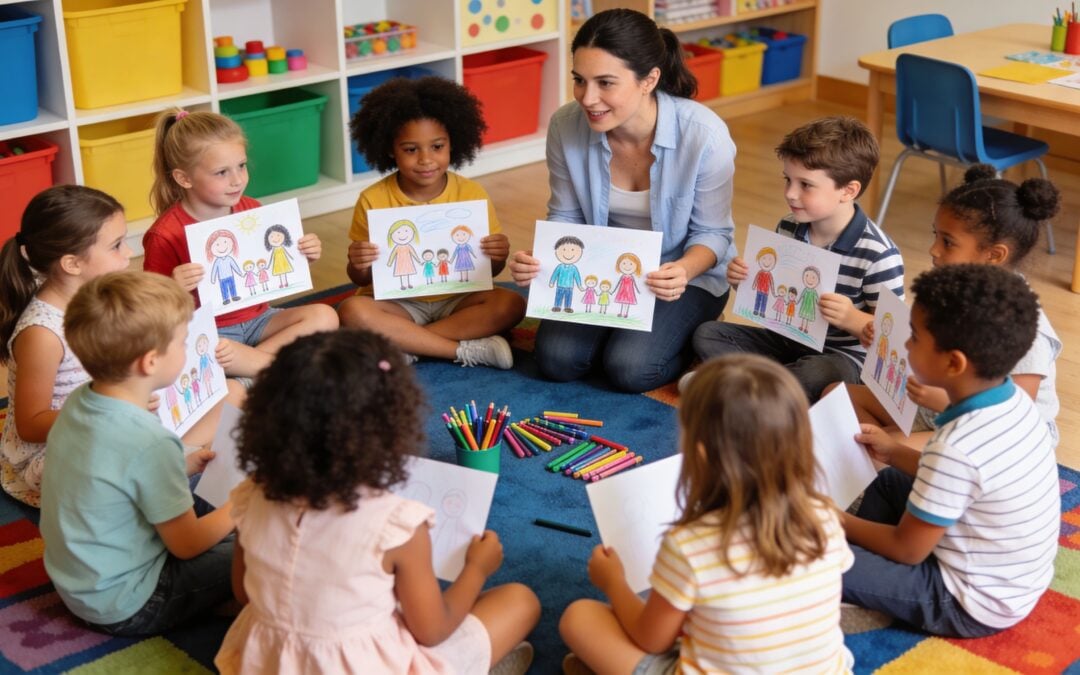
A self-portrait says, “I can show you me.” A name activity says, “My name matters here.” A favorites chart says, “Other kids like things I like too.” A family page says, “The people who care for me belong in this classroom story.”
Practical rule: If an activity helps a child feel seen before it asks them to perform, it’s doing important first-week work.
What teachers can do on day one
You don’t need a complicated unit to begin. Start with a few grounded routines that signal belonging.
Greet each child by name if possible, even if you’re still learning pronunciations.
Offer low-pressure choices such as drawing, stickers, or picture cards.
Model your own sharing with a simple teacher page about your favorite snack, color, or pet.
Name similarities out loud. “You both love pancakes.” “Three friends have baby sisters.”
Protect the pace. Some children are ready to talk. Others need time.
If you’re building first-week routines around connection, this piece on building community in the classroom offers a helpful frame for thinking about belonging as a daily practice, not a single lesson.
The deeper goal
The magic isn’t the poster on the wall. It’s what happens while children make it.
They watch each other. They listen. They compare. They laugh. They realize that difference isn’t a threat.
That’s the beginning of community. And in kindergarten, community has to be built on purpose.
What Are All About Me Activities
When people hear “All About Me,” they often think of one worksheet with a face outline, a spot for favorite color, and maybe a box for age. That can be part of it, but a strong all about me kindergarten unit is much richer than a single page.
It’s an identity-based set of activities that helps children explore who they are, how they’re alike and different, and how they fit into the classroom community.
The core parts children usually explore
Most all about me activities revolve around a few familiar themes:
Self-portraits help children notice physical features, practice observation, and represent themselves visually.
Name exploration gives children repeated chances to see, trace, build, and say their names with pride.
Favorites and preferences make sharing easy. Favorite foods, colors, games, and books are often the safest entry points for conversation.
Family and important people invite children to describe the people who care for them, without forcing one narrow definition of family.
These pieces work because they’re concrete. A kindergartner may not be ready to explain identity in abstract language, but they can tell you, “My grandma makes rice,” or “I like red rain boots,” or “My baby brother cries a lot.”
More than a tradition
All About Me activities have been a foundational back-to-school tradition for over a decade. A 2016 study by Little et al. in Facilitating the Transition to Kindergarten found that they support this transition by building self-awareness, enhancing peer connections, and boosting confidence, with improved social integration rates by up to 25% in classrooms using such icebreakers, as noted through this Teachers Pay Teachers kindergarten All About Me resource overview.
That’s why I don’t treat these activities as filler. I treat them as early community curriculum.
What an all about me unit can include
A full unit often includes a mix of experiences rather than one product:
Drawing work: self-portraits, family pictures, favorite place drawings
Oral language: partner sharing, circle time prompts, teacher interviews
Early writing: name practice, labels, dictated sentences
Home connection: family photos, caregiver questionnaires, take-home pages
If you want to extend the theme beyond school with hands-on projects, families often appreciate simple, low-pressure options like these easy crafts to do at home, especially when you frame them as conversation starters rather than art assignments.
A helpful way to think about it
An all about me unit works best when it answers three child-sized questions:
Question a child may be asking
Classroom response
Who am I
Activities about name, body, likes, feelings, strengths
Who are you
Partner sharing, interviews, listening games
Do I belong here
Group charts, class books, welcoming displays
Once teachers see that structure, planning gets easier. You’re not just collecting facts about children. You’re helping them build identity, language, and connection in ways they can manage.
Building More Than a Poster The SEL Benefits
If you’ve ever watched a kindergartner hold up a drawing and wait for the class to notice it, you’ve seen social-emotional learning in action. The child isn’t only sharing a paper. They’re taking a risk. They’re hoping to be received.
That’s why these activities matter so much. They help children practice the inner skills and relationship skills that make a classroom feel emotionally safe.
Self-awareness starts with simple choices
Young children build self-awareness by naming what they notice about themselves. That might sound small, but it’s foundational.
When a child says:
“I feel nervous”
“I like building”
“I’m good at drawing”
“I don’t like loud sounds”
they’re practicing the habit of paying attention to their own experience.
A self-portrait supports that work. So does choosing a favorite song for a class chart. So does finishing the sentence, “I feel proud when…”
These are not extra moments. They are how children begin to understand themselves.
Children often share more when the prompt is specific and sensory. “What food makes you feel cozy?” gets deeper responses than “What’s your favorite food?”
If you’re looking at all about me kindergarten through an SEL lens, it helps to connect each activity to a specific skill. This overview of the benefits of social-emotional learning gives useful language for that connection.
A short visual can also help when you’re planning or explaining the purpose to families:
Social awareness grows when children listen to each other
Kindergarteners are still learning that other people have experiences different from their own. All About Me activities create many small openings for that realization.
One child draws two homes. Another says they live with an aunt. Another shares that they speak a different language with grandparents. Another says they hate strawberries while three classmates cheer because they hate them too.
That’s social awareness in real time. Children start to notice difference without fear and similarity without pressure.
Here’s what teachers can say to deepen that moment:
Name the pattern: “We have many different families in our class.”
Normalize difference: “Not everyone likes the same things, and that’s okay.”
Lift shared humanity: “Everyone wants to feel included when they talk.”
Invite curiosity: “What did you learn about a friend today?”
A child learns to wait while a peer talks. Another practices asking a kind question. Someone else learns to respond with interest instead of blurting out their own story. These are relationship moves, and kindergarteners need them modeled clearly.
A few supports make a big difference:
Activity
SEL skill it supports
Teacher move
Partner interview
Listening and turn-taking
Give one question at a time
Favorites graph
Finding common ground
Name shared interests aloud
Class book page share
Speaking with confidence
Let children pass if needed
Family drawing discussion
Respect for differences
Use inclusive language about caregivers
Psychological safety comes first
Children participate more freely when they know they won’t be embarrassed, corrected harshly, or forced to disclose more than they want. That’s psychological safety at the kindergarten level.
You build it when you:
Offer choice: draw, dictate, point, or speak
Avoid public pressure: never force a shy child to present
Respond warmly: thank children for sharing instead of evaluating the content
Use inclusive prompts: “Who lives with you?” works better than “Tell us about your mom and dad.”
This is one place where identity and belonging activities from organizations such as Soul Shoppe can fit naturally into a broader SEL approach, because they give schools structured ways to help students explore who they are and practice seeing one another with empathy.
A poster can decorate a room. A well-led all about me activity can change how children treat each other in that room.
A Step-by-Step Guide to Launching Your Unit
Teachers often ask whether an all about me unit should take one morning or stretch across several days. In practice, many classrooms slow it down on purpose. Data from educator blogs indicates that 70% of TK and kindergarten teachers extend All About Me activities into 10 to 14 day units, and those longer experiences are linked with 40% improvement in fine motor proficiency through repeated self-portrait work and a 30% reduction in isolation reports per teacher surveys, according to this Sharing Kindergarten overview of All About Me ideas.
You don’t need to do a full two weeks to benefit. A five-day launch gives children repetition, routine, and a gentler entry into sharing.
Day 1 My name and me
Start with names because names carry identity, comfort, and recognition.
Activity: Invite children to decorate their printed names with crayons, stickers, dot markers, or small collage pieces. Then let them build their names with magnetic letters, play dough, or letter tiles.
Circle prompt: “What do you like about your name?” If that feels too abstract, ask, “Who says your name at home?” or “Does anyone have a nickname?”
Read-aloud idea: Choose a book centered on names, identity, or belonging.
For children who aren’t yet ready to talk in the whole group, let them whisper their answer to you or show it with a picture.
Day 2 My face and feelings
This is a good day for a first self-portrait. Keep the mood light. The goal isn’t realistic drawing. The goal is noticing features and connecting feelings to self-image.
Activity: Give children mirrors and invite them to look closely at their eyes, hair, skin tone, and smile. Offer multicultural crayons or markers if you have them. Ask them to finish one simple sentence such as “Today I feel…”
Circle prompt: “What face do you make when you feel excited?” You can model several expressions and let children mirror them.
A mirror turns self-portrait work into observation, not guessing. That helps many children feel more successful.
Day 3 My family and home
This day needs the most thoughtful language. Use open prompts that welcome many family structures.
Activity: Children draw the people they live with or the people who help care for them. Some may include pets, grandparents, siblings, foster parents, or more than one household. All of that belongs.
Circle prompt: “Who helps take care of you?” That question is often safer and more inclusive than asking children to label family roles.
Read-aloud idea: Pick a book that shows varied families and everyday home life.
Day 4 My favorite things
This is the easiest day for most children. It also creates quick bridges between peers.
Activity: Make a simple page with spaces for favorite food, color, game, animal, or place. Children can draw, dictate, or use picture choices. Turn some responses into class graphs.
Circle prompt: “What is one thing you love doing after school?”
This day works especially well for movement. Have children stand if they like apples, jump if they like playgrounds, or clap if they like painting.
Day 5 What makes me special
Now children are ready for a slightly deeper reflection. Focus on strengths, preferences, and kindness, not performance.
Activity: Create a final “All About Me” page or poster with sentence starters:
I am good at…
I feel happy when…
A friend can play with me by…
Something important about me is…
Circle prompt: “How can we help everyone feel included in our class?”
A simple weekly flow
Day
Focus
Main task
SEL connection
Monday
Name
Decorate and build name
Identity and recognition
Tuesday
Self-portrait and feelings
Draw self with mirror
Self-awareness
Wednesday
Family and home
Draw caregivers and home life
Belonging
Thursday
Favorites
Share likes and make graphs
Connection
Friday
Strengths and community
Create final page and class discussion
Confidence and inclusion
If you want to continue into a second week, repeat some formats with more depth. A second self-portrait later in the unit often shows visible growth in both drawing control and confidence.
Differentiated Activities for Every Learner
No kindergarten class is made up of one kind of learner. Some children talk before you ask the question. Some watch first and speak later. Some understand everything but don’t yet have the English words. Some know exactly what they want to say but struggle to get it onto paper.
That’s why all about me kindergarten activities need flexible entry points.
What adaptation really means
Adaptation doesn’t mean lowering the value of the task. It means removing barriers so the child can still do the meaningful part.
If the goal is self-expression, a child can meet that goal by drawing, pointing, dictating, using photos, choosing symbols, or speaking to a partner instead of the full group.
The structure matters here too. The Star of the Day protocol gives children a supported way to share themselves with peers. According to this Mrs. Wills Kindergarten article on All About Me activities, that routine is associated with a 35% to 50% reduction in isolation behaviors and uses teacher-guided interviewing to help children move from self-focused talk toward more relational speech.
Adapting All About Me Activities for Diverse Learners
Learner Profile
Challenge
Adaptation Strategy
English Language Learners
Limited vocabulary for personal sharing
Use picture cards, photo choices, gestures, and sentence frames such as “I like ___”
Children with motor-skill challenges
Drawing or writing feels frustrating
Offer stickers, stamps, pre-cut images, dictation, thicker tools, or digital drawing options
Shy or slow-to-warm students
Whole-group sharing feels overwhelming
Let them share with one peer, record their voice privately, or have the teacher present their page
Neurodiverse learners
Sensory, communication, or processing demands vary
Reduce visual clutter, preview prompts, offer clear routines, and allow alternative response modes
Children ready for more challenge
Basic prompts feel too simple
Add comparative questions, short dictated stories, or “three things about me” mini-books
If you support students with varied sensory and communication needs, this piece on how SEL supports neurodiverse students offers language that pairs well with identity-centered work.
Making Star of the Day feel safe
A spotlight routine only works when it stays predictable and gentle.
Try this pattern:
Preview the child privately so they know what will happen.
Use the same few questions each time.
Invite classmates to notice commonalities, not just differences.
Create a keepsake page with peer drawings or dictated compliments.
Allow passing on any question.
The safest sharing structures are predictable, short, and never forced.
One child might answer, “I like watermelon.” Another child hears that and says, “Me too.” That sounds tiny to adults. To a child who felt alone five minutes ago, it can mean everything.
Sample Prompts and Templates You Can Use Today
Some all about me worksheets stay on the surface because the prompts stay on the surface. “Favorite color” is fine, but children often reveal much more when we make the question playful, sensory, or connected to feelings.
A stronger prompt gives the child somewhere to go.
Identity prompts that invite real thinking
Try questions like these during circle time, in small groups, or on a class book page:
About self: What is something your hands love to do?
About personality: What makes you laugh fast?
About comfort: What helps you feel calm at school?
About pride: What is something you’ve learned to do?
About belonging: What should friends know about you?
These questions still work for young children because they connect to lived experience, not abstract categories.
Family and feelings prompts
When I want children to go a little deeper without making the task heavy, I use prompts like these:
Theme
Sample prompt
Family
Who are the people you like to be with at home?
Home life
What is something you like to do with your family?
Feelings
What helps when you feel sad or worried?
Friendship
How can someone be a good friend to you?
Celebration
What is something your family enjoys together?
For older kinders or children who like reflecting out loud, prompts inspired by simple journaling work well too. This collection of self-discovery journal prompts can help teachers reshape basic worksheet questions into richer conversations.
A simple template that works
You don’t need a fancy printable. A strong all about me page can be made on plain paper with a few boxes and sentence stems.
Try this layout:
Top box for self-portrait
Left box for my name
Right box for people who care for me
Bottom left for things I love
Bottom right for how to be my friend
That last box is one of my favorites. Children say things like: “I like gentle hands.” “Play kitchen with me.” “Ask me first.” “I want you to be silly.”
Those are useful social cues for classmates.
A great template doesn’t just collect facts. It gives children language for connection.
One completed example
A child named Mateo might fill it out like this:
Self-portrait with curly hair and a giant smile
“My name is Mateo”
Drawing of grandma, dad, baby sister, and dog
“I love noodles, trucks, and soccer”
“Be my friend by asking me to play”
That single page tells the teacher a lot. Mateo may respond to movement, family talk, pretend play, and clear invitations from peers. A worksheet becomes a relationship tool when we read it that way.
Partnering with Families for Deeper Connection
Children don’t build identity only at school. They build it in kitchens, cars, apartment hallways, childcare pickups, weekend routines, and bedtime conversations. When schools invite families into all about me work, children get a powerful message. The adults in my life are connected, and my whole story is welcome.
Keep family involvement simple
Families are much more likely to participate when the request is easy to understand and quick to complete.
Good options include:
A one-page questionnaire with prompts like “What comforts your child?” and “What do you want us to know about your family?”
One photo from home printed or sent digitally
A short story or tradition the child enjoys
A family artifact such as a recipe card, song title, or favorite book
Avoid making it feel like homework. The goal is connection, not perfection.
Use accessible language
Some caregivers won’t have time for long forms. Some may prefer speaking over writing. Some may need translation support. Some may be cautious about sharing private family information.
A few practices help:
Use plain language
Offer choices instead of requirements
Invite, don’t demand
Make space for many family structures
Let caregivers respond in the language they use at home if possible
You can also ask families for practical insight that helps children settle:
“What helps your child feel safe when they’re in a new place?”
That one question often gives teachers useful strategies right away.
Low-effort ways to build the home-school bridge
Not every family can come to school, and that’s okay. Connection can still happen through small routines.
Try:
A take-home conversation card with one question for dinner or bedtime
A shared class slide deck where each family adds one photo and one sentence
A classroom display made from family contributions
A weekly message highlighting a prompt children discussed so caregivers can continue it at home
When families see that identity is handled with warmth and respect, trust grows. And when children hear similar messages at school and at home, they settle into belonging more easily.
Frequently Asked Questions
What if a child has a family structure that doesn’t fit typical worksheets
Change the language before the problem starts. Use prompts like “Who lives with you?” or “Who takes care of you?” instead of assuming every child has a mom-and-dad household.
Also review your materials. If a worksheet only allows one kind of family, remake it. A blank house box or open drawing prompt is often better than rigid labels.
What if a child refuses to share
Don’t force public participation. A child can still belong without speaking to the whole class on day one.
Try a ladder of participation:
draw first
whisper to the teacher
share with one partner
let the teacher read their words
present later if they choose
The goal is trust. Once a child feels safe, their voice usually comes.
How can I do all about me kindergarten in a virtual or hybrid setting
Keep it simple and visual. Children can hold up an object from home, draw on paper and show it on screen, or complete one slide with family help.
Short routines work best. Ask one prompt at a time, model your own answer, and give children choices for how to respond. They can speak, point, draw, or use a photo. What matters most is that each child has a way to be seen by the group.
Soul Shoppe offers programs and resources that help school communities teach practical SEL skills like self-awareness, empathy, communication, and belonging. If you’re looking for structured support around identity, connection, and psychological safety in classrooms, you can explore their work at Soul Shoppe.
It is 3:15 p.m. A first grader drops a backpack by the door, frowns, and says, “I don’t know” to every question about the day. Ten minutes later, the same child draws a huge storm cloud, a tiny playground, and one sentence: “I was sad when no won piked me.” That page tells you far more than a forced conversation ever could.
That is the quiet power of a journal in first grade. It gives children a place to put big feelings into small, manageable pieces. A drawing becomes a clue. A sentence starter becomes a bridge. Over time, the notebook works like a container that helps a child notice an emotion, connect it to an event, and begin to make sense of it.
For teachers and parents, that matters because young children tend to feel first and explain later. A journal can support both literacy and self-awareness without adding a complicated new routine. The strongest 1st grade journal prompts do more than fill a writing block. They help adults teach emotional vocabulary, reflection, empathy, and problem-solving in ways six- and seven-year-olds will find useful.
This article approaches journaling as an SEL practice, not just a list of writing ideas. Each prompt is paired with the reason it helps, ways to introduce it, sample student responses, and scaffolds for children who need more support. If a child freezes at a blank page, draws instead of writing, or can only manage a few words, that still counts as real journal work.
Journaling also integrates well into early writing instruction. First graders are learning how to tell a story, share an opinion, explain an idea, and add details that make their thinking clear. A journal gives them daily practice with all four. It also gives adults a window into patterns that are easy to miss during a busy day, especially when children need help naming feelings. A simple feelings chart for kids can make that work easier by giving children concrete words to choose from.
A practical routine stays simple and repeatable:
Use one predictable time: morning arrival, after lunch, or bedtime all work well.
Let drawing come first: many first graders can show an idea before they can spell it.
Offer a stem: “I felt ___ when ___” gives structure without doing the thinking for the child.
Model aloud: write your own short example or say the sentence before asking the child to begin.
Accept different entry points: one child may dictate, one may label a picture, and one may write three sentences.
Sample journal entry model Prompt: “Write about a time you were helpful.” Drawing: A child handing a crayon to a friend. Writing: “I was hlpfl wen I gav Leo a red kran.” That entry is successful because the child communicated an experience, a feeling, and a social action.
Used regularly, prompts like these can strengthen writing fluency and give children a dependable place to reflect. They can also support bigger coping skills over time. If you want to connect journaling with broader emotional growth at home or in class, this guide on how to build resilience in children pairs well with a journal habit.
1. My Feelings Today
Some prompts belong at the center of your routine. “My Feelings Today” is one of them.
When a child can name a feeling, the child has a better chance of handling it. In first grade, that naming typically starts with simple words like happy, sad, mad, worried, excited, lonely, proud, or calm. The journal gives those words a home.
A strong version of this prompt is short and concrete:
“My feeling today is ___. I feel this way because ___.”
If writing both parts feels too hard, let the child draw a face first, then add one word, then explain out loud.
How to set it up
In a classroom, place a feelings chart where children can easily see it. At home, keep a small page with feeling words tucked into the journal. Some adults also color-code emotions. Blue for sad, yellow for happy, red for angry, green for calm. The color is not the lesson. It is a support.
You can also use this feelings chart for kids as a reference tool when children get stuck between “fine” and the feeling they want to name.
Try one of these routines:
Morning check-in: Students draw a quick face and complete one sentence before the day begins.
After-school reset: Children write about one feeling from school before moving into home routines.
Whole-group empathy circle: Invite children to share just one word, not the whole entry, if privacy matters.
Why this prompt works so well
SEL starts with self-awareness. A child who writes, “I feel mad because my tower fell,” is already doing important work. That child is connecting an inner state to an event. Over time, those repeated connections support self-regulation.
A sample student entry might look like this:
“Today I feel nervus. I feel this way because we have music and I do not like loud sounds.”
That entry tells an adult much more than behavior alone ever could.
Practical teacher move If you notice the same child writing “worried” or “mad” across several days, use that pattern for a gentle one-on-one check-in, not for public discussion.
This prompt also helps adults avoid guessing. Instead of asking, “Why are you upset?” you can ask, “Do you want to draw it first?” That small shift opens the door.
2. A Time I Was Kind
Children need help noticing kindness in real life. They tend to think kindness only counts if it is big, public, or praised by an adult. This prompt teaches them to see the smaller moments that build a caring classroom or home.
“A Time I Was Kind” works best after children have heard and acted out a few examples. Shared a marker. Waited for a turn. Invited someone to play. Helped a sibling zip a coat. Sat next to a classmate who looked left out.
The writing can start with one sentence: “I was kind when I ___.”
Then ask a follow-up: “How did the other person feel?”
That second question gently stretches empathy.
Classroom and family examples
In school, I like to collect kindness stories over a week and return to them on Friday. Children begin to realize kindness is not rare. It happens all around them.
At home, parents can use the same prompt after dinner: “Did you do one kind thing today?” If the child says no, offer options: “Did you share, help, listen, or include someone?”
Here are a few real-world scenarios that work well:
Recess example: “I let Maya play tag with us.”
Home example: “I got my little brother a tissue.”
Learning example: “I showed Ben where the number line was.”
Scaffolds that make children more successful
Some children confuse kindness with obedience. Others only recall what adults praised. Narrow the lens by using role-play first. Act out two quick scenes, one kind and one unkind, then journal about the kind one.
Helpful supports include:
Sentence starter: “I was kind when I…”
Feeling extension: “That made my friend feel…”
Drawing cue: “Show what your hands or face were doing.”
A sample entry might read: “I was kind when I let Ana use my pink crayon. She felt hapy.”
That is enough. It is specific, social, and meaningful.
You can extend the prompt into community-building by creating a “Kindness Wall” with copied drawings or rewritten class dictations. Keep the original journals private if needed. The point is not display for display’s sake. The point is helping children see that kindness is something they do, not just something adults talk about.
3. What I’m Grateful For
A first grader has a hard morning. The shoe feels wrong. The bus was loud. A classmate sat in the usual seat. By the time journal time begins, the problem can feel as big as the whole day.
That is why gratitude prompts help so much. They give children a small, steady place to stand. Like turning on a flashlight in a messy room, gratitude helps a child notice what is still good, safe, and caring, even when the day feels wobbly.
For first graders, gratitude should stay concrete. Family members, pets, favorite foods, a cozy bed, a teacher, the playground, a grandparent who tells stories. Children this age write best about what they can see, touch, remember, or feel in their bodies.
A simple prompt works well: “I am grateful for ___ because ___.”
The SEL goal is bigger than polite language. This prompt teaches attention, perspective, and emotional balance. Children practice noticing support instead of only noticing frustration. That skill matters on ordinary days and on hard ones.
How to help children answer with detail
Some children freeze when they hear the word grateful. They know the word, but they do not always know where to start. Narrowing the choice helps.
Try one category at a time:
A person: “Who helped you today?”
A place: “Where do you feel calm or safe?”
A body ability: “What can your body do that helps you?”
A small moment: “What made today a little better?”
This structure gives adults a full SEL routine, not just a writing line. First, name one category. Next, let the child talk before writing. Then invite a drawing, a sentence, or dictation. If the child gets stuck, offer two choices instead of an open-ended question.
A breathing pause can also help. One slow breath before writing and one after. That small routine tells children, “We are settling our minds now.”
Why gratitude supports resilience
Gratitude does not ask children to ignore sadness, anger, or disappointment. It teaches them to hold two true things at once. “I had a hard recess” and “I am thankful my teacher helped me” can live in the same sentence.
That is emotional maturity in first-grade form.
If you want to connect gratitude writing with broader confidence-building activities for kids, pair this prompt with moments when children remember who supports them and what helps them keep going. Gratitude and confidence often grow side by side.
Scaffolds that make this prompt easier
Children tend to give very broad answers such as “my family” or “school.” Those are fine starting points, but specific details build stronger reflection. You can coach gently by asking, “Which person in your family?” or “What part of school?”
Helpful supports include:
Sentence starter: “I am grateful for ___ because ___.”
Oral rehearsal: “Tell me first. Then we will write one part.”
Drawing cue: “Draw the person, place, or moment before adding words.”
Extension question: “How did that help you feel?”
A sample student entry might read: “I am grateful for my sister because she reads with me.”
Another child might write: “I am grateful for my blanket because it helps me sleep.”
Both are developmentally strong. Each one shows connection, comfort, and cause.
Gratitude writing works especially well during transitions such as Monday mornings, bedtime, the day before a break, or after a stressful moment. Over time, children begin to see that reflection is not just a school task. It is a way to steady their hearts.
4. When I Felt Brave
Bravery in first grade can appear ordinary to adults and enormous to children.
It can be raising a hand, reading aloud, trying a new lunch, sleeping without a night-light, asking to join a game, or telling the truth after making a mistake. This prompt helps children see courage as something they already practice.
A good first-grade version sounds like this: “I felt brave when I ___.” Then add: “It was hard because ___.” And if the child is ready: “I did it anyway.”
Helping children define brave
Many children think brave means fearless. That definition blocks reflection because most brave moments come with fear.
Before journaling, I like to say: “Brave means doing something important even when it feels hard, scary, or new.”
Then I give examples children recognize:
Speaking up: asking for help
Trying: doing a hard math problem
Social courage: telling someone to stop
Body courage: going to the doctor or dentist
A sample student entry: “I felt brave when I read in front of the class. It was hard because I was shy.”
That sentence helps a child build identity around effort, not perfection.
Use brave entries as future reminders
This prompt becomes even more useful when adults return to it later. If a child is nervous about a class presentation, you can say, “Remember when you wrote about being brave at swim lessons? What helped then?”
That is how journaling grows into a practical coping tool.
One more reason to keep this prompt in regular rotation. A 2024 NCES report indicates U.S. public schools are increasingly diverse, with a significant portion of students being non-white. An analysis summarized by Waterford.org found that only 2% of prompts across major sites referenced global cultures, which means many children may not see their own experiences reflected in common prompt lists, according to Waterford.org’s discussion of journal prompts for kids. “When I Felt Brave” can help address that gap if adults invite children to define bravery through their own lived experiences, family traditions, languages, and communities.
Useful reframe When a child says, “It wasn’t brave. It was little,” answer with, “Little brave things count. Those are the ones we practice most.”
5. My Favorite Person and Why
This prompt invites children to write from love, admiration, and connection. It also gives adults a window into who helps a child feel safe, seen, and cared for.
Keep the wording open: “My favorite person is ___ because ___.”
Do not limit the answer to family. For some children it will be a parent or grandparent. For others it may be a sibling, neighbor, teacher, friend, coach, or cousin. That openness matters.
Keep the language inclusive
Children live in many kinds of families and communities. Some live with one parent, two parents, grandparents, foster caregivers, or extended family. Some may choose a person they miss. Some may choose a person at school because school feels steady.
You can support the writing by offering trait words: kind, funny, helpful, patient, brave, calm, gentle, playful
Instead of asking only “why,” also try: “How does this person make you feel?”
That leads to richer responses.
A sample entry: “My favorite person is my aunt because she is funny and she makes me feel safe.”
Notice that the child is not just naming a person. The child is identifying a relationship quality.
Practical ways to deepen the prompt
This prompt works well in partner sharing, but it should never require public reading. Some entries are personal. Offer choices.
You might invite children to:
Draw a portrait: Include a shared activity.
Label traits: Add words around the person’s picture.
Turn it into a note: Copy the entry onto a card for the person, if the child wants to.
At home, families can respond in the journal with one sentence back. A teacher can also send the prompt home for a keepsake page. Those little exchanges make journaling feel relational, not isolated.
This prompt is also a good way to teach descriptive writing without pressure. Children have something real to say. They are more likely to stretch their language when the subject matters to them.
If a child struggles to choose “favorite,” soften the wording. Try “Someone important to me” or “Someone I love spending time with.” The emotional work stays the same, and the pressure drops.
6. How I Helped a Friend
A child walks in after school and says, “I helped Jayden find his backpack.” That may sound like a small story. For a 1st grader, it is a window into empathy, responsibility, and confidence.
“How I Helped a Friend” helps children notice their own prosocial choices. Many children remember who helped them. Fewer pause to see themselves as someone who can comfort, include, explain, or assist. Journal writing makes that invisible SEL work visible.
A simple sentence frame keeps the task manageable: “I helped my friend when I ___.”
Then build the reflection one step at a time: “My friend needed help because ___.” “After I helped, my friend felt ___.” “I felt ___ too.”
That sequence works like training wheels. Children first name the action, then the need, then the feeling on both sides. If a child gets stuck, the middle sentence is often the missing piece. Once they can name why help was needed, the writing usually starts to flow.
Examples also matter here, but they should sound like real first grade life, not adult language. You might offer:
School routines: zipped a coat, found a folder, showed the right page
Friendship moments: invited someone to play, shared a seat, waited for a turn
Emotional support: sat with a classmate who looked sad, got a teacher, said kind words
Learning help: repeated directions, pointed to the next step, helped clean up supplies
Ask the child to choose one true moment from today or this week. Fresh memories are easier to write about than broad ideas about being helpful.
A sample student entry: “I helped my friend when I let her play with us at recess. She was alone. She felt happy. I felt happy too.”
That response shows more than kindness. It shows perspective-taking. The child noticed another person’s problem, took action, and connected that action to feelings. That is the heart of SEL writing.
How to teach the prompt so children do not confuse helping with fixing
Some children think helping means solving everything for another person. In class, I teach a gentler definition. Helping can mean noticing, including, supporting, or getting an adult. A first grader does not need to “fix” a friend’s sadness to be helpful. Sitting nearby, sharing materials, or telling the teacher can all count.
This prompt is also useful after conflict, but use it carefully. If a child had a hard social day, do not force a cheerful answer. Instead, invite the child to remember any time they were supportive, even from another day. That protects dignity and reminds the child, “You are still someone who can do good in a community.”
If students need more support with feelings language before writing, child-friendly tools such as these anxiety coping skills for kids can give adults phrases to model during reflection.
Practical scaffolds for home or school
You can make this prompt easier with a few small supports:
Use a choice bank: “Did you help with work, play, feelings, or clean-up?”
Let children draw first: A picture often unlocks the sentence.
Add a feelings word bank: proud, calm, happy, relieved, included, safe
Offer partner retell before writing: Saying the story out loud helps organize the page
At home, a parent might ask, “What did your friend need?” In the classroom, a teacher might ask, “How did your action change the moment?” Those questions move the child beyond “I helped” into cause and effect.
Over time, these entries do more than fill a journal. They help children build an identity: I am someone who notices others. I can make school feel safer and kinder. That belief supports both writing growth and healthy relationships.
7. What Worried Me and How I Felt Better
A first grader walks in looking fine, then melts down when the pencil breaks or the line moves too fast. Adults often see the moment of upset first. This prompt helps us see the story underneath it.
“What worried me and how I felt better” teaches two SEL skills at the same time. Children practice naming a trigger, and they practice remembering a strategy that helped. That combination matters. A worry named without support can leave a child stuck. A coping tool taught without context is harder to use in real life.
Use a simple three-part frame:
“What worried me was ___.” “I felt ___.” “I felt better when I ___.”
Keep the first entries small and familiar. A missing toy. A loud fire drill. Worry about reading out loud. A friend saying no. Fear of missing the bus. For young writers, small worries are like training wheels. They let children practice honest reflection without feeling exposed.
Teach the coping menu before the writing
Children cannot explain what helped if they do not yet have words for calming down. I treat this prompt like a toolbox check. Before asking children to write, make sure they can identify a few tools they have put to use.
A class or family coping menu might include:
Breathing: slow breaths in and out
Talking: telling a trusted adult or friend
Moving: stretching, walking, squeezing hands
Creating: drawing the problem or coloring
Comfort: holding a stuffed animal or sitting in a cozy spot
“What worried me was the fire drill. I felt scared. I felt better when my teacher told me what to do.”
That short response gives an adult useful information. You learn the trigger, the feeling, and the support that worked. Over time, entries like this become a map. They show children, “I can have a hard feeling and still get through it.”
How to scaffold the prompt for first graders
Some children freeze when asked to write about worry. That is common. Worry can scramble language, especially for young students.
Try these supports:
Offer a feelings bank: scared, nervous, confused, sad, frustrated
Let children draw first: a picture often helps them recall the event in order
Use sentence strips: one strip for the worry, one for the feeling, one for the coping step
Model your own mild example: “I worried I would be late. I felt rushed. I felt better when I made a plan.”
Give a private sharing choice: with the teacher, caregiver, or no read-aloud at all
A sample teacher prompt might be, “What happened first?” A parent might ask, “Who or what helped your body calm down?” Those questions guide the child toward reflection instead of turning the page into a retelling of the whole day.
When to follow up
Some journal entries need only a warm response: “Thank you for telling me.” Others call for a closer check-in, especially if the same worry appears often or the child cannot name anything that helped.
A good response sequence is simple. Validate the feeling. Listen to the whole story. Notice patterns. Then help the child return to one strategy that worked before.
Gentle reminder Never require a child to read a worry entry aloud. Journals build trust when children know some pages are for a trusted adult, not an audience.
8. When I Made a Good Choice
A first grader bumps a classmate by accident, pauses, and then says, “I’m sorry. Are you okay?” That small moment can pass by in seconds. A journal prompt helps the child slow it down and see what happened inside: I noticed a problem, I chose what to do next, and my choice affected someone else.
That reflection matters because “good choice” is a broad phrase. Young children hear it frequently, but many still need help naming what the choice was and why it helped. Writing gives them a simple mirror. It shows them that character is built in ordinary moments, not only in big acts of kindness or perfect behavior.
Try this prompt: “I made a good choice when I ___.” Then add: “I felt ___ after because ___.”
That last phrase strengthens the SEL lesson. It links behavior to an internal result such as relief, pride, calm, or connection. Over time, children begin to notice that their choices shape both the room around them and the feelings inside them.
What counts as a good choice
Some children define a good choice too narrowly. They may think it means staying quiet, following directions fast, or never making mistakes. A healthier definition is more useful for SEL. A good choice is a decision that helps keep someone safe, honest, responsible, or cared for.
You can teach that idea with categories like these:
Self-control: I used words when I was upset.
Responsibility: I cleaned up what I spilled.
Honesty: I told what really happened.
Problem-solving: I asked for help when I got stuck.
Respect: I waited for my turn.
Care for others: I checked if my friend was okay.
That gives children a framework, not just a rule.
A sample student entry might sound like this: “I made a good choice when I told the truth about breaking my crayon box. I felt nervous first. Then I felt proud because I was honest.”
Notice what makes that strong. The child names the action, the feeling before, and the feeling after. That sequence helps adults see developing self-awareness, conscience, and decision-making in one short response.
How to teach the prompt without making it feel like punishment
Use this prompt on calm, ordinary days. If it appears only after a hard moment, children start to hear it as a correction tool instead of a reflection tool.
A better routine is to notice specific behaviors before writing. You might say, “You kept your hands to yourself when you were frustrated,” or “You asked to join the game instead of grabbing.” Specific language works like a flashlight. It helps a child see the exact choice worth remembering.
Then scaffold the writing:
Name the moment: “What happened?”
Name the choice: “What did you decide to do?”
Name the feeling: “How did you feel after?”
Name the impact: “Who did that help?”
If a child gets stuck, offer a sentence frame such as: “I wanted to ___. I chose to ___. That was a good choice because ___.”
Scaffolding tips for first graders
This prompt is often harder than adults expect. Children may remember the event but struggle to explain why the choice mattered. They need concrete support.
Try these classroom or home supports:
Sort examples first: good choice for me, good choice for others, good choice for the group
Use picture cards: waiting, sharing, telling the truth, asking for help, cleaning up
Model a small example: “I was in a hurry, but I stopped and listened. That was a good choice because it showed respect.”
Let children draw the scene: the drawing can hold the memory while they build the sentence
Offer paired talk first: speaking the story aloud often makes writing easier
For children who often hear correction, this prompt can be especially powerful. It gives them evidence of success. One page at a time, they build a new self-story: I am someone who can stop, think, and choose well.
Why this prompt belongs in an SEL framework
This journal idea supports more than behavior. It strengthens self-awareness, social awareness, and responsible decision-making. It also helps adults respond with more precision. Instead of saying, “Be good,” a teacher or parent can point to a real action and reinforce the skill behind it.
Family conversations can deepen the learning. Ask, “What was one good choice you made today that another person may not have noticed?” That question can bring out quiet acts of growth, especially from children who are not eager to speak in a group.
Saved over weeks, these entries become a record of developing judgment. During a conference or check-in, a child can reread earlier pages and see progress in plain language: “I asked for help.” “I told the truth.” “I waited.” For a 6-year-old, that kind of evidence is powerful.
8-Point Comparison of 1st Grade Journal Prompts
Prompt
Implementation complexity
Resource requirements
Expected outcomes
Ideal use cases
Key advantages
My Feelings Today
Low, simple daily check-in, easy facilitation
Minimal, paper, crayons, feelings word bank/chart
Improved emotional vocabulary and self-awareness; teacher insight into mood patterns
Morning routines, daily SEL check-ins, individual monitoring
Low-pressure, visual + written options; aligns with SEL standards
A Time I Was Kind
Low-Medium, requires prompts and modeling
Minimal, sentence starters, role-play scripts, sharing circle
Increased prosocial behavior, empathy, confidence
Weekly reflection, kindness programs, community building
Reinforces kindness through reflection; builds classroom community
Behavior management, character education, conferences
Supports internalization of values; aids classroom management
Making Journaling a Lasting Habit of the Heart
A first grader drops a backpack by the door, shrugs when you ask about the day, and says, “Fine.” Ten minutes later, that same child draws a storm cloud, writes “I was mad at recess,” and adds, “I felt better when Sam played with me.” That is why journaling matters. The page gives children a place to name what happened before they have the words to explain it in conversation.
These prompts support much more than early writing practice. They help children sort feelings, remember caring moments, notice strengths, and connect actions with consequences. For adults, that makes journaling a simple SEL routine with a clear purpose. Each entry becomes a small window into self-awareness, empathy, coping, and decision-making.
Young children rarely reflect in a neat, polished way. Their thinking can emerge in pieces. A drawing holds one part. A sentence starter holds another part. Inventive spelling fills in the rest. That is developmentally appropriate. A journal works a lot like training wheels. It gives enough support for a child to try something hard, then build skill through repetition.
This routine helps at school and at home. In a classroom, a journal can show a teacher who needs extra support, who is proud of a kind choice, or who is still carrying worry from the morning. At home, journaling slows a rushed conversation and gives children more than one way to communicate. Some children talk first and write later. Others write first and talk after an adult responds with calm interest.
The strongest results usually come from a steady routine, not long entries. Three short writing times each week can teach more than one long session that feels tiring or forced. Children learn best when the structure stays predictable and the expectations stay manageable.
A few practices make that easier:
Keep the entry small: One picture and one sentence is enough for many first graders.
Use the same routine: Prompt, draw, write, share if wanted. Predictability helps children feel safe.
Offer scaffolds on purpose: Sentence stems, feeling word banks, and dictation support help children focus on reflection instead of getting stuck on mechanics.
Respond to meaning first: “You looked proud when you wrote this” supports SEL growth better than correcting every spelling choice.
Follow up with action: If a child writes about belly breathing, asking for help, or taking space, remind them to use that strategy the next time they need it.
Save old entries: Looking back helps children see patterns, growth, and progress they would otherwise miss.
This is also where the full framework around each prompt matters. The prompt itself is only the starting point. The adult guidance, sample responses, and scaffolding choices shape what the child learns from it. “What Worried Me and How I Felt Better,” for example, is not only a writing topic. It becomes a lesson in naming stress, remembering a coping tool, and building confidence that hard feelings can change.
Over time, these pages send a steady message. Your feelings are real. Your choices matter. Your words can help you understand yourself and care for other people. That message supports the heart of SEL. Children begin to see themselves not only as students who complete assignments, but as people who can reflect, repair, help, and grow.
For schools that want broader support around these same skills, Soul Shoppe is one relevant option. The organization works with school communities on connection, safety, empathy, self-regulation, communication, and conflict resolution. Those are the same skills adults reinforce when they use journal prompts with intention.
A notebook may look ordinary.
Used well, it becomes a record of emotional growth, one short entry at a time.
If you are trying to choose worksheets for bullying right now, you are probably not looking for another poster that says “be kind.” You need something children can put into practice. Something that helps a student name what happened, helps a class practice what to say, and helps adults respond without turning the moment into a lecture that lands nowhere.
That matters because bullying is common. About 20% of students reported experiencing bullying, according to National Center for Educational Statistics data summarized by Free Printable Behavior Charts. The same summary notes that an estimated 160,000 students miss school daily because of fear of bullying or harassment. Those are not abstract numbers. They show up as stomachaches before school, kids who stop participating, and classrooms that look calm on the surface but feel unsafe underneath.
Good worksheets for bullying can help, but only when they do more than ask students to circle “kind” or “unkind.” The strongest tools build recognition, language, empathy, self-regulation, and bystander action. They also give teachers and parents a way to keep the conversation going after the paper is done.
This guide focuses on practical tools I would give to a teacher, counselor, or caregiver. Some are full systems. Some are fast print-and-go resources. Some work best for cyberbullying, while others are strongest for classroom community or identity-based harm. I’ll call out those trade-offs clearly, and I’ll show you how to use each one well.
If you also need group-based ideas that work beyond the school day, these After School Club Activity Ideas pair well with anti-bullying work because they build belonging before conflict escalates.
1. Soul Shoppe Running Successful Classroom Meetings Digital Workshop Binder
A lot of worksheets for bullying fail because they are isolated. A child fills out one page after a problem happens, then the class goes back to business as usual. Soul Shoppe takes the opposite approach. The binder supports regular classroom meetings with scripts, prompts, rituals, templates, and facilitation guidance, so bullying prevention sits inside community practice instead of outside it.
That matters because students need repetition. They need chances to practice naming feelings, setting boundaries, repairing harm, and supporting peers before a hard moment happens.
Why this works better than a one-off printable
Soul Shoppe’s format fits what seasoned teachers already know. Kids rarely become upstanders because of one lesson. They become upstanders when the room has shared language and predictable routines.
The binder is especially useful when a team wants to build:
Self-awareness: Students notice body signals, feelings, and triggers before reacting.
Social awareness: Students learn to recognize exclusion, rumor-spreading, and power imbalances.
Relationship skills: Students practice listening, “I” statements, and repair language.
Responsible decision-making: Students think through safe bystander choices, not just ideal ones.
For classrooms where bullying shows up as eye-rolling, side comments, lunch exclusion, or online spillover, this meeting-based format is often more effective than a stack of disconnected handouts.
A practical example for grades 3 to 5: use a weekly meeting opener where students finish the sentence “A respectful class sounds like…” Then move into a short scenario page about exclusion on the playground. End with partner practice: “What can I say if I see someone left out?” The paper matters, but the rehearsal matters more.
Teachers who want consistency: The scripts reduce prep and lower the barrier to doing meetings well.
Counselors supporting several classrooms: Shared templates make it easier to coach teachers across grade levels.
Schools building common SEL language: The binder pairs well with workshops and coaching.
Trade-offs are real.
It is not magic on its own: A digital binder cannot model tone, pacing, or facilitation presence for you.
It needs calendar space: Classroom meetings only work when adults protect the routine.
It asks for buy-in: If a teacher treats it like a compliance task, students will feel that immediately.
Practical tip: Do not save the worksheet for “when there’s a bullying problem.” Use it when things are calm. Prevention tools work best before students need them.
PACER’s strength is breadth. You can pull student activity sheets, discussion prompts, campaign-style materials, and schoolwide engagement pieces without having to buy a full program. That makes it useful for counselors planning Bullying Prevention Month, grade-level teams doing a short advisory series, or parents who want clear student-facing language.
Where PACER shines
PACER works well when you want anti-bullying work to become visible across a campus.
Its resources lend themselves to:
Classroom discussion pages: Good for naming behaviors and feelings.
Schoolwide participation activities: Helpful for creating shared messages across classrooms.
Reflection prompts: Useful after a conflict, assembly, or advisory lesson.
A practical elementary example: after a recess issue, give students a PACER reflection sheet and ask them to sort what happened into actions, impact, and next steps. Then have them rehearse one support sentence they could say to a peer who was targeted.
A practical middle school example: use a discussion guide in advisory, then ask students to create a short hallway campaign around what bystanders can do safely.
For adults who want a concise overview of response strategies, Soul Shoppe’s post on how to stop bullying is a useful companion read.
The trade-off
PACER is not a tightly sequenced curriculum. You assemble the experience yourself.
That is fine if you are comfortable curating. It is less ideal if your staff needs a scripted week-by-week scope and sequence.
I also find that some PACER resources work best when you add your own processing questions. A worksheet alone may identify bullying, but students still need help answering, “What should I do next time?”
Use PACER when you want high-quality free options and enough variety to meet different classrooms. Skip it if your team needs one linear, all-in-one implementation system.
3. KidsHealth in the Classroom
KidsHealth in the Classroom is one of the easiest free options to hand a busy teacher. If you want grade-banded bullying and cyberbullying lessons with teacher directions and student handouts that print cleanly, it delivers.
This is the platform I’d recommend to someone saying, “I need something for tomorrow, and I need it to be age-appropriate.”
Best fit by age
KidsHealth does a good job separating elementary and middle grades. That matters because younger students often need concrete examples, while older students can handle nuance around rumors, exclusion, and online behavior.
Use it this way:
K to 2: Focus on recognizing hurtful behavior, naming feelings, and telling a trusted adult.
Grades 3 to 5: Add role-play and bystander language.
Grades 6 to 8: Bring in cyberbullying, social pressure, and group dynamics.
A strong grade 2 example is a simple sorting activity. Read short scenarios aloud and ask students to decide: kind, unkind, or bullying. Then ask, “What can we say to help?” This keeps the worksheet from becoming passive.
A strong grade 6 example is a scenario handout on group chat behavior. Students mark what crossed the line, who was affected, and what a safe intervention could look like.
If your lesson goal is empathy, pair the worksheet with these Soul Shoppe ideas on how to teach empathy.
What it does not do
KidsHealth is not a full school climate system. It gives you strong individual lessons, not a campuswide implementation framework.
Its visual design is also plain. That will not bother adults, but some students engage more readily with more colorful or interactive formats.
Still, for clean teacher guidance and low-prep classroom use, it is hard to beat. It respects a teacher’s time, and that alone makes it more likely to get used.
4. Common Sense Education
If the bullying concern in front of you involves group chats, screenshots, gaming chat, fake accounts, or online pile-ons, go to Common Sense Education first.
Many schools still use worksheets for bullying that focus almost entirely on face-to-face behavior. That leaves a large gap. Verified educational materials note that cyberbullying is one of the core categories students need help identifying, alongside physical, verbal, emotional, property abuse, and threatening behavior, as outlined in the Friendly Schools bullying education materials.
Why this platform stands out
Common Sense Education is strong because it combines student handouts with digital citizenship framing. Students do not just label “cyberbullying.” They examine context, intent, privacy, audience, and what safe reporting looks like.
That is what real online prevention needs.
A practical upper elementary example: students review a fictional text thread and answer three questions on a worksheet.
What happened?
Which message made the situation worse?
What could a bystander do without escalating it?
A practical middle school example: students analyze a rumor shared through screenshots. Then they write two responses, one impulsive and one responsible, and discuss the likely impact of each.
Real trade-offs
Common Sense is best for digital contexts. It is less complete if your main concern is playground exclusion, cafeteria dynamics, or repeated in-person intimidation.
Downloads may also require account setup, which can slow down someone who wants instant access.
Expert move: Send the family tip sheet home before the classroom lesson, not after. Parents often hear about online bullying only when the conflict has already exploded.
This is one of the few resources in the list that helps schools and homes talk about the same behavior in the same language. That alone makes it valuable.
That is the key distinction. Second Step works best when administrators want common language, common routines, and staff alignment across classrooms.
Why schools choose it
The biggest advantage is structure. Teachers get grade-level materials, reproducible student pages, and staff guidance that supports a shared response protocol.
That makes a difference because a worksheet works differently when students hear the same language from recess staff, classroom teachers, and counselors.
I especially like this kind of system when bullying behavior is tied to impulsivity or poor emotion regulation. Students often need direct practice before they can interrupt the urge to mock, exclude, or retaliate. Soul Shoppe’s ideas for impulse control worksheets pair well with that need.
Best implementation style
Second Step is strongest when used schoolwide.
For principals: It gives staff a more consistent response framework.
For counselors: It reduces the need to reinvent mini-lessons for every class.
For teachers: It lowers planning load once the system is in place.
A practical K to 2 example: students use a worksheet to identify respectful attention-getting versus mean behavior, then practice “Stop, walk, talk” style responses in pairs.
A practical grade 4 or 5 example: students read a repeated exclusion scenario, identify the bystander role, and rehearse what they can say to include the targeted student.
The main downside
It is a paid system. For some schools, that is the right investment. For others, especially small programs or families, it will be more than they need.
It also works best with staff training and implementation support. Buying a program without giving teachers time to learn it usually leads to thin results.
Choose this when you want consistency and can support rollout. Skip it if you only need a few flexible worksheets for bullying and do not want a larger program commitment.
6. Kidpower
Kidpower is one of the most practical choices for children who need concrete language and body-based safety skills, not long reflection pages.
Some worksheets ask kids to process feelings before they know what to do with their hands, voice, or body. Kidpower flips that. It emphasizes boundary-setting, assertive communication, and safety habits in a way that works especially well for role-play.
What makes it useful
Kidpower’s one-page tools, posters, and handouts are easy to turn into active practice.
That works because many students do better with:
Clear scripts: “Stop.” “That’s not okay.” “I’m going to get help.”
Body cues: Standing tall, making space, moving toward safety.
Short rehearsal cycles: Say it, practice it, reflect briefly.
A practical grade 1 example: use a simple boundary worksheet, then have students practice a strong voice with a partner. Keep the script short. Young children often need repetition more than explanation.
A practical grade 5 example: use a gossip or electronic aggression handout, then ask students to role-play three responses. One direct, one supportive to the target, and one that gets adult help.
Where to be careful
Kidpower’s free materials can feel scattered across the site. You may need a little time to locate the exact handout you want.
It is also more skills-first than discussion-first. For some classrooms, that is excellent. For others, especially older students dealing with subtle social aggression, you may want to pair it with a deeper reflection tool.
One reason I keep Kidpower in the mix is that not every child benefits from a heavy language-based worksheet. Some need a physically grounded script they can remember in a hard moment. Kidpower provides that better than most.
7. Learning for Justice
Learning for Justice is the right choice when bullying overlaps with identity, bias, belonging, or classroom climate.
Not every bullying situation is just about meanness. Sometimes students target race, religion, disability, gender expression, language, or perceived difference. Generic anti-bullying worksheets often flatten that reality. Learning for Justice does not.
What it adds that others miss
Its surveys, activity sheets, and learning plans help students think about power, identity, and fairness. That makes it especially useful in upper elementary and middle school settings where teasing may be rooted in bias.
A practical grade 5 example: use a classroom survey or reflection sheet after students discuss who gets left out and why. Then ask them to rewrite a class norm so it protects belonging more clearly.
A practical middle school ELA example: pair a student handout with a read-aloud or article about exclusion, then have students identify the difference between conflict, bullying, and bias-based harm.
This resource also works well for interdisciplinary teaching. A language arts teacher can use it without making the lesson feel bolted on.
The trade-off
The site can take some digging. It is rich, but not always quick to find specific resources when you are in a rush.
It is also not a linear curriculum. That is a strength for experienced educators who like to curate. It is less helpful for people who want one tidy packet and no decisions.
Use Learning for Justice when your students need more than “be nice.” Use it when they need to understand how belonging gets protected, or broken, in a community.
8. Twinkl
Twinkl is the classic time-saver choice. If you need visually polished, grade-leveled worksheets for bullying, discussion cards, and quick classroom printables, it can save a lot of prep time.
The value here is speed plus volume. Twinkl offers many options for different ages and formats, including resources that sort types of bullying such as verbal, physical, emotional, and cyber. That broad categorization aligns with commonly used anti-bullying worksheet approaches described in the earlier verified education materials.
Best way to use it
Twinkl is strongest when you already know the lesson objective.
Do not start by browsing everything. Start with one question: Do I need students to identify bullying, reflect on impact, practice bystander responses, or understand cyberbullying?
Then choose one matching resource.
A practical grade 3 example: use a “types of bullying” worksheet with picture-supported examples. Ask students to match each behavior to a category, then share one safe action they can take.
A practical grade 7 example: use discussion cards on online harassment and ask students to rank responses from least helpful to most helpful, then defend their choices.
What to watch
Most of the best materials sit behind a paid membership. That is the main drawback.
Quality can also vary across individual resources because large libraries are not as tightly curated as smaller programs. Some pages are excellent. Some are just okay.
Quick coaching tip: When a worksheet has strong visuals but shallow reflection questions, keep the worksheet and rewrite the discussion prompts yourself. That often turns an average printable into a strong lesson.
Twinkl is a good purchase for teachers who use printables often and want consistency in look and layout. It is not the first tool I’d choose for deep facilitation guidance.
9. PBS LearningMedia
PBS LearningMedia is particularly useful for students who engage more when a worksheet is paired with media.
That combination matters. Some students will not open up through paper alone. A short video, story clip, or discussion prompt can lower defensiveness and give them a safer way into the topic.
Best classroom use
PBS works well in advisory, homeroom, SEL blocks, and language arts crossover lessons.
A practical sequence looks like this:
Watch a short clip involving exclusion, rumor-spreading, or bystander action.
Give students a printable response page.
Ask them to identify what the target might feel, what the bystander noticed, and what action was realistic.
A middle school example works especially well here. The verified data for a grades 6 to 8 lesson on graphing bullying statistics describes using real data in class, including 21% of U.S. students ages 12 to 18 experiencing bullying nationwide. PBS-style media plus a response worksheet can make that kind of data discussion feel grounded instead of abstract.
Why it is not higher on the list
PBS has excellent pieces, but the bullying resources are not always gathered in one clean place. You may need to search.
Some content also leans older, so elementary teachers need to check fit carefully.
Still, if your students need a story, clip, or shared media reference before they can discuss bullying openly, PBS LearningMedia is a smart option. It gives the worksheet a context, and context often improves discussion quality.
10. Scholastic
Scholastic is a good fit for upper elementary and middle school educators who want reading-based anti-bullying lessons with strong teacher support.
Its advantage is familiarity. Many teachers already trust Scholastic’s classroom tone and know how to use reading-plus-response formats well.
When Scholastic works best
Scholastic is especially useful when students benefit from scenario analysis instead of direct personal disclosure.
That can be important. Some students shut down if you ask, “Have you been bullied?” They respond better when the worksheet starts with a story, article, or fictional situation.
A practical grade 5 example: students read an “Is It Bullying?” scenario page, then annotate what makes it repeated, harmful, or power-based. After that, they write a response from the perspective of a bystander.
A practical grade 8 example: students read a short article on cyberbullying, fill in a graphic organizer, and then discuss which adult responses would help versus embarrass the targeted student.
The trade-offs
Some of the best resources require a subscription, magazine access, or Teachables membership.
The grade fit also skews a little older in many anti-bullying materials. Always check whether the reading level matches your group.
I like Scholastic most when a teacher wants the anti-bullying lesson to feel academically integrated instead of separate from the rest of the day. That can increase buy-in, especially with older students who resist anything that feels too scripted or juvenile.
Top 10 Bullying Worksheets Comparison
Resource
Core offering & format
Target audience
Key benefits / USP
Ease of use & implementation
Price
Soul Shoppe: Running Successful Classroom Meetings Digital Workshop Binder
Research-based digital binder with scripts, agendas, prompts, printable templates; adaptable for in-person & virtual
Teachers & whole-school SEL leaders; K–8 adaptable
Plug-and-play materials, builds belonging & psychological safety, aligns with workshops/coaching/app
Ready to use and customizable; pairs well with live coaching for best fidelity
Paid (digital product; pricing on site)
PACER’s National Bullying Prevention Center (NBPC)
Upper elementary to middle school (check grade fit)
High production value, clear teacher notes and extensions
Easy to implement when available; some content behind subscription
Freemium / subscription or purchase required for some materials
From Worksheet to Lifelong Skill
A worksheet is never the intervention by itself. It is a tool inside a larger adult practice.
That is the most important point to keep in view when choosing worksheets for bullying. The page can prompt reflection, teach language, and structure a conversation. It cannot create safety on its own. Adults create safety through routine, follow-through, and the way they respond when a child finally tells the truth about what is happening.
The strongest resources in this list all support one of four jobs.
First, they help students identify what bullying is. That matters because many children confuse bullying with ordinary conflict, or dismiss harmful behavior as joking.
Second, they help students build response skills. Good worksheets do not stop at “How would this make you feel?” They move into “What can you say?” “Who can you tell?” “What is a safe bystander action?” and “What should happen next?”
Third, they give adults a repeatable structure. That is why classroom-meeting tools and sequenced programs tend to outperform random one-off printables. Students need repetition. They need to hear similar language across circles, advisory, recess repair, and home conversations.
Fourth, they support belonging before a crisis. This is often the missing piece. Bullying prevention works best when students already have practice with inclusion, emotional literacy, boundary-setting, and repair. In other words, the best anti-bullying worksheet often starts working before anyone would label the problem “bullying.”
For teachers, the practical takeaway is simple. Pick one resource that matches your actual setting. If your classroom needs daily culture-building, Soul Shoppe or Second Step will serve you better than isolated scenario sheets. If you need free and fast, PACER or KidsHealth are easier entry points. If the issue is happening online, Common Sense should move to the top of the pile. If the conflict touches identity and bias, Learning for Justice is the better lens. If you need role-play-friendly assertiveness tools, Kidpower is hard to beat.
For parents, start smaller than you think. One worksheet at the kitchen table is enough if you use it well. Read the scenario together. Ask your child what they notice. Help them sort feelings from actions. Practice one sentence they could say. Identify one adult they could go to at school. Then revisit the same language later in the week. Children remember what adults repeat calmly.
For school leaders, consistency matters more than novelty. A staff does not need fifty resources. It needs a manageable set of tools, shared language, and a plan for how adults will respond when students report harm. If your school is trying to organize that work, a student progress tracking template can help teams document patterns, supports, and follow-up without relying on memory.
Use these worksheets as practice fields. Let students rehearse what safety sounds like. Let them test the words before they need them in a painful moment. Let adults get more skilled at listening and guiding instead of reacting.
That is how a worksheet becomes more than paper. It becomes part of a culture where students know what respect looks like, what help sounds like, and what to do when someone is being hurt.
If you want worksheets and SEL tools that do more than fill time, explore Soul Shoppe. Their programs, classroom resources, and training support schools and families in building the shared language, empathy, and conflict-resolution skills that help bullying prevention take hold.
In the bustling worlds of classrooms and homes, creating space for quiet reflection can feel like a luxury. Yet, it's in these moments of stillness that children begin the essential journey of understanding who they are. This guide provides eight powerful types of self discovery journal prompts specifically designed for K-8 students, transforming a simple notebook into a profound instrument for personal growth.
For teachers and parents, this is not just about giving kids writing assignments. It's about providing a structured, safe, and effective tool to cultivate critical social-emotional learning (SEL) skills like self-awareness, empathy, and resilience. We will move beyond generic questions, offering practical, age-appropriate examples and facilitation tips to help you guide learners as they explore their values, strengths, emotions, and relationships.
You will find actionable strategies to implement these prompts, including:
Age-appropriate examples for early elementary (K-2), upper elementary (3-5), and middle school (6-8).
Sample student responses to illustrate a range of possible reflections.
Quick facilitation tips for both classroom and at-home settings.
These prompts are designed to build a foundation for psychological safety, creating environments where students feel seen, valued, and ready to thrive. This resource will equip you to turn a blank page into a meaningful opportunity for connection, self-understanding, and lasting insight.
1. The Values Clarification Prompt
A foundational exercise in self-awareness, the Values Clarification Prompt guides individuals to identify their core principles. This is more than just picking words from a list; it’s an introspective process of connecting personal beliefs to real-life experiences. By reflecting on moments of pride, authenticity, or deep satisfaction, students and adults can uncover what truly matters to them. This understanding forms the bedrock of personal identity and influences future decisions.
This prompt is a powerful tool for social-emotional learning, helping students navigate the complex social dynamics of school. As emphasized in the research of Brené Brown and frameworks from CASEL, living in alignment with one's values is central to well-being and resilience.
Why This Prompt Works
The strength of this prompt lies in its connection to concrete memories. It asks learners not to think about abstract ideals but to mine their own history for evidence of their values in action. This makes the concept of "values" tangible and personal, rather than a theoretical school lesson.
By anchoring values to specific past moments, students can see that their principles are not just ideas they hold, but truths they have already lived. This builds a strong, evidence-based sense of self.
How to Use This Prompt: Examples and Adaptations
This exercise can be adapted for various ages and settings, making it one of the most flexible self discovery journal prompts available.
For Lower Elementary (Grades K-2): Use simplified language. Ask, “Think of a time you felt super happy and proud of yourself. What were you doing? Who were you with?” After they share, you can help them name the value: “It sounds like helping your friend was really important to you. That’s called kindness.”
Practical Example: A teacher asks a 1st grader this prompt. The student draws a picture of themself giving a classmate a bandage on the playground. The teacher says, "You felt proud when you helped them. That shows you value being a caring friend."
For Upper Elementary (Grades 3-5): Introduce a list of value words (e.g., honesty, respect, creativity, friendship). Prompt them: “Write about a time you felt most like the ‘real you.’ What was happening? Look at this list. Which of these words best describes what was important to you in that moment?”
Practical Example: A 4th-grade student writes, "I felt like the real me when I showed my comic book to my friends, even though I was nervous. That felt like courage."
For Middle School (Grades 6-8): Students can handle more complex reflection. Use a two-part prompt:
“Describe a time you were proud of a choice you made, even if it was difficult.”
“What does this story tell you about what you believe is most important?”
Practical Example: A 7th grader writes about choosing not to join in when friends were gossiping. Their reflection might be: "It was hard, but it shows I value loyalty and respect for people, even when they aren't around."
For Caregivers at Home: Journal alongside your child. Share a story about a time you stood up for one of your values, like integrity or family. This modeling shows that identifying values is a lifelong process.
2. The Strengths and Superpowers Inventory
This empowering exercise shifts focus from deficits to assets, guiding individuals to identify personal strengths and talents they often undervalue. Instead of asking "what's wrong with me," this prompt encourages students and adults to catalog their 'superpowers'—both obvious talents and hidden strengths. This asset-based approach builds a positive self-concept by helping individuals recognize the unique value they bring to their communities.
Popularized by positive psychology pioneers like Martin Seligman and frameworks from Marcus Buckingham, this prompt is a core component of many asset-based educational approaches. By inventorying strengths, learners develop a vocabulary to describe their capabilities, which is a foundational step in building self-esteem and resilience.
Why This Prompt Works
The power of the Strengths and Superpowers Inventory lies in its concrete, evidence-based approach to self-worth. It encourages learners to move beyond vague feelings and identify specific, observable abilities. This process makes abstract concepts like "confidence" tangible by connecting them to real-world skills, whether it's a knack for making people laugh or a talent for organizing group projects.
When a student can name their strengths, like "I am a good listener" or "I am persistent," they are building a mental toolkit they can draw from during challenging times. It reframes their identity around what they can do, not what they can't.
How to Use This Prompt: Examples and Adaptations
This inventory is one of the most affirming self discovery journal prompts and can be easily adapted for any age. It’s a great way to kick off group activities and build a positive classroom culture.
For Lower Elementary (Grades K-2): Use the "superpower" metaphor. Ask, “If you were a superhero, what would your special power be? Is it being a super helper? A super-fast runner? A super kind friend?” Create a class poster with drawings of each child's superpower.
Practical Example: A kindergartener says her superpower is "making people smile." The teacher can respond, "That's a wonderful superpower! It's called humor or cheerfulness."
For Upper Elementary (Grades 3-5): Have students create a "Strengths Resume." Prompt them: “List three things you are good at, inside or outside of school. For each one, write a sentence about a time you used that strength.” Strengths could include humor, creativity, or being a loyal friend.
Practical Example: A student's resume might include: "Strength: Problem-solving. Example: I figured out how to fix our Lego tower when it kept falling over."
For Middle School (Grades 6-8): Introduce more nuance. Use a prompt like:
“Describe something you do that seems to come easily to you, even if others find it difficult.”
“What is a non-academic skill you have that you are proud of (e.g., patience, problem-solving, empathy)?”
Practical Example: An anxious student might identify that their "worry" is actually a strength in careful planning and attention to detail, writing, "I worry a lot about group projects, but it means I always make sure we have everything we need before we start."
For Caregivers at Home: Regularly "catch" your child using their strengths. Say, "I saw how you kept trying with that puzzle even when it was hard. That's your persistence superpower showing up!" This external validation is a key part of many effective self-esteem building activities.
3. The Emotion Explorer and Mindfulness: Understanding Feelings, Triggers, and Present-Moment Awareness
This dual-focus exercise develops both emotional literacy and present-moment awareness. It guides individuals to identify, name, and understand their feelings, patterns, and triggers while simultaneously practicing non-judgmental observation of their current experience. By combining journaling with mindfulness, learners build a detailed map of their inner world, see the links between thoughts and feelings, and create the crucial space needed to choose thoughtful responses over automatic reactions.
This approach draws on foundational concepts from Daniel Goleman's work on emotional intelligence and Jon Kabat-Zinn's Mindfulness-Based Stress Reduction (MBSR). Journaling actively promotes present-moment awareness and emotional regulation, aligning perfectly with the principles of mindfulness and overall well-being.
Why This Prompt Works
The power of this prompt is in its integration of feeling with sensing. It teaches that emotions are not just abstract concepts but have physical signatures in the body. By learning to notice a tense jaw or a tight chest, students gain an early-warning system for their emotional states, allowing them to self-regulate before feelings become overwhelming.
When students can name their feeling, locate it in their body, and breathe into it, they move from being controlled by their emotions to being in a relationship with them. This is the foundation of emotional resilience.
How to Use This Prompt: Examples and Adaptations
This exercise builds a core life skill and can be adapted for any age, making it one of the most essential self discovery journal prompts for social-emotional growth. You can explore more ideas through these mindfulness activities for students.
For Lower Elementary (Grades K-2): Use an emotion wheel or feeling flashcards. Ask, "Point to the face that shows how you feel right now. Where in your body do you feel like a grumpy storm cloud or a happy sunbeam?" This connects the feeling name to a body sensation.
Practical Example: A student points to the "sad" face. The teacher asks, "Where do you feel that sadness in your body?" The child might say, "My eyes feel heavy," creating a body-emotion link.
For Upper Elementary (Grades 3-5): Introduce a "body scan" before journaling. Prompt them: "Close your eyes for a minute and be a detective. Notice any tight spots or wiggly spots in your body. Now, write about a time this week you felt a big feeling. Where did you feel it in your body then?"
Practical Example: A 4th grader might discover they feel angry when left out and that anger feels like "a hot knot in my stomach." Now they have an early warning sign for that emotion.
For Middle School (Grades 6-8): Encourage more nuanced self-reflection with a "trigger map" prompt:
"Describe a recent situation where you had a strong, sudden emotional reaction (like snapping at someone or shutting down)."
"What was the trigger? What feeling came up? How did you know you were feeling it? What behavior followed?"
Practical Example: A student identifies that their trigger is being interrupted. The feeling is frustration, felt as a tight jaw. The behavior is sarcasm. This helps them see the pattern and consider a different response next time.
For Caregivers at Home: Model the practice openly. You might say, "I'm noticing I feel really frustrated because we're running late. My shoulders are getting tight. I'm going to take three deep breaths before we get in the car." This shows that managing emotions is a normal, healthy practice for everyone.
4. The Relationship Reflection: Exploring Connections and Dynamics
This relational self-discovery exercise prompts individuals to examine their connections with others. By exploring relationships with peers, teachers, and family, learners can identify patterns, understand their needs, and see how they show up in their interactions. The goal is to build awareness around relational habits, communication styles, and the roles we play.
Understanding these dynamics is key to social-emotional health. Concepts from attachment theory, along with the work of researchers like Brené Brown and Harriet Lerner, show that a sense of belonging and the ability to navigate conflict are essential for well-being. This prompt helps students build those specific skills.
Why This Prompt Works
The power of this prompt is its focus on the "self-in-relation-to-others." It moves beyond solo introspection to help students see how their inner world impacts their external connections, and vice versa. It makes abstract concepts like empathy and communication concrete by tying them to specific friendships and family interactions.
By examining real relationships, students learn that they are not just passive participants but active contributors to the health and quality of their connections. This awareness empowers them to make intentional choices that foster more positive bonds.
How to Use This Prompt: Examples and Adaptations
This exercise offers a powerful lens for students to understand their social world, making it one of the most practical self discovery journal prompts for building interpersonal skills.
For Lower Elementary (Grades K-2): Keep the focus on feelings and specific people. Ask, “Who is in your family circle? Who is in your friend circle? Draw them. How do you feel when you are with your best friend?” You can help them label feelings: “It sounds like you feel safe and happy when you play with them.”
Practical Example: A student draws their best friend and says, "We share." The teacher can say, "Sharing is what good friends do. That's how you show you care for each other."
For Upper Elementary (Grades 3-5): Introduce the idea of patterns. Prompt them: “Think about a time you had a disagreement with a friend. What did you do? What did they do? What do you usually do when you feel upset with someone?”
Practical Example: A student recognizes a pattern of withdrawing when upset. They write, "When my friend and I argued, I just stopped talking. I usually do that." This is the first step to choosing a different strategy next time.
For Middle School (Grades 6-8): Students can analyze more complex dynamics. Use a prompt that encourages deeper self-awareness:
“Describe a friendship where you feel completely yourself. What makes this relationship feel safe?”
“Now, describe a situation where you felt you had to act like someone else to fit in. What does this tell you about the kind of friend you want to be?”
Practical Example: A student contrasts feeling relaxed with a close friend versus feeling anxious with a "popular" group. They realize they want friends who appreciate their "nerdy" sense of humor.
For Caregivers at Home: Use concentric circles as a visual tool. Draw a small circle in the middle for your child, then a larger one around it, and another larger one. Ask, “Who are the people closest to you, in the inner circle? Who is in the next circle? Why are they there?” This helps them map and articulate the structure of their social world.
5. The Resilience and Challenge Narrative
This forward-focused self-discovery exercise prompts individuals to reflect on past challenges they have overcome. By narrating their own resilience stories, students identify the internal resources, support systems, and specific actions that helped them persevere. The goal is to recognize their existing capacity to handle difficulty and develop concrete strategies for future challenges, turning past struggles into a roadmap for future strength.
This narrative approach is supported by the work of researchers like Angela Duckworth (Grit) and Carol Dweck (growth mindset), who show that understanding one's ability to grow through effort is key to success. It helps students frame challenges not as failures, but as opportunities for learning and proving their own strength. For more practical strategies, discover our guide on building resilience in children.
Why This Prompt Works
The power of this prompt is in its ability to reframe a student's personal history. It moves them from a passive role ("bad things happened to me") to an active one ("I got through a hard thing, and here’s how"). This narrative construction builds self-efficacy and provides tangible proof of their own grit and resourcefulness.
When a student articulates their journey through a challenge, they are not just recounting a memory; they are authoring a story of their own competence. This story becomes a powerful reminder they can access during future difficulties.
How to Use This Prompt: Examples and Adaptations
These self discovery journal prompts are excellent for building confidence and can be tailored to help students process both small and large setbacks.
For Lower Elementary (Grades K-2): Focus on small, relatable worries. Ask, “Write about a time you felt worried but kept going anyway. What happened? What did you do to feel brave?”
Practical Example: A student writes about being scared on the first day of school but then finding a friend to play with. The teacher highlights their bravery: "You were worried, but you looked for a friend. That was a brave choice!"
For Upper Elementary (Grades 3-5): Introduce a simple narrative structure. Prompt them: “Think of a time you solved a tough problem. 1. What was the problem? 2. What did you feel? 3. What did you do to solve it?”
Practical Example: A student writes about learning a difficult math concept. "Problem: Long division. Felt: Confused. Action: I asked the teacher for help after class and practiced on a whiteboard."
For Middle School (Grades 6-8): Encourage deeper reflection on social and academic challenges. Use a multi-step prompt:
“Describe a time you recovered from a friendship conflict or a disappointing grade. What happened?”
“Who helped you? What did they do or say?”
“What strength did you discover in yourself during that time? How can you use that strength again?”
Practical Example: A student writes about getting a D on a test. They identify their sister helped them study differently and discovered they had the strength of persistence to try again.
For Caregivers at Home: Model vulnerability and resilience. Share a story about a challenge you faced, like a tough project at work. Emphasize what you learned and how it made you stronger, showing that overcoming obstacles is a normal part of life for everyone.
6. The Identity Exploration: Intersecting Identities and Belonging
This powerful self-discovery exercise invites individuals to explore the many layers of who they are, including race, culture, gender, interests, and family structure. It moves beyond a one-dimensional view, recognizing that identity is multifaceted and intersectional. This prompt encourages students to reflect on how different parts of their identity influence their experiences and sense of belonging in various spaces.
Inspired by Kimberlé Crenshaw's work on intersectionality and resources from Learning for Justice, this prompt helps students develop an awareness of their own unique story. Journaling about identity builds empathy, reduces isolation, and fosters a school community where everyone feels seen and valued for their authentic selves.
Why This Prompt Works
Identity exploration connects a student’s inner world with their external experiences. It provides a structured way to make sense of complex feelings about fitting in, being different, and what it means to belong. It validates all parts of a child's identity, showing them that who they are is a rich combination of many factors.
By examining their intersecting identities, students gain the language to articulate their experiences, understand others better, and advocate for themselves and their communities. It turns the abstract concept of identity into a personal, lived story.
How to Use This Prompt: Examples and Adaptations
This prompt is deeply personal and can be tailored for different ages, making it one of the most meaningful self discovery journal prompts for building an inclusive classroom.
For Lower Elementary (Grades K-2): Start with an "All About Me" identity web. Draw a circle with the child's name and add spokes for things like "My Family," "My Favorite Foods," "Languages I Speak," and "Things I'm Good At." Prompt them: “Draw a picture of a time you felt happy to share something special about your family or culture.”
Practical Example: A student draws a picture of their family celebrating Diwali. The teacher can invite them to share one thing about the holiday, celebrating that unique part of their identity.
For Upper Elementary (Grades 3-5): Introduce the idea of multiple identities. Prompt: “We are all made of many parts. Write about two important parts of you (like being an athlete and a big brother, or being creative and from an immigrant family). How do these parts of you fit together?”
Practical Example: A student writes, "Being the oldest sister means I have to be responsible, but being an artist means I like to be messy and creative. Sometimes it's hard to be both." This opens up a rich discussion about navigating different roles.
For Middle School (Grades 6-8): Students can engage with more complex ideas like intersectionality and representation. Use a multi-step prompt:
“In what spaces or situations do you feel most like yourself? What about that space makes you feel comfortable and seen?”
“Describe a time you felt your identity was misunderstood or stereotyped. What part of your identity was it related to? How did it feel?”
“Do you see people who share parts of your identity in books, movies, or in leadership positions at school? Why does this matter?”
Practical Example: A student might write about feeling most themselves in their coding club but feeling misunderstood in P.E. class, leading to a reflection on stereotypes about "techy" kids.
For Caregivers at Home: Model vulnerability. Share how different parts of your identity (e.g., your profession, your cultural background, your role as a parent) intersect. Discuss how you navigate spaces where one part of your identity is more visible than another. This shows that understanding our identity is an ongoing journey.
7. The Goal Setting and Growth Vision
This forward-focused self-discovery exercise guides individuals to clarify not just what they want to achieve, but who they want to become. It moves beyond academic or task-based goals to encourage reflection on personal growth, like becoming more confident, a better friend, or more resilient. By articulating a vision for their personal development and breaking it down into manageable steps, students develop agency, hope, and a clear sense of direction.
This prompt is inspired by the work of Carol Dweck on growth mindset and behavior change research from experts like James Clear. It helps students see that their character and skills are not fixed but can be cultivated through intention and effort, making it one of the most empowering self discovery journal prompts for building a proactive mindset.
Why This Prompt Works
The power of this prompt is its focus on personal agency and process over outcomes. It teaches children that they are the architects of their own character. Instead of just wishing they were different, they learn to create a concrete, actionable plan for growth, which builds self-efficacy and intrinsic motivation.
When students set goals for who they want to be rather than just what they want to get, they connect their daily actions to a deeper sense of purpose and identity. This makes the effort feel meaningful, not just mandatory.
How to Use This Prompt: Examples and Adaptations
This exercise can be scaled for different developmental stages, helping students build essential life skills from a young age. Successful goal setting for kids often involves making the process visual and celebratory.
For Lower Elementary (Grades K-2): Keep it simple and behavior-focused. Ask, “What’s one way you’d like to be an even better friend this week?”
Practical Example: A student decides, “My goal is to ask someone who looks lonely to play with me at recess.” This makes the abstract idea of "being a good friend" a concrete action. The teacher can then check in at the end of the week.
For Upper Elementary (Grades 3-5): Introduce the concept of breaking down a bigger goal.
Practical Example: A student who struggles with anger could set a goal to “notice my feelings and pause before I shout.” Their first step might be, “When I feel my face get hot, I will take one deep breath.” The journal becomes a place to track their attempts.
For Middle School (Grades 6-8): Encourage more complex, long-term growth visions. Use a prompt like:
“Imagine yourself at the end of the school year, feeling proud of the person you’ve become. What is different about you?”
“What is one small habit you could start this month to help you grow in that direction?”
Practical Example: A student aiming to be more confident in class could set a goal to raise their hand to answer one question per week. They can use their journal to reflect on how it felt each time they did it.
For Caregivers at Home: Create a family “growth goal” board. Each person can write down a personal growth goal (e.g., “My goal is to be more patient”) and the small steps they are practicing. Check in weekly to celebrate effort and progress, not just perfect achievement.
8. The Contribution and Legacy Reflection
This meaningful exercise shifts the focus of self-discovery from inward-looking reflection to an awareness of one's impact on the world. The Contribution and Legacy Reflection prompts individuals to consider how they contribute to their communities, the effect they have on others, and the legacy they want to create. It guides students to recognize their role as community members and change-makers, developing a sense of purpose and connection.
This prompt helps students move beyond a narrow self-focus to see themselves as part of a larger ecosystem. This concept is supported by Viktor Frankl's work on purpose and is a key element in service-learning and youth empowerment programs. By journaling about their contributions, no matter how small, learners build a sense of agency and belonging.
Why This Prompt Works
The power of this prompt is in its ability to connect personal actions to a bigger purpose. It shows students that even small acts of kindness or help have ripple effects, building their confidence as valuable members of their school, family, and community. This fosters intrinsic motivation and social responsibility.
By reflecting on their contributions, students learn that their presence matters. They move from being passive recipients of their environment to active creators of the community they wish to see.
How to Use This Prompt: Examples and Adaptations
This prompt is an excellent tool for building a positive classroom or family culture and can be adapted for a wide range of ages, making it one of the most impactful self discovery journal prompts for fostering empathy and leadership.
For Lower Elementary (Grades K-2): Keep the focus concrete and immediate. Ask, “Write or draw about a time you helped someone today. How did it make you feel? How do you think it made them feel?”
Practical Example: A student draws a picture of them sharing crayons. They realize that a small action made their friend happy, which in turn made them feel happy. The teacher can call this "being a community helper."
For Upper Elementary (Grades 3-5): Introduce the idea of ripple effects. Prompt them: “Describe one kind or helpful thing you did this week. Who did it affect? What might happen next because of your action?”
Practical Example: A student writes about inviting someone new to play. They reflect that this might make the new student feel more welcome all week and maybe even encourage them to invite someone else to play later.
For Middle School (Grades 6-8): Encourage deeper thinking about legacy and impact. Use a multi-part prompt:
“What is one problem in our school or community you care about?”
“What special skill or strength do you have that could help with this problem?”
“If you were to create a small project to help, what would be the first step? What impact do you hope it would have?”
Practical Example: A student who is good at art decides they care about loneliness. They propose a "Kindness Rocks" project where they paint positive messages on stones and leave them for others to find, using their art skills for a community-building purpose.
For Caregivers at Home: Model this reflection by talking about your own contributions at work or in the neighborhood. Ask, “What kind of family do we want to be? What’s one thing we can each do this week to help create that feeling in our home?”
Executive function support, advisory periods, habit-building
Builds agency, planning skills, and measurable progress
Contribution and Legacy Reflection
Low–Moderate; reflective plus action-oriented steps
Minimal–Moderate — prompts, service opportunities, facilitator
Increased sense of purpose, prosocial behavior, community ties
Service learning, citizenship education, community projects
Fosters purpose, motivates altruism, strengthens community connection
Putting Prompts into Practice: Cultivating a Community of Connection
The journey of self-discovery is not a destination but a continuous, rewarding practice of reflection and growth. Throughout this article, we’ve explored a powerful framework of eight distinct self discovery journal prompts, from the Values Clarification Prompt to the Contribution and Legacy Reflection. These are not merely writing exercises; they are tools for building a child’s inner architecture, providing them with the language and space to understand who they are, what they stand for, and how they connect to the world around them.
The true impact of these prompts emerges when they become part of a consistent routine, woven into the fabric of classroom culture and family life. By moving beyond a one-time activity and embracing journaling as an ongoing dialogue, you foster an environment of psychological safety and authentic expression. Students learn that their thoughts and feelings are valid, their struggles are a normal part of growth, and their unique identity is something to be celebrated. This consistent engagement is what transforms individual insights into a collective culture of empathy and support.
From Individual Reflection to Community Strength
A common mistake is treating journaling as a purely solitary activity. While individual reflection is crucial, the real magic happens when these personal discoveries become bridges to connection. The goal is to build a community where students feel seen, heard, and valued not just by adults, but by their peers.
Consider this practical pathway:
Individual Journaling: A student uses the Resilience and Challenge Narrative prompt to write about a time they struggled to learn a new skill, like riding a bike. They detail their frustration, the falls, and the moment they finally balanced.
Voluntary Sharing in Small Groups: In a small, facilitated group, the student shares their story. Another student might share a similar story about learning to swim, realizing they both felt "frustrated but determined."
Whole-Class Connection: As a group, they identify the common feeling: perseverance. The teacher can then anchor this shared experience, noting, "Look how many of us have felt that same way. We are a classroom of perseverant people."
This process turns an internal, personal victory into a shared, communal value. The journal prompt becomes the catalyst, but the structured sharing is what builds the community. You are not just teaching social-emotional learning; you are creating a living, breathing model of it.
Actionable Next Steps for Lasting Impact
To ensure these practices take root, focus on integration rather than addition. You don't need to find a new 30-minute block in your already packed schedule. Instead, infuse these prompts into existing structures.
For Teachers & Administrators: Start your Monday morning meetings or advisory periods with a 5-minute quick-write using a prompt like the Strengths and Superpowers Inventory. Use the Relationship Reflection prompt before a collaborative group project to set intentions for teamwork.
For Parents & Caregivers: Use a prompt as a dinner table conversation starter. Instead of asking, "How was school?" try, "What was a 'superpower' you used today?" or "What's one thing you're curious about right now?" The goal is to make reflection a natural part of your family's daily rhythm.
Remember, the power of these self discovery journal prompts lies in their consistency and the safe space you create around them. Every entry, every shared story, and every moment of quiet reflection is a step toward building a child who not only knows themselves but is also equipped to understand, support, and connect with others. For further exploration and a curated list of valuable insights, delve into these 7 powerful self discovery journal prompts to expand your toolkit. This work is the foundation of a healthy, compassionate, and resilient community.
Ready to deepen this work and bring experiential social-emotional learning to your entire school community? Soul Shoppe provides dynamic assemblies, parent workshops, and staff development programs that give students, educators, and families a shared language for empathy and conflict resolution. Visit Soul Shoppe to learn how we can help you build a more connected and supportive school culture.
In today's classrooms and communities, the ability for students to connect, empathize, and collaborate is more than a 'nice-to-have'—it's foundational to academic success and emotional well-being. Strong peer relationships create the psychological safety necessary for students to take risks, ask for help, and engage fully in their learning. When students feel a sense of belonging, they are more likely to participate, cooperate, and support one another.
For parents and teachers, fostering these connections isn't about forcing friendships; it's about intentionally creating opportunities for positive interaction. This guide moves beyond generic advice to provide a curated roundup of 10 powerful, research-based relationship building activities. Each entry is designed for practical implementation, complete with age-differentiated examples, clear instructions, and alignment with core Social-Emotional Learning (SEL) competencies.
Whether you are a teacher building a supportive classroom culture, a school counselor leading a small group, or a parent helping your child navigate social dynamics, these activities offer concrete tools to help every student feel seen, valued, and connected. From Cooperative Games that teach teamwork to Empathy Mapping that encourages perspective-taking, this list provides specific, actionable strategies to strengthen the bonds that underpin a thriving learning environment. You will find practical examples for various age groups, helping you adapt each exercise for your specific needs.
1. Two Truths and a Lie
This classic icebreaker is one of the most effective and adaptable relationship building activities for any age group. It fosters a climate of psychological safety and shared discovery with minimal setup. Participants share three statements about themselves: two that are true and one that is false. The group then guesses which statement is the lie, leading to surprising revelations and genuine connections.
The activity’s strength lies in its participant-led nature. Each person controls the level of personal information they disclose, making it a low-stakes way to practice vulnerability. For example, a student might share, "I have a pet tarantula," "I have been to Hawaii," and "My favorite food is broccoli." This simple format sparks curiosity and helps peers find common ground in a playful, non-threatening manner.
How to Implement "Two Truths and a Lie"
Objective: To build rapport, foster active listening, and create a safe space for sharing.
Best For: All ages (K-8+), opening new groups, warm-ups before deeper discussions.
Time: 10-20 minutes.
Materials: None required (optional: whiteboards, index cards, or paper for writing).
Step-by-Step Instructions:
Model First: The facilitator (teacher, counselor, or parent) should always go first to set a clear example. Share three interesting but not overly obvious statements about yourself.
Give Thinking Time: Allow students 1-2 minutes to silently prepare their three statements. For younger students (K-2), provide sentence starters like, "My favorite animal is…" or "I have visited…" to guide them.
Share in Small Groups: Have students share in pairs or small groups of 3-4. This increases participation and reduces the pressure of presenting to a large audience.
Guess Respectfully: Instruct students to listen carefully to each person's three statements before discussing and making a group guess.
Reveal and Elaborate: After the group guesses, the sharer reveals the lie and can briefly elaborate on one of the true statements, adding context and personality.
Key Insight: The debrief is as important as the activity itself. After a round, ask questions like, "What did we learn about our classmates today?" or "What made a lie believable?" This reflection reinforces the goal of getting to know one another beyond surface-level assumptions. Soul Shoppe, a social-emotional learning organization, frequently uses this activity to establish a safe, playful tone at the beginning of their classroom workshops.
2. Circle of Trust / Talking Circles
This intentional gathering is one of the most powerful relationship building activities for establishing equity and deepening connections. Rooted in indigenous wisdom and restorative practices, Talking Circles create a space where participants sit in a circle and take turns speaking and listening without interruption. This structured format promotes authentic dialogue and ensures every person has an equal voice and visibility.
The circle's strength is its ability to build empathy and understanding of diverse perspectives. By using a "talking piece" (an object that grants the holder the right to speak), the dynamic shifts from a free-for-all debate to focused, respectful listening. It is used effectively in restorative justice circles to address peer conflict, as well as in daily morning meetings to build a positive classroom community from the start.
How to Implement "Circle of Trust / Talking Circles"
Objective: To build empathy, cultivate respect for diverse perspectives, and create a brave space for authentic sharing.
Best For: All ages (K-8+), community building, conflict resolution, daily check-ins.
Time: 15-30 minutes (adaptable).
Materials: A designated "talking piece" (e.g., a decorated stone, a small stuffed animal, a special stick).
Step-by-Step Instructions:
Establish Circle Agreements: Before the first circle, collaboratively create agreements with the group. These often include principles like "Listen with respect," "Speak from the heart," "What is said in the circle stays in the circle," and "It's okay to pass."
Introduce the Talking Piece: Explain that only the person holding the object may speak. This simple rule is key to ensuring everyone is heard and interruptions are eliminated.
Pose an Open-Ended Prompt: The facilitator starts by asking a question that invites reflection, not a simple "yes" or "no" answer.
Practical Example (K-2): "Share one thing that makes you smile."
Practical Example (3-5): "Talk about a time you showed kindness to someone."
Practical Example (6-8): "Describe a challenge you are proud of overcoming."
Model and Pass: The facilitator answers the prompt first, then passes the talking piece to the next person in the circle. Remind participants they can pass if they do not wish to share.
Allow for Silence: Do not rush to fill pauses. Silence gives participants time to think and shows respect for the person who just spoke.
Close with Intention: End the circle with a closing ritual. This could be a shared quote, a moment of silent reflection, or a collective thank you to honor what was shared.
Key Insight: The structure itself teaches social-emotional skills. The act of waiting for the talking piece builds impulse control, while listening to every peer's perspective cultivates empathy. As a core component of restorative practices, circles shift the focus from punishment to understanding, helping communities repair harm and strengthen bonds after a conflict.
3. Cooperative Games and Team Challenges
Cooperative games shift the focus from individual competition to shared success, making them powerful relationship building activities. In these exercises, groups work together toward a common goal, requiring communication, problem-solving, and mutual support. This approach builds group cohesion while teaching practical collaboration skills that are essential in both academic and social settings.
The value of cooperative play is evident in its application across various youth settings. An elementary PE class might use the "Human Knot" to encourage physical problem-solving, while a middle school advisory period could feature a digital escape room to foster strategic thinking. Furthermore, a variety of energising indoor team building activities can effectively boost cooperation and communication among students, particularly in diverse learning environments. The shared struggle and eventual success create strong bonds and positive memories.
How to Implement Cooperative Games and Team Challenges
Objective: To improve communication, build trust, and develop group problem-solving skills.
Best For: All ages (K-8+), breaking down cliques, building team identity, applying SEL skills.
Time: 15-30 minutes.
Materials: Varies by activity (e.g., rope for Human Knot, building blocks for a tower challenge, or just open space).
Step-by-Step Instructions:
Select an Appropriate Challenge: Choose a game that fits the group's developmental level.
Practical Example (K-2): "Keep the Balloon Up." Students work together to keep one or more balloons from touching the floor.
Practical Example (3-5): "Group Juggle." Students stand in a circle and toss a soft ball to one another, aiming to establish a pattern and see how quickly they can complete it without dropping the ball.
Practical Example (6-8): "Spaghetti Tower." Groups get 20 sticks of spaghetti, a yard of tape, and a marshmallow. The goal is to build the tallest freestanding tower with the marshmallow on top.
Clearly State the Cooperative Goal: Before starting, explicitly state that the goal is to succeed as a team. For example, "The goal is for everyone in your group to untangle the knot, not to see which group finishes first."
Facilitate, Don't Direct: Your role is to monitor group dynamics. Watch for students who may be excluded or for individuals who dominate the conversation. Gently intervene with questions like, "Let's hear what Maria thinks," or "How can we make sure everyone has a chance to help?"
Allow for Productive Struggle: Don't be too quick to offer solutions. Let students experience the challenge of working together. This is where the most significant learning and bonding occurs.
Debrief with Reflection: After the game, lead a discussion. Ask questions like, "What was the hardest part?" "What did someone do that helped the group succeed?" and "How can we use this teamwork in our classroom?" Soul Shoppe provides many excellent ideas for cooperative games that build community.
Key Insight: The primary goal is the process, not the outcome. Whether a team "wins" or "loses" the challenge is less important than how they communicated, supported each other, and managed frustration. Emphasize that these skills are the same ones needed to be a good friend, a helpful classmate, and a supportive teammate in any situation.
4. Guided Reflection and Journaling Prompts
Structured writing or drawing exercises provide a quiet, introspective path toward stronger relationships, starting with the one we have with ourselves. By using guided prompts, individuals reflect on their experiences, emotions, and interactions, creating a powerful foundation for empathy and connection. This method is especially valuable for introverted students who may process their thoughts more effectively internally before sharing with others.
Journaling’s effectiveness comes from the safe, private space it creates for honest self-expression. A student can explore complex feelings about a peer conflict or celebrate a moment of kindness without the pressure of an immediate audience. For instance, a prompt like, "Describe a time you felt proud of how you treated a friend," allows a child to connect positive actions to their own emotions, building both self-awareness and social-emotional skills.
How to Implement "Guided Reflection and Journaling Prompts"
Objective: To develop self-awareness, practice self-regulation, and create a safe outlet for emotional processing before sharing with others.
Best For: All ages (K-8+), introverted learners, after-conflict resolution, morning meetings, or individual check-ins.
Time: 10-15 minutes.
Materials: Journals or notebooks, paper, writing/drawing tools (optional: digital tools like the Soul Shoppe app).
Step-by-Step Instructions:
Introduce the Prompt Clearly: Present a single, open-ended prompt.
Practical Example (K-2): "Draw a picture of a time you felt happy with a friend. What were you doing?"
Practical Example (3-5): "Write about a time it was hard to be a good friend. What happened and what did you learn?"
Practical Example (6-8): "Reflect on a time you disagreed with a friend. How did you handle it, and what might you do differently next time?"
Offer Multiple Formats: Emphasize that there is no "right" way to respond. Students can write sentences, use bullet points, draw a picture, or create a mind map. This accommodates different learning styles and expressive preferences.
Create Quiet Reflection Time: Build in 5-10 minutes of uninterrupted, quiet time for students to work in their journals. The focus is on reflection, not production. Ensure the space feels calm and free of pressure.
Make Sharing Voluntary: If sharing is part of the activity, make it optional and low-stakes. Use partner sharing or a "talking circle" where students can pass if they choose. Never force a student to read their private reflections aloud.
Connect to a Theme: Use themed journals (e.g., Gratitude, Friendship, Managing Big Feelings) to give the practice structure over time and track growth in specific areas.
Key Insight: The primary goal is honest reflection, not writing quality. To build trust, keep initial journal entries private. As a facilitator, your role is to create the conditions for safety and underscore that journaling is a tool for understanding ourselves, not an assignment to be graded. Programs like Soul Shoppe integrate journaling to help students master self-regulation, turning internal reflection into a cornerstone of healthy peer relationships.
5. Peer Mentoring and Buddy Systems
Pairing experienced students with younger or socially isolated peers is a powerful strategy for building an inclusive school climate. These structured buddy systems create authentic opportunities for support, modeling, and friendship. By creating a formal program, schools can nurture prosocial behaviors, reduce bullying, and give students a profound sense of belonging.
The effectiveness of this approach comes from its peer-led foundation. A mentor relationship feels more natural and less intimidating than adult intervention. For instance, a school might pair a confident 5th grader with a shy kindergartener to help them navigate the lunchroom, or train a group of 8th graders to act as peer allies for new students. These connections build genuine peer bonds that increase feelings of safety and community.
How to Implement "Peer Mentoring and Buddy Systems"
Objective: To build empathy, foster leadership skills, reduce social isolation, and create a supportive peer culture.
Best For: All ages (K-8+), school-wide initiatives, supporting new students, and bullying prevention.
Time: Ongoing throughout the school year or a semester.
Materials: Training materials, mentor applications, and a clear role description.
Step-by-Step Instructions:
Define the Program's Goal: Be clear about the purpose. Is it to help new students adjust, support academic skills, or improve social dynamics at recess? This will guide your mentor selection and training.
Train Your Mentors: Explicitly teach mentors key skills. Provide training on active listening, confidentiality, problem-solving, and knowing when to get an adult involved. Use frameworks like Soul Shoppe’s communication tools to give mentors specific language to use.
Match Pairs Intentionally: Thoughtfully pair students based on personality, shared interests, and specific goals. Avoid random pairings. A quiet, artistic 6th grader might be a great match for a new 4th grader who loves to draw.
Structure Low-Pressure Activities: Start the relationships with fun, informal activities.
Practical Example (K-5): "Reading Buddies." Older students read picture books to their younger buddies once a week.
Practical Example (6-8): "Lunch Buddies." Mentors meet their mentees for lunch once a month to chat and help them connect with other peers.
Provide Ongoing Support and Check-Ins: Schedule regular check-ins with the mentors. Give them a safe space to share their experiences, ask for advice, and discuss any concerns. This prevents mentor burnout and ensures the program's health.
Key Insight: A mentor’s role is to be a supportive friend, not to fix another student’s problems. Clarify this boundary from the start with a role description that states, “Your job is to be a friendly peer support and a positive role model.” This empowers mentors to act within their capacity and helps them understand that their primary contribution is building a trusting relationship.
6. Empathy Mapping and Perspective-Taking Exercises
These structured relationship building activities guide students to analyze another person's experience by considering what they might see, hear, think, and feel. By mapping out another's perspective, whether it's a fictional character, a peer, or a public figure, students practice the foundational SEL skill of empathy. This process builds a deeper understanding of others, reduces conflict, and encourages supportive behaviors in the community.
The power of empathy mapping lies in its structured approach to a complex emotional skill. It moves students beyond simple sympathy toward genuine perspective-taking. For instance, after reading a story, a first-grade class might map out how a character felt when they were left out. In middle school, students could use an empathy map to analyze the perspective of someone who engaged in bullying, exploring the potential needs or pressures that led to their actions. This helps dismantle assumptions and fosters a more compassionate school climate.
How to Implement "Empathy Mapping"
Objective: To develop empathy, improve social awareness, and promote pro-social problem-solving.
Best For: All ages (K-8+), conflict resolution, literature analysis, anti-bullying initiatives.
Time: 15-30 minutes.
Materials: Whiteboard, chart paper, or individual worksheets with an empathy map template (sections for See, Hear, Think, Feel, Needs/Wants).
Step-by-Step Instructions:
Introduce the Subject: Select a subject for the empathy map. This could be a character from a book, a historical figure, a student in a hypothetical scenario, or even a real but anonymized situation from the school community.
Explain the Map: Draw or distribute the empathy map. Guide students through each quadrant: What does this person See in their environment? What do they Hear from others? What might they Think to themselves? How do they Feel?
Brainstorm Collaboratively: As a class or in small groups, have students brainstorm ideas for each quadrant.
Practical Example (K-2): After reading The Recess Queen, create a class empathy map for the character "Mean Jean." What did she see (kids running away)? What did she feel (lonely, angry)?
Practical Example (3-5): Use a map to explore the perspective of a new student on their first day of school. What might they be thinking and feeling?
Identify Needs and Pains: After filling out the main quadrants, discuss the person’s underlying needs, wants, or pains. What is their core challenge or desire in this situation?
Connect to Action: Ask students, "Now that we understand this perspective, how could we support this person?" or "What is one kind thing we could do?" This step turns empathy into compassionate action. More perspective-taking activities can help build this skill.
Key Insight: The goal is understanding, not necessarily agreement or forcing a conclusion that "we are all the same." After mapping, focus reflection on how this new perspective might change future interactions. In its conflict resolution curriculum, Soul Shoppe uses role-play and perspective-taking to help students understand the impact of their actions, a crucial step in restorative practices after harm has occurred.
7. Social-Emotional Learning (SEL) Skill-Building Workshops and Assemblies
Moving beyond brief icebreakers, structured SEL skill-building workshops and assemblies are powerful relationship building activities that directly teach core competencies. These are not one-off events but intentional, interactive presentations designed to equip students with practical tools for self-awareness, conflict resolution, and social awareness. By focusing on experiential learning, these programs make abstract concepts like empathy concrete and memorable.
The effectiveness of this approach comes from its direct instruction model. Instead of hoping students absorb skills implicitly, organizations like Soul Shoppe create signature assemblies that explicitly teach students how to use "I-statements" to resolve conflicts or how to recognize and regulate their emotions. These skills become a shared language for the entire school community, fostering a culture of mutual respect and understanding that reduces bullying and improves classroom dynamics.
How to Implement SEL Skill-Building Workshops
Objective: To explicitly teach, model, and practice specific SEL skills (e.g., conflict resolution, emotional regulation) in a structured, school-wide format.
Best For: All ages (K-8+), whole-school culture initiatives, targeted interventions for specific grade levels or behavioral challenges.
Time: 45-60 minutes for an assembly or workshop; can be a series or a single event.
Materials: Varies by program; often includes props, visuals, take-home resources, and follow-up lesson plans for teachers.
Step-by-Step Instructions:
Identify a Specific Need: Before booking a program, use school climate data or teacher feedback to pinpoint a precise skill gap. Are students struggling with managing frustration or resolving playground disputes? Choose a workshop that addresses that exact need.
Select a Reputable Provider: Partner with an organization that specializes in experiential SEL, such as Soul Shoppe, which has a 20-year track record. Ensure their approach is interactive and aligns with your school’s values.
Prepare Students and Staff: Frame the assembly as an exciting, practical learning opportunity, not a lecture on behavior. Brief teachers beforehand on the key skills that will be introduced so they can help reinforce them.
Engage During the Event: Encourage active participation. Effective programs use student volunteers to model skills, role-play real-world scenarios, and lead call-and-response chants that make learning sticky.
Plan for Reinforcement: A one-time assembly is a starting point. Use the provider's follow-up materials, such as posters and classroom activities, to integrate the new skills into daily routines and school-wide language.
Practical Example: A teacher can reference a "Peace Path" poster taught in the assembly when two students have a disagreement. They can walk the students through the steps on the poster: 1. Cool down. 2. Use "I-statements." 3. Brainstorm solutions.
Key Insight: To get leadership buy-in, frame SEL workshops as a direct investment in academic achievement. Explain that when students learn to manage their emotions and relationships, they are more available for learning, leading to improved attendance, focus, and test scores. Presenting SEL as a cornerstone of a successful academic environment, not just a "nice-to-have" program, is critical for securing resources and support.
8. Restorative Practices and Repair Circles
When conflict causes harm, restorative practices shift the focus from punishment to accountability, healing, and community repair. Unlike punitive measures that isolate individuals, these practices bring together those affected to understand the impact of actions and collaboratively find a path forward. This process is one of the most profound relationship building activities because it rebuilds trust after it has been broken.
The core of this approach is the repair circle, a facilitated meeting that includes the person who caused harm, the person harmed, and supporters for each. For instance, after a bullying incident, a restorative circle allows the student who was targeted to explain the emotional impact, and the student who did the bullying to understand the consequences beyond a simple disciplinary action. This structured dialogue helps rebuild the social fabric and prevents future harm by addressing root causes.
How to Implement "Restorative Practices and Repair Circles"
Objective: To repair harm, rebuild trust, and teach accountability and empathy after a conflict.
Best For: All ages (K-8+), responding to peer conflict, bullying, or community disruptions.
Time: 30-60 minutes, depending on the complexity of the situation.
Materials: A talking piece (an object to signify whose turn it is to speak), a quiet and private space.
Step-by-Step Instructions:
Invest in Training: Facilitating a repair circle requires skill. Seek professional development from organizations like Soul Shoppe to learn how to manage difficult conversations and guide participants toward resolution.
Conduct Pre-Meetings: Meet with the person who caused harm and the person who was harmed separately. Prepare them for the process, listen to their perspectives, and ensure they are willing to participate.
Set the Stage: Begin the circle by clearly stating its purpose: "Our goal today is to understand what happened and work together to make things right." Establish ground rules, such as using the talking piece and listening without interrupting.
Use Restorative Questions: Guide the conversation with specific, non-blaming questions:
What happened?
What were you thinking at the time?
Who has been affected by what you did, and how?
What do you think you need to do to make things right?
Create a Repair Agreement: Collaboratively develop a concrete plan of action.
Practical Example: After a student repeatedly interrupted a classmate's presentation, a repair agreement might include: 1) A sincere, specific apology to the presenter. 2) The student practices active listening skills with a counselor. 3) The student writes a short reflection on why respecting others' work is important.
Key Insight: Restorative practices are most effective when they are also used proactively to build community from the start, not just reactively after harm. Soul Shoppe coaches teachers to use circle formats for daily check-ins, creating a foundation of trust that makes repair conversations more successful when conflicts arise. To learn more, see this detailed overview of what restorative practices in education are and how they can be implemented.
9. Gratitude and Strength-Based Recognition Activities
These structured activities create a culture where students regularly acknowledge peer strengths, express gratitude, and celebrate positive contributions. This practice combats isolation by ensuring every student feels seen and valued for their unique qualities. By making recognition a daily habit, schools build an environment of belonging and mutual respect.
The power of these relationship building activities comes from their consistency. When students are taught how to spot and name specific strengths in others, it shifts their focus from deficits to assets. For instance, instead of a generic "good job," a student might learn to say, "I appreciated how you included Sarah in our game at recess; that was really kind." This level of specificity makes the recognition more meaningful and helps students see positive behaviors in concrete terms.
How to Implement "Gratitude and Strength-Based Recognition"
Objective: To build a culture of appreciation, improve self-esteem, and help students recognize positive qualities in themselves and others.
Best For: All ages (K-8+), morning meetings, classroom community building, restorative practices.
Time: 5-15 minutes, depending on the activity.
Materials: Sticky notes, index cards, a "gratitude jar," or a designated bulletin board.
Step-by-Step Instructions:
Teach Genuine Recognition: Model how to give specific and sincere appreciation. Explain the "what and why" format: "I noticed you (specific action), and it mattered because (specific impact)."
Integrate Into Routines: Make recognition a predictable part of the day or week. Use a "Gratitude Circle" during morning meetings, asking, "Who did you see being a good friend yesterday and what did they do?"
Offer Multiple Formats: Accommodate different comfort levels.
Practical Example: Create a "Shout-Out" bulletin board where students can write positive notes about classmates on sticky notes and post them publicly.
Practical Example: Use a "Gratitude Jar" where students drop in private notes of thanks for others. The teacher can read a few aloud (with permission) at the end of the week.
Celebrate Diverse Strengths: Ensure a wide range of contributions are celebrated, including academic, social, creative, and athletic skills. Highlight qualities like kindness, perseverance, and leadership.
Model Receiving Gratitude: Teach students how to accept a compliment gracefully. Practice simple responses like, "Thank you, that means a lot to me," to avoid deflecting positive feedback.
Key Insight: To ensure every student is seen, facilitators should discreetly track who receives recognition. If certain students are consistently overlooked, find opportunities to "spotlight" their strengths publicly or prompt peers to notice their contributions. This intentional approach ensures that recognition activities are truly inclusive and reinforce the value of every single member of the community.
10. Social Skills and Conversation Coaching
This targeted approach moves beyond general activities to provide direct instruction in specific social skills that are foundational to forming relationships. It involves modeling, role-playing, and guided practice in areas like initiating conversations, reading social cues, or managing disagreements. This coaching is especially helpful for socially isolated students, those with social anxiety, or anyone needing explicit support to build peer connections.
The power of this method is in its precision. Instead of hoping social skills develop on their own, coaching breaks them down into small, achievable steps. For instance, a counselor might role-play with a student how to join a group at recess, starting with observing the group, finding a natural opening, and using a simple phrase like, "Hi, what are you playing?" This makes the abstract goal of "making friends" a concrete, repeatable process.
How to Implement "Social Skills and Conversation Coaching"
Objective: To teach, practice, and reinforce specific social behaviors required for building and maintaining positive relationships.
Best For: All ages (K-8+), students struggling with social isolation, small groups, or one-on-one intervention.
Time: 15-30 minute sessions, ongoing as needed.
Materials: Role-play scenarios, video modeling examples, checklists for specific skills.
Step-by-Step Instructions:
Assess the Specific Need: Identify the precise skill gap. Is the student struggling with eye contact, asking questions, or joining a group? Start with one small, observable goal, such as, "Ask one follow-up question during a conversation."
Model and Explain: Explicitly model the skill. The adult should think aloud to reveal the internal process. For example, "I see they are talking about video games. I also like video games, so I will wait for a pause and then ask, 'Which game is your favorite?'"
Practice in a Safe Setting: Use role-play in a counselor's office or a quiet corner of the classroom to practice the skill.
Practical Example: A parent can practice with their child how to ask a friend to play at the park. Role-play both a "yes" scenario and a "no, maybe later" scenario so the child feels prepared for either outcome.
Provide Specific Feedback: Offer immediate and positive feedback. Say, "You did a great job making eye contact when you asked that question. That helped your friend feel heard."
Plan for Generalization: Help the student apply the skill in a real-world setting. Before lunch, you might say, "Remember how we practiced asking a question? Let’s try to do that with one person at your table today."
Key Insight: Acknowledge the student's feelings throughout the process. Coaching social skills can feel vulnerable, so it's important to validate their anxiety by saying, "I know this feels new and a bit scary, and I am proud of you for trying." Celebrating small wins and connecting them to real-life success helps build the confidence needed for these relationship building activities. You can find more strategies for successful social skills training and implementation.
Low-cost, frequent reinforcement that increases visibility
Social Skills & Conversation Coaching
Medium–High — individualized instruction and practice
Trained coach, structured lessons, time for in vivo practice
Improved observable social behaviors, confidence, better peer interactions
Small-group interventions, students with social anxiety or ASD
Targeted, skill-based coaching that boosts real-world success
From Activities to Culture: Making Connection a Daily Practice
The journey through this extensive list of relationship building activities reveals a powerful truth: fostering connection is not about isolated events but about intentional, consistent practice. We’ve explored a variety of methods, from the introductory fun of Two Truths and a Lie to the deep, healing work of Restorative Practices. Each activity, whether it's a quick Cooperative Game or a structured Peer Mentoring program, serves as a vital tool in your toolkit. However, the real impact emerges when these tools are no longer seen as special occasions but as integral parts of your school or home's daily rhythm.
The activities detailed in this guide, such as Empathy Mapping, Gratitude Circles, and Social Skills Coaching, are designed to be more than just fillers in a schedule. They are foundational blocks for building a culture where students feel seen, heard, and valued. The key is to move from doing activities to being a community that embodies the principles behind them. This requires a fundamental shift in mindset, championed by the adults in the environment.
Bridging the Gap: From One-Off Exercises to Daily Habits
To make this cultural shift a reality, consider how these activities can be woven into the fabric of your daily and weekly routines. The goal is to make positive social interaction the default, not the exception.
Morning Meetings: Instead of a simple roll call, start the day with a quick round of a Gratitude and Strength-Based Recognition activity. A simple prompt like, "Share one person you're grateful for today and why," can set a positive tone for the entire day.
Academic Integration: Embed these practices directly into your curriculum. When studying a historical conflict, use an Empathy Map to help students understand the different perspectives involved. When starting a group science project, kick it off with a Cooperative Game to build team cohesion before the academic work begins.
Conflict Resolution: Move away from punitive measures and toward a restorative approach. When a disagreement arises on the playground, don't just separate the students. Guide them through a mini-Repair Circle, giving each a chance to speak and be heard, fostering mutual understanding and a path forward.
True connection isn't built in a single assembly or a one-time workshop. It is cultivated in the small, consistent, and intentional interactions that happen every single day. It’s the teacher who models active listening, the administrator who champions peer mentoring, and the parent who facilitates a Talking Circle at the dinner table.
The Lasting Impact of Strong Relational Skills
Investing the time and resources into these relationship building activities yields benefits that extend far beyond a peaceful classroom or a harmonious home. You are equipping children with essential life skills. The ability to perspective-take, communicate needs clearly, resolve conflict constructively, and build supportive networks are predictors of long-term well-being, academic success, and career fulfillment.
To foster a culture where connection is a daily practice, implementing robust and effective community building strategies is essential for creating a sustainable and supportive environment. When students feel a deep sense of belonging, they are more engaged, more resilient, and more available for learning. They learn to trust others and, just as importantly, to trust themselves. By prioritizing these practices, you are not just managing behavior; you are nurturing compassionate, capable, and connected human beings who will positively shape their communities for years to come.
Ready to move from simply implementing activities to building a thriving, connected school culture? Soul Shoppe provides the expert training, curriculum, and ongoing support needed to embed these powerful relationship building activities into the very DNA of your school. Learn more about how Soul Shoppe can help your community today.